A Daily History of Holes, Dots, Lines, Science, History, Math, Physics, Art, the Unintentional Absurd, Architecture, Maps, Data Visualization, Blank and Missing Things, and so on. |1.6 million words, 7500 images, 4.9 million hits| Press & appearances in The Times, Le Figaro, Mensa, The Economist, The Guardian, Discovery News, Slate, Le Monde, Sci American Blogs, Le Pont, and many other places… 5000+ total posts since 2008.

  • A Plate Full of Eyes (1851)

    JF Ptak Science Books   Quick Post   Overall Post  2529

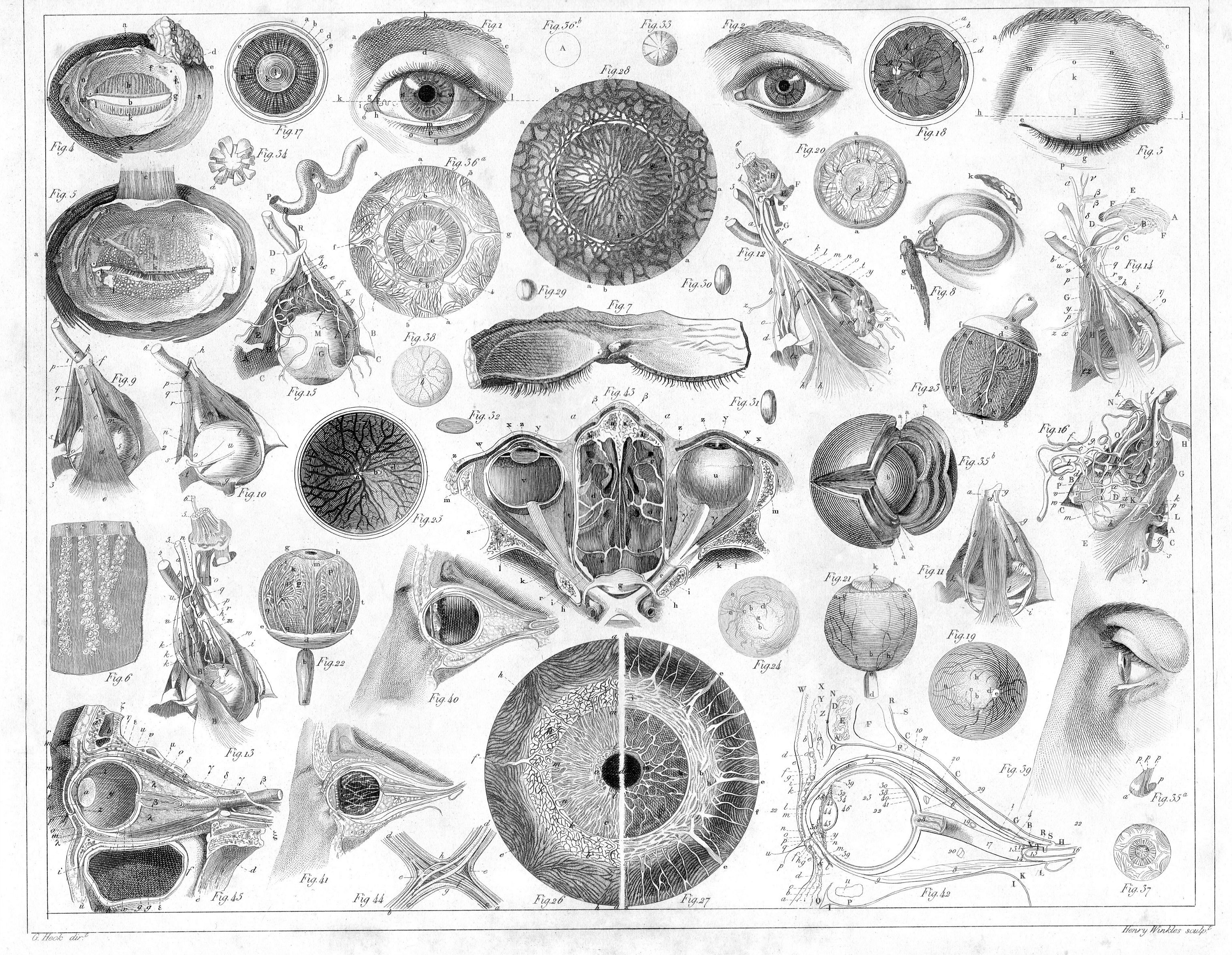
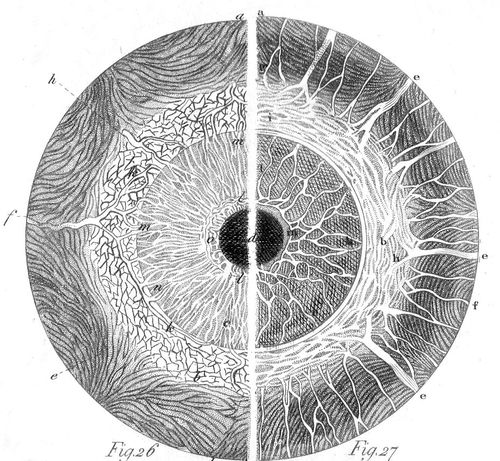
    J.G. Heck wrote and compiled a fascinating and complex work entitled The Iconographic Encyclopedia of Science, Literature and Art, which was published in the U.S. for the first time in 1851 in Spencer Baird’s translation from the German.

    EYEs _1_

    [Detail–60mm in the original.]

    The key to his work is the amount of data displayed on each of the 500 engraved plates illustrating this work and the way in which it is arranged.  The design and layout of the 30,000 items on these 500 plates was a work of genius, and for my money it is easily the best-presented complex means of the display of data and objects that was published in the 19th century.  

    The image above is from one engraved plate featuring 43 aspects of the human eye–beautifully arranged, and somehow fitting perfectly on the 9×11″ sheet of paper.  It is a work of real design engineering.  

    The image above is a detail from:

    EYe_2_

  • The Garden of Eden at the North Pole

    JF Ptak Science Books   Quick Post  Overall Post 5126

    Artic

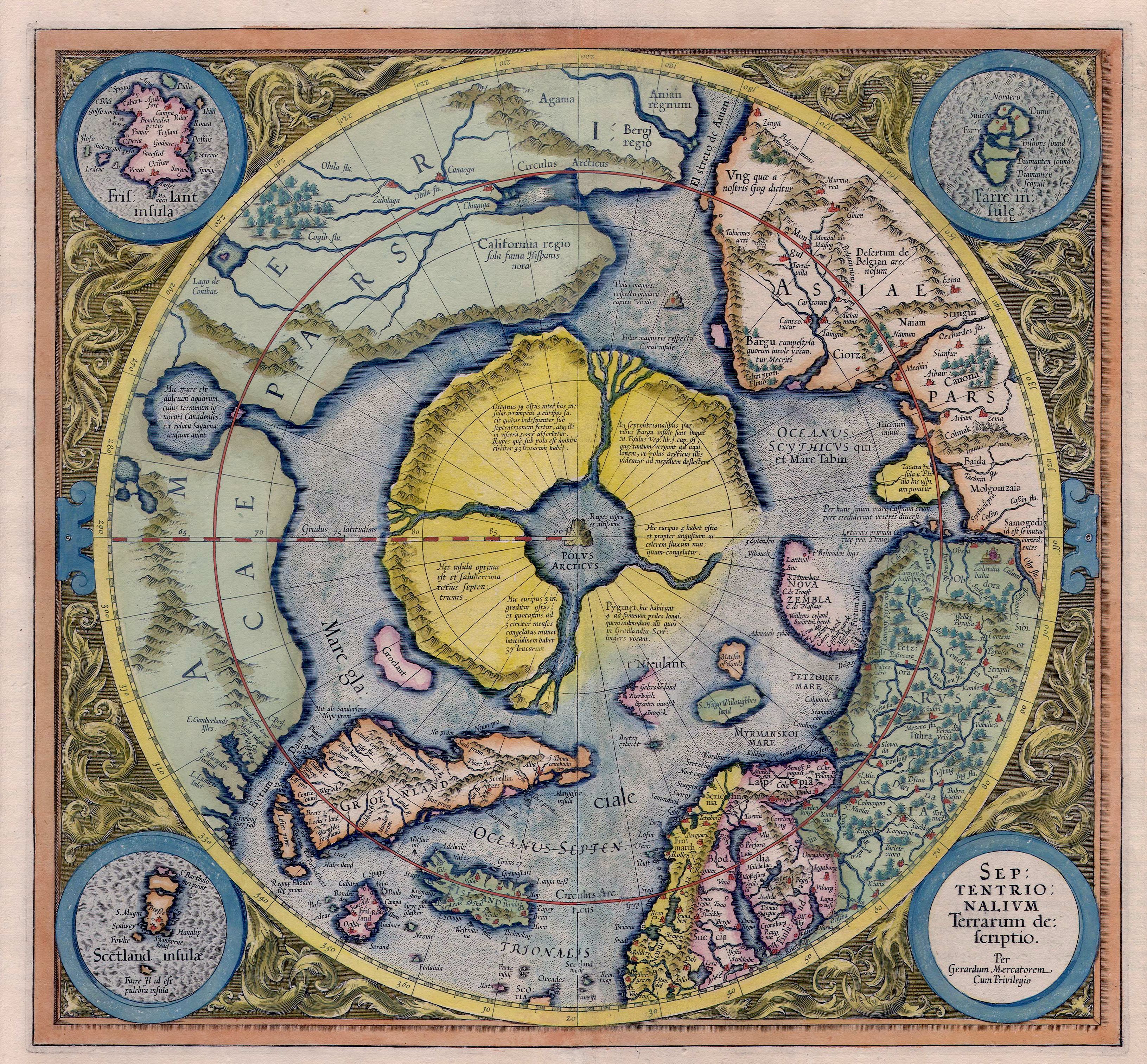
    (Gerald Mercator, 1596)

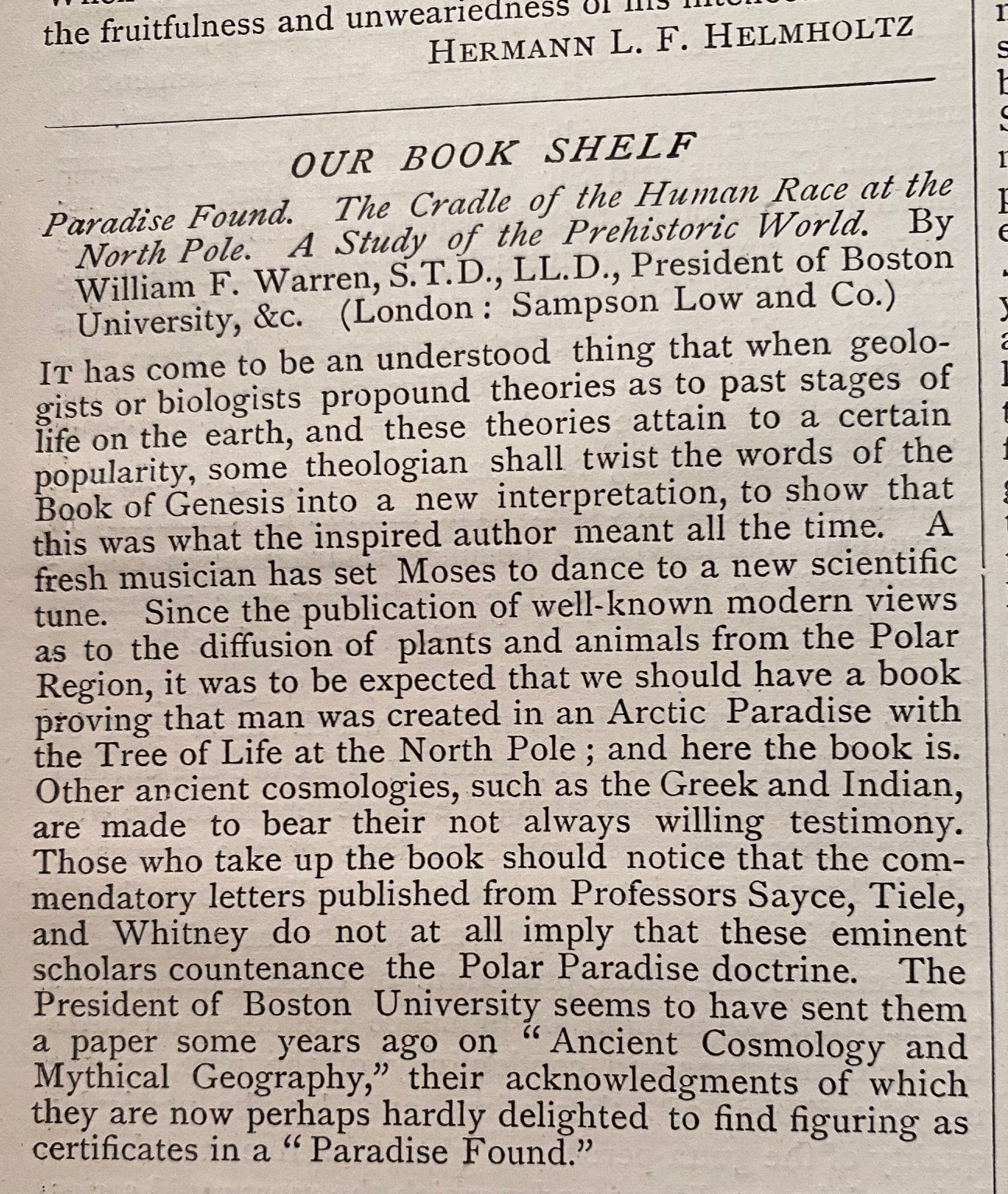
    IMG_5158This is a short, dismissive, stabbing review of a book by a theological and long-established scholar and administrator, William F. Warren (1833-1929). I remember his name from his interesting work on ancient cosmologies (1882), illustrated with examples of the history of all things according to various belief systems and religions. This quick-and-dead arrow of a review (which appeared in Nature on 14 May 1885 p, 28), was directed at his new work Paradise Found, the Cradle of the Human Race at the North Pole..., which as you can guess tries to establish the origin of humans at the North Pole, along with the Garden of Eden and the Tree of Life. And, for that matter, also establishes the Pole as the home of Mt. Maru, the Arthurian Avallon, and so on. There’s a lot that can be said but not by me—there is an attraction to hunting up other mythologies placing some part of great importance to the North Pole as the Navel of the Earth, but I just don’t have the time or inclination. As a matter of fact, I hadn’t known about this work by Warren, and I doubt I’ll know much more than what I am communicating right now—one thing the reviewer doesn’t mention is that the book runs about 500 pages, which is just too much of an investment for yours truly.

    ·Posted by :

    ·in:

    — — —
  • Found Poetry in Use of the Infinite and Imaginary in the Service of the Finite ad Real (1885)

    JF Ptak Science Books   Quick Post  Overall Post 5127
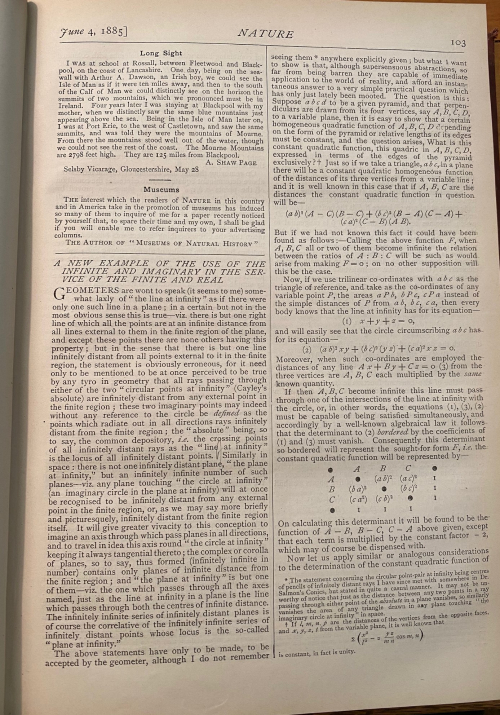
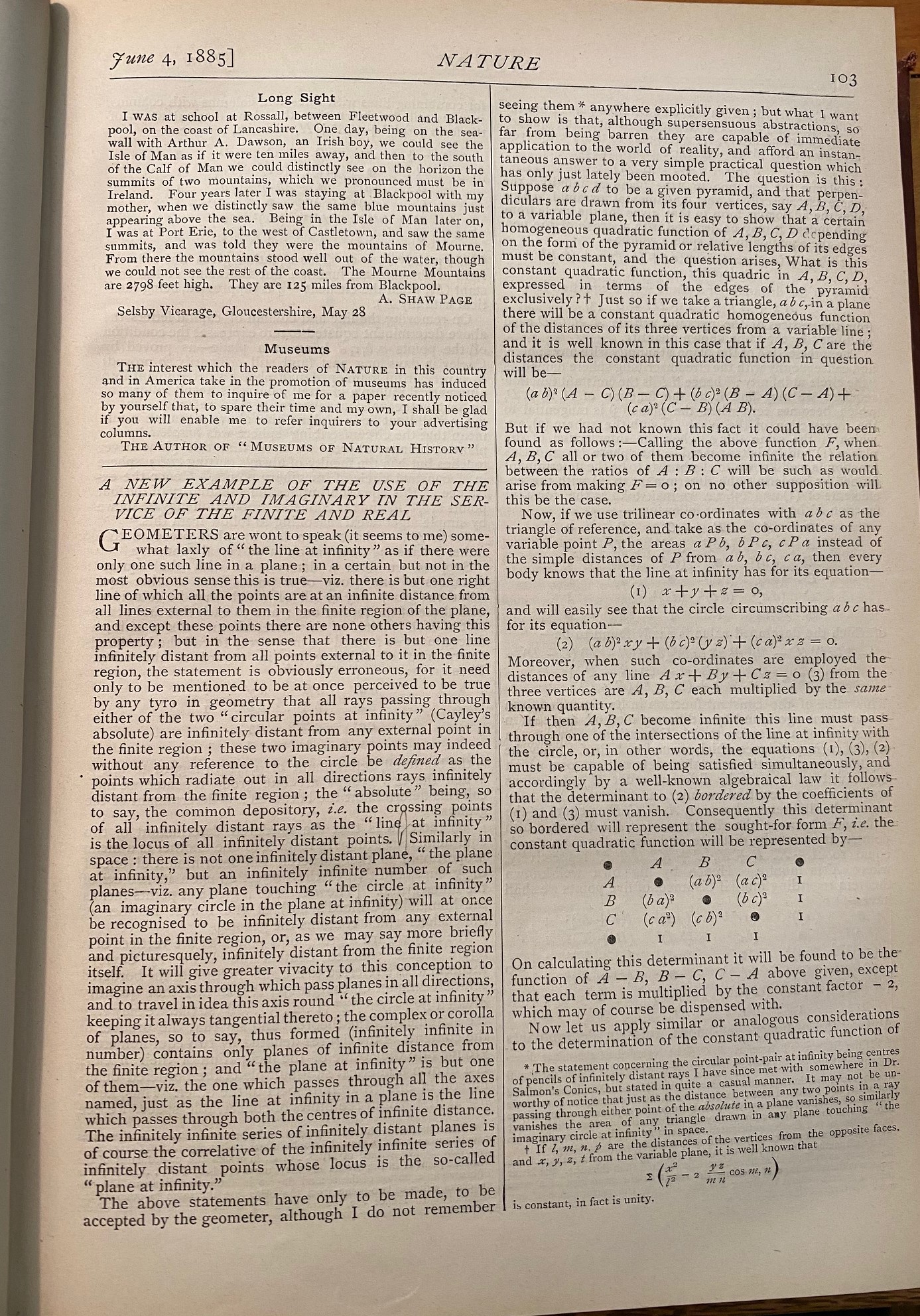
    IMG_5160Over on my blog I’ve made a number of posts on “Found Poetry”–phrases and constructions of interesting structural images that when removed from a narrative form and subjected to a different display find a sort of light art form in themselves. The phrases and sentence are in their original order—spacing and delineation have changed a bit to focus their attractiveness. There have been posts on “Found Poetry” in the (sometimes very extended) titles of Renaissance books, recipes and instructions on cooking dainty sardines, a disintegrating machine from 1877, descriptions of clouds from 1726, and well, you get the picture. “Found art is where you don’t find it”, as M. Duchamp didn’t say—sometimes the found poetry is pretty obvious, sometimes not. Today’s entry has a terrific title, though the text lets us down a little, but then closes up very strong in the last paragraph. And so, from NATURE, volume 32 number 814, 4 June 1885, by the great and prolific J.J. Sylvester,  “A New Example of the Use of the Infinite and Imaginary in the Service of the Finite ad Real”:


    “GEOMETERS are wont to speak 

    (it seems to me) somewhat laxly of ” the line at infinity ” 

    as if 

    there were only one such line in a plane; 

    in a certain but not in the most obvious sense 

    this is true —

           viz. there is but one right line of which all the points are at an infinite distance from all lines external to them in the finite region of the plan

                 and except these points there are none others having 

                        this property; but in the sense that there is but one line infinitely distant from all points external to it in the finite region, 

                               the statement is obviously erroneous, for it need only to be mentioned to be at once perceived to be true by any tyro in

                                      geometry that all rays passing through either of the two “circular points at infinity” (Cayley’s absolute) are infinitely

          distant from any external point in the finite region ; these two imaginary points may indeed without any reference

                 to the circle be defined as the points which radiate out in all directions rays infinitely distant from the finite  region…

    the “absolute” being, so to say, the common depository,

    i.e. the crossing points of all infinitely distant rays as the  “line at infinity”

    is the locus of all infinitely distant points.
    ·Posted by :

    ·in:

  • “Children Who Work on the Nation’s Crops” (1942)

    JF Ptak Science Books  Quick Post   Overall Post 5128

    IMG_5329

    This is a substantial indictment and attack on the loose laws (where they actually existed) regarding child labor in the United States, specifically regarding kids working in the fields.  If you scroll down you can see what laws were applicable to what states, and there were plenty of states that had virtually no regulations on children laboring in the fields, being part of a migratory family.  I’ve reproduced here some of the most significant bits from the pamphlet as well as all of teh photos–the photo images aren’t exactly Jacob Riis, but they’re getting there. In any event Ms. Zimand was making a very strong case and presenting an embarrassing expose on the use of child labor in the U.S. just at the beginning of the U.S. overt military involvement in WWII.  


    [Source: ZIMAND, Gertrude Folks. Children who work on the nation’s crops. New York City, National Child Labor Committee [1942] [National Child Labor Committee. Publication no. 384., 9″x 6″, 19pp. Photo illustrations.]


    IMG_5331

  • Your Daily Dirigible (1913)

    JF Ptak Science Books  Quick Post  Overall Post 5129

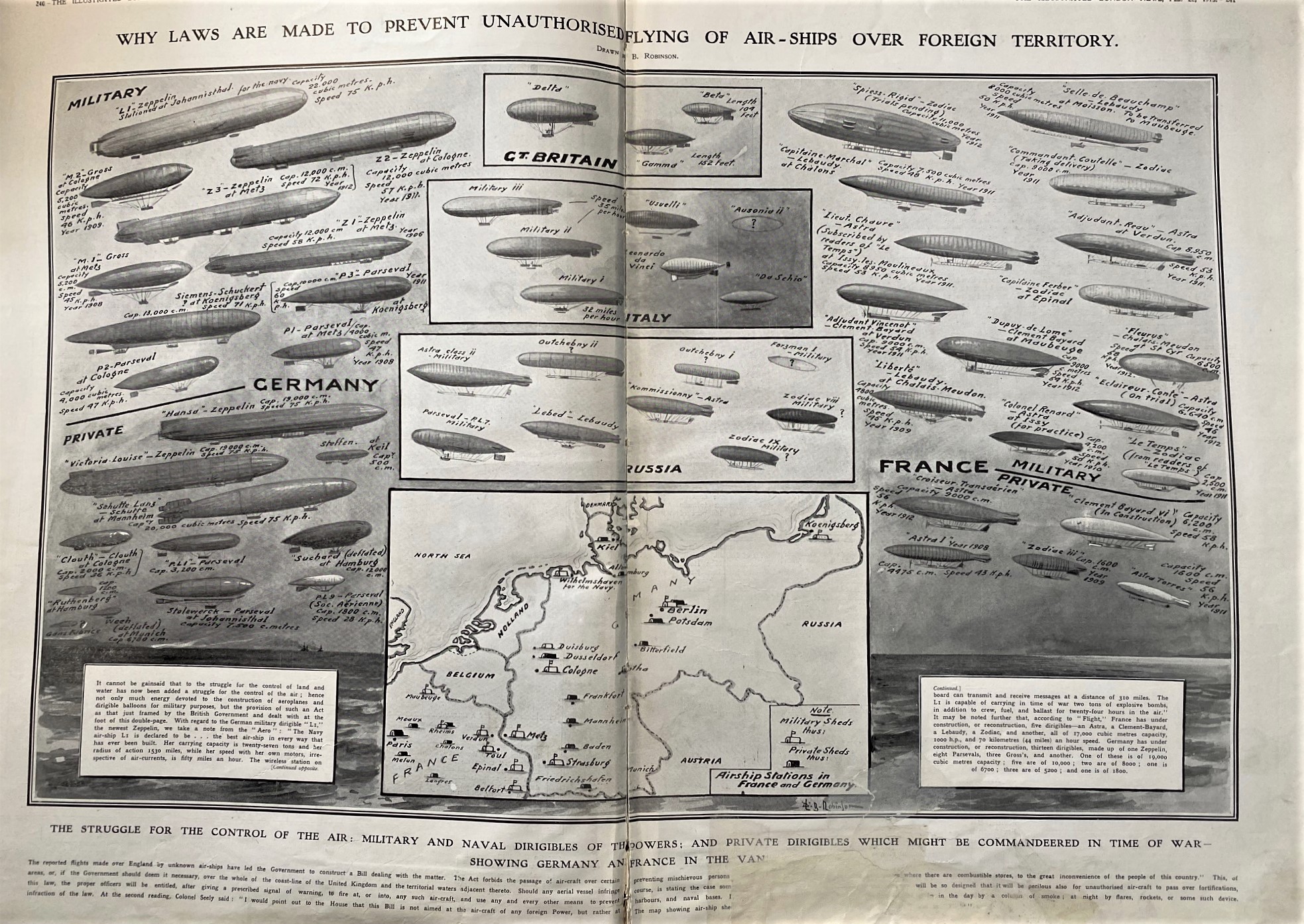
    Well, no, this is not really a “daily” dose of dirigibles, though it is a nice display of the airships. This double-page display is found in the Illustrated London News  from 22 February 1913, illustrating a short article addressing the need for legal reform in the flight of dirigibles, particularly in regards to the airships being used in possible combat.  WWI wasn’t far off at this point, and the ILN takes its readers on a quick tour of who-had-what in regards to the airships, depicting German and French airships and aerodromes. If you click on the images and then click again you’ll see that there is info on individual airships as well.  

    Click to Expand


    IMG_3862

    Details follow:

  • An Eviscerating Review of “The Last Attack on Darwinism” (1872)

    JF Ptak Science Books   Overall Post 5130

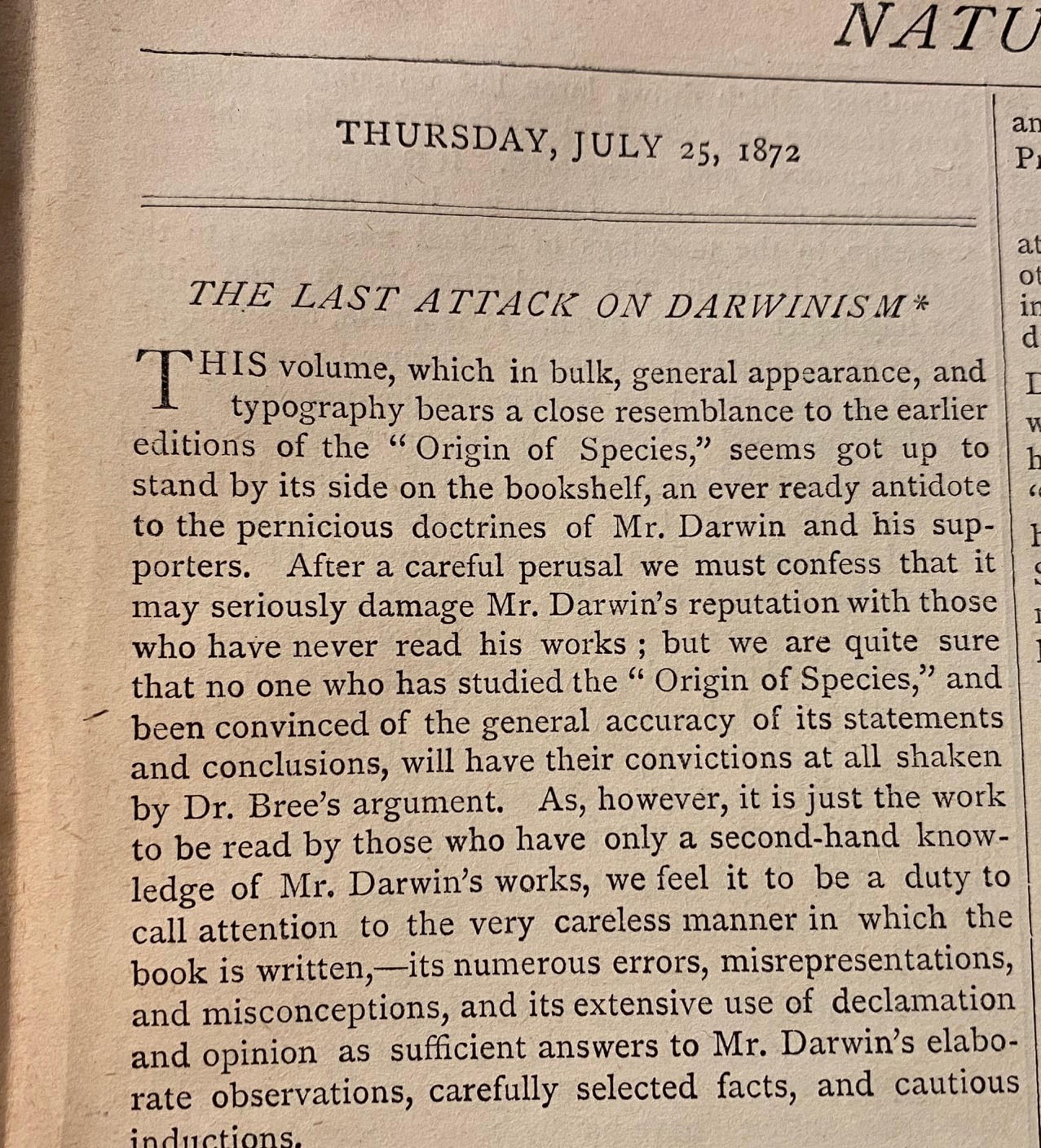
    There are many hopeful headings that appear in the fantastically-readable journal Nature (especially in the 19th century), and this one–“The Last Attack on Darwinism”–is certainly one of them. It was written for the 25 July 1872 issue by Alfred Russell Wallace in 1872 in response to Dr. Charles R. Bree’s1 An Exposition of Fallacies in the Hypothesis of Mr. Darwin, and it pretty much eviscerates Dr. Bree’s attack.  No doubt this title can be read two ways–one meaning the most recent attack on Darwinism, and the other meaning the final attack.  I suspect Wallace hoped that this would be the last such thing he’d have to read or review, but being a thinking man he probably felt that no mater what proof and evidence was established for evolution there would always be someone/group/society that would argue their belief over the science, and so on into the future the debate would go.  In any event, I’ve reproduced the first and last paragraphs of the Wallace review. Also there’s a further quotation on Bree from The Lancet as an example of the many scathing reviews Bree’s book received.  The reviews are surgical and denunciating, though from what I’ve read they do not reach the high/low level of book reviews by Poe, whose book reviews read as though he read the work with a sledge-scalpel. 


    IMG_4244

    And the last short paragraph from Wallace: “In conclusion, I must again repeat that the only reason for devoting so much space to a book so little worthy of its title or its author, is the wish to warn such as are not well acquainted with Mr. Darwin’s works from implicitly relying either on Dr. Bree’s facts and arguments, or on the accuracy of his representation of those of Mr. Darwin and his supporters.”

    Now a snippet from one of many such reviews that greeted Dr. Bree’s work, this from The Lancet (volume 2 1872):

    “This book is the production of an uncompromising opponent of the Darwinian hypothesis. Dr. Bree can see no good in it at all, but hews away at it root and branch…The position taken up by Dr. Bree would, it appears to put a stop to all investigation of nature, for he contends that it is beyond the limits of human reason to furnish any sound explanation of the modus operandi of God in creation.” And: “Upon the whole, we should scarcely expect to find Dr. Bree’s work exercise much influence in staying the progress of  the new opinions, or do more than satisfy those who have already made up their minds against them.” 

    Notes:

    1. Charles R. Bree (1811-1886). An Exposition of Fallacies in the Hypothesis of Mr. Darwin. London: Longmans, Green, and Co., 1872. 8vo., 418 pp. + 32 pp.(publisher’s list).

  • A New Category: Techno-Naive Art (1924)

    JF Ptak Science Books  Quick Post  Overall Post 5131

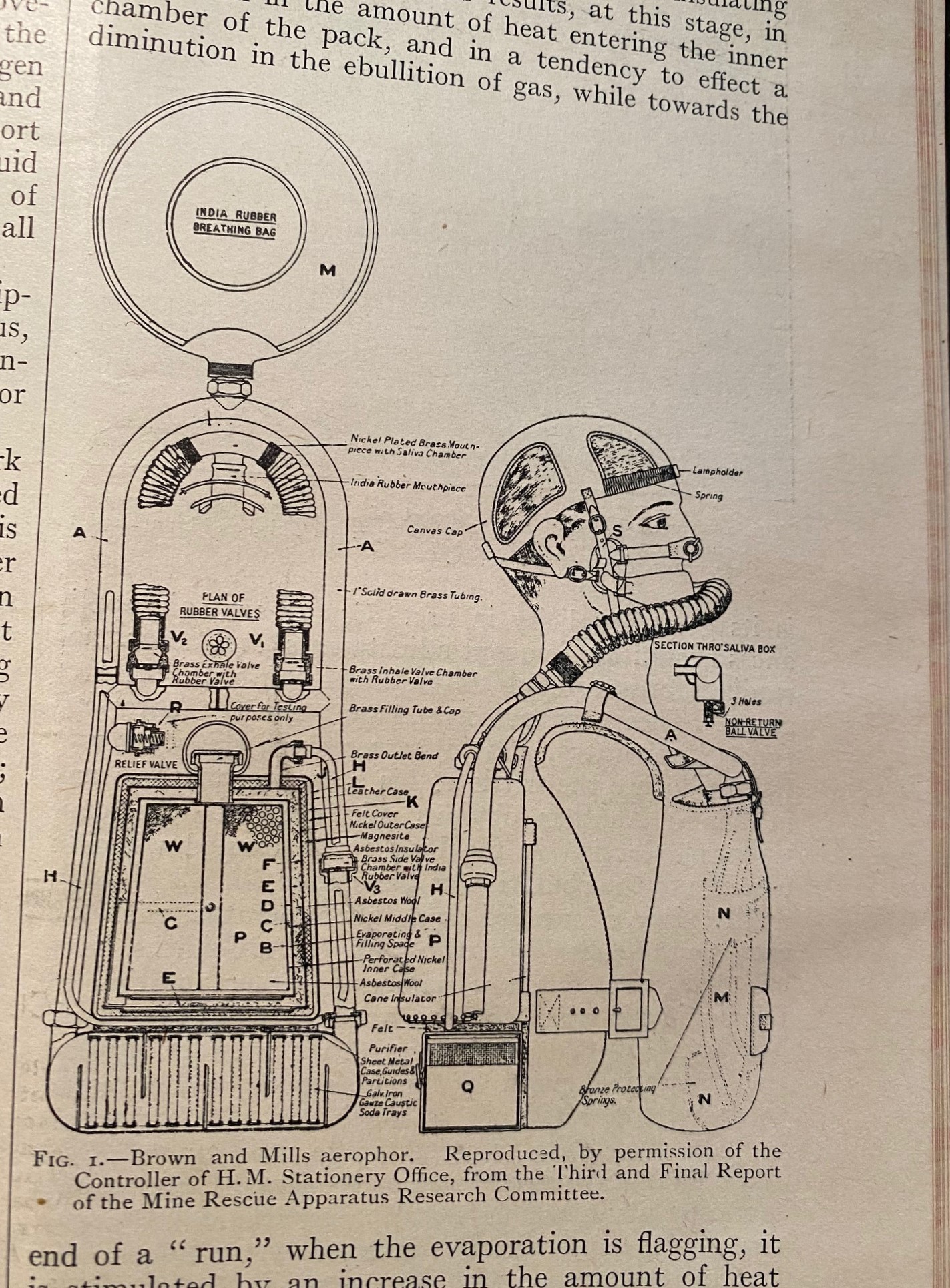
    IMG_4792What a fantastic drawing! I don’t mean to diminish this invention at all, though I must say that I was attracted to the article for the very 1950’s comic book naive and technical (Techno-Naive!) quality of the illustration.  Maybe it is just the subject’s profile that has thrown me into this new spin. 

    That said, this invention was conceived for the rescue of miners and for oxygen-deprived mining, and is known as the Brown & Mills Aerophor, which was “a liquid air respirator for mine work and rescue”.  I found this in the pages of Nature, 11 October 1924, p. 543.

    Brown and Mills evidently worked and improved an earlier idea and design by Col. Cuthbert Blackett (1910), which this citation from Wikipedia: “The Blackett’s Aerophor is a nitrox semi-closed-circuit rebreather with liquid gas storage made in England from 1910 onwards for use in mine rescue and other industrial uses. It was used until the 1950s. “Aerophor” is from Greek αεροφορος = “air-carrier”. Its breathing bag was on the chest, of rubber, in a strong leather case. The other parts were in a backpack. It had two corrugated breathing tubes coming out of the backpack. Its duration on a fill was 2 hours. “


  • On the Other Side of Things: Title Pages

    JF Ptak Science Books  Quick Post  Overall Post 5132

    There’s a certain beauty to be found in odd places in books and paintings.  

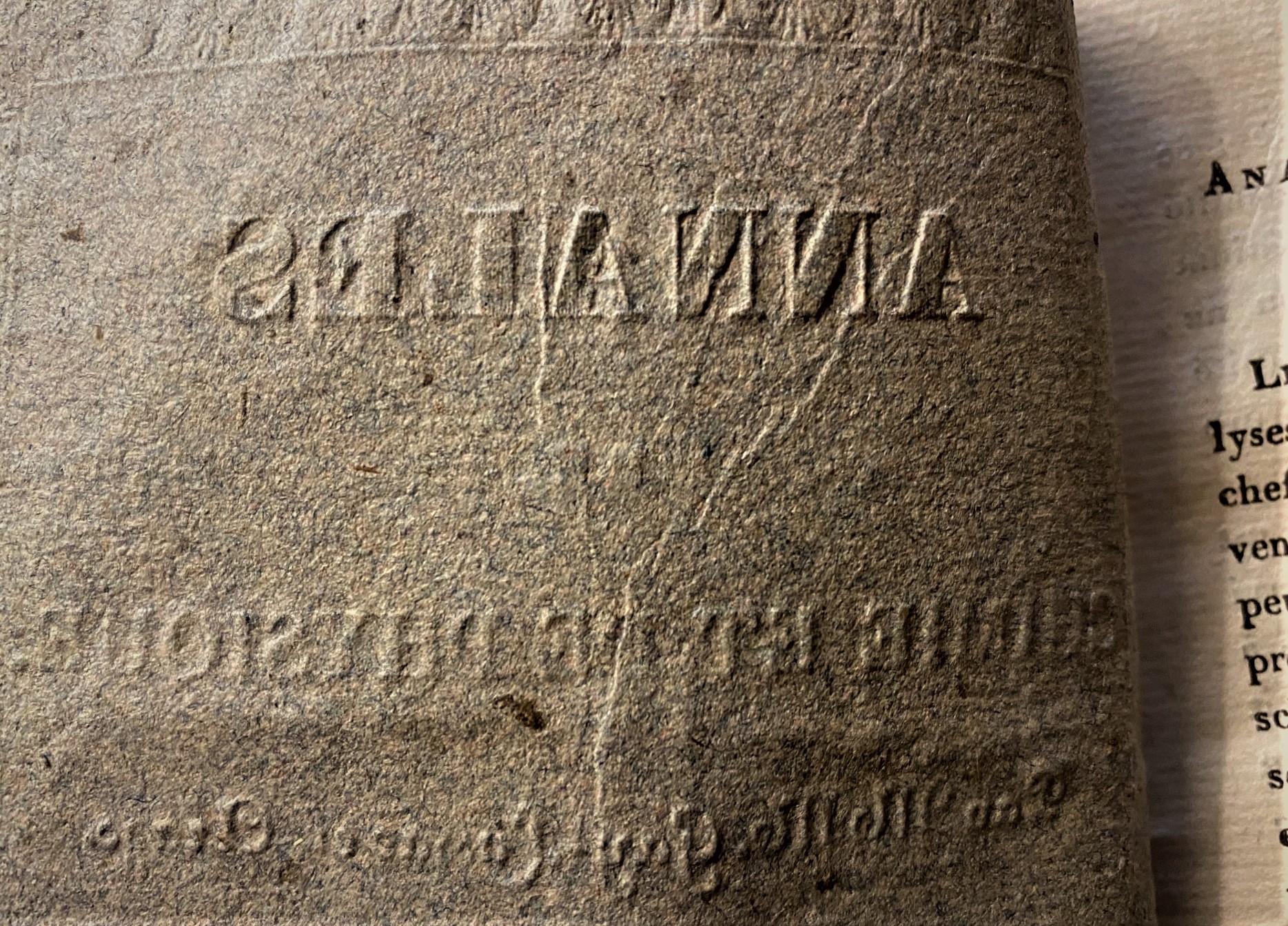
    This is not just looking at the reverse of a title page–this is about finding a little bit of 3-D relief on the back of a 2-D obverse.  Perhaps the printer got a little overly excited or was just starting the day when he compressed the sheet of paper over the set type back there in the late Parisian spring of 1825.  

    Whatever the case was, it didn’t last long, and there were very few other cases of this except here and there, spread throughout the issue–no doubt because he was printing four or 16 or whatever-number of pages per sheet which were then folded and gathered into order before their edges were cut. 

    Source: Annales de Chimie et de Physique, edited by Arago and Gay-Lussac (volume XXIX, June 1825), published in Paris by Crochard.  

    IMG_2921

  • If the Borg Skipped Around in a 3-Trillion-Ton Cube of Coal…(1913)

    JF Ptak Science Books  Quick Post   Overall Post 5133

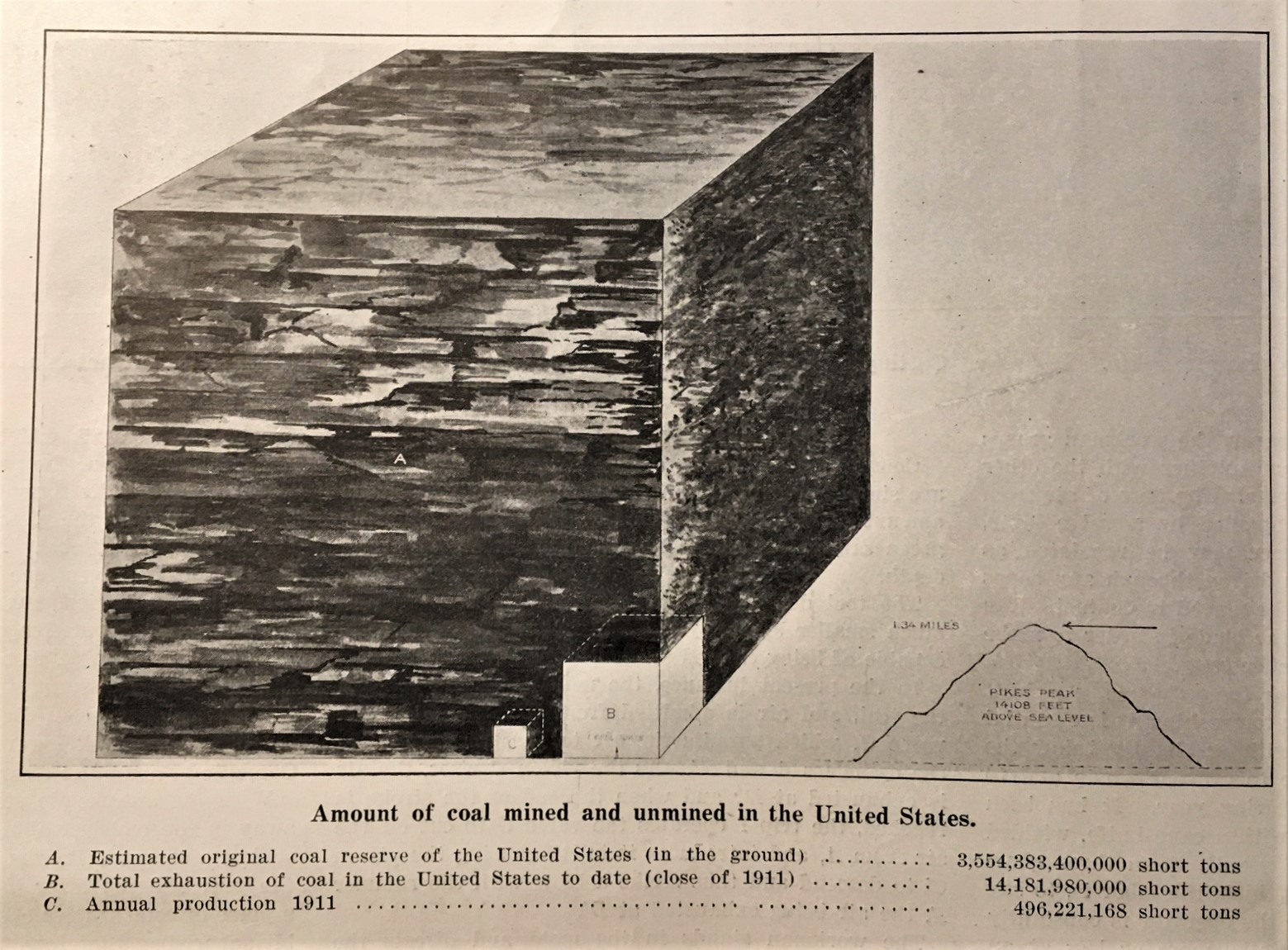
    This is an arresting and somewhat intimidating (1913) image1–a gigantic Borg-like cube of all of the Earth’s coal. It was made to show the vastness of the U.S. coal reserves, and that no matter how much was burned, that there was an absolutely overwhelming quantity still remaining.  The larger of the two cubes at the bottom of the Megacube indicates the amount of coal extracted and used through the course of human activity in what would become the United States, and the block to its left is total production for the year 1913. The thing is that the current numbers pretty must jibe with those of 1913, or at least they do in scale.  The total coal reserve now stands at 254 billion short tons compared to 3.5 trillion in 1913, while the extraction in 20192 was 728 million compared to about 500 million in 1913.  Overall there’s a much wider population and usage base for coal now than in 1913 by about 45%, meaning there’s much less demand for coal as an energy source. I don’t know offhand about the discrepancy between the original 1913 figure for total reserves now might but I’m pretty sure that we didn’t gobble up 3 trillion tons of the stuff.  Probably it was just an inaccurate guesstimate, as we’d have to had used 30 billion tons of coal every year for 100 years to account for the difference of reserve and extraction.  Anyway, it is a great image and artistic display of quantitative data.  

    Notes:

    1. R.H. Byrd “Fuel Production in the Unites States, Present Consumption and Future Supply” July 5, 1913, Scientific American, page 10.  

    2. Current data pulled from US EIA and Statistical Review of World Energy (British Petroleum) websites. 


    IMG_2289

  • “A Physicist and Later a Housewife” (1896)

    JF Ptak Science Books   Quick Post   Overall Post # 5134

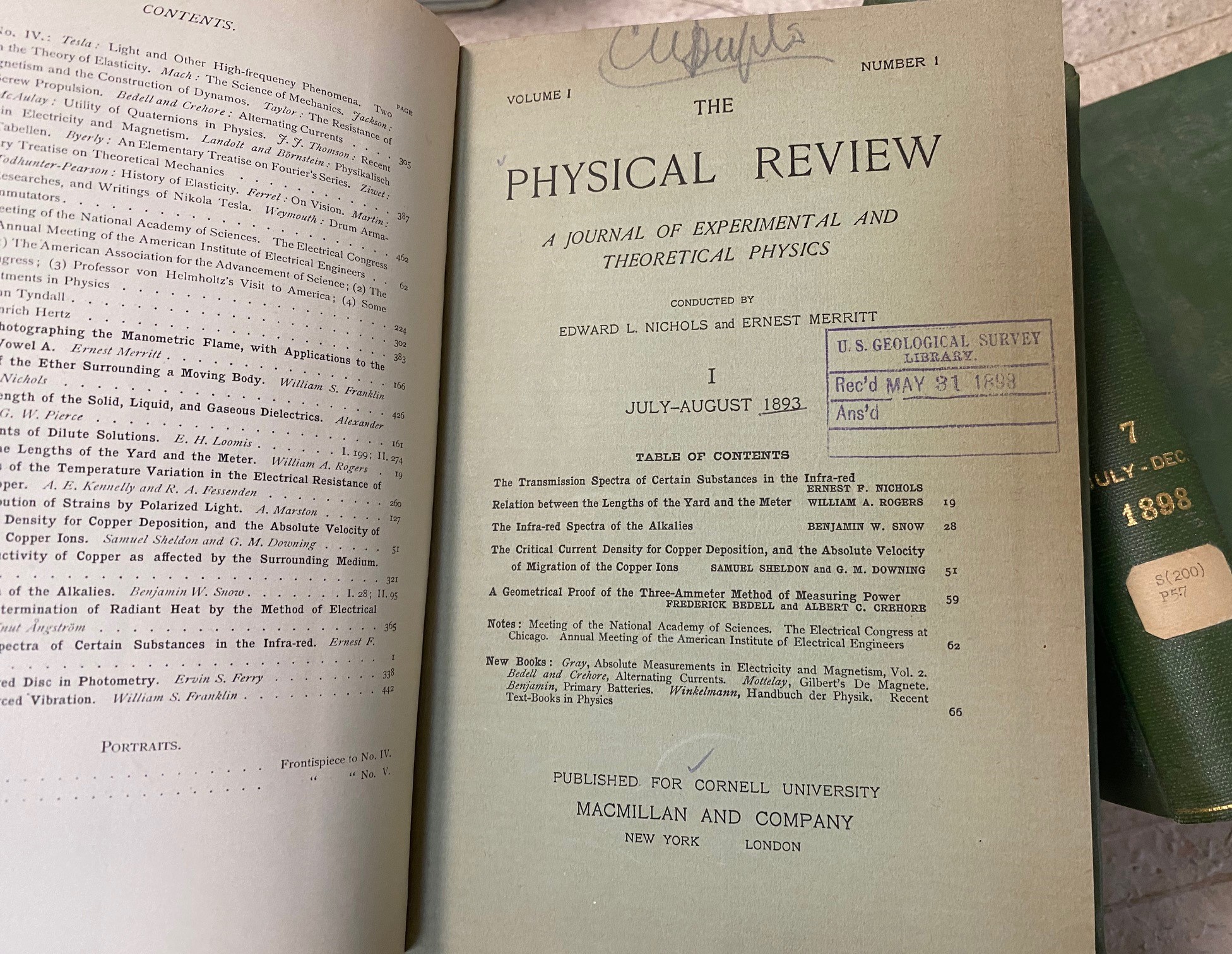
    Paging through some of the first half dozen or so volumes of the iconic Physical Review, I bumped into a paper1 by Caroline Willard Baldwin (“A Photographic Study of Arc Spectra. I” (and II)–and what stopped me was the “Caroline” part as the date of publication was 1896.  I did not expect to see this entry, and after going back to check the other two preceding volumes it can be said that this was the first paper published by a woman in the Physical Review. This may be common knowledge but it wasn’t to me–frankly I was a little surprised that the paper appeared this early on in the life of the journal. After a little research in some scant mentions I found that Baldwin (1869-1928) was the first woman to receive a doctorate in physics/Sc.D. from a U.S. university, and so far as I can see this was her only published paper. Baldwin had one other publication—a physics/mechanics textbook written with George Arthur Merrill–which was the end of her publishing career. She taught physics at the California School of Mechanical Arts in San Francisco, and then married in 1900, which ended her career, evidently, because there’s nothing more on her that I can find except for a few refences for her being “a physicist and later a housewife”, which caused quite a sad sigh. There is nothing wrong or demeaning or lessening in being a housewife, or graduating from being a physicist to being a housewife (or househusband for that matter), except there are all of those “firsts” next to her name…It seems as though she went as far as she could go in academic advancement despite her history and doctorate, having a position “…teaching physics at the California School of Mechanical Arts, a vocational secondary school in San Francisco associated with UC Berkeley”.2 Once married–and then married with children–her fate in physics was sealed.

    Notes:

    1. Caroline Willard Baldwin (1869-1928)  “A Photographic Study of Arc Spectra. I” and “A Photographic Study of Arc Spectra. II”, in  Physical Review, Series 1, volume 3, published 1 March  and 1 April 1896.
    2. +3. “Equipped with a doctorate, Baldwin nonetheless taught physics at the California School of Mechanical Arts, a vocational secondary school in San Francisco associated with UC Berkeley.  Baldwin’s status as a married woman with two children, similar to that of other Berkeley women graduates in STEM of her era,  would have been an obstacle to a position in higher education.”  Berkeley Mechanical Engineering, website, “Caroline Willard Baldwin” entry. 

    ·Posted by :

    ·in:

  • Found Graphic Novel Art in (of all places!) the Annalen der Physik (1885)

    JF Ptak Science Books  Quick Post  Overall Post 5135

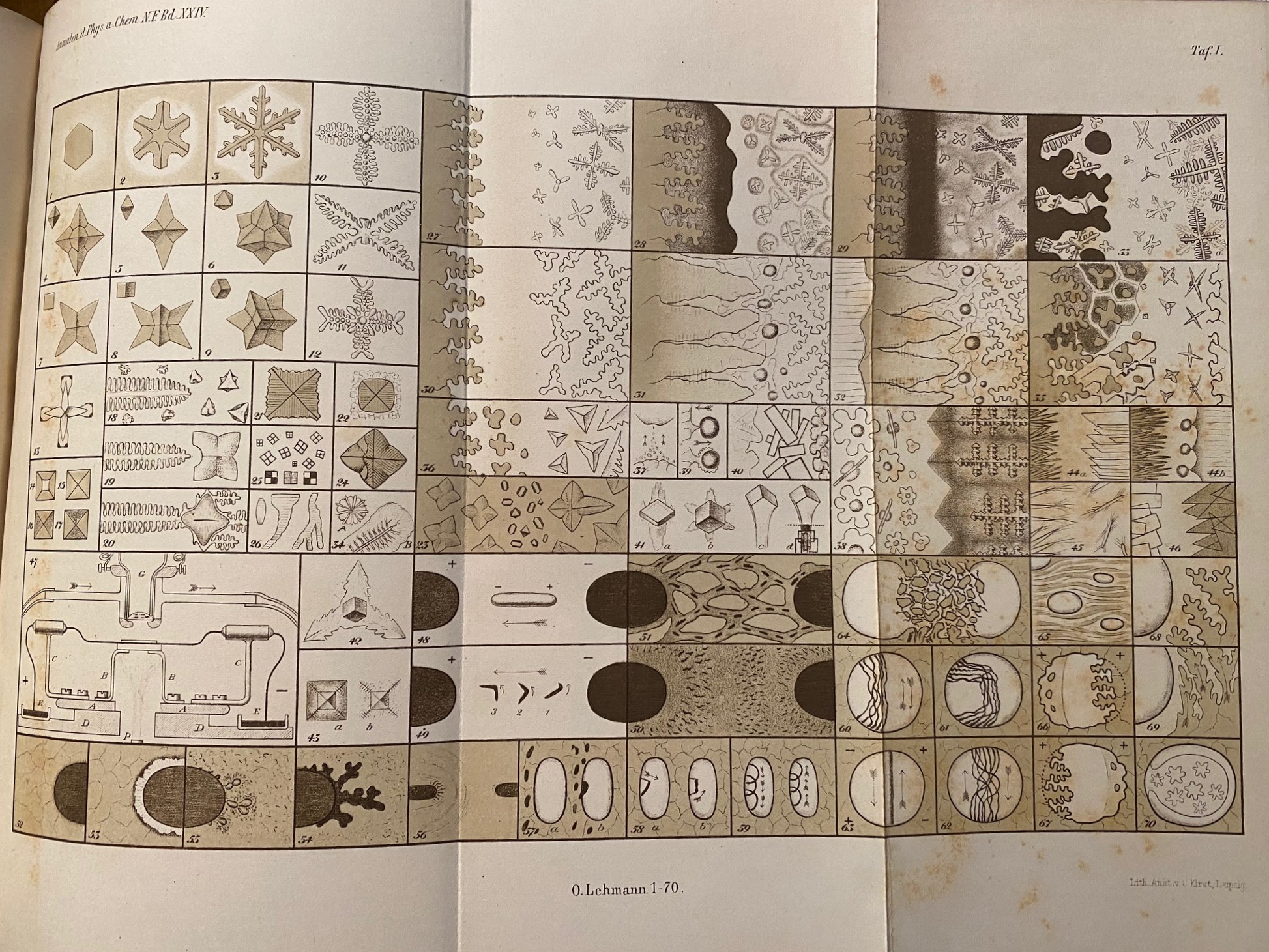
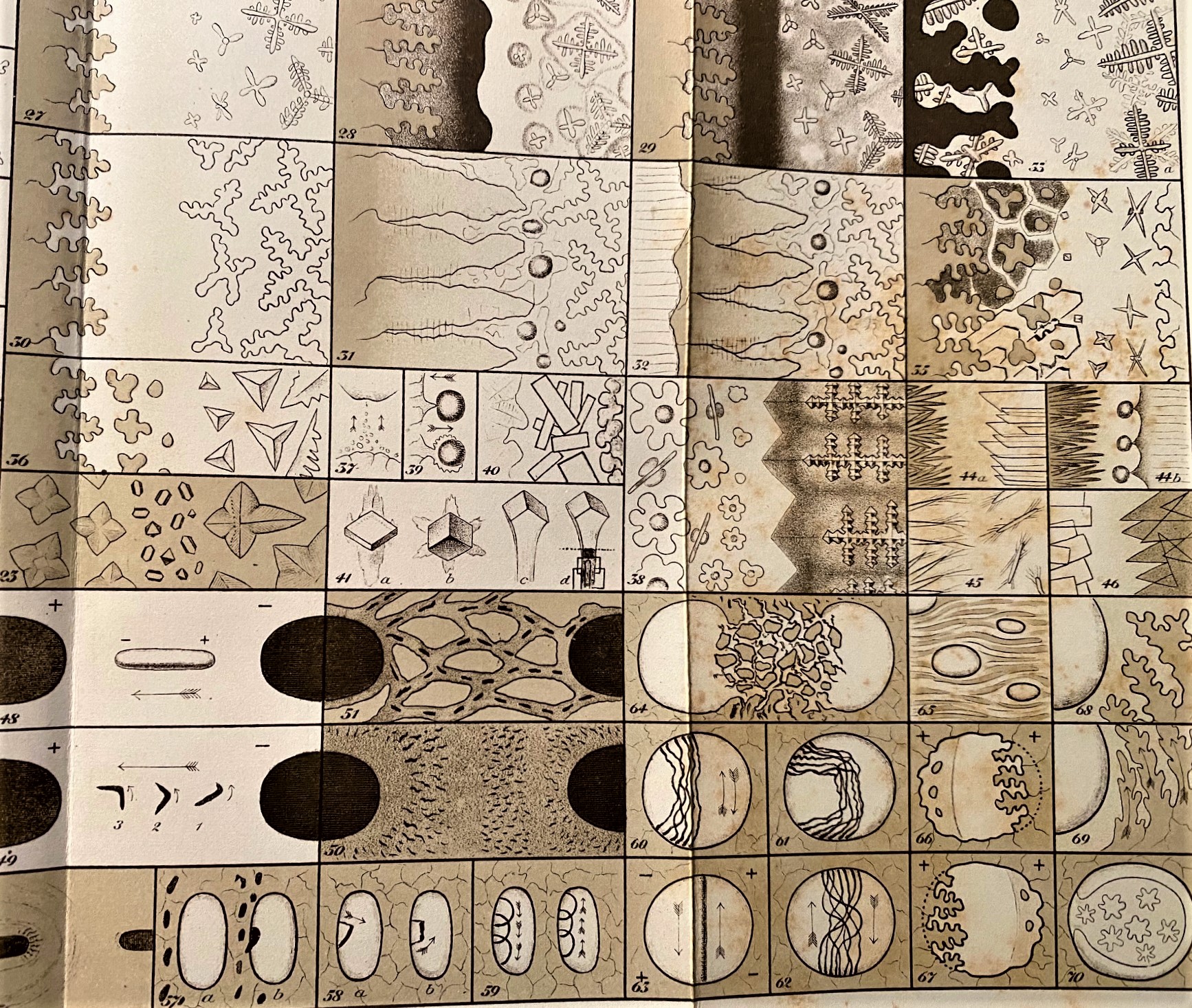
    There are some sub-categories on this 2-million (!?) word blog presented in the vernacular of FOUND items, like FOUND Poetry, or FOUND Science Art, or FOUND Outsider art, or TechnoNaive, and so on. The “Found” prefix simply notices that there is an appreciation of something beyond the use for which it was intended, being removed from context bringing on a new life/meaning for whatever it was that was “Found”. I guess that there are a few dozen of these posts, like “Found Poetry in Lost Plankton”(1872), “Euphonium: Found-Poetry of Recorded Soundwaves” (1897), and “Found-Poetry in a Technical Work on Bubbles” (1896), where by simply poetizing the structure of some of the text the piece can read like a bit of poetry…sometimes this is a bit strangled, but the point comes through.

    Tonight’s Found bit is in the art field, and located in the great physics journal, the Annalen der Physik. There are some other instances of Found Art in the Annalen (these can be found by searching “Found” and “Annalen” in this blog’s Google box), but this is the first time I’ve ever found Found Graphic Novel Art—for all the world this looks to me like a very orderly story board for something like the brilliant Chris Ware’s work. It is a highly unusual de-abstraction abstract when removed from the original context, and I really do like it.

    Source: “Ueber den Schmelspunkt in contact befindlicher Korper und die Electrolyse des festen Jodsilbers” Annalen der Physik, series III, vol 24, 1885.

    IMG_5172

    IMG_5178


    ·Posted by :

    ·in:

Recent Posts

Archives

Categories