A Daily History of Holes, Dots, Lines, Science, History, Math, Physics, Art, the Unintentional Absurd, Architecture, Maps, Data Visualization, Blank and Missing Things, and so on. |1.6 million words, 7500 images, 4.9 million hits| Press & appearances in The Times, Le Figaro, Mensa, The Economist, The Guardian, Discovery News, Slate, Le Monde, Sci American Blogs, Le Pont, and many other places… 5000+ total posts since 2008.

  • Nabokov in Black & White

    JF Ptak Science Books  Quick Post
    Nabokov VN


    The odd thing about seeing Vladimir Nabokov in black & white is that he had such an enormous relationship with color, though perhaps the man had the capacity to add color where it wasn’t and then interpret the missing colors as they should or could before passing them on through his synesthesia machine. In any event, I just wanted to post this picture and share–this is an original of some sort (large, at 11×14″) and though I must say I don’t know all that much about him this image seems to be an uncommon one…or at least I don’t recall seeing it before:
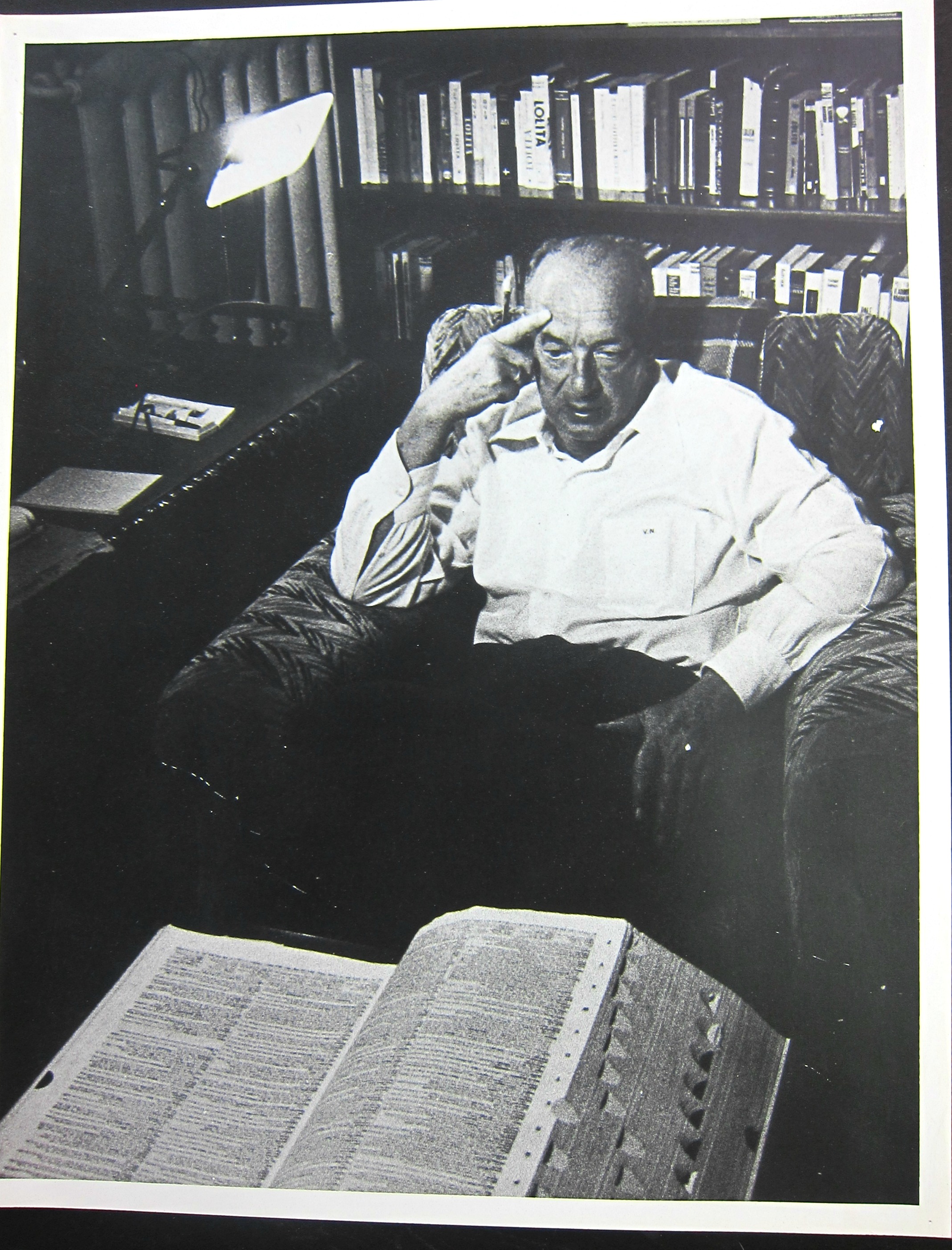
    Nabokov photo

    I can’t make out what page the 2nd Webster’s is open to, but it really doesn’t matter.  It is interesting to see his collection of Lolita in the background: 
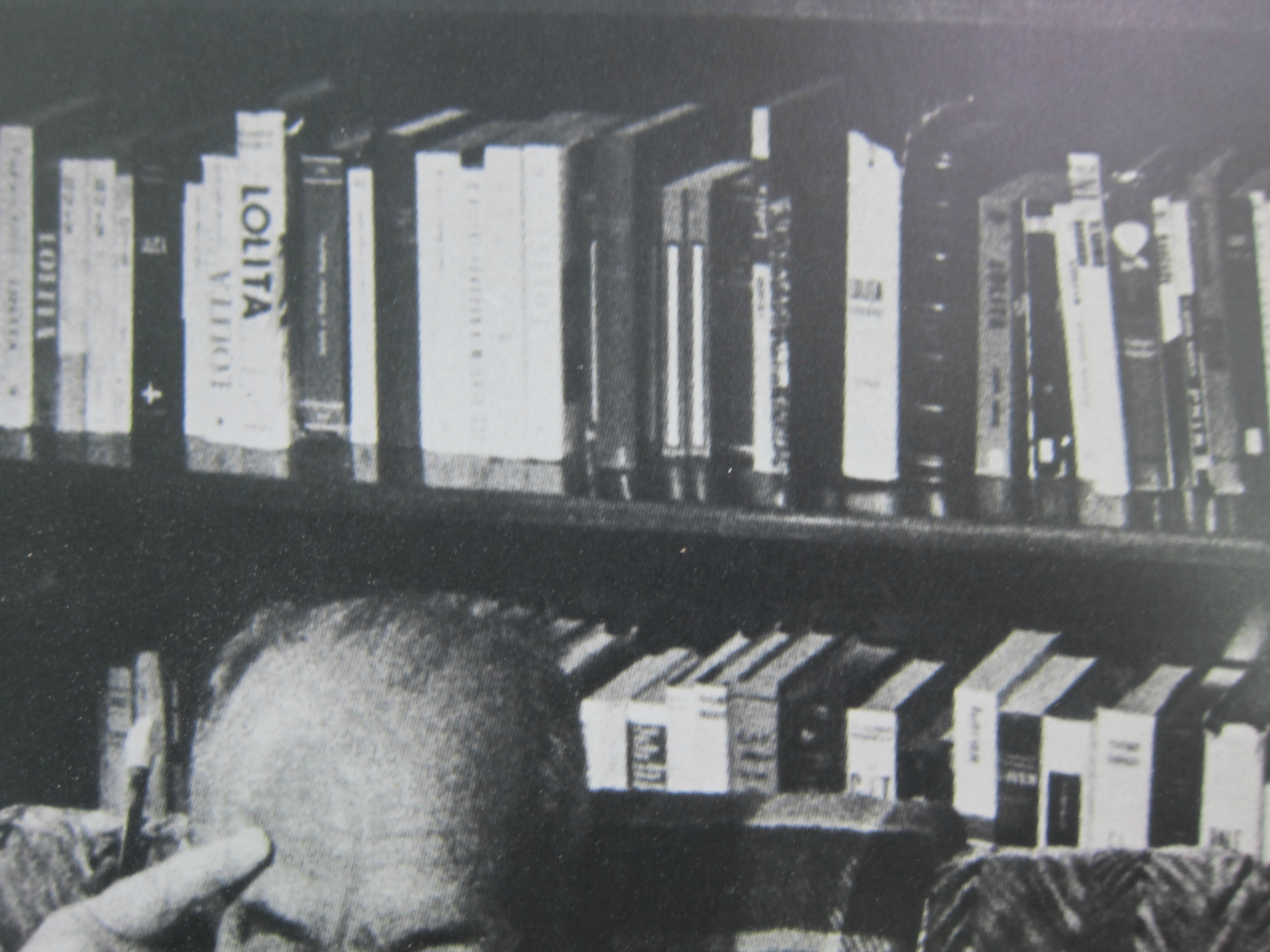
    Nabokov detail


    In any event, here’s a bit from Speak, Memory, in which Nabokov describes aspects of his synesthesia with color and sound (the quote found originally on the Fury Factory blog, here: https://furyfactory.wordpress.com/2011/06/15/nabokov/):

    “…I present a fine case of colored hearing. Perhaps “hearing” is not quite accurate, since the color sensations seem to be produced by the very act of my orally forming a given letter while I imagine its outline. The long a of the English alphabet (and it is this alphabet I have in mind farther on unless otherwise stated) has for me the tint of weathered wood, but the French a evokes polished ebony. This black group also includes hard g (vulcanized rubber) and r (a sooty rag being ripped). Oatmeal n, noodle-limp l, and the ivory-backed hand mirror ofo take care of the whites. I am puzzled by my French on which I see as the brimming tension-surface of alcohol in a small glass. Passing on to the blue group, there is steely x, thundercloud z, and hucklberry k. Since a subtle interaction exists between sound and shape, I see q as browner than k, while s is not the light blue of c, but a curious mixture of azure and mother-of-pearl. Adjacent tints do not merge, and dipthongs do not have special colors unless represented by a single character in some other language (thus the fluffy-gray, three-stemmed Russian letter that stands for sh, a letter as old as the rushes of the Nile, influences its English representation).

    ·Posted by :

    ·in:

  • “Indian Title Extinguished”

    JF Ptak Science Books  Quick Post

    Indian title has been extinguished711

    That’s part of a short (12pp) and stiff little report from President James Monroe asking if Indians of all sorts did indeed have title to their lands within the United States, which means, I guess, that this was really a question in 1822.  Given the number of treaties and the number of treaties with the Indian Nations abrogated and annulled, it still didn’t set me up for this basic question, which really surprised me.  The publication comes a few years after the end of the first Seminole War (1816 or so to 1819), the aim of which was to move the Seminoles from north Florida (Florida having just been ceded to the U.S. a few years earlier) to, well, somewhere else–this occurred in 1819, when the Indians succumbed and were forced to live in central-ish Florida. This didn’t last for long, though, as the Second Seminole War (a much more expanded conflict fought 1835-1842) decimated the Seminole population, the remaining people subsequently were removed from central Florida completely away to Indian Territory.  This was all before the official “removal policies” begun under Monroe and John C. Calhoun (and many others), something that people like Ben Franklin and George Washington were against back in their late days.  

    Indian title has been extinguished712

    The answer seems to be that the question was too big for an answer. and that each treaty had to be treated individually–in short to me it reads like a null response.  

  • Underground Military Airbases, 1938

    JF Ptak Science Books  Quick Post

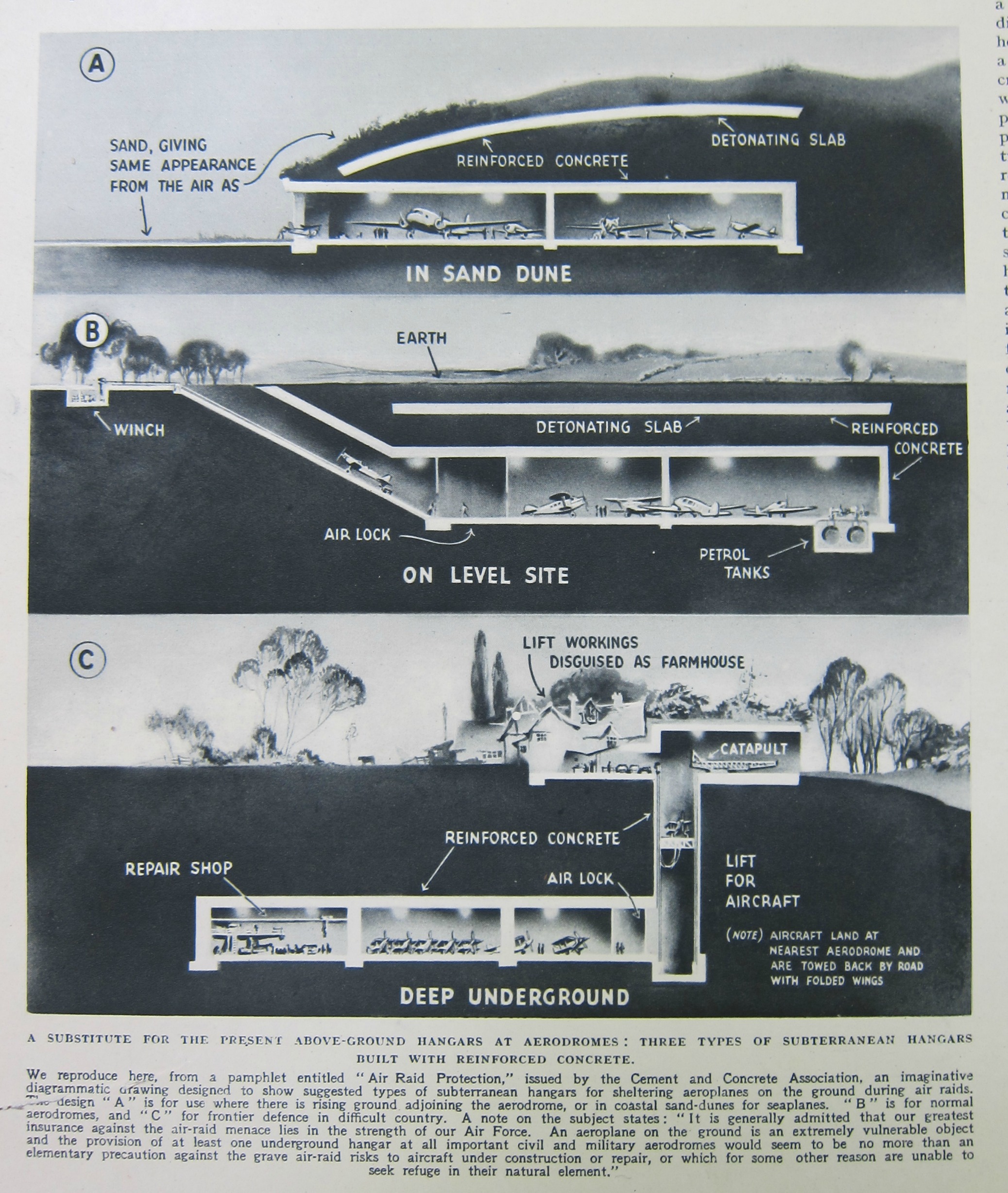
    The Cement and Concrete Association of Great Britain had issued several pamphlets in 1938 regarding air raid shelters for the protection of individual families, groups, and  cities.  In the pages of the Illustrated London News, writer and war correspondent John Langdo-Davies (1897-1971) reviews (or at least shares) the associations plans for underground fortified military airfields, the illustration for which I reproduce below:

    AIrport undergrouned 1938

    Langdon-Davies saw utility in these ideas, no doubt tempered by his experience covering the Spanish Civil War, which saw the first modern wide-scale use of bombing from aircraft, including the work done by the German Luftwaffe the impact of which was not lost on too many people. In any event, the aviation facilities were not moved underground for a variety of general reasons, some of which have to do with the utility of  the vast scale of the operation versus the introduction of replacement aircraft.  This doesn’t address some of the most adventurous ideas shown in the drawings, like the (assumed to be) very large hangar “deep underground”, the planes hauled up and shot into the air on a catapult, which is a different matter entirely.  The overall interest here though is the recognition–growing in 1938–that there is something going on in Germany that requires this sort of response.  

  • Hardware Store Hieroglyphs 1869

    JF Ptak Science Books  Quick Pos

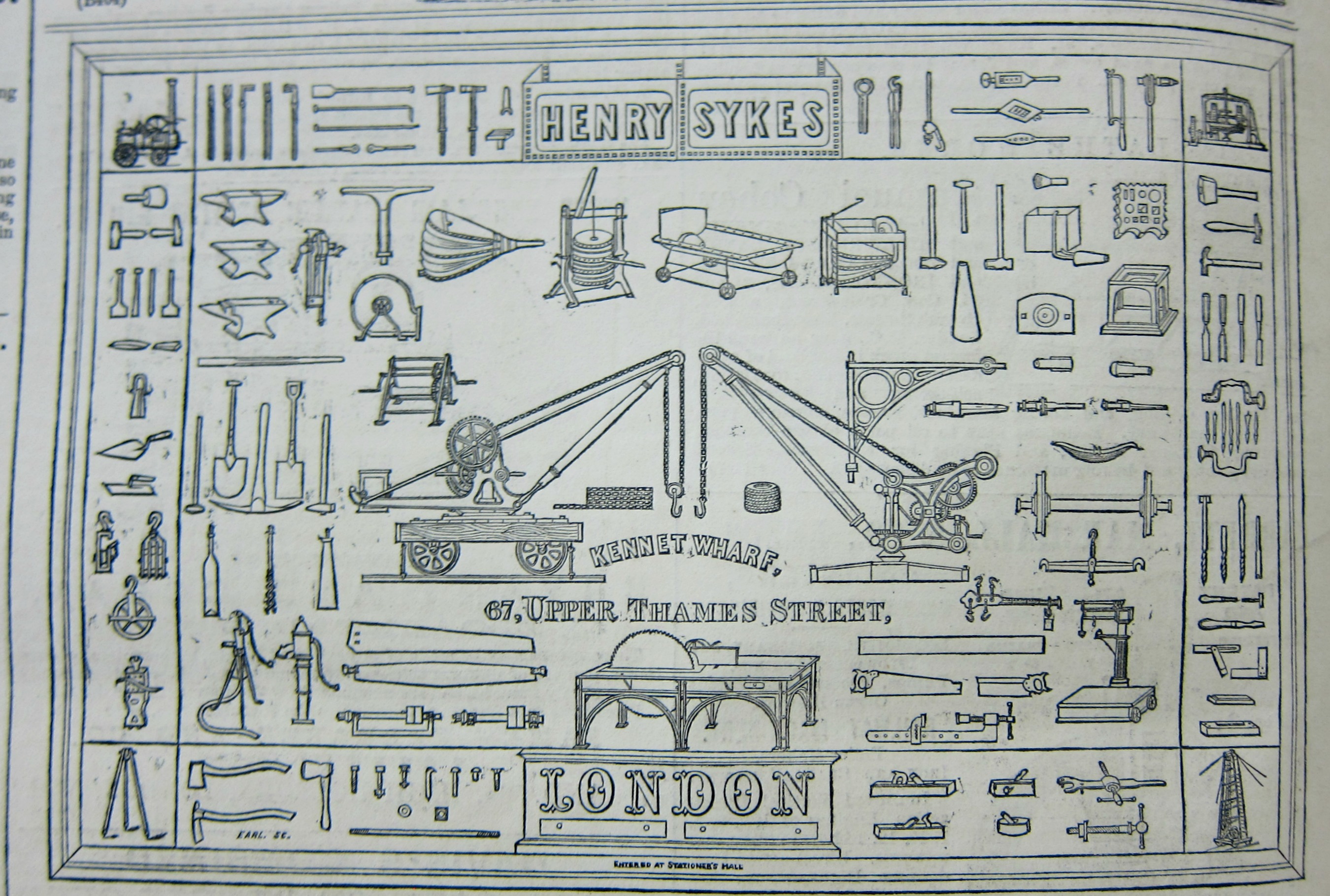
    Maybe you don’t see it, but the first thing I thought of when I saw this small (and here enlarged) ad in The Engineer for 1869 was its remarkable-ish similarity to hieroglyphs. The point is fairly strong, and a person can get a very good idea of how things were being built in 1869–especially if you were an alien and had deciphered what the purpose of all these things was. Granted it isn’t as simple or complex as the SETI plaque on the Pioneer 10 and 11, but it does have the flavor of a message to the future, or to another life form in another place.  

    Engineering 1869 Hardware hieroglyphics

  • Maps: “Through the Meander of the Rockish Creek”, 1842

    JF Ptak Science Books   Post 2634

    Back when I had an open shop I would occasionally have surveyor customers who would come in after hauling themselves back to our civilization, telling stories of doing some re-survey of some piece of land in the out-yonder and finding old heart of pine stakes from a 19th c survey still in place and just very slightly off from where the modern surveying tools would place them. These guys held these earlier surveyors in high regard, as they did hard work and did it very well, using relatively rudimentary tools (optics, chains, measures) in sometimes very difficult conditions and doing a splendid job of it.  

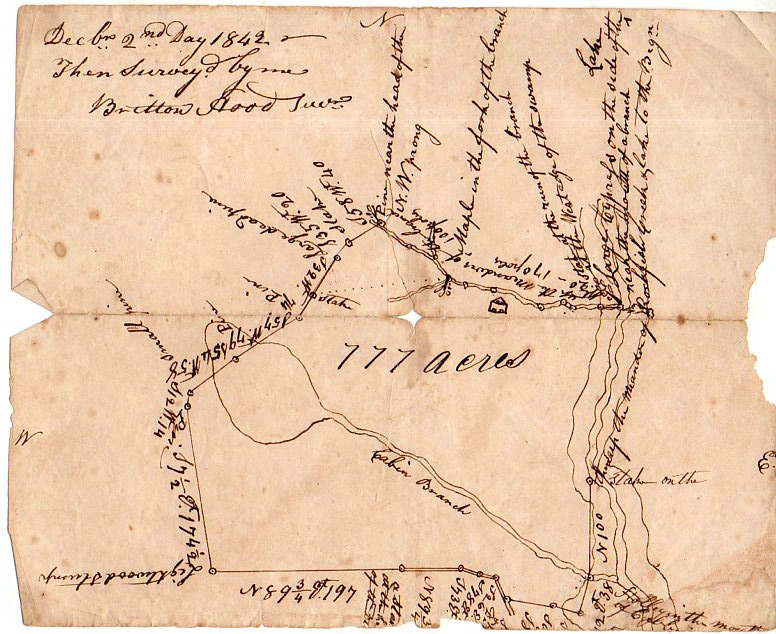
    These stories came to mind just this afternoon again while cataloging an 1842 manuscript map made by Britton Hood, Jr., who was the son of a surveyor Hood Sr. who worked through the late 18th c and into the middle 19th. The family was in Wayne County, and it looks as though the son stayed their, at least according to a hint or two on this map. Although the location is not identified the major feature is, and the “Cabin Branch” of the map may be the “Cabin Branch” creek that is south-central Wayne County, south of Goldsboro. 

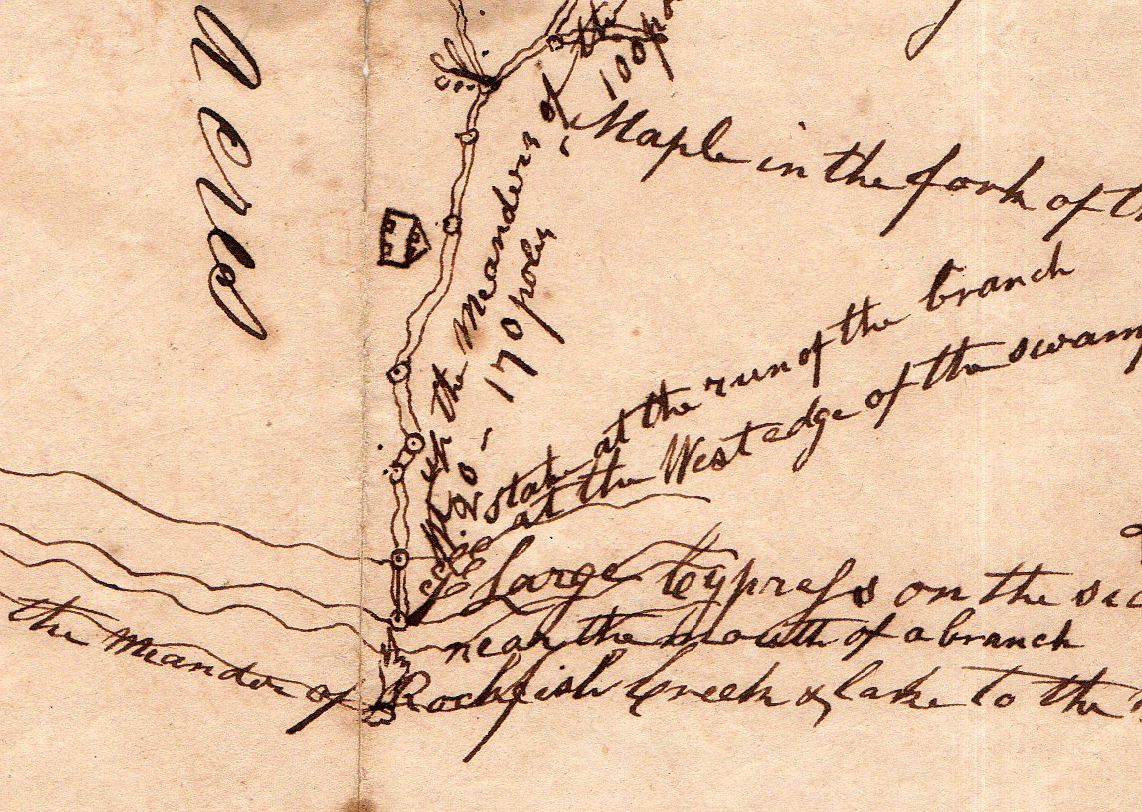
    The very attractive part of this map of course are the landmarks used by the surveyor, and as is very often in these cases, the “landmarks” tend to be simple trees and stumps and such.  Of course is you identify a starting place and base all of the landmarks upon that, then virtually anything can be used, so long as it is referenced to something. 

    This leads to the found-poetry of the Hood map:

    Britton Hood725

    Some of the then-essential and now-delightful boundary markers for Hood’s 770-acre survey include:

    • Maple at the fork of the branch
    • stake at the turn of the branch
    • pine at the west edge of the swamp
    • large cypress at the edge of the swamp
    • through the meander of the Rockish (?) Creek
    • Lightwood stump
    • small pine
    • pine
    • large dead pine
    • stake
    • pine at the prong of the NW branch
    • and of course a pine, pine, and small pine, among other things.

    The map in full (the original measuring 6×7″):

    Britton Hood724


  • The Great Totalisator, 1926

    JF Ptak Science Books  Quick Post in The History of Lines series

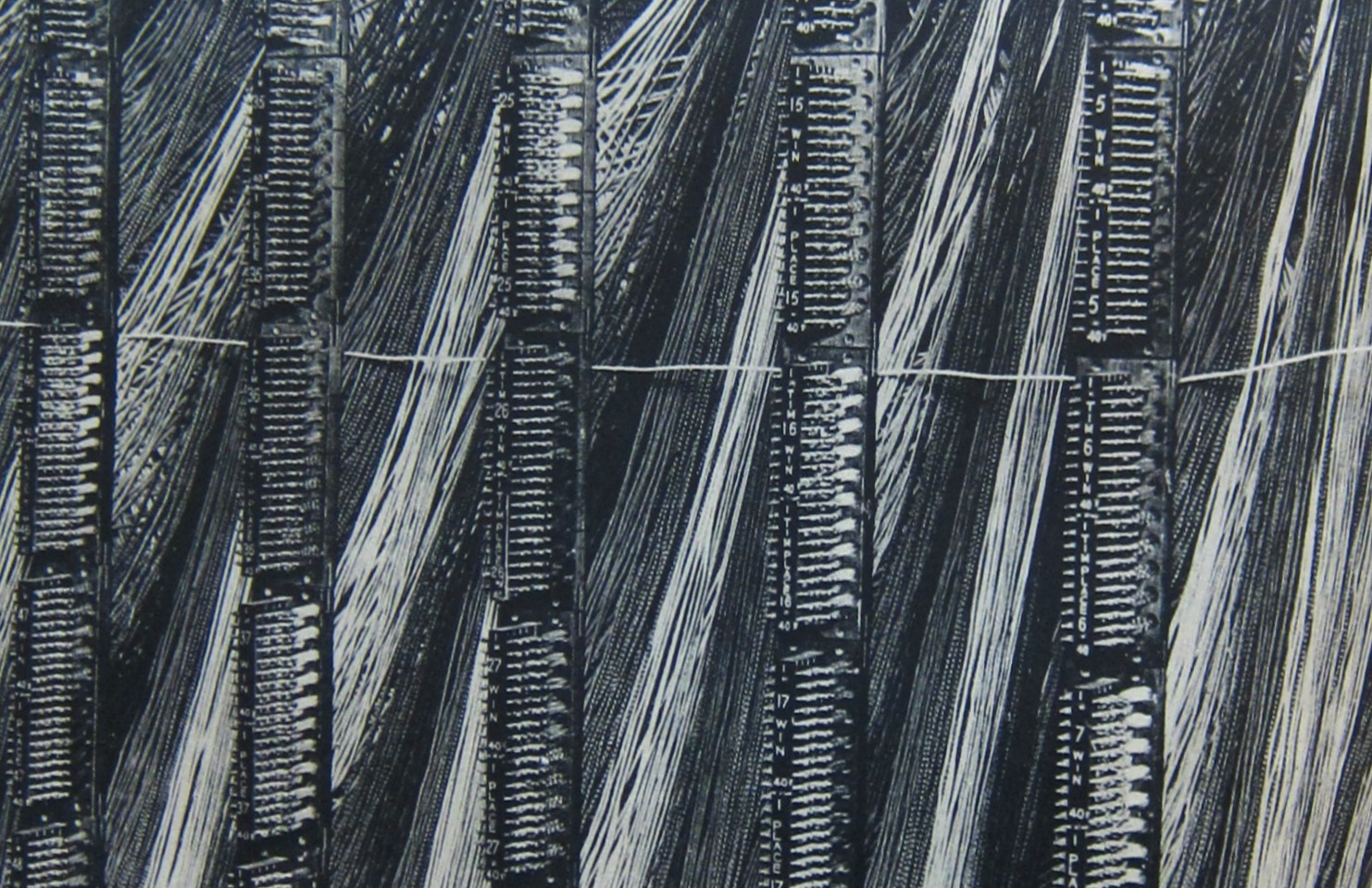
    Computer  totaliser detail

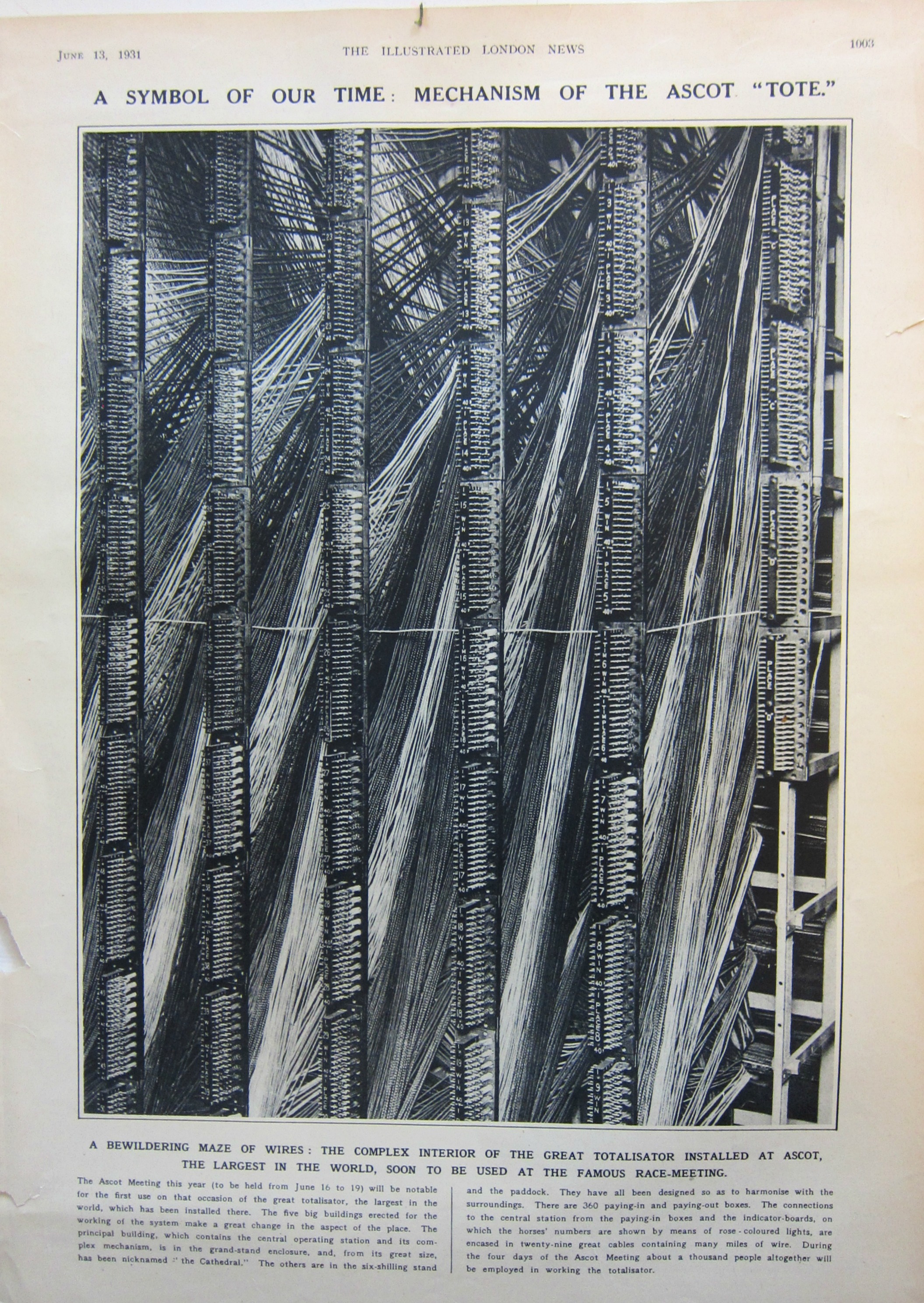
    And so I came to this fabulous word in a running title in the pages of the November 13, 1926 issue of the Illustrated London News–what a fabulous thing, in- or out-of-context!

    Totalisator.

    It appears as a noun in the Oxford English Dictionary as “totalizator”, and goes back to a first use in 1879 in reference to the Pari(s)-Mutuel system of betting–but here, in this article, the “totalisator” is an electric betting mechanism.

    Computer totaliser

    It could also be the nickname of a certain Golem-like U.S. politician implausibly running for the presidency who can make no mistake and is a fanatic for himself no matter the consequence or the validity, or it could be the name of a 1960’s Japanese cartoon monster (either heroic or evil), or it could be an adversary of the 1966 Batman, or it could be a 1930’s Robot (pronounced “Robit”), or I guess a suite of a lot of other things.  It was certainly a behemoth when installed at Ascot in 1925/6, occupying 5 structures and run by a team of 1,000–a fantastic thing of the future, here today, and gone soon afterwards.  

    “Totalisator” seems much more definitive and authoritative with a period at the end of the word, as above, in arial black. 

    ·Posted by :

    ·in:

  • Blade Runner Retinal ID, 1936

    JF Ptak Science Books   Quick Post

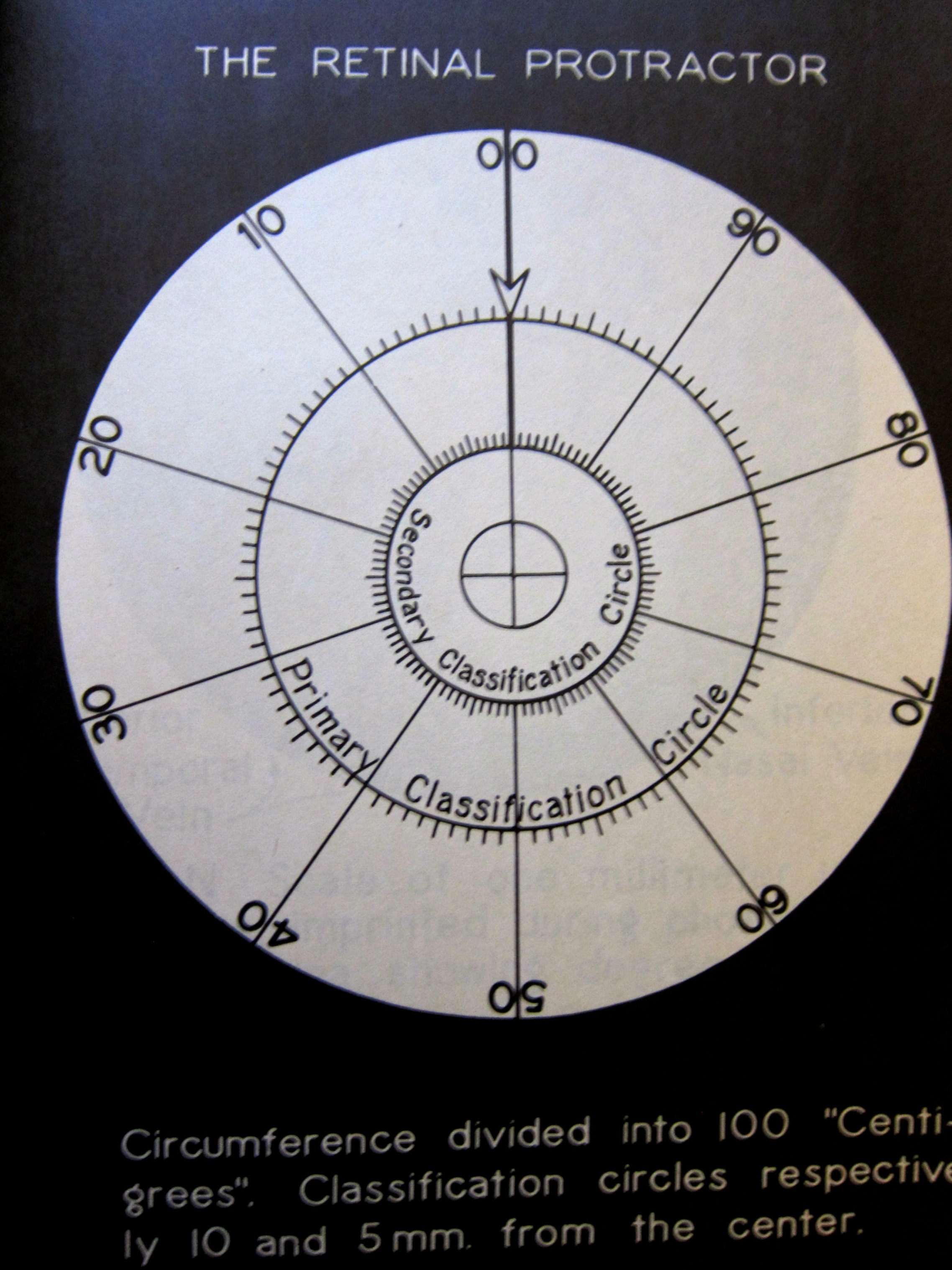
    Retinal identification is here, and it is in the future; it was in the past’s version of the future in the P.K. Dick Do Androids Dream of Electric Sheep? in 1968 which was turned into the film Blade Runner in 1982. But long before any of this was Carleton Simon and Isidore Goldstein, who figured out that everyone has a unique display of veins in their retina. Of course this is not exactly as obvious as fingerprints, but evidently it was a whole new thing in 1936–highly interesting. ANd what struck me was the “retinal protractor” which was like a grid placed on the photograph of the retina onto which the veins would be plotted, from there it went to another step to assign numerical values. 

    Retina id protractor

    Source:  Carleton Simon. The retinal method of identification; a new system of classifying retinal patterns. Presented at the annual convention of the International Association of Chiefs of Police at Kansas City,Mo.,September 21st to 24th, 1936.  11×8.5″ cover/title, followed by 4 leaves of photographs showing the sections of the retina, examples of the veinous patterns, and a retina protractor explaining the sections of the retina in a common language for placement.  
     
    Dr. Simon–“Criminologist of the International Association of Chiefs of Police, New York Association of Chiefs of Police…” is the Simon of Simon & (Dr. Isidore) Goldstein, whose groundbreaking paper1 introducing the uniqueness of the patterns of retinal blood vessels and their use in identification, was published on September 15, just a week before this address.  This publication may have been a handout for the address–it consists of one page of cover text and a separate four leaves of retinal pattern photographs with a cover sheet.  
     
    Notes:
    1. “One of the most accurate techniques for human identification is based on the uniqueness of the retina blood vessels pattern. The unique structure of the blood vessels in the retina pattern was first introduced in 1936 by Simon and Goldestein” . Simon C,,  Goldstein, I., “Retinal Method of Identification”, New York State J Med. 1936 Sep; 15– noted in “Retinal Identification System using Fourier-Mellin Transform and Fuzzy Clustering” Hadi Jafariani and Hamid Tabatabaee, Indian Journal of Science and Technology, Vol 7(9), 1289–1296, September 2014.

    ·Posted by :

    ·in:

  • A Map of Television to Come, with a Price Tag (1946)

    JF Ptak Science Books  Quick Post

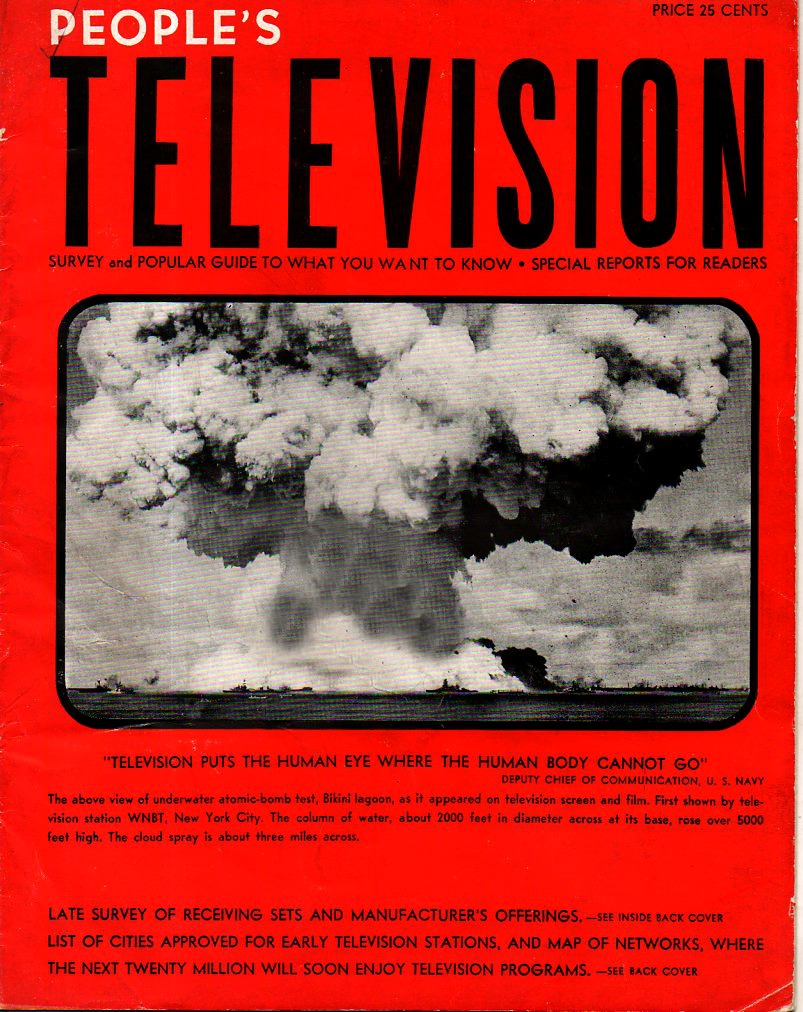
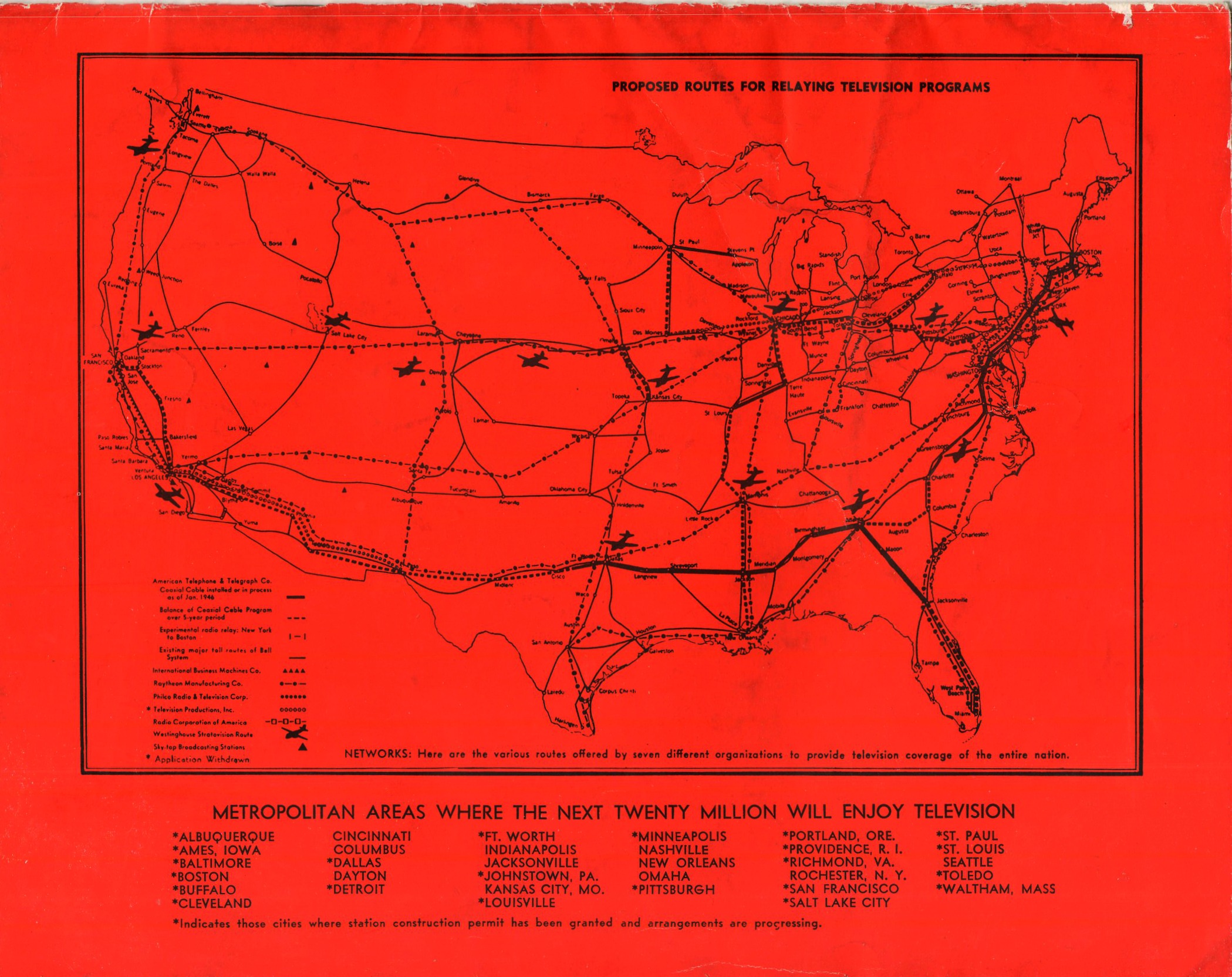
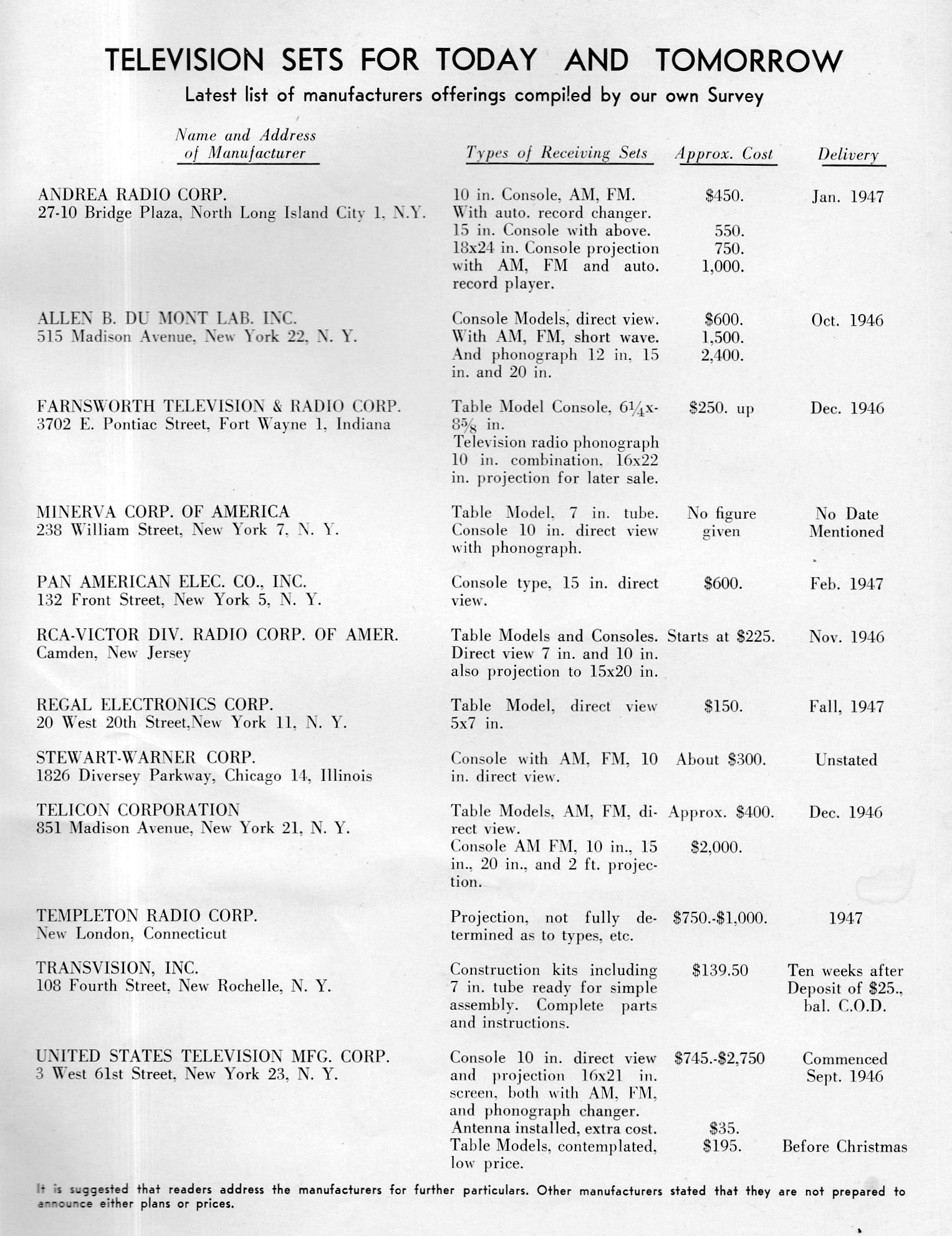
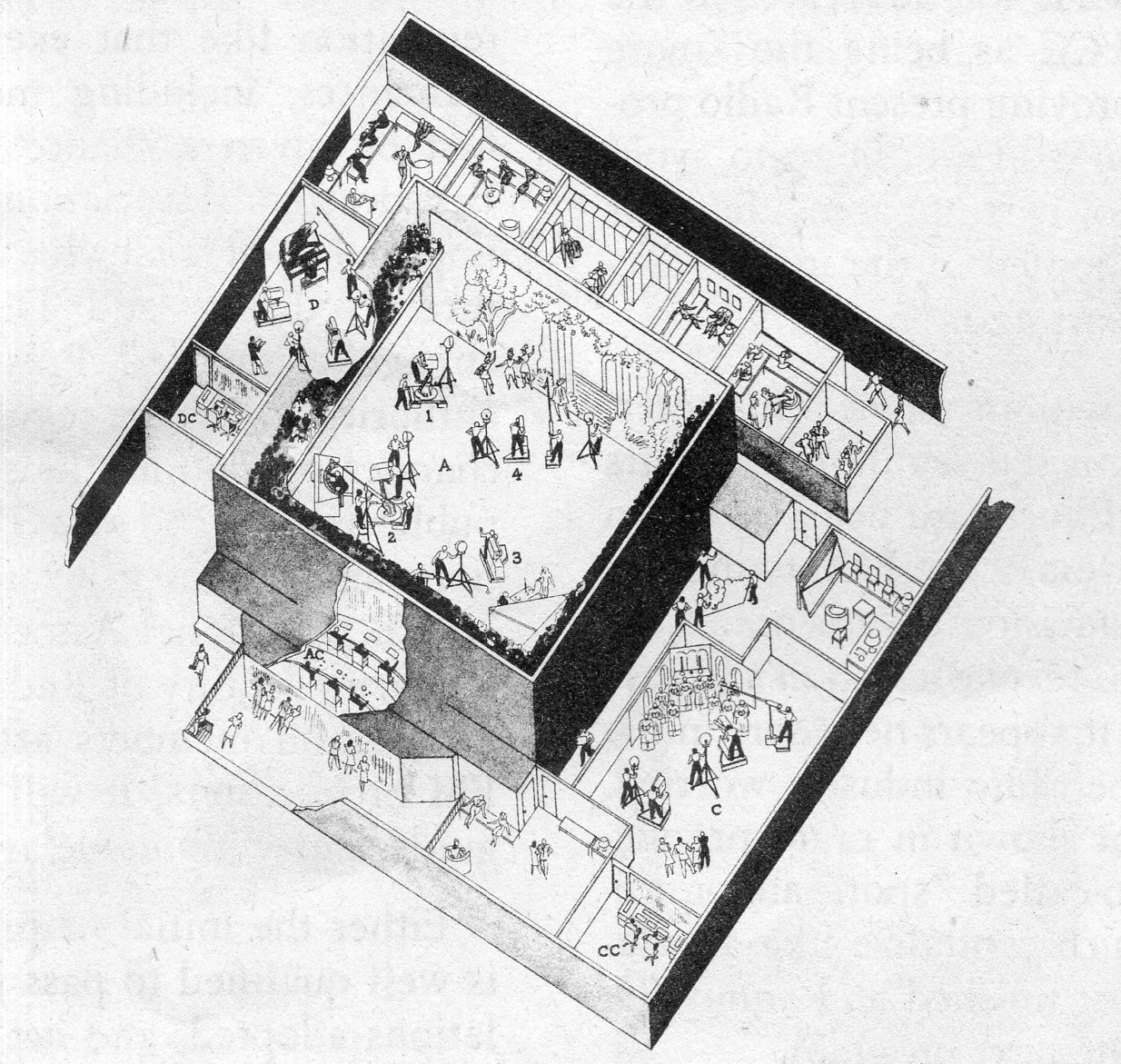
    On the anniversary of the Nagasaki bombing (today being August 9) I found this old friend down in the studio:  People’s Television, Survey and Popular Guide to What You Want to Know…” (possibly) by Walter J. Greene, which was published about a year after the bomb was dropped, received by the Library of Congress in December 1946. In a full twenty-four pages the author laid out the future of the young (“virile youth returned from war”) television and how signals could be transferred across the country for transcontinental broadcast, setting up the reader for the appreciation of the coming boom in the new medium. It includes a small section on how television programs are made (I’ve included a scan of a small diagram of the Du Mont-John Wannamaker Television Studios located at the Wannamaker store in NYC), a chapter on how the public will determine the content of television programming (“The Public is the Final Judge, Television can “Grow Up” More Quickly than Radio”), a bit on the future of television reception, color television (“A Cause for Some Speculation”), all followed by a reader quiz and a list of televisions and their prices.

    Of course the major draw for me in this pamphlet is its cover–one of many efforts using imagery of nuclear explosions to sell an idea or a product. The image is a famous one, being the second airburst test shot at Bikini, Marshall Islands, on July 1, 1946. The image has been cropped a bit, the full versions showing a beach and palm trees in the foreground.  Although it seems as though this was a mass-produced item, it just doesn’t seem to show up anywhere, nothing substantive in the intertubewebs, and the trusty WorldCat/OCLC finding hardly anything–surprising. 

    Peoples television _1_591

    And a map of the coming transmission scheme:

    Peoples television _map_592

    And a list of televisions available–remember that $1 in 1946 is about the equivalent of $12 today, so, $1000 for an upper end model would have been about $12k today, which is considerable:

    Peoples television _tv prices_595

    And of course the television studio of 1946:

    Peoples television _studio_593


    ·Posted by :

    ·in:

  • Unbuilt New York City, 1935–Almost-Closing the NYC Harbor


    JF Ptak Science Books 

    Liberty Landing _1_602

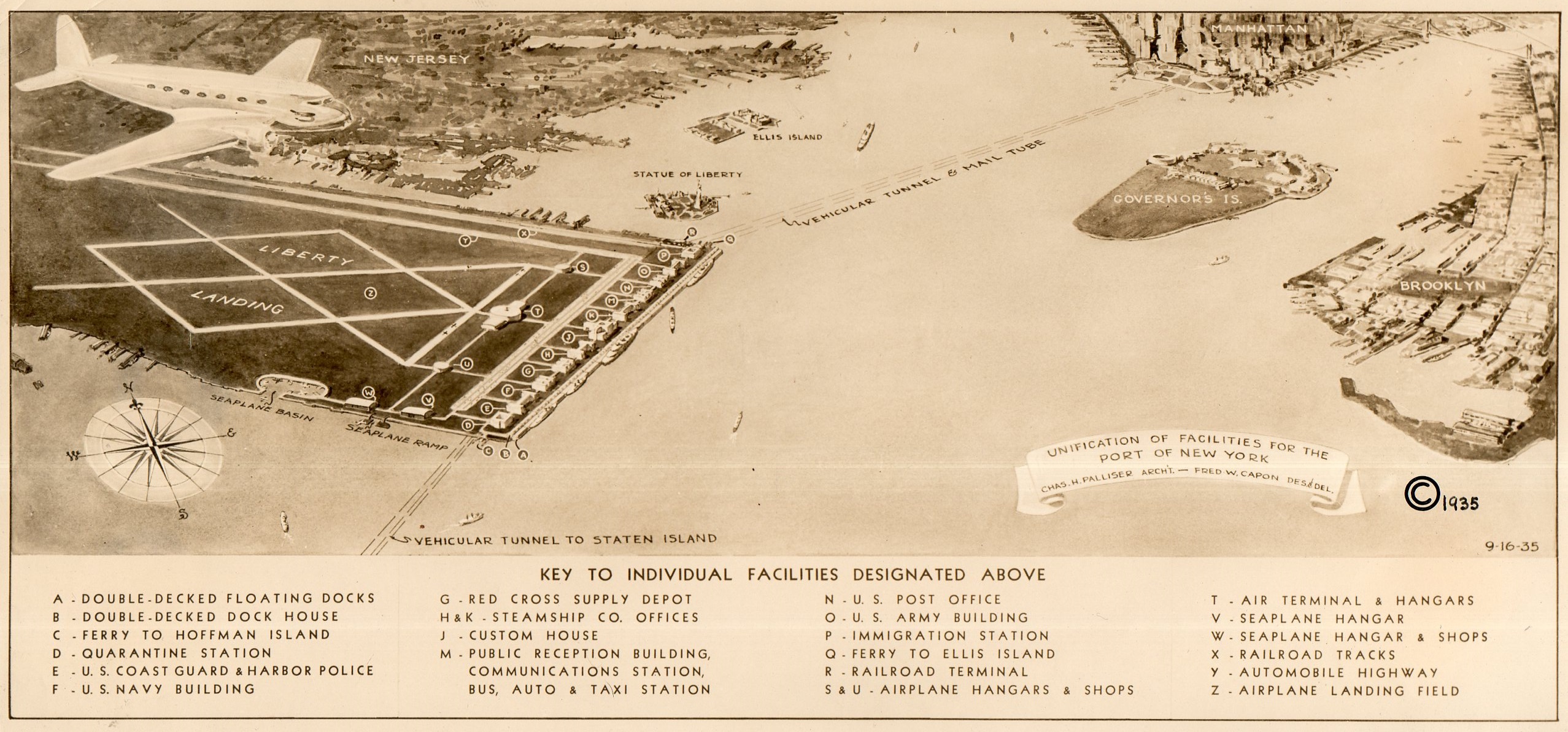
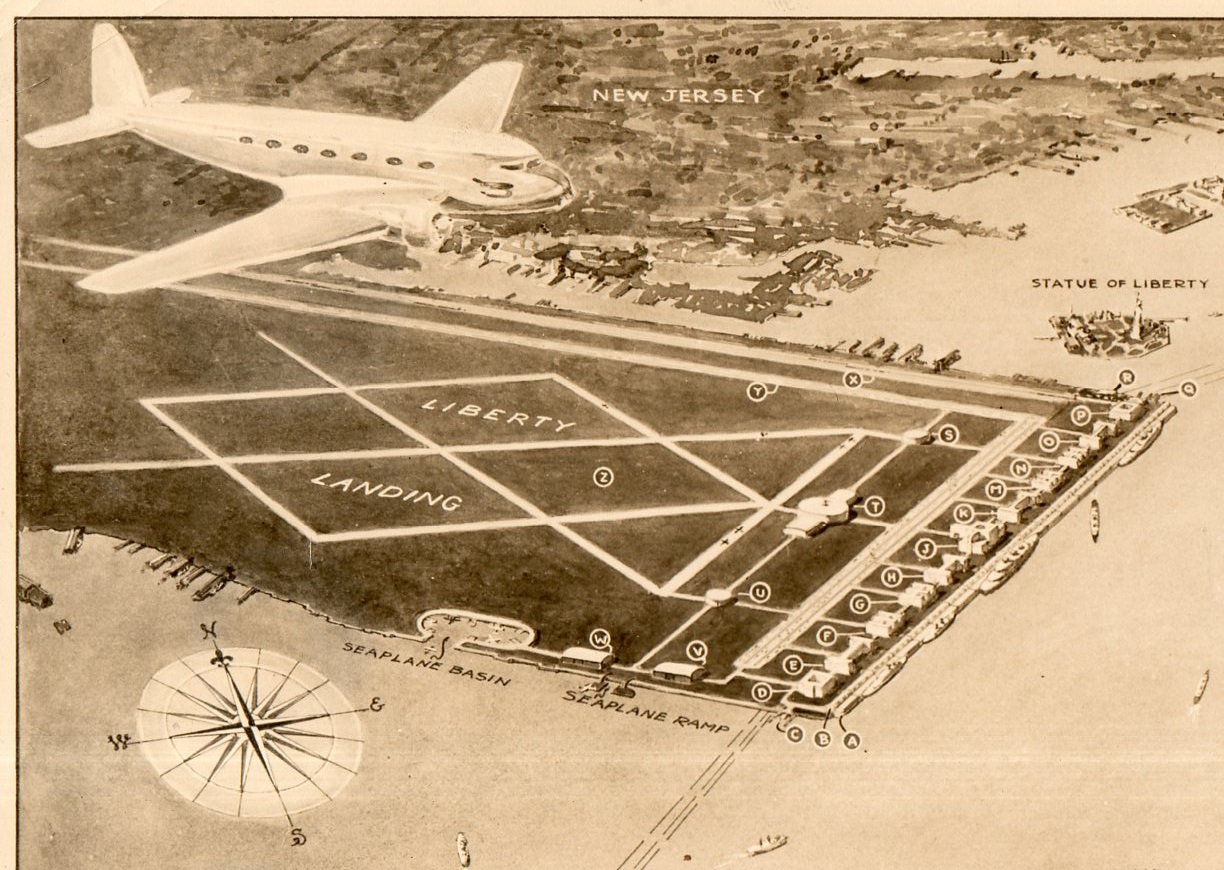
    I recently uncovered an interesting, unpublished and probably not-acceptable engineering report to extend the ports capacity in the Hudson River at New York City–the ports of the  area being famously over-busy for a long period of time, especially right before World War II.  Charles Palliser and Frederick W. Capon presented a proposal in 1935 for a unification of the port and airport facilities to take care of the overcrowding and overworked problem.


    Liberty Landing _2_603

    What they came up with was Liberty Landing, a mile-long and half-mile-wide facility that nearly bumped into the Statue of Liberty (and hence its name).  The plan called for backfilling the “flats” that were just south of Jersey City, as “the natural formation of these were very favorable”, which meant that the airport-port combo would extend all the way into the harbor to the edge of the channel, which would put it further out than the Statue of Liberty, which would also be just hundreds of feet away from the end of the north runway.

    Also attached to the backfill and new land would be a one-mile-long floating dock.  Oh my!

    The floating island would also have vehicular tunnels that connected it to Staten Island and the Battery.  There were facilities for seaplanes, airplanes, railroads, dirrigbles, and trucks, plus a military installation, a custom’s house and the US Mail Service, so that all commerce would converge at this one point, which sounds interesting (for about 20 seconds). 

    Dsc04773

    This is a good candidate for the “Better Left Undone” award for 1935.

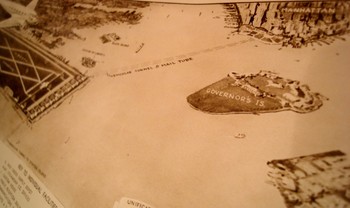
    As I look at the photograph of the aerial view of the plan it strikes me that if the designers increased the surface area by only 125% or so they could’ve connected the new facility with Governor’s Island AND Brooklyn, building a land bridge from Jersey City to Coney Island—a superbly bad idea to cap an already strongly bad idea. 

    The report is called, simply, Liberty Landing, and published by the architect in Jackson Heights, NYC, 16 Septmeber 1935.  This is also the U.S. Copyright Deposit copy (accepted 10 October 1935), which is where the history of this project ends.

    ·Posted by :

    ·in:

  • Beautiful Oil Rigging Supplies, 1899

    JF Ptak Science Books   Quick Post

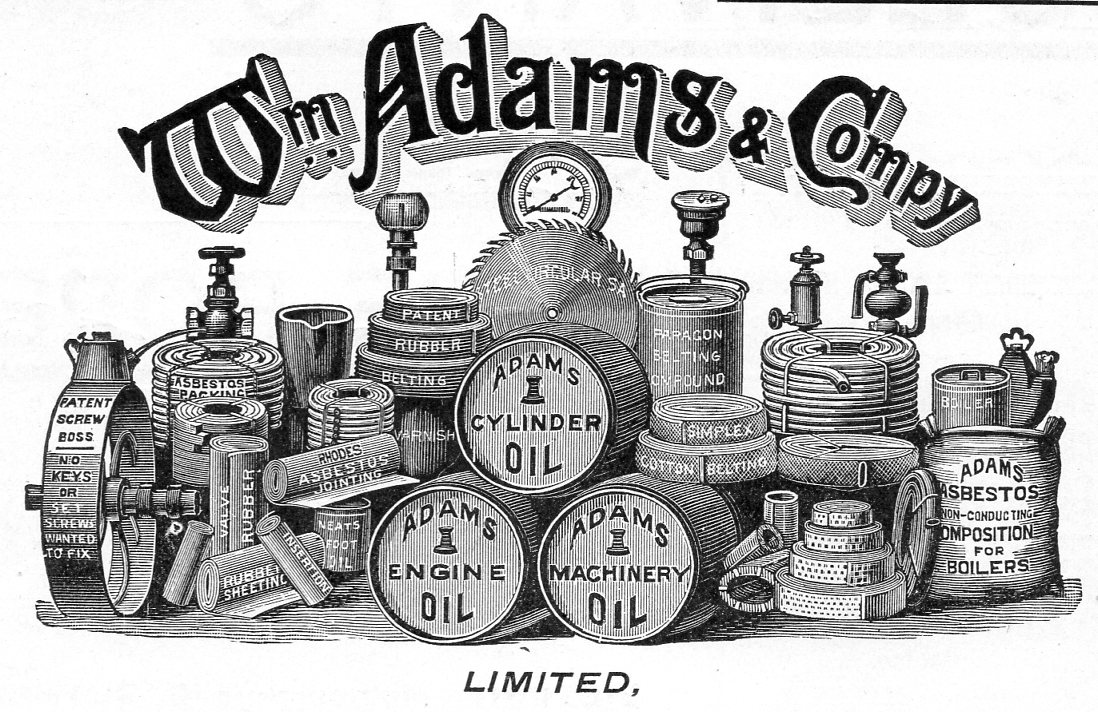
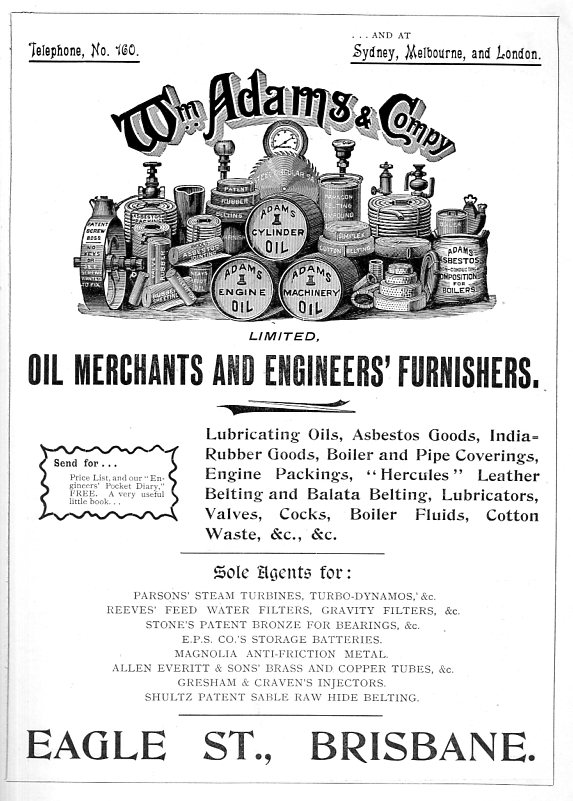
    I couldn’t resist this display found in a short work on the gold fields in Queensland, Australia. William Adams & Company furnished the necessaries for running oil rigs and various mining instruments. The gear is just nicely displayed and presented:

    Simoil merchant611

    Source: The Goldfields of Queensland. Charters Towers Goldfield, by William Lees. Queensland, Outridge Printing Company, 1899. 24.5x18cm, (xii), 34pp. Numerous small inset throughout, including larger images of works, as well as birds-eye views of Charters Towers, Queensland, and four other full-page photo images, plus a full-page plan of the works. (The title page calls for “With Plan” and I’m pretty sure that the full-page plan is it; I can find no evidence of a folding plan or any such thing in the table of contents. The publication is also filled with many advertisements. 


    Simoil merchant610

    ·Posted by :

    ·in:

  • Anti-FDR Cartoon Book, 1944

    JF Ptak Science Books   Quick Post

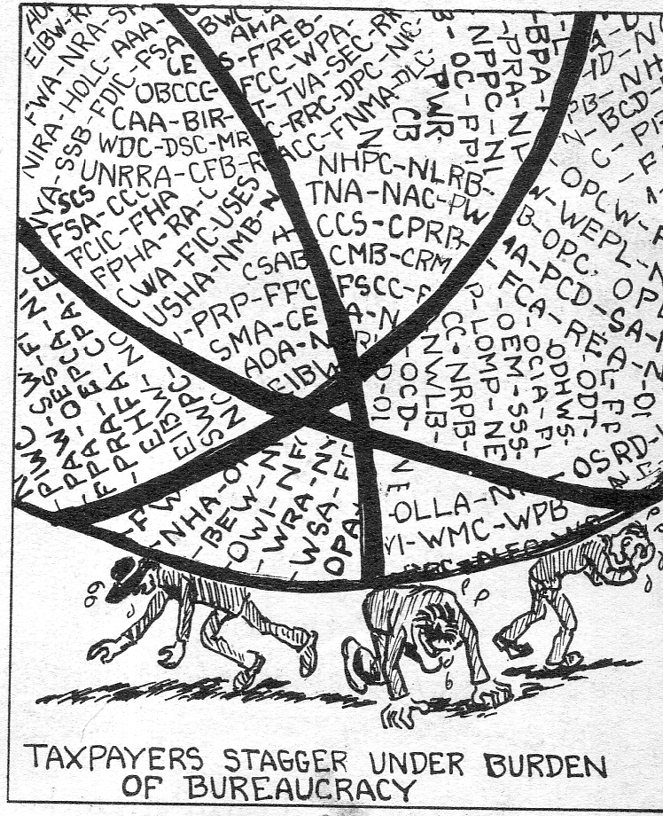
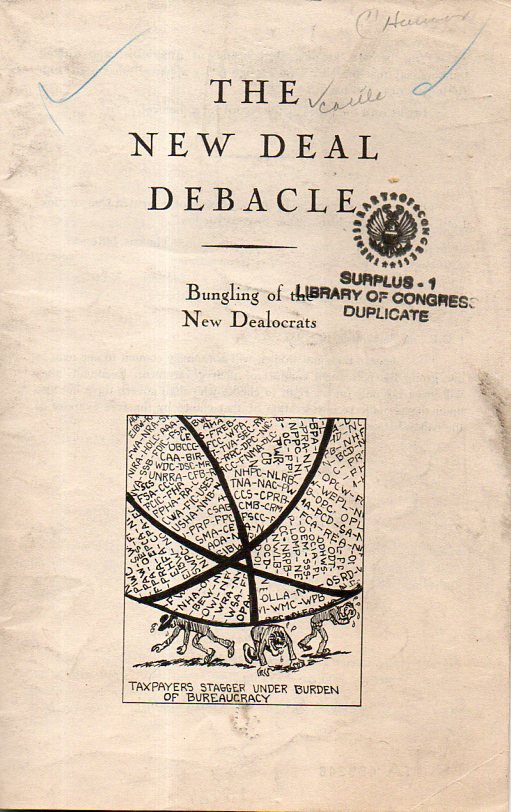
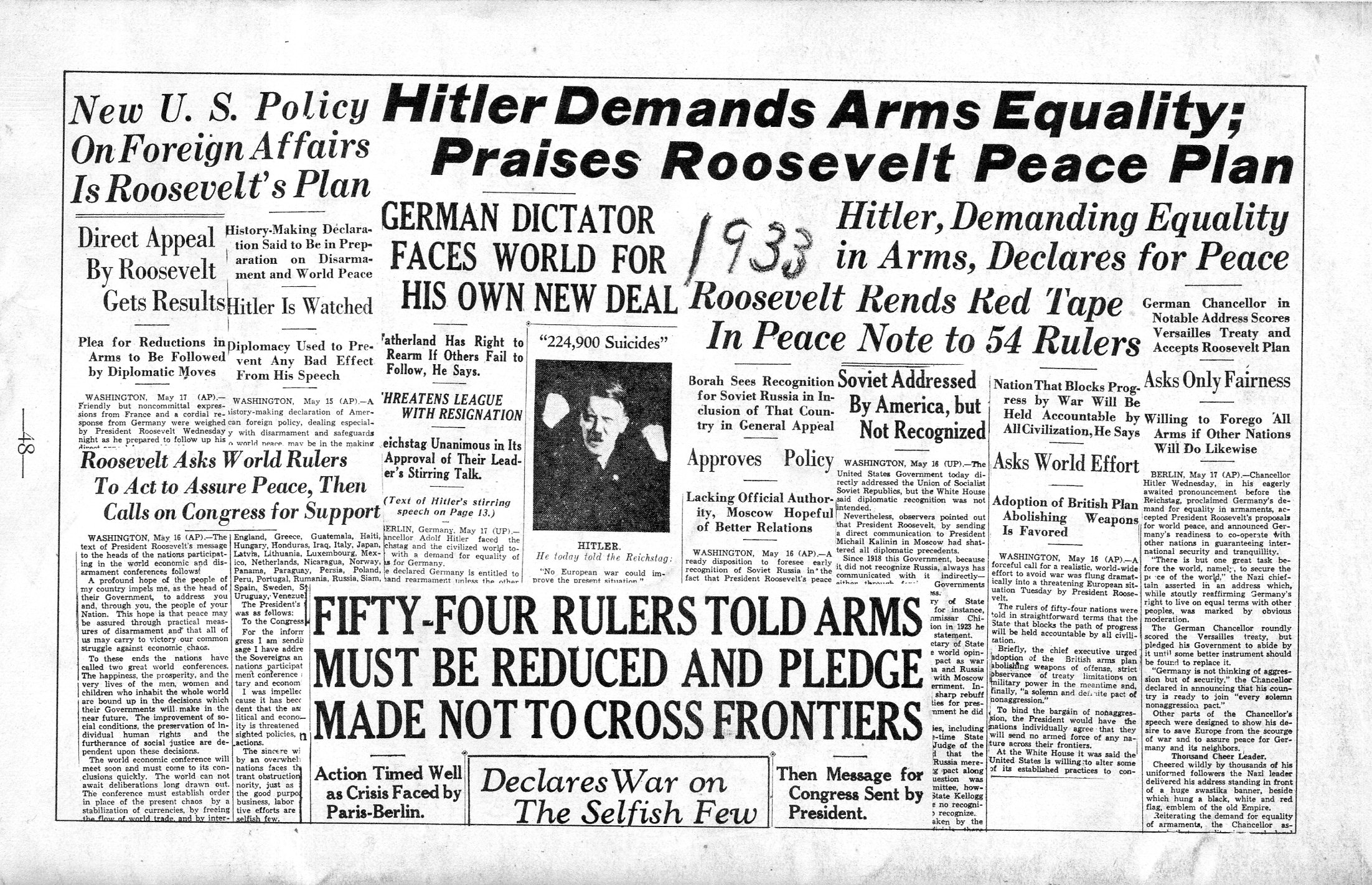
    It takes all kinds, as this pamphlet clearly if not not cleverly shows. There was some opposition to FDR as he went for his fourth term as president in 1944–by the summer of that year the outcome of WWII had swung positively towards the Allies, the Depression was broken, and for fighting in a world war the U.S. was in pretty good shape. There was of course opposition to his re-election, though in hindsight it is hard to see the why of the question, even including the unprecedented fourth term following the unprecedented third term. But the man was doing his job: he had basically saved the country and now was winning the war.  Even though FDR trounced Thomas Dewey in that election, it wasn’t as though a sizable percentage of U.S. citizens hadn’t had enough of him: FDR received 53% of the popular vote, won 36 of 48 states, and slammed the electoral college 432-99.  Still, there were only 3 million votes separating Roosevelt from Dewey in the popular vote (25 mil-22 mil), which seems odd, as it feels particularly uncomfortable thinking of Thomas Dewey heading the U.S. war effort for the closing two years or so of the war. Lincoln crushed the lead-footed Gen’l McClellan in the electoral college in 1864, and wound up beating him handily in the popular vote–but given the stature of Lincoln at that point, one might have expected him to pull more than a 10-point difference over the field commander who felt he never had enough troops, but he didn’t. Anyway, this pamphlet–written by Melissia Castle with cartoons by Pearl Porterfield–took long and myopic aim at the New Deal, trying to crush the enthusiasm for FDR.  I can’t find anything on Ms. Castle, and can only find a possible little bit for Ms. Porterfield (as a studio hairdresser and colorist to Marilyn Monroe and Jean Harlow, though I am not sure if this is the correct Pearl Porterfield)–the book itself also seems to be pretty much nowhere, so it looks as though it probably was published to little effect.   

    New deal debacle613

    New deal debacle612

    And the confusing back cover: 

    New deal debacle614

    ·Posted by :

    ·in:

Recent Posts

Archives

Categories