A Daily History of Holes, Dots, Lines, Science, History, Math, Physics, Art, the Unintentional Absurd, Architecture, Maps, Data Visualization, Blank and Missing Things, and so on. |1.6 million words, 7500 images, 4.9 million hits| Press & appearances in The Times, Le Figaro, Mensa, The Economist, The Guardian, Discovery News, Slate, Le Monde, Sci American Blogs, Le Pont, and many other places… 5000+ total posts since 2008.

  • Questionable Quidity: the Fire Escape Head Parachute, 1879

    JF Ptak Science Books   Quick Post

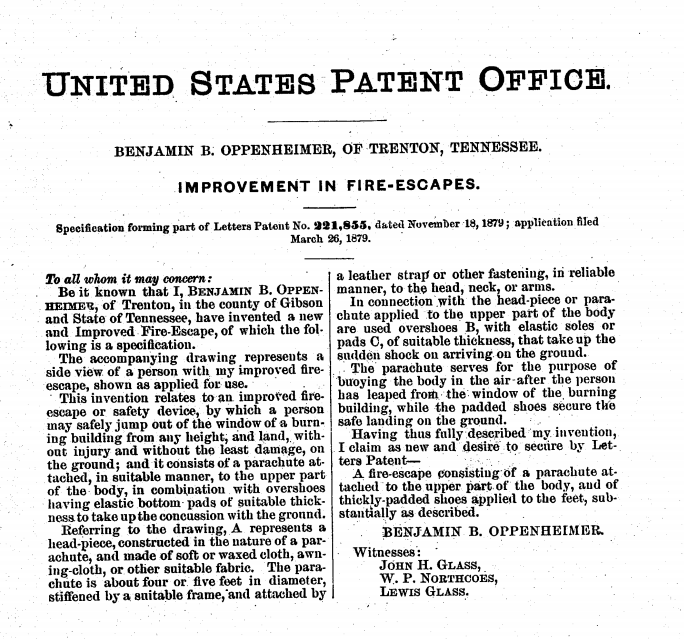
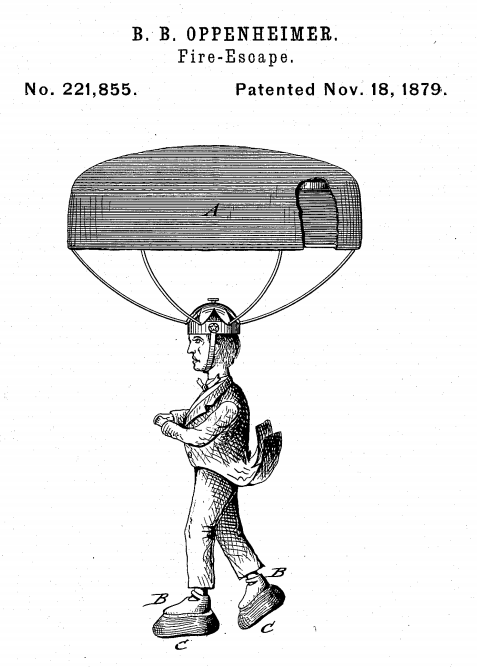
    When I first saw this image I thought, naturally, that it was an unreal real patent; it turns out that Mr. Oppenheimer was a real person and that this patent was a real patent. I doubt that someone would have their necks broken by this device when deployed thinking that it would just pop off–then again, if fastened very securely, it becomes a very cringeworthy thing to think about. The shoes don’t help much.  

    Patent parachute fire escpae _2_

    And the report:

    Patent parachute fires escape

    ·Posted by :

    ·in:

    — —
  • An Elegant-Looking Torpedo Boat, 1887

    JF Ptak Science Books

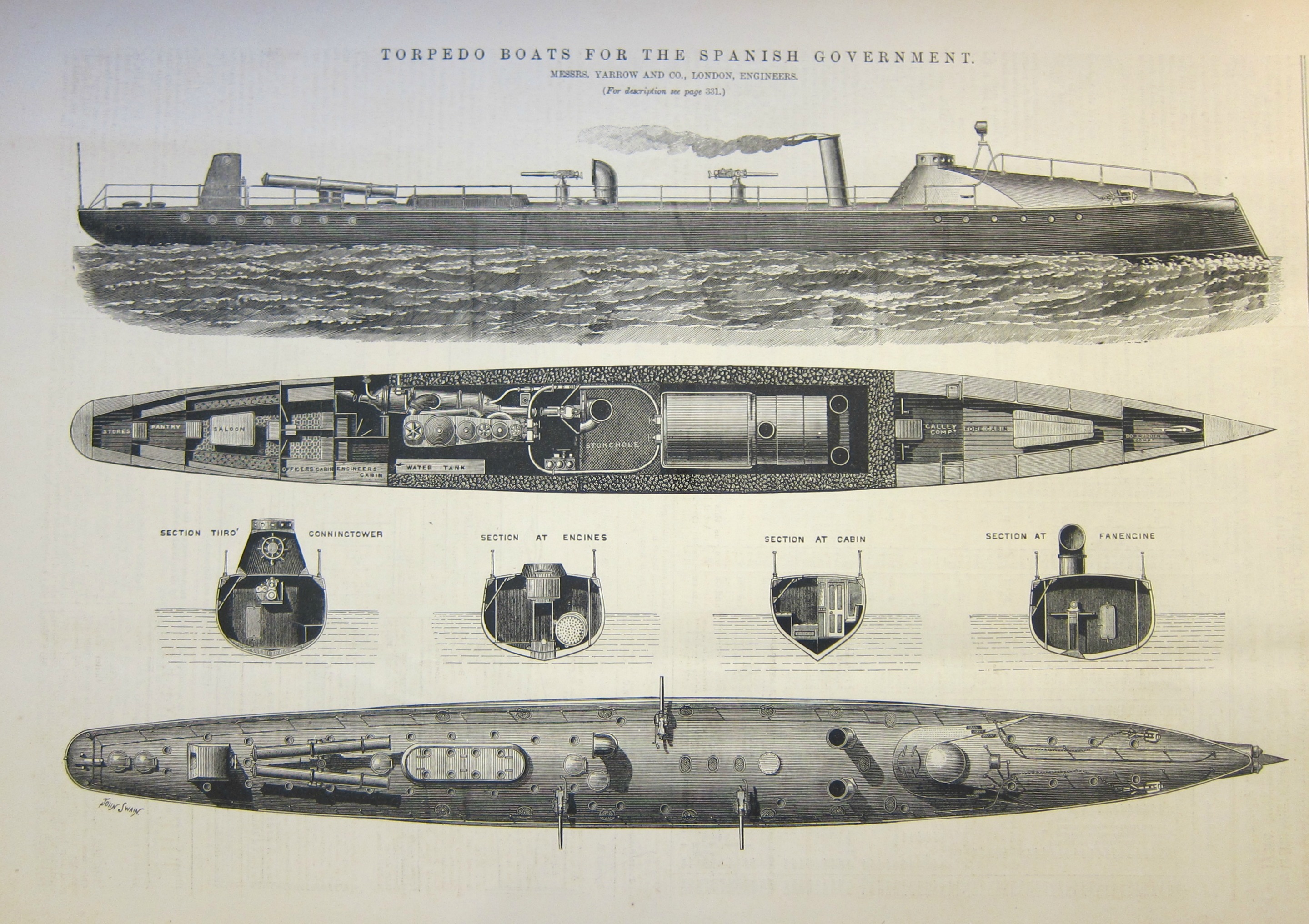
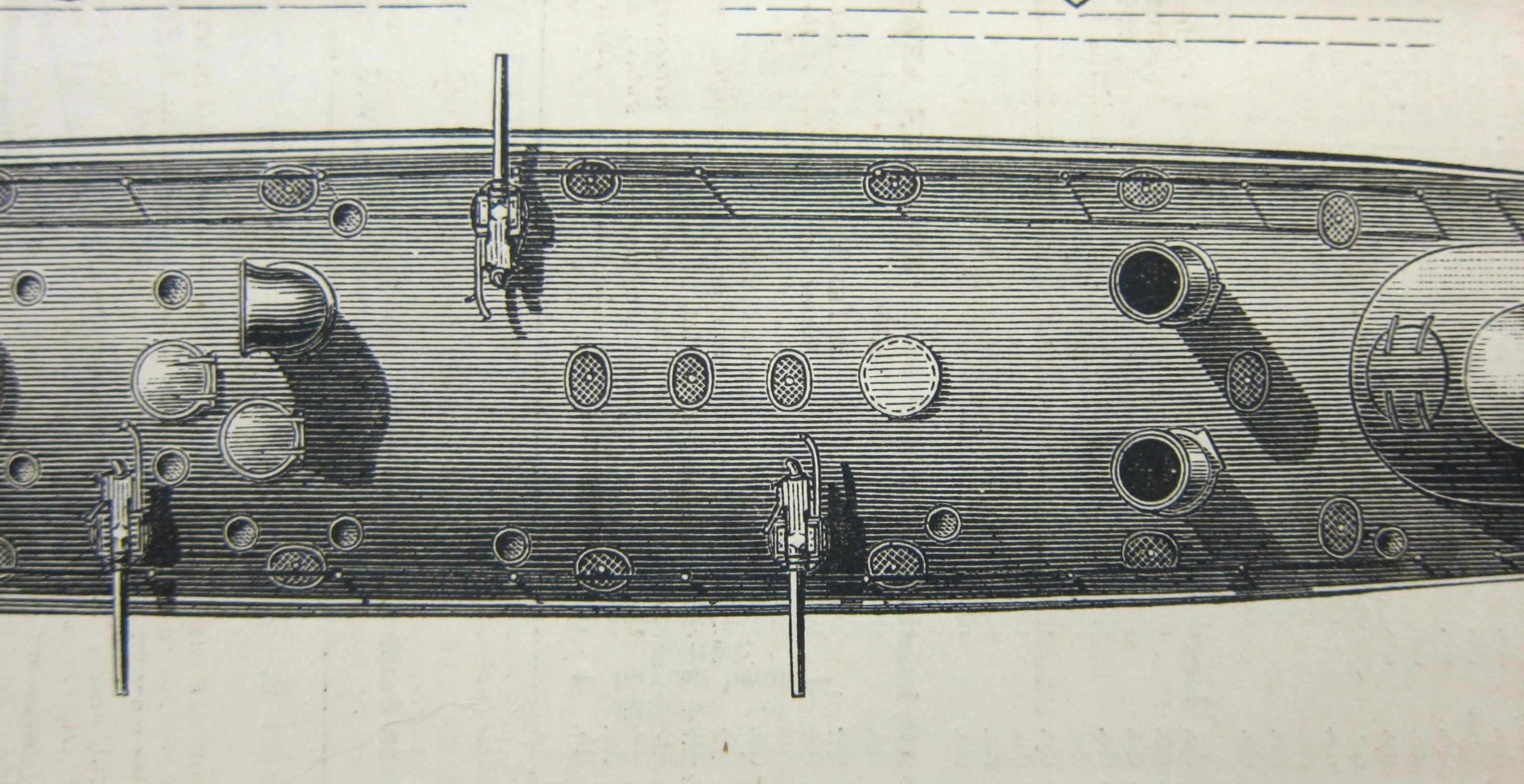
    This is the design for two sister torpedo boats, created by Yarrow & Co. (Poplar, East London) in 1887 for the Spanish government. The torpedo boat was not a terribly-new idea by this point, the first “modern” version of the craft built in 1875 (HMS Lightning), with earlier versions launched during the U.S. Civil War (like the CSS David). The designs shown here are for the Azor and the Halcon,135′ of attack-capacity (with 1600 hp), certainly making them high consideration for the folks on the receiving end, leading to the development of the torpedo boast destroyers to protect the big battleships and hunt the torpedo boats, and idea that would lead to “destroyers”. In any event, I found the image attractive and interesting, and thought I’d share it:

    Engineer 1887 torpedo boat

    [Image will become clearer when expanded/Source: The Engineer, October 21, 1887.]

    Engineer 1887 torpedo boat detail

  • Hollow Plans for the Sleeper–Protection from Bombs and Poison Gas (1927)

    JF Ptak Science Books  Post 2642

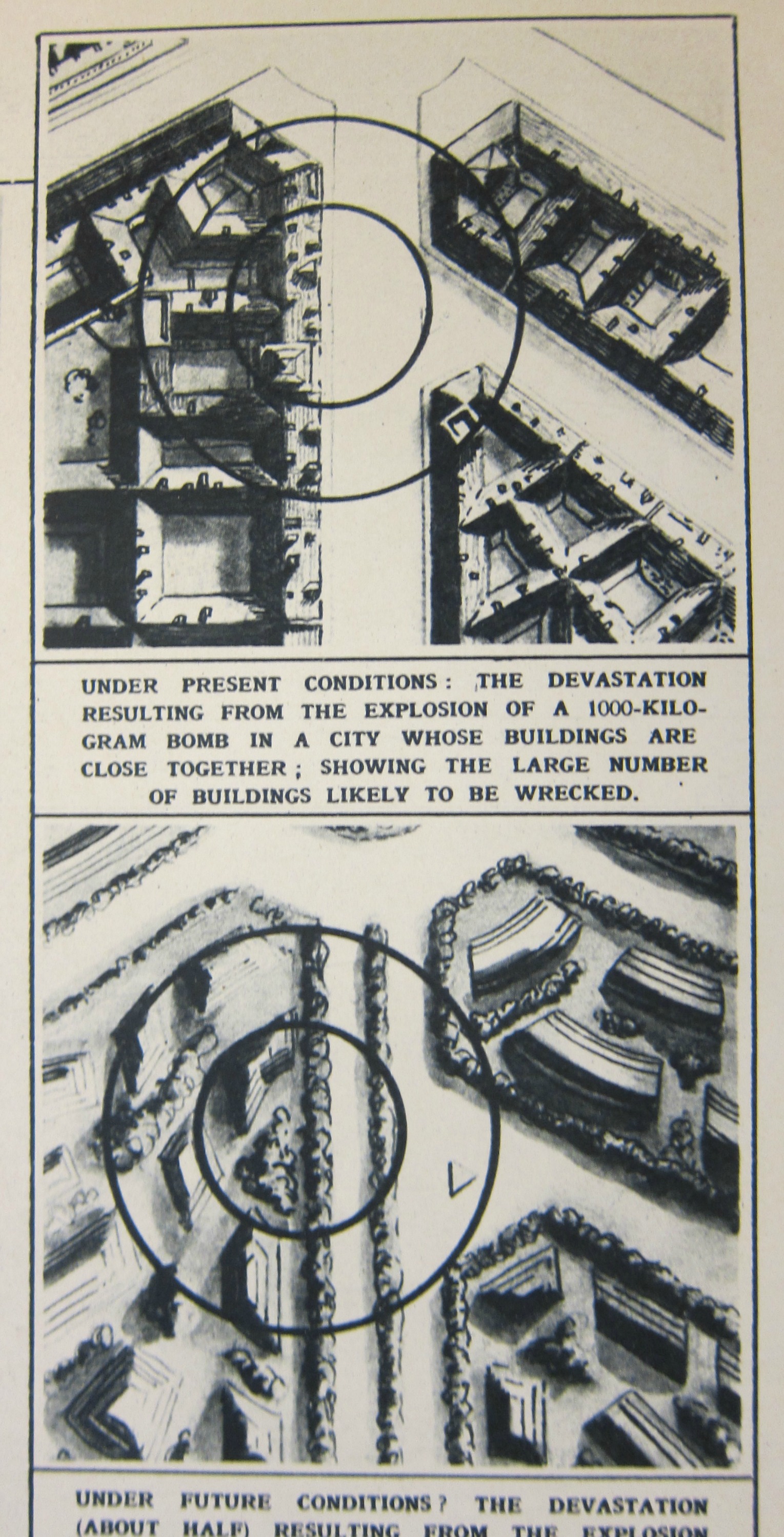
    Anti-aircraft moscow bomb falling

    The OED identifies the first usage of “anti-aircraft” 1914, which to me sounds about right–and pre-war, of course.  That said there were many opportunities to talk about something like anti-aircraft, as bombs had been dropped from balloons by 1849, and airplanes had been dropping grenades/bombs on soldiers and civilians since at least 1911–so the need for combating aircraft was there even though it took the English language a few years to catch up to expressing this idea in a hyphenated term.  By (July 23) 1927, when this short picture-article appeared in the Illustrated London News, there was enormous evidence and experience in anti-aircraft weaponry, and it seems that the Soviet Union was in a full-bore status to acquire a competent system, or at least they were talking about some aspects of it.  

    Anti-aircraft Moscow city street

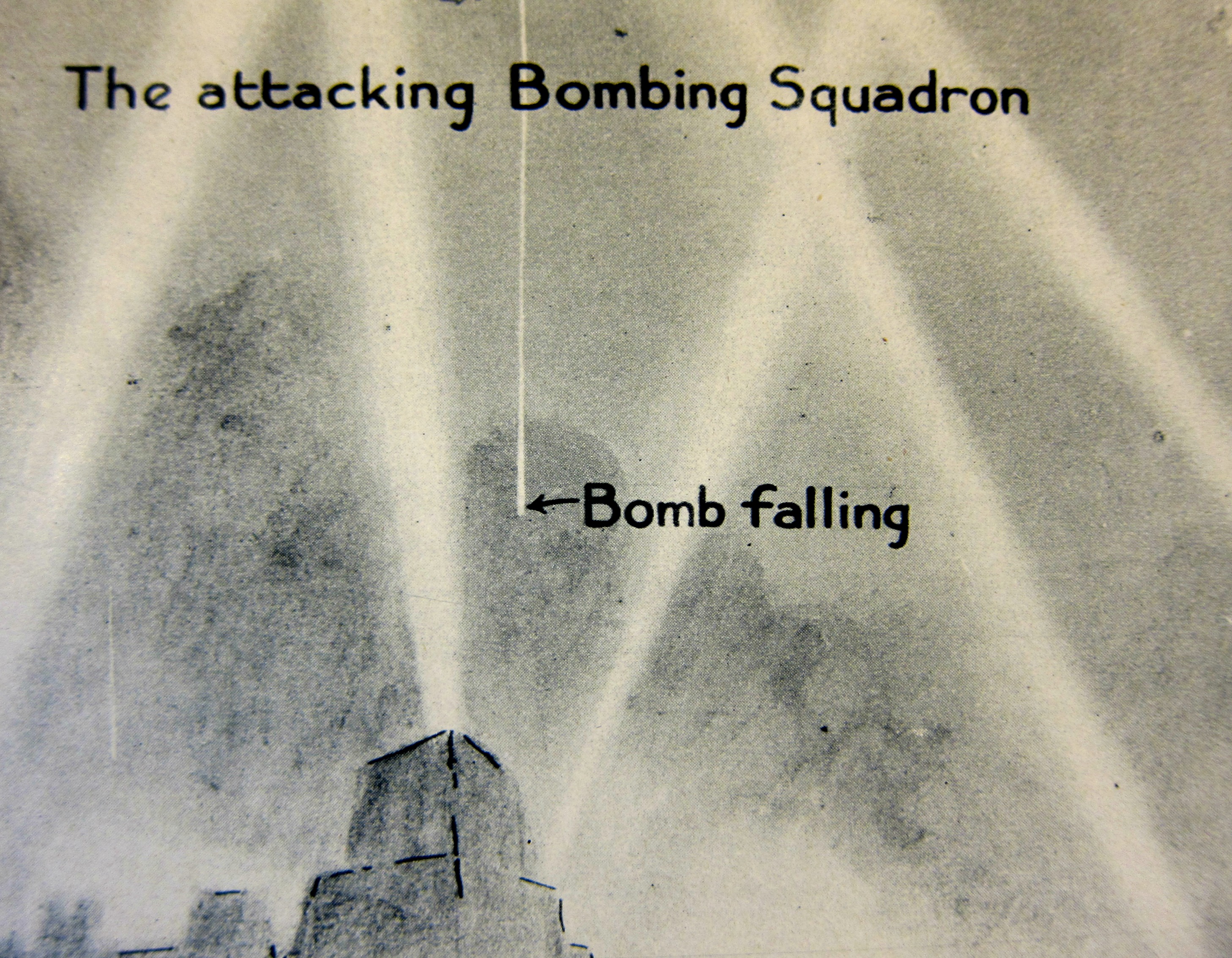
    And thank goodness for the artist who provided us with the right stuff to discern the “bomb falling”, dropped from one of the “attacking Bomber Squadron” able to elude the anti-aircraft defenses. The changes proposed were somewhat large in regards to the AA emplacements–on the other hand, the reassignment of space in a city, spreading stuff out so that dropped and exploded bombs would destroy less given the proximity of structures to one another, is an absolutely monumental undertaking. The city rebuilding is also predicated on a problem, as the bomb used in the scenario is only 1000-kilograms. This sort of thinking extends into the nuclear age when think tanks proposed Atomurbias, spreading out the population of the U.S. to basically everywhere, as well as evenly distributing industrial centers throughout the country (sometimes underground). There are problems enough relieving Flint of its water supply problems–it would be terrifying to think of redistributing the majority of the population of the U.S. and providing entirely new urban-ish areas for everyone to move into.  Of course there wouldn’t be enough material to do this, or workers, or more, or will, but that didn’t stop people from undertaking some federally-funded planning for it.  

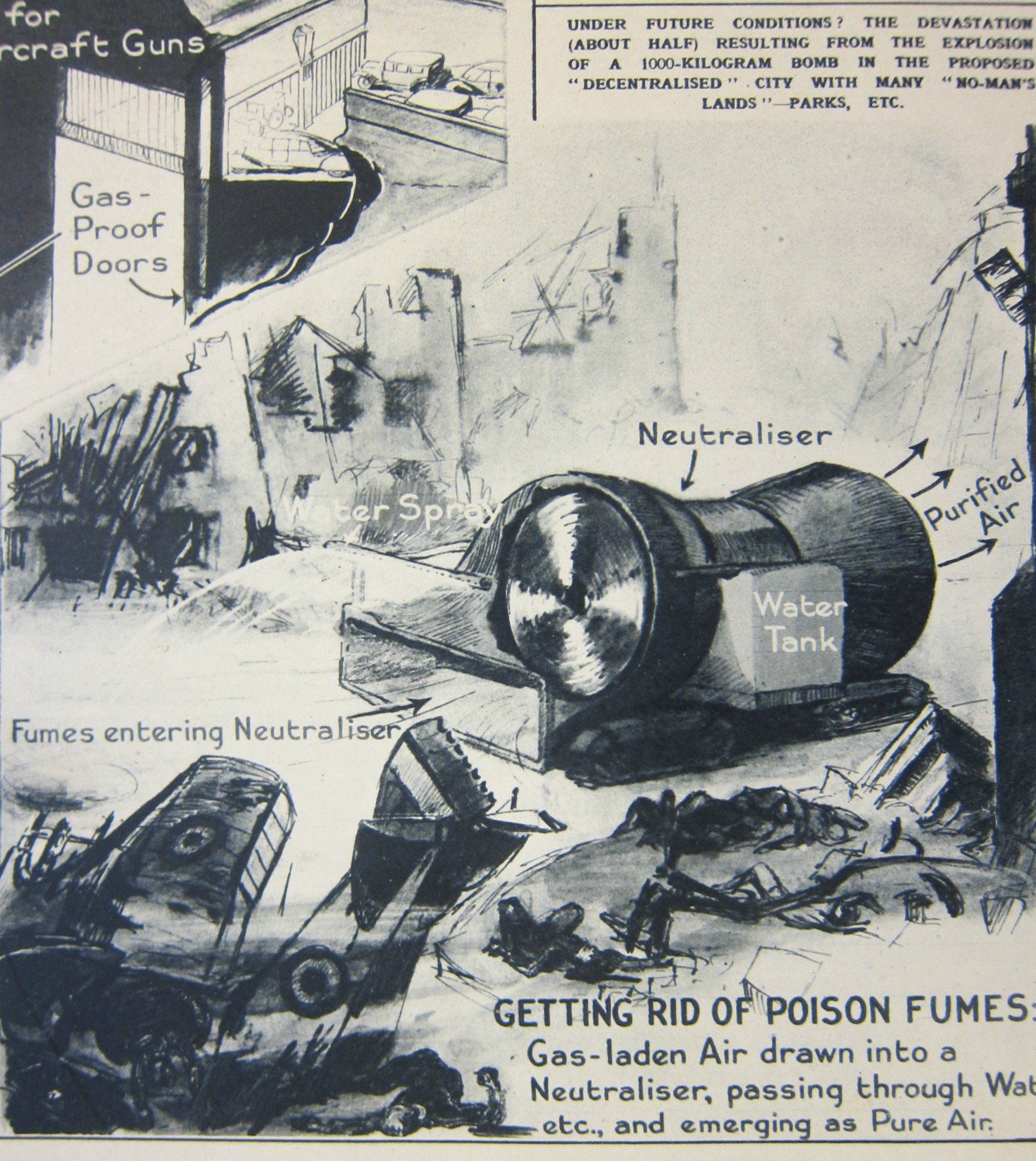
    Anti-aircraft moscow gas scrubber

    The other part of this scenario is the protection from poison gas. And I guess we can just stop right there, with that small tank “neutralizer” that is supposed to absorb poison fumes and release “purified air”, because that sort of protection just will not happen…especially back in 1927.  

    ·Posted by :

    ·in:

    —
  • Ghost Vision and the Coming of T.V.

    JF Ptak Quick Post

    Joseph Plateau, “On a New and Curious Application of the Permanence of Impressions on the Retina”, in Philosophical Magazine, volume 36, January-June 1850, pp 434-436; followed immediately in a much longer paper, “Second Paper on a New and Curious Application of the Permanence of Impressions on the Retina”, pp 436-452, with two plates.

    Plateau

    From: An Annotated Bibliography of Flicker Fusion Phenomena…1740-1952, by Carney Landis, p. 

    PlateauPlateaun (1801-1883) was the inventor of the Phenakistoscope in 1829, and contributed often (especially with considerable papers in 1835 and 1836) on the issue of persistence of vision. Here he writes of that and the flicker effect, which is the optical illusion in which individual sequential units of images are viewed as a continuous motion of images, which is a trick of the visual system and makes such this as the movies and cartoons and animated shows possible.  It is a terrible irony that this great writer on physiological optics would be blind or nearly so by the 1840’s, this a result of an experiment conducted requiring him to stare at the sun for nearly half a minute.

    “Plateau studied in great detail the phenomena of accidental colors and irradiation, both of which he considered as arising from a similar cause related to the persistence of the image on the retina. Accidental colors are those that appear after staring for some time at a colored object and then at a black surface, or closing one’s eyes and pressing one’s hands over them. An image of the object appears, usually in complementary color and slightly diminished in size. Plateau’s results include his discovery that accidental colors combine both with each other and with real colors according to the usual laws of color mixture. In irradiation luminous objects on a dark background appear enlarged, a factor clearly of interest to astronomers, among whom the question of the extent of the enlargement was causing controversy. Plateau showed that enlargement occurs regardless of the distance from the object and—explaining the varied experiences of the controversialists—that the mean amount of enlargement from the same source varied considerably from one individual to another.”–Dictionary of Scientific Biography

    Also in this volume: J. Locke, “On the Phatascope”, pp 453-457, “instrument for giving single vision with two eyes” (–Living pictures; their history, photoproduction and practical working. With a digest of British patents and annotated bibliography, Henry Hopwood, 1899.)

    Among the many other articles in this volume is William Fishburn Donkin’s “On the Geometrical Interpretation of Quaternions”, pp 489-502. (See Alexander MacFarlane’s Bibliography of Quaternions..., 1904, full text here: http://ow.ly/kFRy304gfVD

    Notes:

    • See The History of Discovery of Cinematography timeline, which is especially interesting for the pre-1850 entries http://precinemahistory.net/1850.htm


  • One of Earliest Looking-Down-Between-the-Legs Views of the Eiffel Tower, from an Aeroplane, 1909

    JF Ptak Science Books  Quick Post

    Flight eiffel tower

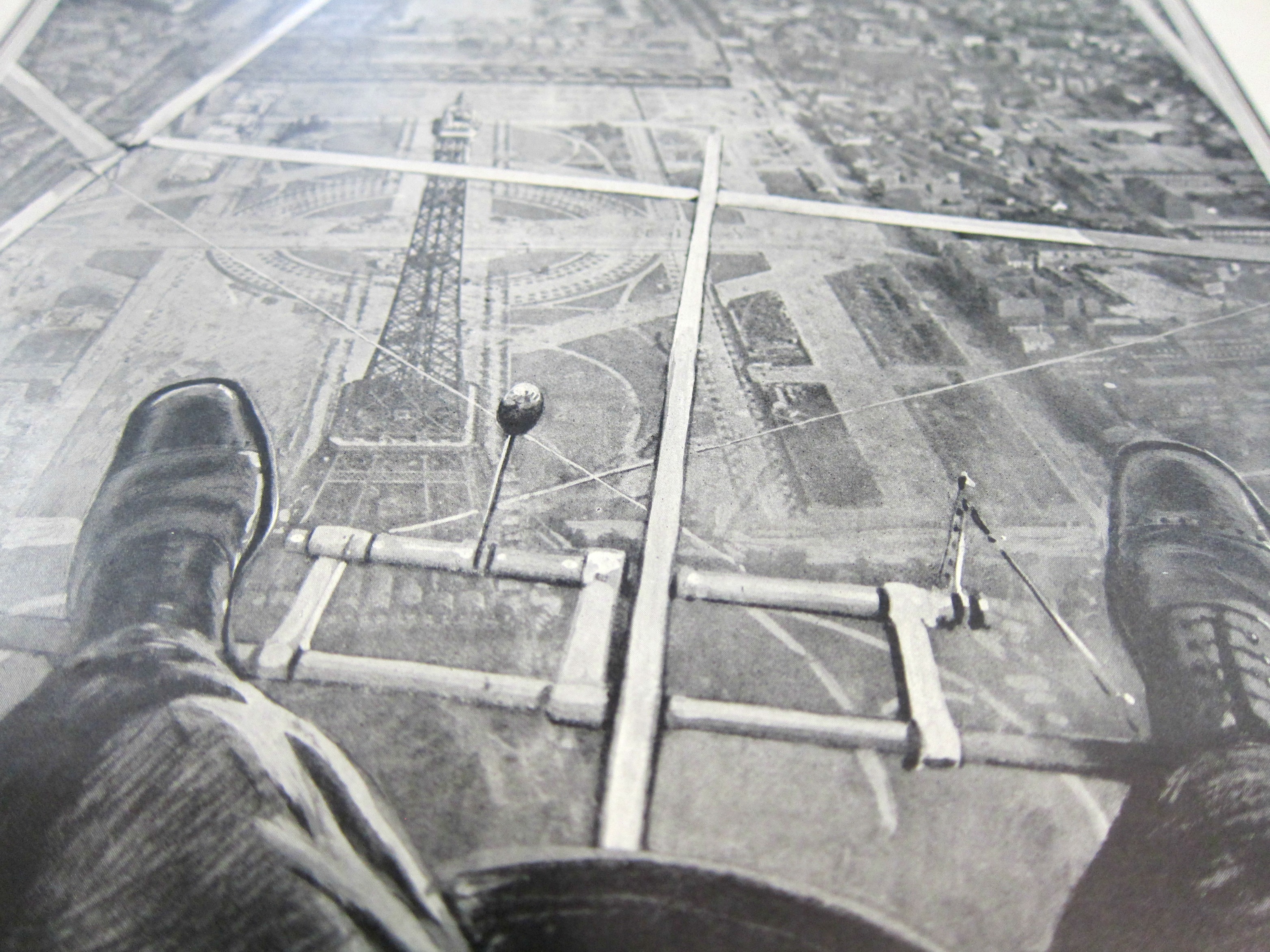
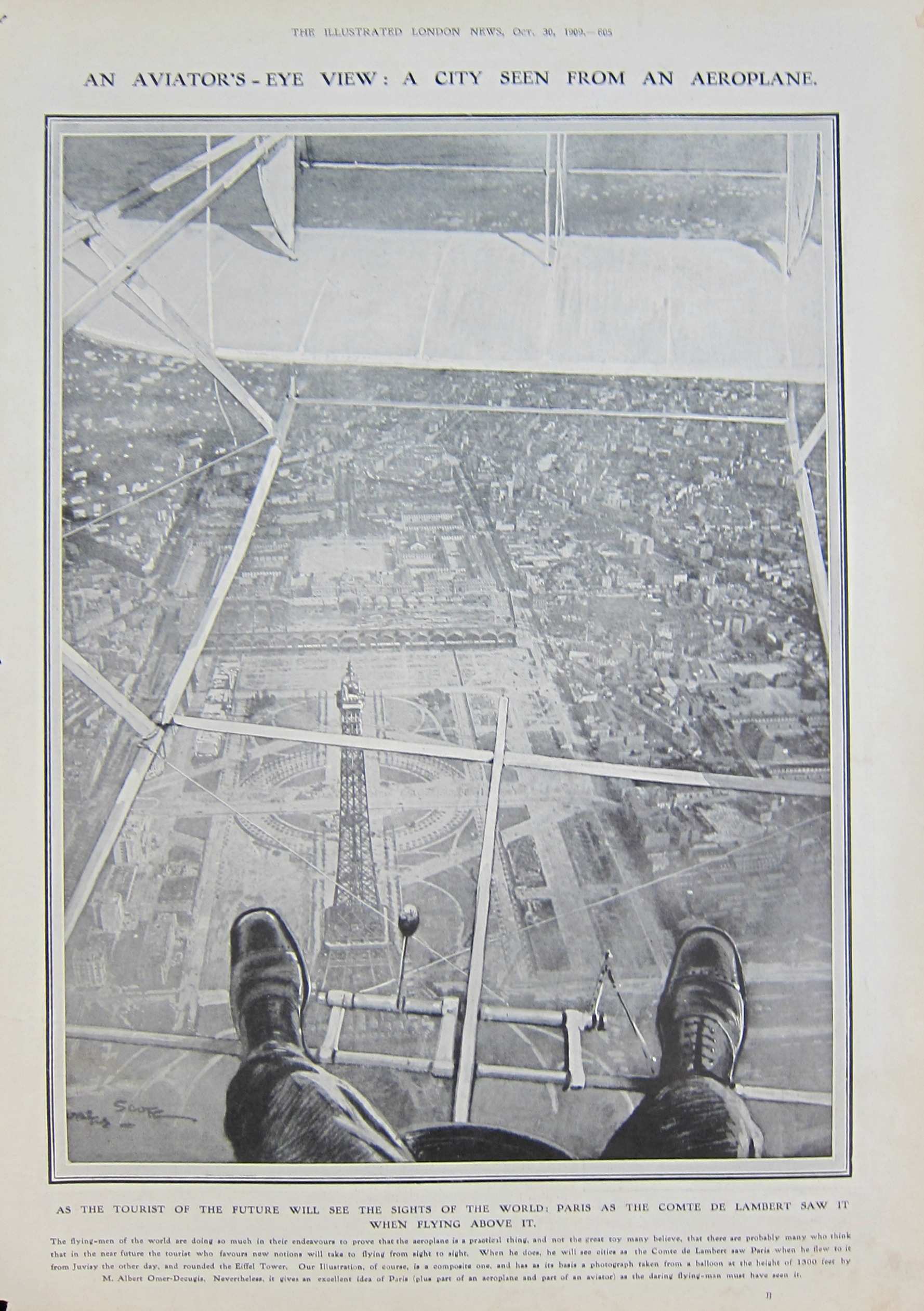
    “An Aviator’s-Eye View: a City Seen from an Aeroplane” is a wonderful composite image published in the Illustrated London News on October 30, 1909.  It represents the city from the point of view of the observer–in this case, the Comte de Lambert, who was the first person in France to receive flight instruction from Wilbur Wright, and who made what the New York Times referred to as “the most remarkable cross-country flight ever accomplished in an aeroplane1“. This was reported in the Times on October 19, 1909, when de Lambert  “left the Juvisy Aerodrome at 4:36 o’clock in a Wright machine, flew across Paris to the Eiffel Tower, circled it, and returned to his starting point, arriving safely at 5:25”, during which he reached a height of about 1300 feet. The you-are-there perspective is a very uncommon one in my experience, and now doubt this one must have given the readers of the ILN a queasy feeling of what flying looked like.  

    Notes:

    1. New York Times, October 19, 1909: “PARIS, Oct. 18. — The most remarkable cross-country flight ever accomplished in an aeroplane was made this afternoon by Count de Lambert. He left the Juvisy Aerodrome at 4:36 o’clock in a Wright machine, flew across Paris to the Eiffel Tower, circled it, and returned to his starting point, arriving safely at 5:25…”
    2. Fkight eiffel tower 1909
  • North Pole Airport of the Future (1945)

    JF Ptak Science Books  Quick Post

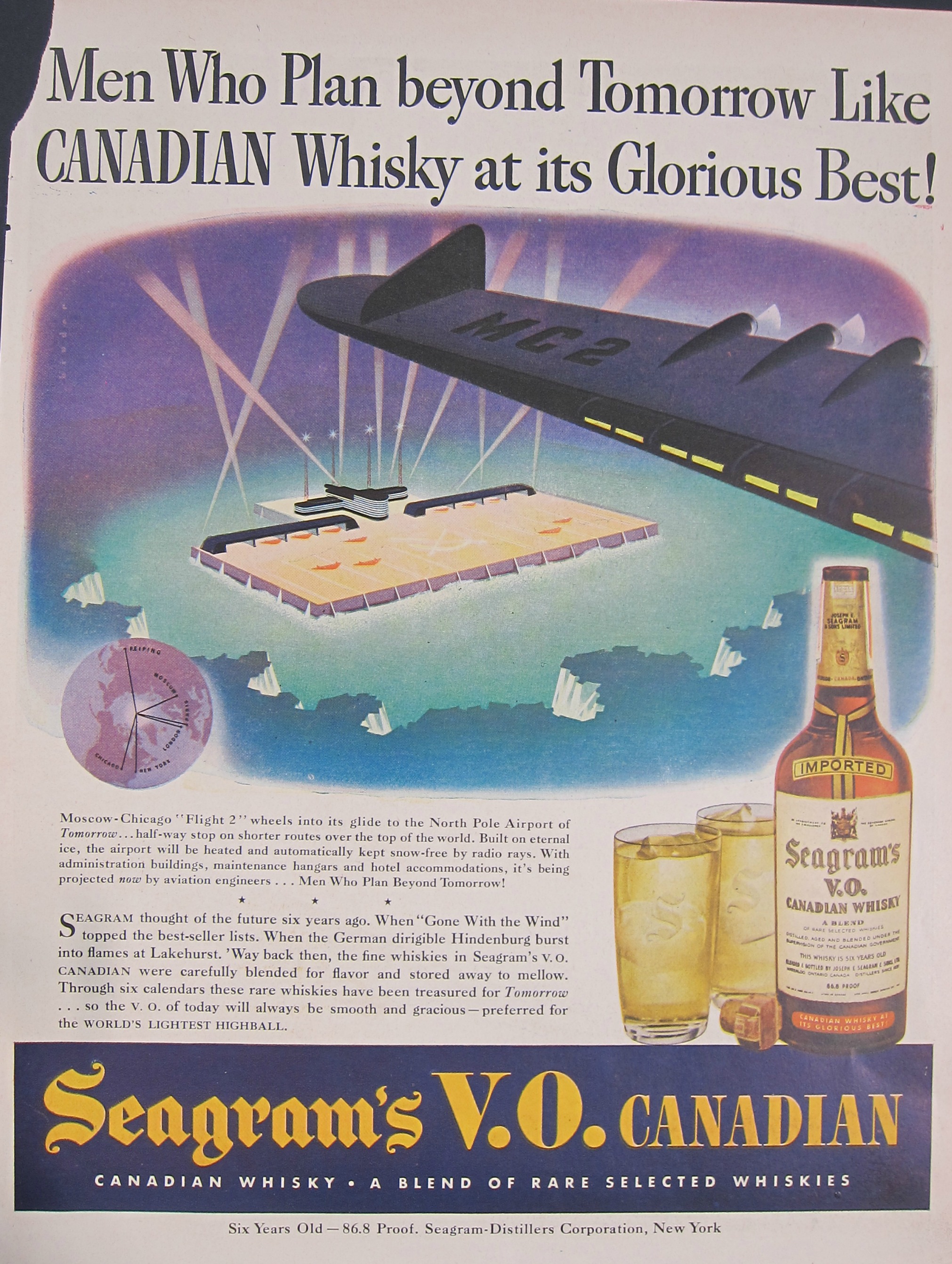
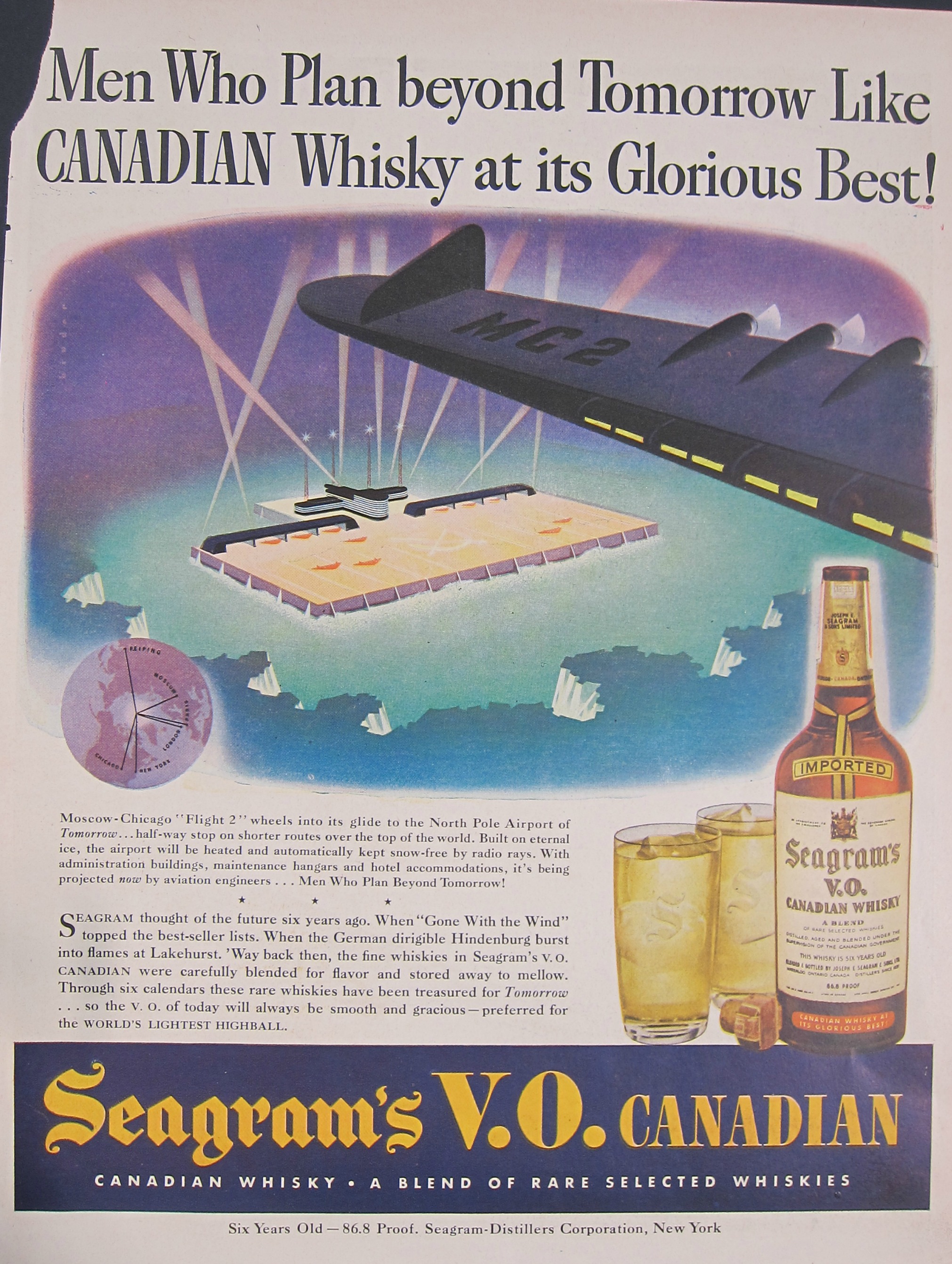
    Future seagrams flightThis gives a new and heavier, colder (?) meaning to the phrase “on the rocks”–a envisionaryiztion or some such thing of air travel in the future, the image fueled or at least paid by Seagram’s Canadian Whisky. At the time when this ad appeared (in LIFE magazine, ca. 1945/6?) it was evidently okay to articulate distilling interests with air flight, which isn’t done so much anymore–that and of course smoking in-flight, though admittedly people were firing up their cancer sticks with a lot more legroom than one has nowadays, but, still, I’d have to go with cramming my body into a too-small seat than sit in a smoke-filled tube with little tiny flames in a combustible environment.

    So this particular piece of the future foresees long-distance flights but not necessarily long distance planes, with the flights accommodated by a large airport at the North Pole that would serves as a nexus for international connections. The airport there “would be heated” and the runways kept clear of snow and ice via ‘radio waves’, adn that’s about it.  No matter about the details or the ideas, so long as you start your own flight of fancy with Seagram’s.  

  • The Heights of the Himalaya Mountains, 1819

    JF Ptak Science Books   

    Offered below is a highly interesting and diverse volume of  The Quarterly Journal of Science, Literature, and the Arts, edited at the Royal Institution of Great Britain, published by John Murray for the Royal Institution, London, 1819; volume VI; illustrated with three engraved plates and a folding map; contained in the volume of iv, 402.  Bound in half-calf with calf tips, and marbled boards. Nice copy. $350

    • “Height of the Himalaya Mountains (pp 51-75), signed “H.T.C.” with a 12×9” folding map.

    This is a wonderful story on the early mapping of the Himalayas, including the work of Capt. WIlliam Webb, who identified the highest mountain peak in the world in 1817.  The map that accompanies the article is mostly blank, with teh exceptions of rivers, a few establishments, and a series of peaks enumerated with Roman numerals. In this case, the peak XIV is identified, rising to 25,643 feet. It is today known as Nanda Devi, located approximately at 79.30 E. Long and 30.30 N Lat.  The peak today is the second highest in India and 23rd highest in the world.

    “A list of many lofty peaks of the Himalaya mountains, measured by him, has appeared in divers publications. It agrees, so far as it goes, with the ampler information contained in a Memoir of his survey officially furnished by him. The Memoir, which bears date 30th Nov. 1817, supplies further measurements of more than two hundred elevated positions, geometrically taken for inaccessible heights -. either barometrically or geometrically, for accessible stations – and in
    both methods, for twenty of those stations. It explains the mode in which the whole survey has been conducted, and these measurements executed…”

    “ From 1816-1820, William Web spent five lonely years surveying Kumaun (he determined the height of Peak XIV or Nanda Devi as 25,669 feet, just 24 feet higher than today’s measurement)..”.–https://www.himalayanclub.org/hj/65/3/the-great-game-of-mapping-the-himalaya/

    And this: “so far as our knowledge extends, the highest mountain in the world.” Its local name was Nanda Devi and for the next 30 years, while expeditions into the central Himalayas from Tibet and Nepal remained impossible, Nanda Devi reigned supreme as the world’s highest mountain (its height is now established at 25,645 feet/7817 m)–http://imagingeverest.rgs.org/concepts/imaging_everest/-288.html

    Other noteworthy articles include

    • “On M. Stromeyer’s new Metal, Cadmium. In a Letter from J. G. Children, Esq. to the Editor. . .” (On the essential element, Cadmium.)
    • “An Hypothesis to account for the variable Depth of the Ocean.” A terrific piece of thinking on measuring the semi-immeasurable in 1818. 
    • “Pitcairn’s Island. From the Voyages and Travels of Amaso Delano. Boston, 1817.”
    • “An Account of some Experiments made on the Body of a Criminal immediately after Execution, with Physiological and Practional Observations.” by Andrew Ure, M. D.  Again, another endlessly interesting article….
     

    ·Posted by :

    ·in:

  • Intergalactic Rocketport, in Glorious Big Color! (1938)

    JF Ptak Science Books   Quick Post

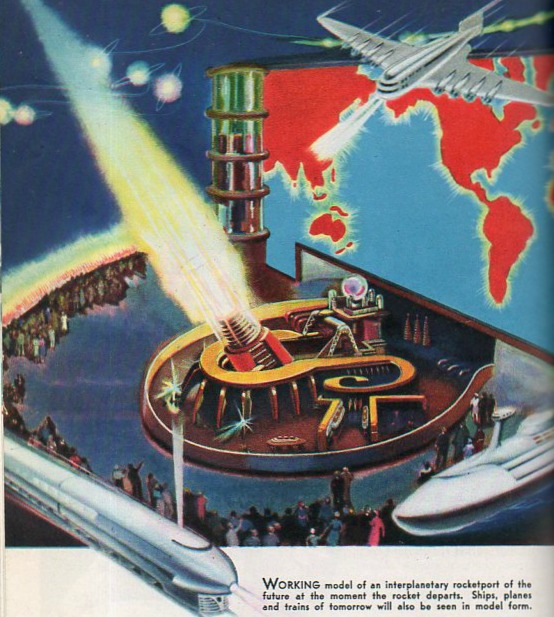
    This was a big gulp of a very colorful possible futureworld in which intergalactic travel has become possible, this image of this model being given an advanced peek prior to the New York World’s Fair of 1939.  “Intergalactic” is a big deal, because, well, there are galaxy-sized distances involved–even in Star Trek the Next Generation, the Enterprise never in the run of that series leaves the galaxy under its own power, and so the possibility of travel between the galaxies such that there could be a ‘rocketport” for it would be a very big deal, indeed. Perhaps that is what was needed at the New York World’s Fair of 1939, given the state of things–the long Depression, the Munich Appeasement and the hollow “peace in our time”, the Austrian Anschluss, the seizure of the Sudetenland, Kristallnacht, the Spanish Civil War, and the continuation of the Japanese assault on China, all could have spelled out the need for some sort of relief even if that was fictional and in the future. Certainly intergalactic travel would qualify for that, as did a number of other pieces of speculative/scifi entertainment that year: Flash Gordon and Buck Rogers were alive and well, Superman appears for the first time, and Orson Welles scares the wits out of a certain trumpian segment of the population  with the Halloween-night performance of The War of the Worlds. Perhaps the time was ripe for the rocketport–especially in such vivid color.

    1939 worlds fair interplanetary701

    [Source: Popular Mechanics, volume 70, August, 1938]

  • What Electricity Tastes Like (1824)

    JF Ptak Science Books  Quick Post

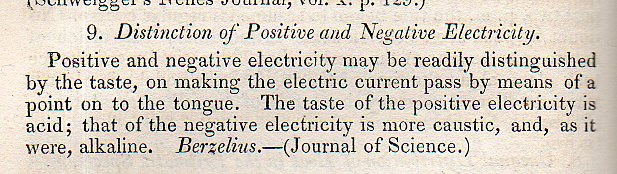
    So, while reading in the Annals of Philosophy–an interesting and curious journal with some important original contributions and a large selection of other interesting papers previously printed elsewhere and which was later absorbed by the more-prestigious Philosophical Magazine–for 1824, after finishing trying to figure out what Gay-Lussac was doing with lightning conductors, I stumbled my way through the journal’s monthly section of “scientific notices”.  The “notices” are usually very brief and give enough info so that the reader can make their way to the original source to read the report in-full.  This is how I came upon the great J.J. Berzelius and this note on the taste of positive and negative electricity, which I admit I’ve never thought of before–I was curious about what the “distinction” would be, and then was surprised by what he wrote:

    Electricity702

    By the way, it was determined in 1822 by some governing committee in France that all large churches in France needed to be protected by lightning conductors–the use of lightning conductors was established during Ben Franklin’s time. This evidently became an issue following a particularly bad bit of weather during which numerous churches were damaged, including the Rouen cathedral. Gay-Lussac notes elsewhere that the fear of thunder makes no sense, because the lightning event has already occurred, and that nothing can happen at this point. He points out that people struck by lightning never hear it coming, and have no idea what happened to them–small is that comfort.


    ·Posted by :

    ·in:

  • Warm Sulphur, Coal, and the Cosmos, 1836

    JF Ptak Science Books   Quick Post    An installment in the History of Dots series. 

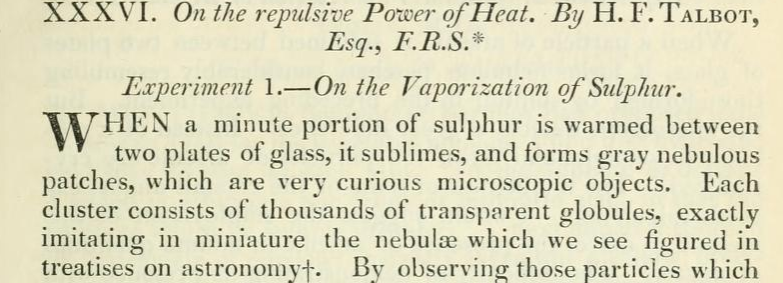
    William Henry Fox Talbot (1800-1877) was among the earliest of the photographic pioneers, or pre-pioneers, as he asserted priority of his photographic method for 1835 when Daguerre revealed his own (very different) method in 1839. Talbot (or Fox Talbot)  was also a practitioner of the art, publishing a stone-cold and revolutionary work of photographically illustrated books, The Pencil of Nature. The work I am interested in for the moment though is this interesting observation he made in the Philosophical Magazine (third series, vol 8) for 1836, when he unexpectedly turns somewhat poetic in the start of his paper:

    Talbot nebulae


    I don’t know about the history of likening some collections of objects to a starry night of deep space–certainly it has been going on for a long time, with people finding similarities (and perhaps corollaries!) between collections of stuff (dust, moles, sand, so on) and the night sky. (There are several such observations on this blog, the most recent one, on deterioration of paper in a book and the negative of a deep space image, appears here:  https://historyofideasblog.com/thesciencebookstore/2016/08/page-in-a-book-or-stellar-field.html )  Funny thing here is that there is some small connection between my paper-damage-night-sky and the Talbot’s sulphur–some part of this ‘foxing”, those reddish discolored “dots” on the page of the book, is a product of the interaction of the paper and sulphur oxides, like sulphur dioxide, produced in the burning of coal. So: coal and the cosmos. 

    Here’s the image from that earlier not-Talbot  piece on the blog–one is a close-up of paper deterioration in a book from 1820, and the other is an ultraviolet photograph of the Pleiades made in 2009:

    Book universe montage

     Unfortunately Mr. Talbot only provided a thinking-image of his experiment…

    ·Posted by :

    ·in:

    —
  • WWII Military Secrets in British Politics (1945)

    JF Ptak Science Books   Post 2632

    British political pamphlets fido detail705

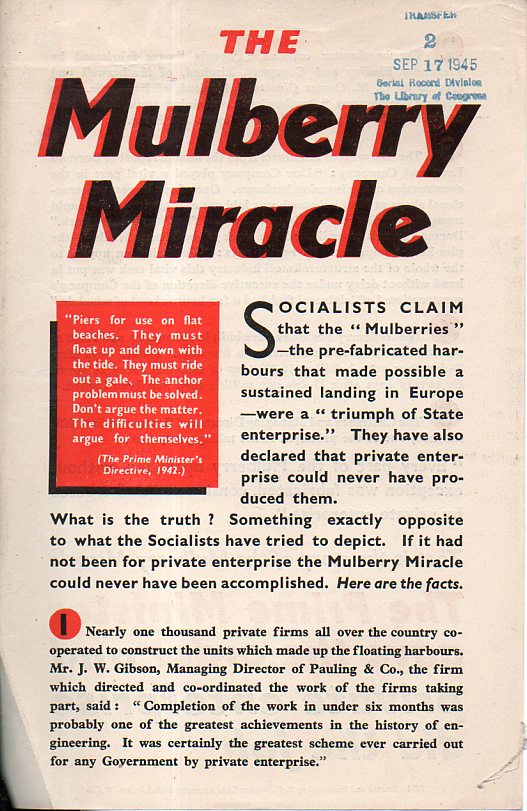
    British political pamphlets Mulberry703Earlier this morning I was looking at a collection here of British political leaflets (half around the 1893-1895 period, and then a bunch around the election of 1945) when I read a very dynamically-designed handout on how the Conservative government mobilized private industry into wartime production, and concentrating on the much-beloved and critical creation of the “Mulberry”, or the Mulberry Floating Harbor.  It was striking to me as the creation of the enormous floating harbor was a deep secret as it was an essential element in supporting/supplying the Allied invasion force in Normandy–and yet here it was, used by the Conservative party in an effort to re-elect Prime Minister Churchill, in a publication printed perhaps just a year after they were pulled across the Channel and presented to the world.  

    And it happens again in the following leaflet, though this one employs more of the previously secret stuff.

    I should say that this election in July 1945, just weeks after VE Day, produced what must have been a very surprising/shocking result, a result probably none the less surprising ti the unexpected victor, Clement Attlee, whose Labor Party produced a seemingly impossible small landslide victory over the (probably) most important man to the Allied war cause in WWII, Winston Churchill,  and the Conservatives.  (Churchill would return the favor in 1951.) 

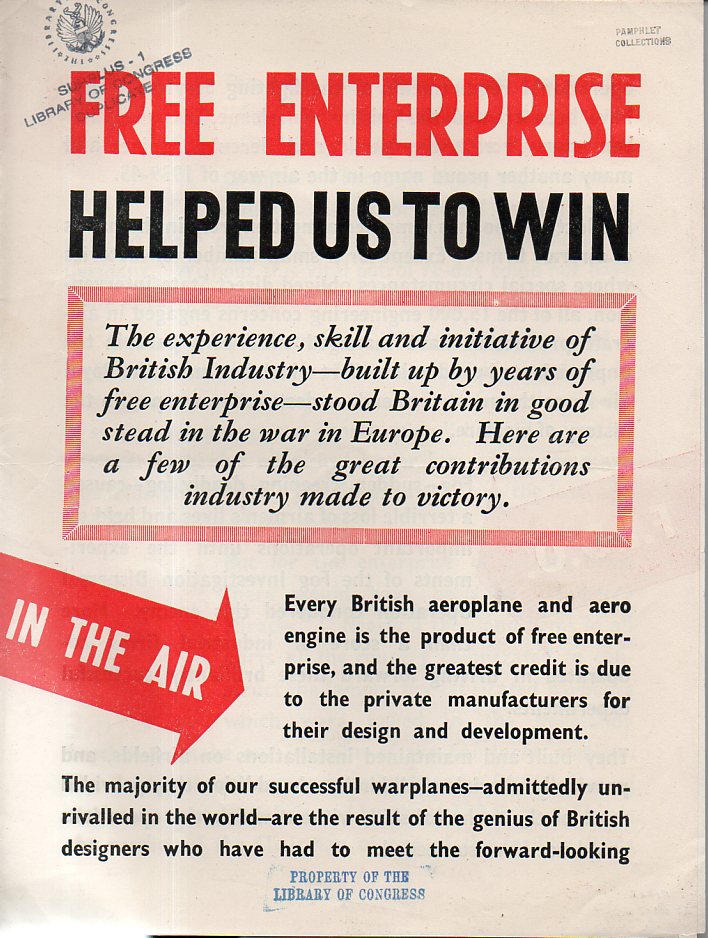
    Be that as it may, in this leaflet, “Free Enterprise Helped Us To Win”, produced by the Conservatives and ending with the ringing slogan, “Vote National”, used a number of the important and secret military developments of WWII as examples of private enterprise contributing to the war effort and standards of free enterprise.  Included here are:

    British political pamphlets fido704

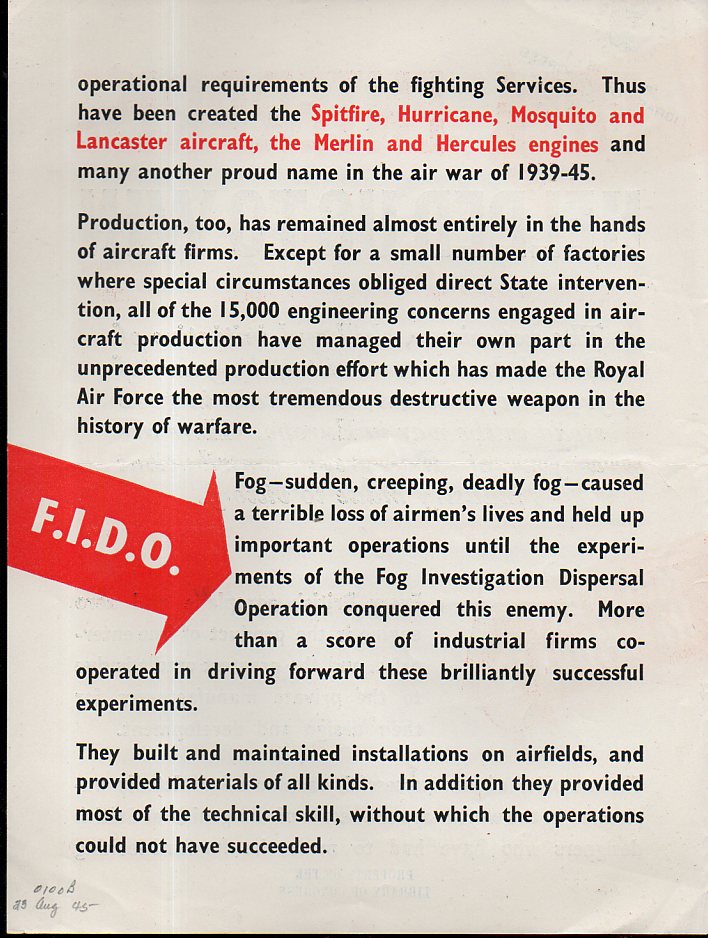
    • the private designers who helped produce the singular Spitfire and other warplanes;
    • F.I.D.O, the Fog Investigation Dispersal Operation, which was a system installed at airfields by which (as teh acronym tells us) dissipated fog and smog so that bombers and fighter planes could land in foggy conditions;
    • P.L.U.T.O.: “Pipe Under the Ocean”, an enormous operation, was an oil pipeline that stretched from England under the Channel and basically deep into Europe, a much more efficient and effective way of getting fuel to your advancing armies than, say, the German shipping fuel across the Mediterranean where Rommel’s necessary petrol was happily torpedoed;
    • and as mentioned the Mulberry Harbours, plus the “sticky bomb”, the “flying dustbins, the Spigot mortar, and the P.I.A.T…all brought about by Free Enterprise, according to the leaflet.

    I’m not saying anything about this in a judgmental way–I was just very surprised to see all of this here, in a public handout leaflet, a brief description of some formerly very secret stuff. 

    British political pamphlets fido705

Recent Posts

Archives

Categories