A Daily History of Holes, Dots, Lines, Science, History, Math, Physics, Art, the Unintentional Absurd, Architecture, Maps, Data Visualization, Blank and Missing Things, and so on. |1.6 million words, 7500 images, 4.9 million hits| Press & appearances in The Times, Le Figaro, Mensa, The Economist, The Guardian, Discovery News, Slate, Le Monde, Sci American Blogs, Le Pont, and many other places… 5000+ total posts since 2008.

  • A Staccato of Abbreviations and Finding a Mystery Where There Probably Isn’t One

    JF Ptak Science Books  Post 2641  

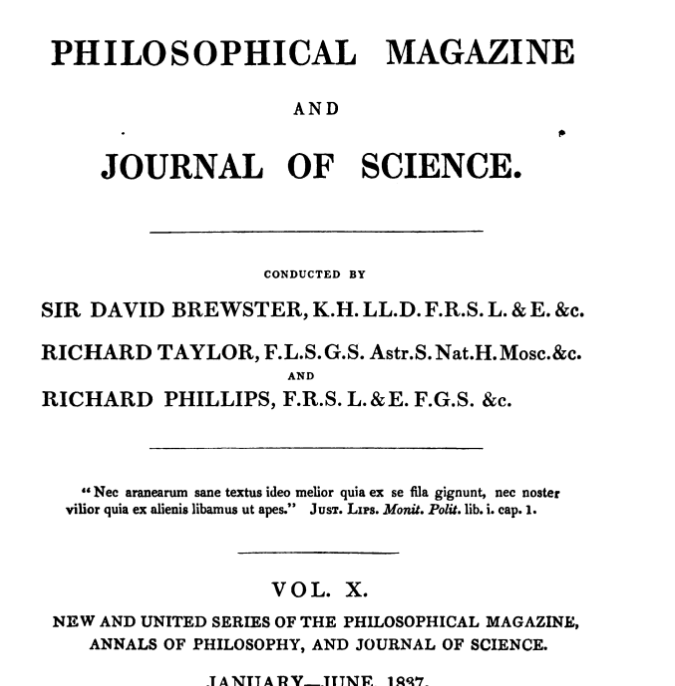
    Philosophical Magazine quote

    Philosophical Magazine quoteI’m a fan of some sorts when I see a string of abbreviations, the writer writing for a sympathetic readership with at least a common interest in the subject, knowing that spelling everything out isn’t quite necessary, especially if space is an issue.  On title pages this happens often with the academic heritage and awards of the author, as well as with quotes, which is where my staccato of abbreviations was found.

    The “misunderstanding”  here occurs in the reference to the source of the quote, which has lead me to look at a number of different editions of various works by the author.  It seems that I am missing something big in finding the source of the quote, because it seems impossible that an attribution right there in the middle of the title page of one of the most significant scientific periodicals of the 19th century will surely not be incorrect.

    First, the abbreviation for the origin of the quote (“Nec aranearum sane textus ideo melior quia ex se fila gignunt, nec noster
    vilior quia ex alienis libamus ut apes.”) starts out beautifully with “Just. Lips.” followed by “Monit. Polit. lib. i. cap. 1.”  

    This is simply the name of the author and the work and page on which the quote is found:  initially I thought I was dealing with Justus Lipsius’1 Politicorum sive civilis doctrinae libri sex : qui ad principatum maxime spectant. Additae notae auctiores, tum et De una religione liber…, printed at the Plantin Press in Leiden in 1589, book one (of the six books/sections comprising the work, or “libri sex”), chapter one.

    I don’t know the quote, and even though I have been working with the Philosophical Magazine for quite some time, I never had bothered to to it up until a few days ago, when I bumped into this question.  The thing is, the quote doesn’t really appear in I/1–it does appear in the Additae Notae section at the end of the book, on page 463, referencing I/1 on page 12.

    Then I figured out that this seemed to not be the correct book, although the quote was more-or-less placed correctly.  The “Monit” part of the extended abbreviations refers to Lipsius Monita et exempla politica : libri dvo, qui virtvtes et vitia principum spectant…2(1609), in which I did a text search for keywords and the quote but could not find it, which further confuses a matter that may not be confusing to someone more familiar with these works and era. 

    It seems impossible that the Phil Mag would be in error here on the issue of referencing a great classic and that it must be that I’m just missing something,  and no doubt someone reading this will let me know.

    In any event I thought I’d share this little ride I took on the back of this quote…which, by the way, along with the sentence preceding it, is quoted and translated  in  The Reception of Erasmus in the Early Modern Period, edited by Karl A. E. Enenkel (page 188. below):
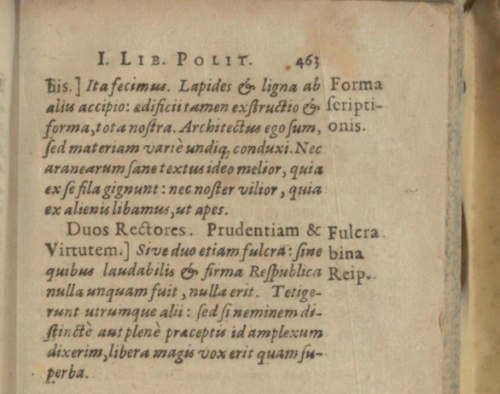
    Lipsius

    Image source and full text at Internet Archive: https://archive.org/details/imgPiz59MiscellaneaOpal
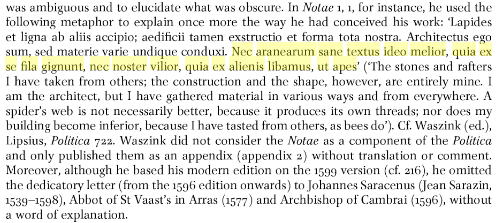
     

    Lipsius notae translation

    Which in a sense is similar to the Newton/shoulders-of-giants quote, here the writers building upon that which has come before and making something different of it. 

    Notes:

    1.  Justus Lipsius  “…humanist and classical scholar…(Joost Lips, 1547–1606), described by his admiring correspondent Michel de Montaigne as one of the most learned men of his day (EssaysII.12), was the founding father of Neostoicism, a key component of European thought in the late sixteenth and seventeenth centuries…”–Stanford Encyclopedia of Philosophy (online))

    2.  Lipsius’ work can be seen here at the Internet Archive: https://archive.org/details/ivstilipsimonita00lips

    ·Posted by :

    ·in:

  • A Coy Zeno, Without Paradox

    Zeno detail 2

    Zeno portraitThis fine engraving of Zeno of Elea (490-430 BCE) was printed in 1739  and appeared in Veterum Illustrium Philosophorum, Poetarum, Rhetorim et Oratorum Imagines…by Jo. Petri Bellorii, and published in Rome.  It is a fairly large image for a portrait like this, measuring 8.5×5″inches on a sheet 13×9″, engraved on a very heavy and thick paper.  

    From the Stanford Encyclopedia of Philosophy:

    “Zeno of Elea, 5th c. B.C.E. thinker, is known exclusively for propounding a number of ingenious paradoxes. The most famous of these purport to show that motion is impossible by bringing to light apparent or latent contradictions in ordinary assumptions regarding its occurrence. Zeno also argued against the commonsense assumption that there are many things by showing in various ways how it, too, leads to contradiction…” More here: http://plato.stanford.edu/entries/zeno-elea/

    It is a little curious to me that in Augustus de Morgan’s wonderful A Budget of Paradoxes that there isn’t a single hit for Zeno in the 150 mentions of “paradox” in the work, though that is probably due to my “looking around” more than anything else.  

    Full text for that here at Project Gutenberg: http://www.gutenberg.org/files/23100/23100-h/23100-h.htm

    ·Posted by :

    ·in:

  • An Early-ish Report on the V1, January 1945

    A Technical Report on the V-1, 1945

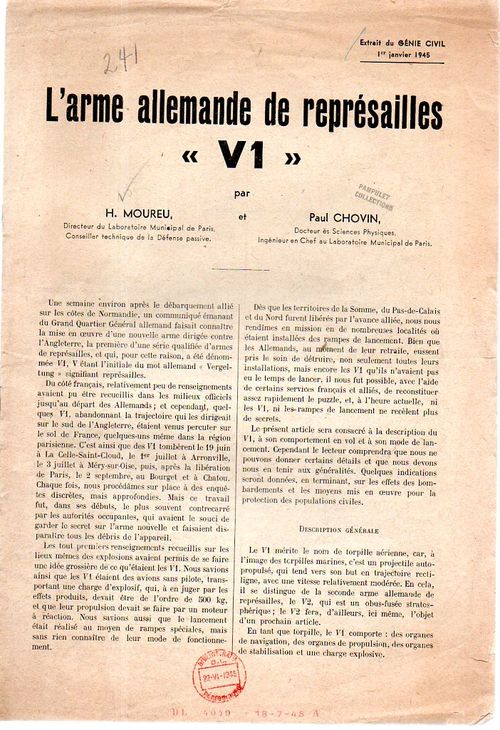
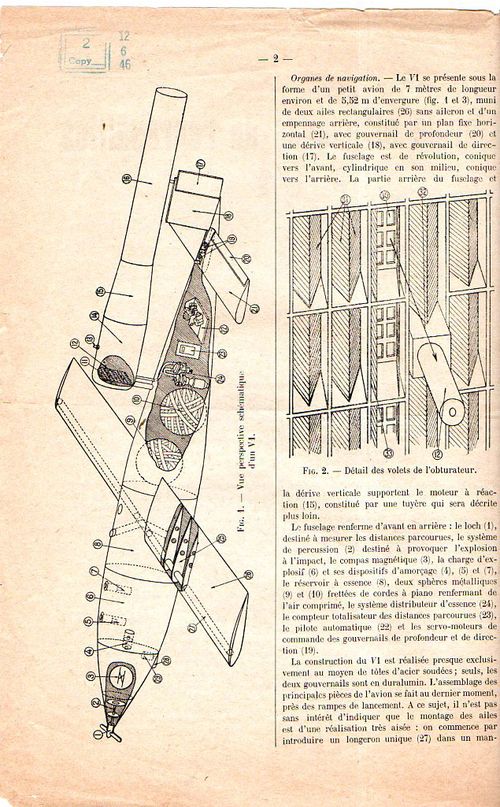
    This report by Henri Moreau (1893-1978) and Paul Chovin–“L’arme allemande de represailles V1”–is an offprint from Genie Civil, and printed 1 January 1945. It is  9×6 inches and runs a pretty-involved eight pages, and was printed in Paris (newly liberated from the German army 25 August 1944) on the first day of 1945.

    I was frankly surprised to find this fairly-well documented piece on the V-1, and couldn’t find much on it at all, so I reprinted the report in its entirety. Some of the text runs off the side of the scanner, but that is the best I can do in scanning the pamphlet without taking it completely apart. 

    V1_1_


    V1521

    ·Posted by :

    ·in:

    —
  • Definitely Not Your (Modern) Weekly “People Magazine”

    JF Ptak Science Books  

    I have developed a sort-of  collection in the History of Blank and Empty Things series of not-filled-in applications and diaries and questionnaires and such, from Hitler Jugend diaries to notebooks for Nazi Warsaw telephone directories to applications for membership in the Women’s KKK, and so on.  This small installment comes on the back inside cover of Labor Conscription, What Does it Mean…Involuntary Servitude!, a hopeful ad for the reader who might be interested in Socialism and receive the magazine People Weekly, as this far Left pamphlet was after all published by the New York Labor News Company on behalf of the Socialist Labor Party U.S.A. This of course in no way bears any resemblance to the modern People Magazine, the fruits and labor of that periodical being sweets and fats.

    Labor Conscription761  Labor Conscription762

  • Nazis and T.V. (1944)

    Nazi tv770JF Ptak Science Books   Quick Post

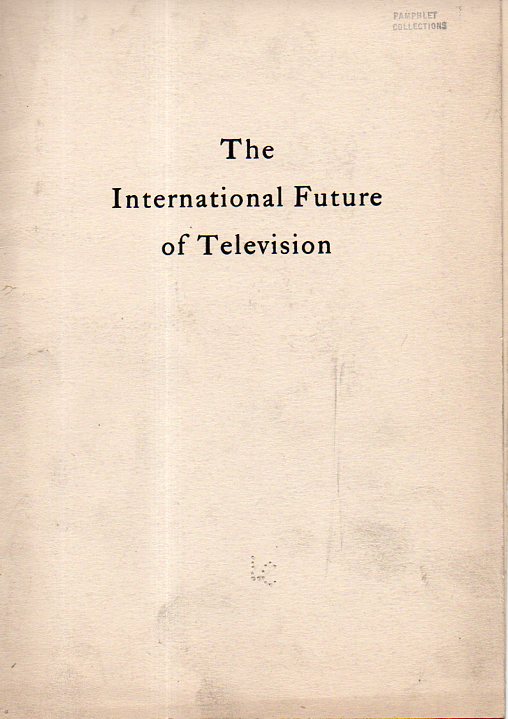
    In all my exposure to the history of WWII  I am pretty sure that the only reference to Nazi television has been along the lines of the Berlin Olympics or Carl Sagan’s Contact–that and some dim memory about Hermann Goering somehow in the great bowels of the labyrinthine Nazi bureaocracy being in control of German tv broadcasting. The International Future of Television, an address by Paul Railbourn before the American Television Society in NY in January 1944, discusses the possibility of television in the Post WWII era–and in that, stresses in no uncertain terms that the Nazis should not have access to the new medium. Railbourne (who would later become a VP at Paramount Pictures) talks about how Hitler utilized and dominated the radio, and how after the war re-education of Germany was necessary along with free enterprise undertaking of newspapers, radio, television, and motion pictures.

    He notes that “The Nazis are well aware of the importance of television…destroy the Luftwaffe and the Krupps Armament works, but leave television in their hands, and we shall be leaving them with the most powerful weapon of all…”

    To that end the author discusses post-war control of radio and television in German. He also talks about establishing television networks throughout the U,.S. as quickly as possibly to “capture world leadership in television programming” and “carry the gosphel of the Four Freedoms to all mankind”.  “…Television will play a vital role, for good or ill as it is intelligently or evilly directed, in the establishment and maintenance of an enduring peace, once the present war comes to an end.”

    Railbourne made good sense, and had I think a pretty good idea of the coming possible influence of the new medium.


  • Ghost Vision and the Coming of T.V. (1850)

    JF Ptak Quick Post

    Joseph Plateau, “On a New and Curious Application of the Permanence of Impressions on the Retina”, in Philosophical Magazine, volume 36, January-June 1850, pp 434-436; followed immediately in a much longer paper, “Second Paper on a New and Curious Application of the Permanence of Impressions on the Retina”, pp 436-452, with two plates.

    Plateau

    From: An Annotated Bibliography of Flicker Fusion Phenomena…1740-1952, by Carney Landis, p. 

    PlateauPlateaun (1801-1883) was the inventor of the Phenakistoscope in 1829, and contributed often (especially with considerable papers in 1835 and 1836) on the issue of persistence of vision. Here he writes of that and the flicker effect, which is the optical illusion in which individual sequential units of images are viewed as a continuous motion of images, which is a trick of the visual system and makes such this as the movies and cartoons and animated shows possible.  It is a terrible irony that this great writer on physiological optics would be blind or nearly so by the 1840’s, this a result of an experiment conducted requiring him to stare at the sun for nearly half a minute.

    “Plateau studied in great detail the phenomena of accidental colors and irradiation, both of which he considered as arising from a similar cause related to the persistence of the image on the retina. Accidental colors are those that appear after staring for some time at a colored object and then at a black surface, or closing one’s eyes and pressing one’s hands over them. An image of the object appears, usually in complementary color and slightly diminished in size. Plateau’s results include his discovery that accidental colors combine both with each other and with real colors according to the usual laws of color mixture. In irradiation luminous objects on a dark background appear enlarged, a factor clearly of interest to astronomers, among whom the question of the extent of the enlargement was causing controversy. Plateau showed that enlargement occurs regardless of the distance from the object and—explaining the varied experiences of the controversialists—that the mean amount of enlargement from the same source varied considerably from one individual to another.”–Dictionary of Scientific Biography

    Also in this volume: J. Locke, “On the Phatascope”, pp 453-457, “instrument for giving single vision with two eyes” (–Living pictures; their history, photoproduction and practical working. With a digest of British patents and annotated bibliography, Henry Hopwood, 1899.)

    Among the many other articles in this volume is William Fishburn Donkin’s “On the Geometrical Interpretation of Quaternions”, pp 489-502. (See Alexander MacFarlane’s Bibliography of Quaternions..., 1904, full text here: http://ow.ly/kFRy304gfVD

    Notes:

    • See The History of Discovery of Cinematography timeline, which is especially interesting for the pre-1850 entries http://precinemahistory.net/1850.htm


    ·Posted by :

    ·in:

  • A Warehouse of Locomotives: Baldwin Works, 1884

    JF Ptak Science Books   Quick Post

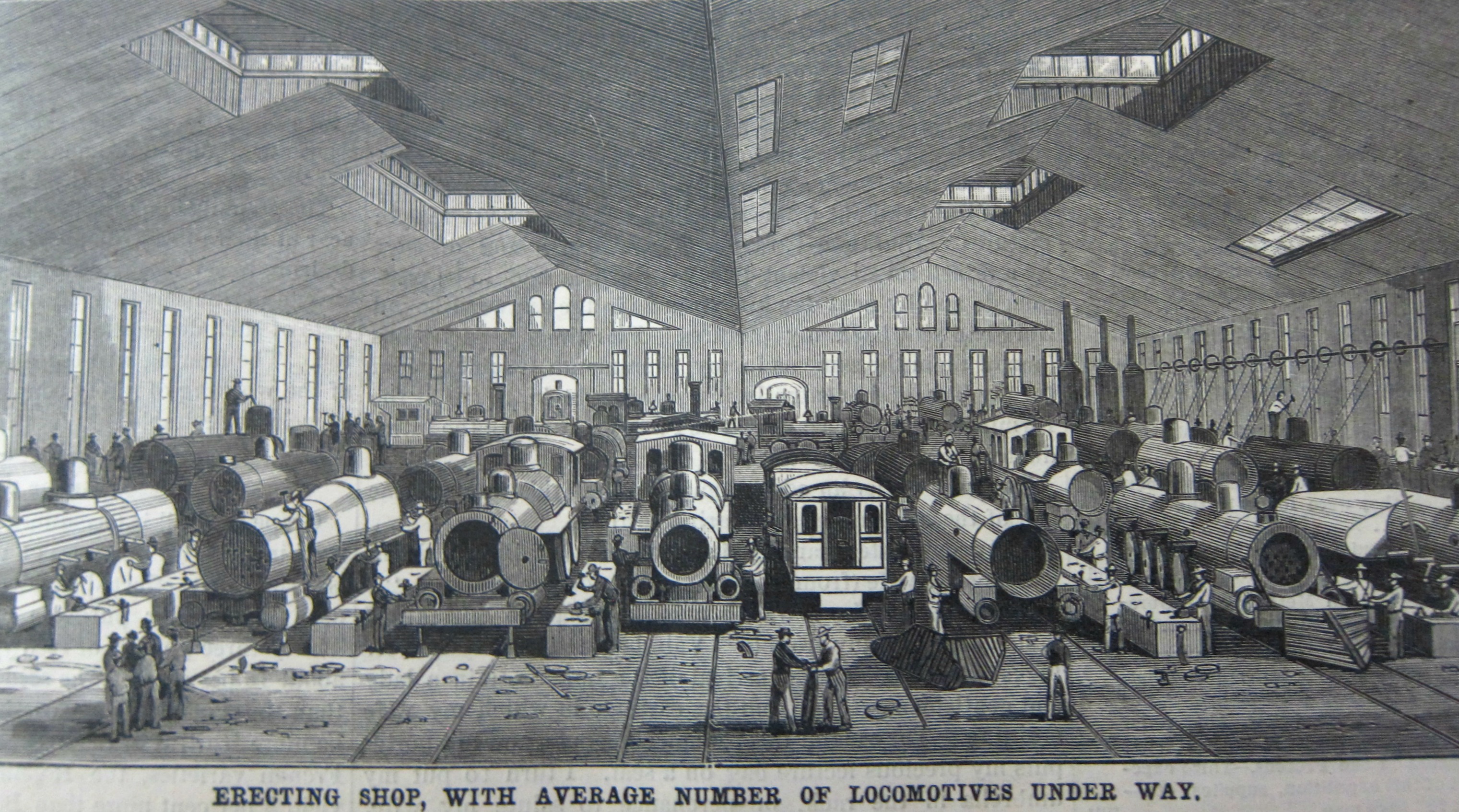
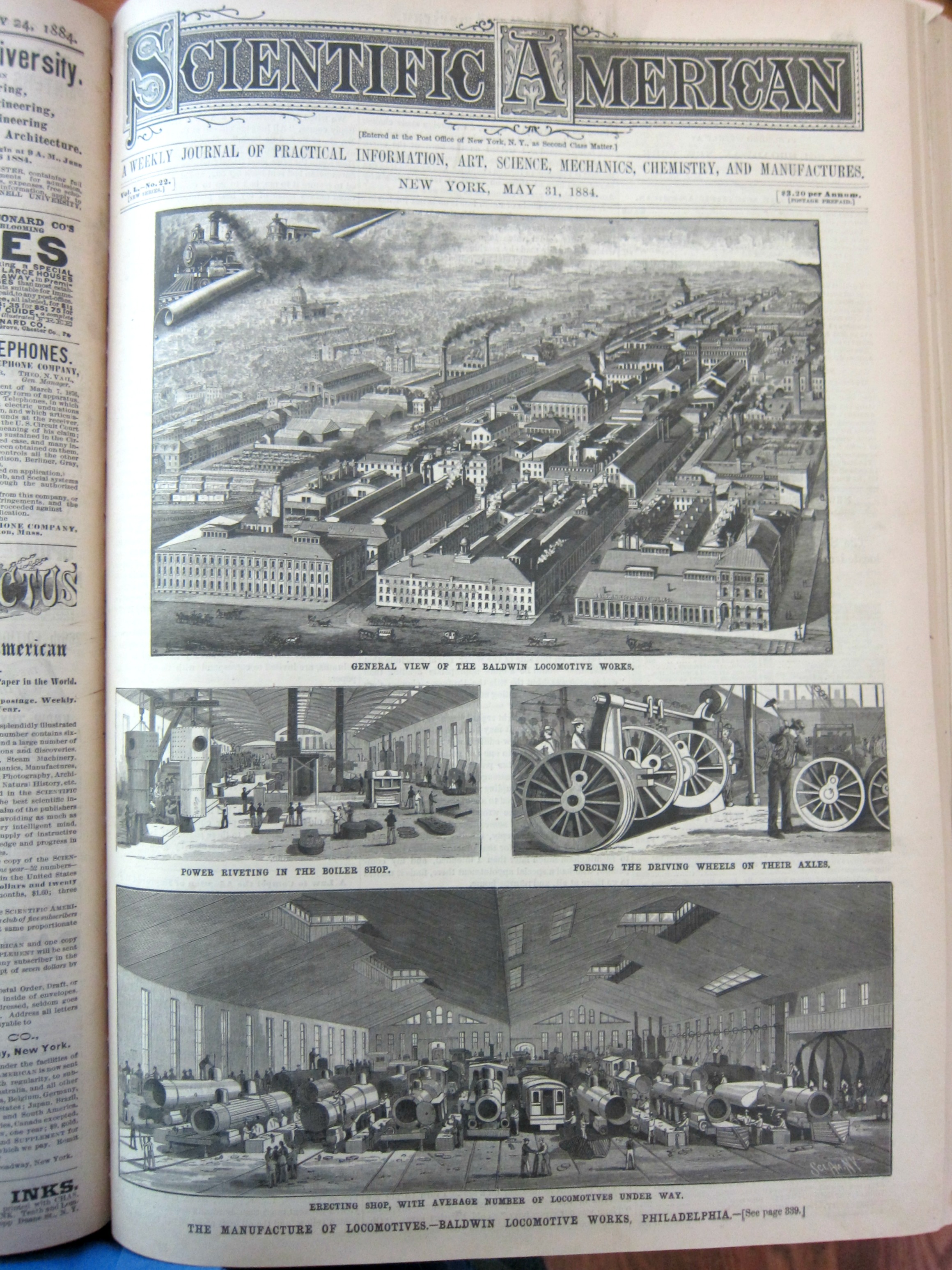
    There’s a definite real-or-imagined synesthesic olfactory reaction to this image–for me, at least.  The ceiling seems a little low for what’s going on inside this building, and none of the skylights seem to be open, and the windows in the walls don’t seem to be letting much air in, which means that there is probably a high order of oil and carbon and other hammering smells going on here, locomotives being assembled/fixed check-to-jowl. It looks to be about 12/15 locomotives in one stage of completion or another in this structure, which means that there must’ve been 100-200 engineers and workmen in there too.  The Baldwin Works–pictured here in a detail of the front page of the Scientific American for May 31, 1884–is shown at a very strong point in U.S. railroad development, and there’s nothing quite like an image like this that spells out “work” than something like this. 

    Locomotives Baldwin SI 1884


    Locomotives baldwin SI 1884

  • Brevity and Complexity–ALGOL 1960

    JF Ptak Science Books     

    I think that I’d like to start a new category of observation for this blog–complicated work explained with celebrated brevity and clarity.  Earlier today I wrote a post on a 24-page effort by the great polymath and mathematical titan, Henri Poincare, describing his Newtonian-clad version of relativity, and it certainly classifies as a superior effort in a short, clarifying description of a wide and complex topic.  Wittgenstein’s Tractatus Logico-Philosophicus is another–it is considerably longer though incredibly short for the work that it undertakes, ending with a sentence that has become an independently-standing aphorism, “Whereof one cannot speak, one must pass over in silence”.

    But for right now, I’d like to look at a splendidly short work.

    ALGOL 1960

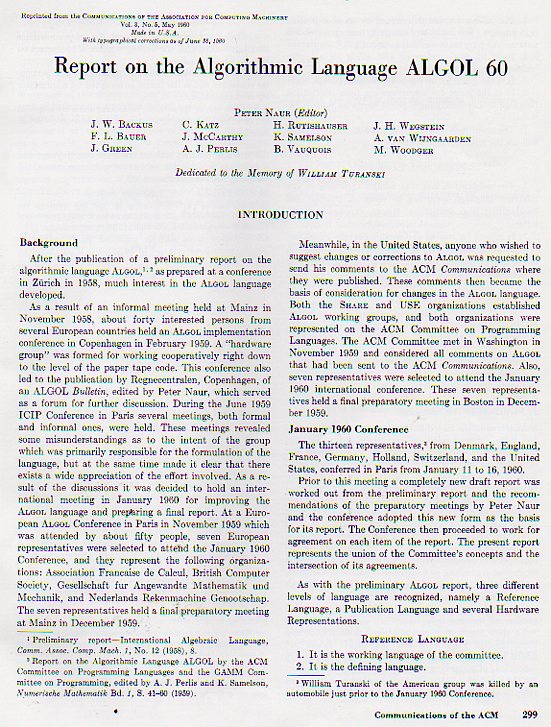
    Much is owed to people like Peter Naur1, a Dane who made an enormous contribution in the development of computer languages by being the lead developer in the creation of ALGOL.  As a matter of fact Naur (b. 1928) received the computing world’s equivalent of the Nobel Prize (“highest distinction in Computer science”)–the Turing Award–for this work, receiving the high honor in 2005. The official short description–again in the manner of the Nobel Committee– was “(f)or fundamental contributions to programming language design and the definition of ALGOL 60, to compiler design, and to the art and practice of computer programming”.         

    This all came to mind while looking through Report on the Algorithmic Language ALGOL 60 (published in the Communications of the Association for Computing Machinery, May 1960) which was edited by Naur.  ALGOL was the creation of 40+ minds, twelve of whom were listed contributing to this paper-–it is a great testament to Naur to control all of that input, producing a superb fifteen page report of great brevity, beautiful logic and utter accessibility.  Perhaps If the team was given a lot more time Naur could’ve made his work even more succinct, but I really doubt it.  It is written in a language that is somewhat foreign to me, but I can certainly appreciate the way the work is structured its precise manner of presentation.  It seems to me a hallmark of communicating complicated ideas in a small space.

    NOTES:

    1.  NAUR, P. (with J. W. Backus, F. L. Bauer, J. Green, C. Katz, J. Mccarthy, P. Naur, A. J. Perlis, H. Rutishauser, K. Samelson, B. Vauquois, J. H. Wegstein, A. Wijngaarden,M. Woodger) . Report on the algorithmic language ALGOL 60. Offprint:  Communications of the ACM,  May, 1960, vol 3, #5. 25x21cm, pp 299-314.  Rare.  There is evidently an two months earlier-but-not-circulated report (no citation for this), as well as a later printing appearing in  Numerische Mathematik, 2/1, December, 1960, followed in 1962 with a longer edition.

  • The Square of Art: the Beauty of Square Roots (1833)

    JF Ptak Science Books   Post 2640    

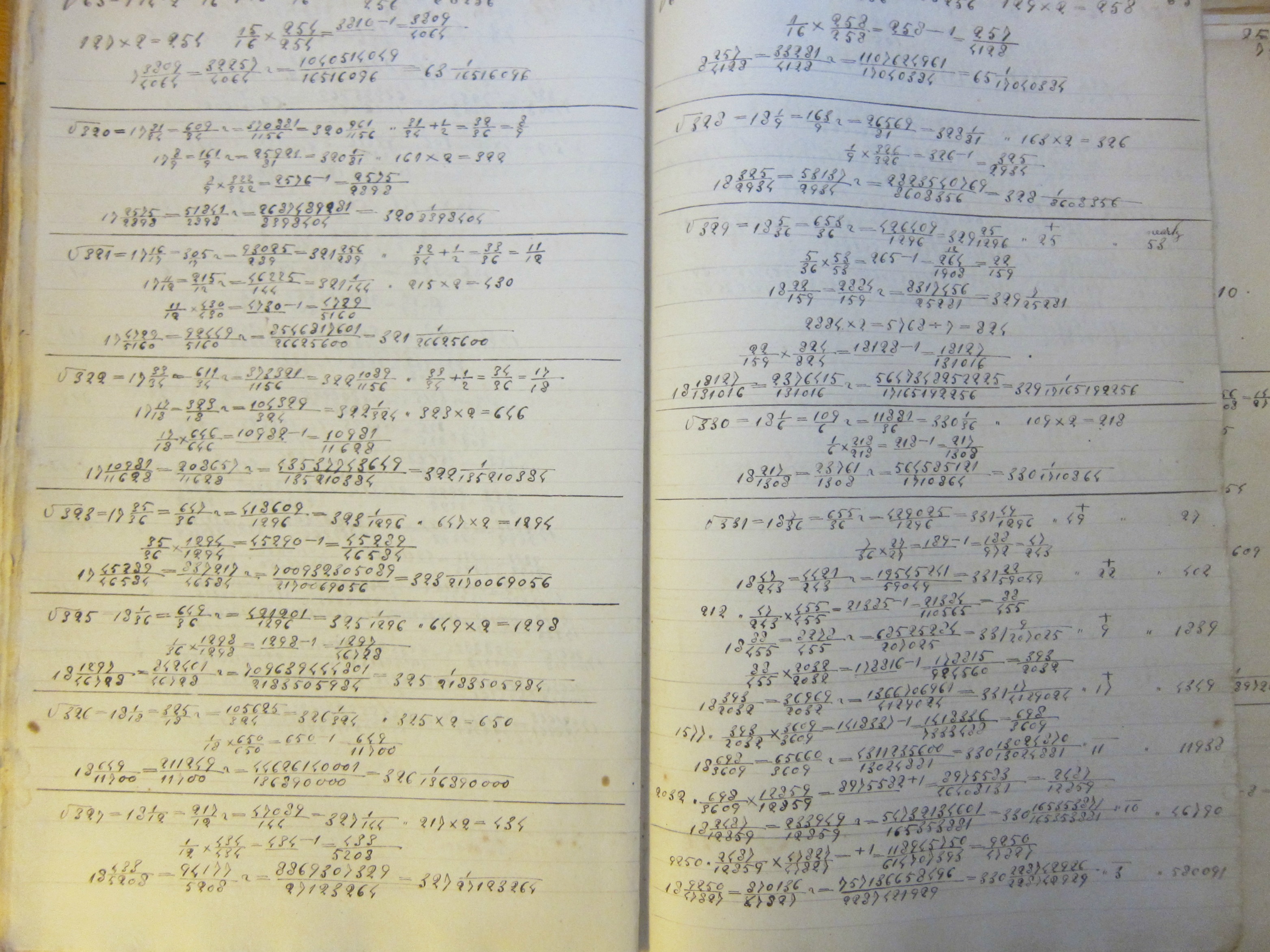
    I’m returning to this earlier post, expanding it some, and correcting it a little–usually that comes with a fresh eye to something old and done. The work on hand is a mathematics manuscript by a man named Charles Fisher. It is an impressive  collection of work on square roots, from √2 to √628.  It is 13.5 x 8.5 inches and  160 pages long–it is all gathered together in separate quires, the text now just floating inside the original binding, which is very thick paper wrappers that have been handled so much that it feels like leather.   Most of the manuscript is still bound, though several “signatures” are now loose within the binding. It is a good, solid copy in spite of what I just wrote–and it is a definite work of art.  

    The book is paginated according to the sq rt that Mr. Fisher was working on, so the first page is page 2 for √2. Also, the work figuring the square roots of 2 through 196 takes place on the top half or portion of the first 80 leaves, at that point he turns around and starts on the first leaf again, working out his answer for √197 (and √198) on the first page (or page 2) and so continues to the end of the book again, ending up at 628. The square roots seem pretty complete through the 400s and then gets very spotty after that, for whatever reason Mr. Fisher leaving some numbers alone. So far as I can determine the work is complete in itself.  

    Square root 1

    The (seeming)  author of this manuscript, Charles Fisher, evidently took a solitary pleasure in calculating the square roots of numbers from 2  to 628  not bothering to write down the 24 perfect squares to 576.  (The sqrt being r2 = x for every non-negative real number x.) From the few bits that I have checked the man seems to have done a good job back there in the 1830’s.   (Note: we’ll deal with square root of  3 at another time…)

    I cannot determine where this book was written or who Mr. Fisher was.  There is a transcription in the last leaf of the book of a community meeting dedicating people to building a meeting house in “Wertham” (?) near “Cumberland’, and that something like the minister or preacher would be shared with the local Baptist Church or something like that, and signed in January 1767.  Fact is though that there is at least one contemporary date in the work and that is 1833 for figuring the √193.  

    Square root 2

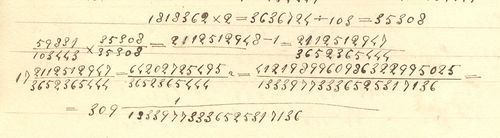
    Fisher’s work is pretty elegant.  Take for example his solution (and proof) for the square root (hereafter sqrt(x)) 309,

    which the calculator living under this page says is 17.578395831246947    Mr. Fisher’s answer is 17 10/17 = 799/17=89401/989=309 100/989, and after some more involved arithmetic comes t the lovely proof number of   

    4121989960986322995025 /13339773336525317136 or

    309.00000000000000000007496379247

    Which is getting pretty close. 

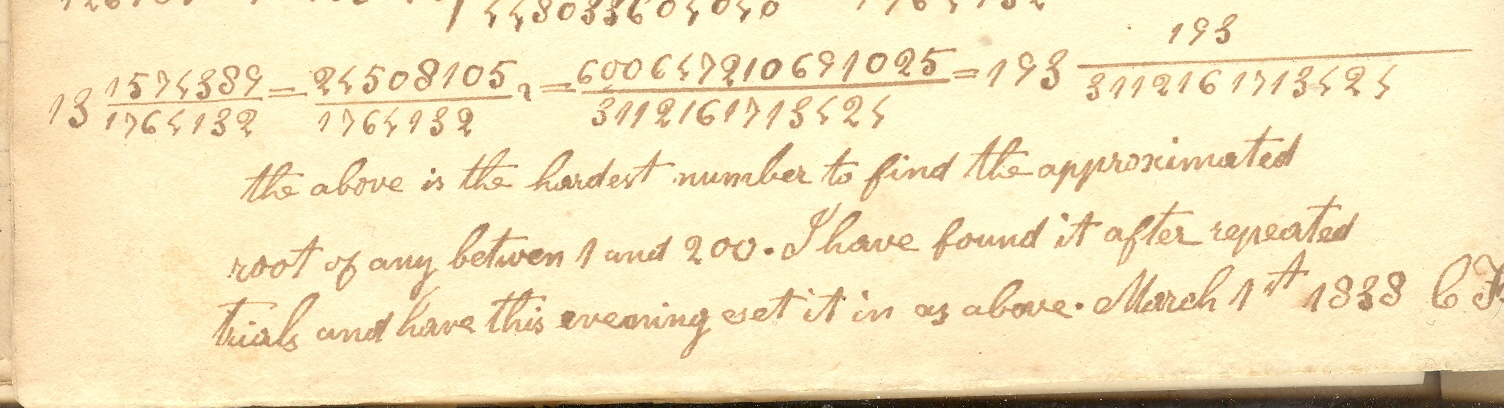
    The only note that Mr. Fisher makes on his calculations is for the sqrt(193), which he notes as “the hardest number to find the approximate root of any between 1 and 200. I have found it after repeated trials and have this evening wrote it in as above. March 1st, 1833. CF.”  (This may actually be 1838–I think it is dependent on interpretation.)

    Square root 3

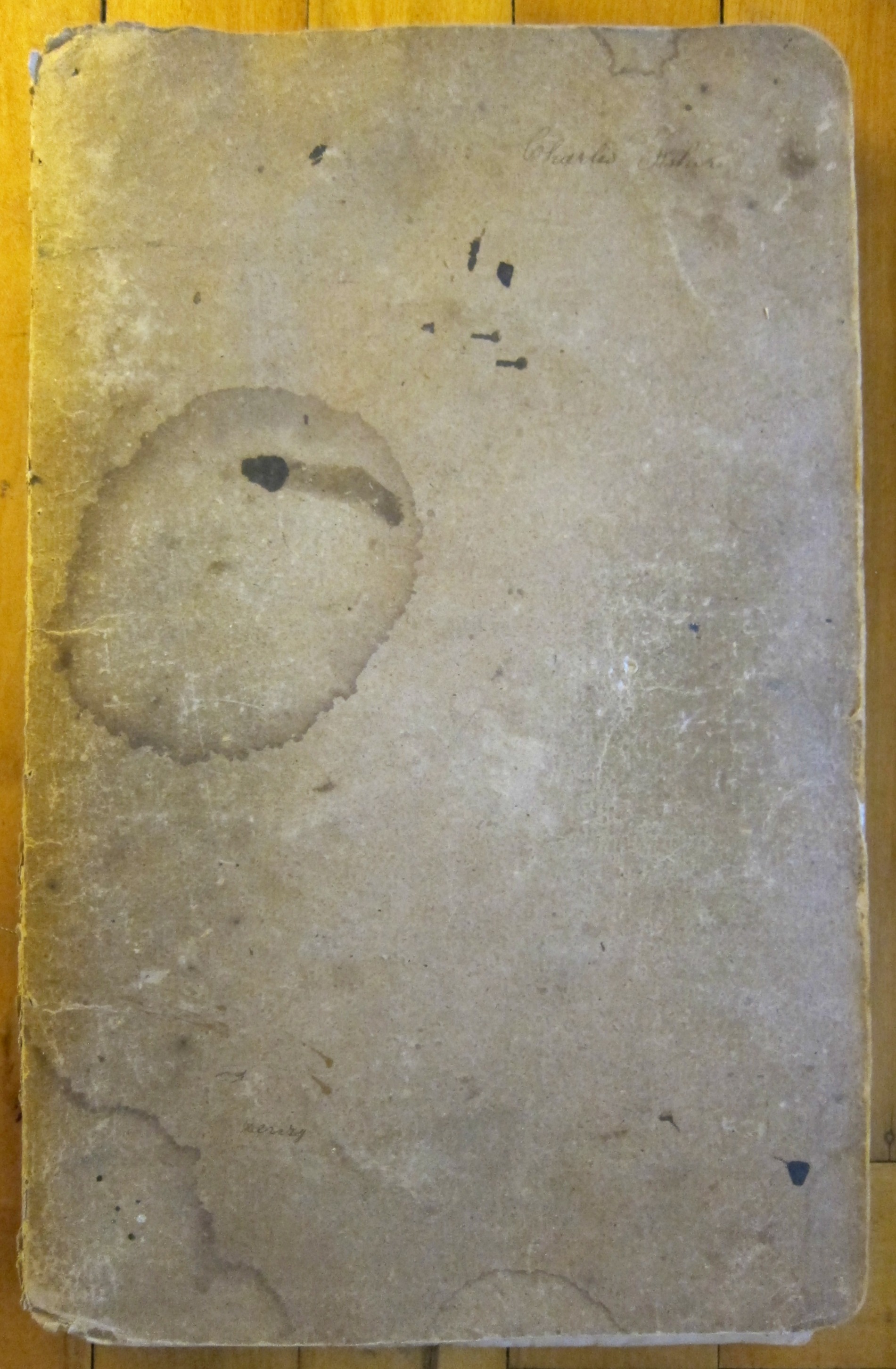
    The lovely cover of the work:

    Math ms sq rt cover _2_

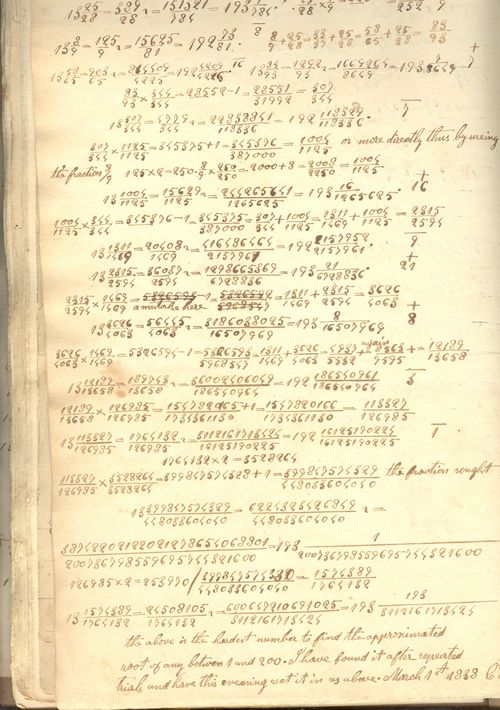
    And a double-page sample of the work:

    Math ms sq rt _1_

    ·Posted by :

    ·in:

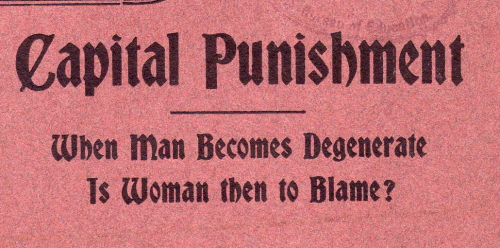
  • When Man Becomes Degenerate is Woman Then to Blame? (1907)

    JF Ptak Science Books  Quick Post

    Capital punishment woman _2_773

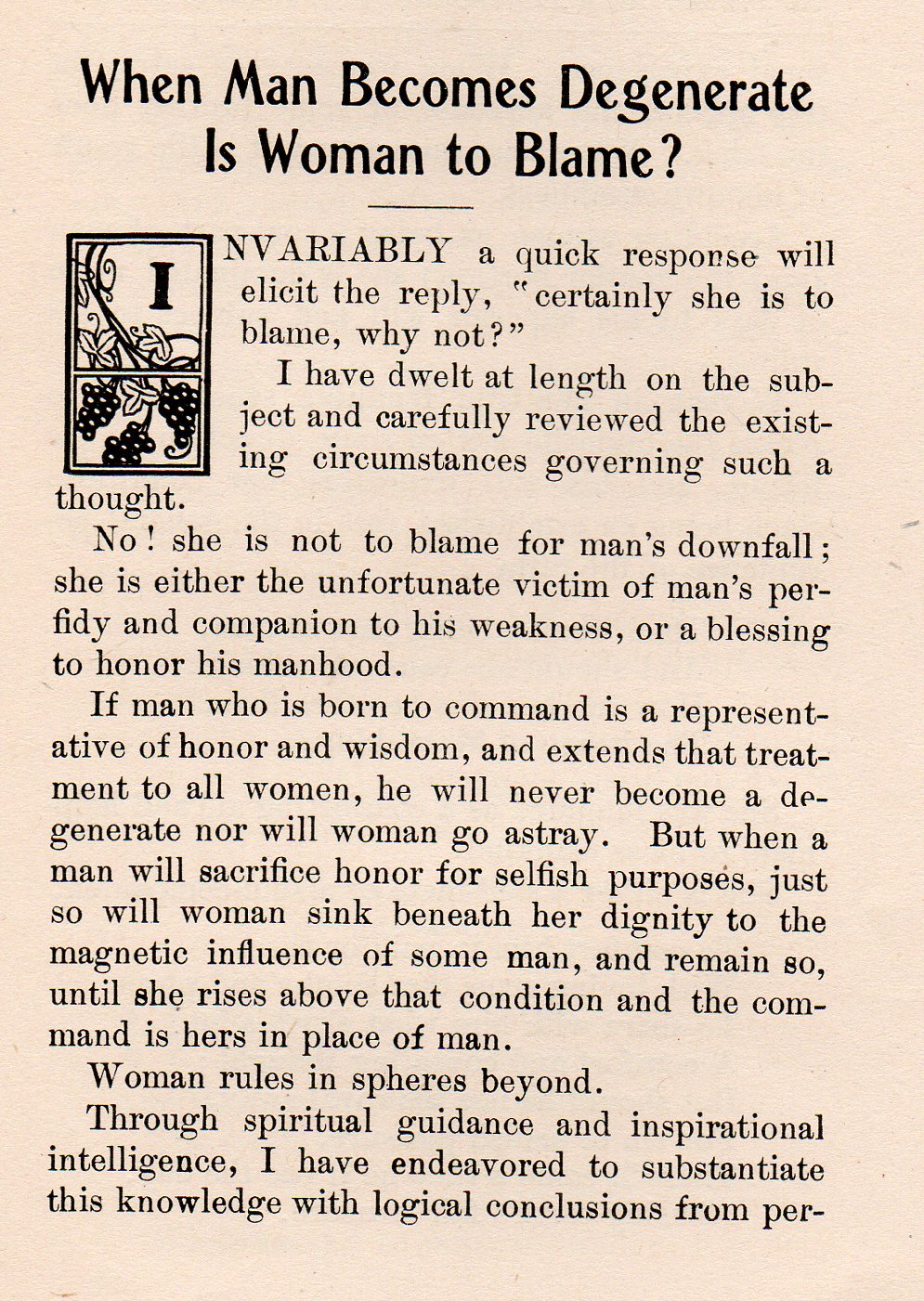
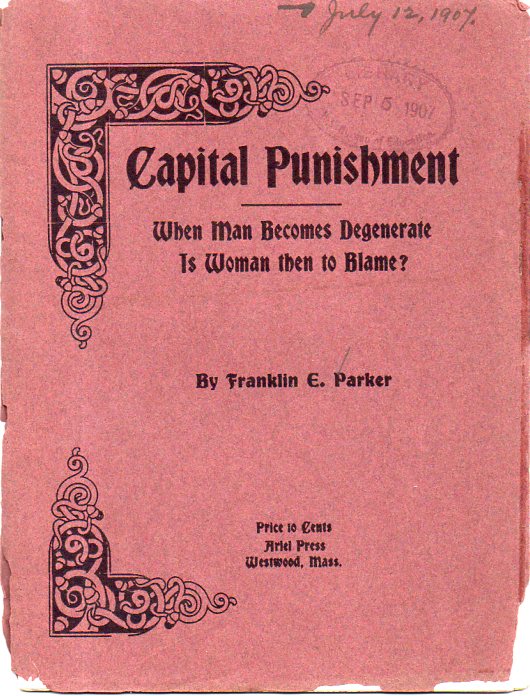
    I guess I’ve seen this question before, though not nearly as full-frontal-assault as this one. One of the odd things in this little pamphlet (Capital Punishment, When Man Becomes Degenerate is Woman then to Blame?”, self published by Franklin E. Parker at the appropriately-named  Ariel Press in Westwood, Massachusetts in 1907)is that the question in its title is only relatively lightly addressed and that at the end of the short work. What Mr. Parker is mostly concerned with is capital punishment, which in the end he sees only as another form of murder, and makes a number of biblical arguments against it.  Relative to the responsibility of woman in the degeneracy of man (which doesn’t seem necessarily related to the issue of capital punishment) the argument is made that she is not–conditionally. That is, if a woman stays with the degenerate man than she does share responsibility–on the other hand in 1907 I do not know what religious beacon suggesting what a woman might do about that situation. On the third hand another statement maintains that is a “soul-part of man”…(and is) “dominated more or less by his superior will and subject to his ruling”, which presents a different issue altogether so far as being married to a degenerate man goes.  

    I only gave about five minutes to this pamphlet, so there may be a more adaptable answer somewhere–there is actually a long poem at the end that was light and sugary and withering, and I knew that reading it would be like watching a baseball player adjusting his batting glove for a full five minutes, which means you needed it to stop as soon as it started.  Anyway, I think the ultimate answer to this woman/blame question was both “yes” and “no”. 

    Capital punishment woman _3_774


    Capital punishment woman _1_772


    ·Posted by :

    ·in:

  • Cross Section of a German U-Boat, 1915

    JF Ptak Science Books  Quick Post

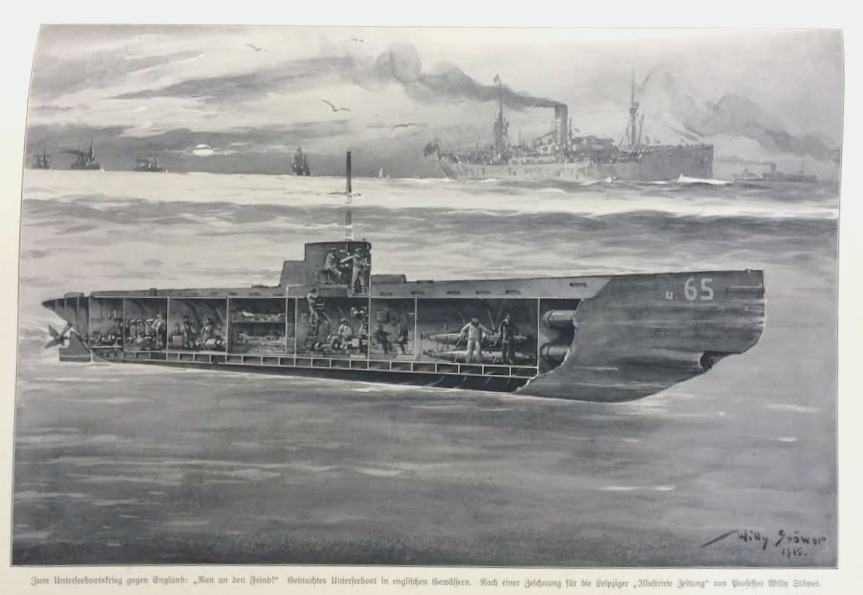
    I have paged through the entire Illustrirte Zeitung for the war years 1914-1918 and I’ noticed a number of naval works by the illustrator and painter Willy Stower, but I do not recvall offhand any other cross sections, which is why the image below struck me so. Stower’s (1864-1931) drawing appears in the September 7, 1915 issue of the magazine, and depicts one of the early German U-Boats.  [Evidently the U-65 began its career in 1916, and registered at 226′–this rendition doesn’t look like it would be as big as this, and I’m not sure then what we are looking at…] 

    Submaruine WWI _1_

Recent Posts

Archives

Categories