A Daily History of Holes, Dots, Lines, Science, History, Math, Physics, Art, the Unintentional Absurd, Architecture, Maps, Data Visualization, Blank and Missing Things, and so on. |1.6 million words, 7500 images, 4.9 million hits| Press & appearances in The Times, Le Figaro, Mensa, The Economist, The Guardian, Discovery News, Slate, Le Monde, Sci American Blogs, Le Pont, and many other places… 5000+ total posts since 2008.

  • Lonely Lights of France, 1860

    JF Ptak Science Books   Quick Post

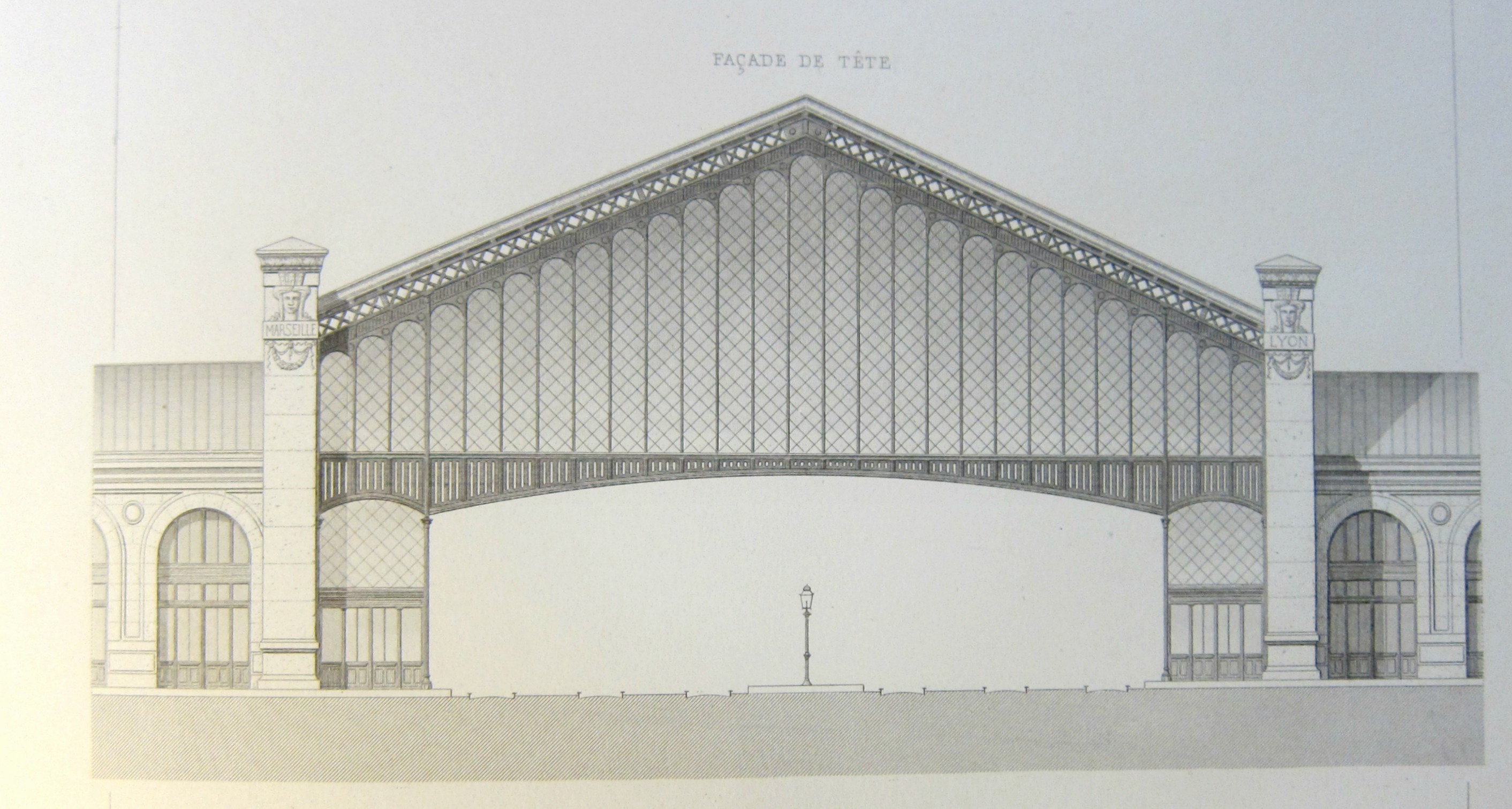
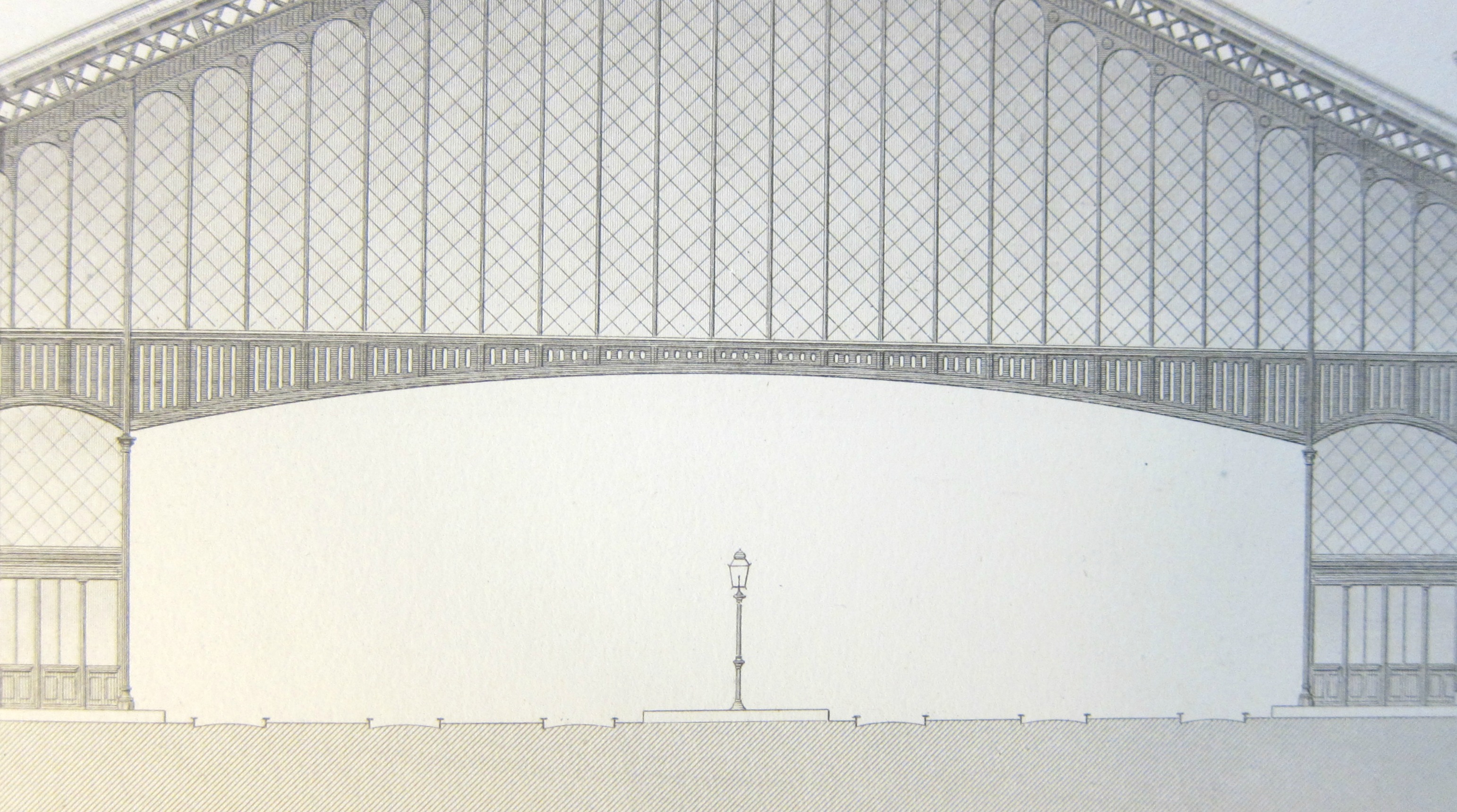
    I have written some posts here on Lonely Things–telegraph poles, electric cable structures, houses, cows, horses, and such–but I think nothing regarding The Lonely Light. And not Light-Lonely-I’m-So-Exposed-and-Vulnerable Lonely, but Lonely in a very public or crowded space. And that I think is just what we have here, found in an architecture journal edited buy Caesar Daly, who I have written about in a contiguous post. (The engraving is the work of the prodigiously talented and very busy Caesar Daly, who in addition to writing and editing books also edited the journal Revue Generale de l’Architecture et des Travaux Publics, des architects des ingenieurs des archeologues des Industriels et de Proprietaure, these images coming from volume XVIII, printed in 1860, in the section “Chemin de Fer de Paris a Lyon”, which turns out to have been a very busy railway hub in teh early expansion period of railroads in France.) Anyway, I have no doubt that there was a row of these gas light fixtures along the concourse, this being a view of the interior of the station looking down/longitudinally along the tracks so you see their cross-section–and frankly I can’t tell if this shows two sets of tracks on either side of the central platform, or three (narrow gauge) lines.  As they say over there, “Ça ne fait rien”/”Machts nichts”–I’m just focused here on the lonely light. 

    Lonely light


    Lonely light big

    ·Posted by :

    ·in:

  • Some Blank and Empty Baroque Design Bits, ca. 1700

    JF Ptak Science Books   Quick Post

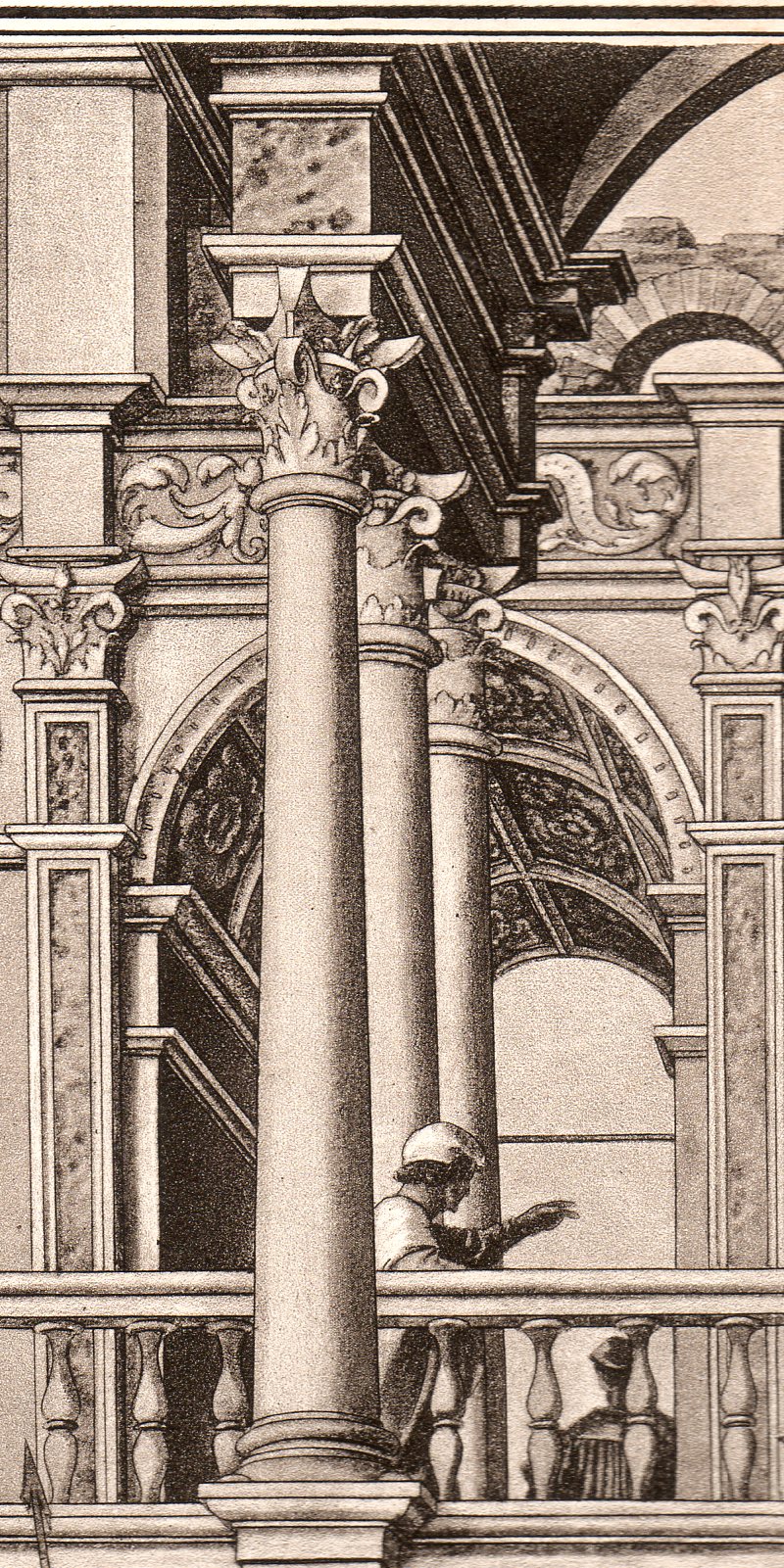
    I saved this image many years ago, and unfortunately I do not have a year/location/maker, nothing at all, just the print. I reckon that the print is in a Baroque style, I think, highly manner and ornate and detailed, and quite empty where there should be obvious detail, as these are the spaces that the eye is directed to by the other elements of the design, except that there is nothing there.  No doubt this was designed for an identifying purpose, though that perhaps had not yet been determined. 

    It is a little curious that the frieze shows a merry peasant party; curiouser still are the three people and a dog on the upper balcony–the middle person seems otherwise engaged in who-knows-what. 

    As it stands, this is a good candidate for the Blank, Empty, and Missing Things series.  


    Empty spaces baroque731

    [Detail from the full image, below.]

  • 115-Pages of Directions on How to (Possibly) Leave Manzanar (1944)

    JF Ptak Science Books   Post 2635
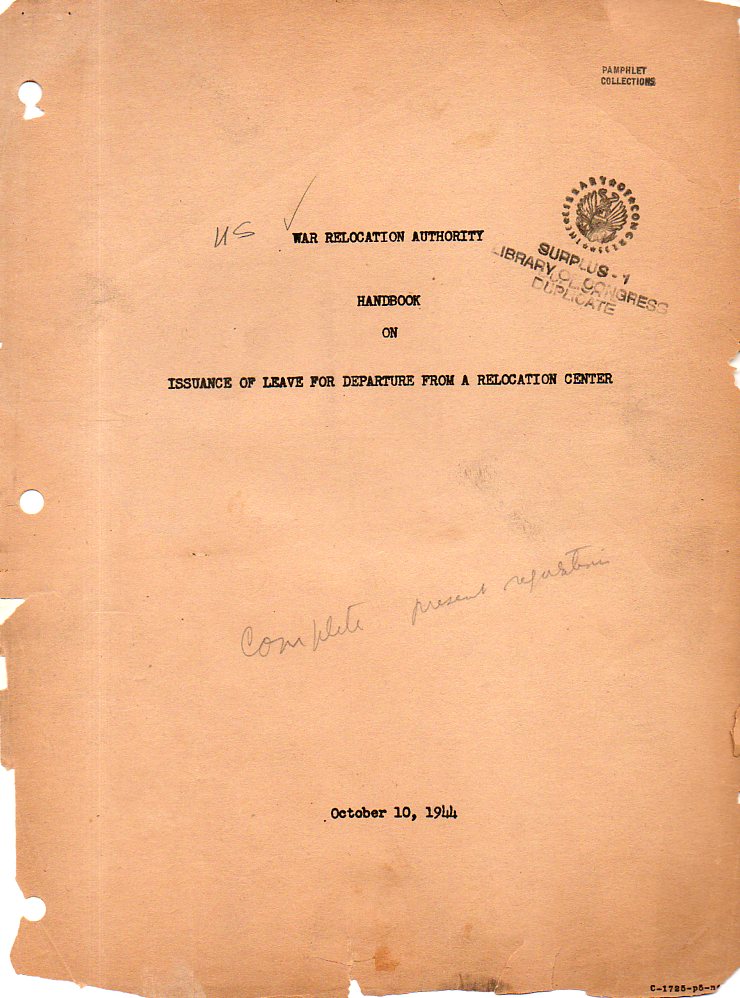
    WRA_1_732
    Just this morning I unearthed this interesting document: War Relocation Authority Handbook on Issuance of Leave for Departure from a Relocation Area October 10, 1944, which was basically a set of rules and regs on how an a Japanese person/”evacuee” could apply for dispensation for leaving the relocation center /internment camp. The language and organization of the document is dense, misleading, and labyrinthine, and spread wide and thin over 115 pages. It is in fact difficult to go from page one to the final page, as there is no real pagination that one can distinctly follow to get through the document in order–if you were to take the thing and toss it into the air and then try to put it back together again, it would not be a straightforward task. It is a confusing and seemingly-contradictory work bibliographically, at least if you were try to define it by its structure. Perhaps this speaks to the administration of the places that this document was trying to describe: there are numerous versions of the document issued over several years, some replacing parts of sections and other replacing entire sections though leaving in place sections contiguous to and within the new sections; the tiny sub-pagination at the bottom right of each sheet doesn’t necessarily follow from one page to another although the text does (for example, there is a page “C-109 2 p1 of 11 nubu-cos-pun-wp”; further, the pagination which is the most useful is the section/page designation at top right, however the numeration of sections and paragraphs in the actual text seems a little thick, starting sections as “.1” rather than “1” and the “.1 A.” rather than 1A or some such. In the end,  when I figured out that the document was actually complete, I was very surprised, because it hardly looked so while trying to follow pagination alone. 

    The War Relocation Authority was formed on March 18, 1942 via Executive Order 9102, following the Japanese attack on Pearl Harbor and the U.S. Entry into WWII, with Milton S. Eisenhower as the director. This was the action taken in the interests of national security resulting in rounding up and deporting to remote internal U.S. Destinations more than 125,000 people—mostly U.S. citizens—of Japanese heritage. The WRA was the consequence of the larger initiative, the Roosevelt administration’s Executive Order 9066 (19 February 1942), which was the legal bombshell that gave the War Department the authority to authorize the removal of the Japanese and theoretically prevent those people from engaging in sub rosa and fifth column activities as wartime terrorists fighting for Imperial Japan within the United States—and this effort concentrated mainly on the Pacific coast and West. For the greatest majority these people stayed in the “Relocation Centers” (routinely referred to as “internment centers” and “U.S. Concentration Camps” for the remainder of the war, and then some. The Japanese/internees were bused away from their homes and lives and businesses with extremely limited notice, and were forced to sell nearly all possessions (including lands and businesses) at what were less than fire-sale prices.  They were made to board buses and trains and were shipped to locations (mainly in California) where they were processed and sent further and deeper into the trying hinterlands of the West for their final destinations until the war was won.  (One of the processing centers was the Santa Anita racetrack, where thousands of Japanese were sent to live for periods in converted, just-painted horse stalls.)  After 3+ years and WWII won, the relocation centers were closed, with Tule Lake was the last (that once included Gila River, Granada, Heart Mountain, Jerome, Manzanar, Minidoka, Poston, Topaz,and the Rohwer War Relocation Centers) to close, though that didn’t take place until March 20, 1946, via Executive Order 9742, signed by President Harry S. Truman on June 26, 1946.

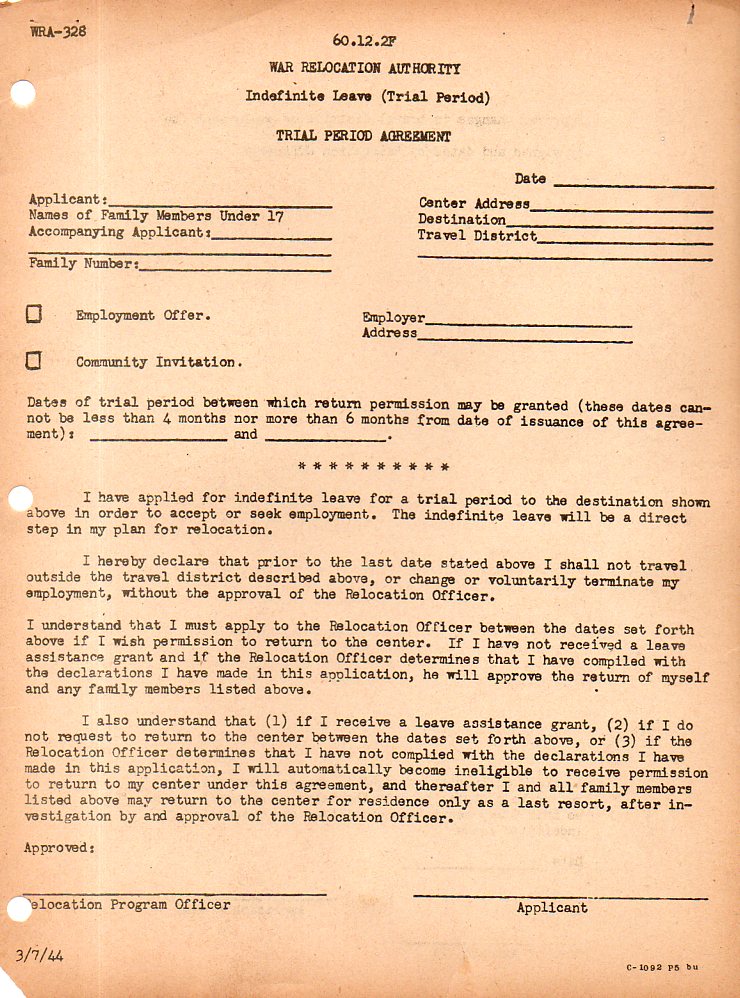
    Here is what seems to be a sample of what the interned Japanese would fill out and submit for leaving the internment camp:

    WRA_3_734

    The overall introduction to the document is signed (in the original, and then reproduced) by Dillon S. Myer, who was the Director and oversaw the WRA from 1942 until 1946; other sectional introductions in the document are signed similarly by Duncan Miller (who in 1945 was at the Colorado River Relocation Center at Poston, AZ), Malcolm Pitts (who was an executive administrator and who wrote Administrative Highlights of the WRA in 1945), E(?)D. Brooks, and Leland Barrows—all but Brooks are located as being “Executive Officers” of the WRA.

     From my reading this series of rules and regulations for the possibility of an “evacuee” to leave the relocation center is a Menkenian example of using 10 words where one word will do. The introduction is sufficient enough for a general reader to be able to guess at what is to come over the next 100+ pages:

    ·Posted by :

    ·in:

    — —
  • Musical Realism and Ethnology, 1891

    JF Ptak Science Books   Post 3636

    I first came upon Jesse Walter Fewkes for his work on the U.S. Southwest pottery, and knew of some of his work casually–I did not know about his work with the phonograph until I bumped into this article in Nature for 1890. Evidently, Fewkes’  work, “On the Use if the Edison Phonograph in the Preservation of the Languages of the American Indians”, (in Nature, April 17, 1890, volume 41, #1068, p 560), was among the earliest (if not the earliest) reports on using a phonograph to record Native American songs and rituals. He reports on his use of the relatively new phonograph (14 years old now) to record music, folk tales, language and other aspects of the expressive culture of the Passamaquoddy Indians of Maine–this before heading to the Southwest to make recordings of the Zuni (in 1890) and Zuni (in 1891). 

    This is interesting no doubt because Fewkes offered the world proof of these societal sounds, an imprimatur on authenticity. This must have exploded or leaked into the rest of teh world like the involvement of photography in reporting the news. It was shown early on, during the U.S. Civil War, that engravings made after photographic images and identified so were believed more so in terms of authenticity than the artists rendering a scene “on the spot”. Then of course when Stephen Horgan’s halftone process was introduced and began to be widely-employed–at about the same time as this article, in fact–and would begin to replace hand-drawn images in newspapers and journals, and offer a new version of what was deemed “trustworthy” and “authentic”…until of course this new process came into question via photo manipulation and fraud. But for the time being, here in 1890, there was a new sense of the concept of “realism”, and I think that this doesn’t happen very often. 

    On the Use of the Edison Phonograph in the Preservation of the Languages of the American Indians.

    “THE present state of perfection of the Edison phonograph led me to attempt some experiments with it on our New England Indians as a means of preserving languages which are rapidly becoming extinct I accordingly made a visit to Calais Maine and was able through the kindness of Mrs W Wallace Brown to take upon the phonograph a collection of records illustrating the language folk lore songs and counting out rhymes of the Passamaquoddy Indians. My experiments met with complete success and I was able not only to take the records but also to take them so well that the Indians themselves recognized the voices of other members of the tribe who had spoken the day before. One of the most interesting records which was made was the song of the snake dance sung by Noel Josephs who is recognized by the Passamaquoddies as the best acquainted of all with this song of old time. He is always the leader in the dance and sang it in the same way as at its last celebration I also took upon the same wax cylinder on which the impressions are made his account of the dance including the invitation which precedes the ceremony. In addition to the song of the snake dance I obtained on the phonograph an interesting trade song and a Mohawk war song which is very old. Several other songs were recorded. Many very interesting old folk tales were also taken In some of these there occur ancient songs with archaic words imitation of the voices of animals old and young. An ordinary conversation between two Indians and a counting out rhyme are among the records made I found the schedules of the United States Bureau of Ethnology of great value in my work and adopted the method of giving Passamaquoddy and English words consecutively on the cylinders. The records were all numbered and the announcement of the subject made on each in English Some of the stories filled several cylinders but there was little difficulty in making the changes necessary to pass from one to the other and the Indians after some practice were able to make good records in the instrument. Thirty six cylinders were taken in all. One apiece is sufficient for most of the songs and for many of the short stories. The longest story taken was a folk tale which occupies nine cylinders about Podump and Pook jin Squiss the Black Cat and the Toad Woman which has never been published. In a detailed report of my work with the phonograph in preserving the Passamaquoddy language I hope to give a translation of this interesting story.”  [Source:  Google Books. I do own the original of this paper, should anyone want to purchase it…]


    ·Posted by :

    ·in:

    —
  • Robot Songs of Love (1930)

    JF Ptak Science Books  Post 2637

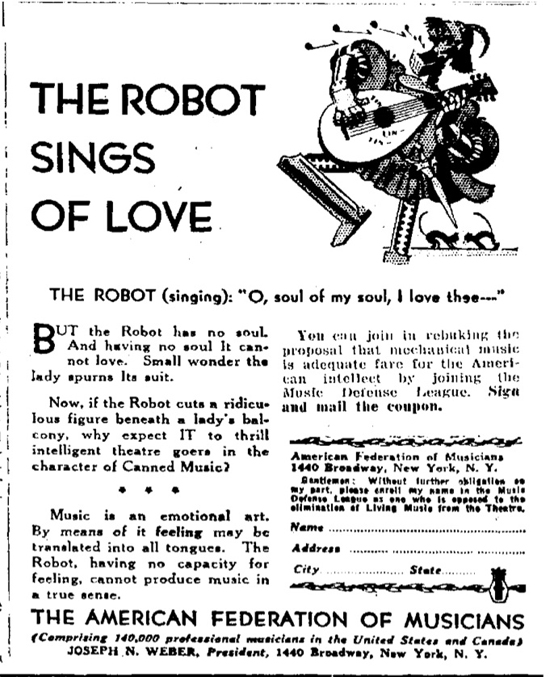
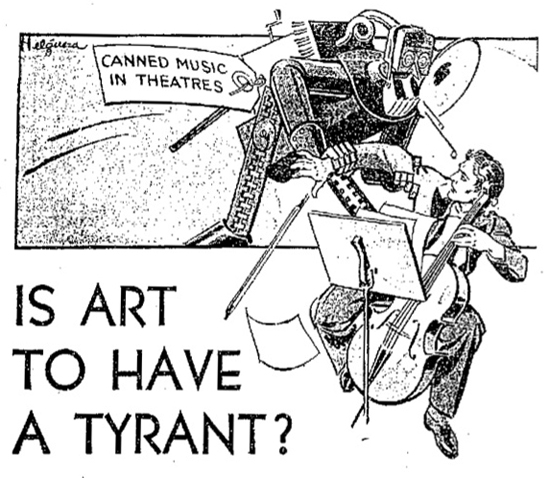
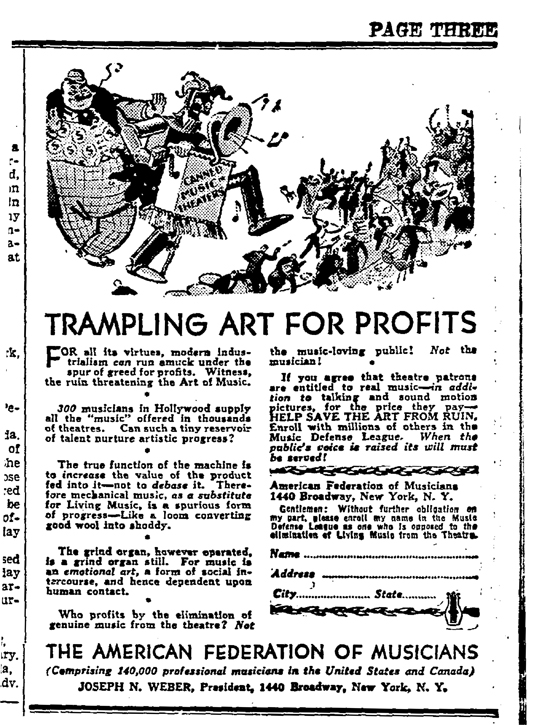
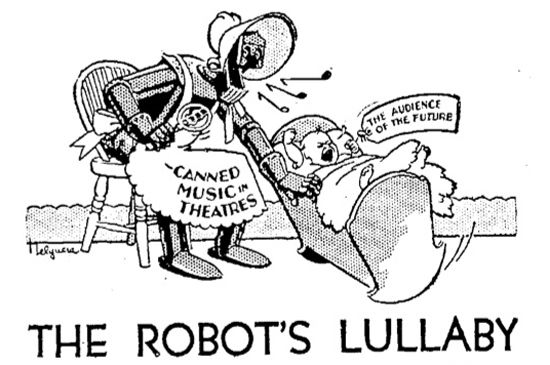
    There is little doubt that scribes and woodblock cutters and such absorbed the stab of the movable type printing press, and that stationers felt the stab of modernity when the telegraph came into play threatening sales of paper generally used for letter-writing, an art form that they felt would be diminished by the new technology. At about the same time though came the second revolution in mail delivery, which made it cheaper and more regulated in using a more-competent mailing system, which meant an increase in letter writing. Ditto that for the telephone, which again would threaten written communication. Movies too threatened the theater, and on and on.  That what comes to mind in viewing these ads unearthed by Matt Novak at Smithsonian.com for the American Federation of Musicians who were protesting the arrived-future in theaters of “robotic” or “canned’ music–that is, recorded music that would replace the in-house small orchestras/organists that would play during live shows or movies. 

    The ad extols the reader to join “in rebuking the proposal that mechanical music is adequate fare for the American intellect” by joining the Music defense League. At this point the musicians do have a case–even though the recorded music is just music recorded, which would be as good as the musicians who made the music, there was a larger issue of playback for the performance, which is where the “canned” part of “canned music” partially comes from. The quality of the speakers and so the so of the recording was not very high at this point, around 1930, so the clarity and richness and color of the music must all have suffered compared to its live performance. 

    This also speaks to the “emotional” part of robots, as well as their influence on emotional/social aspects of the human experience–in this case, interpreting music (though there is no mention yet of creating or writing the music.  But the robots-doing-our-creating-for-us part may be inherent in these ads, and this part of the history of Our Future Robot Overlords goes back a long but skinny and limited way, at least as far as the seemingly never-disappointing Daniel Defoe–that part of this story will have to wait for another day and a different two cups of coffee.  

    Robot song of love

    [Source via Matt Novak/Paleofutre http://www.smithsonianmag.com/history/musicians-wage-war-against-evil-robots-92702721/]

    Robot song art have a tyrant

    [Source: Hack the Union, http://www.hacktheunion.org/2013/09/]

    Robot song trampling profit

    [Source: Matt Novak/Paleofutre http://www.smithsonianmag.com/history/musicians-wage-war-against-evil-robots-92702721/]


    Robot song lullaby

    [Source: Matt Novak/Paleofutre Smithsonian.com http://www.smithsonianmag.com/history/musicians-wage-war-against-evil-robots-92702721/]

    Many more images and history from this campaign are located Novak’s Smithsonian.com’s “Musicians Wage War Against Evil Robots” at http://www.smithsonianmag.com/history/musicians-wage-war-against-evil-robots-92702721/


  • YOU and the Atomic Bomb (Again)

    JF Ptak Science Books  Quick Post

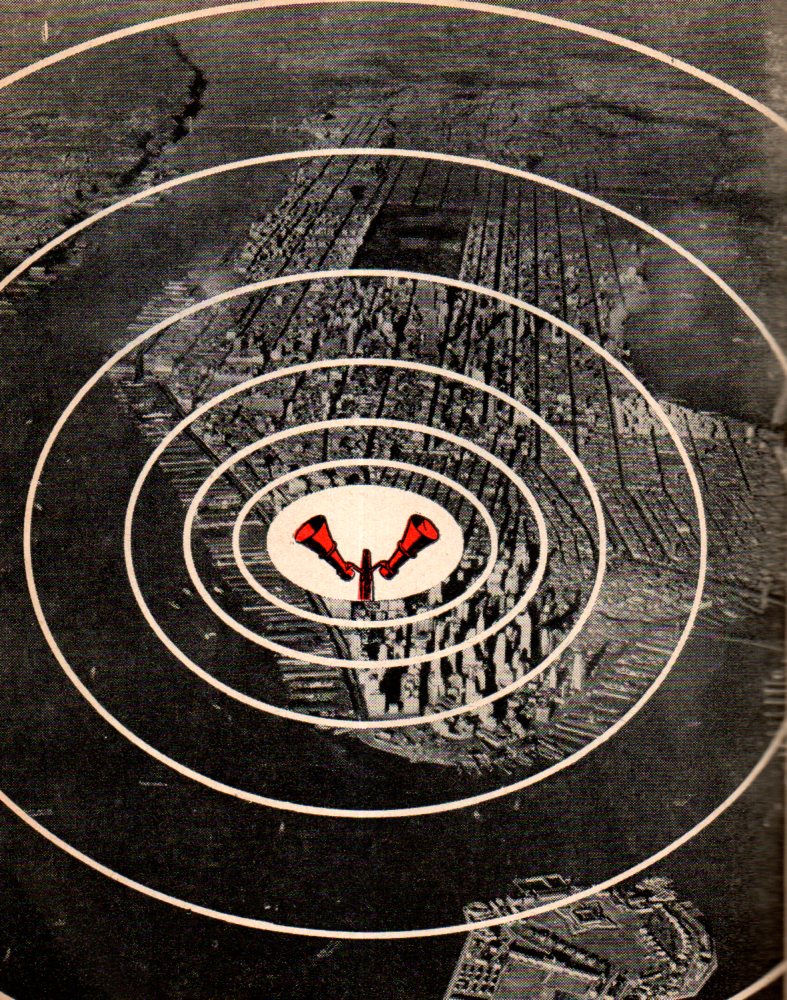
    No doubt there is some serious and useful information in this little undated (ca. 1945/6) pamphlet–mostly I guess its purpose was fulfilled in its attempt at softening the dread of nuclear holocaust in that there was actually something that could be “done” in the event of an attack.  It addresses the standard fears, and perhaps the standard fears of hope, though the pamphlet does paint a profile of possibility for a post-attack scenario that is, shall we say, a little optimistic.  In any event, I share this now for the graphics, and the Manhattan Destroyed map.  

    Atom bomb you and the737


    Of course there must be a map, but instead of the usual map of rings of destruction, this bird’s eye view was meant only to depict the effective range of an air raid siren–and it is not lost on me that the central red graphic is placed very near to the WTC site. (The first published map of the rings of destruction of an atomic bomb on any city of so far as I can tell appeared in the great PM newspaper the day after Hiroshima, showing what sort of effects the bomb would have on a profile not of Hiroshima, but of Manhattan.  As a matter of fact the entire issue of the ad-free newspaper was devoted to the bombing, Hiroshima receiving more (and better) coverage than in any newspaper reporting I have seen in the first week after the bomb was dropped.  I really have no idea how the paper was able to put together dozens of bright and informed pages of coverage in 24/36 hours after the event–except of course that those were some very smart people.)  

    Atom bomb you and the NYC map738


  • A Course in Chemistry Offered by Michael Faraday, 1825

    JF Ptak Science Books  Quick Post

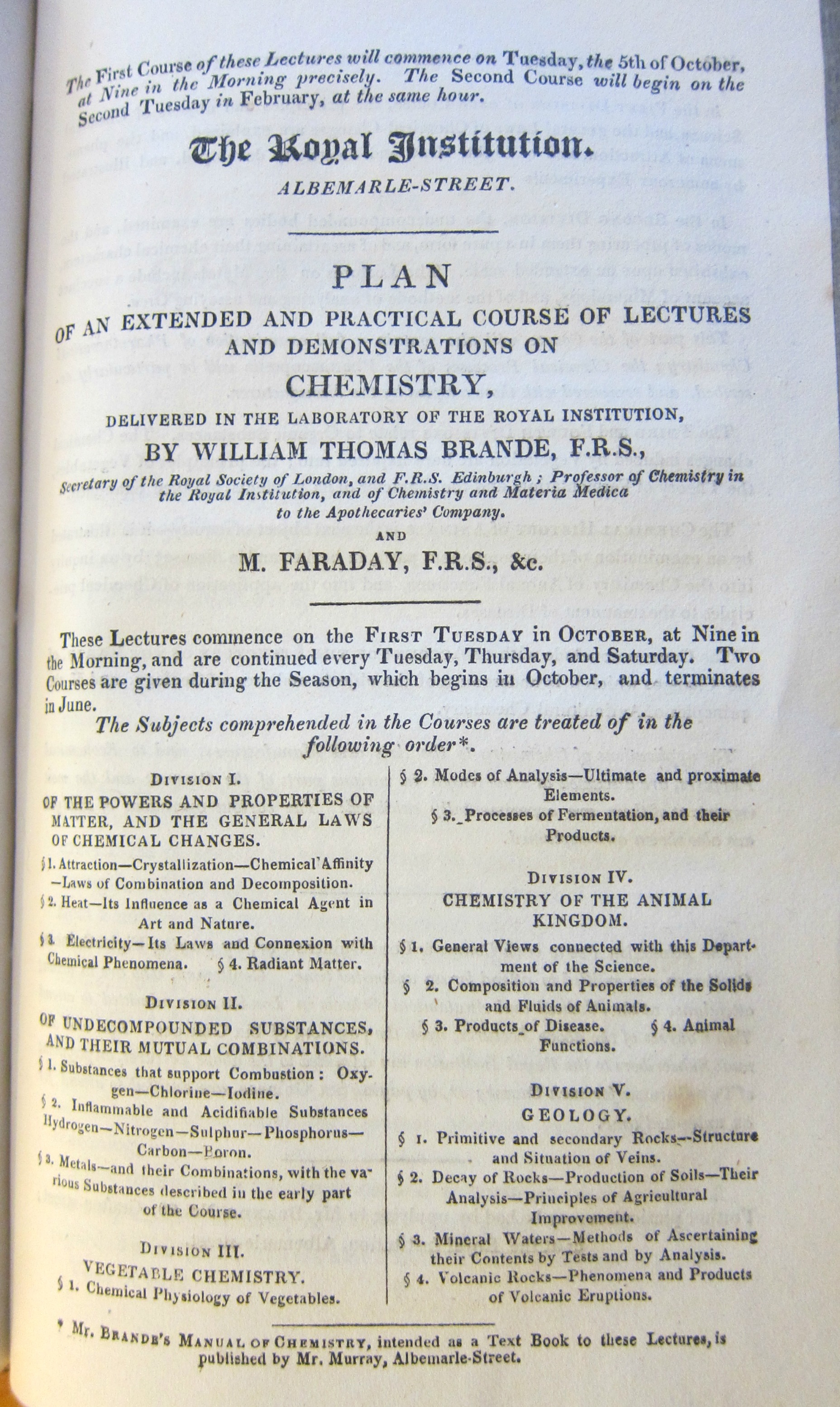
    Here’s an interesting bit I just found in a volume of  The Quarterly Journal of Science, Literature, and the Arts 1(of the Royal Society of Great Britain): a wonderful two-page advertisement for a course in chemistry, given by William Thomas Brande (1788-1866) and “M. Faraday” (1791-1867). Brande was the more-established and more socially-correct figure at this point (1825), though Faraday had already made a major contribution to the history of chemistry in 1821; still, the overall accomplishments and appeal of Brande probably explains the top billing. Be that as it may, lecturing under the auspices of the Royal Institution was a very big deal, and obviously a major imprimatur for any career. (Also it is interesting to note that Brande’s Manual of Pharmacy I advertised for sale on a full page opposite page vi.)

    Faraday lectures _a_

    ·Posted by :

    ·in:

  • Tunneling the Thames, 1824

    JF Ptak Science Books    Post 2639

    Here’s an interesting find made while browsing a volume of The Quarterly Journal of Science, Literature, and the Arts1 (of the Royal Society of Great Britain): Samuel Ware’s2  “A Design for making a Public Road under the Thames from the east side of the Tower near Iron Gate Stairs to the opposite side of the River near Horseley down”. This interesting article outlines a proposal and plan by Ware for building a convenient/strategic tunnel under the Thames. This proposal was made a year before the M. Isabord Brunel/Isambord Kingdom Brunel Thames Tunnel project, which when completed in 1843 was called “the Eighth Wonder of the World”, being the first tunnel built under a navigable river. This project was an incomplete success, as it was opened to only pedestrian traffic for decades until in 1869 it was modified to accept trains (which were smoking coal trains, not replaced with a cleaner electric variety until 1913). In any event the idea was to be able to transport goods under the Thames, which would replace the practice of across-the-Thames shipment that would necessitate stopping the very vigorous sailing traffic on the river. It is interesting to note that in the Ware plan it is the snaking approaches to the tunnel that would accept wagons and carriages are plainly visible; the Brunel plan called for such access but ran out of money before the commerce aspect of entering the tunnel was built. “

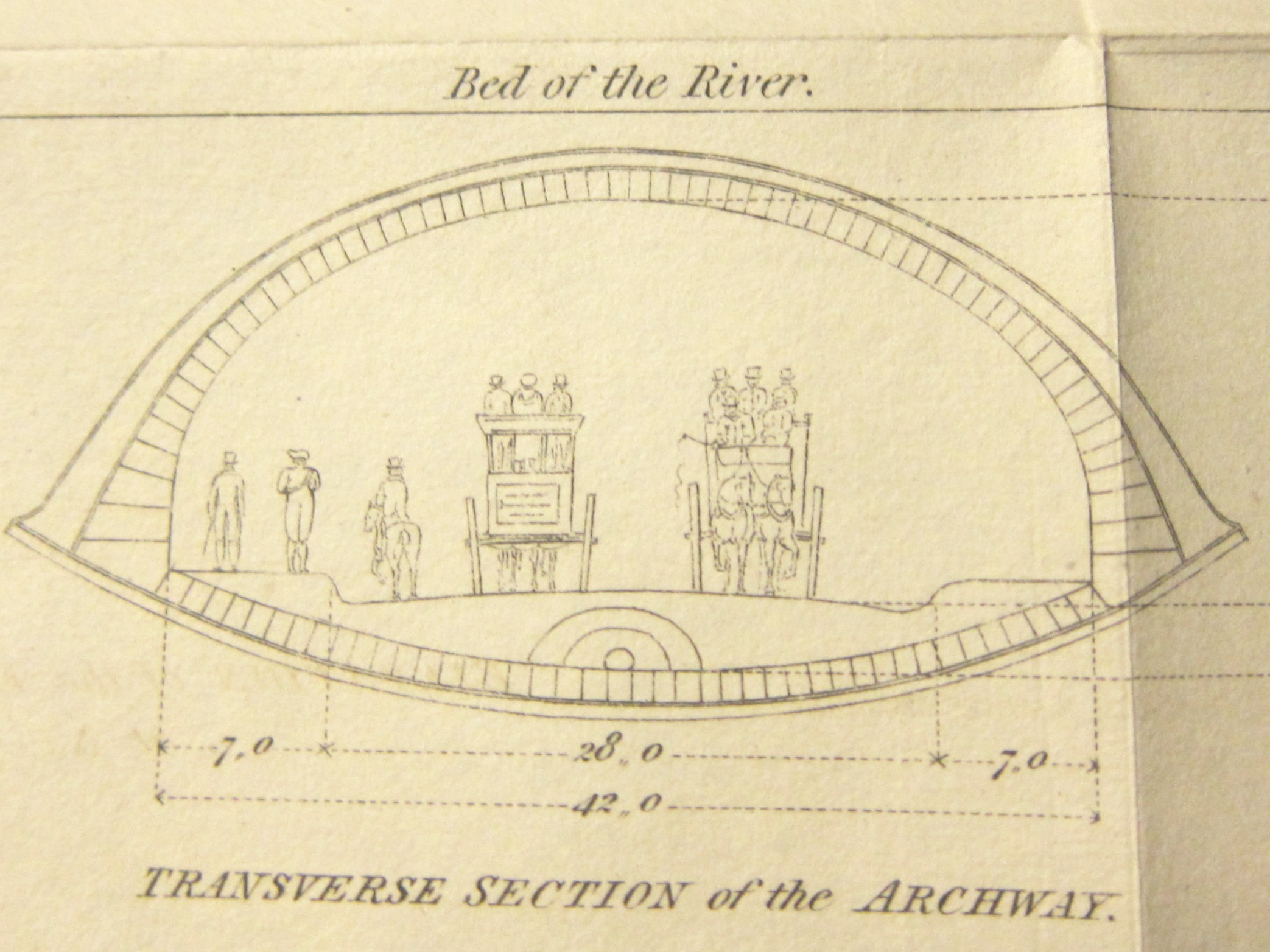
    This is a cross section of the porposed tunnel, wide and tall enough for carriages and two walkways:

    Thames tunnel 1824

    [Detail from the 13″ folding cross section of the Thames tunnel.]

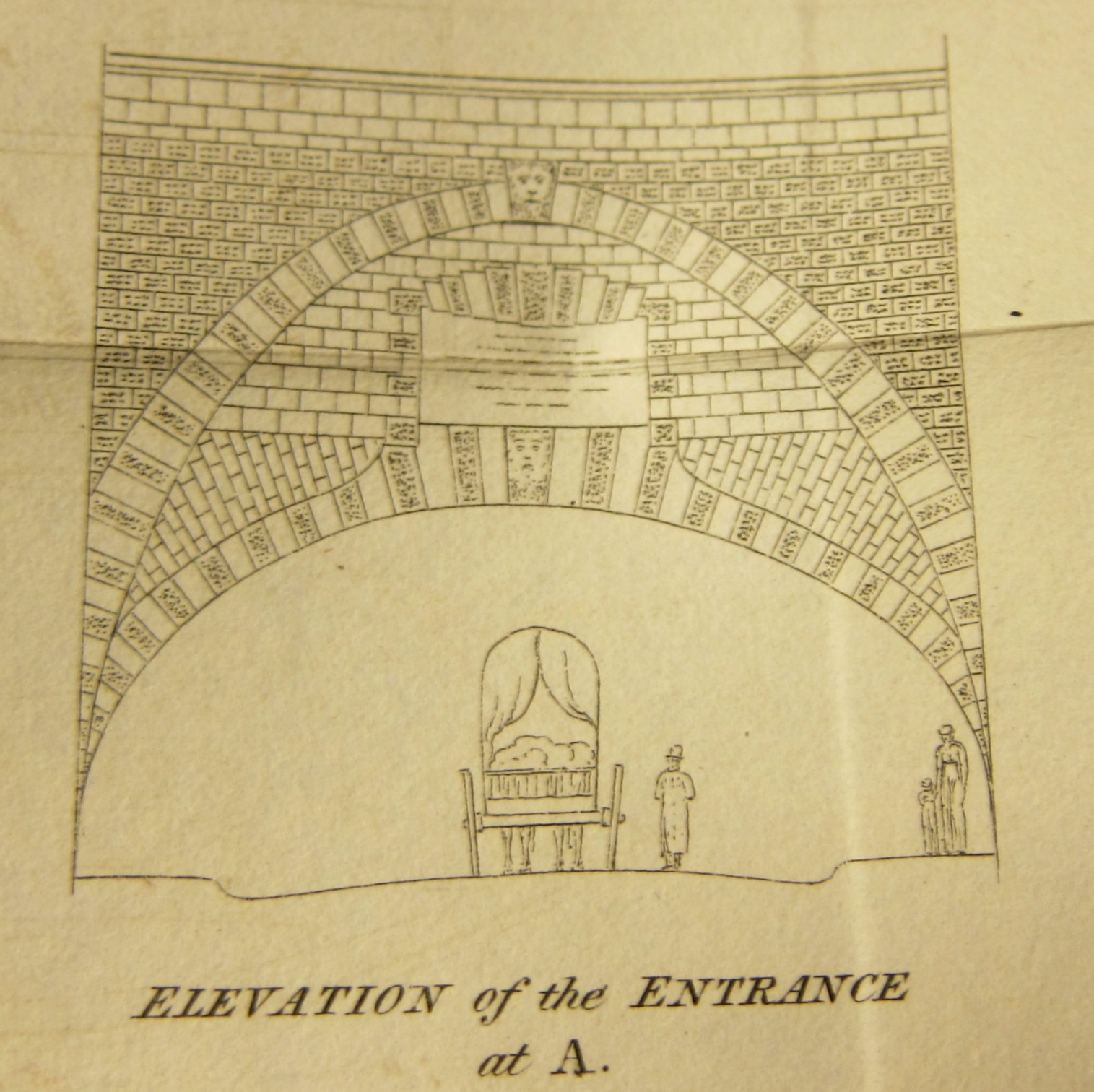
    And a rather massive entrance to the proposed tunnel:

    Thames tunnel 1824 entrance

    From the Ware article:

    “The following particulars of the Estimate describe the mode of erecting the arch way: Compensation for the ground and buildings on the north side of the river and for the ground and buildings on the south side to form the approaches cofferdams in ten successive lengths or removes to keep out the water and strutting to keep up the ground; Steam Engines to keep the works within the cofferdams dry and subsequently for draining the road should there be occasion; Digging out a channel in the bed of the river for the arch way and the ground for the approaches; Removing the refuse earth claying filling in and leveling two feet above the extrados of the arch Yorkshire; Ledgers for the foundations of the arch way and walls of the approaches and embankments and piling as occasion may require; Stone work cut in voussoirs of the arch and counter arch; Lining with lead 10lb to the foot superficial enveloping these arches; Super arch of brick work lined externally with tiles in; Centering for the arches; Forming and gravelling the road ascending one foot perpendicular to twenty feet horizontal; Drains pipes foot paths and lamps; Embankments and other walls and parapets in the approaches; Facings to the entrances to the arch ways and tollhouses. Estimated amount of the above works 250,000 [pounds]”

    “Political Advantages: The communications by this road between the officers of government and the Mint; Trinity House Custom House and the Tower may be facilitated; A readier transfer of soldiers arms and stores to and from the counties north and east of London and the Tower to and from Woolwich Chatham and Sheerness by land will be obtained by this arch way; This arch way may be made a military pass there being proposed a private way to it from the Tower…”

    Notes:

    1. London, printed by John Murray, 1824, volume XVII. 8.5×5”, 408pp, 3 plates, plus a long folding schematic of the engineering proposal for building a road under the Thames.

    2. Samuel Ware (1781-1860) was employed by the sixth Duke of Devonshire on both his English and Irish properties. In 1814 he exhibited a view of Lismore Castle at the Royal Academy. Ware was architect to ‘many excellent buildings in Ireland’…”–Dictionary of Irish Architects, 1729-1940.

    Also included in the volume:  

    Also:

    • Poisson, Simeon Denis. “Extract of a Memoir on the Theory of Magnetism, read at the Academy of Sciences, 2 Feb 1824, pp 317-334;
    • Daniell, Ferederic. “On Evaporation”, pp 46-62;
    • Olbers, Heinrich Wilhelm Matthias. “Remarks on the Catalogue of the Orbits of the Comets that have been hithertoo computed”, pp85-96;
    • Encke, Johann Franz. “Further Remarks on the Periodic Comets…” pp 98-100.

    ·Posted by :

    ·in:

  • The First Moscow Show Trial (1928)

    JF Ptak Science Books  Quick Post

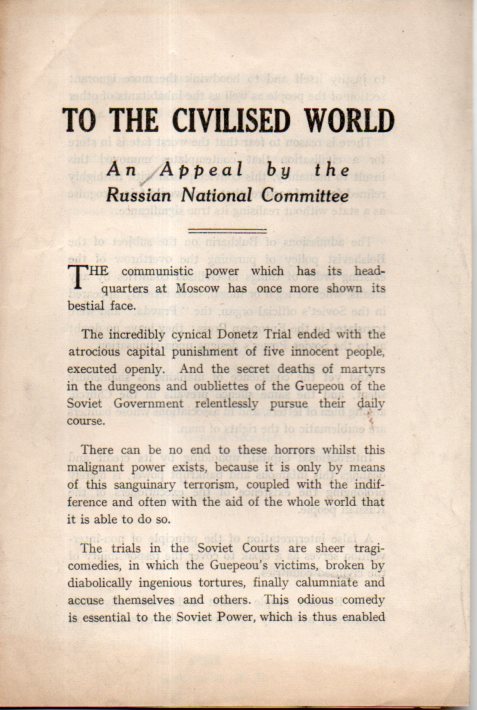
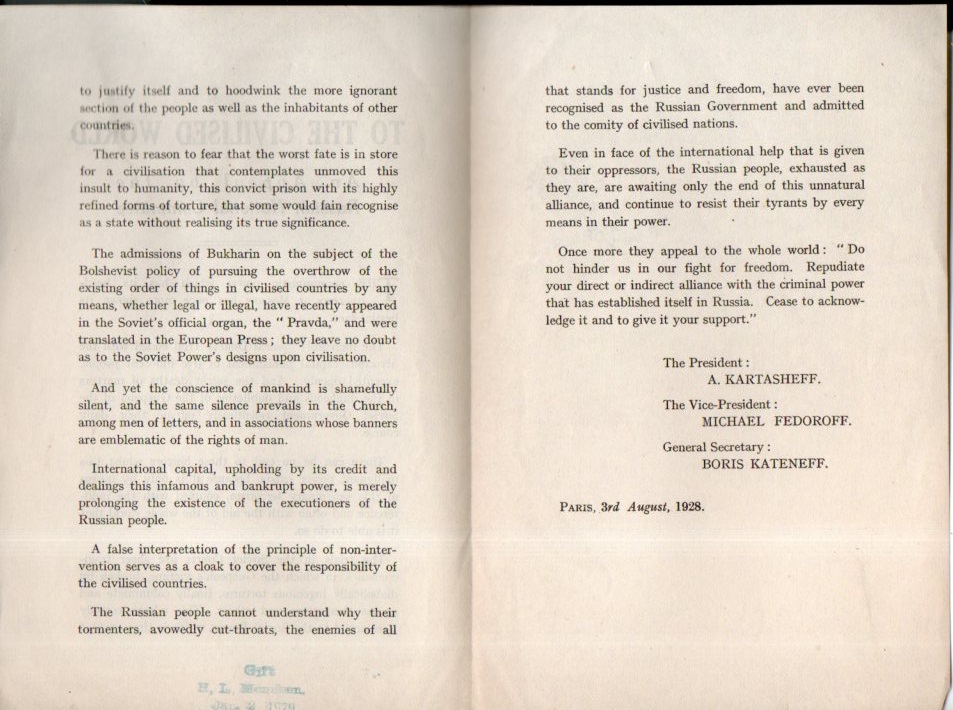
    Russian show trial 1928746A.Kartasheff,  Michael Federoff, and Boris Kateneff’s  To the Civilized World, an Appeal by the Russian National Committee is a four-page leaflet and  strongly-worded plea to the world-at-large to not recognize the Communist government in Moscow, this based on the behavior of the government and judicial system is the first of the show trials, “the incredibly cynical Donetz trial”.  I’ve included the three pages of the indictment against the “bestial face” of the “communistic power which has its headquarters at Moscow”.  The authors ask readers to “not hinder us in our fight for freedom” and to “repudiate your direct and indirect alliance with the criminal power that has established itself in Russia”.  To the great tragedy of many dozens of millions of people, this was just the beginning of the Stalinist purge.

    This was also H.L. Mencken’s copy, given over in January 1929. I can’t find him writing on the trial in 1928, but it does make an appearance in his American Mercury in November 1937 in a savage article “Ten Years of Soviet Terror” (by the magazine’s “Moscow Correspondent”, an anonymous writer kept so for the sake of protection):

     “The famous Shakhty trial in May, 1928, was the signal for a nation-wide persecution· of engineers and technicians, which lasted for fully three years. Hundreds were shot on the thinnest evidence and on mere suspicion of sabotage, thousands were herded into concentration camps. They became the technical personnel in the vast structure of forced labor under the command of the GPU which, at its height, employed more than 2,000,000 prisoners.” Also:


    “The first major political trial to have the effect of seriously aggravating the internal political situation in the Soviet Union was the so-called Shakhty case. The defendants were engineers and technicians in the coal industry of the Donetz basin. They were accused of “wrecking,” deliberately causing explosions in the mines, and maintaining criminal ties with the former mine owners, as well as less serious crimes, such as buying unnecessary imported equipment, violating safety procedures and labor laws, incorrectly laying out new mines, and so on. At the trial some of the defendants confessed their guilt, but many denied it or confessed to only some of the charges. The court acquitted four of the 53 defendants, gave suspended sentences to four, and prison terms of one to three years to 10. Most of the defendants were given four to 10 years. Eleven were condemned to be shot, and five of them were executed in July 1928. The other six were granted clemency by the All-Union Central Executive Committee.”–
    Medvedev, Roy. Let History Judge. New York: Columbia University Press, 1989, p. 258 via Espresso Stalinist  https://espressostalinist.com/the-real-stalin-series/moscow-trials/

    Russian show trial 1928747

    ·Posted by :

    ·in:

  • An Uncommon Reference to a More Uncommon Reference from the OSS Library (1944)

    JF Ptak Science Books  Post 2640

    Here’s an uncommon book, referenced in a very obscure publication, written by a politician and operative whose time had come and gone, and from a library that did not exist to the public. Andre Marty’s Pour liberer le Patrie des Armes our la France, Confiance en le peuple. (“For the Liberation of the Homeland, ARMS for France/Have Trust in its  People”) is a small publication made from an address made by him on 25 July 1944, one month exactly before the liberation of Paris. It was incendiary and was not of course printed in Nazi-occupied France; rather it was printed at Editions Liberte, in the still-safe Algiers. Marty (1886-1956) was a long-time member and leading official of the French Communist Party, and at the time of this writing he had been sent to Algeria from the Soviet Union, where he had been working directly with the Comintern since 1939.  Marty returned to France soon after the liberation of Paris where he attempted a revolution or some such thing, trying to take advantage of the chaos and confusion of the newly-forming French government. 
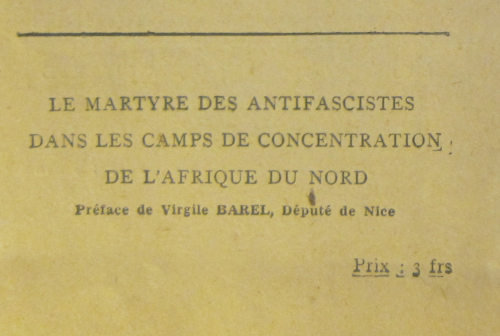
    Algeria concnetration camp

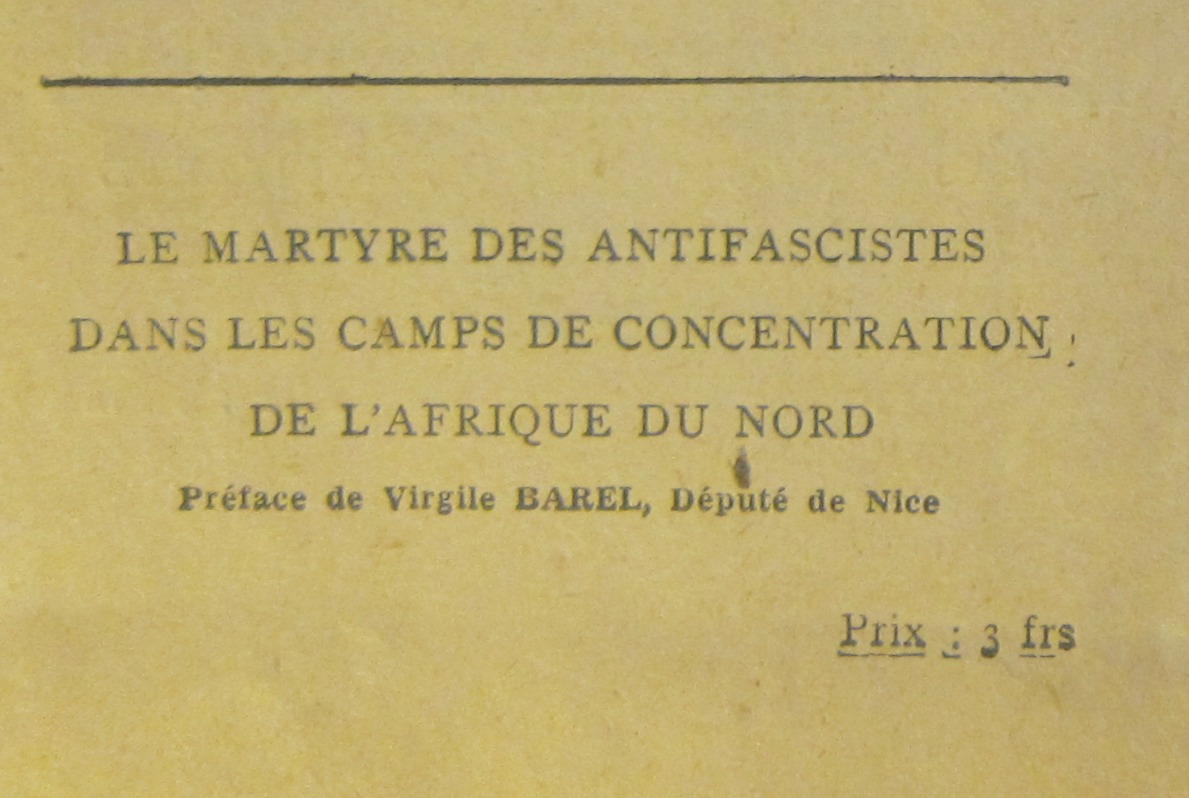
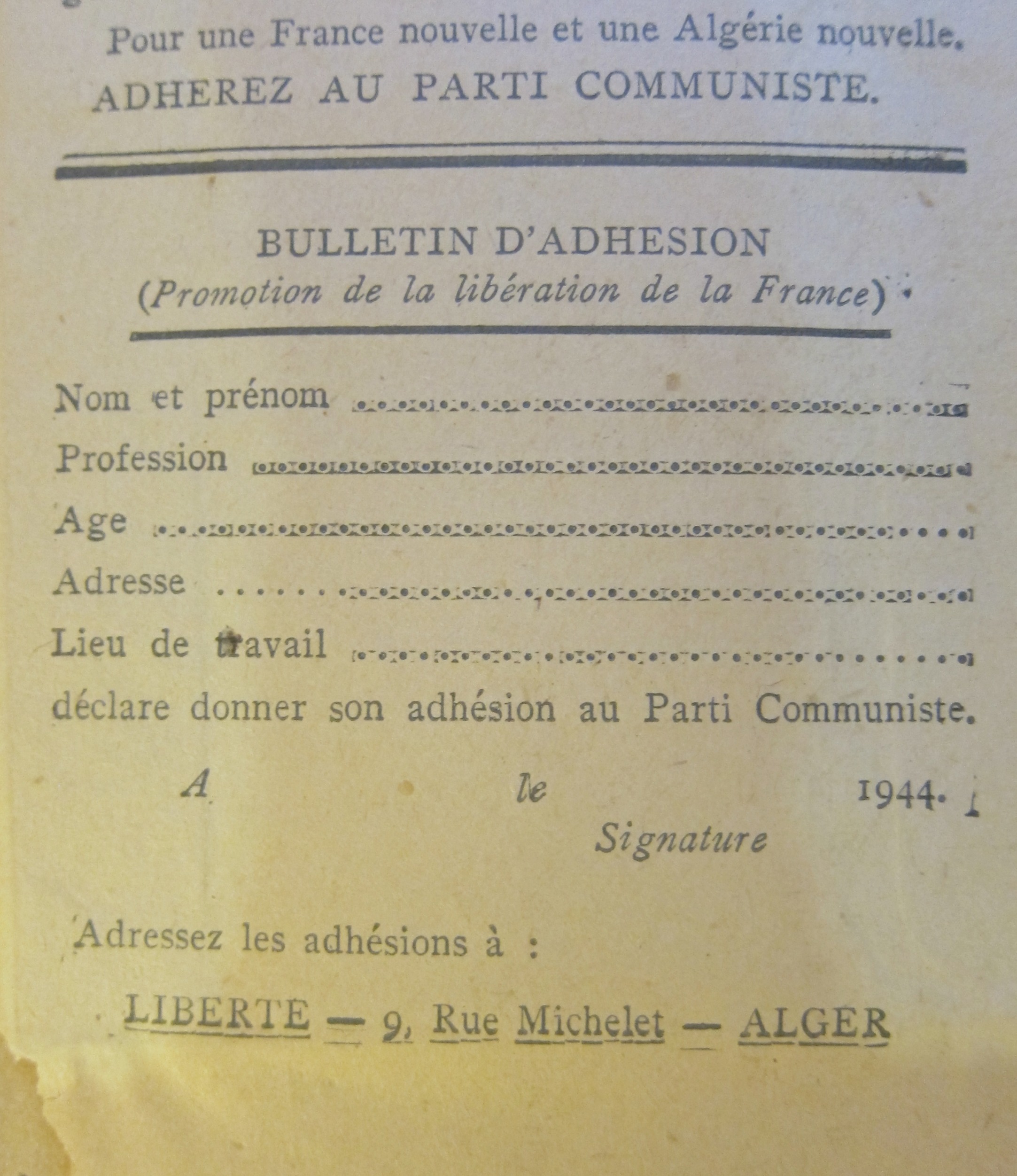
    In the back of the short pamphlet there was an advertisement among the ads for a provocatively-titled book, Le Martyrs des Antifascistes dans les Camps de Concentration de l’Afrique du Nord. It is unusual first of all because it is about a concentration camp and there was still nearly a year left of WWII; secondly, although I cannot find a copy of it online, I assume that the camp is a Vichy camp, set up to contain and work and kill Jews, anti-fascists, and other perceived enemies of Vichy France and Germany. More so than the present pamphlet, this is what would make for good reading. Also, this ad sits among a number of others that refer to the coming liberation of Algeria from France–something that would not happen until the end of a complicated and awful war of liberation fought from 1954 to 1962.  The Vietnamese operated under the same assumption, that the end of the war would bring about their freedom, too, from the French–the French would be done there in another nine years, replaced by the U.S., and then another 30 years of war.  The end of WWII brought with it high clarity and deep complexities, with thousands of varied decisions affecting the lives of hundreds of millions of people.  August 1945-August 1946  was a very involved and potentially dangerous year, full of joy, relief, desperation, hope, hunger, revenge, gratitude, homelessness, and so on. 
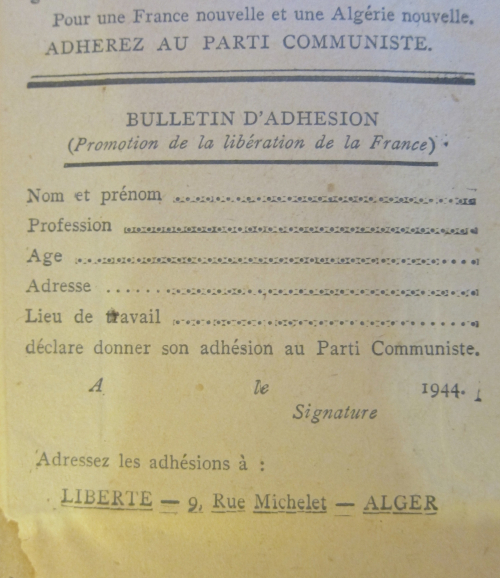
    Algeria freedom

    The last bit on this unusual pamphlet–my copy comes from the Library of Congress, having been sent there from the library of the Office of Strategic Services (O.S.S.), which was the direct predecessor of the C.I.A., the library holding things classified and not, though it was not for the use of  the general population. According to the WorldCat/OCLC, there are no copies of this in libraries in North and South America, with only three copies located institutionally in Europe. 

    Using a simple search on WorldCat for the period 1930-1938 there seem to be about 33 distinct and different titles using “concentration camp” in the title or having “concentration camp” as a keyword—so, not all that many; not unknown, of course, but still, not too many. There’s about an equal distribution between German/Soviet concentration camps, with Spain and Cyprus making appearances. A quick look for 1940-1944 shows 103 titles, 90+ of them being distinct and separate. Beyond 1944 the data on WorldCat gets a little tricky to use in such a quick way as I have been using it—the numbers get bigger and the classifications grow wider, so I really can’t offhandedly say how many books were published in, say, 1945/6 using the previously-mentioned criteria. This at least gives some idea of the relative opacity of the topic within a restricted parameter.

    Some of the interesting titles from the early period include:

    The Sonnenburg Concentration Camp. New York City: Workers International Relief and the International Labor Defense, 1934. 

    Chernavin “Life in Concentration Camps in USSR.” The Slavonic and East European Review12.35 (1934): 387-408.

    Appalling Facts. Letters from German Concentration Camps.Martin Lawrence: London, 1935

    Niemöller, Martin, and A. S. Duncan-Jones. From U-Boat to Concentration Camp : The Autobiography of M. Niemöller.London, 1936.

    Nazi Germany : Its Concentration Camps, Penitentiaries and Jails.New York: Labor Chest, 1938


    Note:

    Being part of the OSS library the Marty pamphlet has a borrower’s card in a slip on the rear cover, and it shows that it was borrowed “indefinitely” by Henry B. Hill, 1907-1990, “…professor of history, University of Kansas, who developed British history there and later at Wisconsin”.–Cloak & Gown: Scholars in the Secret War, 1939-1961 by Robin W. Winks (New York: William Morrow, 1987), pp. 495-97.  I have about 50 or so of these former OSS Library pamphlets, and they almost all have these call slips, and they almost all have been borrowed at one time or another.  And for those names I could find they all had gone on to interesting lives. 
     

    ·Posted by :

    ·in:

  • Hanging the Catatonic (1922)

    JF Ptak Science Books   Post 2641

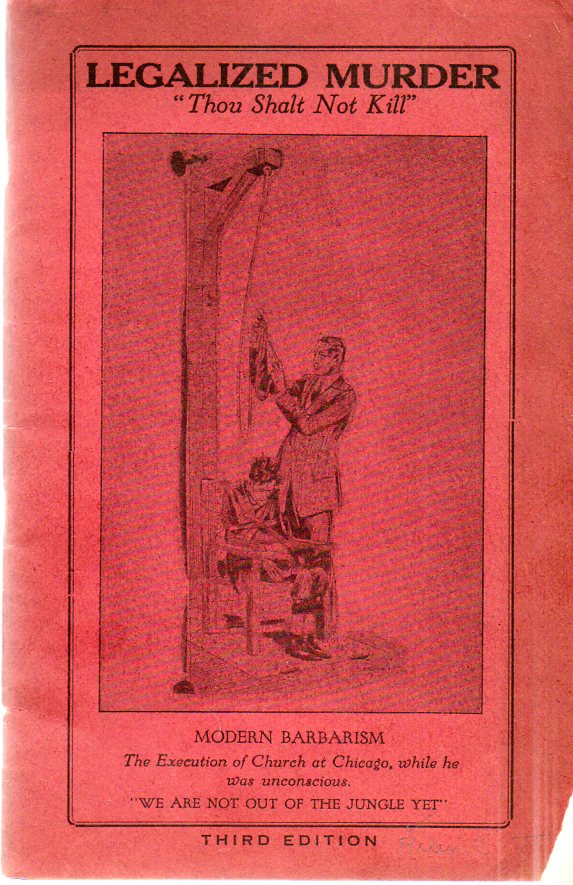
    Execution catatonia753I came upon a reference to hanging an unconscious man sentenced to death in a roller-coaster presentation of a pamphlet called Legalized Murder, “Thou shalt Not Kill”1 (or thereabouts).  It is the work of Dr. C.T. Riley (of New Matamoras, Ohio), and the “thereabouts” title is on the front cover of the pamphlet, and there is no title page per se, so the title may this or something else (like walking into someone else’s conversation mid-way and needing to title it).  It is, well, a highly individualized work, very vehemently against the death penalty, citing scripture and medicine and law and just about anything that Dr. Riley could get his hands on, while on occasion slipping in an advertisement for his medical practice and Gall Stone Cure. He is very passionate, and though his arguments seem very disjointed to me, when approached on the paragraph level he can make a very convincing argument.

    What was remarkable to me in this pamphlet was the cover illustration, which shows a hangman about to fix a noose around the neck of an unconscious man tied to a chair and placed on the scaffold’s trap door. The livid caption identifies the execution of “Church of Chicago” but so far as I can tell the subject is not again mentioned in the pamphlet. A little research reveals that this was a Mr. Harvey Church, who murdered two men to steal a $1500 Packard, and who was sentenced to death for his crime in 1922. It turns out that Church was a “dementia praecox catatonia”, and forty days before his execution, he entered a catatonic state. 

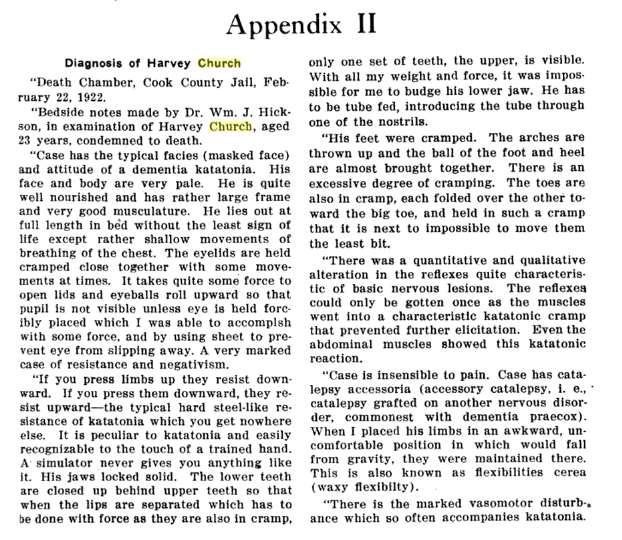
    There is a remarkable report by an unnamed physician published in the  Journal of the American Judicature Society, to Promote the Efficient Administration of Justice, vol 7/2, August 1923, documenting the condition of Church “in the death chamber”.  He of course was completely unresponsive, impervious in reaction to pain; the doctor reported clenched fingers and toes that were so cramped together that the doctor could not move them using all of his strength; nor could he part Church’s lips, except after exertion, and them only revealing the top teeth.  Here is most of what the doctor reported:

    Execution church katatonia

    This is the state in which Church was sent to the gallows.

    This case was probably enough to force a discourse on the issue of capital punishment. I knew that there was extreme treatment like this of people with similar disorders–epileptics for example were treated far more harshly than the general population–and in general pleas were made for sterilization of people with a wide range of disorders as well as the establishment of “colonies” for the rest of that population.  Hanging the unconscious (if that is what Mr. Church was) was something I had never heard of before. 

    Notes:

    1.  C.T. Riley,  Legalized Murder, “Thou shalt Not Kill, printed by the Baptist Banner, Parkersburg, West Virginia, 1930 (third edition), 69pp. 

    ·Posted by :

    ·in:

Recent Posts

Archives

Categories