A Daily History of Holes, Dots, Lines, Science, History, Math, Physics, Art, the Unintentional Absurd, Architecture, Maps, Data Visualization, Blank and Missing Things, and so on. |1.6 million words, 7500 images, 4.9 million hits| Press & appearances in The Times, Le Figaro, Mensa, The Economist, The Guardian, Discovery News, Slate, Le Monde, Sci American Blogs, Le Pont, and many other places… 5000+ total posts since 2008.

  • Nerves of Steel–Human-centric Target Practice from 1934

    JF Ptak Science Books  Quick Post

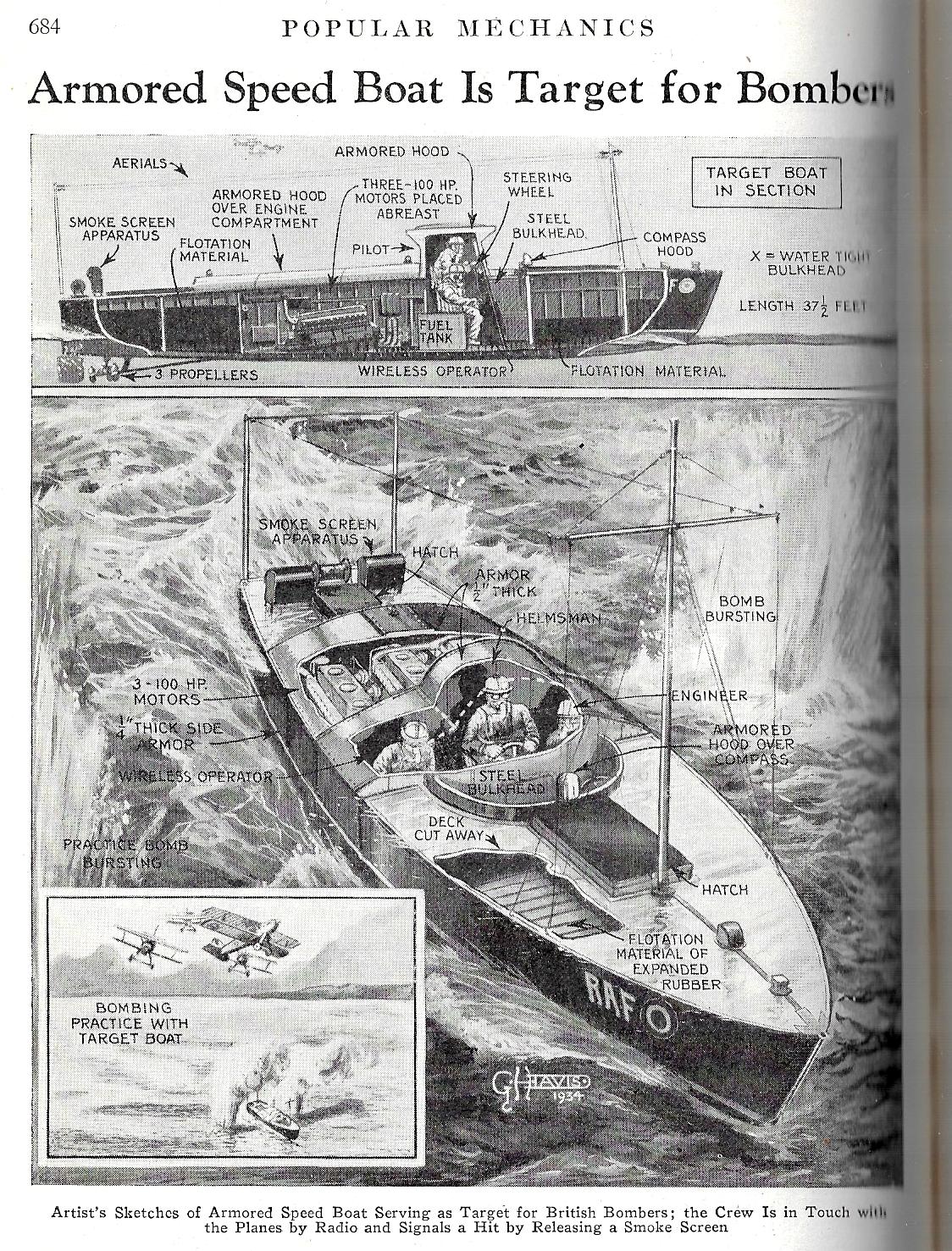
    This illustrated story from Popular Mechanics for May 1934 seems almost nominal–“Armored Speed Boat is Target for Bombers”–until you realize that it is piloted, and has an engineer and a wireless operator on board. This British crew of three would run around, powered by three 100-hp engines and serve as target/bait for bombers, trolling around, waiting for the aircraft to attack and strike.  Evidently the boat was screamingly fast at 30 knots, and was constructed to both protect and fail: the crew and engine compartments were shielded by half-inch iron plate and shock absorbers, while most of the rest of the 37′ boat was made of lighter material encasing rubber flotation devices. The boat was actually made to be hit by a bomb from the aircraft–if so, the bomb was supposed to pass cleanly through the fore and aft sections, with the rubber parts supposedly keeping the boat afloat. In the event of strike, the wireless engineer would both radio the plane pilots of their success as well as release a smoke screen.  Quite right.  Seems that you’d need steel fibers for nerves in this operation.

    Pop Mech 1934 speedboat target

    The drawing and cutaway were made by George Davis, a highly prolific and skilled artist who made hundreds of these drawings over the decades.  

    ·Posted by :

    ·in:

    —
  • A Beautiful Nighttime Cross Section of a Burning Building, 1690

    JF Ptak Science Books   Post 2572

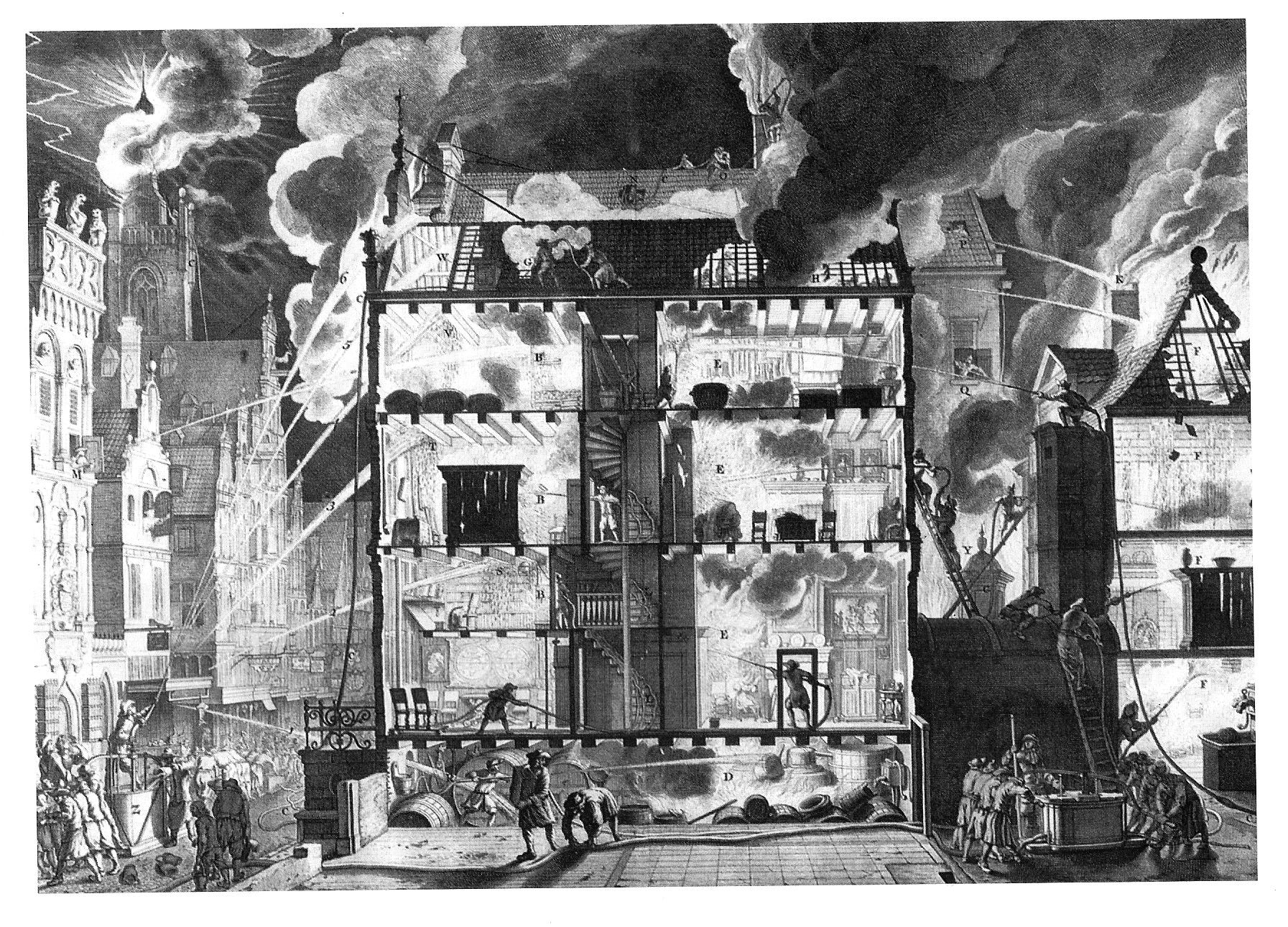
    Jan van der Heyden, a 17th century Dutch inventor, engineer, and artist, shared in his sensibilities in illustration a certain profound sense of color and depth of the Golden Age, even though he was working in just black and white in this capacity. He was the inventor of the fire hose, and was in charge of firefighting acting at the pleasure of the governors of Amsterdam, employing innumerable new technical benefits in the art of fighting fires as well as a “radical” new approach to dealing with fires.  (Which was a fine and very important thing, given the compactness of Amsterdam and all). In 1690 van der Heyden and his son published a revolutionary work1 on firefighting that explained the apparatus (the best of which he manufactured and patented), which is seen by experts as being perhaps the greatest book on firefighting ever published.  My interest was drawn to it by the illustrations, which really are quite spectacular (a number of them were engraved by van der Heyden himself). There are numerous nighttime scenes of firefighting, as well as some forensic images of post-fire situations, and of course images of the apparatus. (The content of the book were thoughtful and quite modern in presentation, with chapters dedicated to the old fire fighting equipment and then the new, a history of 40 years or so fires in Amsterdam, plus sections on buckets, ladders, hooks, tarpauline, the arrangement of the fire house, and of course the fighting of fires. It is an impressive work of a high order.)

    Perhaps the most interesting image for me is the cross section of a burning house at night–offhand I cannot recall an earlier, architectural image of such a thing.


    Firefighting cross section

    [Image source: Van der Heyden, Fire Fighting with Water Hoses and the Method of Fighting Fires now used in Amsterdam, translated by Lettie Stibbe Multhauf, and published by Science History Publications, 1996, opposite the header for chapter one, page 12.]

    For other images, please see  “Jan van der Heyden and his firefighting book” at Princeton University Library, Firestone Collection  https://graphicarts.princeton.edu/2015/01/30/jan-van-der-heyden-and-his-firefighting-book/

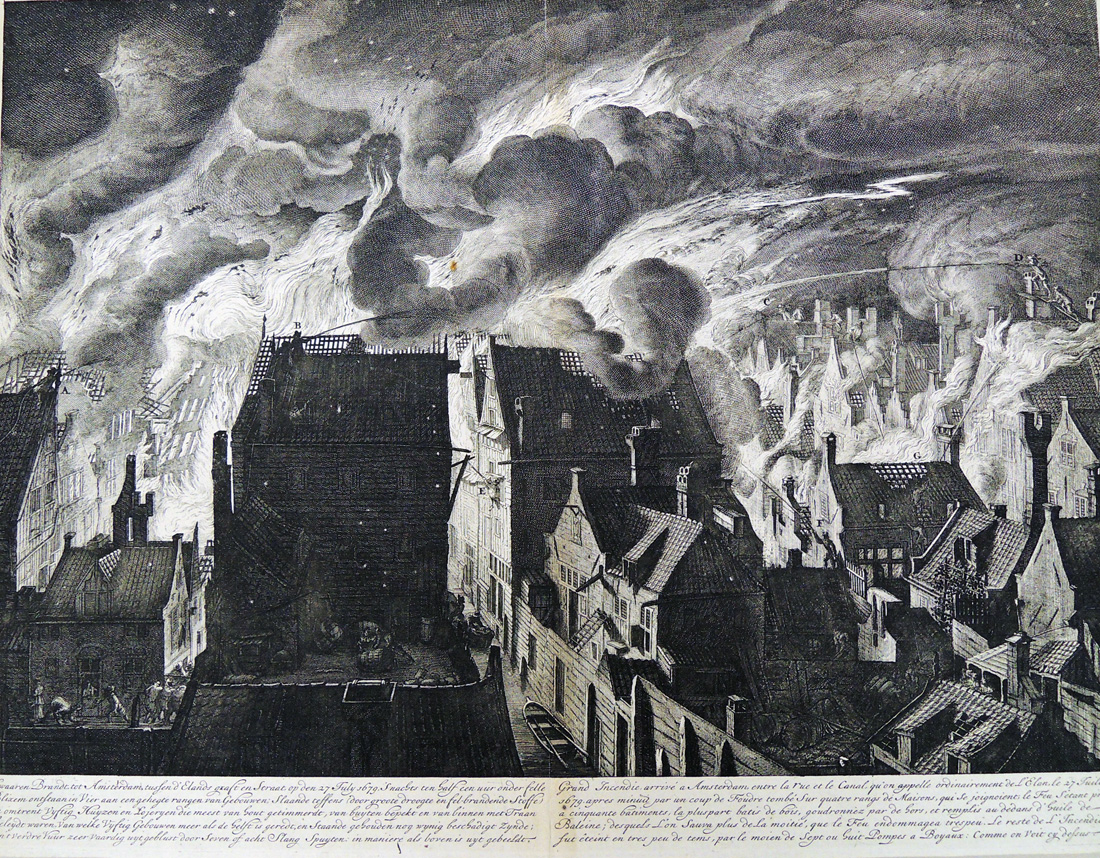
    One of the spectacular images of the book:

    Fire fighting Heyden

    Source,  Princeton University Library, Firestone Collection  https://graphicarts.princeton.edu/2015/01/30/jan-van-der-heyden-and-his-firefighting-book/

    Notes:

    1. Jan van der Heyden (1637-1712), Beschryving der nieuwlyks uitgevonden en geoctrojeerde slang-brand-spuiten en haare wyze van brand-blussen (Description of the Newly Discovered and Patented Hose Fire Engine and Its Way of Extinguishing Fires) (Amsterdam: Jan Rieuwertsz, 1690).

    ·Posted by :

    ·in:

  • Acrobatic Vocabulary and Found-Poetry in Night Dust Removal Technology, 1877

    JF Ptak Science Books  Post 2573

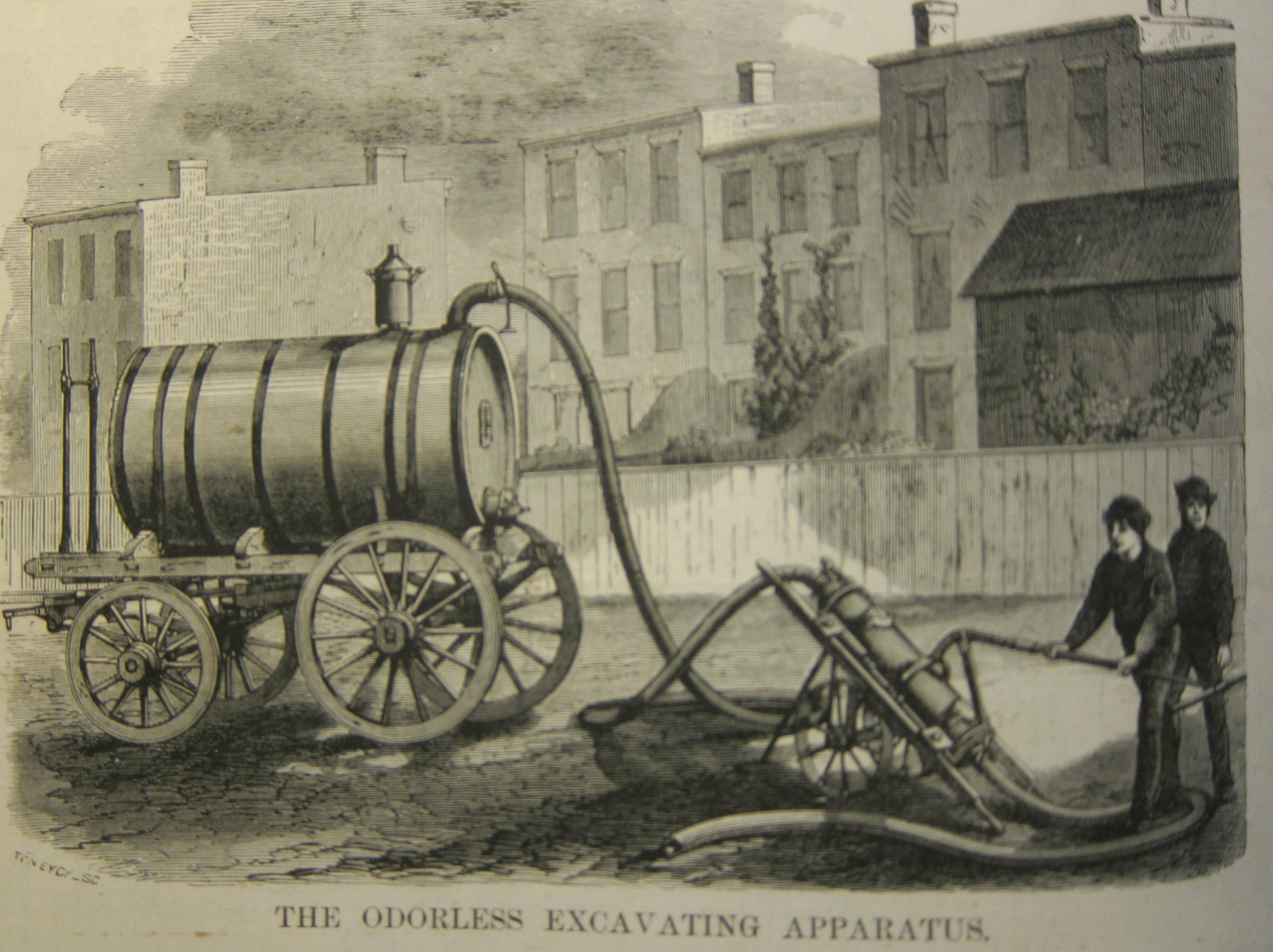
    The heavyily-lithe text of an article in the Scientific American Supplement (1877) on the virtues of the Odorless Excavation Apparatus Company of Baltimore isn’t so much “acrobatic” as mentioned in the title of this post as it is “aromatic” (or worse yet, “aroma-acrobatic”).  The OEAC of Baltimore was performing a daily routine of high importance and necessity–except that there was a high possibility of offending brittle social virtues if there was a description of what the company actually did without using far too many words. (For example: “The discharging of the contents of privy vaults during the hours of daylight, and without offence or danger to health, as well as the utilization of the matters taken from them for fertilizing purposes, has been a problem long and slow of solution.”) This was 1877, after all, and people really didn’t write too much about Daily Functions and the technology for dealing with them outside of the deep-end product of manure–and then there was a lot to say about that. Having said that, dealing with the absolutely necessary job of solving night dust/waste/dirt issues was just a difficult thing to do, in print. You can’t have the Second Industrial Revolution without people, and you can’t have the people without housing them close together so that everyone could get to work, and you can’t have closely-housed people without water and the means of getting rid of that and body eliminations, otherwise the nasty biological stuff can ensue. And thus you are left with the great need that nobody really cares to discuss. 

    Sci Am 1877 Odorless

    Here’s an example of some meandering and circuitous sentences from the 3000 words article, ideas trying to get somewhere:

    “To complete this system and render it applicable to
    the most extreme cases, as to difficulty of removal of the
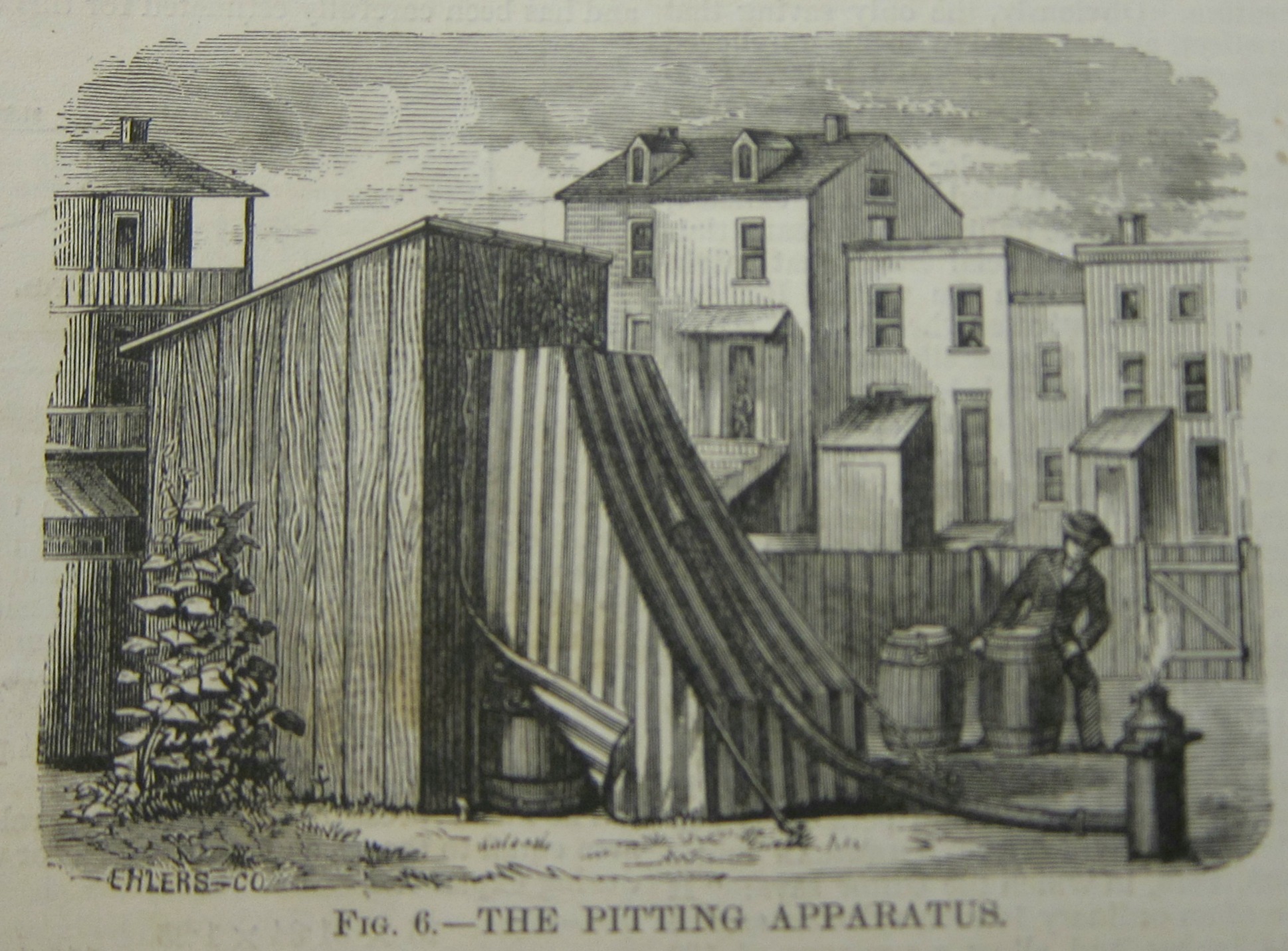
    material, the plan shown in fig. 6, and called the “ pitting”
    apparatus, is resorted to, and consists simply in covering the
    approaches to an outhouse with a kind canvas awning,
    from which is led a flexible tube to the deodorizer, to destroy
    the effects of the gases and odors generated in the disturbance
    of the material inside. The awning likewise excludes the
    operation from observation.

    “This plan is only resorted to
    in cases where the contents of the vault has become from
    long standing or other causes so unyielding as to preclude the
    use of the pump, in which case it is simply removed by
    digging, which, in its comparatively solid condition, is not
    by any means so disagreeable an operation to the workmen
    inside the awning, as was the old bucket system with the
    more liquid contents. In this way it is removed in the day
    time without offence to either sight or smell.”

    Sci Am Odorless _2_

    [Image of the privy door covered by tent, with the special apparatus, as described above.]

    And then in all of it there’s quite a bit of  Found-Poetry in the discussion of the removal of collections of night dust:

    “So far as the deprivation of these deposits of their odors is concerned, it may he said that, if a tithe of the expense

    and trouble were expended upon them with this view that is nowadays lavished upon the modern watercloset,they might be made
    as comfortable, convenient, and unobjectionable in every way
    as the best of them; and that while they may be so readily
    discharged of their contents, and in a manner so entirely un-
    objectionable as is done under the system shown in the
    illustrations, there can be no necessity of their ever becoming
    offensive or dangerous.”

    At the end of the day the article made its point and impact, and I have no doubt that there was a good amount of positive feedback for the Odorless Excavating Apparatus Company of Baltimore.

  • Maps of Ancient Cities and Colliery Cross Sections (1877)

    JF Ptak Science Books   Quick Post

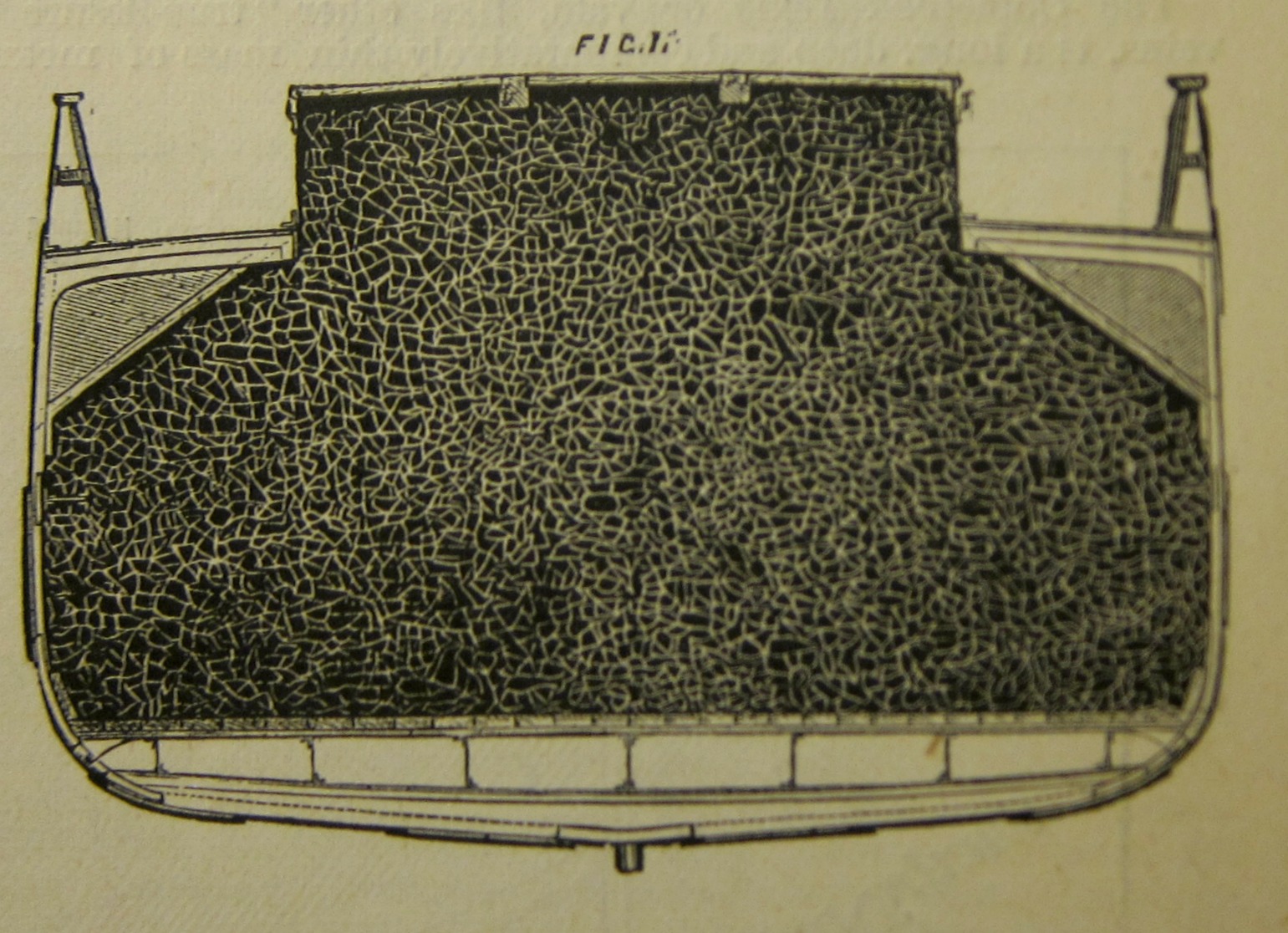
    One in a long list of tough jobs of the 19th century was that of the “trimmer”. These guys would be in the holds of coal transport ships, in the recesses and odd spots, whose job it was to shovel the coal into those far regions that would be missed in the loading process to ensure that as much coal is hauled as possible and to secure a stable cargo. They would be in a tough position, probably not well lighted, doing heavy work, and breathing a lot of coal dust. It was far from “easy” work, though it was pretty important that this work was done.  

    But as I saw in a Scientific American Supplement article for May 26, 1877, even these jobs were being released to a higher technology. In this case, that tech-boundary wasn’t so high. The solution in at least two cases of improved colliery loading was to make the hatches of the hold much larger so that coal could be distributed more evenly and reach all of those hard-to-reach spots.  And so the trimmer would lose his job to gravity.

    What I found most appealing though (as I slightly scared myself thinking about doing the actual work of a trimmer) was the cross section illustration for the article.  On close examination it may well be the skin of a large mammal in a dry place, or a road map of some ancient place with no legends, or any number of other things. The big brace of black is simply a cross section of the coal in the hold, but it does have a certain Found-Outsider Art quality to it.  

    Sci Am Supp 1877 Colliery gravi ty

  • How to Deal with Female Traitors (1861)

    JF Ptak Science Books   Quick Post

    Harpers Weekly female traitor detail

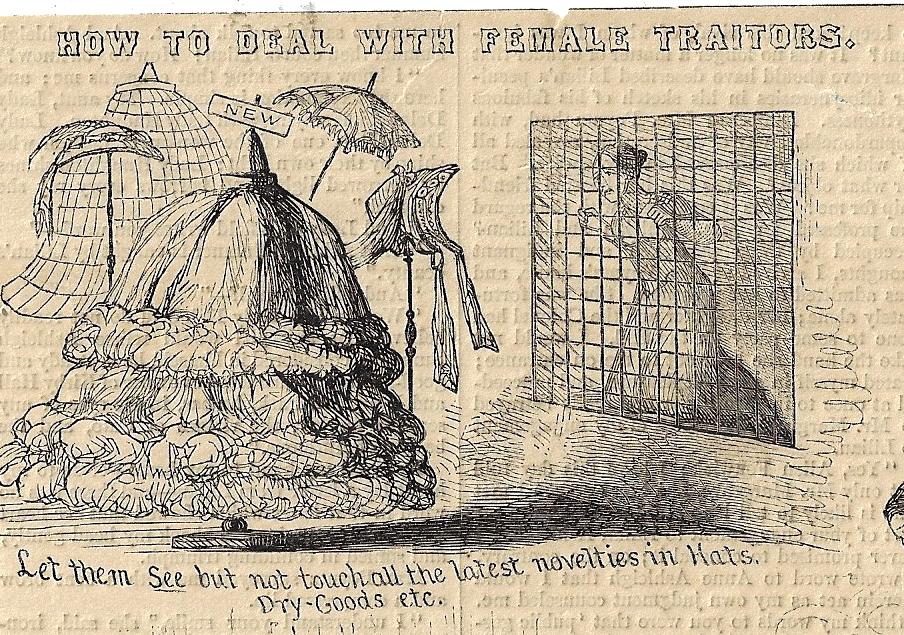
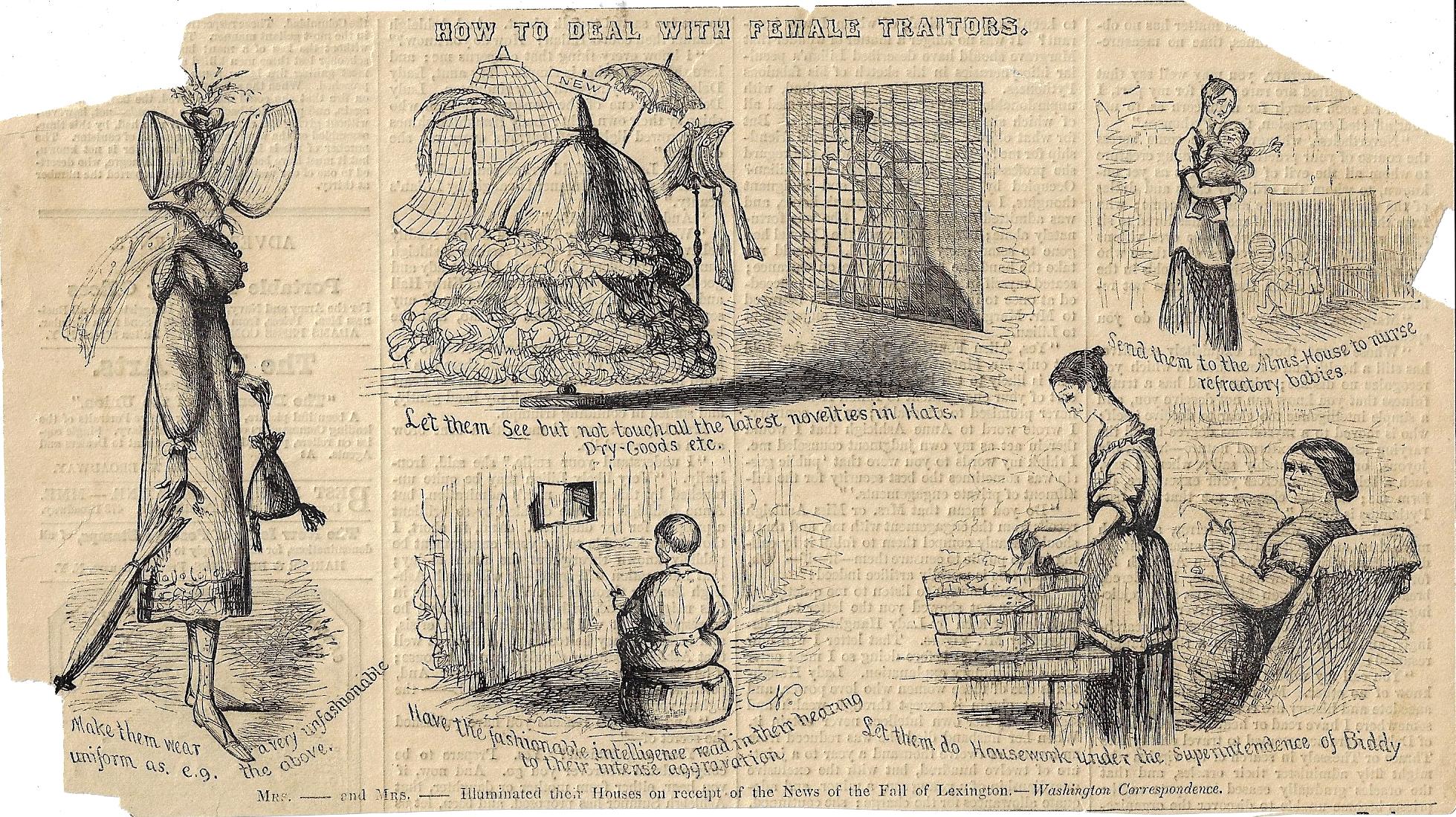
    I found this in the files this evening, a cartoon from Harper’s Weekly from October 26, 1861, from when the Civil War was but half a year old or so and there was still three and a half years of fighting to go. This was a modest suggestion on what to do with female traitors–the sections are pretty self-explanatory, and I’ve provided a transcription for them if difficult to read in the original:

    Harpers Weekly female traitor

    The captions:

    • “Let them See but not touch all the latest novelties
      in Hats, Dry Goods, etc.”
    • “Send them to the Alms House to nurse refractory babies”
    • “Have the fashionable intelligence read in their hearing to their intense aggravation”
    • “Make them wear very unfashionable uniform as e.g. the above”
    • “Let them do Housework under the Superintendence of Biddy”


    ·Posted by :

    ·in:

    —
  • Killing Whales with Exploding Rockets (1822)

    JF Ptak Science Books   Quick Post


    Congreve rockets

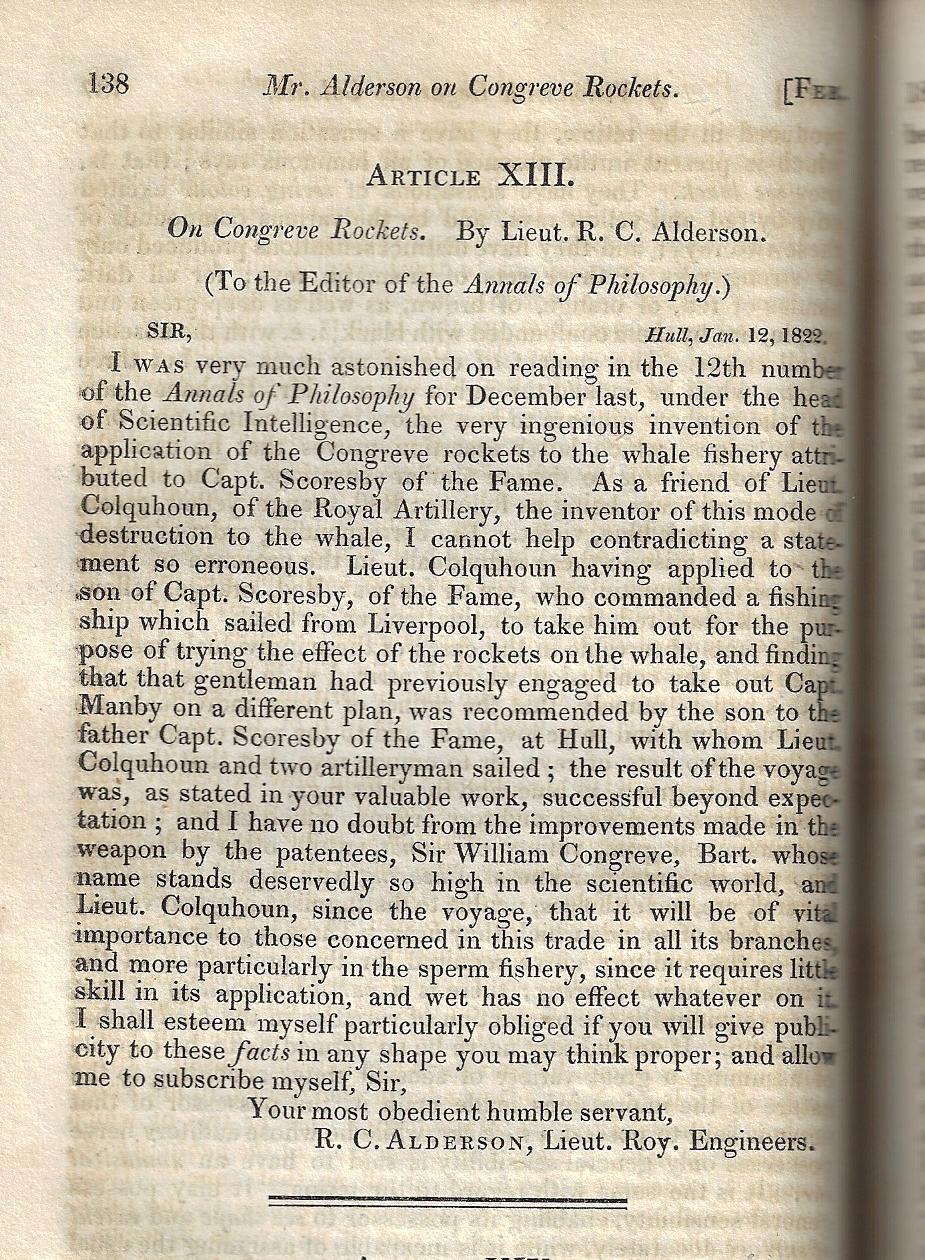
    Well, this is the detached and blatant title on Willliam Congreve’s rockets hides its purpose, unlike the original article written a year earlier by Congreve which lays out the intent of the rockets straight away: “Application of Rockets to the Destruction and Capture of Whales” (1821). William Congreve and James N. Colquhoun developed this idea of a rocket and twisted it into an exploding harpoon, something that could be fired at a whale, embed itself, and then explode, all to maim or kill the whale.  (The idea for this application seems to have lived through the entire century, evidently reaching its zenith/nadir with the work of Capt. Thomas Roys in  his bomb-harpoon (1861).  

    See: Mike Gruntman, Blazing the Trail: The Early History of Spacecraft and Rocketry, pp 85-6.

    Article source:  Thomas Thomson. Annals of Philosophy; or, Magazine of Chemistry, Mineralogy, Mechanics, Natural History, Agriculture, and the Arts. Volume III (and the 19th since the start of the series), January to June, 1822. Printed in London, for Baldwin, Craddock, and Joy; v, 480pp,

    ·Posted by :

    ·in:

  • Very Early “Cinematography” (1882)

    JF Ptak Science Books  Quick Post

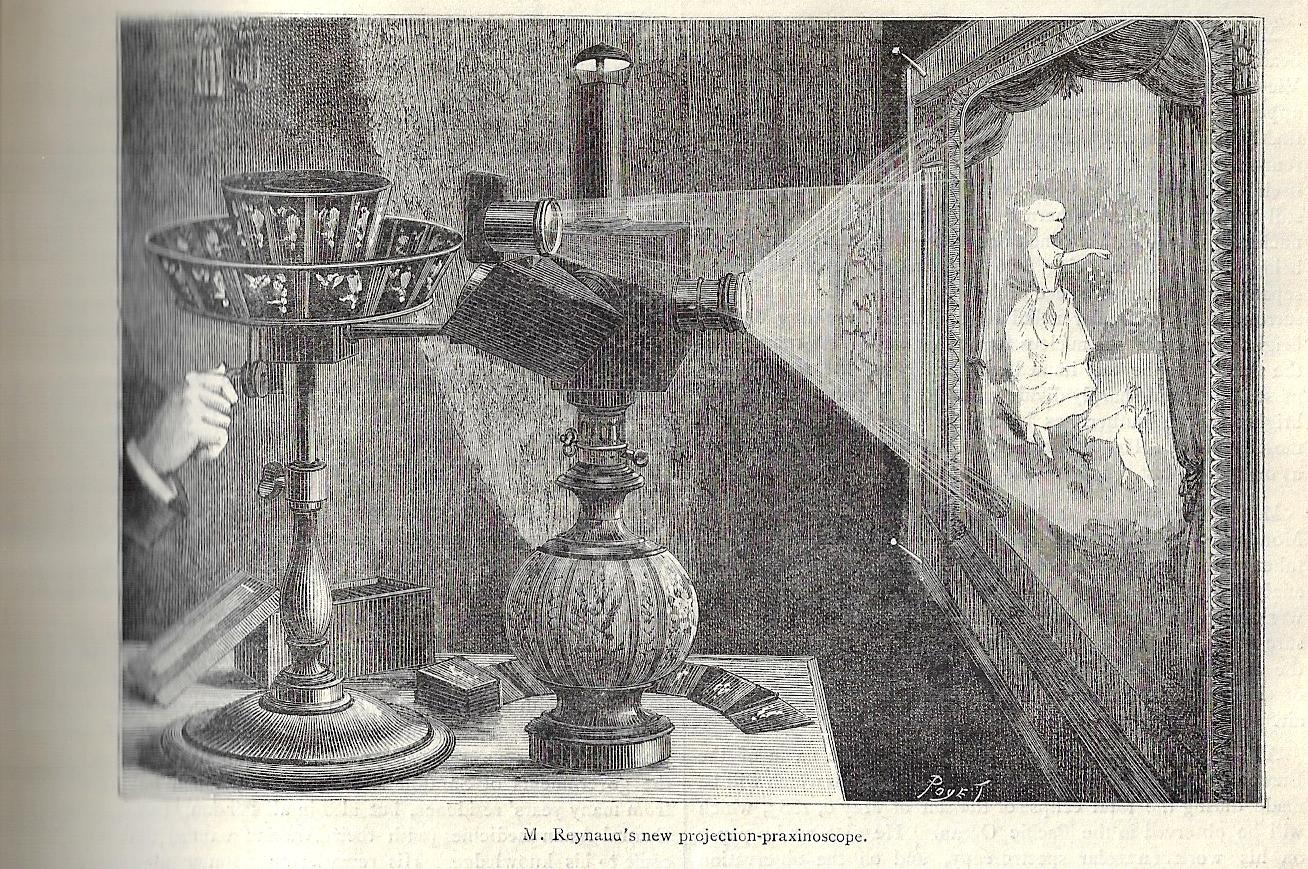
    This short article in the November 16, 1882 issue of Nature reports on the invention of the “lampascope” by Emile  Reynaud. Reynaud (1844-1918) builds on his own invention of the praxinoscope (1878) which in turn had continued earlier ideas of the zoetrope and phenakistiscope–all of which are very early animation devices and considered a part of prehistoric film history–allowing a projection of the moving images, and turning the personal viewing experience into a shared one. Reynaud worked on the invention through the decade, making adjustments and improvements, leading to his first public demonstration of the device in his Theatre Optique in 1892, which is just at the beginning of the filmed motion picture history. It was an elegant idea, and certainly for the time it would have been a major attraction and popular “philosophical toy”.  

    Nature 1882 lampascope

    ·Posted by :

    ·in:

  • The First Church for Animal Rights (1921)

    JF Ptak Science Books  Quick Post

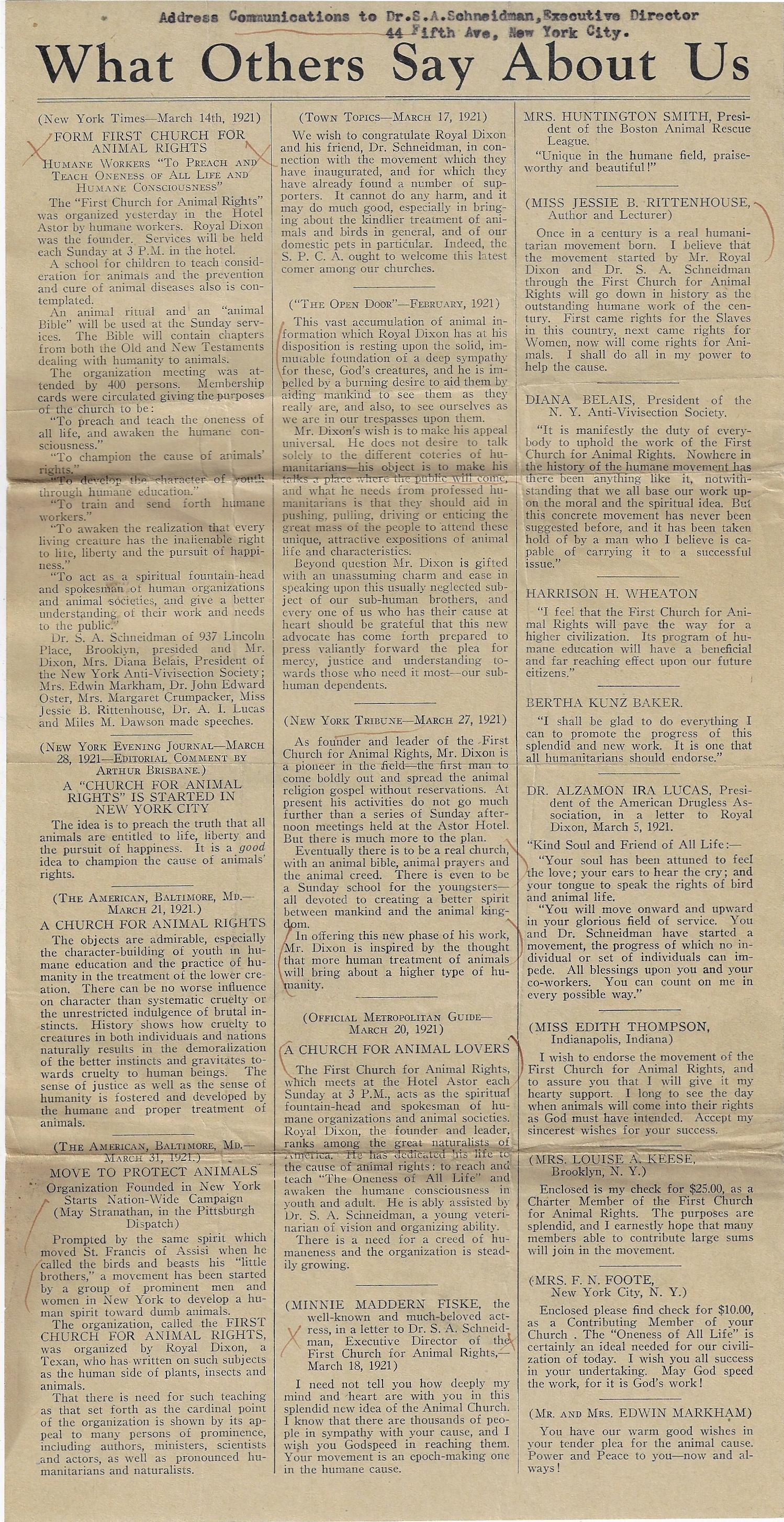
    This broadside comes announces  “Humane Workers to Preach and Teach Oneness of all Life and Humane Consciousness” in the formation of a church dedicated to equal rights for humans and animals, and so far as I can tell it is a rare application of the idea of church for all living things.  “The First Church for Animal Rights was organized yesterday in the Hotel Astor by humane workers. Royal Dixon was the founder. Services will be held each Sunday at 3 P.M. in the hotel.” so states the broadside.  Mr. Dixon (1885-1962) blazed an interesting path to this point (in 1921) in the formation of this church; he was a former actor, and then a curator of botany at the Field Museum in Chicago, a staff writer at the Houston chronicle and writer in general (The Human Side of Plants (1914),  The Human Side of Birds (1917), The Human Side of Animals (1918)), and then on to the great cause of animal rights.  

    The church seems rather a radical thing, to my eye, and especially for the times. Not only was there a church, but also “A school for children to teach consid­eration for animals and the prevention and cure of animal diseases also is contemplated.” Also from the broadside:

    • “An animal ritual and an “animal Bible” will be used at the Sunday services. The Bible will contain chapters from both the Old and New Testaments .The organization meeting was attended by 400 persons.”

    The listed objectives of the church:

    • “To preach and teach the oneness of all life, and awaken the humane consciousness.”
    • “To champion the cause of animals’ rights”
    • “To train and send forth humane workers.”
    • “To awaken the realization that every living creature has the inalienable right to life, liberty and the pursuit of happiness.” 
    • “To act as a spiritual fountain-head and spokesman of human organizations and animal societies, and give a better understanding of their work and needs everyone.”

    ANimal kindness


    In spite of what seems to be an initial success, I can find nothing else about a second meeting of the church.

    ·Posted by :

    ·in:

  • An Appeal for Help for War Horses, 1915

    JF Ptak Science Books  Quick Post

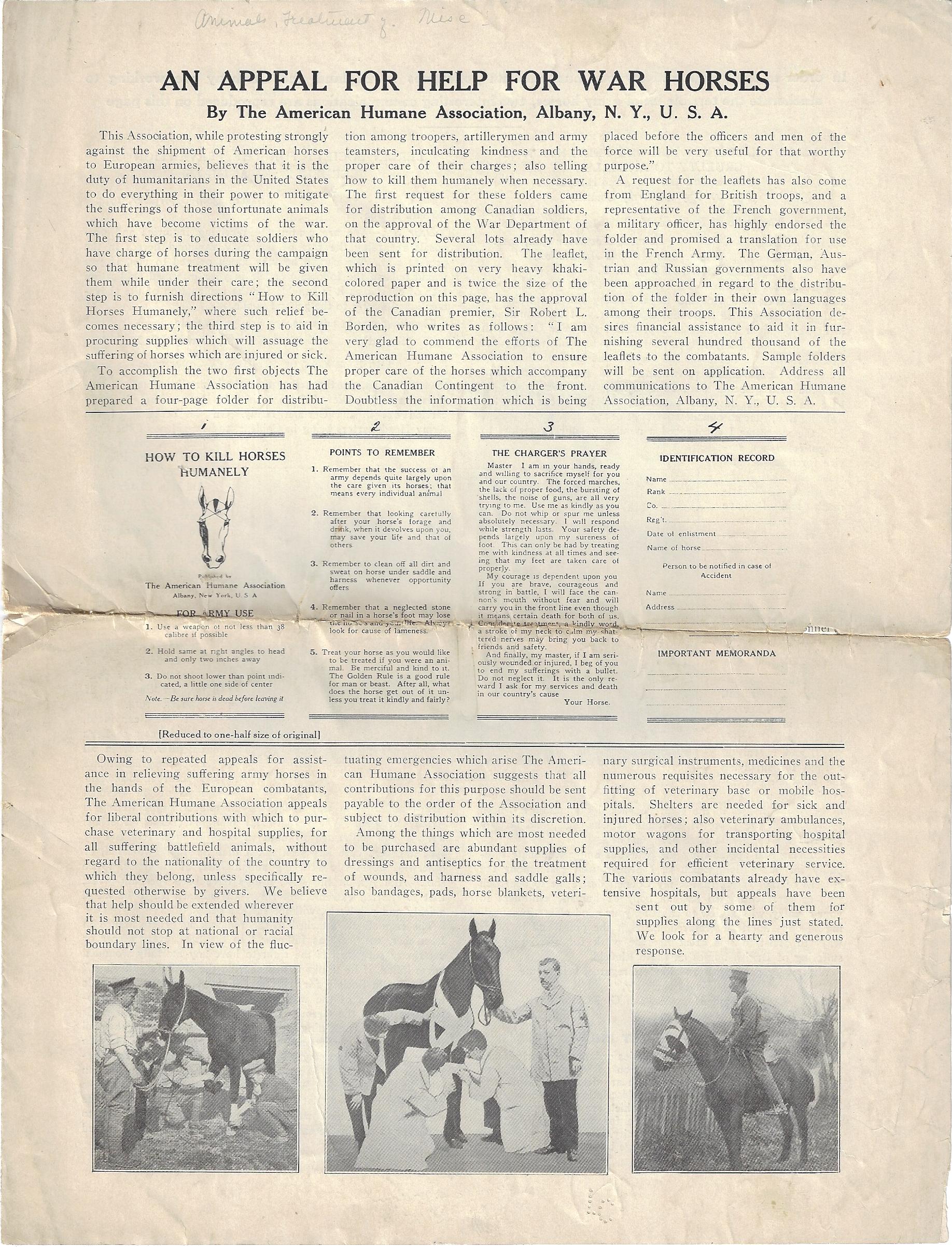
    I’m just sharing this document on a subject that I’ve never thought about, and now that I have a chance to think about it, I really don’t want to…it is just a tough go, especially considering myself part of what is a horse family with two dogs and four cats.  At the very least I can reproduce the document for this rather forward idea, which was published in 1915, one year into WWI.  


    War horses_1_


    ·Posted by :

    ·in:

    —
  • Cutaway of an Airship-based Hospital, 1930

    JF Ptak Science Books   Quick Post

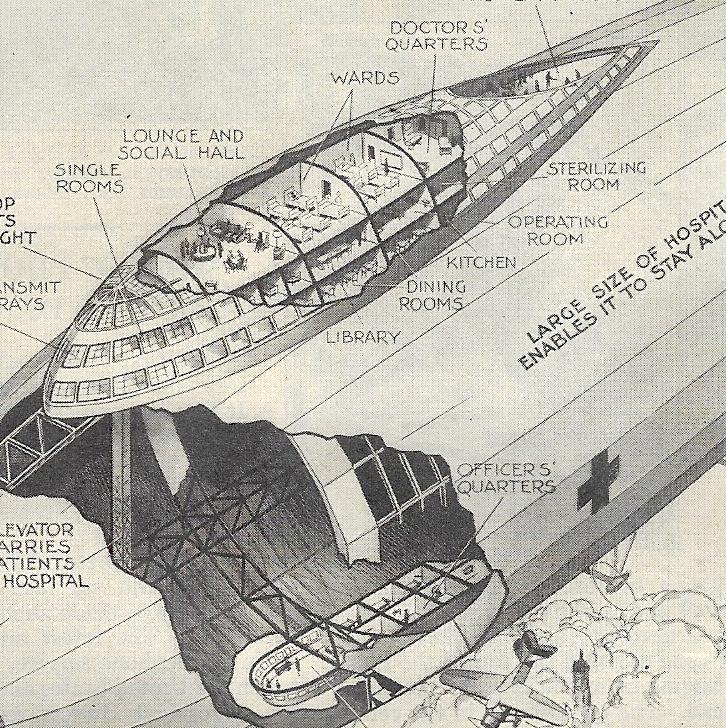
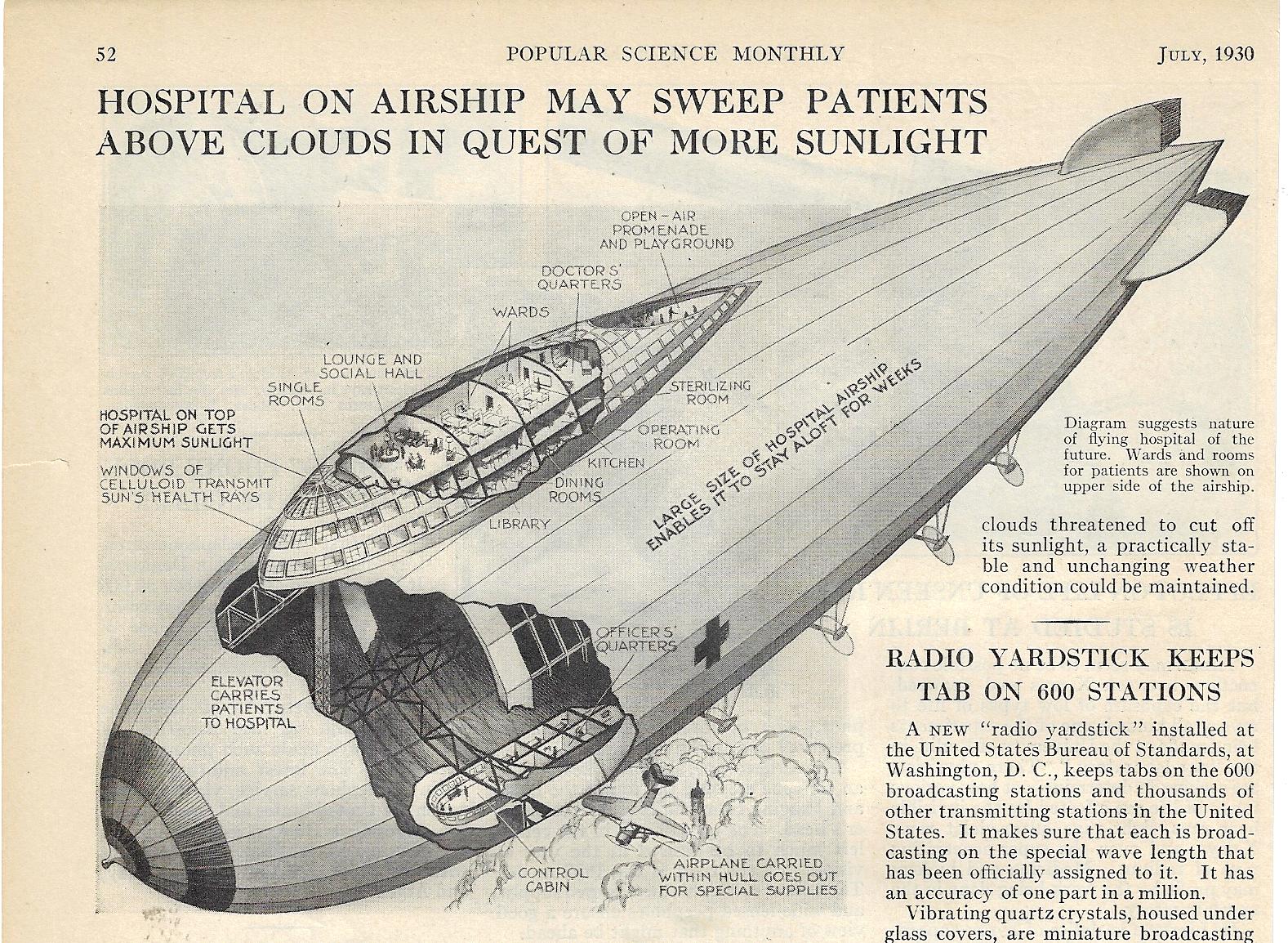
    “For people suffering from tuberculosis, or just from nerves, will physicians soon prescribe a trip to the clouds in a flying clinic hospital instead of a visit to the mountains?”  That was the leading sentence in the PSM issue on the flying clinic, appearing in July 1930.  The thinking was that if people were removed to high altitudes to get a “change in the blood” to being in such an atmosphere with a lot of sun, then the higher up, the better, And so the great airship hospital idea perked up for a few years, the idea getting a big boost from French physician Charles J. Juillot. who wrote on the benefits of a floating high-altitude clinic. The hospital/clinic (“aerial sanatorium” part of the airship would be situated on the top of the airship “like a big blister”, the patients taking the sun under large celluloid windows, enjoying their stay for weeks at a time between re-supplies. 

    Hospital airship, Popular Science Monthly, 1930:

    Cross section 1930 hospital airship detail


    Cross section 1930 hospital airship

  • Robot/Computer Anthropomorphic Brains

    JF Ptak Science Books  Post 2570 (continued)

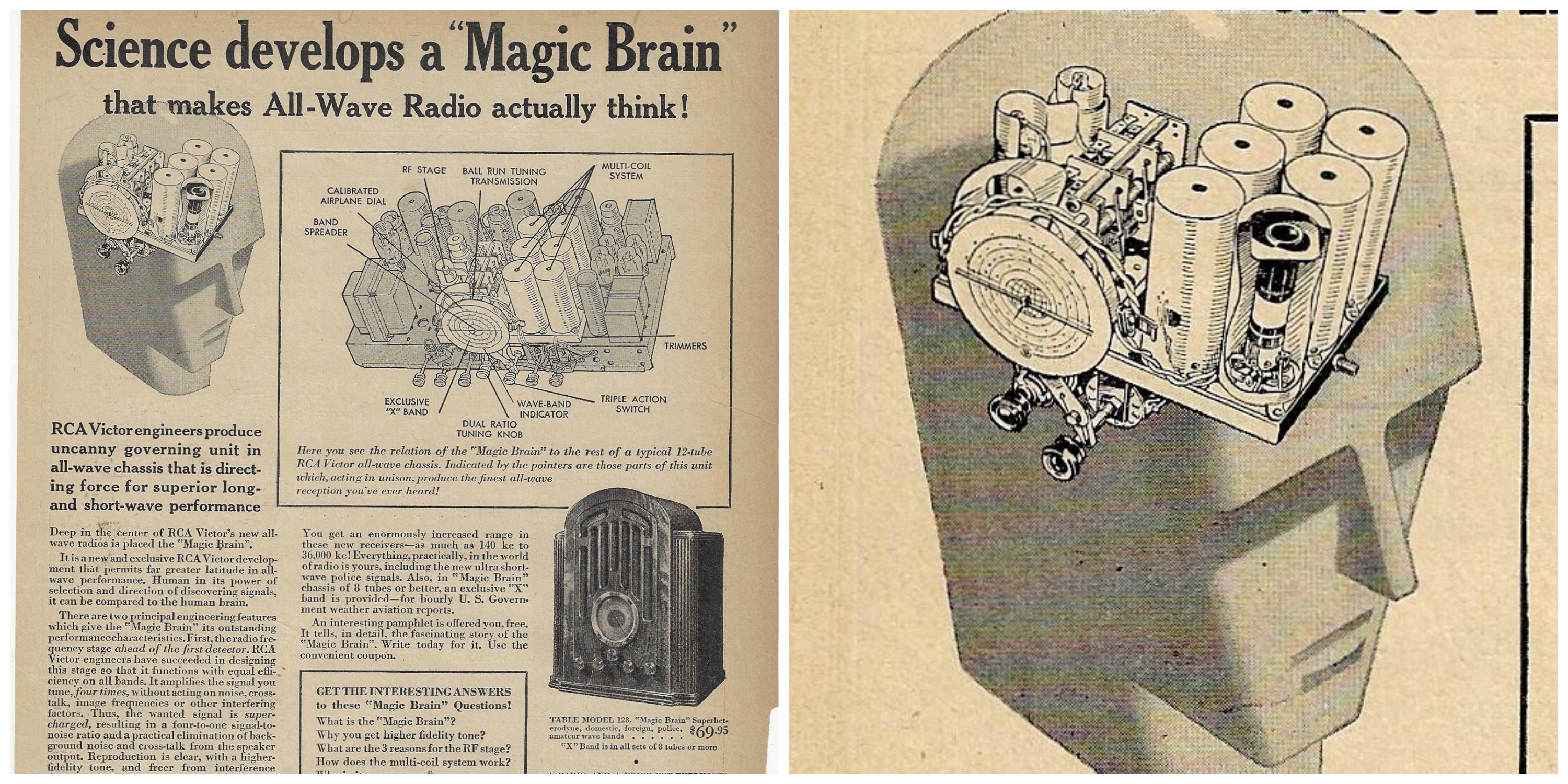
    There seems to be a developing thread in the stuff I’ve been saving on the history of anthropomorphic robots pre-1955 or so–and that is, the robotic or computer brain.  These are not nearly as plentiful as the robot-entire, or at least that is the way it seems from a general impression of long and sloppy reading in the area. I bumped into another brain post, this one still on the early-ish side, coming from Popular Science Monthly for 1930. It really is a stand alone, and an illustration for an advertisement for radios, but it still sent a message to the reader, and it seems that it probably was still very uncommon territory in the application of images like this:
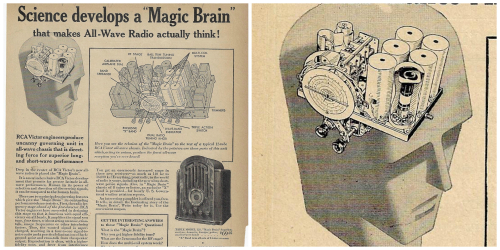
    Robot magic brain montage

    That really is beginning to put the hot tube-scented “logic” into biological.  

    Here’s another, one that I wrote about some time ago, though this one has more the makings of a computer in place of some tubes and a dial.
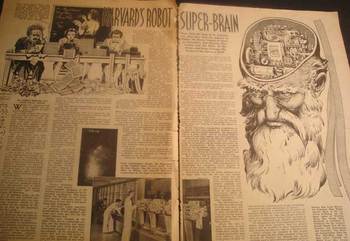
    Robot brain harvard
    This may well be the first public, popular, report on the Harvard Automatic Sequence Controlled Calculator (ASCC) (appearing in the American Weekly, 15 October 1944), the first automatic, general-purpose, digital calculator.  Known as the MARK 1, it was the brainchild of Howard Aiken (1900-1973), a graduate student at Harvard, who started it all in 1937 by proposing a series of coordinated Monroe calculators to function as a unified whole  that would cross the threshold of the physically-impossible calculation (though theoretically possible) to the eminently doable. Here’s a detail of the inset:
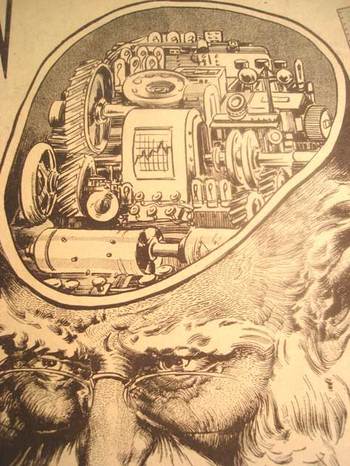
    Robot brain harvard detail

    There are some others in the category, including this fine image from the Burroughs people:

    Robot brain wheel burroughs

    The Burroughs Adding Machine company did about as much as anyone to objectify the worker in America during the 1880-1915 period, making the worker a part of a machine within the machine. In a way it was like creating the Ford assembly line for people sitting down. 

    The company was founded on the work of William S. Burroughs’ grandfather, William Seward Burroughs (1857-1898 and native son of Rochester, NY), who created a mechanical calculator to help him add long columns of numbers in his job as a bank clerk. American Arithmometer Company was founded by him and others in 1886, later evolving into Burroughs Adding Machine Company (1904), Burroughs Corporation (1953), and then into Unisys (combining with Sperry Univac in 1986) before sliding away.

    In any event the adding machine connected millions of people to a mechanizing process of what had previously been a mental operation–the flywheel in the side of the head of the clerk/accountant in this add for Technical World (More Fascinating than Fiction) for August 1915 wasn’t too terribly far from the truth. Interesting that on the other side of the head of this fellow, behind the other ear, is a pencil. 

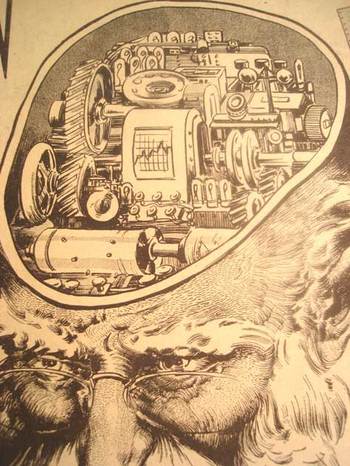
    Another in this line of depicting human brains as sort-of machines is this very entry-level bit of gearing in an advert for a tech correspondence school for folks to “modernize make more money”, and found in  Popular Mechanics, August 1936. As these things go, it would be difficult to imagine a less complex depiction of a mechanical brain:

    Robot brain few gears Pop Mech 1936

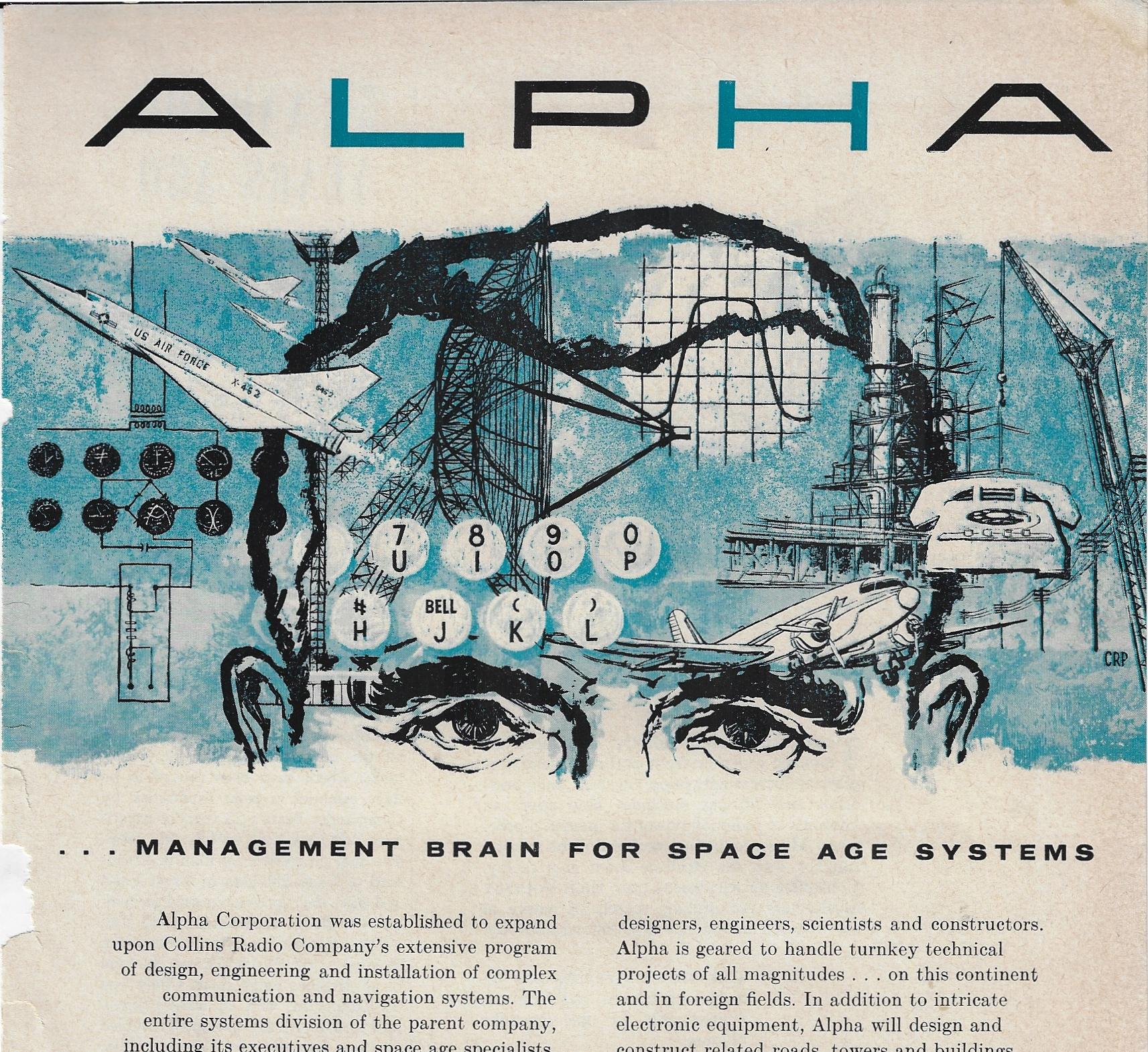
    And another–again, this is not much of an electronic brain, but it does get across the point of the ad for the Alpha Corporation (“A subsidiary of Collins Radio Company”) for 1958:
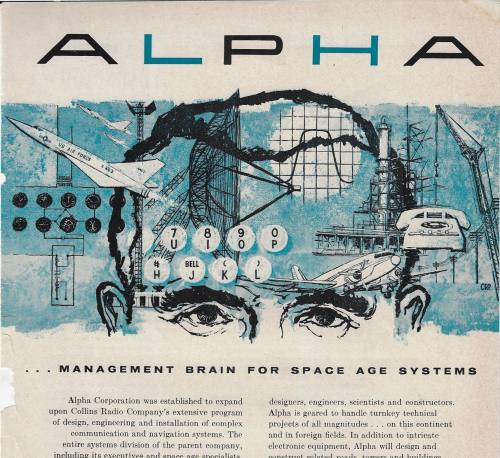
    Robot brain alpha 1958_0001


    And yet another boundary is threatened with the astromatic panel concept of the Electrosnap corp (of Chicago), showing the interaction of biological and electronic systems, as shown in this advertisement in Missile and Rockets in 1959:

    Robot brain link machine human

    In any event, these are three of this developing collection of metalizing/electrifying the brain for its robot-y future.  
Recent Posts

Archives

Categories