A Daily History of Holes, Dots, Lines, Science, History, Math, Physics, Art, the Unintentional Absurd, Architecture, Maps, Data Visualization, Blank and Missing Things, and so on. |1.6 million words, 7500 images, 4.9 million hits| Press & appearances in The Times, Le Figaro, Mensa, The Economist, The Guardian, Discovery News, Slate, Le Monde, Sci American Blogs, Le Pont, and many other places… 5000+ total posts since 2008.

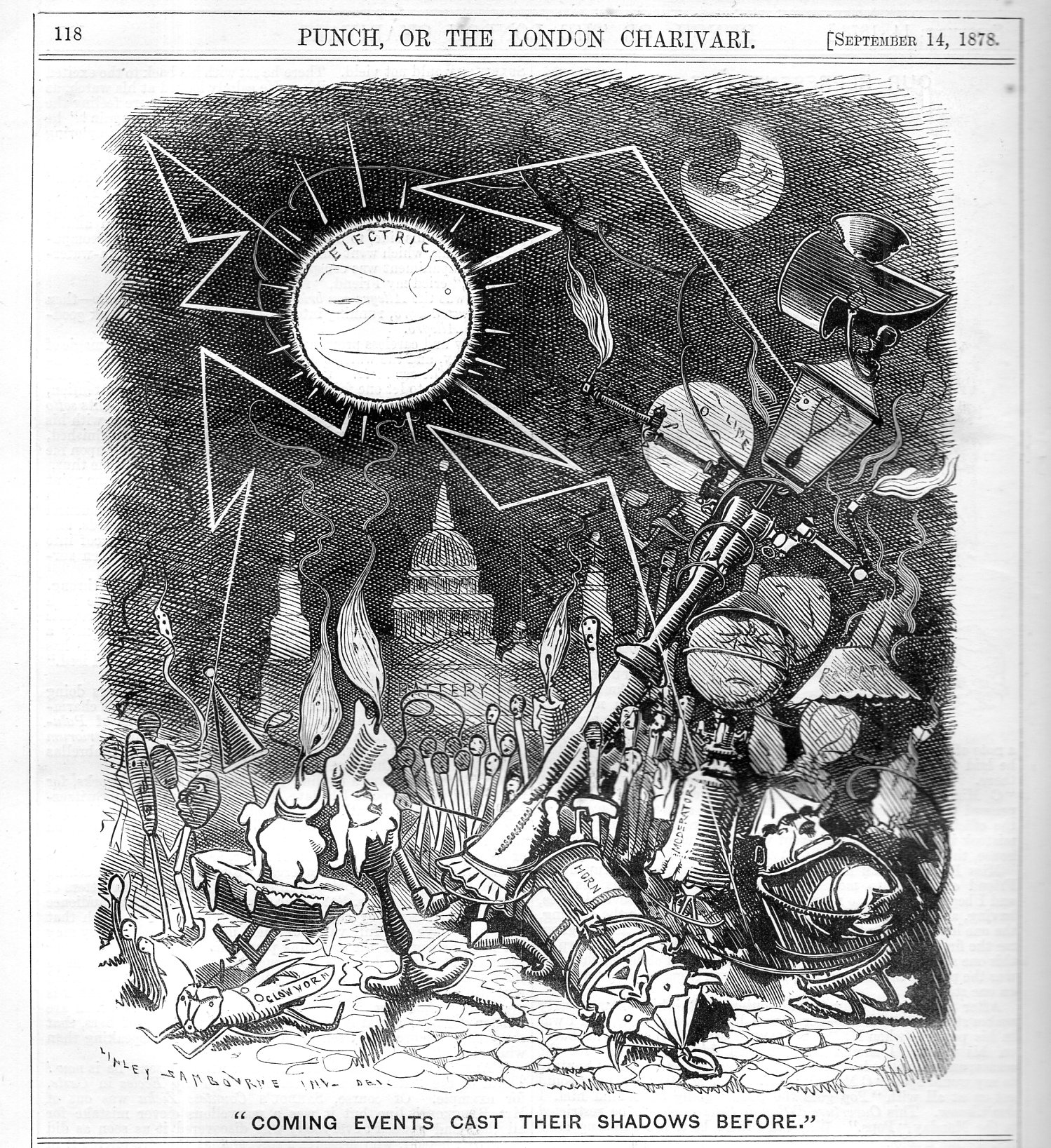
  • “Coming Events Cast Their Shadows Before” (1878)

    JF Ptak Science Books   Quick Post

    Punch etectric  1878818The “coming event” here, as depicted in a satirical bent-future speculative cartoon by the ever-present Linley Sambourne (1844-1910) in the journal Punch in 1878, is electricity. The shadows cast by its own approach are many, and though we don’t have a pre-historic campfire, we do see candles, and a gaslight, and oil lamps, and plain matches, all sadly scurrying their paths away from the sharp War of the Worlds legs of electricity. An interesting bit here is that what is generally seen as the common capstone for the invention of the electric light–with the first practical incandescent light bulb–was achieved by Thomas Edison about a year after this graphic was published. There are numerous inventions of different sorts of electric lights prior to that which Sambourne is no doubt referencing, and he certainly knew enough of his recent history of technology to guarantee that his vision of the importance and standard of electricity for the future was absolutely correct.  

    Source for the idiom in the title: 

    Lochiel, Lochiel! beware of the day;
    For, dark and despairing, my sight I may seal,
    But man cannot cover what God will reveal.
    ‘Tis the sunset of life gives my mystical lore,
    And coming events cast their shadows before.
    I tell thee Culloden’s dread echoes shall ring
    For the bloodhounds that bark for thy fugitive king.  

    –Thomas Campbell, (d. 1844)  Loichiel’s Warning, (1802).                                                                                                                                              .

  • How Much it Cost to be a Drug Addict in the 1930’s

    JF Ptak Science Books   Post 2570

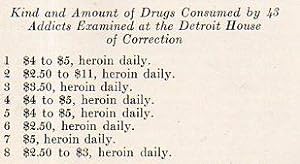
    I’m not sure that I’ve ever seen a list of the personal daily cost of antique drug use, though I did manage to stumble across one in a remarkable little pamphlet by Edward C. Jandy called Narcotic Addiction as a Factor in Petty Larcency in Detroit (published by the Narcotic Committee of the Wayne County Medical Society, et al. in November 1937). There’s a lot packed into its 23 pages, not the least of which is a pretty sophisticated look at how to examine the costs of drug addiction to the sales economy of that city.

    Narcotic Addiction as a Factor in Petty Larcency in Detroit: Edward C. Jandy

    One of the interesting historical bits that emerges from it is a list of the daily cost of the addiction of one of the target study groups–a selection of 43 local addicts with a combined 673 years of addiction (averaging an unholy 15.5 years of addiction/person). There are immediate limitations to this info–for example there is no correlation to the number of years of addiction to the individually-reported daily drug costs–but since this data seems to be fairly rare it does at least give some idea of the strain of usage per person. And what does it mean to spend $5/day on your heroin habit? CPI is useful, but it is better to look at what that figure means in terms of the average salary and costs of basic goods. If you were working back there in a bad spot of the Depression in 1937 the average salary was about $1,700/year, which means that if these addicts were working (and the great majority wasn’t) then they would be spending about 1/3% of their annual income per day–or a little more than all of their daily salary–on their everyday habit.

    Spending $1,800 a year on drugs on a $1,700 salary leaves not-so-much-room for anything else but crime, and not having any income at all would mean that all of that money would have to be from criminal activities. In another (potentially gross) way of thinking about this expense is by looking at the average salary in 1937 being about 1/30th of what the average American family income is in 2012, so the daily $5 heroin hit would be something like $150 today, which sounds about right. And if you applied that multiplier to some other standard 1937 prices, the numbers are fairly constant from then to now–the big exception being postage stamps (which would be $1.50 for a first class stamp) and gasoline ($6/gallon), both of which would show a decline. Again, that’s a very crude approximation, but it does pause. The author then does some tricky and interesting semi-statistical work with the bottom line showing that drug addicts stole a total of about 3% of the total retail sales (of $545 million) in the U.S. That’s a big number–in today’s economy, which currently stands at about $33 billion in thefts (or 1.5%) that would 3% for just addicts would be an enormous number, twice the national general total which would spike drug losses at $100 billion for theft alone. I’m thinking that these 1937 stats might be a little (or a lot) loose, but it the report still is decently argued and nicely presented though the data might be not-great–and the daily/habit numbers are a fine thing to find. 

    ·Posted by :

    ·in:

  • “Look Out!” (1939)

    JF Ptak Science Books   Quick Post

    Look Out! (a WARNING ABOUT PROPAGANDA), Common Sense Talk.  This was published by Men of America in 1939, and is a slight, six page publication.  

    Striking design! And a scarce little bugger! 

    Propaganda Look Out202

    ·Posted by :

    ·in:

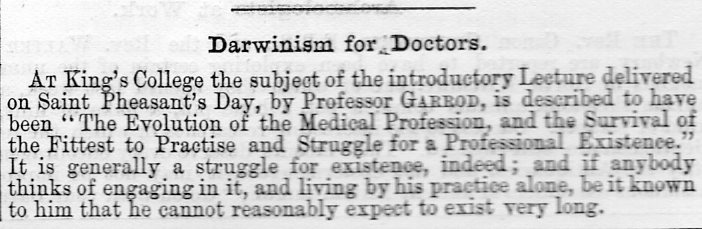
  • Darwinism for Doctors (1878)

    JF Ptak Science Books   Quick Post

    Punch darwin for doctors819

    Source: Punch, or the London Charivari, October 12, 1878

    ·Posted by :

    ·in:

  • Hilbert’s Problems

    JF Ptak Science Books   Quick Post

    This is just a short bibliographic note on David Hilbert’s great paper of 1900–this a result of trying to figure out where a particular French translation occurred in the history of the printing of the paper.  

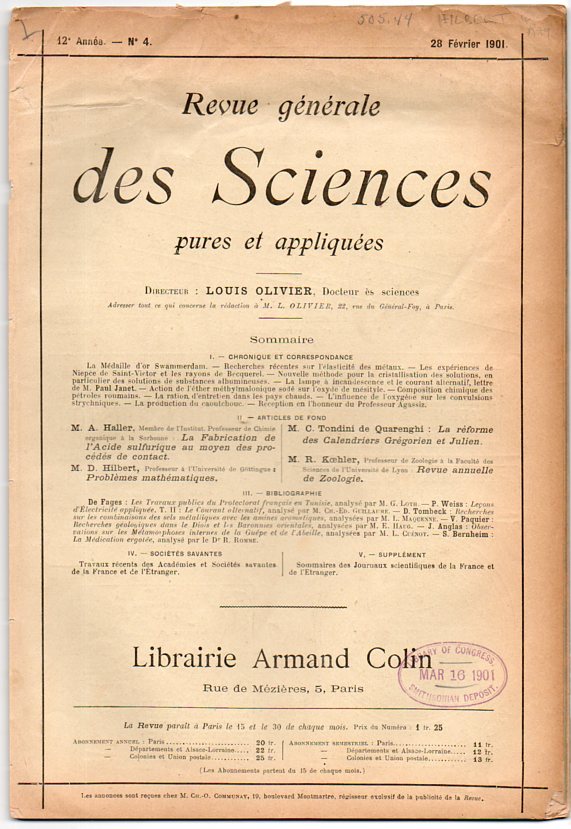
    The paper in question is David Hilbert  “Problemes Mathematiques“ , printed in Paris  by Librairie armand Colin (28 Fevrier 1901, 12e annee, No. 4) in the publication Revue generale des Sciences pures et appliques. This is a revised printing of the 2nd printing of Hilbert’s “great problems” speech (taken from The Archives of Mathematics), in which the he famously posed his 23 problems.  “The Problems of Mathematics” was delivered to the Second International Congress of Mathematicians in Paris and outlined major issues of math

    “…which would challenge mathematicians to solve fundamental problems in the maths for years to come.   It was a speech full of optimism for mathematics in the coming century and he felt that open problems were the sign of vitality in the subject:  The great importance of definite problems for the progress of mathematical science in general … is undeniable. … [for] as long as a branch of knowledge supplies a surplus of such problems, it maintains its vitality. … every mathematician certainly shares ..the conviction that every mathematical problem is necessarily capable of strict resolution … we hear within ourselves the constant cry: There is the problem, seek the solution. You can find it through pure thought… Hilbert’s problems included the continuum hypothesis, the well ordering of the reals, Goldbach’s conjecture, the transcendence of powers of algebraic numbers, the Riemann hypothesis, the extension of Dirichlet’s principle and many more. Many of the problems were solved during this century, and each time one of the problems was solved it was a major event for mathematics”.–A Century of Advancing Mathematics by Paul Zorn, pg 321.

    It seems as though this is the second of the early printings of this classic (though third if you include an earlier and truncated French translation):

    • Hilbert, “Mathematische Probleme”, lecture held at the Paris ICM 1900, Nachrichten von der Koniglichen Gesellschaft der Wissenschaften zu Gottingen (1900), HEFT 3,  making this the third quarter of 1900), pp 253-297; revised version in Archiv der Mathematik und Physik 1 (1901) 44-63, 213-237, and [58:3, pp. 290-329]
    • The first English translation (by Mary W. Newson) in Bulletin of the American Mathematical Society, 8 (1901) 437-479
    • French translations by L. Laugel (with corrections and additions) in Compte rendu du deuxieme congres international des mathematiciens tenu `a Paris du 6 au 12 aout 1900, E. Duporcq, ed., Gauthier-Villars, Paris, 1902, pp. 58-114; (fragments).L’Enseignement Mathematique 2 (1900) 349-354. 

    Hilbert poblem417

    ·Posted by :

    ·in:

  • An Interesting Cutaway for the Graf Zeppelin, 1929

    JF Ptak Science Books   Quick Post

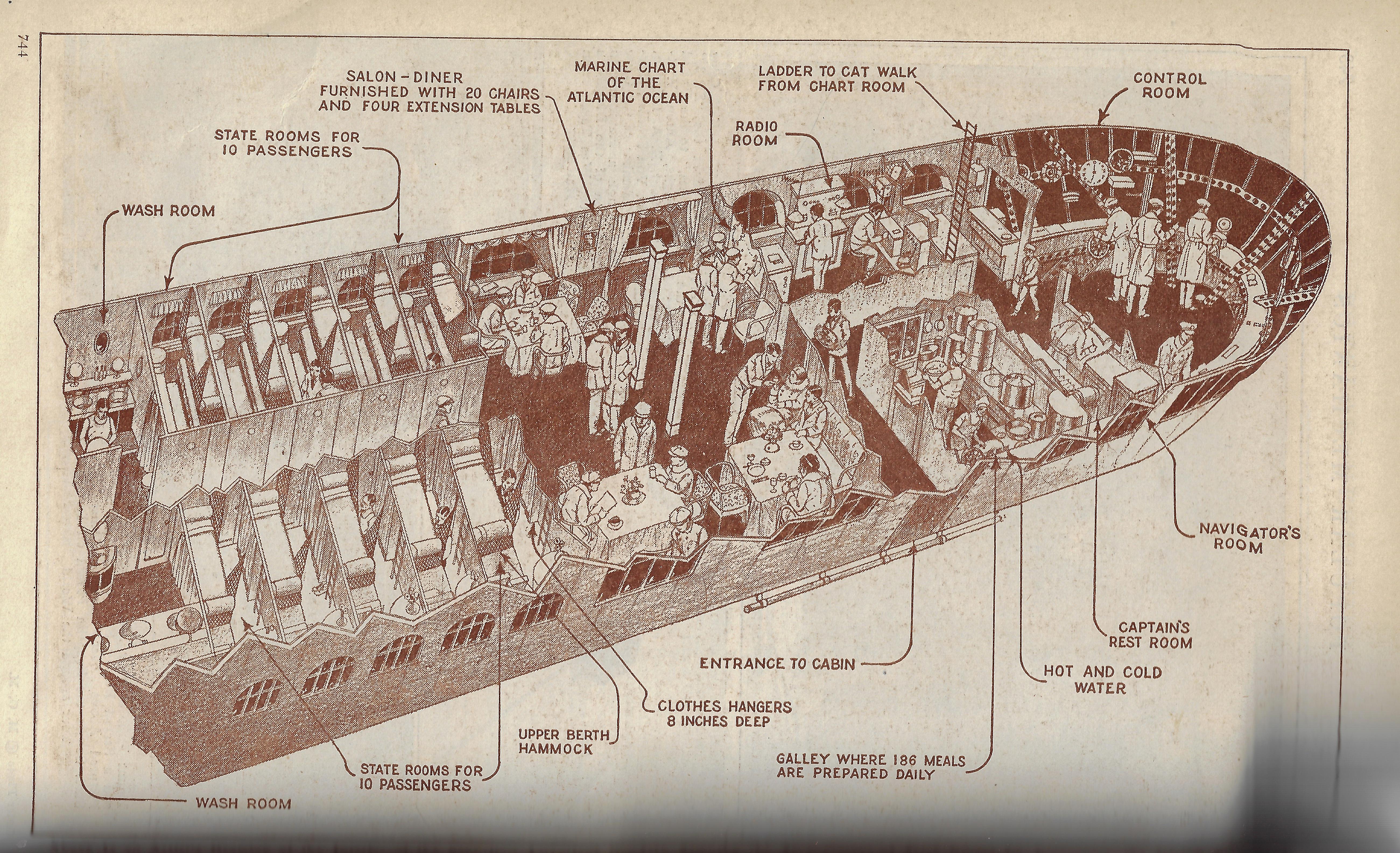
    This is an interesting oblique cutaway/view of the gondola section of the Luftschiffbau Zeppelin, the LZ127 Graf Zeppelin, as it appeared in an issue of Popular Mechanics for November 1929.  The hydrogen-filled rigid airship, which operated from 1928 to 1937, was a true monster–at more than 770 feet long it was the largest flying thing in the skies during its career. 

    Pop Mech Dataviz Graf Zep

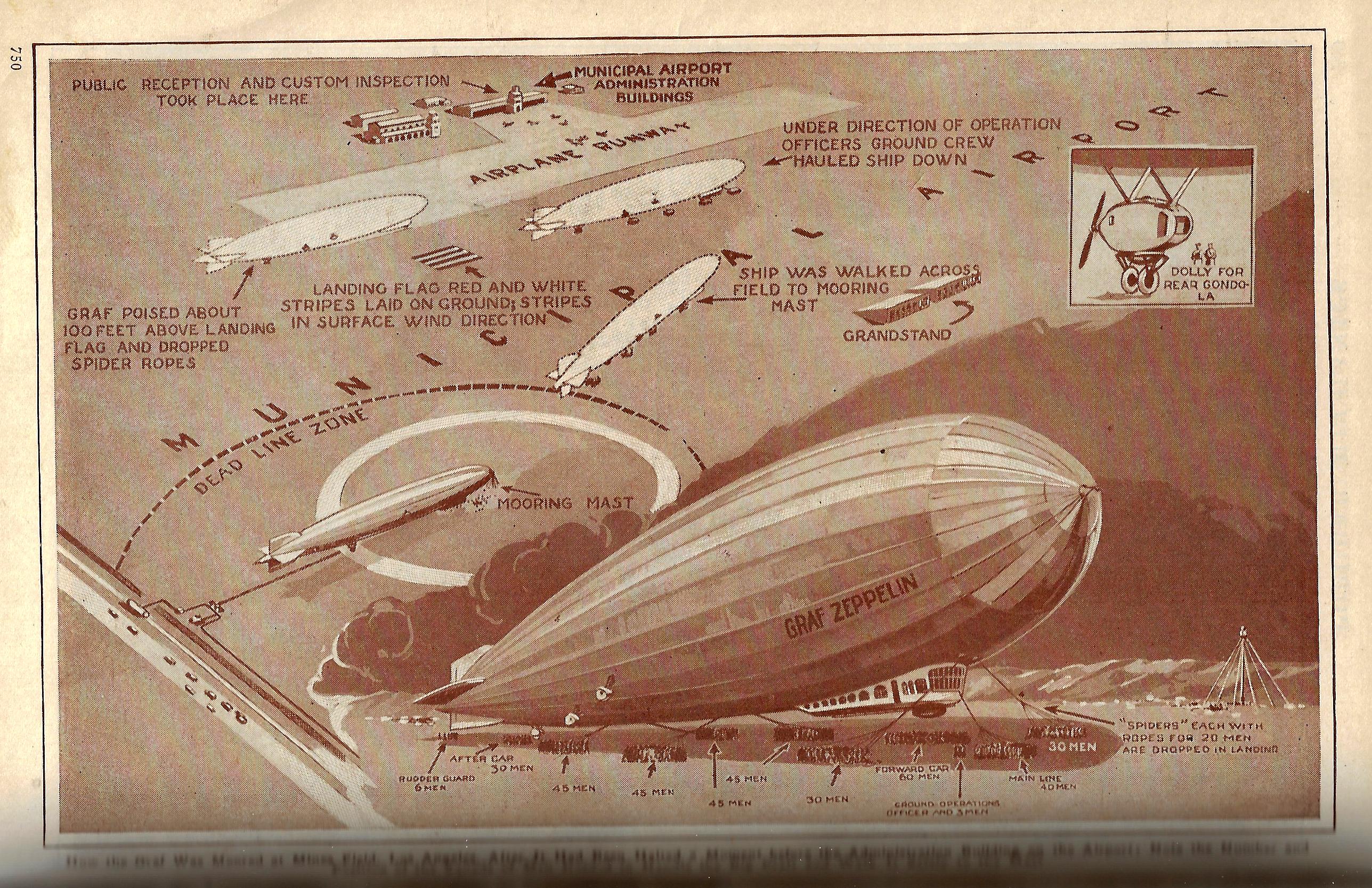
    Also in what is a somewhat extended article is this illustration showing how the zeppelin is landed and moored–in this example, at Mines Field, Los Angeles. The caption asks the reader to notice the “number and position of squads of men” who gathered the mooring lines and walked the airship to its mast.  And there were a lot of people involved in this process–at least 370, according to the illustration:

    Pop mech data viz graf

    ·Posted by :

    ·in:

  • A SteamPunk Torpedo Car of the Possible Future (1925)

    JF Ptak Science Books   Quick Post

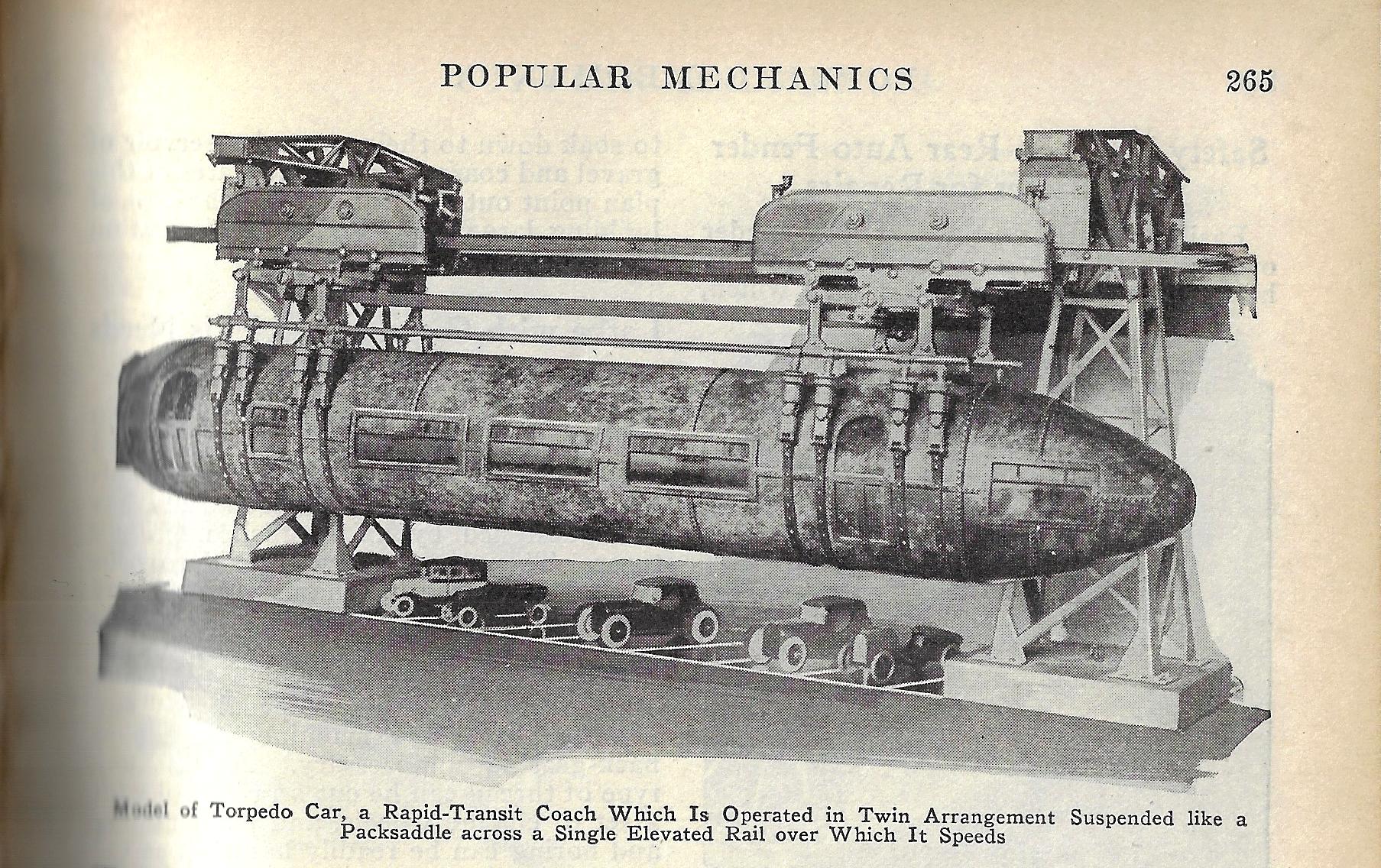
    Seating 100 and going 100 mph this “Torpedo Car” seems more steam-punk torpedo than car, and nearly as dangerous. The vehicle looks tremendously heavy, which makes the pylons and all other supports also need (and seem) to be very heavy duty. Also, a 10 or 20 ton bullet going 100 mph in a city and suspended 10′ off the ground seems as though there would be a lot of collateral damage to this invention. 

    Pop mech 1925 bullet train

    [Source: Popular Mechanics, February 1925, page 265.]

  • Lazare Carnot’s “Vertical Fire” and the Wanting Rain of Death (1820)


    JF Ptak Science Books   Post 2571    

    Lazare Carnot (1753-1823) is a justifiably revered and famous person in the history of science and engineering, though not I think for the paper that I stumbled upon in a volume of The Quarterly Journal of Science, Literature, and the Arts1 for 1820.  The article “Theory of Defence by Vertical Fire” (pp 200-295) sounded mysterious at first, though it was quickly revealed that the “vertical fire” related to the extreme angle for firing canons and mortars and such and not to a burning fire. This vertical firing of projectiles was reserved for opposing siege force of a fortification, fired at an angle so extreme that given the height of the charge and the extreme closeness of the enemy that it would seem to be raining bullets and shells upon them. Given that the opposing force would be entrenched and largely impervious to a more “horizontal” line of fire, the metal rain seems a consideration. Carnot described this as  an “impregnable” defensive position. Others saw it differently:  

    “M Carnot boldly and ingeniously proclaimed the discovery of a new mode of defence by which fortresses might be rendered absolutely impregnable and by means so simple as to be easily adapted to all places. In promulgating this new doctrine Carnot introduced some useful materials and observations calculated to excite protracted defence but his general reasoning is quite delusive. He wrote as a political engineer or rather he compiled the treatise which he informs us. Napoleon sketched and the deduction drawn from it is perhaps one of the most curious and interesting passages that ever emanated from the imperial press. From what we have just read says the author “results I think very evidently this tranquillizing truth that the barriers of the French empire are absolutely inexpugnable by any power or coalition of powers whatever if well defended”.-Observations on modern systems of fortification: including that proposed by …1859, by General Sir Howard Douglas.  And:

    This line of defense would be enacted against a siege force against a fortification, meaning that the line of the attacker would be close at  100+yards away (or hundreds of yards away) given the ballet of how these things were supposed to be done in the history of sieges. The”vertical fire” is the fortified force using mortars and etc. launching their shot with lots of powder at an extreme angle  because it seems as though Carnot somehow depended on the velocity of the shot falling from the vertex of the curve to inflict the damage on the soldiers of the opposing side. Terminal velocity being what it is, a major league pitcher could almost pitch a bullet as fast as the falling projectiles. To have a rain of such things–even by the tens of thousands–doesn’t seem to be very practicable. I think this just goes to show that in spite of the enormity of Carnot’s name and achievements, this part of his engineering career doesn’t seem to be very distinguished–unless I’m wrong about this, and if so I hope someone will point that out to me and explain how the rain of fire made sense. 

    Notes:

    The Quarterly Journal of Science, Literature, and the Arts, volume VIII, London, John Murray, 1820. iii,iii, 412pp, with five engravings, three folding.  Nicely bound in calf backed marbled boards, with calf tips, with gilt-stamped paneled spine. There is a gilt-stamp on the spine reading “Ex lib Soc Reg Sco”. Also included in this volume: “On the Mammoth, or Fossil Elephant, found in the Ice, at the Mouth of the River Lena, in Siberia. From the Fifth Volume of the Memoirs of the Imperial Academy of Sciences of St. Petersburg”, pp 95-107; [Laplace] “On the Figure of the Earth”, pp 108-114 (from the Annales de Chimie, volume XI); William Philip, “Some Observations relating to the Agency of Galvanism in the Animal Economy…”, pp 72-83; “Description of Messrs. Taylors and Martineau’s Patent Apparatus for the Production of Gas from Oil…”, pp 120-124 (that would be John Martineau and John Taylor, who joined in a company to produce machines and fuel flourishing in the 1815-1830 period, though for most of that time Taylor would not be a part of it), among others.  

    ·Posted by :

    ·in:

  • Rocket Mail Delivery, 1934

    JF Ptak Science Books  Quick Post

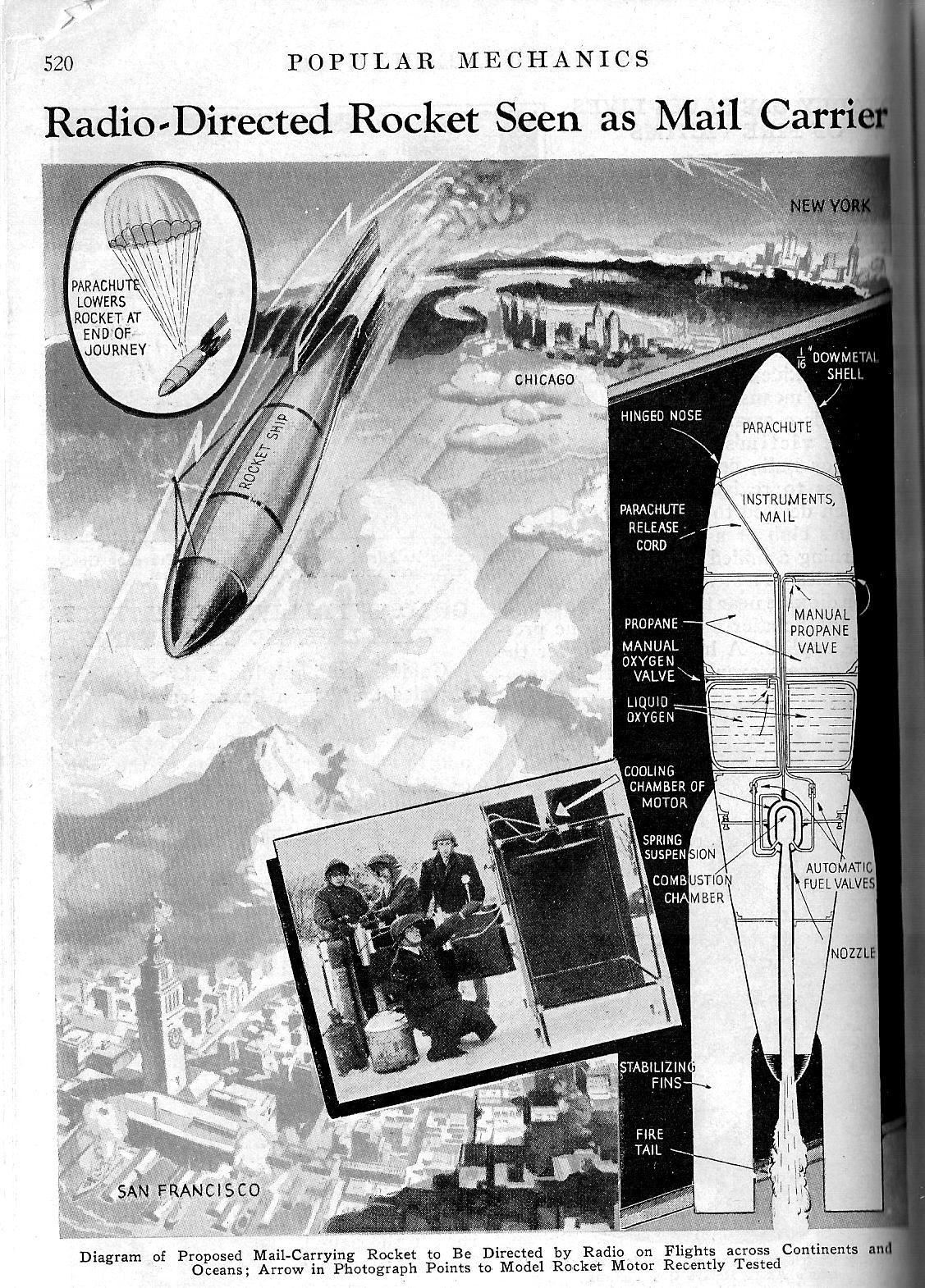
    This seems as though it was an interesting idea back in 1934–but no doubt there were others thinking that instead of dropping mail on a city by a rocket that another payload could be substituted…better yet, just use the entire rocket for this delivery-of-something-else item and dispense with the parachute altogether. In any event, the idea never caught on (though megastars of rocket flight Hermann Oberth and Eugene Sanger discussed its possibilities in a positive light), and it seems as though there was only one instance of USPS rocket mail delivery–a converted nuclear-warheadless SSM-N-8 cruise missile was used to do so in 1959, and that seems about it. 


    Pop MEch 1934 Rocket Mail

    {Source:  Popular Mechanics, April 1934]

  • The Spectrum of Chess, Dante, and 4 Trillion Kg of Wheat

    JF Ptak Science Books  Post 2571

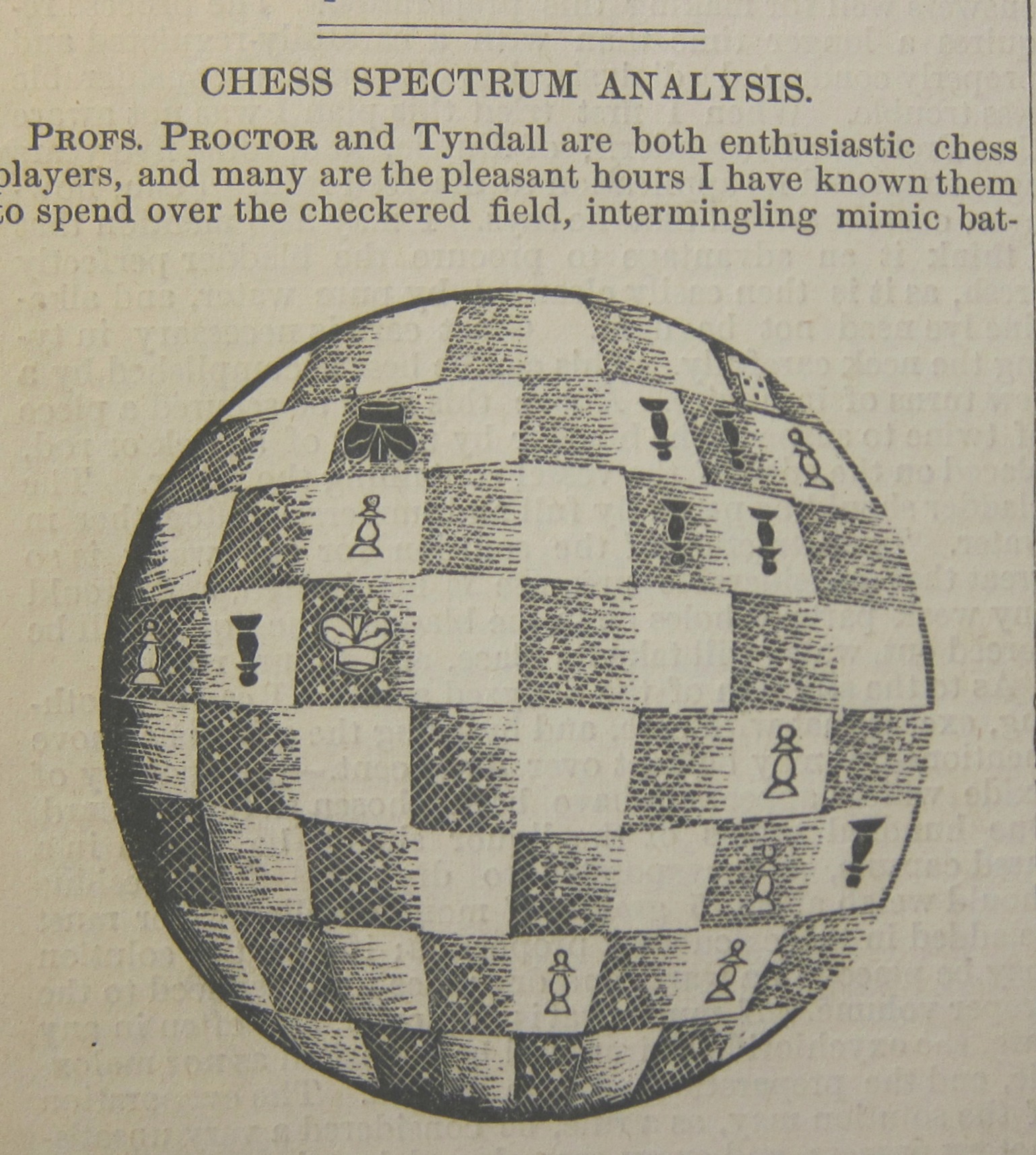
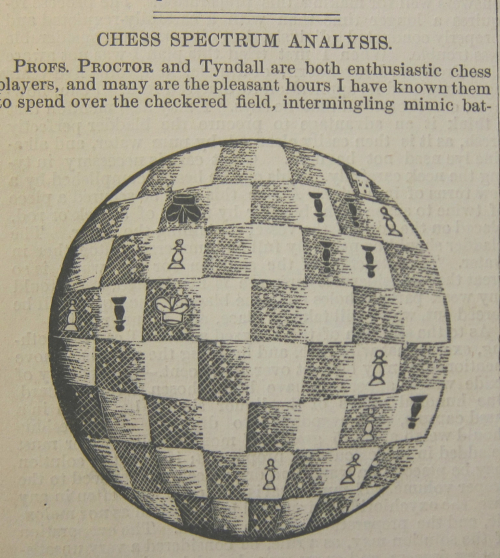
    As is often the case in looking through the early-ish issue of Scientific American, I usually find much more than what I was originally looking for, finding a lot that I had no idea that I needed to find, mostly because I had never heard of them before. And so grazing though the 1877 volume of the Scientific American Supplement I found in the weekly chess review in the back of each issue an extraordinary image and title:
      Sci Am Supp 1877 Ches spectroscopy

    I was tempted to add “Pre-Escherian” in the title to this post, but that would put the thing way over the top–but that is what came to mind first, a polished gazing ball with an interesting perspective. This was meant to illustrate an imaginary dialog between two astronomer-chess players (Richard A. Proctor and John Tyndall, though Tyndall’s interests were spread far and wide and deep and then not so much in astronomy), both of whom had made contributions to astronomical spectroscopy.  Further into the short article there was a little discussion of Dante and sunspots, which I was not aware of, though when I went looking for that reference I did find the following chess quote in Paradiso (Canto XXVIII) with our Poet in the ninth heaven:

    “So sparkled then those circles all and each And every spark did more and more abound, In fiery light and so their number grew, Beyond the chess board’s doubling problem’s bound”

    And another translation

    “And after she had finished with her speaking,  The circles all around began to sparkle,  Like red-hot iron shooting off bright sparks.  Each sparkle stayed within its fiery ring, So many that their number runs to more, Millions than the redoubling of the chessboard.”

    Moving on from the sunspots mentioned in the SA article, it has been pointed out by many that in the quote above that Dante may be referring to an earlier chess story, told at least by the 12th century, where the inventor of the game of chess agreed to give it over to the king if the king paid him in grains of wheat based upon the chess board, starting with one grain in the first square and then doubling the amount until the last square is reached. The big surprise for the king who agreed to this payment was a very fine lesson in the  quick-as-a-bunny expansion of exponential sequences: you’d move from 1 to 2 to 4 to 8 to 16 to 32 to 64  to 138 to 276 just in the first rank, 57 more squares of doubling to go, until you summed them all up on square 64 and find yourself with the number  18,446,744,073,709,551,615, which is a big number. Bigger still if you consider that this is in terms of wheat, and I figured the weight of that wheat to be about 4 trillion kg, 4 trillion being about the equivalent of stars in 40 Milky Way galaxies. 

    Even though the article was very heavy in the discussion of some real games, and light in the inclusion of our astronomers and their conversation, everything winds up and out in a whimsical fashion, with a discussion of Gutenberg and spell-check.  The author tells us:

    “It would take but little argument to show that a mere oversight of Guttenburg’s [sic] proof-reader made the world believe the moon was composed of cheese instead of chess”.

    And so it goes.  19th century astronomy/chess humor, as whacky as it gets.  


    \sum_{i=0}^{63} 2^i.\,


    ·Posted by :

    ·in:

  • Darwin’s “Biographical Sketch of an Infant” (1877)

    JF Ptak Science Books   Quick Post

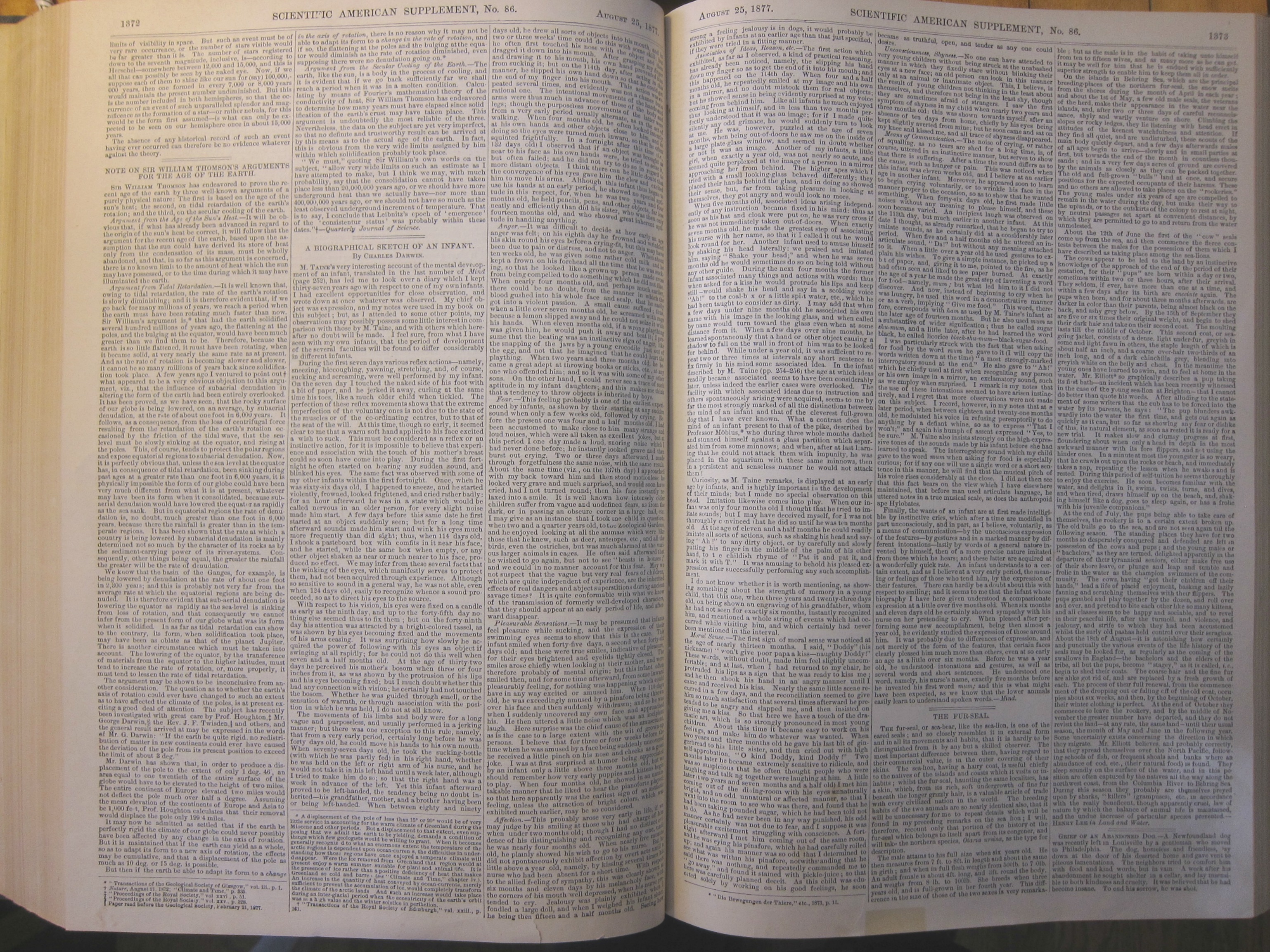
    I found a very interesting and unexpected bit in the always-fascinating Scientific American Supplement for August 25, 1877.  In the middle of the weekly issue, following a James Croll article on the age of the sun and a William Thomson piece of the age of the Earth, and just pages away from a semi-famous illustrated piece by A.M. Worthington on his observations of liquid splashes, came a long and densely-printed contribution by Charles Darwin, “A Biographical Sketch of an Infant”.  This first appeared a month earlier in Mind, and printed in nine pages–the Scientific American version is printed on two, as I show below. I find this remarkable, in a way, that the SA would do such a thing and be successful with it, fitting in as much info as possible in the least amount of space.  

    Darwin infant 1877

    {Image very expandable.]

    In any event, the article by Darwin is pretty interesting, and the experimentalist/clinical observer in him was applied to watching the first months of the birth of his first son (William Erasmus Darwin, 1839-1914). I found at the superb Darwin-Online website a reference to Darwin’s activities and the birth of William in his Autobiography: “My first child was born on December 27th, 1839, and I at once commenced to make notes on the first dawn of the various expressions which he exhibited, for I felt convinced, even at this early period, that the most complex and fine shades of expression must all have had a gradual and natural origin.” And indeed he does, establishing in his second sentence “I had excellent opportunities for close observation, and wrote down at once whatever was observed”. Darwin certainly would have had a chance for a observation as the subject’s father, but I am sure that he was being clinical/professional about the whole undertaking, and so the understatement.  

    I include my own version of the Darwin paper (below) as well as a link to the OCRd version from the Mind original from the Darwin-Online website: 

    • http://darwin-online.org.uk/content/frameset?pageseq=1&itemID=F1779&viewtype=text


    ·Posted by :

    ·in:

Recent Posts

Archives

Categories