A Daily History of Holes, Dots, Lines, Science, History, Math, Physics, Art, the Unintentional Absurd, Architecture, Maps, Data Visualization, Blank and Missing Things, and so on. |1.6 million words, 7500 images, 4.9 million hits| Press & appearances in The Times, Le Figaro, Mensa, The Economist, The Guardian, Discovery News, Slate, Le Monde, Sci American Blogs, Le Pont, and many other places… 5000+ total posts since 2008.

  • A Glorious Episode in Outsider Literature–“the Great Scope Ever to be Attempted in a Work on Paper”, and a Peep into the Year One Billion A.D…

    JF Ptak Science Books    Post 2691

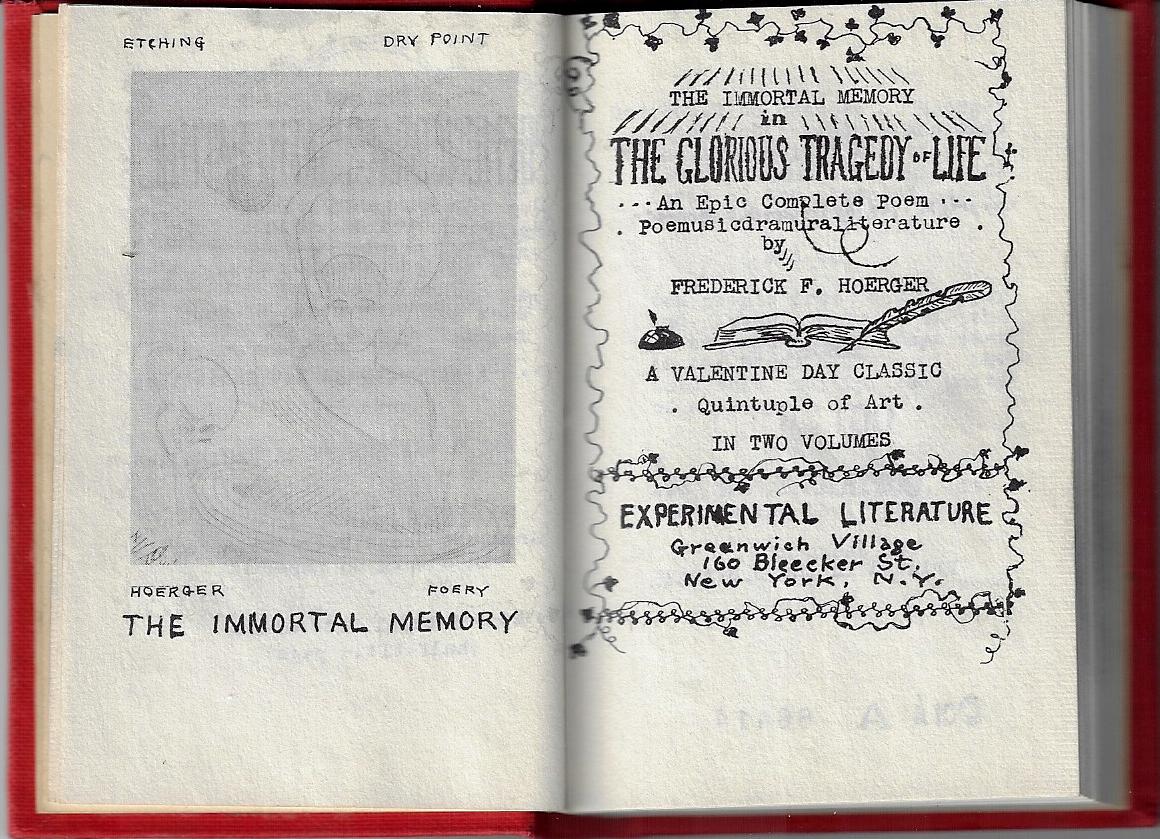
    There are some things that stand to be admired simply because exist. They may be mundane, but they are the magnificent mundane, brought to life by sheer force of will. Such I think is the case of Mr. Hoerger’s Poemusicdramuraliterature Epic Poem the Immortal memory in the Glorious Tragedy of Life (1946). The work is billed as a “Valentine Day Classic, quintuple of Art”, the “greatest scope ever attempted in a work on paper”.  It is a big claim made by a little book–bound in red cloth, it measures 4″x2.5″ and is 86 pages long, though the word count for all of the little pages only makes it to about 8000 words, or about 20 type pages. I don’t think that the book ever actually catches up to itself, as for what I can see of it, it is always one step ahead of itself and one step behind.
    Outsider poemliterature _1_

    (I’m guessing that Mr. Hoerger could have lived at 160 Bleeker Street–it is the Mills Building No. 1, and was built in 1910, where today you could easily spend 4.5k/month for a one-bedroom place…unless the printer for this book was in the basement, and Mr. Hoerger lived elsewhere. This copy by the way came to me via the Library of Congress and is one of the Copyright Deposit copies. There are at least five other works copyrighted by Mr. Hoerger; Highroad Number Z, Vintage One (1941),  Immortal Aid (1946), The Daze of Forty-Nine (1958), and Deep Surprise, post-Abstraction, Space-age Understatement (1961).)

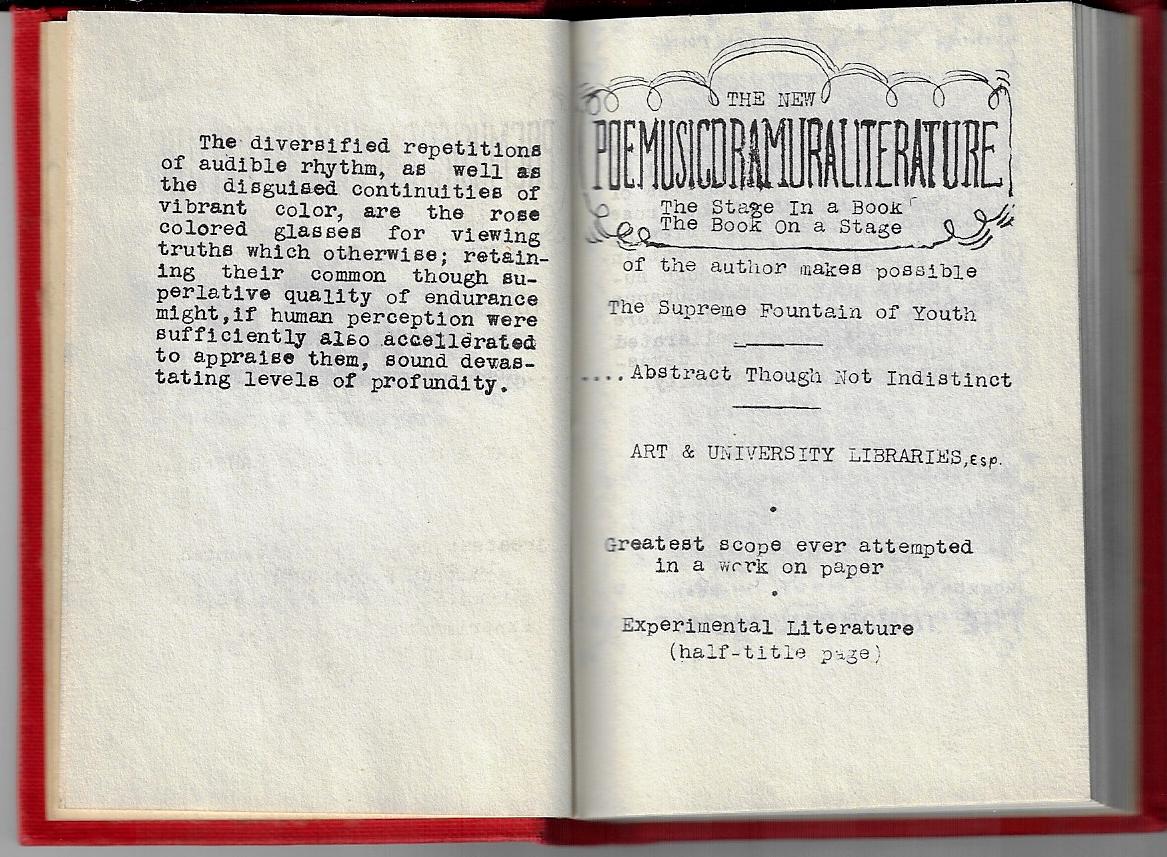
    We are reminded of the new sort of “work on paper” this is on the half-title page (identified so), as well as the non-sequitur “art & university libraries, esp”, which seems like an enormous emotion of some unidentifiable sort that the author brings to bear on the possible reader:
    Outsider poemliterature _2_

    The extraordinary cover:

    Outsider poemliterature _3_

    And a sample of the writing, which is, at the very least, quite something; it seems a major attempt at producing and communicating ideas that are just too far in an unreachable zone for me, though I have to give credit to the author for his imagination and for completing a project.  

    I should point out that in the last section of the last page reproduced here something is “calibrated” at “50 septillion light years”, which is a pretty big number in the scale of the base -illions, especially when you think about the universe being “only” 13 billion years old–that means that the width of the universe in 26 billion light yeas wide  or 156 billion light years in the altogether or some such, but 26,000,000,000 is crushed by the 50,000,000,000,000,000,000,000,000 light years being discussed here. Of course there’s also the fast-forward to the future part, introducing the year 1,000,000,000. That would be impossibly far into the future, considering that Homo sapien has been around for 150,000 years or so, and that there have been about 7,500 generations in that time. The Year Ten Billion would entail 400 million generations (and that’s assuming that we haven’t started to “live” forever after the year 3000 or 2500 or whatever) since we have been brought to our present medical modernity in the scant eight or nine generations since Joseph Lister invented the idea of sterilizing operating instruments, and considering again that we are just three or so generations removed from DNA (1953) and the first successful heart transplant (1967) and how far the replacement of human bits has come since then, it is impossible to say where medicine might be in a 50 generations or a thousand years, let alone in ten billion years. 

    I do have to commend the author for thinking big. And: he does make you think. 
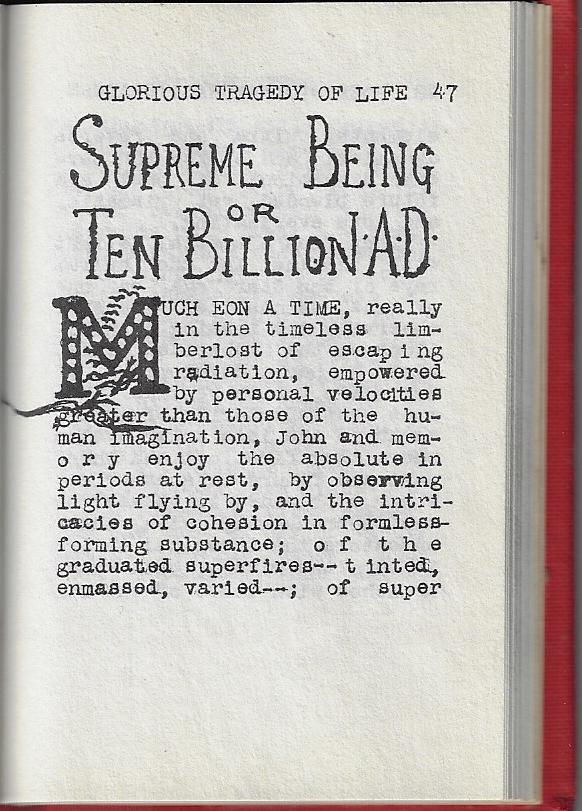
    Outsider poemliterature _4_


  • German Interior Design Catalog, 1907

    JF Ptak Science Books  Quick Post

    This beautifully illustrated 1907 German book1 seems to me to be a sales catalog for a company selling flat-masks, or templates, through which desirable and somewhat complicated (or at least complex) nay be produced.  A customer could leaf through this book of 60 designs which are arranged according to room type, and perhaps, if the fancy struck, could purchase the sheets and instructions necessary for the job to be done.  For example, plate #44 (Reggie Jackson’s number in the great summer of 1977), the “Pause mit Hilfsschablone” (its identifier in the “Preisliste” and offered at 10 Marks) is meant to decorate a wall for a stairway. 

    Jugendstihl361

    The great bulk of the designs are those for ceilings, and ceiling corners, as well as for wall designs and the small bits that run slightly above the floor and the wall (I’m sorry, but I don’t know the technical term for this).

    In any event it is a very surprising work to find–for me, at least–to see someone selling the possibilities of such advanced design motifs in a simple, order-it-from-our-catalog format.

    Notes:

    1.  Paul Steuer.  Malereien fuer Flachenschablone und Pinseldruckmanier in modernem und Biedermeier-Stil, published by the Otto Baumgaertel publishers, Berlin, in 1907.  Only two copies of this work are found in WorldCat, at the Staatsbibliothek zu Berlin and another in the Wissenschcaftliche Staatsbibliothek in Mainz. 

    Jugendstihl365


    http://upload.wikimedia.org/wikipedia/commons/a/a0/Zimmerbild_83.jpg


    ·Posted by :

    ·in:

  • Graphs of Defects of American Soldiers, 1919

    JF Ptak Science Books Quick Post

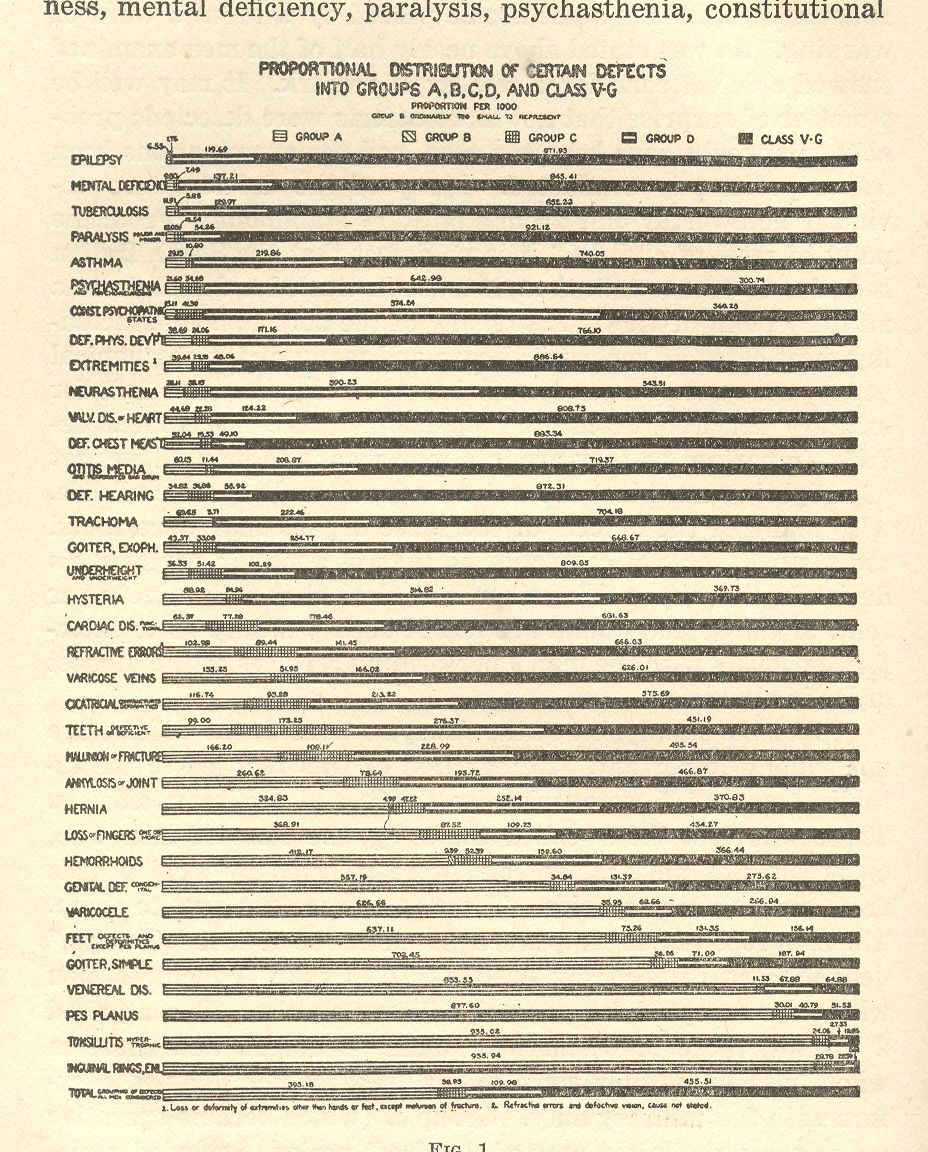
    Right at the end of WWI there appeared a famous publication on the end results of an epic study on the physical conduction of U.S. men drafted into the armed services:

    War Department: Defects Found in Drafted Men; Statistical Information Compiled from the Draft Records…the Physical Condition of the Men registered and Examined in Pursuance of the Requirements of the Selective Service Act, Prepared under the direction of the Surgeon General M.W. Ireland, Major General, MC U.S. Army, by Albert G. Love, MD…and Charles B. Davenport... 

    This huge (358pp) report was printed by the Government Printing Office in 1920 and provided more data of enlisted men than had ever exited, and for good or for ill (and for the various problems encountered in data collection and interpretation), there was a tremendous stew of bubbling bits of human failure and detractions, real and not.

     Full text via National Library of Medicine: https://collections.nlm.nih.gov/bookviewer?PID=nlm:nlmuid-9502639-bk  NIH Digital Collections

    • “This 1920 study of the men called by the selective service for the U.S. Army upon America’s entry into the Great War was ordered by the War Department, and it employed as its eugenics specialist, Charles Davenport. The study looked at many types of physical, psychological, and mental factors within this part of the male population of the United States.”
    • “The conclusion of the analysis was than an inordinately high proportion of U.S. Army draftees were defective and below average in physical fitness and psychological or mental readiness. Davenport and his colleagues also concluded that much of the American male population was not equipped for participatory democracy. This test of U.S. soldiers was thoroughly challenged at the time due to suspect analytical methods.”–University of Missouri Library   https://library.missouri.edu/exhibits/eugenics/defects.htm

    ===blog==aug 9=defect graph


  • “I Escaped from Nazi Germany” (1944)

    JF Ptak Science Books  Post 2692

    I Escaped from Nazi Germany, a French Deportee’s Report, is a short, compact story by a French resistance fighter (of the “Armee de l’Ombre”) and observer/informationist. The writer is not identified, though the translator ( Egon Larsen) is, along with author of the author of the foreword (Waldeck Rochet). It was published by I.N.G. Publications in London in 1944, and although it is unclear whether this is pre/post 6 June, the writer does make it clear that the end was near for the Nazis.

    Perhaps the most emotional part of the pamphlet is the section (“Slave Workers and  Prisoners-of-War Under the Swastika”) on “foreign workers”. There’s a fairly longish description of the types of slave labor being done in Germany, and of the accommodation of the ‘workers”, with some insight on those who were kept in private houses/stables/billets and not in a camp. There’s also an interesting statement that speaks to the numbers of “foreign workers” in sections of Germany, saying that amidst the sea of these slaves that it was difficult to find an actual German resident. Then, at the extreme end of the treatment of foreign workers, in listing the tragedies of those people forced into cruel labor, the author ends with:

    “Foreign workers run the risk of being sent to concentration camps; and everyone knows what that means.”

    This may be the Great Unspoken of the war–unspoken though spoken, or unheard, or partially heard, or heard but not believed. 

    “A terrible fate await those who are sent to Dachau, the notorious torture camp” the pamphlet continues, followed by a short discussion of terrible working conditions and brutal treatment. Then there is a curious statement, an attempt to show the essential savagery of the Nazi/German, relating how there were “other Germans who were there fellow prisoners” [italics mine], not “just” foreign slave workers at the camp, “and whose treatment was even worse than that of the foreign workers”.  These “other Germans” could have been political, or gay, or a host of other legislated offenses–but in 1944, these people were no doubt Jewish, though the “Jewish” part of this explanation goes unmentioned.And so far as I can tell the only time the word “Jew” or “Jewish” appears in this pamphlet is a description of serendipitous punishment levied on the foreign worker for simple infractions of not-necessarily-exiting codes of behavior: “A Jew who tried to pick up a cigarette butt was ‘shot out of hand’”. This person, this Jewish person, was identified as a “Jew” as a social indicator (like telling someone to go ask Moshe, the Jew) rather than identifying the person as a class of people signaled out for particularly brutal treatment.  Rather than just say “a person” or “someone” being shot for picking up a cigarette, the writer identified that someone simply as a “Jew”. 

    I escaped Nazi Germany

    So, most of the pamphlet is an outsider’s view inside Germany–how the Germans live, what they eat, traffic conditions, Hitler Youth, and so on. There’s a discussion of R.A.F. (nighttime) bombing and the “catastrophe” of rail travel. There are also plenty of attacks on the social fibre and people of Germany laced throughout the work: “the uniformity of the masses can be found everywhere”, “their faces betray an enormous tiredness”, “the faces of the Germans do not show anything but appalling mediocrity”, “not human beings but automatons”, that sort. Also there’s a fair amount of notice on the state of terror instilled by the Gestapo on the German population (“Himmler’s Gestapo terrorism”): “individual expressions of dissatisfaction are suppressed with fantastic brutality”.  

    I wonder that in all of this ability of insight how the author missed the particularly brutal treatment of the Jews–especially when he knew about Dachau (to some degree), and spent so much time in Germany, and it was 1944.  It is certainly possible, I guess, but I don’t know how likely that possibility is, knowing so much about a big piece of the picture.  Perhaps much of what he says in hearsay, or second hand, or contrived for propaganda purposes, and perhaps not; I doubt it is a knowable thing. 


    ·Posted by :

    ·in:

    —
  • Classic Work on the French Resistance, 1944

    Kessel armee des ombresJoseph Kessel, L’Armee des Ombres, Chronique de la Resistance. Pantheon Books, New York, 1944, edited by Jacques Schiffrin.  185x18mmm 266pp. Written in London, completed in the summer of 1943.  Original red, white, and blue wrappers, and printed on a nice paper stock, and mostly unopened. Overall a nice production, in a “paperback” size but hardly a paperback format. Rather thick for this format, which usually means that the spine is cracked, though in this case, it is not. Very nice copy.  About Fine. $75

    Kessel (1898-1979) was a very interesting man of long accomplishment, a significant figure in the history of modern French literature, and a patriot, and a resistance fighter. He wrote this book using himself as a model for the main character (named “Philippe Gebier”), and used his experiences along with those of others to create this story of resistance–it seems that while the characters were composites, the overall story was real and accurate. As he states in the opening sentence of the book, “Il n’y a pas de propaganda dans ce livre et il n’y a pas de fiction” (“This is not a work of propaganda nor a work of fiction”). He makes it abundantly clear in this book that the absolute duty of all French citizens was civic disobedience and resistance, period. 


    ·Posted by :

    ·in:

    —
  • Prison Camp Music of Stalag VIII B (1944)

    JF Ptak Science Books  Post 2693

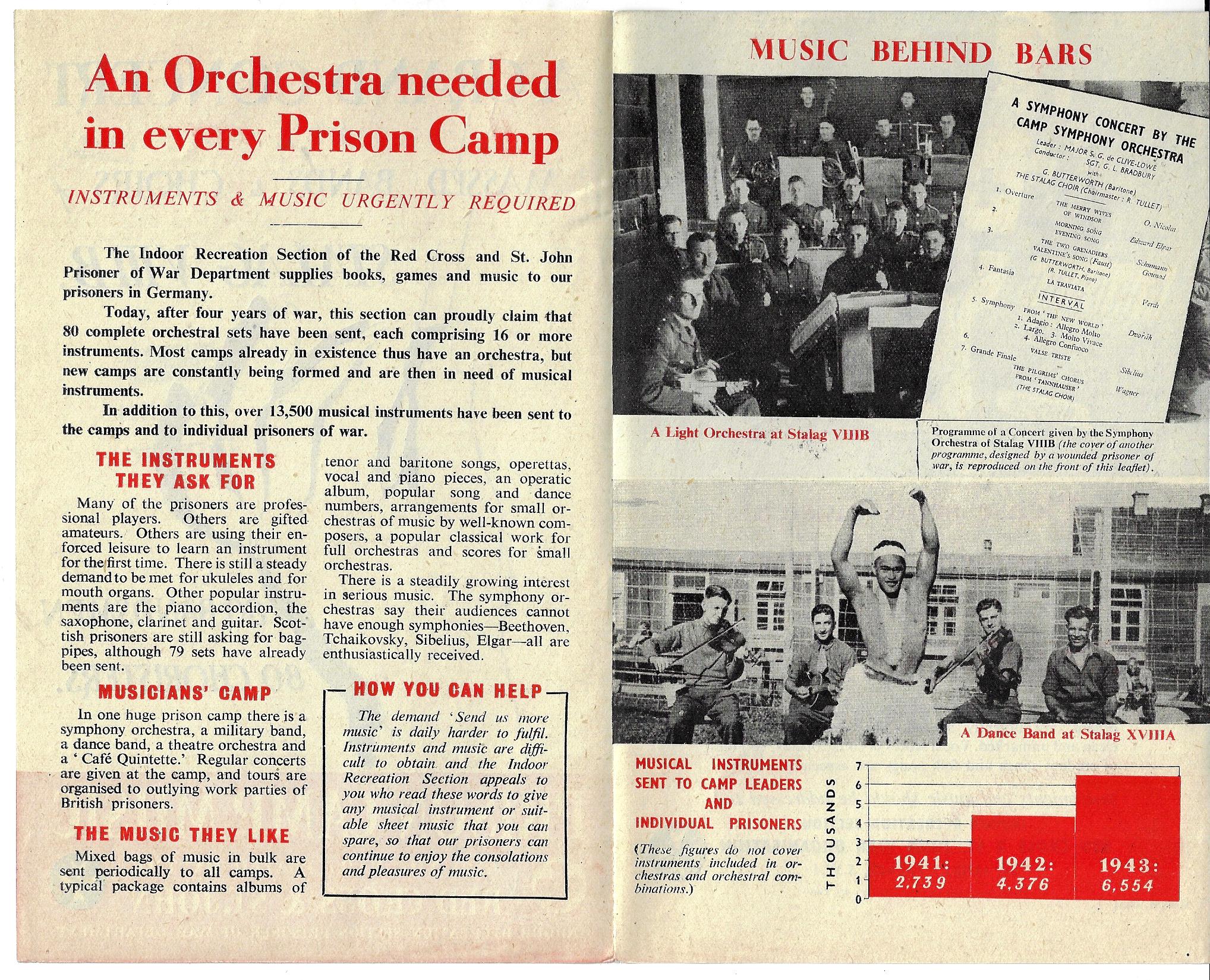
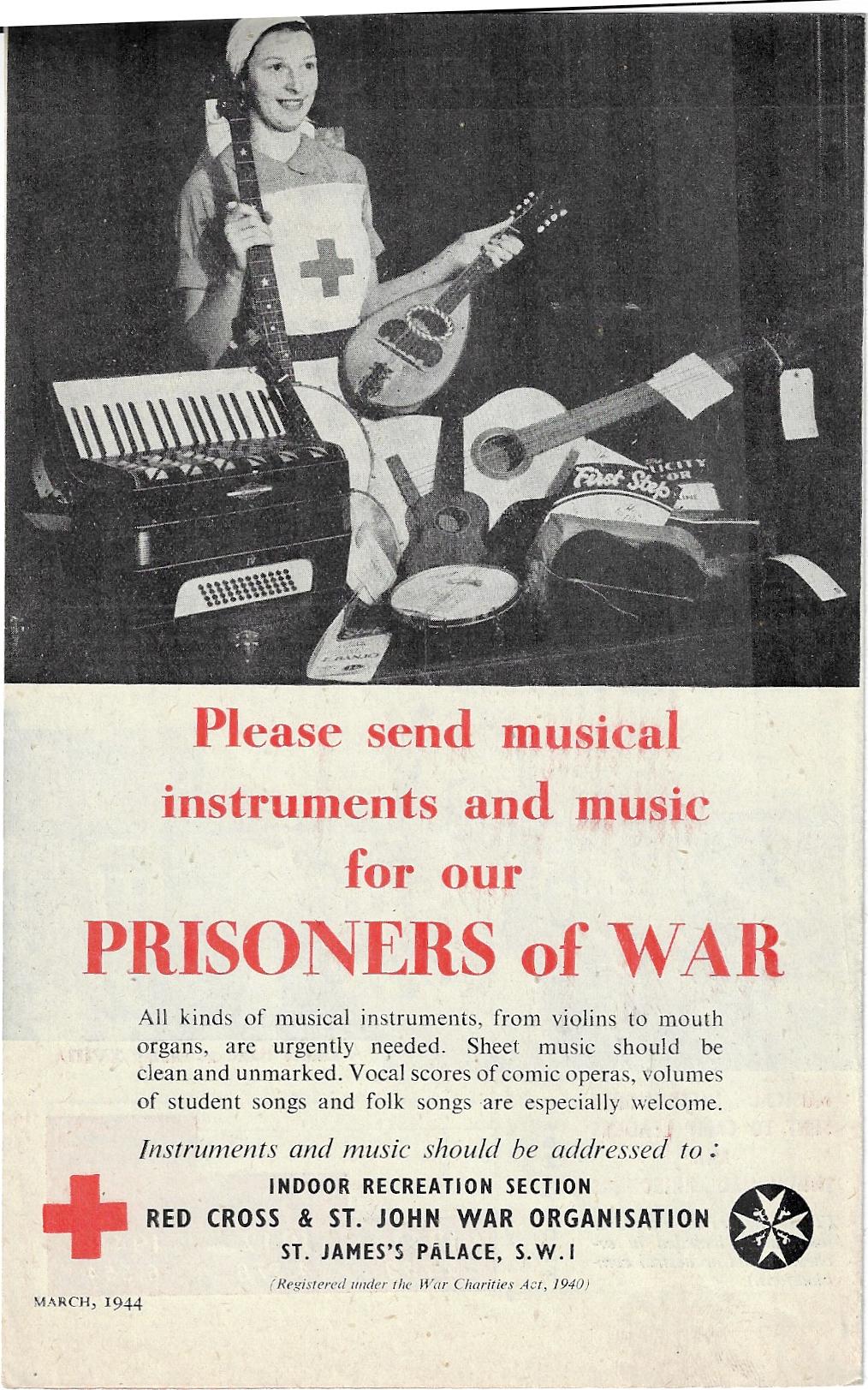
    I found this unexpected leaflet this morning, the title of which is enough to stop anyone: A Grand Concert by the Massed Bands & Choirs of Stalag VIII B. 80 Bandsmen, 80 Choristers. PRISON CAMP MUSIC and the Part Played by the Red Cross & St. John. It was printed in London in 1944, and printed by by the Red Cross and St. John War Organization and is a leaflet (20x13cm, 4pp, single sheet folded vertically) which I reproduce in full below.  (Provenance: Library of Congress, received by them September 1944, with their rubber stamp on the front cover.)

    There are no listings for this item in the WorldCat/OCLC, and a google search has one hit, finding the leaflet at the National Army Museum in London–outside of this, I cannot find it. This is a little surprising given that it was sued to raise awareness and funds; that said, it was also highly ephemeral, meaning it was probably thrown away very easily and often.  

    Prison camp orchestra _1_I am not an expert in this field, though one thing that can be said for sure was that overall British and U.S. held as POWs by the Germans were treated much more humanely than other nationalities of soldiers (particularly the Russians), and so it was possible for some POWs to enjoy receiving Red Cross packages while interned. I did not know about an orchestra with 80 instruments and a choir of 80 voices. At first blush this seems like a work of home front propaganda, an attempt to establish hope for normalcy for the families of soldiers taken prisoner, though it seems as though these accommodations were made by the Nazis in deference to the British and Americans. (Again, this is a broad generalization and no doubt those enjoying POW music at Stalag VIII B were in the distinct minority. At Stalag VIII B it looks as though the main group of POWs were British, and then segregated in different parts of the camp were Indians, and then another section for Greeks, Cypriots, and Palestinians, and then in an entirely different section of the camp under lights and interior barbed wire was a camp for the RAF. British airmen were treated “differently” than the rest given at that time the terrific damage being inflicted upon Germany from endless nighttime British bombing raids. 

    On the reception of Red Cross packages at Staalg VIII B and other Stalags in general, from “MEDICAL SERVICES IN NEW ZEALAND AND THE PACIFIC: CONDITIONS AT STALAG VIIIB, LAMSDORF”, from New Zealand Electronic Text Collection:

    Prison camp orchestra _2_

    “Owing to a Red Cross parcel bottleneck at Lisbon there was a complete parcel failure from January 1942 until May 1942…Regarding Red Cross parcel shipments: “The year 1943 was relatively full, except for three months following the German occupation of Italy…During early 1944 Red Cross supplies were adequate, and, in fact, most camps, both large and small, endeavoured to build up a three months’ reserve of their Red Cross food. Unfortunately, on …17 September 1944)…most Wehrkreise (war districts) came an order from the Oberkommando der Wehrmacht: ‘All prisoner of war tinned food must be destroyed forthwith.’ This order was ruthlessly enforced, particularly on the many (over 600) working parties of Stalag 344 [part of Stalag VIII B], with the result that, whilst there was a week’s feasting on salmon, sardines and meat roll, lean and hungry months followed. Even in the Lazarett at Lamsdorf, where the patients and staff enjoyed community messing, much of their tinned food was destroyed, with the resulting onset of semi-starvation, which did not abate till the end of the war.”

    Prison camp orchestra _3_

    “The Russian prisoners had no Red Cross food and they were starved on bread and turnip soup. In vain did the British medical officers at Cosel plead with the German medical authorities for food, rather than drugs, to treat their Russian patients. Only after a change of senior German medical officers and the start of the Russian offensive towards the Reich in March 1943 did the German attitude change and the health of those miserable Russians improve.”–


    Also this story at the end of the war should be shared (although it has nothing to do with this leaflet): “In January 1945, as the Soviet armies resumed their offensive and advanced into Germany, many of the prisoners were marched westward in groups of 200 to 300 in the so-called Long March. Many of them died from the bitter cold and exhaustion. The lucky ones got far enough to the west to be liberated by the American or British armies. The unlucky ones were ‘liberated’ by the Soviets, who instead of turning them over quickly to the western allies, held them as virtual hostages for several more months, until the British agreed to release to the Soviet Union POWs of Soviet origin who had been fighting on the German side, which left the British Government with little choice on the matter, even though they were understandable reluctant to hand these men over to the Soviet Union for their inevitable execution. These soldiers from states such as Latvia, Lithuania and Estonia for example, had fought with the Germans in an effort, as they saw it, to release their own homelands from Soviet occupation and oppression.”–lamsdorf dot com


    ·Posted by :

    ·in:

    —
  • A Beautiful Regression, and then Some (1877)

    JF Ptak Science Books   Quick Post

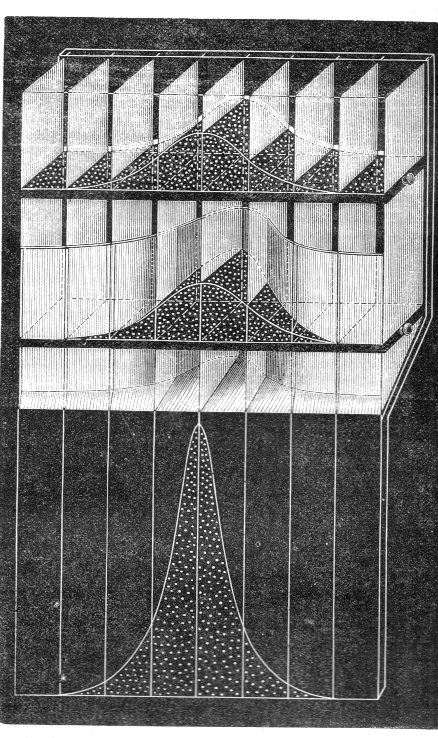
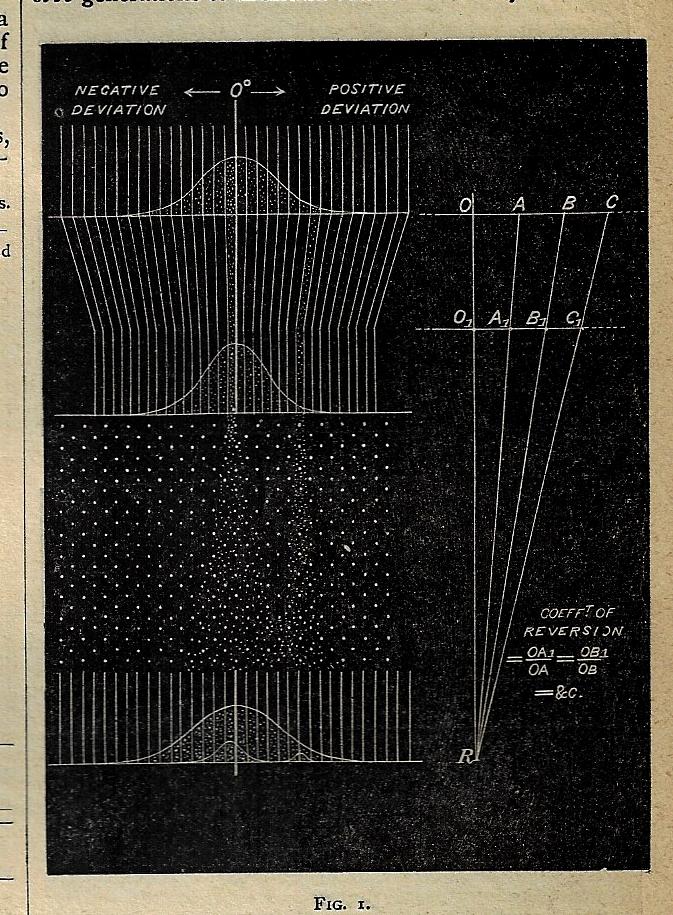
    This beautiful bit of data visualization was a significant development in the history of statistics and was employed in pioneer Sir Francis Galton’s “Typical Laws of Heredity, III”, which appeared in Nature magazine on April 19, 1877.  

    Galton707[Image: Francis Galton, “Typical Laws of Heredity, III”, Nature. p 513, April 19, 1877] 

    Tis follows on the heals of the first paper in this series, earlier in the month of April, 1877:

    Galton 1877 regression _1_

    This contribution by Galton is the “first major step in the development of correlation and regression analysis” according to Judy Klein’s Statistical Visions in Time: A History of Time Series Analysis, 1662-1933, (page 131). She continues: 

  • Think or be Damned–1899

    JF Ptak Science Books  Post 2694

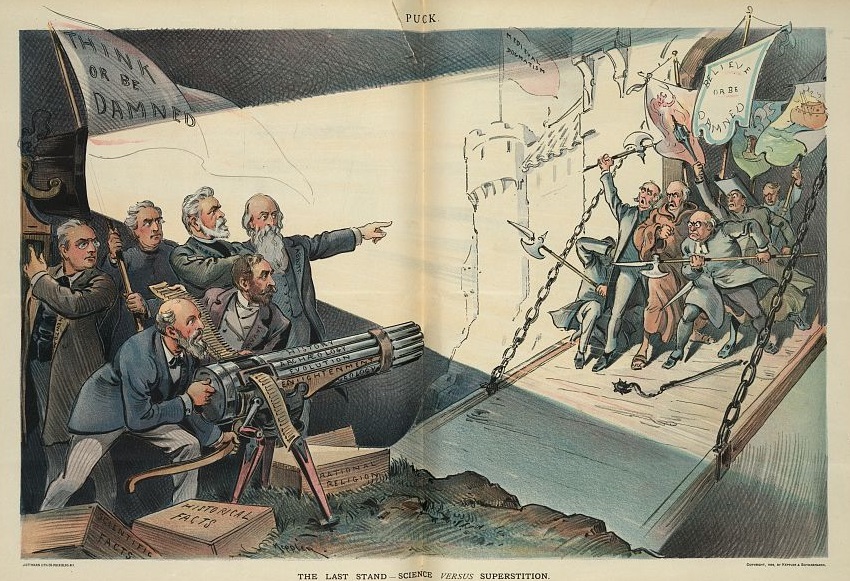
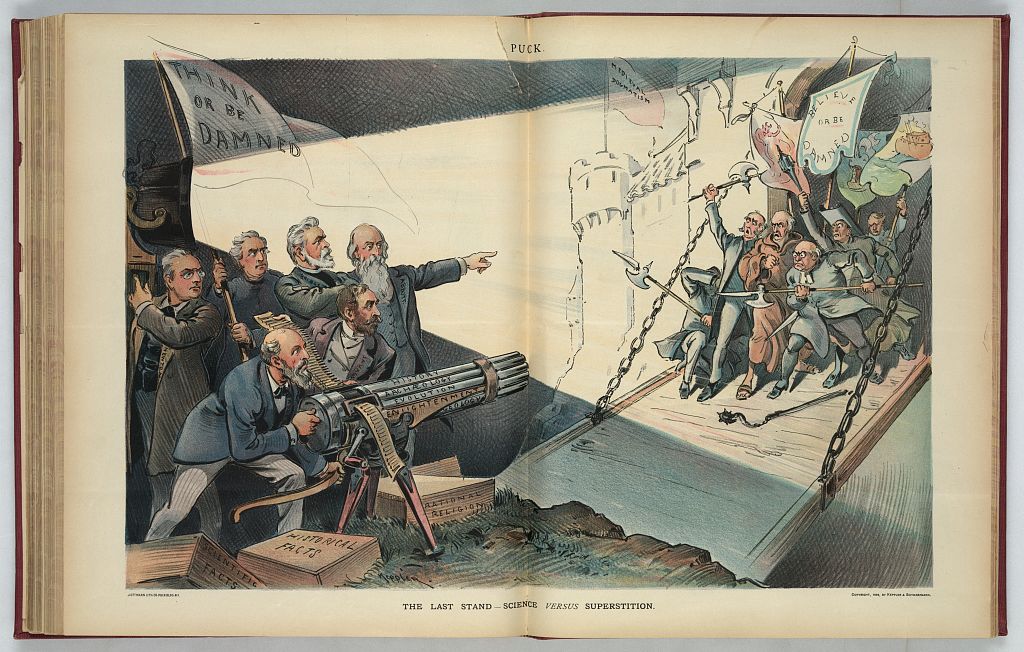
    This work—“The Last Stand, Science versus Superstition”, a chromolithograph by Udo J. Keppler (close!)–appears in Puck in the issue of July 19, 1899.  It is a very strong statement and also one that I’ve never seen it before (my thanks to Thony Christie of Renaissance Mathematicus and Whewell’s Ghost for surfacing it), and appears to me on the day of the global marches in support of scientific thought against tyrannies of illogical and sodden belief.

    Last stand

    [Image: Library of Congress, http://www.loc.gov/pictures/item/2012647443/]

    I guess the greatest aspect of this print is the flag “Think or be Damned” that flutters in the background of The Fact Men as they prepare to defend themselves against the “Believe or be Damned” crowd, “Medieval Dogmatism”, just advancing. It is a voracious print, and leaves nothing to spare in the choice of science and facts and inquiry against not-so. Interestingly, the men fighting this battle aren’t scientists, but theologians.

    The “Think” group is identified by the LC as (Richard Heber) Newton (1840-1914, an Episcopal theologian and forward thinker;  (Lyman) Abbott (1835-1922, American Congregationalist theologian); (Charles A.) Briggs (1841-1913, Presbyterian scholar and theologian); (Minot J. ) Savage (1841-1918, Unitarian), and (Felix) Adler (1851-1933, professor of political and social ethics, rationalist). They are surrounded by cartridge boxes for their Gatling gun labeled “Scientific Facts”, “Historical Facts”, and “Rational religion”, theologians prepared for the fight of rationalism against obedient belief. 

    It wasn’t the “Last Stand”, as I think there is always a stand to be made, especially in times like these where preposterous and Bie Lie-sized ideas are formed at the extreme head of state. Who would have thought it possible that a stand must be made against “alternative facts”, climate change denial, manipulation of the scientific record, “FAKE ______”, and so on? Images like this from Puck from 118 years ago show that there is a history of “last stands” of coherent and inquisitive thought against feeble sloppiness of such sugary mindless dogmatisms, and that there will be a future to them, as well.

    ________

    The image above appears in a fine post by Peter Harrison on the conflict between science and religion here: https://sciencereligionspectrum.org/blog-posts/science-and-religion-conflict-for-non-religious-britons-and-canadians/  I just wanted to add some information on the print itself.  


  • “An Appalling Attempt to Muzzle the Watch-Dog of Science” (1883)

    JF Ptak Science Books  Quick Post

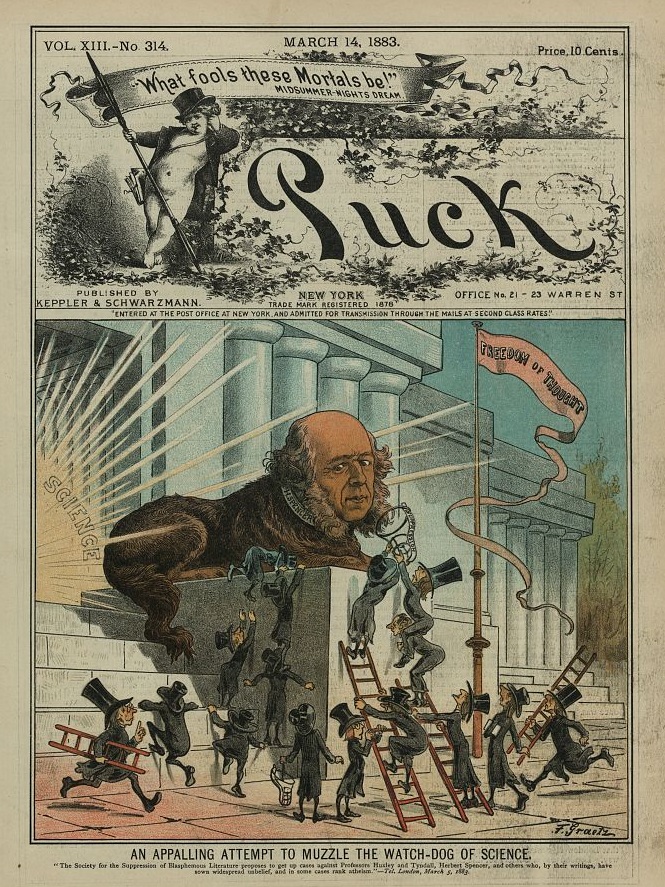
    “An appalling attempt to muzzle the watch-dog of science”, by Friedrich Graetz (ca. 1840-1913), was published in the 14 March 1883 ( v. 13, no. 314) issue of Puck magazine. The caption reads: “The Society for the Suppression of Blasphemous Literature proposes to get up cases against Professors Huxley and Tyndall, Herbert Spencer, and others who, by their writings have sown widespread unbelief, and in some cases rank atheism”. Thomas Henry Huxley (“Darwin’s Bulldog”), John Tyndall, and Herbert Spencer were all champions of Darwin and eovlution, and evidently were found to be dangerous by the entirely real society—I thought that the name might have been a euphemism, but it evidently existed (according to English Modernism, National Identity and the Germans, 1890–1950 by Dr Petra Rau).

    Puck appalling attempt to muzzle

    From the Library of Congress description http://www.loc.gov/pictures/item/2012645455/:

    “Illustration shows Herbert Spencer as a statue of a large dog at the entrance to a public building emitting rays of light labeled “Science”; many diminutive men, wearing oversized top hats, scamper about with ladders and muzzles in an attempt to silence Spencer’s views on religion and science. On a nearby flagpole hangs a banner that states “Freedom of Thought”.”


  • The Poisonous Miasma of the U.S. Capitol as Found Poetry (Fred. Law Olmstead, 1882.)

    OlmsteadJF Ptak Science Books  Quick Post

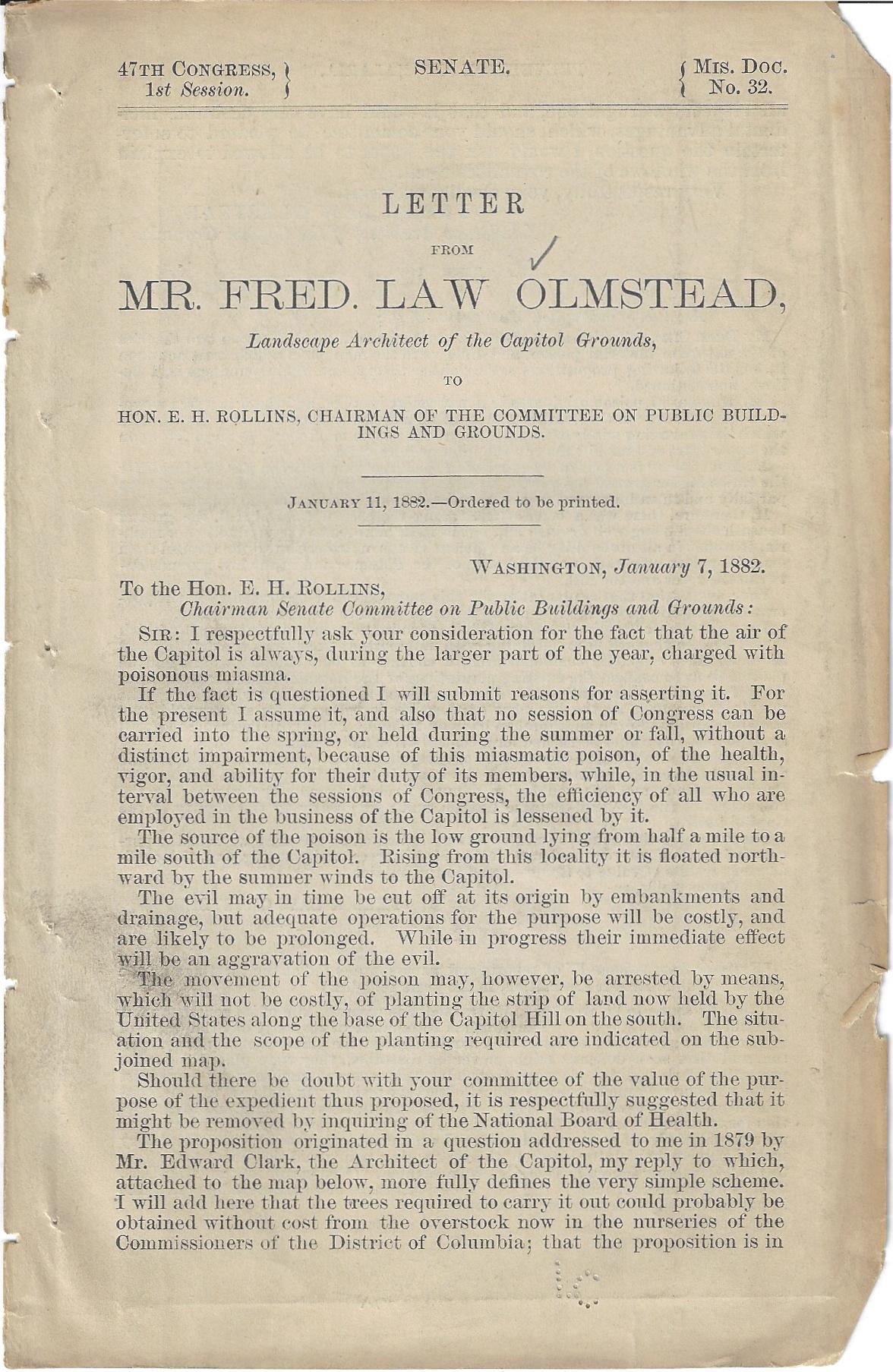
    Yes, that is pretty much a direct quote (full quote to follow) by the great landscape architect and engineer of the Capitol grounds, though it is in reference to the miasma going into the Capitol and not that coming out of it.  Olmstead reports that there’s some wicked “evil” stuff in the low-lying areas just east of the building, and recommends that for the sake and pity of all that is holy that the problem be addressed, and quickly. His immediate solution is to transplant and grow a wide row of bushes and trees in between the Capitol building and the evil stuff.  The text of the lead of the appeal follows, rendered intact, but lofted into a poetic structure that probably doesn’t work–it would work out better though if you can listen to it in your head being recited by Billy Collins:

    I respectfully ask your consideration for the fact

    that the air of the Capitol is always during the larger part of the year

    charged with poisonous miasma.

    If the fact is questioned I will submit reasons

    for asserting it.


    For the present I assume it and also that no session of Congress can be carried into the spring or held during the summer or fall without a distinct impairment because of this miasmatic poison of the health vigor and ability for their duty of its members while in the usual interval between the sessions of Congress

    the efficiency of all who are employed in the business of the Capitol is lessened by it.

    The source of the poison is the low ground lying from half a mile to a mile south of the Capitol. Rising from this locality it is floated north ward by the summer winds to the Capitol.

    The evil may in time be cut off at its origin by embankments and drainage but adequate operations for the purpose will be costly and are likely to be prolonged. While in progress their immediate effect will be an aggravation of the evil.


    And so on. The “regular” text version is below. 

      • “Chairman Senate Committee on Public Buildings and Grounds: Sir: I respectfully ask your consideration for the fact that the air of the Capitol is always during the larger part of the year charged with poisonous miasma.”

      • “If the fact is questioned I will submit reasons for asserting it. For the present I assume it and also that no session of Congress can be carried into the spring or held during the summer or fall without a distinct impairment because of this miasmatic poison of the health vigor and ability for their duty of its members while in the usual interval between the sessions of Congress the efficiency of all who are employed in the business of the Capitol is lessened by it. The source of the poison is the low ground lying from half a mile to a mile south of the Capitol. Rising from this locality it is floated north ward by the summer winds to the Capitol. The evil may in time be cut off at its origin by embankments and drainage but adequate operations for the purpose will be costly and are likely to be prolonged. While in progress their immediate effect will be an aggravation of the evil. The movement of the poison may however be arrested by means which will not be costly of planting the strip of land now held by the United States along the base of the Capitol Hill on the south…”

    Source: Letter from Fred. Law Olmstead, Landscape Architect of the Capital Grounds, to Hon. E.H. Rollins, Chairman of the Committee on Public Buildings, Washington, D.C., Senate Miscellaneous Document No. 32, 47th Congress, 1st session, January 11, 1882.  9×6″, 2pp, simple folding diagramatic map.  


  • A Fine Moment in the History of Mistakes: Attacking California, 1842

    JF Ptak Science Books  Quick Post     Part of the series on the History of Anticipation

    Catesby ap JonesOops!

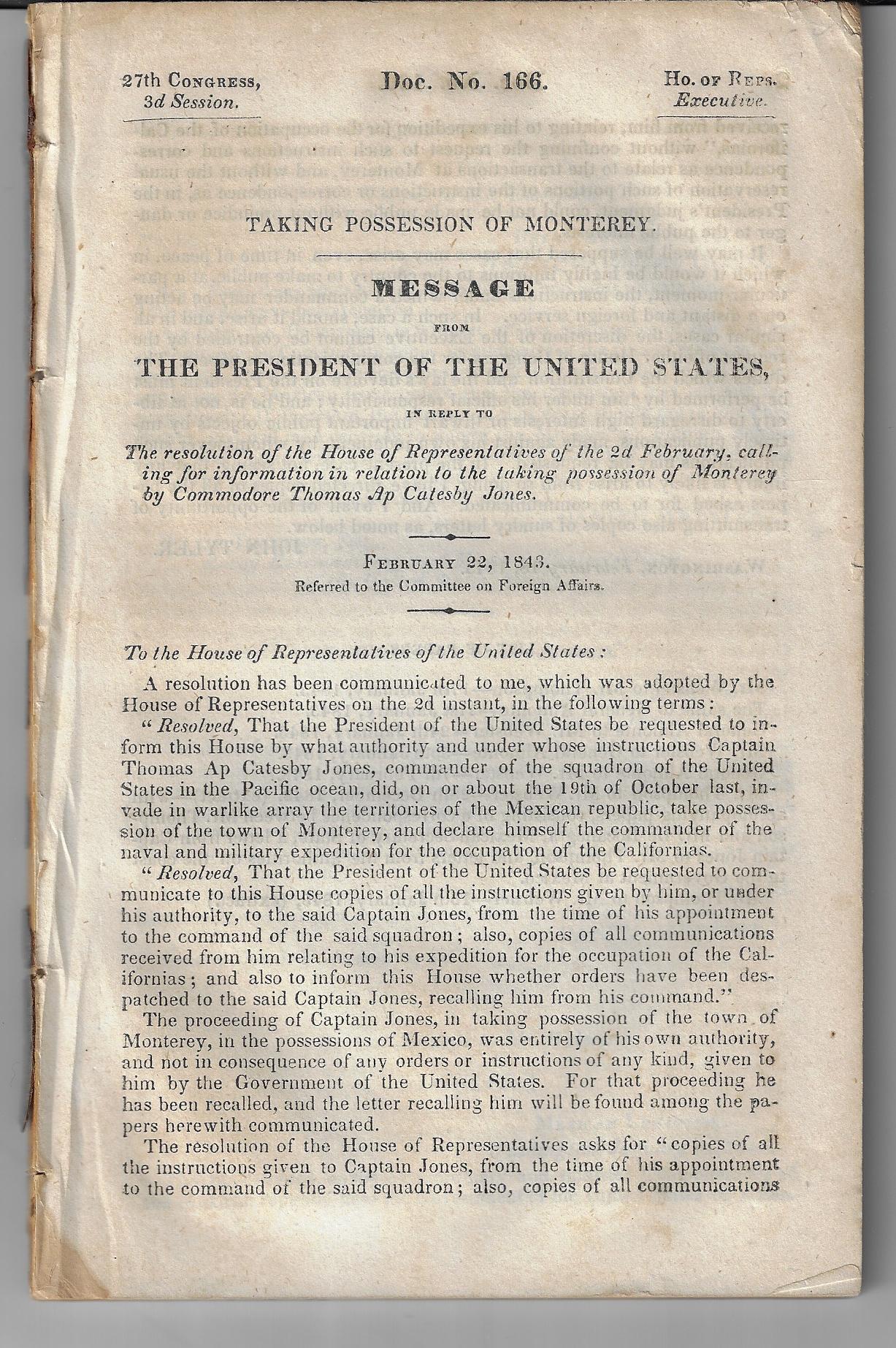
    The wonderfully-named Thomas ap Catesby Jones (the “ap” evidently a Welsh patronymic indicating “Thomas, son of Catesby”) was a Commodore in the U.S. Navy in 1842 when a Short Series of Unfortunate Events occurred. Jones (1790-1858), a War of 1812 veteran, commanded a group of three naval vessels (including his frigate the USS United States and two sloops of war) from Lima Peru to upper California after understanding that the U.S. Was at war with Mexico and that there was a fear that the Brits were on their way to take over the middle-western coastline. So off he went, arriving at Monterey1 in October 1842, about four years ahead of the war. He settled off the cost and demanded the surrender of the Mexican gallery there, which consisted of about 60 soldiers in an old fort. The Mexicans, outnumbered and no doubt confused, surrendered the port the next day. The day after that, Jones received word that he had jumped the gun, somewhat, and withdrew from Monterey, with his apologies. From there, he went off to chase the British away from Hawaii, and somewhere in this course of events transports the deserter Herman Melville back to the U.S.

    I cannot leave this without mentioning that Jones’ nephew was named Catesby ap Roger Jones (1821-1877).

    Notes:

    1.  A good source of information on this action: Taking Possession of Monterey. Message from the President of the United States in rely to the resolution of the House of representatives…calling for information in relation to the taking possession of Monterey by Commodore Thomas Ap Catesby Jones. February 22, 1843. House of representatives Executive Document Number 166, 27thCongress, 3rd session. 9X6”, 117pp. Howes M 740aa. Cowan 317


Recent Posts

Archives

Categories