A Daily History of Holes, Dots, Lines, Science, History, Math, Physics, Art, the Unintentional Absurd, Architecture, Maps, Data Visualization, Blank and Missing Things, and so on. |1.6 million words, 7500 images, 4.9 million hits| Press & appearances in The Times, Le Figaro, Mensa, The Economist, The Guardian, Discovery News, Slate, Le Monde, Sci American Blogs, Le Pont, and many other places… 5000+ total posts since 2008.

  • Beautifully Design Railway Lights (1874)

    JF Ptak Science Books   Quick Post

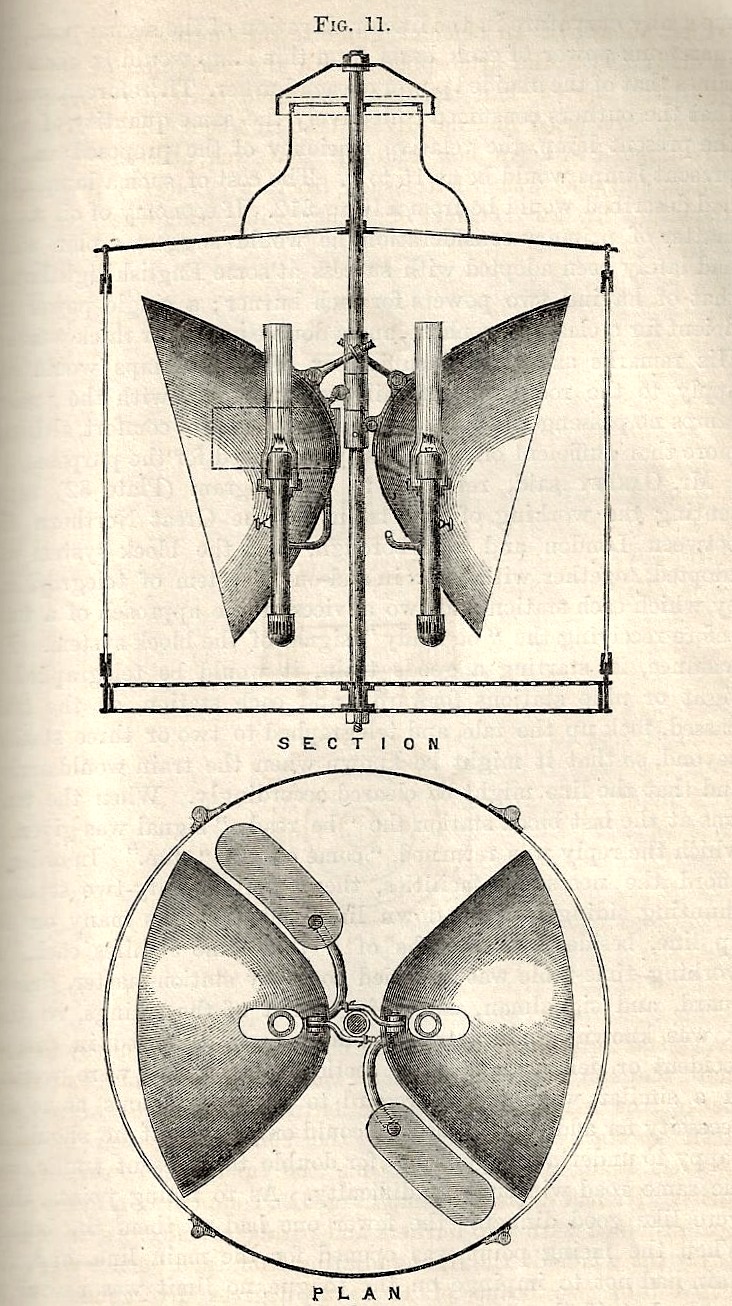
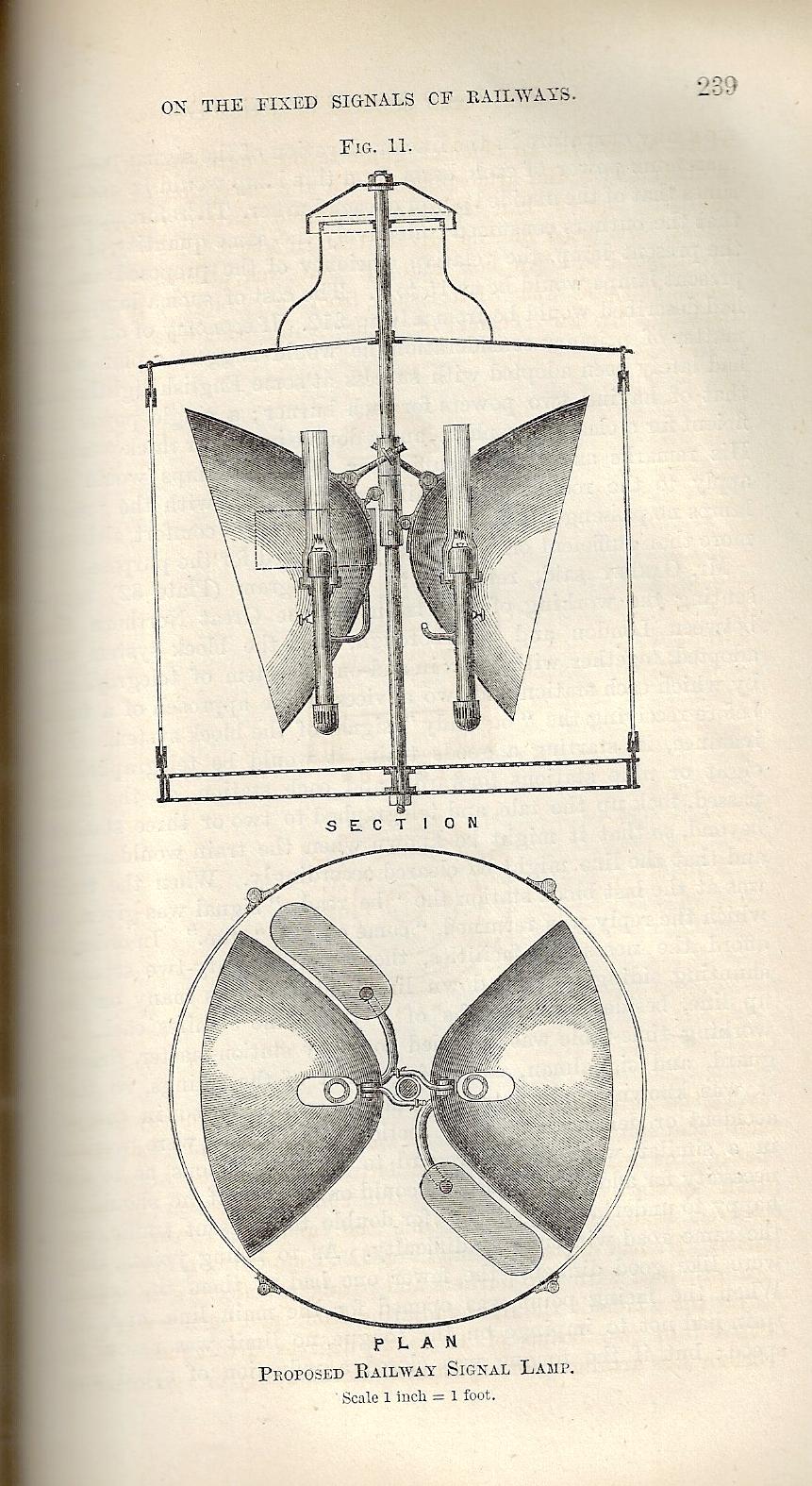
    I find this cross section and plan of a railway signal light to be spare, elegant, and beautiful. Just enough work was done to the detail, with all extraneous matter left behind. It is one of those excellent pieces of thinking that pop out all of the time in the 19th century engineering journals that I have here–this one really made an immediate impression. The work is that of Richard Rapier, and appears in the Proceedings of the Institute of Civil Engineers and published in London in 1874.  

    Civil Engineers 1874 RR lights

    ·Posted by :

    ·in:

  • Fine Map from the Excellent and Seldom Seen “PM” Newspaper, May 8, 1945

    JF Ptak Science Books   Quick Post

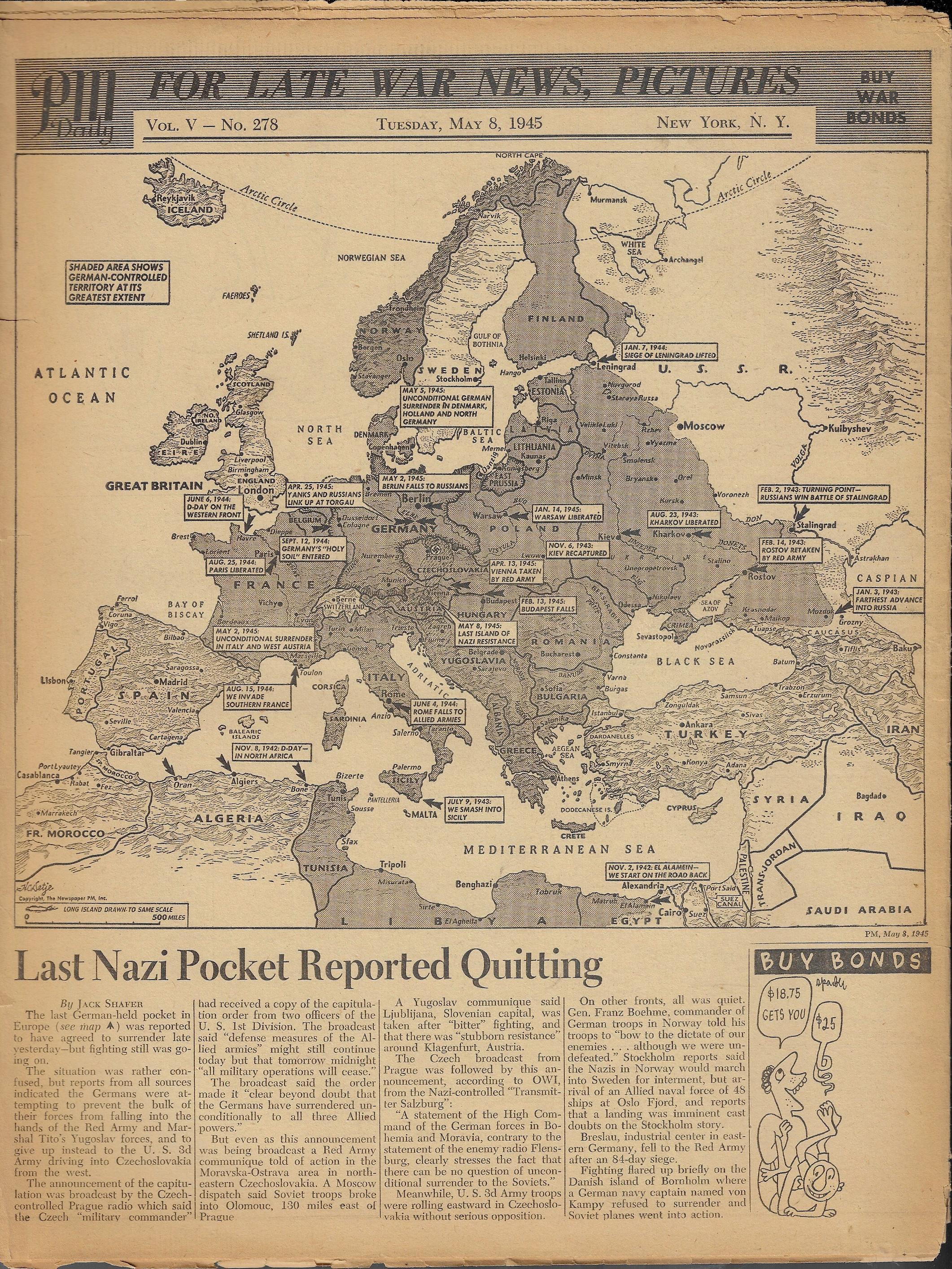
    PM  newspaper (active 1940-1948) was a left-leaning newspaper funded by Marshall Field III, and was home to excellent reporting. Among the staff writers was I.F.Stone and staff photographers Margaret Bourke-White.  Other contributors included Heywood Hale Broun, James Thurber,  (the great) Dorothy Parker, Ernest Hemingway, Eugene Lyons, Ben Stolberg, Malcolm Cowley, Tip O’Neill, and Ben Hecht, among many other illuminati.  (PM’s stated mission: “PM is against people who push other people around.   PM accepts no advertising. PM belongs to no political party. PM is absolutely free and uncensored. PM’s sole source of income is its readers–to whom it alone is responsible. PM us one newspaper that can and dares to tell the truth.)  It so happens though that PM is a difficult newspaper to find, nowadays, and so far as I can tell very little of it lives online, which is why I’ve decided to post some of the bits of interest from the copies of the paper that I have. Today’s installment: a fine and illuminating map of the seat of war in Europe, published at the end of the on May 8, 1945, showing the advance of victory. Whoever their cartographer was did a superior job.  (Note: double clicking into the map will open a very large and bright version of the map.)

    PM Newspaper May 8 MAP

  • Display of Information: the Naval Power of Principal Nations (1903)

    JF Ptak Science Books   Quick Post    

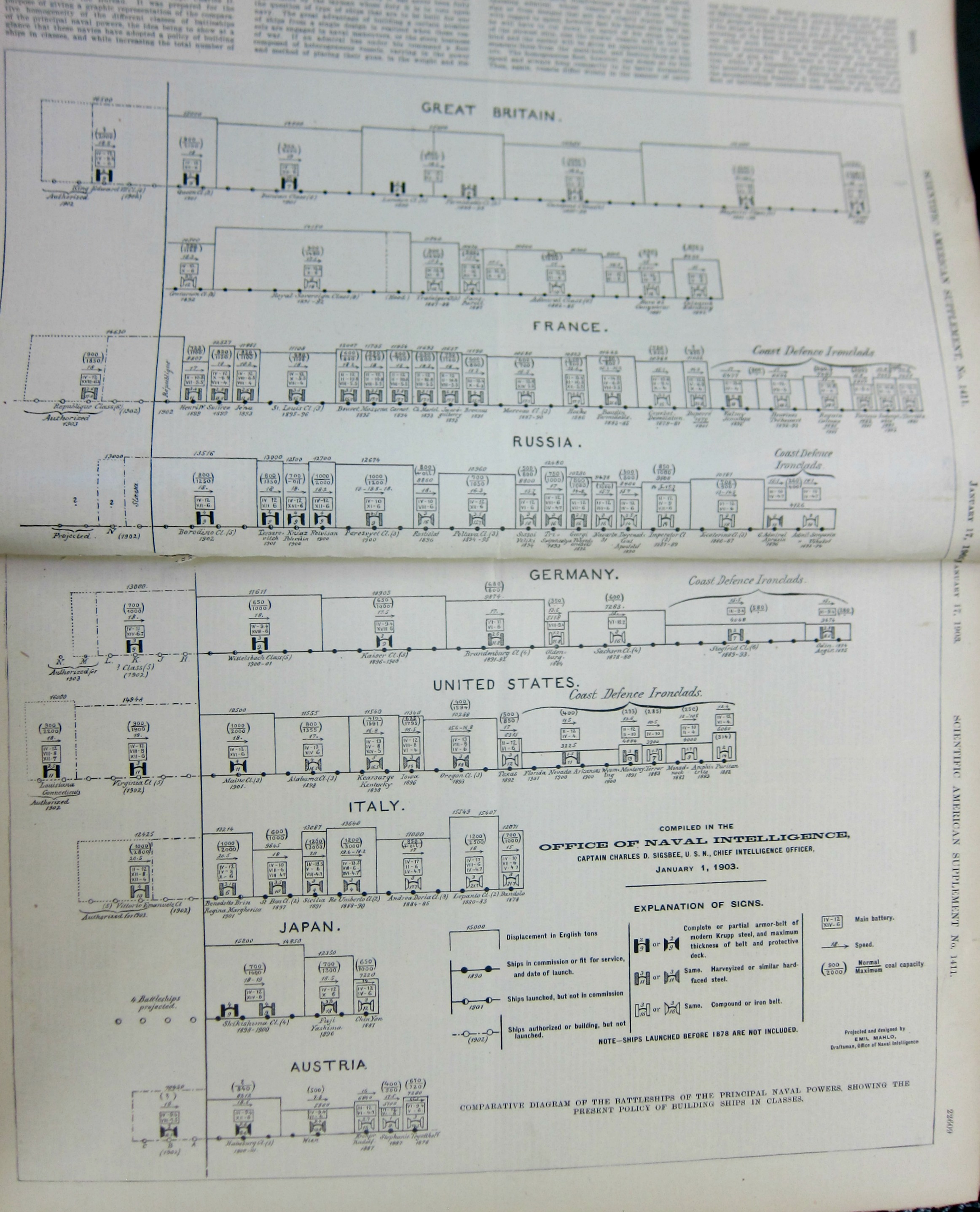
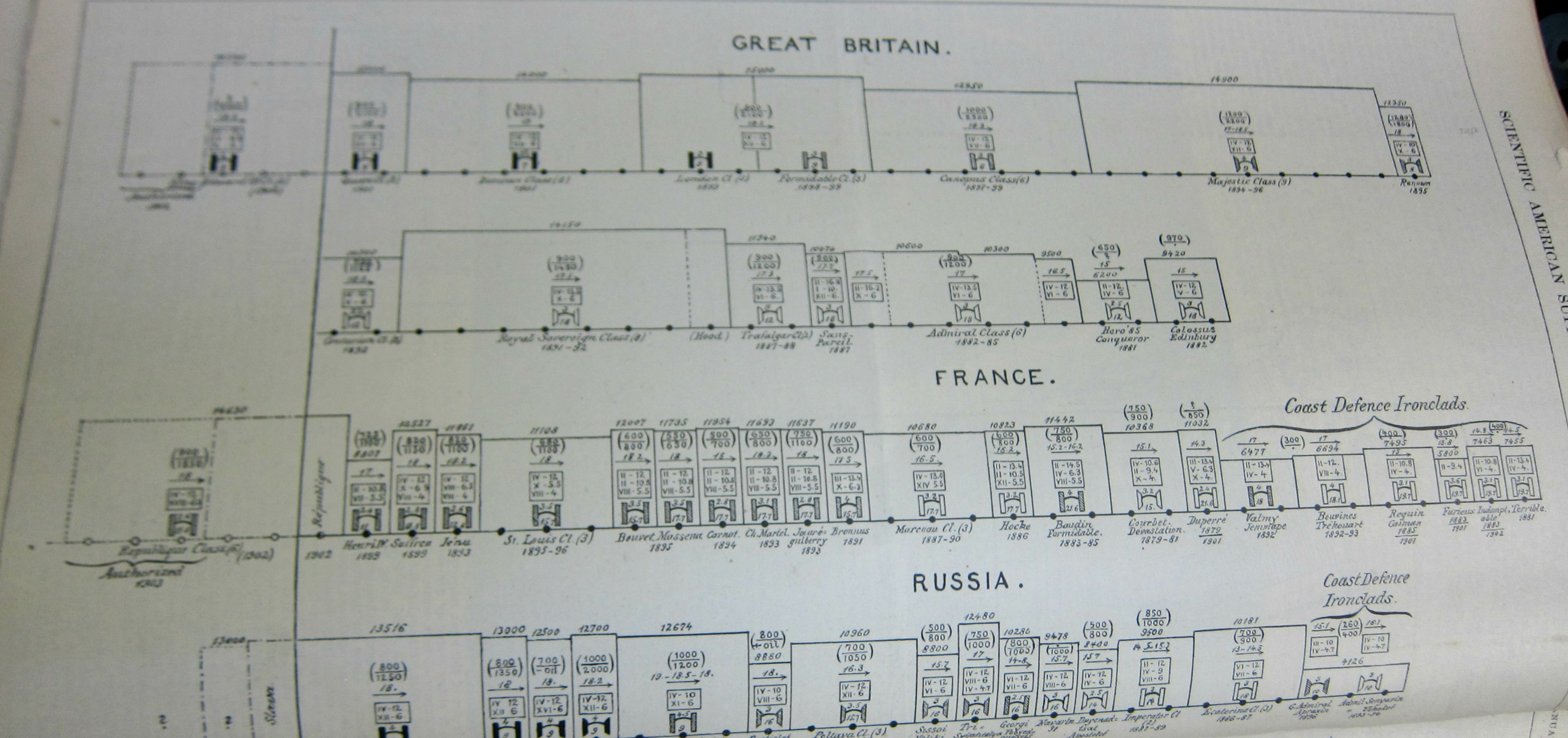
    I came upon this fine display of info this evening, a big two-page spread in the Illustrated London News, opening up to an impressive 16×26″ or so. The chart shows relative naval power (measured in this case in terms of battleships) between Great Britain, France, Russia, the U.S., Italy, Japan, and Austria. It appeared in Scientific American Supplement issue 1411, January 17, 1903 (pp 22608-9). The images are greatly expandable: 

    Datviz naval power 1903 ILN

    And in parts:

  • Internment Camp in Germany for British Civilians, 1915

    JF Ptak Science Books   Quick Post

    WWI POW civilians Ruhleben _2_ detail

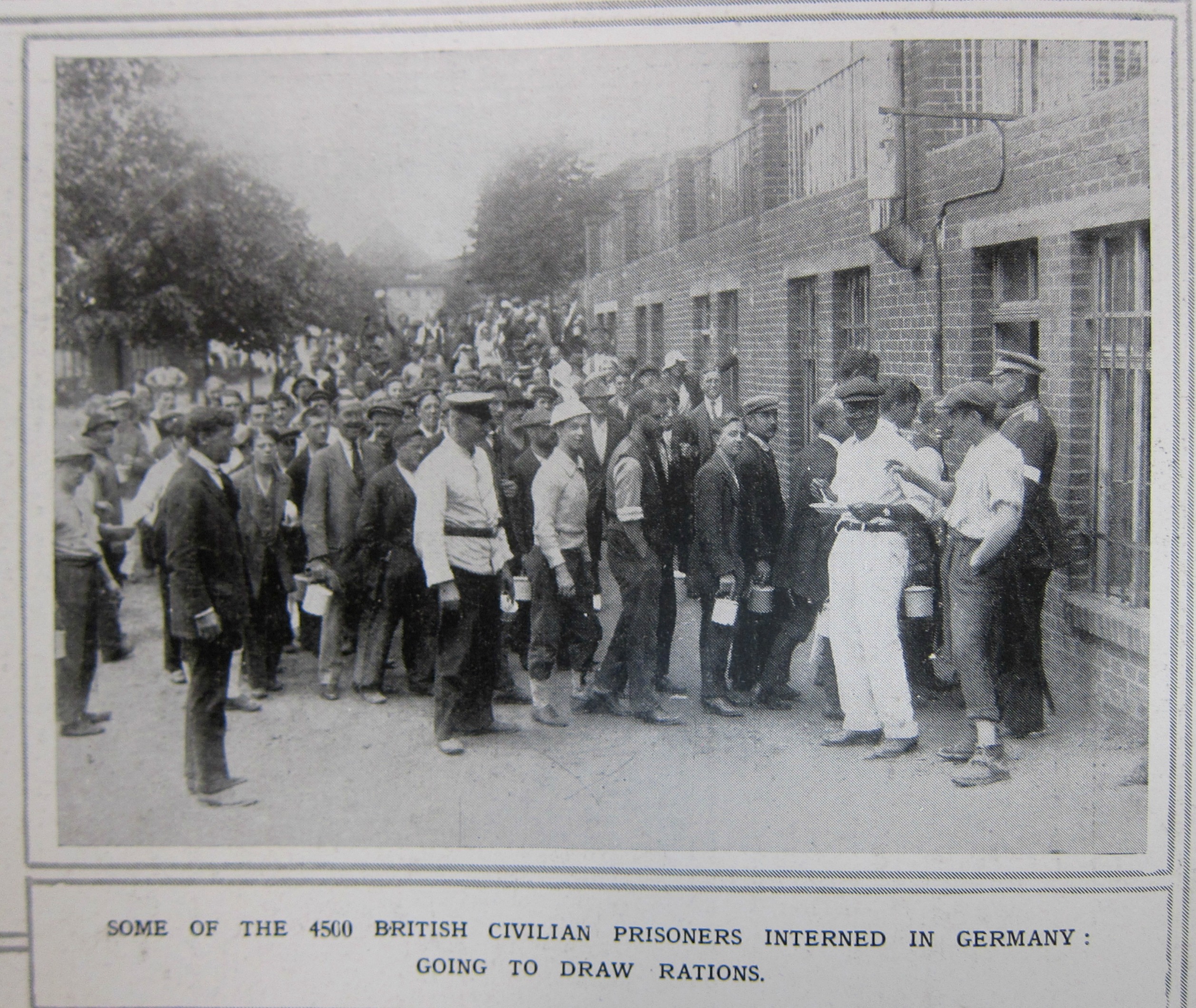
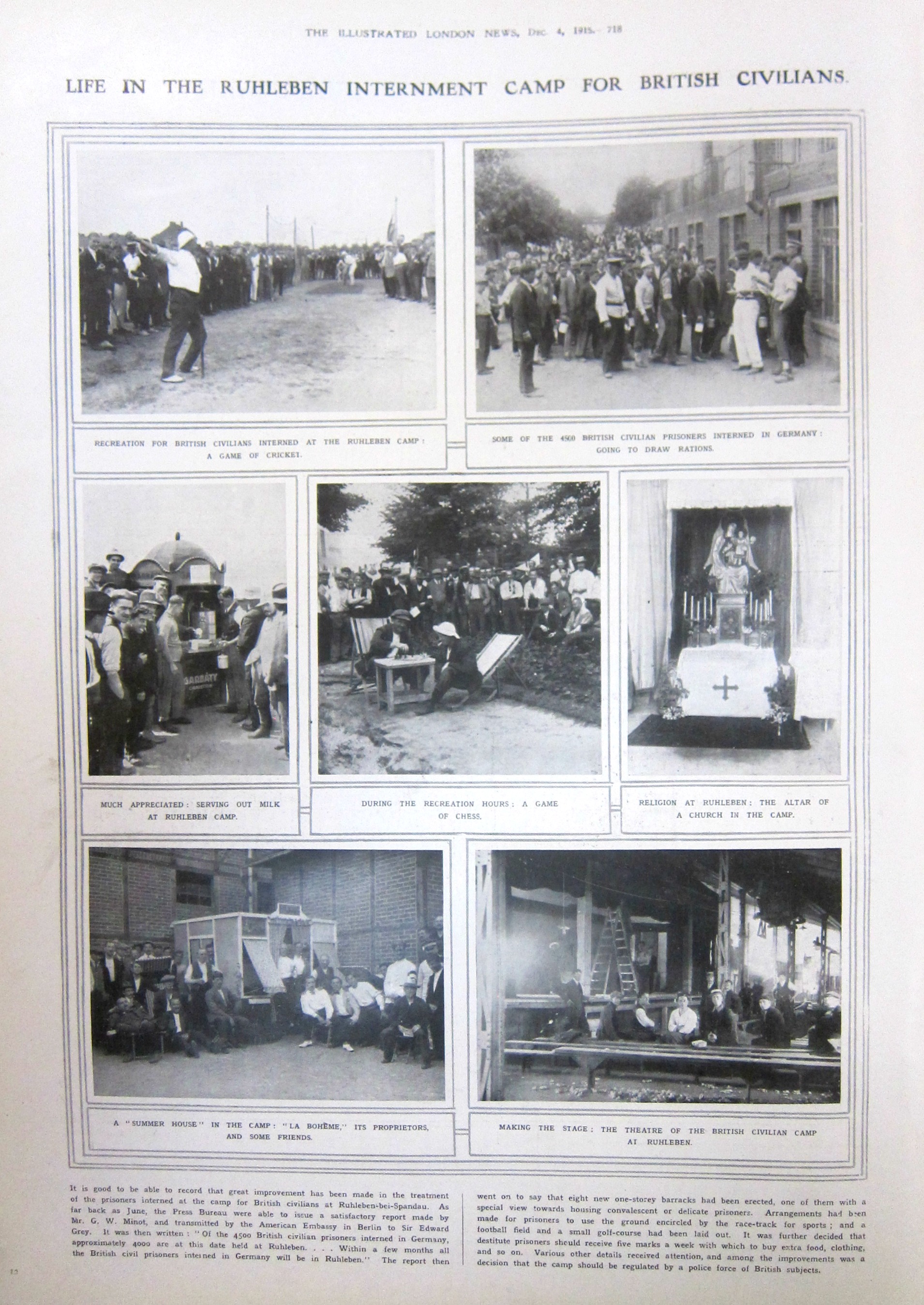
    This image was a little surprising to me when I saw it this afternoon–it occurs in the Illustrated London News for 1915 and even though I have been through all of the issues for that journal for WWI I had no recollection for it…and I certainly do not recall other similar pictures. And so there it is, a collection of photos of life inside Ruhleben Detention Camp, near Berlin, as published on December 14, 1915. (I don’t think “Ruh” is a word in German, but if it was “Ruhn” then the camp would be “Resting Camp” or “Living Camp” or some such.)   In any event the detention camps for Brits in Germany in WWI is something that is not commonly mentioned, so I thought I’d share this find. As it turns out, Ruhleben was a harness racing compound, with people housed in converted stalls–this is something I’ve encountered semi-frequently, this use of horse racing venues as detention centers, as with the internment camps for the Japanese in the western U.S. in 1942+.) Ruhleben seems to have been open and used for the duration of the war, and housed on average about 4-5,000 people at a time. (At one point one of those imprisoned here was James Chadwick, who would discover the neutron in 1932 and be awarded the Nobel Prize in physics in 1935.) 

    WWI POW civilians Ruhleben 1915

    I know that these places existed, of course, though I just do not recall seeing anything about it in the Illustrated London News or the Illustrirte Zeitung (Leipzig). 

    ·Posted by :

    ·in:

    —
  • Allied Nicknames for Japanese Aircraft, 1944

    JF Ptak Science Books   Post 2712   

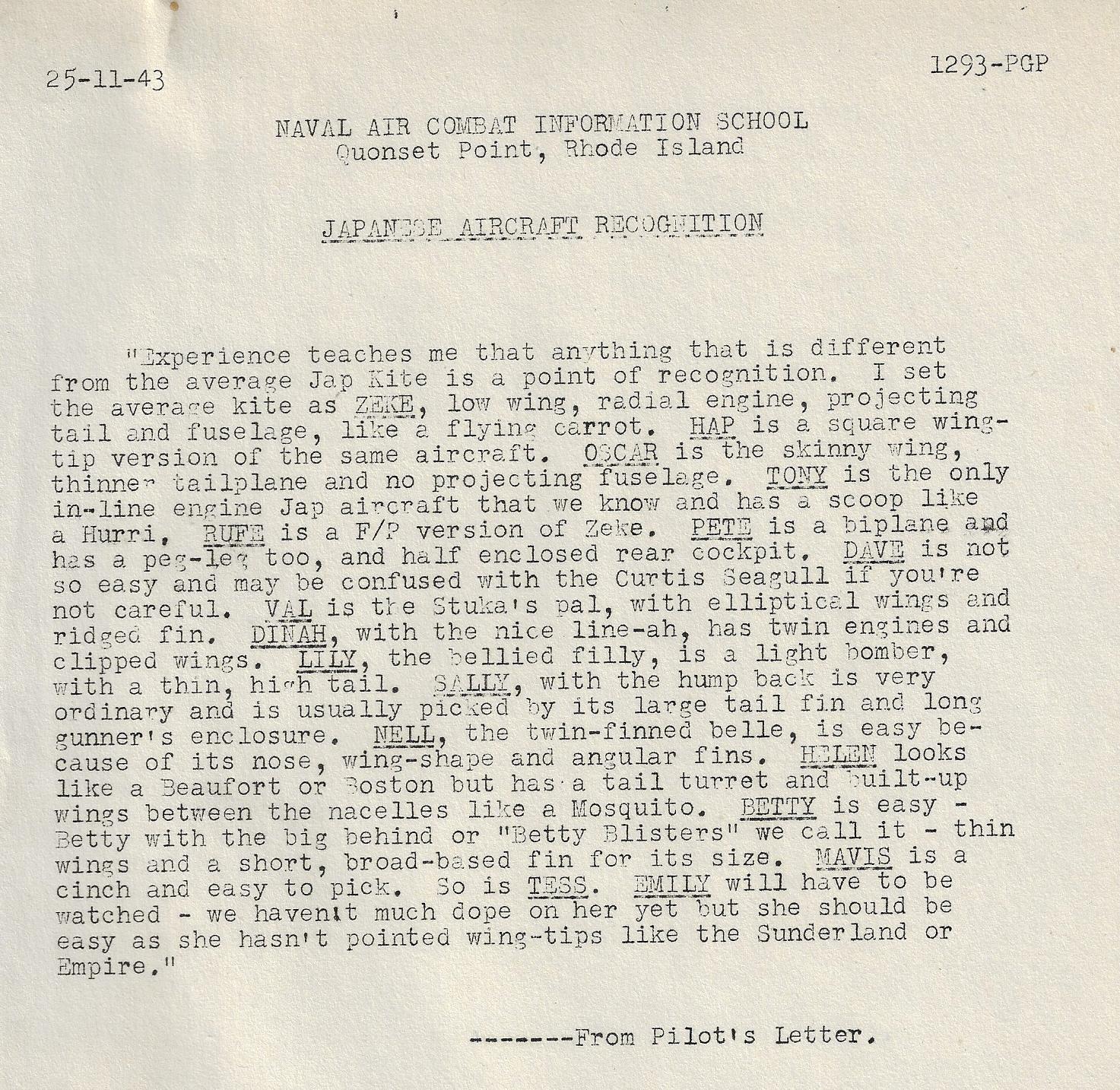
    The outline are details from a notebook written as classroom notes (ca. 1944) by a naval student of the Naval Air Combat Information School at Quonset Point, Rhode Island. Generally the diagrams are relatively small for the amount of information conveyed. The printed text for the curriculum and classes are nearly all marked “RESTRICTED” in the typed original of the offset pages.  The entire document is about 150pp long, and if there is interest in the contents I’d probably reproduce the entire thing–it is surprising how much can be learned and how much is revealed even in the multi-page lecture descriptions.

    This is an extract “from Pilot’s letter” describing the Japanese aircraft encountered and using the McCoy/Williams/Grattan shorthand-slang method for identifying the aircraft. Evidently using the Japanese names and designators was clumsy and complicated, so an alternative means was developed using common given names, trees, and birds to identify Japanese aircraft.

    NACIS Japanese plane names

    “In mid-1942, Captain Frank T. McCoy, a United States Army Air Forces military intelligence officer from the 38th Bombardment Group assigned to the Allied Technical Air Intelligence Unit in Australia, set out to devise a simpler method for identifying Japanese aircraft. Together with Technical Sergeant Francis M. Williams and Corporal Joseph Grattan, McCoy

    • divided the Japanese aircraft into two categories; fighters and everything else…
    • boys’ names to the fighters,
    • names of girls to the others…
    • training aircraft were named after trees.
    • single engine reconnaissance aircraft were given men’s names…
    • multi-engine aircraft of the same type were given women’s names.
    • (t)ransports were given girls’ names that all began with the letter “T”
    • Gliders were given the names of birds.”–edited, from Wiki https://en.wikipedia.org/wiki/World_War_II_Allied_names_for_Japanese_aircraft

    Here are the “translations” of the U.S. Names for Japanese aircraft in this short report in order of appearance

    • ZEKE: Mitsubishi A6M, Navy Type 0 Carrier Fighter. [This is the legendary “Zero” aircraft, so called as it was manufactured in the Imperial Year of 2600, or 1940, and adopting the final zero (or two) as a nickname in its Japanese designation. The “Zero” was “Zeke” for another six months or so before it was widely switched out. By the time of this report—November 1943—the “Zero”, which was recognized as the finest and most lethal carrier-launched fighter plane in then world, was decidely less so than, the Allies catching up by mid-1942 to make it roughly the equal of the best Alied fighter planes, and then increasingly less so until in 1944 it was considered outdated.
    • HAP: Mitsubihi AGM3, Navy Type 0 Carrier Fighter Model 32
    • OSCAR: Nakajima Ki-43, Army Type 1 Fighter
    • TONY: Kawasaki Ki-61, Army Type 3 Fighter
      RUFE: Nakajima A6M2-N, Navy Type 2 Interceptor/Fighter-Bomber
    • PETE: Mitsubishi F1M, Navy Type 0 Observation Seaplane
    • DAVE: Aichi D3A
    • VAL: Aichi D3A, Navy Type 99 Dive Bomber
      DINAH: Mitsubishi Ki-46, Army Type 100 Command Reconnaissance Aircraft
    • LILY: Kawasaki Ki-48, Army Type 99 Twin-engined Light Bomber
    • SALLY: Mitsubishi Ki-21Army Type 99 Dive Bomber
    • NELL: Mitsubishi 3GM, Navy Type 96 Attack Bomber
    • HELEN: Nakajima Ki-49, Army Type 100 Heavy Bomber
    • BETTY: Mitsubishi G4M, Navy Type 1 Land-based Attack Aircraft
    • TESS: Douglas DC2, Navy Transport
    • EMILY: Kawanishi H8K, Navy Type 2 Large Flying Boat

    ·Posted by :

    ·in:

    —
  • Debriefing Life Raft Usage by Air Combat Intelligence (1944)

    JF Ptak Science Books  Quick Post

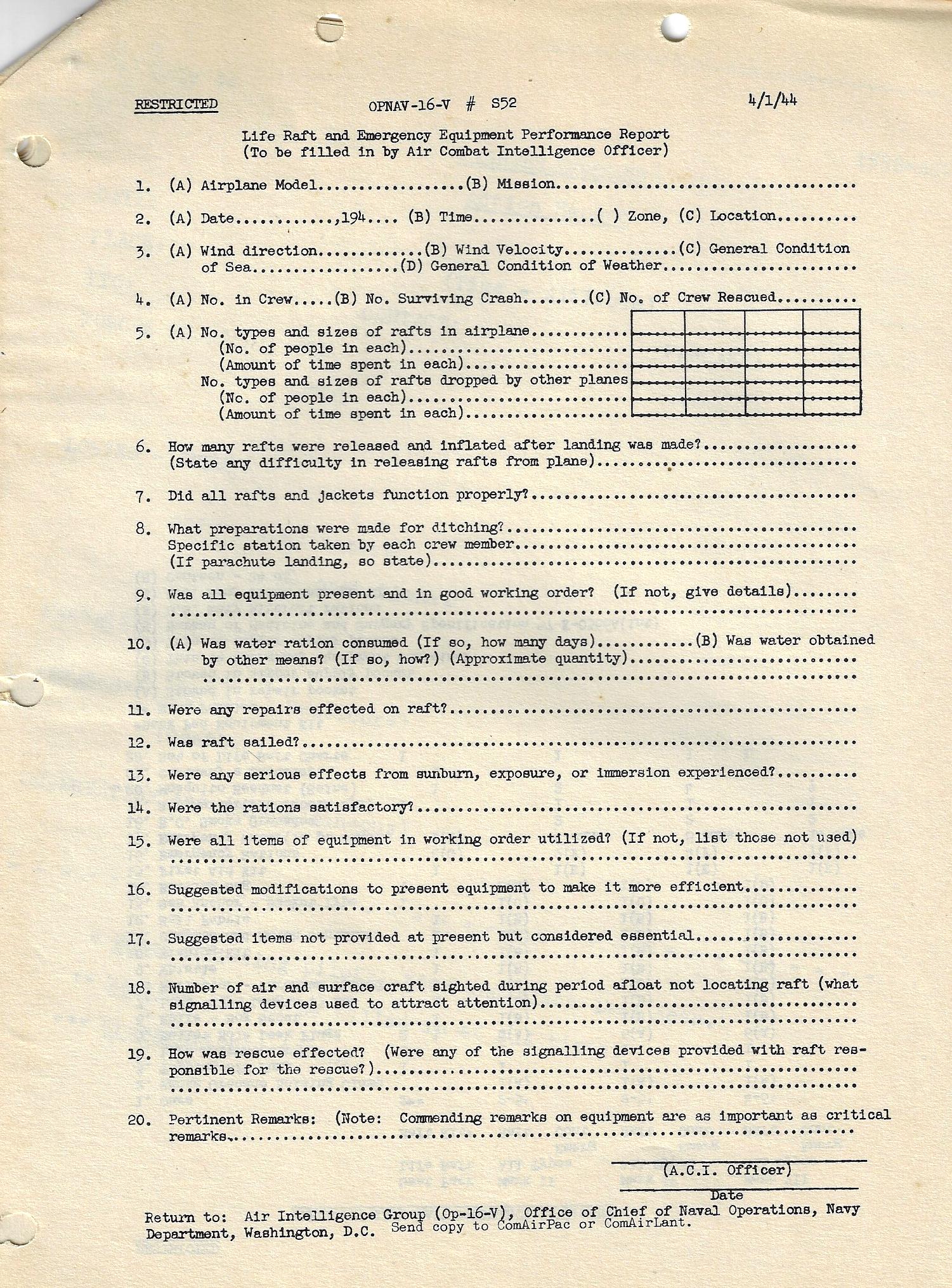
    I was so surprised to find this 1944 checklist and review for an “Air Combat Intelligence Officer” of “Life Raft and Emergency Equipment Performance Report” (!).  It was in  a notebook prepared (ca. 1944) by a naval student of the Naval Air Combat Information School at Quonset Point, Rhode Island. The printed text for the curriculum and classes for an intelligence officer given during the summer of 1944 are nearly all marked “RESTRICTED” in the typed original of the offset pages.  The entire document is about 150pp long, and if there is interest in the contents I’d probably reproduce the entire thing–it is surprising how much can be learned and how much is revealed even in the multi-page lecture descriptions. 

    The document below addresses an odd internal issue of mine, something that I’ve sort of followed around in some fashion in reading about WWII in the air, and especially in the Pacific, and especially for the precautions and supplies aboard USAAF aircraft in the event of a ditching. I knew from incidental and second-hand reading exposure that these supplies changed quite a bit from 1942 to 1943, but I had no idea that there was such a debriefing schedule established for life raft usage. 

    I would really be interested in the answers to #17.  No doubt there is a collection of those answers, but I think I’ll just have to leave those to mystery. 

    NACIS Lifeboat

    ·Posted by :

    ·in:

    —
  • On Not-Missing the Not-Unhidden Darwin and his “Masterpiece” Map (1845)

    JF Ptak Science Books   Post 2680

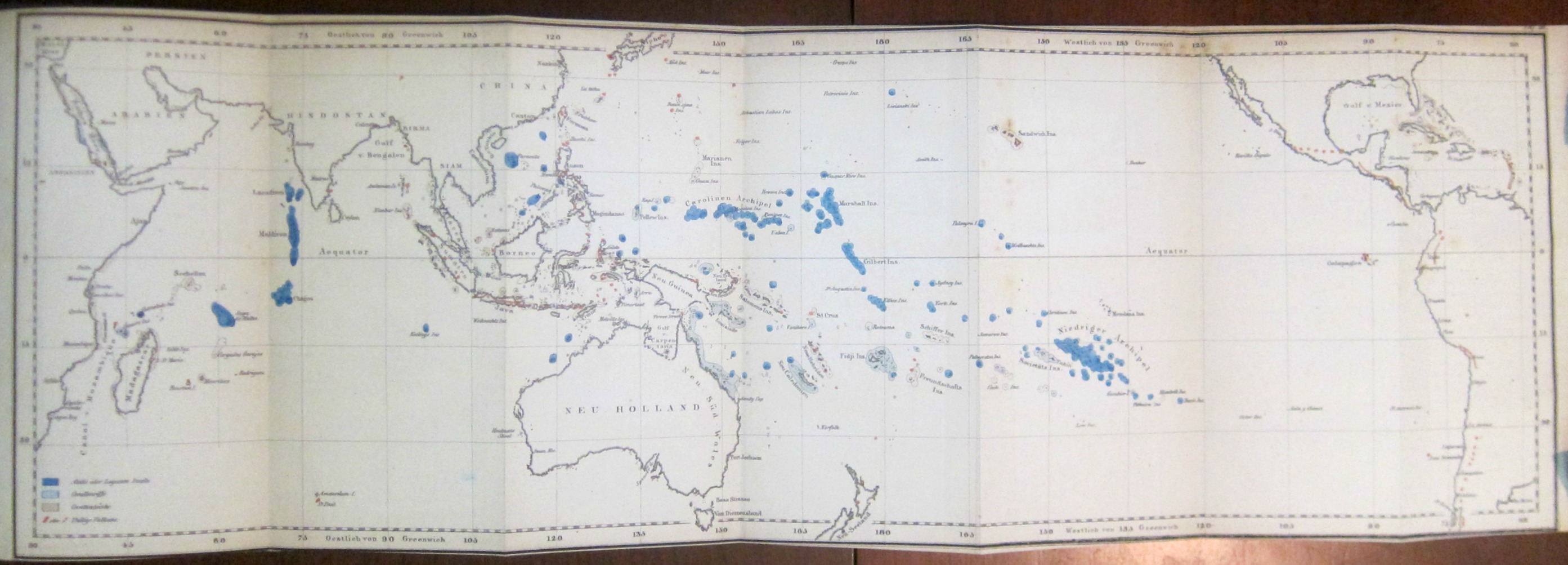
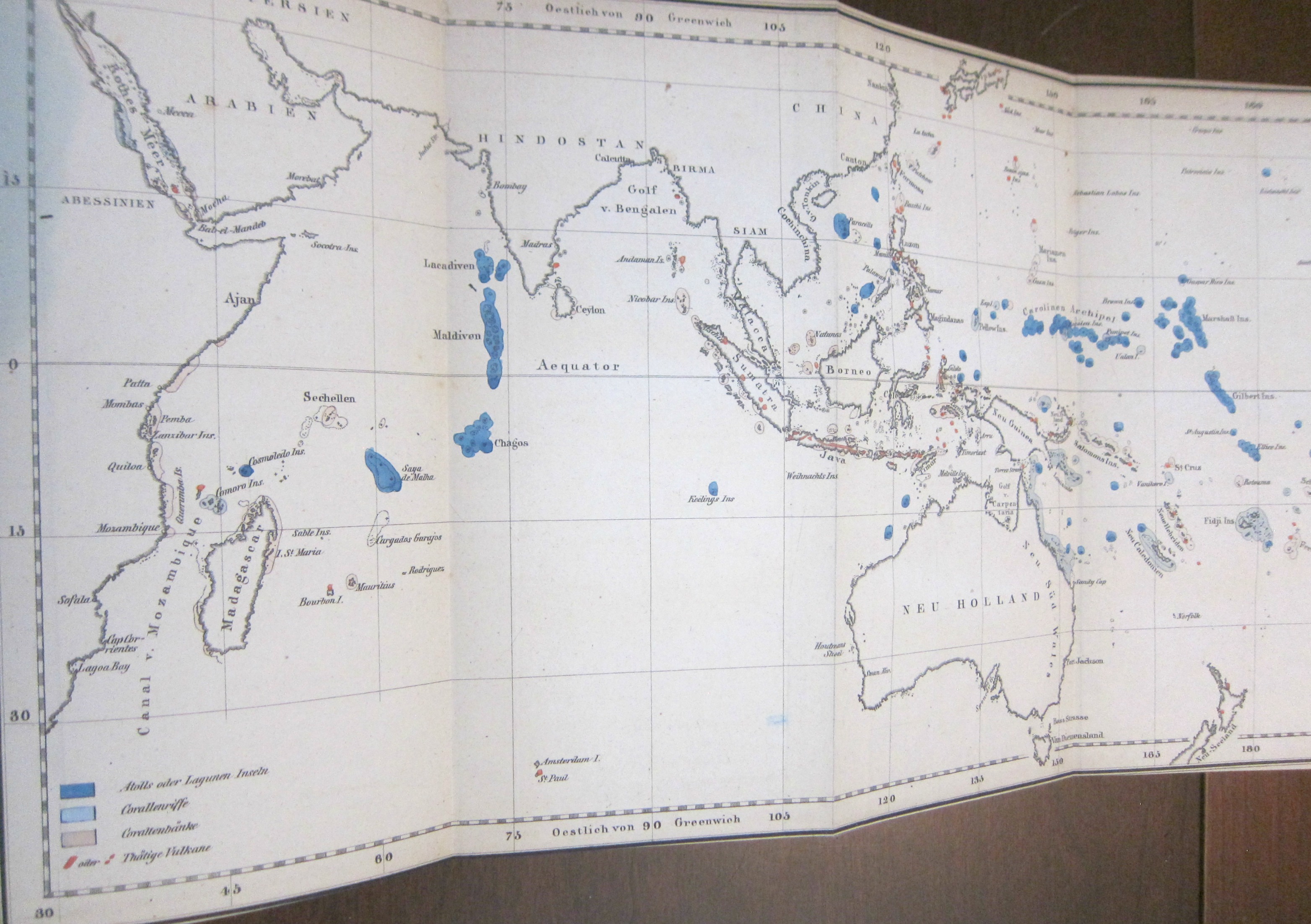
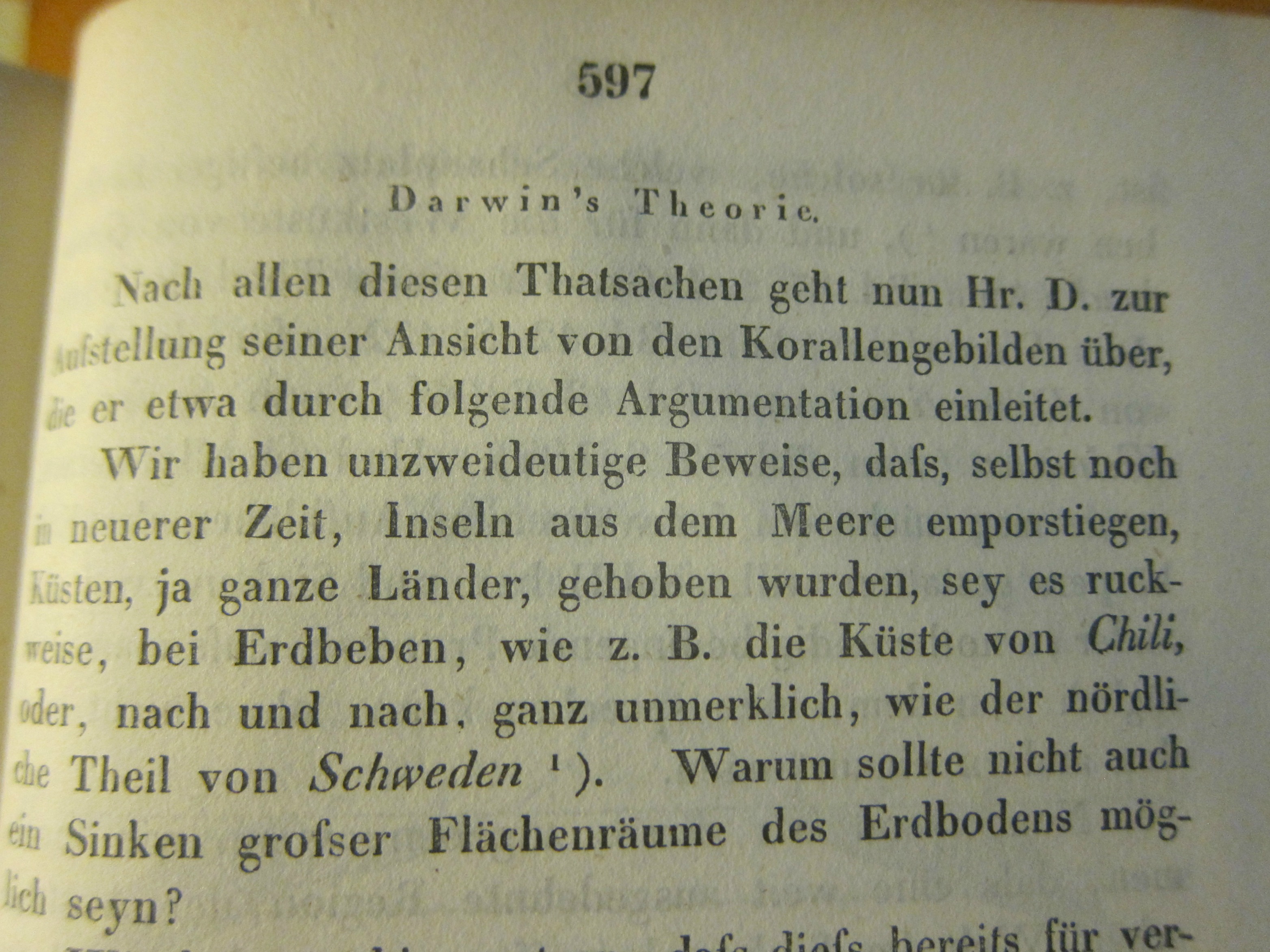
    I was surprised to find this long and early (1845) contribution1 on Darwin and his ambitious work on coral reefs in the generally physical-sciences-heavy Annalen der Physik2. The surprise was ever more so because of the illustration for the article–a German version of the coral islands/reefs map that appears as the frontispiece to Darwin’s The Structure and Distribution of Coral Reefs3…  that appeared three years earlier in 1842.  (Darwin’s Journal of Researches...,  today more commonly known as the Voyage of the Beagle, which was the third volume of Narrative of the Surveying Voyage of His Majesty’s Ships Adventure and Beagle…… was published in 1839, and his first publication of any kind appeared ten years earlier in 1829; the first German translation of the Narrative appeared in 1845 as  Naturwissenschaftliche Reise. As John van Wyhe–the founder and curator of the fantastic resource Darwin Online–points out the German translations were significant because “It was in German…that Darwin influenced the founder of genetics Gregor Mendel, and the pioneering evolutionists August Weismann and Ernst Haeckel”4.)

    When I was thumbing through the volume I noticed the folding map tucked away at the back of the book, nestled with a number of other folding engravings–and I very nearly missed it (that being easy to do in this case).

    Darwin annalen _4_

    • [For a full description of the map consult Darwin Online, Structure and Distribution of Coral Reefs, chapter VI, pp 119-126 http://darwin-online.org.uk/content/frameset?viewtype=side&itemID=F271&pageseq=8]

    Having worked with the Annalen for many years (principally the Annalen from 1799 to the early 1930’s which numbered in the low hundreds of volumes) it was my overall impression that the appearance of contributions in the natural sciences were not at all common in the early years and had become less so by the time of the Darwin-related article. In any event, there it was–I felt a little groggy for not recognizing the map straight away–I slowly pieced it together from the clues, and then pinned the thing down in the test (the Annalen is not generally very user-friendly in placing images with text, though if I had bothered to look for the usually missing image index it would have made life easier). And then, there it was–right where it should be.

    Darwin annalen _2_

    So tonight I’m just sharing a few images of the map from this happy little adventure of not-missing the not-attributed-in-the-table-of-contents Darwin.  I guess I should’ve recognized the map right at the outset, but didn’t. Ah, well. 

    Here’s an appreciation of the map from the University of Maryland’s Integration and Application Network, “Ten Classic Maps” (http://ian.umces.edu/blog/2013/12/27/ten-classic-scientific-maps/): 

    “Coral reefs: The map of coral reefs throughout the Pacific Ocean created by Charles Darwin in 1842 as part of his first science book, The Structure and Distribution of Coral Reefs is a masterpiece. Although Darwin’s subsequent books about natural selection eclipsed his insights into coral reefs, this coral reef map is part of the theory that Darwin had about the formation of coral reefs. Darwin correctly hypothesized that coral reefs were formed by the limestone accumulation by corals and that extinct volcanos were buried beneath modern coral atolls. It was over one hundred years before drilling associated with the nuclear testing on Bikini atoll that Darwin’s theory was confirmed. Darwin did a couple of important things with this map: he color coded the reefs that were subsiding (blue) and uplifting (red) and he produced a large foldout to cover the entire tropical Pacific Ocean in a single contiguous map. In this manner, viewing the map instantly reveals the “magnificent and harmonious picture” of the broad patterns that Darwin observed. I am convinced that this is the first important piece of evidence supporting plate tectonics and the Pacific ‘Ring of Fire‘, and that if Darwin had a bit more information available at the time, that he would have actually come up with the theory of plate tectonics.”


    Darwin annalen


    Notes

    1. (Darwin, Charles.) “Ueber Verbreitung, Beschaffenheit und Entstehung der Korllen-Inseln” [nach Darwin], in Annalen der Physik und Chemie, 1845, series II volume 64, pp 563-614 (about 15,000 words).  (“The distribution, character, and origin of the coral islands.”, “after Darwin”.)

    2.  The Annalen would become one of the most important scientific journals in physics beginning in the 1830’s. 

    3. The Structure and Distribution of Coral Reefs. Being the First Part of the Geology of the Voyage of the Beagle, under the Command of Capt. Fitzroy, R.N. during the Years 1832 to 1836. The work included three folding maps in total (two of which were hand colored). 

    4. John van Wyhe, “Darwin in Translation”,https://www.amphilsoc.org/library/valentinedarwin/vanwyhe

  • The Fate of the Future & the Ironies of Artistic “Futurism”

     JF Ptak Science Books

    “The oldest of us is thirty: so we have at least a decade for finishing our work. When we are forty, other younger and stronger men will probably throw us in the wastebasket like useless manuscripts—we want it to happen! They will come against us, our successors, will come from far away, from every quarter, dancing to the winged cadence of their first songs, flexing the hooked claws of predators, sniffing doglike at the academy doors the strong odor of our decaying minds, which will have already been promised to the literary catacombs.”–from the “Futurist Manifesto”, by F.T. Marinetti, 1909

    They came for Mr. Marinetti (1876-1944) a little earlier than that, and continued to come, though whoever it was that came couldn’t quite reach the founder of Futurism, who seemed to be one invisible step ahead of oblivion.  Or perhaps it was behind?  I’m not sure.

    But futurism as a movement was more in the past than in the future, barely lasting long enough to have anything but a past.

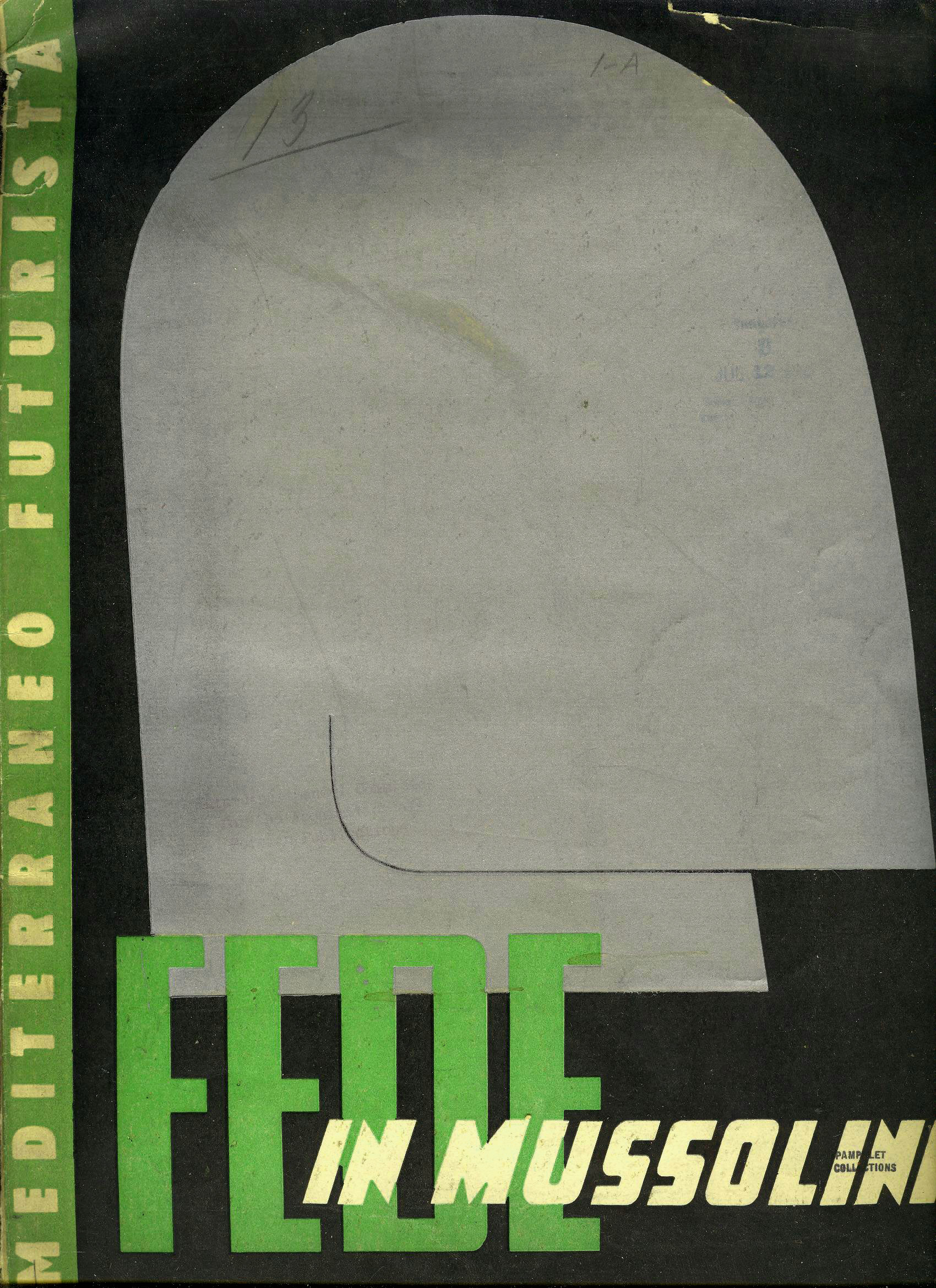
    Mussolini

    • This is the cover of a magazine edited by Marinetti and others, a hagiographic-porn hommage to the leader of the Italian fascist government, Benito Mussolini, featuring a very striking portrait of the leader on the cover. (I’ve seen a note elsewhere stating that the image on the cover is by (Mari Biazzi (1880-1965)) though I could not find any other references for that. Also I’m not sure about the journal, as it comprises the names of two Futurism journals, Mediterraneo Futurista and Fede in Mussolini (“Faith in Mussolini”).Apologies for this incompleteness. Mostly I just wanted to share the image given its particularly brutal Brutalist aspects.)

    Not that the movement wasn’t important–it was, obviously–its importance branched out into other areas and movements, morphing into necessary branches, leaving behind a shell of the original tended by the originator.  (It can be argued that this movement helped create the environment for Dadaism and Cubism [or at least Cubist-futurism as in the Russian sense of that art].)  Marinetti had some unsavory and some just downright weird political and social ideas, having a long and vested interest in fascism.1  And not only the earliest part of Italian fascism –founded in 1919 with an interest in expanding the democratic process–but the later, Mussolini-controlled Italian fascism as well.  Marinetti sought the protection of Il Duce,2 and even so during the war, when he sought to protect his movement’s art from being designated as “degenerate ” and therefore unacceptable and existence-deniable by Adolf Hitler.

    And so the unlikely prolonged existence of futurism–a movement transformed far beyond itself in a matter of years, held together by pieces of fluff and dust, supported in its old age on the hopes of a noxious political system which was itself doomed to rapid failure.

    “At last they’ll find us—one winter’s night—in open country, beneath a sad roof drummed by a monotonous rain. They’ll see us crouched beside our trembling aeroplanes in the act of warming our hands at the poor little blaze that our books of today will give out when they take fire from the flight of our images.”  –F.T. Marinetti, from his “Futurist Manifesto”, 1909

    Notes

    1. Marinetti’s goal was to establish futurism as the official art movement of the government–something he specifically wrote against in earlier incarnations of himself.  He would come to loggerheads with much of his earlier social opinions, abandoning his beliefs in his never-ending quest to promote his movement.  I must say though that Marinetti did publicly speak against anti-Semitism.

    2. Marinetti sought to have the Nazi traveling exhibition of degenerate art–which included works by futurists–banned from Italy.  So even though the Nazi fascists established futurism as degenerate, Marinetti was able to enlist the aid of Mussolini to shield Italians from what the Nazis thought of the art.  But the futurist manifesto seemed comfortable with the while idea right from the start, as we can see in proposition #9 of its self-proclamation: “We will glorify war – the world’s only hygiene – militarism, the destructive gesture of freedom-bringers, beautiful ideas worth dying for and scorn of woman…”

  • Moving the Atlantic Inland

    JF Ptak Science Books   Quick Post

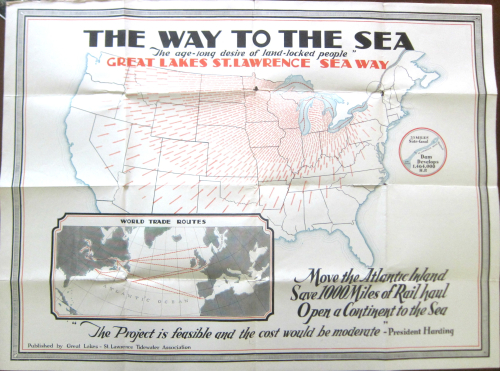
    Here’s an arresting image: the arrows of transportation interests directing themselves inward, inland, to the Great Lakes, ca. 1923.  The map is a bit of advertisement–a “convincer”–to send more economic traffic through the Great Lakes and of course the Great Lakes–St. Lawrence Seaway. Somehow it was making more sense to the writers of the copy for this idea to send freight from Virginia and Pennsylvania and New York away from the coast and up to the lakes, even though that would triple or quadruple the shipping times for those goods. Some of this makes sense, some doesn’t. Anyway, the resulting map is quite a piece of work–but I do think they should’ve let the Atlantic coast stay where it is.  

    Maps Move Atlantic Inwards

  • A Beautiful Solar Eclipse Print (1858)

    JF Ptak Science Books   Quick Post

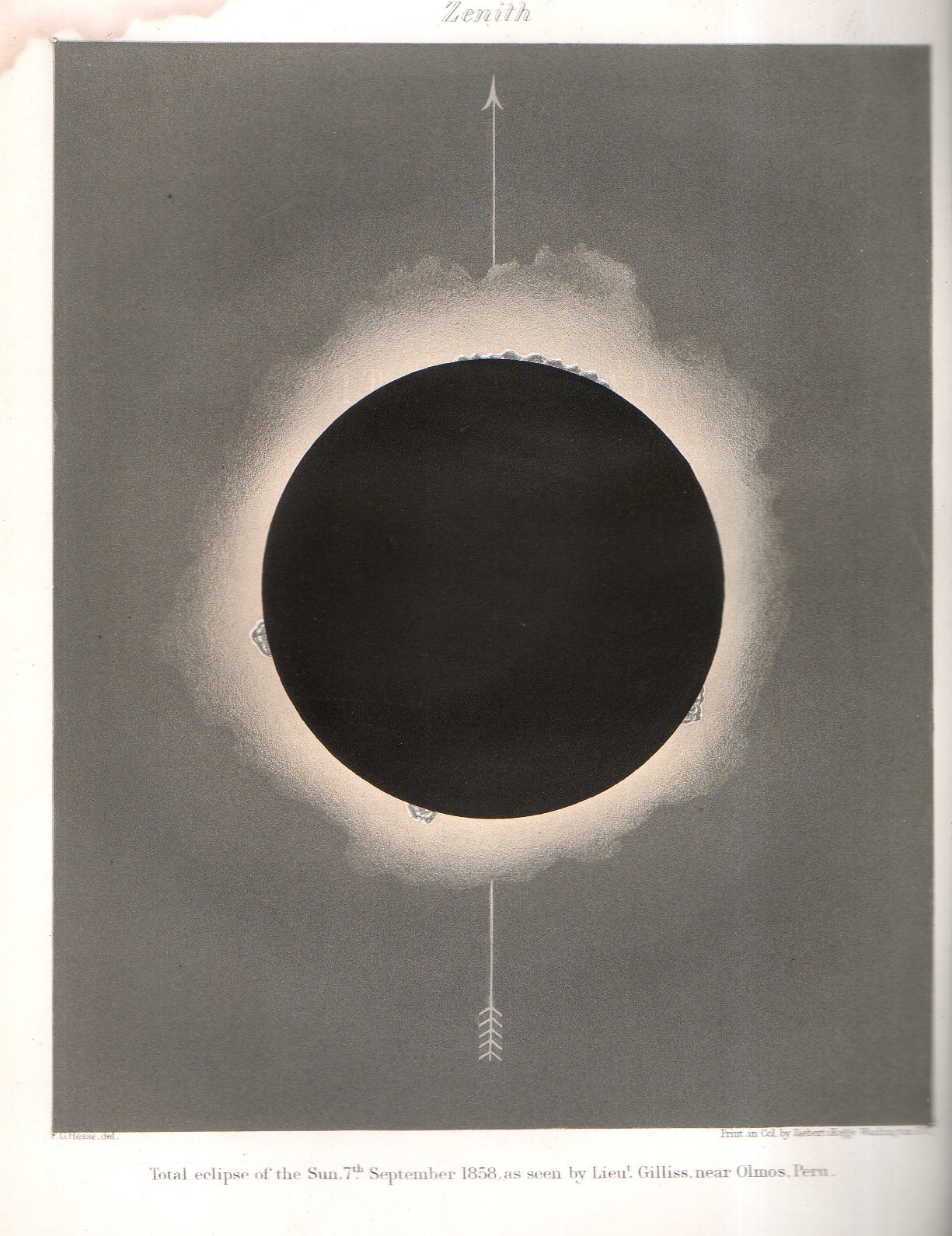
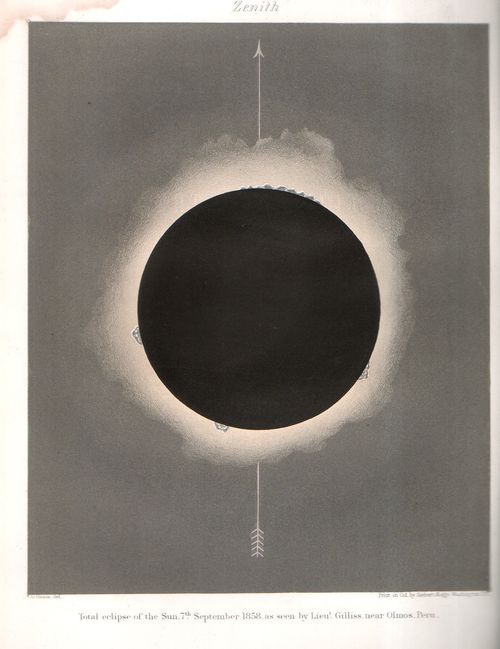
    Eclipse913


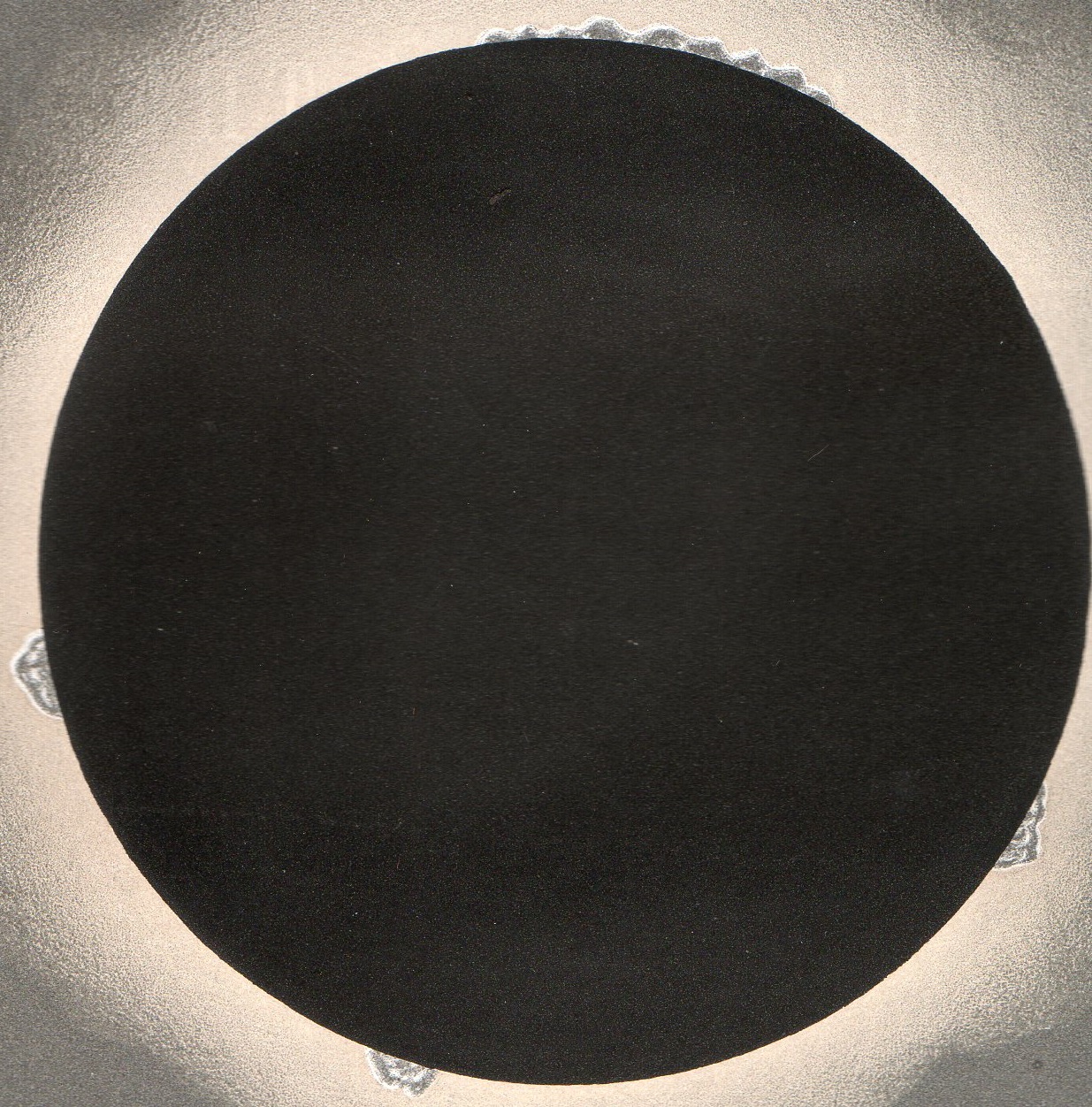
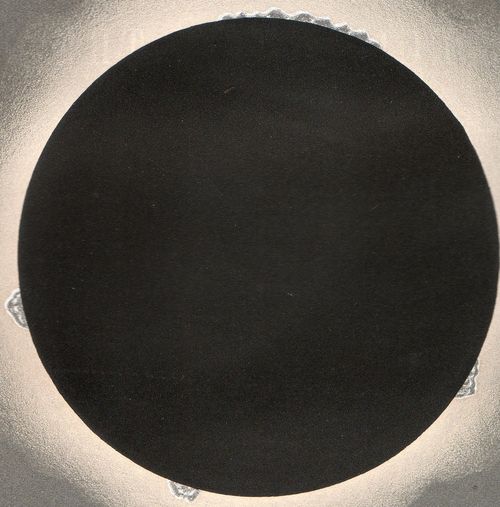
    F.G. Hesse captured this dramatic image of total eclipse at Olmos, Peru for Lt. James Melville Gilliss’ report of the event that he chased down for the U.S. Naval Observatory and the Smithsonian in 1858. Gilliss (1811-few months too short of the end of the Civil War in 1865) was a Georgetown boy who is buried in the beautiful Oak Hill Cemetery, and best known probably for being in charge of the Naval Observatory (previously the “National Observatory”), which was teh first national observatory established in the U.S.  He took over that position from Matthew Fontaine Maury1 (as in “Maury Day” celebrations in Virginia and being the father of American Oceanography and a prominent figure in the Confederacy) and was a position he held until his untimely death at age 53. The report in which the eclipse image appears is An Account of the Eclipse of the Sun, published in the Smithsonian Contributions to Knowledge series in 1859.

    In the report it sounds as though Gilliss was not prepared for the effects that the eclipse had on his non-experimentalist persona, and how awestruck he was to see it once in totality:

    “The screen of the glass [from the telescope] was hurriedly removed, and in the brief instant of doing so I found, to my surprise, that all the phenomena were distinctly visible to the unassisted eye.”

    “A corona light flashed out at the instant of totality. It extended farthest from the sun, in lines drawn from the centre through the solar clouds, but was nowhere traceable more than 15′ or 16′ beyond the lunar disk. There were no radial streamers, or bundles of rays, but only a uniformly diminishing, and slightly orange-tinted light, whose brightness and extent were apparently influenced by the mist-film, as the color of the clouds also may have been. Beyond the corona light, the color of the sky was of a grayish-black.”

    And then: 

    “It was a far more imposing sight without than with the telescope, and long has been my experience in the investigation of celestial phenomena, and calm and unimpassioned, at such times, as my temperament has become, the sublime majesty of the scene thrilled me with excitement and humble reverence.”

    During and after the eclipse Gilliss reported on the behavior of the town:

    “For some minutes previous, all work in the valley below us had ceased, and even the strains of martial music, which the Governor of Olmos employed to cheer laborers digging for water, two or three miles from town, were no longer audible. Superstition is still dominant here, and we hear the solemn toll of the church bell, whose sounds were intended to drive evil spirits from its vicinity.”

    “Neither at Olmos nor Piura, did any enceinte woman leave her room during the eclipse, whilst some from curiosity, but more through fear, were in the streets, yet not daring to look upon the sun, lest malady befall them. The somber green light gave them the appearance of corpses, and they apprehended that a plague might be visited upon them. Afterwards, the muleteers told us that their animals stopped eating, and huddled together in evident alarm.”

    Notes.

    1. Maury left the Observatory to become  a high-ranking official and overseas representative with the Confederacy at the outbreak of the war. The writeup for Gilliss in Wikipedia includes the coy and Victorian statement about Maury joining the Confederacy to fight for separation from the United States, with Gilliss promoted to the Maury position “when Maury responded to serve his state, kin and friends…” with no mention of the Civil War. 
    Eclipse912

    ·Posted by :

    ·in:

  • The K.K.K., the Catholic Church, and (Badly) Organized Labor (1923)

    JF Ptak Science Books   Quick Post

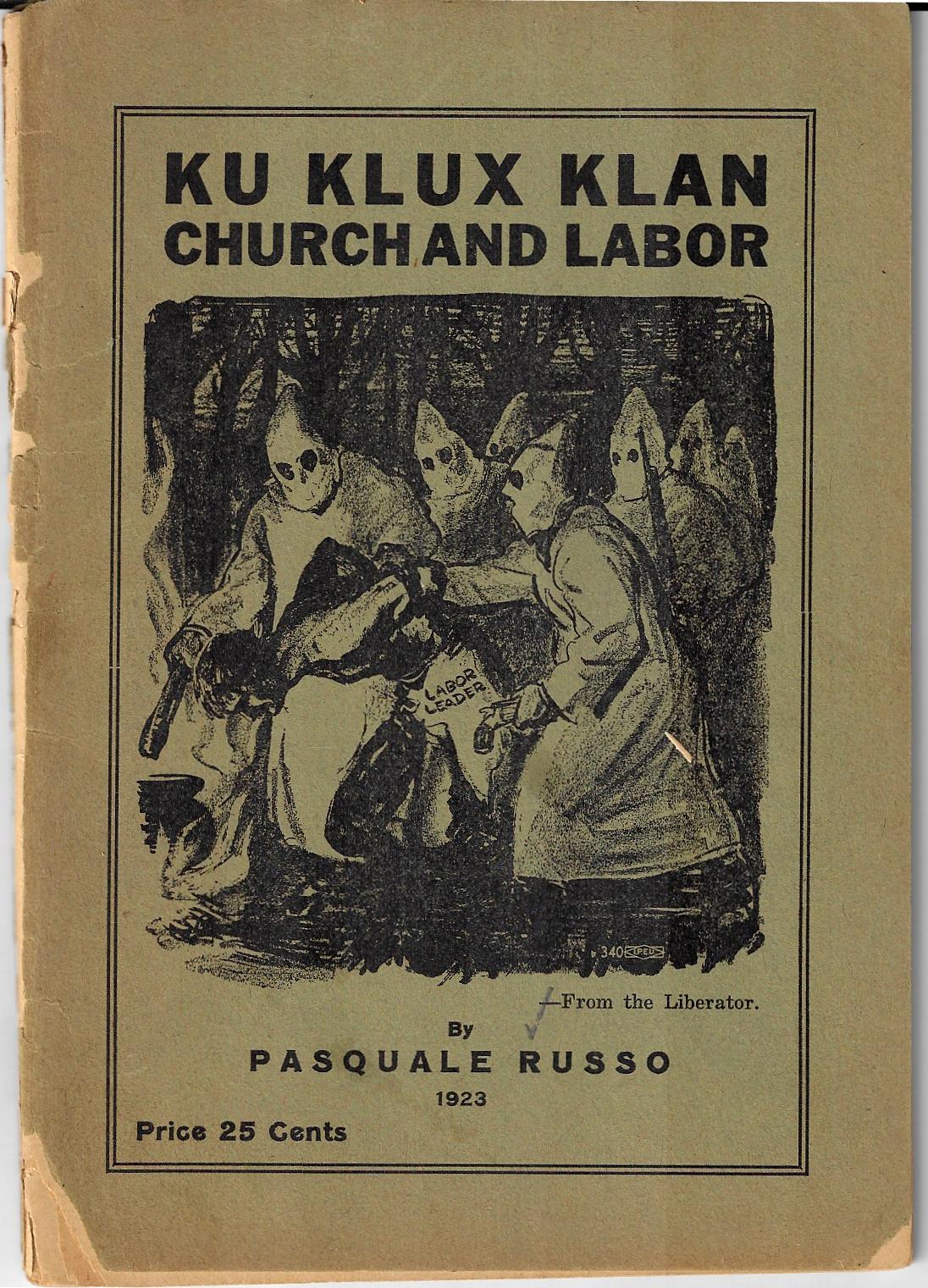
    KKK Church and Labor 1923The author of this curious work1, Pasquale Russo (who also wrote “Negro Slavery or Crime of the Clergy” and “Tony the Immigrant” among others) makes a case against the K.K.K., and also manages a conjoined condemnation against the “Church”–and that being, so far as I can tell, the Catholic Church–all the while building a very strong pro-labor (Socialist?) overview for the improvement of the condition of the working classes. This seems a little unusual to me as the K.K.K. was also anti-Catholic, making similar arguments against that religion as Mr. Russo. Mr. Russo’s reasoning behind the attack here seems to be that the Church was in its way complicit with the actions of the K.K.K. by being against labor, as was the Klan, and so with this thinking the Church was pro-K.K.K. and anti-working class by restricting the freedom of the laborer, and against “the solidarity of the white and colored”.  There is very strong support in the pamphlet for the Negro worker (the “N” in “Negro” being capitalized at a time when even that small dignity was rejected by many in the publishing industry), railing against the  segregationist policies of the “United Federation of Scabs” (the American Federation of Labor, A.F.L.) and Samuel Gompers and for being the “lickspittles” of the ownership class. The pamphlet was published at an interesting time–1923–for the main aspects of the work: there was significant anti-Catholic leanings high and low throughout the country; the K.K.K. was about halfway through its second very short-lived revival before its collapse later on in the decade; the African American as a race and as a worker class was still very abused; and the infatuation with Socialism and the newly-formed Soviet Union was young and growing. So the pieces of history were there, though they are in a jumble. 

    The pamphlet is a highly problematic but forensically-interesting work, and speaks to its times in a number of ways–that said, I am not sure where this fits in with anything, and how much of Mr. Russo’s self-published philosophy was shared and how much of it was simply an externalized internal insight. 

    Overall my little graze through this pamphlet left me a little tired and depressed–it did give me some sort of understanding of something, but I don’t know what. 

    Notes:

    1.  Pasquale Russo, Ku Klux Klan, Church and Labor, 1923; published by Mr. Russo in Chicago (833 Sedgwick Street). 7×5″, 59pp.   Provenance: Library of Congress, with their surplus/duplicate rubber stamp on the rear cover.  WorldCat/OCLC locates 16 copies.

    When I looked up 833 Sedwick on Google it seems as though it is just an empty lot wit a fence made of found bits of corrugated metal and chain link. 

    ·Posted by :

    ·in:

Recent Posts

Archives

Categories