A Daily History of Holes, Dots, Lines, Science, History, Math, Physics, Art, the Unintentional Absurd, Architecture, Maps, Data Visualization, Blank and Missing Things, and so on. |1.6 million words, 7500 images, 4.9 million hits| Press & appearances in The Times, Le Figaro, Mensa, The Economist, The Guardian, Discovery News, Slate, Le Monde, Sci American Blogs, Le Pont, and many other places… 5000+ total posts since 2008.

  • The Perfect Cherry to Top Off a Piggery Pie (1845)

    AJF Ptak Science Books   Quick Post

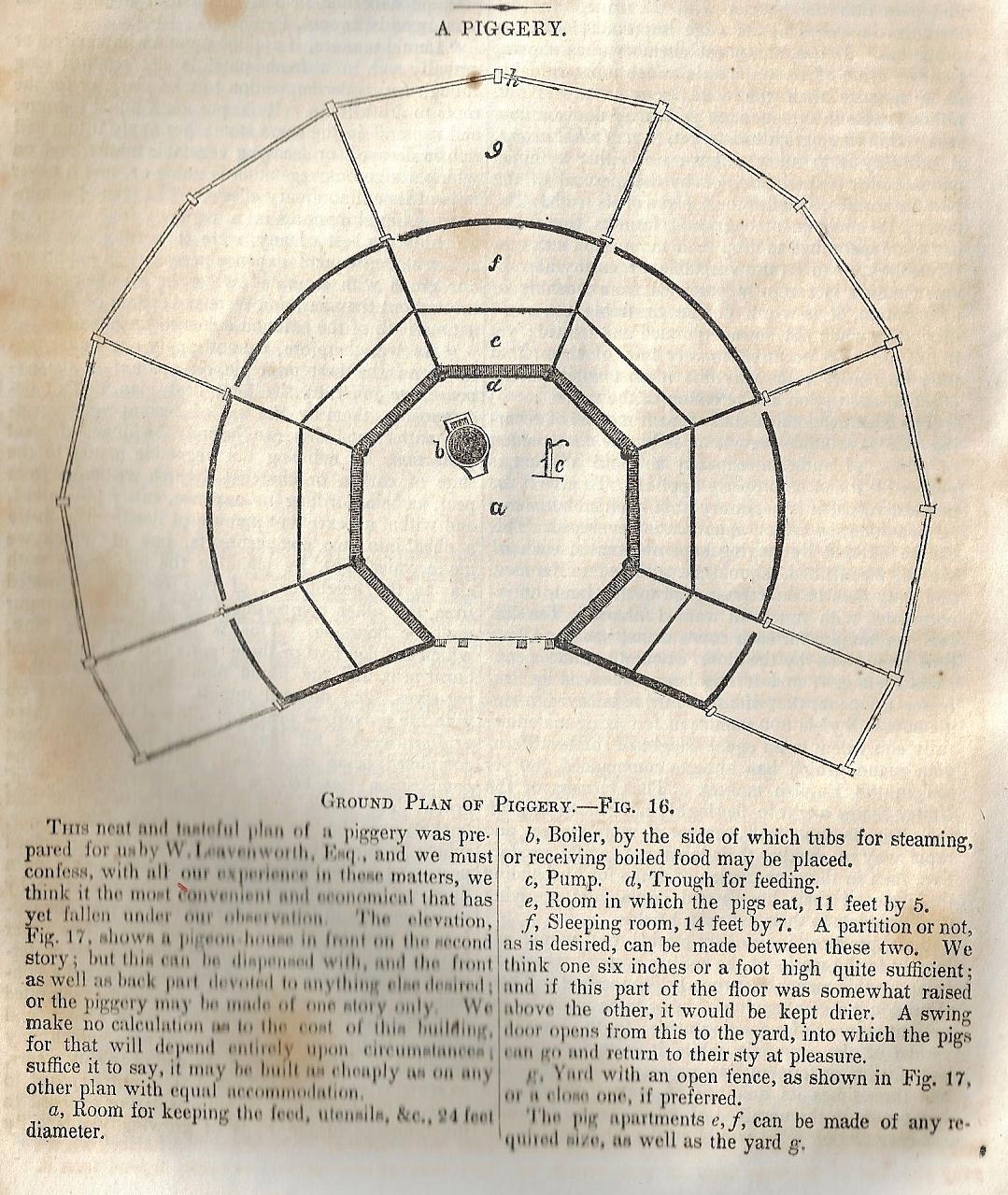
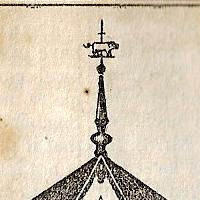
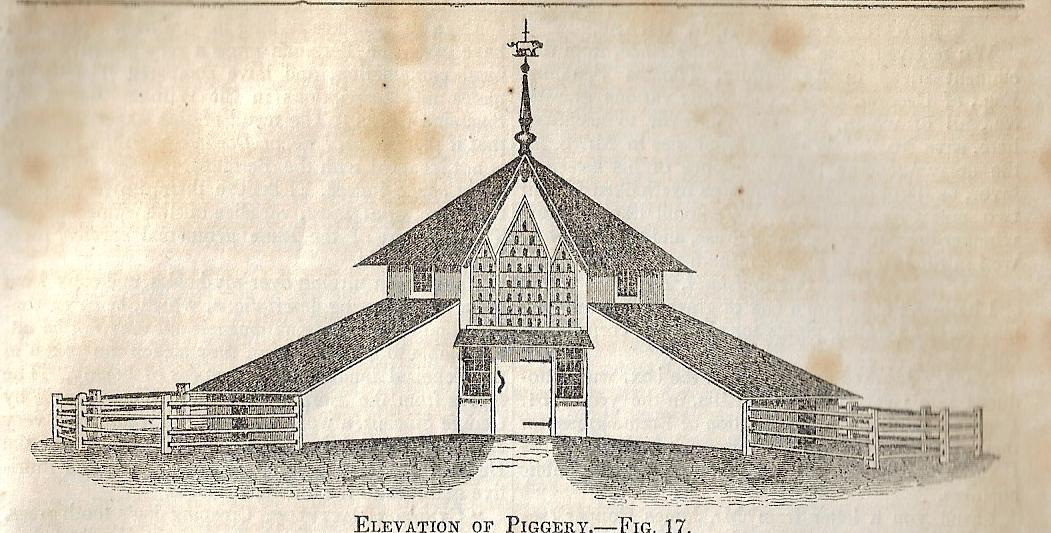
    In the history of humans building things there is a tendency to engage in celebration for the completed job, an effort well done. These victory monuments can be a flag, or spire, or dirigible mast, or lightning rod, or transmitters, or small statues, and so on. There was another example of this, unexpectedly found in the pages of endlessly interesting and resourceful American Agriculturalist, this one from volume 4, 1845.  This was another in a series of articles on farm buildings, and the building in question was a piggery. Now the plan for the piggery seemed a little uneven, and not very clear, and not all that interesting, even for a piggy. But the elevation revealed the early-Victorian beauty of the structure, which was a real surprise. The fabulous aspect of it though was the figure in the weather vane, which, upon close inspection, revealed:

    Piggery _3_

    And the full image (which in real life was only about 50mm tall):

    Piggery _2_ elevation

    And the plan, with explanatory accompaniment:

    Piggery _1_


  • The Twelve Leading Digital Computer Manufacturers in the U.S., 1954

    JF Ptak Science Books   Quick Post    

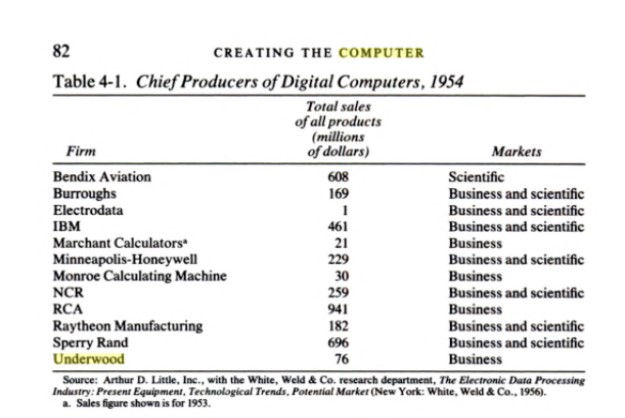
    I found something to share–this interesting table (based on numbers gathered by Arthur D. Little) showing the top-12 U.S. computer-producing firms and their incomes for 1956. [Note: the Bureau of Labor Statistics CPI calculator figures $1 in 1956 is “worth” nearly ten time that–$9.21–in 2017.] (This came as a result of researching the Elecom 100 digital computer for a manual that I found for the machine, finding that Elecom had been purchased by Underwood, which at that point was the 9th highest grossing computer manufacturing companies in the U.S.)

    Computer income

    Worth noting is that of the 12 in 1954 only 6 remained in 1965; in 1975 the number was 5, and in 1986, 4. Interesting to see the shares of the market by the standard office calculator companies like NCR, Monroe, Burroughs, and Marchant. 

    • Source:  Kenneth Flamm, Creating the Computer: Government, Industry and High Technology, Brookings, 1988, pg 82.


    ·Posted by :

    ·in:

  • When “Complex” and “Complicated” Meet (1938)

    JF Ptak Science Books  Quick Post

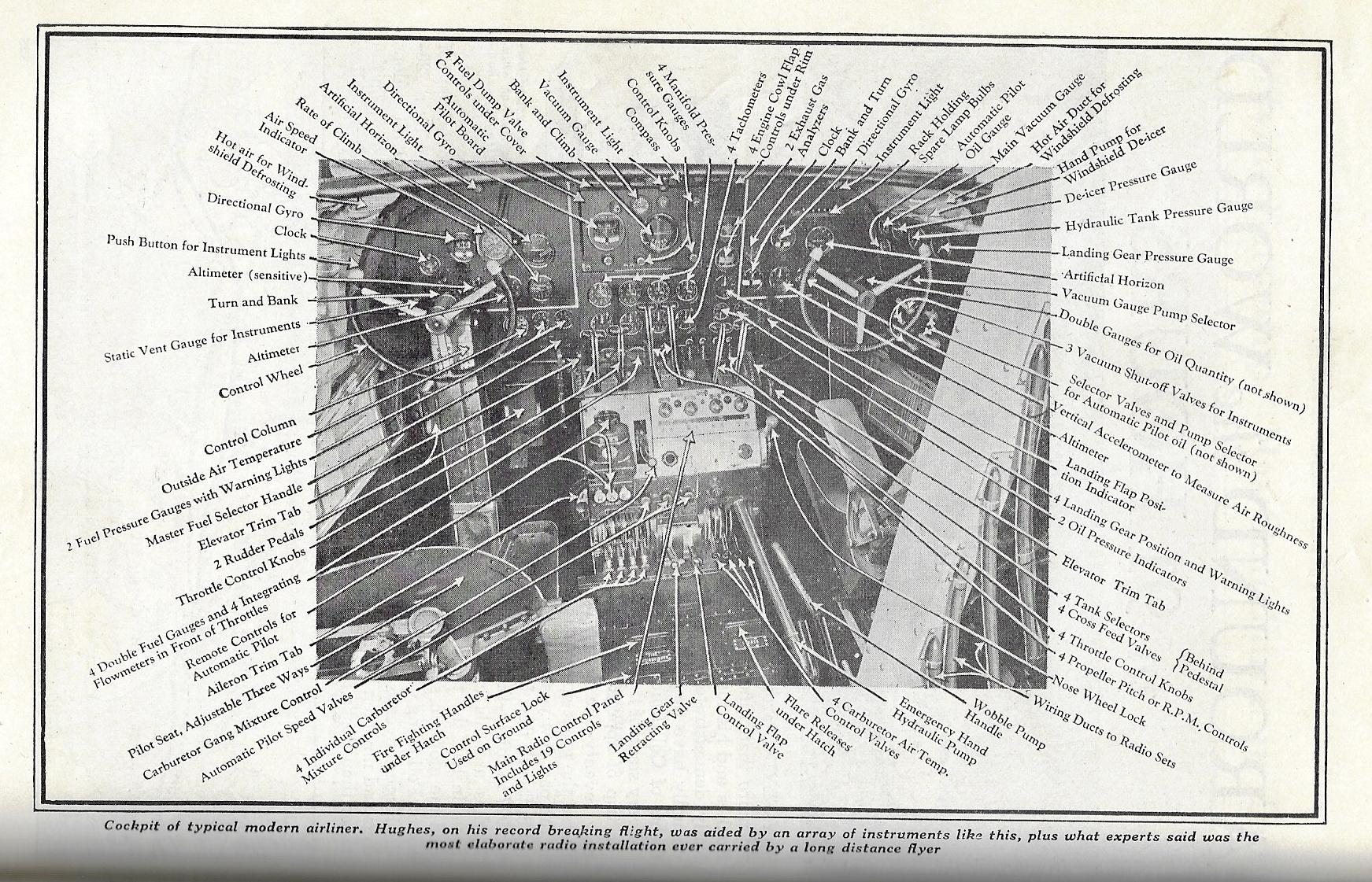
    This image caught my attention immediately–there were so many lines and so many acute angles that it seemed to be a if-it-bleeds-it-leads data display. The information is definitely there, but it all needs to be reformatted, like straightening out a bowl of angel hair pasta:

    Pop Mech 1938 aviation instrument panel_0001

    Source: Popular Mechanics, September, 1938, p. 326.  

    I’d say that when “complicated” and “complex” (that sounds like a hair color) meet, they really collide, except that the collision is very orderly.  

    ·Posted by :

    ·in:

  • The 50 Million Volt Dust Curtain of Nikola Tesla (1934)

    JF Ptak Science Books  Post 2709
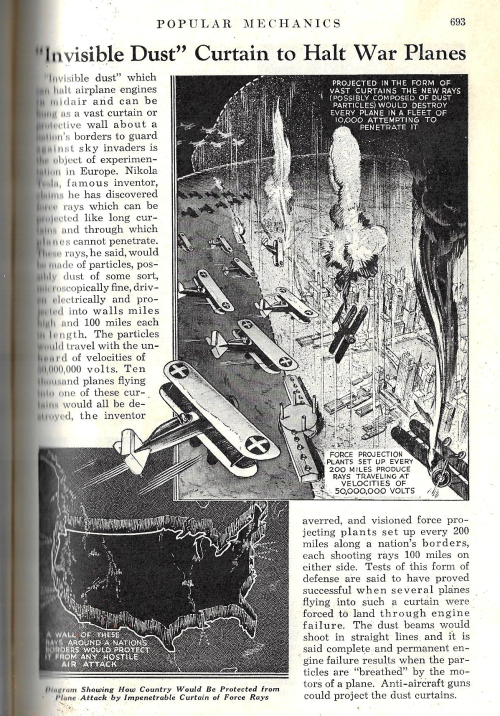
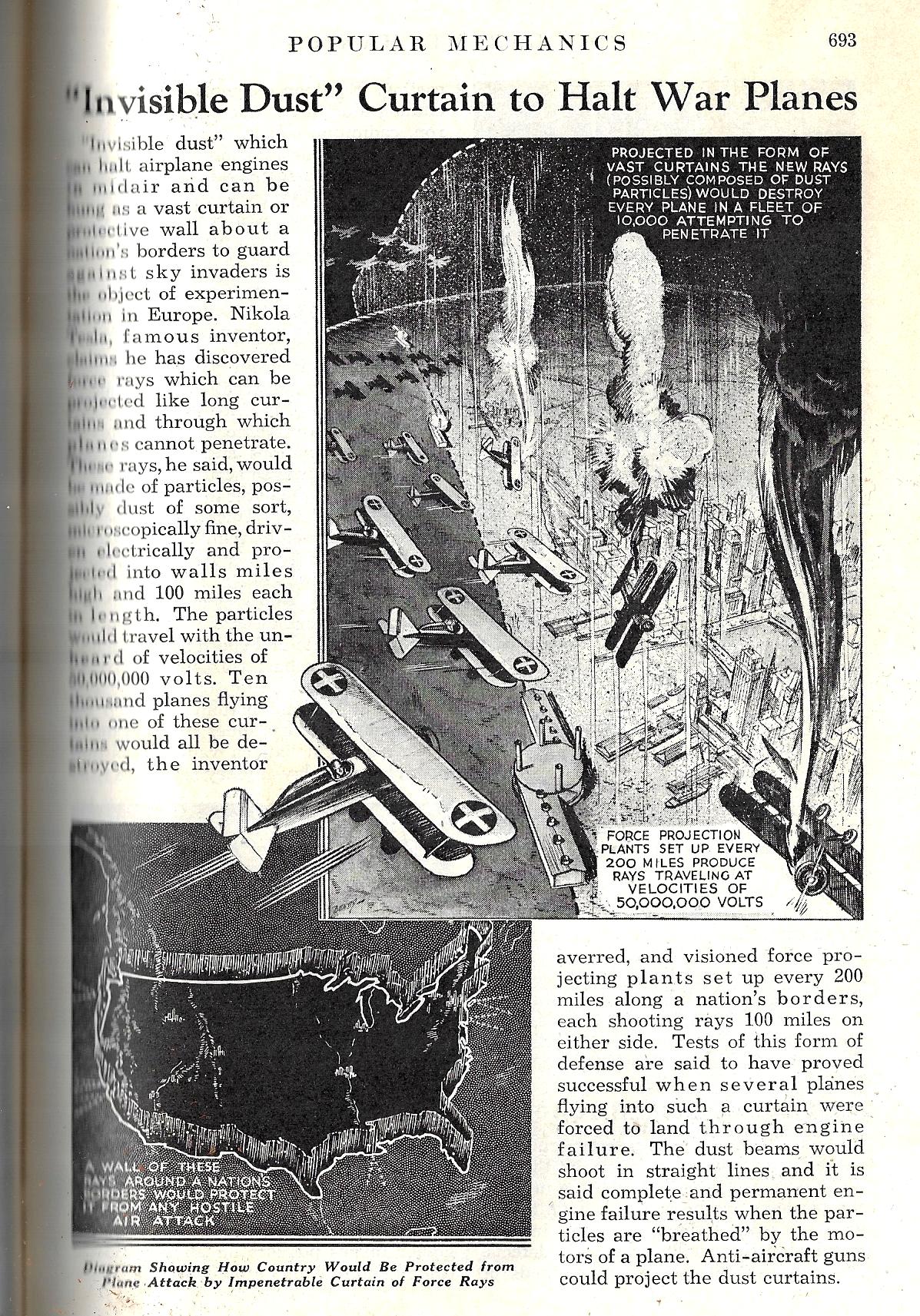
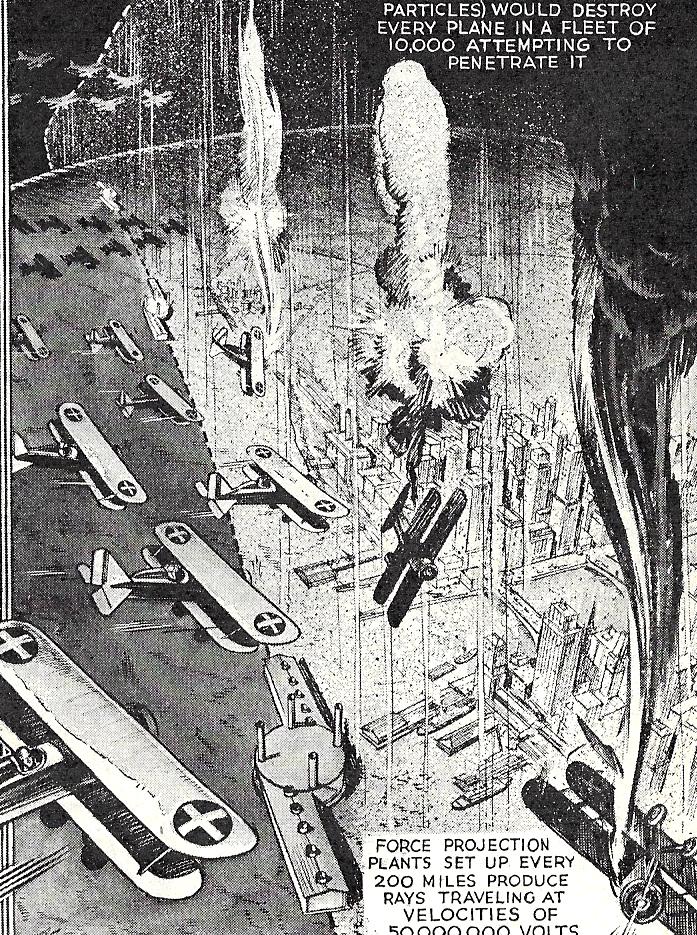
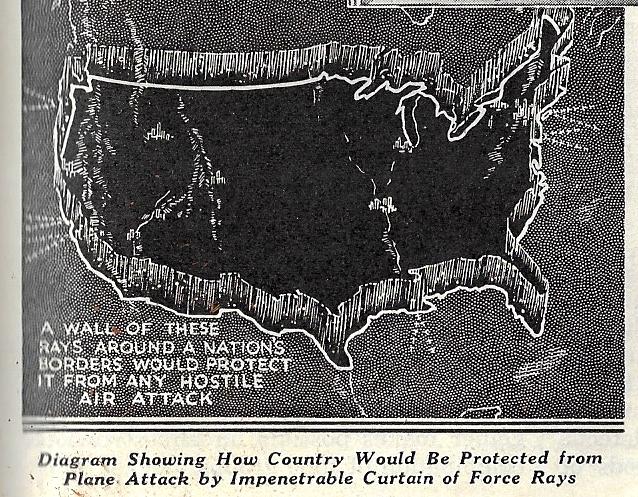
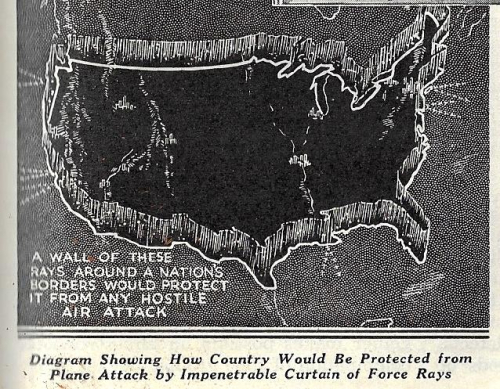
    Pop Mech 1934 TeslaThe “dust” in question here is not intended to be weaponized versions of those famous dancing bits of Brown and Einstein, but a very very high voltage-invisible-something that would obliterate any attacking air force or army. The idea is one in a long history of “death rays”, though this one belonged to Nikola Tesla (who had a much earlier outline for an idea on militarizing wireless telegraphy technology) and as such was received with considerable respect in the public and scientific spheres—or, at least in scientific areas, the low/no detail plan was given inspection and testing before it was dismissed.

    The popular press (Chicago Tribune, New York Times, Newsweek) reported that Tesla had plans for a country-wide defensive network that would basically make the U.S. Impregnable and put an end to war. One problem was that there were nearly no details offered for the plan—at least until this article (“Invisible Dust Curtain to Halt War Planes”) appeared in Popular Mechanics in November 1934. Even though this as an extended version of the idea, there’s scant detail in this article as well. But, Tesla being Tesla, the idea was given wide circulation.

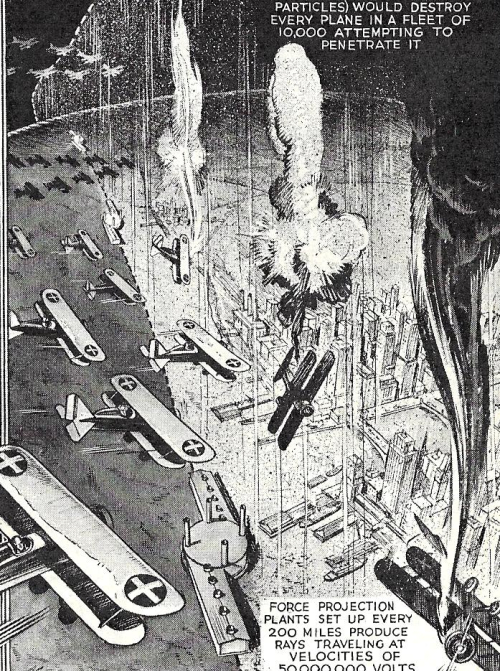
    Simply put, the article reports that Tesla “discovered force rays which can be projected like long curtains and through which planes cannot penetrate” which was composed of “microscopically-fine” “possibly dust of some sort”bits “driven electrically” at “velocities” of 50,000,000 volts and which would form invisible walls that were miles high and surrounded the country. And so thus powered the weapon could destroy an army of one million and an attacking air force of 10,000. Somehow all of this would permanently disable aircraft engines as well as destroy soldiers.
    Pop Mech 1934 Tesla _2_

    Evidently the plan for this invention was based upon four other inventions which hadn’t yet been invented, which would explain the lack of details. Nevertheless, the National Bureau of Standards did investigate and attempt to reproduce something resembling the results that Tesla was trying to bring about, but obviously failed, even though Popular Mechanics had reported some successes in experimentation.

    It seems to me that Tesla’s technology was far more powerful and advanced than many of its fictional rivals like Flash Gordon and Buck Rogers, and maybe even so of the Martian weapons from Wells’ The War of the Worlds.
    Pop Mech 1934 Tesla _3_

    Notes:

    For an interesting read in this area I was surprised to what looks like a thorough and engaging work by William J. Fanning, Jr.: Death Rays and the Popular Media, 1876–1939: A Study of Directed Energy Weapons in Fact, Fiction, and Film (McFarland, 2015) page 95

    Also, it is a curious thing that when I googled “tesla” the first reference to Nikolai was at the bottom of the 9th page, nearly 100th in line after the car/company–and that is just all sorts of wrong.
  • The Unions and Tear Gas Propaganda

    JF Ptak Science Books   Quick Post

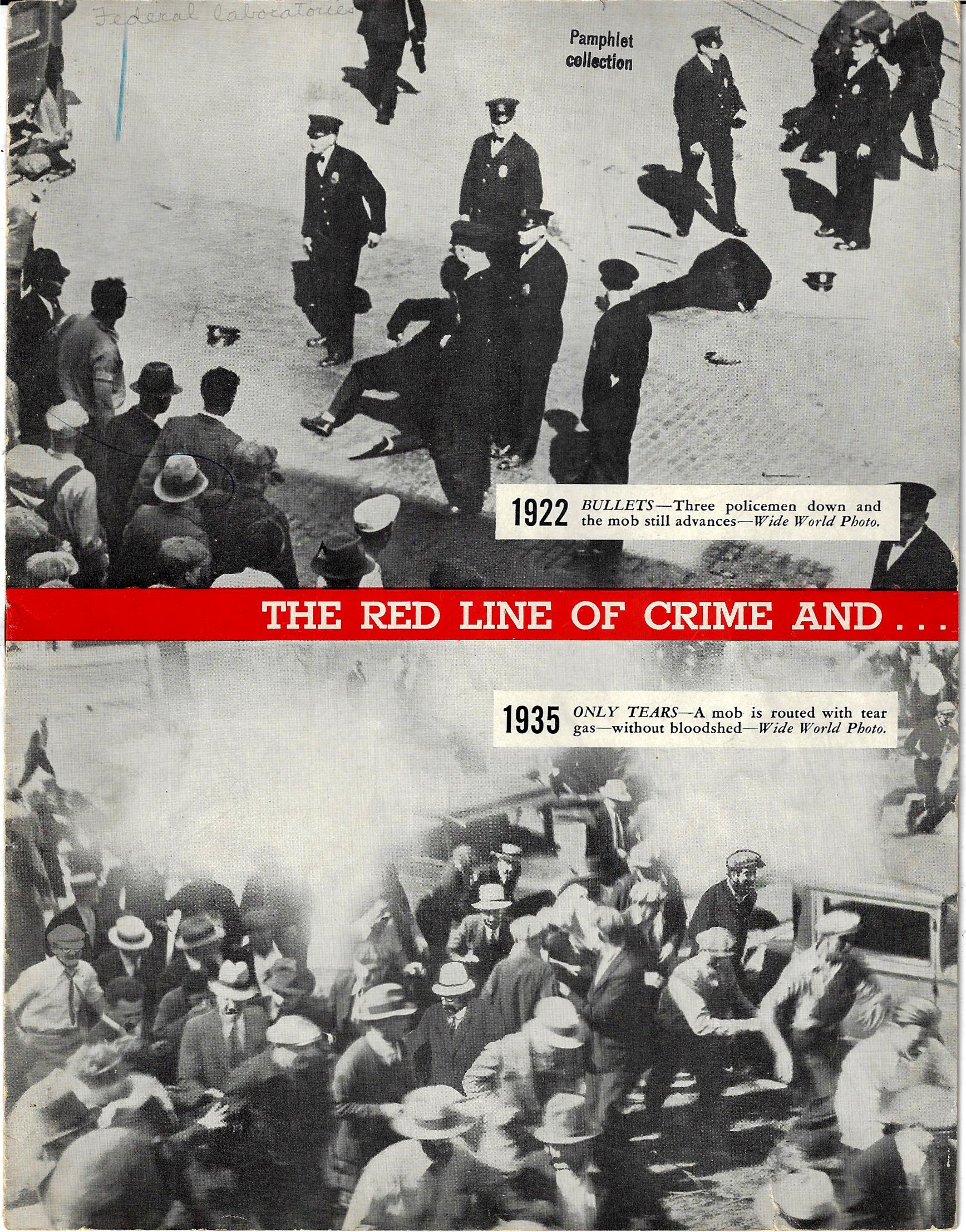
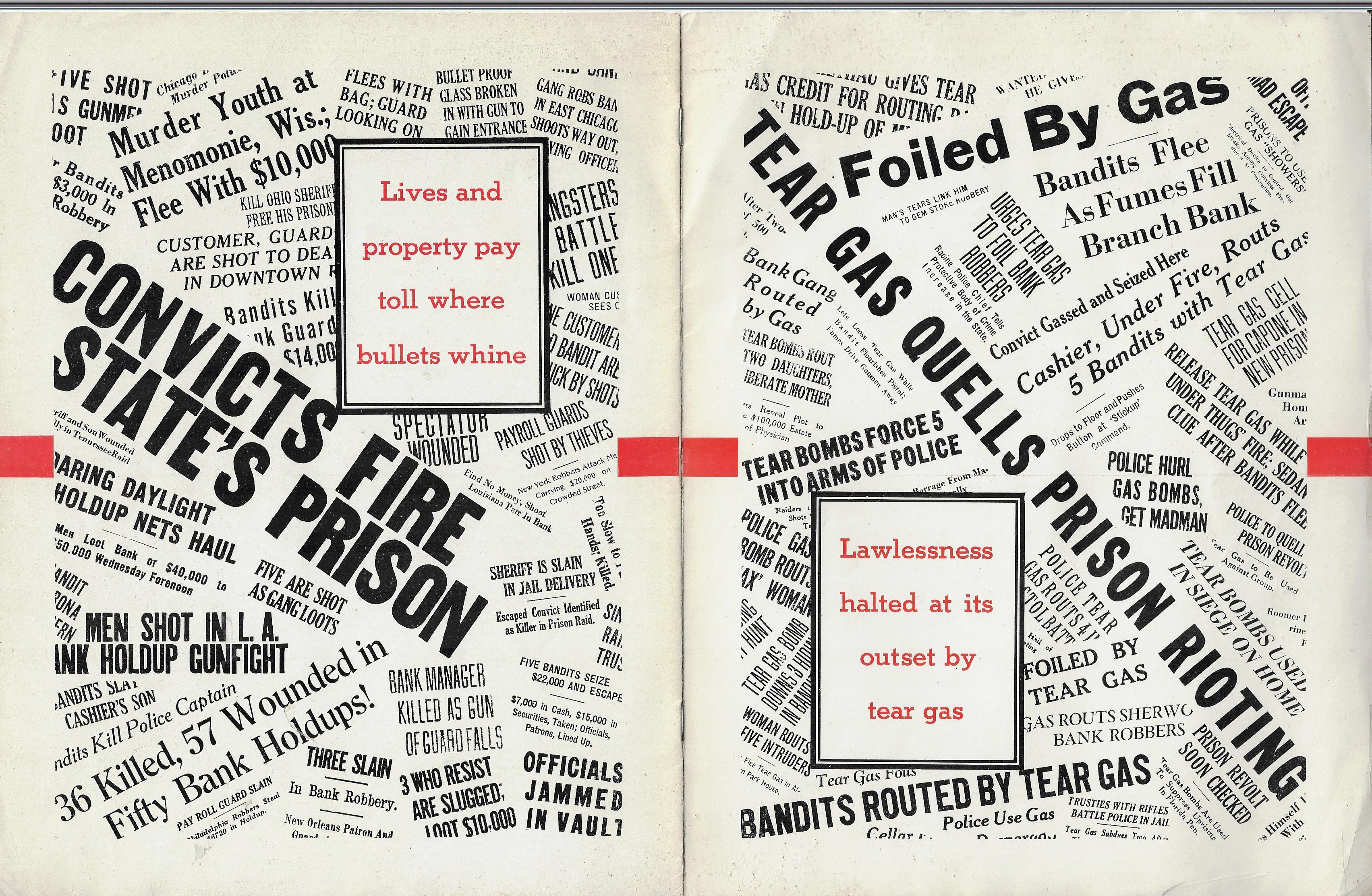
    The “sublime mundane” probably isn’t the correct category for this pamphlet, though I think it comes close. The illustrations and the text are squint-inducing, both unusual in peculiar ways, and all for the purpose of selling tear gas.  

    The Red Line of Crime and…Civil Disorder is the pamphlet, and it was published in  Pittsburgh and printed by Federal Laboratories  in 1934. It makes the case for tear gas over bullets in response to civil disobedience/riots/unrest, a good part of that being described sotto voce (and not so much so) as the work of unions. In any event, tear gas is prescribed as the reactive agent to the reaction, being more humane and less fatal…anyway, that is the sales pitch. 

    I’m sharing the pamphlet here mainly for its illustrations and design. Here’s the very arresting front cover:

    Books covers red line _1_

    • A description of Federal Laboratories from Wiki:  “In the 1930s, custom gas guns by FedLabs were adopted by the New York Prison department, following a sales pitch made before the APA by the president of FedLabs in Baltimore in 1931. Also in the 1930s, Federal Laboratories actively worked to sell gas guns for the purpose of strikebreaking, with one FedLabs representative firing a tear gas grenade during the 1934 West Coast waterfront strike, resulting in the death of a striker due to skull fracture. Auerbach notes, however, that despite FedLabs stated opposition to “communist” strikers, the firm continued to sell tear gas to the Soviet Union even during 1933.”

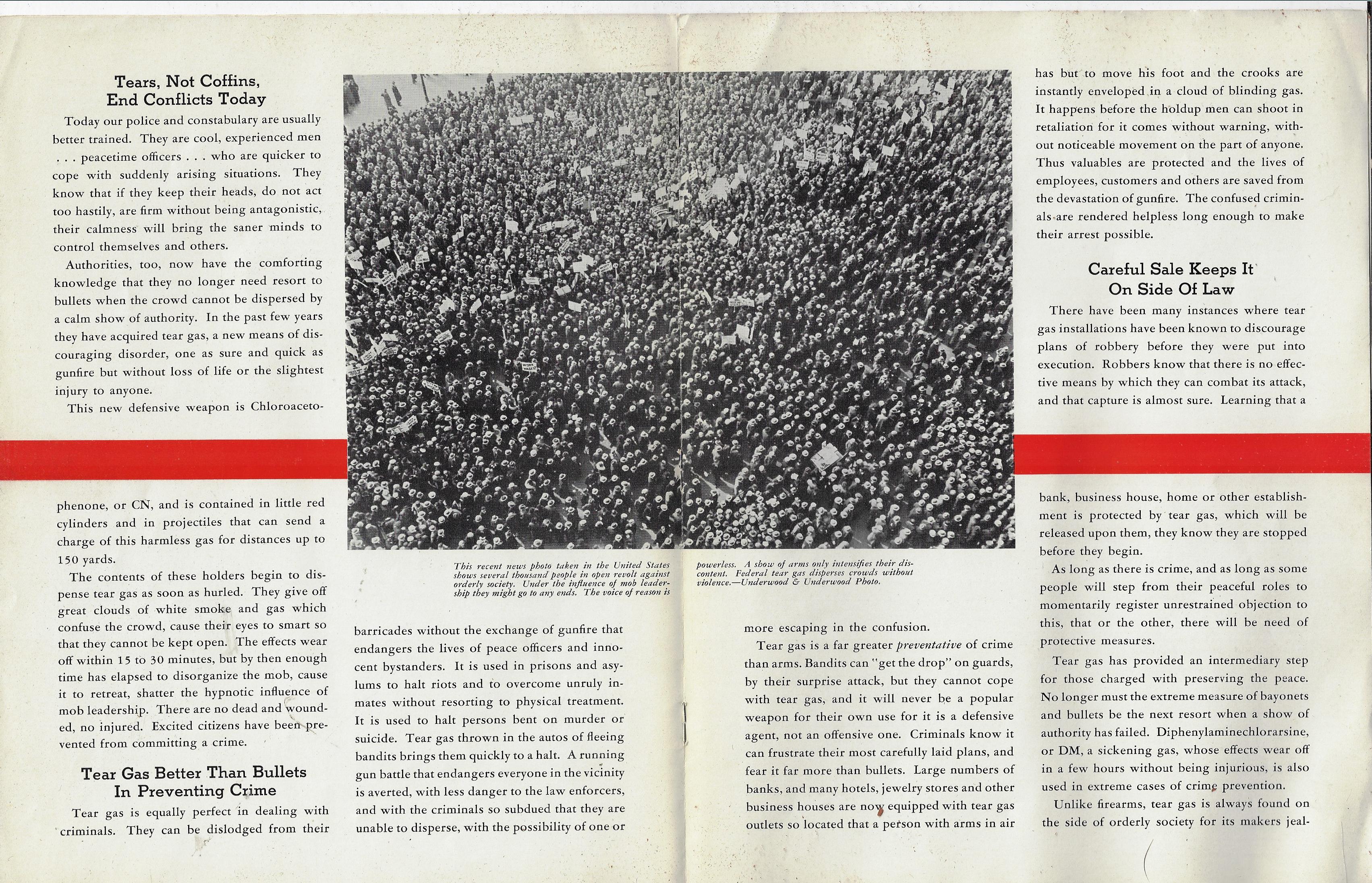
    And the center illustration, a montage of newspaper clippings:

    Books covers red line _2__0001


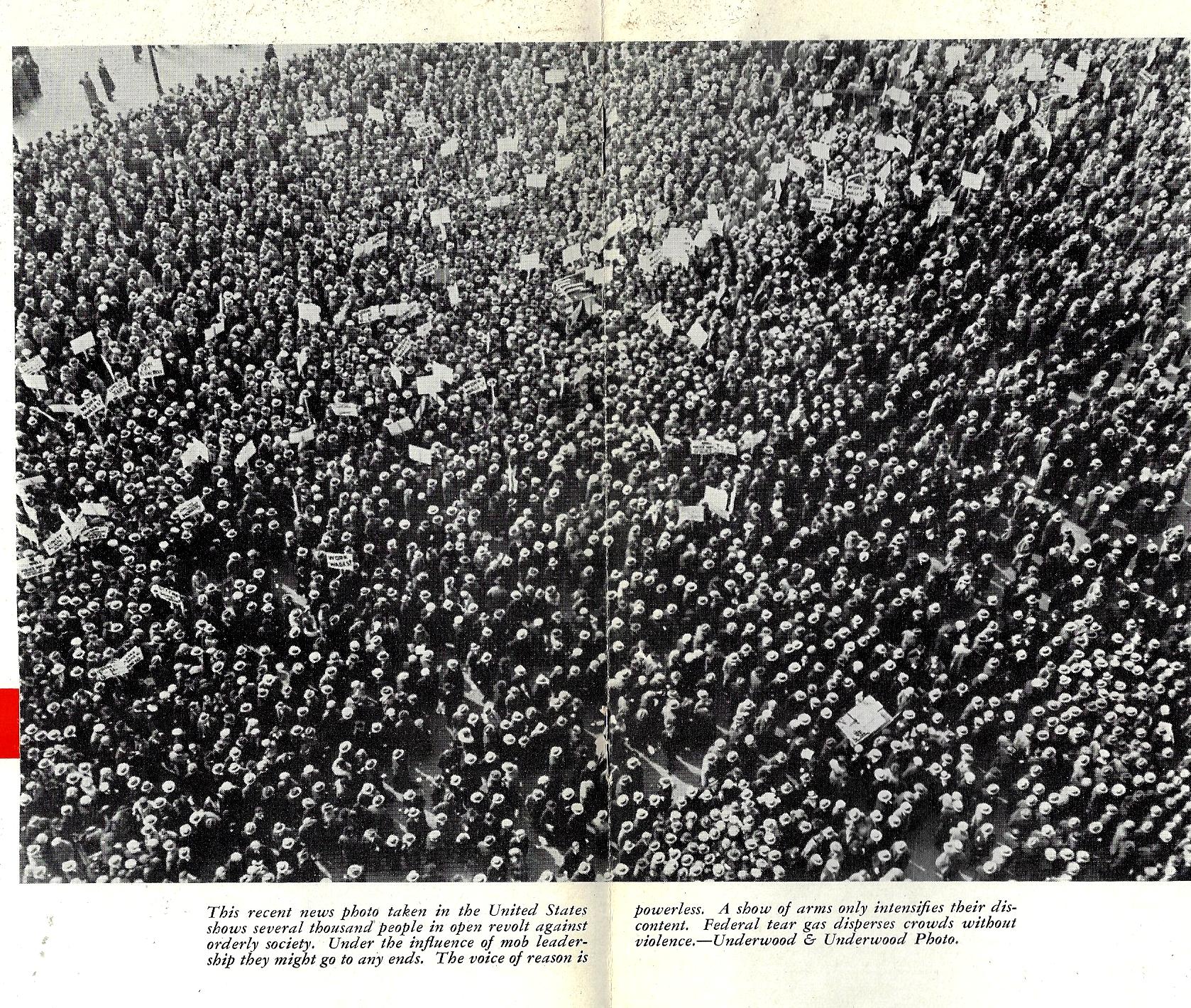
    And in this image, a worker’s strike is described as “an open revolt against orderly society…under the influence of such leadership they might go to any ends”, which is as great a propaganda statement against unions as I have seen:

    Books covers red line _4_ detail


    Books covers red line _3_

    ·Posted by :

    ·in:

    —
  • On Forming a National Database of “Mental defectives” (1931)

    JF Ptak Science Books   Post 2702 (with additions) 

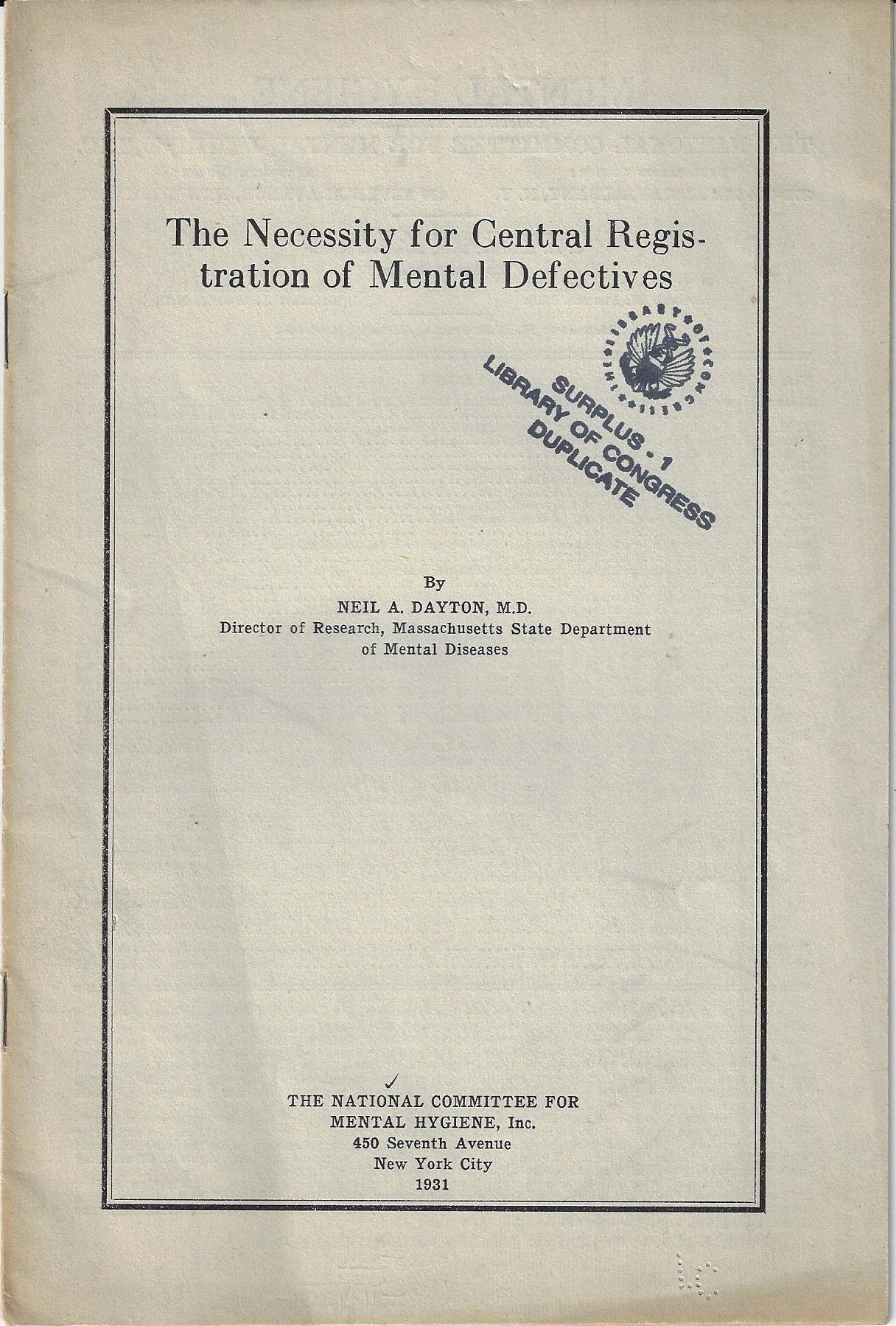
    Here’s a title that should stop you: 

    Mental defectives

    [Source: Neil Dayton, “The Necessity for Central Registration of Mental Defectives”, published as an offprint by the National Committee for Mental Hygiene, NYC, 1931, and printed by the William Boyd Printing Company, Albany, NY. ]

    Of course, it was 1931, and the Eugenicists were running free and easy, the stiff wind of their convictions running freely through their imaginary hair…and what would we all do with this gathering of information on mental defectives1 once that was done? And what was the definition of mental defective, anyway? thirdly of course–what do we do with the mental defectives once this energy of definition and collection had been done?  well, a new group would come to power in two years’ time from the publication of this article, and in their own right they did these things and then decided to kill many of the people that they cataloged. That’s one example. I’m not saying that the well-meaning people like the author of this paper would be anywhere near this horrible, not at all; I just don’t know why they would want to gather this information.  There wasn’t a discussion of collection of treatment of these people, just their registration in one large database. Every time I see in this pamphlet the statement on the need for such a registry, I expect to see why–but that never comes, only the repetition of a phrase like “that a central registry for mental defectives is desirable, and that it should be organized and operated by an established state department” and its variations.

    Finally, at the end of the short 14-page pamphlet, in the final paragraph, something appears close to explaining the “why” issue–but it winds up being a little tautological, stating that the need for gathering the names of all mental defectives is “to make available authorized agencies and individuals definite information on known mental defectives”

    Basically–at least so far as this pamphlet explains–the reason for gathering all of these names into a system of state-wide databases is to have the names in state-wide databases. 

    Notes:

    1.  “Mental defective” seems to make its first appearance in English in 1899, according to the Oxford English Dictionary: 

    •  Designating a person suffering from an illness or impairment of the mind. Esp. in mental case,mental defective. A use now increasingly avoided.
      • 1899   Appletons’ Pop. Sci. Monthly Apr. 747 (title)    Mental defectives and social welfare.
      • 1904   Lancet 17 Sept. 838/1   The Home Secretary..has at last been impressed with the total inadequacy of the provision made for..mental incapables.
      • 1908   Lancet 12 Sept. 813/2   Dr. W. C. S. Clapham..had many suspected mental cases sent to his out-patient department.

    By 1960 it was seen in the U.K. that “the most important change in terminology made by the new Act [sc. the Mental Health Act, 1959] is that the expressions ‘mental deficiency’ and ‘mental defectives’ should be abolished… ‘Mental disorder’ is introduced as a new term covering all forms of mental ill health.”–Oxford English Dictionary (“Mental”)

    ·Posted by :

    ·in:

  • Rare and Formerly “Restricted” Info Packet on German Aircraft, 1944

    JF Ptak Science Books   Quick Post

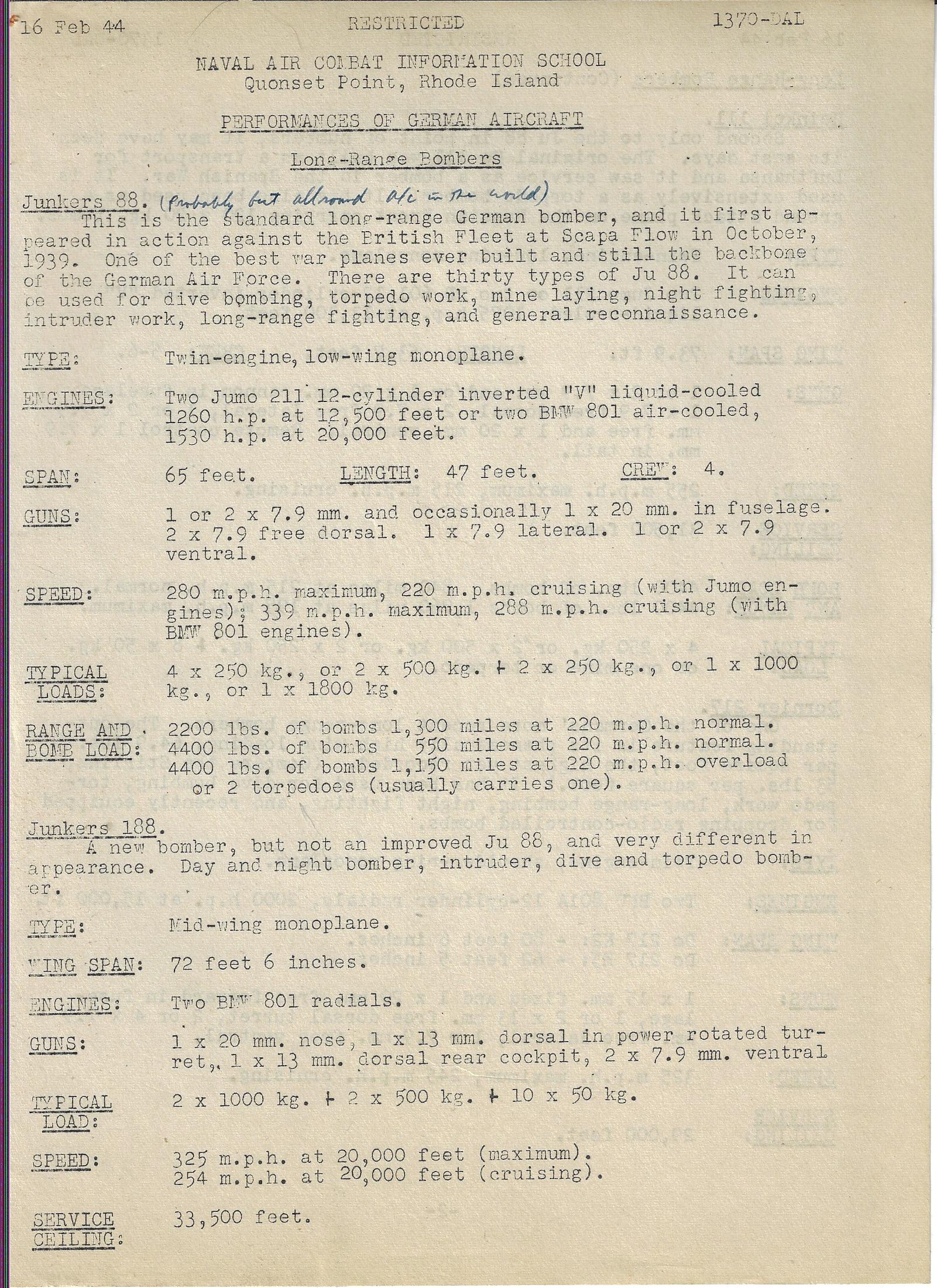
    “Performances of German Aircraft” (16 February 1944) is one of several dozen pieces that were loose-leaf bound by a naval student of the Naval Air Combat Information School at Quonset Point, Rhode Island.  The entire notebook is interesting as a whole from a pedagogical point of view, and teh components are usually very engaging (and even noteworthy) on their own.  The nine pages that comprise this Luftwaffe section of the classwork (identified as “RESTRICTED” in the offset typed original) are an outline for the classwork and no doubt augmented during lectures–but as they stand it is s statement of the base knowledge for what was being taught to intelligence officers.  

    This section is 9pp, complete, and I reproduce it below (each page is greatly expandable and easy to read):

    German planes _1_

  • Interesting Manuscript Outline of the Japanese Air Force, 1944

    JF Ptak Science Books   Quick Post

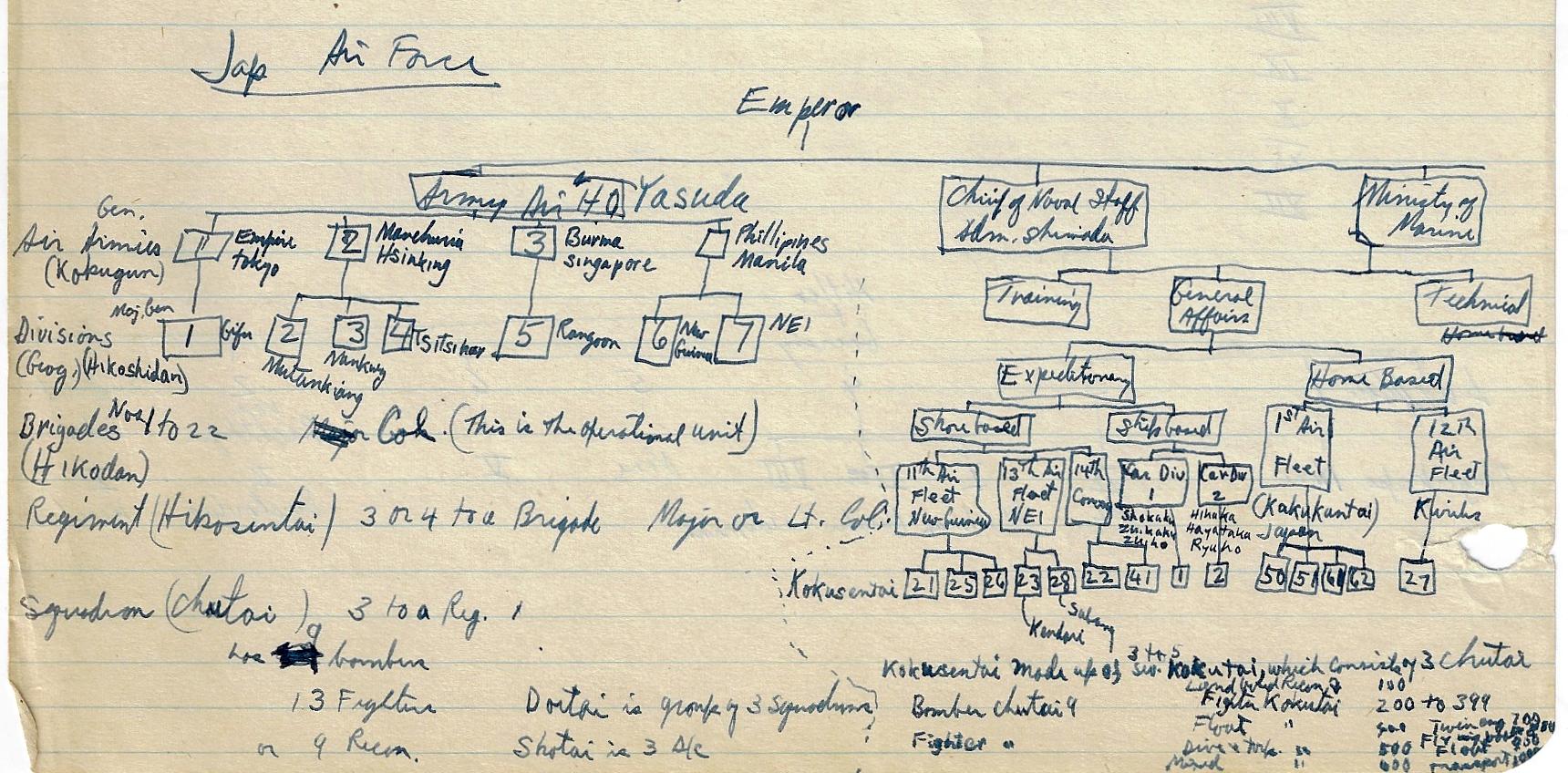
    “Jap Air Force”  is a short outline on the structure of the air force of the Japanese Imperial Army, written as classroom notes (ca. 1944) by a naval student of the Naval Air Combat Information School at Quonset Point, Rhode Island.  It is a section of a larger notebook from the class of February 1944, with nearly all of the offset pages from type originals are marked as “restricted”.  The diagram that leads the three pages of notes is 3″x8″ in the original, and is a bit remarkable for how much information it contains and organizes in such a small area.  I reproduce the text below:

    Japanese Air Force ms _1_

    ·Posted by :

    ·in:

    —
  • Manuscript Outline Diagrams of the Organization of the Major Air Forces, 1944

    JF Ptak Science Books   Quick Post

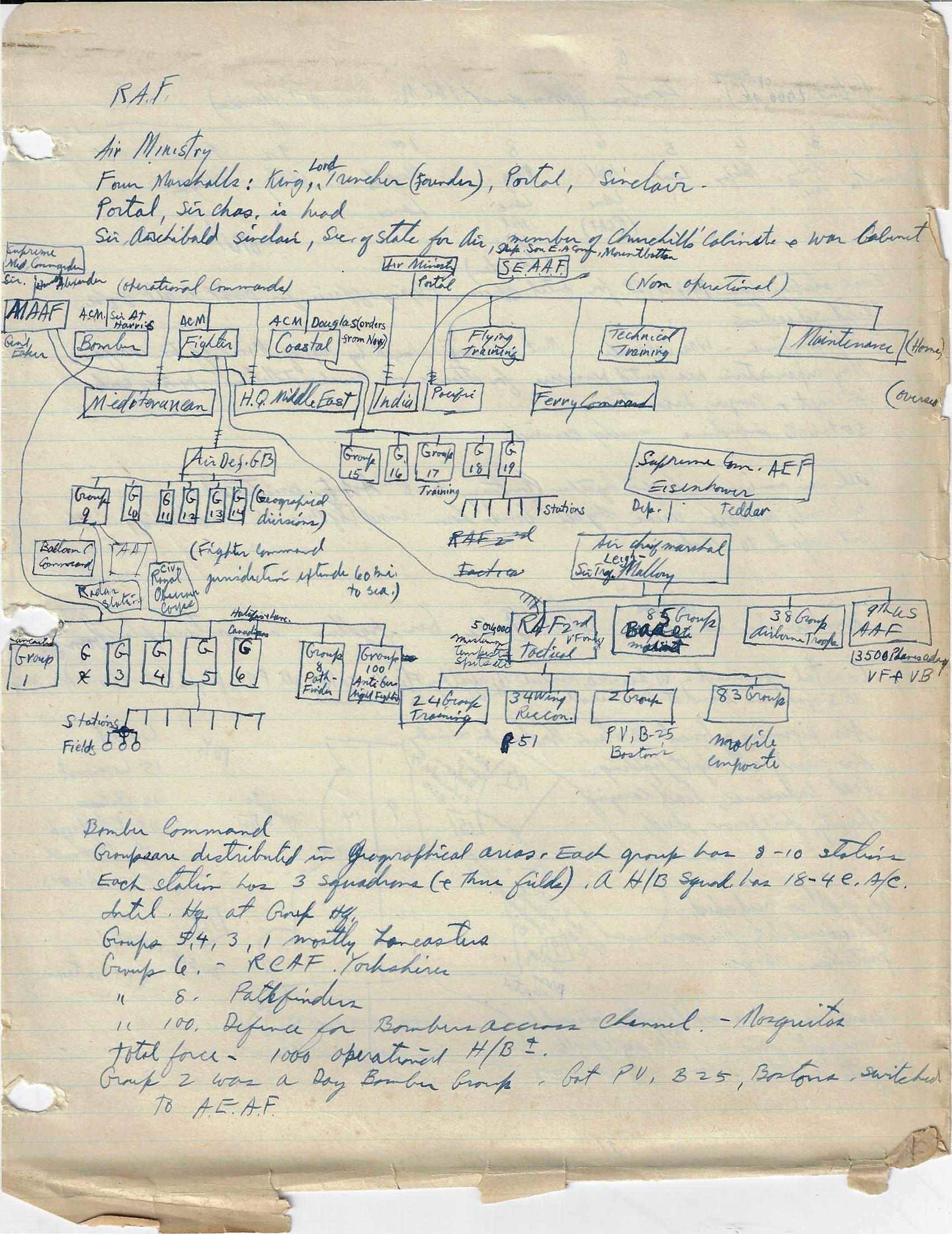
    The following diagrams are details from the manuscript sections of a notebook written as classroom notes (ca. 1944) by a naval student of the Naval Air Combat Information School at Quonset Point, Rhode Island. Generally the diagrams are relatively small for the amount of information conveyed. The printed text for the curriculum and classes are nearly all marked “RESTRICTED” in the typed original of the offset pages.  The entire document is about 150pp long, and if there is interest in the contents I’d probably reproduce the entire thing–it is surprising how much can be learned and how much is revealed even in the multi-page lecture descriptions.

    The air forces outlined in diagrams in the notebook include the U.S. Army Air Force, the Luftwaffe, the air forces of the Soviet Union, and the air force of the Imperial Army of Japan, which I reproduce below. I’m not saying that these notes are significant, just that they are from an unusual source, and so from that perspective alone they are interesting–that and the fact that the person who made the notes and took the classes became the head of the chief nuclear weapons preparedness organizations in the U.S.

     R.A.F. (1944):

    RAF diagram

    ·Posted by :

    ·in:

    —
  • Electric Biometrics (1921)


    JF Ptak Science Books   Post 2710

    The use of finger prints in identification is fairly old, used in Asia and India long before it became a popular practice in the West.  Also it seems that finger prints as forensic instruments occurs in literature before it occurred in actual police work. Mark Twain uses finger prints as essential legal elements (as well as comic relief) in his novels Life on the Mississippi (1893) and Puddn’head Wilson (1894), no doubt inspired by Francis Galton’s pioneering work on the subject (Finger Prints, published in 1892). Conan Doyle takes things a step further and describes the forging of finger prints, which I think was a brilliant idea.  All of this takes place before finger prints were more or less firmly established as an identifying tool, as the first conviction based on finger print evidence did not occur (in Great Britain) until 1902, while its weight in the conviction of murderers wasn’t felt until a first conviction was made using them in 1905 (and then 1910 in the U.S.). 

    Finger prints _1_

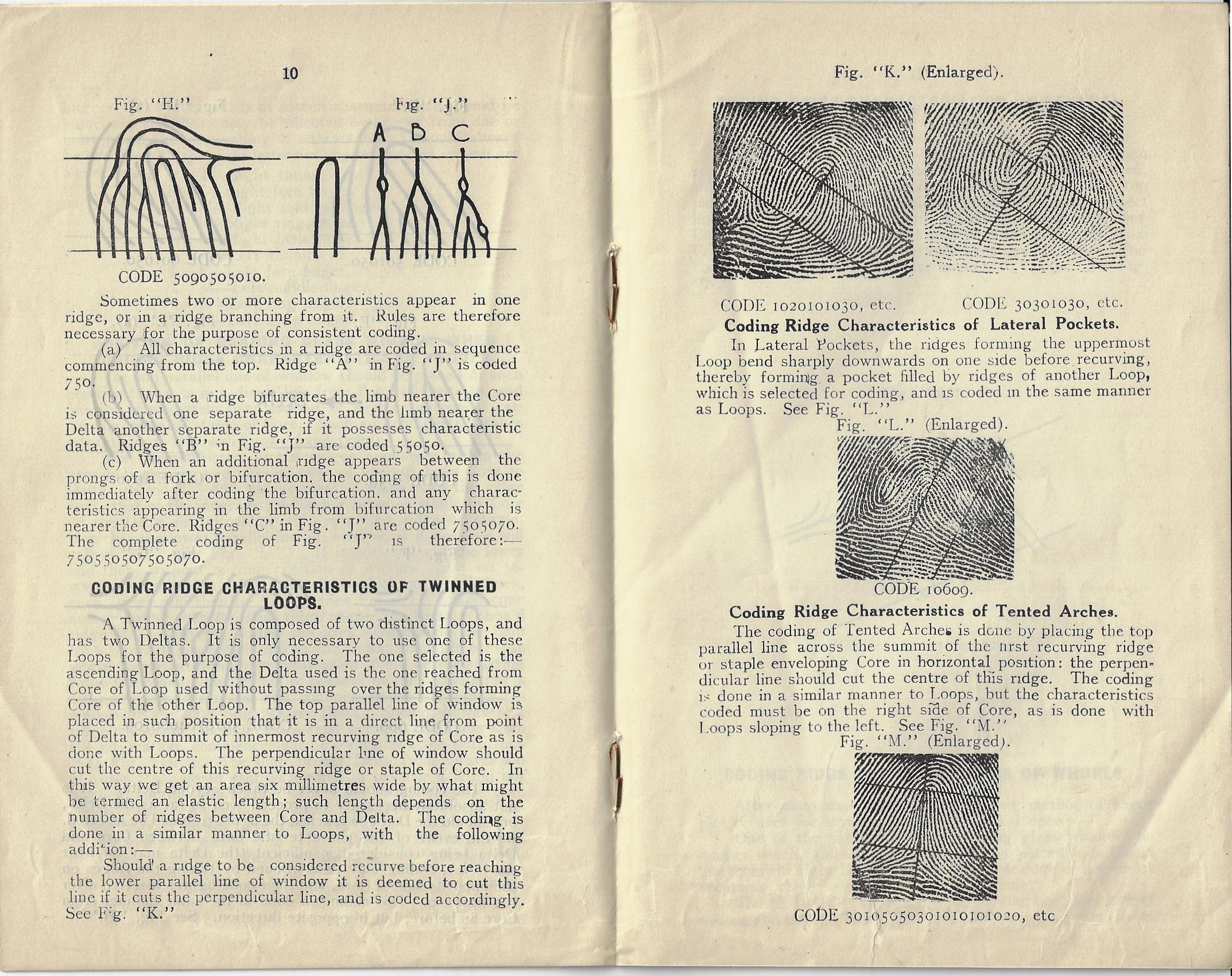
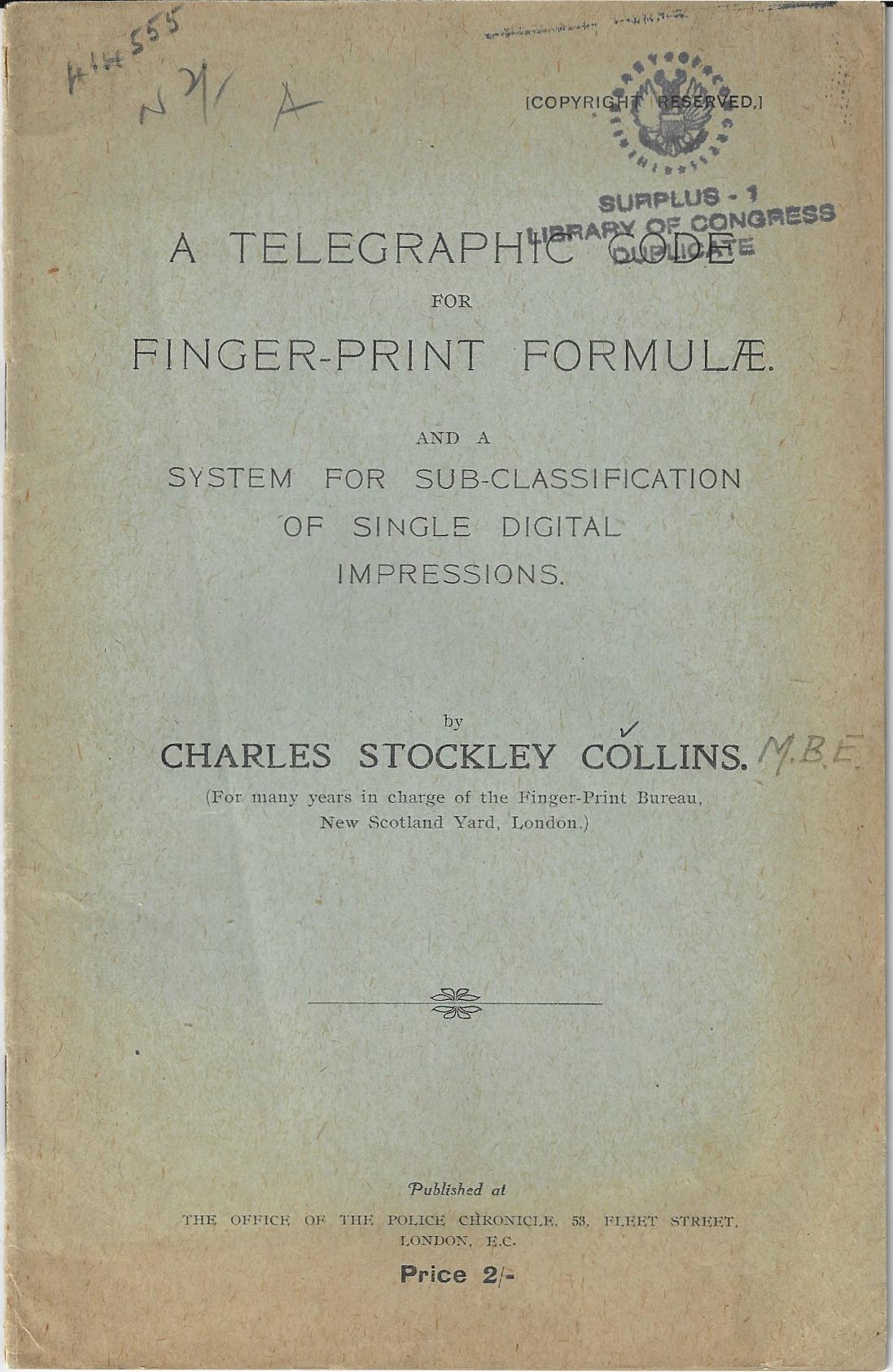
    Which brings us to these fascinating images1 of finger prints and their enumeration and transmission by wire,  which was the brainchild of the foremost finger print expert in the U.K., Detective Chief Inspector Charles Stockley Collins (M.B.E.), chief of the Finger Print Bureau at the New Scotland Yard.  I cannot determine how long in advance of this publication that he employed the idea of transmitting finger print data by telegraph, but it seems to be an excellent idea, sending important information relatively instantly over distances to help in conducting criminal investigation. It may be that this idea–far in advance of modern transmission practices, even though Arthur Korn’s first “facsimile” images were made as early as 1902–was seen at the time as both fantastic and obvious, the second impression coming almost immediately on the heals of the first, like one of those terrific ideas that seemed “obvious” once it was first stated. 

    Notes:

    1. Charles Stockley Collins. A Telegraphic Code for Finger-Print Formulae and a System for Sub-Classification of Single Digit Impressions. Published at the Office of the Police Chronicle, London, (1921).  9×6″, 17pp, with two plates and 15 illustrations/drawings in text. There are only two copies of this work located in WorldCat/OCLC (Cornell and the British Museum); for all of what Mr. Collins accomplished, this seems to be his only publication outside of journals. 

    Finger prints _2_


  • Original Surgical Drawings for Pituitary Tumor Removal (1930)

    JF Ptak Science Books  Post 2711

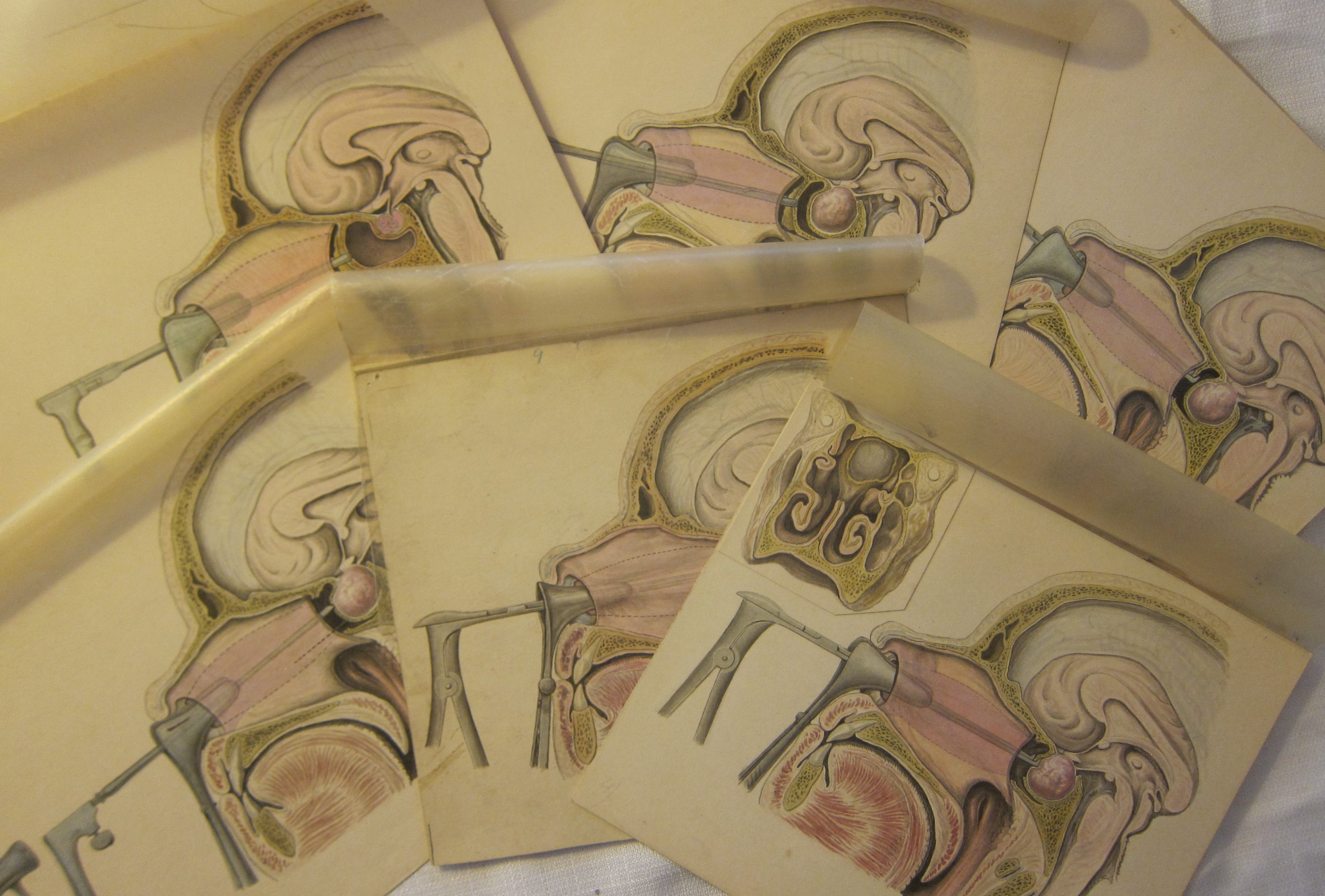
    I don’t intend to say anything at all, really, about the following drawings–I was attracted to them and purchased them a while ago, figuring them to be pituitary tumor removal of some sort and knew that for being done in 1930 that they were sort of early. The twelve fine pen and ink images were made by the prolific anatomical/medical illustrator Bruno Keilitz (b. 1898) and do indeed show some of the stages of the removal of a pituitary tumor. The illustrations seem to have been for an article written by Dr. Prof. Oscar Hirsch (1877-1965), who was an early and influential Viennese rhinologist who made major contributions to pituitary surgery, performing this transspheroidal procedure for Harvey Cushing in 1911, and who would go on to perform the procedure more than 500 times in his long career.1 Cushing of course is the Big Name, though in this area of neurology I found out that Hirsch is looms pretty large as well.  I don’t know how these stand in the history of this operation, but they certainly seem interesting enough to share online, and so I do:


    Pituitary _1_

    Details:

    • Of the 12 drawings, 9 are very closely related and show the progress and route of a transsphenoidal surgery for the removal of a pituitary tumor. I feel pretty confident that these drawings were done in 1930 (see below). These images are labeled I-VIII (including a “Ia”). These images measure about 6×8.5 inches each, drawn on a heavy stock, and done in colors. Each of these images is drawn from the same perspective and show different aspects of the surgery in progression. These drawings I-VIII are all rubbers tamped on the back with Bruno Kelitz’s name and address; two of this series are signed by Kelitz in the drawing, both of which are dated 1930. There are also some other notations in ink on the reverse that I can’t quite place, as well as some later dates, as the images seem to have been used on more than one occasion. 

    One drawing in this series has an old American Medical Association label (seemingly stamped Feb 11, 1952), identifying the publication of origin (“Arch. Otol” Archives of Otolyrngology), the author (“Hirsch”), and the type of reproduction to be used when illustrating the article.

    ·Posted by :

    ·in:

Recent Posts

Archives

Categories