A Daily History of Holes, Dots, Lines, Science, History, Math, Physics, Art, the Unintentional Absurd, Architecture, Maps, Data Visualization, Blank and Missing Things, and so on. |1.6 million words, 7500 images, 4.9 million hits| Press & appearances in The Times, Le Figaro, Mensa, The Economist, The Guardian, Discovery News, Slate, Le Monde, Sci American Blogs, Le Pont, and many other places… 5000+ total posts since 2008.

  • On the Economic Efficiency of Poison Gas in Wartime (1921)

    JF Ptak Science Books 

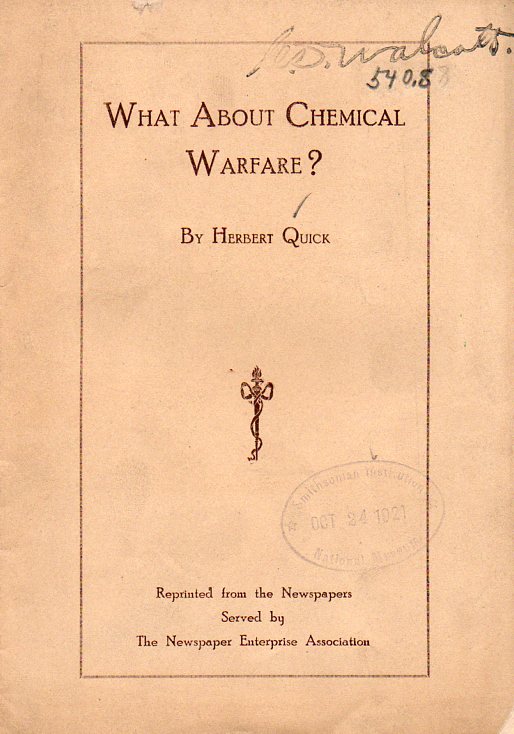
    • Review: QUICK, Herbert. What About Chemical Warfare? The Newspaper Enterprise Association (1921) 15pp.
      7×5 inches. Fine condition. WorldCat/OCLC locates 6 copies. 
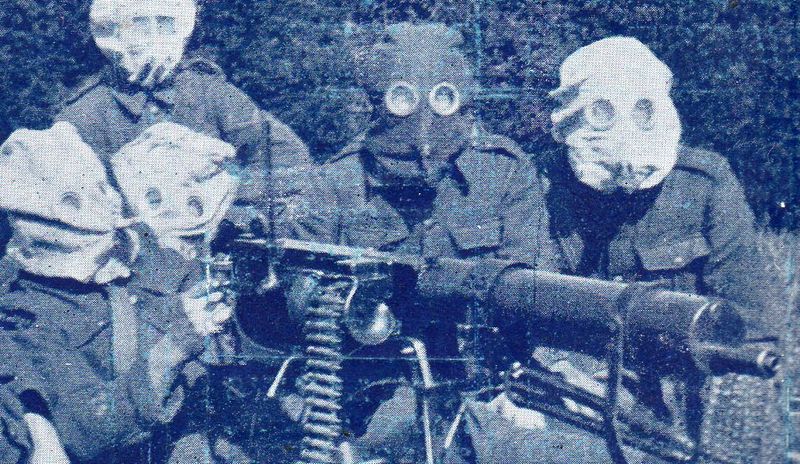
    WWI--gas machine gunb712

    [Image: Illustrated London News, October 30, 1915, detail of photo on front cover.]

    Herbert Quick did a fair amount of thinking about the military use of poison gas, and it winds up, in the
    final analysis, thinking that it was tolerable. What About Chemical Warfare? (published by the
    Newspaper Enterprises Association in 1921) is certainly a possible title for a Duck-and-Cover A-Bomb
    or You and Your Hormones kind of film. But Mr. Quick took the slow boat around his issue, thinking
    about it a little long and out loud, before coming to his final conclusion in the chapter titled “Gas
    Warfare Cheapest and Most Effective Arm of Defense”.
     

    [Internet Archive offers the full text : https://archive.org/stream/whataboutchemica00quic/whataboutchemica00quic_djvu.txt]

    He points out the enormous impact in the war effort that relatively small chemical corps played in
    WWI–something on the order of hundredths of one percent of all serving soldiers were employed in
    the combined chemical corps, saying “how small a body to produce such great results!” Which is true,
    assuming that by “great” he meant ‘widespread’, though it is unclear exactly what he was talking about.
    Quick does make a case for poison gas being not so inhuman as presented by most civilized people,
    pointing out both its high quick-death rate and survivability/recovery rates, which seems to be
    giving/taking at the same time. No matter: “But woe to the army or nation that does not keep up with
    the times. The Angel of Death will breathe in their faces” he writes.

    The author also warns that though Germany was “stripped” of her war-making capacities, he thought it
    was not so of the industries necessary to produce poison gas. He points out that Germany can produce
    these munitions in secret, and that if any “militaristic nation conquers the world in the future”, it will be
    through the use of the poison gas it developed in secret.

    Defense was also important: “in the absence of efficient defense worked out beforehand, our great
    cities might be wiped out with gas bombs dropped from aircraft”. Mr. Quick believes that protecting
    cities is possible, writing simply “preparation will prevent such a crisis”. Indeed. Unfortunately no
    ideas about this defensive posture were forthcoming, though he did bring himself around to writing
    about gas as a defensive tool. Against looters. And rioters. And snipers. “Gas puts the sniper in the
    power of his enemy” Quick writes, using the Marine action in Vera Cruz, Mexico, as a good example of
    where gas (“gas grenades”) would have come in handy.

    The bottom line is of course the bottom line, practically stating that poison gas as a weapon was
    indisputably more cost-conscious than anything else, by far, each dollar spent on chemical warfare
    being worth “from three to five hundred for the army”. Poison gas services Quick says should be
    pursued, because “gas warfare cannot be stopped until all war is stopped”.
    Gas warfare “gives the educated, intelligent nations the advantages over the people of lower
    civilizations”.

    “When both sides are prepared it is much less inhumane than war with bullets and high explosives; but
    it means horrible annihilation to the army which is unprepared.”
    It is an interesting exercise to replace “poison gas” with other types of weapons, just to see how it
    reads.

    Mr. Quick was up and down in his treatment of poison gas and war, though almost entirely down. One
    thing he didn’t see, that no one saw, really, was the use of a particular gas that was used to destroy
    millions of people, and which was developed quite in the open in Germany for many years, used for
    killing rats. The Nazis simply used it instead on people. No one saw Zyklon-B coming, and no one
    could have, even when they did.
  • The Medium is the Mess

    JF Ptak Science Books  Post 2716

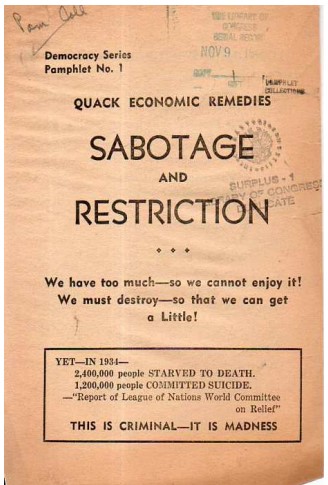
    This is an interesting pamphlet (printed ca. 1933/4) that makes a lot of good points in what seems to be
    our current post-salient world, except that the author’s presentation makes it all look kooky, borderline,
    Outsider-y, and therefore dismissable. But the good points are there, and no doubt a lot of the
    numbers seem as though they can be true–it is just that the presentation is about as actionable as
    listening to some guy sitting in a shopping cart under the overpass and wearing cardboard box signs
    while delivering his message in bolts of screams–the medium really can be the message, or the mess.
    And this is just a mess, true or not, which was too bad.

    Medium is the mess

    (This is another one of those pamphlety works that seem as though they were very popular–and
    perhaps so, except that its popularity did not translate into any sort of existing longevity–there is only
    one copy of this work located in WorldCat/OCLC, and the only two online references to the pamphlet
    are for the listings for in the the library found by WorldCat. So, popularly, this work is no longer
    “around”. It is interesting to note that for the few dozen Google hits on “Quack Economic Remedies”
    there are several referring to presidential programs, with those including a wide range of politics, and
    include Obama, Nixon, and Wilson.)
    63 / 93
    • Item: 7×5″, 4pp. WorldCat/OCLC locates only 1 copy

    ·Posted by :

    ·in:

  • Symmetry in Chaos–a Collision of Geometric Designs at San Marco

    JF Ptak Science Books   Post 2717

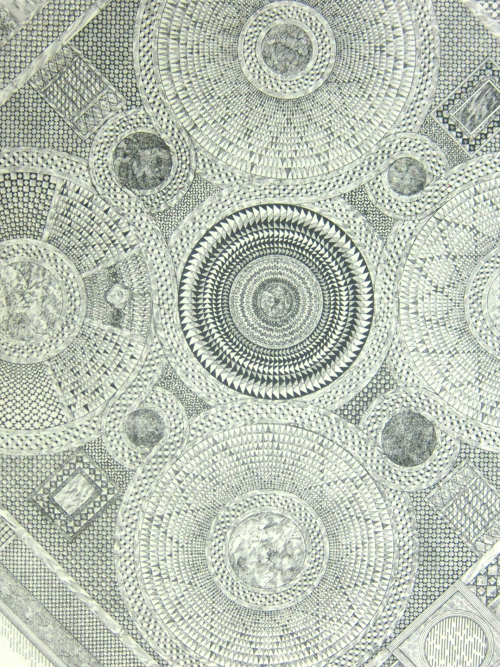
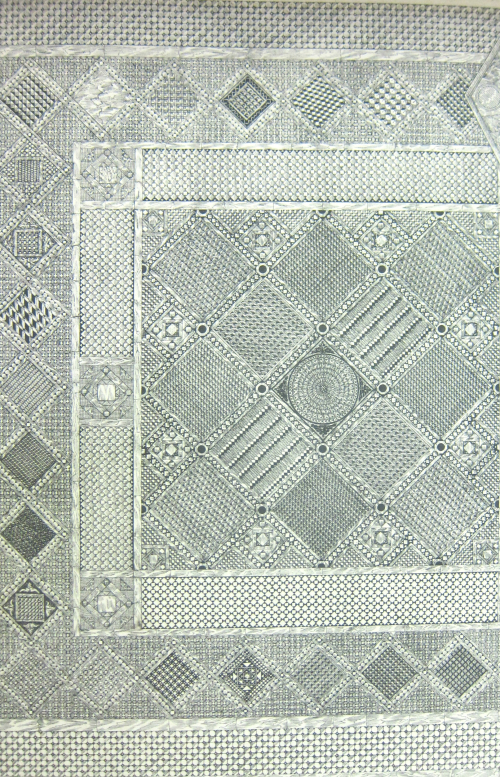
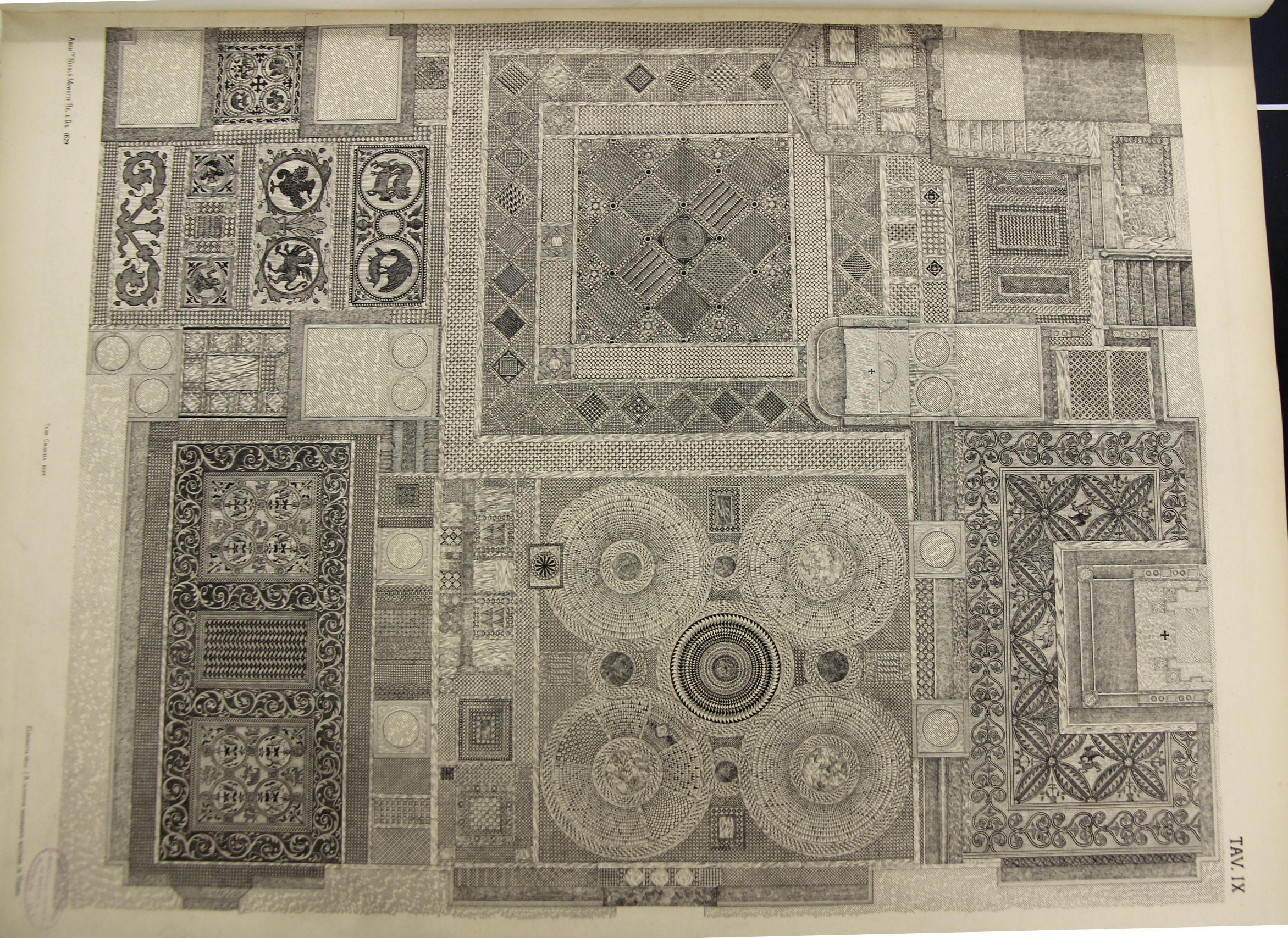
    The following four engravings appeared in the massive La Basilica di San Marino du Venezia, published by the prolific Ferdinand Ongania in 1886.  It is an exhaustive study of the iconic building, the publication being known chiefly I think for its very large and sumptuous chromolithographs of the building’s architecture, art, and endless detail. It forms two volumes of an overall monumental 12-volume epic, though these were complete in themselves.

    San Marco mosaic detail _4_


    [Detail from the second engraving, below.]

    But then there are these engraving, in wonderful black-and-white, showing with fantastic detail and with a deft touch the mosaics of the basilica.  I believe that there were six overall but I sold two some time ago and hadn’t made a digital record of them.  Since I have these and another 22 images from that great work, and since I can’t seem to find them online, I thought to make at least rudimentary photographs of them and share.  (Making the pictures was a little problematic, as they are pretty large at 27×21″, so some of the lines are a little parabolic, though I think they’re good enough given limited time to spend on them–also each image is at least 2 meg, so they can stand some amount of enlarging.)

    San Marco mosaic detail _3_

    [Detail from the second engraving, below.]

    The engravings (again, they are large at 27×21″, 68x53cm, and are packed with detail) are printed on a  very thick paper that will now crack if you try the double-fold test, so although the paper is stable you do not want to bend it, though you wouldn’t want to do that, anyway.  Each sheet has a protective paper guard attached to it on the left side, covering the entire image–the reason why you may see a shadow along one long side is just from the rolled-back protective sheet not getting completely out of the way.  Also all of the margins are not necessarily included in the photos–there were certain limitations in making the photographs, and some margins just didn’t make ti entirely into the picture. All this said, I think you can a pretty good idea of the massive order in the seeming chaos. 

    These are large and gorgeous pieces of art, and have a certain value of beauty outside their architectural context. (The images are also very clickable.)

    • AND you may actually purchase these from my bookshop, here: https://historyofideasblog.com/books/2015/06/hyp.html


    Ongania Mosaic 2

    ·Posted by :

    ·in:

  • Finding Typhoid Mary in a Short Work on Street Cleaning Machines (1930)

    JF Ptak Science Books Quick Post

    Soper titlepageThis rather nicely-designed and withdrawingly-titled pamphlet really packs quite a few surprises in its rather simple but innovative approach to controlling disease and epidemics in urban settings.

    Mr. Soper (1870-1948) had a long career in public health service in NYC as a sanitary engineer, and was a pioneer in a number of different areas within that discipline. That said, he is probably best remembered for his work on the typhoid epidemic(s) in New York, including the infamous 1906 outbreak in which he was able to find its root cause, located in Ms. Mary Mallon. (Ms. Mallon was a very unfortunate person, and was a doomed non-affected asymptomatic carrier of the pathogen associated with typhoid fever–she is better known as “Typhoid Mary”. Over time she would be quarantined though she would leave, taking jobs as a cook/bottle washer/laundress and such, and would wind up spreading typhus on multiple occasions. Eventually she would be kept/quarantined on North Brother Island in the East River, a place she would stay, kept out of the public, from 1915 until her death in 1938.)

    In any event, Soper’s work on street cleaning was essential thinking on how to maintain health standards in tight quarters of highly-populated places. And in there, in a ghostly whisper, was the unfortunate Ms. Mallon, never far from being part of the general epidemiological conversation.  

    Notes:

    “(Soper) received his degree from Rensselaer Polytechnic Institute in 1895 and a PhD from Columbia University in 1899. He was the managing director of the American Society for the Control of Cancer, which later changed its name to the American Cancer Society, from 1923-1928.”–Wiki

    See also the full text for “The Work of a Chronic Typhoid Germ Distributor”, George A. Soper, Ph.D.
    1907 https://www.learner.org/workshops/primarysources/disease/docs/soper.html 


    ·Posted by :

    ·in:

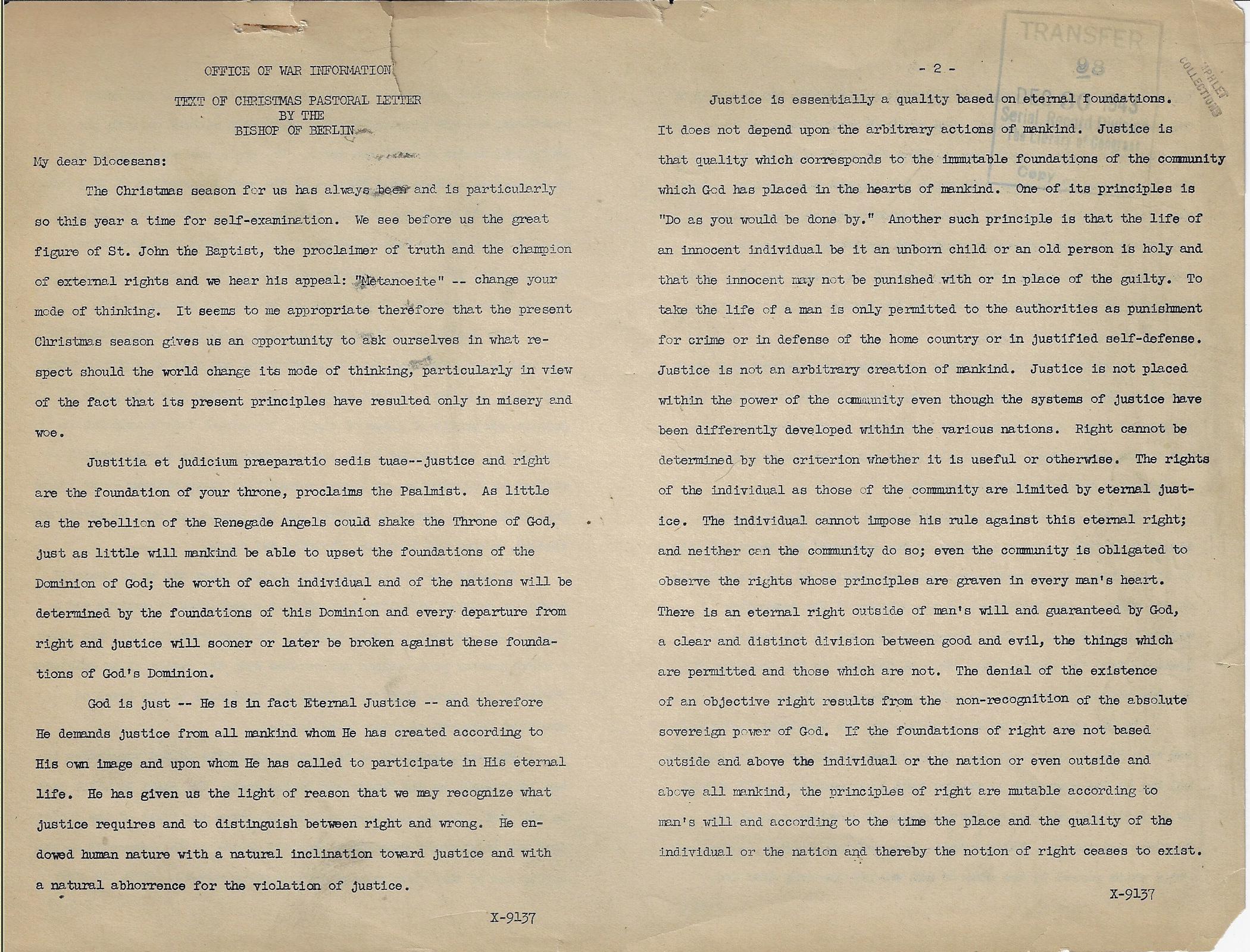
  • Anti-Nazi Christmas Pastoral Letter from the Bishop of Berlin, 1942

    JF Ptak Science Books   Quick Post

        “(T)he foulest of carrion are those who come clothed in the cloak of humility and the foulest of these Count Preysing! What a beast!”–Adolf Hitler on Konrad von Preysing

    I tried to find the text of this sermon by Dr. C(K)onrad Graf von Preysing1, Bishop of Berlin, for December 12, 1942 online but could not–there was a much more famous address made by Pope Pius at about the same time (which was much longer and well worn in history), but so far nothing for the von Preysing. So, since I have a reprint of it right here (made by the U.S. Office of War Information) I’ll just present the very short document here.  At this point in the war, int eh winter of 1942, Hitler and the Nazis were on the other side of the height of power, the efforts in the East becoming the total defeat that had been awaiting them for most of the year, and the surrender of what was left of the decimated 6th army just weeks away. But there was still another 2.5 years before the final downfall, during which many millions of people will be murdered and killed. So, making such comments in Berlin in the winter of 1942 was still very dangerous, and Bishop von Preysing was a courageous man.

    Some points from the Pastoral Letter:

    • “…(I)n wartime, when might confronts might and when power seems to be supreme, we are in danger of despising justice…only by acknowledging and respecting right can we hope for a better future for everyone and a just peace for all. Let us examine ourselves and see how far the idea of an eternal, immutable right lives in us and how strongly we are convinced that certain  primeval rights may not be denied any man, regardless of his origin. We must be perfectly clear that the absence of such rights or even a violation of the rights of our fellow man is an injustice towards the alien nation as well as against our own nation. It is the curse of an evil deed that it must continue to conceive more evil…”
    • “Change your mode of thinking.”
    • “Let us always remember that respecting alien rights we acknowledge and profess God’s sovereign rule.”

    Bishop of Rome 1942 _1_

    ·Posted by :

    ·in:

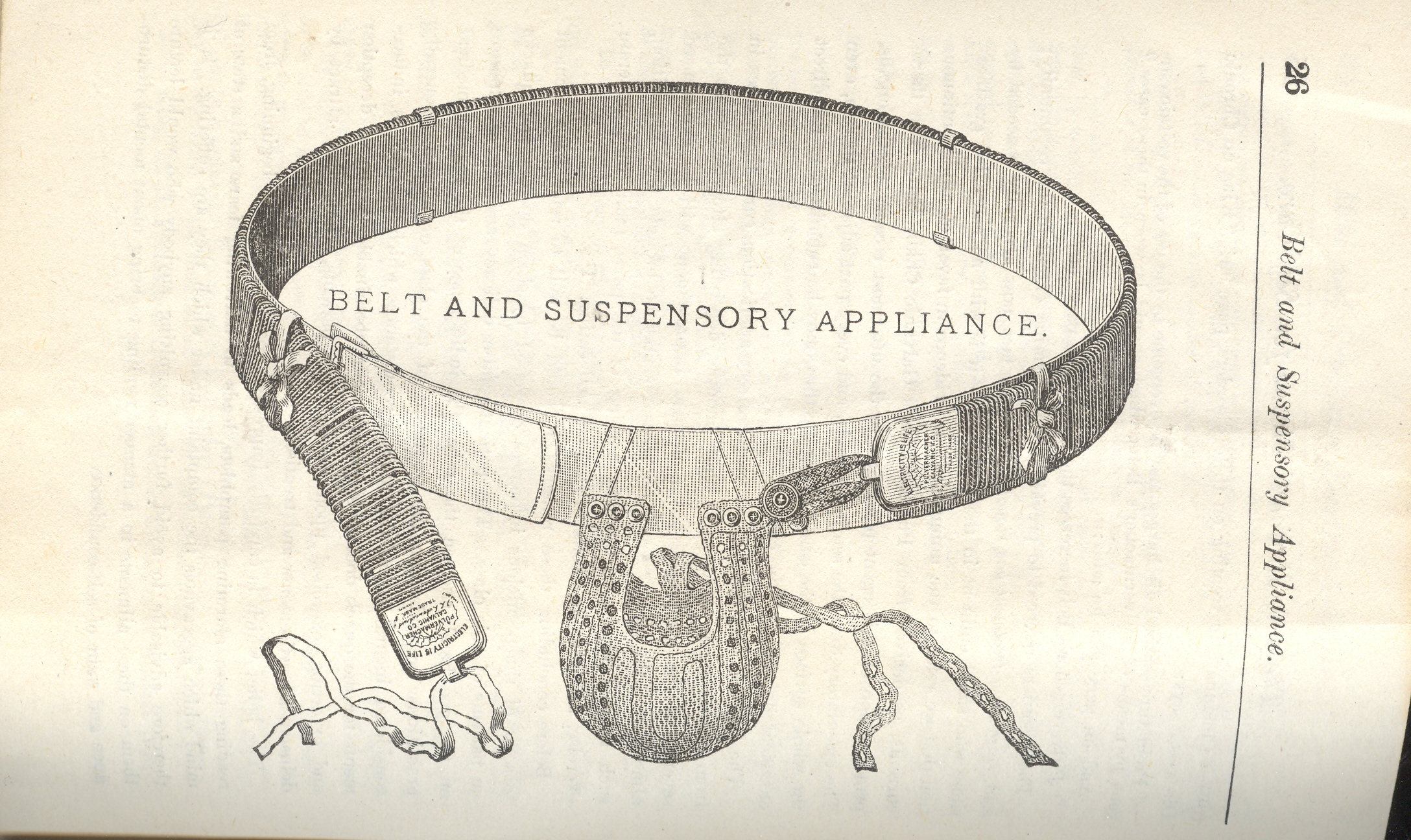
  • An Indelicate Electrical Cure for Kidney Disease, Cramp, Lost Manhood, Paralysis, Indigestion, Dyspepsia, and Much Else (1880)

    JF Ptak Science Books   Post 2717

    Sometimes all one can do is say “wow!”Or “wow?”

    ++ebay--testi belt 1

    And sometimes all that is possible is a trailing, eyebrow-arched, widening “wow…” that is somewhere between excitement/fear/curiosity/repulsion, which is the sort of response I had from reading bits of Pulvermacher’s Electric Belts &c/ Electricity Natures Chief Restorer, Self-Applicable for the Cure of Nervous and Chronic Disease without Medicine. Printed around 1880 or so, the slim pamphlet features a cure-all medical device fashioned from electric “belt” connected to a codpiece “suspensory” for a man’s vitals. It is one of many, perhaps hundreds, of electrical geegaws that climbed aboard the principles of Michael Faraday’s monumental invention of the induction coil (1831)–one can hardly imagine what Mr Faraday would’ve thought of this application of his great addition to the history of technology. This electrical stimulus was supposed to cure all manner of unspeakably lingering medical tragedies, including spermatorrhea, exhausted vital energy, female complaint, inflammation of the prostate gland, seminal weakness, kidney disease, cramp, lost manhood, paralysis, indigestion, dyspepsia, spinal complaints, nervous debility, and of course the “debilities of sexual self-pollution” (“the sexual sin (which) is the most destructive of all human vices…the greatest outrage against Nature’s sexual ordinances that man can possibly perpetrate”. 

    Isaac Pulvermacher’s (which is German for “gunpowder maker”) electrical medico-contraption was popular for several decades in the mid/late 19th century until it faded and trailed away at the turn of the century, though it was not for the lack of trying.  Pulvermacher had all manner of glowing letters of support for his product, though one wonders if they weren’t mostly cooked up on the back burner of a no-burner stove top, much in the way he invented this bizarre electrical device and pathologized aspects of male sexuality.


    ++ebay--testi belt 3


    ·Posted by :

    ·in:

    —
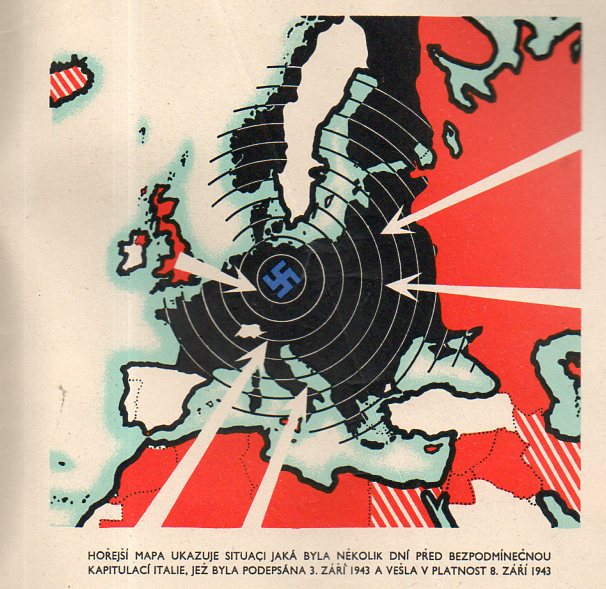
  • Maps of Nazi-Controlled Lands, Including Nazi Germany 1948 (Published in 1942)

    JF Ptak Science Books  Post 2718

    Čtyři léta války v mapách (“Four Years of War…in Maps”), published in London, ca. 1942, is a curious, Czech-exile publication telling the story of the rise and fall of Nazi Germany in maps.  The culminating interest though shows the Nazis surrounded, and put to the final test–it is the first map I list, below, even though it was about the last map in the pamphlet. The “Ein Volk, Ein Reich…” map (the last map shown below), is a Nazi propaganda piece, reproduced here no doubt to show the audacity and hubris of the Nazi state, shows them with a vast territory, including Great Britain and the Soviet Union. I can’t recall having seen such a map depicting Great Britain as a captured entity.)

    [The pamphlet is 9″x 6″ and 35pp, with printed wrappers. It is a rare thing, this pamphlet, and it does not show up in the usual places. There are only seven copies located in the WorldCat/OCLC, all in top-notch libraries: NYPL, Yale, Harvard, Harvard Law, UC Berkeley, Oxford, and Nanterre.]

    1943:

    Maps Germany 1942183

    And the vision of the future, taken from a German design (poster? illustration?) showing the advance of the making of Greater Germany, showing countries conquered through 1940 and then countries that would be conquered, including the Soviet Union (which was to be taken in 1941) and also an occupied Great Britain, though no date is given for that.  

    1938-1948:

    Maps Germany 1938-1948175


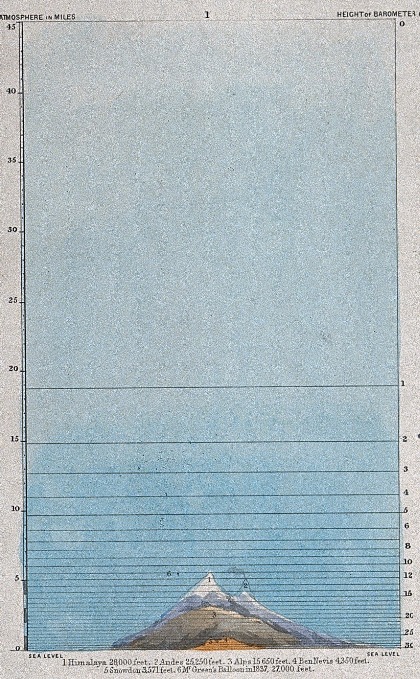
  • How High is Blue? (1851)

    JF Ptak Science Books   Quick Post

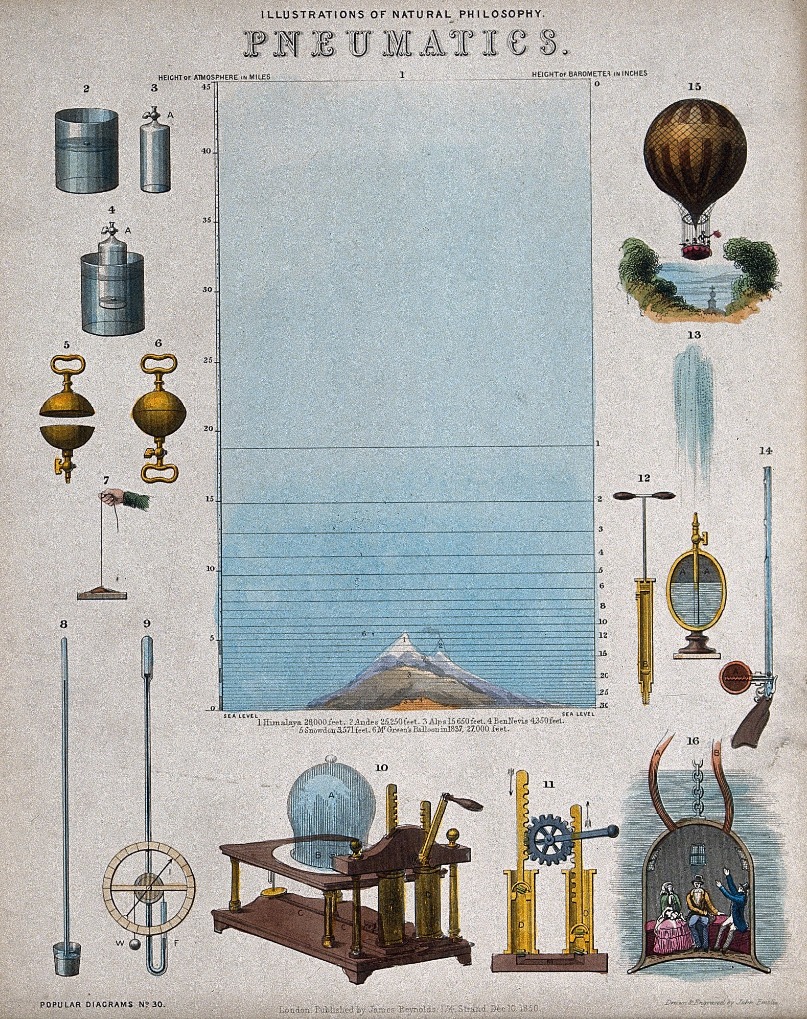
    What struck me in this technical illustration is the cross-section of the ocean of air, and the attempt to depict the characteristics of the atmosphere in receding qualities of blueness. This seems a natural thing to attempt, but I can’t really remember seeing anything quite like this from the mid-19th century–sure there there are images showing the height of the atmosphere, but I just can’t recall the point being made in shades of blue. The image itself is a large detail from “Illustrations of Natural Philosophy, Pneumatics”, a colored lithograph by John Philipps Emslie, and made in 1851.  This copy is from the Wellcome Collection, London, and try as I might I have not yet been able to find out in what book (if any) in which this work was published. Emslie was very active, and composed a number of complicated technical and data visualization efforts like this one, but I can’t yet find publication details.  In the meantime, I’m posting this, concentrating on the atmosphere.

    So far as the heights go in this image, we get through the troposphere and stratosphere, and most of the way through the mesosphere, and so far as the oxygen content goes at the various altitudes, the faded blueness for the relative ease of breathing air is fairly not-so-correct, but that’s not what the intention of the graphic was supposed to show…I was just trying to match-up the blueness with something besides height. The practical experience of humans in 1851 was extremely limited, the record ascension in a balloon at this point still stood at about 27,000′ and was made in 1837–the next big step would be in 1862 when the record was set at 39,000′, which was about 10,000′ higher than any mountain on Earth, the flight subjecting the aeronauts to the thrills of extremely low air pressure and cold. Anyway, the print does get its point across. 

    Emslie pneumatics detail

    Source: the Wellcome Collection, https://wellcomecollection.org/works?query=John+Philipps+emslie#zpyyeaut

    The full image: 

    Emslie pneumatics

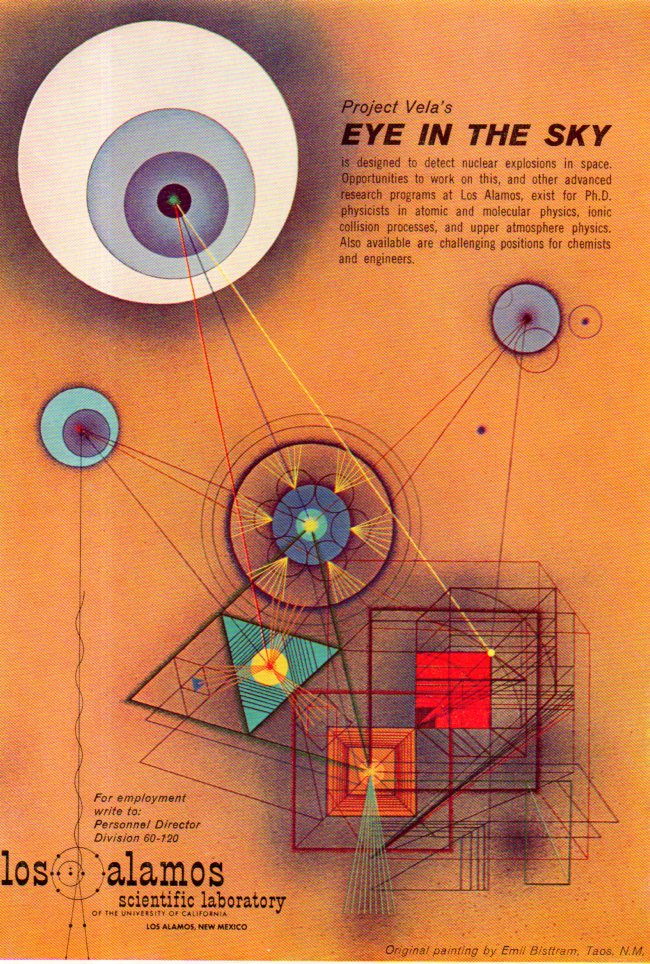
  • Artwork for Detecting Nuclear Explosions in Outer Space (1960)

    JF Ptak Science Books   Quick Post–continued

    I do not have the source for this though I believe it is from Science Magazine from 1960.  The ad was placed LANL looking for new hires, and employed the artwork of Emil Bisttram1 (Taos, New Mexico), representing the new ARPA (pre-DARPA) work for the detection of nuclear explosion tests conducted in outer space, Project VELA. 

    “In a continuation of presidentially-directed programs, Eisenhower assigned ARPA in the summer of 1959 the task of developing the technologies necessary for the detection of nuclear tests, what would become Project VELA (Vela means watchman in Spanish). This program would examine technologies for detection space and atmospheric tests by satellites (VELA , undertaken by the High Altitude Detection panel (the Panofsky panel) of PSAC, which recommended that a satellite system be employed to detect atmospheric or space nuclear tests as part of a verification system for a possible nuclear test ban treaty.”–“DARPA Space History”, here: http://qnet.me/legal/DARPA%20-%20Background.pdf

    Ads  VELA371

    Notes:

    1. “Hungarian born, James Emil Bisttram (1895-1976) attended the National Academy of Art and Design, Cooper Union Art School, Parson’s School of Design, the American Student’s League, and the New York School of Fine and Applied Arts. Bisttram studied mural painting by Diego Riviera’s side. After moving to New Mexico he started the Taos School of Art, where he founded the influential Transcendental Art movement.”–from the Sullivan Goss Gallery, http://www.sullivangoss.com/James-Emil_Bisttram/


    ·Posted by :

    ·in:

  • The Sudden, Unexpected, Ineffable Beauty of Pile Driving (1950)

    JF Ptak Science Books   Quick Post

    I was making my way through the IBM  Proceedings of the Industrial Computation Seminar for September, 1950, after having reported on the article by pioneer Wallace Eckert1 on the role of punched cards in scientific computation, when I read down the contents list and found a paper titled  “Pile-Driving Impact”.  The contents page listed the author (Edward A. Smith) but not their association, and so when I turned to the article I expected a vision-of-the-future-world-of-computer sorta paper. 

    Wrong! 

    The paper was far more interesting than that, and Mr. Smith–from the Raymond Concrete Pile Company–was writing about piles, pile driving, and the impact of the application of computing in the course of doing pile driving…and teh people who loved them. Well, not that last part, but everything preceding it. Of course it makes sense to be writing about this, though I had never before considered the role of computation on pile-driving before this–and I must report that Smith’s paper was sort of beautiful, in its way.  I was very happy to have read it.  

    Here’s a part of the Smith piece to enjoy, followed by a link for the rest of the paper.

    • Pile-Driving Impact, by EDWARD A. SMITH (Kaymond Concrete Pile Company ) “[Calculations] performed in the IBM Technical Computing Bureau, provided a complete numerical analysis of the behavior of a pile when struck by a pile-driving hammer. The results indicated what stresses occurred within the pile and capblock, as well as the penetration of the pile into the earth. This is an example of the replacement of costly experimentation by economical calculations…”
    • “Previously, using only key-driven calculators, it has been possible to study only partially a few isolated cases of the behavior of a pile under an impact. This was due to the high cost in time and money associated with each case studied. By employing the high speed and accuracy of IBM electronic calculating machines to perform this repeated formula evaluation, it is possible to study the behavior of numerous pile types. The cost of each case studied thereby will be substantially reduced.”
    • Source, and for the rest of the paper, see Internet Archive: https://archive.org/stream/bitsavers_ibmproceedmputationSeminarSep50_8283585/IBM_Industrial_Computation_Seminar_Sep50_djvu.txt

    Notes: 
    1. Eckert was professor of astronomy at Columbia from 1926 to 1970 (!), as well as the Director of

    the US Naval Observatory Nautical Almanac Office, and founder and Director of the Watson
    Scientific Computing Laboratory at Columbia University).

    "As Director of Watson Lab and IBM's Director of Pure Science, he oversaw construction of the SSEC
    (arguably the first true computer) and NORC (less arguably the first supercomputer), the most
    powerful computers of their day, as well as of the IBM 610 – the world's first "personal
    computer" – and he installed the first computers at Columbia open to research and instruction,
    meanwhile initiating what might very well be the first computer science curriculum, in 1946,
    including his own course, Astronomy 111-112: Machine Methods in Scientific Computing, along
    with other courses that same year taught by Watson Lab scientists Grosch and Thomas."
    --http://www.columbia.edu/cu/computinghistory/eckert.html
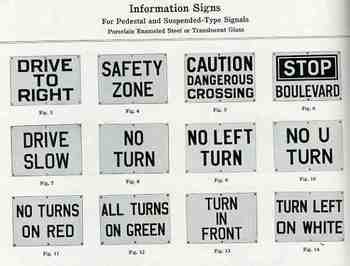
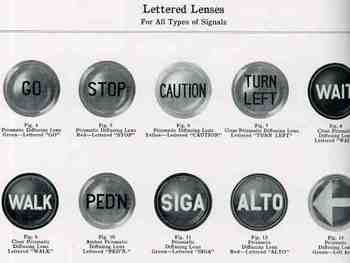
  • The Ineffable Beauty of Traffic Signals (1936)

    JF Ptak Science Books   Quick Post

    This is another in the Ineffable Series of common but unspeakably lovely things, coming just on the heals of a post a few days ago on the ineffable beauty of pile drivers. 

    Blogtraffic262

    These images are about as basic as it gets for the common, everyday, overlooked objects from the disappeared past.  They come from the Course-Linds manufacturer’s catalog for traffic lights and other control systems called, yes, Traffic Signals and Controls, published in Syracuse (NY) in 1936. It is a beautifully designed catalog—excellent illustrations laid out perfectly on their pages, with all of the data you’d ever need to order these things for your municipality.  

    Blogtraffic263
    What I find so fascinating about the images here is that they depict ubiquitous objects that today would today—given their ephemeral nature—be exceptionally difficult to find.  
    Given this catalog, today they are not.


    Blogtraffic260

    Blogtraffic259_2

    ·Posted by :

    ·in:

Recent Posts

Archives

Categories