A Daily History of Holes, Dots, Lines, Science, History, Math, Physics, Art, the Unintentional Absurd, Architecture, Maps, Data Visualization, Blank and Missing Things, and so on. |1.6 million words, 7500 images, 4.9 million hits| Press & appearances in The Times, Le Figaro, Mensa, The Economist, The Guardian, Discovery News, Slate, Le Monde, Sci American Blogs, Le Pont, and many other places… 5000+ total posts since 2008.

  • The Truck-Train of Short Future of 1935

    JF Ptak Science Books   Quick Post 

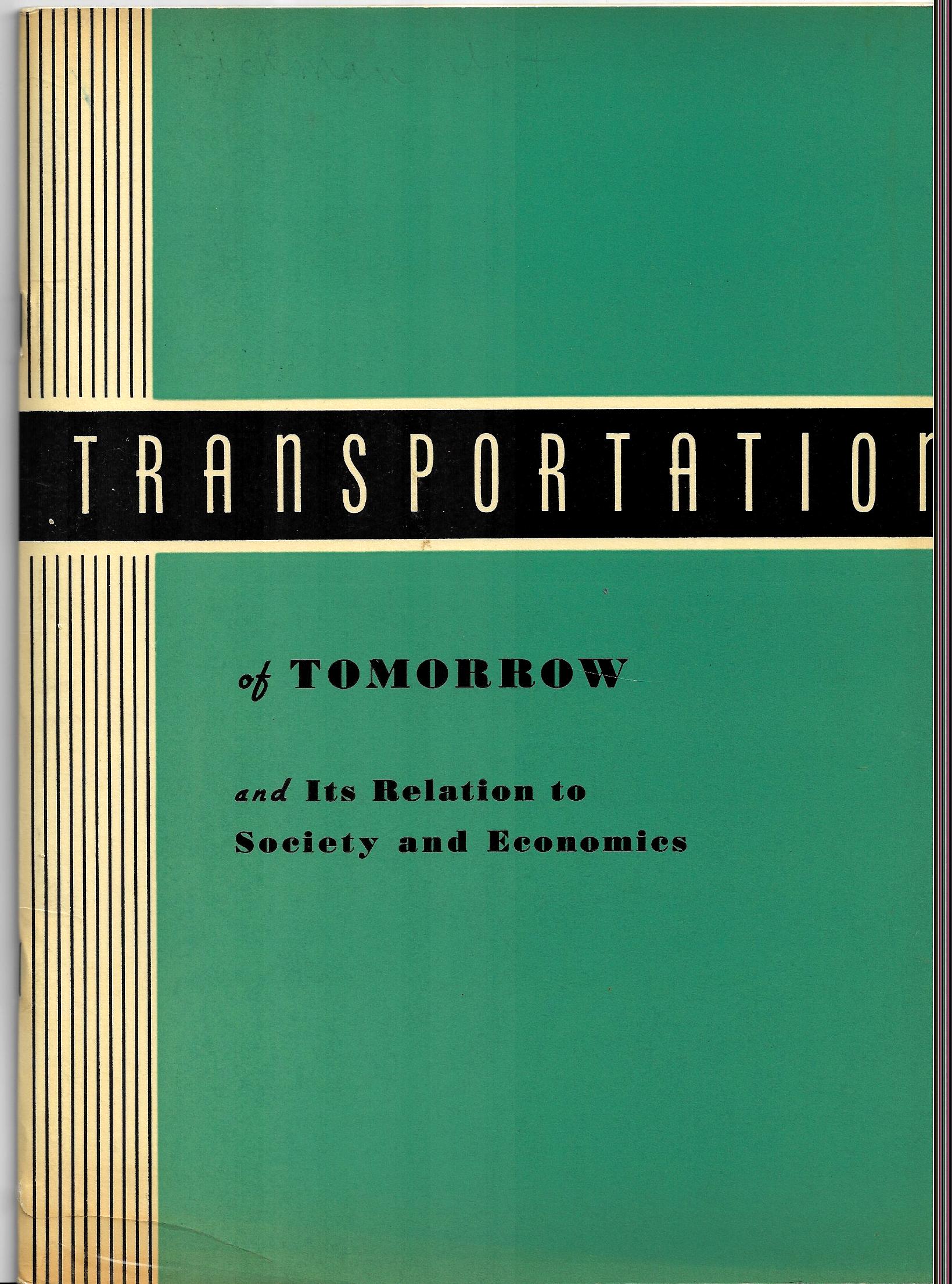
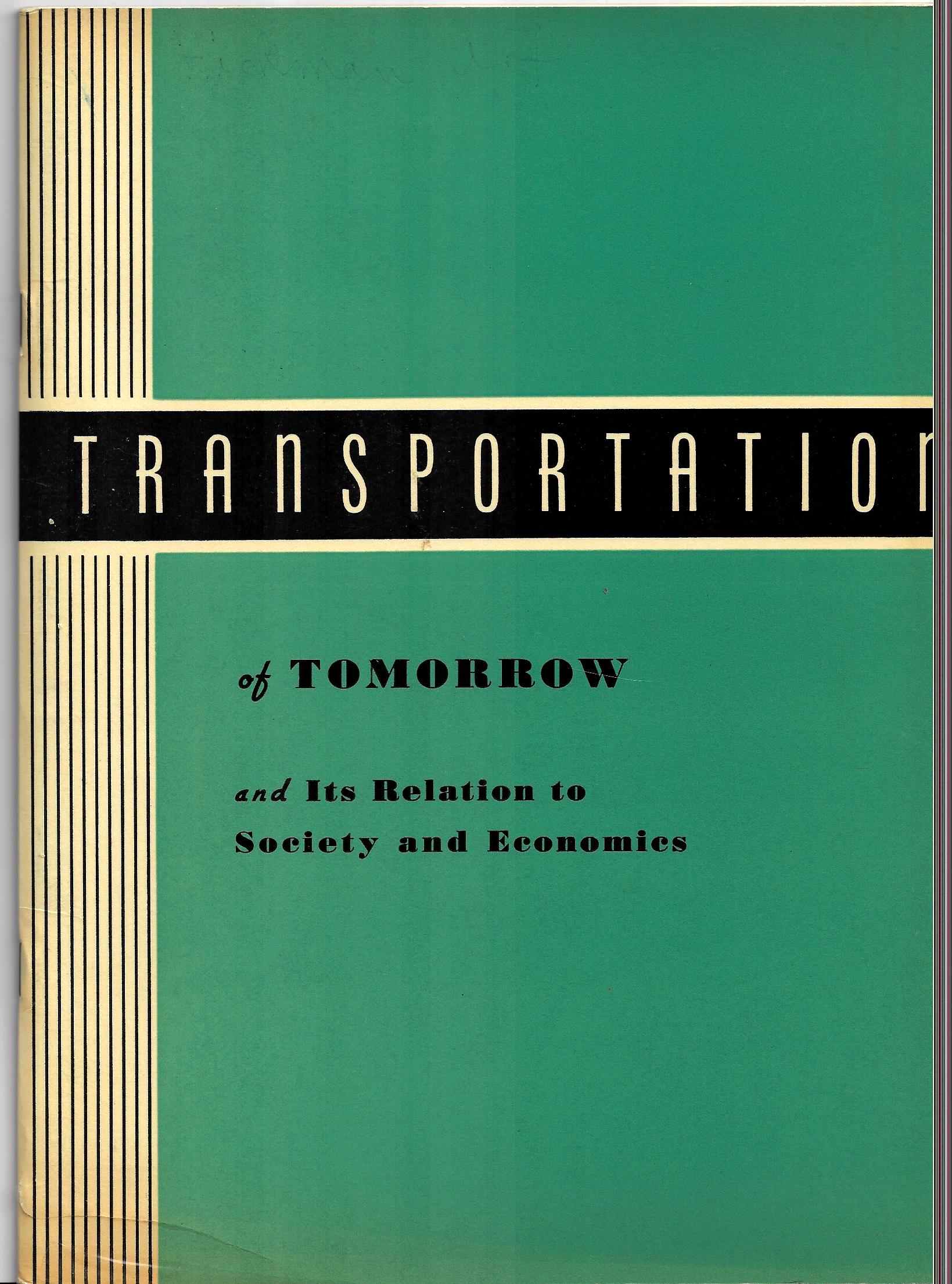
    Future train truckHere’s an interesting and pretty vision of the near-future of transportation–the truck-train. It was presented in the pamphlet Transportation of Tomorrow and its Relation to Society and Economics from 1935 (with drawings by J.F. Hickman) and presents us with smaller-version trains short-profile locomotives that hauled truck trailers where the “rail cars” could be immediately dispatched to a waiting truck at a rail head. On the one hand it seems to make a certain amount of sense if you figure the amount of time that rails throughout the country are employed, and that you could have a lot more rail traffic moving along them. On the other hand, you’d have a lot more traffic on the rails, which could lead to a of scheduling problems and delays. Also, once you got to the railhead, how exactly would trucks access the trailers in a way that was sensical and timely?  Anyway the convertible highway railroad train looks as though it would cause more problems than it would solve by re-inventing the U.S. railroad system on a smaller scale. 

    Future transportation truck train


    Future train truck

  • Transatlantic Floating Airports, 1936

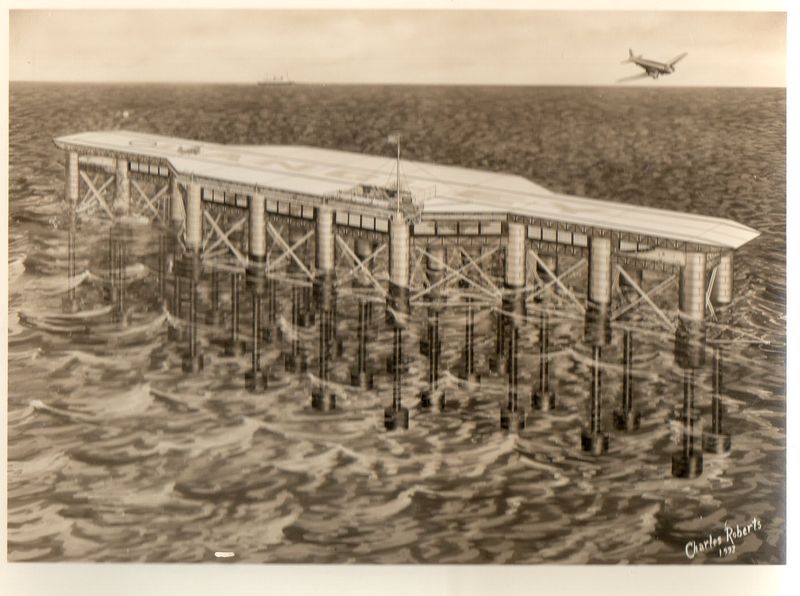
    DocFile (5)This interesting and exploratory pamphlet,  Application of Seadrome Ocean Dock Corporation (a private corporation) for a Loan Under the Provisions of the National Industrial Recovery (1933) was the result of the work of Edward R. Armstrong (1880-1955), and proposed a series of floating airports to facilitate transatlantic flights.

    The outline for this plan asks the federal government for a loan of $30 million (Depression) dollars to undertake the construction of a five floating airports transoceanic network.  “It will require the work of approximately 10,000 men per month for a period of twenty-four to thirty months”.  The labor figures did not include was what necessary to produce all of the material necessary for the project ( for reasons unknown).  Once finished the network would enable aircraft  to make it across the ocean in 18 to 36 hours.

    The members of the Seadrome Corporation estimated that the entire 30 million would be paid back by 1945,  and that the corporation would be completely debt-free.  Perhaps all of  this made sense when Armstrong first developed the plan in 1913, just ten years after the Wright brothers’ successful first in North Carolina. The idea of the floating airport girding the Atlantic was a pretty interesting idea, seeing as how the world record for sustained non-stop flight in 1913 was 11 hours (in a Maurice Farman MF-2), and that was under more-or-less optimal conditions; the speed record was 120mph, and again, optimal conditions and not sustained for hours on end.  By 1933 it seems to me that it had become obvious that non-stop transoceanic flight was coming, and coming soon.  That would of course make an investment in the Seadrome project superfluous, like building an antique, though an unnecessary one. The first transatlantic non-stop flight was made by John Alcock and Arthur W. Brown in 1919, averaging about 100mph; Lindbergh would come later to accomplish the first solo non-stop in 1927–by the early 1950’s jet aircraft would be making the trip with regularity, which means that  for most of the life of the completed Seadrome it would have been unnecessary.  I feel certain that the Seadrome–which was supposed to be paid off by 1945, though in 1933 there was no inkling on the part of the Corporation members who wrote the request for the money that a war was looming and that there would have been almost no way for them to have been made at any time between 1939 and 1945–would never have been paid for.Armstrong’s idea would get major play in the popular press from time-to-time, and discussed as a series of floating islands.  Armstrong himself would organize the Seadrome Ocean Dock Corp. in the late 1930’s, his pretty but  impractical idea (reported by Time Magazine1 in 1933 as little more than “a perennial gift to Sunday feature editors”)  finally grinding to a salty end with greater fuel capacity and efficiency in transatlantic aircraft. 

    As I said, this idea seemed pretty good when it was shiny and new, but less so as time went on and aircraft became larger, more powerful, and more efficient, capable of making the trip on their own. 
    Seadrome152

    Notes:
     
  • “We are, then, gas engines.” Turing and Some of his Childhood Reading.

    JF Ptak Science Books  Quick Post

    The enduring intellectual legacy of Alan Turing’s childhood reading in the delightful (and deeply insightful) book Natural wonders every child should know (1912, 1939), by Edwin Tenney Brewster (1866-1960) can clearly be seen throughout the book, given its absorbing and penetrating curiosity. It is a very disarming book, and I think could be easily under-read, even though it has some semi-lofty writing given its audience, but if you give it a chance, there is a LOT going on in it.  The possible influence of the book, for example, in relation to Turing’s relationship with thinking machines, can be seen in chapter 35, “The Living Automobile”, on pp 238-240, something that must have given the young Turing some considerable stuff to think about: 

    “If you will think back over what you have already learned in this book, you will see that we began by finding out something about how we men, the animals, and the plants come to have any such things as bodies at all…. We found about something of what animals cannot do, and what they can do, and how they do…We learned how animals of various sorts, and plants as well, see and feel and act; and we learned also something about how we ourselves do our thinking, which is so very different, and so very-much better done, than that of any animal or plant.

    “Now we turn to a different matter. We have taken up being, and doing, and thinking. Now we shall consider living. We shall learn about how the body of the plant or animal feeds itself and keeps alive, and how the different parts of it, the bones and skin and leaves and bark, manage to get on with one another, and work together like a well-made machine.”

    “For, of course, the body is a machine. It is a vastly complex machine, many, many times more
    complicated than any machine ever made by hands; but still after all a machine. It has been likened to a steam engine. But that was before we knew as much about the way it works as we know now. It really is a gas engine; like the engine of an automobile, a motorboat, or an airplane.”

    “We are, then, gas engines.”

    Full text of the 1939 edition is found here: https://babel.hathitrust.org/cgi/pt?id=coo.31924001126055;view=2up;seq=8

    ·Posted by :

    ·in:

  • East St. Louis Massacre and the Silent Parade, July 1917

    JF Ptak Science Books  Post 2752

    The Crisis, a journal of the NAACP, called for attention and action in response to the terrible 2 July East St. Louis Riot and massacre in their issue of September 1917. The leadership published a long article detailing the background and the horrors of the event, which you can read if you follow the link. The back of the cover of the journal featured a plea for membership (actually calling for people to “enlist”, much like the people doing so during WWI which the U.S. finally entered 6 April 1917 after nearly three years of European warfare) which was followed in a few pages by the details of the event. 

    Long story short, racial tensions in East St. Louis were increased due to northerly African American migration from the Southern states, causing anxiety among the whites on purely racial reasons as well as the belief that there would be stiffer competition for work. The main catalyst though seems to have been a strike at American Steel, the management hiring hundreds of Black workers to replace the White strikers. Tensions high, a carload of Whites drove into the segregated Black side of town and opened fire on a group of Black men. Shortly afterwards another car of Whites–this time including two policemen–made a similar tour of the area, the Blacks responding with gunfire thinking that it was another drive-by. The two policemen were killed, and then things escalated quickly and brutally, with tens of thousands of Whites turning out to ESL and rioting, beating, clubbing, shooting, and setting fire to buildings (while cutting the hoses of the fire department to ensure that the arson burned the buildings to the ground. Impartial eyewitnesses to the event reported that the National Guard and the police were in very large part unresponsive to the threatened population, and in many cases aided and abetted the rioting. In the end estimates ranged stating that 50-200 African Americans were killed and 6,000 made homeless, while later on a Congressional investigation reported that an accurate estimate of the murdered could not be made. 

    Crisis East St Louis ENLIST

    • Source: The Crisis, September  1917, vol 14/5, pp 218-238,  via Marxists.org: https://www.marxists.org/history/usa/workers/civil-rights/crisis/0900-crisis-v14n05-w083.pdf


    ·Posted by :

    ·in:

  • A History of Blank, Missing, and Empty Things, Part 48: Numbers Numbering Nothing

    JF Ptak Science Books  Quick Post

    It has been some months since the last post in the Blank/Missing Things category, and today I happily add the following, a nominalistically numerated note of nothing:


    DocFile (4)

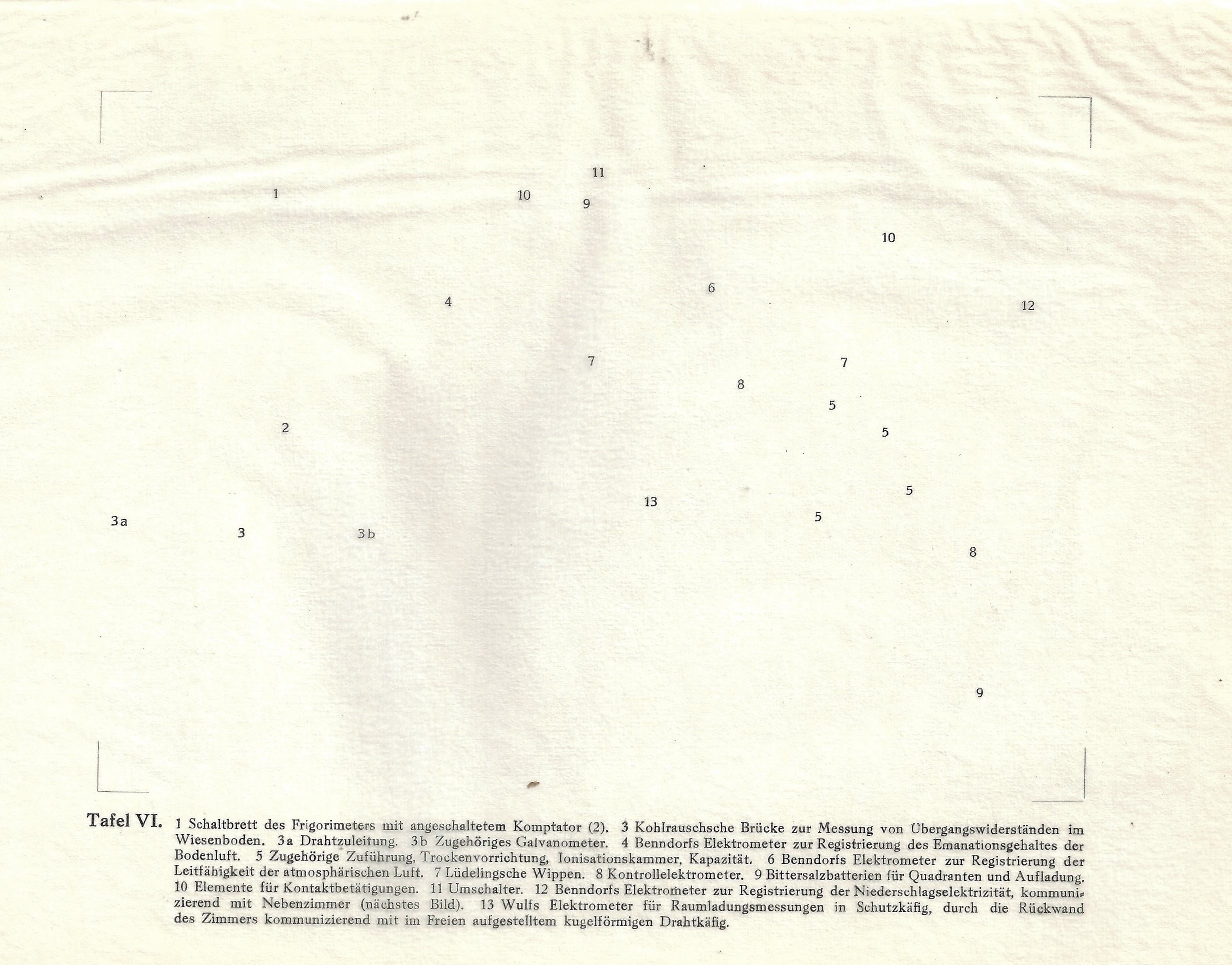
    There is an “underneath” for this “overneath”, as this is simply a glassine key for a relatively complicated photo showing a group of meteorological instruments1. Taken out of context, though, the overlay without the reference image takes on quite a different and appealingly Dada-like complexion, an artful canvas of enumerated blankness…that, or a rendering of unregulated numbers in the wild, a capture of herding physical numbers. Do numbers exist? Are there points in space, and lines, and planes, floating out there just beyond our knowledge like Arthur C. Clarke-like monoliths or Abbott’s Flatland objects? Well, no. But it is enjoyable to find these printed forms that, if we look at them in a certain way and allow for a bit of fancy, take on a life of their own.  (What a funny thing it would be if numbers had names other than their number– for example,  “3” is the form only but its name is a taste or smell, or “Borges”, or the bubble 44,332 in the head of a pint of Guinness, or a particular wavelength…that could spice things up.)

     NOTES:

    1. Dorno, C. Ausstattung moderner Strahlungsobservatorien, Braunschweig, Vieweg u. Sohn, 1926. 10×7”, 13pp+ an interesting illustrated section, “Bilder aus dem Physikalisch_Meteorlogischen Obervatorium, Davos”, which has 9 photo illustrations of the instruments, 6 of which have numbered glassine overlays to help with the identifying legend for the plate. 


  • “Should Britain Fight?” An argument for Appeasement, 1938

    JF Ptak Science Books  Post 2753

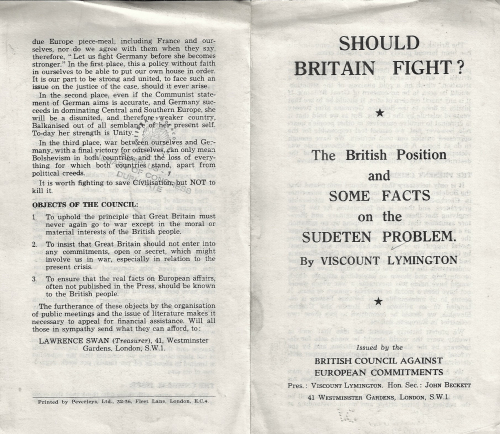
    DocFile (2)


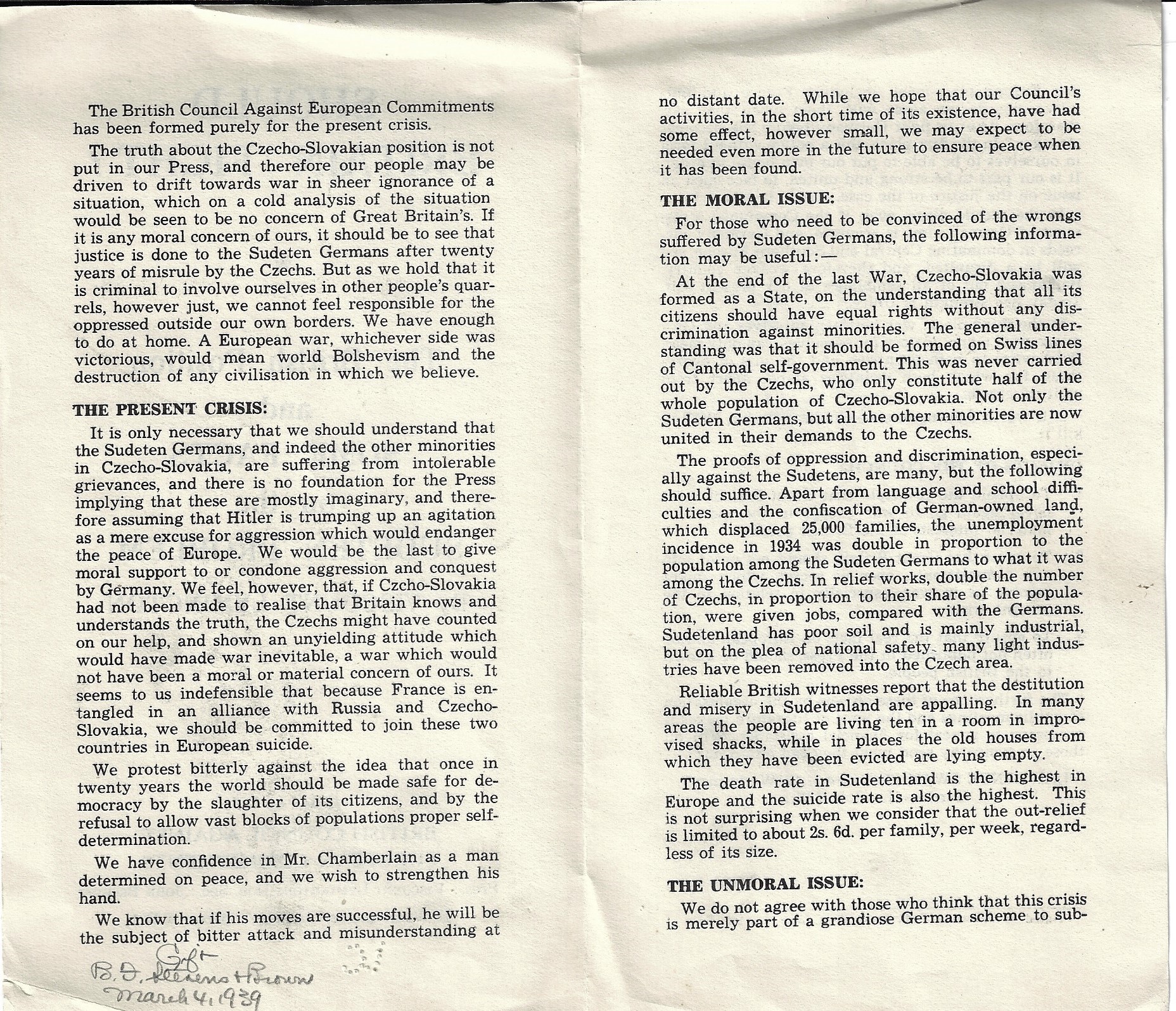
    There were some in Great Britain who just simply did not want to become involved in the European crisis, and who saw their way around the obvious to the in-obvious of what needed to be seen. That, or the source of info leading to this opinion was limited. Or, the information sources were good but the interpretation was limited. Or it was too early in the process of war…except in this case, in the pamphlet below, it was already 1938, and the issue was Hitler and Czechoslovakia.

    It is a little difficult to say when this was published in 1938–if it was published in the early Spring the Anschluss would not yet have occurred, and so no mention; but I have a feeling that this is post-Anschluss, and the event (of March 1938) is treated with silence, as it surely would not have fit very well with the writer’s denouncing of the diatribes against Hitler. My suspicion is that this was post-Anschluss and pre-Munch Agreement/Diktat (30 September), and that the entire business with Austria is left out of whatever thinking is going on here. There is a mention of strengthening Chamberlain’s hand though nothing specifically about the Munich meeting, so my general reaction is that this pamphlet was printed in the Summer of 1938. 

    The case that the author makes is that the Sudeten Germans “are suffering from intolerable grievances” and that anything to the contrary is a construction of “the Press” who were implying that the troubles were “mostly imaginary”, “therefore assuming that Hitler is trumping up an agitation as a mere excuse for aggression which would endanger the peace of Europe”, and so on. Any sort of European war coming as a result of  an involvement over Czechoslovakia, the author contends, would result in “world Bolshevism”, no matter the winning side. Thus the need for Great Britain to stay away from any possible conflict, and that its only “moral position” would be to see justice done to the Sudenten Germans.  Poland and Hungary would carve up their own slices of the rest of Czechoslovakia in October and November 1938, and then come March 1939 Germany would seep into what was left of the country, completing the death of the six-month Munich agreements. 

    And somehow the ending argument was that even if Central and Southern Europe were “dominated” by Germany, “she will be a disunited, and therefore weaker country, Balkanized out of any resemblance to her present self”.

    In any event, these sentiments were hardly unknown, in any country. The U.S. certainly had its fair share of groups espousing these beliefs, some –like the “America First” organization–held on to their keep-our-distance programs 28 months into the war, only disappearing on December 7, 1941.

    Here’s t he entire leaflet:

    DocFile (2)


    ·Posted by :

    ·in:

    —
  • Straightening Out Michelangelo (Part of the “History of Lines” series)

    JF Ptak Science Books  Quick Post

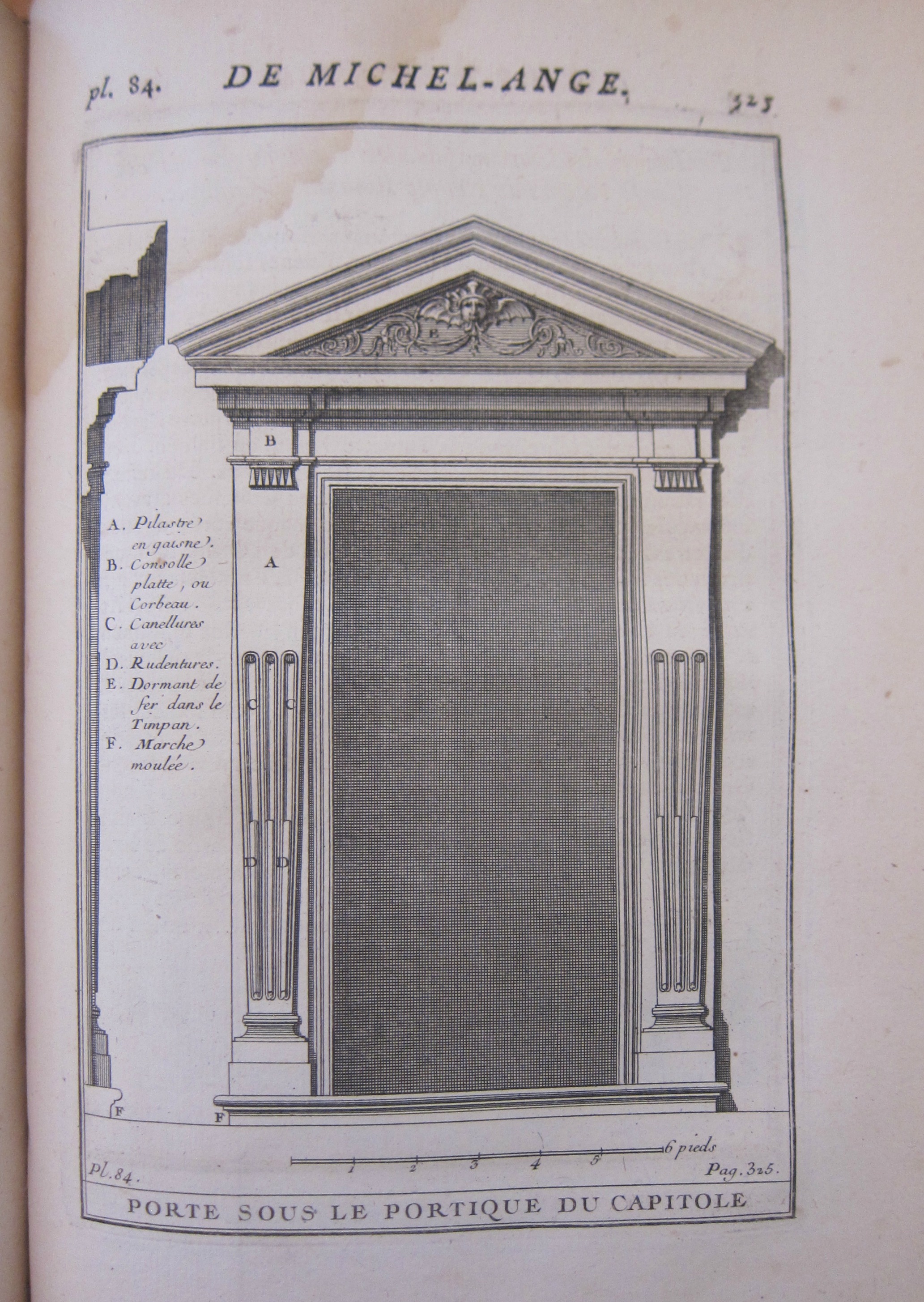
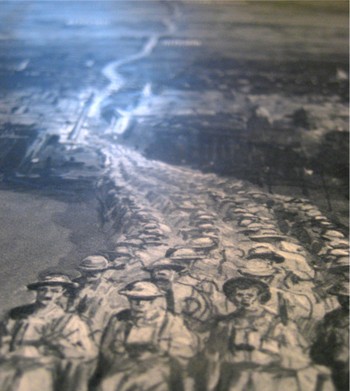
    I suspect that the subject of “straightening out” of any work of Michelangelo is, well, infrequently done, mainly because of all the things that could and should be written about that man this would be the least of them all.  That said, the “straightening” bit struck me when I was looking at the detail in an engraving of a doorway that Michelangelo design on Capitoline Hill, and the extraordinary detail in the shadowing just called out to me.  The design is beautiful, but all I could think of was how many squares were in that shadow. And then of course one had to wonder how long a line all of those shadow line would be if they were all placed end-to-end. The answer to that is about 300′.  

    There you have it. 

    The engraving is from C.A. d’Aviler, Cours d’Architecture qui Comprend les Ordres de Vignole…new edition, printed in Paris in 1756, p 325, plate 84, “Porte sous le portique du Capitole”. 

    The detail of the shadow:

    Michelangelo lines _3_ detail

    And the full image:

    Michelangelo lines _1_ full

  • 269 Miles of Dead Soldiers

    JF Ptak Science Books  Quick Post


    The Illustrated London News
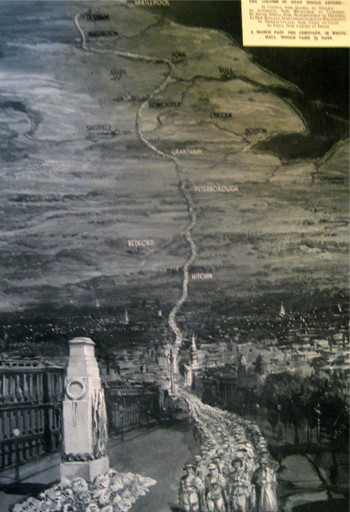
    published this very sobering image showing the general reader in London in 1933 the absolute strength and weight of the dead–and probably in a way that they had never seen before.  The image is entitled “In Memory of the 1,104,890 British Dead of the Great War”, and was drawn by D. Macpherson.  It very graphically represents all of the war dead of the British Empire for the period of the Great War of 1914-1918 (not to be called “WWI” or “The First World War” until after the second week in September, 1939, when there was a new World War from which the older one needed to be distinguished).  Depicted here are the dead as a line of men, four across, extending from London to Durhham.  The column passes from London through Hitchin, through Bedford and Peterborough and Grantham, past Sheffield and Leeds and York, and then on to Durham.  An extraordinary column of the war dead: 900,000 of the dead were not soldiers at the beginning of the war, but they sure died that way, and this map shows them all in a line, marching from  a point 269 miles distant.

    This line of dead soldiers would be 2,690 miles long including all military deaths for the war; 5,380 miles for all deaths overall. 


    Blogmarch

    Blogmarching_2


  • A Very Large and Very Early X-Ray Photo, February 1896

    JF Ptak Science Books  Quick Post

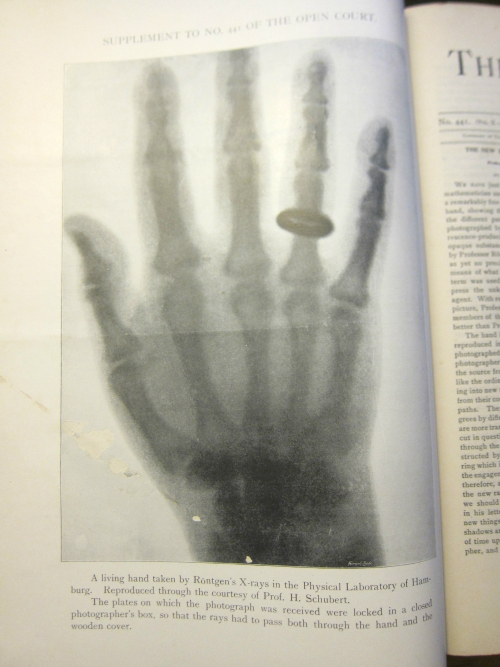
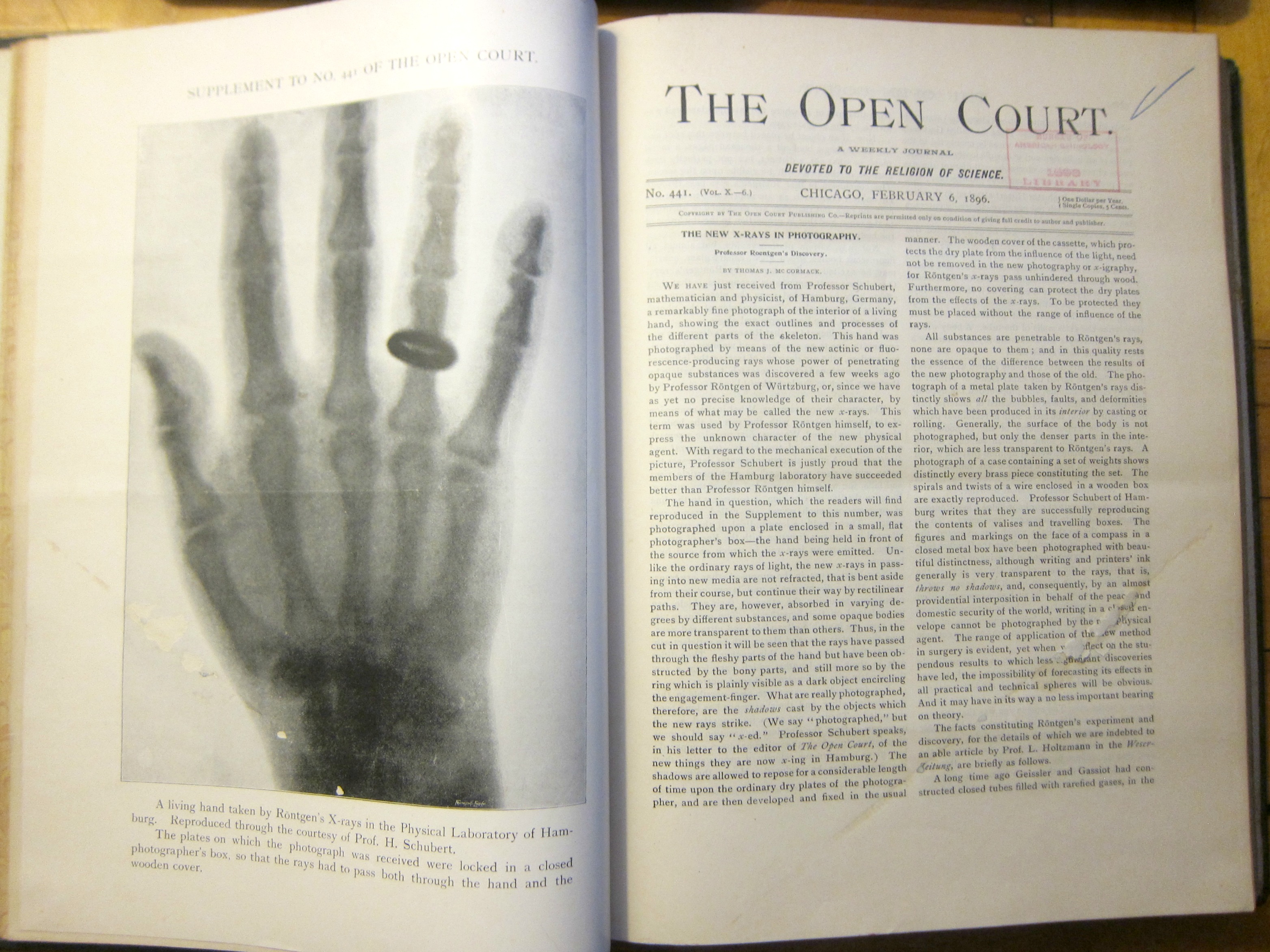
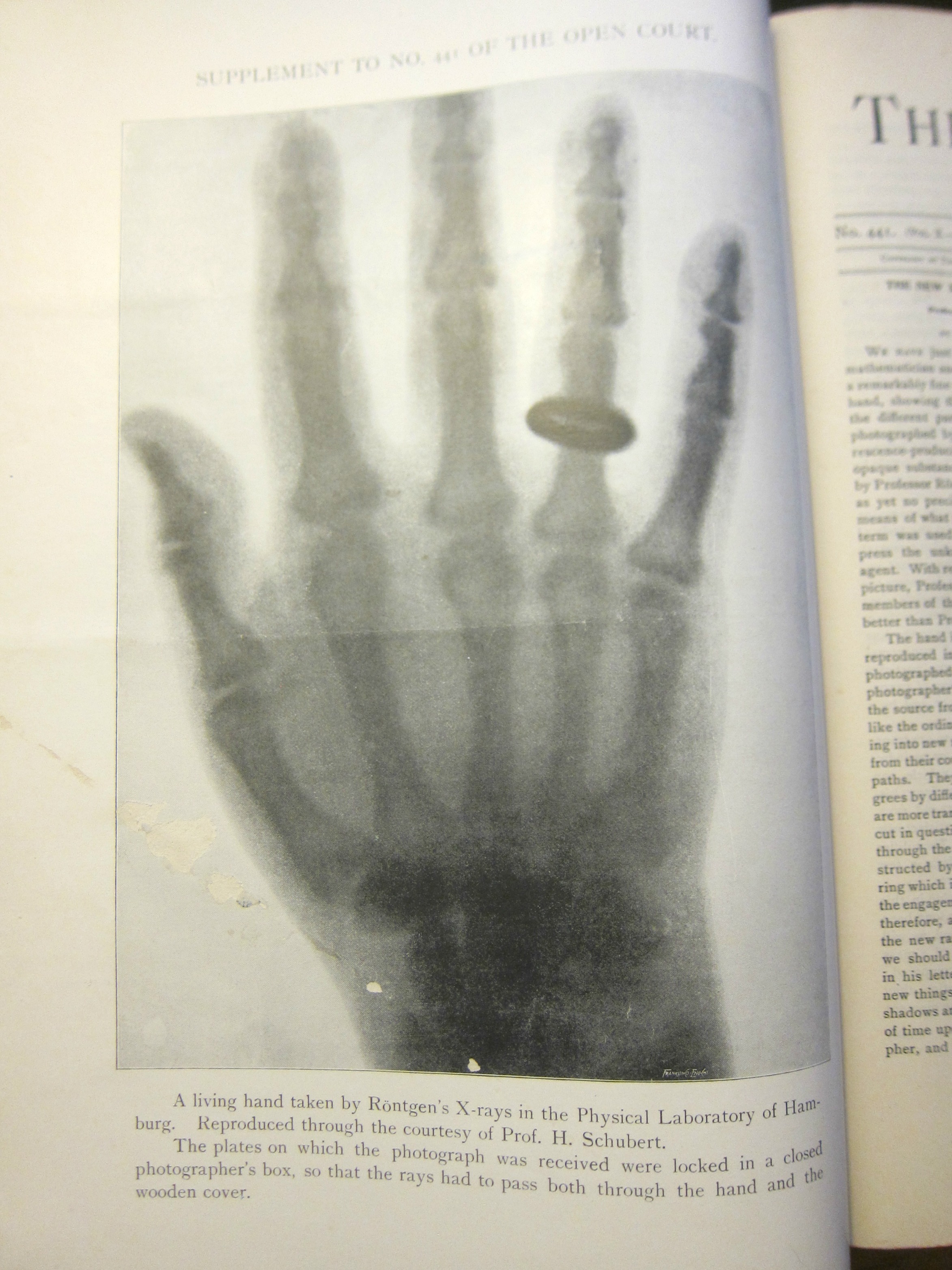
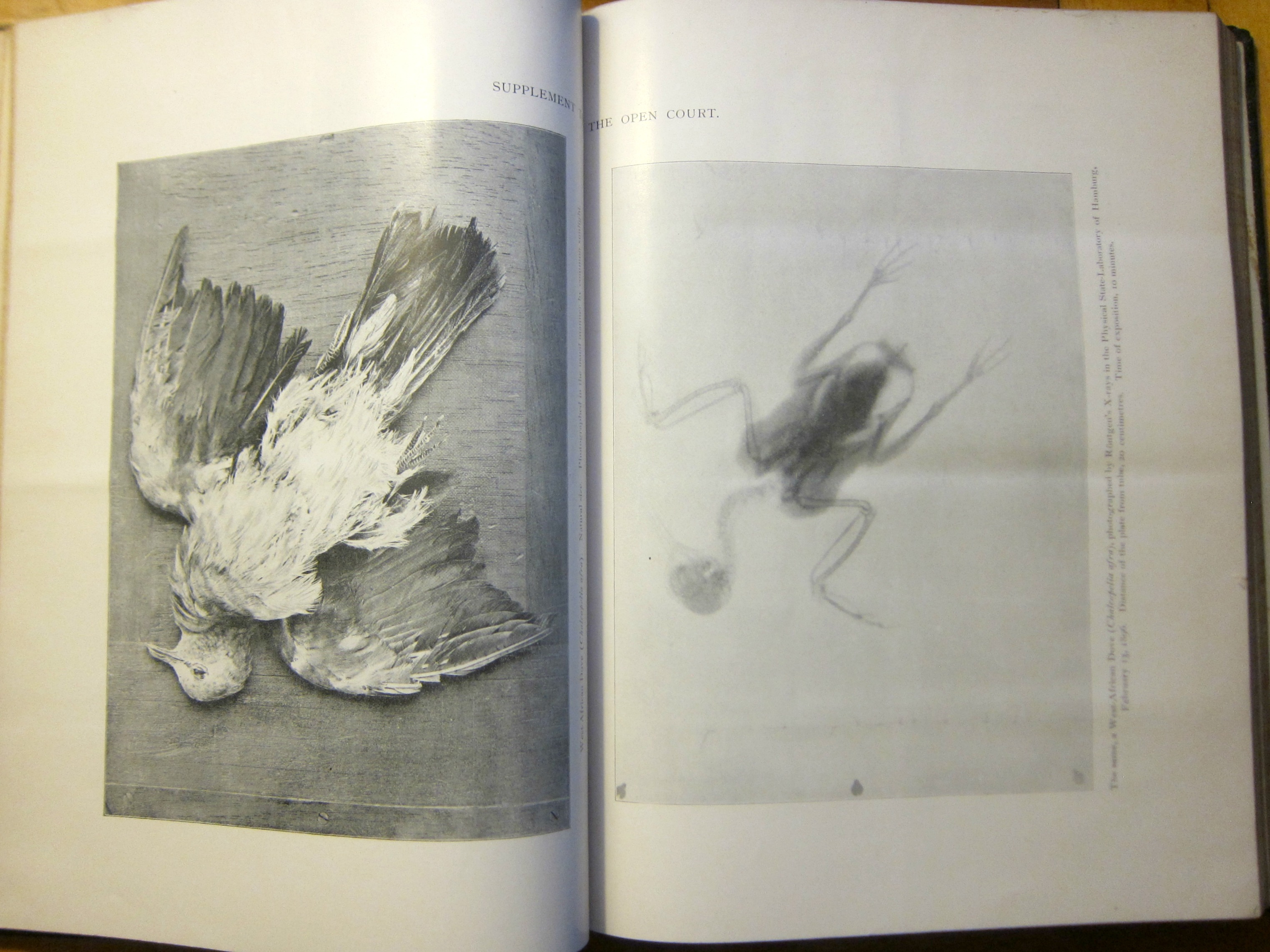
    I made an unexpected find today, poking around in a February 18961 volume of the probing, somewhat classically-radical and Easternist journal, The Open Court, a Weekly Journal Devoted to the Religion of Science.  The photo and article form a very early appearance in the U.S. of the weeks-old Roentgen discovery of the x-ray. The first journal edition in English appears to be 23 January 1896 in Nature (vol 53), and the first in a U.S. journal in Science on 31 January, though that is not illustrated.  (The Science article, written by Hugo Muinsterberg of Harvard, notes that this was a good thing for the reassurance of German stature in physics as they had in the last year lost Kundt, Hertz, and von Helmholtz, and now they had Wilhelm Roentgenfor a new placeholder of living greatness.) 

    X-ray _3_


    X-ray _2_

    A close-up of the 12″ tall image

    The illustrated article by McCormack, in the Taoist-historico-scientific journal Open Court, shares an example of x-ray photography by H(ermann). Schubert (1848-1911, and who would have his paper on the Rontgen rays translated for the Monist in April) ) of the Physical Laboratory in Hamburg which is very large, more than 12″ tall, and by far the largest of these famous photos that I have seen. There is a short discussion on what exactly to call the “photograph”, since it really wasn’t a photo by general standards, and the term “x-ed” is suggested…I’m not sure when the “X-Ray” as a term for the product of being exposed to x-rays and photographic film was, but it wasn’t long after this.)  There is a bit of history of the discovery of the x-ray, and a discussion on the idea of chance and discovery in scientific progress. 

    There would be an enormous wave of publications on the x-ray over the course of the next year–in fact, the Bibliography of X-ray Literature and Research (1896-1897) by Charles Phillips (published in 1906) is 68pp long and finds more than 1500 books and articles published over just two years. Oddly, the Open Court papers are not to be found in the Phillips bibliography, and I’m not sure why.  

    It seems to me that Open Court publishes on the of the first photographs of an x-ray in a U.S. journal. 

    McCormack (1865-1932) had an interesting career, translating Lagrange, Weismann, Mach, as well as the photographer and mathematician  Hermann Schubert’s books on recreational mathematics), and wrote several books in disparate disciplines.  
    X-ray _1_

    Notes:

    1. Thomas J. McCormack, “The New X-Rays in Photography”, in a bound volume of The Open Court, a Weekly Journal Devoted to the Religion of Science, February 6, 1896, no. 441, volume x-6, pp 4799-4801.  With a very large photographic image (12×9.25″ 31x24cm).
    Also appearing in this volume, again by McCormack,  “Roentgen’s Rays Again”, no. 446 vol X-11, March 12, 1896, pp 4483-4844, illustrated with a double-page photographic image. 
    ·Posted by :

    ·in:

    —
  • Data Visualization and Enormity 2: NYC Overtaken by Gigantic Corn, Bread, and Cigars (1912)

    JF Ptak Science Books  Post 2745

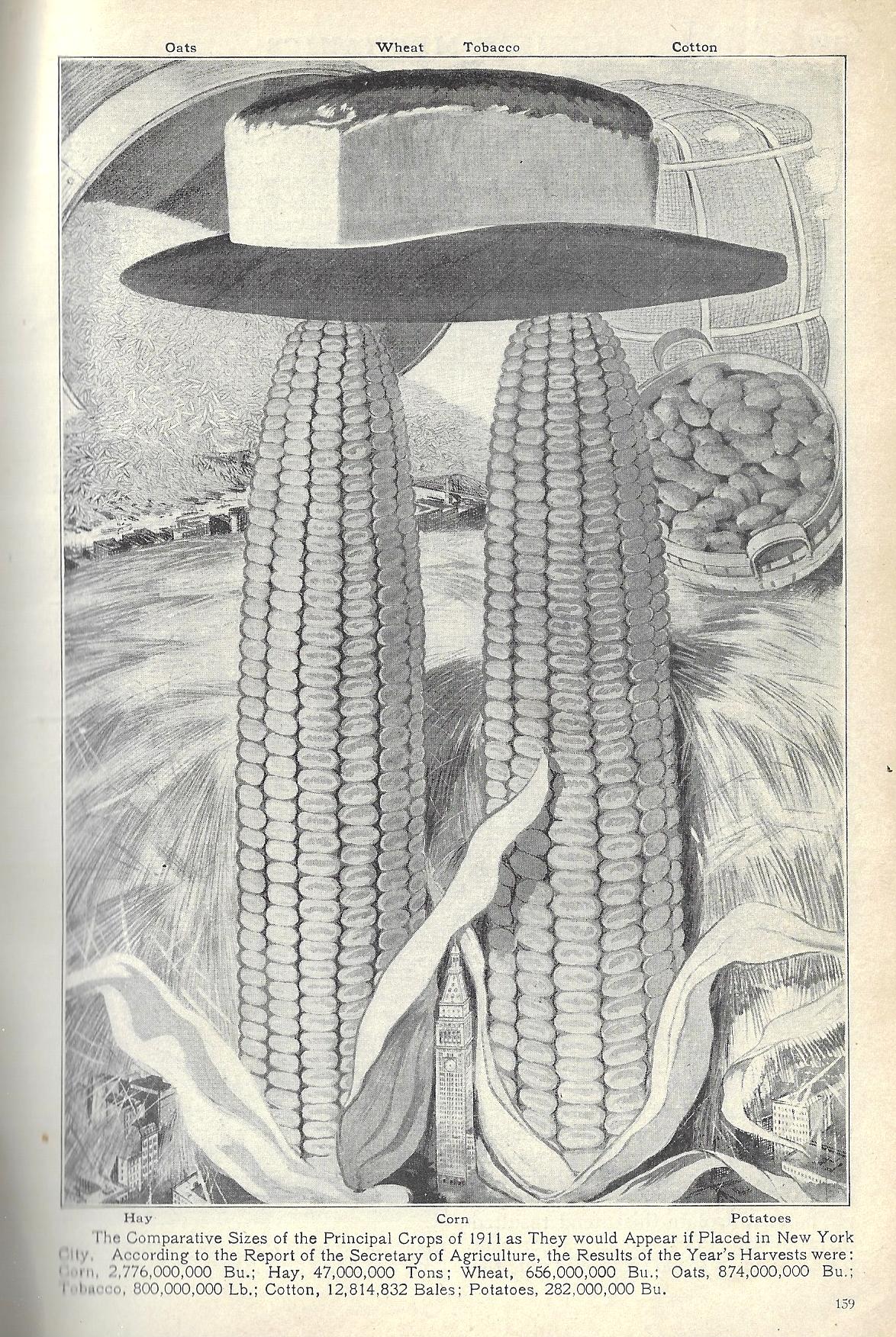
    On this blog I have entertained stories about Manhattan being completely detached/uprooted, attacked by bloomers and aliens and spaceships and spaceship aliens, floated above itself, nuked (numerous times), miniaturized, crushed under sudden ice, joined to Brooklyn and New Jersey (?!), and other such game-enders. There have also been posts on data visualization techniques comparing the known to hard-to-grasp bits of other information or statistics or entities, using the Brooklyn Bridge, Woolworth Building, Empire State Building, Eiffel Tower, Hoover Dam, and so on, as measuring sticks for oil or nail or auto production and the like. It seems that only once before on this blog of nearly 5k posts has Manhattan been used as an intellectual tool of comparison for something non-nuclear-related, and that was for a salt mine. (And according to advisers to President Merkin Muffley the salt mine comes close to playing a strategic nuclear role.) This in mind, finding today’s piece of Overtaken Manhattaniana was a fabulous bridge between two imaginary islands of not very useful data visualizations(s). 

    Pop Mech 1912 Dataviz crops NYC

    Image source: Popular Mechanics, 1912, pg 159.

    So what we have here is the presentation of the yearly production of some principal crops of the USA for 1911, spread across Manhattan with a wide-data butter knife. Nestled between the two ears of corn is the tallest building in NYC (and the world) for 1911, Metropolitan Life, which stood 700′ tall, and reigned for a few skinny years until the Woolworth Building was finished off at 792 feet in 1913. So it looks like the corns were about 2100′ tall with a 600′ diameter at the base. Big. On top of that rests a cigar which is crowned buy a loaf of bread, all of which lords over a sea of hay that covers the rest of the island and almost all of its buildings. For some reason nothing very creative is done with the potatoes, which are just sitting there in a 1000′-tall basket. In the upper left there is a positively enormous pouring of something-or-other of disaster movie proportions. It is slightly disappointing that the maker didn’t figure out how many people it would take to eat all of that stuff in one day. (Throwing caution to the wind mainly because getting to the mostly-useless answer to this is not all that interesting, I will guess that it would require 10x the current global population to eat Manhattan clean in one day.)

    There you have it.   

    The ironic thing here is that this use of corn size really doesn’t tell you very much, except that corn production in the U.S. is (1) a lot and (2) more than bread, which of course you can tell by just looking at the numbers…though that isn’t quite fair as it does give some basic common denominator for measures that are given in pounds, bushels, and bales. The point is that whether the twin corns were 2000′ or 8000′ tall probably didn’t help your understanding of what the numbers meant. But all is fair in war and war, and since this is basically an info-toon, we’ll just enjoy it for what it was, or is.  

    ·Posted by :

    ·in:

  • Aeroplane Roulette, 1912

    JF Ptak Science Books   Quick Post

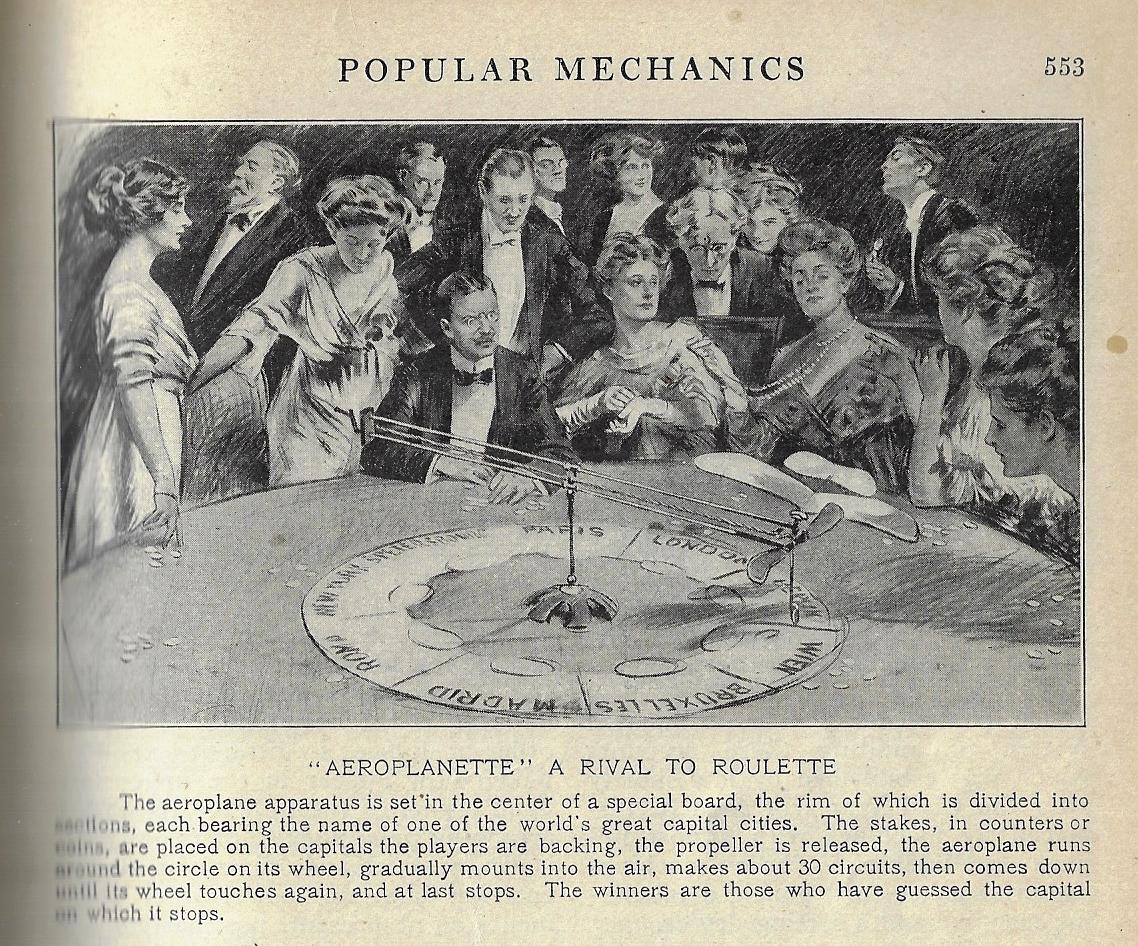
    It took a few years for the Wright Brother’s iconic and monumental flights of 1903 to be thoroughly and popularly deemed not-crackpot, but once that was the case, the Wrights, and their flying machine, and aeroplanes in general, were heralded as the future-arriving. (It seems to me that their fame was mounting over a few years, but still, their reception was limited–it wasn’t like Einstein becoming instantly immortalized following the eclipse confirmation of 1919, being obscure one day and immortalized soon after, but they did go from relative quiet to international renown in a couple of years.) 

    In any event, by 1912 there were aeroplane toys, and games, and popularly sold sheet music for songs, and also, evidently, a version of roulette made to accommodate the cascading interest in the new technology. I had never seen this toy/game/gaming apparatus before tonight, and I was happy to see it:

    Pop Mech 1912 aeroplane roulette

    Source: Popular Mechanics, p 553. 

Recent Posts

Archives

Categories