A Daily History of Holes, Dots, Lines, Science, History, Math, Physics, Art, the Unintentional Absurd, Architecture, Maps, Data Visualization, Blank and Missing Things, and so on. |1.6 million words, 7500 images, 4.9 million hits| Press & appearances in The Times, Le Figaro, Mensa, The Economist, The Guardian, Discovery News, Slate, Le Monde, Sci American Blogs, Le Pont, and many other places… 5000+ total posts since 2008.

  • Pre-History of the A-Bomb: Arming Nukes with Your Teeth, 1914.

    JF Ptak Science Books   Post 2741

    “Atomic Bomb” appeared in print for the first time thirty years before there was one. It appeared in H.G. Wells’ The World Set Free, written in 1913 and published in 1914, evidently before the appearance of the guns of August later in that year. The “set free” part of the world in Wells’ hands doesn’t come without an atomic struggle, though, much of the novel being a stage-up for the last bit in which people realize that atomic-bombing everything everywhere is not the way to go.

    There are other atomic-conjoined terms in this book besides “bomb”, and they are somewhat telling of the period. Wells does make a good strike with “atomic bomb”, “atomic ammunition”, and “atomic power”, and then goes on to describe the other bits that could benefit from this atomicity, including “atomic aeroplanes”, “atomic hay lorries”, “atomic traction engines”, “atomic riveters” (riveting at twice the pace of a human), and “atomic smelters”. So there are some weak spots here and there in his 57 mentions of “atomic-something”, and that’s okay—he did some pretty good sightseeing into the future with the bomb.

    And he was definitely the first to use “atomic bomb”, according to many sources and not the least of which is the OED (which also provides another interesting example of the word in use, quoting the Yale Review in 1917 “When you can drop just one atomic bomb and wipe out Paris or Berlin, war will have become monstrous and impossible”.) “Atomic-bombed”, “atomic bombing”, and “Atomic bomber” do not make their appearance in the English language until after August 6 in 1945.

    The first view of the atomic bomb in Wells finds that there not one but three of them, all contained in a “coffin-shaped box”, and even with a 2′ diameter were small enough to be stored under a person’s legs. The “essential element” in its construction was a substance named “Carolinum1”, which thus far had been “tested only in almost infinitesimal quantities within steel chambers embedded in lead”.

  • “Hand it Over to the Machine” (1878)

    JF Ptak Science Books   Post 2742

    WIlliam Spottiswoode (1825-1883),  an English mathematician and physicist, president of the Royal Society from 1878 to 1883, and of the British (Science) Association in 1878 as well, wrote a very appreciable piece on the state of Science in Nature in 1878.  At 15 pages this was a one-percenter for Nature so far as length goes–the pagination sounds short, except that the text was printed in about 8-pt, 90 columns per page, double columns, so the article was no doubt 15k+ words. There were numerous nuggets in this review and state of affairs of the sciences and technology, including sections on mathematics, literature and art, physics instrumentation, manifold space, imaginaries,  and so on, not the least of which was 1500 words on Non-Euclidean Geometry.

    What struck me most in all of this was the half-column entry for “Mechanical Methods” (on page 413), which turns out to be “mechanical appliances”, or calculating machines/engines.  It starts with an unusual assertion:

    “Mr Babbage, when speaking of the difficulty of insuring accuracy in the long numerical calculations of theoretical astronomy, remarked that that “most accurate science” had become “inaccurate and uncertain in some of its results”.

    Spottiswoode continues with an explanation and a dig:

    “It is doubtless, some such consideration as this, coupled with his dislike of employing skilled labour when unskilled labour would suffice, which led him to his invention o the calculating machine”.

    The author then makes another—again, to my experience—unusual observation, referring to the replacement of human thinking capacity by a machine:

    “The idea of substituting mechanized for intellectual power has not lain dormant…”

    It is a very short comment, but I think makes a strong if understated point.

    The author then moves onto the “recent” machine of James Thomson (“by its aid it seems an unskilled laborer may, in a given time, perform the work of ten skilled arithmeticians…reduced to the simple process of turning a handle”), before finishing with a flourish, though it is easy to read through. In telling the story of Michael Faraday, who after muscling through some concept and determining that the next step would be to hammer it all out mathematically, would “irreverently “ say “hand it over to the calculators”, which at that point was a team of human calculators, arithmeticians, and perhaps more famously known now as “computers”.

    And the finish:

    “But truth is stranger than fiction; and if he had lived until our day, he might with perfect propriety have said, ‘Hand it over to the machine’ ”.

    It is a small statement with a lot of possibility. Even though this comes seven years after Babbage gave up the ghost in Marleybone, it still seems remarkably early to be talking about this sort of major impact in the conduct of the sciences, lending part of the process over to machines. The Industrial Revolution is well into it second century by this point, and human effort in all manner of manufacturing has been replaced by machines—except here the active part of the human experience in the creation of ideas is the thing that is becoming “machinized”.

    This brought to mind an earlier piece in the same journal by James Clerk Maxwell, who also wrote an assessment of recent developments in science2. 

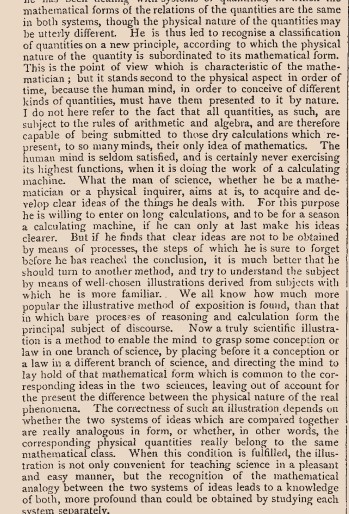
    What I find to be most interesting here is Maxwell pulling back the reins and directing the idea of clear scientific discourse by means of analogy. He does speak of “calculating” and “calculating machine”, which is referring to human calculators and not mechanical ones–the issue being that “spending a season” doing this stubborn and consuming work could turn the person occupied with in into a “machine”. He writes: 

    “What the man of science, whether he be a mathematician or a physical inquirer, aims to do, to acquire and develop clear ideas of the things he deals with. For this purpose he is willing to enter on long calculations, and to be for a season a calculating machine., if he can only at last make his ideas clearer.”

    “But if he finds that clear ideas are not obtained by the means of processes,  the steps of which he is sure to forget before he has reached the conclusion, it is much better that he should turn to another method, and try to understand the subject by well chosen illustrations derived from subjects with which he is more familiar.”

    “We all know how much more popular the illustrative method of exposition is found, than that in which bare processes of reasoning and calculation form the principal subject of discourse…”

    Calculators Maxwell NAture 1870

     Notes:

    1. SPOTTISWOODE, William. “British Association”, address on the state of the British Association by the president, in Nature, vol 18, no. 459, occupying most of the weekly issue, pp 403-425 in the issue of pp 401-428.
    2.  MAXWELL,  James Clerk.  Mathematical and Physical Sciences–address to Section A of the British Association.  London:  1870.  Nature, vol 2, Sept 22, 1870.   Maxwell addresses the British Science Association meeting in a long (for Nature) entry of about 4,000 words, over 4 pages. 

    ·Posted by :

    ·in:

  • Note on the First Microscopical Images of Captured-and-Reproducible Sound? (1878)

    JF Ptak Science Books   Post 2743

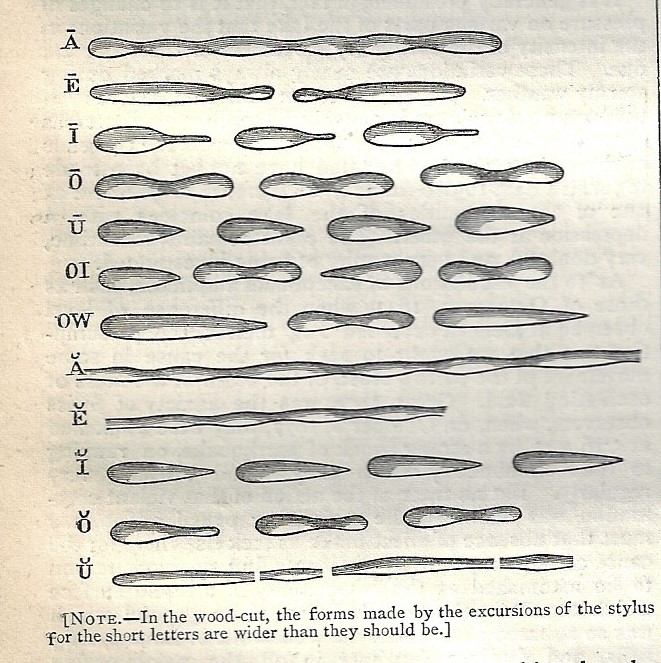
    Only months into the invention of the phonograph by Thomas Edison (at Menlo Park in December of 1877 and patented in January 1878) Alexander J. Ellis reviewed a version of it constructed in London by Mr. Stroh, and found it, well, wanting.  Ellis (1814-1890) was a product of Eton, Cambridge, Trinity, and was a gifted mathematician, philologist, and a groundbreaking ethnomusicologist, and did see some limited utility of the machine to restricted areas of his research. In the short note he wrote for Nature in their April 18, 1878 issue1, he mostly found that the phonograph was generally flawed in its reproductive capacity, and did not venture far from this interpretation so far as the possible applications of the machine was concerned, which seems iconically short-sighted from my perch here in the future. Even though Ellis recognized that “the effects produced are sometimes startling (as in cries, coughs, laughter, music), the philosophy of the process (making a permanent impression of a very complex compound vibration, and using it as a mould to reproduce that vibration is exceedingly attractive, but at present the instrument–at least the one that I saw…” he concludes that the status of the invention “…has not risen beyond a lecture illustration or a philosophical toy”.  
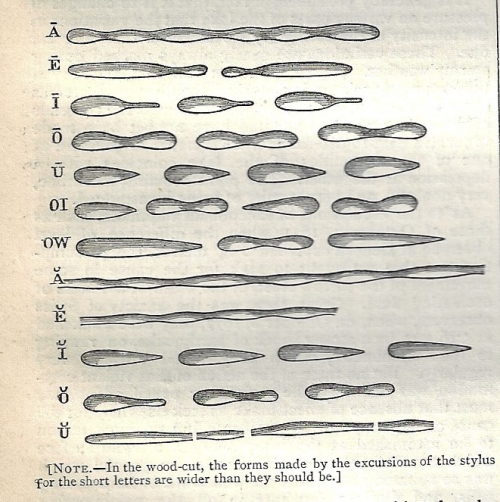
    Nature 1878 Perifser Frazer

    Five weeks after this article and about four months following the patenting a visually-arresting article appeared in Nature2 which contains what I am assuming to be the first microscopic images of recorded and reproducible sound. I know that is a pretty deep qualification, but I think that’s its accurate. The article appeared as “Examination of the Phonograph Record under the Microscope” by Persifor Frazer3, who investigated what the impression of the stylus looked like as known sounds are recorded on tin foil. And so this remarkable image, showing what vowel and some dipthongs “look like”.  

    There were a number of early attempts to study what sounds look like by Lissajous and Konig, though these instruments did not produce reproducible sound but the  experimenters were able to produce characteristic traces of sounds which were of high value to folks like von Helmholtz. The premier pioneer in this area must be Édouard-Léon Scott de Martinville  (1817 –1879), a Parisian printer and bookseller [and also described in other places as a typesetter, stenographer, and “tinkerer”], who was the inventor of the earliest known sound recording device (patented 25 March 1857) known as the “phonautograph”. He was a pre-Edison Edison and was a major influence on the man, though Edison was the man who produced playback from his recordings, and Scott did not. 

    • “Scott called this process “phonauto­graphy”—the self-writing of sound. Of course he didn’t expect perfectly formed letters of the alphabet to emerge from the stylus. But he did believe the calligraphy inscribed in the soot—”the words that wrote themselves”—embodied a form of “natural stenography” that would some­day be read as easily as a sten­ographer deciphered his own jottings.”–https://www.nps.gov/edis/learn/historyculture/origins-of-sound-recording-edouard-leon-scott-de-martinville.htm
    • “Sound had been invisible and transient since the beginning of time. Scott’s phonautograph recorded it and made it both visible and perm­anent. It was a technological breakthrough, ahead of its time. He did not intend for his phon­autograms to be played back; that concept was another 20 years away. “-https://www.nps.gov/edis/learn/historyculture/origins-of-sound-recording-edouard-leon-scott-de-martinville.htm

    This instrument was not as I said designed to play back the recording; rather it was intended that the sound’s images and not the auditory experience would be studied. Scott achieved fame, recently, when archephonists were able to math the hell out of the recorded record and cranked an image to sound result—and thus, the earliest recording, Scott de Martinville  (or someone) singing a bit of “Clair de la lune”, made on 9 April 1860, which was presented for the first time in 2008.

    I saw a reference and then promptly lost it stating that the first appearance in a journal of Scott’s work occurs in 1857—except that in a later paper (1861) Scott references this event and describes giving the Academie a “paquet cachete”, a “sealed document”, which I think means that it wasn’t read to the assembly or published and was private. This turns out to be the case, the 1857 document being a manuscript, and presented at the excellent First Sounds website, here: http://firstsounds.org/publications/facsimiles/FirstSounds_Facsimile_01.pdf   It does seems though that the first and second published descriptions of the machine occur in 1858 and 1859, with Jules Lissajous’ “Report to the Society” (1858) and in Scott’s own paper in Cosmos,  “Phonautographe et fixation graphique de la voix” (1859).

    As luck would have it I own a copy of Scott’s third paper on his instrument, which appeared in the Comptes Rendus in 1861 (15 July 1861, vol 53 #3, pp 77-128), which seems in its few pages to contain a good description of the device, which would render, as Scott said, “the imprudent idea of photographing the word.”

     Notes:

    1)  “The Phonograph”, being an article in the April 18, 1878 issue of Nature, volume 17, No 442, pp 485-6 in the weekly issue of pp 481-500. 

    2)  Abstract of a paper presented at the Franklin Institute April 17, 1878, by Persifor Frazer, “Examination of the Phonograph record under the Microscope”, in Nature, May 23, 1878, p. 102. In this same issue is an excellent paper by Francis Galton, “Composite Photographs…”

    3)  Persifor Frazer was of the Philadelphia Frazers, of long and interesting lineage. A Gettysburg vet, he was in professional life mainly a geologist; he did become expert in handwriting and the detection of forgeries using photographic means. 

    4) Scott, M. E.-L. “Inscription automatique des sons de l’air au moyen d’une oreille artificielle”,  which is translated along the lines of  “Automatic Registration of Sound by an Artificial Ear”. Evidently the idea came to Scott while working/reading a textbook and having an aha! moment while reading about the human ear.  Comptes Rendus, pp 108-110, volume 53, 1861. 
    ·Posted by :

    ·in:

  • The Department of Unexpected Questions: Is the Sun One Sided? (1878)

    JF Ptak Science Books   Quick Post

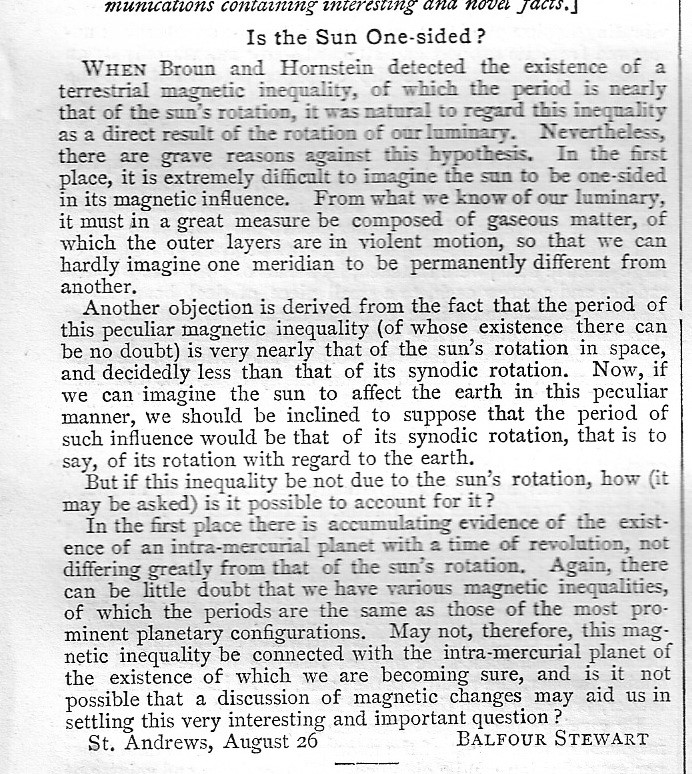
    I found–or bumped into–the following short note in Nature (September 5, 1878) .  At first glance it has a flat-earthy/Nazis-on-the-dark-side-of-the-Moon quality to it, or at least to me it did. It is a very unexpected question, though it isn’t quite what it seems at the outset before you try to think about what part of one-sidedness the author, Balfour Stewart, is addressing. Read the note, and then the title will make sense.  

    DocFile (2)

    “Balfour Stewart, (born Nov. 1, 1828, Edinburgh—died Dec. 19, 1887, Drogheda, Ire.), Scottish meteorologist and geophysicist noted for his studies of terrestrial magnetism and radiant heat. Stewart pursued a mercantile career for 10 years before becoming an assistant at Kew Observatory and later an assistant to James Forbes at Edinburgh University, where Stewart conducted his research on radiant heat. In 1859 he became director of Kew Observatory, and in 1870 he became professor of natural philosophy at Owens College, Manchester. In his work on radiant heat, Stewart was the first to discover that bodies radiate and absorb energy of the same wavelength; his work in this field was soon surpassed, however, by that of the German physicist Gustav Kirchhoff. In his studies of terrestrial magnetism, Stewart discovered that daily variation in the magnetic field could be explained by air currents in the upper atmosphere, which act as conductors and generate electrical currents as they pass through the Earth’s magnetic field.”–Encyclopedia Britannica

    ·Posted by :

    ·in:

  • A View of the “Zones of Animal Life” (1889)

    JF Ptak Science Books  Quick Post

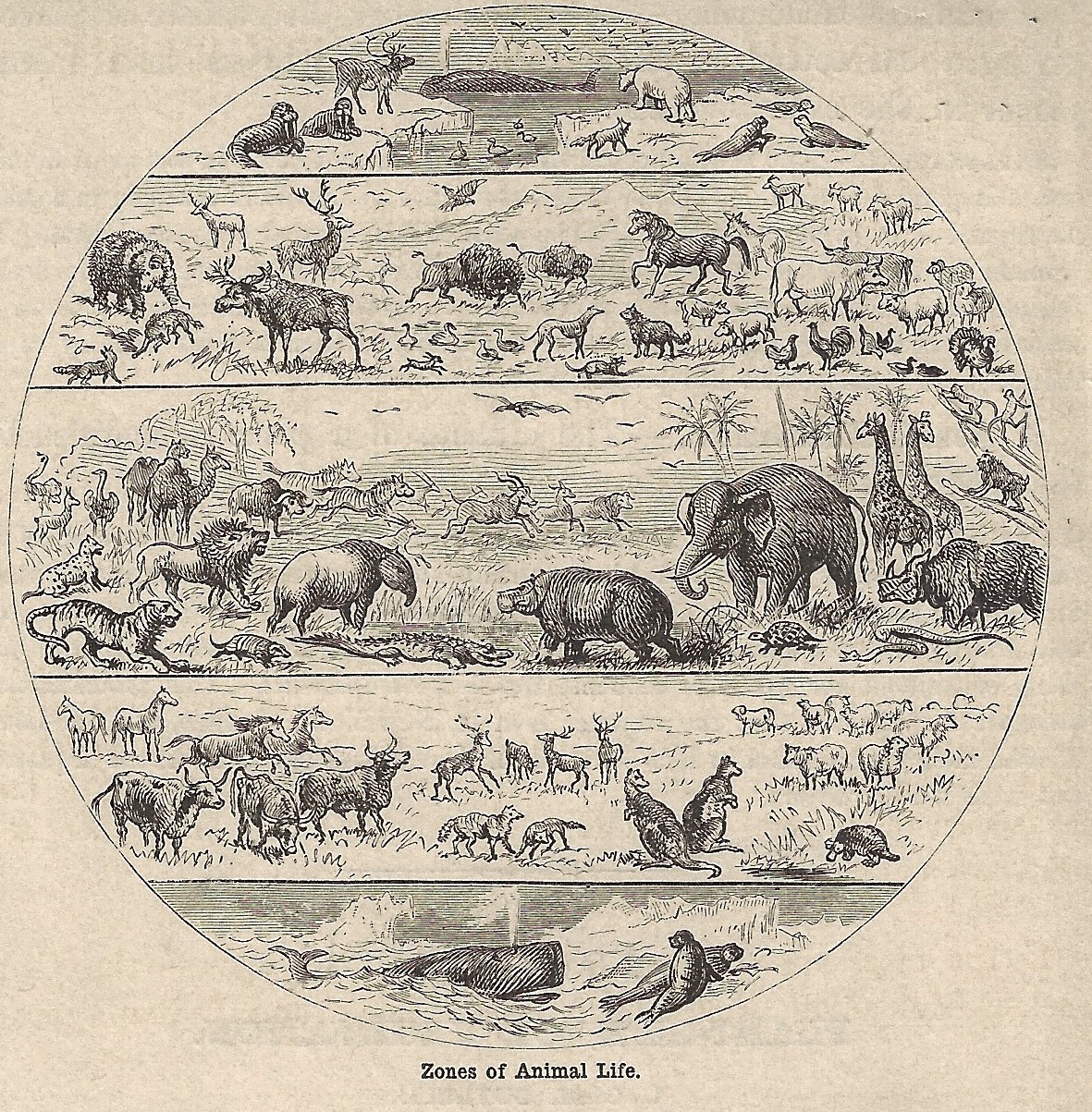
    Here’s is an interesting bit of data display, showing the distribution of animal life in torrid, temperate, and frigid zones. It is relatively small, 4×4″ or so, and is found in James Orton’s  Comparative zoology, structural and systematic, published in New York by Harper and Brothers in 1889, (pg 389). 

    Maps zones of animal life


  • An Episode in the History of Massiveness: a Double-Bridge and Canal Across the Channel, 1925-1936

    JF Ptak Science Books  Quick Post

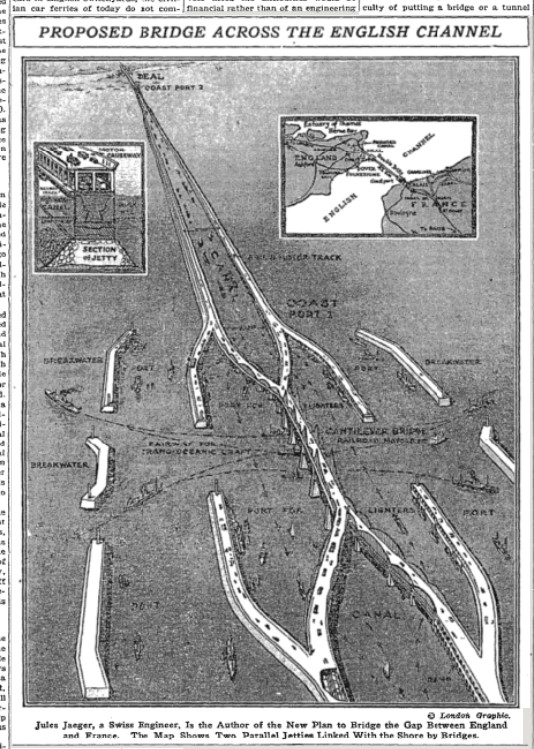
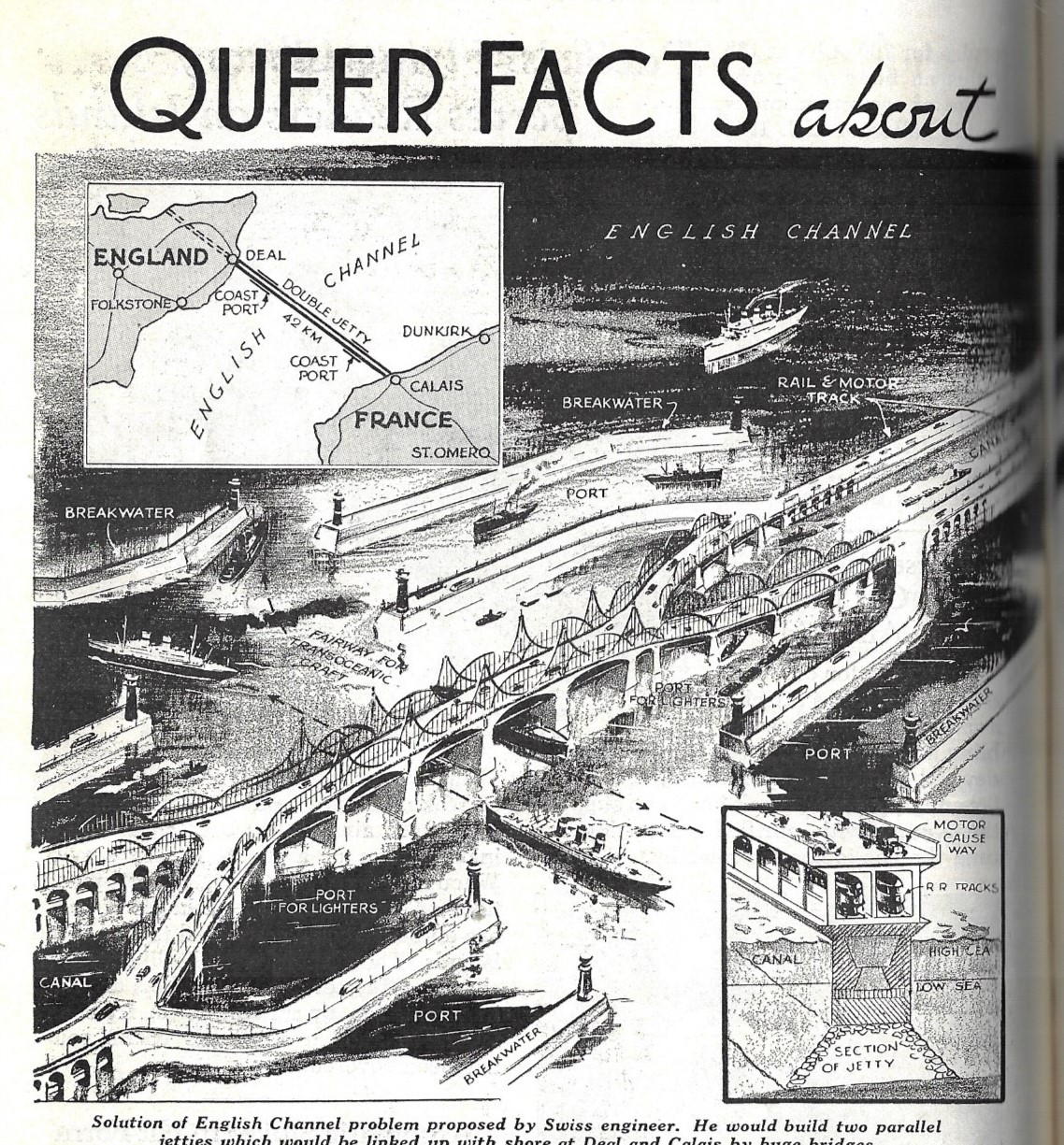
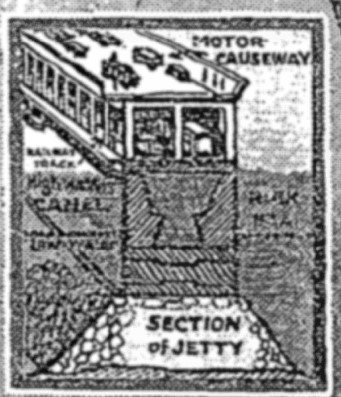
    Jules Jaeger proposed this mammoth project for bridging the English Channel: a double-jetting/bridge structure with a 1000′-wide channel between the two. Claire Price wrote a story on the idea for the New York Times on December 6, 1925, and described the structure running straight as an arrow from Calais to an eventual terminus in London, and cost $400,000,000 (or between $4-10 billion in 2018 according to the BLS CPI computer). The two jetties would rise from the channel bottom and be wide enough to each hold a double set of railroad tracks and an upper roadway for cars and freight. Price states that the colossus would be able to handle all manner of traffic in the future, even though the motor causeway is two lanes wide, and that it would be safe during wartime as the jetties would protect against torpedoes for the inner canal, though there is no mention of aircraft or other sorts of attack. 

    There’s a lot that I do not understand about the construction, not the least of which would be building a jetty 30′ wide and 150′ high/deep that was 30 miles long, times two. 

    Channel bridge jaeger full 1925

    And by a stroke of serendipity, I located (stumbled upon) an illustration of Jaeger’s channel bridge in a 1936 issue of Popular Mechanics (page 500). And again poor Mr. Jaeger goes unidentified (as a “Swiss engineer”, only).  Eleven years later the channel bridge is still alive, in some way, and with a more detailed illustration:

    Pop Mech 1936 channel bridge


    And a detail cross section showing roadway and train tracks:

    Channel bridge jaeger detail Xaection

    ·Posted by :

    ·in:

  • Creating National Monuments Made of the Ashes of the Dead (1917)

    JF Ptak Science Books  Quick Post

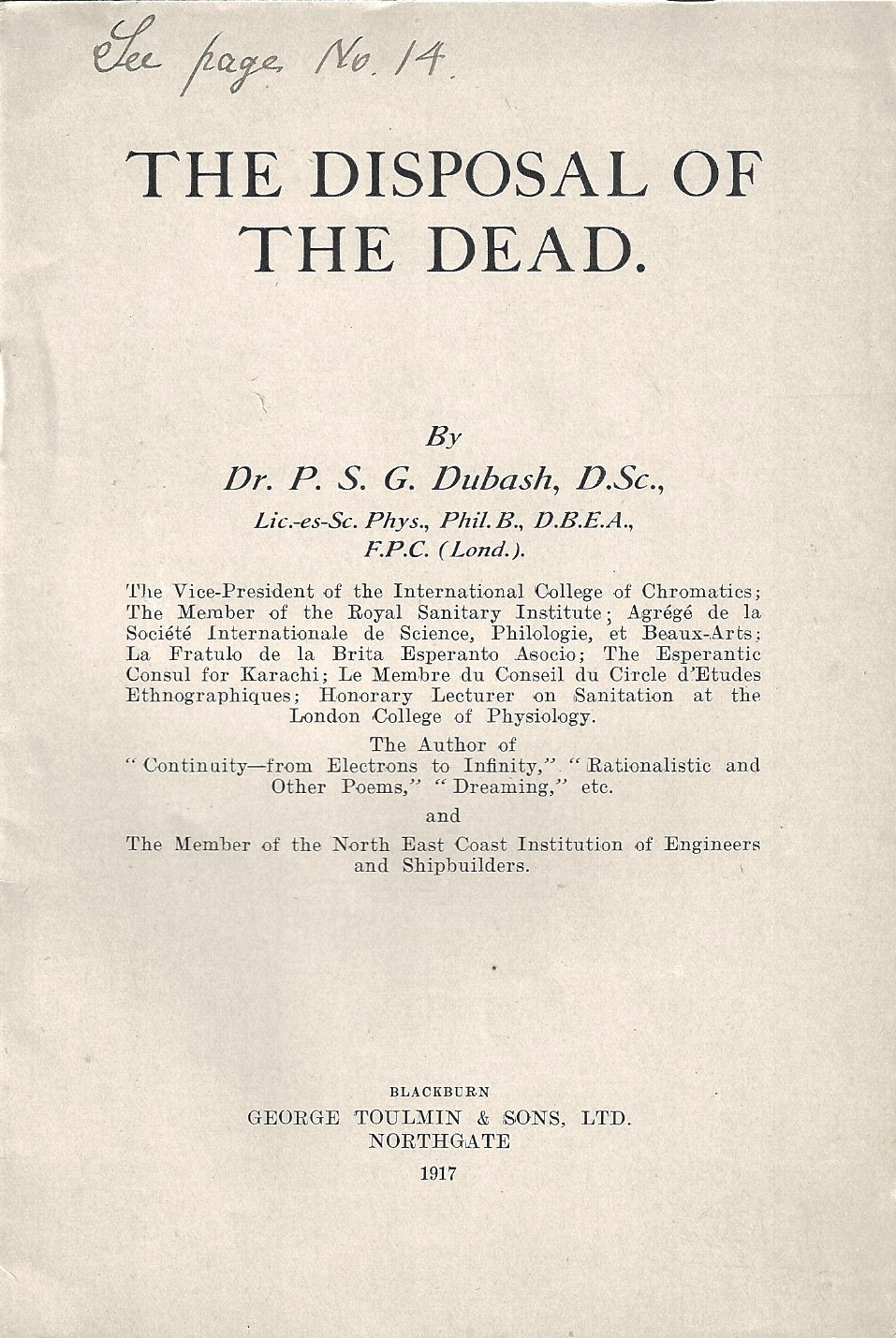
    Books covers disposal deadIn the death-drenched year of 1917, in the third year of the then Great War, P.S.G. Dubash offered to readers here and there the idea of transforming the ashes of the dead into something “useful”, using them as the material for creating statues of the “Great Departed”.  “The world today is so much the poorer for not having the ashes of such great men as Isaac Newton, Lord Kelvin, Martin Luther…”  and so, we can create statues of them using the ashes of others. This would be particularly so for people contributing their ashes to the statue of someone whom they admired. In that way, as Dubash points out, the remains of soldiers would live a more sustained post-death state by being part of a statue of, say, Lord Kitchener. “Towns can be thus adorned with the living memories of the great dead.”

    Part of this 18-page pamphlet (published by George Toulmin & Sons of Northgate) describes the four ways of disposal of the dead: internment, embalming, burning in the open, and the towers of silence (where bodies are brought to a height and displayed to be eaten by birds).  Dubash makes the case of great waste in three of the four, only finding use in the “exposure” category.  

    And so, there you have it. There’s a certain something here that makes sense, using thousands and tens of thousands of remains to create statuary. Gravestones and memorials aren’t made of ashes, but they are reminders of what sleeps underneath, and in a way they are a type of mostly-repetitive statuary sans biological remains. 

    There is an interesting part here at the end of the pamphlet, where Dubash makes the case that “there should be no colour prejudice, because after death there is no colour prejudice, because in the eyes of God the colour prejudice is a sin”. This is a provoking comment, and makes me think of the history of the skin color in Heaven…a history that I do not know.

  • Radio HATE, Stuttgart, 1939/1940

    JF Ptak Science Books    Quick Post

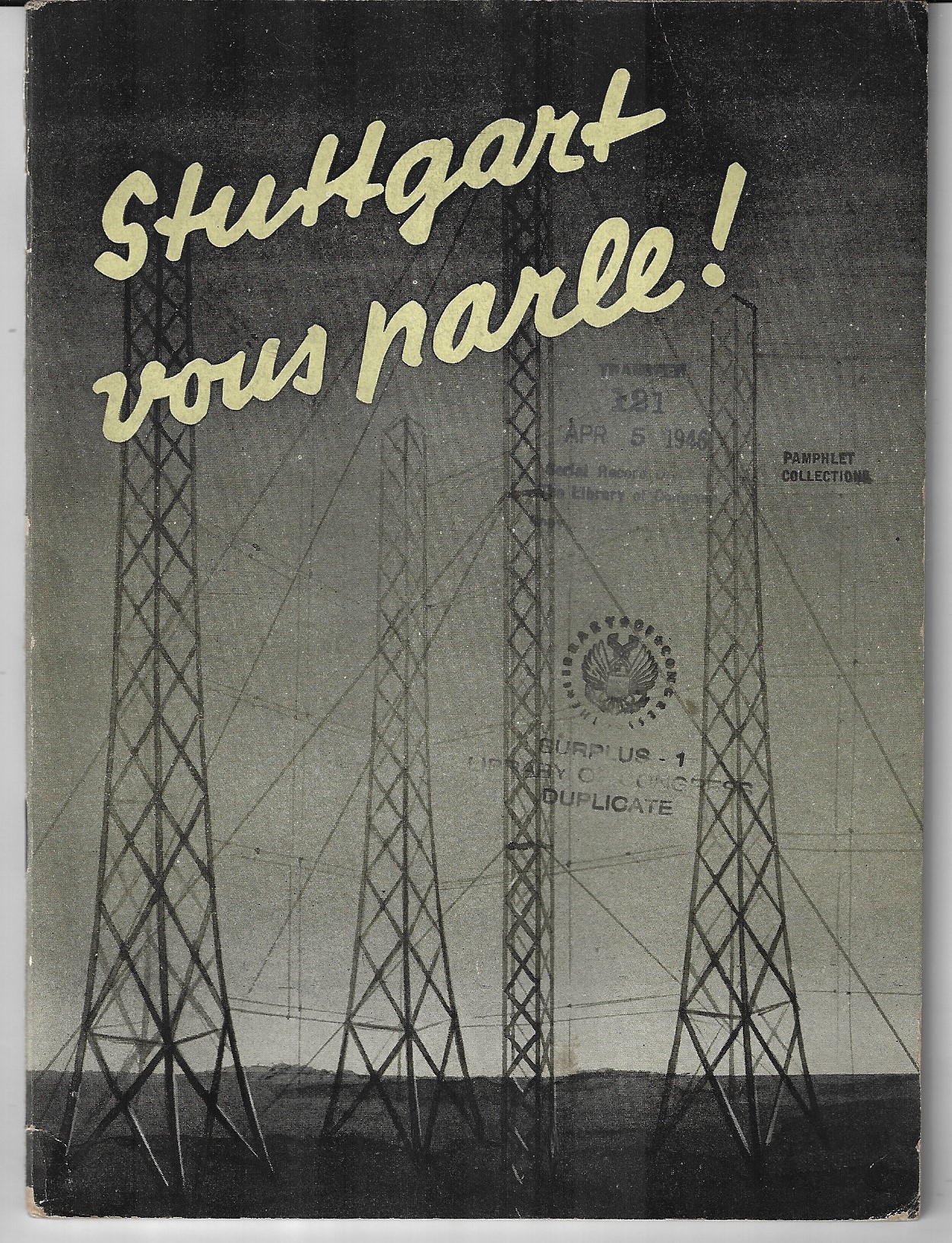
    Books covers stuttgart radioThe pamphlet Stuttgart vous parle! (ca. 1941) is nearly the same name as the Stuttgart radio station/program which was a propaganda arm of the Nazis, broadcasting into France in 1939 and 1940, and progressively less so after the French capitulation. Goebbels was very thorough in controlling the radio and television programming/writing/distribution in Germany, as well as creating propaganda broadcasts into Nazi-occupied countries. There is very little question about where this pamphlet is heading, its pro-German, appeasement, anti-Ally, anti-USSR, pro-Vichy sentiments being very clear.  For an example, here’s a bit from page 30, which recommends the immutability of Mein Kampf:

           “Si en quelques jours, devant l’evidence des menaces et des pieges que l’Angleterre lui tendait, le Reich s’est reconcilie avec Moscou, il faut admettre qu’il n’existe pas d’idees preconcues dans la mentalite du Fuhrer et qu’il dirige la politique allemande au mieux des eventualites. Que ces quelques explications vous fassent saisir ce qu’il y a d’immuable dans mein kampf et ce qu’il s’y trouve de momentane, c’esttout ce que nons esperions aujourd’hui.”

    Experts state that the principal broadcaster for the radio show was Paul Ferdonnet. Captured at the end of the war in Germany, Ferdonnet was tried as a war criminal, a charge he denied, saying that it was not he who was the broadcaster and so on. The court found otherwise, and Ferdonnet (“le traître de Stuttgart”) was convicted and executed in short order, not living to the end of the summer of 1945.

    [There is also a publication Stuttgart vous Parle! Les Discours de Paul Ferdonnet Diffuses vers la France a partir de la Radio Allemande en 1939-1940 (edited by VHO), which seems to state in certain terms that Ferdonnet was indeed guilty of war crimes for his participation in pro-Nazi propaganda. It is also interesting to note that  Stuttgart vous parle!  has no identifying marks for publisher, printer, or place of publication. Nothing.]

    On the one hand, free speech is a big deal; but free speech does not extend to shouting “Fire!” in a crowded theater. (I’m slipping up on the name right now, but there was a case back in the ‘teens of 100+ people, mostly women and children, family of union members, who were meeting in a hall when an anti-union thug yelled “fire!”, starting a deadly stampede.) Working away at the psyche of a people trying to defend itself, trying to survive, is very nasty and murderous stuff. Ferdonnet was executed for this action, a fate escaped by E. Pound for his Fascist broadcasts in Italy during WWII…but all of that is another story. 

    ·Posted by :

    ·in:

  • A Beautiful Diagram of Cyclone Activity (1922)

    JF Ptak Science Books  Post 2750

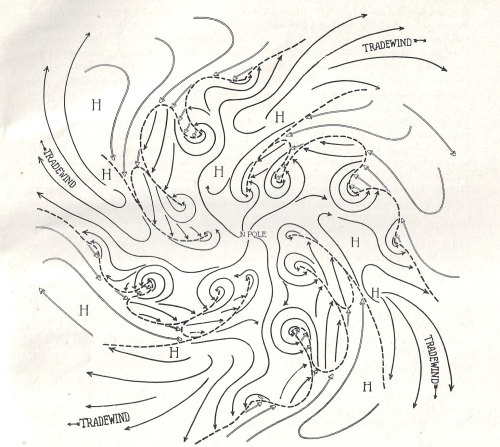
    This lovely and significant piece of sci-art appeared in Jacob Bjerknes and H. Solberg’s  “Life Cycle of Cyclones and the Polar Front Theory of Atmospheric Circulation”1 in 1922. This was an expansion of an earlier paper of 19192, and provided the basis for the motion of the atmosphere in terms of warm and cold fronts. “Although rapid transitions or discontinuities in temperature, pressure, and wind velocity had been noted in Jacob’s first model—and even by nineteenth century meteorologists—and although such discontinuities had been theoretically postulated, the 1919 Bergen cyclone model represented the introduction of discontinuities into meteorology as the major focus for practice and, eventually, theory. These “fronts,” as they later were termed, were endowed with scientific reality through the introduction of major changes in forecasting practice. The cyclone model based on fronts entailed the ability to specify in time and three-dimensional space important weather phenomena associated with cyclones to a much greater degree than earlier models could achieve. During the next few years the Bergen group of Vilhelm and Jacob Bjerknes, Ernst Calwagen, Halvor Solberg, and Tor Bergeron, among others, expanded this preliminary cyclone model and accompanying forecasting methods to a comprehensive system for explaining midlatitude weather changes. The polar front, the occlusion process, an evolving cyclone model, and air mass analysis were the conceptual foundation for a new era in meteorology.”3


    Bjernkes

    The two authors “…pictured the polar front as a string of families of cyclones, described by dashed lines linking successive warm and cold front”.–Mark Monmonier, Air Apparent: How Meteorologists Learned to Map, Predict, and Dramatize Weather, pg 64, with several reproductions of some of the lovely diagrams.

    Notes:

    1. J. Bjerknes and H. Solberg, Life Cycle of Cyclones and the Polar Front Theory of Atmospheric Circulation. Offprint/separate, Geofysiske Publikationer 3, no. 1, 1922. 12×9, 18pp (paginated 1-18). Bound in cloth, with a half-title and title, though no publication data save for a running abbreviation of the journal name and volume above the text. Nicely bound in buckram. Provenance: U.S. Navy, Naval War College. “Polar front theory is attributed to Jacob Bjerknes, derived from a coastal network of observation sites in Norway during World War I. … The convergence line ahead of the low became known as either the steering line or the warm front. The trailing convergence zone was referred to as the squall line or cold front.”–Wiki
    2. This was evidently a longer and more thorough version of a paper submitted by Bjernkes and Solberg to the Monthly Weather Review in 1919 on the findings of the Bergen group. –Robert Marc Friedman, Appropriating the Weather: Vilhelm Bjerknes and the Construction of a Modern Meteorology, p. 180; also noting that this article is “frequently cited”.
    3. Complete Dictionary of Scientific Biography.
    4. Wikipedia entry for Bjerknes. 

    “Bjerknes was part of a group of meteorologists led by his father, Vilhelm Bjerknes, at the University of Leipzig. (“Bjerknes’s father, Vilhelm. has often been called the father of modern meteorology. This title is doubly appropriate, for not only did Vilhelm’s vision and research programs lead to establishing new directions, methods, and the conceptual foundation for the science, but Vilhelm’s son also played a fundamental role in creating this new era in atmospheric science.”) Together they developed the model that explains the generation, intensification and ultimate decay (the life cycle) of mid-latitude cyclones, introducing the idea of fronts, that is, sharply defined boundaries between air masses. This concept is known as the Norwegian cyclone model.”–Wikipedia

    “The “Bergen School of Meteorology” is a school of thought which is the basis for much of modern weather forecasting. Founded by the meteorologist Prof. Vilhelm Bjerknes and his younger colleagues in 1917, the Bergen School attempts to define the motion of the atmosphere by means of the mathematics of interactions between hydro- and thermodynamics, some of which had originally been discovered or explained by Bjerknes himself, thus making mathematical predictions regarding the weather possible by systematic data analysis. Much of the work was done at the Geophysical Institute, University of Bergen, in Bergen, Norway.”–Wikipedia  It should be noted that Jacob was the chief forecaster and head at Bergen 1918-1931.–Complete Dictionary of Scientific Biography

    ·Posted by :

    ·in:

  • Outside Looking Out–Space, 1899.

    JF Ptak Science Books   Post 2751

    Back in 1899 the astronomer Adolphe Duponchel1 published a pamphlet on his very involved theories of the motion of the stars and star clusters and the shape of the universe.  I couldn’t understand much of it, and when I thought about it more, I understood less, and probably less than that. I just couldn’t decide what the idea was that he was trying to decipher and share, except to say that it was big. 

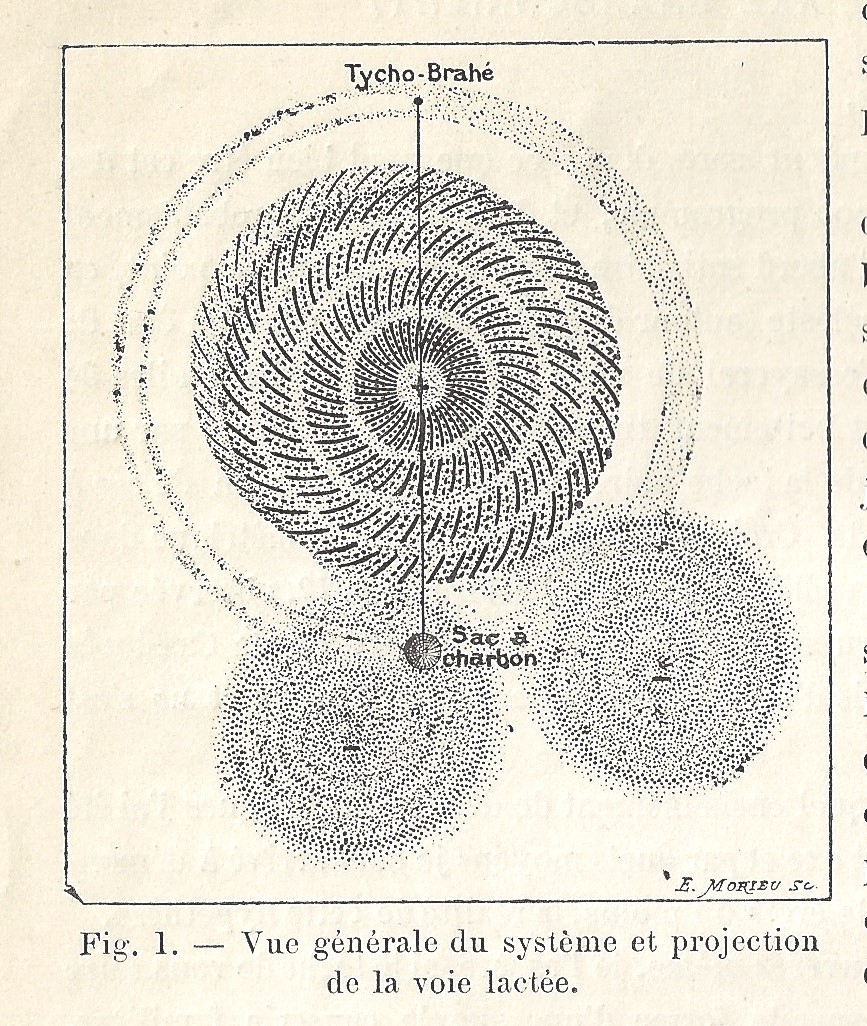
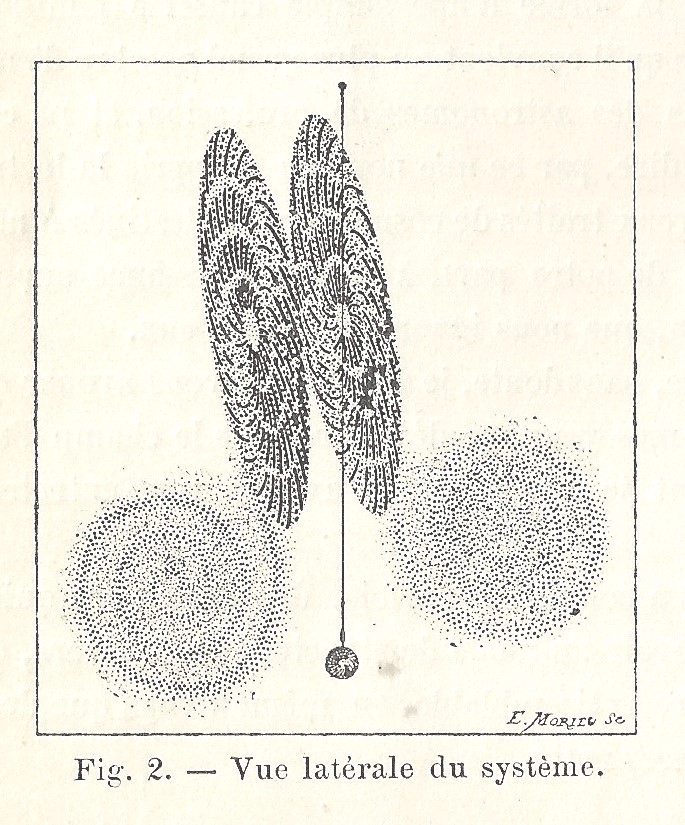
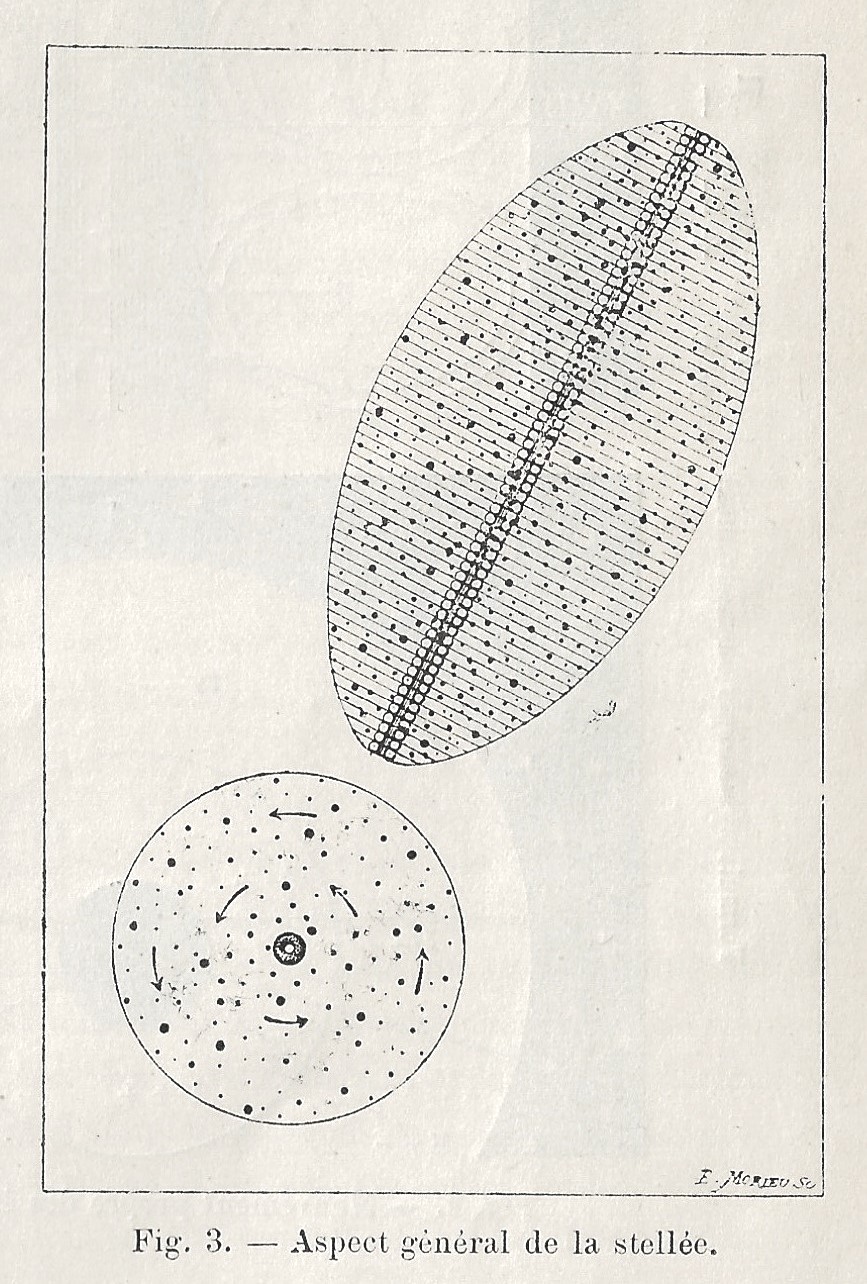
    I wouldn’t have thought about this pamphlet at all it if was not illustrated, because the illustrations in this short pamphlet are quite, well, inspired:

    DocFile (3)

    Duponchel was an accomplished and published civil engineer, canal and bridge builder, and hydrologist, who later in life veered into cosmogony, publishing on the effects of meteors and solar activities on the distribution of stars, the structure of the galaxy, and the motions of the planets. He met with no success from what I can determine, though he seems to have been very active in his starry pursuits through the 1890’s, which was a prime period for French cosmogony. At the very least his ideas look entertaining, and as I said the imaging is quite lovely.

    DocFile (4)

    The truth of the matter is that I do not understand what he is talking about, though sometimes it seems as though he is talking about black holes and the motion of stars, except that he seems to be talking about “apex charbonnier” that are dark regions of space that could not be penetrated given the optics of the day. In general though he writes about what effects the “circulation” of the stars and star clusters.  Liberally translating he states that “no astronomical problem could offer more interest, and in the absence of a solution of a rigorously demonstrated accuracy can be I am happy to have arrived at finding a plausible and at least probable explanation of the simultaneity of all these coordinated movements in the same state of general equilibrium.

    After this very pro forma and enormous statement, we arrive at the unknown stuff of his insight: 

    “…points noirs isolate correspondent a des rayons visuels qui auraient traverse les mailles des deux reseaux sans rencontrer aucune etoile sur leur passage. Dans une seule direction, sur un espace sans doute assez restreint, mais parfaitement defini par son contour piriforme, cette illumination fait reellement defaut.” (“Isolated black/dark spots correspond to visual rays that would have passed through the meshes of the two networks without encountering any stars in their path. In one direction, on a space which is doubtless rather small, but perfectly defined by its “piriforme” outline, this illumination is really lacking.” The translation doesn’t help the original too much, which left me understanding nothing.

    Then, a few pages later, he writes: 

    “…étudier ici tapissant en quelque sorte les parois du vide de l axe s y trouveraient distribuées en anneaux ou pour mieux dire en tores successifs dont chacun correspondrait à une strate particulière en forme discoi dale d étoiles extérieures. Ces to res successifs (figs 1+2) correspondant aux sphères magnétiques qui accompagnent les noyaux solides du Soleil et des planètes comprendraient chacun un certain nombre d étoiles circulant autour de l axe du tore avec un mouvement de rotation ac célérée en spirale comme celui des sphères magnétiques mais avec des vitesses alternativement de sens direct et de sens inverse de manière à assurer des vitesses concordantes de même direction aux points de tangence de deux tores consécutifs…” Or, “Firstly, to study here somehow lining the walls of the void of the axis would be distributed in rings or, to put it better, in successive tori, each of which corresponds to a particular stratum in the form of a disc of external stars. These successive rests (fig 1+2) corresponding to the magnetic spheres that accompany the solid nuclei of the Sun and planets would each include a number of stars circulating around the axis of the torus with a spiral arc rotational movement like that of the magnetic spheres but with alternately direct and reverse direction so as to ensure concordant speeds of the same direction at the points of tangency of two consecutive tori…”  Again, a not-good translation, but I really didn’t have much of an idea of what he was writing about. 

    DocFile (1)

    The pictures are pretty.

    If I’m missing something big, please let me know.


    Notes:

    1. Adolphe Duponchel,  “Circulation de notre groupe stellaire autour de l’axe charbonnier et mouvement parallactique de l’apex Solaire”. Printed by the author, in Paris, 1899, from its appearance in Societe Astronomique de France, 1 March 1899.  9×6″, 18pp.  WorldCat/OCLC reports 1 copy in the U.S. And either 1 or 3 copies at the Observatoire de Paris—otherwise there are no other copies of this work located. Provenance: Smithsonian Institution, and then the Library of Congress (small mostly-faded oval stamp for the SI on front cover, and the LC surplus stamp on the back cover).  

    “Et les individus qui participent à cet engouement pour la quête des origines cosmiques n’épargnent ni leurs efforts ni leur temps pour développer, étayer, rendre publique, et faire reconnaître leurs théories. Ainsi, l’ingénieur des Ponts et Chaussées Adolphe Duponchel (1821-1903), après avoir déposé un pli cacheté à l’Académie des sciences le 27 mars 1893 contenant le sommaire d’une brochure exposant ses « Principes de cosmogonie générale », fait imprimer celle-ci à ses frais et l’envoie à l’assemblée savante. Il n’obtient aucune réponse mais persévère et soumet six Notes ou Mémoires à l’Académie sur ce sujet entre 1893 et 1894. Ne parvenant pas à obtenir le soutien académique qu’il recherche, Duponchel va finalement publier sa théorie dans des revues populaires de science, d’abord dans la revue Cosmos le 2 septembre 1893 puis, sous une forme augmentée, dans la Revue Scientifique les 28 juillet et 4 août 1894.”Volny Fages, “Dire l’origine scientifique des astres. L’engouement pour la cosmogonie en France dans la seconde moitié du XIXe siècle”https://www.cairn.info/revue-romantisme-2014-4-page-32.htm

    See:

    ASTRONOMES FRANÇAIS 1850 – 1950 D’ABBADIE, Antoine.  www.obs-hp.fr/dictionnaire/astronomes_A-Z.pdf

    See: Agnes Mary Clerke , A Popular History of Astronomy During the Nineteenth Century, p 202, a review of some of the later 19th c solar astronomers.

    ·Posted by :

    ·in:

    — —
  • The Art of Arithmetic–Numbers on a Stick Calculator, 1936

    JF Ptak Science Books   Quick Post

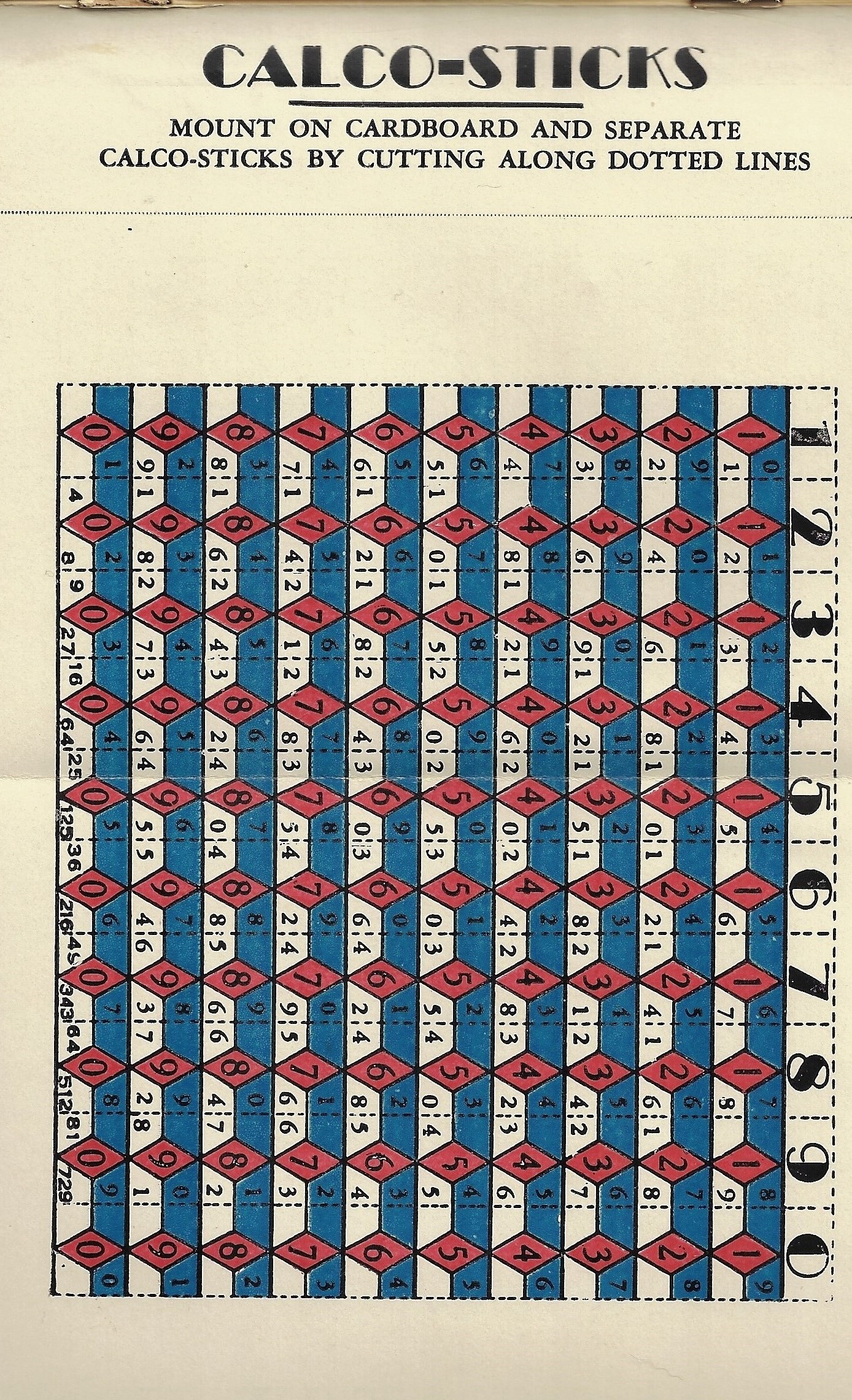
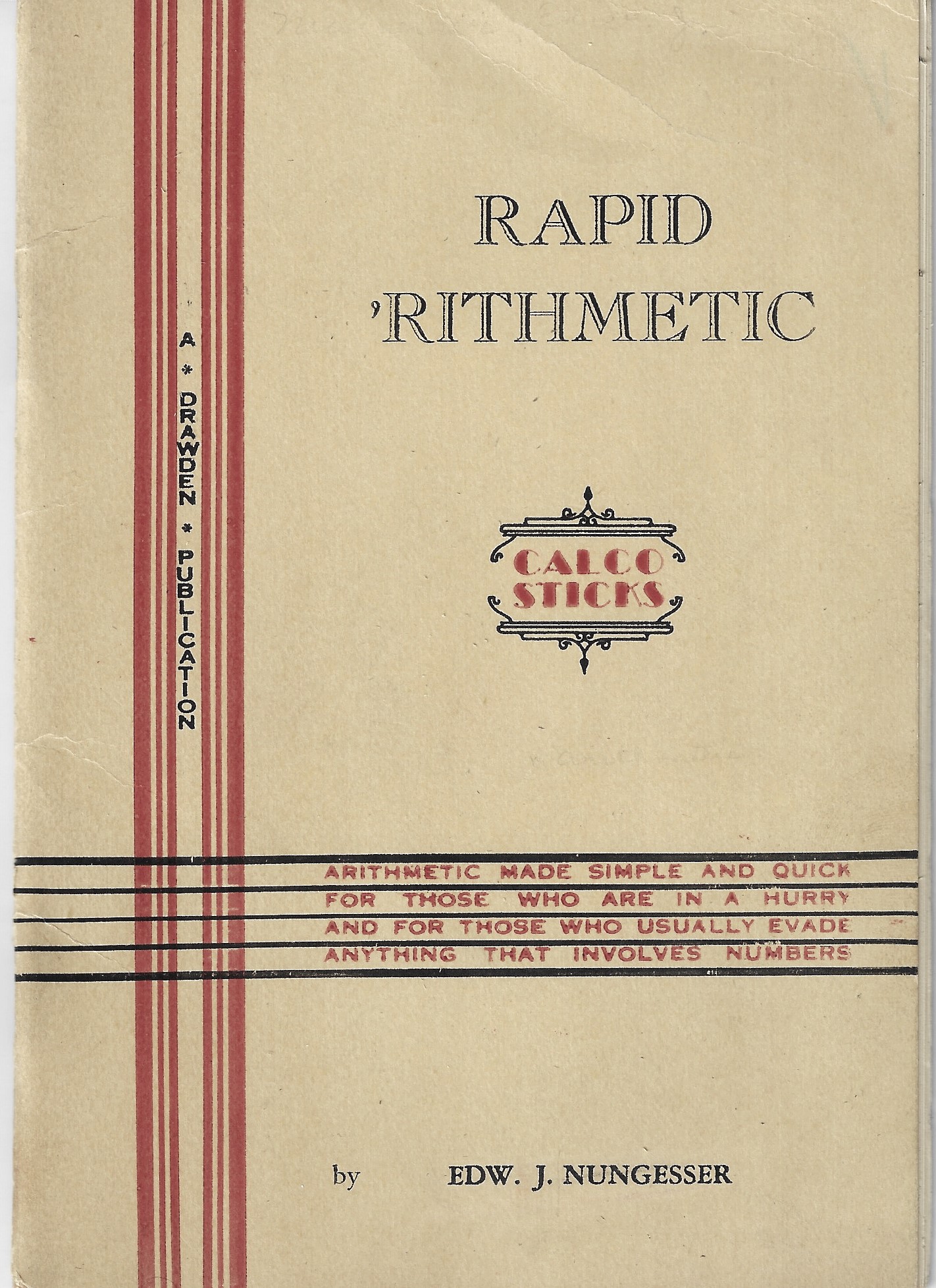
    Here’s your chance to download a DIY cardboard reckoner. I think it would be much more satisfying to do the arithmetic by hand, or use your phone-device, or just call up The Internet and ask it to divide some number y by some number x, but that’s not the point. Making it would certainly be a pleasure of some sort because the Napier-like sticks/bones are such a lovely assemblage. And of course all hats off to the person who created the thing to begin with–and I assume that person to be the author of the little pamphlet in which the calco-sticks are found. Edward J. Nungesser published Rapid ‘Rithmetic/Calco Sticks (Arithmeic Made Simple and Quick for Those who are in a Hurry and for Those who Usually Evade Anything that Involves Numbers). It was published by Drawden Publications of 7 W 44th St NYC in 1936, and is a pocket-sized 5″ tall and 32pp thin. In any event, I really like this little guy, and I think Mr. Nungesser did a fine job. (I tried to find references to him but came up empty; for an instant I thought his name but be a pseudonym (“No Guesser”) but I’m pretty certain that this is not the case. Also there is no sign of it at all on WorldCat/OCLC.)


    DocFile (5)

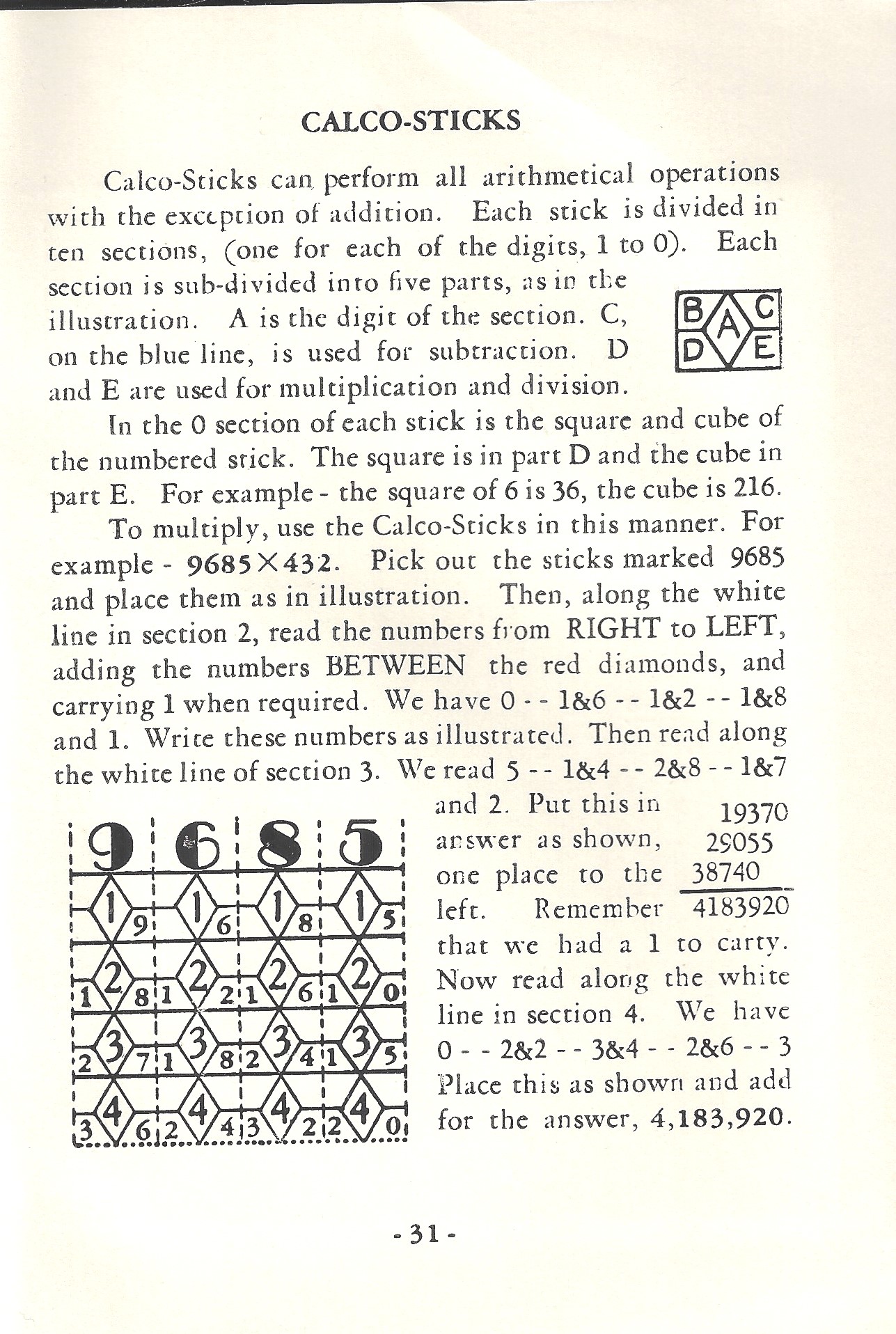
    And the instructions:

    DocFile (6)

    And the wonderful cover:

    DocFile (7)

    ·Posted by :

    ·in:

Recent Posts

Archives

Categories