A Daily History of Holes, Dots, Lines, Science, History, Math, Physics, Art, the Unintentional Absurd, Architecture, Maps, Data Visualization, Blank and Missing Things, and so on. |1.6 million words, 7500 images, 4.9 million hits| Press & appearances in The Times, Le Figaro, Mensa, The Economist, The Guardian, Discovery News, Slate, Le Monde, Sci American Blogs, Le Pont, and many other places… 5000+ total posts since 2008.

  • Striking Artwork from the Wobblies, 1933

    JF Ptak Science Books   Quick Post

    • I’ve been mostly on a sabbatical this summer.  The blog will return to its normal output of 20-40 posts per month by September.

    This is  fantastic artwork is for the cover of the pamphlet The General Strike for Industrial Freedom which was printed in Chicago in January 1933 by the Industrial Workers of the World (the Wobblies).  The IWW was pretty far left–okay, very far–and was founded in 1905 by Eugene V. Debs, Mary Harris “Mother” Jones, William D. (“Big Bill”) Haywood, Daniel De Leon,  Thomas Hagerty, Lucy Parsons,  and others.  By the ’30’s membership in the organization was off probably an order of magnitude, its heyday more “day” than “hey”, its flash gone. Also the Great Depression hurt membership, as well as the coming and fighting of WWII.  In this instance, there was no one particular “general strike” that was being advanced, but (so far as I can tell) the idea of a general strike itself was being explained. Not only was the strike about a general work stoppage across multiple industries, but also advocated the seizure of industries/factories/properties by the workers to fight oppression and Fascism. 

    The artwork for this work, though, was terrific. 

    Books covers general strike red

    ·Posted by :

    ·in:

  • A Note on Dragging Ships (1) Over a Mountain and (2) Over Land

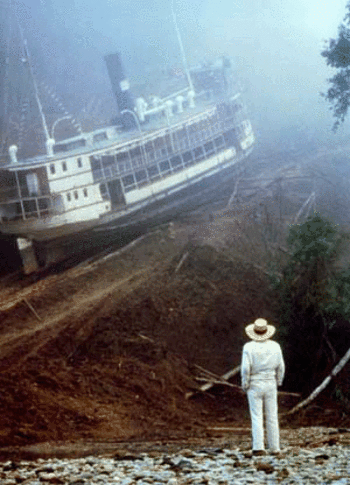
    Blogbig_sciencefitz[This is an expansion of an earlier post on Herzog.] In 1982 Werner Herzog, in what may have been the culmination of a weirdly fashioned and irresistible death-wish effort, released a film that he wrote and directed:  Fitzcarraldo.  It is a spill-over big, magnificent film about a would-be ice-making rubber baron bringing an opera house into the trans-Andes, trying to make his way into the dense forest in a huge (320 tons) steamboat on the Amazon to stake a claim in exploiting previously un-leased lands filled with rubber trees  The problem faced by Fitzcarraldo (played by the probably-slightly-insane Klaus Kinski1–just see Herzog’s 1972 Aguirre, Wrath of God and you’ll know what I mean) is that his path is blocked by unnavigable rapids–he can however reach his destination by hauling his very large ship up and over a mountain to get to a more pliant river and then to his goal.  Herzog actually does this for the film–no digital anything here2,3–in what is one of the most glorious things I’ve ever seen in the movies.  He really does have native people clear a path up the side of a mountain, and they DO haul this ship up and over.  It is truly magnificent, especially seeing the boat moving slowly up a mountain as background to a sweating Fitz.  

    The story is partially based upon the adventure of Carlos Fermín Fitzcarrald, who in 1890 attempted a similar feat, though with a much smaller vessel, and who also dismantled the craft to haul it overland. (Its not a bad idea, necessarily, to do this dismantling thing, especially if it has to be done and there’s no other way to do it. The North Vietnamese famously did the impossible by hauling artillery up through the jungle and up mountains to shockingly surround the French at Dien Bien Phu.) 

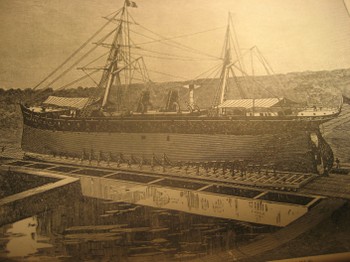
    Blogbig_sciencefitzcarraldo    The bigger and deeper back-story though is the effort–mainly by Elmer Corthell and James Eads–to build a combination railroad ship canal across the Tehuantepec isthmus in Nicaragua.  The idea of moving across Central America rather than taking the enormously long route around the tip of South America and up again is hundreds of years old.  The Corthell/Eads plan, begun in 1870’s and alive in the early ’80’s, was really the first feasible (and workable) initiative.


    Blog_big_large_ship

    It would have been a gigantic undertaking, and even though it was much longer (130 miles or so)  than the more-favored Panama location for the canal, it seemed more workable as there would be less digging and no need for a lock/canal system as required at Panama. 

    The French began a doomed attempt at conquering Panama shortly before this.  Ferdinand de Lesseps tried to build a canal in 1880, but the organization and general construction plan was truly inferior; also, the sanitary and medical conditions were terrible, with the French losing perhaps 22 thousand men in the failed process to disease (mainly malaria).  (The United States would lose 5,609 workers while building the Panama canal, on land granted as a payback for “helping” Panama release themselves from Columbia.)

    Blog_big_closeup

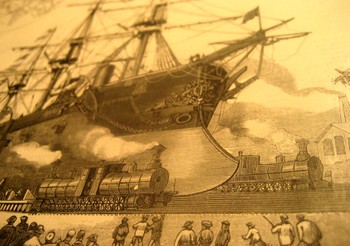
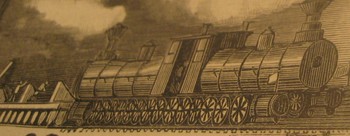
    The Corthell/Eads (who by the way was a master builder perhaps best known for his inspired masterpiece of a bridge at St. Louis) plan called for hauling the ships up and out of the water in a short canal and placing them on an enormous floating roundabout; the roundabout would then be raised, and the ship place on huge cradles borne upon vastly augmented railway lines.  Once on the cradle, the ship would be pulled and pushed by a team of four large locomotive teams which were in turn composed of two large engines.  Happily aboard, the ship would then be taken on the extended, expanded wide and augmented rail 130 miles overland and dumped into the Pacific.

    It was evidently not a workable deal all the way around, though, as the U.S. decided on the new Panama to works its engineering miracle.

    Blog_big_big_closeup

    There is something pleasing though about the Ship Railway, though, something that appeals to the little bit of Mr. Herzog in me.  Perhaps it was the appraisal of the very stiff-lipped Sir Edward Reed–who was the former master engineer for the British navy and consultant to Eads—that makes it all so irresistible.  “It would be best to avoid a very high rate of speed” when hauling the massive ocean-going and heavily laden cargo ships.  Indeed.

    Oh, wait: there’s also this example:

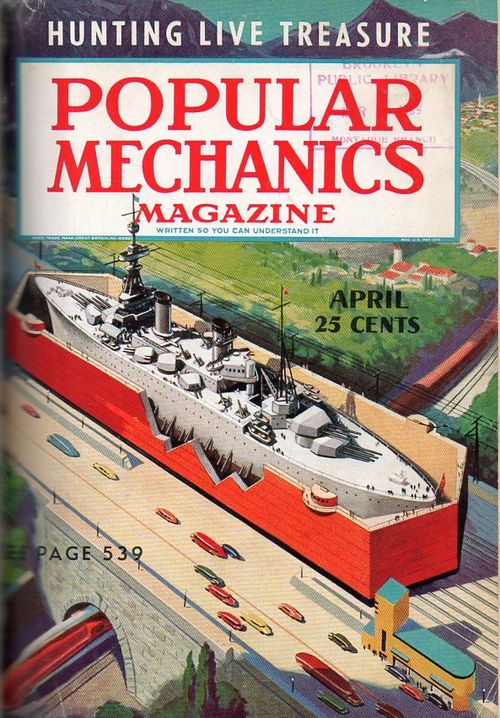
    This fantastic cover appeared in Popular Mechanics, volume 71 (1939, right at the brink of doom), and showed a devotion to a monumental idea of dragging enormous ships by rail from the Atlantic Ocean to the Mediterranean Sea.  It was to be 300 miles long, and what looks like 125′ wide, connecting Port le Verdon and Beziers, putting down the 1,200-mile Bay of Biscaye/Gibraltar/Mediterranean route. It seems a kind of mobile Maginot Line, except this bad idea wasn’t constructed. 

    Ship overland

    Notes

    1. The original actor in the Fitzcarraldo role was Jason Robards, who had to give the film up after about a third or so the way through as he came down with dysentery. Kinski came into the role after that, and the film was re-shot. 

    2. There is a scene showing the steamboat being unmoored and sent down the rapids on its own–that is done with a model. So far as I know, that is the only bit of post production trickery for the film. 

    3. There’s an interesting documentary of the film also released in 1982, Burden of Dreams.

    ·Posted by :

    ·in:

  • A Glorious Issue of Scientific American featuring NYC (1908)

    JF Ptak Science Books   Quick Post  

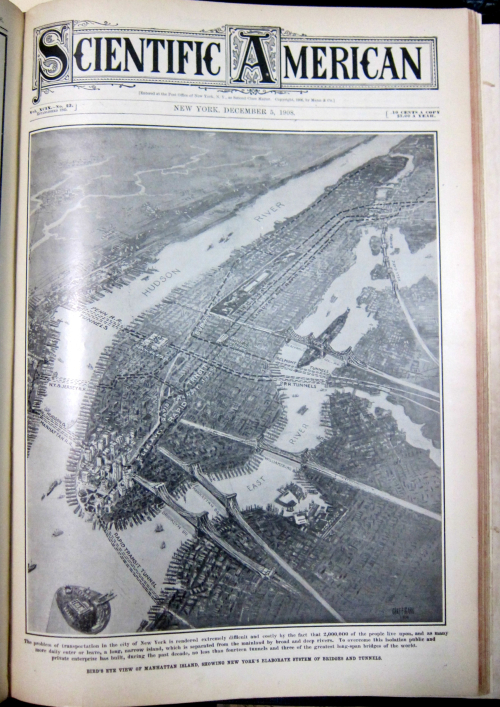
    I don’t have that much to say about the series of images that I found in the 5 December 1908 issue of Scientific American–except for “Wow!” Sometimes that is about all I can manage, and that’s fine. (Richard Feynman, on witnessing the Alamogordo test shot in the desert in 1945, simply said “hot dog!”, which was quite a distance away from Oppenheimer’s reaction, and one which I like more.) Anyway, opening up the volume and by chance opening to this full-pager was very pleasantly surprising, and this from a journal which was very successful in achieving their constant goal of being “surprising”. 

    And as you can well see, “wow” can be shared:


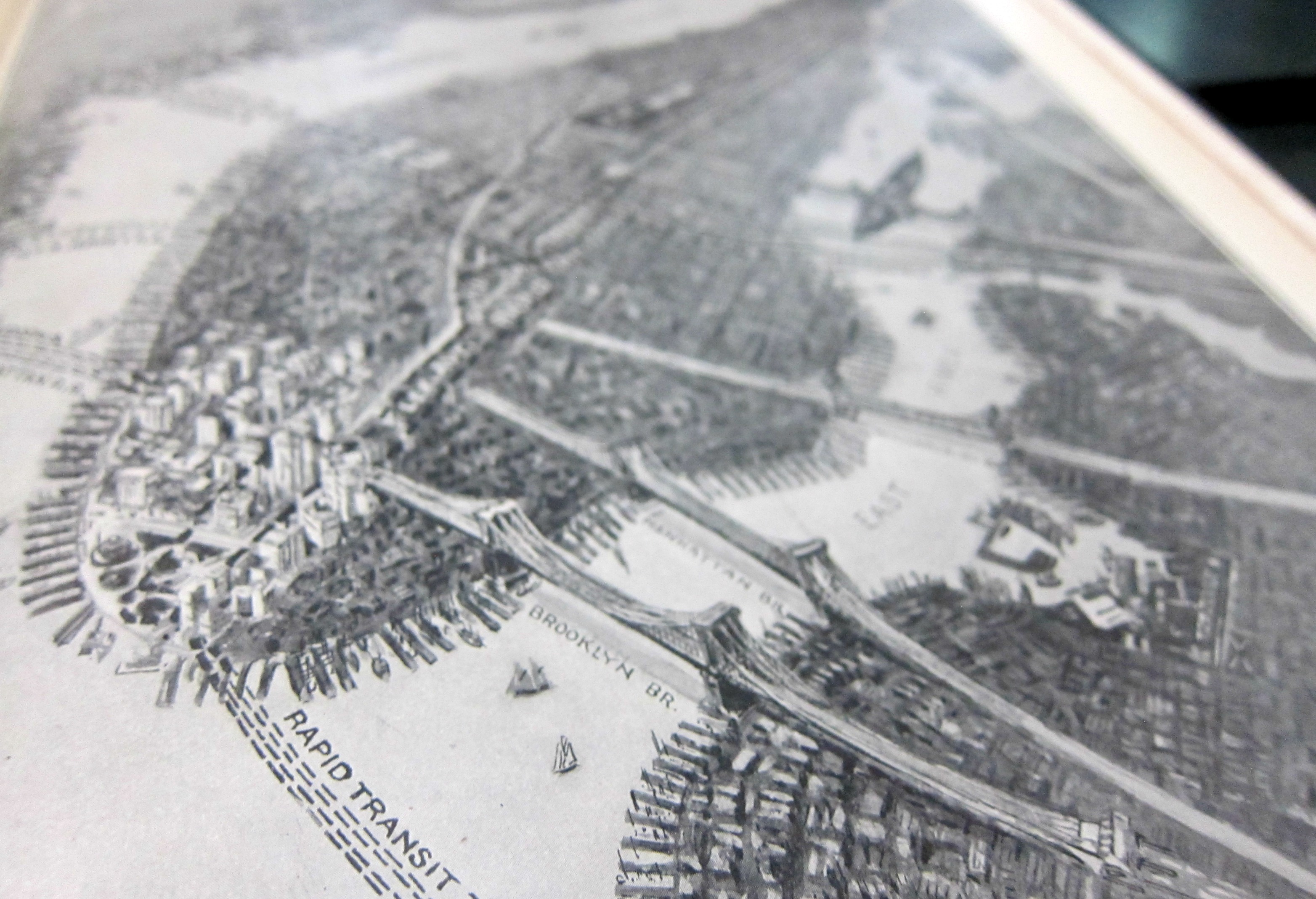
    NYC Sci Am map 3d detail

    The bird’s-eye view has a peculiar 3D sense to it–you could make any of the bridges pop to life by changing your angle of perspective, like so:


    NYC Sci Am map 3d detail


  • The Human Buoy (1877)

    JF Ptak Science Books  Quick Post

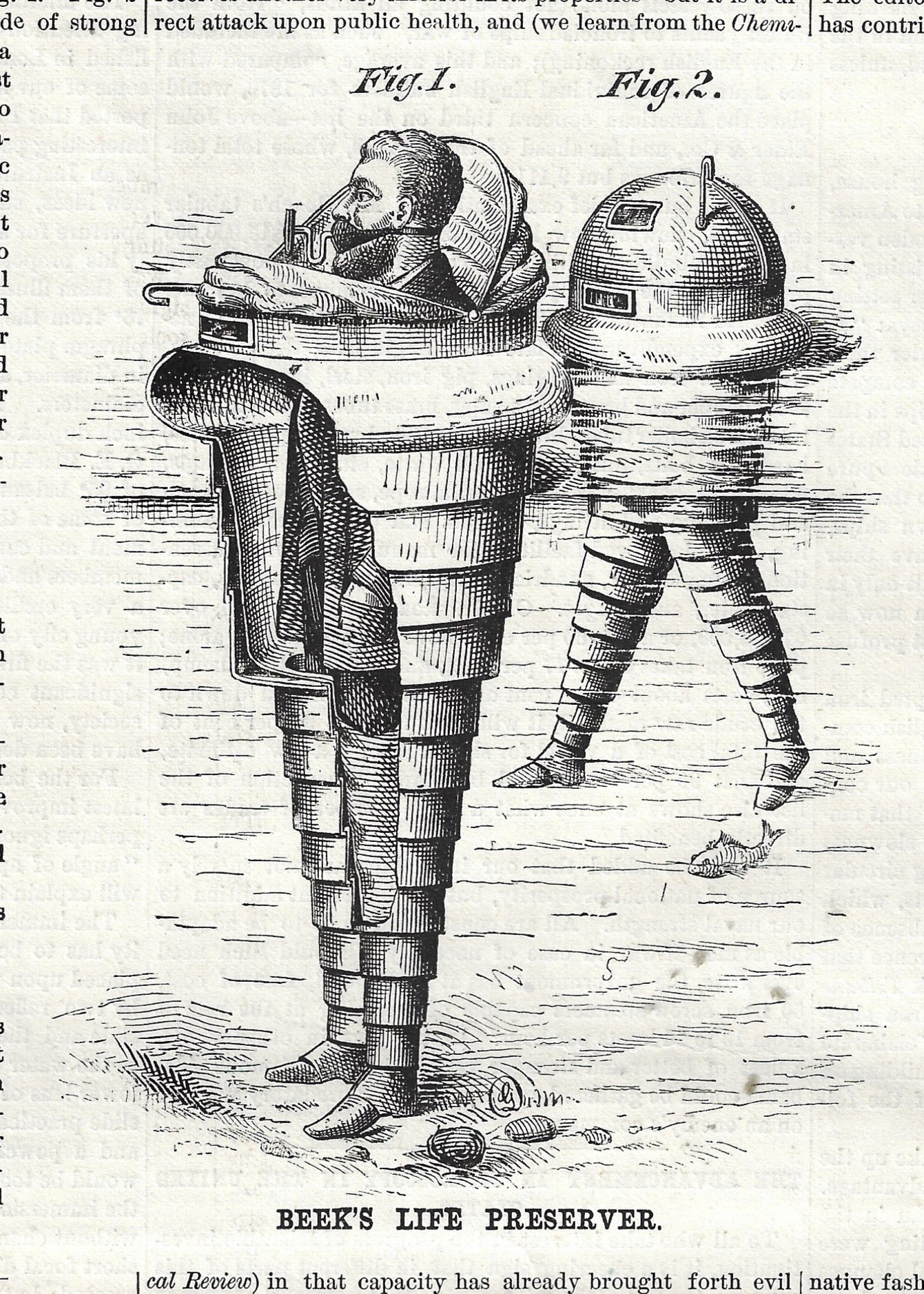
    1876/7 were pretty good years for science and technology (though a poor one for U.S. presidential elections): there was the telephone, cathode rays (Eugen Goldstein), John Draper’s photography of the solar spectrum, Berliner’s microphone, Boltzmann’s 2nd Law, and so on. In the middle of the Scientific American for 1877 there were two articles on the telephone and the Grant calculating machine, and in between these two articles was another less important but still fascinating and unexpected story on the human buoy:


    Sci Am 1877 full body buoy

    Well, it really wasn’t a buoy though it behaved like one–the real cause to action here was a survivor suit. It was a big, armless version of Robbie the Robot, a roomy and I guess somewhat versatile suit that one could jump into and then would float around in like a dud torpedo. What caught my attention with the thing was that there was food and drink enough in it for a person to live a month (“if need be, in safety and comfort”). Source: Scientific American, 5 May 1877, p. 274l, and invented by the wonderfully-named Traugott Beek, of Newark, NJ.  


    ·Posted by :

    ·in:

  • The Mundane Glory of Pig Bristles, Hooking, and the Mystery of Filters–Pamphlet Covers, 1930s

    JF Ptak Science Books  (Expanding on an earlier post)   Blog Bookstore  

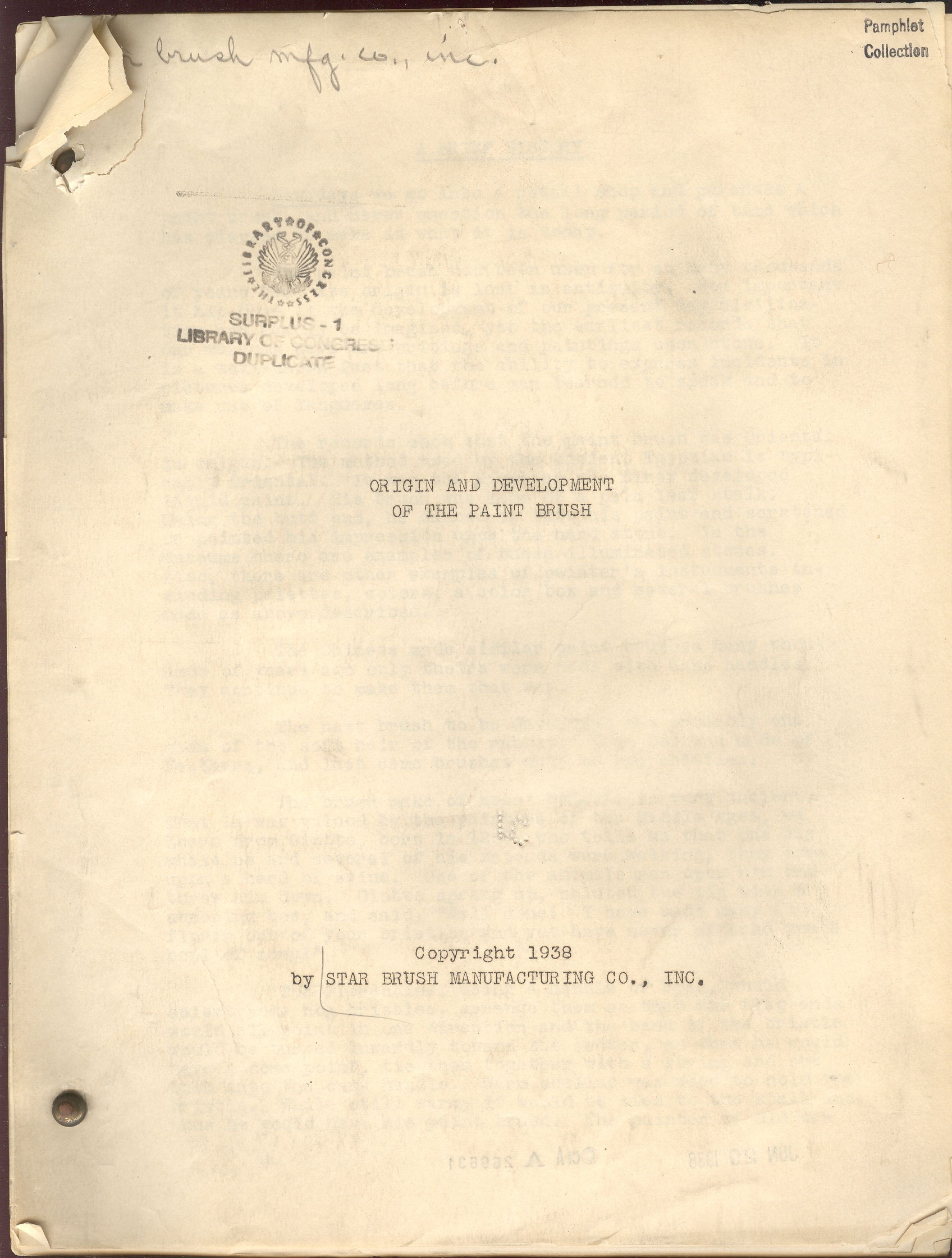
    Books covers origin paint brushI wonder what is was like to be a traveling salesman hauling around hundred-pound barrels of pig bristles?

    We don’t really find out the answer to that question in Origin and Development of the Paint Brush (1938), but that remarkable, far from the maddening crowd question does present itself in the text.  And that is why I love pamphlets like these.

    Spending my professional life with the book, and being a reader, I’ve come into contact with and have been exposed to a good, solid, Big  Number of books, a Big Book of Big Numbers of books.  And so when the unusual creeps in or is stumbled upon, they shine like little novas in my book-sky.  And the ones that shine with their own special light are the titles come in three favorite flavors:  the Sublime Mundane, Outsider Logic, and Fantastic (and Impossible).  Today’s selection are from the first category, and exhibit titles and texts that look like non-luminous and uni-dimensional but turn out to be anything but mundane.

    Earlier in this blog I’ve written on pamphlets entitled Flagpole Painting, School Safety Pioneers, Fortunes to be Made with Frogs, Where are the Dead?, How to Repair a Zipper, Mud’s Romantic Story, Soap in Everyday Life, The Fine Art of Squeezing, Salt Salesman’s Manual, Know Your Groceries, The Book of Envelope Facts (and others), and they’ve all shown a terrific inner quality that is completely hidden by their so-sleepy and yet strangely-compelling titles.  Like the paint brush history pamphlet.  Here are a few other new examples:

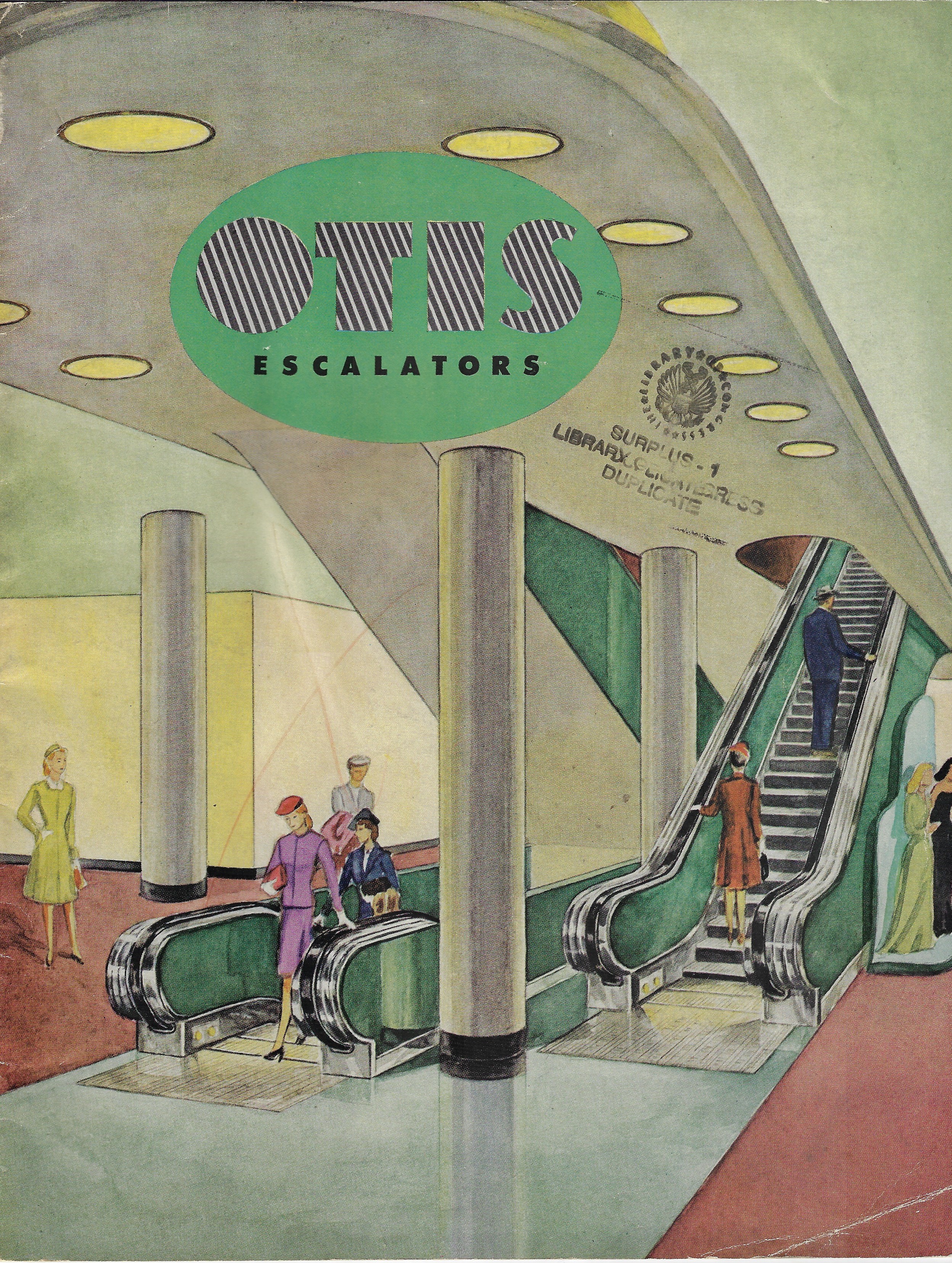
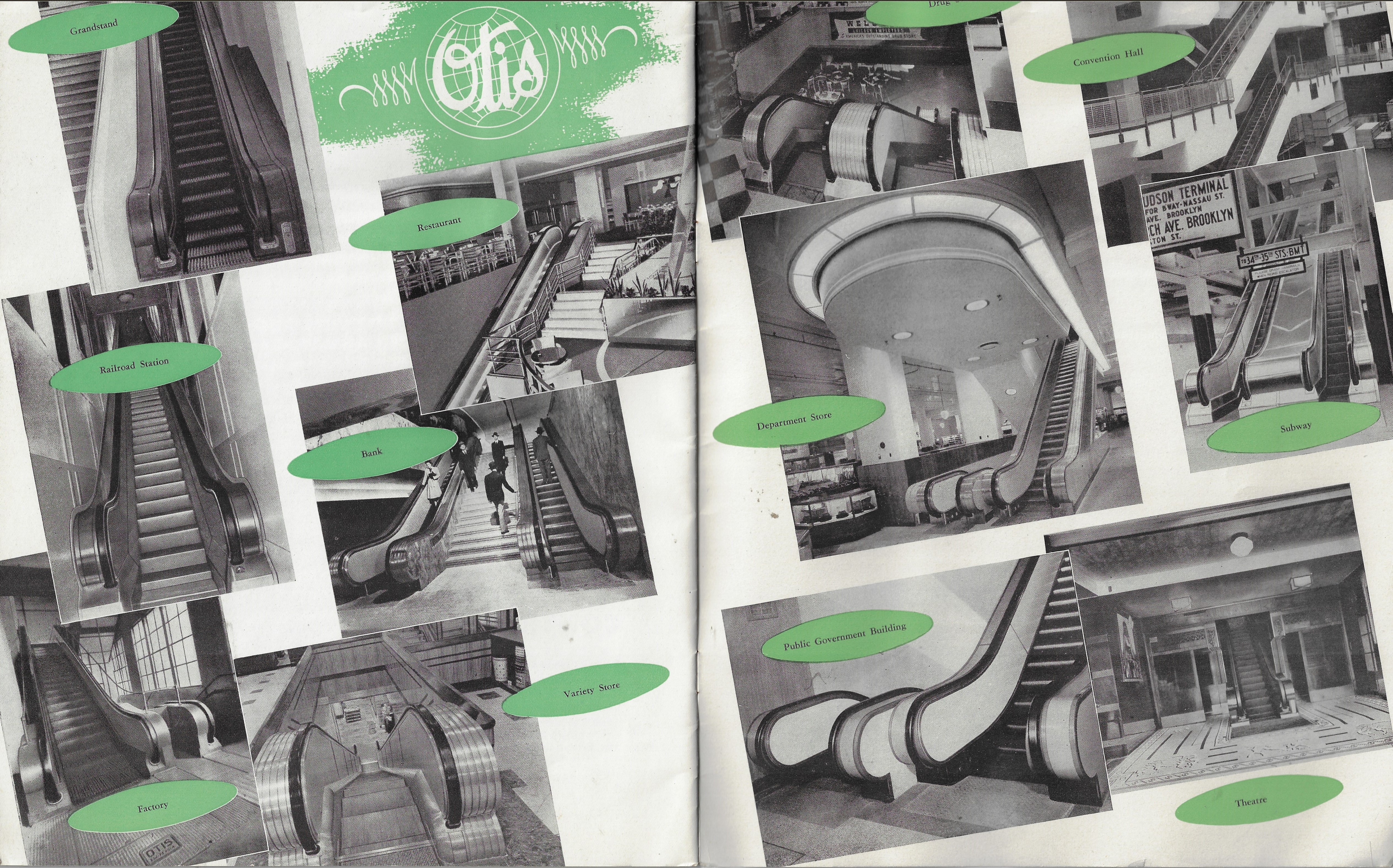
    The Otis Elevator pamphlet (1947) is efficiently designed beneath its semi-bizarre cover, floating in odd typeface, completely lifeless design, mannequin humans, and washed-out pastels.  The Chinese coloring book style of its covers hides a superior content, complete with schematics and beautifully supplied with photos of elevators long-since removed from sight and memory. 

      Books covers otis

    Books covers otis _2_

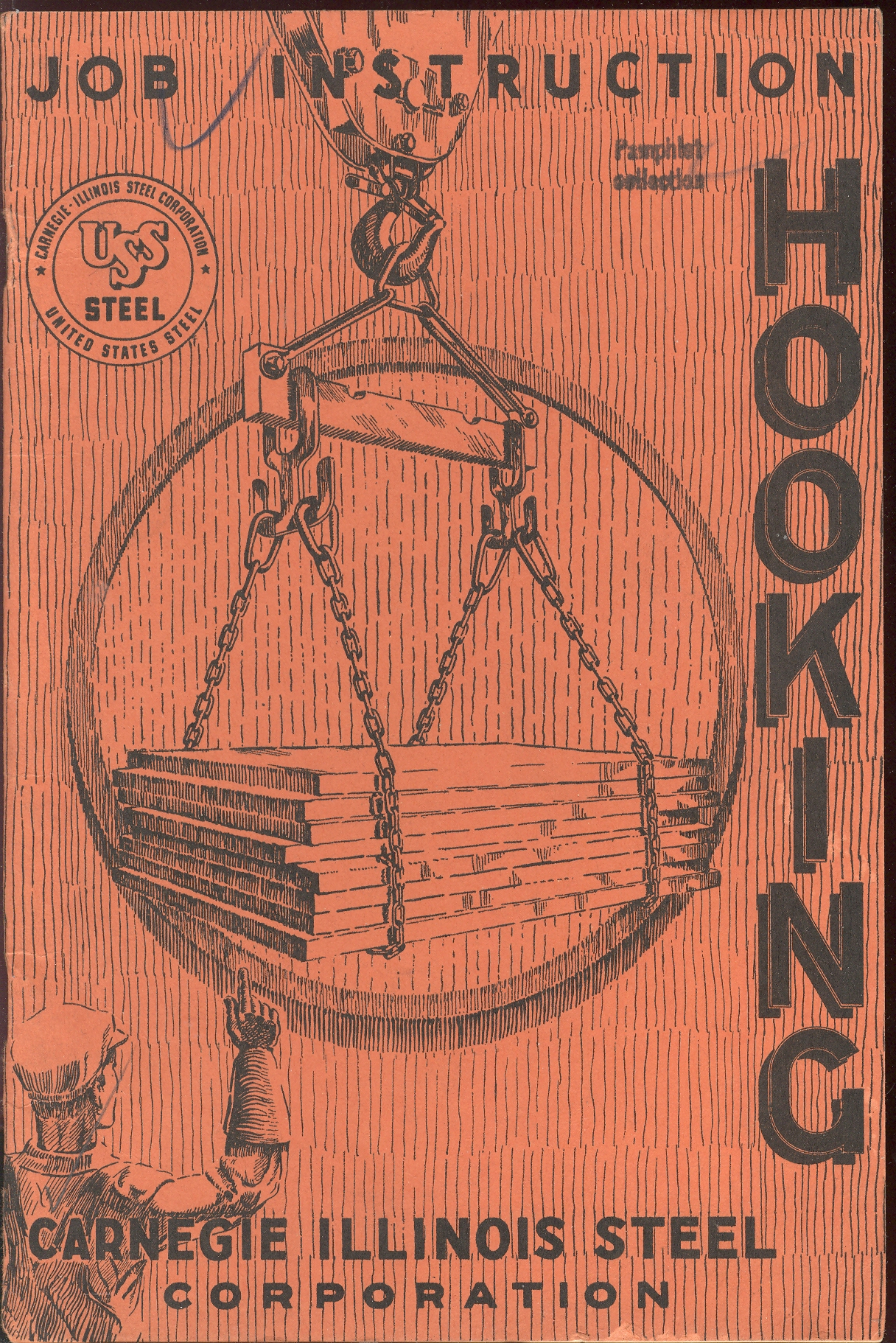
    The Hooking pamphlet is not about its obvious contemporary counterpart, but is a luminous, luxurious introduction and stylizer to the science of hooking large objects to cranes via giant hooks and chains, and especially about how to keep yourself from being  crushed by tons of steel not hooked properly. 

      Books covers hooking

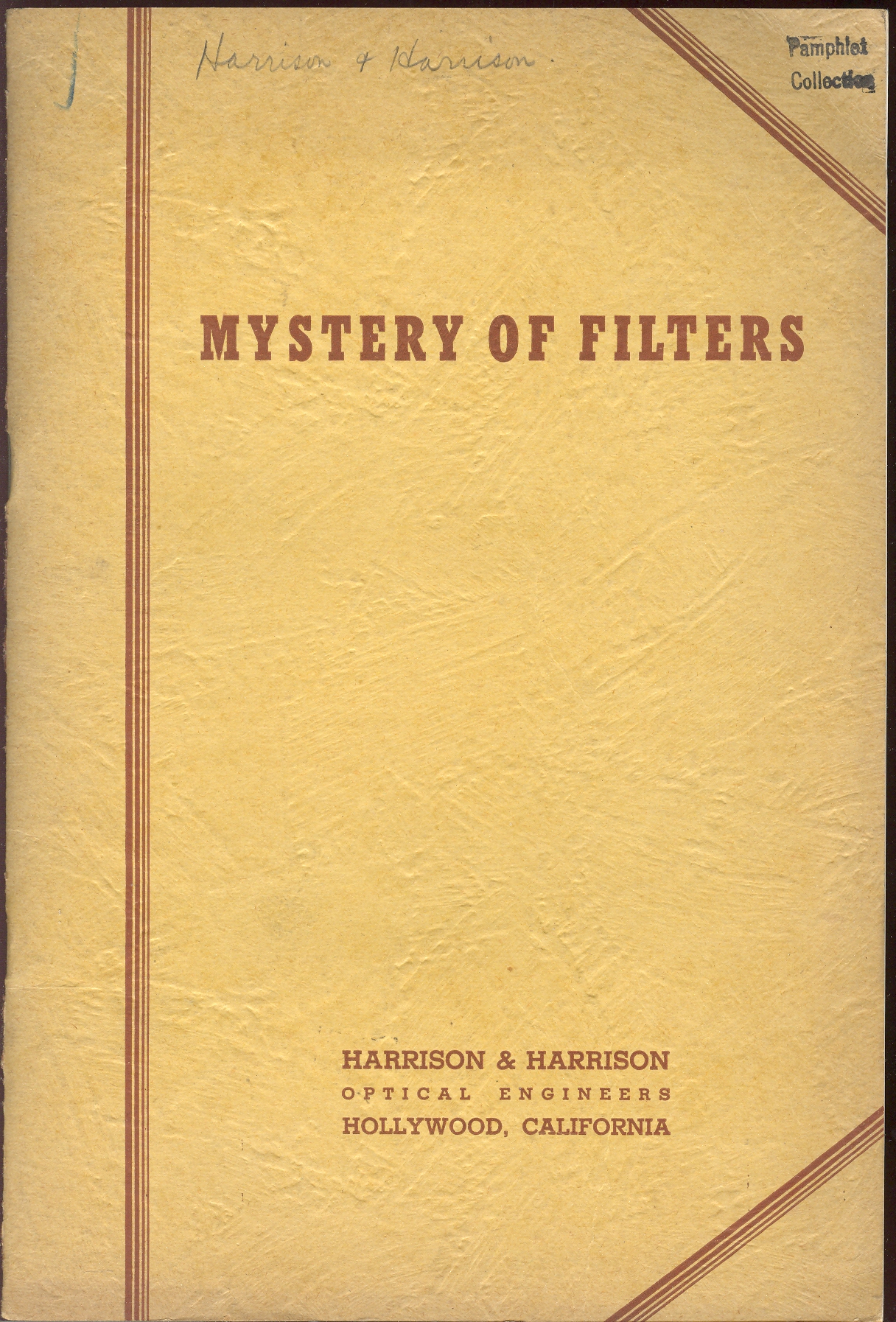
    The Mystery of Filters charm is wholly in its title and cover design, its text describing nothing but camera filters.  It is still a cool cover, nonetheless.

      Books covers mystery filters

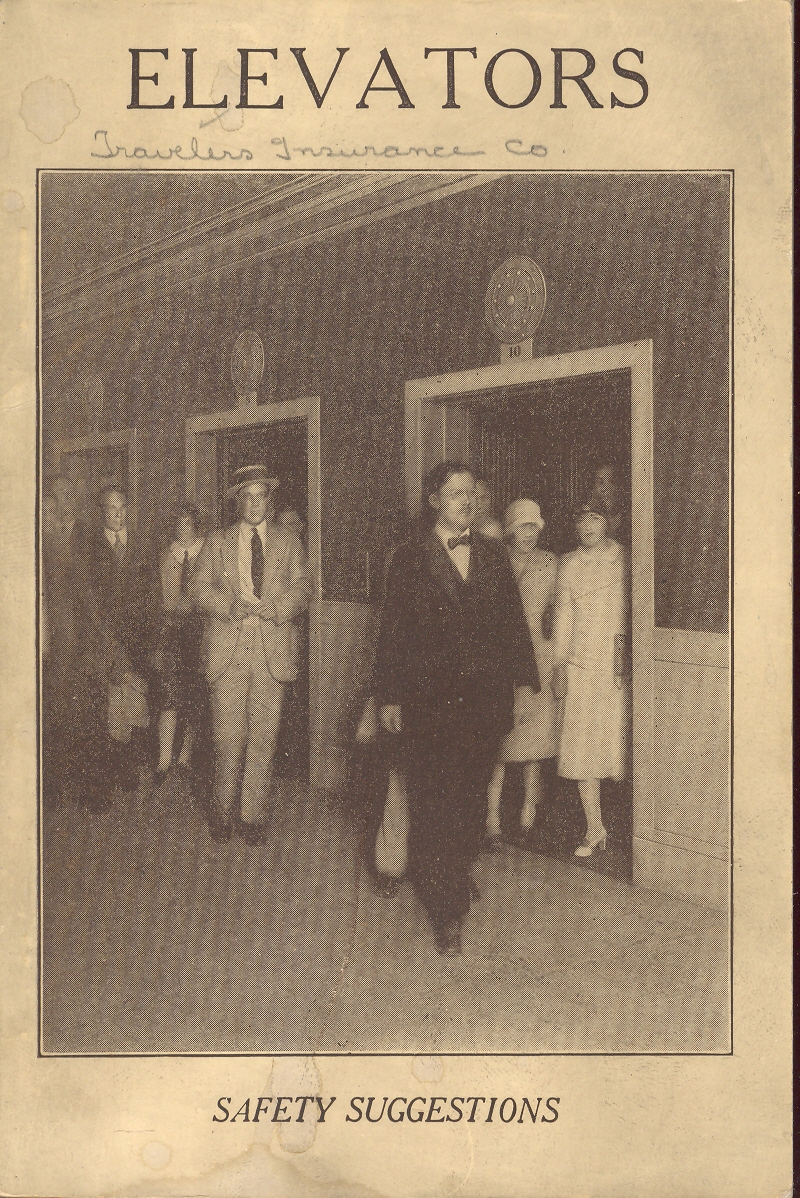
    Elevators, published by Travelers’ Insurance Company, tried to protect themselves a little further by ensuring safe practices of elevator operation, mostly in industrial settings.  This was published in 1926 and was already in its seventh printing from its inception in 1913 when the elevator was just in its second decade of popular, relatively widespread usage. The haven’t-given-this-cover-design-a-moment’s-thought hides a thorough (and bland) treatment of elevator safety; too bad, the cover photosnap-art promises something more.  Its not there, except for this beautiful photo of an industrial elevator op with a tie.

    Books covers elevators

     And coming back to wood barrels that are not necessarily filled with pig (or wild boar) bristles but with something else less advanced comes this manual on making wood barrels.  Everything is there, everything you’d need to make a barrel (and a good one at that), and I admire this sort of fantastic dedication to what is essentially (to our modern mind) mundane—except that it is as dry as well-cured barrel wood.  But I admire it still,  as I do the Elevator pamphlet, because, well, they’re done right.

    Books covers wooden barrel


  • Science-in-Art Art Reviews in “Nature”, 1883

    JF Ptak Science Books  Quick Post

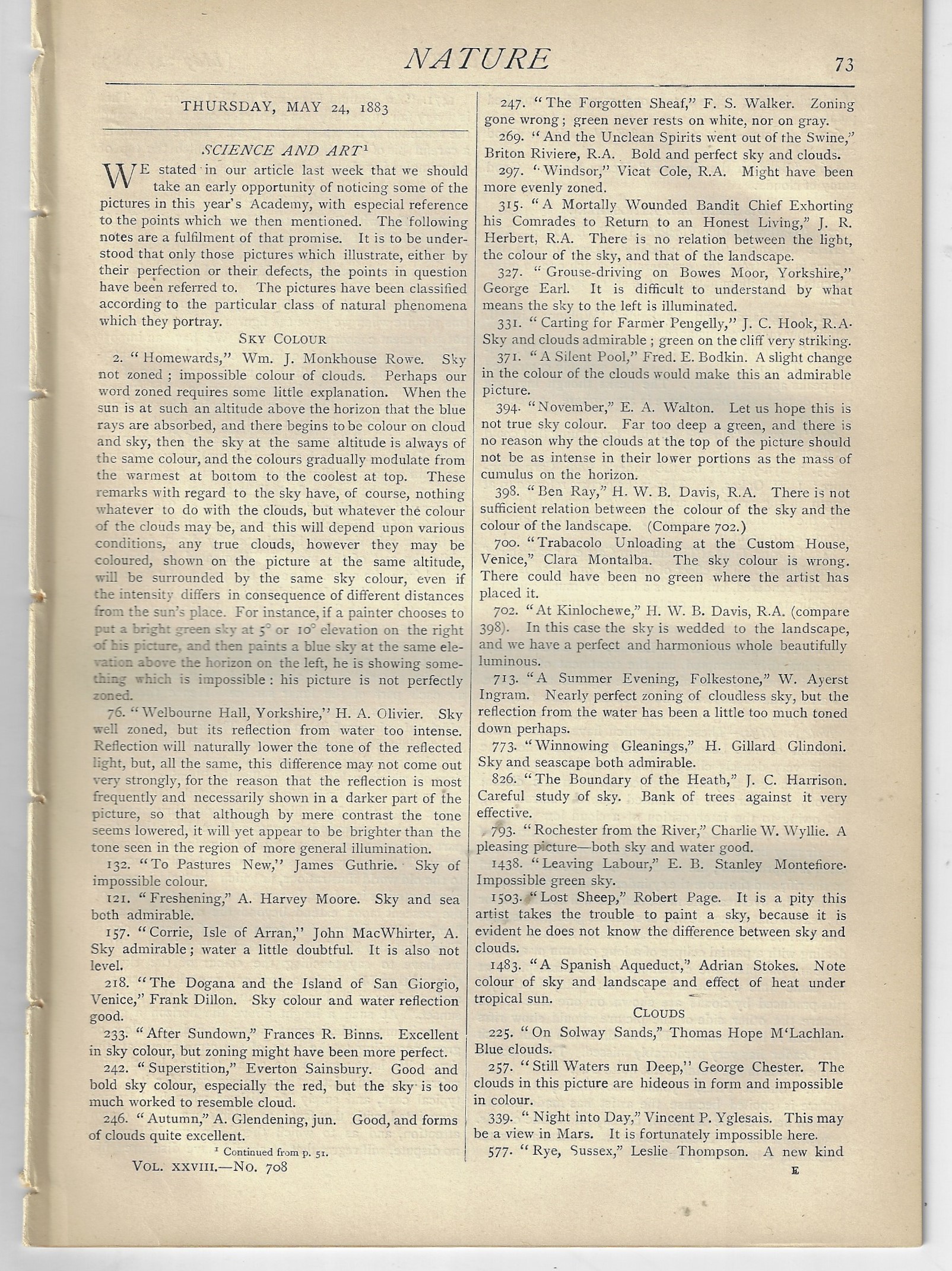
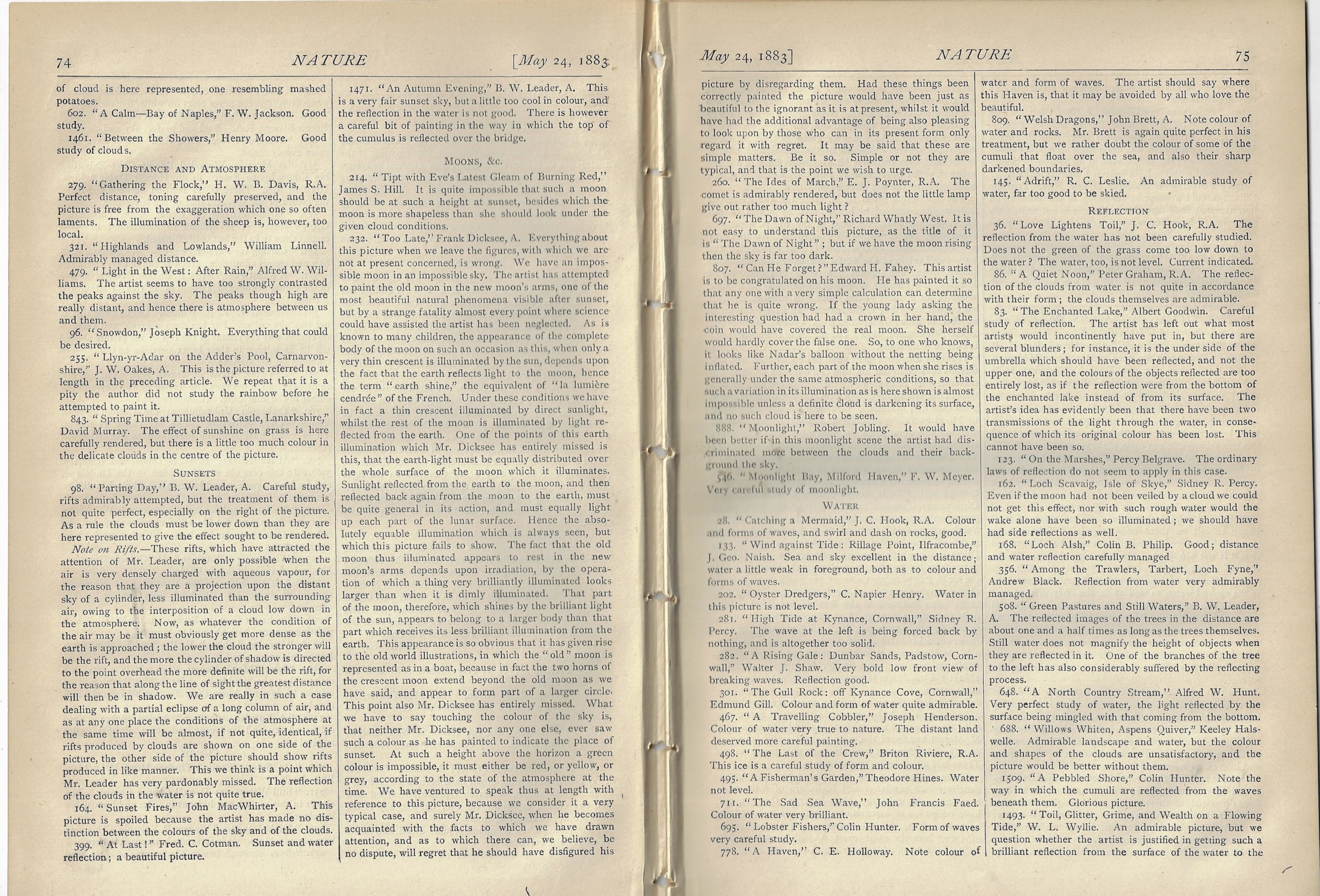
    I haven’t seen too much in the venerable journal Nature (begun in 1869), though I did not the following two papers written1 in 1883.

    In the second paper there is a discussion of various aspects of some of the paintings including “Sky Colour”, “Clouds”, “Distance and Atmosphere”, “Sunsets”, “Moons &c.”, “Water”, “reflection”, and “Snowstorms”. The reviewer liked some, and others—from the “science” end of things, not so much. For example there is a long and involved and devastating review of Frank Dickee’s (a successful and highly-Victorian (almost Victorian-velveteen)) piece, concentrating on the Moon, which presented many problems to the sci-observer, with the assault on the Moon of Dickee occupying about 20% of the entire article. He really didn’t like it.

    You can read the review below:

    Notes:

    1. [“Science and Art” in Nature, vol 28, no 707, May 17, 1883, pp 50-51; with “Science an Art” same volume, no. 708, May 24, pp 73-76.]

      Nature 1883 Sci Art _2_

    NAture 1883 sci art _3_

    ·Posted by :

    ·in:

  • The Private Public Face of the Brooklyn Bridge: Emily Roebling, 1883

    JF Ptak Science Books   Quick Post

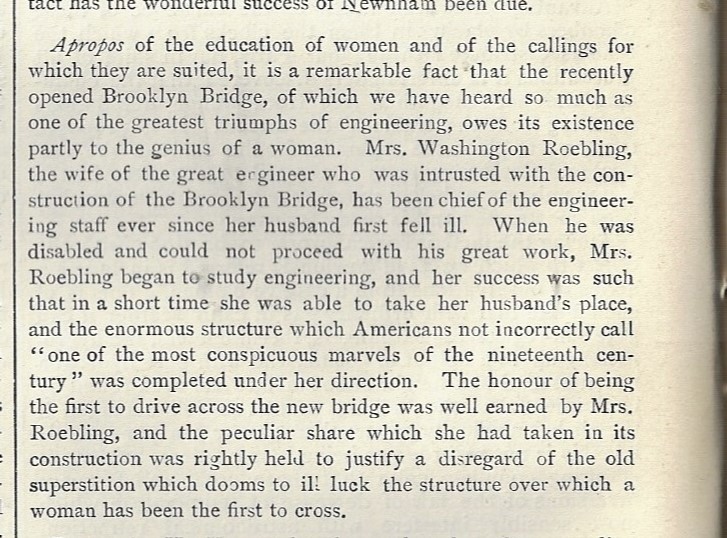
    I stumbled upon this, a fine notice on a matter of fact that was somewhat obscured, then and now–that the surrogate chief engineer of the Brooklyn Bridge was Emily Warren Roebling, the wife of the ill and disabled Washington Roebling.  The small notice of her achievement appears in the 14 June 1883 issue of Nature, just a few weeks after The Bridge was opened, with Emily Roebling being the first to cross. Washington Roebling took over as chief engineer following the death of his father, John A., in 1869, following a freak accident and the ill-conceived treatments for it that brought on the tetanus that wound up killing the man. Washington in just the next year suffered debilitating illnesses brought on by decompression sickness–that came on as a result of his famous leadership and participation in fighting an underwater fire in the Brooklyn caisson of the great bridge. After that, Washington became the shadowy Man-n-the-Window of his Brooklyn townhouse, seeing almost no one for years, though still conducting the engineering and almost everything else having to do with the construction of the bridge in concert with Emily. And so life went on like this for 13 years, and as David McCulloch wrote in his lovely work, The Great Bridge, Washington was as indispensable to the bridge as Emily was to Washington–it could not have been built without the pair of them.

    As encouraging as this small notice is in recognizing and congratulating “Mrs. Washington Roebling”, they did not recognize her given name. That was the practice, back then, but it would have made a finer point to elevate the woman to her own name rather than keep her as “the wife of”. 

    Nature 1883 MRs. Roebling

    Source:  Nature, volume 28, 14 June 1883, p 156.

  • A Note on the Pledge of Allegiance–Excluding “Equality”, and Including “God”

    JF Ptak Science Books  Post 2749

    The Pledge of Allegiance was written by Francis Bellamy1 (1855-1931) in 1892 for the 400th anniversary of the arrival of Christopher Columbus to the Western Hemisphere.  The Christian Socialist Baptist Minister Bellamy started the pledge out as a simple confirmation, and at one time considered the inclusion of the word “equality” in the message, but backed away after he saw potential difficulties with the word, what with the social and legal exclusions of women and people of color getting in the way of the concept. 
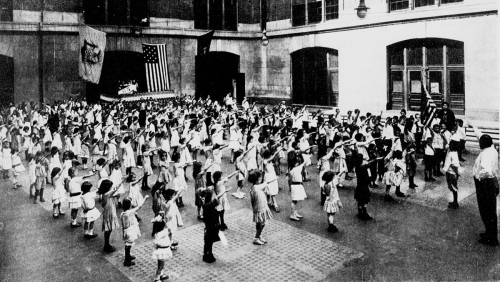
    Bellamy salute

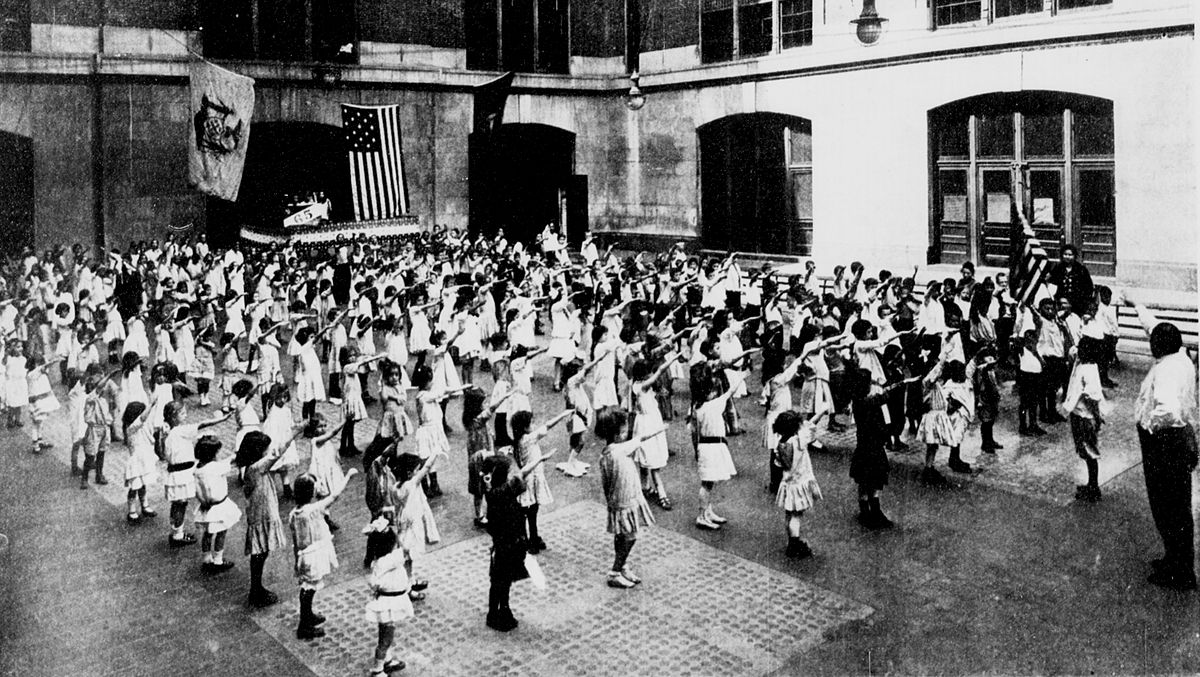
    • Image source: Wikipedia, “Pledge of Allegiance”, ca. 1930. There were several salutes to the flag that were adopted over the years, including this the, the “Bellamy Salute”, which of course faded away quickly with the coming of WWII. Another version of this salute ended with the palm up.

    Bellamy’s original version was non-secular, and, just like the Constitution2 and all of its Amendments, did not mention the word “God”. (“Lord” is used describing the date that the Constitution was signed, but this was another way of saying “1777 A.C.” or even “1777 A.C.E.”. The Declaration of Independence uses the word once, in the phrase “Nature’s God”.)   This does not mean that the Founding Fathers were a-religious–hardly so.  All it means is that they sought to differentiate religion and government, and to form a government separated from religious practice and observation, and to ensure that there was no preference to any particular religious sect.  On the other hand the Framers provided security for the practice of religion, any religion, by any person, in a very elegant and succinct statement:”Congress shall make no law respecting an establishment of religion, or prohibiting the free exercise thereof” in the First Amendment, Bill of Rights.  The concept is given further freedoms by the fact that “religion” is not defined anywhere in the Constitution.

    I think that a concise way of viewing the matter of religion and government can be seen in the Supreme Court ruling in the (landmark) case of Reynolds v U.S. (98 US 145 [1878]) which said that making religious rule or law superior to civil law would encourage everything and nothing, making each person a “law unto himself”, meaning that there would be all law and no law, with government having no say in the matter3.

    In 2000 a case was filed in the U.S. District Court, 9th Circuit, by Dr. Michael Newdow, on the use of the word “God” in the Pledge, and in 2002 that court upheld Newdow’s case, deciding in his favor 2-1.  The case went to the U.S. Supreme Court which skirted the issue entirely–in their Elk Grove v Newdow ruling on March 24, 2004, finding that Newdow did not have the standing to speak for his daughter (for whom the case was originally brought) because she lived with her mother, and not with the her father who initiated the case.  Case dismissed, 8-0, though the issue itself was left untouched. On the other hand (long story short) Newdow returned to the same court on March 12, 2010 with a similar argument, though the court ruled against him in a 2-1 decision…ruling on the same day, but in a different case, the court found in favor of the use of “In God We Trust” on American money.

    And so it goes.  And on to the Pledge:

    Pledge of Allegiance, 1892

    • ‘I pledge allegiance to my Flag and (to*) the Republic for which it stands, one nation, indivisible, with liberty and justice for all.’ [ * ‘to’ added in October, 1892. ]

    31 years later came the adopted variation:

    Pledge of Allegiance 1923/4

    • ‘I pledge allegiance to the Flag of the United States of America, and to the Republic for which it stands, one nation, indivisible, with liberty and justice for all.’   

    The Pledge changed against the interests of Francis Bellamy by the American Legion and the DAR, replacing “my flag” to “the flag of the United States of America”.

    31 years after this came the “God” change, which Bellamy certainly would have objected to:

    Pledge of Allegiance, 1954

    • ‘I pledge allegiance to the Flag of the United States of America, and to the Republic for which it stands, one nation, under God, indivisible, with liberty and justice for all.’ 

    The words “under God” were added after diligent prosecution of religious and political interests by the Roman Catholic organization, the Knights of Columbus, to help fight the Communists. The change was approved on Flag Day, June 14, 1954, at which time President Dwight Eisenhower remarked: “In this way we are reaffirming the transcendence of religious faith in America’s heritage and future; in this way we shall constantly strengthen those spiritual weapons which forever will be our country’s most powerful resource in peace and war.”

    The inclusion of “God” in the pledge and the exclusion of “equality” seem to be the reverse of the original intention of the pledge–unless of course the necessity of counterplay against godless Communists is still a requisite for a statement of fidelity to what the American flag represents–not to mention the separation intentions of the Founding Fathers.

    Notes

    1. Like many others Bellamy was thrust into this position by peculiar circumstances.  He was also a writer and did work on Shay’s rebellion, which I must point out found one of its birthplaces was Great Barrington, MA, where my father’s family comes from, though not from that far back. 

    2. Jefferson had no hand in writing the Constitution per se, but we can see his thinking at work. For example, as a legislator from Virginia, Jefferson drafted a bill that was to stop government from proposing a tax to help pay for religious education:. “… no man shall be compelled to frequent or support any religious worship, place, or ministry whatsoever, nor shall be enforced, restrained, molested, or burthened in his body or goods, nor shall otherwise suffer, on account of his religious opinions or belief; but that all men shall be free to profess, and by argument to maintain, their opinions in matters of religion, and that the same shall in no wise diminish, enlarge, or affect their civil capacities.”

    3.  Part of the ruling reads as follows:

    “In the context of the Pledge, the statement that the United States is a nation “under God” is an endorsement of religion. It is a profession of a religious belief, namely, a belief in monotheism. The recitation that ours is a nation “under God” is not a mere acknowledgment that many Americans believe in a deity. Nor is it merely descriptive of the undeniable historical significance of religion in the founding of the Republic. Rather, the phrase “one nation under God” in the context of the Pledge is normative. To recite the Pledge is not to describe the United States; instead, it is to swear allegiance to the values for which the flag stands: unity, indivisibility, liberty, justice, and — since 1954 — monotheism. The text of the official Pledge, codified in federal law, impermissibly takes a position with respect to the purely religious question of the existence and identity of God. A profession that we are a nation “under God” is identical, for Establishment Clause purposes, to a profession that we are a nation “under Jesus,” a nation “under Vishnu,” a nation”under Zeus,” or a nation “under no god,” because none of these professions can be neutral with respect to religion.”

    It is interesting to note that from the beginning of the pledge in 1892 the flag was saluted by non-military personnel by starting with right hand placed over the heart, and when the phrase “to the flag” was reached, the right arm would be extended outward, palm down, arm slightly raised.  When WWII began it was decided to keep the right arm/right hand firmly over the heart.

    ·Posted by :

    ·in:

  • A History of Big: Massive Aircraft, 1936

    JF Ptak Science Books   Quick Post

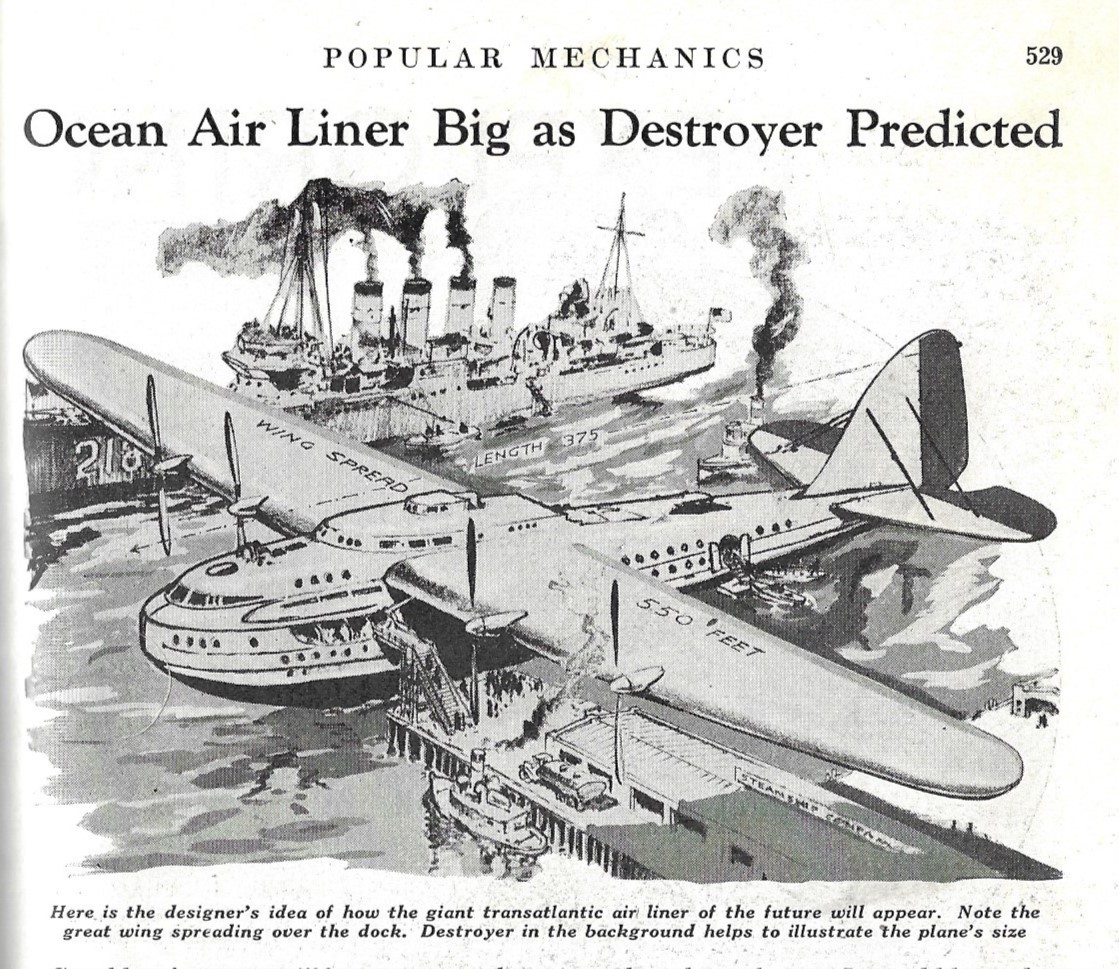
    In the history of aircraft, there’s big, really big, and then Hughes H-4 (“Spruce Goose”) big.  Then there’s the ocean-going aircraft below, found on p. 529 in the 1936 volume of Popular Mechanics. The nameless aircraft would be more than 375′ long and have a wingspan of 550′.  By comparison, an aircraft called the “Stratolaunch” now under construction and designed by Burt Rutan, would have a wingspan of 385′. The “Spruce Goose” was 319′ wide and 216′ long; the 747-8 was 249’wide and 242′ long; and the Airbus A 380-800 stands 262′ wide and 236′ long. In short, of planes having flown, this fabulous thing with the 550′ wings would be twice their size.  

    That said, this giant aircraft was limited not by imagination but by flight of technological fancy. It was supposed to require a crew of 100, fly at only 12k feet at 300mph, and make it across the Atlantic in 11 hours. So, the size was certainly awesome by today’s standards; the tech business end of it, not so much. In any event, the image is quite striking:

    Pop MEch 1936 massive plane


  • On the History of Kindness to Children (1687)

    JF Ptak Science Books   Post 2745

    Bibliotheque Universelle 1687

    Another piece of great serendipity fell from the sky, again this week, this time on the idea of the history of childhood–more accurately, it is on the history of kindness extended to children. The idea of looking at childhood in that way lies in the work, for example, of Phillipe Aires (Centuries of Childhood, first French edition 1960) and Lloyd deMause (The History of Childhood, 1974), among others, who maintain that kindness towards children is a modern invention. (This is kind of wildly brief statement of this idea–suffice to say though that the treatment of children through long history has not been necessarily “kind”. For example, the word “childhood” appears only twice in the Bible (KJV), and really only once in reference to what childhood might have been rather than a simple statement regarding a period of human life. That occurs in Ecclesiastes 11:10: “Therefore remove sorrow from thy heart, and put away evil from thy flesh: for childhood and youth are vanity.” This is in line with an older variety of that book, the Cloverdale Bible, in Ecclesiastes xii. “A   Childehode and youth is but vanite” which again makes the point of childhood being something to get away from rather than a chance to improve the life of the new person. The Oxford English Dictionary takes the word back to Middle English times, but even into the 19th century I can’t really point to an applicable use of the word in connection to this discussion.)

    The issue came up while listening to a public reading by my wife’s (Patti Digh) favorite living author, Richard Powers. He was taking questions after a lovely read from his newest, called The Overstory, when a question came to him regarding human-like senses in animals. Powers responded saying that all was possible, seeing as how people question those human qualities in other human beings. He used the term “Anthropomorphism of Man”, which I found fantastic, as he was correct. For centuries certain people simply weren’t regarded on the same human level as other people (those people doing the judging). For example, in the U.S., women, African Americans, the poor, Asians, and so on from a long list, have only recently been elevated to the prospect of “sameness” with those in power in this country. Before this, they were something “lesser”. And it was here that Powers offered “children” as not being children, not even a full human, for most of the history of humans, and so only recently come into their own as full humans.

    Then came the serendipity.

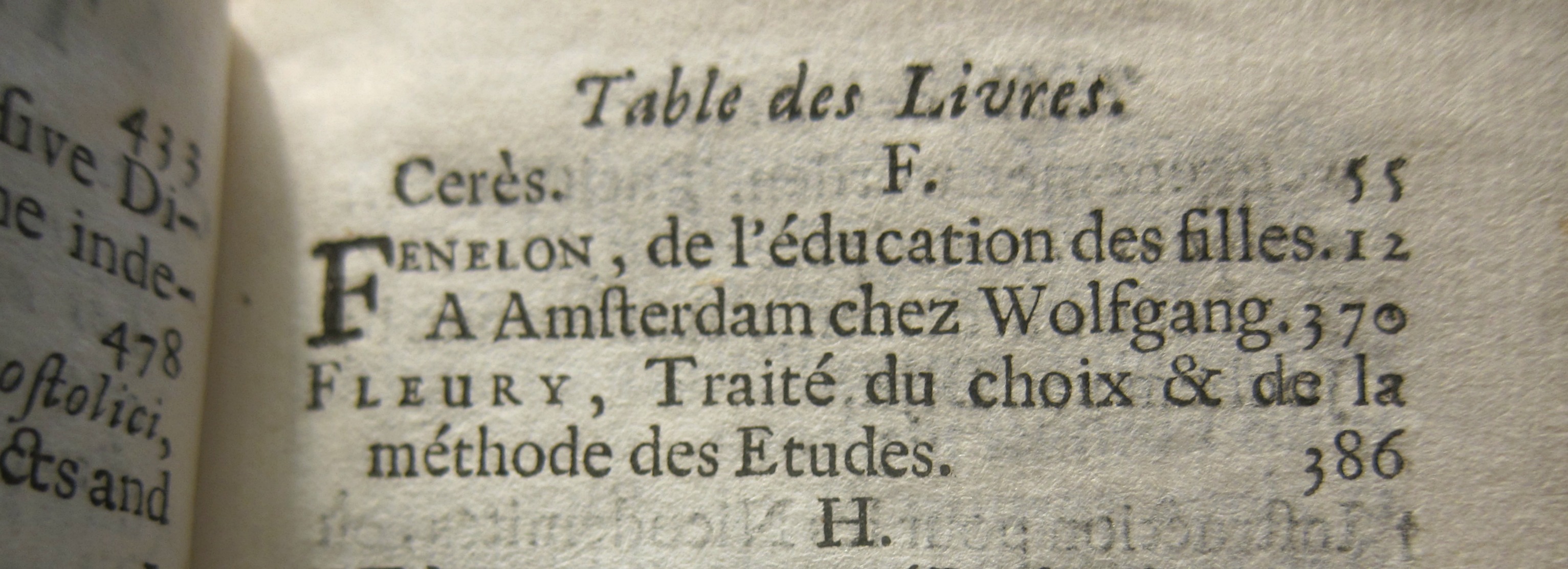
    I was browsing through one of the 30 volumes or so of an Amsterdam-published 17th century magazine/journal called Bibliotheque Universelle looking for articles of scientific interest. There’s a lot in these little bricks of books, and they do have some occasionally good (and great) scientific efforts in them, the one I was working on, one of several volumes for the Principia year of 1687 (July 5), yielded nothing of any great sci-interest in its 500+ pages. Then, I spotted it, just a simple four lines of 6-point type in the 5”-tall book: “Fenelon, de l’Education de filles…” That’s François de Salignac de La Mothe- Fénelon, of Telemachus (son of Ulysses, etc.) fame, and his book was on the education of daughters. It was published the year before, in 1686, and the editors of the Bibliotheque gave it 14 pages or so of review and explanation.

    It seems to me from this reading that in this account—really on education of children in general–M. Fenelon was an advanced thinker, a human human-rights person, treating children and their education as individuals, with understanding, and kindness.

    Evidently the man speaks to curiosity and rational amusement in the book—that curiosity must precede the rational, and that one must be careful in doing that, because there is a danger of “imitation”–curiosity is the thing that banishes ennui.

    At the same time instruction must be realistic, so that once mature and grown that the real world is not a total shock, and that once subjected to the daily routine of “housewifery” there will be no denouement from the dreams of childhood—all of that seems like a pretty sticky wicket. Fenelon did seem to insist on the beginning of education from infancy, but not to overdo the instruction as that would “oppress the facilities”.

    Perhaps the most surprising positive thing of them all to me was Fenelon’s insistence on being careful with your words with the mature child, and to never be guilty of a falsehood with children, which is pretty good and sane advice.

    There’s other stuff that doesn’t translate any longer into where we are today, but there seems to be a lot of material that is timeless.


  • One Word, Three Un-hyphenated (?!) F’s in a Row!

    JF Ptak Science Books   Post 2746

      Luftfff

    I just came upon this fine word, which for a moment challenged my probably under-corrected vision, and saw that it contained three consecutive f consonants! On a Saturday, cranky with a fever and stiff(f) neck, this was a superb BLAST! Or “blast”. Or “b”. Anyway the word is Luftschifffahrft and it occurs in the title of a pamphlet by Wenzel Kotzauer, Die Luftschifffahrt und ihre Zukunft, printed in Vienna in 1895.

    The forty-page pamphlet is about the future of air flight and as fixed-winged aircraft rather than airships, noting in particular the 1894 Hiram Maxim “aeroplane1”. The Maxim machine was prodigious, and was mainly built for testing purposes—it weighed 3 to 4 tons, carried two steam engines that generated 180hp (!) and had pushing props that were 17.5′ in diameter, making the thing a beast-and-a-half. It was fixed to a very wide two-track system to keep it from lifting off the ground when the engines were running—or to keep it from careening around out of control. In any event, Maxim’s dream machine didn’t make it very far and was dismantled after a few years. (He also attempted an unsuccessful return to heavier-than-air flight in 1910.)

    But back to the three Fs. “Luftschifffahrt”, which translates basically to “airplane” or perhaps “aeroplane”, and thus the title is about Airplane/ship/aeroplane Travel in the Future. Or thereabouts. It is a technical work, with much on the actual “aeroplane”, which in its first use were the wings, and here there is much discussion on their size and shape.

    What most interests me though are the repetitive consonants. They just don’t seem to happen in English, naturally, without being hyphenated. (Using the word “un-hyphenated” again I just want to point out its terrific irony!) The word appears with fewer letters as “Schifffahrt”, which is simply “shipping”.

    The most obvious hyphenated candidate for me is “cross-section”, which I use often in this blog, though I can’t kill the hyphen and pulling the two words together as it makes it look like overstuffed snake-sausage: crosssection. As smaller snake is the person who sees a seer is not a seeer, and Scrabble-challenged words like “zzz” and “brrretc” definitely do not count, noooo sir.

    Anyway: fff.

    Notes:

    1.  In general at this time “aeroplane” referred to the wings/airfoils of a plane, not so much as an aircraft itself.  Mostly, it seems. The Oxford English Dictionary says that the first use of the word in this sense occurs in 1866, with a useful explanation of it found two years later:

    All of the following come from the Oxford English Dictionary:

    “Aeroplane”

    1868   3rd Ann. Rep. Aëronaut. Soc. 36   He had turned his attention to the wing and to the sustainer, or what he might call the aëroplane.

    1894   O. Chanute Progress in Flying Machines 237   This main aeroplane..is trussed and stiffened in every direction by wire stays.

    1905   G. Bacon Balloons 111   What are called ‘aeroplanes’—large flat surfaces, light but rigid inclined at a suitable angle to the horizon.

    Aeroplane=aircraft/airplane (as a noun) comes at about the same time:

    1868   Eng. Mechanic 24 Apr. 91/2   We have yet to see the ‘aëroplane’ with buoyancy sufficient to sustain 150 lb., or with apparatus sufficiently light and portable to make headway on an ‘air plane’… Supposing an aëroplane to have raised itself, if it reared out of equilibium it and the occupant would come to grief.

    1873   D. S. Brown in 8th Ann. Rep. Aëronaut. Soc. 17   I think this [sc. impetus] will be more requisite with respect to the aëroplane than any other vehicle.

    1873   Ann. Rep. Aëronaut. Soc. 20   Mr. Bennett introduced an Aëroplane invented by a Frenchman, to be worked by a screw by motive power derived from elastic springs.

    Finally, “airplane” as a noun comes into existence, or nearly so, in the early part of this past century:

    1906   Sci. Amer. 29 Dec. 487/1   Air-plane is a much better word than aeroplane. It is as good etymologically, and much better when it is spoken.

    1907   Westm. Gaz. 19 July 4/2   It is this ease of going against the current, with no motive force in evidence, that is..the despair of the aeronauts with their air-planes.

    1917   N.A.C.A. (U.S.) Rep. Nomencl. Aeronaut. 31   Airplane..This term is commonly used in a more restricted sense to refer to airplanes fitted with landing gear suited to operation from the land. If the landing gear is suited to operation from the water, the term ‘Seaplane’ is used.


Recent Posts

Archives

Categories