A Daily History of Holes, Dots, Lines, Science, History, Math, Physics, Art, the Unintentional Absurd, Architecture, Maps, Data Visualization, Blank and Missing Things, and so on. |1.6 million words, 7500 images, 4.9 million hits| Press & appearances in The Times, Le Figaro, Mensa, The Economist, The Guardian, Discovery News, Slate, Le Monde, Sci American Blogs, Le Pont, and many other places… 5000+ total posts since 2008.

  • Francis Galton, Life on Mars, and Extraterrestrial Communication (1896)

    JF Ptak Science Books   Post 2761
    Nature 1896 Galton MArs
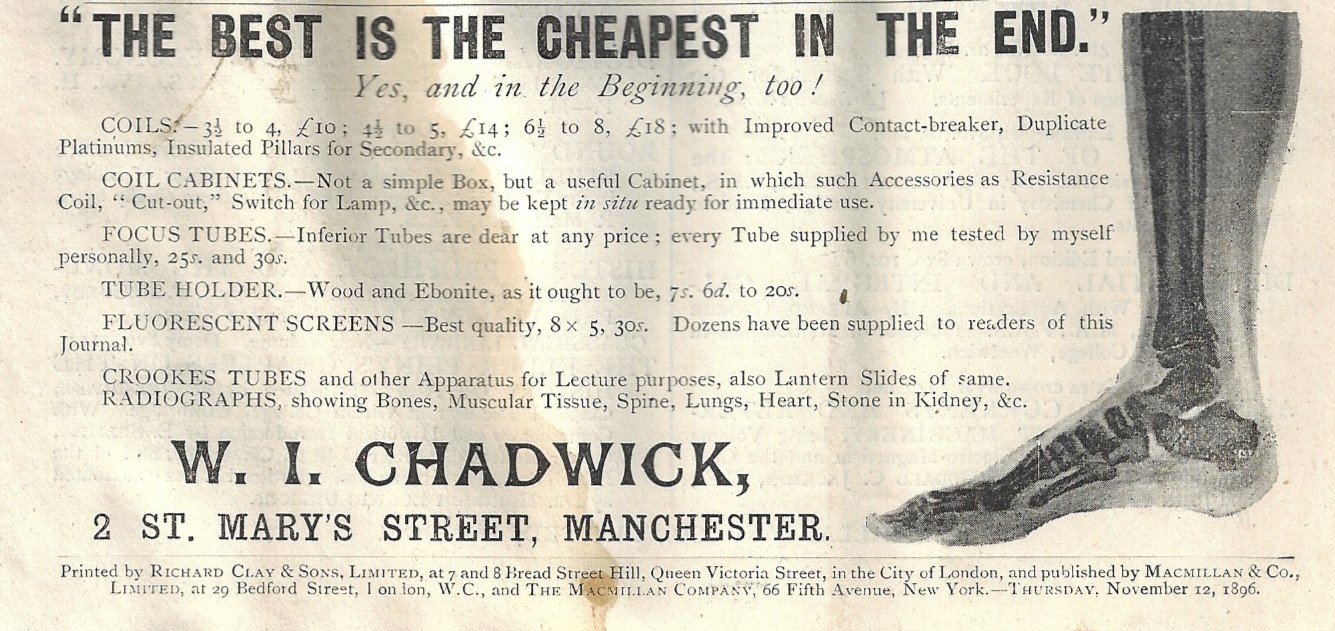
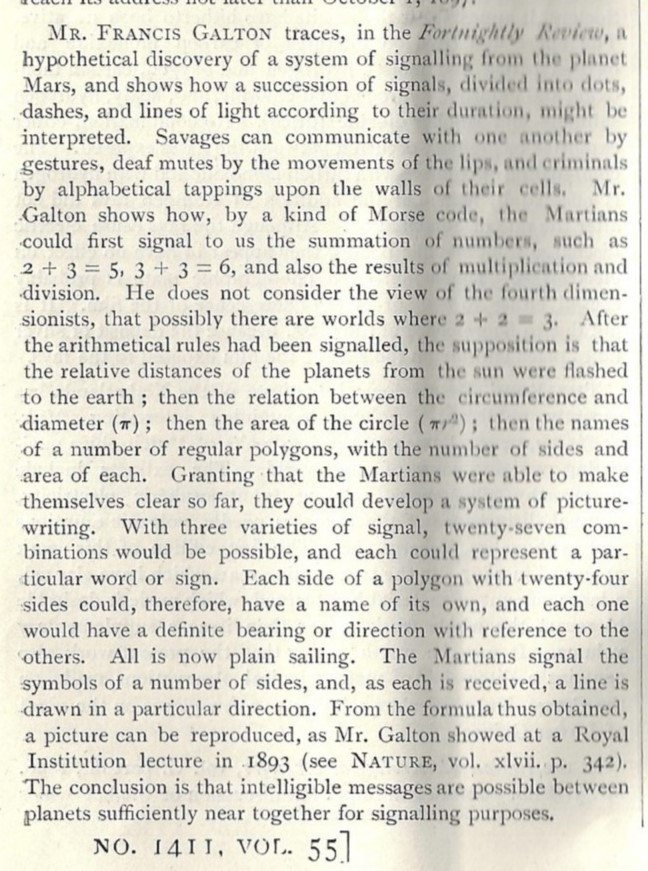
    Okay, these two images1 at the head and foot of this post have almost nothing to do with Mars and Francis Galton, except that they were advertisements in the issue of Nature (November 12, 1896) in which his notice on the possibility of extraterrestrial communication is discussed. That, and that the ads are very engaging, as is the report on Galton. Actually this is a report on a Galton paper that appeared two weeks earlier in the Fortnightly Review (“Intelligible signals between neighbouring stars”, volume 60, pp 657-64, November 1, 1896), and shared to a more scientifically-centered reading population than the other journal.  (Full text: https://galton.org/essays/1890-1899/galton-1896-fortnightly-review-signals-stars.pdf)

    It seems to me that the Galton—a genius who worked across many diverse fields—was having at a thought experiment in interstellar communication. Given the contemporary mileu of possible/expectant life on Mars, Galton thought about ways in which we could send some sort of communication, and what the logic of that “language” might be. He presents the idea of symbols, picture writing, with a combined arithmetic etymology to display an additive language that would show Martian observers a level of intelligence on Earth.

    Galton was hardly alone in figuring out a communication system though from what I can tell seems to stand out in his thinking on what was actually being said. The system itself was one of reflected light from the sun using a vast array of mirrors, an approach that would also be worked on by A. Mercier a few years later in 1899 and by W. Pickering (with a very mechanically-ingenious and enormous display).

    In any event it seems that at this point of the decade that the possibility of life on Mars was very distinct–almost in some cases a foregone conclusion.  To illustrate this, here is a short story about a short notice of a considerable prize offered by a citizen of France for scientific achievement. It was intended for astronomical and medical achievement, and was established by Anne Emile Clara Gouget (d. 1891), the wife of Marc Guzman, in memory of their son, Pierre Guzman. The amount was a very hefty 100,000 francs, which went a long long way in turn-of-the-century France, and which today would be equivalent to about $1 million or some such.

    The preference for the award is in astronomy—specifically, to the person/s who could successfully contact an alien civilization. That contact however does not include Mars. It was during this decade especially that there was much debate about the atmosphere on Mars, and whether it was vegetative, and whether there was an intelligent and advanced society capable of construction was what was seen by some as a massive system of canals across the planet. So with this in mind, Mme. Goguet-Guzman like many others assumed that there was some sort of life on Mars, and so Mars was excluded from the prize for contacting an extraterrestrial civilization.

    I’ve read in some sources that the astronomer/popular writer Camille Flammarion2 “announced” the prize in 1891, though the first published account that I can find appears in the Comptes Rendus in 1900. The notice states that Mars is excluded from consideration of the 100,000 franc prize, and in the event that no one wins another award would be generated from the interest compounded by the prize deposit every five years to a deserving person in science and medicine.

    Here it is in translation:

    “Mrs. Clara Goguet, widow Guzman, bequeathed to the Academy of Sciences a sum of one hundred thousand francs for the foundation of a prize bearing the name, Pierre Guzman, in memory of her son, and will be awarded to [the person] who finds a way to communicate with a planet other than the planet Mars.”

    “Foreseeing that the prize of one hundred thousand francs has not yet been awarded. The founder wanted, until this prize was won, that the, capital, accumulated for five years, constituted a price [in itself], always to be given in the name of Pierre Guzman, which would be awarded to a French scientist or foreigner who makes an important advance to Astronomy.

    The five-year prize represented by the interests of the capital, will be awarded,for the first time, in 1905.” (See the original French version, below.)

     Getting back to Galton, here’s the Nature summary in full:
     

    Francis Galton mars  _1_

    ·Posted by :

    ·in:

    —
  • Early Views Extraterrestrial Views of the Earth and the Red Vegetation of Mars

    JF Ptak Science Books  Post 2762

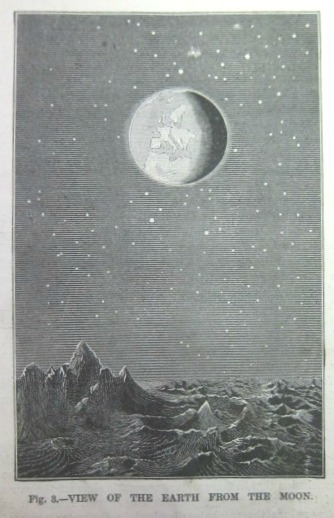
    Sci Am Earth from other planets _5_I am not sure of when it was that the first view of the Earth from another planet appeared in print. They are certainly rare prior to 1900, so that when I saw (the following) 19th century images of extraterrestrial landscapes in Scientific American (November 23, 1877) with the Earth in the background I was stopped by their unexpectedness–how unusual that unusualness is I don’t know.  I remember that the very busy and gifted Camille Flammarion’s published views of the Earth like these in his Astronomie Populaire in 1880, though the images that follow were published several years earlier in the SA. 

    The extraterrestrial landscapes are a leap of faith based on available observations, and no doubt that the readers of the late 19th century seeing these images for the first time would have been transported by their ingenuity and depth of understanding i n representing the Earth as just another bit in the sky when it is seen from other locations. 

    These images also led to a note about a paper that Flammarion wrote for La Nature1 in 1873 on what turns out to be the similarities of the atmospheres on Mars and Earth–and that led me to a somewhat earlier paper that he wrote for the Comptes Rednus that seems to have a little more punch than the later one. 

    In the short paper in the CR2 Flammarion observes that the Earth is mostly covered by water, and on Mars there is more “land/continental surface than maritime/sea surface”. “ L’étude détaillée de la planète montre que sa surface est bien différente de la surface terrestre, au point de vue du partage des terres et des mers. Chez nous, les trois quarts du globe sont couverts d’eau; sur Mars, au contraire, il y a plus de surface continentale que de surface maritime.”

    He then notes that according to spectrum analysis the Martian atmosphere and seas and snows are made of water just as they are on Earth. “…l’analyse spectrale montre que l’atmosphère de Mars est chargée de vapeur d’eau comme la nôtre, et que ces mers, ces neiges, ces nuages sont réellement composés de la même eau que nos mers et nos météores aqueux”. And at the end of the article, saying that the atmosphere of the Earth and Mars are very similar: “ La météorologie de Mars est à peu près la même que celle de la Terre; l’eau y est dans le même état physique et chimique que sur notre propre globe…”

    Also, there is vegetation on Mars which is very different from that of Earth, and that is what gives the planet its red color, as the plants growing there must be red. “…comme ce n’est pas l’intérieur du sol que nous voyons, mais la surface, la coloration rouge doit être celle de la végétation de Mars, quelle que soit d’ailleurs l’espèce de végétation qui s’y produise.”

    In his last summary point, Flammarion makes a case for the possibility of life on Mars, saying that conditions for necessary for life on Earth and life on Mars are familiar and similar for both planets (“…organic conditions there are not very different from those that have presided over manifestations of life on the surface of the Earth.”)“Enfin les raisons d’analogie nous montrent sur cette planète, mieux que sur toute autre, des conditions organiques peu différentes de celles qui ont présidé aux manifestations de la vie à la surface de la Terre.”

    And so some pretty strong observations about water and snow and life on Mars, all coming before the Schiaparelli developments and the canals four years later. 

    That was a long digression–the Earth from afar images follow the footnotes. 


    Notes:

    1. Camille Flammarion, “La Planète Mars d’après les dernières observations astronomiques” in La Nature – Revue des sciences, n° 10, page 145. (August, 1873) and is translated soon after for Popular Science https://todayinsci.com/F/Flammarion_Camille/FlammarionCamille-Mars.htm

    2. _____. “Sur la planete Mars”, in Comptes Rendus, vol 77 no 4, p. 278, July 28, 1873.


    ·Posted by :

    ·in:

  • Orders and Instructions on Living in France and on the “Disposition” of the Jews, September 1940

    JF Ptak Science Books  Post 2751

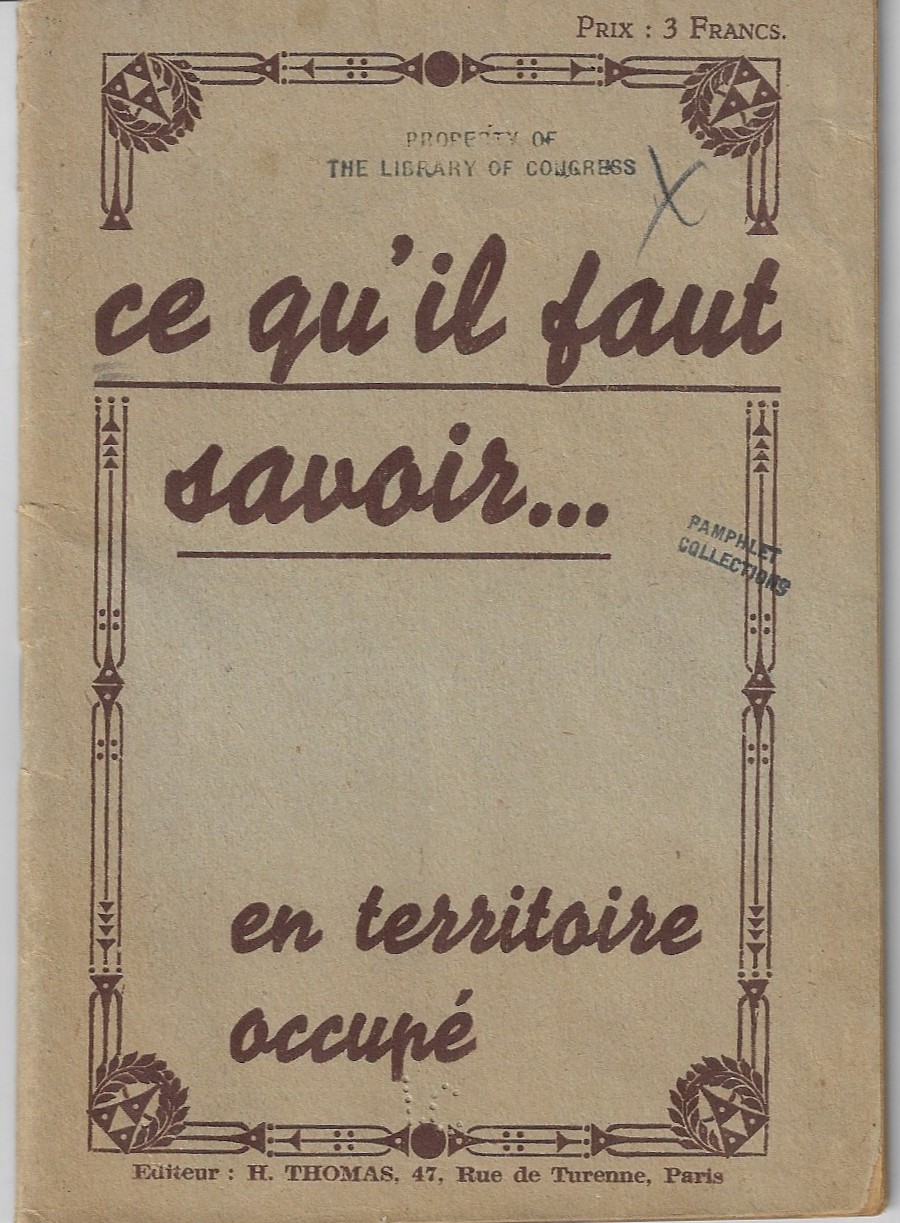
    Books covers france occupied territories JewsBy the title, Ce qu’ill faut savoir en territoire occupe1 (“what you need to know in the occupied territories”) we see that this short/small and rather plain pamphlet is an outline of expected behavior of conquered France…or shall I say “overrun” in its six miserable weeks of fighting which found no good end, all of it coming to a close on 22 June 1940, though there were strong pockets of resistance that would arise and take hold until the defeat of the Germans five years later. It is almost ephemeral, having virtually no “presence”, if appearance were to judge—it looks like nothing, nearly. It is hardly that, and represents a coming great evil.

    It contained the rules of society from the Germans and from Vichy, and in no small way dictated the expectations of the conquerors. The thinking was wide and brutal and trite, defining the occupied territories, the new justice system, economics of the occupation, and the like, as well as the “camouflage” of street lights, rates of exchange, bicycle rules, and the use of motorcycles.

    What caught my eye was the header for a two page section on French Jewry, “Les Dispositions pour les Juifs”.

    It is announced simply that the “German authorities” and of course the Vichy government have taken measures against Jews in the occupied territories.

    • (“Les autorites allemands ont pris des dispositions contre les Juifs demeurant en territoire occupe…a ces dispositions pourront en etre adjointes d’autres prises par le gouvernement francais de Vichy…”) and then went about its business.

    The first thing to do was for the Jews to make themselves available and report to authorities before 20 October 1940. It encouraged the head of a household to make a report on the entire family.

    • (“Pour le moment, les obligations faites aux juifs en territoire occupe sont les suivantes de ne pas rentrer, pour les juifs qui ont lui la zone occupe de se presenter avant le 20 Octobre 1940 a la sous-pretecture de leur arronfissement de domicile pour se faire inscribe a un registre special. La declaration du chef de familie est valable pour toute la familie.”)

    Next of course came the subjugation, demanding the identification of all businesses either run by or principally owned by Jews to identify themselves as such, with fines and imprisonment (and confiscation) the consequences of not doing so. A Jewish business was also defined as having more than 50% investment by Jewish interests.

    • (“…d’afficher en langue allemand et francais la mention entreprise juive a tout comemrce dont le proprietaire ou le deteneur est juif. Les dirigeants des communautes israelites doivent fournir. Les contraventions sont punies de prison et d’amende, ou d’une de ces deux peines. La confiscation des bien pourra en outre etre prononcee…”)

    Then comes the identification of who is a Jew, and according to this document, someone is a Jew if their grandparents were (“or appeared to be”) Jews.

    • (“Sont retenus comme Juifs ceux qui appartiennent ou, la religion juive ceux qui ont plus de deux grands-parents.”)

    Just a couple of hundred words. Two pages. And yet it outlines the basics of population control and discrimination, setting the stage for removal. All contained in this little pamphlet, which I should point out was not free, but sold for 3 Francs. There would be a many-orders-of-magnitude price to pay in the very near future.

    Notes:

    1. Ce qu’il faut savoir … en territoire occupé, (Ed : H. Thomas, 47 rue de Turenne, Paris,) 6×4”, 46pp. No doubt the work of the Nazi government. Printed ca. August/September 1940. Original wrappers. Provenance: Library of Congress, with their stamp on the front wrapper and their surplus/duplicate stamp on the cover’s back.


    ·Posted by :

    ·in:

    —
  • A Small Episode in the History of Irony: On-Beyond Common Sense Rules from the Successor Company Which Built the World’s Most Fatality-Stricken Railroad

    JF Ptak Science Books   Quick Post

    The Panama Railroad was flat-out more costly in the terms of human lives than any railroad ever built in the Americas.  Probably anywhere in the world, at any time, mile-for-mile. From 1851 until it was finished in 1855 the railroad linking the oceans was a thin ribbon of red that was 47 miles long and cost perhaps 12,000 lives. The Panama Railroad Company admitted to something like 1500 deaths or some such, I forget now–it was impossibly low, particularly since the only thing they seemed to do with the bodies of non-white laborers was bury them or sell them to medical schools far and wide…they most certainly did not count them. There is no record of perhaps 10,000 dead laborers, and there never will be.  

    The railroad was being built in an impossibly bad place, with no utilizable natural resources, no laboring population to hire, and so on, all the while taking place in fantastically bad circumstances. As much as landslides and accidents took the lives of workers, they also succumbed to smallpox, dysentery, cholera, various types of fevers, and a host of other killers. Melancholia and depression also took the lives of perhaps 1000 Chinese workers, who it seems took their own lives for terrible living conditions, terrible pay, and terrible human treatment. It seems too astonishing to be so, but I’ve read a number of accounts of the so-called “Chinese Tragedy”, and it bears up. 

    And so all of this bubbled up when I found this very small and incredibly skinny hardback publication from the Panama Railroad Company called Safety Rules. It seemed terribly ironic. 

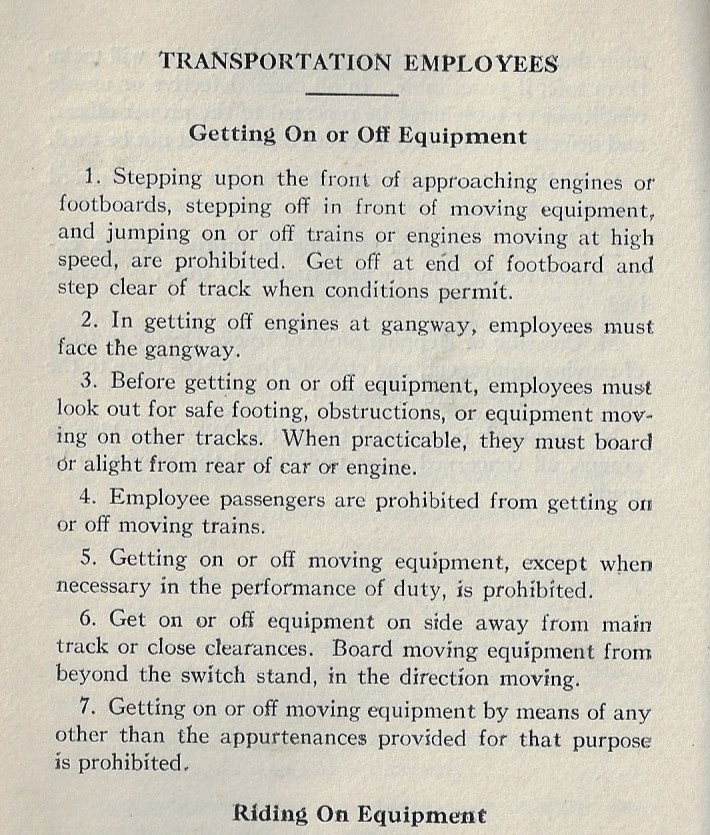
    Now this was not the same company though it carried the same company name as the originator, this rule book being published in the “C.Z.” (“Canal Zone”) in 1945, and 80-some years separated the two, but I couldn’t shake the terrible connection of opposites, especially given the breadth of the 255 rules in the rule book, many of which were incredibly obvious. I’ve included the first few rules in the book, #1 being not to hop off a moving train in front of it…that’s even a hard sentence fragment to write, let alone conjure why it was written in the first place.

    Panama RR

    ·Posted by :

    ·in:

    —
  • Data Visualization of Air Force Bomber Strength, 1937

    JF Ptak Science Books   Quick Post 

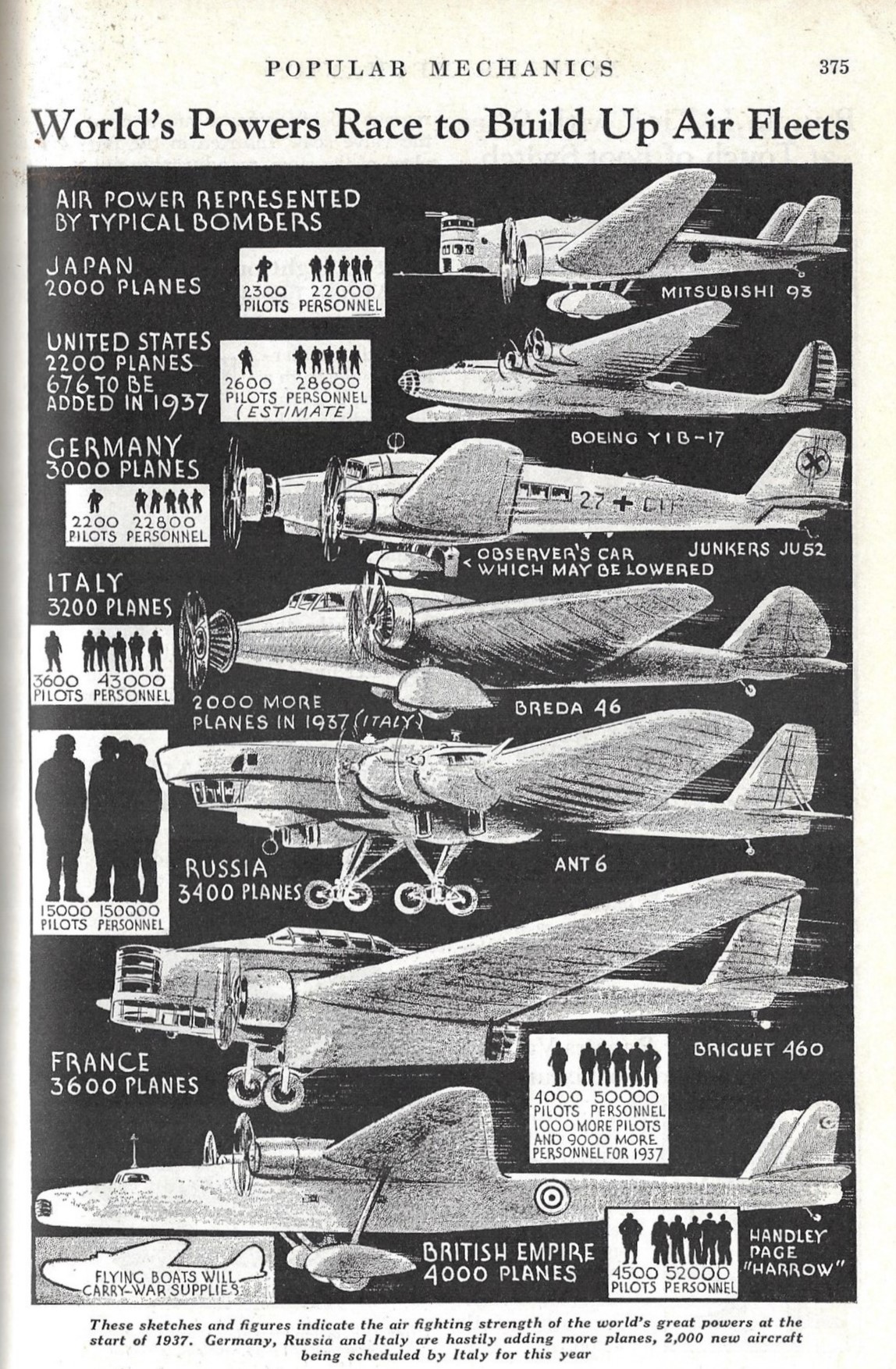
    What caught my eye in this piece of data visualization were “bomber” types and the date (1937). First of the seven aircraft six are bombers—the German Junkers JU 52 was a transport aircraft. The year here is 1937, which makes it more than two years past Hitler’s 26 February 1935 repudiation of the treaty of Versailles, in which it was announced that among other things the Nazis would re-arm and stop paying war debts. Theoretically then the would have been no German air force before 1935, except of course that pilots were being trained sub rosa both in German and the Soviet Union—that means that the Luftwaffe (founded in 1935) would have started from nothing and appeared on the world stage two years later with the 5th largest air force of the global powers (ahead of the U.S. And Japan). This graphic appeared in September 1937, just four months after the Nazi Condor Legion delivered its much-publicized bombing against Guernica in the Spanish Civil War. So why are we being shown a transport aircraft in this analysis? [Several have shared now that the Junkers was also used as a bomber–thanks!]


    Pop MEch 1937 Dataviz airfroce

    Source: Popular Mechanics, September 1937. 


  • A Business Card and the Coming Destruction of the Jews

    JF Ptak Science Books  Quick Post

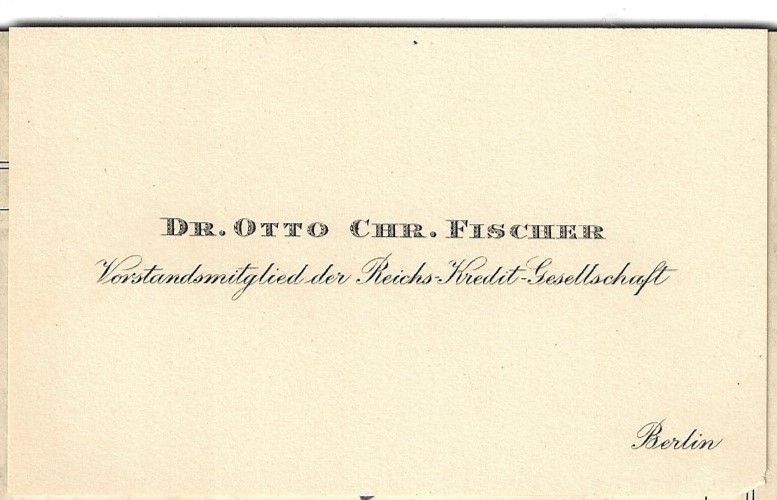
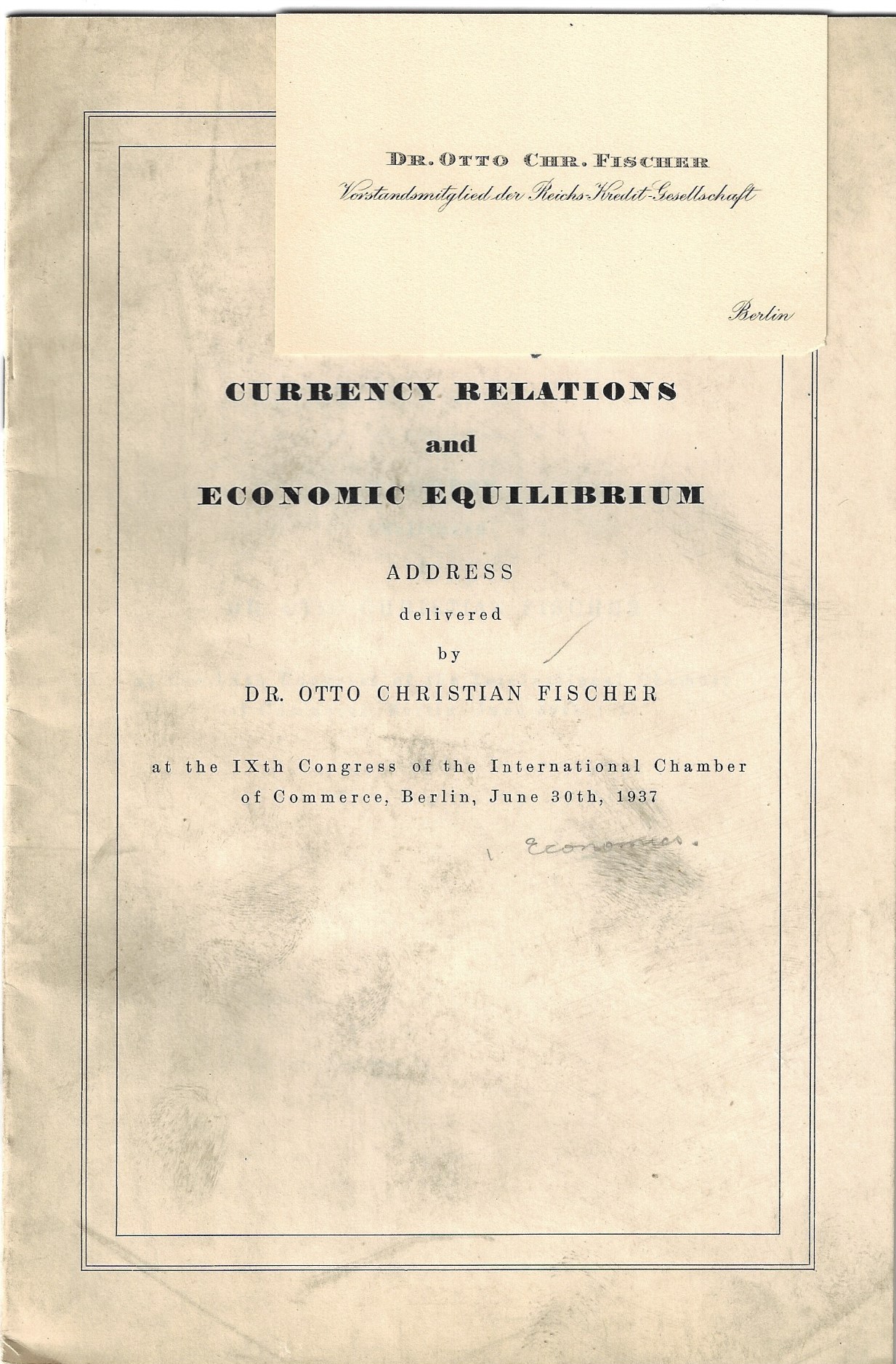
    Fischer biz card detail
    I have opened dozens of thousands of pamphlets over the years, and usually the only thing that happens is that the pamphlet opens. On very rare occasions, something will fall out. Today, that happened twice, within minutes: two pamphlets with two falling business cards. The first business card was the bigger surprise–it came with the card owner’s short work, Economic relations and Economic Equilibrium, Address by Dr. Otto Christian Fischer, (presented at the 9th Congress of the International Chamber of Commerce, Berlin, June 30, 1937). 

    The engraved card identifies Fischer as  “Verstandsmitglied der Reichs-Kredit-Gesellschaft”

    Fischer (1882-1953 (?)) approached the National Socialists and Hitler as early as 1931, at which point he seems to begin his rapid and lofty ascent to the heights of Nazi banking. Seven years later:

    • “…when the National Socialists began to collect Jewish assets in the course of the “Aryanization”1, it was also about blocking the assets of bank deposits against the access of the owners.”
    • “Fischer made no resistance to these measures in his area of ​​the Reichsgruppe, nor did he delay such actions.”
    • “He also took no initiatives.  He simply put them through and thus made in the view of historian Christopher Kopper a contribution to the destruction of the economic existences of Jewish citizens and societies. In November 1938 he took part in a meeting in the Reich Chancellery, where the questions of the so-called atonement of the Jewish citizens in the amount of one billion RM was negotiated.”–Wikipedia

    The “?” next to his death date is suggested—he was picked up at the end of the war by authorities of the Soviet Union, and was disappeared for his contributions towards the destruction of the Jews. It is was assumed that by 1953 with no word whatsoever regarding him Fischer was presumed to be dead. 

    Fischer biz card

    Notes.

    1.  (Aryanization/Arisierung), “…the transfer of Jewish-owned businesses to German ownership throughout Germany and German-occupied countries. The Aryanization process included two stages: from 1933–1938 the Jews were gradually removed from German economic life, termed by the Nazis as “voluntary” exclusion; after 1938, Jewish businesses and property were forcibly confiscated by the Nazis.”

    “Aryanization was organized by government economic counselors within each district in order to ensure that the best businesses were given to longstanding Nazi Party members. In some cases, Jewish business owners were jailed until they agreed to give up their ownership; in others, the government just confiscated the businesses. After the 1936 Olympics Aryanization was intensify. During the summer of 1938 Jewish professionals were banned from their jobs. After the Kristallnacht pogrom of November 1938, the Nazis legalized forced Aryanization—allowing the forcible confiscation of Jewish property. The German Jewish community had to pay a fine of one billion reichsmarks for the damage inflicted upon them during the pogrom.”–Yad Vashem website http://www.yadvashem.org/odot_pdf/Microsoft%20Word%20-%205775.pdf

    ·Posted by :

    ·in:

  • A “Fire-Proof” Library of 1846

    JF Ptak Science Books   Quick Post

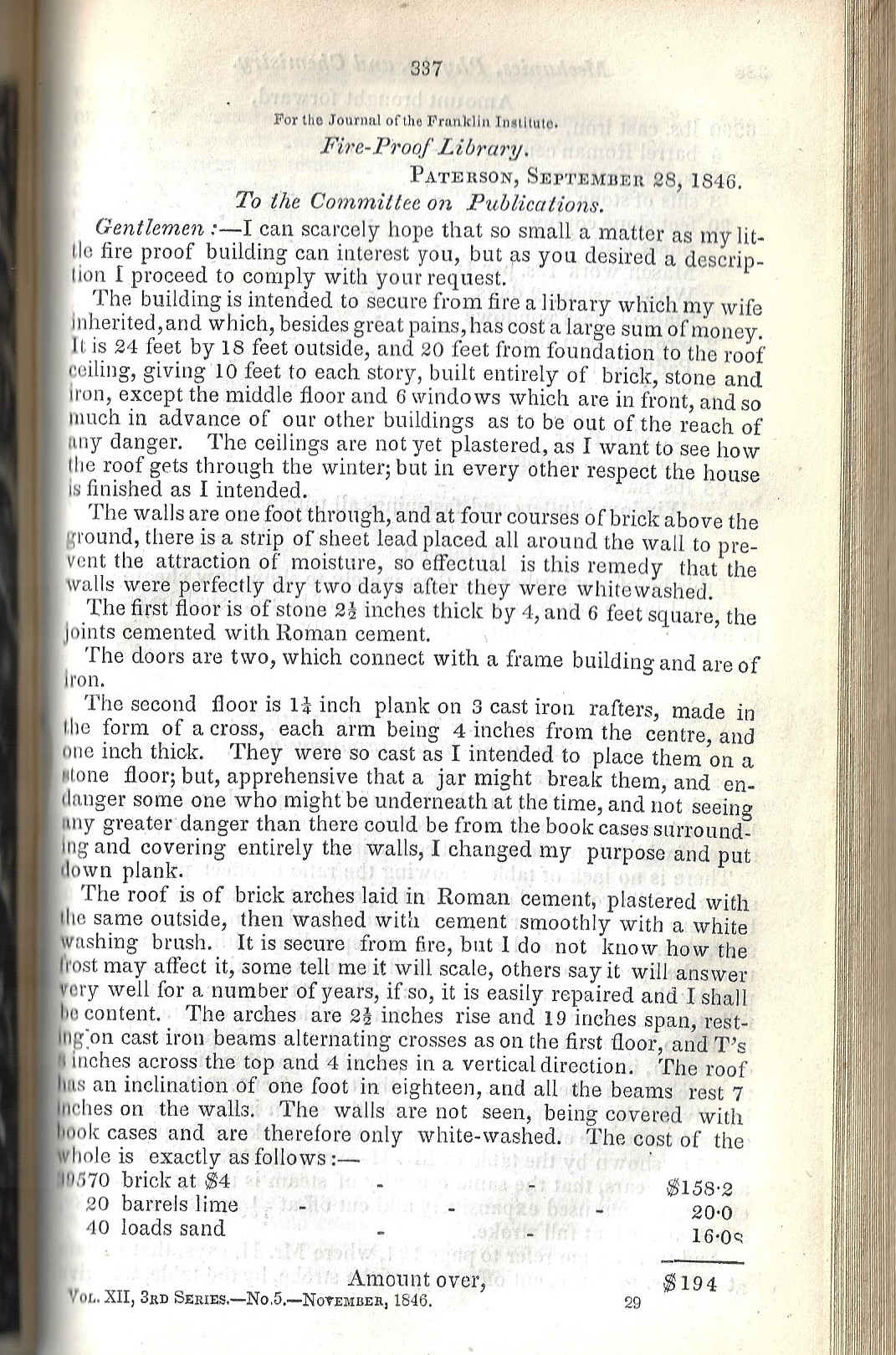
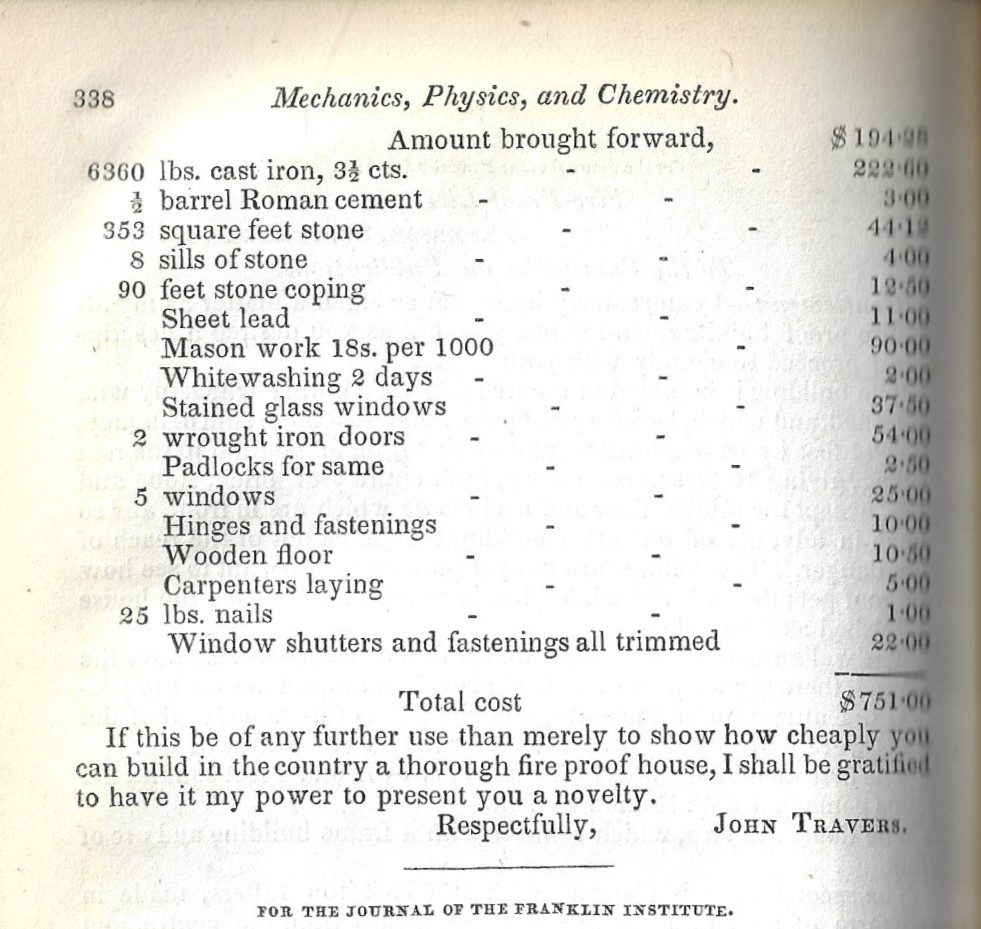
    The fire-proof home was not much seen as a topic (so far as I can tell) in the early 20th century when Frank Lloyd Wright wrote about his proposal for one in the Ladies Home Journal in 1907. His design, outlined in “A Fireproof House for $5000”) was an unusual subject then, and far more so since scholars say that this house of Wright’s was never built as designed, appearing in a few iterations with stucco over wood, which of course is not fireproof. The article for a “Fire-Proof Library” appeared in September 1846 in the Journal of the Franklin Institute, written by a John Travers, who shared his plans for safely housing his wife’s inherited library. The guy certainly was building a stout structure with massive walls, three tons of cast iron, cement, iron doors and window casements, stone, sheet lead, and 1.5″-thick wooden plank floors over cast iron trusses. How the wood figures to be “fire-proof” I do not know. But the subject was highly unusual, and decided to share the short article in full.

    [By the way a very skilled mechanical engineer might make $5k/yr in 1910; a dentist, about $2.5k, and the average worker about $400 a year. So the Wright house for $5,000 intended not-for-the-wealthy was affordable for a few years’ labor by the skilled professional and would have been out of reach for anyone else beneath that on the pay scale.]

    JFI 1846 fire proof library _1_

    JFI 1846 fire proof library _2_


    ·Posted by :

    ·in:

  • How to Straighten the World’s Tallest Chimney (1860)

    JF Ptak Science Books   Quick Post

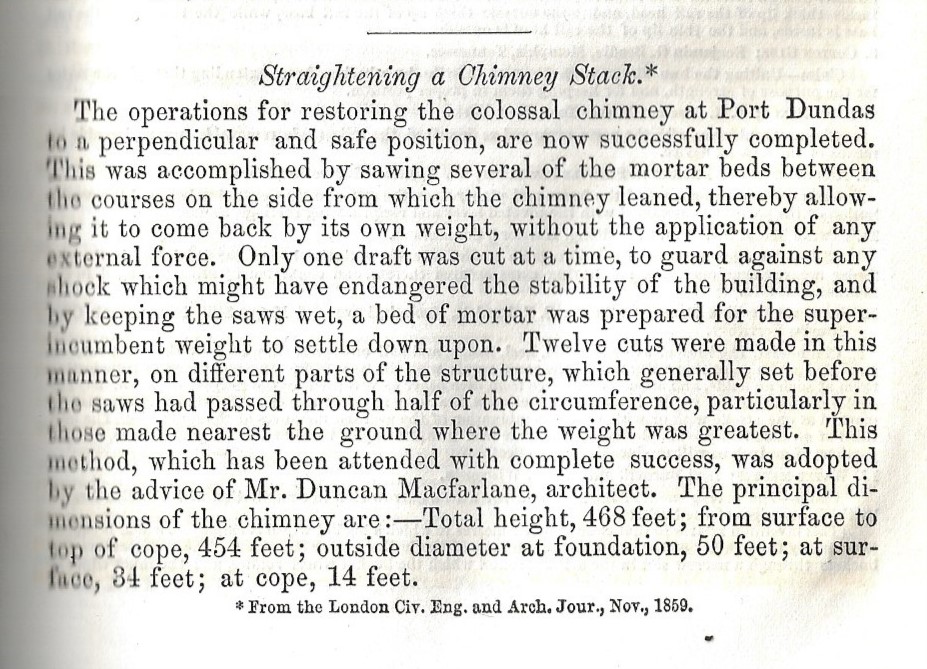
    JFI 1860 straightening chimneyThe running title at the top of the page in the Journal of the Franklin Institute (September 1860) reads “Straightening a Colossal Chimney Stack”, which attracted my immediate attention. It was constructed in 1859 in Port Dundas, near Glasgow, Scotland, and evidently needed some help in being straight-out perpendicular. The chimney was 454′ tall, and the tallest in the world–it was also one of the tallest masonry structures in existence. And it needed straightening. 

    “The tallest chimney was built at Port Dundas, Glasgow, Scotland, 1857 to 1859, for F. Townsend. It is the highest chimney in the world, (454 feet,) and one of the loftiest masonry structures in existence. It is, independent of its size, one of the best specimens of substantial, well-made brickwork in existence.”-­September 8, 1895, Page 17, The New York Times Archives

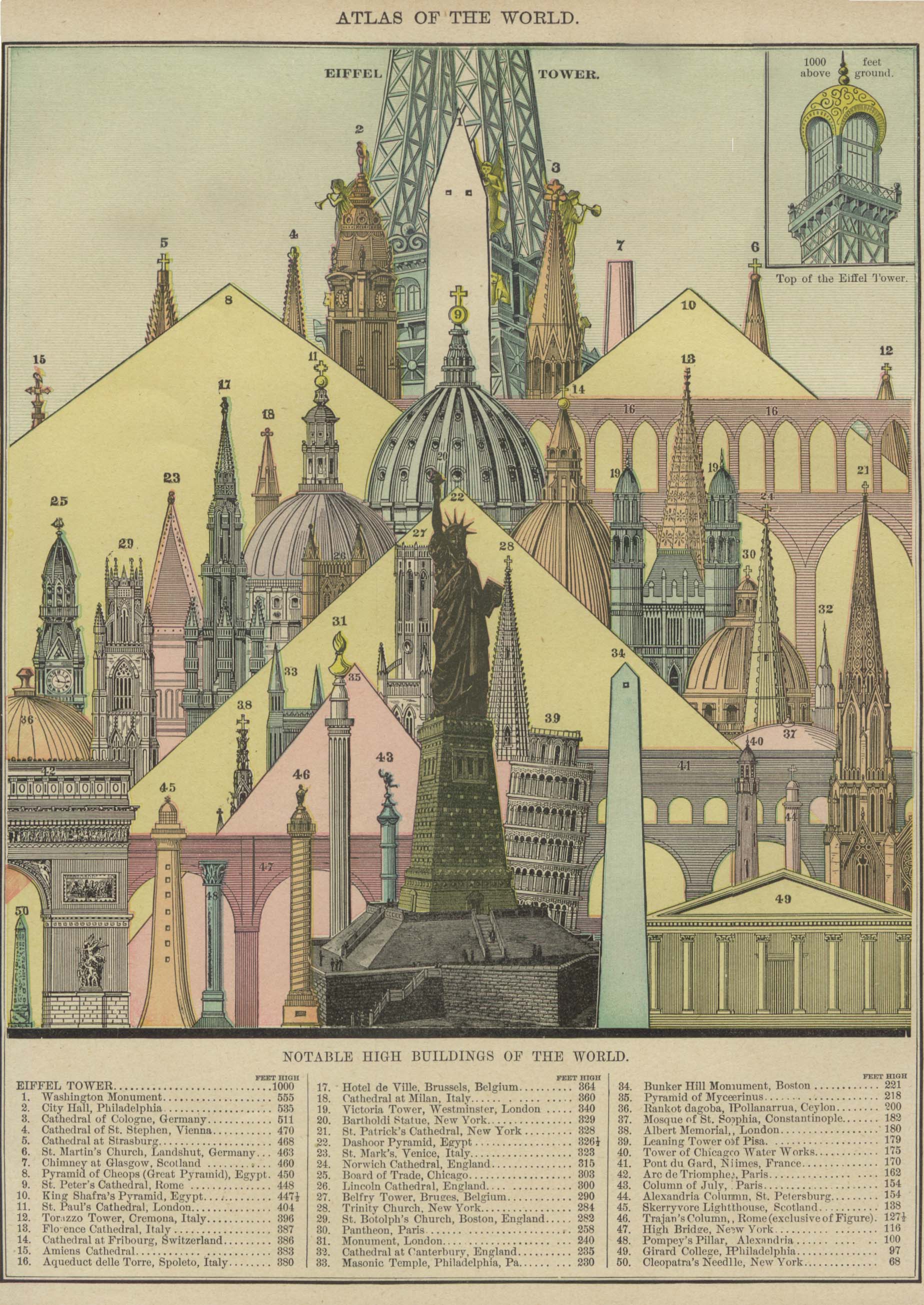
    The structure turns up in this delightful illustration of the world’s tallest structures in  Rand, McNally & Co.’s Universal Atlas of The World. Edition 1896 (as #7):

    Dataviz tallest buildings

  • Mechanization, Sea Biscuits, & Jolly Tars

    JF Ptak Science Books   Post 2752

    “It is pleasant to think that our jolly tars are no sufferers by this expeditious mode of making their sea bread. It seems to be admitted that the machine made biscuits are better mixed and better kneaded than those made by hand. The three bakeries at the three arsenals before named could produce when at full work six or eight thousand tons of biscuits in a year which would effect a saving of ten or twelve thousand a year as compared with the old method.”

    This is the paragraph that ends the long selection, below, taken from The Pictorial and Literary Sketch Book of the British Empire, (volume 1, published by Charles Knight, London, 1849). It is a great and lovely ending and also a fine beginning to describing a curious and engaging article, “Biscuit Baking Machinery”, in the Journal of the Franklin Institute, 1833. Overall, this is a chapter in the history of machine-over-human, of “Mechanization Takes Command” (with reference to Giedion’s superb and occasionally gut-wrenching book), and takes place in regards to sea biscuits, Jolly Tars, and a beautifully named Royal Clarence Victualling Establishment (“at Weevil, near Portsmouth”)

    It all boils out to biscuits. And in this case a Mr. T.T. Grant received a 2000-pound grant to develop his machine. The article goes into some great detail on it, though I found this curious before-and-after article (quoted below) that describes the biscuits made by hand and those by machine. One thing was certain: the machinery saved time in labor and also seems to have cut cost by 75%.  In any event, I wanted to share these two episodes in the early stages of the introduction of machines in the mass production of food.

    ·Posted by :

    ·in:

  • Tri-Triplane Monster Plane (1921)

    JF Ptak Science Books   Quick Post

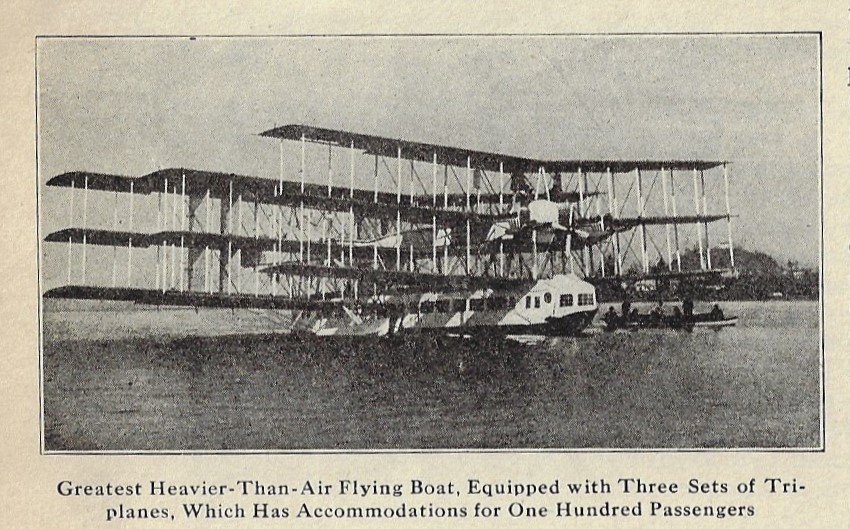
    A short article (with a smaller photo illustration)  on a very big topic appeared in Illustrated World in June 1921. The photo showed a remarkable plane constructed by aeronautical engineer Giovanni Caproni (1886-1957)–three planes, really. Three triplanes were attached to a floating Pullman-like fuselage, making this the largest/heaviest aircraft ever built at that time. It was 32′ high, 66′ long, and 130′ wide, and was made to seat 100 and make a transatlantic voyage. This was the “Noviplano” (the Caproni Ca. 6c, and translated in the article as “Nine-plannen”), and presented itself in an impressive if not complicated manner–it was a prototype, though, and was crashed and finished on its second flight.  

    Illus world caproni flyer 1921

  • Morse Code to Mars, 1921

    JF Ptak Science Books   Post 2750

    “Blapo”

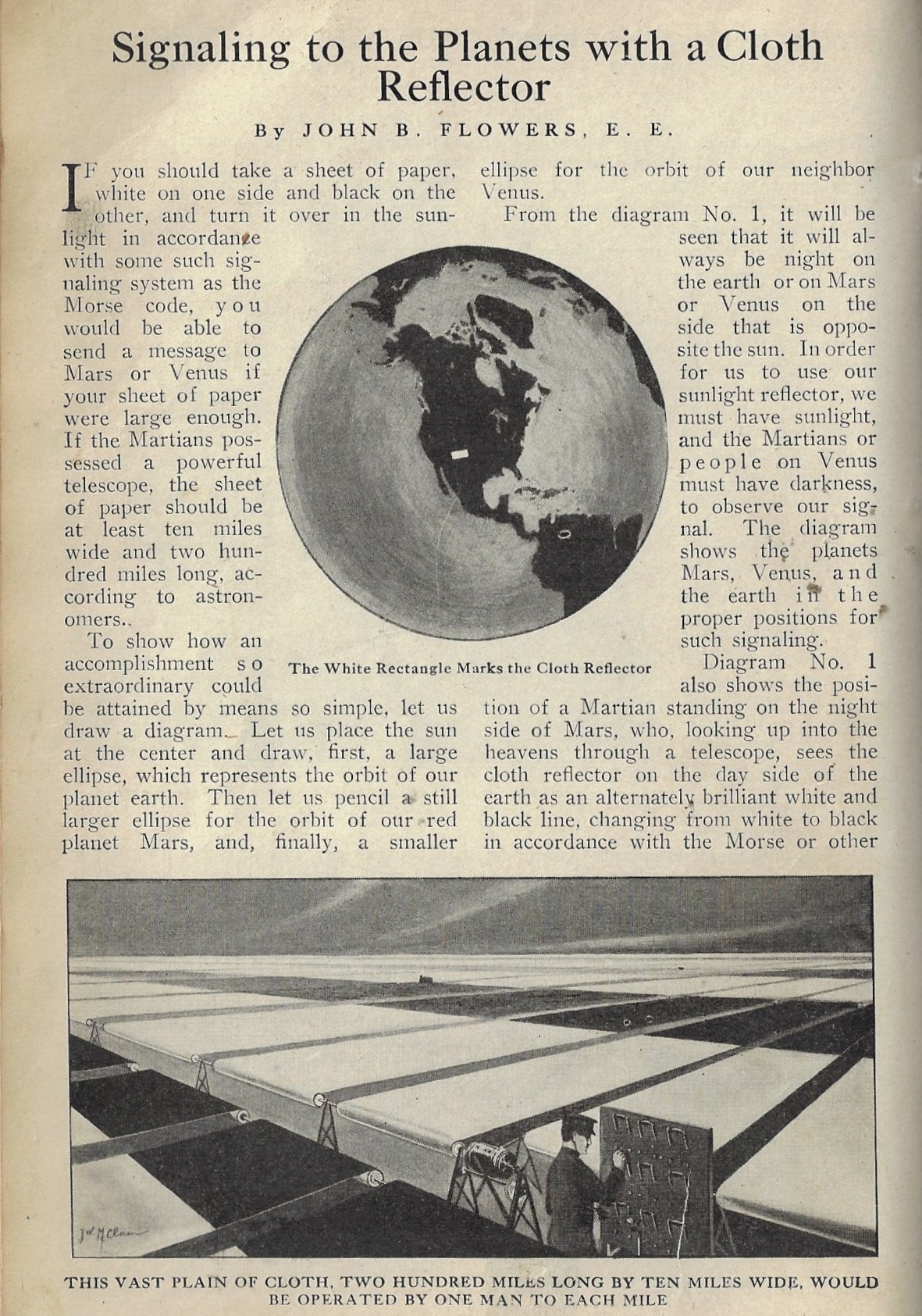
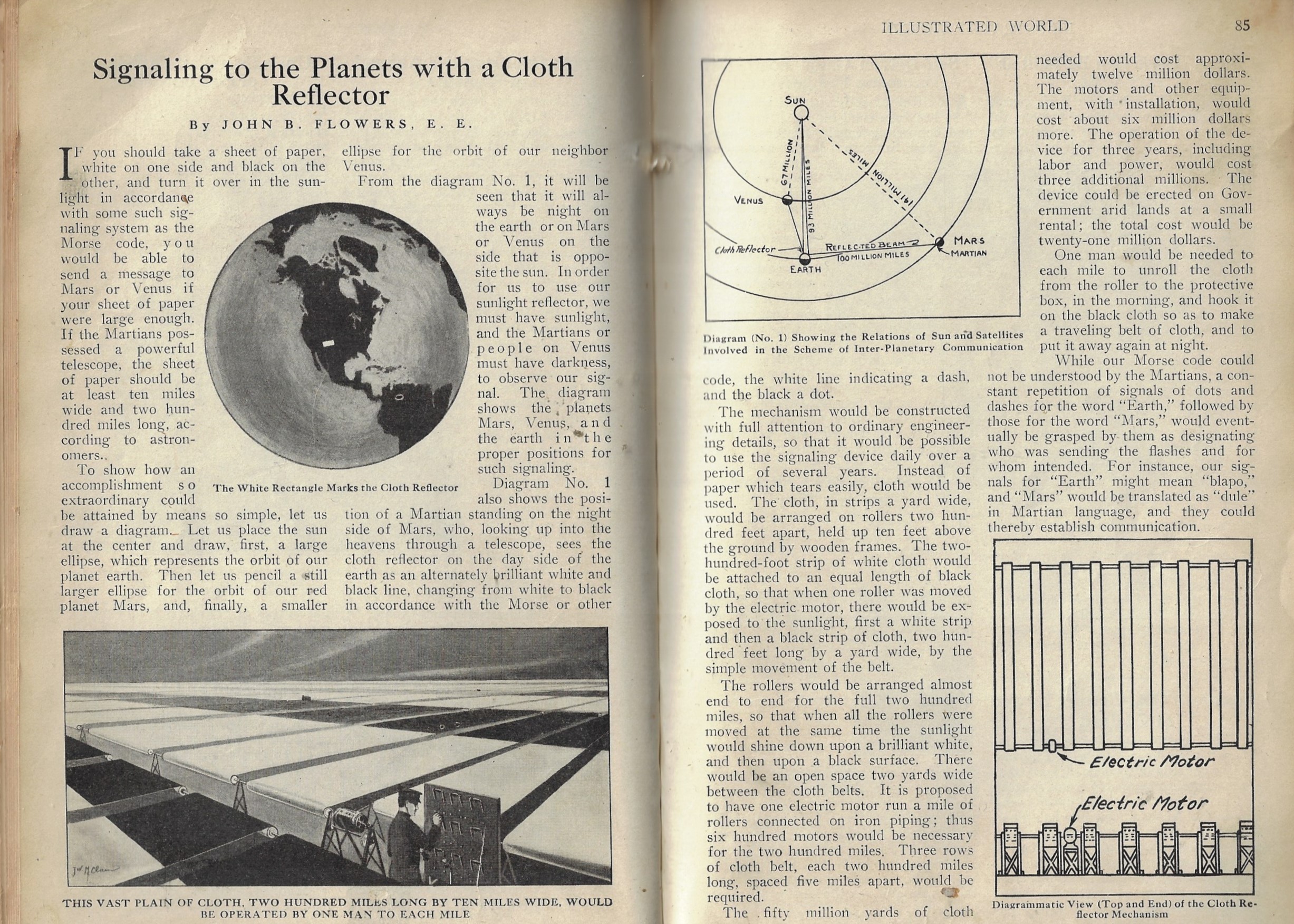
    A provocative article appeared in the somewhat obscure magazine Illustrated World suggesting a gigantic apparatus for signalling to possible observing beings on Mars. John B. Flowers, author of “Signaling to the Planets with a Cloth Reflector”, reported on a remarkable structure suggesting a possible way of communicating with intelligent life on the other planets–principally, it seems, Mars.  The briefest background here shows that the most popularizing idea of life on Mars came about as a mistranslation/interpretation  of astronomer’s Giovanni Schiaparelli’s observing term “canali” to be “canals/channels”, meaning an intelligent life form existed on the planet capable of constructing large technological forms. This idea was given full flight by Percy Lowell in his 1895 book Mars, followed just two years later by H.G. Welles’ War of the Worlds. 

    The uncredited idea in the Flowers article  called for a a series of connected mechanisms holding white sheets over a 200 x 10 mile (!) section of Federal desert lands, the movements of the sheets conducted by 600 large motors, making use of the segmented sheets to send messages via Morse code. The $21 million plan would repeat “Earth” and “Mars” over and over again until a response was heard. It was the hope that the Martians receiving the message would figure out the the dots/dashes related to Earth/Mars, finding that “Earth” was equal to their word for Earth (“Blapo”, for example) and “Mars” for (again, for example) their “Dule”.  And so on.  The article is only two pages long and for what its worth it spends a fair amount of space on the description of the apparatus, and a little on what it was that would be transmitted. There isn’t a word spent on what the consequences might be if the Martians returned the favor. 

    That said, the idea of life on Mars had mostly lost its pinkish pulse by 1920, though people still were still tinkering with ideas of how to communicate with alien forms of life over vast distances. Camille Flammarion, for example, advocated turning desert land into a massive Las Vegas, heating up the desert with millions of light bulbs and then using them to flash signals who-knows-where. Harvard’s William Pickering advocated an enormous mirror to reflect sunlight back into space somewhere, and R.W. Wood floated a similar idea to what is described by flowers, except the opposite, using black cloth over white sand. Over the next twenty years, into the 1940’s,  the interest seems less in communication than with the visiting the place.

    Notes

    • For a contemporary description of these ideas see “Hello Mars, this is Earth! Will the Martians Answer Us?”, in Popular Science Monthly, 1919, July-December, pp 74-5, full text here:  https://babel.hathitrust.org/cgi/pt?id=uc1.d0002769792;view=1up;seq=345
    • Also: here’s a good article (with the same title as the above but written in 2012) by Matt Novak in Smithsonian dot com exactly on this Pop Sci Monthly 1919 article. Well done! 


    Illus World Morse Code to MArs


    Illus World 1925 Morse to Mars 2pp


Recent Posts

Archives

Categories