A Daily History of Holes, Dots, Lines, Science, History, Math, Physics, Art, the Unintentional Absurd, Architecture, Maps, Data Visualization, Blank and Missing Things, and so on. |1.6 million words, 7500 images, 4.9 million hits| Press & appearances in The Times, Le Figaro, Mensa, The Economist, The Guardian, Discovery News, Slate, Le Monde, Sci American Blogs, Le Pont, and many other places… 5000+ total posts since 2008.

  • Humans as Numbers

    JF Ptak Science Books  

    Computer art154The idea of the human machine, the machine human, the technological man, the robot, the anthropomorphization of artificial life, Computer man automationgoes back a long way. One of my favorites comes from the 1830s and features a steam-driven automaton of some sort that was also a preacher–that was very cool, and was the subject of an article I wrote for the magazine at Mensa. I mean, an artificial semi-replacement life form that was created by humans that was having-forth on the gods and associated interpretations that humans also created–seems like an uncomfortable (and temporary?) middle space to be in. And that is a clear-cut anthropo image. There are many others that have appeared over the years showing gearworks in the brain, min-staffed miniature computer consoles in a head cutaway, tiny versions of the brain’s owner running around in the brain looking for paper in file cabinets (that one is just Spongebob Squarepants), and so on.

    These two images, however, are a little different than what I have seen over the years. 

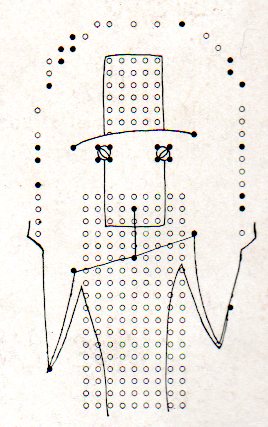
    The first one, on the left, is almost computer art, and almost art imaging a human as a computer component, but not quite. It is on the cover of one of the early issues of the “new” Physics Today magazine (volume 2, number 10), in October 1949–it is the artwork of Paul Bond, who created this portrait of a juggler “on a matrix sheet used for plotting computor [sic] plug board diagrams”, and is one of 11 such images. So, it does show a person composed of computer bits, and is pretty early for whatever it is that it is, so long as we’re talking about the modern computer and not something that was made-up in 1932.

    I wrote about this in more detail here: https://historyofideasblog.com/thesciencebookstore/2014/10/human-computer-art-1949.html

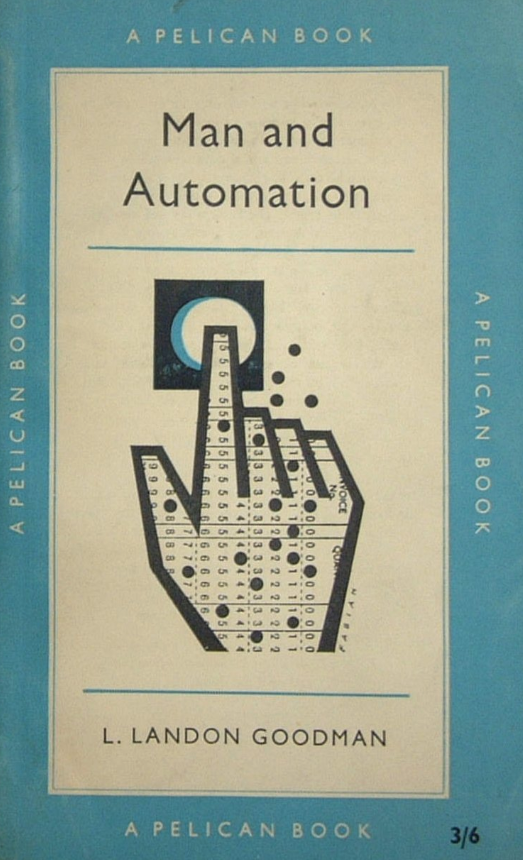
    The second image was one I found today, and was published in 1957. The cover implies some sort of human control being replaced by a computer-driven machine, hence the punch card. It is in some way similar to the compu-juggler, though the control aspect is far more obvious. 

    In any event even though I have looked at a lot of material in this field for a long time I don’t see very many computer-anthropomorphic images at all, and so present these two side-by-side today.  


    ·Posted by :

    ·in:

  • A Very Large Barrel (1888)

    JF Ptak Science Books  Quick Post

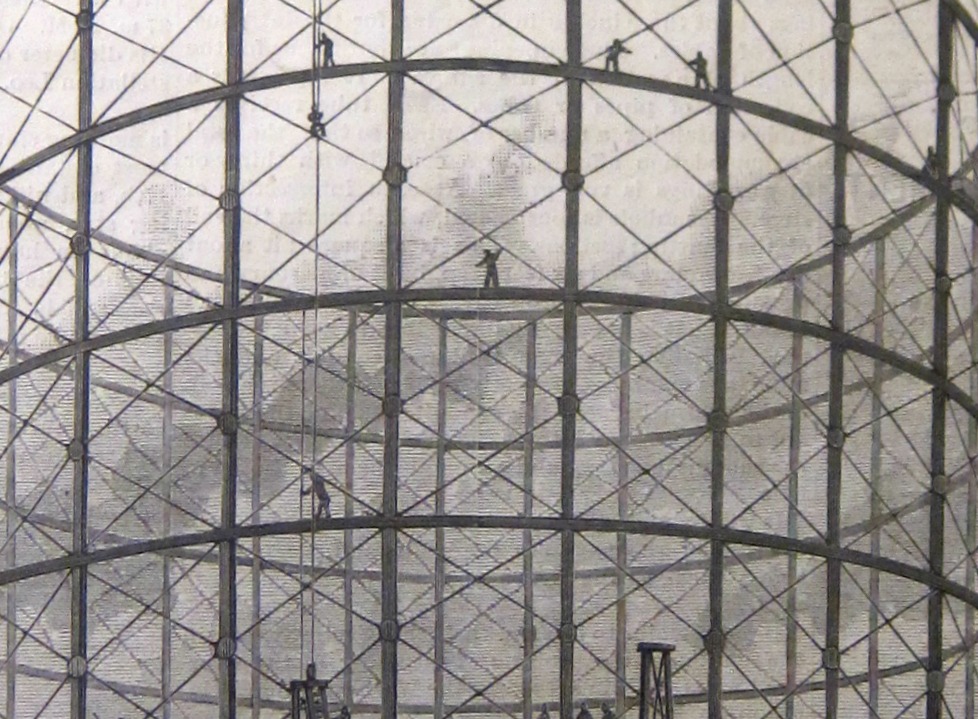
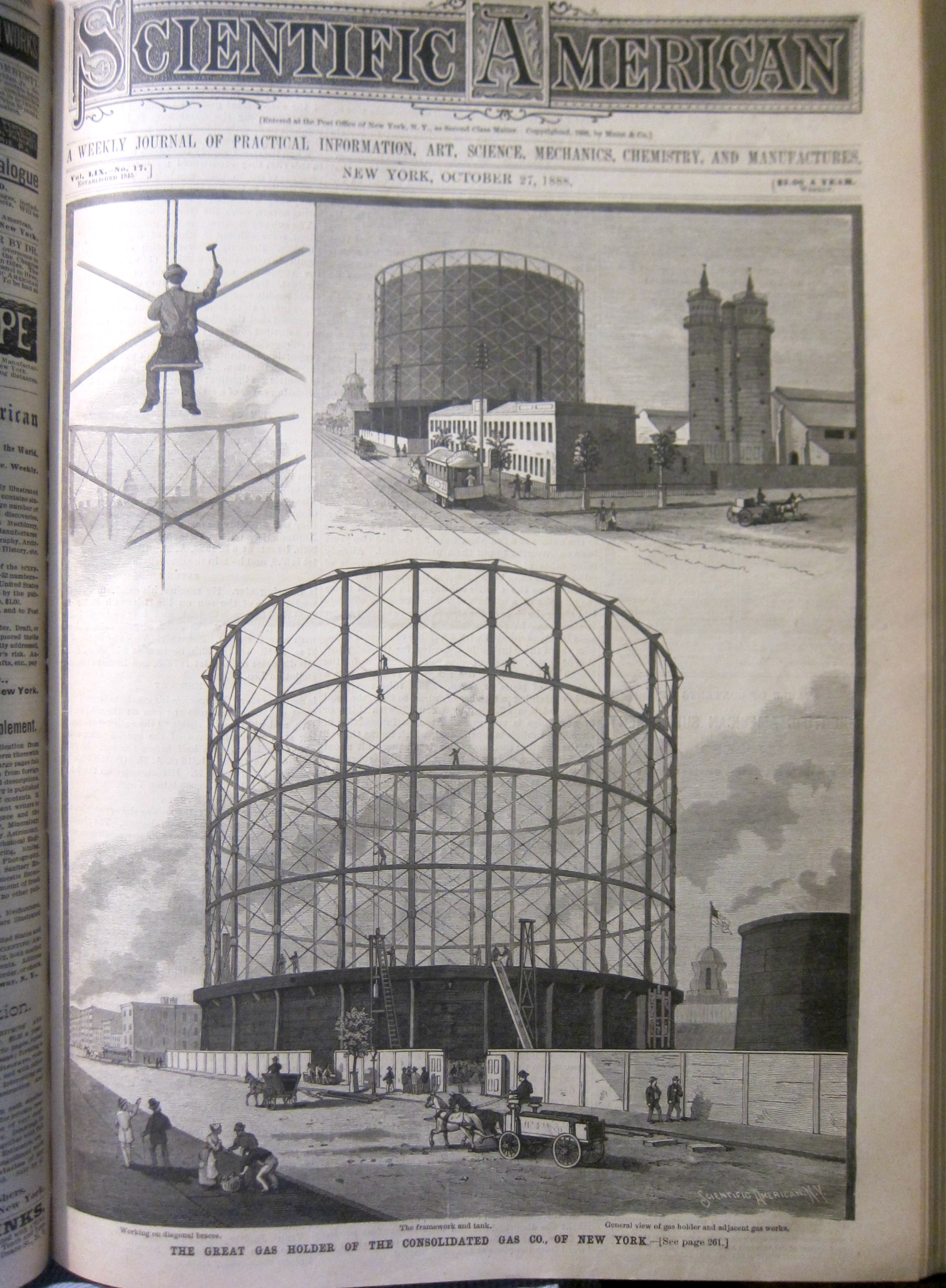
    Consolidated Gas Company storage facility being constructed in Manhattan, on Ave C between 15th+16th, as it appeared in Scientific American, 27 October 1888. It is a striking structure. Consolidated Gas (formed from six companies in 1884 and which would become Con Ed in 1936) built this mega bruiser: the facility was 192′ in diameter  and 150′ tall, the “barrel” made of double applications of 7/8″ wrought iron plate which would accommodate 3.2 million cubic feet of gas. Big.

    I don’t see any harnesses:

    Brooklyn Gas detail

    Brooklyn Gas 1888 Sci Am

    ·Posted by :

    ·in:

  • The Mystery of Suggested Promise–an Advertisement for Electrical Cure of Diseases (1885)

    JF Ptak Science Books
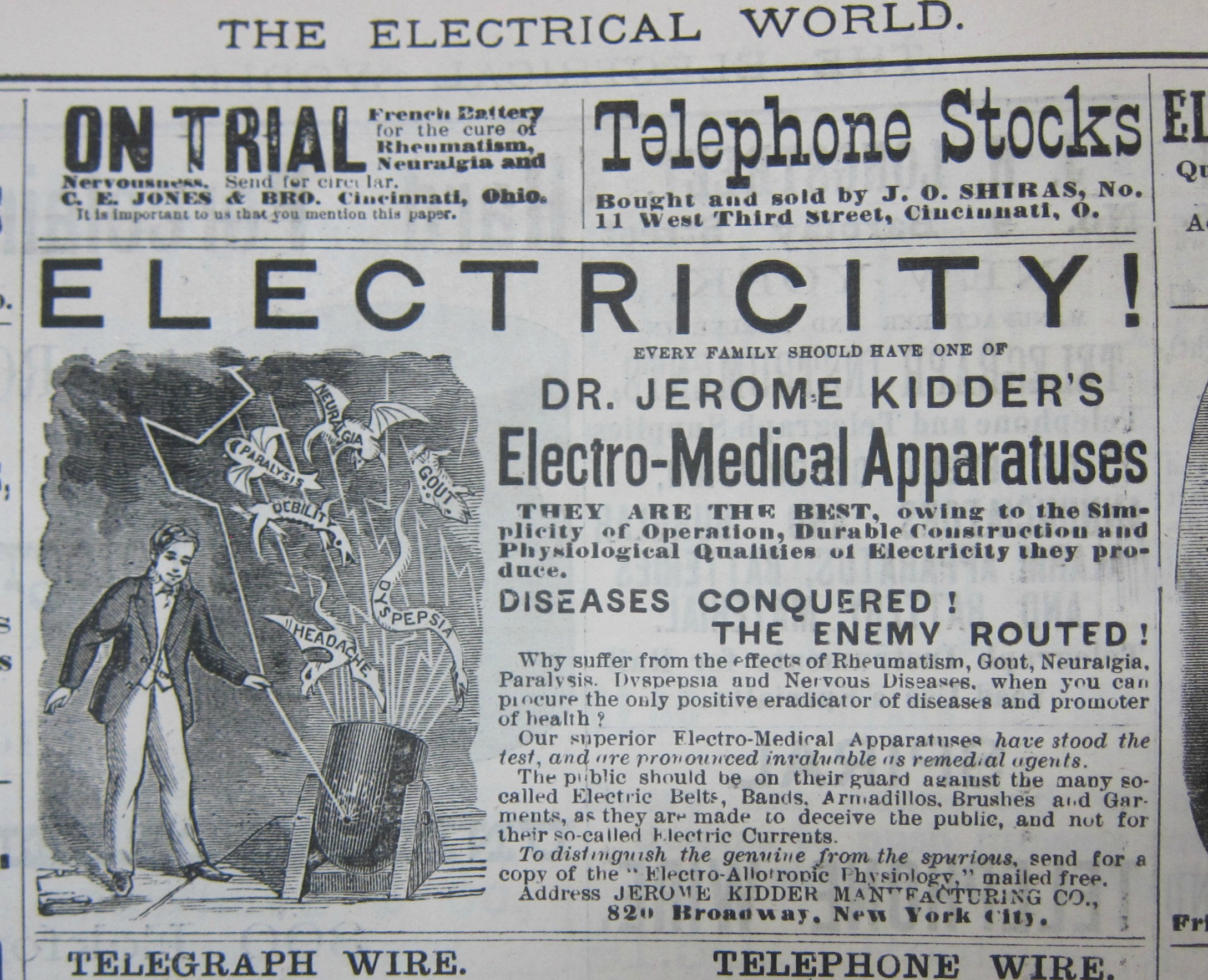
    I’m stepping right into the middle of this one–there’s a ton of material before and after this ad appeared in 1885 on the invention of the idea of curative factors of applying electricity in medical pursuits. It goes on to day of course but now the electrical stimulation will actually help rather than just simply electrically remove the money from your wallet. This ad happened to catch my eye while looking for telephone ads in the 1885 volume (#4) of Electrical World, mainly because of the graphics of the inventor, Dr. Kidder, happily satisfied and nonchalantly controlling a lightning bolt ignite the charge of a mortar–why a mortar, I don’t know. (There’s a slim chance for mortar-and-pestle, the mortar here being a siege weapon and the pestle being lightning issuing some sort of electrical wonder “pharmaceutical”, but I think that’s overthinking the image.) In any event the electric charge to the mortar spears various diseases and complains (including neuralgia, gout, paralysis, debility, dyspepsia, and headache) with electrical bolts/something, offering a cure to the afflicted with lightning speed. 

    Electricity Electrical world 1884 vol 4  electro medical

    I’m not sure of Jerome Kidder’s background as there are at least two I’ve found online that could be him, so I’ll just continue on personal history in ignorance. Seems to me though that he must’ve known that whatever it was he was peddling just didn’t work. 

    ·Posted by :

    ·in:

    —
  • Beautiful and Complex Interfaces (1880s)

    JF Ptak Science Books   Quick Post

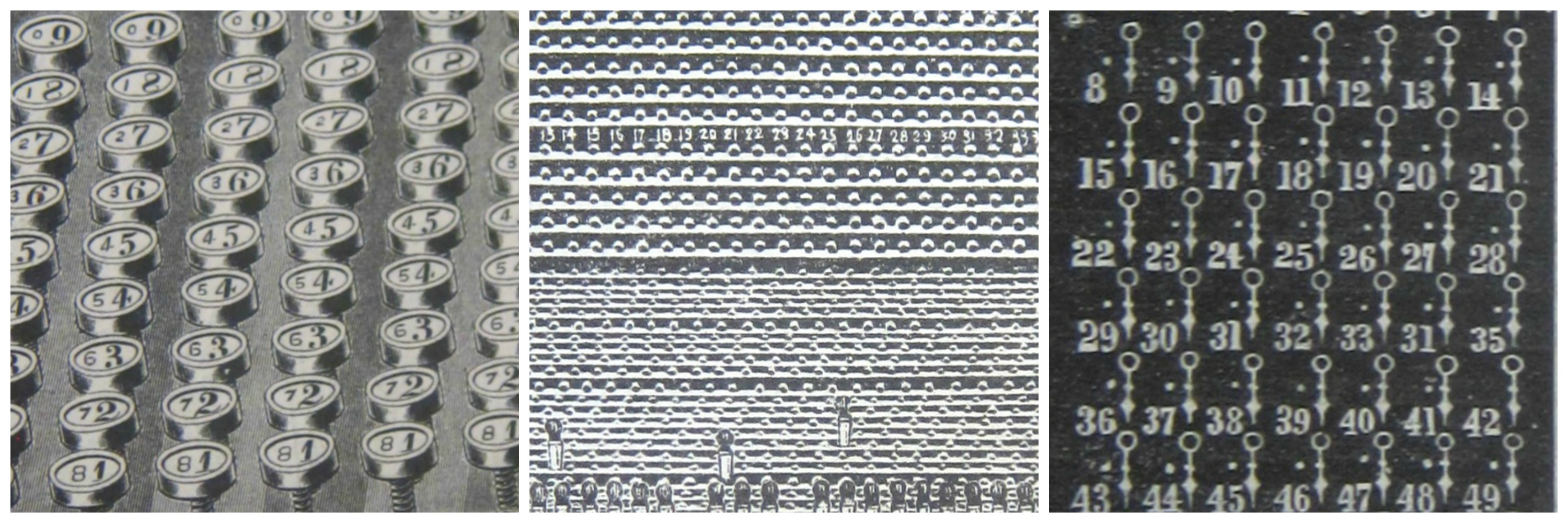
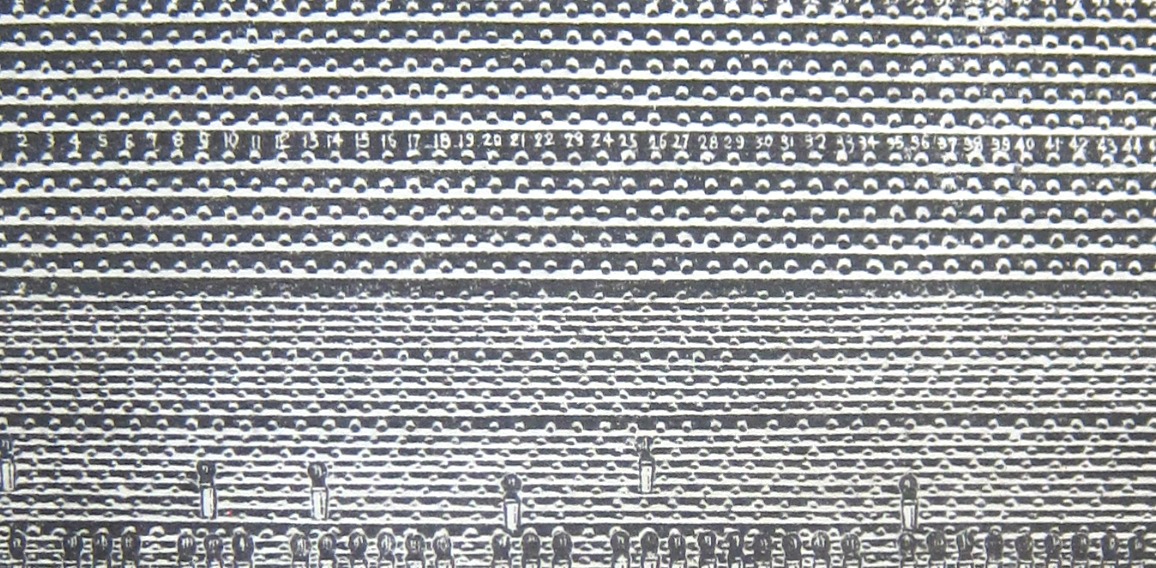
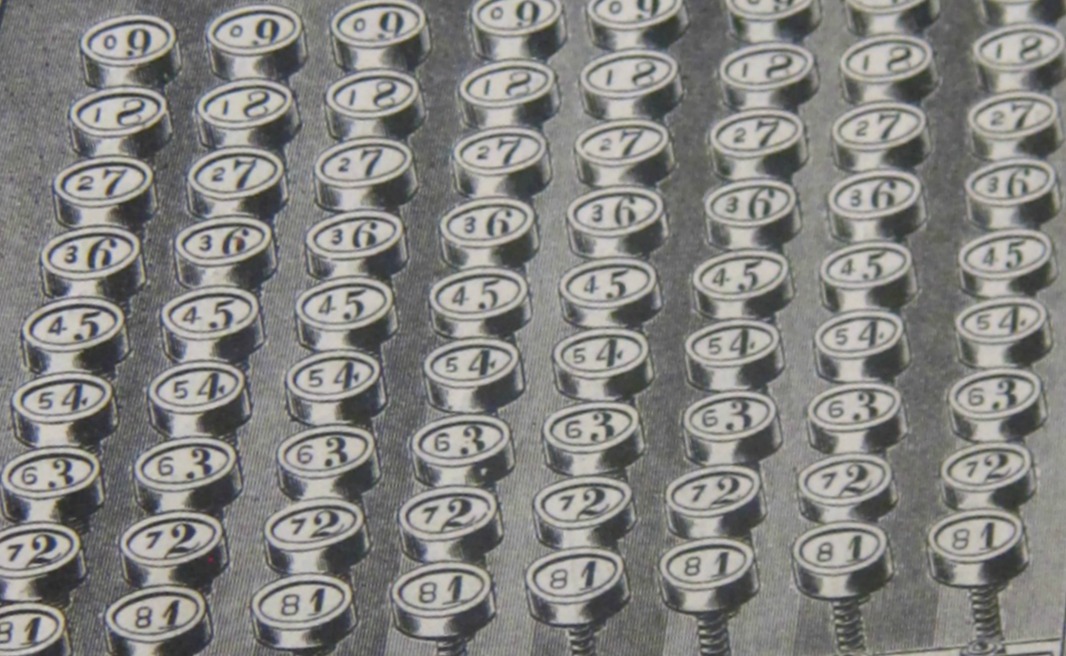
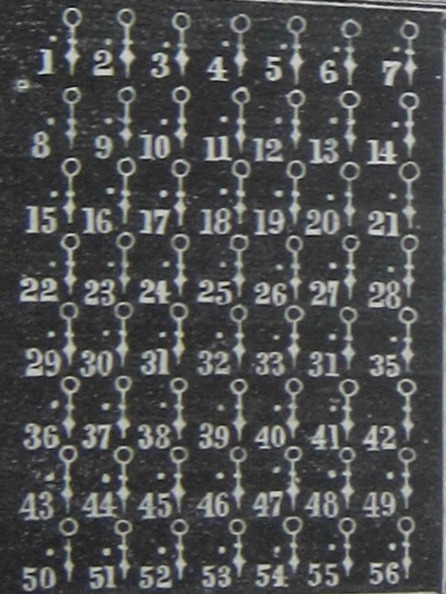
    There’s a certain gravitational attraction for the user/machine interface of 19th century tech that is highly–pardon me–attractive. All I want to do here in this simple post is share a few of these that I bumped into yesterday while on the search for 1880s calculating devices, one of which appears below. The three detail images below display some of the beauty of these machines and the point at which they come into contact with its operator. First, the keys for a very early image of Dorr E. Felt’s “Comptometer” calculating machine (1885); the second is a detail of Stabler’s Single Call telephone exchange (1884), and the third the business end of an electric bell display cabinet, also from 1884.  (The full images are displayed below along with their sources.)

    Collage interface
    Telephone signal system electrical world super detail

    Comptometer detail super


    Electrical bell electrical world detail


    From the front page of Electrical World for March 8, 1884:

    ·Posted by :

    ·in:

  • A Bridge for Carrying a Ferry Over Water (1869)

    JF Ptak Science Books  Post 2755   

    I don’t mean to appropriate the past from my seat here in the future, raising my eyebrows over what definitely seems to be an Ig Nobel engineering effort, but, well, there are times when you distill a bad idea over a low flame that the bad idea distilled is still a bad idea. 

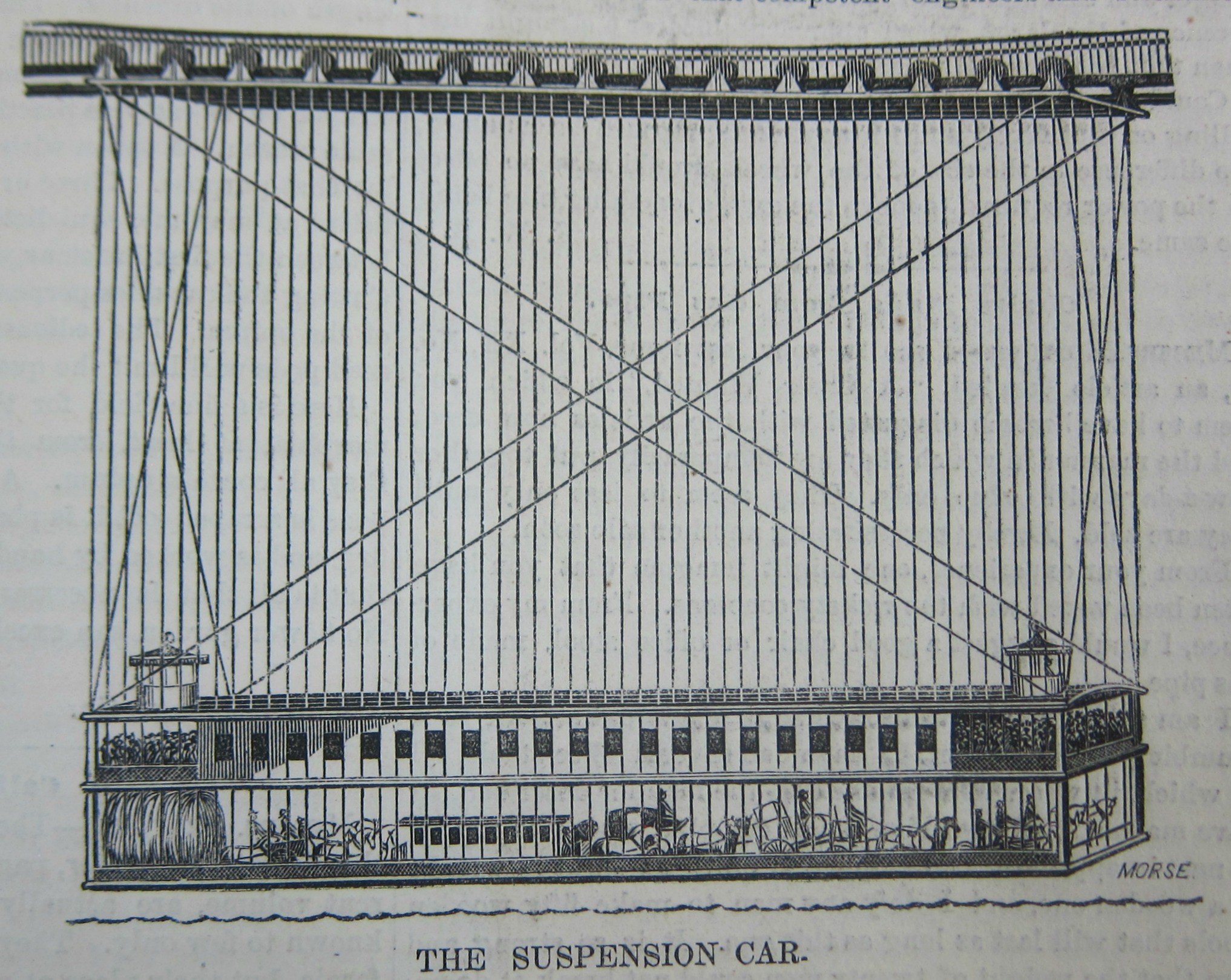
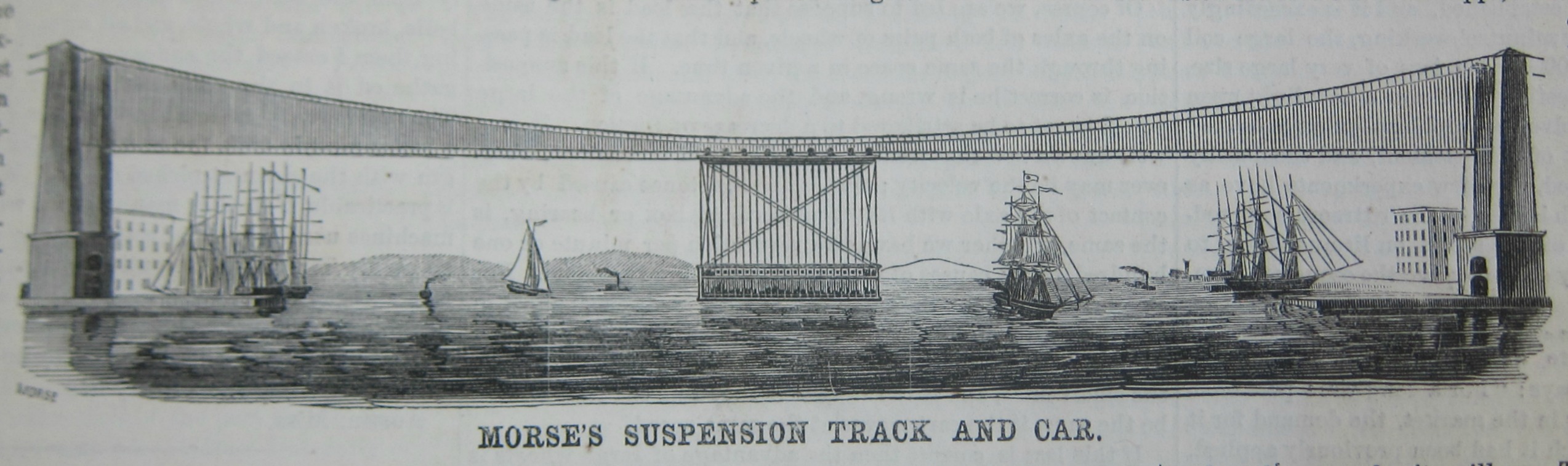
    I’ve tried to imagine the circumstance in which this bridge would make sense, particularly in light of the fact that it was a proposal by J.W. Morse to counter the Roebling plan to erect the East River (later “Brooklyn”) Bridge in about the same location. This is how this bridge plays itself out in my mind: a suspension bridge of some substantial size is constructed to carry a ferry from Manhattan to Brooklyn, even though it seems that a ferry would be able to get from one place to the other with not terrible fuss, except in the old style of using a boat it would be moving on/in the river rather than over it. The ferry wouldn’t need a bridge to cross the river if it didn’t wholly depend on one from completing its task, which ferries almost never do, being watercraft and all.

    Sci Am 1869 suspension ferry

    The details of the plan are a little shocking: that “car” hanging from the bridge cables measured 160’x40′ (6400 square feet) and two storeys high, and was meant to carry 5,000 people at one time (75,000 over a 12-hour period) along with another 500 horses and carts on the lower level. It was to make the trip in a minute or two, and would be moved from one point to the other at a few feet above the river.

    This might make sense if the river was choppy, or ice-bound, at which point it would be nice to use HyrdoplanePunk to get across the river. A bridge-as-bridge would accomplish this task without turning itself basically upside down and inside-out. 

    As I said it is not so good to judge application of technology by a modern standard; though in this case it seems as though if you were to look just slightly into the future from 1869 that you’d realize a continuous flow across the river would be highly preferable to a car shuttling a limited number back and forth. In addition to numerous other issues, I’m not sure how the engineer was dealing with the traffic and congestion caused by the fits and starts of 1,000 or 2,500 (let alone 5,000) people plus freight leaving the car/boat all at once, joining a crowd of people and horses and so on waiting to board, dozens of times a day.

    Sci Am 1869 suspension ferry profile

    At the end of it all, this bridge is also just not very attractive, and not made for the ages—it seems temporary, a short range solution to a long range issue, something soon to be dismantled, used elsewhere, and then scrapped.

    I should point out that there is a variety of bridge dedicated to this sort of transportation—it is evidently of French origin, and referred to as a pont a transbordeur, and seems to have some utility here and there, though that “here” and “there” did not include “Manhattan” and “Brooklyn”.

    • From the article:  “While plans have now been divulged to connect the island of Manhattan in New York with Brooklyn by means of a giant suspension bridge over the East River, Mr. J. W. Morse has devised a bridge which permits of a much lighter construction than a normal suspension bridge and is, consequently, much cheaper to build. Mr Morse’s project provides for transportation across the river in a giant platform, suspended by means of cables from a trolley running upon a gantry across the river. Measuring 40 X 160 feet, the platform has two stories: the top floor is for pedestrians while the bottom deck is intended for horses and carriages. While a normal suspension bridge requires extensive abutments and ramps to enable the road traffic to reach the bridge-deck level of almost 120 feet, Mr. Morse’s transporter bridge obviates the need for such provisions. The fact that the traveller [sic] hangs only 3 feet above the water-and hence is almost at street-level-makes it easy for heavily loaded wagons to cross the river, and will also be appreciated by the workman returning home on foot after a hard day’s toil in the factory or warehouse.” —Scientific American,  24 May, 1869
  • A Dedicated Man Dedicated to his Dedicated Dog

    JF Ptak Science Books   Post 2756  [Dedicated to Bluey, Cowboy, Watson, Finbar, Dudley, and Perry. Also dedicated to Ralph Kenat, a great and understanding friend to dogs; and Alexandra Horowitz, author of the keenly penetrating and insightful Inside of a Dog.)

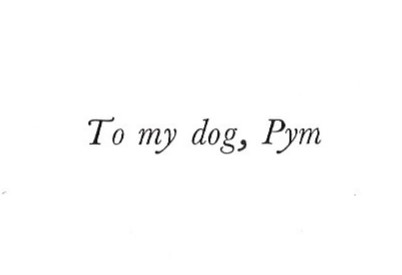
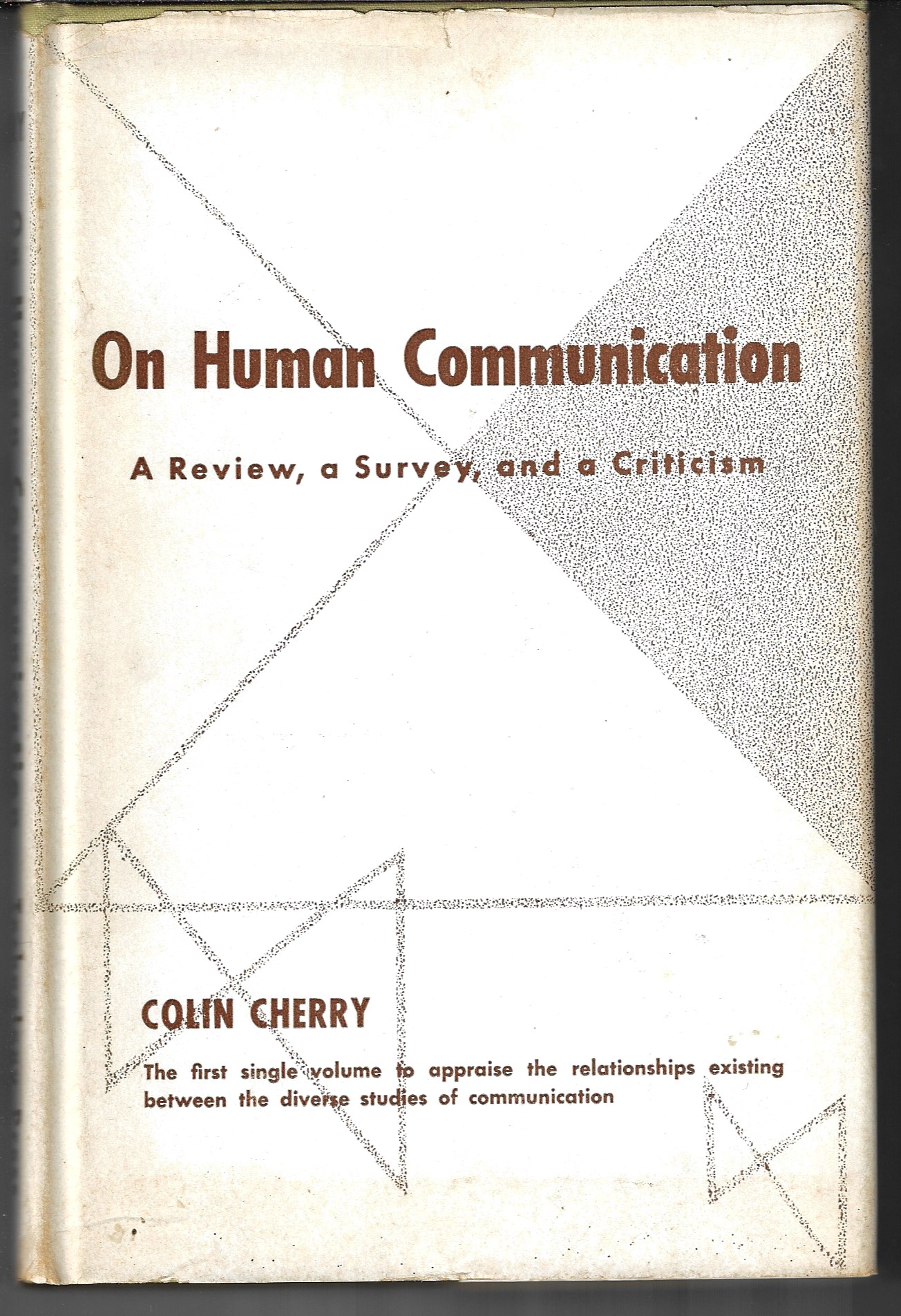
    One of the most intriguing bits I’m taking away from an intriguing book (On Human Communication…M.I.T., 1957) is its dedication page. The author, Colin Cherry (1914-1979) was an interesting pioneer in cognitive science, AI, and associated areas, and did what very very few other writers have done: he dedicated a major book to his dog.

    What came to mind immediately was Poe’s only novel, The Narrative of Arthur Gordon Pym, of Nantucket,  which is the only “Pym” I know–but there the dog in the story was named Tiger, and he was certainly not the object of dedication. Next came Isaac Newton’s dog, who infamously caused (or not) the destruction of a Newton manuscript…but that dog’s namePymwas Diamond, and that little doggie certainly didn’t get anything dedicated to him or her after that (assuming the dog was real).  Then John Steinbeck’s Travels with Charley bubbled up—Charley being one of Steinbeck’s dogs and the subject of the title, though the book was not dedicated to him in spite of that. I’m hard-pressed to recall any other books besides Cherry’s dedicated to a dog, although there’s no doubt plenty of room to pay homage to a loyal friend on a dedicatory page.Evidently there are virtually no books dedicated to dogs known and unknown. Certainly at some point dogs real and imagined like Argos, Brian, Buck, Bullseye (Oliver Twist), Cerebus, Clifford, (Hagrid’s) Fang, Goofy, Huckleberry, Laelaps, Lassie , Nana, Nipper, Pluto, Pongo, Rin Tin Tin, Sirius, Snowy, Snoopy, (Buster Brown’s) Tige, Toto, and so on, could have had some work dedicated to them, though it seems like not. (If so, I’d like to hear about it…also I just realized that all of the dogs I’ve mentioned are fictional.) Many writers have had dogs and pets, and some famously so, and some have become characters in books (as with Vonnegut and Dicken’s ravens1), but not as a dedicatee.

    And so I recognize at this late date Colin Cherry, a man who liked his dog.

    (A helpful reader pointed out that the dedication changed in the second edition of the book: “To all those human beings who have enquired so kindly after my dog Pym”. Twenty years later the third edition dedication changes again; this time , it is “To the memory of my dog Pym”.) 

    CHerry Human com coverNote:

    1. Dickens had a series of ravens named “Grip”, one of whom may have had an influence on a young Edgar A. Poe when he met Dickens in 1842. Poe also met Grip, as Dickens traveled with his family and the bird on his U.S. Tour. Some say Grip was an inspiration for Poe and his big poem; if so, he didn’t dedicate the poem to Grip or Dickens. Anyway, I’m talking about dogs here, and Dickens the animalist so far as I can remember didn’t spend too much time on them in any of his novels (Bullseye being an exception noted above), though he did write something about the death of his cat, Bob.

    ·Posted by :

    ·in:

  • On Possibly Rejecting the Telephone for the Ugliness of Telephone Wires (1885)

    JF Ptak Science Books  Quick Post

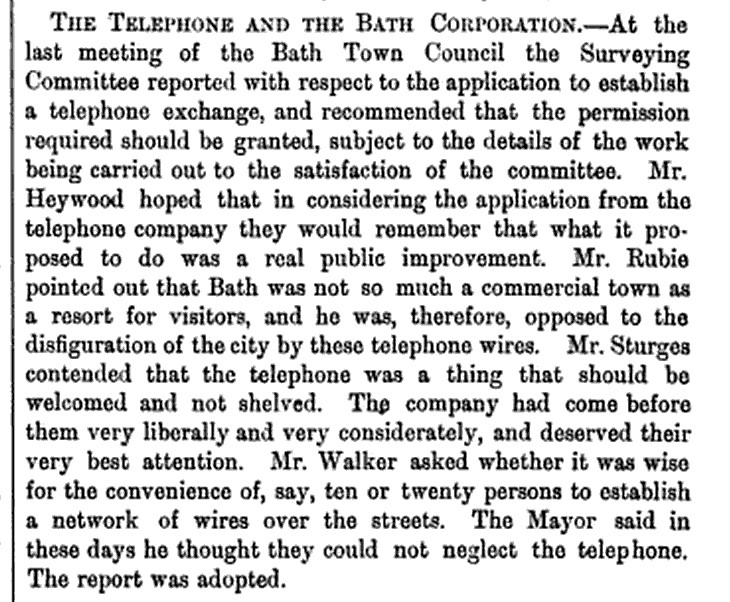
    Vast throngs of people have resisted technological innovation/improvement/invention one way or anther, from the rejection of the printed word because it would badly influence the spoken word tradition; to the telegraph, which would impact the facility and beauty of letter-writing; to the telephone, which would adversely impact the telegraph and become an assault on privacy, and so on. Some of these complaints were real and valid; others, not so much so. Today I found another episode in this sort of thinking, this time relating to possibly rejecting the telephone in terms of aesthetics–and that being the complaint of  the ugly nature of telephone wires and their impact on a cityscape. The city here was Bath, 1885, and the town leaders were considering a proposal by a telephone company, not all of whom were in favor of the relatively new (1876 for all intents and purposes) invention. 

    • “…Heywood hoped that in considering the application from the telephone company they would remember that what it proposed to do was a real public improvement. Mr Rubie pointed out that Bath was not so much a commercial town as a resort for visitors and he was therefore opposed to the disfiguration of the city by these telephone wires. Mr Sturges contended that the telephone was a thing that should be welcomed and not shelved.” 

    In any event, the mayor of Bath said that the telephone should not be “neglected”, and decided to establish the telephone exchange. And so:

    Telephone 1886 The Engineer

    [Source: The Electrician, 25 December, 1885.]

    ·Posted by :

    ·in:

  • Thayer’s “New Navigable War Balloon” and Mutually Assured Destruction, (1885)

    JF Ptak Science Books  Quick Post

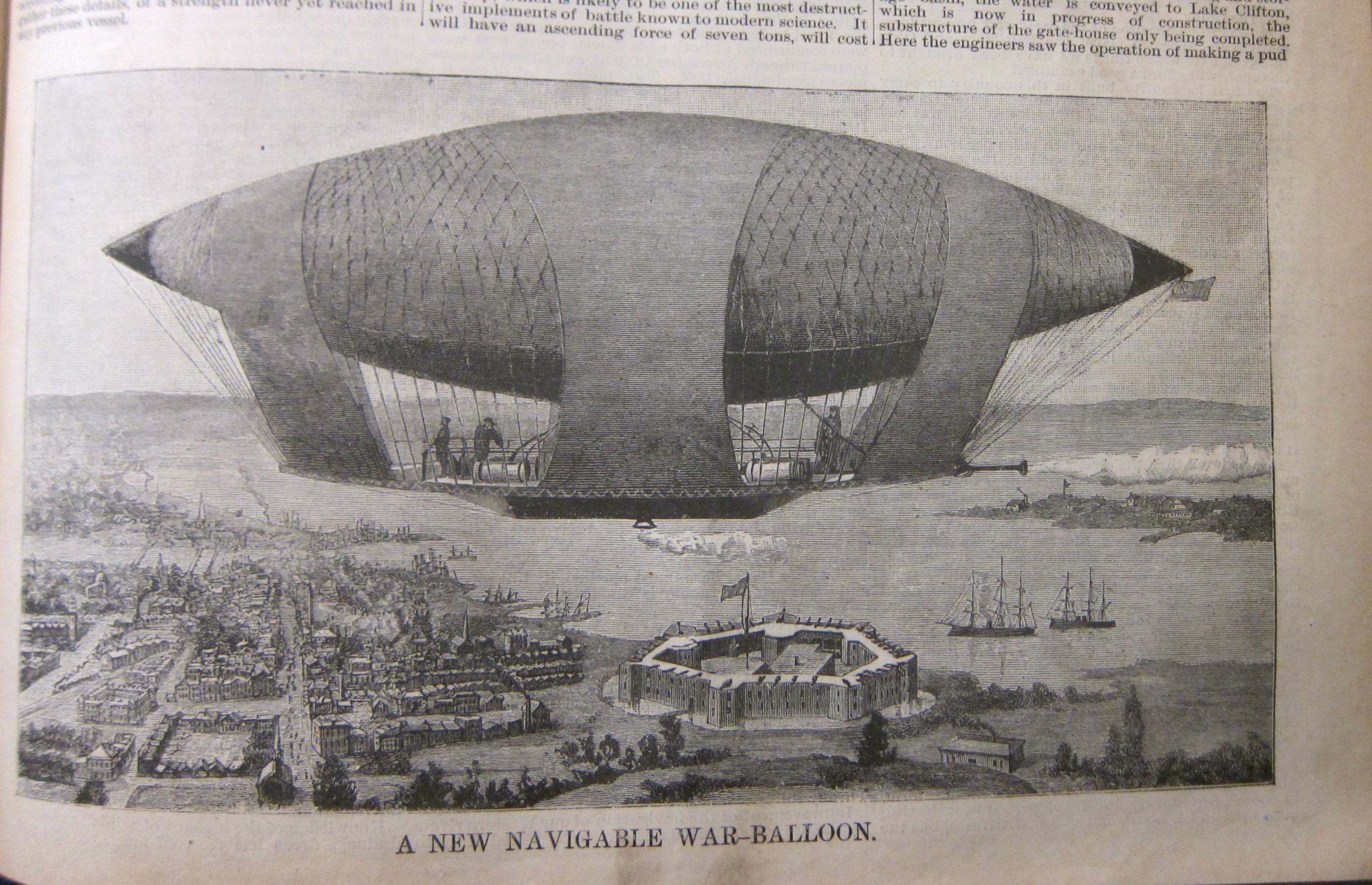
    Here’s a rather Jules Verne-y concept for a military balloon, presented to by General Russell Thayer, and published in the Scientific American Supplement in 1885.  In this iteration the aircraft is labeled a “war-balloon” but looks benign and observational; in the second image, see a month later in Harper’s Weekly, the balloon is definitely a war machine, having just bombed something with what looks like an enormous explosive. The scene here illustrates an airship in flight over a very industrialized section of a city, perhaps to drive home a propaganda point that bombing was accurate enough to be strategic and also that targets were industries and not general populations. 

    (The first aerial bombing seems to have been during the first Italian War of Independence and used by the Austrians from a  balloon against Venice in 1849; while this 1916 bombing occurred a few years after the first bomb was dropped from a heavier-than-air aircraft during the Italo-Turkish War on 1 November 1911, the Italians this time delivering the blow in Tripoli.)  

    The idea of aerial bombardment was an enormous threat, imagining death coming from above,  huge airships dropping untold numbers of bombs upon a city–I imagine that the idea came as much a blow to someone at the end of the 19th c as the threat of nuclear devastation came to those in the mid-20th c.  As a matter of fact S.L. Koter and J.E. Gessler quote an unnamed “distinguished officer in the U.S. Navy” implying much the same thinking as would be later heard as nuclear-weapons-inspired Mutually Assured Destruction (MAD): “War will become impossible because it will signify not merely great loss of life and property, but annihilation”. (Ballooning, a History; 1782-1900, p. 268.)

    It is particularly interesting to note here that Thayer, proposes to use a propulsion system that is not dependent on a propeller but rather “compressed air”.  “In the independent balloon the motor is a high pressure air compressor coupled directly to a newly devised carbonic acid gas engine and a reservoir for storing the air until sufficient pressure is obtained. The construction of the dependent balloon is similar to that of the independent ship except as regards the motive power which is here electricity…”

    Sci Am 1885 war balloon

  • Found-Abstract Art in Electrical Hardware (1885)

    JF Ptak Science Books  Quick Post

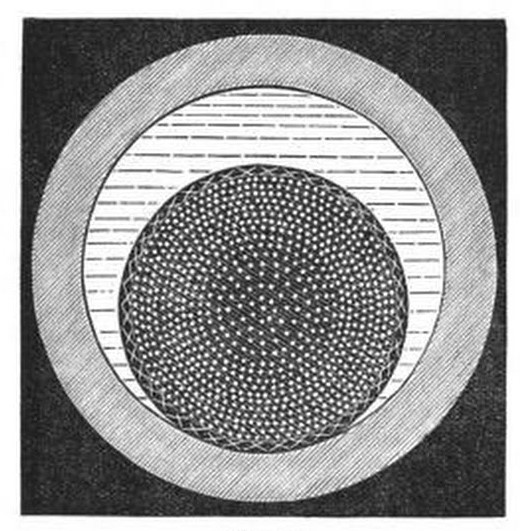
    I like this cross section as a piece of Found-Art–pre-nonrepresentational art, but it appears about 25 years too soon. It could be classified as “art” after Mr. Kandinsky makes an appearance…but we might have to look not very closely at the work of Whistler, Turner, Constable, and some others who came very close to abstract art but not quite…and we’ll also have to overlook some wide swath of Asian art (some quite ancient). 

    The actual element here is a cross section of a piece of 2.5″ pipe half-stuffed with 420 telephone lines, and belonged in 1885 to the Metropolitan Telephone Company of New York.  (“The dark shading shows the pitch filling the box around the pipe. The light ring next the pitch represents the wrought iron pipe inside of which rests the cable showing the ends of the copper wire surrounded with the insulating oil which fills the pipe full at all times.”–The Electrician, November 13, 1885)


    Electrical wires telephone electrician 1886

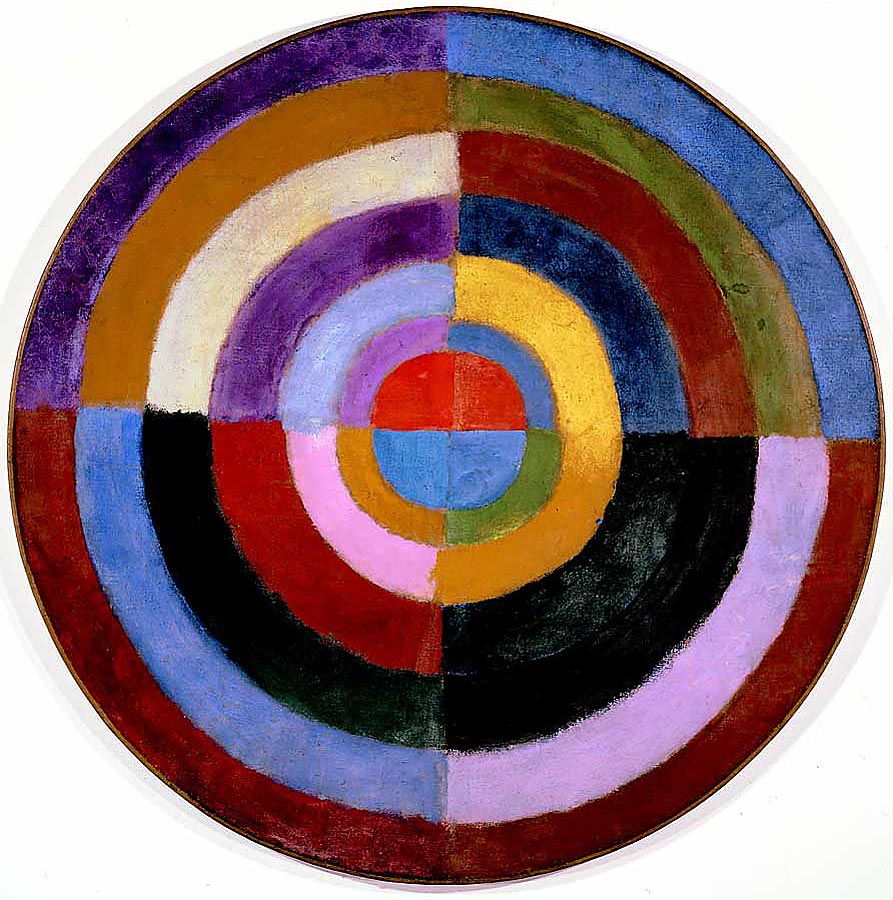
    And just conversationally I’ll include Robert Delaunay’s  1913 Premier Disque:

    Delaunay _1913 _Premier_Disque _134_cm _52.7_inches _Private_collection

    [Robert Delaunay, via Wikicommons]

    ·Posted by :

    ·in:

    —
  • A Short but Good Report on a Major Paper by Tesla, 1892

    JF Ptak Science Books  Quick Post

    Tesla 5121

    In January 1892, the 34-year-old Nikola Tesla gave an interesting and significant lecture on (“alternate currents of high potential and frequency”) in London, first to the Royal Institution and second to the Institution of Electrical Engineers, which was summarized in this short paper in Nature (volume 45, #1163, 1892) reproduced below. This is a continuation it seems of his famous July 1891 lecture in which he first addressed his experiments with alternating current, and which gained him international attention. The full lecture may be seen at the Internet Archive: https://archive.org/details/ExperimentsWithAlternateCurTeslaNikola5098/page/n0

    ·Posted by :

    ·in:

  • Defining the Work: Two Examples of Describing Standard Terms (1710)

    JF Ptak Science Books  Quick Post

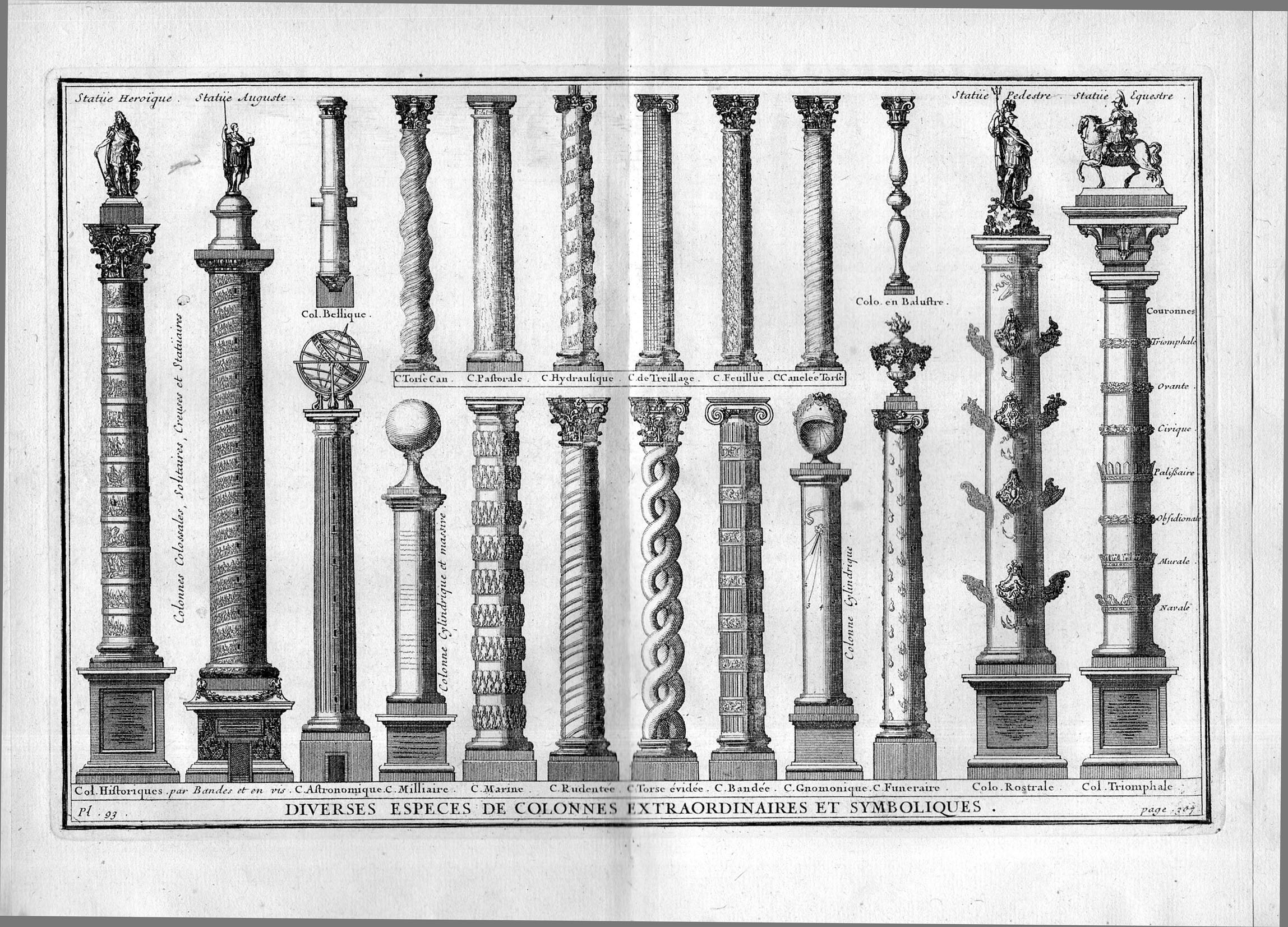
    Over the years I’ve seen many architectural prints, and I’ve come to determine that I most enjoy the comparative views.  It is uncommon to see a single-sheet engraving dedicated to different forms of columns, as we see here in plate 93 (page 307)  of volume one of A.C. Daviler’s Cours d’Architecture qui comprend les Ordres de Vignole…published in Paris in 1710. Daviler (1653-1701),was an architect and a student of  Jean-Francois Blondel (1683-1756) who worked very extensively on the architectural theory of Giacomo Barozzi or Jacopo Barozzi da Vignola (1507-1573). Here he identifies and classifies 20 different types of columns, just to make sure that everyone was on the same page, so to speak:

    Architecture--vignole--columns429

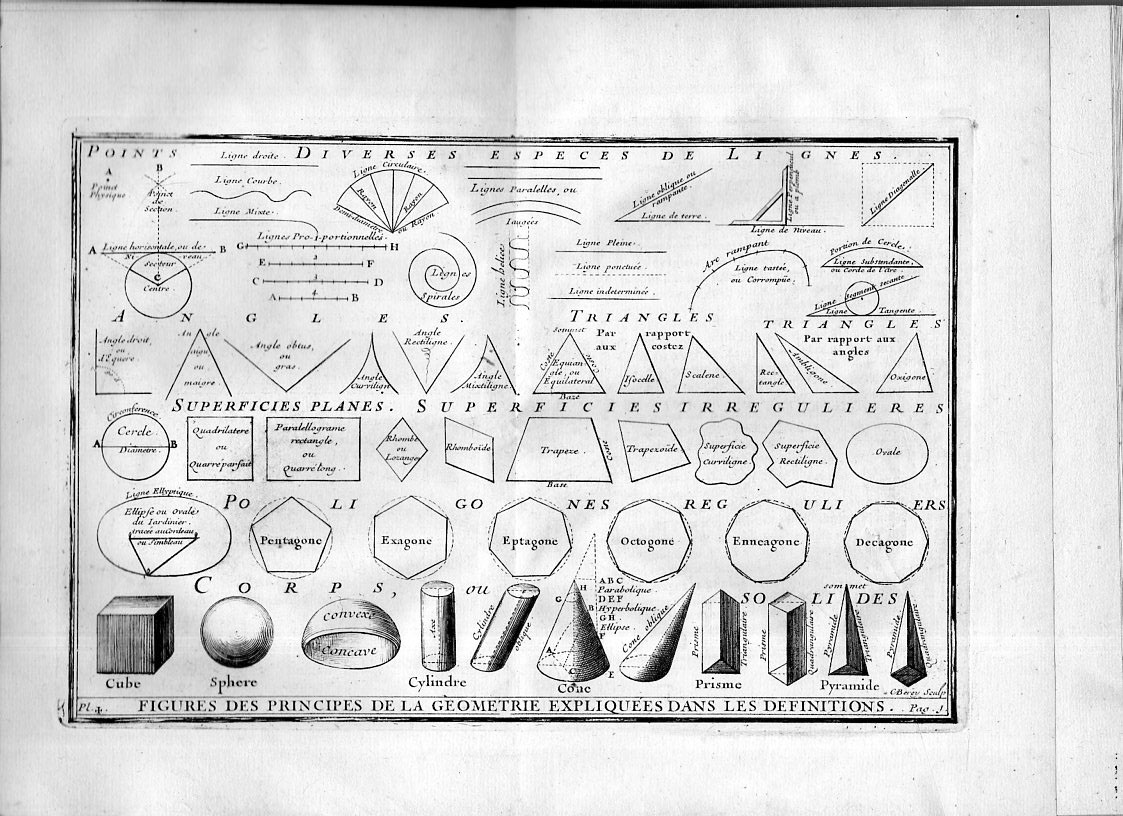
    Actually, the very first engraving in the work is dedicated to a definition of terms, establishing the basis for the forms that would be discussed over the following thousand pages.  It is an excellent way to start a book, making sure that everyone has a common identification for what standard words would mean. It is a standard and very good idea but not often illustrated: 

    Architecture--vignole-shapes430

    ·Posted by :

    ·in:

Recent Posts

Archives

Categories