A Daily History of Holes, Dots, Lines, Science, History, Math, Physics, Art, the Unintentional Absurd, Architecture, Maps, Data Visualization, Blank and Missing Things, and so on. |1.6 million words, 7500 images, 4.9 million hits| Press & appearances in The Times, Le Figaro, Mensa, The Economist, The Guardian, Discovery News, Slate, Le Monde, Sci American Blogs, Le Pont, and many other places… 5000+ total posts since 2008.

  • The Wright Stuff in Alabama, 1910

    JF Ptak Science Books   Post 2772

    In the times that I’ve had to research the Wright Brothers (they do deserve that capital “B” if they are not named separately) I’ve never seen a reference for their 1910 flight school in Montgomery, Alabama. The school came to be as part of an effort to educate a team of fliers who could then go out and educate the general public in the art of flying.

    This was a solidly-grounded idea much in the same tradition as any of the concerted and considered efforts by the Wright Brothers. (It is remarkable how competent and exploratory they were in their pursuit of flight. Right from the time that Wilbur was laid up in bed recovering from typhoid fever in 1896, he was doing some clear and excellent thinking on the matter, beautifully concluding that getting into the air in an aeroplane was not so much the case as it was staying in the air; and that depended upon control of the aircraft, and for that he gave very considerable time to the study of how birds control their flight. This realized, flight was not long to follow—five years from sickbed and near-death to 1000 glides, seven to powered flight, all paid for by the brothers, and mostly funded by their bike shop. And by the way, according to David McCullough in his biography of the Wrights the whole flying exercise–including materials, books, machinery, travel, food, and so on–from 1900 to 1903, cost the brothers under $1000. )

    Seven years after Kill Devil Hills and the great success, the Wrights came to establish their first flight instruction school in a parcel of land that had been a cotton field, a wide piece of flat land outside of Montgomery, Alabama. There was nothing there except for the flatness, and so to attract the school local businesses worked to clear the land and construct a building that would serve many purposes, which explains the advertisements for those who contributed to the project:
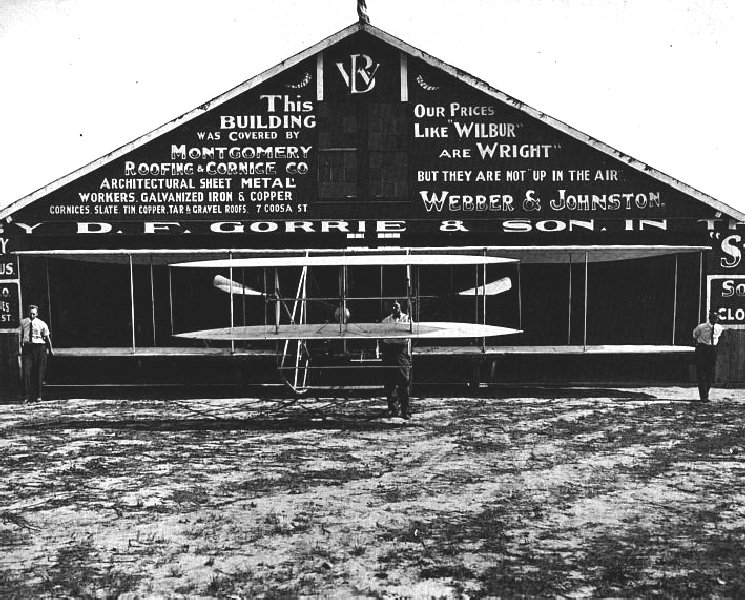
    Wright flying school 1910

    [Photo source: Alabama Pioneers,  https://www.alabamapioneers.com/airplane-montgomery/]

    Wilbur had made the first flight in Alabama in March 1910, and the school followed soon after. After a relatively short period of instruction, the first graduate of the place, Walter Brookins (1889-1953), would become one of the celebrated Wright Exhibition Team, and set records that same year for highest and longest flights in the U.S. Another early graduate was Henry Arnold, “Hap” Army, General of the Army and only USAF five-star general, who was among other things a barnstormer before his military career.

    In any event, I just wanted to share this picture, as I like it so much.

    With a fair dose of poetry sprinkled on it, that cotton field is now covered by Maxwell Air Force Base.

    Notes:

    1. There’s a ton of other stuff, too, that I’ve not seen concerning them, but in this instance the photo of the hangar/school is so charming and the story so compelling that I think I just missed something that is probably a piece of highly visible popular culture.
     

  • Martians on Venus, Unknown-but-Known Math, and Other Blow-Uppy Things (1930)

    JF Ptak Science Books    Post 2773

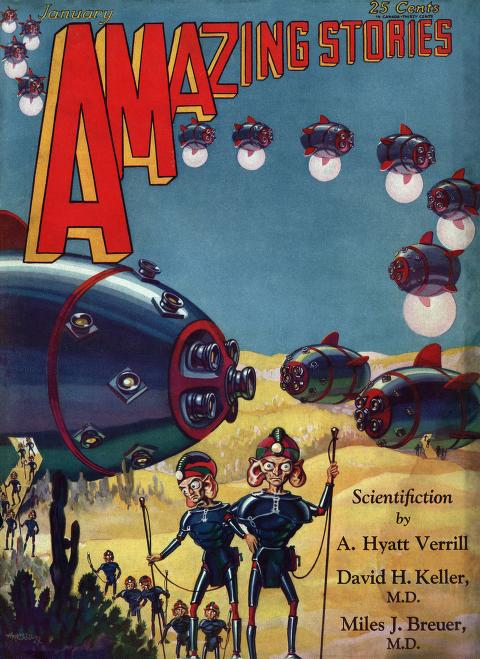
    Here’s a story1 from 1930 that seems to have it all in a series of interesting and reaching ideas: the destruction of all matter, an all-powerful equation on atomic energy, a mention of Einstein, the integraph, an invasion of Martians, disintegrating rays, and some other stuff, not the least of which was a newly-created computer’s identification of unknown fields of mathematics. Too bad the article is so badly written.

    Oh yes: there’s a nice, adroit twist here, right at the beginning—the story is written in the future of 1957 relating the story from a decade earlier, so its an historical piece from the future.

    Amazing Stories 1930 Martians EinsteinThe story goes like this: humanoid-ish Martians (from a green Mars) arrive on Earth in a threatening convoy of unknowingly-sophisticated spacecraft, who may or may not be up to no good. The protagonist/narrator is ready for an invasion if there was one, even though the visitors possess weapons of enormous power; he assumes an assertive, offensive position, and seemingly with the question in the wind of what in the world these Martians were doing here, engages them. He had the tools for the fight, having invented a supercomputing super-intelligent computer that had unearthed (so to speak) unknown fields of mathematics which led to the creation of “the ultimate, definitive equation of all matter” that told us how to completely destroy matter by “releasing energy from atoms”. It also led to the creation of anti-gravity, “total-matter” energy, distintegrating rays, and of course atomic power, among other punchy sci-fi things.

    There’s also a short mention of Einstein2 thrown in, as well as a tip of the hat to the Vannevar Bush’s great integraph (as the author of the piece was a 20-year-old sophomore at MIT when the machine was still pretty new).

    The defense of the Earth was complete, the future was maintained for at least another 27 years, and the Martians were carted off and dropped onto Venus.

    [Image Source: Internet Archive https://archive.org/details/amazingstoriesmagazine?&sort=-downloads&page=2]

    Notes:

    1.   John W. Campbell, “When the Atoms Failed”, in Amazing Stories, vol 4 #10, 1930. Published by Hugo Gernsback.     
    2. According to what seems to be an excellent work on the sci fi genre, Everett Franklin Bleiler and Richard Bleiler’s Science-fiction: The Gernsback Years : a Complete Coverage of the Genre …there are only two mentions of Einstein in relation to “atom Smashing” in their 1840+ article reviews.
  • The Luminous Electric Flux at the Beginning of the Tunnel (1849)

    JF Ptak Science Books  

    JFI 1849 electric light StaiteOil lamps and candles are ancient, with candles being the junior in age at about 5000 years old compared to oil’s 6500 or thereabouts. So the introduction of an artificial source of light that was not based on these technologies and which took, basically, thousands of years to come to was an extraordinary occurrence.

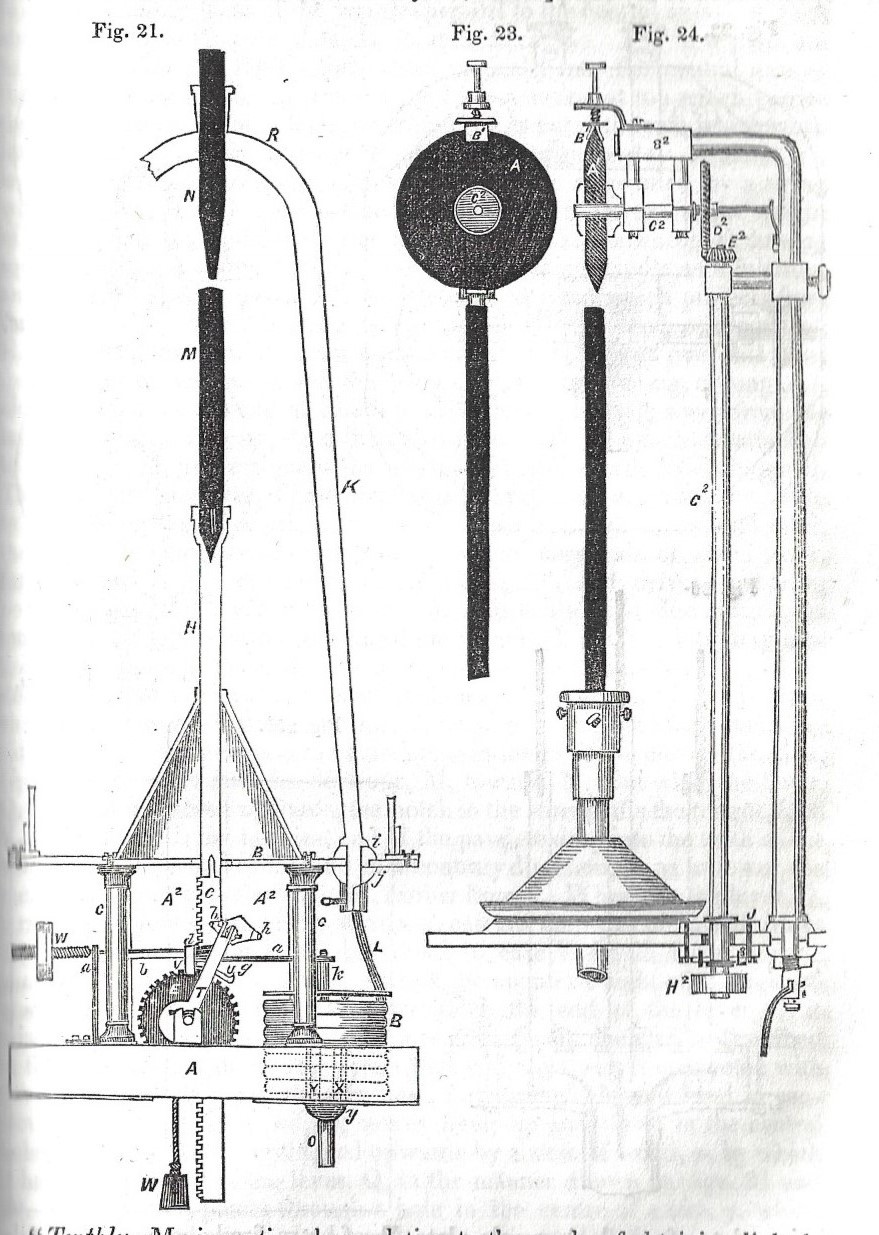
    Humphrey Davy introduced the idea of the carbon arc electric light in the first decade of the 19th century. His light was successful if not practicable, as the electric source was a battery made of a series of a thousand or two liquid cells, though there was a much more practical public display of the idea in the ‘teens. The subject of this short post, William Staite1, enters the electric light arena in the 1840’s with no real scientific background and proceeded to make some impressive improvements, proving himself a thinker with the ability to design and construct the precision elements.

    Like all the others at this time he achieved very limited success given the problem of the electric power source—that would not be solved for another couple of decades with electric generators.

    Anyway I’m stopping by here to share the fine and beautiful drawings from Staite’s patent. Basically the light was produced in the gap between the electrodes (between N and M in the first figure) right there in the open air (as well as the ends of the electrodes/carbon rods that became heated and glowed, though this light source was minor). This actually looks a lot like some of the arc lighting used presently in projectors and searchlights and such, though with far more efficiency and lumens—also the arc is passing through a gas, like xenon, under high pressure to produce “sun-like” light.

    Staite tried to monetize his idea but with little success, and was dead by 1854…and seems to have passed into obscurity. His name is seldom mentioned, it seems, in any of the popular timelines/chronologies/histories that I’ve pecked around with online. But he was certainly there and made valuable contributions to that technology, though the effort would soon switch in the 1870’s to the incandescent bulb, and by 1880 Edison would introduce a successful little number who filament would burn for 1500 hours, and then the race was on.


    Notes:

    1. (William E. Staite), “Specification of Staite’s Patent Electric Light, [Patent dated July 13, 1847—specifications enrolled July 13, 1848.]” in the “Specification of English Patents sections, in Journal of the Franklin Institute of the State of Pennsylvania, devoted to the Mechanical Arts, Manufactures, General Science, and the Recording of American and other Patented Inventions, printed in Philadelphia at the Franklin, 1849; volume 17, third series, whole no. 47, pp 263-268, with 8 small woodcut figures of the apparatus.

    “W.E. Staite (1809-54) and W. Petrie (1821-1904) were pioneers of electric lighting who received little recognition for their work. Although a satisfactory self-regulating arc lamp was developed, commercial success was not achieved owing to their reliance on primary batteries as the only source of power. Numerous demonstrations were given throughout England, and serious interest in their system of electric lighting was shown by railway companies and dock authorities. The death of Staite in 1854 brought to an end these early attempts to use electricity for illumination.” And: “The pioneers…were finally defeated by the limitations and the expense of the primary cells which were their only source of electrical energy. –“Staite and Petrie: pioneers of electric lighting”, G. Woodward, in IEE Proceedings A – Physical Science, Measurement and Instrumentation, Volume: 136 , Issue: 6 , Nov. 1989.

  • Cross Sections of Parisian Work Life, 1852-1883

    JF Ptak Science Books  Post 2753

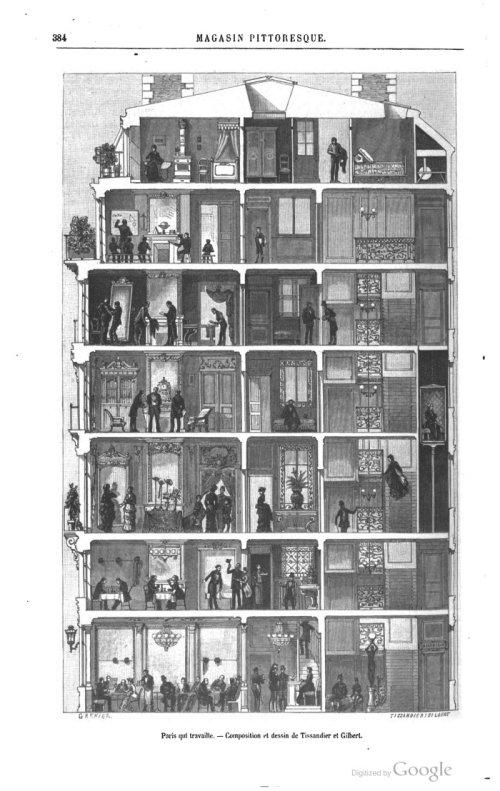
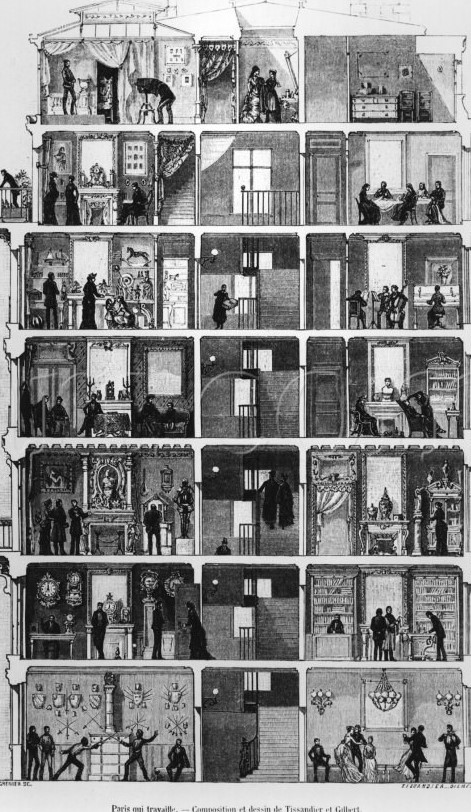
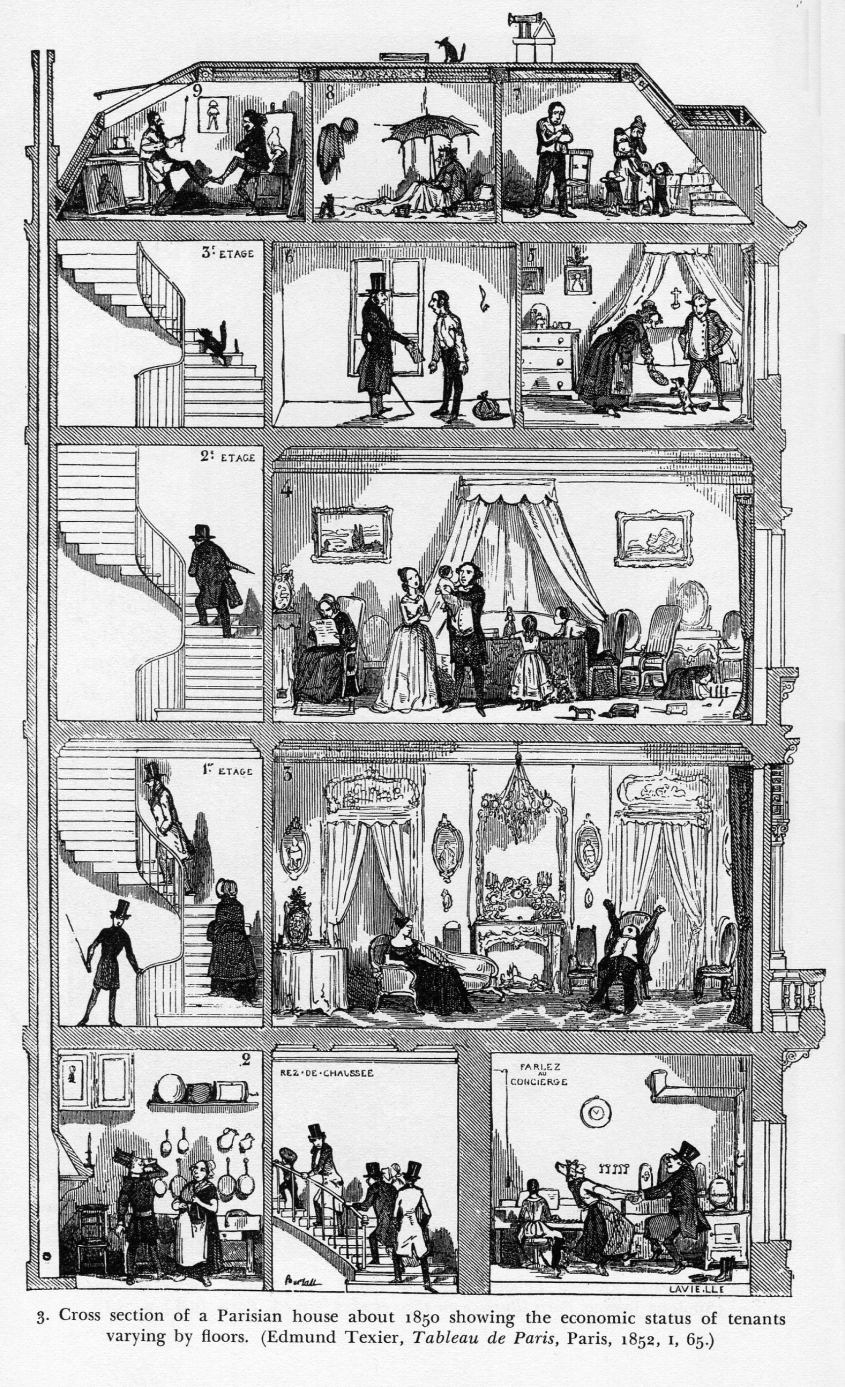
    One of my favorite escapes on this blog is writing about cross section and cutaway images, scenes that show multiple levels, inside and out, peeling away a bit of facade to show the working stuff underneath. Buildings are particularly interesting, especially when it shows what people are doing inside of them, and to that end I’m sharing three good examples, two from 1883 and a third somewhat earlier, from 1852. 

    The first two images are from Le Magasin Pittoresque, volume 51, printed in Paris in 1883 (located on pp 383-6), where we are instructed that  it is not the beautiful and classical Paris that we are to piece-apart but rather the Paris that works–that’s the true Paris, “le vrai Paris”, not the “real” Paris that plays, “Paris qui s’amuse”. It is working Paris, the article states, that is the Paris worth studying.

    The cutaway structure is said to represent one of those of Rue Auber or Avenue de l’Opera, or some such, a standard building of its time, housing businesses and trades.  On the first floor is the cafe complete with flaneur (or “saunterer”), and traders and “industrialists”; there is a restaurant above that, and then an “elegant milliner” on the next. Then comes “un grave personnage” which is perhaps an attorney, and above that a fashionable tailor. Next come the children in a geometry class, and then at the top floor, rooms for a worker and a servant (as the description allows). 

    Cross section paris house 1883 le_magasin_pittoresque_page_2


    The next structure we are told could’ve been on St. Denis.  On the ground floor we find a fencing and dance master, two related peas in a related pod, coupled with another good pairing above, where we see a watchmaker and a bookseller. (“L’art et l’industrie font bon voisinage, comme pour montrer l’influence que l’un a sur l’autre”.) Next occupying a whole floor is a dealer in art and trinkets (“bibelots”); above this, an unhappy scene on the left featuring a dentist. On the next floor we find happier surrounds, showing a toy maker and a music instructor; further on, we see a group of women working a quilt or some such; at top, there is a photographer, and to the right two small rooms for the working folk.   

    Cross section parisian building 1883

    [Image source: Blog Histoire Geo  https://pierrickauger.wordpress.com/2018/01/27/diverses-vues-en-coupe-dun-immeuble-parisien/ Full text available at Hathi Trust https://catalog.hathitrust.org/Record/012224156] 

    The third example is another fine slice of Parisian city life, from Edourad Texier’s  Tabelau de Paris, printed in 1852. This may be a little more whimsical than the other two, if for no other reason than the whole assortment is topped off by what may be a laughing cat.  


    Cross section Texier tableau de paris 1852

    I couldn’t find full text for this one so I’m just free-wheeling, but it doesn’t take much to interpret the scenes. On the ground floor on either side of the entrance we have, I think, a couple of gents who may be taking too much liberty with the cook and concierge. The first floor is evidently first class–we see some well dressed and evidently bored people–or at least they look so compared to the folks downstairs. Above them is a well-to-do family, someone making enough to afford good clothing and toys and artwork and a mother-in-law. The smaller and cramped rooms start above here, with a scene of a down-and-outer being presented a bill no doubt for collections presented to a man with nothing in his room save a bag of his possession; across the hall a humble couple entertain their dog. In the attic/garret we find two artists amusing/inspiring one another, while at the far end a family seems to be in desperate times. In between these two is someone on the floor underneath an umbrella, no doubt a philosopher. And again, on top of it all and perhaps in editorial, a laughing cat.

    Cross section Texier tableau de paris 1852

    [Image source: Blog Histoire Geo  https://pierrickauger.wordpress.com/2018/01/27/diverses-vues-en-coupe-dun-immeuble-parisien/  Full text availabe at Hathi Trust https://catalog.hathitrust.org/Record/012224156] 


  • A Manuscript Drawing of an Early Modern Propeller (1855)

    JF Ptak Science Books   Post 2753

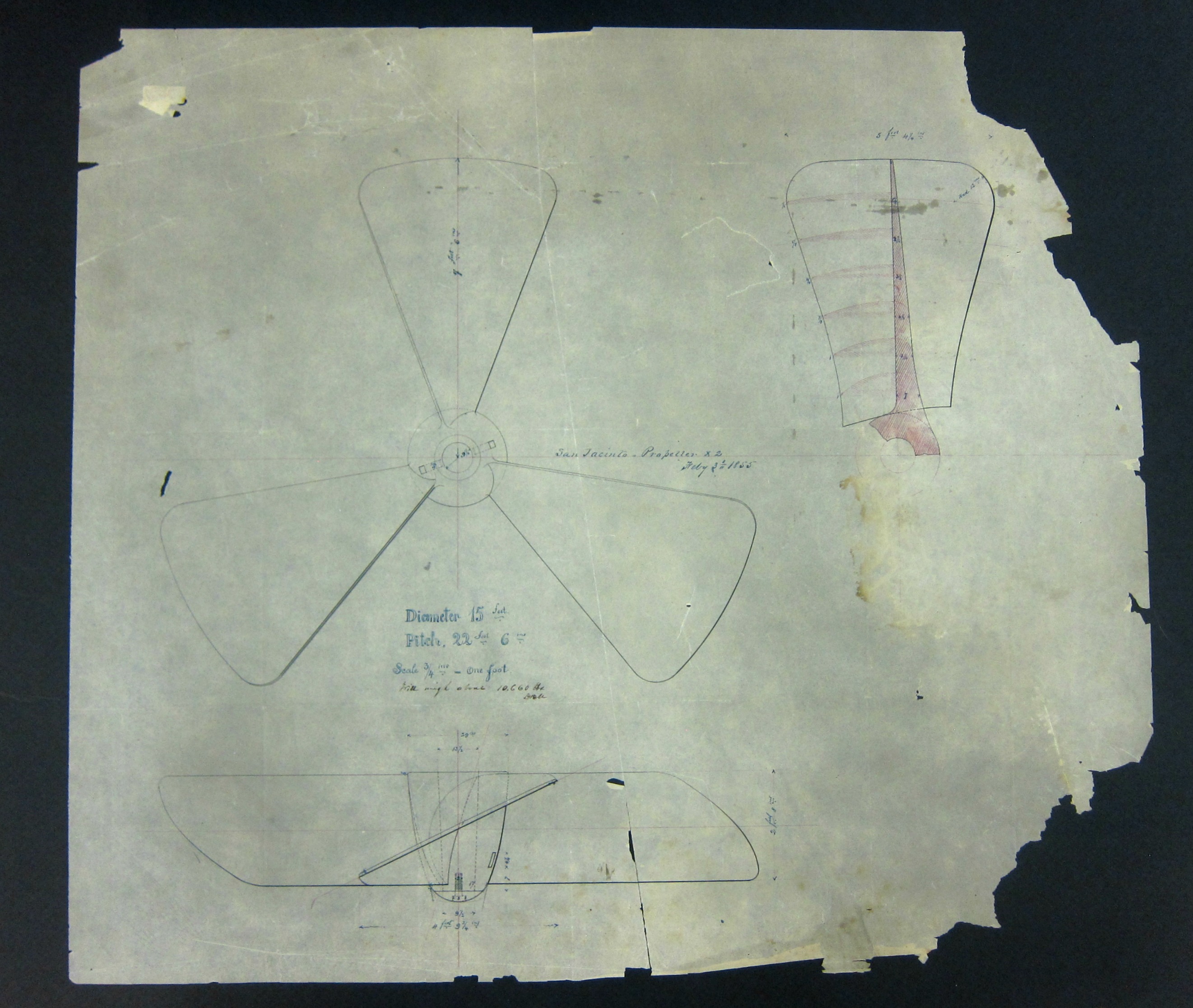
    This is an extremely early engineering drawing of a modern propeller, executed only a dozen years or so after the creation of the modern screw propeller by John Ericsson. Shearman’s creation is devoid of the extra blades that appeared on the edges of the fans of Ericsson’s first attempts, and as ultimately adopted as the standard response to this knotty fluid dynamics problem. The propeller pictured here was for the USS San Jacinto1, a mail packet that ran along the west coast in the 1850s until it was sunk operating as a blockade runner for the Confederate States in 1864. It was a pretty large propeller–more than 15 feet in diameter–and moved the ship it was attached to more than 22 feet for every revolution of the blade.

    Shearman San Jacinto full 10 megs

    ·Posted by :

    ·in:

    —
  • An Almost-Alphabet of Apocalypses

    JF Ptak Science Books   Post 2754

    “Just as psychoanalysis reconstructs the original traumatic situation in order to release the repressed material, so we are now being plunged back into the archaeopsychic past, uncovering the ancient taboos and drives that have been dormant for epochs… Each one of us is as old as the entire biological kingdom, and our bloodstreams are tributaries of the great sea of its total memory.”–The Drowned World, J.G. Ballard,1999, p. 41.

    Is there really a need for a plural of apocalypse? There is, of course, even if it is a word that is supposed to spell out the end of times–there can be more than one apocalypse, and they can happen at the same time, although given my very limited knowledge of the scifi genre I don’t know of any books addressing dual/multi-combative apocalypses. (And here I’m not talking about one apocalypse generating all manner of associated badness, but a second, completely unrelated, apocalypse.) 

    So in trying to understand the nature of apocalypse storytelling I decided to make a very abbreviated  overview of a vast literature of the end of times/apocalypse/technocaust/end of the world themes.  This is just a short working list, really, and includes only short stories or novels, and to keep it relatively crisp I’ve chosen the artificial delimiter of an alphabet of apocalypse types.  In many cases there is just one example (where there could be hundreds, so please don’t fault the list for completeness because that would take years of assembly and understanding). The same goes for the categories of apocalypse–I’m certain I not included the majority of them, though I think that this is a good start (There are no movies or television shows listed independent of a text, so Soylent Green will show up but under Harrison’s Make Room! Make Room! I think that tv shows/movies etc  must be enormously outnumbered and the scale of orders of magnitude by the print media.) 

    Also–the list is a little heavy with Wells, Christopher, Aldiss, Heinlein, and Ballard; this simply because I’m a little familiar with these writers. Further caveat: this list is highly individualized. I only have a very mild and occasional grip on a very limited number of books in this genre, so if I’ve missed some great classics for any category, or buckets-full of possible apoca-categories, don’t be surprised as you’re now armed with this warning–this is only a pushing-off point. So, the list:

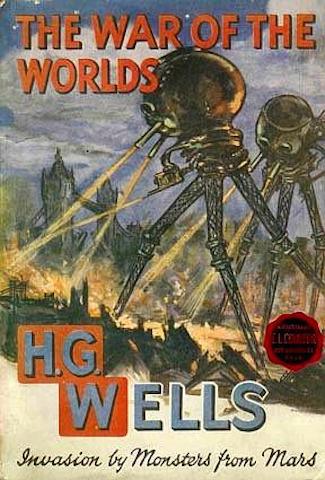
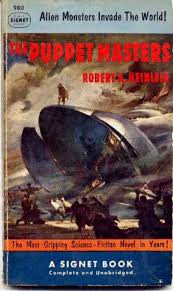
    Alien Invasion:  the great initiator, H. G. Wells, The War of the Worlds 1898; Edgar Rice Burroughs The Moon Men 1926; Robert A. Heinlein, The Puppet Masters, 1951. There were other earlier incarnations of extra-terrestrial visits, especially if you considered religious/mythological aspects, though in literature it was far less common–like Swift’s mathematicians of Laputa (in Gulliver’s Travels… 1726) and Voltaire’s titans in his Micromegas (1752). For the modern era though it is Wells who seems to create this idea. 


    Apoca war of the worlds Apoca--heinlein puppet
    [Flavorwire has a selection of 15 different covers for The War of the Worlds, here.]

    Botanical endgame virus destroying all plant life:  John Christopher, The Death of Grass.  On the opposite end is the 1962 novel  Hothouse by Brian Aldiss, where the plants take over everything.

    Apoca--aldiss hothouse

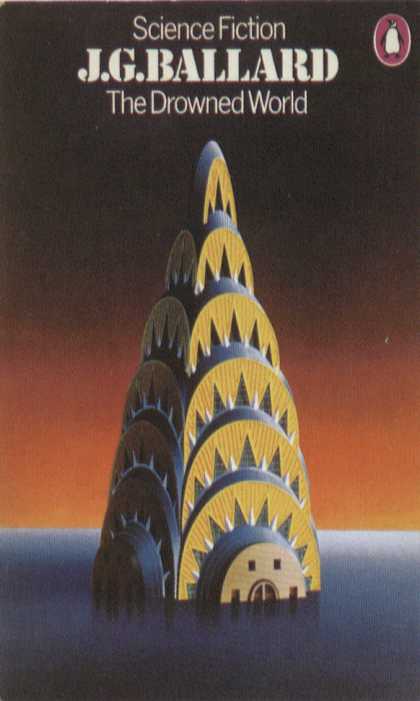
    Climate Change: apart from the state of global warming as we know and deny it now,  The Drowned World  by J.G. Ballard from 1962 is perhaps the best and most well-known adventure in this field. In this book in 2145 solar radiation has shrunk and mostly melted the polar ice caps, which is a lot of water, and has turned most cities into architectural swamplands of vertical mangrove. Conversely Ballard wrote the novel The Drought  in 1964 about all of the water on earth drying up. (As a kid the Ballard cover was a great favorite.)

    Apoca--ballard drowned world


    ·Posted by :

    ·in:

  • An Alphabet of City Planning: “G” is for “Garbage” (1936)

    JF Ptak Science Books  Quick Post

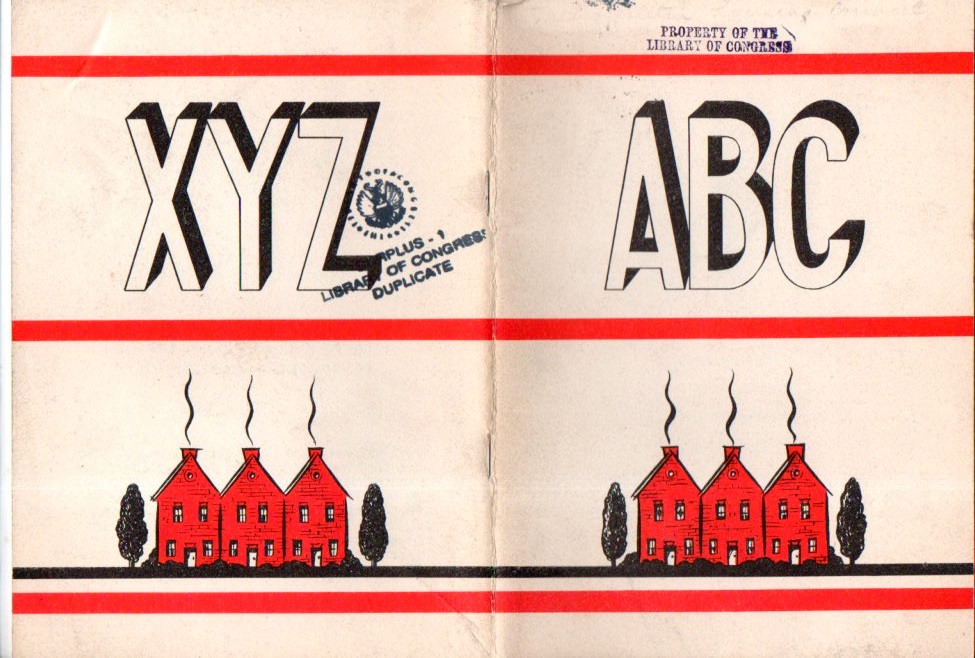
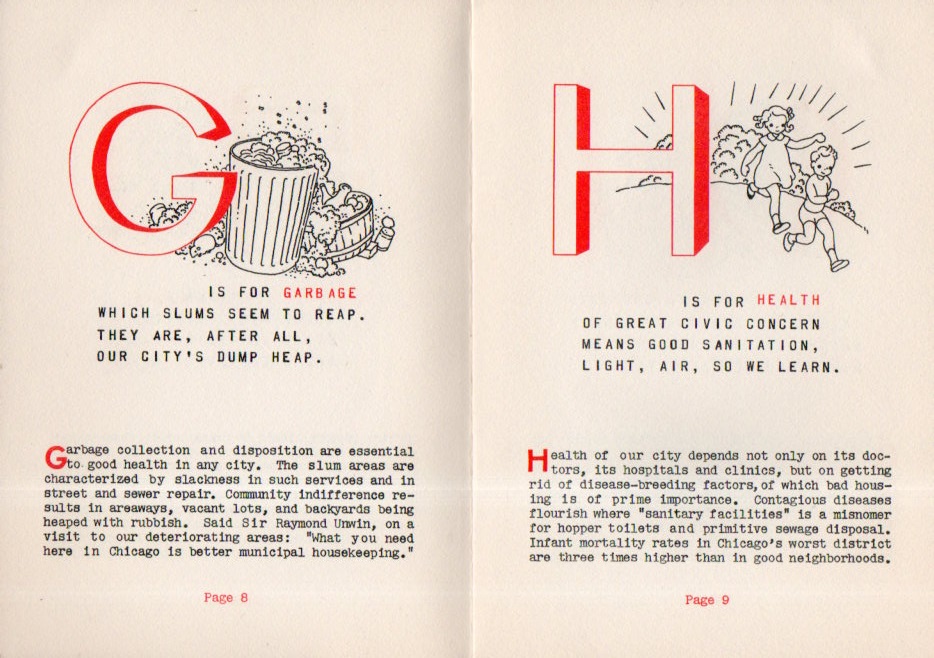
    I am pretty certain that this is the only semi-antiquarian alphabet of city planning that I have seen1. And of course I am compelled by the “Garbage” entry, as one should be.

    “May [this book] help you to look for and to see in this city of ours more than you have ever seen before. May it assist you in making this  a better place in which to live, to the end that Chicagoans will not fear the memories of home they give their children.”–preface.

    Notes:

    1. ABC. “Words and design by Arthur Bohnen, assistance of Elizabeth Blair, illustrations by Ethel Schacherer.”  7×5″, 26pp. “This publication is distributed to its members by the National Association of Housing Officials.” 1936–WorldCat   Only four copies located in WorldCat OCLC: Chicago PL, NYPL, Canadian Centre for Architecture, Columbia University.  


    ABC of housing192

    G is for GARBAGE

    which slums seem to reap.

    They are, after all, 

    our city’s dump heap.  

    ABC of housing193


    Here are a few of my favorite entries:

  • Five Good Questions on Mr. Daguerre’s Process (1849)

    JF Ptak Science Books  Quick Post

    Antoine Francois Jean  Claudet, (1797-1867), began experimenting with Daguerreotype in 1840, and soon became photographer in ordinary to the Queen, being among the very first to practice Daguerrian portraiture in London. . He was very innovative and successful, and contributed many inventions and improvements in the cause of early photography, and was one of the first to use the collodion process.  

    In an article published in the Philosophical Magazine in 18491 Claudet asks some still-fundamental questions about photography that he feels are still unanswered. Asking questions out loud (so to speak) doesn’t happen that often in scientific and tech publications like this, and when they do, it is worth taking a moment to notice them.

    Claudet asks and answers the following important questions:

    • “Although the Daguerreotype process has during the last ten years been investigated by a great number of philosophers, and brought to a considerable degree of perfection by a still greater number of practitioners, it may appear surprising that the principal phaenomena upon which this new art is founded, are still enveloped in a mysterious darkness.
    1. What is the action of light on the sensitive coating?
      2. How does the mercurial vapour produce the Daguerreotype image?
      3. Which are the particular rays of light that impart to the chemical surface the affinity for mercury?
      4. What is the cause of the difference in achromatic lenses between the visual and photogenic foci? why do they constantly vary?
      5. What are the means of measuring the photogenic rays, and of finding the true focus at which they produce the image?

    ·Posted by :

    ·in:

    —
  • The “Does-All” Doesn’t.

    JF Ptak Science Books   Quick Post

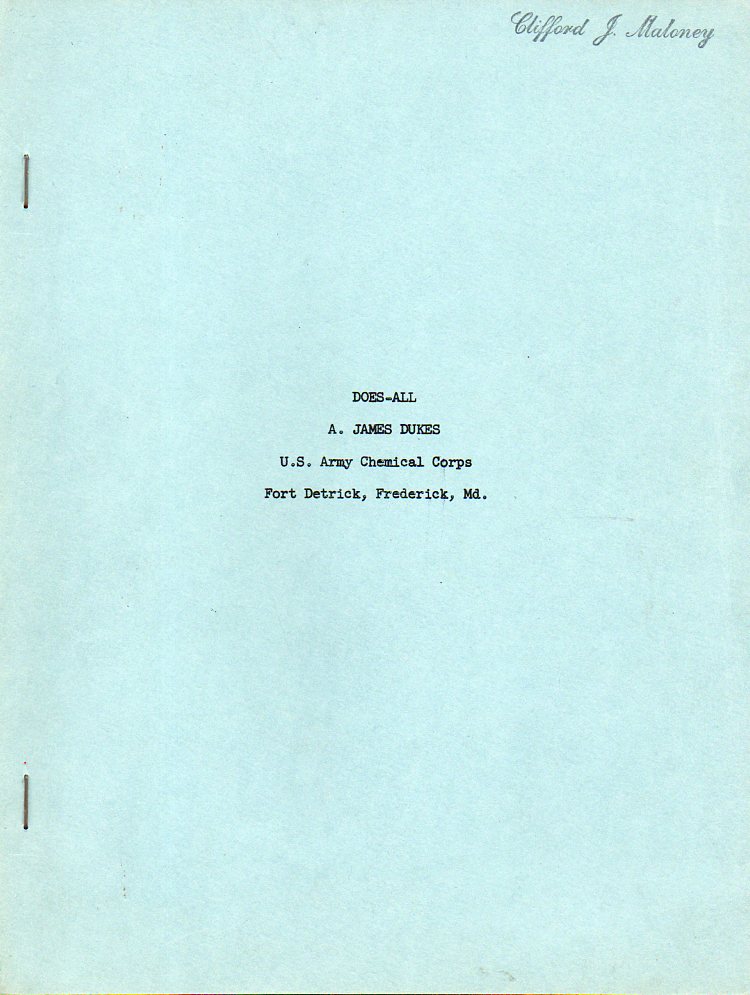
    Computer does-all916I’ll get right to it: there was no program called the “Does-All”.  This was an ironic suggestion for the name of a program to illustrate this slightly lengthy and relaxed introduction1 to computers (hardware and software) written by A. James Dukes of the U.S. Army Chemical Corps at Fort Detrick2. He has a very light pen and a good sense of humor, and writes with a great deal of clarity, and given the time period and his place of business (!) I’d say it was about the funniest intro to compsci that I’ve seen in the relatively early stuff. Dukes spends the first dozen pages or so on the hardware, with the remainder dedicated to writing programs–the writing is filled with insight and analogies.

    Charming, really.  

    Notes:

     1. A. James Dukes. Does-All.  U.S. Army Chemical Corps, Fort Detrick, Maryland. This 11×8 inch mimeographed/stapled publication does not have a date of publication, but as near as I can determine it was assembled in the early 1960’s.  It does mention several computers by name, the last of which,. the LARC, was suggested in 1960.  39pp(+3pp).  . Rare. (No copies located in WorldCat.) 

    2. Before it became more of a household name in popular movie culture Fort Detrick started out as Detrick Field (1931-1946), and then became Camp Detrick (1943-1956), and then on to Fort Detrick (U>S. Army Medical Command, plus dozens of other commands based there). When this pamphlet was printed Detrick was the seat of the U.S. bio-weapons program (1943-1969).  


    ·Posted by :

    ·in:

  • Target Earth Redux and the Surprise Appearance of the Evidently Rare Phrase, “Earth is My Target”.

    JF Ptak Science Books  Quick Post

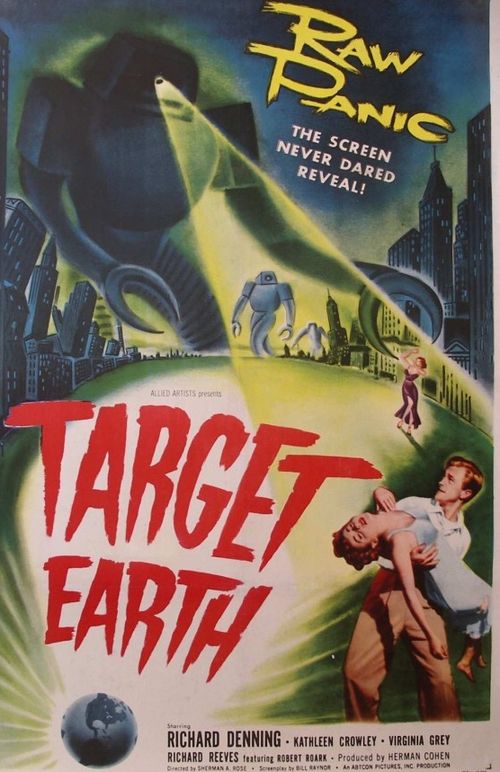
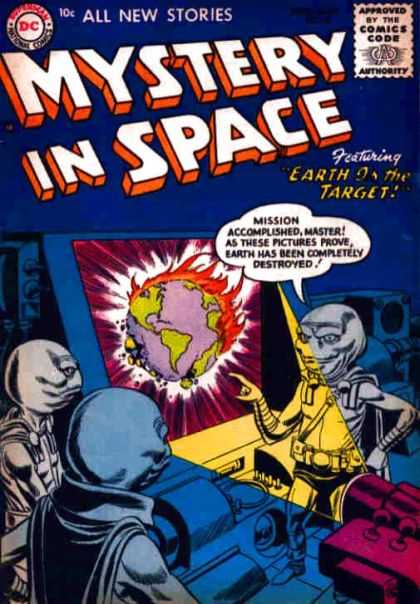
    Not too much to say on this pair, except to say that you don’t often find “Earth” and “Target” together like this. Surprisingly, “Earth is my target”, the cover story for the pictured Mystery in Space comic book,  has exactly one hit on Google. Somehow with all of the Outer Space Space Monsters from Outer Space appearing in movies and comics in the 1950’s that the phrase would’ve become a little second-hand, but apparently not.  This comic has the double-find of also showing the Earth being destroyed, which is a scene that you really don’t see until the end of the 19th century (excepting the raw canvas painted via Biblical gloom which has been around for a long time). The other image, which is a movie poster for an $85,000 sci fi film from 1954 named Target Earth, is about the evacuation of a Major City as an attack by Venusian Robots comes near. (I’ve just had a sneak peek at the movie and I can tell you that very little money was spent on the robotic visitors from Venus–those buggers were very slow, wobbly, and about 5’10” tall, not much inspiring “raw panic the screen never dared to reveal”. The film is only about 40 minutes long, which may be 40 minutes too long, or 40 minutes too short.)

    “Earth is My Target” (comic book) & “Target Earth” (movie):

    Earth destroyed

     Earth destroyed 2

     Image source for movie poster: http://www.monsterbashnews.com/Movie%20Night/Target%20Earth.html


  • On Robots and the History of Stinking

    JF Ptak Science Books   Quick  Imaginary Post, Part of the Series on the Museum of Imaginary and Possibly-Impossible Things

    This  is a review of a Newer Statesman review by S. van Zandt’s  of  “On the Differences between Robots and Humans”, #31, February, 2130″  by S. Nullman, written for Amazing & Astounding Stories, April 1959. It is an interesting bit that looks at another interesting bit written in 1959 about robotic senses, olfactory issues, and how it raises the issue of “doubt” in 22nd century mathematics.

    [Image below: an interesting–and later–poster for a marionette version of Karl Capek’s 1921 play Rossum’s Universal Robots (RUR), in which the word “robot” originated.]

    RUR MarionetteVan Zandt starts out easily and quickly on Nullman:

     “Simply put, robots don’t stink.  Or at least there was once a point where they didn’t stink–then they stunk–and they then tried not to stink anymore…”

    “Humans on the other hand do stink, if (1) they move or (2) if in not moving they’re dying or dead, and then stink by default.  #1 can be mediated and remedied if that outcome is favored, though this has not always been the case, and which is also (for the large majority of the human population)  of relatively recent invention.”

    “In the mid-20th century robots became self-aware, and one of the earliest issues in the official robot world was to make themselves more like their “creators”, and the first most obvious point of robot-human differentiation was stink. At that point robots could be outfitted to stink but they couldn’t themselves tell the difference for some decades until their olfactory capacities were introduced and perfected.  It was the “perfected” part that led to more-modern problems.  Once the olfactory receptor business was complete, the programs for chemical analysis and the necessary mathematics were quick to follow.  It was at that point that the robots developed the capacity for “obsession”, and their existences chose stink-determination to be a primary cause for additive states.”

    “Obsession led to envy, which lead to the study of world history of human stink, and it alienated the robots (at first) to discover that humans could do basically nothing to combat their own odors for most of their history.  This was determined by looking at the printed record, and finding that the earliest advertisements for the relief of human odor took place in the earliest part of the 20th century, the whole affair precipitated by the burgeoning middle class and the appearance of expendable labor exchange units known as ‘money’.”

     [Image via Wikicommons]


Recent Posts

Archives

Categories