A Daily History of Holes, Dots, Lines, Science, History, Math, Physics, Art, the Unintentional Absurd, Architecture, Maps, Data Visualization, Blank and Missing Things, and so on. |1.6 million words, 7500 images, 4.9 million hits| Press & appearances in The Times, Le Figaro, Mensa, The Economist, The Guardian, Discovery News, Slate, Le Monde, Sci American Blogs, Le Pont, and many other places… 5000+ total posts since 2008.

  • Rolling Thunder: a 12,000-Pound London-to-Birmingham Steam-Driven Land Coach (1833)

    JF Ptak Science Books   Quick Post  [And yes! Four hyphens in the title!]

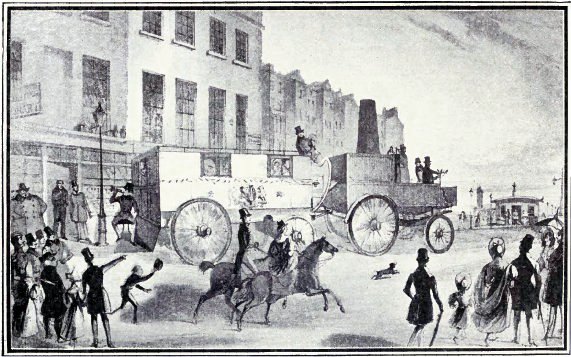
    Here’s a found bit from the Journal of the Franklin Institute, 1833, on a rumbling beast that would have been seen as the great technological achievement it was: a 12,000-lb land carriage connector between London and Birmingham. The report1 was made by the great Thomas Telford, engineer and builder of roads/bridges/canals as president of the Society of Civil Engineers, and a host of others, on the possibility of  Sir Charles Dance’s steam carriage being capable of implementing a transport service using existing roads. Charles_Dance's_carriage_-_1833

    [Sir Charles Dance’s vehicle, ca. 1833. Source: wikipedia entry for Sir Charles Dance, motorist.]

    ·Posted by :

    ·in:

  • RedOdd and RedEven–a Small Collage of Some Unusual Red Pamphlet Covers

    JF Ptak Science Books   Quick Post

       “He is too picked, to spruce, too affected, to od as it were.”–Shakespeare Love’s Labour’s Lost  (1598) v. i. 13

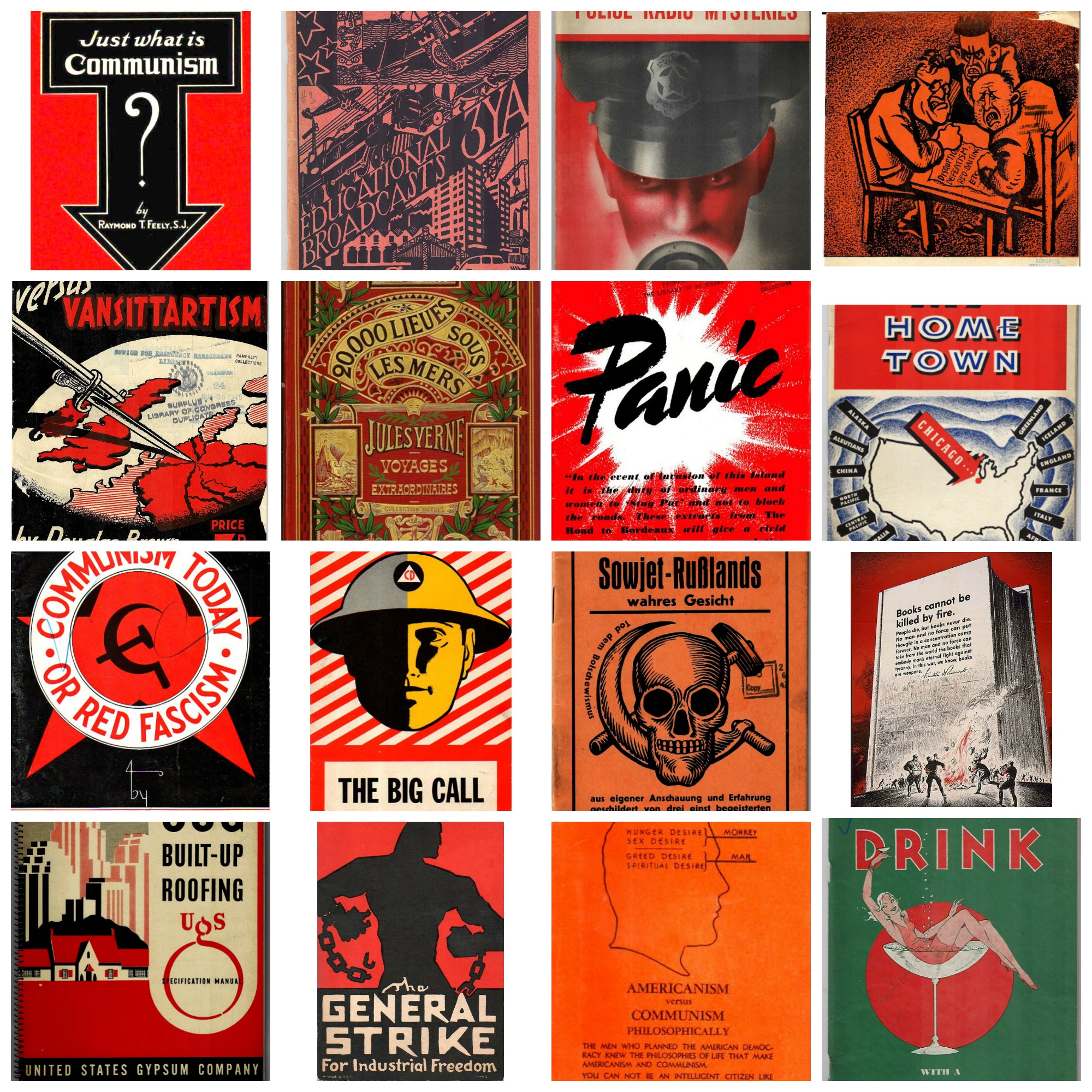
    I just threw this together, pulling in some of the red-based pamphlet cover designs from different odd areas here–there are many many more, but this again is a selection of odd and red: OddRed, RedOdd. Or if not odd, the at least red and even, EvenRed, RedEven. 

    Books covers montage red

    “OddRed” isn’t a color, it just designates that red is being used in relation to something odd, which is very different from nouns or adjectives that get thrown in front of “red”, as in “blood-”, “brick-”, “flame-”, and so on, which are actual colors. OddRed is just an idea. As is EvenRed.

    The OED finds “red” to be as old as OE, and defines it so: “Designating the colour of blood, a ruby, a ripe tomato, etc., and appearing in various shades at the longer-wavelength end of the visible spectrum, next to orange and opposite to violet; of or having this colour.”

    ·Posted by :

    ·in:

  • A Note on Becoming Distracted (Mass-energy Equivalence, Missing Continents, 19th C Martian Communication, and Levels)

    JF Ptak Science Books   Post 2768

    Here’s one of those languid, curling, endless river bends research stories that takes you totally away from where you wanted/needed to go. After a chat with my friend  Eric that involved conspiratorial otherworlders I had the idea of checking out some other other-minded folks who I would normally never consult for some possible angle I might have missed in a long-simmering research topic. I’ve been looking in bits and pieces for the first publication of the world’s most famous equation, E=mc^2: as it turns out this is not a trivial question. I’m not talking about the idea of mass-energy equivalence, but the appearance of equation that everyone on the planet knows. The first derivation that appeared in Einstein’s 1905 paper would not be recognizable as such by a general reader, nor would many of the others. The first appearance of E=mc^2 under Einstein’s name after some considerable digging is in 1946 (!), in the inaugural issue of Science Illustrated; withina  few months the equation appeared in the upper level of an atomic bomb mushroom cloud on the cover of Time magazine…but that all is another and more complicated story.

    Anyway my idea was to look at some anti-Einstein-relativity books to see what I might be missing, and in a short time I found a reference to the equation and Gustave Le Bon in a 1914 issue of the Comptes Rendus. Luckily I have that run, and so I checked out the paper–it did not contain the equation, of course, though it did have some references to him claiming to have had the idea of mass-energy equivalence in a series of papers published in Revue Scientifique (Rose) int eh early 1900s to 1905. I decided to check these out to because, with luck again, I have these down in the studio.

    Le Bon is an interesting/odd guy, who may or may not have been the great polymath he played in his script in life, though he was formidable enough to be considered for the Nobel Prize in 1903. So I worked from 1888 forward in the Revue (called “Rose” because the wrappers each weekly came in were rose colored) and bumped into Le Bon quite a bit. The man was interested in everything, and traveled to those ends to meet his curiosity. In one paper in 1892 he wrote on the origins of the arts of India (as he also happened to be a pioneer anthropologist), and I saw that the article proceeding it was in an area I was working in for a customer relating to the planet Mars. (This was by Norman Lockyer, editor of Nature, who wrote on Mars and it canals, canali, the “canals” part of their interpretation mightily disapproved-of by the old gent.) The Lockyer referenced something in I was actually looking for, an article by Henri Jules Perrotin (in the same journal but in 1888) who wrote of his observations of the planet, happily reporting that he did find the at-that-time-evasive canals, but also noted the disappearance of a Martian continent under what he suspected might be periodic “flooding”.  Anyway on the return to the Lockyer I went too far and with great satisfaction found the following drawing:

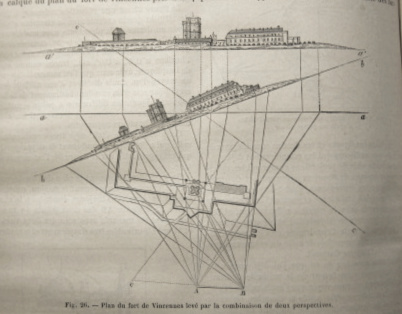
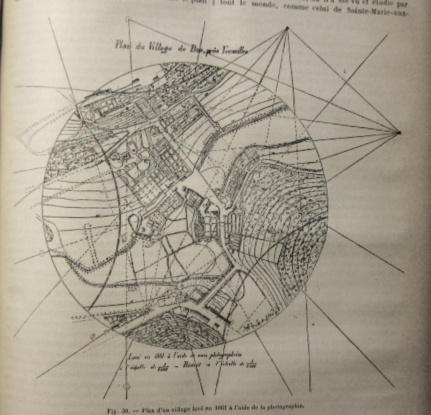
    LEvel camera _3_

    That was quite a wide turn–anti-Einstein, where the hell is E=mc^2?, Gustave Le Bon’s 1905 A-bomb, Lockyer’s review of how to communicate with Martians, Perrotin’s disappearing continents–to get to this lovely drawing, no? It was almost worth it! This lovely thing (and oh to be able to render this in 3-D!) appeared in an article on a new application of photography to the surveying art/craft, M. Laussedat’s “Historique de l’Application de la Photographie au Lever des Plans”, November 5 1892. Its an interesting article, and two of the illustrations for are excellent pieces of art, in and out of context:


    Level camera _2_

    I know that was a long way to drag the reader to share two drawings, but I needed to get rid of the story…

  • A Note on an Often-Cited Quote of Vincent van Gogh

    JF Ptak Science Books   Quick Post

    • Also see: Found Poetry in the Words in Last Lines from Vincent van Gogh, 1889-1890  https://historyofideasblog.com/thesciencebookstore/2014/03/the-words-in-last-lines-from-vincent-van-gogh-1889-1890.html#more

    Van Gogh grave opposite

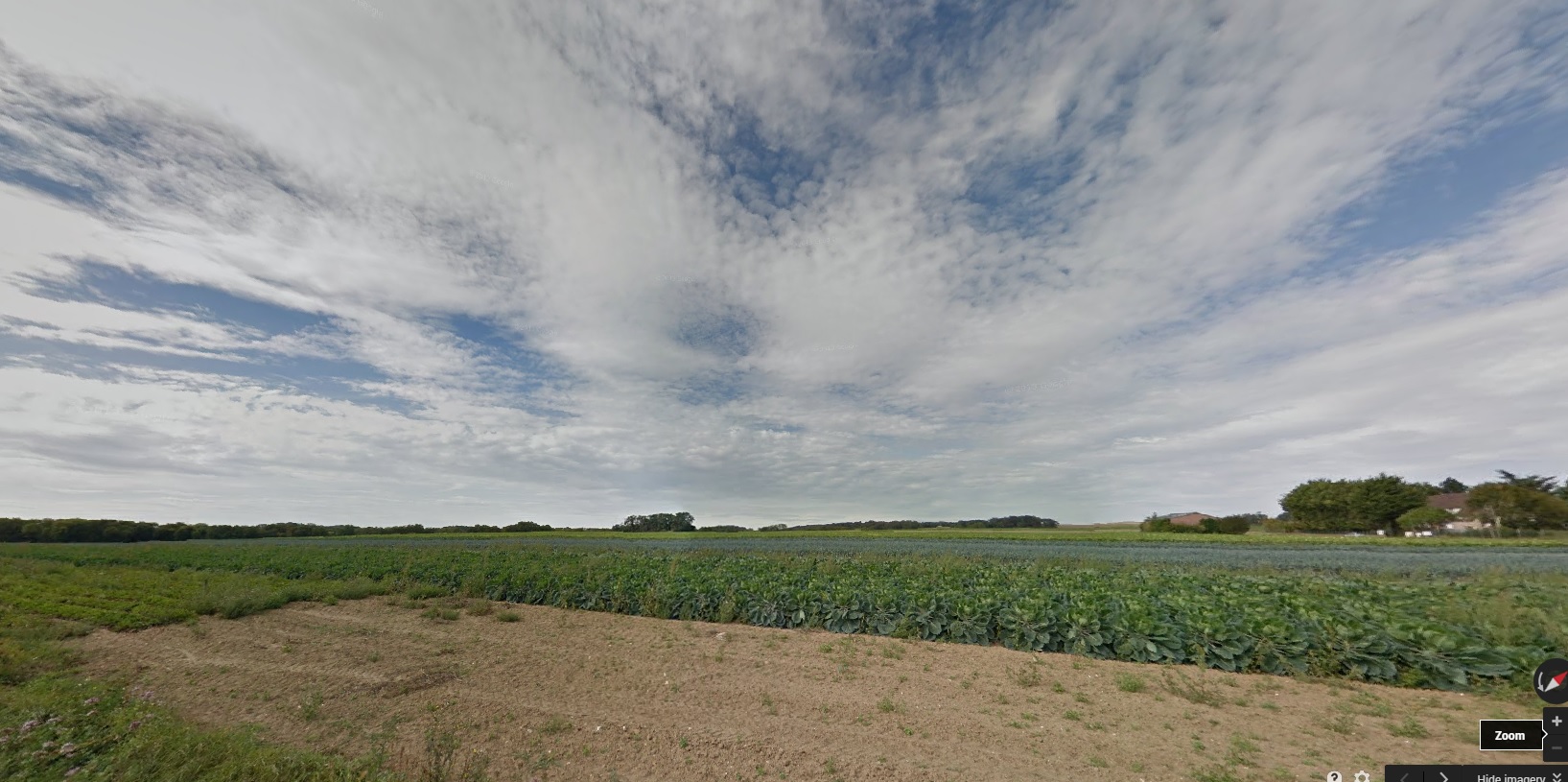
    [Source: Google Maps. This image captured on a virtual walking Google tour of Auvers. This is the view exactly behind the van Gogh brothers’ graves, on the other side of the cemetery wall, looking away.  See: “There are no Van Goghs in Arles (?)”  https://historyofideasblog.com/thesciencebookstore/2014/12/there-are-no-van-goghs-in-arles.html]

    So there’s a van Gogh quote is making the rounds on social media, and to me it sounds not quite right, like some of the odd Einstein and Newton “quotes” that are never attributed or annotated or properly referenced and just don’t exist in the history of the person. I can find a lot of sites using this quote but after looking at a bunch of them no one provides a source reference—some reference another site that simply is carrying the quote though they don’t give a source, either.

    Anyway, the quote: “I put my heart and my soul into my work, and have lost my mind in the process”. I’m not a van Gogh scholar, and I’m not even an historian of art. The only bit of van Gogh experience that I have is that I have read all of the published letter in his archive, as well as some incidental reading–this a scholar does not make, though it does give at least a little background to ask a half-decent question.

    After checking many of the places using this quote and finding no reference to its origin I went to one of the great van Gogh resources: his correspondence.  There are about 903 surviving letters, with ca. 820 written by van Gogh and the balance being letters he received. The great majority of them (about 650) were Vincent writing to his brother, Theo. When I searched the letters for a simple reference of “heart”, “soul”, and “work” I was surprised to find that there were over 800 hits. When I narrowed the search a little,  searching for “heart and soul”, the results were drastically changed–there were only 8 hits, none of which were a fit for the elusive quote. There following were among the eight, and to me could be read as quite the opposite of the meanings of the searched-for quote:

    “What helped me recover my balance more than anything else was reading practical books on physical and moral diseases. I got a deeper insight into my own heart and also into that of others. Gradually I began to love my fellow men again, myself included, and more and more my heart and soul – which for a time had been withered, blighted and stricken through all kinds of great misery – revived.”–12 November, 1881, to Theo. 

    And:

    “I also don’t think that it would be a hindrance if my health let me down on occasion. As far as I can make out, it isn’t the worst painters who can’t work for a week or a fortnight now and then. Sometimes the reason for this is that they’re the very ones who ‘put their heart and soul into it’, as Millet says. That doesn’t matter, and in my view one shouldn’t spare oneself when it comes to the point. One may be exhausted for a while, but one recovers, and the advantage is that one has gathered in one’s studies, just like the farmer does his corn or hay.”–Letter 257 (14 August 1882, to Theo)

    And:

    “You will understand my intention better than Pa if I were to try to explain such a thing to him. In my view I’m often very rich, not in money, but rich (although not every day exactly) because I’ve found my work — have something which I live for heart and soul and which gives inspiration and meaning to life.” 

    “My mood varies, of course, but nonetheless I have a certain average serenity. I have a certain faith in art, a certain trust that it’s a powerful current that drives a person — although he has to cooperate — to a haven, and in any case I consider it such a great happiness if a person has found his work that I don’t count myself among the unfortunate.”

    “I have a certain average serenity”!–Letter 327 (11 March 1883, to Theo)

    There were no hits in the van Gogh letter archives for the phrases “lost my mind” or “heart and my soul into my work”.  It certainly seems as though that the source of the quote is not in the correspondence.

    If you know the source for the much-quoted quote, I’d be very keen to know of it. 

    Notes:

    Sources for the van Gogh letters:


    ·Posted by :

    ·in:

  • Naming Things: a Note on the Winds

    JF Ptak Science Books  Quick Post

    Its curious how there were so many names for something that was invisible though its effects were instantly understood, compared to not naming something so visible but whose effects were not as well understood as the former. I’m talking about the wind and clouds.  Winds and clouds I should say–it is so easy to write in terms of the singular with wind whereas one would never do so with clouds.

    Also the visual vocabulary for depicting winds that aren’t directly associated with a cloud (say, a tornado) are extremely difficult to depict unless you are showing direction and severity. Another obvious exception would be depicting the mythological wind gods, of which there are many and in some cases the wind gods are paired with thunder gods (as with numerous Asian examples, see https://en.wikipedia.org/wiki/List_of_wind_deities#Aztec_mythology for a quick list). And its not like winds are easily represented as wind in art, though again it seems to me that for early works prior to say 1700 its feels to me like Chinese/Korean/Japanese artists are more interested in the subject than others. When I try to imagine the wind and to some degree its effects in art I come up with Andrew Wyeth’s blown curtains, a windy (?) van Gogh “Starry Night”, the great wave of Hokusai, Turner’s Rain/Steam/Speed, and Homer’s nautical scenes (and the nautical genre in general). It is a different story for books with “Wind” in the title–there are no doubt hundreds (Gone with, Name of the, Shadow of the, Reap the, Paint the, Before the, Written on the, and so on). Perhaps the wind is a little bit like the quark of art, in that it is a confined environment but it is observable, and measurable…which I guess makes it nothing like the quark, except that it is “difficult”. 

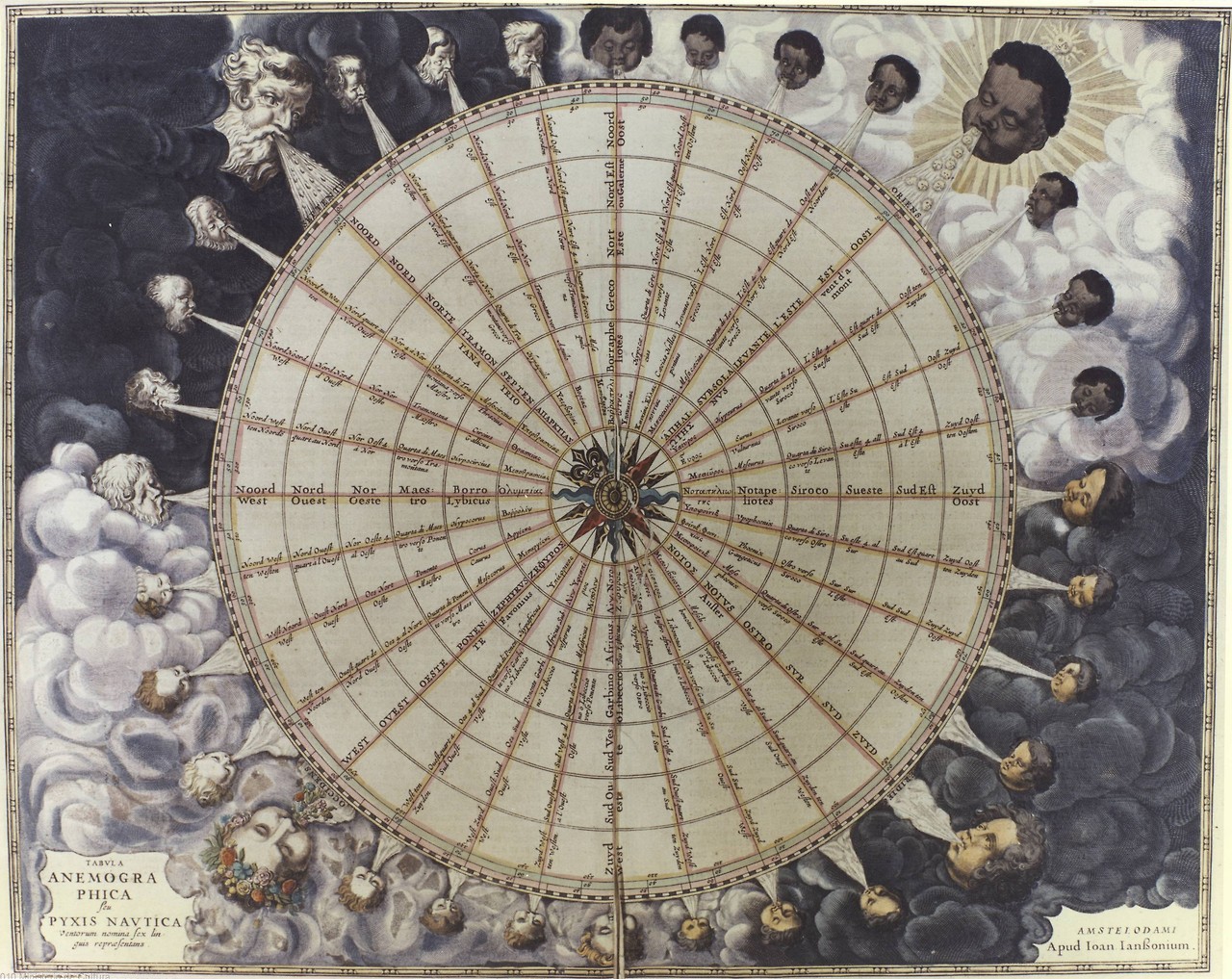
    In any event, following up on post from a while ago on the names of the winds ( https://historyofideasblog.com/thesciencebookstore/2012/04/chasing-the-squamish-the-fremantle-doctor-and-naming-the-wind.html) I wanted to share this great display of information, Jan Jansson’s volvelle/chart of the 32 winds from the fifth volume of his monumental Atlas Major, which was published in 1650.  (Jansson, “Tabula Anemographica seu Pyxis Nautica Ventorum nomina sex linguis repræsentans”. Amsterdam, c.1690.  Image via Bibliodyssey .)


    WInds Jansson


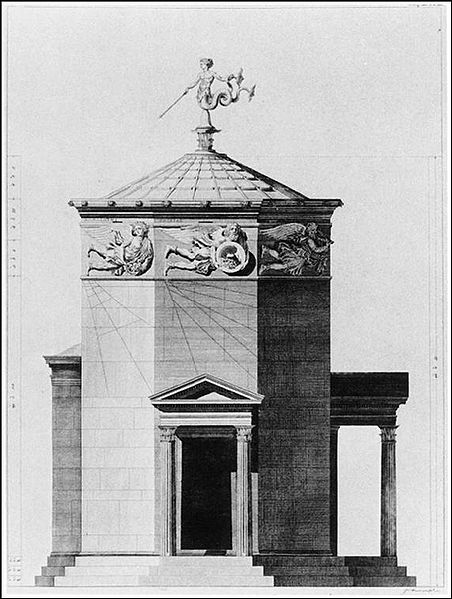
    A monumental, three-dimensional form of wind identification exists in Greece, a marble Roman clocktower (an horologion) with a wind vane at the top, along with eight symbols of the associated gods of the winds (the Anemoi)  that the vane depicts: Boreas (N), Kaikias (NE), Eurus (SE), Apeliotes (E), Notus (S), Livas (SW), Zephyrus (W), and Skiron (NW).

    WInds Athens


    ·Posted by :

    ·in:

  • A New-to-Me Find: the History of Nobel Prize Nominations

    JF Ptak Science Books   Quick Post

    Yesterday I found a fine resource that lives within another fine resource—somehow I missed it, entirely, and for years I suspect of using the one without noticing the other.

    The new-to-me find is the history of nomination process for the Nobel Prize on the Nobel Prize site. What this searchable database holds are all those nominated for the prize in all of the Academy’s fields, who nominated whom, what year, and for what area, with biographical links for all involved, an then cross-referenced so you can search by year and name.

    • Nobel Prize Nomination Archive:  https://www.nobelprize.org/nomination/redirector/?redir=archive
    • Nobel Prize site: https://www.nobelprize.org/

    I came upon the site looking to see the proof of nomination of Gustave Le Bon for the Physics Award in 1903–and indeed, he was there.  I’m not very sure about what Le Bon had done to achieve this level of recognition as he seems in his polymathic way to be around the peripheries of a lot of interesting things in a number of different fields without being at the core (?)–but there he was. One nomination for that year and then for all time. He didn’t stand a chance for the prize for that year, with Becquerel and Poincare receiving it for 1903.

    I didn’t check to see how many others received one and only one nomination, though I did find who received the most nominations and never receive the award–that distinction belongs to the great Arnold Sommerfeld, who was one of the last of those people who “knew everything”, and who over the years received 184 nominations. (#2 by the way was microbiologist Gaston Ramon with 155.)

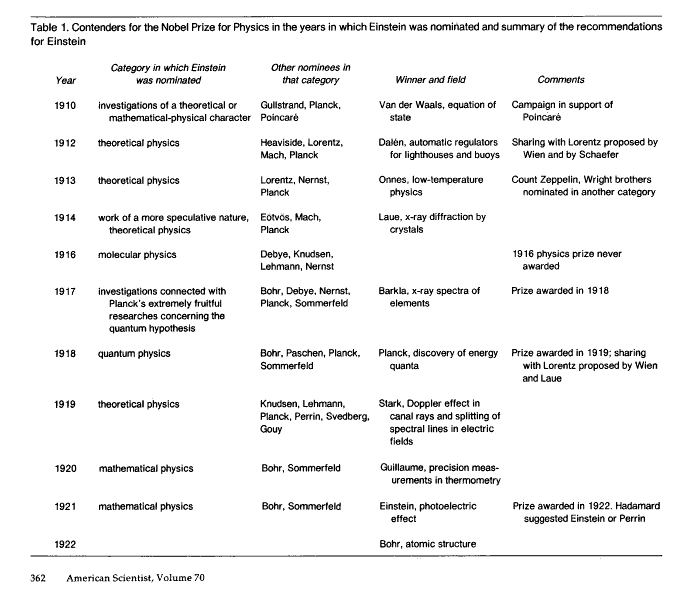
    Just for the fun of it I looked up Richard Feynman and found that he was nominated 48 times, receiving multiple votes in 1956, 1957, 1960, 1962, 1963, 1954, and finally 1965 when we was awarded the prize. Einstein received 62 nominations between 1922 and 1922, receiving them in every year but 1911 and 1915–he was finally awarded the prize (for 1921) in 1922. 

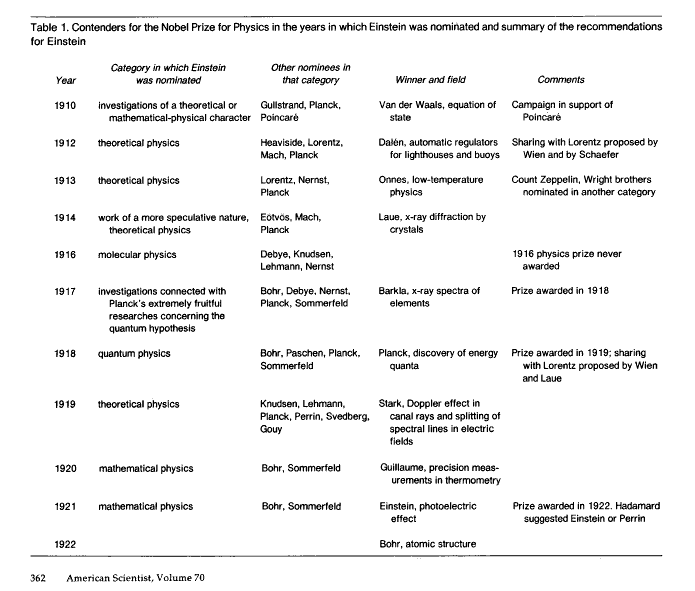
    The story of Einstein’s Nobel (that, is, the getting-it and not-getting-it part) is a bit complex, but is fabulously told by Abraham Pais in his paper “How Einstein Got the Nobel Prize: Why did the Nobel Committee for Physics wait so long before giving Einstein the Prize, and why did they not award it for relativity?” found in  American Scientist, Vol. 70, No. 4 (July-August 1982), pp. 358-365 (and also in a section of his book Einstein Lived Here).  Suffice to say here that the seemingly very long time for him not to receive the award (that he ultimately was given in 1922 for the photoelectric effect and not for relativity) is a “story which has neither heroes nor culprits” according to Pais, but rather seems one where the delayed recognition was due to very conservative appreciation for the proofs of the work. 

    Here’s a table from the Pais paper outlining the history of the Einstein nominations:

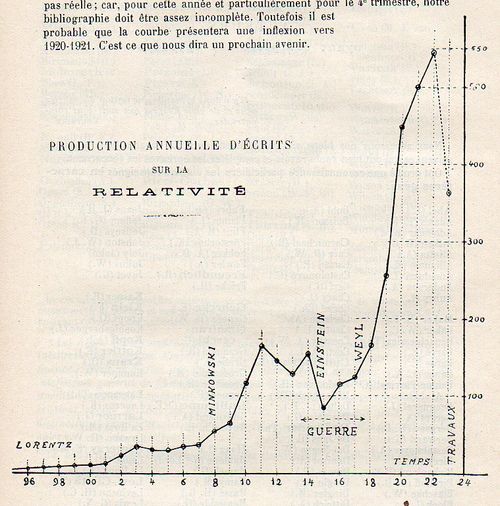
    Einstein nobel historyAgain, Pais points out that the Academy warded Einstein the prize for the photoelectric effect, and not for relativity. We can see in the graph below from the Lecat bibliography of relativity (published 1925) that there was an enormous increase in publications on the theory beginning at the end of WWI. Then came the experimental verification in 1919 that made Einstein into Einstein. Of course this is just a quantitative display of the numbers of papers published on the subject for that year–the members of the Academy certainly had some reservation on the theory of relativity even into 1920, citing what Pais refers to as not-unreasonable hesitations on the interpretation of the eclipse data. 


    Einstein relativituy lecat graph

    In any event, it was a very interesting and somewhat shocking experience to find the nomination archive. I recommend a tour. 

    ·Posted by :

    ·in:

    —
  • Taking Stock of The Machine in 1932–Were They Masters or Slaves?

    JF Ptak Science Books  Post 2769

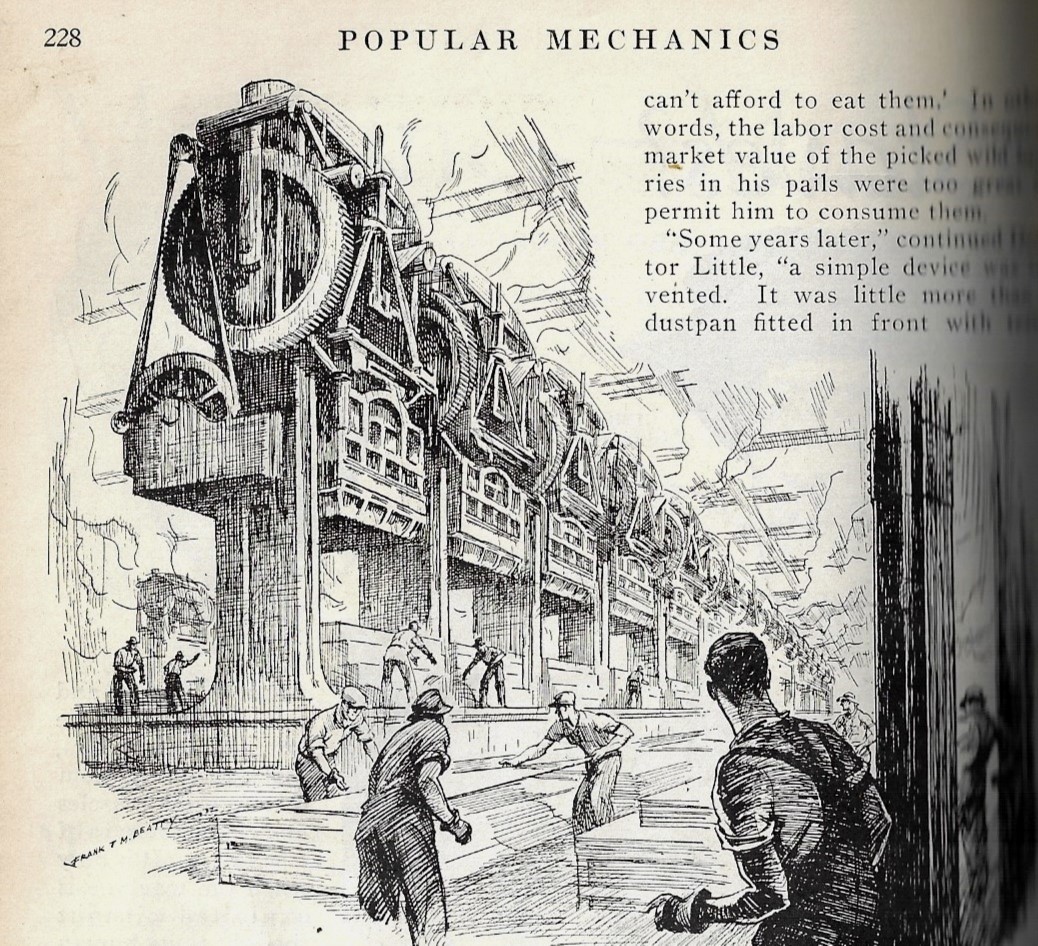
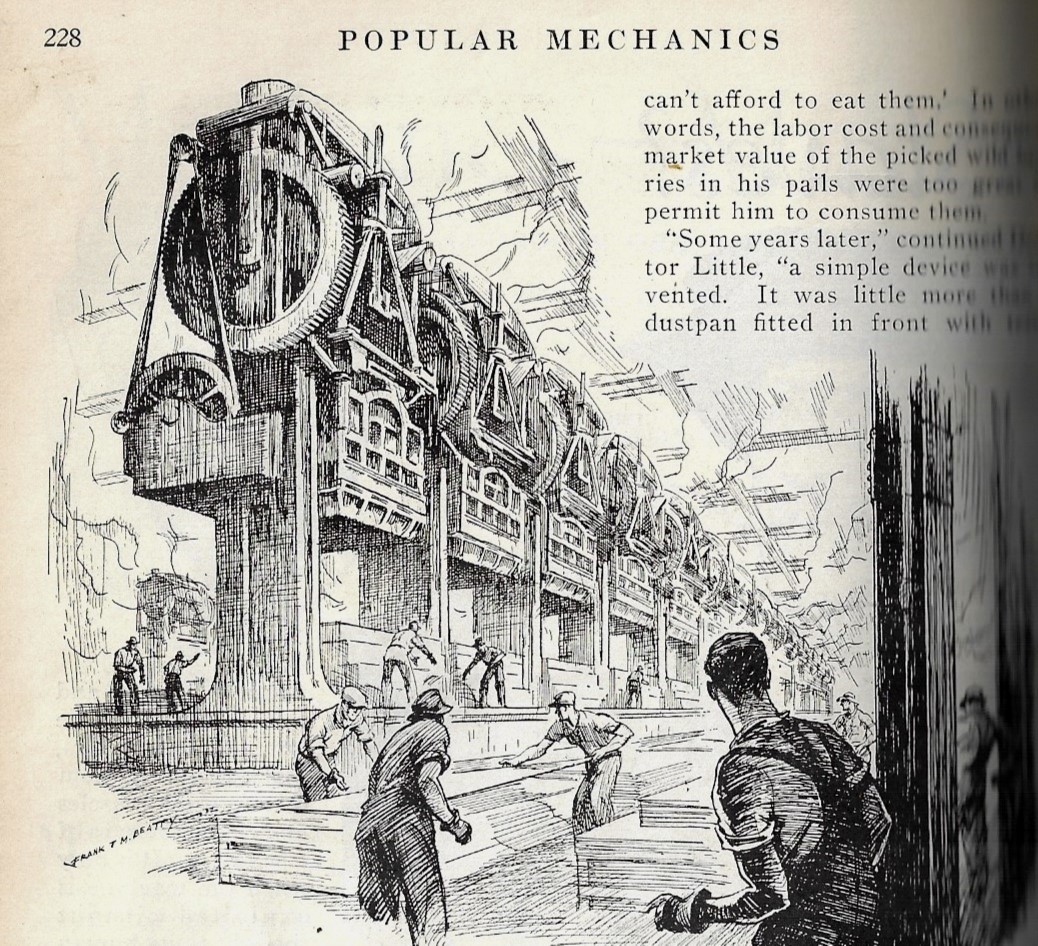
    Pop Mech 1932 Machines Slaves or Masters steam hammerThis unexpected and somewhat philosophical article on the social standing of The Machine appeared in Popular Mechanics in 1932. A standard-bearer for oil and sawdust, sparks and steam, Popular Mechanics was much more interested in DIY than sitting deep in the leather chair to have a long think on the cultural implications of the stuff of the Machine Age. It spoke more about how to manufacture a bolt more so than why one should do so. 

    “Machines–Masters or Slaves?” is the name of the article and it really does ask the question, and in the present tense. It is easier to imagine having this discussion about the machines of our future–or rather in the machines’ future, because it is conceivable that beyond the Singularity that over the course of the next century of five that “machines” may not have much of a need for humans. In any event, five leading techie lights give their assessment of who-rules-whom back there in 1932. 

    One of the unexpected assertions (and unfortunately unexplained) belongs to Raymond Fosdick from the Rockefeller Foundation Machines, who said that machines have “fastened” themselves on every detail of our lives”  and then  “they have called into being millions of people who might otherwise had not been born”.  He says that machines have reached into every part of the world, “for hundreds of millions they are the sole means of support. Stop the machines and half the people in the world would perish in a month”, where he is probably talking about mechanized food production and delivery. 

    Another surprising summation came from Dr. W.E. Wickenden (Case School Applied Science) along these lines: if somehow all and every machine were discontinued and removed and all of their duties were transferred “back into human muscle” to do the job that “we should need at least five billion human slaves” to carry on the work. 

    At this point co-development of machine and human was not an issue, though it would be and famously so in about 18 years. Machines still stood on their own, and the product of human-machine communication and advanced interaction was still the stuff of the newly-burgeoning field of science fiction.  The great question posed by Alan Turing, “May not machines carry out something which ought to be described as thinking but which is very different from what a man does?” (in “Computing, machinery and intelligence.” Mind LIX (236),  433–460)  will have a lot more to do with the future of “machines” for us now and in the future than was ever expected of the “us” of 1932. 

    Another contributor, William Green, president of the A.F.L., took stock about some of the costs of machines: as wonderful as they were, they cost people their jobs, and lists some of the human costs of mechanization. “In the manufacture of razor blades, one man can now turn out 32,000 blades in the same time needed for 500 in 1913. In the machine shops one man with a gang of semi-automatic machines replaces twenty-six skilled mechanics”.  He didn’t mention the Luddites, a secret group bent on preserving jobs decimated by automation by going out and destroying the machines replacing humans. The term is used differently today-often meaning someone who prefers and older tech or non-tech alternative to a tech instrument; that, or simply not knowing some technical subject. The original use was in relation to labor practices, standing against machines that would rob people of their livelihoods. For example, the handweaver population n England stood at 240,000 in 1830 to 43,000 in 1850 after the introduction of the mechanization of stocking and spinning frames, which made for 207,000 not-satisfied people. Anyway the Luddites set out to curtail the replacement of workers by machines and the making of unfair profit by the owners of the means of production, though they didn’t get very far.

    Of course the replacement of workers by machines would continue on the scale of an order or two of magnitude, until finally the machines themselves were replaced by other machines operated more cheaply in other countries.  

    Ultimately the author comes down on the side of the machine as slave rather than the human, because “as an instrument of exploitation or profiteering the machine is doomed by common sense”, “the veiled splendor of the moral vision” in the ‘unending future of the machine”, whatever that means. The machine was a servant of humankind, lifting us from “drudgery”, into a “greater leisure for the exercise of the free spirit”.  No doubt this is all giveth/taketh–I wonder how far into the future it all becomes taketh/giveth?


    ·Posted by :

    ·in:

  • On Measuring a Ship with a Skyline (Part VI)

    JF Ptak Science Books   Quick Post

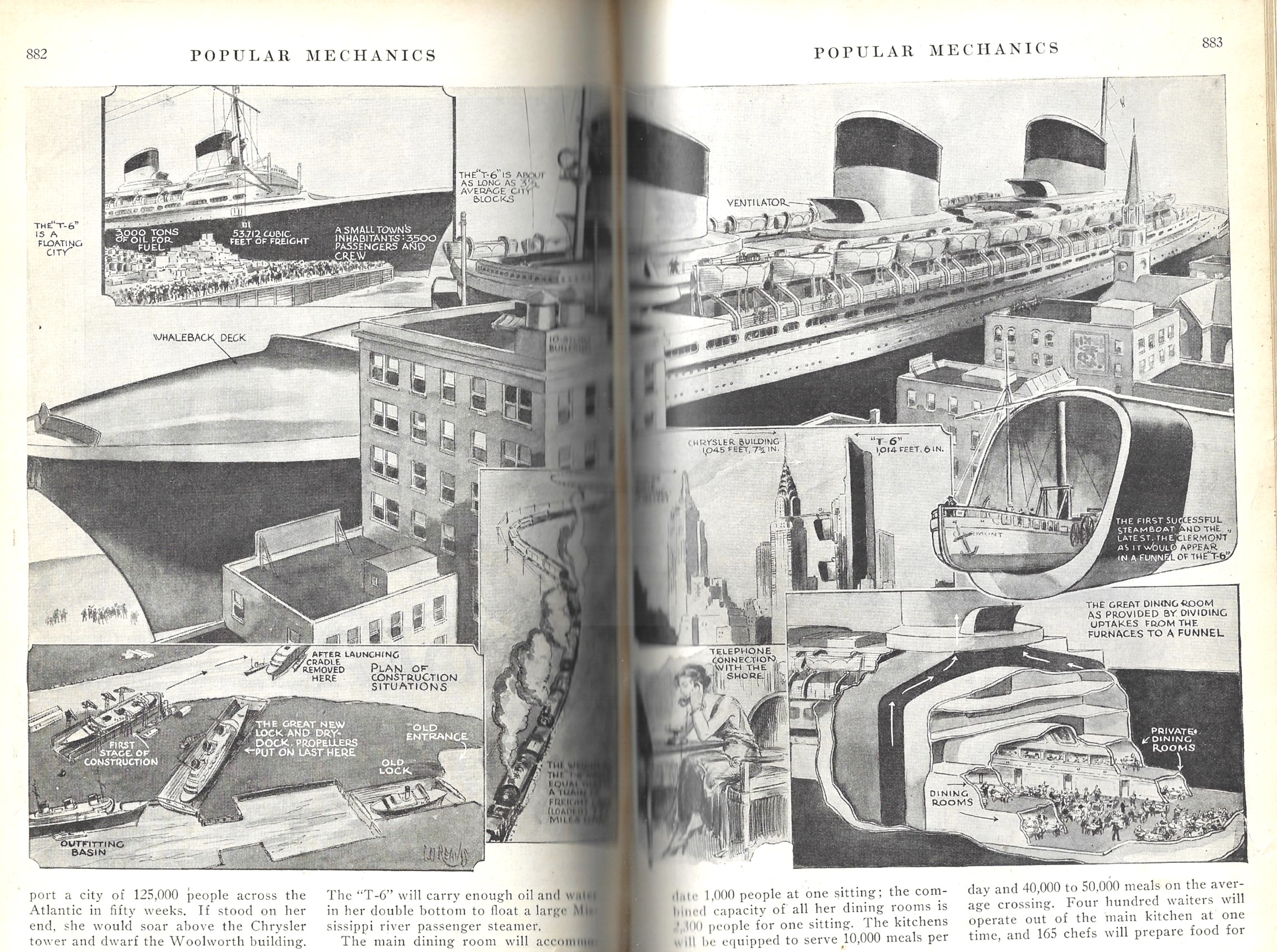
    There are a number of posts on this blog looking at how data is visualized, some of which use ships and skylines and waterfalls and pyramids to compare their relative sizes. This article (“T-6 The Latest Giant of the Sea” by D.N. Glass in Popular Mechanics, December 1932)  uses illustrative means to display the statistics of the luxury liner Normandie (at the time known as the T-6) one of which employs the comparison of the ship to a skyscraper–actually, the comparison uses two skyscrapers, the Empire State Building and the Chrysler Building. 

    Pop Mech 1932 comparative data Normandie

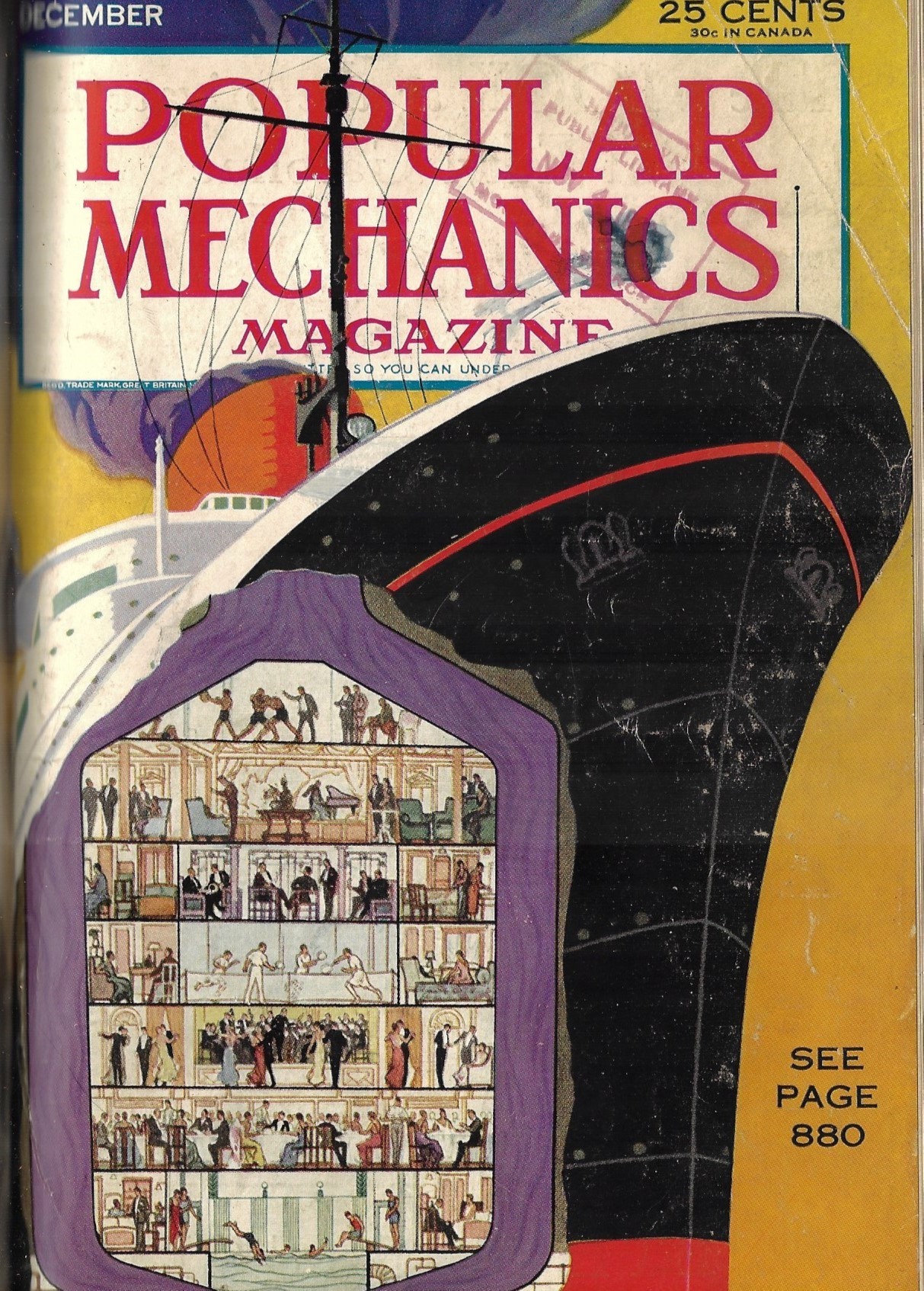
    The cover of this issue uncommonly features a cross section:

    Pop Mech 1932 Normandie cross section


  • An Atomic Trinket for a Nuclear Whimsey: The Bomb in 1940 (?)

     JF Ptak Science Books  Post 2770

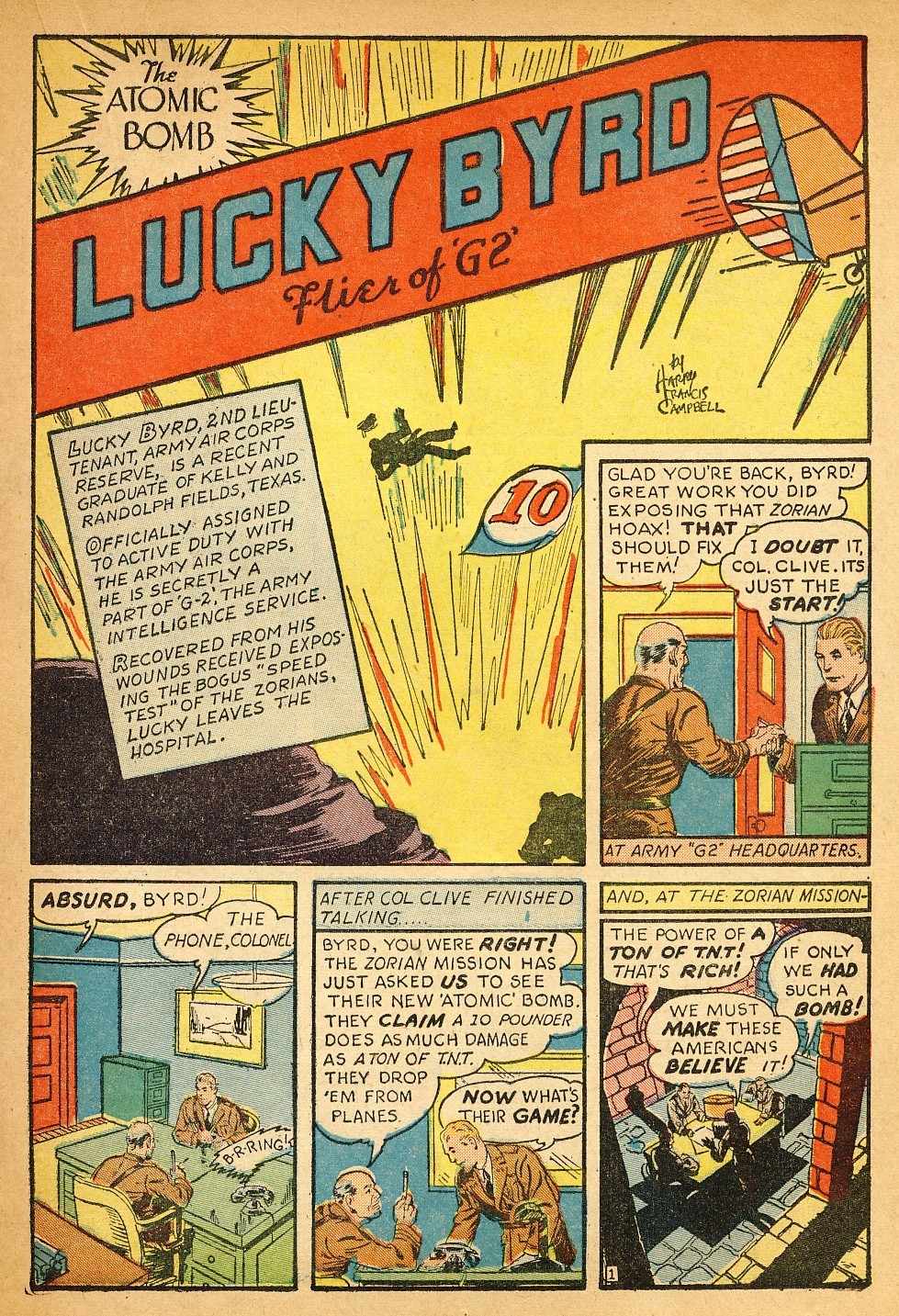
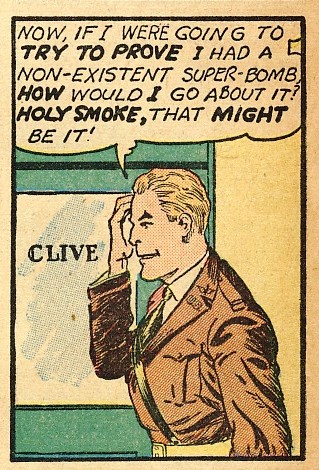
    Comic book atomic bomb cover _1_There are some early suggestions for the atomic bomb that occur earlier than when it was first tested on July 16, 1945: there was H.G. Wells who famously wrote about it in 1914 (in The World Set Free), which came a few years after a very obscure mention by the semi-polymath Gustave Le Bon who wrote about its scientific possibility in 1905 in the Revue Scientifique. That said I was surprised to see the atomic bomb referenced in a comic in 1940 (book five years before the Trinity test): “The Atomic Bomb, Lucky Bird, Flier of G2”1 definitely suggests a bomb of high power, which so far as I can determine from my non-existent comic book expertise seems to be the earliest of its kind. The very intriguing aspect of the story is that it shares an interesting coincidence with the Real Thing.

    The story–only seven pages long–revolves around the Zorians (from where I don’t know) who make it known that they have a smallish shell (a “ten pounder”) that has the yield of 2,000 pounds of t.n.t. We are informed that the Zorians actually don’t have this weapon, this “atomic bomb”, but they intended to “fake it” and convince the world they had it and confound the U.S. They weren’t planning to use their non-existent bomb though they did plan to demonstrate it,  that  bombing 10 labeled secret sites to display its effectiveness. The fakery part was that the Zorians hid 2,000 pounds of t.n.t. beneath each labeled targets that would be ignited by the 10-pounder and thus make that shell look like a lot more than what it was. The hero of the story, Lt. Lucky Bird of “G2” figures out that the test would actually be a fraud and sets out to prove to the world that the Zorrians do not have such a devastating weapon, and thus go on to save the U.S. from having to react to a fraud atomic bomb. 

    Spoiler alert: Lt. Byrd succeeds, the Zorians are exposed, and they of course blow themselves to kingdom come in the end.

    The big real-life coincidence? The Zorians were going to demonstrate the weapon in the “Shiprock Desert”, north of  Gallup, New Mexico, which means I guess they planned to use the thing on land in the Navajo Nation. It so happens that the Trinity Site (of the plutonium implosion explosion) is only 100 miles or east of the Gallup area and the beautiful Shiprock. 

    There’s plenty of desert in the U.S. to experiment with a weapon like this, so choosing a location so close to the one that was used for an actual atomic explosion is pretty interesting. It doesn’t mean anything, of course, but it does have a certain amusement value. 

    And then there’s some fabulousness, like this:

    Comic book atomic bomb _2_

    [Source: Both images from Comic Books + http://comicbookplus.com/?dlid=17561]

    The newspaper Daily Tab announces with a flourish Lt. Byrd’s success with the the sub-header: “Bogus Bomb’s Big Blast of Bunk”. 

    Here’s one more thing: the 10 pounder of the Zorians was supposed to deliver the equivalent explosion of 2000 pounds of t.n.t.  The real thing, the Fat Man bomb, weighed 10,000 pounds and delivered 20,000 tons of t.n.t. For the Zorian weapon to have that sort of yield it would need to be about ten times the weight of Fat Man. 

    Notes:

    1. Target Comics, published by the Novelty Press, December 1940, with ink and color by Harry Francis Campbell. 

    ·Posted by :

    ·in:

  • An Outstanding Display of Air Power (1932)

    JF Ptak Science Books  Quick Post

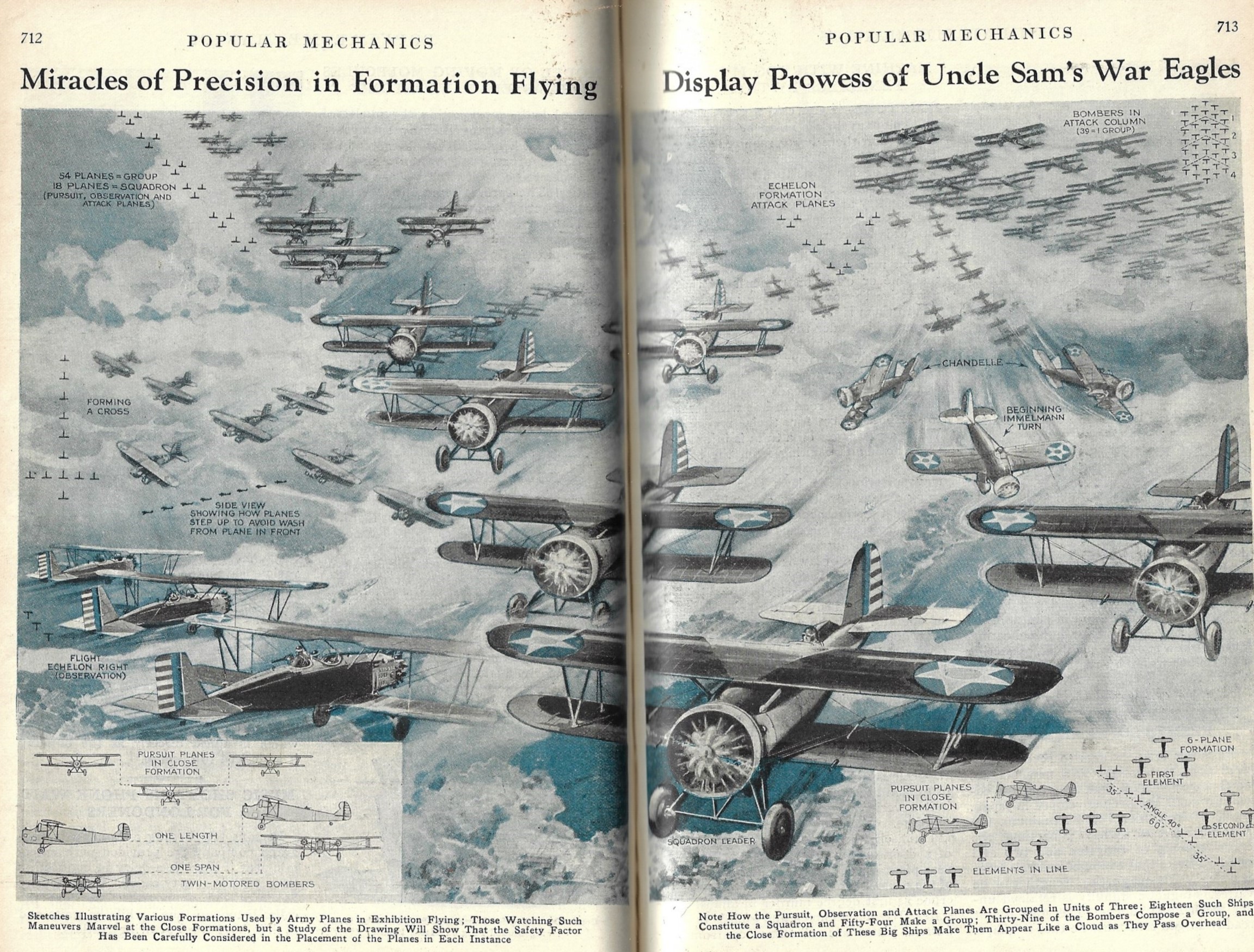
    Here’s an unexpected bit that turned up in a 1932 issue of Popular Mechanics: a remarkable illustration showing formations of aircraft of the U.S. Army Air Corps. (And, just a short note before the money shot: it was the U.S. Army Air Corps from 1926-1941, the U.S. Army Air Force from 1941-1947 (during which in 1944 the USAAF was composed of 80,000 aircraft and 2.4 million airmen), and the U.S. Air Force (since September 1947). 

    Pop Mech 1932 air force formations


    ·Posted by :

    ·in:

  • Automation and Robots: Iron Man, an Automated Bowery Hotel, and a Fortune Teller (1932)

    JF Ptak Science Books   2771

    “All things are leading to Man’s Machine Made Millenium”–maxim by Hudson Maxim

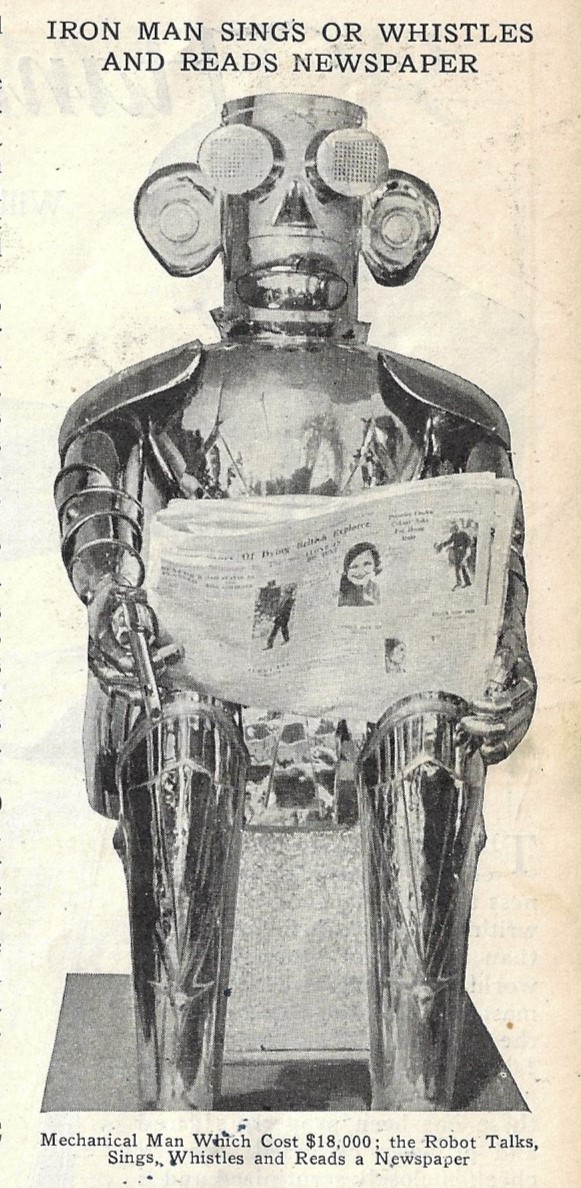
    Pop Mech 1932 robot mechanized iron man _3_There are a number of posts to this blog on the coming of the “robotic” and the modern automatic age(s), though they are mostly concerned with the period from anthropomorphic steam preachers of 1840 to the 1930s. Admittedly there’s not a lot of “robots” in the 19th c lit but there are some; and of course there’s a fair amount of basic automation that takes place in the 19th c as well—but things really start to heat up in the 20th c. (It should be remember that just after the turn of the 19th c that “Ned Ludd’s” followers weren’t what they are confused with being today—they weren’t resistant to technology and innovation, so long as those new machines didn’t take away their means of supporting themselves, which was their real bone of contention. After all, there have been automated machines that have taken jobs from folks going back thousands of years. All of that is a huge story, and today all I’m concerned with in the present entry is robotics (such as they were) and automation (ditto) for an article and a couple of picture-posts from Popular Mechanics for 1932.

    And by “robots” I’m not talking about the the sophistication of AI and the Singularity; mainly they are posts about the first or early ventures in replacing some aspect of human activity with a machine. The Pop Mech article that addresses this in very simple terms: “The Automatic Age, Millions in Pennies” appearing in the October issue, does come close to using the term and concept of “automation” here, though that word does not make an official appearance in this context for another 16 years. The discussion in the article is on curious applications for machines, like penny fortune teller dolls, automated public hair dryers, and “drink dialers” (after the deposit of a nickel you would use a telephone dialer to order your favorite beverage). There’s also some recognition of an automatic grocery which was “devoid of time-wasting conversation” with store clerks, the machine also being equipped with a “mechanical brain” to make change as your dropped in your dime for some 5-cent canned corn. Also among the moderns here were “pin” (pinball machines of a sort) games, automatic scales, and a very odd phrenological device. Plus: there’s a short note on the first coin-operated hotel, this one being opened on the Bowery…The Bowery, the home of America’s “Forgotten Men”. If you dropped two bits into the automated room opener you were allowed into a “tiny room” where the renter was allowed a “cot, hooks, hangers, a chair, a mirror, wash basin, soap, a towel, and privacy for the night”.

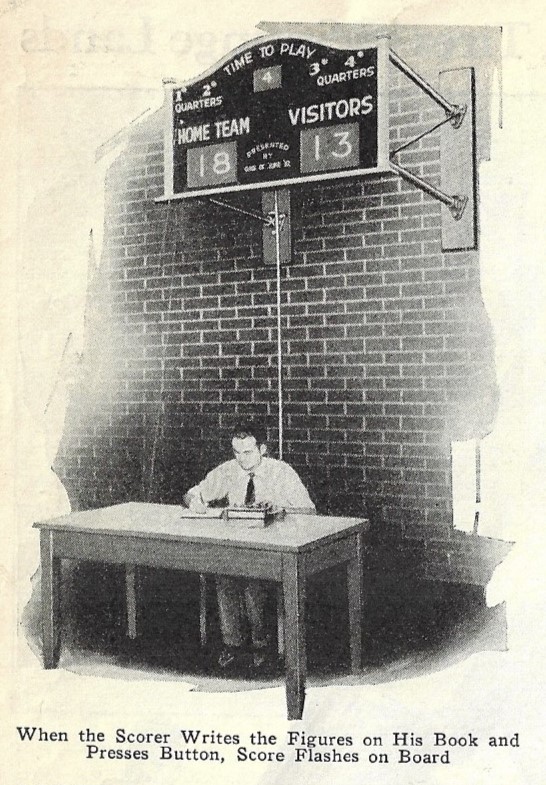
    Pop Mech 1932 Robot mechanized basketball _2_Following on the heels of this article was a short notice on “reading and whistling” “Iron Man”, which just looks sad. And then, but to a lesser extent, there was another automated man, of a sort. A machine that eliminated the need for a person to run a scoreboard at a basketball game. A small wink towards the future, though at the time this was a lovely and wonderful small innovation.

    In any event I was a little surprised to see the attention paid I this half year volume of Popular Mechanics to “the automatic present”.

    Notes:

    Here’s a few definitions of “automation” from the Oxford English Dictionary:

    1948: American Machinist 21 Oct. in McGraw-Hill Encyclopedia of Science and Technology.  I. 676/2. “Automation, the art of applying mechanical devices to manipulate work pieces into and out of equipment, turn parts between operations, [etc.].”

    1953: Manchester Guardian Weekly 3 Dec. 15/2  “ Many factories are spending large sums on ‘automation’, that is, the adoption of automatic machines working together with little labour.”

    1660:  H. More Explan. Grand Myst. Godliness ii. iii. 37   “God will not let the great Automaton of the Universe be so imperfect. (first appearance 1616 though this.”

    Also this, assigning a more definite place for the word to originate:

    1948: ”in the manufacturing sense, coined by Ford Motor Co. Vice President Delmar S. Harder, from automatic+ ion. Earlier (1838) was automatism , which meant “quality of being automatic” in the classical sense.: Online Etymology Dictionary, by Douglas Harper

Recent Posts

Archives

Categories