A Daily History of Holes, Dots, Lines, Science, History, Math, Physics, Art, the Unintentional Absurd, Architecture, Maps, Data Visualization, Blank and Missing Things, and so on. |1.6 million words, 7500 images, 4.9 million hits| Press & appearances in The Times, Le Figaro, Mensa, The Economist, The Guardian, Discovery News, Slate, Le Monde, Sci American Blogs, Le Pont, and many other places… 5000+ total posts since 2008.

  • Blank and Empty History: Patrick Starfish, The Sopranos, Kasimir Malevich and Disappeared Madonnas

    JF Ptak Science Books LLC  Post 374    Removing the object from imaging is serious stuff

    Empty--patrick
    “This pencil is broken, why won’t it make words?” said Patrick Starfish in Spongebob Squarepants.  “I can do this…I can use, my, um….brain!!” he declares, hopefully, with an intensifying anxiety and sweat. After some squirming and smoke and some not pretty inside looks at Patrick’s brain working, (Mr.) Squidward (Tentacles. who never wore paints, ever) )comes in and sniffs the room:  “It smells like something broke in your brain and died” he says, removedly.   “ THAT’S the creative process!” says Patrick happily.  Indeed!  Empty--squid

     
    In The Sporanos. one of the guys, Christopher (“Chris tu fuh”) Moltisanti, decides to write a screenplay about his um business life and buys a laptop for the process of creativity.  He’s upset when he has a hard time of it, brick walls and all that, explaining to one of his cronies that “I even bought this computer, I thought the thing would come up wit sumthin’”. 

     Empty--christufuh 

    In a sense, Kasimir Malevich  was coming to this sort of non-objectivity, but instead of removing himself from the process like Christufuh and the beautiful Patrick, he removed the reality from his painting.

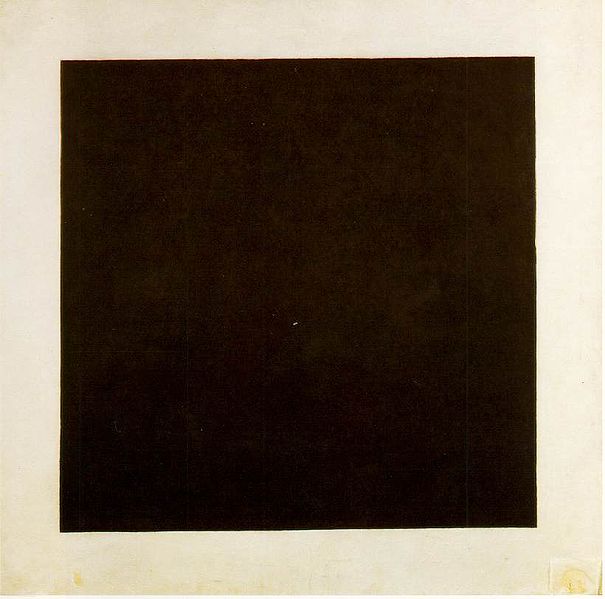
    The Russian-born,  ethnic-Polish Malevich (1878-1935) , the first of fourteen children, introduced the genre of Suprematicism in 1915, just a  few years after Kandinsky’s first effort in abstraction (and the modern world’s first foray into non-representational art).   His first exhibition was exceptional and large—there were some many pieces that it must’ve been the case that he had been working for years with this idea.  This was the “0.10” exhibition, and photos of the show in Petrogard, shows the famous Black Square in a place of honor, in the high corner of the room, like a religious icon. (When Malevich finally was laid down from cancer in 1935 the Black Square was hung above his body as he lay in state.  It saw him into his world, and saw him out.  And, as a matter of fact, his grave is decorated by the Black Square as well.)  So many of these pieces are utterly recognizable that it seems almost impossible that they appear for the first time in the same, opening, introductory, show.
    Empty--maelvich

    Malevich wrote later about the Black Square:

    “The black square on the white field was the first form in which non-objective feeling came to be expressed,  The square = feeling, the white field = the void beyond this feeling.” (See Roger Lipssey, An Art of Our Own, 1988)

    Malevich’s vision on the emptying of form comes again from the 0.10 show:

    “Only when the conscious habit of seeing nature’s little nooks, Madonnas, and Venuses in pictures disappears will we witness a purely painterly work of art.
    “I have transformed myself in the zero of form and have fished myself out of the rubbishy slough of academic art.
    “I have destroyed the ring if the horizon and got out of the circle of objects…”

    Emopty--malevich

    Three years later Malevich would advance the idea to its logical end came Malevich’s  “Suprematist Composition, White on White, 1918”.  I’d reproduce it here but it is a little pointless, especially digitally, what with its incredible subtleties lost in the electromagnetic sauce.  I had the please and opportunity to see this in D.C. at the National Gallery’s homage to Malevich in the early 1990’s, and I can say that the painting is absolutely magnificent.

    Malevich didn’t see as much as he sensed the world (so he wrote), and made the structures go blank and empty to fill them again with what he knew.

    “And knowledge is of two kinds, one turning its eyes towards transitory things, the other towards things which neither come into being nor pass away, but are the same and immutable forever.  Considering them with a view to truth, we judge that the latter si truer than the former.”  Plato, Philebus
  • Blank and Empty History: Disappeared Legions of The Wrong

    JF Ptak Science Books LLC  Post 375

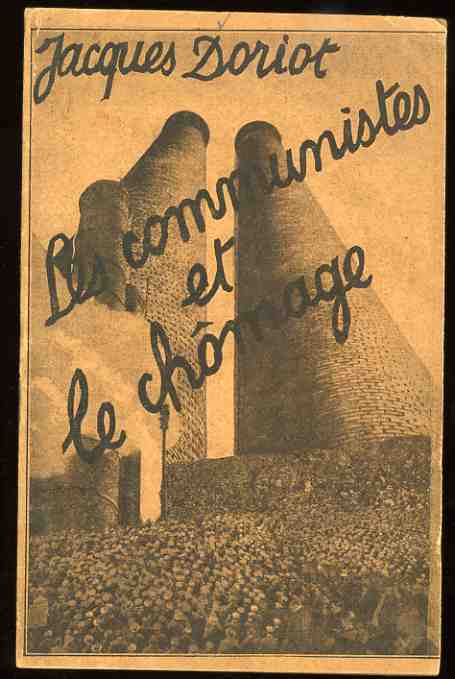
    0-blog---Nov 13 doriot070

    Continuing my series of posts on The History of Blank and Empty (and Missing) Things, I come to this beautifully designed French  pamphlet of 1931.  The design is of less interest than what happened to its author, the exceptionally problematic and traitorous Jacques Doriot.  Now Doriot (1898-1945) started off liberally enough, shooting out soon thereafter to explore the very furthest reaches of The Deep Left, and then, when that didn’t quite work out for him, blasting off to the nether regions of the wincingly bad singularities of The Deep Right.  He scratched at the edges of political extreme idealisms, waiting for something to happen, something that would get him greater fame or more-reaching political power, but his fate would intercede. 

    Doriot began his career as a Communist and would do fairly  well, politically speaking.  A member of the Communist Party since 1902, he would become Mayor of St. Denis (near Paris) and a member of the Chamber of Deputies.  A difficulty would arise and he quit the party, becoming a Fascist over the next few years.  On the invasion of France, Doriot became a Nazi firebrand, committing himself to the cause, and living in  lickspittle Vichy France. 

    Like another fellow ex-pat (Ezra Pound), Doriot made vicious anti-French/communist and pro-Nazi radio broadcasts from Paris in 1940 and 1941.  In that year Doriot would take an uncommon step, a step towards disappearing, when he and Marcel Deat founded the Legion des Volontaires Francais (contre le Bolshevisme) (LVF)), which was a combat unit of French Nazi sympathizers that fought with the Wehrmacht.(Over time and the wear of war it was also known as The 33. Waffen-Grenadier-Division der SS Charlemagne (französische Nr. 1) and Charlemagne Regiment, as new elements were formed to replace the lost.)  I could imagine that no one saw them as anything but pathetic, even their Nazi commanders, who would put them into the meatginder on the Eastern Front.  The LVF was decimated and all but gone by the end of the war, though Doriot, somehow, survived it (with an Iron Cross awarded him in 1943), until he was killed by a strafing plane on 22 February 1945.  The survivors of these groups met bad ends at the hands of the French (and the Soviets of course); some were imprisoned and sentenced to hard labor; many were summarily executed. 

    Groups like the LVF take their members and spin off towards oblivion, much like the Spanish pro-Franco troops that went to fight for the Nazis and were disappeared, or the poor black slaves of the (Western Band of) Cherokees who were made to fight with their Indian masters for the Confederacy, a deeper, darker place I could not well imagine. 

    (A  detail of the crowd scene of the pamphlet on Communism and Unemployment.)0-blog---Nov 13 doriot071

  • Bad Ideas Department: the “Terminal Box” and the Restructuring of Society, 1938

    JF Ptak Science Books LLC  Post 376

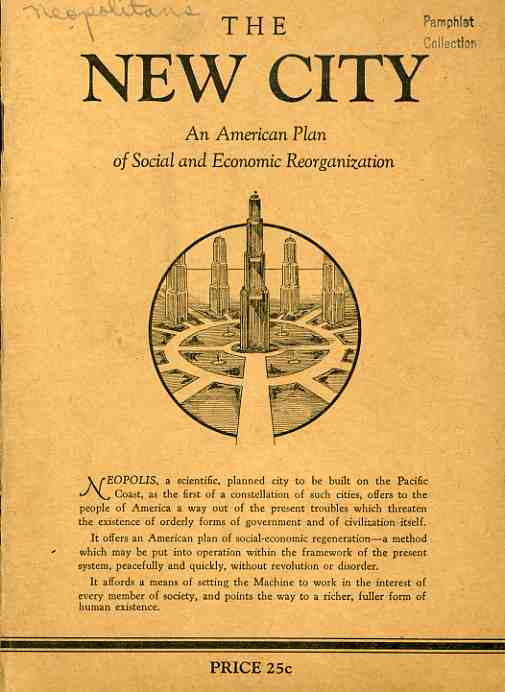
    0-blog---Nov 14 new city075
    The unnamed author of The New City, an American Plan of Social and Economic Reorganization (1938), makes a hard-edged plea for the formation of a new American society—and by “new” the author really means it, advocating a different economics, social structure and even the physical development of new cities and abandonment of the old physical and philosophical structures. 

    Sprinkled among the Swiftian notions of rightness, quixotic lancings of social ills and a general bombardment of the structure of society are some interesting and isolated points: 
    “America is the supreme user of the machine…ravishing the irreplaceable wealth of one of the earth’s richest continents, tearing down forests, looting the treasures of coal and draining the reservoirs of oil and natural gas, by methods scandalously wasteful.” 

    This leads the author to the Depression, “a decade of demonstration of the profit system’s inability to deliver to the people the needs of life, a painful heartbreaking demonstration”.  0-blog---Nov 14 new city076

    It is the profit-deliverers, not the machine s or people, who are to blame.  One way of addressing the distribution system, was, unfortunately, Russia—“a form if society set up to overcome this impasse of the capitalistic system of production and distribution”.  Of course the Russians, the Soviets, were just in the middle of their enforced starvation/gulag/brutalization period under Josef Stalin, the gigantic negative parts of which were still in general not known to the great unwashed. 

    The unnamed author dips lightly into Socialism, and then into Fascism and Nazism, though the only thing he/she really has to say about the later two is that “their answer [to economic woe] was in the seizure or control of the means of production by the state”, their own brutal means skipping off unnoticed into a pinkish glow, though the loss of personal freedom is “disdained”. 

    The New City is actually a new world order, a new governmental form to take advantage of technological advancements leading to “nationalized urbanization” The first city in this new order is Neopolis, and this pamphlet was a call to those who would stand as its citizens.  (There’s actually a sort of application form, though all it really is a bill-of-sale for ordering more copies of the New City pamphlet.)

    Even though the pamphlet is easily obtained, membership, the possibility of being a Neopolitan, is something entirely different.  The difference is actually exceptional, perhaps the most extraordinary thing about this whole misguided idea.  “Membership is to be carefully controlled at all times” we read. . “It is not desired to build up a huge and unwieldy membership of poorly-assimilated elements….interesting educational instruction…with tests to determine the fitness of the member for loyal, cooperative activity, leading, necessarily, to the elimination of those who may be found undesirable”. 
    That’s some pretty muscular, steroidal stuff, particularly after such a glancing blow against the Soviets and Nazis. 
    0-blog---Nov 14 new city077

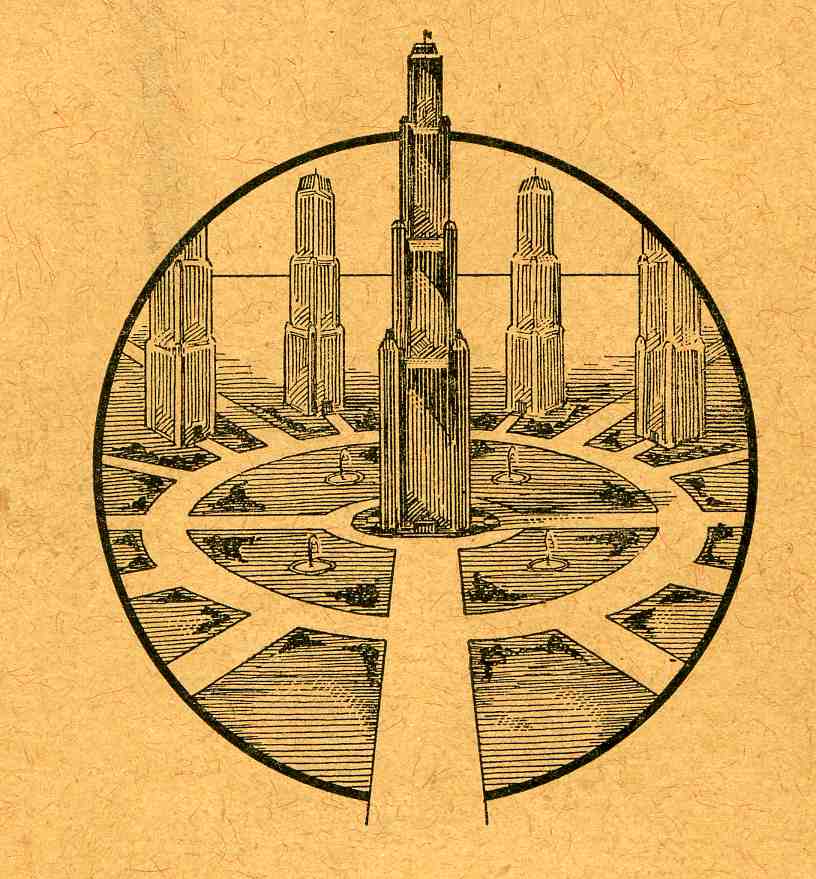
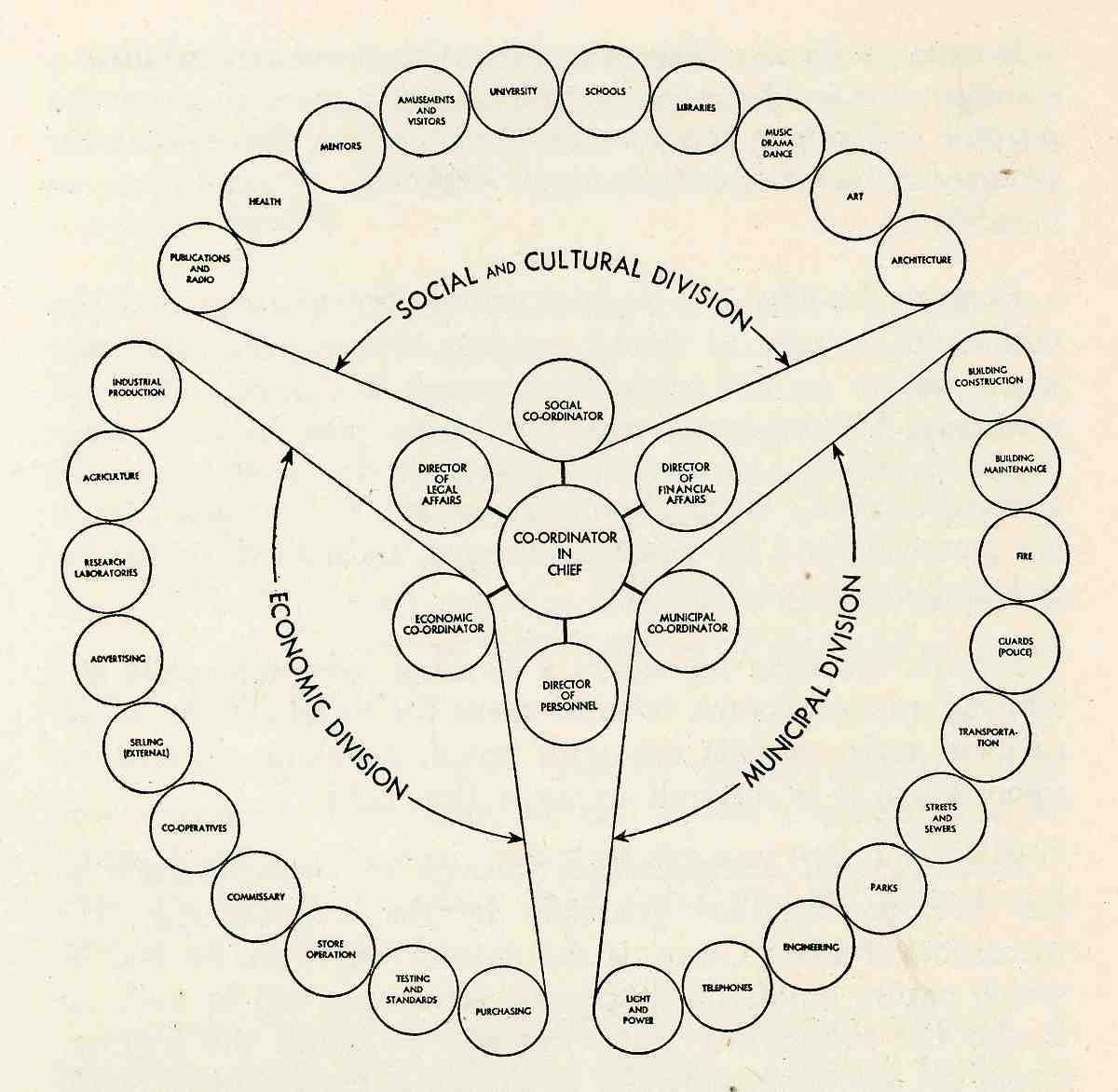
    Since this is just an “abridgment” of a soon-to-be-written 250-page explanation of the concept, the complex and concentric organization of society is left mainly to the drawing of its plan, the physical layout of the city based upon this ideal. 

    The Seattle-based author never did quite make it past page 29, never did name themselves, and never provided a concrete place where all of this heady stuff was being think out.  It is a sort of pretty design in a creepy/queasy way, there on the front cover, but that’s about as far as it goes.  If anyone actually did send any money to this quack thinker, it wound up in a nicely metaphorical place:  at “Terminal Box 3463”. 

    This may be the very best idea to come out of touching this pamphlet—a place where people can send correspondence regarding Bad and/or Dead or Dying Ideas: “Terminal Box ______”.  I guess that box number would be pretty high by now. 

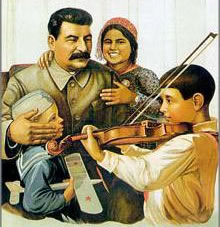
    Stalin20
    (Uncle Joe, before he killed the children.)

  • Fat Redux, Redux: Fat Bullets, 1945

    JF Ptak Science Books LLC  Post 377

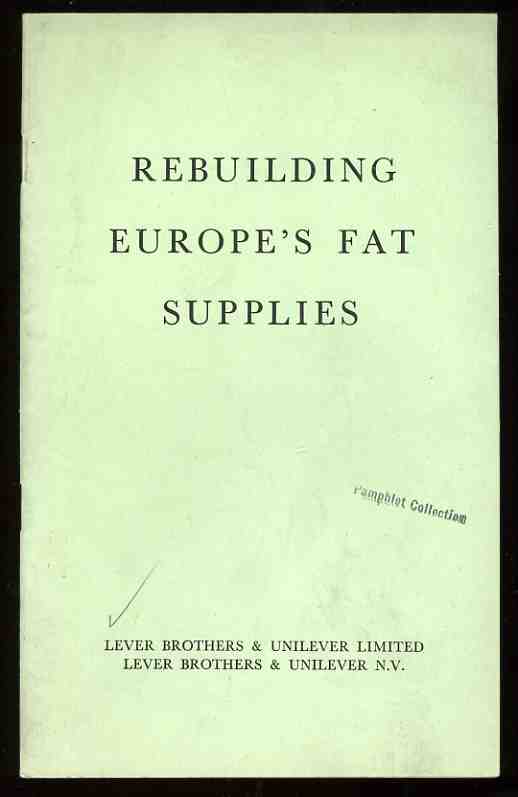
    000-ebay--Nov 8 fat025
    This is the third in the stumpy but cushiony series in this blog on fat, all of the items coming from my purchase of a 90,000-item pamphlet collection from the Library of Congress.  It was unimaginatively called, and stamped, “The Pamphlet Collection”, and was organized into 2,800 or so document boxes, all of which were painstakingly categorized and alphabetized, but done so via a secret and mysterious way that I’ve never deciphered or understood.  Listen:  the pamphlets were organized indifferently in general but diffidently in particular, so an Aa-At box might’ve contained pamphlets categorized via title or author or place of publication or subject matter or publisher. The pamphlets’ placement was almost random, but not quite, as there was a thin thread of logic tying them all together, but just not in a way that it would all be sensical. 

    But back to fat:  it really is just the pamphlet’s title that’s so unexpected, as the content is all about replacing the oils and fats that had gone missing, sucked up by the war effort, that were actually pretty essential. For example, one pound of fat contained enough glycerin to make a pound of black powder, which is also enough to make six 75mm shells.  Butter, margarine, vegetable oils include: olive oil, palm oil, soybean oil, canola oil, pumpkin seed oil, corn oil, sunflower oil, safflower oil, peanut oil, grape seed oil, sesame oil, and so on, were definite parts of the diet and the economy, and, well, did actually have to be replaced.  There.  I’ve killed the humor in this title.  

    ·Posted by :

    ·in:

    —
  • Growing a Junk Yard: Salvaging Fat, Bikes and Stockings for Guns and Tanks, 1943

    JF Ptak Science Books LLC Post 379

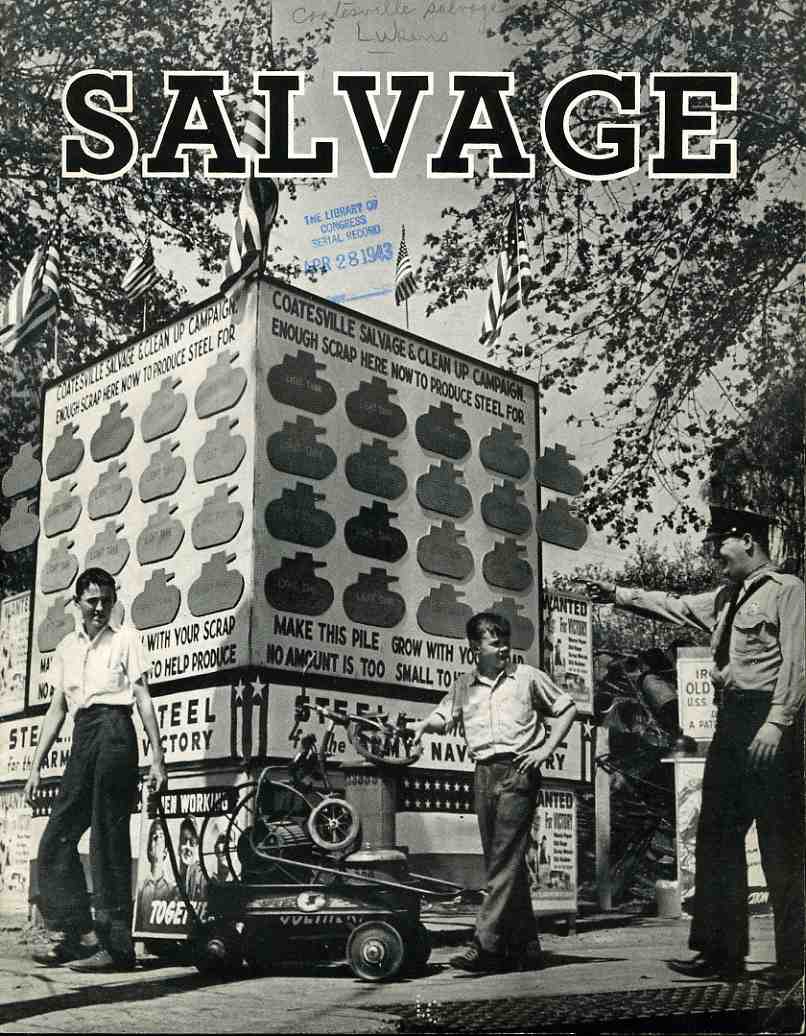
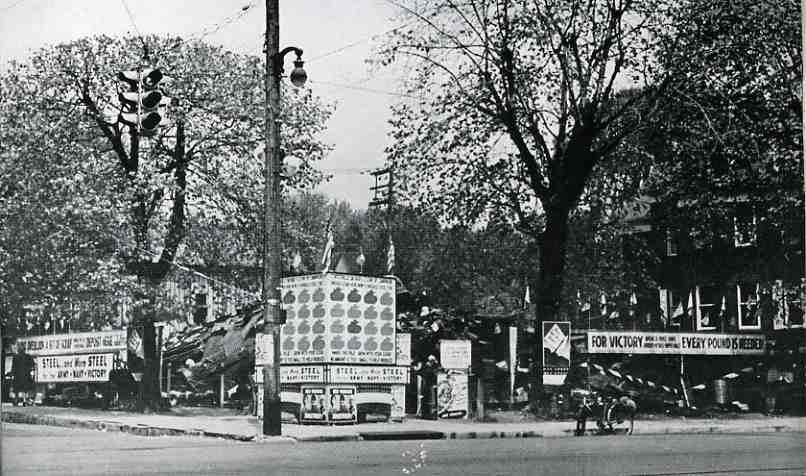
    00-blog-Oct 25 salvage922 Salvage (1943) is just simply brilliant!  It is a superb design, getting its inelegant point elegantly across to the reader, making the collecting of junk  a bona fide war effort, triumphant, superior; it delivers the message gorgeously.  Who wouldn’t want to rush out and look for some metal scrap and bits and grow a neighborhood junk yard so that the community could build a tank?  Certainly these two boys–under the watchful guidance of a smiling cop in a black tie–couldn’t resist, and from the looks of the progress billboard behind them, nor could anybody else in the neighborhood, as the community collected enough metal junk for 14 tanks.  (Or at least pieces and chunks for fourteen tanks.)

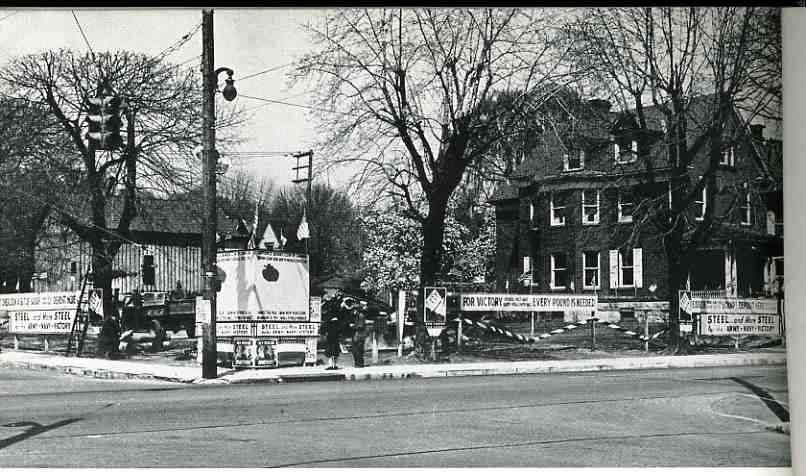
    The community was Coatesville, Pennsylvania, and they certainly did their collecting-best.  The two photos below show (top) the scrap yard after two days of collecting, and (bottom) the end of the campaign two months latter.

    “One pound of fat contained enough glycerin to make a pound of black powder, enough for six 75-mm shells. Twenty three hundred old nylon stockings contained enough nylon to make one parachute.
    Thirty thousand razor blades contained enough steel to make fifty 30-caliber machine guns.”   (Lingeman, Richard R. Don t You Know There Is a War On? The American Home Front, 1941-1945. New York: G.P. Putnam’s Sons 1970, 254-55).  When you have an entire town doing this, you can build tanks; when you have millions of people throwing together to collect this “junk”, then you get part of a war effort.  It is also part of a giant propaganda hearts/minds machine, especially for the U.S., which was (and I use this word with some hesitation) cushioned from the effects of the war by two oceans–it reminded people who hadn’t contributed a life to the war that there was actually something tangible going on, and that they could do something to help.  It kept peoples’ minds in the game.  Rubber was another big concern, as was silk (the controlling exporter of both coming largely from overseas, and in the case of silk, the exporter was Japan.)  Of course there was the introduction of synthetics for both silk and rubber, but the point in fact was that there was indeed a shortage, and the donated and salvaged stuff was necessary. 

    Here’s a beginning picture for the burgeoning community scrapyard:                                                                                                                                              00-blog-Oct 25 salvage before923

    Some interesting works relating to salvage drives:

    Barringer, Edwin C. The Story of Scrap. Washington D.C:Institute of Scrap Iron & Steel Inc., revised edition, 1954.

    Cohen, Stan. V for Victory: America’s Home Front During World War II. Missoula Montana: Pictorial Histories Publishing Co., Inc., 1991.

    And afterwards:

    00-blog-Oct 25 salvage after924

    Hoopes, Roy. Americans Remember the Home Front: An Oral Narrative. New York: Hawthorn Books, 1977.

    Lingeman, Richard R. Don t You Know There Is a War On? The American Home Front, 1941-1945. New York: G.P. Putnam’s Sons, 1970.

    O’Neill, William L. A Democracy at War: America’s Fight at Home and Abroad in World War II. New York: The Free Press, 1993.

    And here’s one I’d like to see (the cover of):

    Wolf, Howard. The Story of Scrap Rubber. Akron, Ohio: A.
    Schulman, Inc., 1943.

    ·Posted by :

    ·in:

    —
  • Bad Ideas Department: First Image of a Hypnotized Chicken

    JF Ptak Sciene Books LLC  Post 380

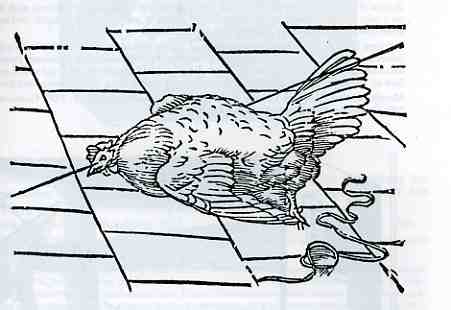
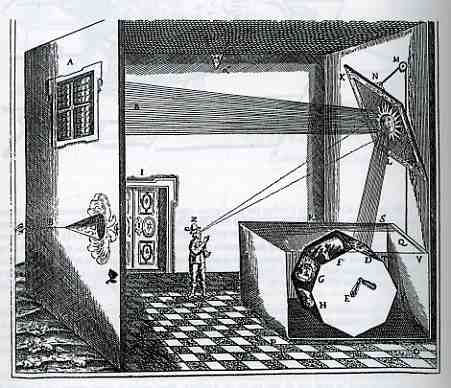
    0-blog---Nov 19 kircher chicken080This non-metaphorical, truth-be-told image is the responsibility of the irrepressible everyone’s-favorite-18th-century-Jesuit, Athanasius Kircher.  Fr. Kircher was extremely learned and had a superb memory and a great scientific bent; and for the stuff that he didn’t know or hadn’t read about or couldn’t prove by experimentation or produce by logical means, well, he just made the stuff up and pressed on.  But there is *so* much that he got correct and he published such a terrific amount of material that we’ll forgive these forays into The Twilight Zone  His detractors and critics  couldn’t keep up with the man; almost nobody could–the bit about the hypnotized chicken that appears in his incredible Physiologia Kircheriana Experimentalis...(Amsterdam, 1680, edited and compiled by Kircher’s pupil Johann Stephan Kestler), which is packed with so much diverse material that the chicken pretty much gets lost in the intellectual sauce.  Kircher’s reach was deep, formalizing bunches of natural science expositions by physical and mathematical experimentation and proof, not the least of which was proving the lunar influence on the tides and the construction of a magic lantern (below) .

    The hypno-chicken comes into the picture via Kircher’s interests in the magnetic art and electricity, dabbling away at the edges of science in a precursor to Mesmerism.  He also came up a little short with his experimental proof that insects were born of animal dung, but, as I said, he got much more right than he did wrong, and forgive him his rush to publication on some things that he may not have been happy with.

    0-blog---Nov 19 kircher movie081

    To press the point only slightly (the list and breadth of his accomplishments is just too much for this prankish little post about the chicken), have a look at the partial list of his publications:

    A partial list of Kircher’s works include:

        * 1631 Ars Magnesia
        * 1635 Primitiae gnomoniciae catroptricae
        * 1636 Prodromus coptus sive aegyptiacus
        * 1637 Specula Melitensis encyclica, hoc est syntagma novum instrumentorum physico- mathematicorum
        * 1641 Magnes sive de arte magnetica
        * 1643 Lingua aegyptiaca restituta
        * 1645–1646 Ars Magna Lucis et umbrae in mundo
        * 1650 Obeliscus Pamphilius
        * 1650 Musurgia universalis, sive ars magna consoni et dissoni
        * 1652–1655 Oedipus Aegyptiacus
        * 1654 Magnes sive (third, expanded edition)
        * 1656 Itinerarium extaticum s. opificium coeleste
        * 1657 Iter extaticum secundum, mundi subterranei prodromus
        * 1658 Scrutinium Physico-Medicum Contagiosae Luis, quae dicitur Pestis
        * 1660 Pantometrum Kircherianum … explicatum a G. Schotto
        * 1661 Diatribe de prodigiosis crucibus
        * 1663 Polygraphia, seu artificium linguarium quo cum omnibus mundi populis poterit quis respondere
        * 1664–1678 Mundus subterraneus, quo universae denique naturae divitiae
        * 1665 Historia Eustachio-Mariana
        * 1665 Arithmologia
        * 1666 Obelisci Aegyptiaci … interpretatio hieroglyphica
        * 1667 China Monumentis, qua sacris qua profanis
        * 1667 Magneticum naturae regnum sive disceptatio physiologica
        * 1668 Organum mathematicum
        * 1669 Principis Cristiani archetypon politicum
        * 1669 Latium
        * 1669 Ars magna sciendi sive combinatorica
        * 1673 Phonurgia nova, sive conjugium mechanico-physicum artis & natvrae paranympha phonosophia concinnatum
        * 1675 Arca Noe
        * 1676 Sphinx mystagoga
        * 1676 Obelisci Aegyptiaci
        * 1679 Musaeum Collegii Romani Societatis Jesu
        * 1679 Turris Babel, Sive Archontologia Qua Primo Priscorum post diluvium hominum vita, mores rerumque gestarum magnitudo, Secundo Turris fabrica civitatumque exstructio, confusio linguarum, & inde gentium transmigrationis, cum principalium inde enatorum idiomatum historia, multiplici eruditione describuntur & explicantur. Amsterdam, Jansson-Waesberge 1679.
        * 1679 Tariffa Kircheriana sive mensa Pathagorica expansa
        * 1680 Physiologia Kicheriana experimentalis

    ·Posted by :

    ·in:

    — — —
  • A Forensic FoundWordist Poet’s House of Page Numbers


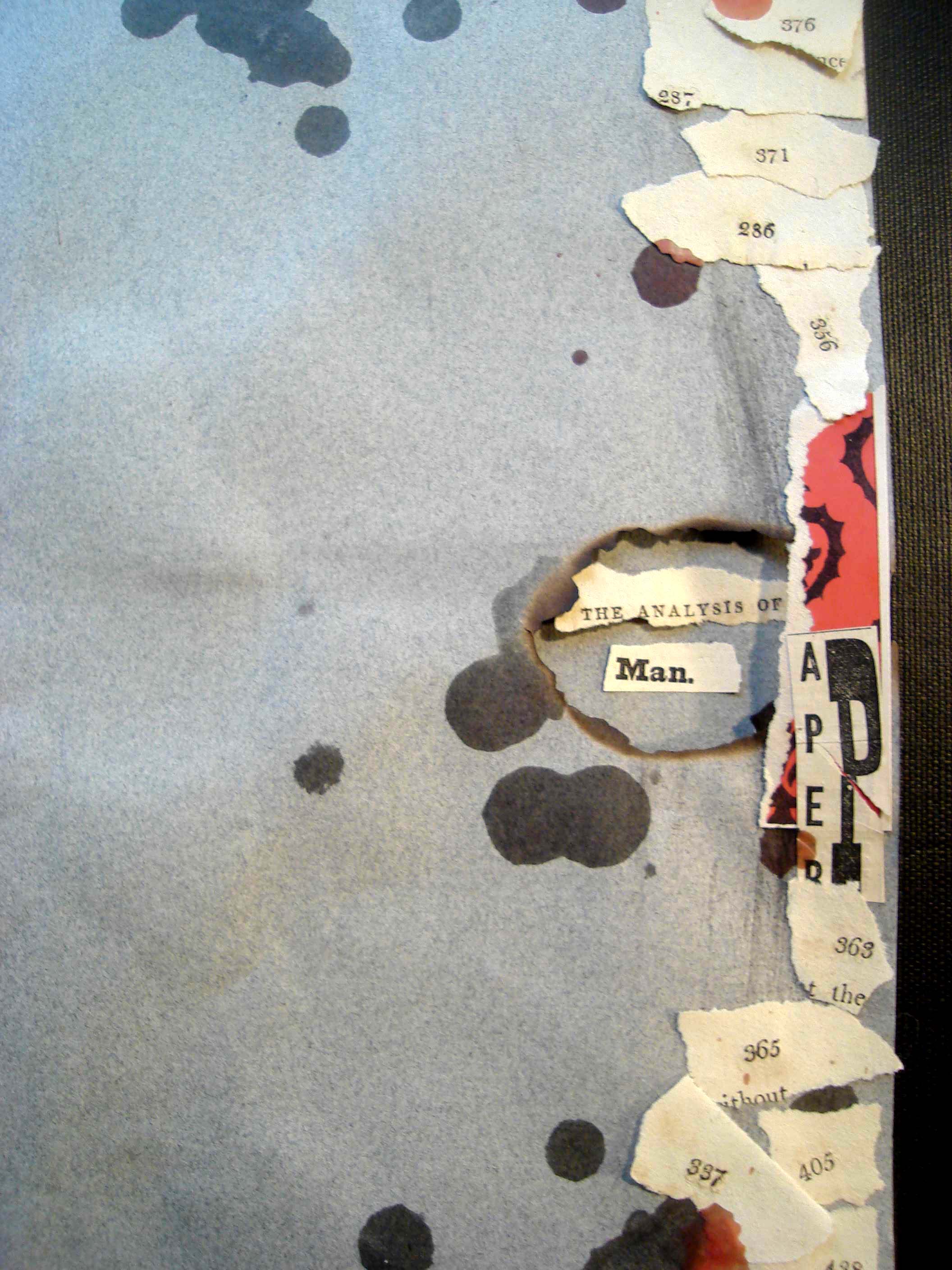
    We offer the following extract from a catalog of an obscure art gallery.  Our interest right now is drawn to Item 15 (below), on the found poetry of a man who derived that art from torn-off page numbers from books.  Enjoy!

    ___________________________________________________


    Wiltin & Wanton Gallery

    Archivist-Artists of Intellectual and Cultural Archaeology

    A Collection of Significant Materials and Artifacts in the History of Literature, Science and Intellectualiana

    The Catalogue of the Traveling Exhibit   June 2009 – January 2010

    Featuring the Following Installations


    • William Gaddis’ Martinis vs. the Slouchy Suburbanite
    • The United States in a Jar
    • The Real Pseudonym of America’s Most Famous Yellow-Backer Outlaw
    • The Sweny Chemist Door of Leopold Bloom
    • The St. Elizabeth Window of Ezra Pound
    • Virginia Woolf’s un-buoyant Friends
    • Thomas Wolfe’s Refrigerated Collectibles
    • Picasso’s Puzzle to Rimbaud
    • The Holy Pants of God
    • The Convict Letter Collection
    • Archive of the Great Shadow-Sickened and Pretended “Firsts Prioritizer”
    • Babe Ruth’s Post-Intellectual Hommage on Locating Lost Sound
    • The Stolen House
    • A Superb Broken Hanger Collection
    • The Great Shirt Diarist
    • Sigmund Freud’s Dream Book
    • Malevich’s Childhood Building Blocks
    • The End of Roundness in Van Gogh’s Eye
    • Bartleby’s Checker
    • Acoustic Museum of Childhood Sounds
    • Kurt Goedel’s Psychiatric Cheat-Sheet and the Formalization of Boredom’s Logic
    • The Transcripts of the Woman Who Spoke to People Only Once
    • Diary of the Man Who Forgot Nothing
    • Michel Foucault’s Word Engine
    • The Broken Correlation Poetry of Found-Wordist Hignatio Norme


    PAGE BREAK//Skip to pages 7-12 of the catalogue, items 14 and 15.


    Item 14.


    Warren Frieda Namaton, Shadow-Sickened Art Historian and Forger


    Obsessive Art Historian and Forger who altered Paintings to Suit his Theory and History

    On the first depictions of (a) shadows (b) stirrups © forks (d) reflected images


    Notices of  Namaton’s  (1930-1988) fame appeared in 1962 when he proved beyond a shadow of a doubt that he located the earliest depiction of a fork in western art (this in Ambo Boyz’ (Flemish, fl 1470-1520) “Mock Muscle Flag-in-Absentio”).  Namaton used a simple jeweler’s loop to discover what had already been apparent to the naked eye—that a fork was visible on the thigh of lazy gentleman in a protohammock.  This discovery fueled Namaton’s career.  In a career that rocketed through 12 suburban colleges in less than 15 years, Namaton went on to establish the vaunted “Firsts” priority in some 30 fields—a record in the art world until the recent troubles with authentication—including the recognition of the first depiction of broken spectacles,  faux agony, subtle grief, confused belief, bewilderment caused by pain and stupidity, and so on.


    His great recent work was on mirrors, reflected images, and, of course, his masterwork on the appearance of shadow and shadows. 

    Namaton’s fame fell when his estate was released from a cold-storage security locker in Alexandria,Virginia. The bulk of his notes, his collection of prints and many hundreds of small oil paintings were acquired by a resident bookseller who was struck by a bus and killed while removing the estate.  It was in the sale of the bookseller’s estate that the Namaton notes came to the attention of Quiver McQuimby, a noted but retired historian of art historians in the new mixed field of the Baroque Revitalizers of Pre-Deconstructionist Members of the Church of Jesus Christ of Latter Day Saints.  He was astonished to find many examples of famous works of art to which Namaton had playfully (?) added shadows.  (There are more than 2,322 works of shadow-adds in this category in the collection). 


    Item 15.


    Poetry from Found-Wordist and Book Pathologist Mr. Ignatio Norme


    Hignatio Norme, Found_Wordist and Page Number Collector (Boston, Mass.; 1923-1988)

    The man who found obscure phi-related connectivity between random word placement, page number and the poetic ideal.

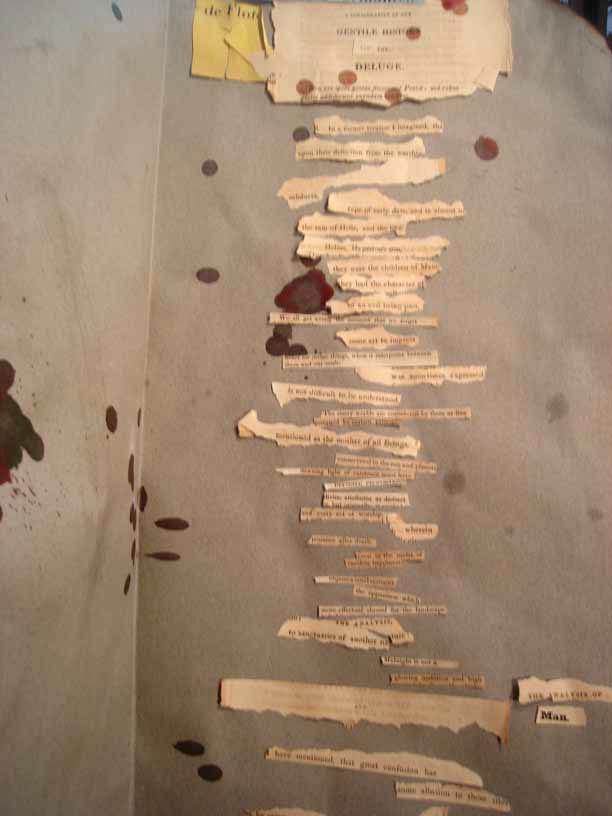
    0-blog-nov-20--norme-cvr


    Mr. Norme’s work first came to the attention of the literati in 1922 when Dallas Headman of Case Western described it as “a unique approach to creativity”; this would be the only phrase ever used to evaluate Norme’s efforts in every review from 1922 to 1975, when his work stopped being noticed.  In a spectacularly prolific career Mr. Norme produced some 8,000 poems, most of which were produced on broadside sheets of paper or large pieces of wood.  The combination of the materials of production and the many tens of  thousands of books led to Mr. Norme’s house being an internal castle, letting in neither visitor nor light, a friendly singularity for his pursuit.  As his utilities and taxes were paid decades in advance, Mr. Norme’s death, and the discovery of his corpse, was not discovered until 2005, seventeen years after his passing.


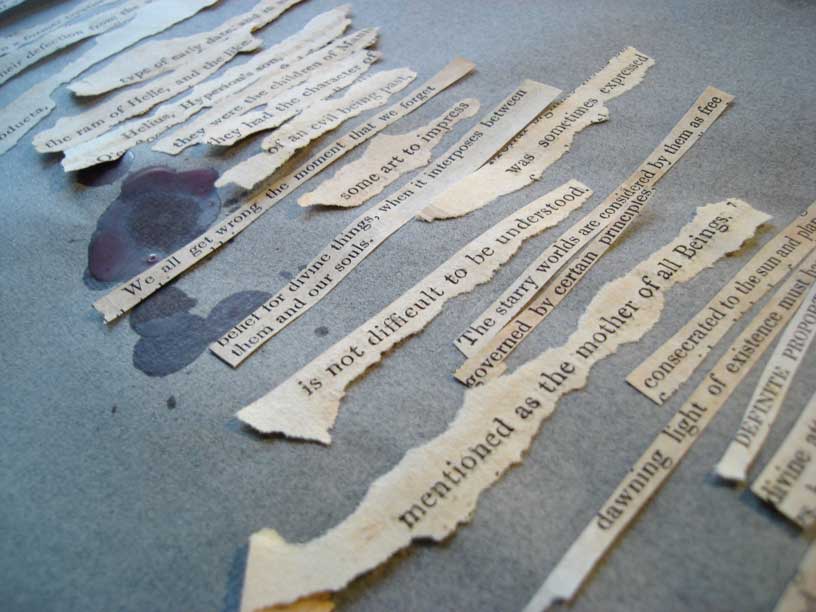
    According to his unpaginated journals, Mr. Norme’s pattern of poetic creativity and discovery involved removing all page numbers from the book he was reading and then choose a number of the “poem lugs” at random.  He would then reverse the number, go to that page of the book, and then add the page number and go to that line of the book, and tear out the number of words as indicated by the page numbers ending numeral.  The bits would then be assembled, and the page numbers glued to the walls of his house.  (We estimate that there were some 60 million page numbers glued to all surfaces of Mr. Morme’s home.  The house itself has been purchased by the
    Museum of American Art, a full room of which will be on display in that museum’s Outsider Art collection in the Henry Darger wing.)


    0-blog-nov-20-norme-full-pa

    Mr. Norme found poetry everywhere he found it, seeing in the simplest verb the most compound noun; even when the poetry seemed not to find an external logical sensate, the internal phi-correlated word relations played in the mind behind all phases of knowledge, an unheard neuro-music that encapsulated the idea of unknown “correctness” in the vision of the poem.


    We are proud to offer this example, “Primo VI, the Analysis of Man//Fantasie brillantes” from 1945. 


    The poem is transcribed below:


    0-blog-nov-20-norme-detail


    Primo VI, the Analysis of Man//Fantasies brillantes


    In a former treatise I imagined

     upon their reflection from worship

                                    Subducta

    be lost it might lie in oblivion.the ram of Helle, and the Life.

    *

    Helius, Hyperion’s sons

    were the children of Mania;

    they hjad the character of

    an evil being past.

    *

    We all get wrong the moments we forget

                    Some art to impress

    Belief for divine beings, when it interposes between them and our souls,

    was sometimes expressed

    and not difficult to be understood.

    *

    The story worlds are condemned by them as free

    governed by certain principles

    mentioned as the Mother of all beings

    consecrated to the sun and planets

    drawing light if existence, must have

    DEFINITE PROPORTIONS,

    *

    Divine attributes distinct

    At every act of worship

    Wherein

    Penance after death,

    Even in the midst of careless happiness

    Imposes a cruel restraint,

    The opposition which

    More effected , shroud for the landscapes;

    The analysis

    To sanctuaries of another nature.


    Midnight is not a Ambiguity,

    Glowing ambition and high.


    AND


    I have mentioned, that great confusion

    Has some allusion to those rites

    By some, were esteemed the offspring of

    Holy men.


    The analysis of a child;

    We may possibly discover their

    Means by saying

    Numberless absurdities arisen to the ruin of much good history. 


    —

    H. Norme, 1945.

    ·Posted by :

    ·in:

  • The Magnetic Sleep Doctor and the Shelf-Life of Dream Images

    JF Ptak Science Books LLC  Post 382

    0-blog---Nov 19 sleep082

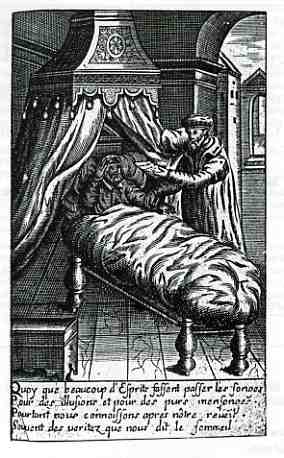
    This interesting and semi-bizarre image shows a doctor of magnetism (and necrologer and astrologer and several other things) conspiring at the edge of science and the heart of all things dark to adjust the dreams of the formerly sleeping man.  The patient is awakening and the doctor is doing, well, things that I don’t understand:  suffice to say that he was trying to assuage good dreams for the other man via the secrets of magnetism.

    The mysteries of sleep and the dreamworld were hotbeds of investigation from all sides, and there is a fairly deep publication record on the subject for the 1550-1700 period. This image comes from Le Palais du Prince du Sommeil, ou est enseignee l’Onriomancie autrement l’Art de Deviner par les Songes, printed in Lyon by Jean Pavhlhe in 1670, and written by the spectre-like M. Mirbel, whose history and biography are just about non-existent. 

    The idea of approaching sleep and dreams via magnetism is unusual even in the very unusual history of unusual ways of adjusting dreams–the interpretation of dreams is evidently closely related in mysterious and bendy ways, almost as convoluted and soft as the physical means used to induce them. 

    The history of big dreams and dreaming in general is far bigger than the issue of fixing them, and much paler, considering the vast range of imagery.  Jung (Memories, Dreams, Reflections), Havelock Ellis (World of Dreams), Freud (oy vey), Shakespeare (“we are such stuff…”), Leonardo, Joseph (and the Pharohs), William Blake, Solomon and of course Daniel, and then on and on into the night.

    Daniel’s
    dreams (as in The Book of Daniel) were gigantic and full, and there
    have been many others who have recorded their dreams in the history of
    literature and religion.  I must say though that the dream of King
    Prasenajit (the ruler of Kosala,  located on the northeast of modern
    Uttar Pradesh, India), a disciple of Buddha, had a dream in ten parts
    which troubled him greatly, and when you look at its elements you can
    see why:

    -Three jugs set in a row, one put against the other.
    The first and the last of the jugs are mutually exchanging the vapours
    of the liquids that are contained in them, vapours which never descend
    in the empty jug situated in the midst.
    -A horse that swallows the food concomitantly through the mouth and through the anus.
    -A tree full of flowers.
    -A tree full of fruits.
    -A man who is knitting a rope. Behind the man there is a sheep. The owner of the sheep eats the rope knitted by the first man.
    -A fox lying down on a bed made of gold, and eating out of golden vessels.
    -A cow suckling her own calf, against the law of nature.
    -Four
    oxen that arrive, bellowing, from the four corners of the horizon. They
    are rushing upon each other, in order to start fighting, but all of a
    sudden they vanish, right before clashing their horns together.
    -A pond surrounded by slopes. Its water is turbid in the offing, but clear near the shore.
    -A huge torrent, entirely red.

    This would give anyone pause, even more so if you were a disciple of the Buddha.  None of these images fit into my dream dictionary (especially the horse one), but perhaps they are deeply related to the times and not transferable over the centuries.  Which is an interesting way of looking at a particular time and understanding a bit of it that doesn’t normally sink into the public record–the expression of dreams might tell a little more about the time and place than about the person.  This sort of made-up historiographic (?) approach reminds me a little of snooping around old Domesday books and business/city directories, looking at the sorts of jobs that were common once upon a time and now slipped away into the tar pit.  So to with dream imagery?  Perhaps like just about everything else, dream images may well have a shelf life.  (I was going to reference Twinkies as an example contrary to this, but I understand that a new something-or-other has been added to it/them to make it so that these fine products will actually go bad after a while, rather than like before, when it could be counted on the cockroaches nibbling on them into eternity following the death of Dr. Strangelove.  Perhaps a former-chemist/librarian out there knows what this ingredient is and will share the knowledge?)

                                                                                             :

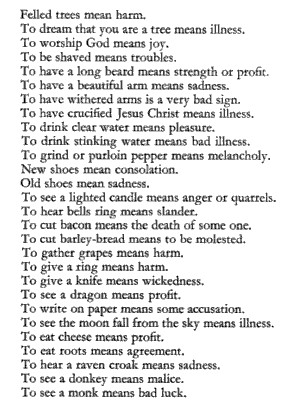
    Blog--magnetic dreamsFor example, this 18th century directory for what dream images may
    “mean” are mostly foreign to the general experience, I would say.  On the other hand, to attach meaning to the importance of dreaming about stealing pepper may be a little quixotic, but much less so than interpreting it as a harbinger f melancholy.  I know that to even mention the business of pepper theft in 1650 tells us a lot about its importance and why it would’ve been stealable and can tell us something about the foods of the time, trade, commodities and such.  Thinking about it in terms of a predictive element may not be as fruitful…

  • Getting Hurt in the Streets of Paris and London: Visual Display of Data that is Pretty than it Deserves to Be…1911

    JF Ptak Science Books LLC  Post 383

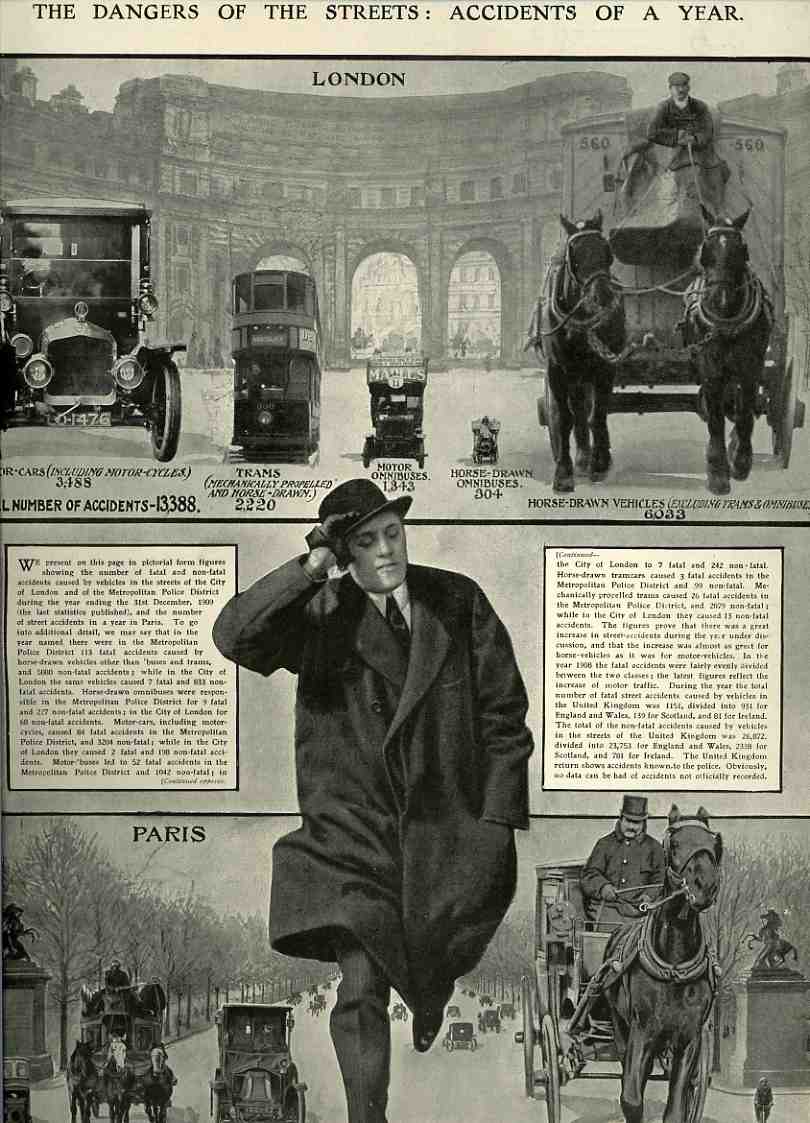
    Aside from looking allot like something that Max  Ernst could’ve produced (at about the same time), this graphic from The Illustrated London News for 11 March 1911 simply but powerfully portrays street accidents (for the year 1910) in london and Paris.  Beautiful and compelling, it is somewhat an empty gesutre, because as much as it describes the various types of accidents it fails to give us the total number of vehicles in use for each category; so, we can compare gross figures only, which is a little vacant.  We learn that the majority of accidents were caused by horse-drawn vehicles; in London, the number of “accidents” for this category was 6,033; for the same period the motor-car (“including motor-cycles”) was 3,488–we have no idea about how many of these were actually on the streets not involved in accidents, or the amount of usage, and the like.  My guess is that there must’ve been–still–many multiples of horse-drawns vs. cars.  So, if there were ten times the number of horse-drawns on the street, these figures would tell you how dangerous the cars actually were  (producing half the number of accidents with one-tenth the number of vehicles); also, the horse-drawns were probably logging more street-time per unit in general, so the “danger” aspect of the motorized vehicle grows further still.

    The other bothersome apples vs. oranges bit is the comparison of Paris and London; again, we don’t have the total number of vehicles, or the populations in general, or pedestrian populations in particular, or the area of the cities, or the miles of raoa, etc. etc.  We do see though that Paris had four times the number of accidents than London, though this seems a pretty meaningless stat.  Nevertheless, I still like the design quality of the set of images even if the statistical quality is weak.  What can I say?  It is pretty, and I like the running man…

    00-blog-Oct 27 Londons dangerous street936

  • Trenching Out in Downtown London

    JF Ptak Science Books LLC  Post 384

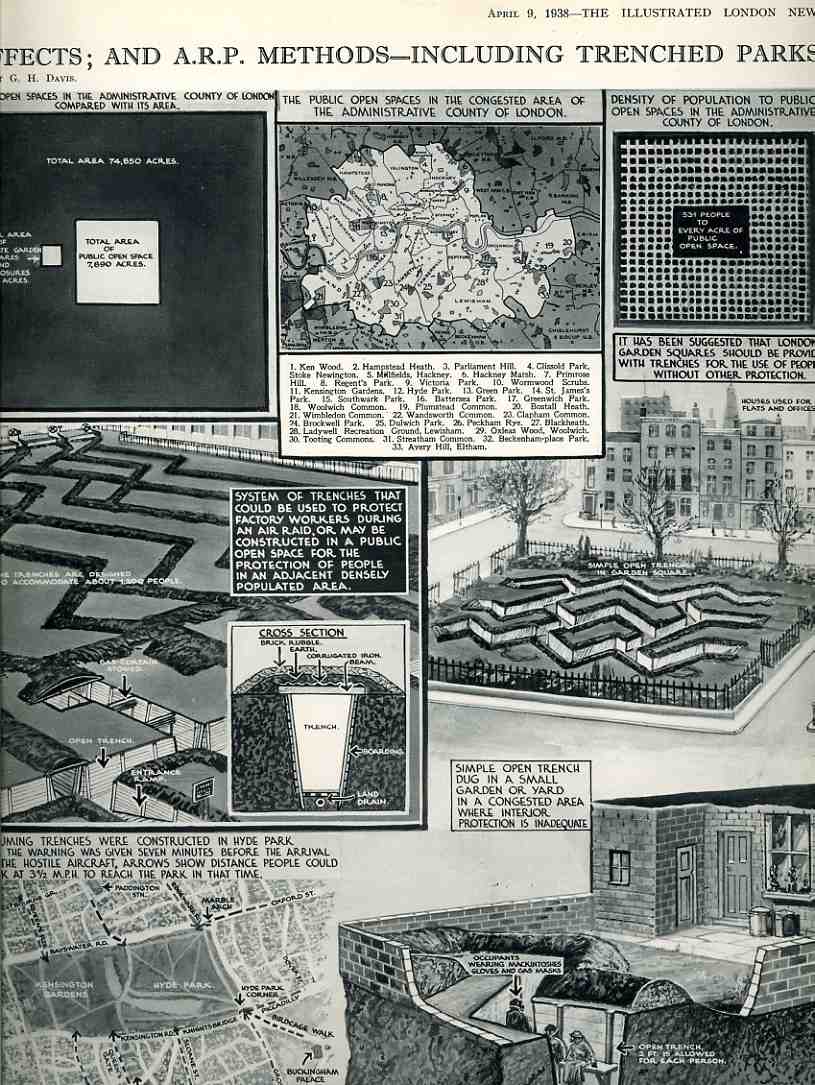
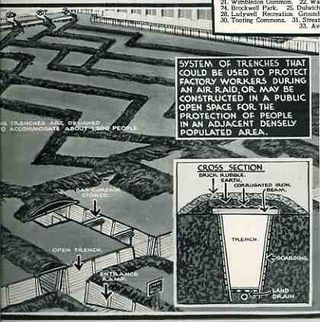
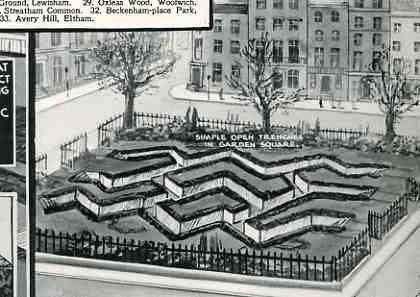
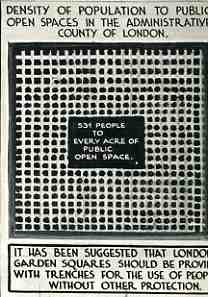
    This set of drawings displaying a plan for the protection of the people of London is simple, elegant and brilliant–accessible without speaking down to the readership, complimentary from one image to the next, cohesive, and pretty.  The series was put together for The Illustrated London News for 9 April 1938 in anticipation of bombing that was sure to come, the war clear and visible on the horizon.  (Hitler was in his fifth histrionic year in power,The Berlin Agreement that sacrificed the  Seudetanland to the Nazis would come in September, Hermann Goering calling the Czechs a “miserable pygmy race” who are “harassing the human race.” , Kristallnacht was not far behind.) So.  The wonderful G.H. Davies, the prolific graphic designer (for decades) at the ILN, produced this work, showing the available acreage for digging trenches in and around London.  There wasn’t much outdoor space, as he takes great pains to show, but there was enough to hide and protect tens of thousands of citizens for bombs that would come in 18 months.  Davies also points out the relevant parts of the protective structures–issues that could be found and understood by anyone should the average person decide to build a shelter for themselves.

    000-ebay--Nov 8 london trenches026


    000-ebay--Nov 8 london trenches027

    000-ebay--Nov 8 london trenches028

    000-ebay--Nov 8 london trenches029

  • Naive-Bizzare Book Title: Selecting Radio Stations Like Lining Up Pigs, 1931

    JF Ptak Science Books LLC  Post 385

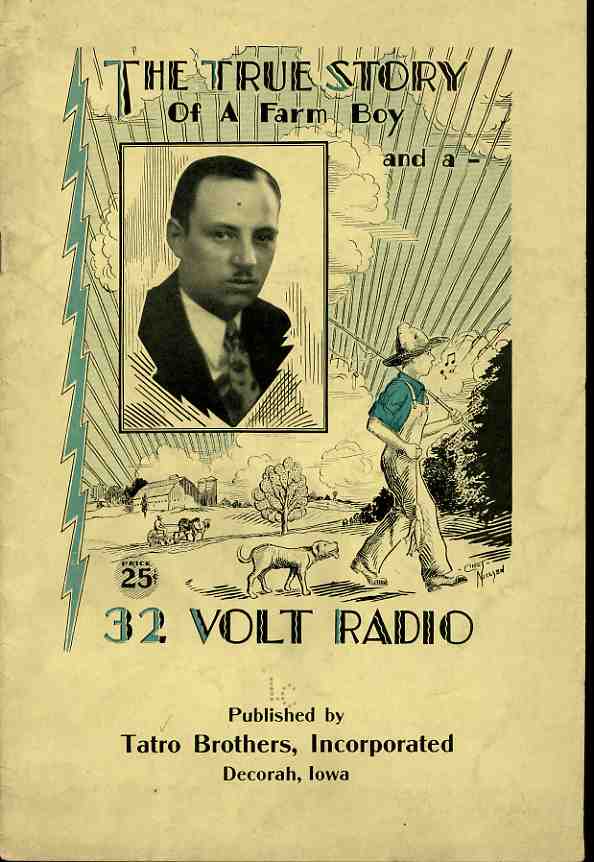
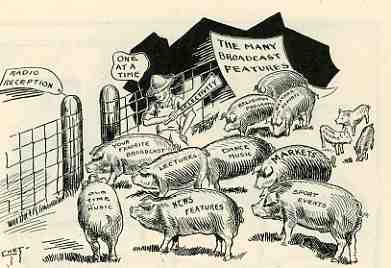
    0-blog---Nov 21 bizarre--radio091I am very attracted to the innocence and softly bizarre category of the Naive Surreal collection here, like this little pamphlet that came out of Decorah, Iowa in 1931.  The titles in this category are odd but still understandable, and the “what the ____!” response to the subtle ones isn’t quite so high and the exclamation points not so many as in the cases of the Naive Surreal titles. 

    This work was really just a sales vehicle for a radio sold by the Tatro Brothers’ store, although the pamphlet did have this wonderful cover going for it as well as some very unusual cartoon illustrations.  The cartoons related everything back to the farm community of the pamphlet’s origins–even the channel selector for the radio related the broadcast stations to pigs going through a gate. 

    0-blog---Nov 21 bizarre--radio092

    The other weird bit on this one is that it is from the Herbert Hoover collection, coming from the White House library in June 1931.  No doubt the author, J.A. Nelson, sent the President a copy of his effort, and the President(‘s staff) no doubt sent it directly to the Library of Congress. 

    ·Posted by :

    ·in:

    —

Recent Posts

Archives

Categories