A Daily History of Holes, Dots, Lines, Science, History, Math, Physics, Art, the Unintentional Absurd, Architecture, Maps, Data Visualization, Blank and Missing Things, and so on. |1.6 million words, 7500 images, 4.9 million hits| Press & appearances in The Times, Le Figaro, Mensa, The Economist, The Guardian, Discovery News, Slate, Le Monde, Sci American Blogs, Le Pont, and many other places… 5000+ total posts since 2008.

  • Is the Antiquarian God Left-Handed?

    JF Ptak Science Books LLC  Post 581      Blog Store Site

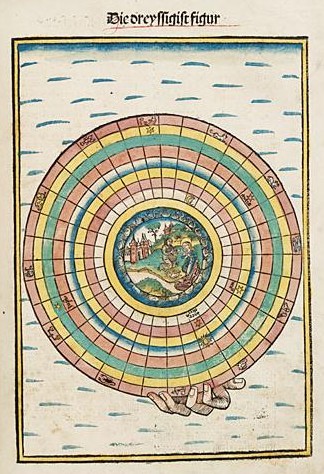
    Blog--fridopion This woodcut is the work of Michael Wohlgemut (1434 – 1519) for an illustration in Stephan Fridolin, Der Schatzbehalter oder Schrein der waren Reichtümer des Heils und ewger Seligheit, which was one of the 15th century’s most brilliantly illustrated books.  It was printed printed by Anton Koberger in Nürnberg in 1491, and formed the backdrop for his even more ambitious book of the next year, the Schedel Liber chronicarum (also known as the Nuremberg Chronicle).  Both books’ illustrations were by Wohgemut and Pleydenwurff atelier (a “school” in which Albrecht Durer had received some of his early training). 
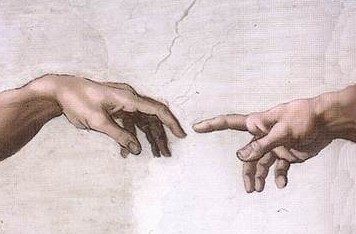
    Hands_of_God_and_Adam
    This center of this woodcut shows the birth of Jesus Christ, a scene circumscribed by numerous other layers representing the heavens and, ultimately, the universe with layer of the heavens  given a zodiacal symbol.  The whole is set in a sketchy blue “sky”, supported underneath by the hand of the creator.  The left hand.  Generally, at least in my memory, images of the creator’s hands have been the right hand.  I’m not so sure why this one is the left.  But it is, and, well, that is unusual.  I don’t know what it means, if anything. 

    LeftHand2

  • A Surprised Christ and Internal Dialog: St. Francis and Bartholomaeus of Pisa, 1510

    JF Ptak Science Books LLC Post 582
    Blog Bookstore

    Blog--christ surprised
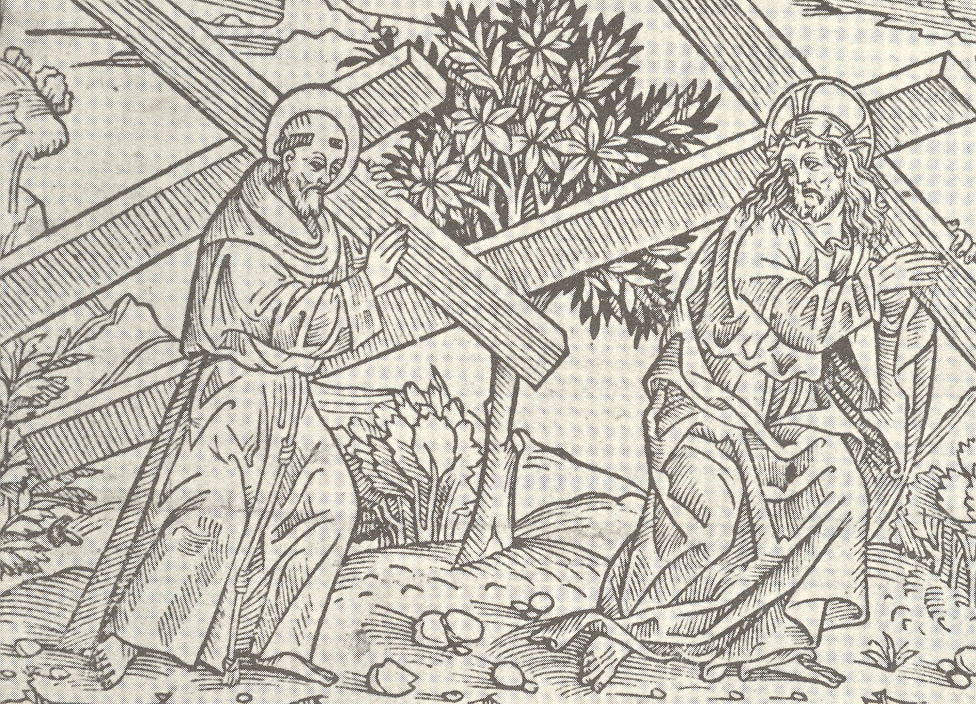
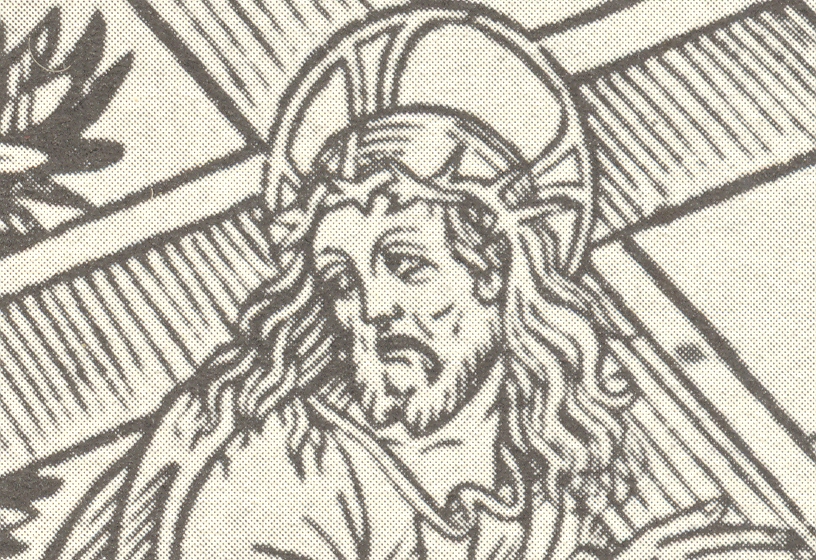
    In Portrait of the Artist as a Young Man, Joyce uses Ovid’s (Metamorphoses, VIII:188) epigram  Et ignotas animum dimittit in artes (“And he applies his mind to unknown arts”  and which continues “and changes the laws of nature”) to describe Daedalus.  It may well address the smaller world of interpretation and metamorphosis of images as it does the larger.  I found this image (at left) in an old bookseller catalog from 1980–it is pretty singular, a show-stopper in a way, the dual burdens of the agony, Christ and the other man.  Actually the woodcut is from the beautiful Liber conformitatium vitae Beati Francsici ad vitam Jesu Christi  (1510) by Bartholomaeus de Rinonichi of Pisa and depicts a scene from the life of  St. Francis of Assisi (1181-1226).  The bookseller notes the work as being very curious and lets it go at about that. On the one hand the work may just well be the massive correspondence on the similarities between the beloved St. Francis and Jesus Christ that it seems to be.  When I look though at the images I can’t help seeing an anti-St. Francis twist to it all. One thing I think that is inescapable is the quizzical look on Christ’s face–he is definitely not sharing the agony, or welcoming a helper. He is clearly at wonder–which in itself is wonderful, as I cannot think of another image showing Christ “surprised”.  It would seem to be a not-subtle attack on the Franciscans in general, an effort to rid it of an exalted place by depicting Francis’ multitudes of too-close similarities to Christ, attacking the order much like the attack on the cults of Mary a thousand years earlier.  I really don’t know–I’m terrifically beyond my element here–I’m just pointing out some surprisingly bothersome aspects of some of the illustrations.  
    Blog--christ surprised 2
    Then again, I’m sure I’m wrong about this “surprised” bit, as this book was a standard for the Order for many years–I just don’t understand the pictures and the interior dialogs that they implied.  I turned to Joyce–perhaps the great master of the internal dialog–to see what I might find there, and then to Hugh Kenner, a revered Joycean interpreter.  And what I found in Kenner commenting on the internal dialog was this:

    “…the Portrait is important not only as an independent work of art but also as a demonstration that the intricate analogical simultaneities of Ulysses and Finnegans Wake are not irresponsibly excogitated from esoteric reading, but grow out of Joyce’s persistent contemplation of intense psychological experience”

    I might as well be working my way through Derrida on Joyce, though without the great suffering.  Could you make that sentence any more difficult by using the same number of words (and without creating poststructuralist vocabulary)? Probably not. His insight might be as obscured as mine.

  • “Emerging” as a Verb: a Note on Patterns in Science and Art

    JF Ptak  Science Books LLC  Post 583
    Blog Bookstore

    And all that appears confusedly on walls is very like the vibration of bells:
    you can hear in their ringing all the sounds or words you want to imagine.”
    – Leonardo da Vinci 1492

    Finding recurring events, schemes and objects, finding predictability, finding a pattern, making a pattern emerge seems to be what we do here on earth.  After all, the stuff that we use to organize our existence into transferable bits of knowledge–points and lines and symbols that stand for sounds which stand for other things which constistute language–don’t exist, but they do tell us pretty much everything we need to know about our environments, real and imagined.

    Blog--emerge

    Stars are (as my daughter Emma pointed out when she was four) “messy” until imaginary lines are drawn between them; the relationship of the elements are mysterious until a (a) they were “discovered” and (b) table of relationships was figured for them.  Mathematics, the queen of the sciences, is nothing but making patterns emerge.  Art* and aesthetics developed over millennia to arrive at things like paint and the golden ratio [(a+b)/a=a/b] and perspective, making images and other representations emerge from the chosen media.  Patterns emerge from massive, seemingly too-complex entities:   even the weather’s patterns emerge (to within a particular range). (Better yet, with weather, it is extraordinary to see how small variations of the initial condition of this sort of dynamical system can produce large, long term variations. Have a look at one of the greatest works on the circulation of the atmosphere at my blog store.)

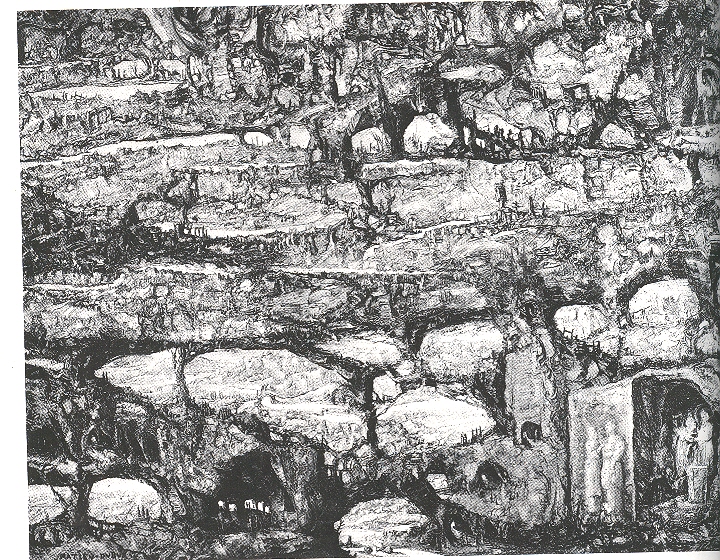
    In a slightly odd and definitely beautiful book by Jurgis Baltrusaitis, Aberrations, an Essay on the Legend of Forms (MIT 1989) I found a fantastic illustration of the work of Mathieu Dubus (1590-1665/5). Dubus evidently was a pre-modern modernist, and painter of fantastic landscapes, though (apparently) very few have survived the years.  He was an outsider to the great Golden Era of Dutch art of the 17th century, probably a little too far afield for most tastes, though his associate and contemporary, Hercules Seegers (Seeghers), another experimentalist-as-artist, found far more afield, at least so far as royal patrons were concerned.  (Segers was also collected somewhat by Rembrandt, who owned at least one of his paintings.  In his own bit of “emerging”, Rembrandt actually purchased one of the metal plates from which a Seegers print was made, and reworked it, making it his own,  publishing prints from the “combined” effort.)  It is also interesting to note that if Dubus was included in the Big Books on Dutch art of this era, he would fall between the beautiful Gerard Dou (small, exquisite, dark, very layered) and Jakob Duck (who had a very Dickensian taste for street/common/low life).

    The Dubus work, The Destruction of Sodom and Gomorrha.,  is exceptional, and odd–I still don’t understand if the image was actually painted on an old and decaying wall, or if was painted on agate that looked like a decaying wall, or if was painted on canvas and made to look like the above.  No matter–the effect is that the artist used the “natural” occurrence of breaks and segments to make his picture of the great destruction from Genesis emerge from the seemingly “found” surface. It is a remarkable image, and I’m fairly well certain that the 17th century wasn’t ready for it.

    It is remarkable that humans have sought for thousands of years to make representations of their environment and ideas more clear; and it wasn’t until the second decade of the twentieth century that artists sought the “reverse”, until, finally, a person wasn’t able to tell what a painting was “of” unless told so.  (Jackson Pollock told the story many times of seeing his work exhibited upside down.) 

    *”Art is the imposing of a pattern on experience, and our aesthetic enjoyment is recognition of the pattern.” is what Alfred North Whitehead (1861-1944, English philosopher and mathematician) said, sucking the very life out of the discovery part of the whole experience. 

  • A Short Homage to the Alphanetical Past of Union-Made American Brooms

    JF Ptak Science Books LLC  Post 584
    Blog Bookstore

    I was breezing through what seems to be an innocuous forgotten document:  the 1941 Union Label Catalogue-Directory. It lists the union labels of trades who were part of the American Federation of Labor (AFL), a 32-page pamphlet advising its readers on how to hunt for union-made goods, and to get the union-earned dollar spent with other unions. Even though only 68 years old, the list of unions seems far more antiquarian, the unions and the jobs/workers they protected seemingly from another, earlier time: the Allied Printing Trades, Cigar Makers, Clerks Protective Association, Glove Workers, Hatters, Horse Shoers, Meat Cutters, Pocketbook Workers, Novelty Workers, Sheep Shearers, Stereotypers, Telegraphers, Wall Paper craftsman, and on and on.   

    But it was the broom and whisk makers union label that really struck me. There is something beautiful and sad in this design–the design is lovely as is the idea of the workers who were probably protected by the union; what is instantly saddening is the recognition of the incongruity that such a trade was widespread enough to need protection and organization, and how far gone such industries are. Really gone.  Blog--broom

    Looking through the names on the list of union shops of broom and whisk makers suggests elements for a poem on vanished brooms.  There is of course the Ace Broom Company, and the Acme, and, yes, the American Broom Company; followed by the Amor, Artzcraftz, Baria, Bard, Birminham, Best, Brown, Buckholtz, Burlington, Coleman, Continental, Eagle, Galesburg, Haferman and Hanset, Ideal, Imperial, Lighthouse, Mid-West, Montana, M & M, Mutual, National, Progress, Progressive, Rainbow, Reliable, Rich, Royal, Western, Terre Haute and Zenith.  The “R’s” have the field, hands down. 

    The pamphlet ably describes the design and its color, and where the label appeared on the product.  In the case of the brooms and whisks, it also assured the purchaser that the product was not made by “contract prison labor”.  (I have a prison-manufactured catalog from Angola Prison here that I’ll have to write about some day–published in 1937, it was glossy and thick, offering hundreds (?!) of items for the office and home, but mostly heartpine and heavy oak goods for white collar consumption.  The scale of the operation is pretty surprising to me.)

    I like the whole idea of the handshake, the square deal, the care in the construction of the broom.  I just looks right.  And as you well know a good broom is a thing of beauty–it will do its just correctly and last forever. 
  • Bad Resurrections: 19th Century Cadaver Trade in New England

    JF Ptak Science Books LLC  Post 585       Blog Bookstore

    History of Missing Things Part XXXVII

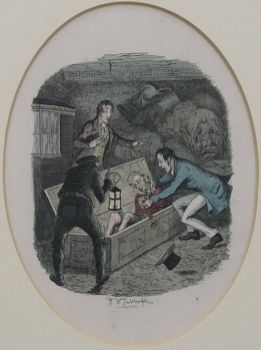
    Grave rob For some, “anatomy is
    destiny”, but not in the way the reach-y Sigmund Freud meant–their
    anatomy quite literally was their destiny, their bodies resurrected (in the bad
    way) from their coffins by chin hooks and sent to the local med school for
    quick and dirty study.  This night-time
    version of ice fishing for cadavers was addressed in a sniffily conceited but
    informative book by A.M. Lassek, Human Dissection:  Its Drama and Struggle (1958).  Lassek, professor of anatomy at Boston University ,
    presides over all aspects of the history of anatomy, but I somehow found my way
    instantly to the cadaver-catching mechanical operations end of it: specifically
    the work of American specimen providers in
    in the early part of the 19th century. 

    Listen:  if I found my way back in time in the Boston area in 1835 and
    was the night jobber and bad-‘un for the local apothecaries hunting down the
    lonesome freshly dead, I think–with praise to Lassek–that I’d be
    able/equipped to do the job.  I hadn’t
    really thought very deeply about the supply of cadervous specimen for the
    thriving medical schools before, but there are many considerations to the
    proper way of stealing a body. (And by “proper” I mean “not
    being caught doing it”.) First of all, there was a serious spike in the
    creation of medical schools, the number of recognized institutions in America
    increasing from seven in 1810 to 33 in 1840 (and 90 in 1870), with a huge new
    population of data-thirsty students to go along with it.  Human anatomy was an exceptionally difficult
    subject to demonstrate with actual specimens (due to moral and legal
    restraints), so the med schools (including the Harvards) had to resort to
    creative solutions:  the bodies had to be
    “found”. And finding bodies had more to do with stealing them than
    arranging for the corpse of a condemned criminal to be purchased from the
    sheriff. 

    The local townsfolk and neighbors of
    medical schools knew this all too well. 
    There were a number of precautions that the bereaved could undertake to
    prevent the resurrection of their departeds. 
    One simple way was to have a guard at the grave all night long–that
    would certainly cause some pain and consideration for the grave robber, though
    it has been the case where the guards were plied with money and alcohol to
    effect a soft gaze on the grave.  Since
    the newly interred laid under six feet or so of newly churned earth, there was some
    amount of extra stuff that was thrown into the pit.  Stones, and rocks and tree limbs were added
    to the hole to make a tougher and noisier go for the robbers; also, wide heavy
    planks were placed width-wise across the coffin and then covered so that the
    robbers would have to dig much wider in order to pull up the boards before
    getting to the coffin.  Another fantastic
    bit that I had never thought of but which falls into the category of branding
    cut lumber for the ride down the river: 
    intricate designs were placed on top of the grave with sticks and stone
    and such so that the family members would be able to detect a defiled
    grave site.  All of this attention would be
    heaped on the grave site for ten days or so–after that the body was deemed too
    far deteriorated as to he of any use to the medical school.

    “Detect?”  Yes, indeed. The grave robber needed to be
    stealthy, leaving no indication of the dark and stinking deed.  Working in very low or no light, the robbers
    would find their mark and lay at least two tarpaulins on the ground. they would
    collect all of the dirt in these catch-alls so as to not excite any attention
    that the grave had been disturbed.  They
    would dig a 3×4 foot hole towards the head of the casket, and, once reaching
    their prize, would drill holes (quietly!) into the wood, break it, and then
    attach a hook under the chin of the corpse and yank it out.  Placed on another tarp, the body would be
    stripped of all clothing, and then wrapped securely to prevent anything
    incriminating falling from it during the trip across town.  Once received by the medical school, the
    hair, teeth and other distinguishing characteristics would be removed to
    prevent detection and identification.  I
    imagine that the skin of the face would also have been peeled away, skillfully
    removed with one cut and a careful pull. 
    All of this was precautionary, in case the relatives of the now-specimen
    suspected foul play and came looking for their beloved.  It would be a corpse among other
    corpses.  Or not. Lassek writes that the
    bodies would be hidden, secreted in different and obscure places around the
    campus, in “domes, belfries and observatories”.  Observatories?  Well! 
    I’m not so sure about that aspect of Lassek’s report on grave robbing,
    but I was pretty impressed with his knowledge on the other aspects of the
    business. 

    I am
    indebted to Dr. Lassek for the image of the grave-marking anti-theft
    artwork.  I may have fabricate a grubby
    1837 cemetery keeper’s chapbook with drawings of their designs and make an
    entry for it in my imaginary museum catalog for
    things-that-don’t-exist-but-should.
     

  • Fish-Eye Views, Part II: Escher’s Tetrahedral Planetoid

    J.F. Ptak Science Books LLC  Post 586    Blog Bookstore 

    Planetoid Late
    last month I wrote a short post about an antiquarian fish-eye view of the city
    of Vienna(1529). (“I’ve paid some attention to antique images that look straight down at
    things (Looking
    Straight-on At Things
      and  Looking 
    Straight-Down on Things
    ) and I can say that they are in general pretty
    uncommon–this is the first time though that I’ve noticed a fish-eye
    view looking straight down, an image conveying a 360-degree horizon-to-horizon
    landscape.”)  I’ve not found another
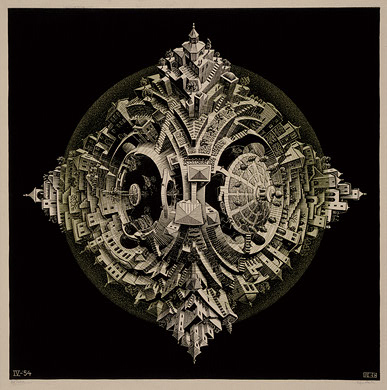
    antique view like this, but I did just come across this magnificent work by
    M.C. Escher  (1989-1972) called
    Tetrahedral* Planetoid, produced in 1954 and now living at D.C.’s National
    Gallery. 

    The
    view of the planetoid is quite complete, as we can see individual houses and even
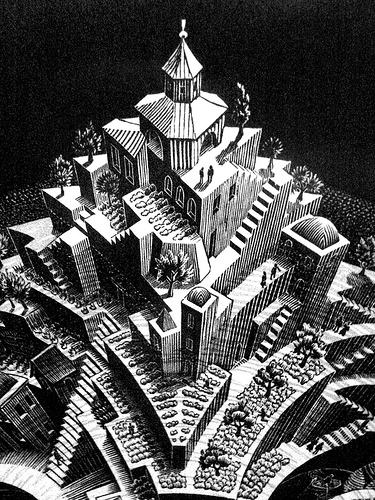
    some people  What I find particularly
    amazing, apart from the design of course, is that this meticulous ideal was an engraving
    done on wood.  It is a glorious accomplishment,
    and a joyful optical shock to the system.  .

    Escher planetoid

     
    *A tetrahedron (plural: tetrahedra) is a polyhedron
    composed of four triangular faces, three of which meet at each vertex.

  • The Measured Intelligence of the Letter “C”

    JF Ptak Science Books LLC    Blog Bookstore

    Dots I’m sure that by now everyone has seen those “are you
    smarter than____ (Barack Obama, 130 I.Q.)” pop ups seen on some news
    sites.  (I doubt that President Obama’s
    IQ would be that limited; his predecessor, well, let’s not comment on that.)  Giving in, and dumping twenty-five minutes
    that I’ll never get back, I took the test. 
    Three times.  The first time I
    filled in all the answers as “A”; the second time, “B”, and the third, “C”.  It turns out that the IQ for A was 80 and for
    B, also 80.  C, however, came in at
    90.  C seems to be the smartest of all of
    the first three letters of the alphabet.

    And what of lonely “D”?   I could not but forebear to press on with my life, leaving it an alpha-intelligent mystery. 

    Did I mention that I’ll never get those twenty-five
    minutes back?

    ·Posted by :

    ·in:

  • Unfinished, Blank and Empty: Durer, Gaudi, Schubert, Mozart, West, Stuart

    JF Ptak Science Books LLC  Post 588       Blog Bookstore

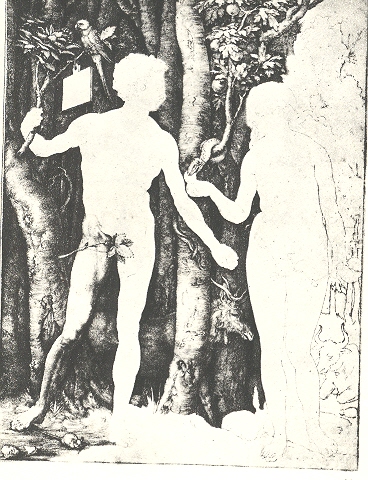
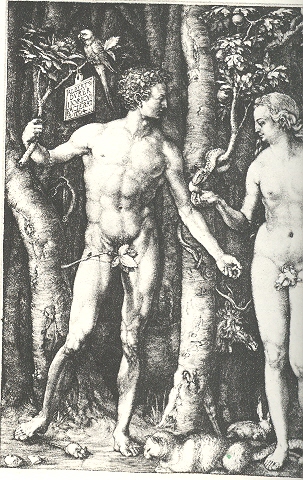
    Unfinished in some ways is part of something that is not there, part of the missing, the blank, the empty.  One aspect of this calling to emptiness is seen in this semi-completed, semi-empty trial proof version of Albrecht Durer’s intaglio Adam and Eve (1504) , the finished and full state of which is seen below.  The unfinished bit is easier to see but hard to find, sometimes.  Leonardo comes to mind several times:  the magnificent Sforza equestrian statue and St. Jerome Praying in the Wilderness come to mind, as with his Study for the Adoration of the Magi.  Gilbert Stuart’s ultra-famous mostly-finished portrait of George Washington wound up in thousands of schoolrooms across the United States as well as—cropped—one the one dollar bill. Nearly-as-famous Benjamin West left unfinished another icon of revolutionary American history, the American Peace conference, half of the historical figures faded unfinished into history.

    There are some things that are unfinished but really aren’t so:  say, for example the not-endable Ulysses, complete and incomplete in its circularity.  Mozart’s Requiem, a piece of music that helped drive the poor man to his death, was unfinished though completed by another hand.  Blog--blank durer 001

    There are unfinished examples of architecture bounding into the urban landscape, fantastic examples of extraordinary things.  The great Schloss Neuschwanstein, the empty and unfinished dream of the “mad” and mysteriously murdered King Ludwig of Bavaria, is certainly one.  This building ironically seems for me more compelling, filled far more than Uncle Walt’s doppelganger in Orlando.  The greatest structure of the Drippingly Baroque is another unfinished masterpiece, the work of Gaudi in Barcelona, the Sagarda Familia.  Started in the 19th century and stopped with Gaudi’s death in 1926, the Sagarda’s forest of towers was only 15% complete—the city is still at work on it, with 40% more to go.  

    We could look at these images while listening to audio examples of the unfinished:  the tidied-up requiem of Mozart, Schubert’s unfinished 8th Symphony, and Mahler’s unfinished 10th  come to mind.

    There are spectacular monuments to unfinished business: American Federal treaties with Native Americans (almost all of which were signed, documented and not enforced; empty, blank, broken); the assurances to the millions still waiting for some verifiable change in the townships of South Africa; promises of decent wages and health coverage for the marginalized “partners” of oblivious behemoth  monsterstores. [I can think of one major player whose corporate name spelled backwards relates to railroading the law, driving that point home to employees, suppliers and patrons.  “Tram Law.”] A history of unfinished business would be massive, and then, once you got to the end, all you’d be doing would be driving a Ford Pinto off the end of an unfinished bridge.
    Some things that looked sort-of finished are later revealed to be not so:  Einstein’s Unfinished Symphony of relativity (titled so in Listening to the Sounds of Space-Time  by Marcia Bartusiak) is one. Mathematics—all of mathematics—also comes to mind, the great edifice nearly “completed” by Hilbert until one of his famous questions got answered by Goedel, and then all became unfinished again.  One day everything seemed filled-up; the next, well, it wasn’t.

  • When Bad Ideas Were “Good”: Just Say “No” to Fighting Fascists, 1938

    JF Ptak Science Books LLC  Post 589    Blog Bookstore

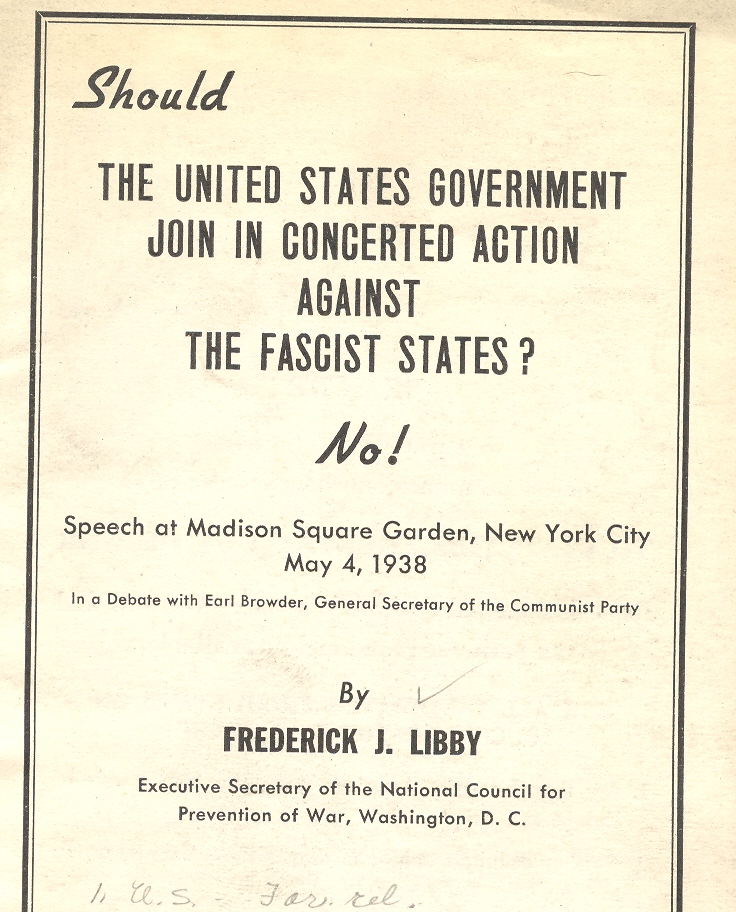
    Blog--fascist Sometimes the screaming done in pamphlet titles like this example are odd and outrageous and entertainingly naive and are often taken out of context.  This one isn’t.  It isn’t odd and it isn’t entertaining and it isn’t naive (at least in the outsider sense).  It is the effort of Frederick J. Libby (1874-1970) to convince Americans that it was against their morality and their best interest to engage in any war to stop fascist aggression in Europe or Japan.  The world was well on its way to total war–Japan had already been savaging China for five years at this point and Europe was sinking into the Styx.  (Just two months before Libby’s May 4th speech Hitler “annexed” Austria and in April had signed a pact with Franco. In the short months following the speech Hitler would mobilize the German army, sign the Munich agreement with the failed Chamberlain, occupy the Sudetenland, and initiate Krystal Nacht.)  The speech was given at Madison Square Garden, which in another years would see have an audience of 20,000 supporting the German American Bund, one of the limp pro-Nazi organizations which sought an anxious fifth-column foothold in the U.S.) 

    The biographical bits I’ve found on Libby support him as a a decent pacifist.  His National Council for Prevention of War–which hosted his speech at the Garden–was evidently his great achievement, though his subject matter was not.  Now it isn’t as though there was a spearhead movement to get the suffering U.S. involved in European activities in 1938–and remember it took 27 months  after the invasion of Poland to get the U.S. into WWII, and that took a massive attack by a non-European entity.  So Libby’s “No!” was really playing to the strengths of the majority.  The U.S. was still in the grip of the Depression–and had just suffered another fresh setback in that year–so there wasn’t much public concerted support for stopping the very visible spread of Fascism around the world.  So as eyebrow-raising as his immodest title might seem, it did reflect the answer that most people in the U.S would have given to that question in the spring of 1938.

    ·Posted by :

    ·in:

    —
  • “Enemy Aliens” and the Invisible Japanese, 1941

    JF Ptak Science Books LLC   Post 590    Blog Bookstore
    Blog--laguardia
    The Little Flower was publicly coming to grips with “enemy aliens” in this small pamphlet, published in the last days of December 1941.  Laguardia–a Republican Congressman defeated for re-election in the Roosevelt landslide of 1932 and elected Mayor of NYC in 1933–was an outspoken critic of the Nazis and Hitler from his first day in Gracie Mansion.  In addition to being the first Italian-American elected to the U.S. Congress, Laguardia was also Jewish, and was a superb and constant speaker* against the monster in Germany. 

    In this pamphlet Laguardia outlined the legal implications of war and the non-citizen  German or Italian immigrant, and possibilities and consequences of their being declared enemy aliens, resulting in “arrest” and detainment.  (This applied to all “…natives, citizens, denizens or subjects…” of any foreign
    nation or government with which the United States is at war, and who could be “…
    liable to be apprehended, restrained, secured and removed as alien
    enemies….”.)  Attorney General Francis M. Biddle cited Department of Justice figures: “Of the 1,100,000 (sic) enemy aliens in the United States, 92,000 were Japanese, 315,000 were German, and 695,000 were Italian. In all, 2,972 had been arrested and held, mostly Japanese and Germans. Only 231 Italians had been arrested**”  (by 1943).  By the end of the war, there were fewer than 3,000 Germans and Italians who had been impounded (the Italians being released by October 1943 following Italy’s surrender). 

    There were upwards of 100,000 Japanese-Americans impounded, half of whom were American citizens.  For some reason there was not a single mention of the Japanese population in this pamphlet. 

    *In 1933, the year of Hitler’s major seating, Laguardia said: “Part of [Hitler’s] program is the complete
    annihilation of the Jews in Germany”, an uncommon and of course prescient point of view.

    **This authority was based on Executive Order 9066 (issued February 19, 1942) and Executive Order 9102 (issued March 18, 1942). These orders authorized the “removal from designated areas of persons whose removal is necessary in the interests of national security”.

    ·Posted by :

    ·in:

    —
  • The Dot and the Sphere—the Depiction of Multiple Dimensions

    JF Ptak Scinece Books LLC  Post 591       Blog Bookstore

    The
    History of Dots, Part 10
    .

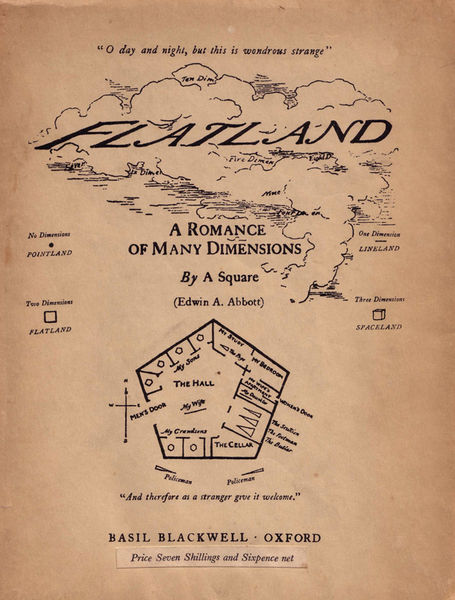
    Edwin
    Abbott’s slender Flatland is perhaps one of the best books ever written on
    perception and dimensions, a beautifully insightful book that was quick and
    sharp, and in spite of all that was also a best-seller.  Written in 1884 when Abbott was 46 (Abbott
    would live another 46 years and enjoy the book’s popular reception), it introduces
    the reader to a two dimensional world with a social structure in which the more
    sides of your object equals power and esteem. 
    Thus the lowest class would be a triangle (three sides) while the
    highest (priestly) class would be mega-polygons whose shape would approach a
    circle.  Abbott’s magistry comes in
    explaining to the three-dimensional reader what it was like to be in a
    two-dimensional world.Flatland_cover

    And
    to this world one day came an epochal event.

    It
    was a dot.  The dot was a magnificent new
    thing to the 2-D world, and what happened was this—it grew concentrically and
    outwardly, expanding and then contracting in a series of circles, morphing
    until it appeared as an entirely new and revolutionary form rising from the
    plane of Flatland.   It became a sphere.

    The
    sphere was from Spaceland and amazed the population of Flatland (Lineland,
    actually); the story was (and the book’s title page saying it was written by) a
    Square, whose deep interest was immediately enhanced by its great imagination.  It turns out that once every millennium the
    good folks of Spaceland visit Flatland to return one its  inhabitants home to try and introduce them,
    educate them, to the idea of added dimensions. 
    Safely in Spaceland,   the Square was presented with the radical
    newness of the third dimension, it engaged the Sphere about the possibilities
    of yet higher (fourth, fifth and sixth) dimensions.  The Sphere was not altogether please—talk of
    higher dimensions in the3-D world was outlawed just as the discussion of the
    3-D world was in Flatland.  Pissed, the
    Sphere returns the Square home to its land of lines. 

    The
    Square finds it very difficult to be home again. (Did I ever mention here that
    my house is about a thousand feet away from Thomas Wolfe’s grave?) It finds it
    a very tough go to convince anyone of its journey and the existence of another
    dimension.  To complicate things further,
    Abbott has the Square dream a remarkable thing—a visit to Pointland, a totally
    self-involved dimension consisting of one ruler, a Point, which exists across
    all area and things.  Even Square’s
    introduction of an idea or question comes to the Ruler of Pointland as an idea
    from its own head, because nothing and no one else exists.  Fantastic!

    Eventually,
    things go badly for the Square—the edict is described making it illegal for any
    further discussion of the third dimension, with dire consequences on a sliding
    scale according to class./caste/sides, with death the penalty for the
    Triangle.  The Square itself winds up in
    prison, an unhappy being locked “in” a cell and prohibited in its mind. 

    Jouffret

    But
    Abbott is certainly successful in relating the possibilities of
    higher-dimension thought by introducing the view from a higher- to a
    lower-dimension.  Still, it’s a tough
    go. 

    19
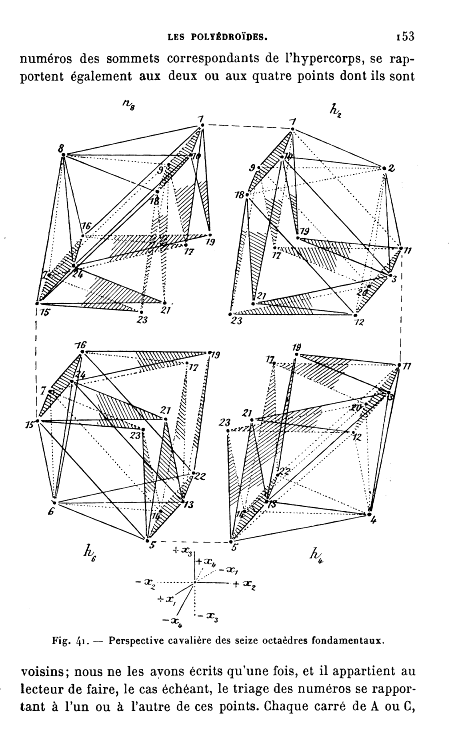
    years later dots came to further assistance to a mathematician and military man
    named Esprit Pascal Jouffret*, who wrote a remarkable and beautiful geometry
    book on picturing the fourth

    dimension. 
    Actually, the book was more an example of how to discus the representation
    of the fourth dimension on a piece of paper, and didn’t’ offer a comprehensive  treatise on the matter.  But the images of depicting space and time
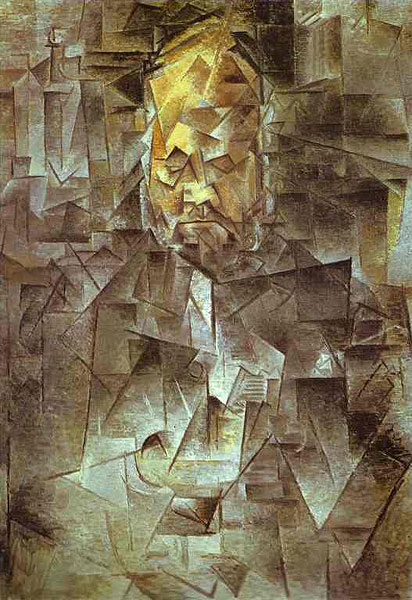
    would look extraordinarily familiar in just a decade in the paintings of the
    Cubists.  For example, the morally-lonely
    Picasso’s 1910 portrait of the movement-molding art dealer Ambroise Vollard looks
    very much like many of the images in the Jouffret book.  Marcel Duchamp—for me the true

    Picasso_vollard1910


    hero of early
    modernism—also drew on the work of Jouffret, and made no secrets about the path
    of his intellectual foundation (unlike the squirrely Picasso). 

    And
    so from the lowly dot comes a beauty unsuspected in soliphismy Pointland. 


Recent Posts

Archives

Categories