A Daily History of Holes, Dots, Lines, Science, History, Math, Physics, Art, the Unintentional Absurd, Architecture, Maps, Data Visualization, Blank and Missing Things, and so on. |1.6 million words, 7500 images, 4.9 million hits| Press & appearances in The Times, Le Figaro, Mensa, The Economist, The Guardian, Discovery News, Slate, Le Monde, Sci American Blogs, Le Pont, and many other places… 5000+ total posts since 2008.

  • Hiding Diseases: Plague and Smallpox

    JF Ptak Science Books LLC Post 936

    “Ring
    around the rosies, a pocket full of posies,

    Ashes,
    ashes, well all fall down.”

    This
    old nursery rhyme has more to do with plague than a skipping-and-falling song, more
    like the Tom Wait’s version of the “Dwarf’s Marching Song” (“Heigh Ho”, see
    below) than anything t0 blog jan 24ars mor424hat could ever be dreampt of in a Disney film. It was the
    mater-of-fact way of dealing with the vast death brought on by the various
    Plagues:  saying a round of rosaries to
    try and invoke divine intervention to keep the disease away from the prayer-mender;
    posies as a fragrant flower to mask the stench of those actually afflicted with
    the disease; and then of course the ashes from the piles of burnt corpses of
    Plague victims, fallen down to death. 

    These
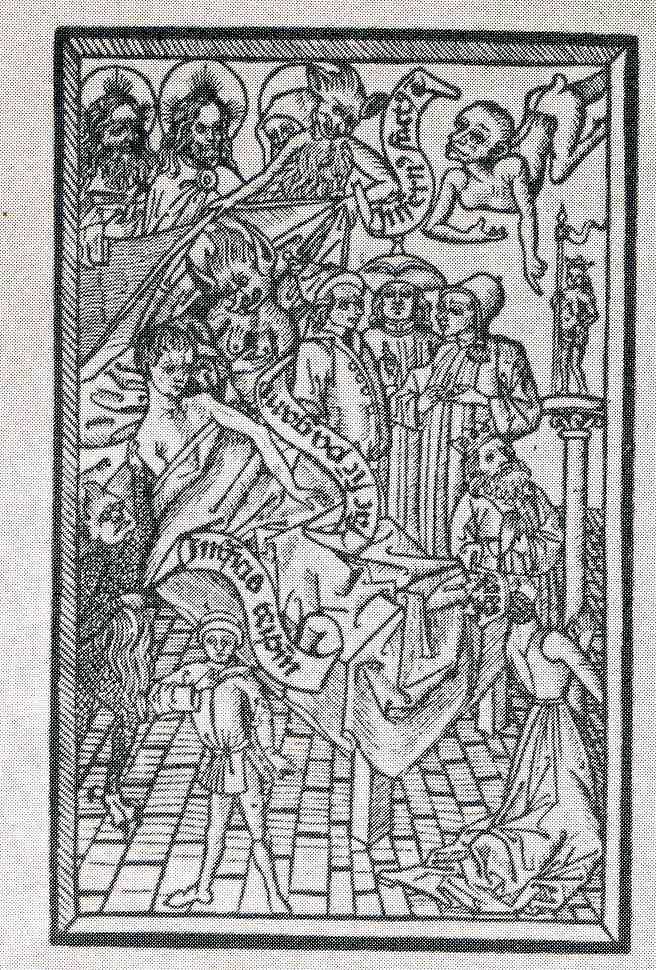
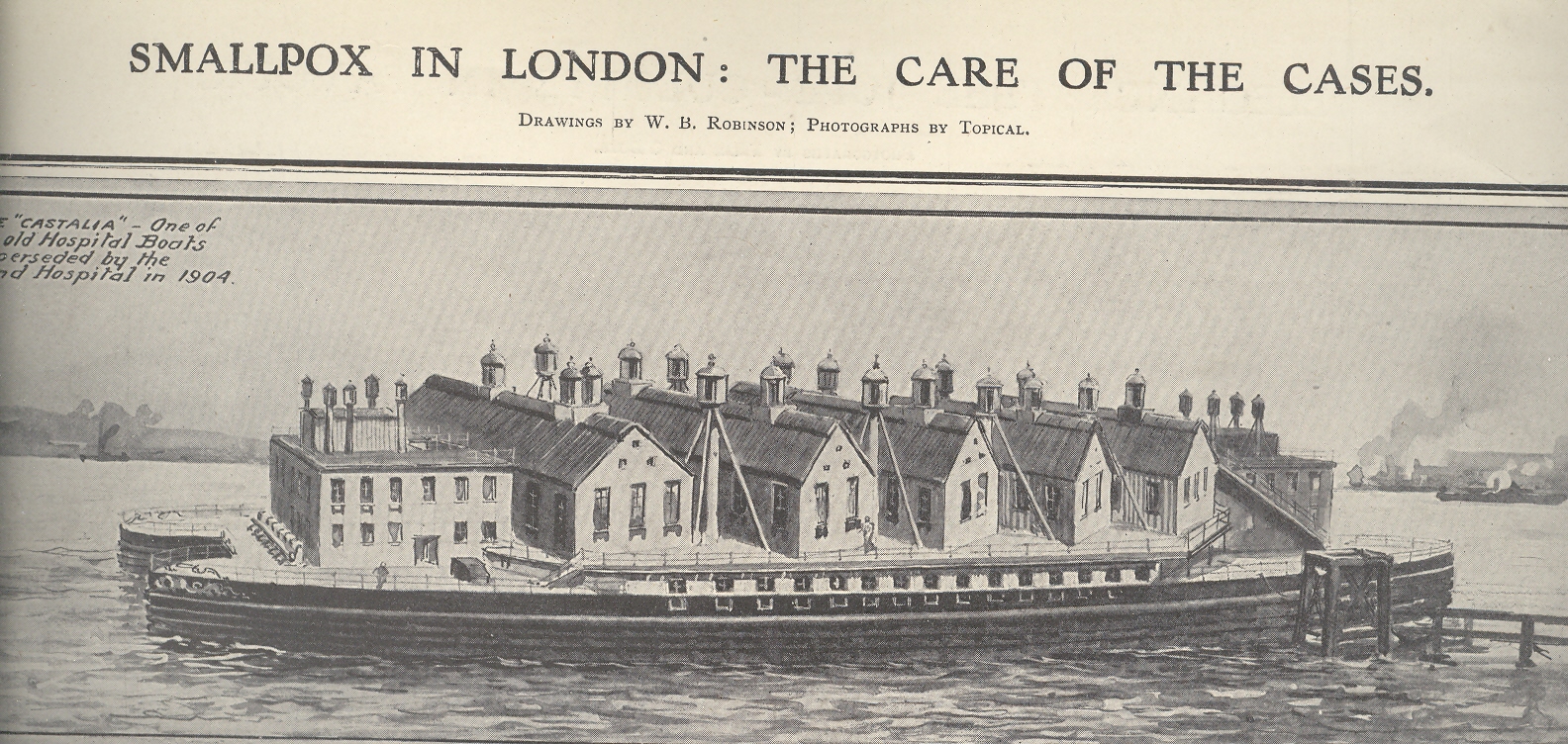
    two images show different aspects of segregating—if not hiding—disease.  The first is a propagandistic portrayal of a
    man dying of the Plague.  This snippet of
    plaguaganda was an ars morendi
    published in the 1460’s, and depicts a not-gruesome portrayal of what was
    generally a very gruesome death.  The
    inflicted lies there in bed, with sheets
    and
    a pillow, looking faint and removed in the retiring Victorian fashion
    (removed 400 years), surrounded by images of his faith/belief. 

    I
    suspect that anyone who knew anything about the Plague knew that this scene
    wouldn’t be truthful, necessarily, but I guess if it could even momentarily confuse
    the viewer into thinking that the visitation of Death could be so composed in
    the face of this horrendous disease, I guess that’s the hope you hang
    onto.  There is a minor battle between
    the possible claimants of the soul of The Sick, but that would be going on
    anyway whether the coming death was relatively peaceful, or not. There wasn’t
    much to be done—as the feeble attempts of preventing the disease would
    indicate, what with choices like urine baths, bleeding, leeching, bell ringing,
    pus-sucking, rotten animal corpse talismans, incense burning being some of the
    preventative choices—so like a belief in Heaven or Nirvana or whatever, the hopeful
    consolation of a possibly decent dying could keep people from running
    amok. 
    1-floating hosp

    The
    second shows the hospital hulk Castalia, “one of the old Hospital Boats superseded
    by land hospitals in 1904”, which was more a floating street than a hospital.  It was a complex of five buildings nested on the
    hulk of the double-hulled paddle steamer Castalia—appropriately named, as it refers
    to the Delphian  fountain that Apollo fabricated
    from the nymph “Castalia” and alludes to the possibility of rejuvenation and
    cleanliness, or health, perhaps).  The
    hospital held hundreds of smallpox patients, sent there by the Metropolitan
    Asylum Board in an effort to stem the flow of the disease and infection rates
    from the rest of the population of London.  Smallpox 
    was still a vast killer in mid-/late-Victorian England, and given the information
    available at the time this was a good social inoculation by distance and
    segregation.  (It is interesting to note
    that out-of-service de-masted, defrocked and striped ships of the line were
    used to house prisoners (though generally prisoners of war); in particular,
    those kept in the East River housing American soldiers inflicted vast death
    tolls via maltreatment and urgently hideous living conditions.)  This really doesn’t fit with the
    propagandist/suppressing model of the above, and its removal did prevent the
    contagion from spreading, but, well, it does look like the Asylum Board was trying to hide the sick.

    Notes:

  • Blank and Missing Things: German Submarine Importance in Graphical Comparison, 1912.

    JF Ptak Science Books  Post 937

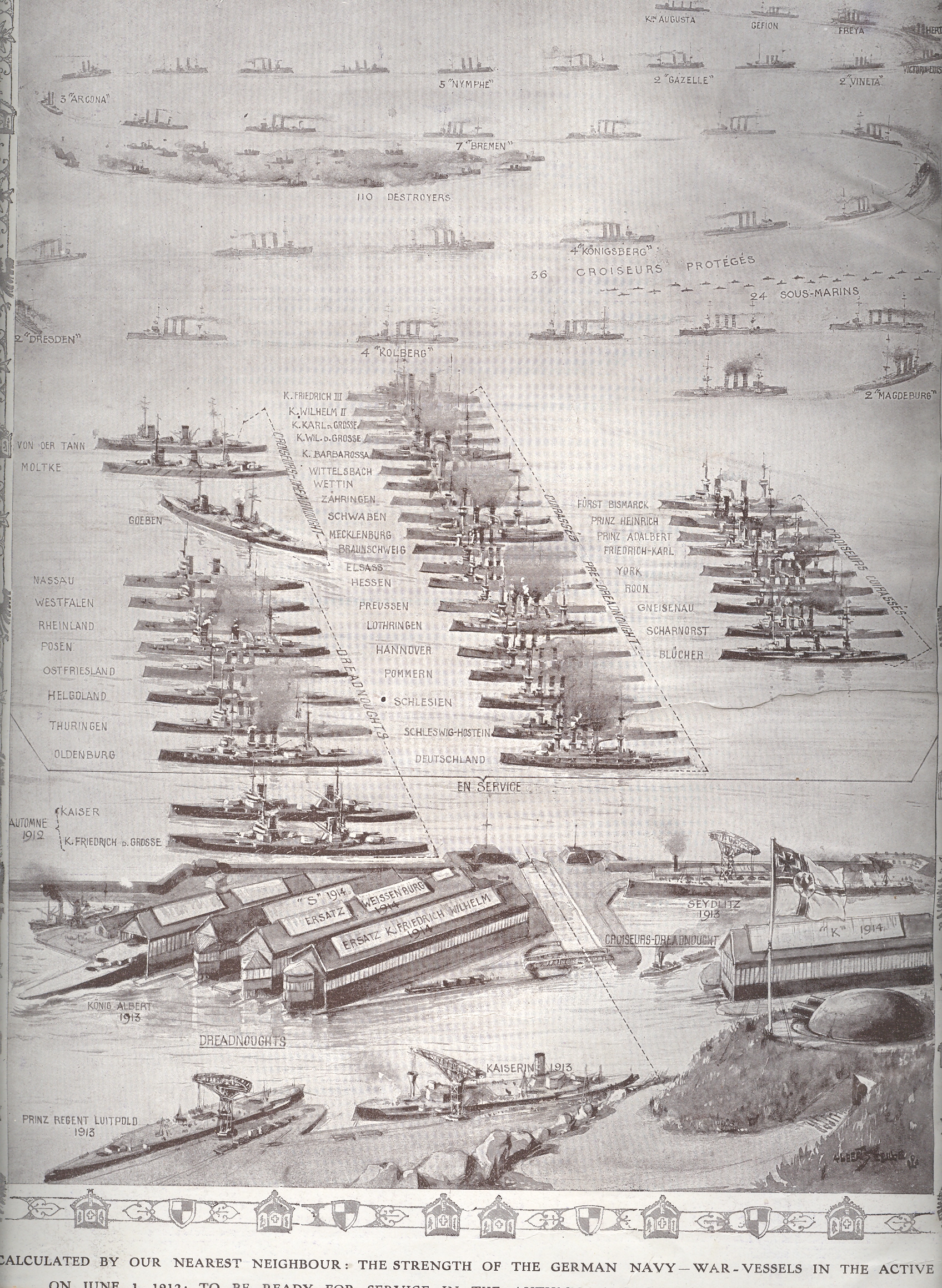
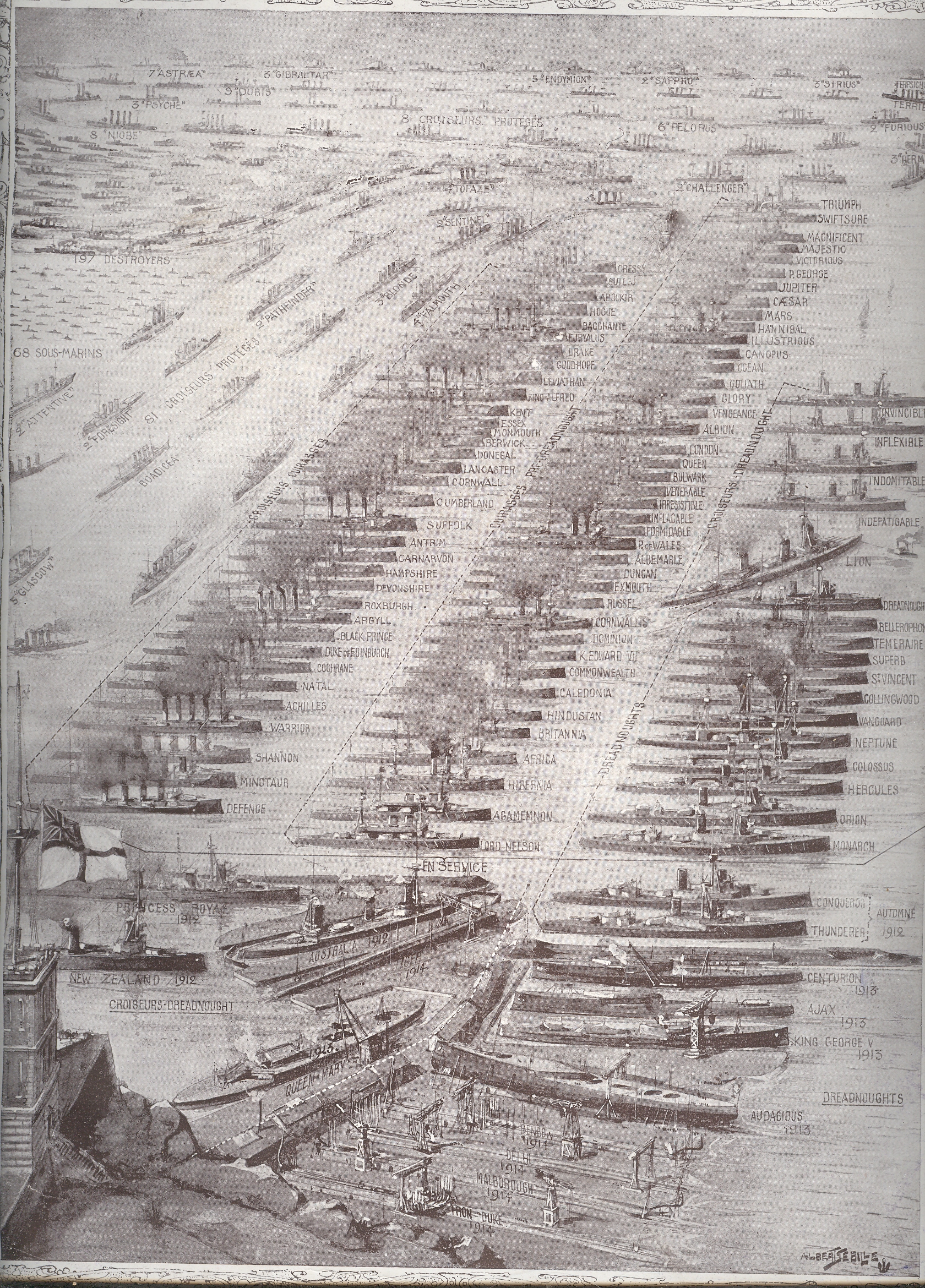
    In the midst of a massive building campaign by Germany and a building-response by England the French journal L’Illustration published these two side-by-side pictorial comparisons of their two navies, which wound up being reprinted in the Illustrated London News soon afterwards in June 1912.  [Royal Navy, left; German Navy right]

    2--brit navy big 2--brit navy germany


    2--brit navy big

    Germany began a rebuilding campaign in 1902 which by 1908/9 was seen by the British Admiralty as a “stab at the heart” of England’s military supremacy, and so the construction wars were undertaken.  It’s a complicated period and a complex race, which I just can’t get into in a short post, so let’s just say that the Brits wound up the winners of the competition  when these images were printed in June 1912.  

    The hidden element of some great importance, a trump card that would  played in just 750 days, would be the small dot-like drawings  labeled “sous marins”. These would be the submarines, and it would be the subs that would be perhaps the most significant aspect of the entire German navy.

    2--brit navy germany

    This was true in spite of what looks like an overwhelming preponderance of subs in favor of the Royal; Navy, where the count was 68 to Germany’s 24.  It was really a question the type of sub, and as it turns out there were only 8 or 9 of the English count that could’ve been considered for blue water ops.

    Germany began the war with 24 submarines in 1914; they recognized the ship’s importance and by war’s end ramped up production, winding up with 351 in total production and with 178 in action in 1918 alone. Of that overall number fully half (178) had been destroyed in combat, with another 11% sunk via other means.  There were more than 12 million tons of Allied shipping destroyed by the German sub forces from 1914-1918 (half of that in 1917). 

    So these two illustrations do portray an overwhelming Royal Navy, but they certainly do not give any hit whatsoever to the coming importance of the German submarine fleet.


  • Heart, Head, Heresy and Burning at the Stake: a Cordial Memory of Michael Servetus on St. Valentine’s Day

    JF Ptak Science Books LLC  Post 938

    Harold,
    like the rest of us, had many impressions which saved him the trouble of
    distinct ideas 
    George Eliot.

    A novel is balanced between a few true impressions and
    the multitude of false ones that make up most of what we call life.

    Saul Bellow


    No, this isn’t a story about the great saint but a much
    lesser one.  For centuries the pulse was
    a vaguely understood thing reaching back into the murky medical past as far
    back as Galen.  The association of course
    was with the heart, and the association of the heart was as the great
    controlling center of all function and control of the human body—a theory that reached
    far forward into the 16th century. 

    It is generally established that it was the fabulous work of
    William Harvey (1578-1657) that brought into light the idea of pulmonary circulation,
    but the idea was buried in a vastly-suppressed work by the brilliant and highly
    problematic Michael Servetus (Spanish, 1511-1553).Servetus

    Servetus (physician, cartographer, theologian, writer and
    general all-adept Humanist of a high order) was in trouble with the church for
    many reasons, not the least of which was trying to dislodge the theory of the
    heart as sacred and the seat of wisdom. 
    But he did establish that the heart was an organ, which didn’t sit well
    with very many people, least of all the Calvinist court in Vienna
    which found him guilty on many anti-Humanist grounds, including his
    anti-Trinitarian Christology, which made him a reviled figure to Catholics and
    Protestants.  He was tried and found to
    be dangerously heretical, and sent to the flames.  (There was a practice at the time to burn
    people alive using wet wood, providing a slow, baking environment in which the
    subject was painfully nearly-baked alive before he/she was actually consumed by
    the flames.  People thought about this….In the engraved portrait of Servetus we see him being burned–along with his books, which are slow burning things, at upper right.  As a matter of fact Servetus’ effigy was burned in some places along with his books, which explains the scarcity of some.)

    Later on, Harvey
    withstood blistering attacks on his correct statements on the circulation of
    the blood (costing him nearly all the patients in his practice), though he at least
    lived to see a brighter day:  Servetus, on the other hand, didn’t, and was
    burned at the stake for his heresies, one of which his attack on the spiritual
    heart. (Plenty of others have paid for their insight and invention and would be
    later celebrated  Semmelweis wasn’t killed but did wind up in an asylum;
    Galileo didn’t wind up in an asylum but did wind up imprisoned; Copernicus
    wound up in neither place, escaping possible clerical criticisms by dying just
    as his revolutionary work was published.  Phillippe Lebon’s ideas for
    illumination by gas were seen as ridiculous, as were the revolutionary ideas of
    Edward Jenner and Luigi Galvani.  Einstein’s 1905 ideas weren’t happily
    received in France
    for a decade, and David Hilbert’s impressions of mathematics in the middle of
    the third decade of the 20th century was that it was “done”. )

    And so I think we might as well remember Servetus today at
    least as often as we do St. Valentine. Or multiple St. Valentine units—the name
    seems to have been canonized in 496 ACE in memory of several people by this
    name.  At least Servetus had an
    association with the heart in a positive way—I don’t know the Valentine/heart
    connection though I suspect that at least one of them had their beating heart
    ripped from their body. 

    Well.  Happy Valentine’s
    Day.

  • The Healthy Coal Miner in the Pyramid of Life, or Death? 1912

    JF Ptak Science Books  Post 939

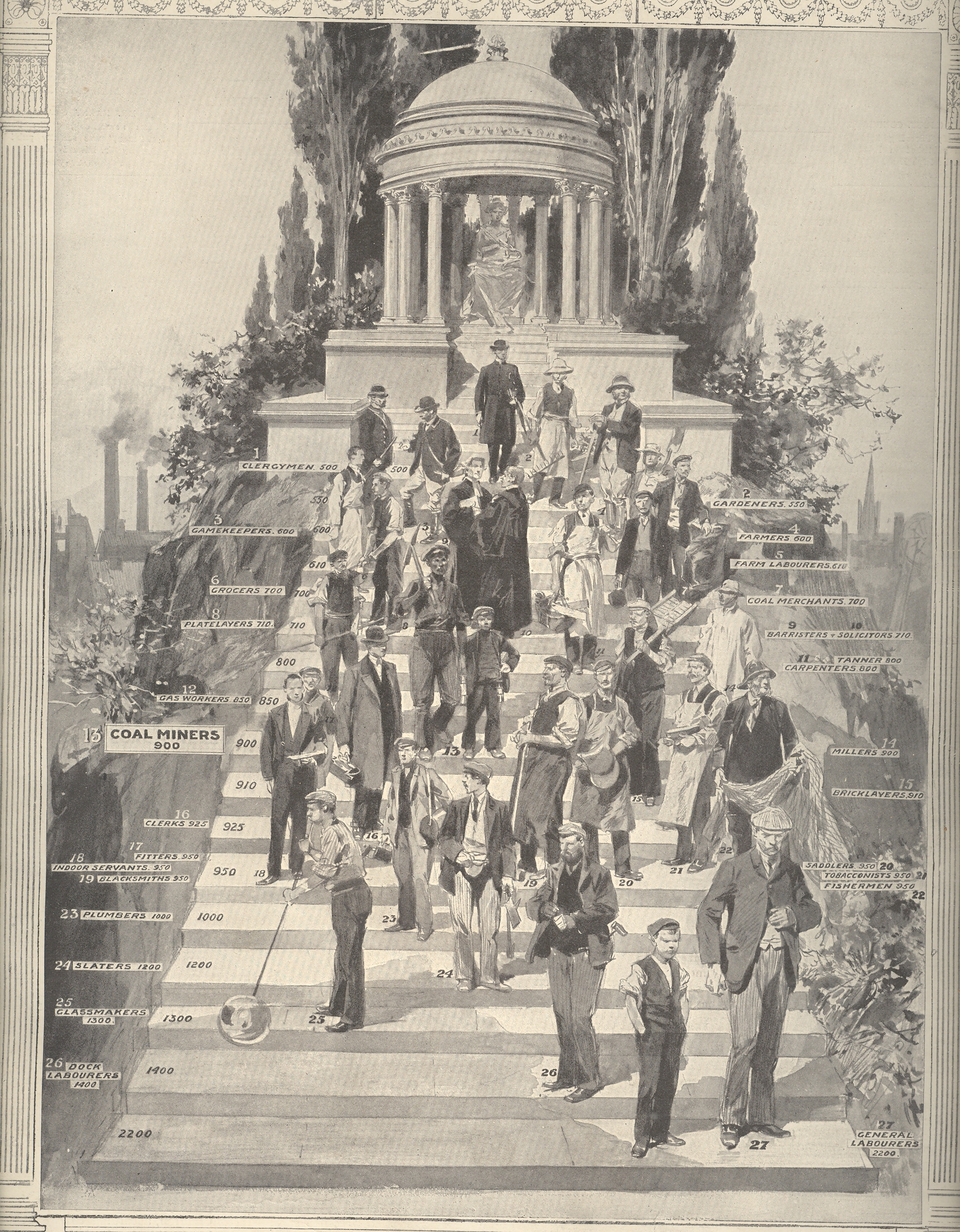
    This pictorial graph shows the places in the temple of Hygeia1 of various British workers, their places on the stairs showing the possibilities of long life, or not.

    2--llife death

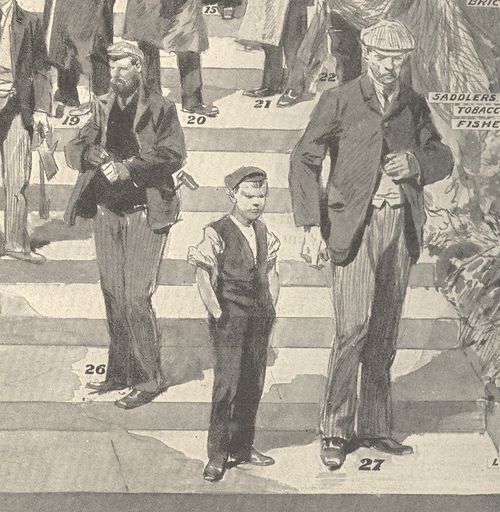
    At the bottom: general laborers, the backbone of the society, ranking well down beyond virtually everyone else save for dock laborers. Unfortunately the scale at left—listing the progression of health, somehow, from 500 at the top to 2200 at the bottom—lists these two groups at 2200 and 1900, respectively., then jumping at third layer from the bottom at 1300 (glassmakers).  That means that in the difference of 1700 between the top and the bottom that 90% of the classes represented were in the 500-1200 category (or a difference of 700 units) while the bottom two classes occupies the 1000 units; 80% of those represented occupy the first 500 units.   I do wish that I knew what these numbers represented. 

    2--death


    2--life
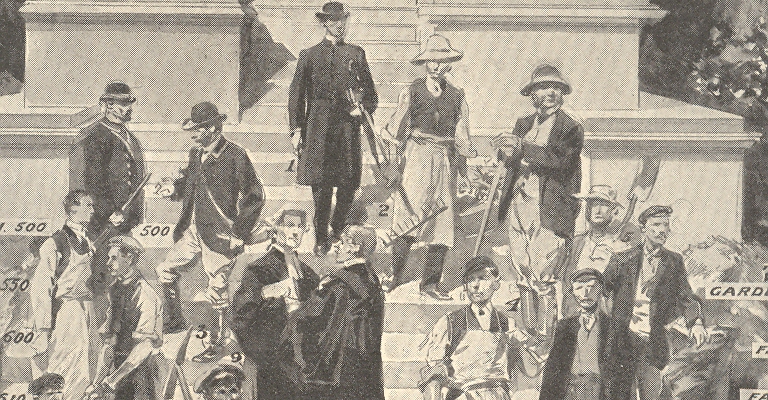
    At the top of the list of health comes the clergy, followed by gardeners, gamekeepers and farmers.  Next are grocers, farm laborers, platelayers, coal merchants and barristers and solicitors. Coming into the bottom steps of the health temple are tanners, carpenters, gas workers, coal miners, millers, clerks, bricklayers, fitters, indoor servants, blacksmiths, plumbers, saddlers, tobacconists, slaters, glassmakers, fishermen, dock laborers and general laborers.  

    It is interesting to note that in 1910 once a person in the U.K. or the U.S. reached the age of 60 their life expectancy was around 75; in 1850 this figure was 72.  Today the life expectancy for this same group is 83 or so. Considering the enormous advances in medicine and medtech since then–in pre-Lister 1850 days there was still no sanitization of surgical instruments, for example—83 seems hardly Kurzweilian. 

    Notes: 

    1.Hygeia was the goddess of good health, and the daughter and attendant of the god Asklepios, a sister of Panakeia (all cure) and Iaso (remedy) and a companion of the Aphrodite.

  • New York City: Missing (1902) & Reproduced in Outer Space (1941)

    JF Ptak Science Books LLC  Post 940

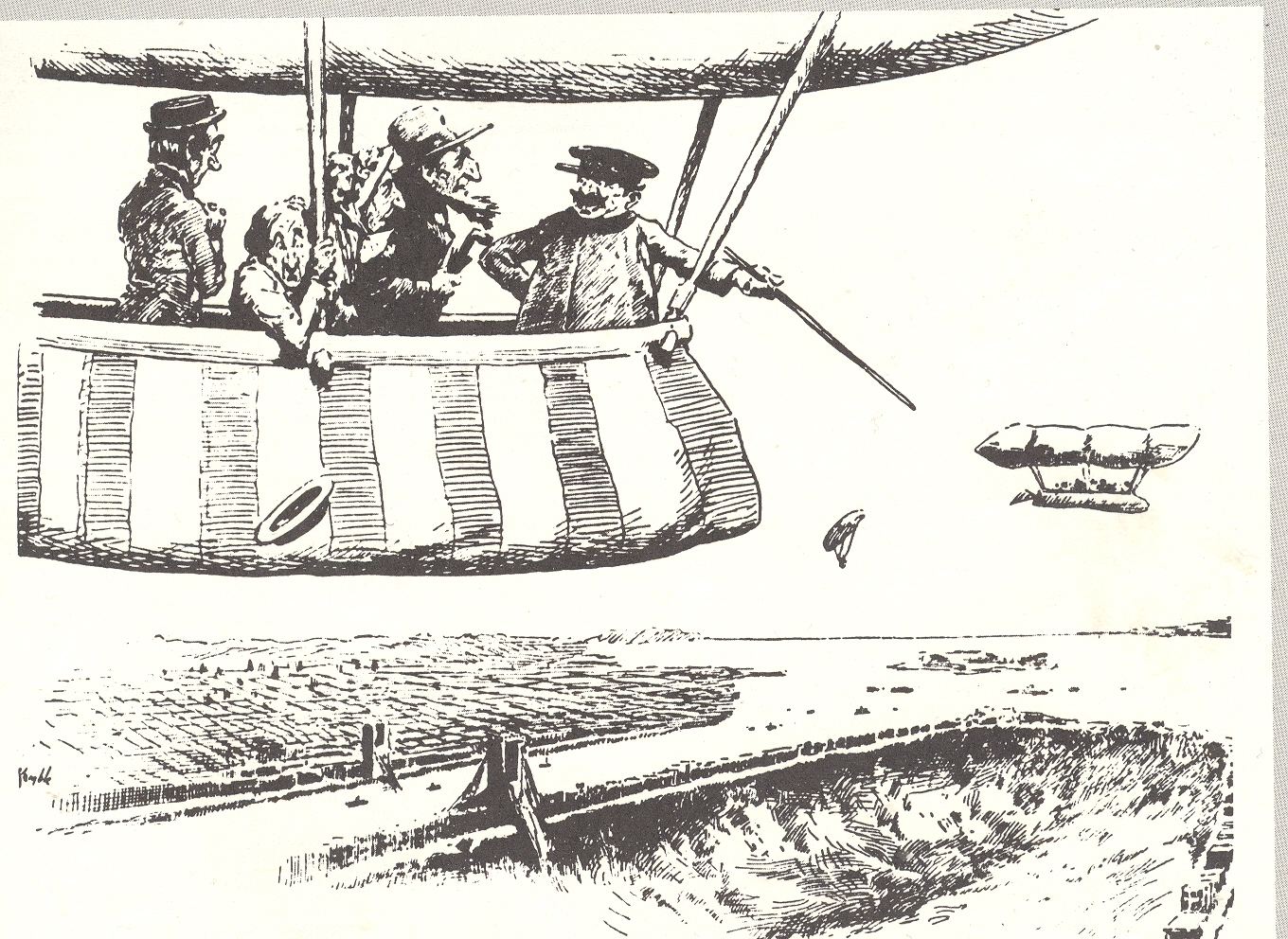
    NYC has certainly had its imaginary/creative trials and tribulations over the last 400 years or so, but I must say that these two depictions of the state of the city are the most, well, unexpected as any I’ve ever seen.  The first comes from 1902 and is a forward-looking appraisal of the chances of New York City in the near-future.  The aeronaut tourists are being told by the aviator/carny–floating above Manhattan in the future, in the year 1920–that those chances are not very good, the city having disappeared under its own weight, sunk by the growing skyscraper1 population in a ground loosened by too-numerous tunnels.  The cartoon is a joking editorial, of course, a riposte to the relatively new building jag that pushed big buildings to great new heights. [A post on more realistic views of the City of New York can be seen here]

    3--nyc gone

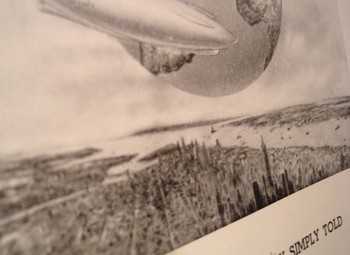
    The second image on the other hand is not a farce; it is one of the strangest (published) unintentionally Outsider, unintentionally Absurdist/Dada works that I’ve ever seen.  It appeared in a post at the very start of this blog (two years and 500,000 words ago) and it remains a capstone of Mondo Bizarro category2.

    Dsc04543

    This 1941 pamphlet isn’t so much “interesting” as it is interestingly illustrated, where all
    of the semi-coherent  interest resides, the text having left coherence far behind, somewhere, in it own intergalactic dust. 

    This is the only known example of the depiction of
    an extra-terrestrial New York City pictured with the earth in the
    background. 

    Huh?  Yes, this is the Big Apple in space—not its own
    space but THE space, outer space—somehow, impossibly, removed to some
    something-or-other (actually in this case, a “bubble”) that, while not
    being the Moon, was something like it, though not actually a solid and
    without gravity, floating on a base of floating effluvia and hope, but, well,
    you get the picture.  Whatever we’re floating on here (actually it is
    identified as the “perisohere” (don’t ask)) is very big and very very
    close to the home planet. 

    The author, David Gordon, is certainly after something, but what that “something” is I just don’t know. He starts things out for the reader asking a series of questions like “why does
    the earth and other heavenly bodies remain in the air and submerged”, answering them with other questions. 

    In all of this Mr. Gordon produced a work of staggering incredibility, more so since it wasn’t an intentional science fiction effort,  and in my book any time anyone reveals such a shocking piece of thought deserves a special kind of praise. I’m just thankful that the pamphlet was illustrated.

    Notes:

    1.  The word “skyscraper” appeared in print only nine years before this cartoon (Harper’s Weekly, April 1893), thugh the necessary elements like heating and
    cooling capacities, electrical lighting, plumbing [with appropriate, siphon jet
    toilets], elevators with dependable brakes, had been in place since the 1880’s or earlier.

    2..  One of the other capstone publications written about here is the monumentally bizarre work on sculpting in fat and lard:

    Dsc04544

  • Bombing New York City with Women, Meteorites, Nazi Amerika Bombers and Atomic Weapons

    JF Ptak Science Book LLC  Post 941

    Having just finished a post here on missing and duplicated-in-outer-space New York Cities, we return to the more grim possibilities of pre-Cold War cityicide.

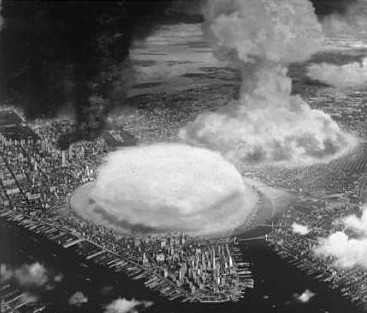
    I haven’t seen very many images at all of NYC under attack, and this one from nuclear attack on NYC from Collier’s Magazine (1948) is fantastically poignant, showing perhaps three ground-bursts of atomic bombs in Manhattan and Brooklyn.  At the time, 1948, the Soviets had just developed their bomb and I think had no way of getting one here.  But this didn’t speak to the future, and my guiess is that Collier’s was just taking it a little easy with the popular reading clientelle.  I can’t remember now how many weapons would’ve been targeted at NYC by the mid-1950’s, but I know it wasn’t a simple dozen.

    Atomic nyc

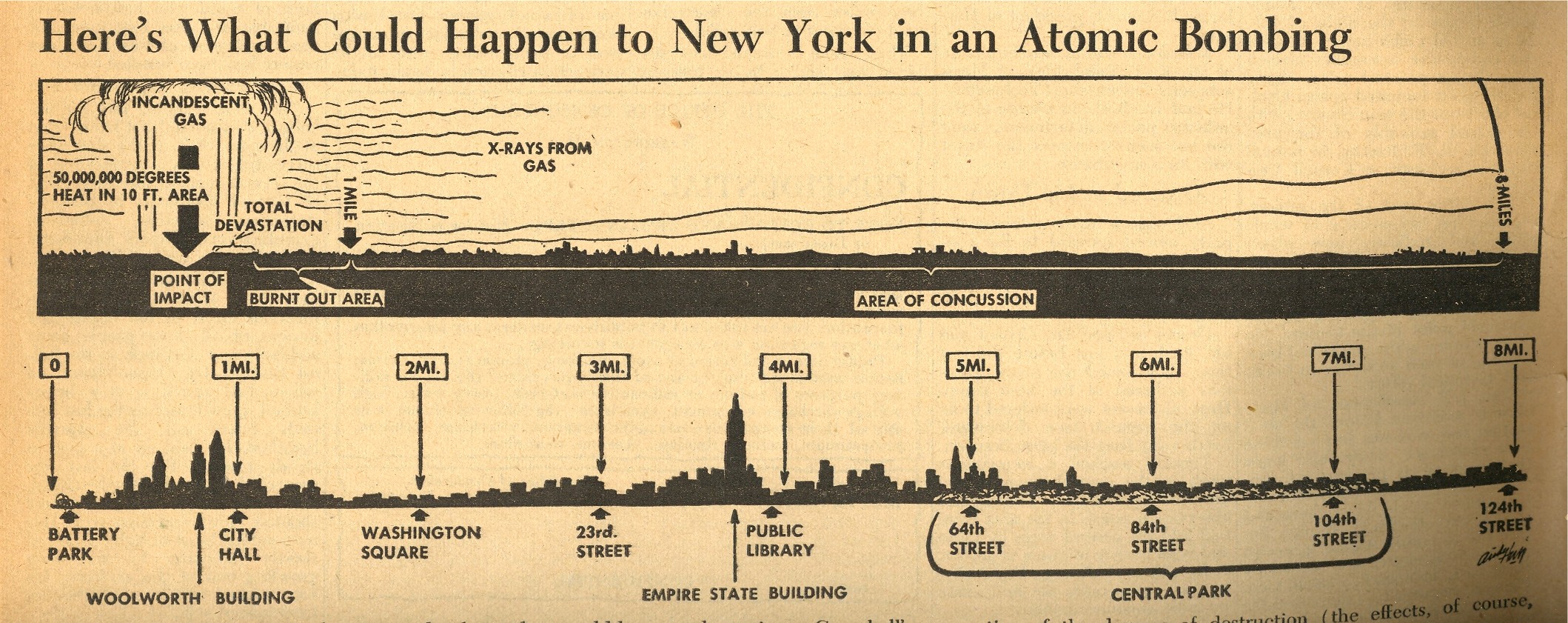
    A lateral view of this sort of explosion in Manhattan was presented in an extraordinary issue of the liberal PM Magazine, issued with a 7 August 1945 date (though I think it came out a few days later).  This would have been just a day after the Hiroshima bombing, and the 12 pages of dedicated coverage t the atomic bomb was really quite spectacular.  Included is the following small graphic that appeared on page seven which shows what effect the Hiroshima atomic bomb would have if dropped on New York City—it was no
    doubt gigantically sobering to anyone who looked at it, and brought the power of
    the bomb and its destruction to a common, understandable point. 
    I’m not an historian of the first newspaper coverage of the bomb, but
    it strikes me that this may well be the first graphic to depict the
    effects of an atomic bomb exploded over NYC.

    ==Blog July 26=PM cvr bomb map

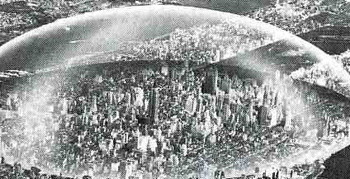
    Seeing the Collier’s pictures makes it that much more difficult to think about the idea of Buckminster Fuller that would help rid ourselves of radiation anxiety (which I wrote about earlier, here).
    Fuller’s idea is multiple orders of magnitude removed from the
    original idea of the arcade, constructing a dome1 to encapsulate NYC
    from the East River to the Hudson along 42nd St, and from 64th to 22nd
    St:  that’s two miles in diameter and, plus a mile high (or about five
    Empire State Buildings pile one on top of the other).  I’m not so sure
    how this would be built, or how things would be heated or cooled, or
    what the construction material was for the skin of the dome, or how
    people get in and out, or how you deal with heating and cooling, or how
    any noxious chemicals are expelled—but Mr. Fuller thought that the
    savings alone from snow removal from NYC streets would pay for the dome
    in ten years. 
    Big_archfuller_detail141

    Mr. Fuller also thought that the dome would protect the city (or
    this part f the city) from radiation fallout.  That could be true,
    assuming that of all the hundreds of nuclear warheads that the Soviets
    would’ve launched against NYC alone none of them would’ve found their
    target, except perhaps for the Ridgways or Staten Island, where the
    shock wave or winds produced by ensuing firestorms would not have
    disturbed the dome.  Of course if a warhead actually came close—or
    actually hit—the dome, the protection from radiation would be moot. 

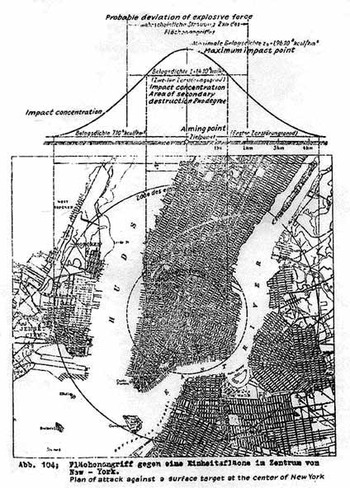
    Another odd and stomach-wrenching image comes from that devilish scamp Eugen Sanger (dead before he was fifty,
    1905-1964), a German rocket designer and engineer for the National
    Socialists, went to work for the French Air Ministry following the end
    of World War Two after doing his all and thankfully falling short for 
    the Reichsluftfahrtministerium (RLM, or “Reich Aviation Ministry”).
    Manhattan_bombed_4

      He
    worked without rancor there until he was nearly kidnapped by Joe
    Stalin—for the purpose I suppose of continuing work on what may have
    been his greatest effort, unfulfilled during the war years—the Amerika
    Bomber.  The Soviets evidently thought that this might come in handy in
    1947.

    The Sänger Amerika Bomber (or Orbital Bomber, Antipodal Bomber or
    Atmosphere Skipper) was designed for supersonic, stratospheric flight,
    and had much more bang for the buck than the V2 (10000 feet/second
    exhaust velocity, as compared to the later V-2 rocket’s 2000
    meters/second, 6560 feet/second) and since it was stratospheric had a
    far greater range, coming in at better than 14,000 miles.  The
    22,000-pound weapon carried one large 8000-pound free-falling bomb.

    Sanger’s idea in the early 1940’s was to get this bomb to around
    Times Square. And since the Amerika Bomber was a relatively inexpensive
    weapon compared to the damage it could cause, there was room for
    producing a lot of them.

    Seeing Manhattan in the cross hairs like this is quite sobering, and it is an image that is rarely made.

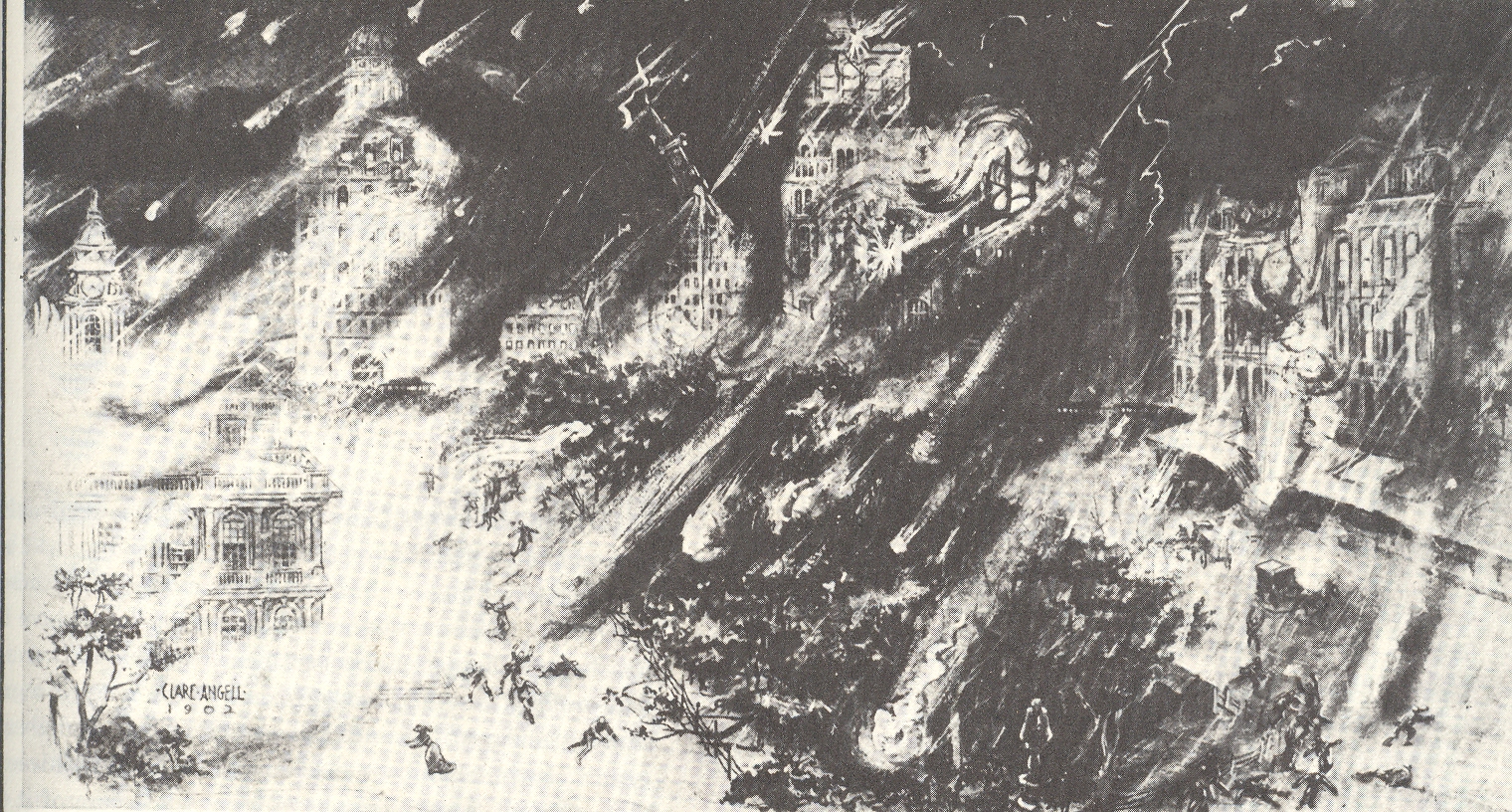
    Another attack on Manhattan depicted here comes from above, way above, Manhattan decimated by a meteorite “shower” of enormous magnitude. The image appears in an article by Hudson Maxim (1853-1927, brother of the 5--meteor more famous Hiram) “How the World Will End”, printed in 1910, and shows dozens of small meteorites striking NYC in the City Hall area. 

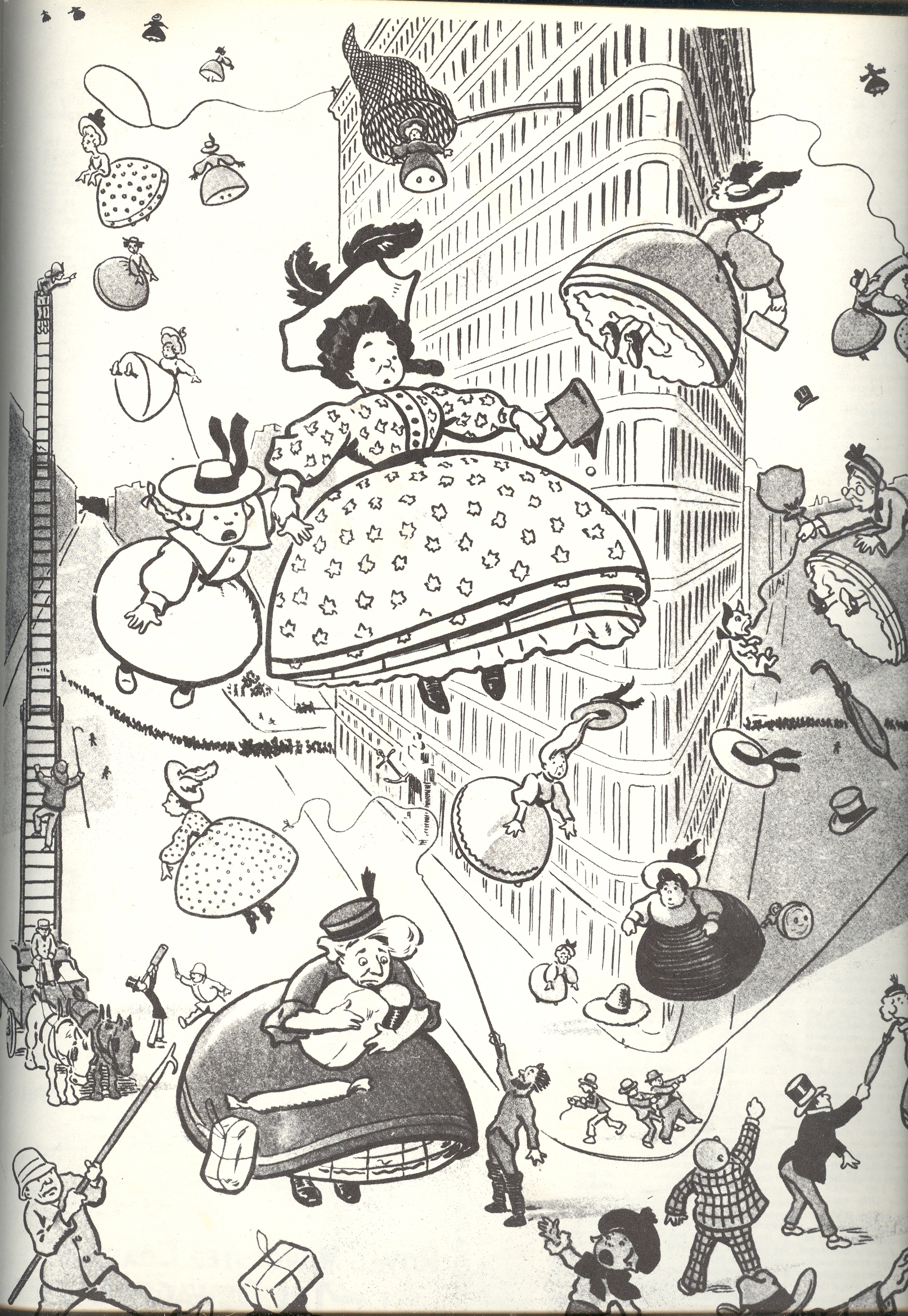
    The last image comes from 1904 and–when taken out of context–it seems
    as though Manhattan is in for the worst of it, with a view in front of
    the Flat Iron Building of an aerial bombardment of women.  This is
    probably one of the few bad things that weren’t done with/at women, and
    would actually predate the first use of explosives being dropped from
    aircraft.  Unfortunately the original, intended image was a poke at  crinoline ,
    and featured women being blown up into the air rather than the other
    way around, though I like my interpretation better.

    5-women

    Notes:

    (Source:  Buckminster Fuller in Think magazine, vol 34, Jan/Feb 1968.  AND of course the lovely work by Alison and Sky Michele Stone, Unbuilt America, McGraw Hill, 1976, pg. 99.)

  • Defining “Ugly” in Architecture: Rooftop Airport, NYC, 1946

    JF Ptak Science Books LLC Post 942   Bad Ideas Department

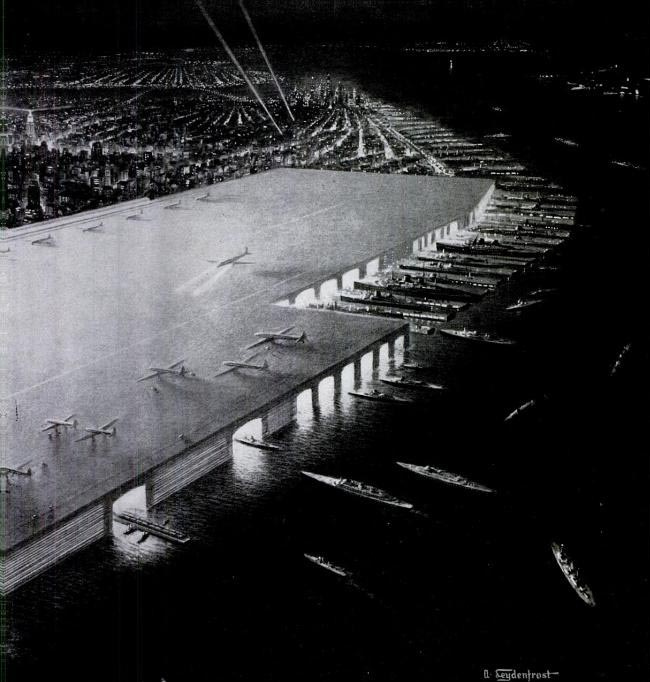
    I think that I’d like to introduce a subset in my Bad Ideas category:  Bad Flat Ideas.  To start it off, I found this very lovely example in LIFE magazine for 18 March 1946, the brainchild of generally-appropriate real estate mogul William Zeckendorf: a spectacularly bad idea of installing a rooftop airport along  a very long swath of property along the West Side. 

    Books 

    It seems as though the airport would extend from the bottom third of Central Park south to, well, I really can’t tell, perhaps lower midtown? Honestly, it doesn’t matter.  For all of its size it actually isn’t quite big enough, looking like there’s maybe 10 or 20 plane lengths margin-of-error at the end of the runway.  Plus there’s the *no* margin of error bit for the edges of the airport, which assumes that no plane will ever topple over the table top. Plus a host of other pertinent stuff.

    The penultimate line:  it is also incredibly ugly, a definition of architectural ugliness that few projects could match. 

    Books_003 det 

    The bottom line though to this project was the bottom line:  in the end, the Manhattan Airport would save about 15 minutes travel time to Philly over Laguardia. 

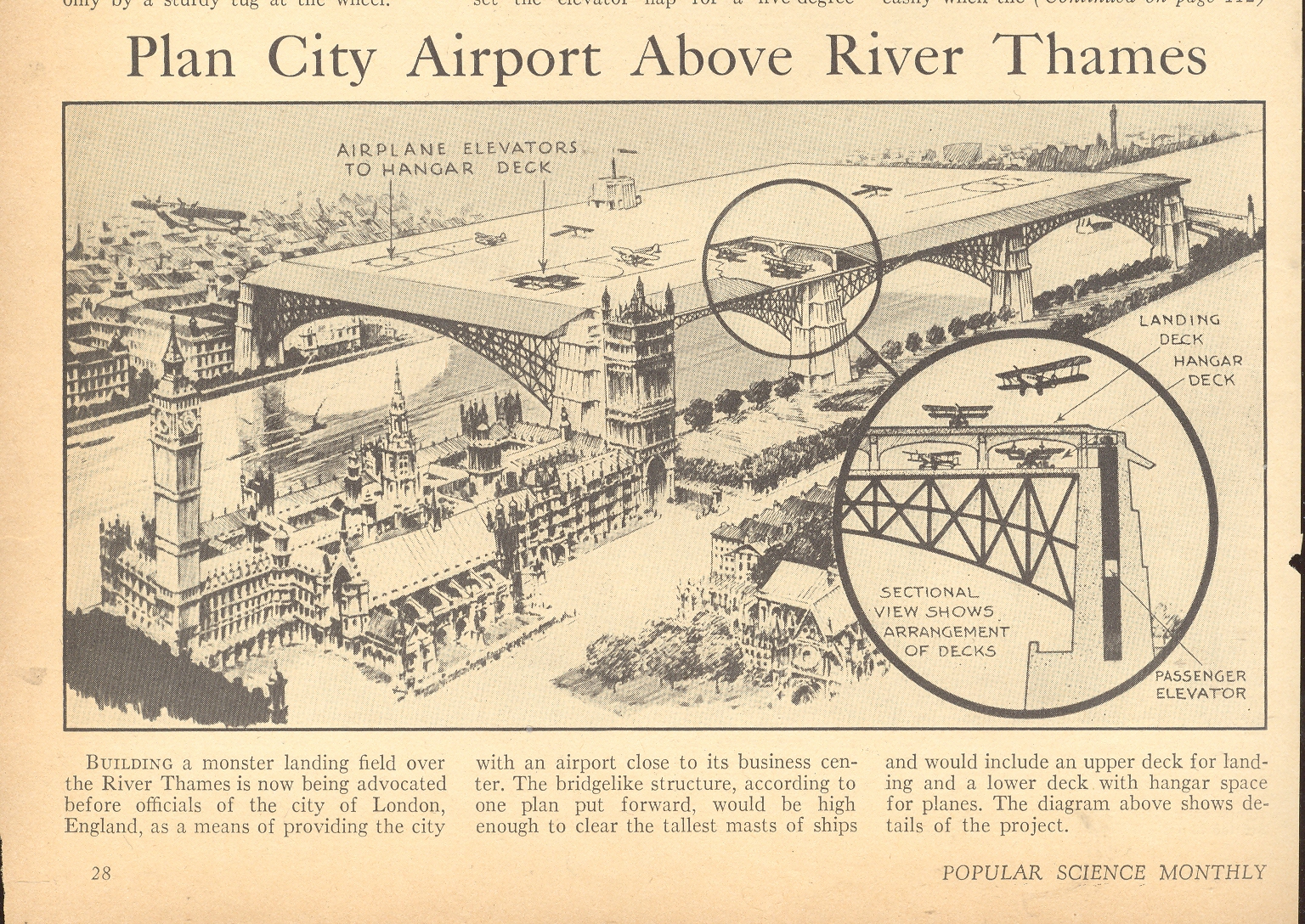
    I should not leave unmentioned the unmentionable project proposed for poor London (which I wrote about late last year here):

    Blog Dec 17 thames airport

  • TomorrowVision: U-235, Project Orion, and City-Sized Space Ships, 1941-1968 (+)

    JF Ptak Science Books Post 943

    “One conversation centered on the ever accelerating progress of technology and changes in the mode of human life, which gives the appearance of approaching some essential singularity in the history of the race beyond which human affairs, as we know them, could not continue.”— Stanislaw Ulam, May 1958, referring to a conversation with John von Neumann  [Ulam, S., “Tribute to John von Neumann”, Bulletin of the American Mathematical Society, vol 64, number 3, part 2, May 1958, pp 1−49.]  This is also said to be the first use of the term “singularity”, referring to the sometime-in-the-future point where artificial intelligence reaches such a level as to create a race of super-intelligent artificially-enhanced human beings.

    In the history of perfect tomorrows, what happens to people when we no longer die, or live to enormous ages, or replicate necessary organs to such a degree that cell death is no longer an issue, or are just able to get rid our biological corpus and live in something else?

    6--crowded earth


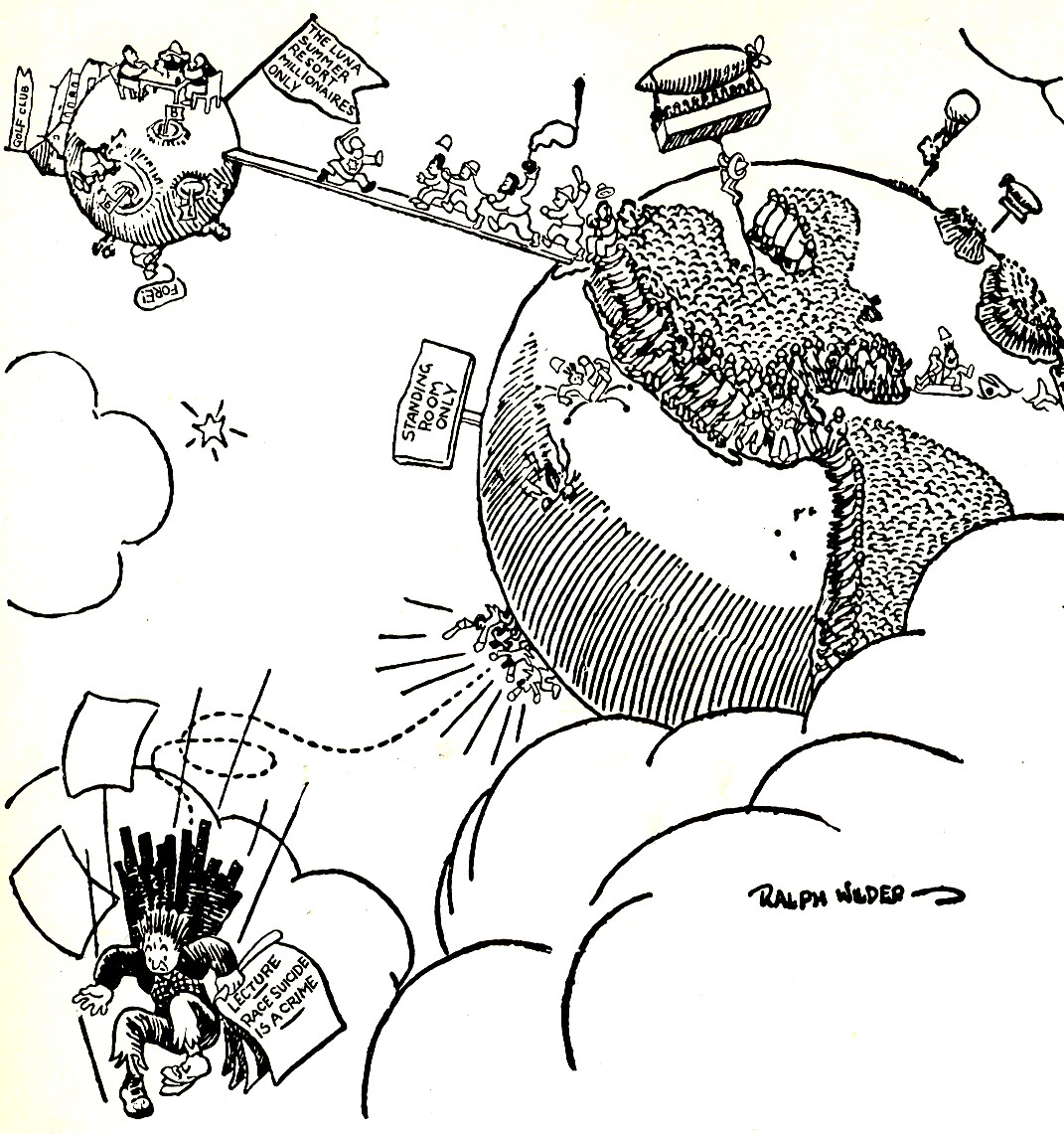
    I can’t tell when the first references start to appear in literature, scientific or otherwise, regarding the sustainability of the population of the Earth, or of simply filling up the Earth, for that matter. This cartoon (above) by Ralph Wilder, published ca. 1915 (source unknown, unfortunately), may well be in the first wave of what must have seemed at the time to be absurd speculation.

    It is impossible for me to imagine what the future of medicine and medical technology may hold for all/some of us in the next 150 years.  I chose this number as it gets us back to one of the greatest advancements in the history of surgery—sterilizing instruments and keeping the surgical room clean. 


    This is the work of Dr. Joseph Lister (remember badly via a popular consumable) who in one fell swoop (and over the course of several years) brought the survivability rate for all surgeries up by half or so, an extraordinary feat, and only four generations old.  It is less than 400 years ago that William Harvey figured out pulmonary circulation and paid hell for it for many years.  To imagine the obverse, the medical advances that will occur in 2400 may be as foreign to educated us here in 2010 as 2010 looked to William Harvey in 1628 or Joseph Lister in 1863.  DNA is only a few years older than me (discovered in 1953), and even though its discovery may seem antiqued at this point, the technologies and understanding initiated by that discovery may look as quaintly fundamental to those in 2150 as the necessity of having a clean surgical environment looks to us. 

    6--crowded earthdet

    And who knows how advancements may spiral ahead of themselves once intelligent machines start producing machines that are more intelligent than themselves leading to god-knows-what.

    But back to the cartoon, and the mathematician Stan Ulam, who is really at the base of this post.  The image depicts the Moon as an escape pod for those who could afford it, the signs suggesting that money would determine who had space to lie and who didn’t.  Of course, there was the problem of actually getting there, which in 1915 or thereabouts was still science fantasy (being twelve years after the Wrights and four years before Goddard).6--u-235 space ship

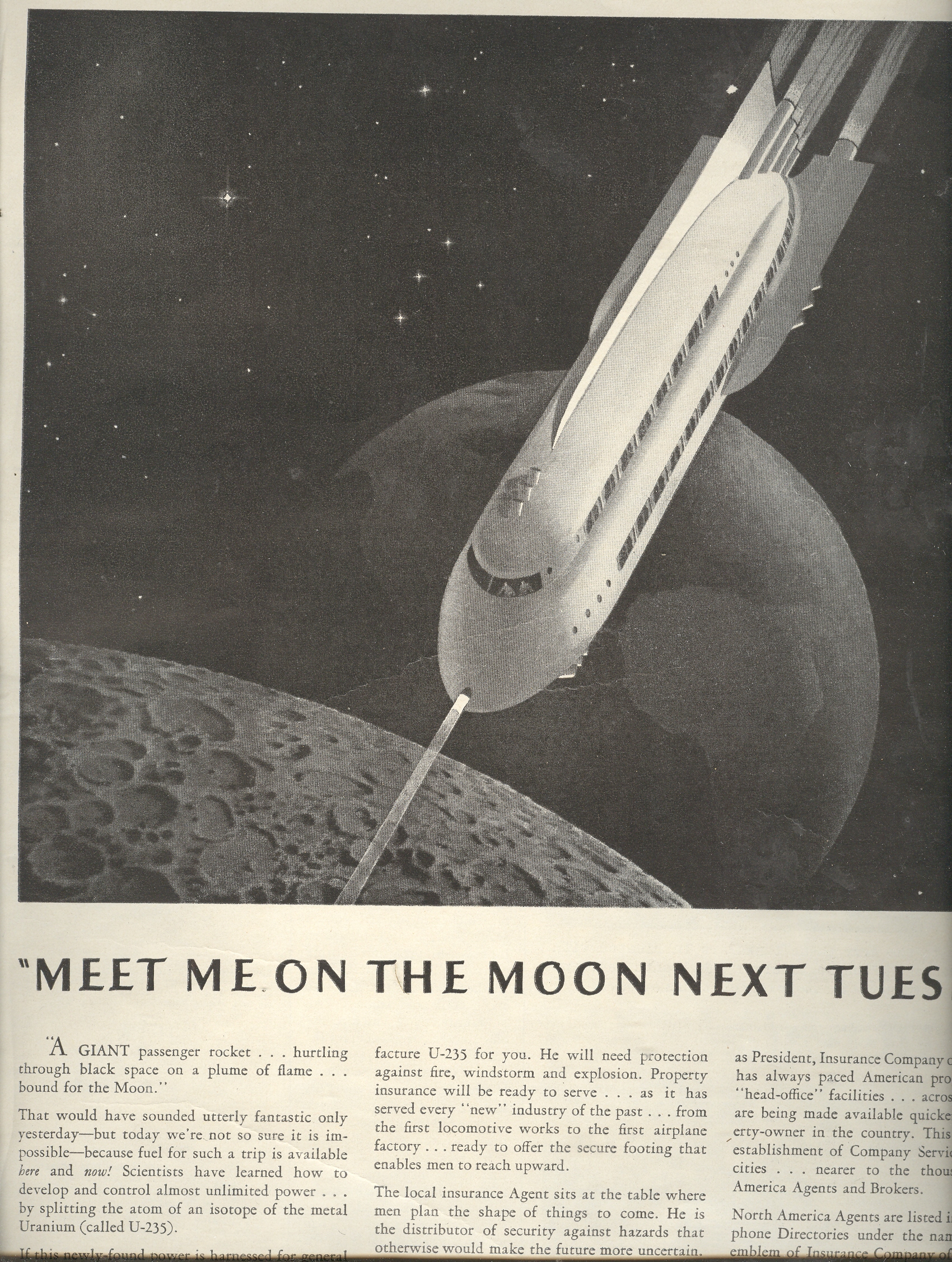
    The second image, from LIFE magazine in 1941, shows a rather massive space vehicle powered by U-235. Discovered by Arthur Jeffrey Dempster in 1935, U-235 was a fissile material capable of sustaining a fission chain reaction. (Dempster, 1886-1950, was a Chicago Ph.D. who during the war would be the Chief Physicist of the great Metallurgical Lab at Chicago, from 1943 to 1946.) The ad (for an insurance firm) shows the ship being powered by what would be a series of nuclear explosions—quite a remarkable thing to be printing in a mass market periodical in the second year of WWII. As it turns out the Physical Review was still publishing sensitive articles on these topics ‘till right about this point, after which their appearances were suspended for the duration of the war. 

    And as it turns out the thinking here was prescient.  It was Stan Ulam who first suggested this use of atomic energy in 1947; and it was Freeman Dyson and others who (beginning in 1958)  took this many steps further with Project Orion.  In short, this project was a think-sink for a pulsed nuclear propulsion system for a class of space vehicle that would range in (three) sizes from 8,000 tons to an incredible, space-insatiable 8 million tons. 

    Yes, that’s 8 million tons.  That was for a city-sized space ship with a diameter of 400 metres and which could travel at 20,000-30,000 m/s with meganewton thrust, being pushed along by series of nuclear explosions, carrying fantastic payloads and enabling the construction of vast structures on, well, other places. 

    I don’t know how the thing would get off the ground.  Evidently this was not an issue, for even in the late 1980’s drawings and plans for this monstrous ark were still being published. But even as I write this I wonder if my own incredulity with the possibility of such travel will be seen incredulous to folks just a few generations down the road.  I suppose this is just another small stop in the history of the time it takes for absurd ideas to look not so.

  • Architectural Palindromes (or Semordnilap), Reversible Structures and Fractally Bad Ideas

    JF Ptak Science Books LLC  Post 9447--car park top

    “The Edge… there is no honest way to
    explain it because the only people who really know where it is are the ones who
    have gone over.
    “–(Dr.)Hunter S.Thompson

    Oddities
    and Curiosities and the Tryphiodorus Award

    Sometimes
    things that were just done because they could be done aren’t necessarily an
    accomplishment—they may use letters in the alphabet and make words, but the
    words really don’t seem to take us anywhere. 
    Literally.  There is a literary practice (and I mean this in a medical
    or forensic sense) in which the writer chooses to not use a particular letter
    of the alphabet, abandoning it for very private reasons into the dustbin of
    abandoned alphabet letters. (That dustbin is generally empty until one of these
    people show up with the idea of filling it, unless of course we expand the
    dustbin to include punctuation, and then it gets filled rat her quickly (though
    not in the Steinian sense).)

    The
    work which most filled the alphabet dustbin more than any in history is probably the
    Odyssey of Tryphiodorus (a Greek grammarian who flourished in Egypt ca. 4th century ACE) effort
    written in 26 parts, each segment abandoning one letter of the alphabet until
    each letter had been completely omitted from one section.. The author could
    have a lot of time by writing this 26-part cycle in all at once, in one part,
    abandoning all 26 letters at the same time—this may have produced a more
    elegant result (with the Bellman’s map coming to mind).

    7--car park mid This
    Odyssey may have produced a sort of a
    lipogramic palindrome, in a  squinty-eyed
    way. 

    Which
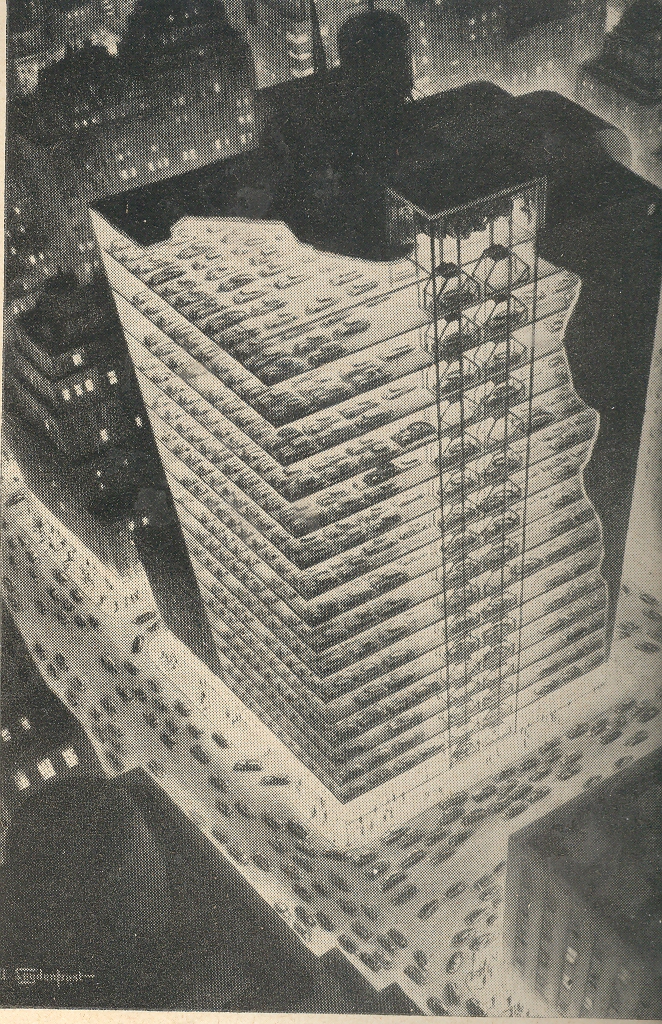
    brings me to this odd structure proposed by real estate mogul and hyper-builder  William Zeckendorf, whose vision brought to
    the pages of LIFE magazine in 1942 (?)  a 
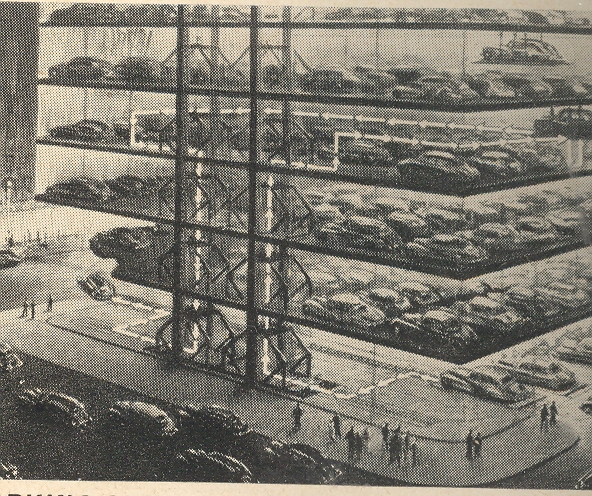
    very tall completely automated structure designed for nothing but car
    parking. People would drive to NYC in their own cars (!) and park them in this
    car hotel; the car functions would be given over completely to the building, moved
    into their spots and juggled and finessed into position by conveyors and forklifts
    and such.  7--car park bot

    Cars
    in a building, moved about free of humans, rested; humans on the street making
    their own human traffic.  The whole idea,
    the entire structure, seems backwards to me, the meaning of a building turned
    inside out, wanting the essential idea, forwards and backwards being simply a
    bad notion.

    The
    picture of Mr. Zeckendorf—who was tremendously energetic and who had very many good ideas along with these heavily
    popularized odd plans—standing in front of a lovely (scale?) model of his
    parking structure makes me want to see another, smaller version of Mr.
    Zeckendorf  and his model standing just
    behind it, and smaller one after that, and so on…a fractally bad idea deserving of the Tryphiodorus award for missing the most sense. I bow deeply to Mr. Zeckendorf for trying and for constructing this beautiful (I want it) model.

    7--car portrait

  • Magnificent Titles, Ranters and Hell Breaking Loose (England, 1650)

    JF Ptak Science Books LLC  Post 946

    Ranters,
    Diggers, Manifestarians, Puritans, Muggletonians, Shakers, Quakers, Levellers, Seekers…terrific names all for religious or religioesque movements, most now
    gone, though it seems that of the most-gone the Ranters are probably the
    most-goned gone–which must’ve been a function of their unstated aims of not
    having a particular course of action.  As
    an anti-movement their movement was tautologically doomed, as they flourished
    for only a decade or so, sandwiched into the very full mid-17th
    century. 

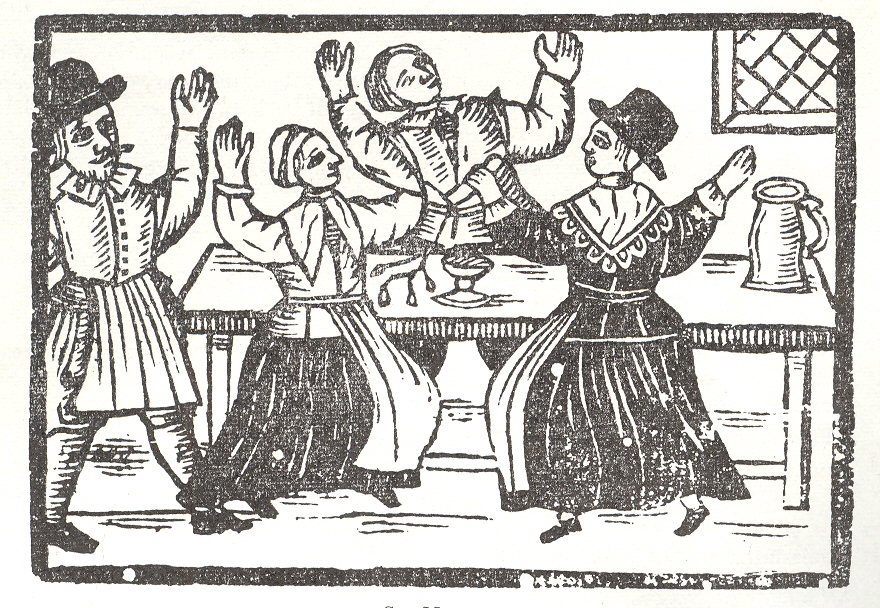
    1--ranter
    {The image above is an illustration from the book, Hell Broke Loose... below. It also is a pretty tame version of other images that show more nudity/drinking/sexual activities.]

    Ranters
    were an English Free Spirited heretical group of wide interpretation of social
    and moral value. Their questioning of the potency of the man’s fall doctrine
    steamed together with a quasi-semi-millenialism evidently led to an
    alehouse-based loosening of socially governed restraints. According to the many People magazine-like pamphlets and soft
    porn reporting, their activities made for sugary eating by the bawdy-eyed ha’penny
    people buying gossip in cheaply printed formats.   Free of Sin and Law, the Ranter celebrations
    were soaked in alcohol and nudity, which are ripe pluckings for any non-serious journalist, then or now.

    Judging from the list of publications (listed below in the “Continued Reading” section) there must’ve been a very immediate lusty interest in the Ranters’ lustily interesting ways.  I’ve written this post for the simple interest in one particular, extraordinary title: [with apologies for the underlining, but I cannot convince the Typepad gods to remove it.]

    Hell broke loose: or, the notorious design of the wicked Ranters, discovered on Sunday last at Black-Fryers Being a true relation of the strange proceedings of Mr. Vaughan, and his wicked proselytes; and their entring of Black-Fryers church in sermon time, like so many spirits from hell, with four damnable papers in the hands, containing such horrible, audacious, and abominable songs, the like not to be parallel’d in former ages. With the manner how this onsolent Ranter traced the streets from Black-Fryers to Saint Paul’s Church-yard, in his Holland shirt, without doublet or breeches, a treble cap, like the Pope’s miter, with silk fring, and white shooes, and stockings. With their damnable plots, and conspiracies against the ministers of the gospel: their examination before the right honourable the Lord Mayor of London; the sad and woful speeched, made by the ringleader of the Ranters, concerning the city magistrates, and golden chains: and the committing of them to Bridewell till the next sessions. 1650

    See?  That’s just fabulous, and represents a Title Page Extravaganza that seems to be a 17th century feature–including as much as humanly possible on a title-page.  As does this book, with all manner of detail in the title, not the least of which is the description of a man running around with no pants but with a Pope’s mitre and white shoes and socks.

    The 17th century “Hell Broke Loose” extended-title (but non-Ranter) category has a number of other entries in it, too, for published books, including the following lovilies:

    Hell broke-loose; upon Doctor
    S–ch–ve–l’s sermons
    or, Don Quevedo’s vision, of an infernal cabal of Whiggish papists and
    popish Whigs in Utopia; upon a mock-tryal of the doctor. Translated from the
    original; by Jack the Spaniard.
      1713

    Hell broke loose, or, An answer to the late bloody
    and rebellious declaration of the phanatiques, entituled A door of hope,
    &c.
    wherein their horrible conspiracy against our gracious soveraign, and the
    city of London, in their late rebellion is discovered : together with a brief
    view of our lives, manners and malice of those desperate and unparallel’d
    traytors
    . 1661

     Hell broke loose : or an history of the Quakers both old and
    new. Setting forth many of their opinions and practices, published to antidote
    Christians against formality in religion and apostasie
    1660

    Some of the other big-title Ranter titles from this time include the following:

    The Ranters creed being a true copie of the examinations of a blasphemous
    sort of people, commonly called ranters, whose names are herein particularised,
    together with the name of their pretended God almighty, and their false prophet
    : taken before Thomas Hubbert Esquire … with a declaration of their fantastic
    gestures and deportments as they were coming before him, and in his presence :
    and now committed to the New Prison at Clarkenwell.
    ,
    1651

    The great mistery of the great whore unfolded, and antichrists kingdom
    revealed unto destruction in answer to many false doctrines and principles
    which Babylons merchants have traded with, being held forth by the professed
    ministers, and teachers, and professors in England, Ireland, and Scotland,
    taken under their owne hands, and from their owne mouths, sent forth by them
    from time to time, against the despised people of the Lord called Quakers, who
    are of the seed of that woman, who hath been long fled into wildernes … in
    this answer to the multitude of doctrines held forth by the many false sects,
    which have lost the key of knowledge, and been on foot since the apostles
    dayes, called Anabaptists, Independents, Presbyters, Ranters, and many others,
    who out of their own mouths have manifested themselves not to be of a true
    descent from the true Christian Churches : but it’s discovered that they have
    been all made drunk with the wine of fornication received from the whore which
    hath sitten upon the beast, after whom the world hath wondred /
     
    1661

    The Ranters reasons resolved to nothing. Or, the fustification instead of
    the justification of
    the Mad Crew Being, a serious answer returned to one who in his letter desired
    an unlawfull and wicked book to be sent unto him, call’d the Justification of
    the Mad Crew. Instead of vvhich, the author of this letter sent him the Act of
    Parliament made against the Ranters; and did also both justifie their way, and
    ingratefully asperse some, who in Christian love would have reduced them to the
    life and truth of Christianity. Wherein the people called by themselves god and
    by some others, the Gods of Godmanchester, may, as in a glasse, behold, that
    they are a deluded and defiled people, if not incarnate Devils.
     

    1651

  • Bad Sounds Department: the V-1, 1944

    I remember seeing a film (with sound) many years ago, when I was little, back in the mid 1960’s, of a V-1 in flight.  The flying bomb issued a terrifically awful sound, punctuated by the silence when its engine  turned off and it fell to its target in silence. It sounds like death.

    [The V-1, or Vergeltungswaffe 1, (“retaliation”, or “vengeance” weapon), or Fieseler
    Fi 103, or Buzz Bomb, or Doodlebug, was a flying bomb (on the order of a very primitive
    cruise missile guided by a gyroscope autopilot) launched against population centers
    in England by the Nazis during the June 1944-January 1945 period.  The bomb was about 27’ long and 17’ wide,
    weighed 4,700 pounds, and reached 400 mph with an 1,800 pound warhead.  Its 8,000+ sorties killed more than 6,000
    people.]

    http://www.youtube.com/watch?v=Q1qsBGTkVSk&feature=related

    And again:

    And again, here:

Recent Posts

Archives

Categories