JF Ptak Science Books
At point point in 1944, there were 4,890 American B-17s in service (as part of an overall artime production of 350,000 aircraft). This is what 4,890 B-17s might look like:
A Daily History of Holes, Dots, Lines, Science, History, Math, Physics, Art, the Unintentional Absurd, Architecture, Maps, Data Visualization, Blank and Missing Things, and so on. |1.6 million words, 7500 images, 4.9 million hits| Press & appearances in The Times, Le Figaro, Mensa, The Economist, The Guardian, Discovery News, Slate, Le Monde, Sci American Blogs, Le Pont, and many other places… 5000+ total posts since 2008.
Contact johnfptak at gmail dot com
JF Ptak Science Books
At point point in 1944, there were 4,890 American B-17s in service (as part of an overall artime production of 350,000 aircraft). This is what 4,890 B-17s might look like:
BP has caused 100,000,000 gallons of oil to be released into the Gulf of Mexico.
With numbers getting to be this big, it gets a little harder to visualize even the scope of the breadth of the disaster let alone its effects on the ecosystem. So:
100,000,000 gallons of oil would fill the 555′-tall Washington Monument seven times.
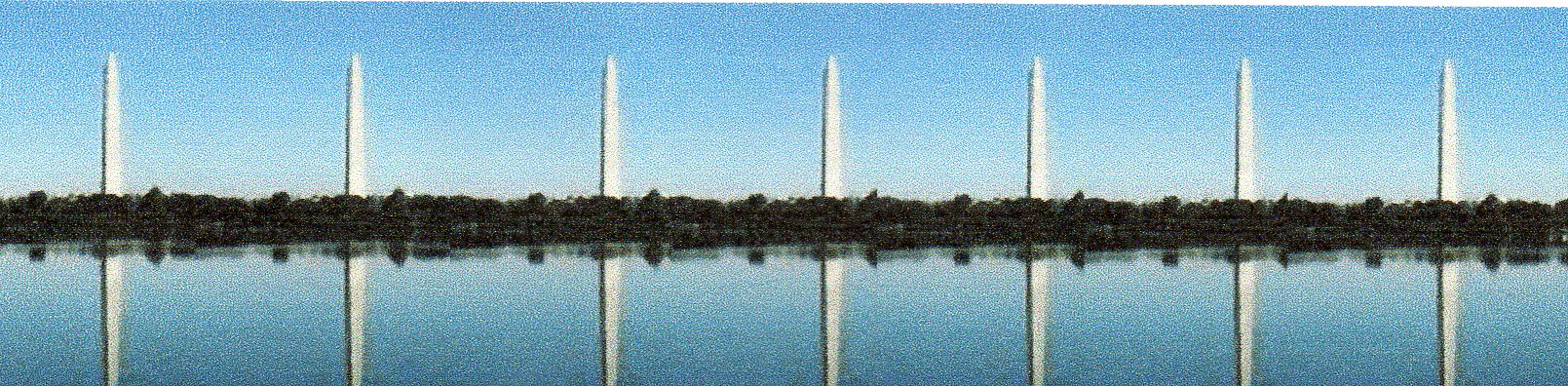
100,000,000 gallons of oil would fill the Big Ben clock tower 70 times
If 100 million one gallon jugs of oil were set side-by-side in a line it would stretch across the country and back again.
If you had started to fill your car with 100,000,000 gallons of BP oil –it would’ve been Amoco Oil–you would’ve started a little before the October 1973 gas shortage (at a rate of 5 gallons a minute).
If on a clear night the best the human eye could see is 6,000 stars, and if each star represented a gallon of oil, it would take 40 years of clear nights to represent the BP disaster.
Hopefully it won’t take 40 years to clean this mess.
____
Incidentally, you should check out the insipid history BP has provided for itself at its website For example:
“Our history is full of discoveries, starting in
1908 with oil found in a rugged part of Persia after a long and
difficult search. Since then, discoveries large and small (and sometimes
just in the nick of time) have fuelled our progress.”
Is this written for first graders?
“In our story, you may make a few
discoveries of your own. Winston Churchill gives a rousing speech. The
Smurfs cause a traffic jam. Our employees help construct a giant spool,
build the world’s largest deepwater pipeline and bring solar power to
remote villages in the Philippines.”
It also looks like BP has misspelled “fueled” and “deep water” on their own website. Nice attention to detail!
JF Ptak Science Books Post 1054 The History of Dots series
[Thanks to Randall Rosenfeld of the University of Toronto for sparking this post!]
It seems that few people now remember Frederick William Herschel as a great discoverer of alternative existences, but, well, that’s pretty much what he did–and he did it during a time that must’ve made his astronomical discoveries seem like science fiction .For example, in 1785 Herschel published
a revolutionary image of the “Stellar System” (the Milky Way), showing
its irregular pattern
and the off-center placement of our sun amidst a panoply of other stars.
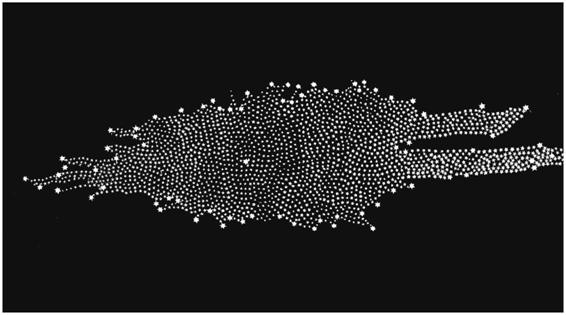
(His
image was remarkably and substantially correct, with the most grievous
error being the placement of the sun too close to the center of the
galaxy.) It was an image which bought the concept of a
not so humano-centric idea into popular philosophy, and that our sun was a star among stars in a sea of stars1.
Not only that, but Herschel also made observations on double stars that showed that Newton’s laws of gravitation extended throughout the universe, and that it was possible for the stars themselves to submit to these laws and react to each other. After constructing his mammoth four-foot telescope, Herschel expanded the observable sky multifold, showing that there was a possible 75 million stars now available for study. And if the stars were behaving like planets then the actions of our own solar system seem perhaps to be not so unique; and with all of these new stars the possibilities for new planets and new solar system (and with that the possibilities for other life forms) seems a greater possibility.
And on these new worlds in these new solar systems there was therefore the possibility of two or more suns, meaning that there could be sets of shadows cast by anyone/thing on the surfaces of any of these new worlds.
In fact Herschel was able to show that our own Sun was following a prescribed path through the Milky Way, making Sol much less of spectacular enigma of mythical importance and more of just another starry dot in a sea of dots. And while he was making the Sun into a starry dot he was also resolving those other starry dots into something of greater understanding and significance, bringing them into a systemic mechanism of the universe.
Herschel also made an alpha/omega kind of discovery, as well–he marveled at nebulous “holes”2 that he was finding in the Milky Way, thinking that, perhaps, he was looking into the very soul of the universe, at the place where stars were born.
This is extraordinary stuff coming to use from 200 years ago. Few people have made such enormous and concrete contributions with such far reaching intellectual and philosophical implications. So hats-off tonight to Frederick William Herschel, a man with big eyes.
Notes:
1. This
galacto-centric view remained until the work of Harlow Shapley’s
globular clusters in 1918.
2. Specifically his famous and luscious “Coalsack” nebula.
JF Ptak Science Books
One of the things that I’ve not thought of before was the invention of luxury for the working poor.
The first comfortable chair, the first luxurious chair,. ever bought by a member of the working, laboring class was purchased in the United States on July 23, 1852 at 11.11 in the morning.
Or perhaps not.
But what did happen around this time was that a commodity that was over and above the absolute necessity–say for an upholstered chair with springs–did become available en masse to the vast majority of working/poor Americans. Or at least that’s what I’m thinking. The Industrial Revolution, now 80 years old or so, began to rub up against objects that we’re formerly only available through extended labor and craftsman but were now becoming widely accessible and for cheap because of mechanized production.
So, for example, the stuffed comfy chair which had been the nearly exclusive domain of the middle- and wealthy classes were now patented inventions that were mass produced, their cost coming down because of the ease of production and the vast new demand. The industrialization of luxury found its true invention in mid-century Americas and was subject to enormous variation and tremendously expanded development–so much so that in just the next few decades there would be massively distributed catalogs containing almost nothing but eminently affordable necessaries and new luxuries. By the 1880s the mail order catalog was becoming commonplace, as was the ability for the poorer classes to purchase formerly unaffordable objects–luxury for the masses had been discovered, and an enormous consuming class had been invented.
JF Ptak Science Books Post 1055
(Including a short tale of when Winston Churchill’s nephew, John Spencer Churchill, wound up passed out on the back seat of my 1979 Chrysler New Yorker.)
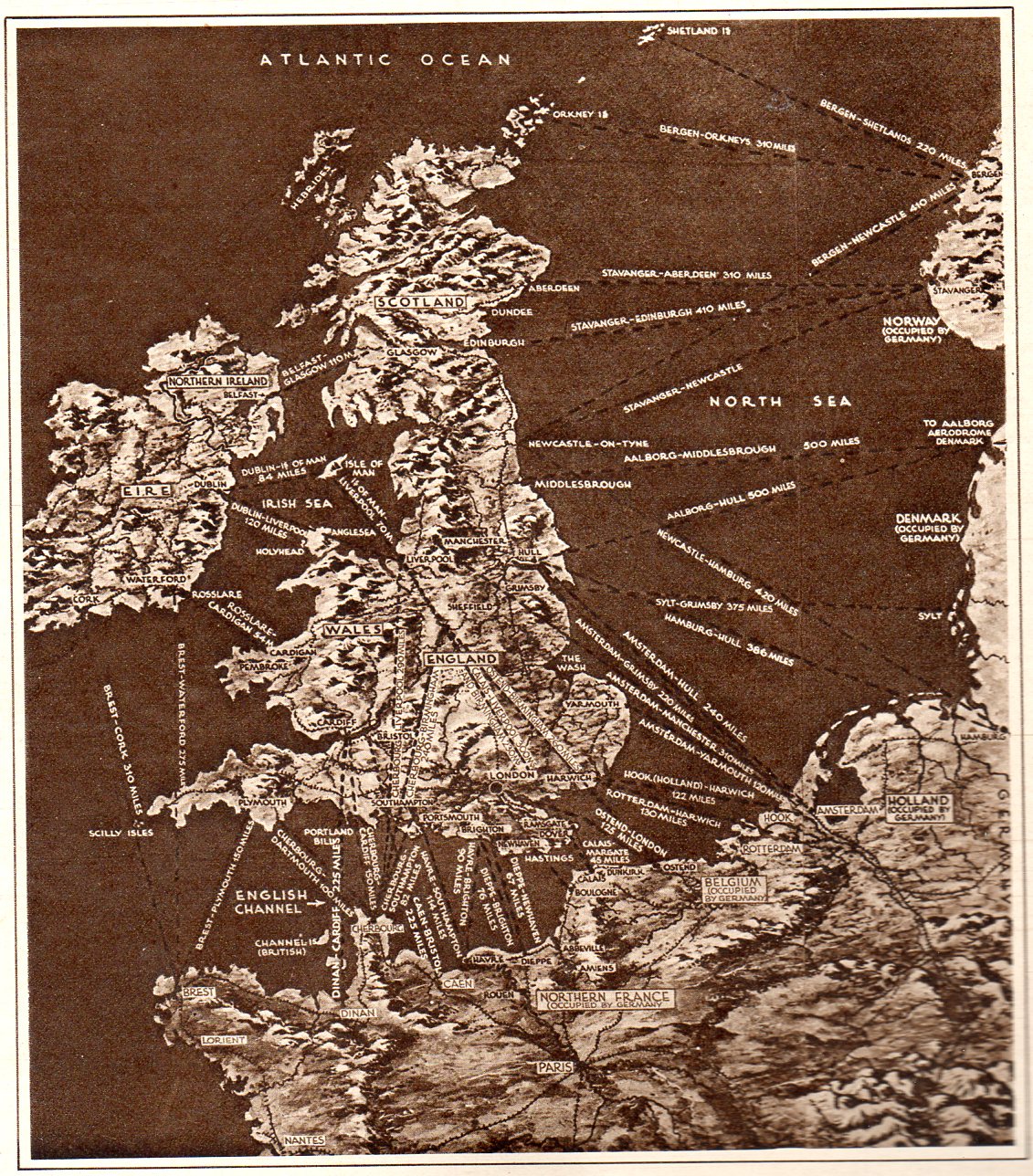
This map pretty well tells the story of the perilous situation of Europe and England at the beginning of June, 1940. It appeared in the Illustrated London News on the heals of Churchill’s “Blood, Soil, Sweat and Tears” speech, and was a very frank presentation of the wearing of the war. By this point in the war Nazi Germany had successfully invaded Belgium, France, Luxembourg and the Netherlands, sweeping across Europe in a broad westward movement, backing up British and French troops all the way to the sea at Dunkerque, where a monumental rescue operation (“Operation Dynamo”) saved them. (There was an enormous amount of materiel left there on the beach, a devastating loss for the British Expeditionary Force, nearly crippling it.) This was a bad time for the Allies, this part of the war coined by
Winston Churchill in 18 June 1940 in the House of Commons by: “The
Battle of France is over. I expect the Battle of Britain is about to
begin”. There was very little good that came of these few months for the U.K and the Allies, though four things do stand out: (1) as I just mentioned, the saving of 300,000+ troops at Dunkerque; (2) the resignation of Neville Chamberlain, (3) the coming of Winston Churchill as Prime Minister of the U.K., and (4) the first deciphering of the Enigma at Bletchley. Other than that, the situation was dim, and these invasion routes (published at t he very time that Germany was studying such a feat in its “Operation Sea Lion“, or “Unternehmen Seelöwe”).
The endgame at Dunkerque took place almost four years to the day of the invasion of Europe, when the intent (though not placement) all of these arrows were turned around for the Allied operation at the Normandy beaches on 6 June 1944..
It came to pass in 1985 that some friends and I had drinks with John Spencer Churchill, a man who was at Dunkerque and who reported on it to his uncle Winston. (A slightly longer story on this meeting with Mr. Churchill appears below.) After much else I finally asked Mr. Churchill if there was any particular sound that he remembered from being at Dunkerque. I do not recall his phrasing, but what he said was that the beach at Dunkerque was rocky, pebbly, and that the sound made by tens of thousands of boots on that shore was “disgusting”. He also said that the mixture of petrol, wind and grit burned the eyes and tasted bad. It was of course fascinating to hear a first hand description, especially a memory of something so uncommon and visceral. It was unexpected to me, though now when i read about Dunkirque I can imagine its smell thanks to this encounter.
First Address by Winston Churchill as Prime Minister.
·Posted by :
·in:
JF Ptak Science Books Post 1056 (First post in our History of Noses series)
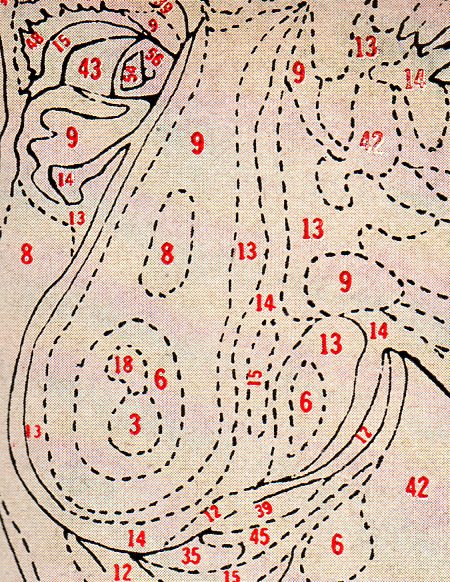
There is an entire dictionary of explanations for this odd image (appearing in LIFE magazine for 14 September 1953). Here’s a candidate launched from this blog’s Museum of Impossible Things department: the photograph accompanies a newspaper clipping from the Library of Congress’ Newspaper Clippings Collections!, an above-the-fold front-page obituary for a man with an unusual obsession, as follows:
[Source: Obituary from the Stationary News, from At, Texas. ]
<clip> “The Mystery of the Secret Painter of At, Solved!” <clip>
“Gileless, Newton. After a long illness of undescribed origin and affect, Mr Newton Gileless, at home. Newton was born in Aint, Texas before moving to At in 1916 “to get away from the negativeness”. He had few friends and distant neighbors, and was fond of keeping overturned muffin-stuffed cowboy boots on his fence posts. He donated hard pancakes to the bench-sitting old men down by the Rexall, and kept a large box at the Post Office.”
“Mr. Gileless’ prime mover of community interest was his secretive painting practices. For decades Mr. Gileless could be seen scurrying around town, or at in the fields, or along the dusty roads, or at the stream near the peach trees, carrying a large easel with a canvas attached with yards of “paintin’ rope”.. He could be seen painting but only from a distance, as distance of quietness seemed the enabler for his painterly ambitions. The object of his interests was not known”
“Mr. Gileless’ estate was left to Bo Tanger, the regional coroner, who administered the last wishes and who revealed the close secret. “I finally got to see what Newton was painting”, said Tanger, “and its odd, even for here, where people’s business is their own in private, and his was public-private”.
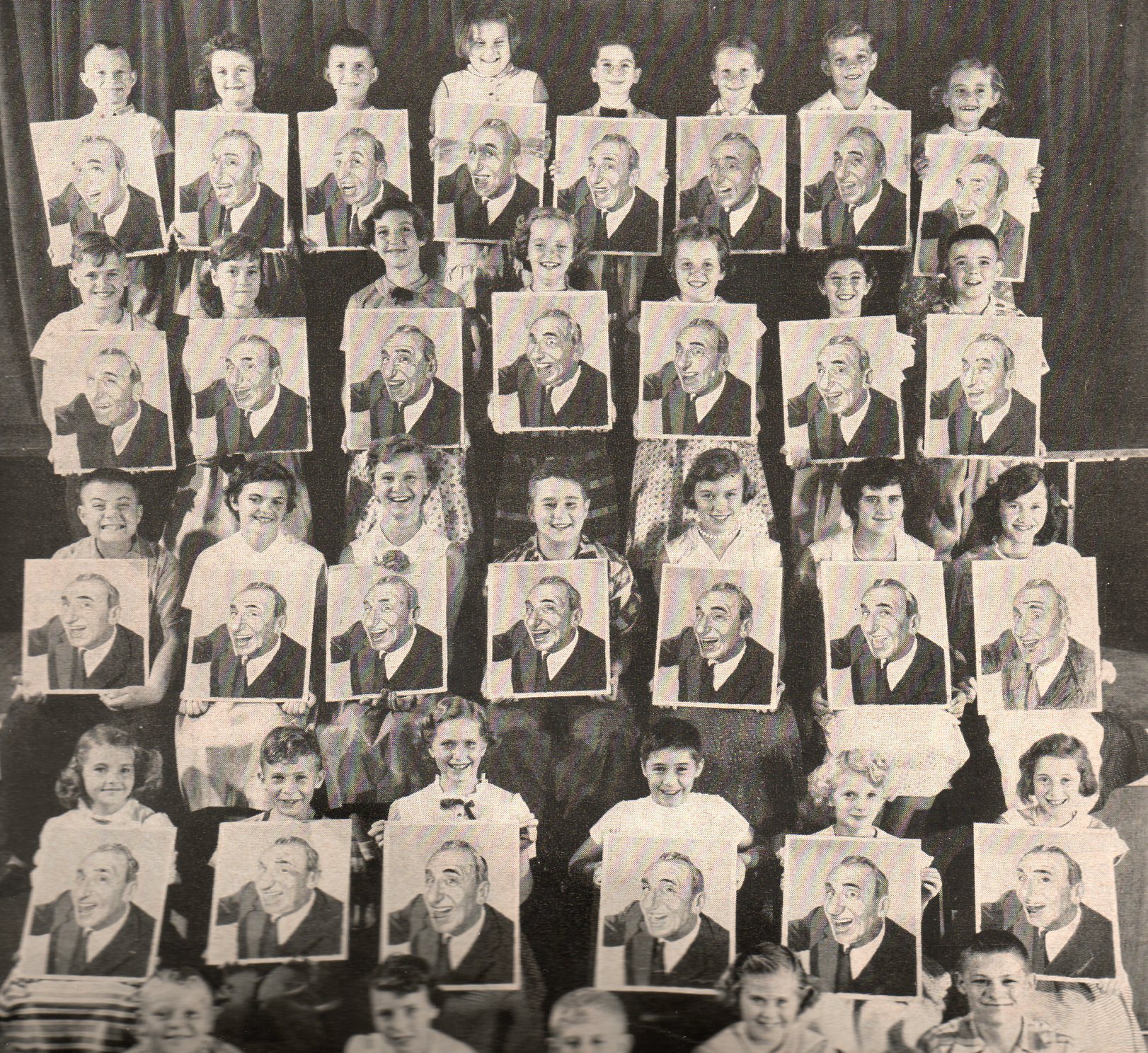
[Photo: 2nd grade class with their happy bequest of Mr. Gileless’ artwork at At, Texas Primary School.]
“Mr. Gileless’ continued artist pursuit was painting Color-by-Numbers portraits of Vaudevillean, comic and movie actor Jimmy Durante. There were more than 6,250 of these portraits found in Gileless’ barn. His will instructs (and provides the funds for) their distribution to ‘as many good Texan second-graders as possible. Yes.’ And so it was this that Mr. Gileless was painting in his secret painterly way, painting again and again, hoping for the colors to improve with exposure to different surroundings, especially and evidently en plein air.”
“When overly prompted on the mysterious Durante muse, Mr. Tang responded: ‘Well sir, I don’t know. But Durante has showbusiness’ biggest nose, and Mr Gilieless had but a scant smidgeon. Maybe it was soulful envy.’ ” –Buck Smeal for the At Tattler Texas, 1 September 1953.
Notes.
1. The Library of Congress decided in the midst of a space-saving fit to save only “necessary” bits from its newspaper collections and to discard the rest. “We aren’t Mr. Borges”, one library staffer volunteered, “and we just thought that all of the other challenged stuff had to go”. The Library’s reduction removed 92% of the newspaper collection “bulk”. Another source said that “if you look at it in one way, what we dumped was mostly nothing, ‘cause the printed page is mostly white space and unused”.
·Posted by :
·in:
JF Ptak Science Books
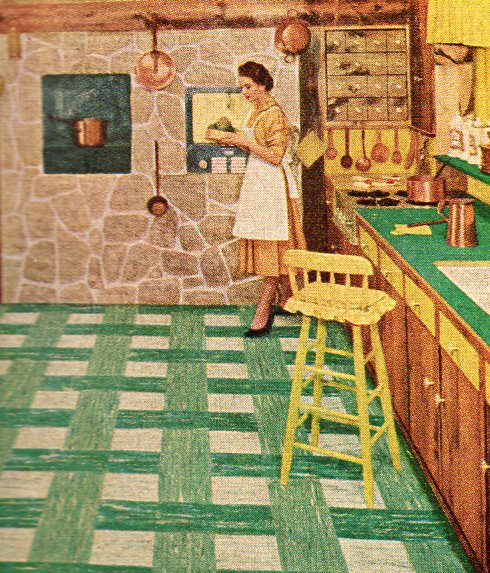
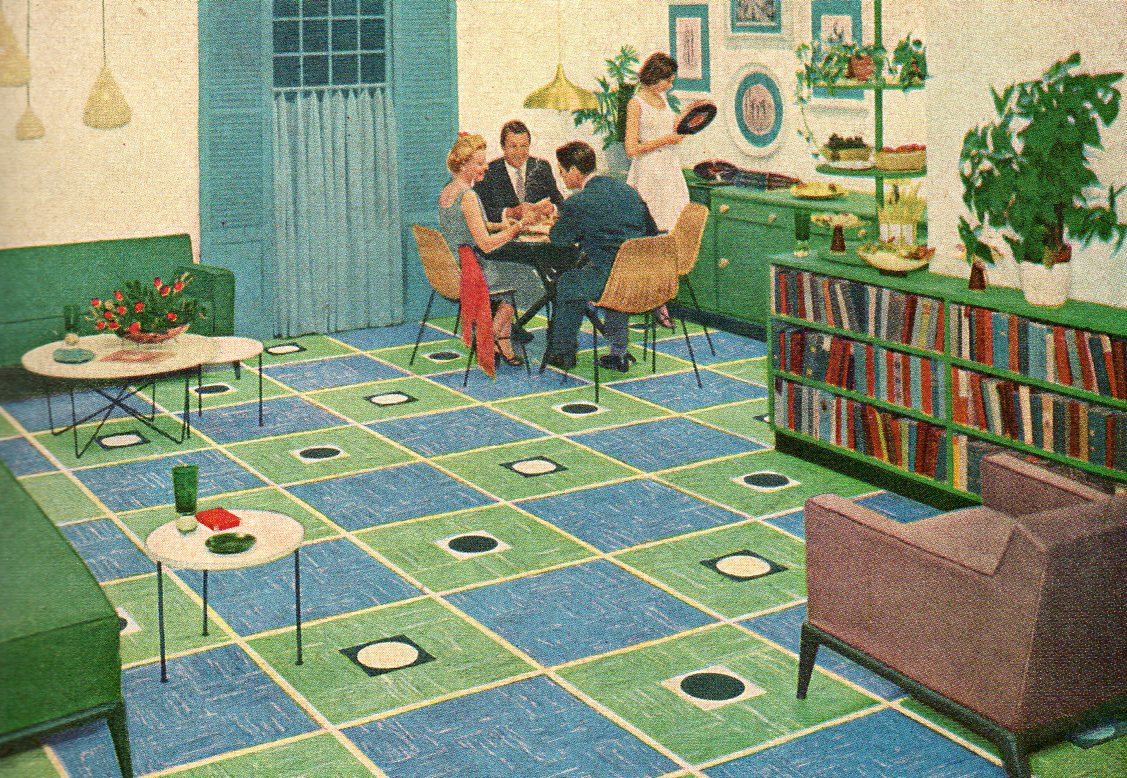 There is an invisible thread running through this blog on the history of squares, starting with Euclid and winding its way through Mondrian, Klee and Malevich and Boullee, atom bomb resistant countries, pixels, perfect, Times, magic, and so on. I don’t think that I’ve ever touched on what might be my own solitary and perhaps-wrong observation on the preponderance of green squares in 1950’s linoleum flooring. As I said, this might be because of my own faulty receptors–and even if I’m slightly correct the color I think doesn’t mean or imply anything in particular. Perhaps the abundance of green comes from a left-over paint or dye that a manufacturer decided to bump into flooring; or perhaps green just looked better to the readers of LIFE magazine than other colors. Be that as it may, there is some loose strand of memory that gets activated every time I see green squares in flooring of the 1950’s, and I just wanted to say that I noticed it.
JF Ptak Science Books (Image Post)
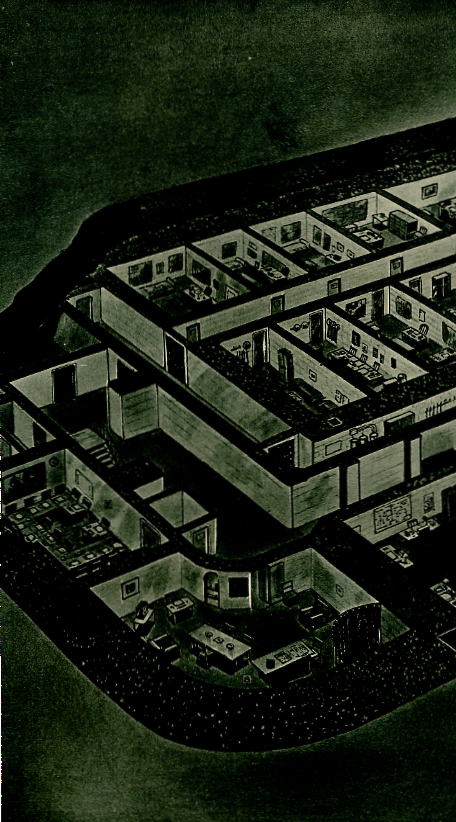
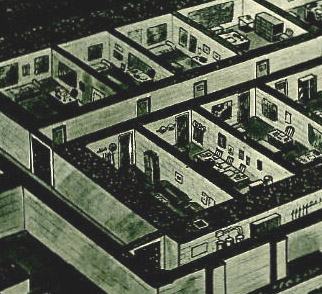
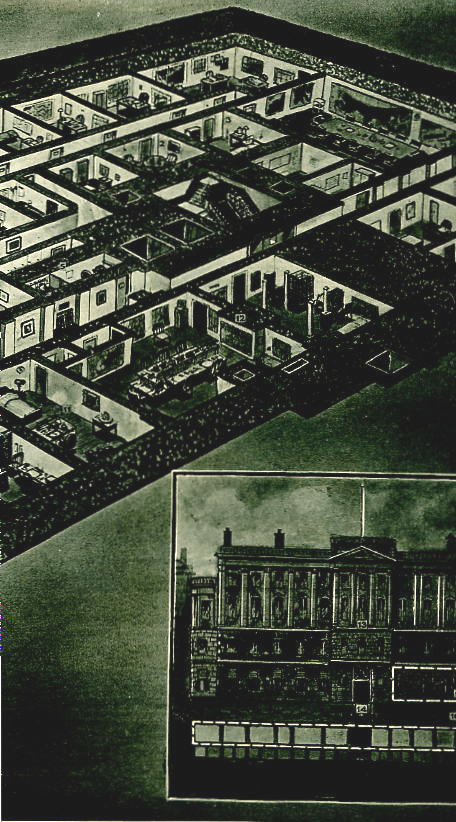
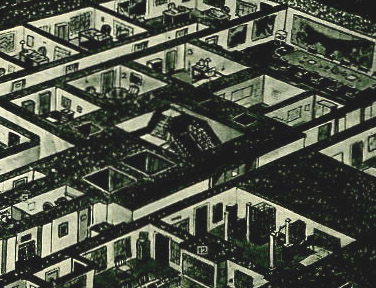
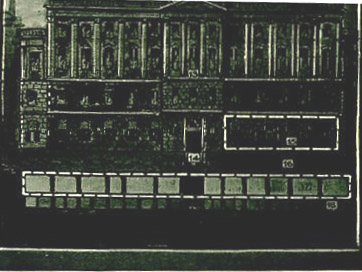
I had intended to write a full post on this schematic of Churchill’s war-time bunker–about a possible future that never came to be–but it has escaped me, though, the I just couldn’t let go of the date–(June 14) now late–for the formation of the second part of the title of this short post. (I guess it will become an entry later on in a life-in-the-ground series.) But I thought at least to publish the images of where–the war was fought–and especially, where the Battle of Britain was waged in the middle and later months of 1940–rather than about the other underground war (or warriors) were getting ready to fight an entirely different sort of war. I’m referring to the Auxilliers, the “Scallywags”, fighters in the league of “ungentlemanly warfare”, the 6,000 or so guerrilla fighters who were being readied to fight the Nazis for the Battle of Britain on British soil by a means other than direct military engagement. Major Colin McVean Gubbins was in charge of this operation (the Special Operations Executive), and he sought people “who knew the forests, the woods, the mines, the
old dosed shafts, the hills, the moors, the glens–people who know their
local stuff”, people who wouldn’t be found, in order to produce a devastating and terminal underground fighting force. Interestingly the headquarters for the SOE was moved by September 1940 to 64 Baker Street, thus giving the folks there the nickname of the “Baker Street Irregulars”.
I should point out that the SOE was very active in different theatres for the vast part of the war–I’m just concentrating now on what could’ve been their operations in the U.K.
These were the fighters who led calm lives during the day who would hen turn into fighters by night who would do absolutely anything to fight the Nazi invading force. But that’s another story (and ably told by John Warwicker in Churchill’s Underground Army). I’ve bumped into other stories of what the British were planning to do in the face of Nazi invasion and occupation–there was of course stockpiling of materiel and intelligence in removed locations, digging bunkers, readying boobytraps, and so on, but also aggressive scorched earth plans that involved flooding, sinking part of the Navy, destroying munitions, and so forth: desperate things, heroic measures, to fight to the last. And I absolutely believe that Brits would’ve done every bit of that, fought to the very last possible end and effort, every person doing what was expected of them.
JF Ptak Science Books LLC (Image Post)
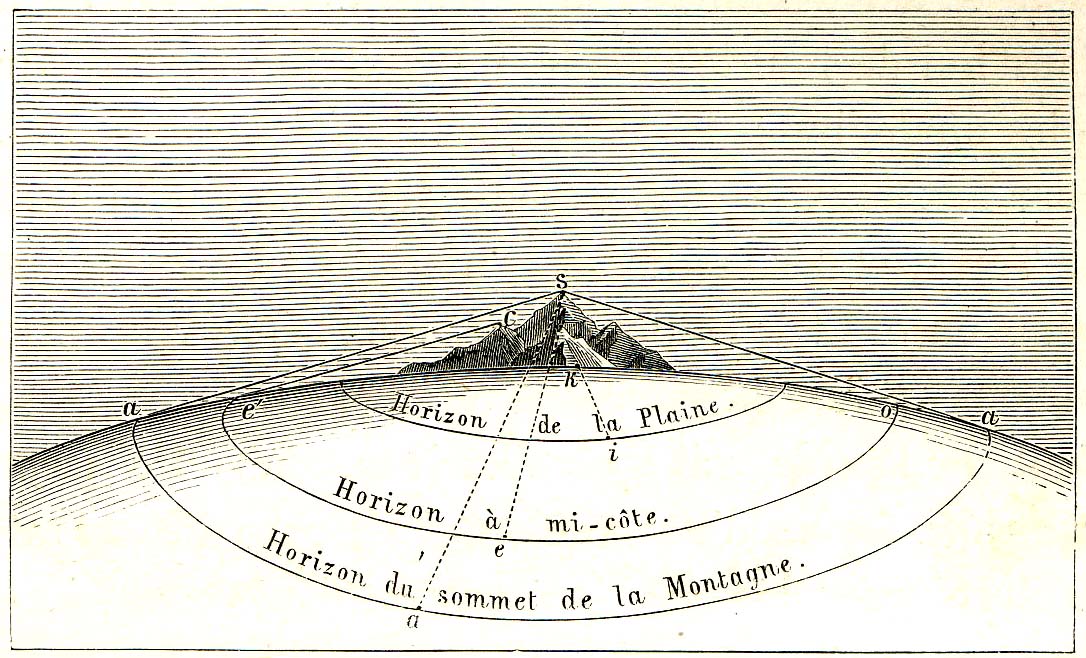
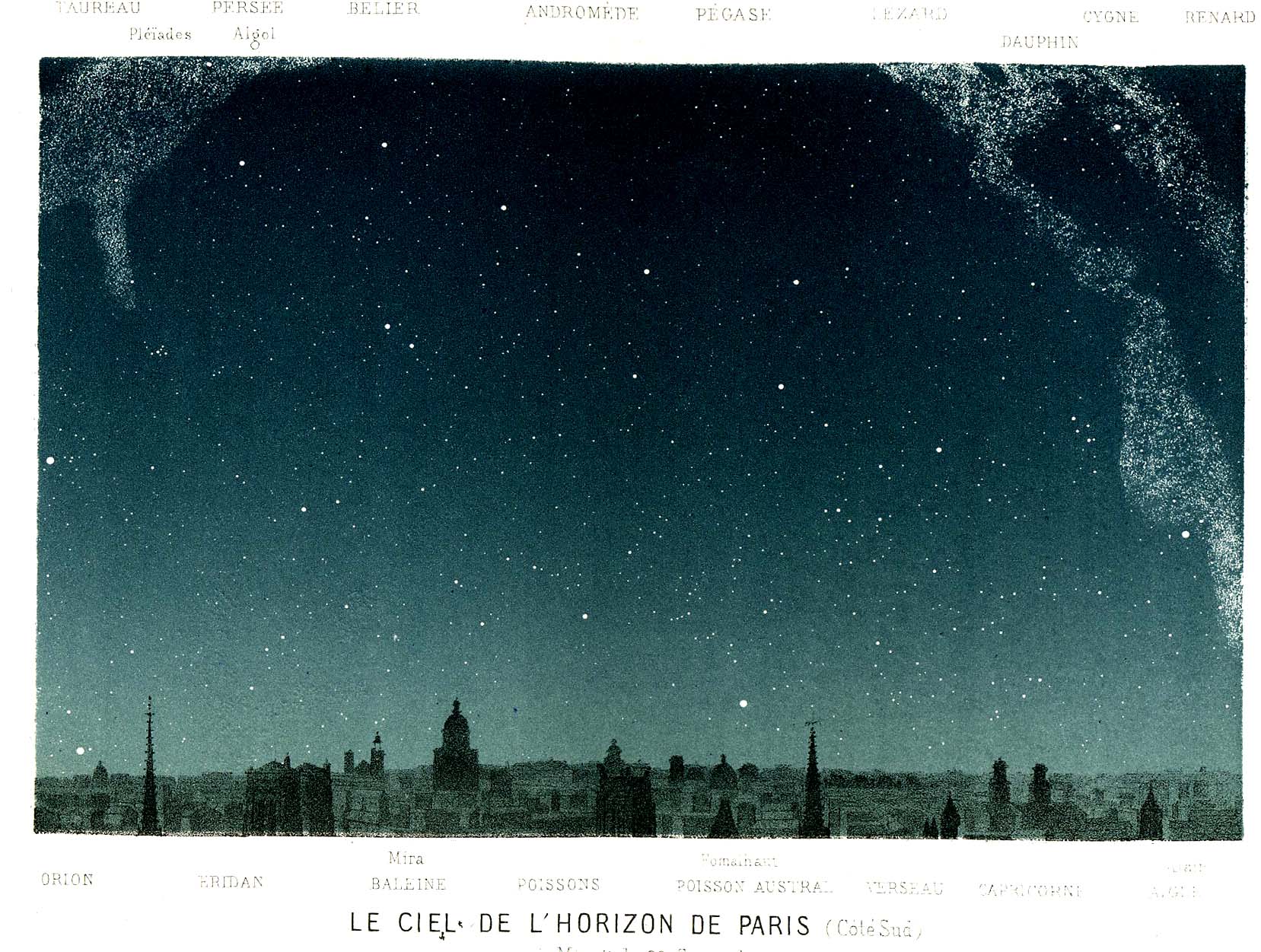
I’ve always been attracted to antique prints showing distant horizons engulfed by a big (and preferably blank) sky, though in a pinch of a human landscape made miniscule by an enormous starry sky will do just fine. In any event the images below are unusual for their depictions of Big Sky–a hard thing to translate on a little piece of paper.
JF Ptak Science Books
I came across this image in the Illustrated London News for 8 Mar 1943–it is an extraordinary thing, both wrenching in the fantastic simplicity of the material used for training, and magnificent for these men behaving like the soldiers they were for training in a flimsy imitation landing craft for the invasion of Europe. I think it an amazing thing that so much could have been produced with so little material assistance.
The caption reads: “the Royal Marines are ready for anything; an invasion craft has been built on land so as to give them invasion practice”. I think of these men with nothing but the highest respect and admiration–they certainly know that these bits of wood on dry land won’t approximate anything, and yet they train. There was no alternative.
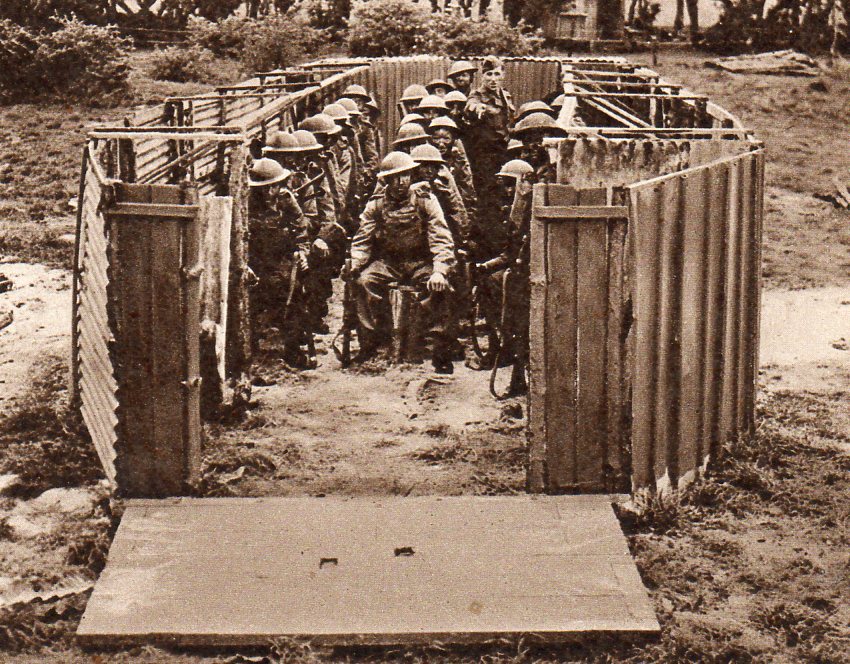
Patti Digh just said–while looking at this picture–“history makes me weep”.
Thanks for dropping by! There are more than 600,000 other words on this site (along with another 3,000 images) so have a go. There’s an index of categories to the right–enjoy! Some other recent posts from this blog have appeared in The Economist, The New York Times, Boing Boing, Jezebel, The Wall Street Journal, and others.