A Daily History of Holes, Dots, Lines, Science, History, Math, Physics, Art, the Unintentional Absurd, Architecture, Maps, Data Visualization, Blank and Missing Things, and so on. |1.6 million words, 7500 images, 4.9 million hits| Press & appearances in The Times, Le Figaro, Mensa, The Economist, The Guardian, Discovery News, Slate, Le Monde, Sci American Blogs, Le Pont, and many other places… 5000+ total posts since 2008.

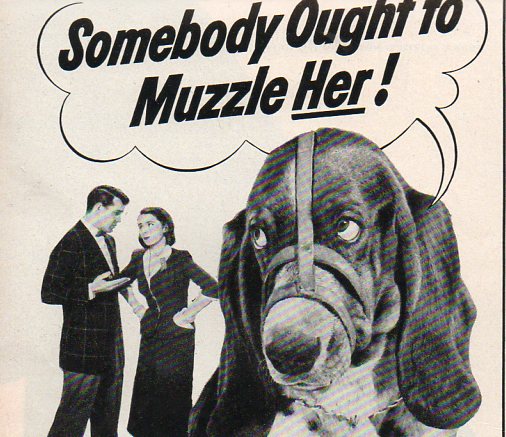
  • Women–Muzzle Her, Mask Her and Turn Her into a Cigarette. 1953 Ads

    JF Ptak Science Books   Post 1149

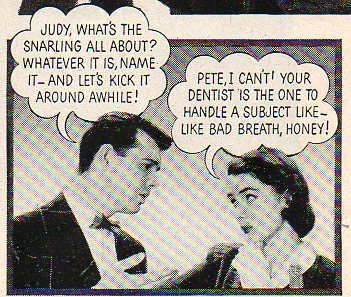
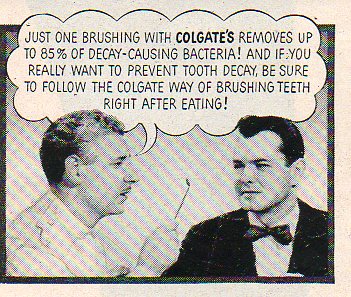
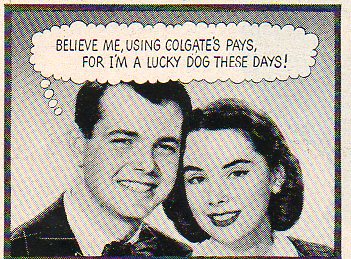
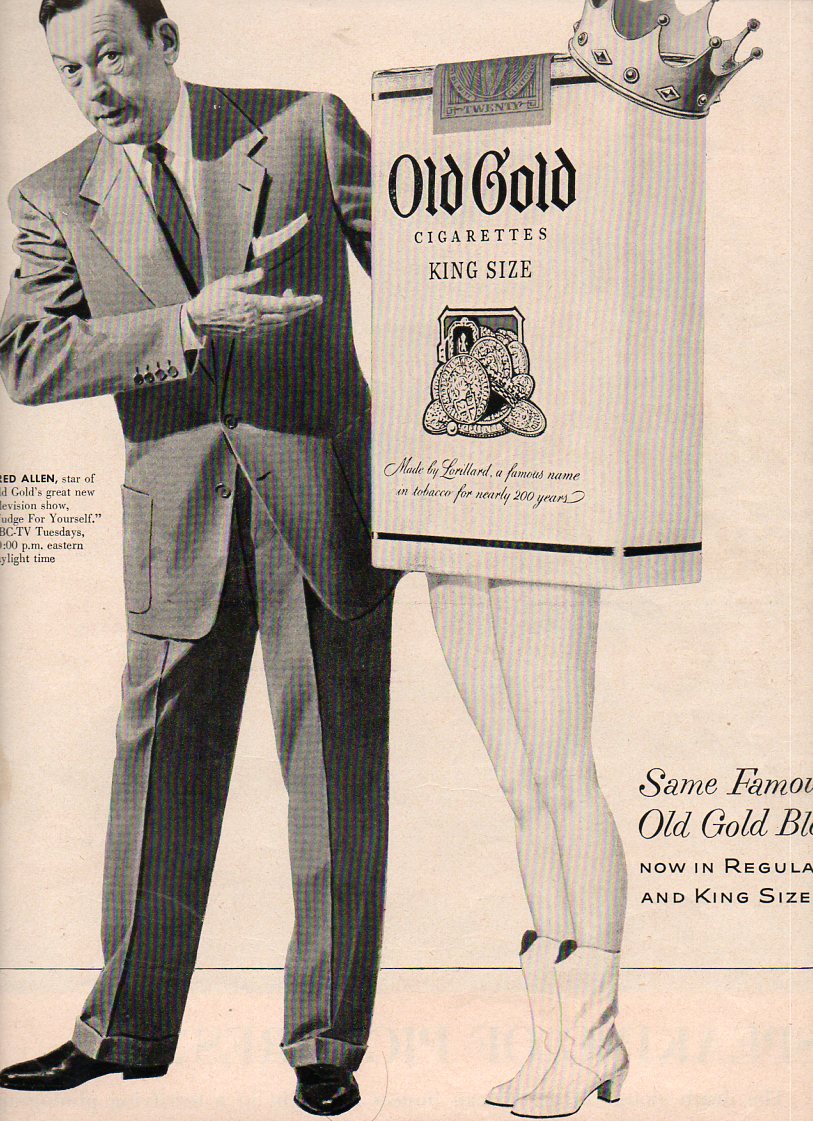
    Three ads disappearing women– first with a muzzle, then with a full head mask, and then there’s nothing left but legs–part of this blog’s History of Women series.

    There’s nothing quite like objectifying women than objectifying them, making their objectification so wide and gross and visible that it is almost impossible to imagine that it was done–but, then, there it is.   And that’s part of what we see as standard operating procedure here in these ads in Life magazine for a four week period in 1953,   I started out on this foray looking for an article about US aid to Vietnam, but kept bumping into these advertisements.  The images today have certainly changed and have become more subtle, but the message is still the same. 

    The first series
    Muzzle 1430 

    Muzzle 2431

    Muzzle 3432

    Muzzle 4433

     Muzzle 5434 

    is so odd; I’m not so sure why the dog was barking to muzzle the woman–she has hardly said anything…but perhaps that’s the entire message.  There there’s this approach:

    Muzzle C helmet436
    keeping a beautiful, manicured and jeweled body while getting rid of the face and head and personality.

    And then

    Muzzle b old gold435

    Old Gold makes a final assault on womanhood, replacing her upper half with another oral fixation, keeping the booted lower half for whatever.  I think that there was a refrigerator with high heels in that year, somewhere, but I can’t find it.

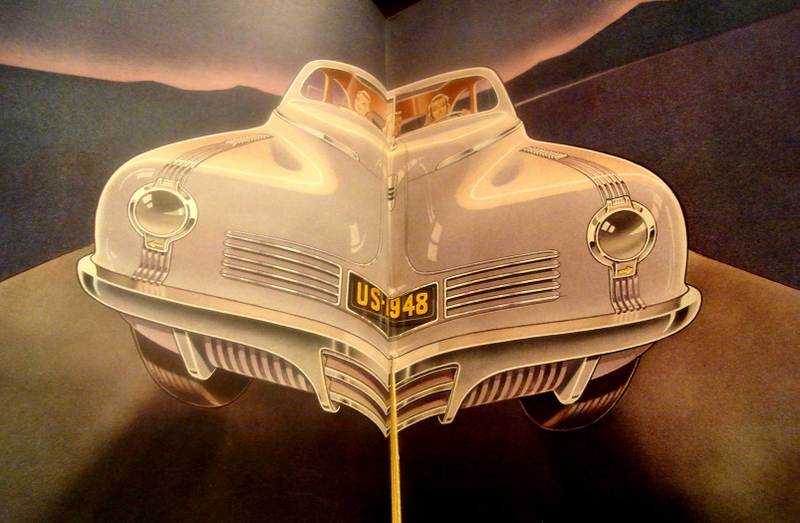
  • TV and Liquor, the Modern Colossuses–Visualizing the New SuperSize for the Masses

    JF Ptak Science Books  1150

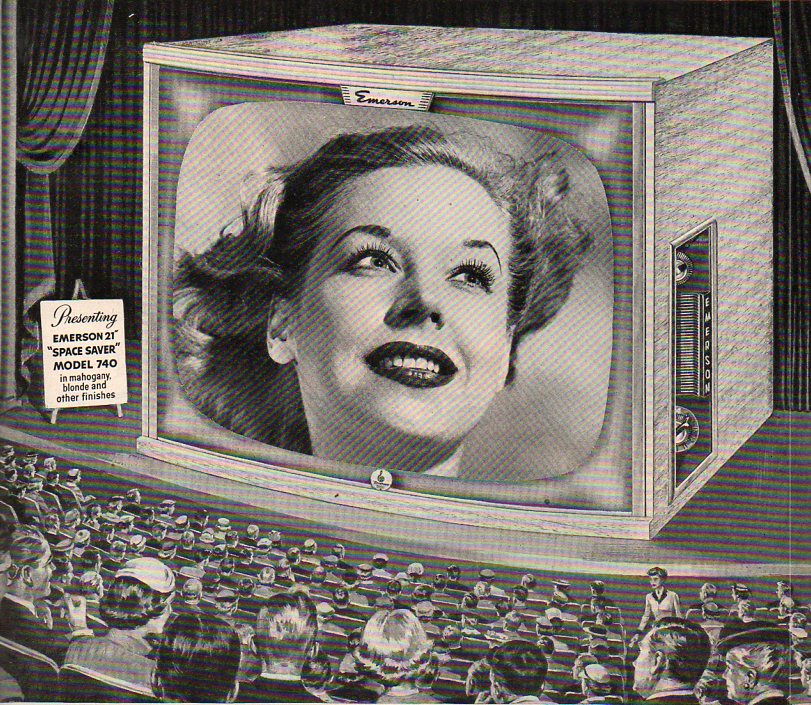
    Rabelais’ Gargantua and Pantagruel, Hobbes’ Leviathan, the Buddha at Yungang (Shanxi) and Melville’s whale were all pushed to their competitive monsterous edges in the 1950’s, when you were more likely to think of The Bomb and creeping Communism before thinking back to any of these great representations.  And it is also my general impression, having been paging through Life magazine for the 1950’s, that there are some other major, lesser heralds of gigantism, especially if you paid attention only to the advertisements. There were 1950’s colossal characters who were pale imitators of their earlier counterparts–the Amazing Colossal Man and Colossal Woman being two minor mirrors of older ideas–but they hardly contained the colossal ideas that were resident in the earlier creations. (Perhaps part of that is due to having just witnessed the demise of two enoromities in Hitler  Stalin.)

    Monumental television theatre446

    The new Pantegruels seem to have been television (completely victimizing
    and nearly eradicating radio in its day), giant cars, liquor,
    cigarettes, breasts, and, television, followed by television.  There was
    also the movies, with films filmed in super-spectro-pano-fabulism; and
    of course there were the computers (the 1943 machine at Bletchley Park
    was actually called the “Colossus” with Mark 1 and Mark 2 varieties,
    which were actually less colossal than the other period  colossi such as
    the Harvard Mark I/IBM ASCC and ENIAC), which just now turning the
    corner on “big” and getting faster/smaller/more powerful, and also
    fulfilling the “Giant Brains” dream.

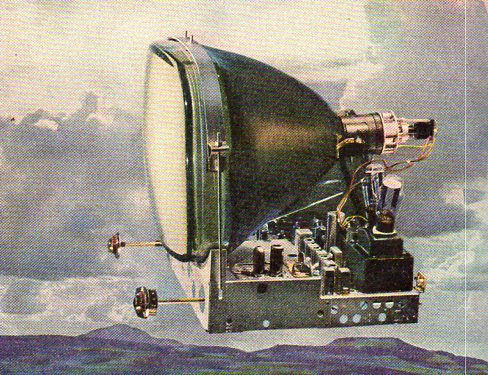
    Monumental television flying445
    I’m not sure, but it feels right to say that there is a direct correlation to things getting both bigger and smaller as things got faster.
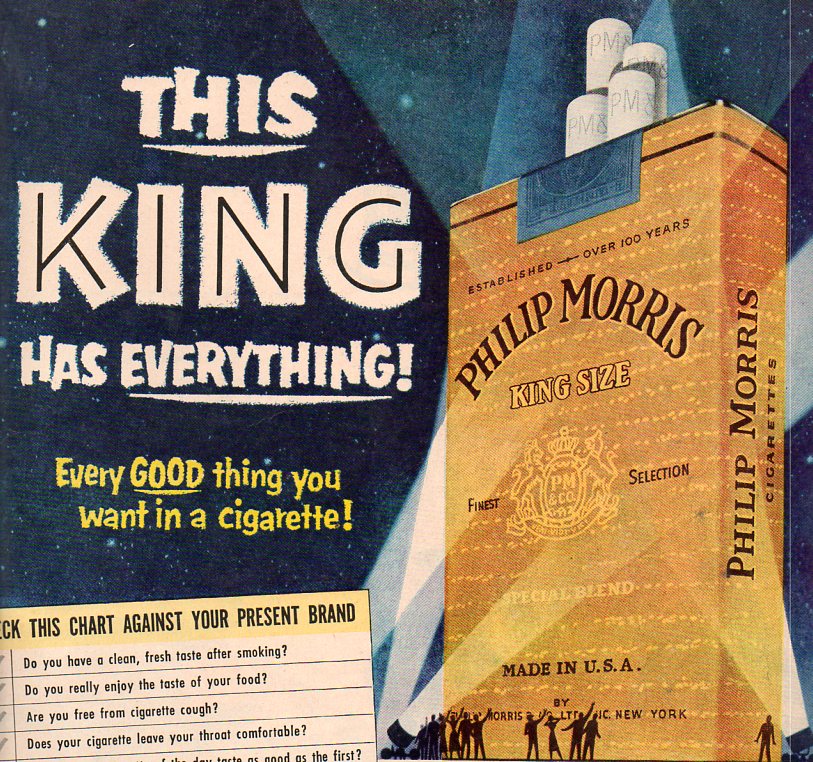
    Monumental cigs the king444

    Anyway the new Colossuses/Colossi  were hardly as attractive and had
    virtually no literary value compared with their earlier Rabelaisical
    counterparts or the giant 4th century BCE statue bearing that name in
    the harbor at Rhodes.  It is certainly true that the big things that
    were imagined in the 20th century were beyond any conception of “big” in
    the Western Canon of Big.  (There are certainly great big things in
    other cultures, say, in India for examples, where there are entities and
    numbers so vast that there was nothing to compare them with in the
    West.  But that’s another story.)

    Monumental whisky world442

    Monumentalism--airplane
    Monumentalism--car

    Monumental world tophat447

    Monumental world tire440 

    And of course joining the gigantic cultures of guns and booze:
    Monumental gun farm441

    ·Posted by :

    ·in:

    — —
  • Prescience of a 1953 TV Ad: the Speed of Isolation, and the Post-Forgetting Future

    JF Ptak Science Books   Post 1151 [Part of our History of the Future series]

    The History of the Speed of Things is an interesting category for a history of odd things: the speed of exploration, of curing someone with a gallbladder problem, of flashing across the White Sands desert in a rocket car, of the pulse of a human neuron, of the time it takes to go from 10 microns to 1000000 microns, of how long it takes to get to Tybee Island from Asheville North Carolina, of insurance information to tall ships coming over the horizon, of gravity, of light, of computing a billion place of pi, of calculating where to aim your anti aircraft guns at the incoming Luftwaffe, of diving to the greatest depth in a submarine, of running 100 metres, of a drop of mercury falling 1/1000 of an inch, of the speed of nightfall on the Moon, and so forth. 

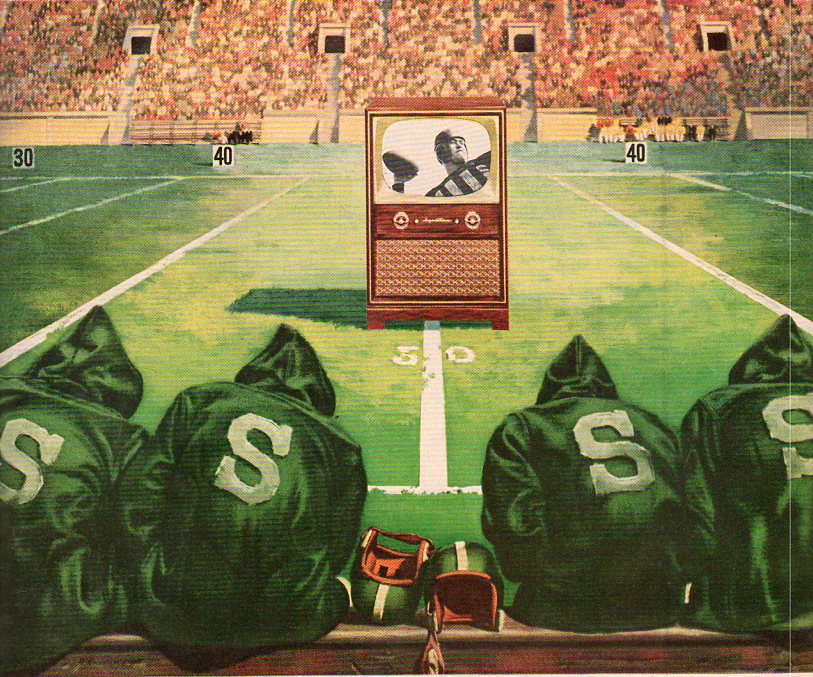
    Future of thinking sparton 2449
                                                                                                                                                                 
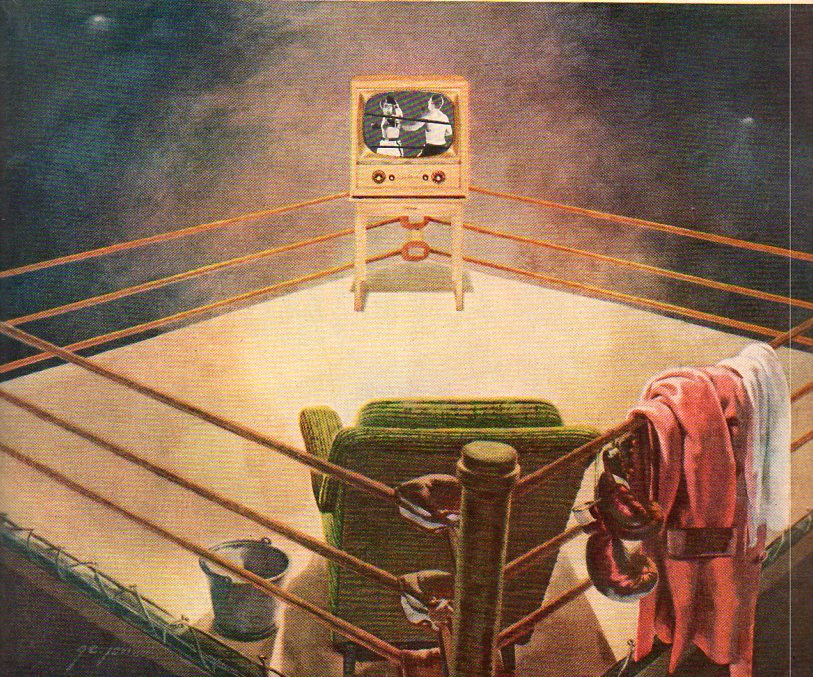
    The Speed of Things’ subcategory is the History of Speed of Knowing Things, with its interesting and proportional  subcategory of the The History of the Speed of Forgetting Things, both of which are associated with the point of today’s post, which was the sneak-peak of the future offered in a series of ads in Life magazine in 1953.  The full-page ads were formatted by Sparton Television Company to grab the attention of even the laziest semi-monied reader of the magazine, selling the promise of entertainment at home.  The cost for admission for this product was fairly luxurious and a little extreme once you translate the $400 entrance fee into its percentage of the average monthly salary (which was about equal) or of a new (general) Ford (about 25%) or of the average monthly rent (125%). The television as something to be reckoned with.              

    Future of thinking sparton boxing450
    There’s something more to the ads that the designers and readers couldn’t have known at the time, though.  In the ads, the tvs are shown replacing the action that it is supposed to be transmitting–it has become the thing itself, a passive replacement to an action.  Rather than watch a baseball player at bat swinging at a pitch, we see a television with a batter in it, moving just as the pitcher is moving,.  The barcolounger in the ring of the prizefight is presented with the fight on a tv in the opposite corner, and the football players have been replaced by a black-and-white image on a television tube on a field of green. 

    The message then of course was that television was putting you into the scene, that the viewer was part of the action and not just a casual observer.  I guess.  Sitting here in 2010 though the ads seem to play to a greater truth, and might be more prescient for the coming future than the original advertisers could’ve possibly imagined.  All throughout the history of communication, I am certain that there was a  percentage of the population that viewed the newest invention as  not necessary and an affront to privacy and free time, of more deeply removing a person from the act of communicating–the semaphore, telegraph, telephone, wireless, airmail, overseas calls, email, bluetooth, twitter, and so on all presented this similar problem.  Just as these improvements were adding to the flow of information, they were also isolating the recipient from the sender.  The more access to info and data, the more it was accessed; the more access, the more time spent accessing; the more time spent accessing, the more time theoretically spent responding. And so on ‘tll you get to the so-called modern time, when there is data presented to us all of the time, inescapable info flows, gargantuan landslides of numbers and images and words and fluff, available at all times, and almost at all places.  The technology making it possible for people to more freely communicate is, in a way, replacing the person, allowing communication nodes to have a human interface connecting them.

    Now this might be a little extreme, at least for the present.  I’ve little doubt that some people feel as though they are simply connecting word threads to other word threads and passing it along, seeming as though the are piecing together the floating bits in an enormous flood of floating bits.  As my wife Patti Digh quotes the Buddha in her book Life is a Verb, “What is the appropriate behavior for a man or a woman in the midst of this world, where each person is clinging to his piece of debris? What’s the proper salutation between people as they pass each other in this flood?”

    I’m guessing that people would be uploading pictures of themselves googling the question, or receiving an image of someone in front of them, waving to them, as they are swept along in the flood waters.

    These pictures from Life tell the coming story, and I think can remind us that as foreign as they might seem then, and as uncomfortably true that they might seem to some now, that they could very well seem painfully/obviously true at some near point in the future.  The computer for all intents and purposes is only 65 years old; home computing is three decades old; the internet, two.  The changes brought on by all of this were almost invisible 25 years ago.  The coming of the future in regards to communication, even a future that is only 25 years from now,  may very well wind up being as difficult to see from 2010 as it was to see our year in 1985. 

    I wonder if in the future we’ll have to pay for silence, pay to be relieved of data, pay for relief from advertisements from a flood of products and services that we don’t ad will never actually “need”, pay for time for the silence to actually think?  When people are smoking and talking on a cell while riding a bike or texting while plasticizing their dog’s environmental offerings, when is it exactly that there will be quiet moments for extended thinking?   Where will our consumption of information be in 25 years from now, or 50? It is only too bad that the process of consuming info didn’t lead to some sort of generation of energy, like tidal power, because at least then there would be one certain positive outcome of data access. 

    And I know that accessing things will be much smarter even in the near-future than it is now, Google searches will look as quaint four-digit phone numbers.  But still there is the data, and at that point the data will be more pertinent, which means there will be more of it to spend more time on.  Its a Catch-22–we’ll waste less time, probably, on what we weren’t looking for, which means we’ll have more time to look at more things that we were looking for, except that there will be too much of it, and there won’t be enough time to read all of that, let alone to give it some thought.

     In all of this, the thing that might take more time to deal with than actual thinking might be the process of forgetting.  Perhaps in the deeper future we’ll just be born with all of this information, or have instant access to it, and then in that future where there is no forgetting we’ll just have to imagine that we’re imagining quiet time. 

  • 1947 Anatomy of Womanly Desire–Aprons, Plastics and Meat

    JF Ptak Science Books  Post 1152  {Part of the History of Women series.]

    Looking at just one week’s worth of advertising directed at women in America’s most popular magazine.

    One of the great custodians of American popular desire in the 1940’s and 1950’s was Life magazine, a picture-heavy chronicle of social history and needs and dreams.  I enjoyed the issue of Life for 12 May 1947 because it had an article on the history of skirt lengths (something I wrote about earlier in this blog here), and looking at it a second time I realized that I had entirely missed the ad content that drove the magazine.  The poetry of expectation flavored by the ads directed at women were rive ting to me here in 2010, partially because of their narrow aim, and partially for the simple and simplistic urges that were addressed.
    Women--growing grown451

    The basic messages were lace, timid street crossing, plastic conveniences, bendy girdles, smart shoes, refrigerator hope chests, instant coffee, machine made clothes by Singer, DuPont combs, artificial fabrics and diamond-centered bedroom window covers by Textron, “shoes to catch his eyes”,  various flavor secrets, baby insomnia aids (“to help your husband sleep”),  dreams of meat, and some other vaguely painful things.

    The ad that first caught my attention was the life cycle of woman, seen above, picturing the grown woman in a petroleum-product apron  gleaming as she worked  her way through her Firestone-provided kitchen, emerging from babyhood to childhood to womanly-aprony-adulthood. 

    And an impossible position for girdle wears to participate in the wearer’s girdle’s allowances, complete with fluttery Disney-esque birds:

    Women--growing bendy454
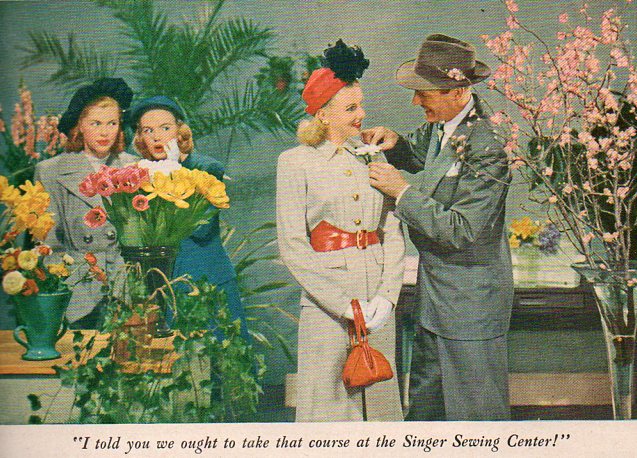
    The clustered desire over the another woman’s success in snagging a man’s interest because she could sew:
    Women--growing singer460

    And just one of three ads exalting various refrigerators, though this one had a newly-minted bride inspecting a model that for all the world could’ve been her hope chest, though this version was filled with food and meat (and a whole hell of a lot of potatoes) and introduced by a version of herself in the next chunky-shoed decade:
    Women--growing Kelvinator453

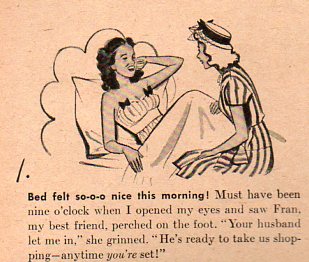
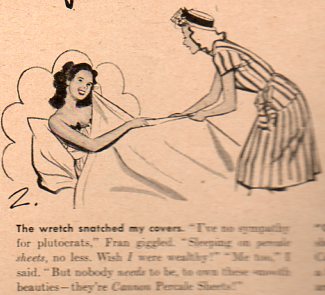
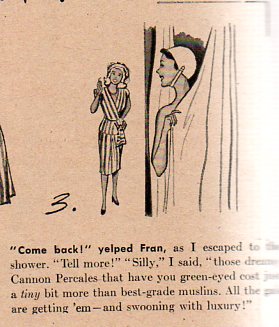
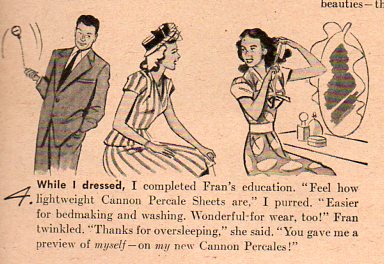
    There were ads for percale sheets, though the segment has a rather odd, vaguely proto-sensual feel to the thing (hardly I think what was intended in 1947).  It plays out a little better when the ad is rearranged in filmstrip style, reading top-to-bottom, rather than side to side:

    Women--growing overslept `455
    Women--growing overslept 2456 

    Women--growing overslept 3457
    Women--growing overslept 4459 

    Women--growing overslept 5458
    Hm.

    Not all of the womanly attention of the magazine was focused on girdles and bras and wedding meat–there was an article on Dorothy Shaver, the President of Lord & Taylor, America’s “No. 1 Career Woman”.  She made $110,000 a year  and was widely successful, but still  “carried a lace handkerchief and cross(ed) streets timidly”, and lived with her younger sister–in an earlier time Life tells us that Ms. Shaver would simply be called a “spinster”, “but now she is called a career woman”.  There was no change in the description or definition of a “spinster” or a “career woman”–they just changed the name, the result being the same, even in describing the first American woman to ever lead a multi-million-dollar international business.  (This in spite of the fact that there were plenty of working women at the time who were married and had families, no to mention the fact that we had just finished a war during which a  near-majority of women were in the workplace.  None of that seems to have come into play here in 1947, when those same war-working women were summarily replaced and sent packing, and the careerist was defined for one and all to be a spinster.)

    I am sure that I will be called to task one day i n the not-too-distant future by my daughters, asking what it  was, exactly, that people were thinking in the year 2000 in regards to women–so strange to them in their version of looking back on their equivalent of my 1947 Life magazine, a version in which I actually lived.

    In any event, these ads weren’t necessarily what women wanted, of course–they were what advertisers wanted women to want. 

  • Zippers, Part Two: a Big Lesson from the Humble Zipper

    JF Ptak Science Books   Post 1154

    Blogaugust_28zipper469_2

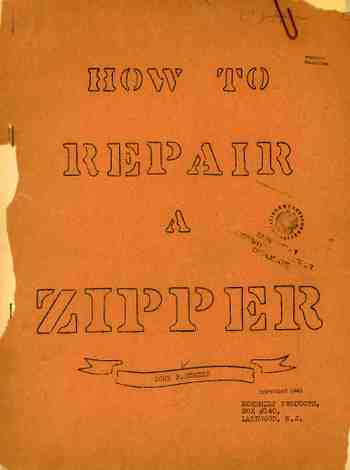
    Earlier in this blog I made a post about the Ulysses of zipper repair.  How to Repair a Zipper was one of those great, unknown classics of American technolit that stands the test of time, a great manual on how to approach n-problems with a faulty zipper–if only there were zippers worth repairing.  There are different grades of zippers, just as there are different grades of any other fastening device or automobile or wine.  Of course the zipper seems a ridiculous subject unless the lives of people–say the lives of soldiers–are dependent on their zippers working when the going got tough, 
    when soldiers’ jackets really needed to stay closed, tight, protecting them from the rain or cold.  Just ask the soldiers in 
    Zipper trouble465

    the Napoleonic army when their coats refused to stay closed because the threads that held on their  buttons that held their jackets closed failed, leading to the death of many due to exposure and cold.  Suddenly, fasteners are a big deal.  Just try it the next time you’re out on the frigid trail–unzip your jacket and try to keep the thing closed and you warm.  Its a bad story. 

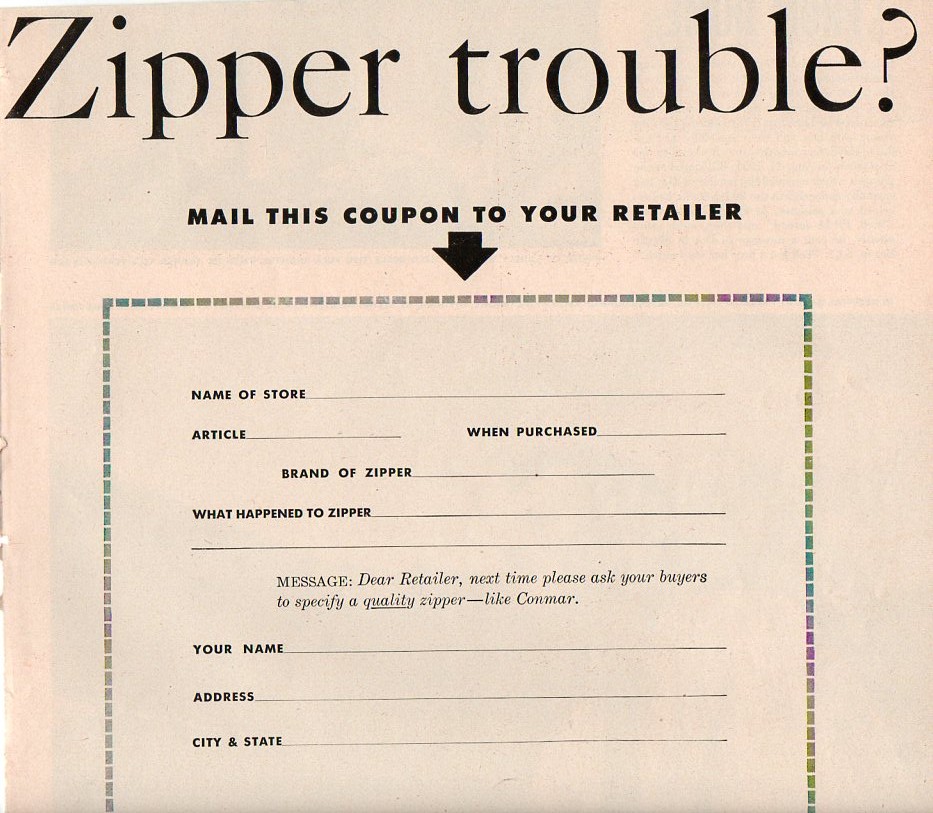
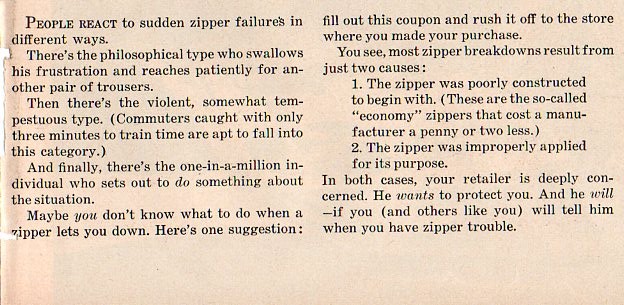
    So the initial reaction to this ad that appeared in Life magazine in 1953 is some laughter to a non-sequitor, but once you gave it a little thought, it can be appreciated just like any other piece of good craftsmanship.  In this ad, the manufacturer of Conmar Zippers (located in the once-mighty, once-leading American city of Newark, in New Jersey) plead with the reader of the full-page ad to pay attention to the zippers on their apparel.  If the zippers fail , they should use the blank form to send to their appropriate retail in complaint, and to replace the zipper with a high-quality, unconditionally guaranteed Conmar zipper, made to never fail. 

    This is attention to the small detail that would do us a world of good today. I love the idea of the Conmar Zipper.

    Zipper trouble 2466

  • Airport in the Sky, Airborne Zeppelin Airfield, 1925

    JF Ptak Science Books  Post 1101

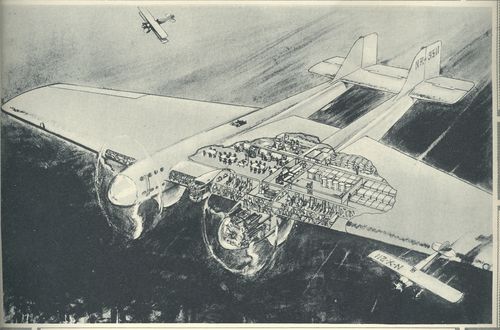
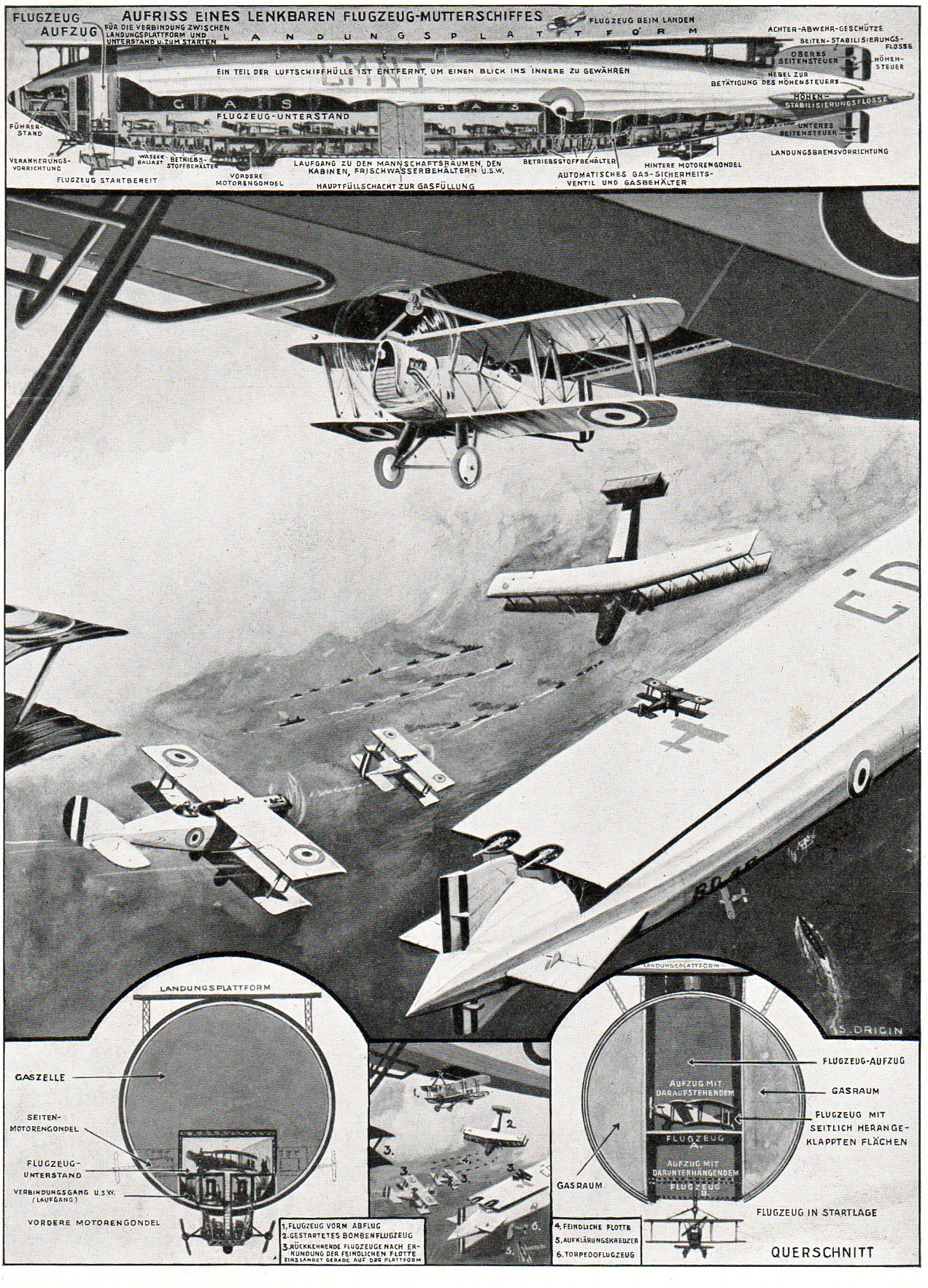
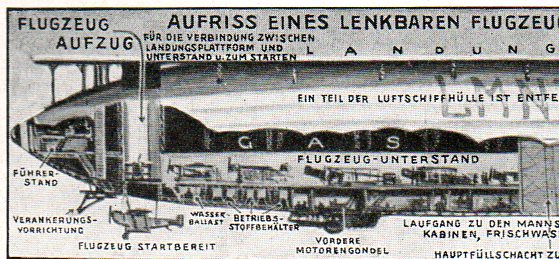
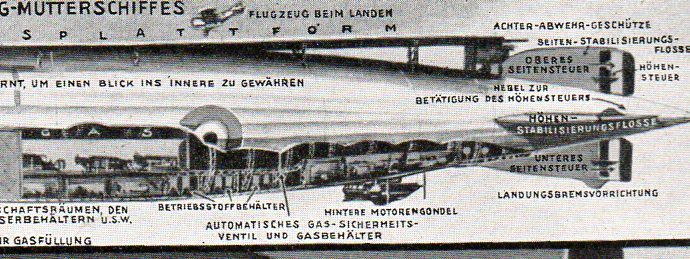
    This interesting image comes from the Illustriete Zeitung (Leipzig) for July 1925 (“Zeppelinsche Riesenluftschiffe” by Dr. Hildebrandt), and shows a British proposal for a dirigible outfitted as a sea-going airborne airport for military planes. 

    Airport--dirigible241

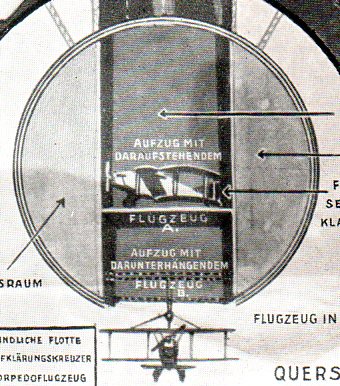
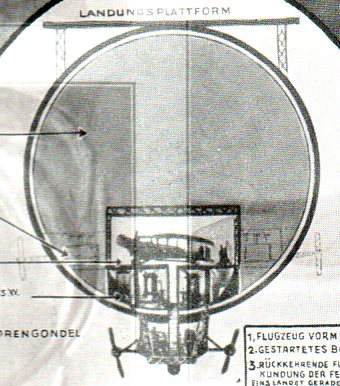
    The aircraft would land aft, and then proceed forward to an elevator that would lower it belowdecks to a hangar (looking as though it could accommodate 11 or 12 aircraft).  Once refueled and re-outfitted, the planes could be lowered from the body of the dirigible and launched into space. 


    Airport--dirigible a243

    Airport--dirigible b244

    And of course some cross sections:

    Airport--dirigible c245 

    Airport--dirigible d246

  • Elevated, Rooftop Inner-City Circular Airports, 1919

    JF Ptak Science Books  Post 1102

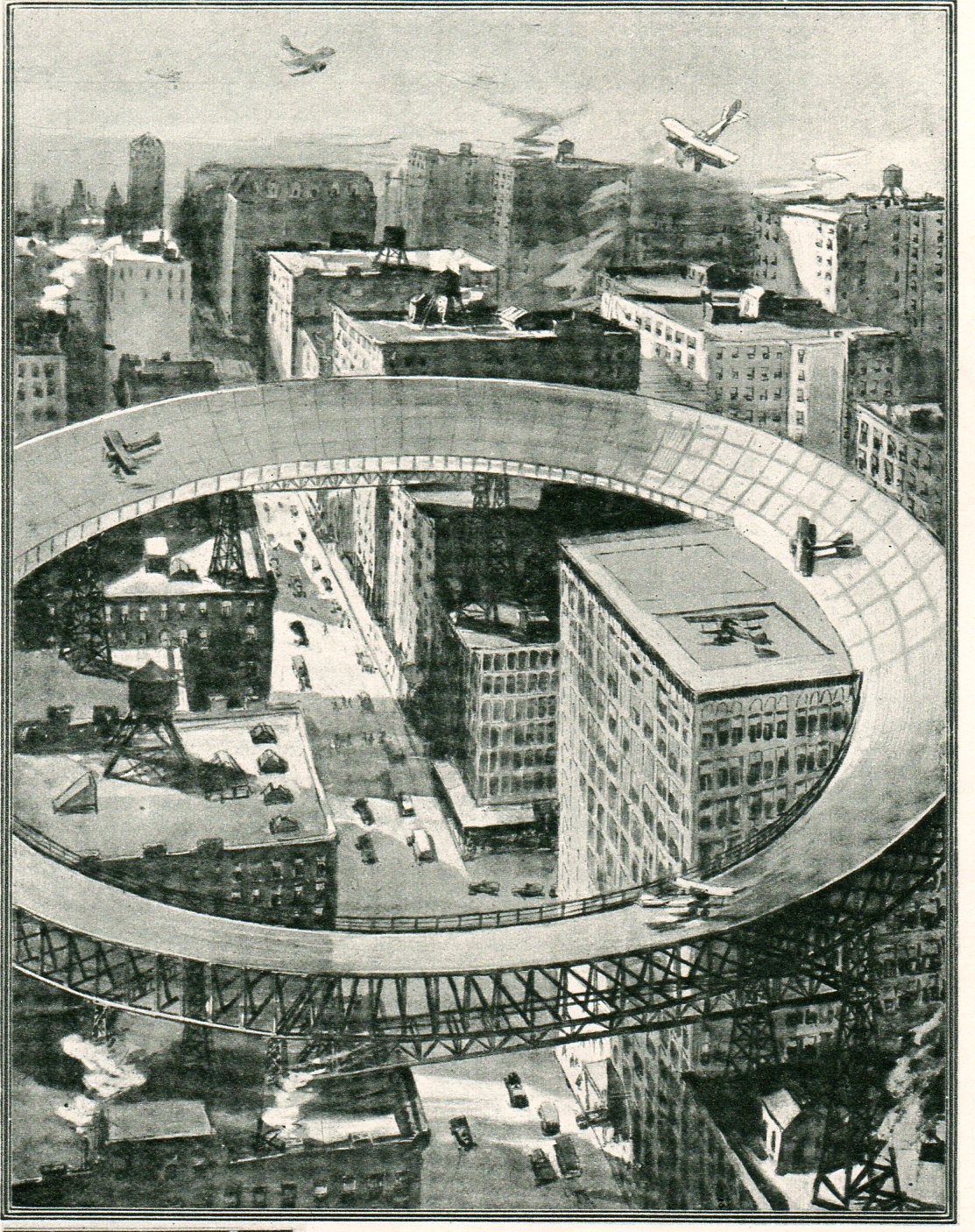
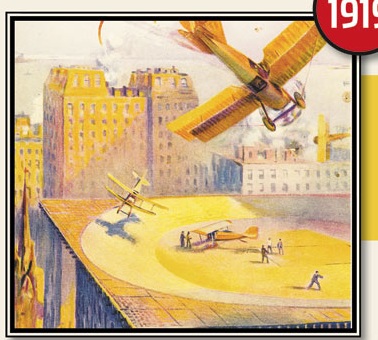
    The presumption of this Illustrated London News article (“On the Impulse to Fly Commercially”, 18 October 1919) on the growing popularity of commercial flying for business and pleasure was correct, but the placement of the airports to service the growing community of flyers was, well, not.  

    Airport--round 247

    This is a prototype, of sorts, for many dozens of proposals that would appear in magazines like  Science and Popular Science and Popular Mechanics and so on, suggesting inner-city airports that could be easily accommodated by the city bustle by placing the airport on top of buildings (as above), and these other closely-related ideas (below):

    [Picture source: Paleofuture.com]

    and this:

    Aircraft
    [Picture source, again, from Paleofutue.com]

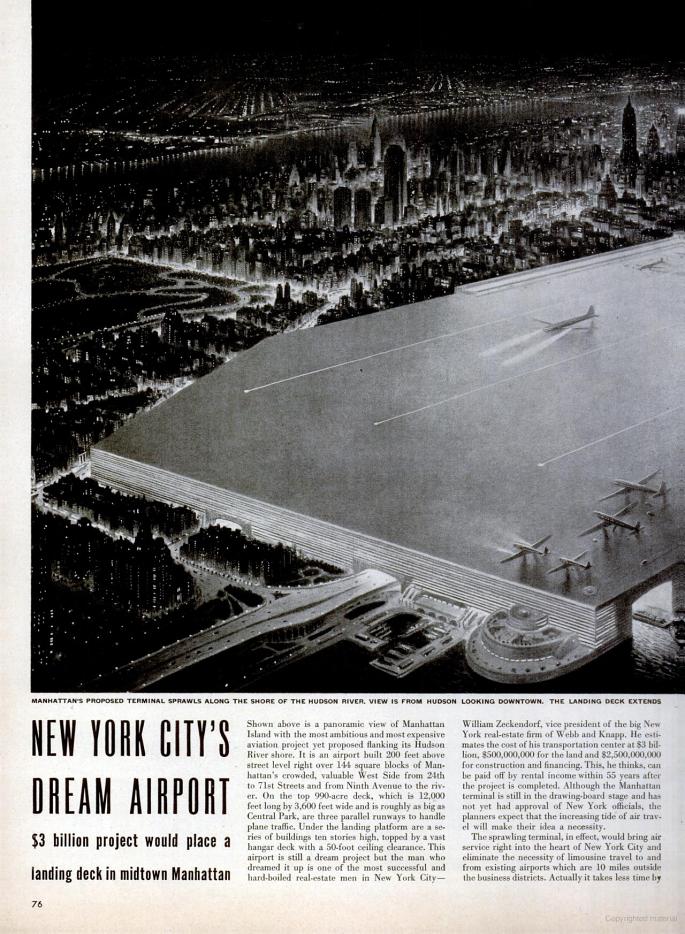
    These terrible ideas were also seen in building enormous platforms over entire sections of the city (like Zecendorf’s massively bad 1946 idea)

    Books

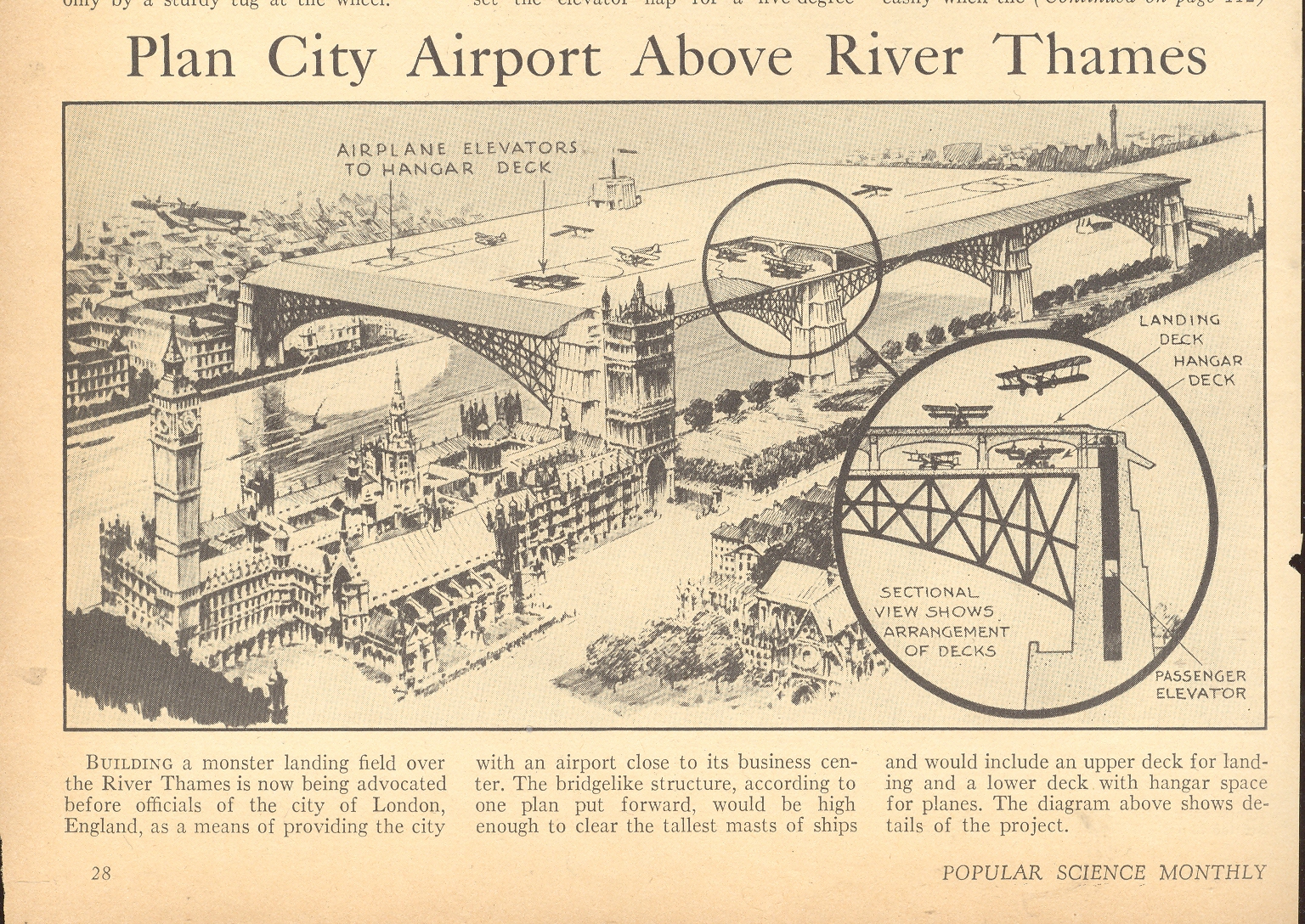
    or massive flyovers on rivers (which I also wrote about here),

    Blog Dec 17 thames airport

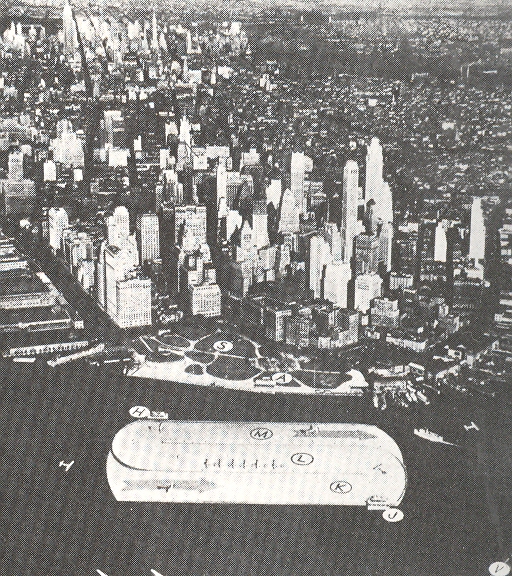
    or enormous floating airport islands (like that proposed by Norman Bel Geddes at the tip of Manhattan,  

    1--bel geddes airport 2 

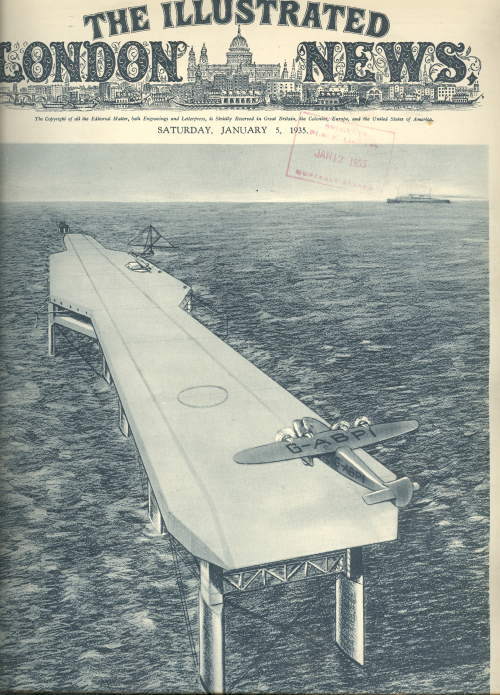
    and of course a series of airports that stretched across the Atlantic.

    https://historyofideasblog.com/a/6a00d83542d51e69e2012876bef533970c-500wi

    But they all had to start somewhere, and perhaps this Illustrated London News entry for 1919 was among the first wave of these proposals. 

  • Pictographic Messages to the Year 12,010: the Medium is the Mess.

    JF Ptak Science Books  Post 1103

    Talking to the Future: a Note of Pity to Ourselves in 300 Generations
    Nuke waste--dead251

    In the history of words I’ll take a wild guess and say that fractions of 1% of everything communicated is directed at ourselves in the future–or at least it has the possibility of being directed to someone else when our deeds are long, long since forgotten. 

    And by writing to the future I don’t mean in an off-hand way, our words being read in 12,010 by chance, idea archaeologists looking at what people were talking about 10,000 years earlier; and I don’t mean via “reconstructing” our radio or tv broadcasts (in the not-right Jodie Foster Contact kinda way).  I mean intentional messages to be read a long time from today.   

    A more problematic entry would be images and symbols design to be read by future generations, in the deep future.  This is not a very deep category, though a famous (if not well designed) example being the one associated with Carl Sagan that was attached to the 1972 Pioneer 10 and 1973 Pioneer 11 spacecraft, which attempted to explain what humans were should either vehicle  in any eon come into contact with other-than-Earth life.
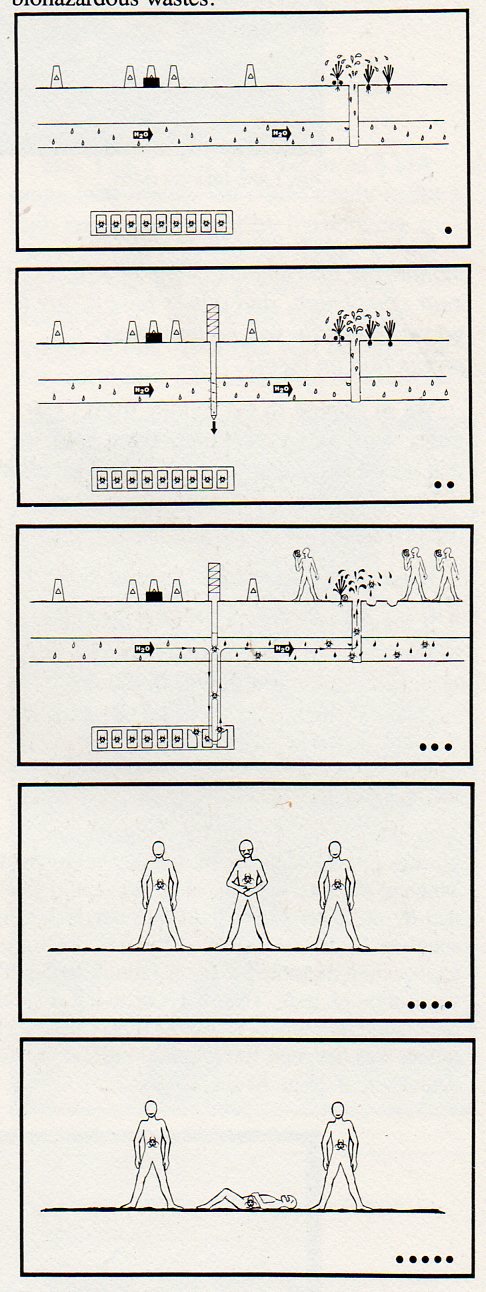
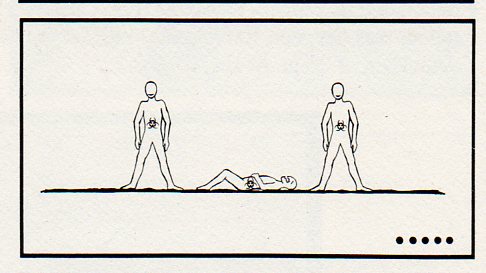
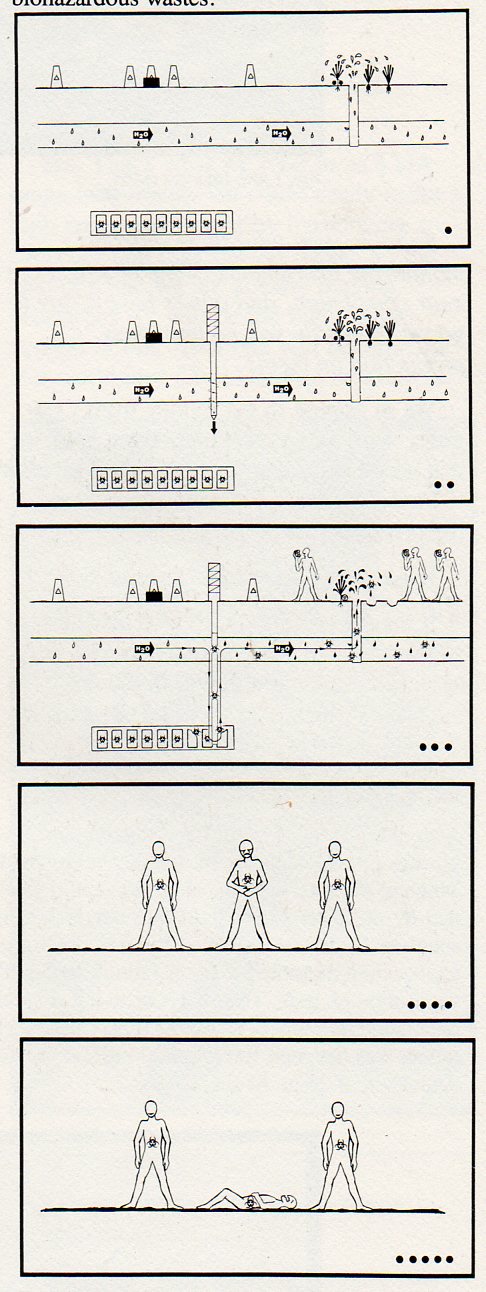
    Nuke waste--overall250 Another is the pictograph presented here, which appeared on page 117 of the ironically and extraordinarily-titled Reducing the Likelihood of Future Human Activities That Could Affect Geologic High-Level Waste Repositories1, the first half of which (bolded above) could make a nice departure for some other science fictiony type story.    But what these folks were talking about, plain and simple, was how to prevent future generations from digging into or other disturbing in any way buried masses of nuclear waste. 

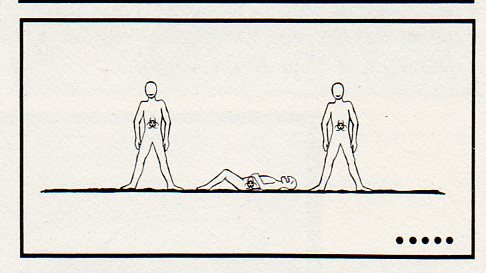
    This pictograph is meant to be a non-linguisitc, universally-understood  warning to future generations that the ground they are standing on is above a nuclear waste storage site.  The plan was that nuke waste would be solidified and buried in rock hundreds of meters below the surface in an effort to keep in line with governmental policy of waste disposal2. The pictograph relates to the restricting of future human activities part of the title of the work in question–that is, folks in the future who might muck around, drilling, into the nuclear waste site.  This pictograph tells them why they shouldn’t do so, because of all of the terrifically lethal mojo underground. 

    As one might guess by the title, the report has its own communication problems–it is dense, turgid and not a particularly clear document.  It is a fine document illustrating the problems of communication, but not in the way it would have wanted to be, celebrating a reverse triumph in a Darwin Award/IgNobel type of way. And all of this in spite of/or because of a healthy slice of linguists, semioticians, logicians, artists, graphic designs, politicians,. sociologists and so on constructing the thing.

    The sign basically says that if you drill at this spot (to some unspecified depth) through aquifer or underground stream or water source or something that some point you may reach the biohazard nasty, which will then get into the water supply and into humans, which will then kill them.

    The sign was designed for 10,000 years hence, and depended upon pictures to convey the message rather than words (except for H20, and the biohazard symbol).  Of course the radioactive nastiness will be there for millions of years, which would be an entirely different story in terms of imaging.  Perhaps. 

    The one thing the design of the pictograph has in its favor is that it is read top to bottom–no language on Earth (so far as I know) is read bottom to top, though there are many differences in reading right-left/left-right.  Beyond that, the pictograph stumbles over itself–except for the last two images, which may or may not tell someone that something bad is happening. 

    There are plenty of time capsules and idea-vehicles to the future–I’m saddened that this was seen to be one of the essentials that we would pass on to our future selves.

    Notes:

    1. Reducing the Likelihood of Future Human Activities That Could Affect Geologic High-Level Waste Repositories (Technical Report prepared for Office of Nuclear Waste Isolation, Battelle Memorial Institute; BMI/ONWI-537; May 1984)

    2. “Present society’s responsibility is to dispose of radioactive wastes in a manner that is safe, is environmentally acceptable, and does not require long-term maintenance or surveillance. This ground rule is consistent with the objectives in the U.S. Department of Energy.”Reducing…, page 2.

    The pictograph, explained,  pp 115-116 from Reducing….

    The pictograph…was developed using the concepts and guidelines discussed by Givens (1981). The objective is to convey to the reader the sense that if the area below the markers is disturbed, toxic substances will enter the ground water and lead t o severe consequences. relies on several visual images acting in concert to relay the message.

    The ground surface exhibits peripheral markers and a central monument to denote relevance to the site where those markers and monument exist.

    The ground-water system is indicated by water-drop shapes and by the chemical symbol for water (the only departure from icons, used as a redundant measure).

    A repository far below the surface is depicted with the biohazardous symbol. The fact that the object portrayed below the surface is a repository may not be at all evident to a future reader from the first frame; however, the movement of the dark material from the repository through the aquifer and into the vegetables in the third frame, coupled with the movement of the biohazardous symbol, should imply the burial of biohazardous materials below the surface.

    The pictographic sequence exaggerates reality with regard to the rapidity of contaminant transport and uptake, and with regard to the severity of the consequences. However, exaggeration is necessary because both the clarity and the relevance of the message may suffer if.the pictograph attempts to indicate contaminant transport time of thousands of years. Similarly, the consequence portrayed, a painful death, over-exaggerates the cause-effect relationship and the rate of the individual’s demise (one out of three suffer death in the pictograph, whereas a
    to chance would be more representative).
  • Darkpunk City Architecture: Psycho-Noir Cityscapes of Hugh Ferriss

    JF Ptak Science Books   Post 1104

    The work of architectural delineator Hugh Ferriss (1889-1962) gives me the same sort of feeling that I get from Martin Scorsese’s  Gangs of New York–a blistering, gritty, taut film that doesn’t really add up to anything but it really doesn’t matter; getting there being all of the fun…we know its just made up, even by Marvelous Marvin.  We know that Mr. Ferriss wasn’t going anywhere with these designs, that he wasn’t going to kill us, trapped  in his  psycho-noir cityscapes. These designs are beautiful, and a wonderful background for something, so long as no one has to live in them.  (Much more on Ferriss here.)

    Why didn’t I use Fritz Lang’s Metropolis?  The emotional (and not necessarily visual)  metaphor just didn’t work as well as The Gangs does for me; makes little sense, I know, because Ferriss knocked pretty loudly on Lang’s door.  It just didn’t work for me.

    In a way these designs could fit in my Blank and Empty Things category, lacking life, inspiration–even in their solitude these images have an advanced emptiness to me, moving well beyond simple solitude.  Edward Hopper’s 1942 Nighthawks  is a painting of solitude, but it isn’t necessarily empty.

  • The Future of Women–Helicopter-Delivered Paper Clothing for Woodsy Frolics

    JF Ptak Science Books   Post 1105

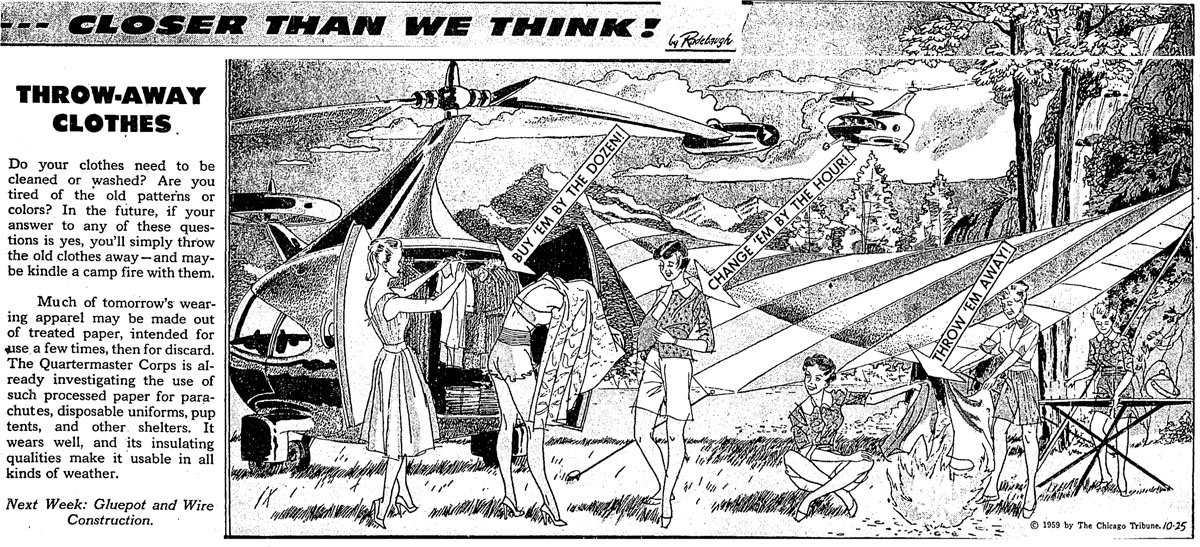
    Future--throw away clothing

    The artist of this perspective of the future offers us a little too much of his personal dreamcastle, I think.  Perhaps the future is filled with paper clothing to be thrown away at a whim, or if not paper then something else besides that, like paint.  Painted clothing might make more sense than natural disposables.  But what makes this image special to me is that none of it makes sense, but for semi-noxiously-underwear-filled reason, it did find its way into publication, even if it was only in the Chicago Tribune.  

    The artist shared a very personal vision of the future which reminded me in a way of a reverse Reclusorium.  Monks and recluses filled out their fair share–men and women alike–of Anchorages and Reclusoria, living down in tiny cells sometimes dressed in chaffing (or worse*) clothing, sometimes being permanently caged (or even walled in), spending their lives devoted to their own unworthiness and penitence and glorification of a private conversation with a god of salvation. 

    This picture offers us a group of non-recluses, living far from any sort of St. Jerome-y existence. For some reason these women are living out in the wild in high heels, enjoying The Nature, and having their disposable clothing delivered to them via helicopter(s).  They choose their paper outfits, and change into them right there, right in front of the helicopter, the artist enjoying their wreckless abandon. Find the clothing, take off old clothing, dress languidly, and then sit down and throw the old paper rags into the fire. Just in case, the lady in the background is serving refreshments.
    Seems to me that the women in this scene are developing a public demonstration of a little private fetish of the artist more so than delineating a vision of a hellfire future filled with semi-naked women frolicking  in the woods.  Or rmaybe I’m being too cranky and seeing things too hard–maybe not…

  • A History of Holes: the Hole in the Clouds over Nagasaki

    JF Ptak Science Books   Post 1106   [Atomic and Nuclear Weapons Series]

    This post is one in a continuing series on the history of holes–the appearance of this particular hole meant the difference of life and death for hundreds of thousands of people, and it killed almost as many people as it didn’t kill. 

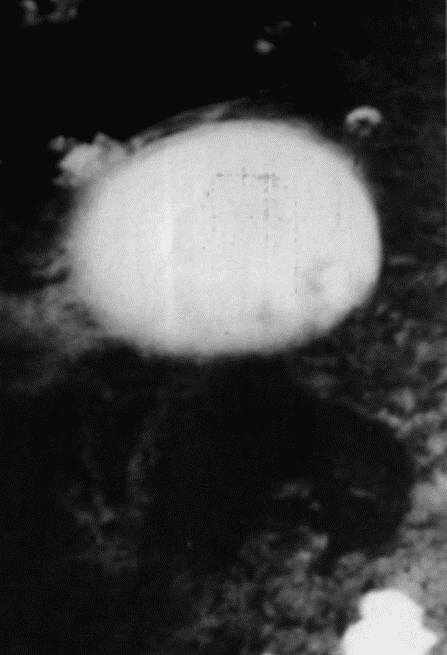
    The hole was in a cloud.  It was a corollary cloud to missing clouds from a few days earlier. 

    NagasakiCloud1Large


    On 6 August, 1945, the primary target of the first atomic bomb to be dropped on Japan was Hiroshima1–had there been unfavorable weather conditions, had the target been obscured by clouds or haze, a second target would be engaged–that was the Kokura Arsenal on the north shore of  Kyushu.  But conditions were bomb-favorable on that day, and Hiroshima was the city that was killed. Little Boy, the U-235 bomb dropped by Paul Tibbets from the Enola Gay  exploded 1,900 feet above Hiroshima. The bomb detonated and–with blast and shock wave and the ensuing damage and conflagration–70,000-80.000 people were killed (and at least double that number within five years).       

    It was a day before the news of the bombing was verified for Tokyo, and another day before the Big Six leaders of the Japanese army and government decided that they couldn’t decide in what to do with the Potsdam declarations and order of surrender.  It was a raging debate among those leaders, and it was a failure.           

    The second bomb, the plutonium Fat Man, was to be dropped by Major Charles Sweeney from Frederick Bock’s  B-29  Superfortress Bock’s Car on the next target, which was decided to be the  Kokura Arsenal.  And so Fat Man was taken over Kokura on 9 August, but by the time Major Sweeney (who had piloted the Great Artiste behind the Enola Gay on the Hiroshima bombing)  had arrived the previously comfortable atmospheric conditions had turned cloudy, overcast, the target obscured. Sweeney made three runs over the target, but it stayed hidden from the bombardier, and so the people of Kokura were spared. Major Sweeney tuned to his secondary target, Nagasaki.  With fuel running out, the clouds were also running thick over Nagasaki, until the last moment, when a hole opened in the canopy and the bomb was released through it,  exploding  with the impact of 22,000 tons of TNT at about 1640 feet above the city, killing 70,000 people (by the end of the year, 140,000 by 1950).

    The hills around Nagasaki confined the blast and protected those on the other side of them.  Kokura had no such terrain, which means that had the bomb been dropped there, even more people would have been killed outright and many more so over time. 

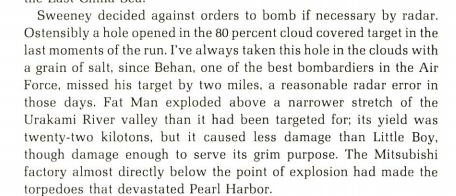
    The hole theory though is not necessarily complete–there may not have been a hole. Nobelist (physics) Luis Alvarez, who made major contributions to the firing mechanism for the weapon and a genius-in-general, and who flew as part of an Aerial Observation Team to assess the yield of the bombs, thought that perhaps there was a hole in the clouds and perhaps there wasn’t–“ostensibly” there was a hole, he wrote. Perhaps the bombardier saw the target, and perhaps not. In his Adventures of a Physicist (1989), Alvarez writes about the misery and the snaufedness of the mission, the clouds over Kokura and the multiple runs, the very low fuel which allowed only for one run on the Nagasaki secondary, and the growing accuracy of the flak from below. On page 145 he states that pilot Sweeny had decided against orders to attempt a radar-guided bombing of the 80% cloud-covered target–until suddenly the famous hole appeared, and bombardier Kermit Behan found the target and released the weapon.  Alvarez records that the bomb detonated about 2 miles off-target, which he said would have been an acceptable margin of error for a radar-controlled drop, which would fit nicely with the his claim that Behan was Air Forces’s “best bombardier”.  Alvarez said that he took the report of the hole “with a grain of salt”2.  (See extract below.)

    In any event, some sort of hole opened for Nagasaki, and closed for Kokura.

    Notes:

    New York Times correspondent William L. Laurence flew in the Great Artiste, following the   that delivered the bomb 1640 feet over Nagasaki. His report on Nagasaki appeared a month later in the newspaper, and the full text is available via the Atomic Archive blog here.  

    1. The targets discussed  by the Targeting Committee (“Minutes of the second meeting of the Target Committee, Los Alamos, May 10-11, 1945″) on 10 and 11 May 1945 included the following:
    (1) Kyoto (the former capital with one million people, a center of religious and intellectual life in Japan This target is an urban industrial area with a population of 1,000,000. It is the former capital of Japan and many people and industries are now being moved there as other areas are being destroyed. From the psychological point of view there is the advantage that “Kyoto is an intellectual center for Japan and the people there are more apt to appreciate the significance of such a weapon as the gadget”;  (2) Hiroshima (listed as an Army depot though “due to rivers it is not a good incendiary target”; (3) Yokohama (one of the largest remaining untouched industrial centers in Japan); (4) Kokura Arsenal (one of the largest in Japan and situated by urban industrial sprawl); (5) Nigata (port on Honshu) and (6)the Emperor’s palace (which was discussed  as a possible target but dismissed almost immediately).[Yawata was also considered (as an industrial center) (during the preliminary meeting of the targeting committee on 2 May 1945) (along with Tokyo, Nagoya, Osaka, Kyoto, Kobe, Hiroshima and Nagasaki.]
    .
    The members of the targeting committee (source for this material is Gene Dannen at Dannen.com, transcribing targeting material of the U.S. National Archives, Record Group 77, Records of the Office of the Chief of Engineers, Manhattan Engineer District, TS Manhattan Project File ’42-’46, folder 5D Selection of Targets, 2 Notes on Target Committee Meetings) included (on 10 May): “General Thomas  Farrell,  Dr. Charles C. Lauritsen, Colonel L.E. Seeman, Dr. Norman Ramsey, Captain Parsons,  Dr. Robert L. Dennison, Major John A. Derry, Dr. John von Neumann, Dr. Stearns, Dr. Robert R. Wilson, Dr. Richard C. Tolman, Dr. William G. Penney, Dr. Robert Oppenheimer.”  In attendance for the 11 May discussion was  Dr.Hans Bethe and Dr. Brode, plus: Colonel Seeman,  Dr. Stearns, Captain William S. Parsons, Dr. John von Neumann, Major Derr, Dr. Robert L. Dennison, Dr. Richard C. Tolman, Dr. Penney, Dr. Oppenheimer , Dr. Ramsey and Dr. Wilson.”

    2.  Alvarez on the hole:

    Alvarez nagasaki[Source, Luis Alvarez, Adventures of a Physicist, 1989, p 145.]

Recent Posts

Archives

Categories