A Daily History of Holes, Dots, Lines, Science, History, Math, Physics, Art, the Unintentional Absurd, Architecture, Maps, Data Visualization, Blank and Missing Things, and so on. |1.6 million words, 7500 images, 4.9 million hits| Press & appearances in The Times, Le Figaro, Mensa, The Economist, The Guardian, Discovery News, Slate, Le Monde, Sci American Blogs, Le Pont, and many other places… 5000+ total posts since 2008.

  • High Color in Cowboy Vocabulary, Selections from an Unpublished Typescript (1938)

    JF Ptak Science Books  Quick Post

    I reckon that at some point or another one or some or all of these words might come in handy, a garnish to a small thought or medium sentence, or even as a companion to Patrick Starfish and his “sentence enhancers”.    They’re a little far from the “history of science” material that I guess I’m supposed to be writing about here, but, well, like all of the other non-science stuff that makes an appearance in these pages, its interest was too irresistible for me to say “no” to. 

    And so to some colorful Cowboy vocabulary, choice morsels that I plucked from a document found some time ago at the Manuscript Division of the Library of Congress.  They’re located in what still seems to be an unpublished typescript from the Texas Folklore Project of the Works Progress Administration (WPA) and the Federal Writers’ Project (FWP).  The language was collected by marginally-employed historians and such put on temporary dole by the U.S. government, sent out to the far regions, interviewing old Cowboys for what they knew and remembered. The document is dated February, 1938. 


    Bog rider

    Cowboy sent to patrol bogs and extricate cattle

    Button

    Boy

    Chuck eater

    Easterner come west to learn ranch work

    Circle

    Area a roundup rider must inspect in a day

    Climb your hump

    Fight

    Deep in the wood

    Firmly in saddle

    Drag your loop

    I didn’t steal that cow, itjust poked its head in the loop I was dragging”

    Fork a horse

    Ride a horse

    Forty Rod

    Liquor

    Give up the head

    Complain

    Gizzard gravel

    Courage

    Grass train

    Ox-team freighters

    He left the score

    Left in a panic

    Jiggle

    Ride

    Jingler

    One who herds horses for an outfit

    Lacing up a tree

    Putting the saddle on

    Moonshine

    Night rider

    Old cedar

    Six shooter

    Rattling his hooks

    Ride fast

    Riding through strong

    Riding horses average cowboy doesn’t want to ride

    Slop and tatter

    Pacing horse

    Swing a long rope

    Horse or cattle thief

    Turn a cat

    Take a fall

    Wheelbarrow man

    One who walks across the plains

  • The History of Blank, Empty and Missing Things–the Voice of Beethoven

    JF Ptak Science Books   Post 1540   (Part of a long series on The History of Blank, Empty and Missing Things.)

    So, in the history of very creative people saying things, I wonder if Ludwig van Beethoven said the most of the least interesting things? I’m referring to his correspondence and other written works, and not his music of course—and given the music nothing else really matters. But given the amount of surviving letters and conversation books, and of course his staggering genius (which makes him one of the most important men of the century) it is kind of remarkable that there isn’t more attractive, inventive, interesting content in his communications—which at the very least makes reading the stuff somewhat disappointing, and, at the very most, pretty much the same.
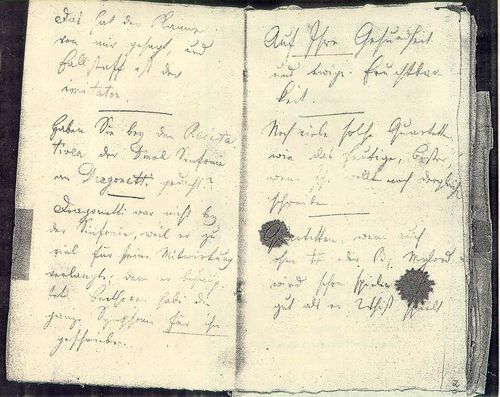
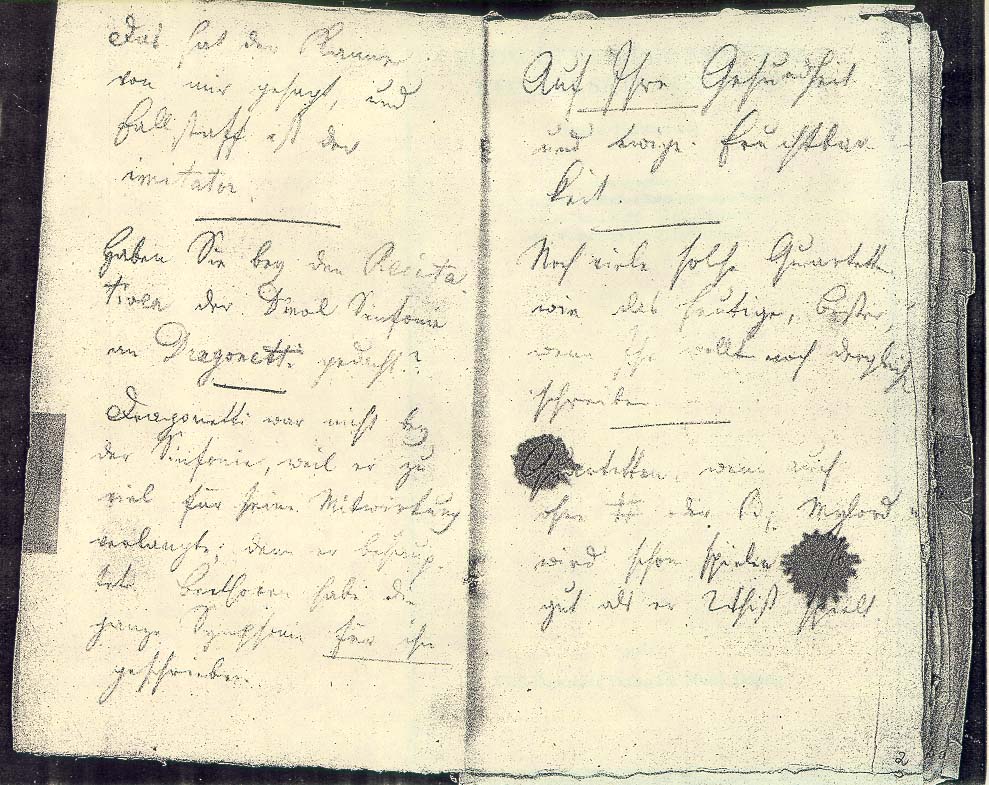
    Beethovenconversation2

    When Beethoven (who died at age 57 on 26 March 1827, a year younger in death than Dickens and five years old than Shakespeare—a remarkable thing to consider how much these people accomplished in a very short period of time) began his experience in being deaf he resorted to using largish, quarto-sized blank chap books for his visitors to write their questions and answers to him. These books, Konversationshefte, the Conversation Books, were precisely that—they recorded the conversations with Beethoven over a number of years. Unfortunately, they reveal some very basic, daily, non-sequitur sorts of stuff, and contain almost nothing of what Beethoven actually said.

    Sometimes—according to scholars—it is possible to intuit what Beethoven sort of said by looking at series of questions and answers from his guests. But by and large the notebooks offer few clues to what the voice of Beethoven was actually saying. This is particularly grueling given the extent of the notebooks—136 of these books remain, covering the periods from about 1819 to 1827. (Actually, at Beethoven’s death there were more than 400 of the things, but his biographer, Anton Schindler, the man who inherited much from Beethoven including the notebooks, managed to purposely destroy at least 160 of the books. Evidently he found them impolitic, among other things, and tried to protect Beethoven’s reputation by making the evidences of the supposed impertinences disappear.)

    The conversations cover all manner of small, daily bits of life, including numerous one-sided conversations with/to the Maestro on how to take his enemas. (It is extraordinary that such evidence remains in the face of how much other –and probably more interesting—material didn’t.

    The letters of Beethoven, too, as voluminous as they are, are a terror to read, mainly because—at least to a general reader—there’s so little of interest in them. I have no doubt that for scholars they are vast repositories for things like Lost Punctuation and the sort, but the letters as intellectual documents, as things that give and insight into the mind of Beethoven, or what he thought about his work, or the works of contemporaries, and so on, well, the content just doesn’t seem to be there. (There are some occasional bright spots, like his continued reference to how extraordinary Handel was and that he, the great Beethoven, still learns from the man, even on his deathbed, but there’s really very little like this, relative to the great weight of the sheer number of words in the letters.)

    A number of writers have quoted W.H. Auden saying that there was only one memorable sentence in the whole of the Beethoven correspondence.  I can’t yet find what this was to Auden–my first guess is that it is in the “Immortal Beloved” writing, where we do get a big, deep cut into Beethoven’s mind.

    The letters do reveal all sorts of other things, most of which makes me sad, particularly when the sick room of Beethoven is described in not-pretty terms as an outreach and indicator of his possible poverty, and how much the ill Beethoven had to worry about securing a little money to pull him through his illness and into the next half-year or so of life if he survived  himself. 

    Even making my way though the Thayer biography of Beethoven and looking for his voice is a chore. I tried to content myself constructing found poetry in the questions of the visitors to Beethoven in the notebooks, but that was fairly well a failure.

    It is in these cases that the authentic voice of Beethoven  seems to be almost entirely missing–a blank, empty and missing sound from the man who made some of the most beautiful music ever created.

    The other end of this part of blank, empty and missing things history, and sound, and Beethoven, would obviously be his deafness, or perhaps his depression (in the 1815-1820 period, when he was plagued by, well, something).  For years Beethoven heard very little; and then for years after that, he heard almost nothing at all.  But he was sensitive to vibration, so he was able to experience music, though in a different sense form what we think of as auditory.  Missing music–though I wouldn’t call it “Empty” or “blank.”
     

  • A Note on the Pledge of Allegiance: Exluding “Equality” and including “God”.

    JF Ptak Science Books  Quick Post

    The Pledge of Allegiance was written by Francis Bellamy (1855-1931) in 1892 for the 400th anniversary of the arrival of Christopher Columbus to the Western Hemisphere.  The Christian Socialist Baptist Minister Bellamy started the pledge out as a simple confirmation, and at one time considered the inclusion of the word “equality” in the message, but backed away after he saw potential difficulties with the word, what with the social and legal exclusions of women and Black people getting in the way of the concept. 

  • Are there More People than Knots? Finding the Structure of Matter in Smoke Rings

    JF Ptak Science Books   Post 1541 (Part of the Series Blank, Empty & Missing Things.)

    Embedding a circle in 3-D Euclidean space is another way of looking at a simple and substantial elements of human activities.  Knots have played a large role in human history over a long period of time–not just for connecting things, or determining speed, but also in design, the appearance of, say, objects that would later be known as  Borronean rings that appear in Tibetan Buddhism (endless knots as keys to infinity) to the Celtic knots (decorating, say, the Book of Kells).

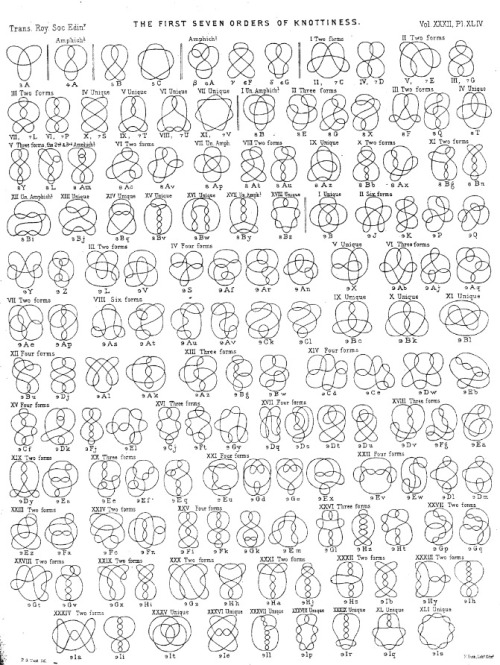
    Gauss did very early work (1)-as is so often the case– on knot theory, as did William Thomson, Lord Kelvin,who visualized atoms as knots in the aether and who was perhaps inspired by P.G. Tait’s experiments on smoke rings (2)  and who in turn had been influenced by  a paper of Hermann von  Helmholtz on vortex-rings in incompressible fluids, and organized the  stability of chemistry around this pricnipal.  In turn  P.G. Tait based his very solid work on knot theory in 1867 on this work of Kelvin and von Helmholtz. .(Kelvin’s theory (3) was rather well received for several decades until it was not, but it did enjoy the support for a time by J.C. Maxwell.  Kelvin was a brilliant man who I think is too often remembered for some of the few hundreds of the millions of words that he wrote and lectured, not the least of which were his pronouncements at the every end of the 19th century on the impossibility of heavier-than-air flight.)   Tait–who also co-authored a very well respected textbook on Natural Philosophy with Kelvin–moved on to firmly establish knot theory and on the elements that makes knots different, formulating tables on how knots form, and in essence believing that he was fabricating a table of the elements. All of this work suffered a fatal blow when the great Michelson-Morely experiment (1887) (4) failed to detect the luminiferous aether. 

     betonbabe:  P. G. TAIT THE FIRST SEVEN ORDERS OF KNOTTINESS, 1884 … super nerdy blog post #01

    • [The first page of how knots come to be as they appeared in P.G. Tait’s earliest work, though he by necessity kept the investigations to  relatively minimal degree: “We find that it becomes a mere question of skilled labour to draw all the possible knots having any assigned number of crossings. The requisite labour increases with extreme rapidity as the number of crossings is increased. … I have not been able to find time to carry out this process further than the knots with seven crossings. … It is greatly desired that someone, with the requisite leisure, should try to extend this list…”]

    This was the beginning of the tabulation of knots, found in Tait’s beautiful work.  To date some 7 billion tabulations have been identified, a number nearly equal to the of the world’s population. Knot theory has taken shape as an area of study within the field of topology, which was developed in the 1850’s through the 1870’sby Riemann/Listing/Mobius/Klein and then which received its algebraic foundation by Henri Poincare (5) just af ew years after Michelson-Morely and in the same year as Roentgen’s x-ray, 1895.

    Notes

    1.  The Gauss linking integral,1833, carried forward by Johann Benedict Listing.

    2. An interesting modern recreation of the Tait smoke ring experiment can be seen here. See malso: Silliman, Robert H., William Thomson: Smoke Rings and Nineteenth-Century Atomism, Isis, Vol. 54, No. 4. (Dec., 1963), pp. 461–47

    3.  Lord Kelvin, Sir William Thomson, “On Vortex Atoms”, Proceedings of the Royal Society of Edinburgh, Vol. VI, 1867, pp. 94-105. Reprinted in Phil. Mag. Vol. XXXIV, 1867, pp. 15-24.

    Cross section illustration of vortex around a ring

    –It was also Kelvin (along with A.A. Michelson) who spoke on the finiteness of physics, with Kelvin in particular stating at a British Association for the Advancement of Science meeting in 1900 that there would be nothing new in physics, and that all that was left was measurement.  I seem to remember a story about one of Einstein’s uncle’s (?) warning him against going into physics because there was nothing left new to do…I can’t remember if this was before or after Roentgen.  In any event, Kelvin’s statement was five years after Roentgen, but it didn’t stop him from making his claim. 

    4. On the Michelson-Morely experiment.

    5.  H.Poincaré, “Analysis Situs”, J. Ec. Polytech ser 2, vol 1 (1895) 1-123.

    –The Journal of Knot Theory and Its Ramifications was founded in 1992, establishing a journal devoted purely to knot theory.

  • The “Other” Hiroshima: Hamburg, Operation Gomorrah, Summer 1943

    JF Ptak Science Books   Post  1543

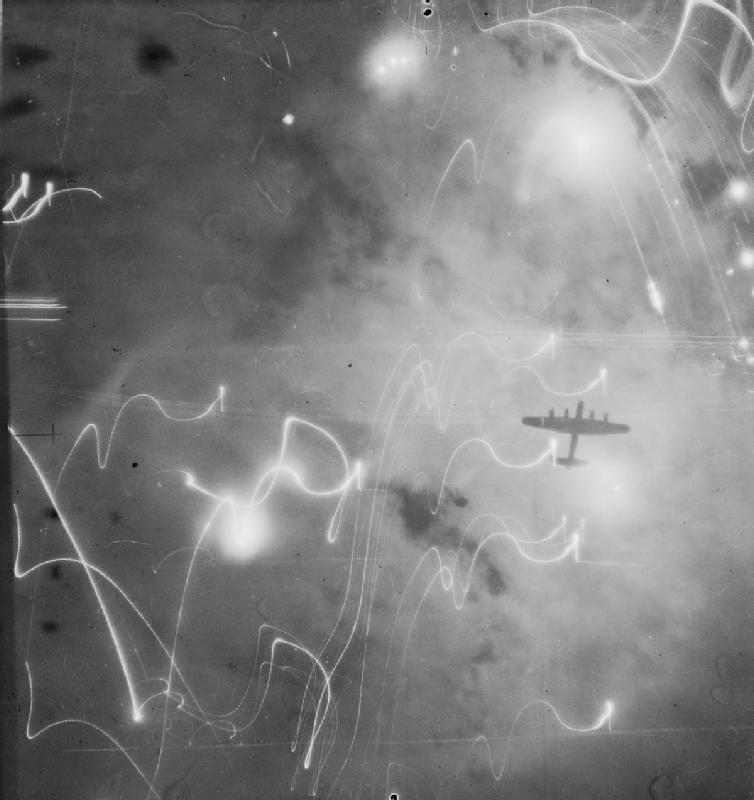
    It was during the spring and summer of 1943 that the Allies came to the conclusion that the idea of strategic bombing needed to be expanded–the expansion part grown to include the total destruction of the target city. 

    The “most secret” letter1 (dated 27 May 1943)  that outlined the coming approach to aerial bombing was sent by Air Chief Marshal Arthur “Bomber” Harris  to his six group commanders and detailed the more-new strategic approach to bombing cities–the city itself would be a strategic target, with the goal in this case of destroying the entire city.

    File:Attack on Hamburg.jpg

    Operation Gomorrah occupied four nights from 24-30 July, involving 791 aircraft on the 24/25th, 90-110 B-17s on the 25th, 131 B-17s on the 26th, 787 aircraft on the 27/28th,  777 on the evening of the 29/30th., and finally with 740 aircraft on the night of the last raid on 2/3 August.3,000+ aircraft were employed in the action dropping 9,000 tons of bombs.   At the end of the Gomorrah campaign, 42,600 people had been killed as well as almost 40,000 wounded, destroying about half the homes int the city and causing another million people to flee the city.  The greatest amount of damage and death occurred on the night of the 27th, when 787 British aircraft caused an enormous firestorm to be formed, at one point fueled by a 1500′-foot tall tornado of fire, which caused 150 mph fire winds, temperatures reaching so high (1800 degrees and more) that it  set the asphalt streets on fire.  Most of the dead were killed by asphyxiation, the oxygen pulled out of bomb shelters and hiding places to be used in the fires.  The infrastructure of the city had been largely destroyed before this day’s bombing, so getting firefighting crews to any of the new scenes would be impossible.  As a matter of fact, there was so much smoke generated from the previous day’s bombings that the USAAF B-17 attacks were suspended because targets could not be identified. 


    And from this point to the end of the war there were another 60+ campaigns flown at Hamburg, attacking and re-attacking oil storage facilities, shipbuilding industries, U-Boat factories, and the like.  53 missions involving several thousand aircraft, flying against the re-supplking and ruined city right to the end of the war, including 5 major actions in the last week of the war. 

    File:Hamburg after the 1943 bombing.jpg

    I don’t think that this was its own “Hiroshima” as British command thought, because, well, Hiroshima and Nagasaki have their own categories for destruction.  As does Tokyo. And Dresden.  It does though share a newness of bombing with Hiroshima in establishing the mission against Hamburg as a mission against an entire city rather than specific targets–certainly there were specific targets in mind for the hour or more worth of aircraft, but the overall effect was to support a carpet bombing plan and to initiate a fire so massive and destructive that the entire city would succumb.

    Newsreel of the bombing of Hamburg.

    Notes

    1.   The Harris ltter:

    MOST SECRET


    BOMBER COMMAND
    OPERATION ORDER NO. 173
    Copy No: 23 Date: 27th May, 1943


    INFORMATION

    The importance of H A M B U R G. the second largest city in Germany with a population of one and a half millions, is well known and needs no further emphasis. The total destruction of this city would achieve immeasurable results in reducing the industrial capacity of the enemy’s war machine. This, together with the effect on German morale, which would be felt throughout the country, would play a very important part in shortening and in winning the war.

    2. The ‘Battle of Hamburg’ cannot be won in a single night. It is estimated that at least 10,000 tons of bombs will have to be dropped to complete the process of elimination. To achieve the maximum effect of air bombardment, this city should be subjected to sustained attack.

    Forces to be Employed

    3. Bomber Command forces will consist of all available heavies in operational squadrons until sufficient hours of darkness enable the medium bombers to take part. It is hoped that the night attacks will be preceded and/or followed by heavy daylight attacks by the United States VIIlth Bomber Command.

    INTENTION

    4. To destroy HAMBURG.

    [Source]

    ·Posted by :

    ·in:

    —
  • Aerial Bombing Accuracy Calculator, WWII

    JF Ptak Science Books  Post 1545

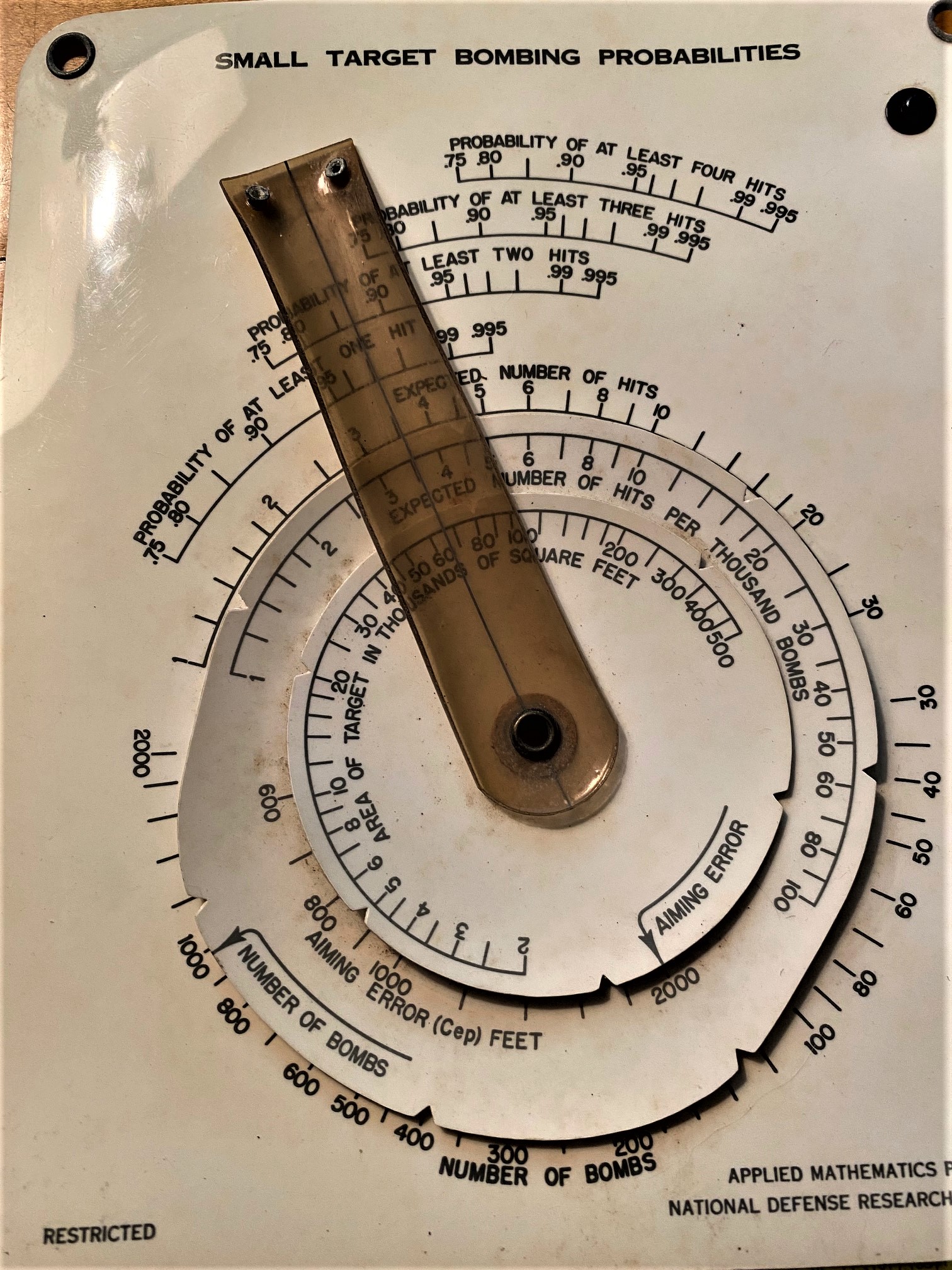
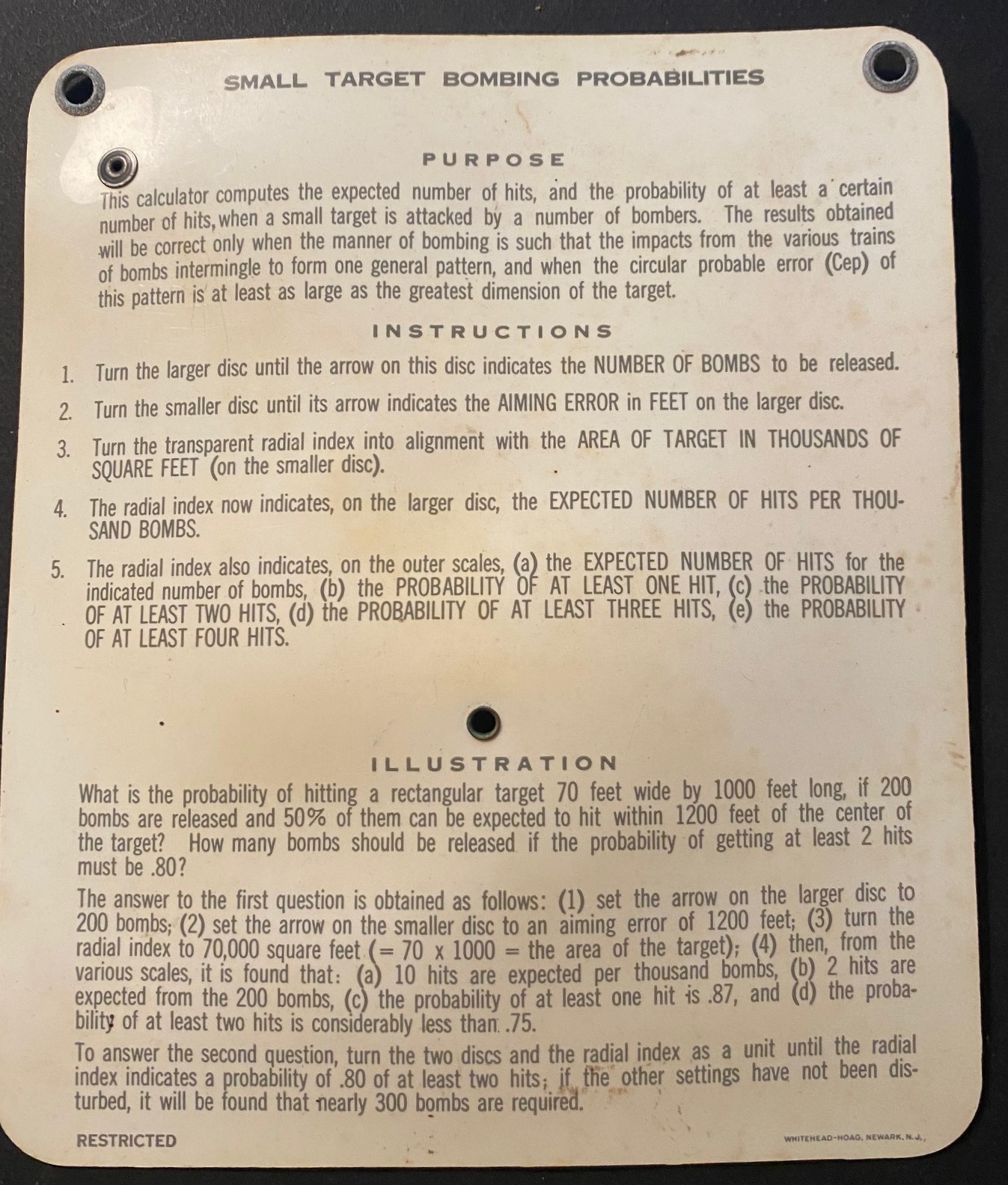
    IMG_5402I found this object in my paper-calculators box (moveable disk calculators made of paper, two going back to A. Kircher in the 1660’s)—I’m not sure why it was there as it is not paper, though it is an interesting calculator.

    [Images are greatly expanded in click mode.]

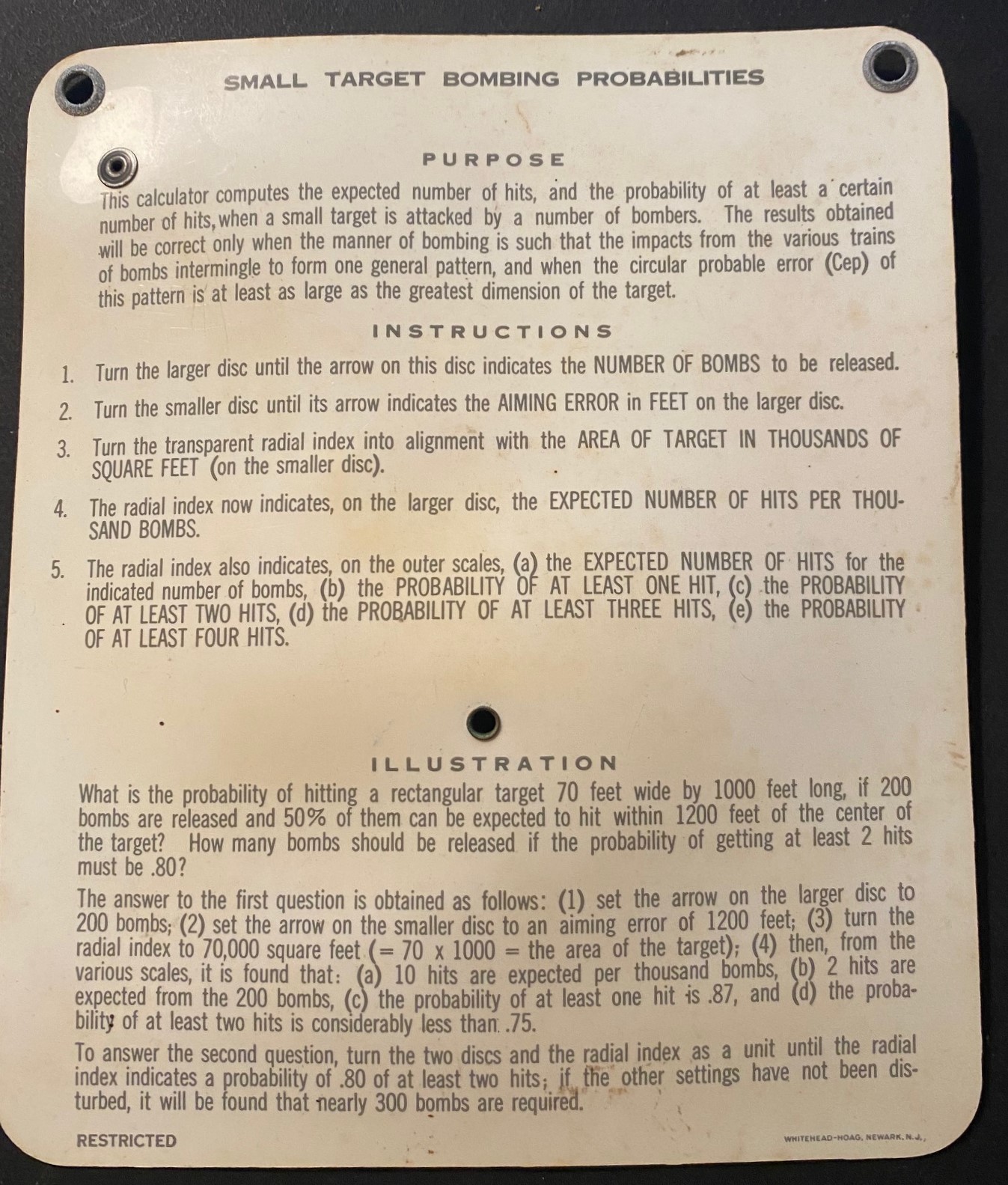
    I learned a big lesson from it.   The “Small Target Bombing Probabilities” calculator was issued by the little-known (in the popular sense) Applied Mathematics Panel of the National Defense Research Council (NDRC)1 in the early 1940’s during WWII. 


    IMG_5403Marked “Restricted”, it calculated the number of bombs that would successfully be delivered given (1) the number of bombs, (2) the “aiming error”, and (3) target size. It would then generate results for “(a) the expected number of hits for the indicated number of bombs”, (b-e) the probability of at least one hit to four hits.

    What is a little surprising to me was the number of bombs that didn’t find their target. For example, a 65,000 square foot target bombed with 1000 bombs and an aiming error factor of 2000 feet could expect to land 3-4 bombs on the target, with an 88% chance of landing at least two hits, 75% chance of landing three hits, and about 50% of landing at least four hits.  And so the necessity of large numbers of planes dropping a large number of bombs.  

    Notes

    1. The establishment of the NDRC was announced so: “It is announced by Science Service that the following committee has been appointed in the United States to correlate “scientific research on the mechanisms and devices of warfare”: — Nature 146, 191-191 (10 August 1940).

    “Members included: Dr. Vannevar Bush (chairman), president of the Carnegie Institution of Washington, formerly dean of the faculty of engineering at the Massachusetts Institute of Technology; Prof. Richard C. Tolman (vice-chairman), dean of the graduate school and professor of physical chemistry and mathematical physics at the California Institute of Technology; . Dr. Irvin Stewart (secretary), formerly Federal Commissioner for Communications and chairman of the Committee on Scientific Aids to Learning; Rear Admiral Harold G. Bowen, director of the Naval Research Laboratory, Anacostia, D.C.; Conwiy P. Coe, U.S. Commissioner of Patents; Dr. Karl T. Compton, president of the Massachusetts Institute of Technology, formerly professor of physics at Princeton University; Dr. James B. Conant, president, formerly professor of organic chemistry, Harvard University; Dr. Frank B. Jewett, president of the Bell Telephone Laboratories; Brigadier General G. V. Strong, assistant chief of staff, U.S.”

  • The History of Lines: Lines Come and Gone.

    JF Ptak Science Books  Post 1546    [Part of the History of Lines series.]

    Ines union pacific 573

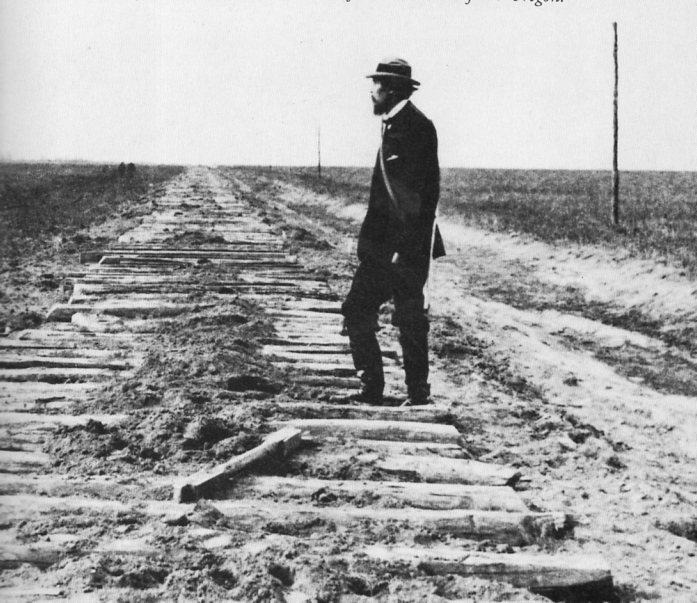
    This picture tells as much about the making lines–railroads pushing their way  towards one another, the Union Pacific and the Central Pacific, pushing on towards one another to complete a rail line that connected the American coasts–as it does in covering them up.  The photograph is of a Union Pacific supervisor named Samuel Reed, who was inspecting the rail bed–in 1868/9 it was not uncommon for one team to clear the land and lay down the ties miles ahead of the track layers.  Miles of bits of wood, waiting for their iron.

    But most roads, or at least most early roads, were in their places for a reason, and generally that reason was because it was a good way for getting from Point A to Point B.  This photograph, along the way of the Old Platte Valley route,  seems to be a mid-way point between the old and the new, or between the old and the old, lines of communication and lines of travel.  These timbers are laid down on top of the old immigration route from the east to California and Oregon, which in turn were laid on top of the trails of fur traders, which were on top of those of Indians, which were on top of those of the buffalo herds, and so on, all the way down. 

  • Crowd Series–Find the Hat, NYC, WWII

    JF Ptak  Quick Post

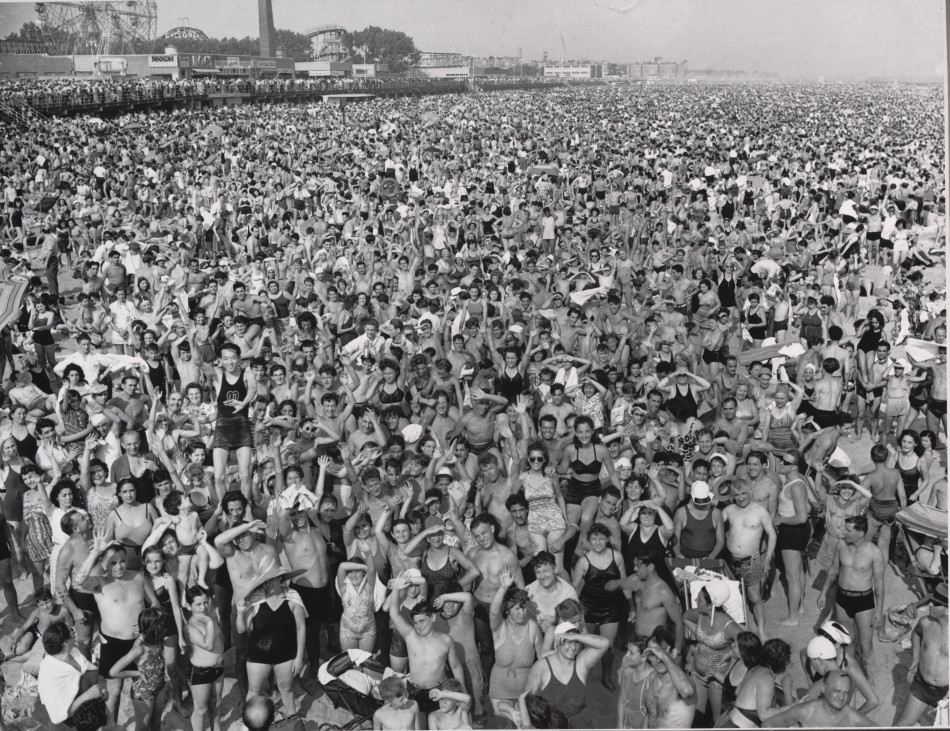
    Funny how in so many of these big crowd picture that I’ve performed surgery on that hats seem to be an issue.  For example, there’s this iconic photograph by Weegee (Arthur Felig, born Usher Felig in the Ukraine, 1898-1909, a man who lived for “the shot” and got it over and over again, evidently at the cost of just about everything else in his life) of the crowds at Coney Island. (“Weegee” was the phonetic spelling of Ouija, a moniker given to the man because he seemed be able to intuit the location of a crime or action of some sort.  It helped that he was the only journalist/photographer given a license to have a police-band radio receiver at home and in his car. 

    Weegee_-_Coney_Island-big
    Weegee_-_Coney_Island-big hat So far as I can tell there is only one man in a hat–the guy in the bottom right corner of the image, and he’s wearing a fedora at that.  The person at 10:00 from him–white-hatted with a plastic visor–may be a man, too, in which case I’ll have to amend this a little to restrict hats to fedoras.  And wearing it, too, at the time of the photo–there’s another man in there somewhere who is doffing his boater to the photographer.  And that’s about it.  Not much sand in this picture.

    It is a little unusual, this hat business–but Weegee at least has captured hats in unusual places.  Finding his bread buttered by crime photography and the gritty aspect of late-night city life, Weegee documented all manner of criminal activities in NYC during the 1930’s-1950’s, including more than his fair share of Mafia slayings.  I recall several of this photographs featuring the “hit” face-down on the pavement or on the table-clothed tabletop, hat still firmly in place. MOMA bought several of Weegee’s works in the 1940’s for an exhibit called “Action Photography”–which I guess would describe Weegee’s work, though if the action was starkly captured by a flash at night in tough surroundings, the description might be better. 

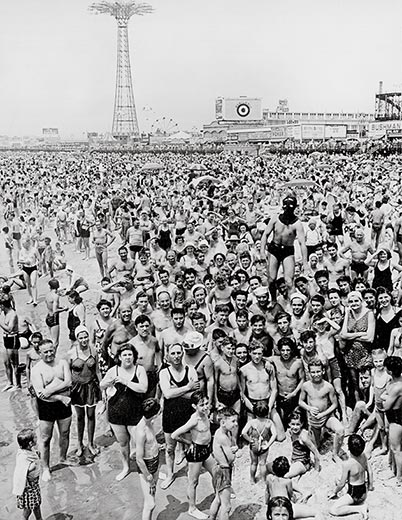
    Weegee-masked-man-Coney-Island-520
    This photograph by Weegee captures a few sailors in their caps, which I’m not sure count.  Primary in this photo though is the man in the middle, wearing a mask (for reasons unknown). 

  • History of Lines: Complicated Simplicity and Marconi’s Lines of Communications

    JF Ptak Science Books  Post 1547   [Part of the History of Lines series.]

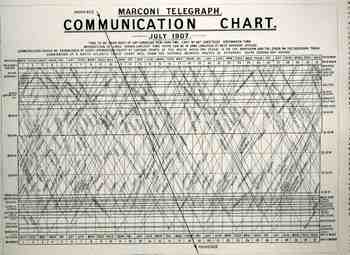
    This is an illustration of the approximate times and places that ships at sea could expect to be able to communication with each other by the relatively new invention of wireless telegraphy. (We’re talking about Marconi here and just very briefly; this is not the place for the discussion of what he did or didn’t “borrow” from his predecessors and contemporaries such as Heinrich Hertz, Oliver Lodge and Nikolai Tesla.  He at the very least however owed all of them at least an enormous helping of gratitude, and probably more.  Then there’s Marconi’s very conservative technical continuation in the field which is confusing and interesting.  And finally but not the least of all of the stuff about Marconi is his comfort and support of the Fascist regime in Italy, where Marconi became a member in 1923, escalating in his fame through the party ranks to have none other than Benito Mussolini serve as the best man in his second wedding.  But as I said that’s all for another day.) It appeared in The Illustrated London News for 7 September 1907,surrounded by an article on Obelia in the “Science Jottings” section of the magazine.  This chart isn’t
    1blog_oct_13marconi_at_sea816

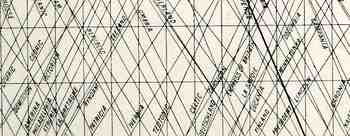
    quite as complicated as it seems, really: all you need to do is follow one line from the top to the bottom.  Simply put, each diagonal line represents a specific ship (all of which are named) and their positions as they make their ways across the North Atlantic ocean; each intersection represents the time and place that two ships can communicate via wireless with one another.  So, for example, the Empress of Britain will on its six-day voyage be able to communicate at least 26 times with other ships for news and information.

    What this seems to me to be is the supplemental efforts of the ocean-going ships

    1blog_oct_13marconi_at_sea817

    to the newly established trans-Atlantic radio-telegraphic company and installation opened by Marconi in October 1907.  Even though the first transatlantic communication is celebrated as having taken place in 1901, the performance, even in 1907, was still spotty.

    Again, I’m just after this for the image 

  • Fear of Numbers, Part 7 and Seven Sevenths: Octophobia.

    JF Ptak Science Books   Quick Post   [Part of the Unintentional Absurdist series.]

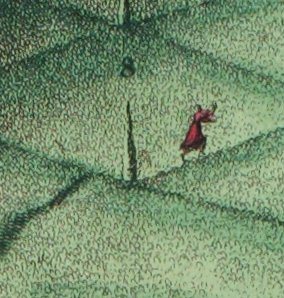
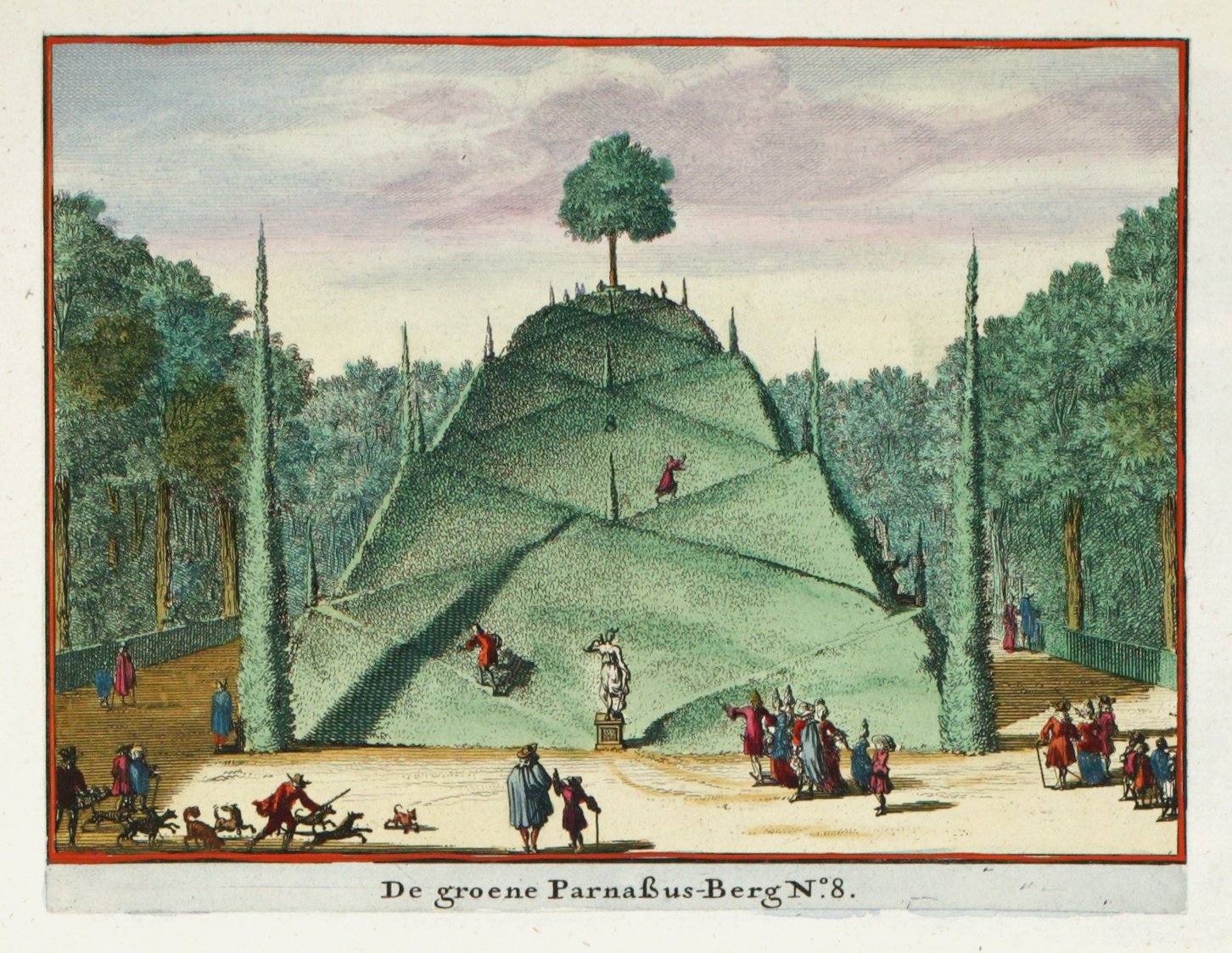
    Lines Large Mount Parnassus detailThis illustration comes from the beautiful Bibliodyessy site (follow link for the full description of the artwork), where the curator unearthed this series of 32 hand-colored engravings of the gardens of the great emblematicist, Jacob Cats.  I wonder why this fellow had such a strong reaction to whatever it was he was seeing.  I guess he was just looking at the shrub, but the vicinity of the eight, and its potential peril (!) for what it might represent (from eight-of-something-bad to the sign for an inverted infinity) , made this a little too good to resist.  [This is the first in a series of “found” images displaying unusual reactions to unintentioned floating numbers.]

    And the full image from which this detail was removed, a garden Mount Parnasus. 

    Lines Large Mount Parnassus 

    ·Posted by :

    ·in:

  • Women with Guns–a “First” in Women/Pistols/Advertising?

    JF Ptak Science Books   Post 1548  [Abdullah Cigarettes Revisited]

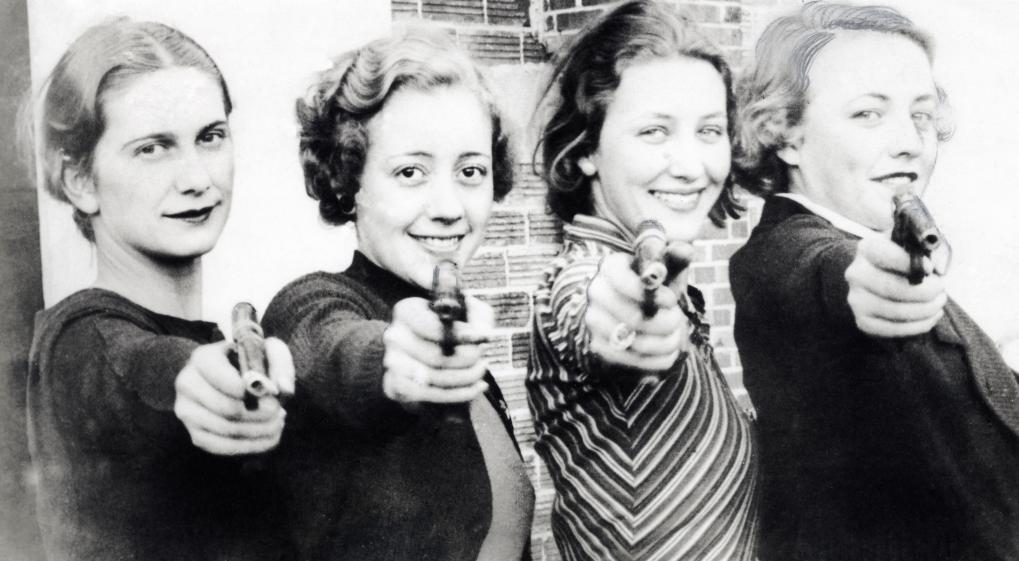
      Women with pistols

     
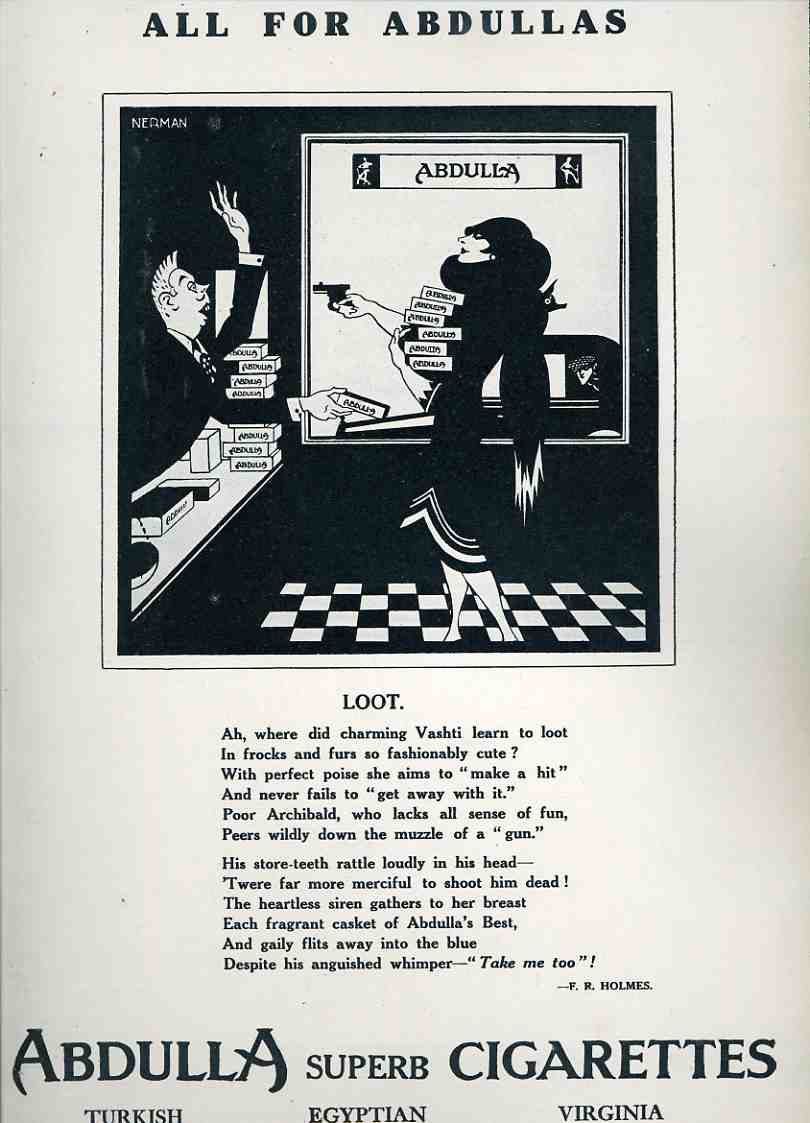
    Here’s a not-usual question:  when was the first image printed of a woman pointing a gun in the commission of a felony who was NOT an American Western leather-slapping, bronc-ridin’, Buffalo gal?  I have a funny feeling that it wasn’t until relatively recently, 20th century, or thereabouts.  I thought about this when I saw this ad in the Illustrated London News for 21 August 1926, calling for women to rush out and buy the ciggy that was worth stealing–Abdulla (“Superb”) cigarettes.

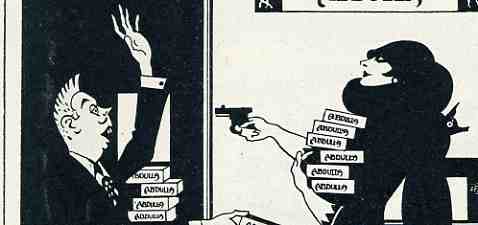
    0 blog feb 26630


    The doggerel of the poet-izer F.R. Holmes that decorates this page (and who recognizes that the clerk named Archibald who was handing over the cigarettes was chattering through “store-teeth”, which is kind of nice) did absently grind out a factual bit when he referred to the packaging of the Abdulla cigarettes as “Caskets”. Of course he had something else in mind in line with his time, but he did mistakenly have a peep into the future when he labeled the box of coffin0 blog feb 26629 nails so, though not so “fragrant” as he was thinking.  (I also like the masked male accomplice peeping into the scene from the safety of the getaway car.)

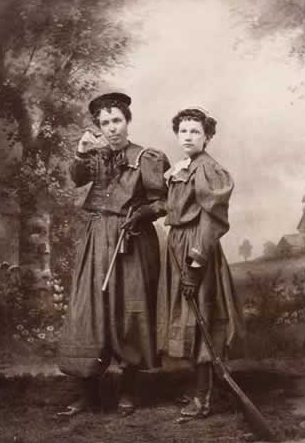
    Offhand, though, I cannot bring up an earlier image of a non-cowgirl-performing woman pointing a gun at someone to achieve a criminal end–especially not in an advertisement. 

    It is interesting considering this ad as a statement of sorts of women in the marketplace purchasing stuff that had previously been considered male terrain.  Woman had been he target of cigarette manufacturers in some small ways in the late 1880’s and early 1890’s, but it seems not until after the War and then after the Vote was there a full-on effort to sort women into some consuming fields that they had been excluded from previously.  Unfortunately, in this case, the advertisers recognized that they were missing perhaps half of their possible market, and that new market was pursued and resulted in tens of millions of cancer-related deaths. 

    Well!  Now that I’ve finished this short post, it just came to mind that a good alternative and much earlier source might be images of she-pirates, though it might still be a stretch to find one of those women with their sword at someone’s neck…

    Women and guns

    ·Posted by :

    ·in:

    — —

Recent Posts

Archives

Categories