JF Ptak Science Books Post 1547 [Part of the History of Lines series.]
This is an illustration of the approximate times and places that ships at sea could expect to be able to communication with each other by the relatively new invention of wireless telegraphy. (We’re talking about Marconi here and just very briefly; this is not the place for the discussion of what he did or didn’t “borrow” from his predecessors and contemporaries such as Heinrich Hertz, Oliver Lodge and Nikolai Tesla. He at the very least however owed all of them at least an enormous helping of gratitude, and probably more. Then there’s Marconi’s very conservative technical continuation in the field which is confusing and interesting. And finally but not the least of all of the stuff about Marconi is his comfort and support of the Fascist regime in Italy, where Marconi became a member in 1923, escalating in his fame through the party ranks to have none other than Benito Mussolini serve as the best man in his second wedding. But as I said that’s all for another day.) It appeared in The Illustrated London News for 7 September 1907,surrounded by an article on Obelia in the “Science Jottings” section of the magazine. This chart isn’t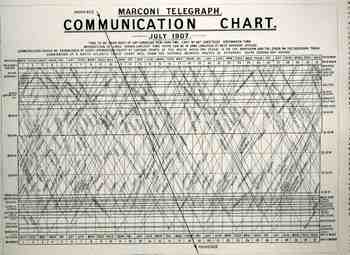
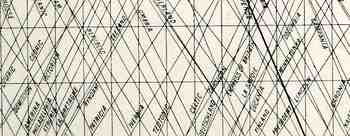
quite as complicated as it seems, really: all you need to do is follow one line from the top to the bottom. Simply put, each diagonal line represents a specific ship (all of which are named) and their positions as they make their ways across the North Atlantic ocean; each intersection represents the time and place that two ships can communicate via wireless with one another. So, for example, the Empress of Britain will on its six-day voyage be able to communicate at least 26 times with other ships for news and information.
What this seems to me to be is the supplemental efforts of the ocean-going ships
to the newly established trans-Atlantic radio-telegraphic company and installation opened by Marconi in October 1907. Even though the first transatlantic communication is celebrated as having taken place in 1901, the performance, even in 1907, was still spotty.
Again, I’m just after this for the image