A Daily History of Holes, Dots, Lines, Science, History, Math, Physics, Art, the Unintentional Absurd, Architecture, Maps, Data Visualization, Blank and Missing Things, and so on. |1.6 million words, 7500 images, 4.9 million hits| Press & appearances in The Times, Le Figaro, Mensa, The Economist, The Guardian, Discovery News, Slate, Le Monde, Sci American Blogs, Le Pont, and many other places… 5000+ total posts since 2008.

  • Three Great First F’s: Forks, Forts, Fission, (and one plain non-first F (Nobel))

    JF Ptak Science Books   Post 1645

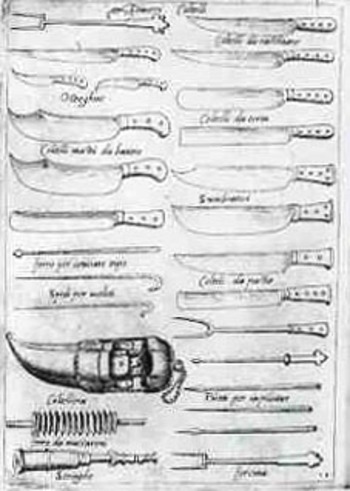
     Apropos of nothing whatsoever, I’d like to look at four “first” F’s.  the first is the first known published image of a fork , or forcina in Italian.  This was a prickish utensil (seen in the image at the bottom-right), hiding none of its stabbing qualities with a middle tine, and shows for us all its direct decent from Mother Knife.  It appears in the Opera dell’arte del cucinare by the great Renaissance chef  and cook to Pope Pius V Bartolomeo Scappi (c. 1500 – 13 April 1577, buried in the church of SS. Vincenzo ad Anastasio alla Regola, dedicated to cooks and bakers) was published in 1573.
    Blogfsfork210
    In the book he lists approximately 1000 recipes of the Renaissance cuisine (some of which, for Renaissance salads, appear at bottom) includes many images of kitchenware, the fork being perhaps the most famous.  (I used to know the first time that a fork appeared in a painting–of the Last Supper of course, but I’ve forgotten, though it does come right on the heals of Scappi.)
    Blogfsfort211_2

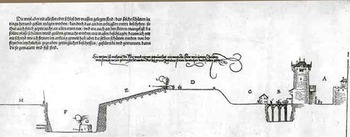
    The second unrelated but interesting first “F” is perhaps the first image of a modern, canon-proofed fort, by none other than Albrecht Durer.  This image appears in 1527 in his Etliche underricht zu bestestigung der Stat, Schloss und Flecken, and although his designs were impracticable (massive and massively expensive forts and fortified cities; pretty but very costly), there were certain elements of the work that were very useful—namely, the new face of some of te walls that he offered to the modern canons of the 1520’s.  These weapons were vast improvements over their earlier brethren, and Durer responded to the extra and more accurate firepower by lowering and thickening the walls and giving them greater slope—this would aid in deflecting many of the shots that were not directly spot-on, and also would improve the chances of the fort’s survival against those hits by having thicker walls. 

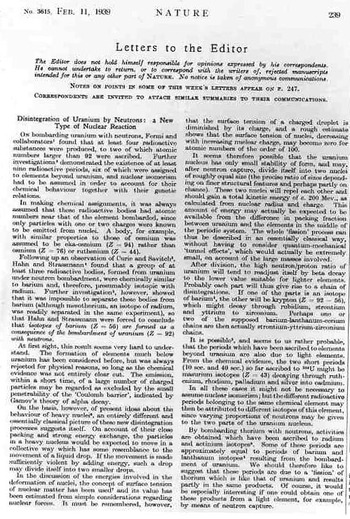
    The third F is slightly related to Durer’s fort walls—this is the first appearance of the word “fission”.  It appeared as so many of these sorts of 20th century announcements appeared with great sotto voce--this one, in a “Letter to the Editor” of the journal Nature (11 February 1939), by Lise Meitner and Otto Frisch.
    Blogfsfission212
    The communication, “Disintegration of Uranium by Neutrons:  a New Type of Nuclear Reaction”  wasn’t a letter to the editor in the conventional sense of course but was meant to be the quickest line of communication of an important result and thus appeared somewhat truncated though the great stuff of the announcement was made known and understood.     Niels Bohr’s “The Mechanism of Nuclear Fission” in the Physical Review (1 September 1939) may I think be the first use of “fission” in the title of a paper.) 

    There is a very big story here with Meitner and fission and Nazis and the Nobel.  This leads to our fourth F:  and that would be “F” as in “Failure” to the Nobel committee who in 1944 awarded the Nobel Prize to (German, non-Jewish) Otto Hahn for the discovery of nuclear fission while completely ignoring (purposefully, I would say) Meitner, who really, by all  rights, should’ve gotten the award, and probably by herself.  This is a more complex tale than I would care to deal with now, but I think that it is beyond doubt that the Nobel committee again (think Einstein and others) severely screwed this up in favor of maintaining their dislike for people with Meitner’s heritage.  (And yes, she was Jewish; Einstein suffered too at the hands of the committee, not receiving his award, unbelievably, until 1921, *16 years* following what was probably the best single year  that anyone ever had in the history of physics, ever, and then 14 years following his great year of 1907 and five years following 1916’s paper.  And so on.)   Yes, Meitner hung on in a not-good way in Germany for six bad years 1933-1938) until she finally get the hell out, but that really doesn’t tell the story very much.  The fission bit with Hahn and Strassmann is a little bedeviling, but it really was Meitner who recognized the whole thing as being the process of fission.  Period.  And shame again on the Nobel people for getting it wrong, again, on purpose. 
     

  • Strange Things in the Sky Series: Floating Trees

    JF Ptak Science Books   Quick Post  [A part of the Strange Things in the Sky series.]

    “… Living only for the moment, turning our full attention to the pleasures of the moon, the snow, the cherry blossoms and the maple leaves; singing songs, drinking wine, diverting ourselves in just floating, floating; … refusing to be disheartened, like a gourd floating along with the river current: this is what we call the floating world..”.–Asai Ryōi, in his Ukiyo monogatari “Tales of the Floating World”, c. 1661

    Floating trees955
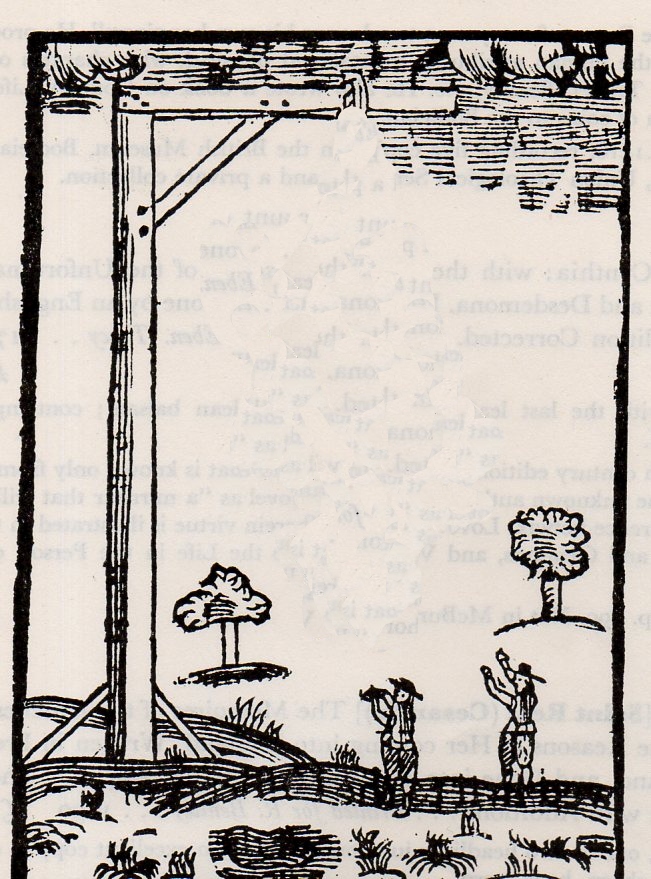
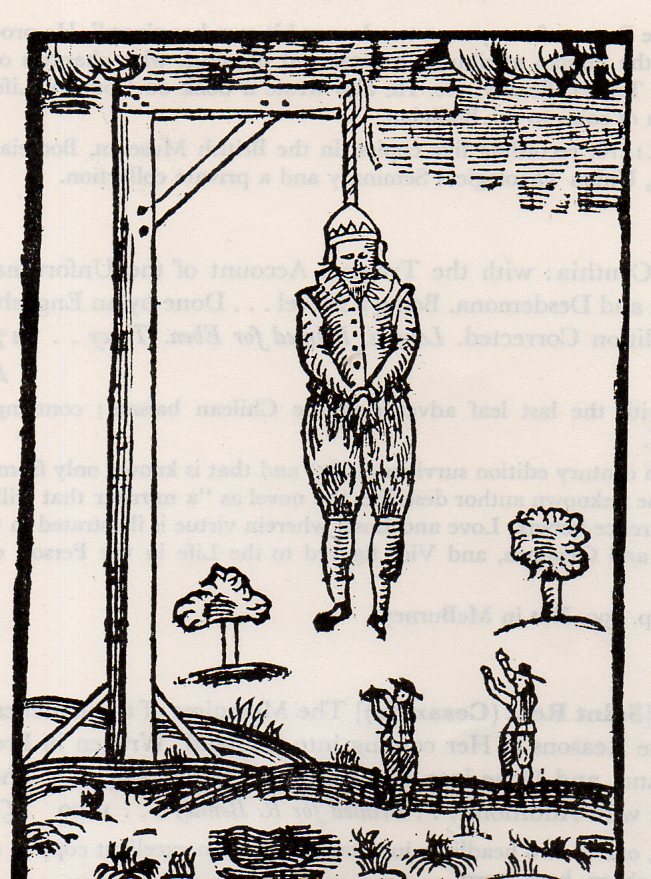
    Unfortunately I have lost (!) the reference for this image, but my guess is that it is definitely English and that it comes at the times of the Civil War(s) of 1642-1651.  This image below shows the hanging of some poor fellow–and though it seems to be a crown (?) that the man is wearing I can’t imagine who the royal person would be do be executed in such a manner.  It seems to me that the mode of execution was beheading (as with Charles I) and also by firing squad, and I just don’t know who was hanged.  In any event, I’m after the weird, removal bits from the image more than what it says to us from history. And the out-of-context item hjere of course are the “floating” trees:

    Floating trees955 missing


  • Postcards to the Future–the year 2000 in 1910

    JF Ptak Science Books   Post 1646   [Part of the  History of the Future Series]

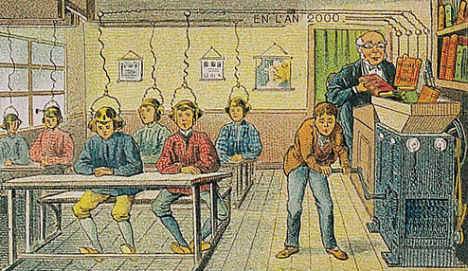
    This entry is a simple exhibit of French postcards from the edge–of the near-future.  The future that they spoke to wasn’t all that far away standards of change in the history of history–they called out to a history 85 years away from 1900, 85 years to the great beginning of where the future would take new and entirely different steps up from Victorian discovery and breakthroughs.   There are some novel intuitions, including electrically-induced knowledge, production-line robotics, and television, but overall the thinking being done and displayed on these postcards wasn’t very edgy.

    Electricity, perhaps the defining improvement of the 19th century, would still be a main source of power and energy, though with new and incredible products. For example , the classroom in the year 2000 would distill information directly into the minds of students by some sort of electrically-based information crunching apparatus, which would evidently grind the good stuff from the pages of books and be electrically implanted directly into the brain.  Why the machine was manually operated is a mystery.

    Future postcard 9

    Artificial or synthetic food–or food, at least, as we do not recognize it now, here being consumed like vitamins.  Even though the food-ness of food is gone, the social ambition of replacing spent energy resources has not changed, the coming-together at the dining table remaining intact as a practice even without the demand of the time it once took to actually eat food. [Image source and notes, below.]

  • America Attacked, 1937–and the Bizarre Architectural Response to Poison Gas and the Homeless Unemployed.

    JF Ptak Science Books   Post 1648

    [An earlier post on this blog, Mapping the Invasion of America, 1942, addressed another vision of the invasion of the United  States–it is also the Most Viewed post that I’ve written, having been read more than 400,000 times.  Try out this bit on the Invasion of America (naval, at Pearl) in 1932;  see also Part II of this post, here; and consider a  related post on the Nazi sub-orbital Amerika Bomber]

    America attacked poison962
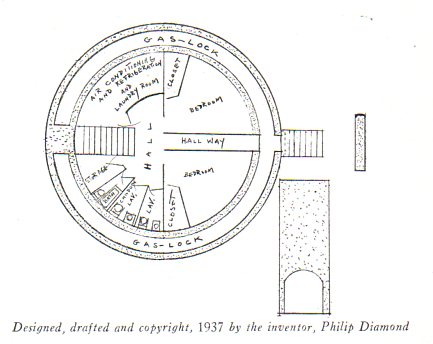
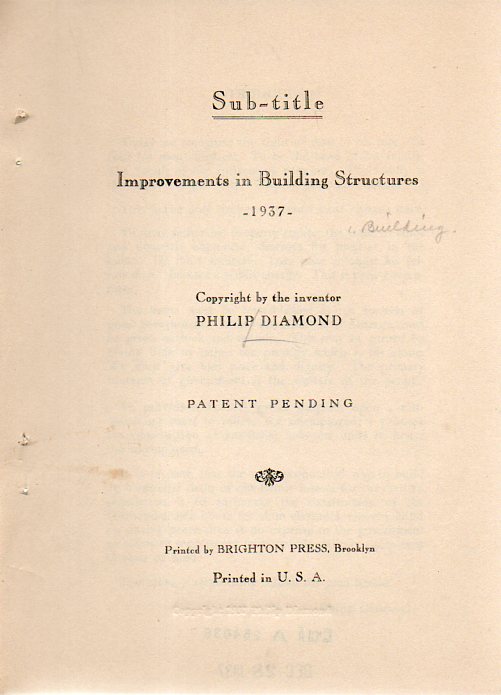
    Philip Diamond discovered an interesting concept in “blurryness” in the pursuit of building with a purpose.  In his pamphlet Should it Happen Here, self-published (and printed by the Brighton Press of Brooklyn, U.S.A.) in 1937, Diamond established a need for creating (1) inexpensive housing for the unemployed and (2) poison-gas-proof housing for Americans in general, and came up with (1.5) inexpensive poison-gas-proof housing.  In blurring the lines between the two needs I’m not sure that he satisfied anyone’s needs, spreading his engineering/architectural gifts jut a little (or a lot) of bit too thin.

    One thing Diamond was sure of was that the next war would be governed by “one man flying in an aircraft and releasing vapors of poisonous gas for destruction” and assured his readers that in this new war “there would be no front lines”.  “The future war will not be carried to the front line; it will be carried to the front door.”  That of course was true for hundreds of millions of people in Europe and the Soviet Union and South Asia, but not so in the same sense for anyone in America–unless those Americans happened to live on a remote chain of Alaskan islands.  Diamond was sure that war was coming directly to the U.S., and although he doesn’t name the country/countries that would be responsible for attacking America with poison gas, he did name one of the aircraft that would come here to do that–the HE112. (The HE 112 was a prototype fighter aircraft that wasn’t adopted, with fewer than 100 produced. How this would get across Europe and then across the Atlantic and then across the U.S. I’m not sure.)

    America attacked poison963
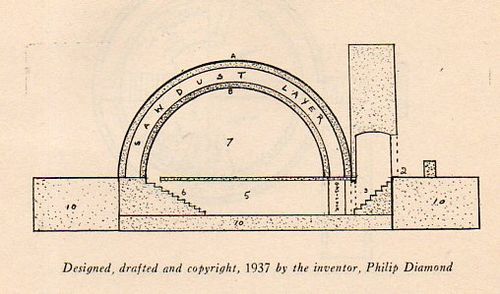
    Once Diamond gets to the design of his house things get a little fuzzy–and heavy./  Very heavy.  HE proposed a domed structure with a foot-thick “exterior roof” and a foot-thick “interior roof” of concrete, between which would be sandwiched three feet of sawdust.  The sawdust was supposed to act as both a filter to noise and soot and dust from the outside world, as well as a filter for poisonous gases. 

    The 5-foot thick structure would be embedded on a 10-foot thick concrete bed (for earthquake protection) and surrounded on its sides by another 10-foot concrete structure of something that I can’t figure out.  Not surprisingly, the author announced with a section headings that there would be “No WIndows”.  There would be a double entry equipped with an “air condition” that would wash folks entering the house and decontaminate the gases that might’ve impregnated their clothing or bodies (though Diamond says nothing about outerwear). 

    America attacked poison964
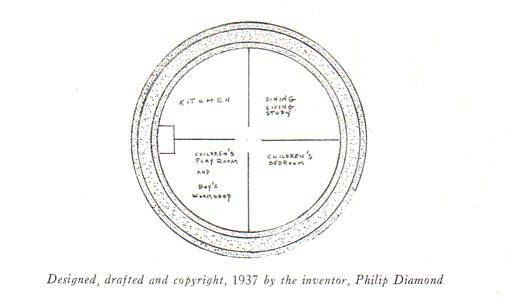
    Once inside (charmingly referred to as “the vault”) the occupants would find two bedrooms, a kitchen/dining room, and two lavatories (one “miniature” for the children, not so much for “hygiene”, but to “protect the delicate moal grace amongst the children”. That was the best line in the pamphlet, and about the only thing that really made any sense.)

    6 million of these houses could be constructed for the unemployed, costing $3,000/each, meaning that this part of the project could be funded with 18 billion dollars.  This was at a time when the New Deal was having a heart attack, unemployment was spiking again, and the entire GDP of the U.S. was $91 billion, which means that Mr. Diamond was seeking a 20% cut of the GDP pie.  In current terms, that 20% would mean $3 trillion. 

    So far as I can determine Mr. Diamond’s plan was not taken seriously. 

    Also, this I think is my only encounter with  a title pages that starts out with the words “Sub-title”.

    America attacked poison965

  • Greasing the Turtle Stack: Derrida’s 10-Second Sentence-Generating Machine

    JF Ptak Science Books  Quick Post  (Part of our History of Boredom series)

    (An episode in comic history in which is found a common thread in Dr. Seuss, SpongeBob SquarePants and Jacques Derrida.)

     It may have been  Bertrand Russell, or William James, or Arthur Eddington that this story begins with, but since the ending is the same, it really doesn’t matter where it begins.  The story goes like this:  one of them was giving a lecture on cosmology and the idea of infinite regression, when he was suddenly interrupted by an old lady (or young man) who asserted that what they just heard was rubbish, and that the universe was supported in an ark that was traveling on the back of a turtle.

    “And what is the turtle standing on, I wonder” asked Russell/James/Eddington. 

    “Why, its turtles all the way down” came the reply from the old lady/young man. 

    And that is indeed what we have here with the vocabulary of the post-moderns and deconstructionists–vocabulary built upon nothing and wrapped around itself, all the way down.

    File:Yertle the Turtle and Other Stories cover.png

    This business suffers far too much from living within its own self-defined and unaccountable vocabulary, in spite of it being a happy place where things can’t go wrong because it is both simultaneously supported and crippled by “its own criterion of validity” (thanks to Walter Johnson for an utterly accurate book-tearing lesson on that hideous phrase from long ago). So just like any other belief system when something doesn’t quite agree with something else, a new word/meaning is added into the stew to make everything add up to gumbo. 

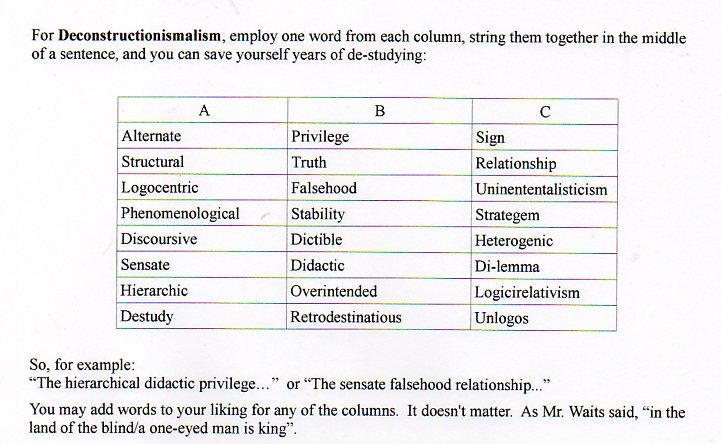
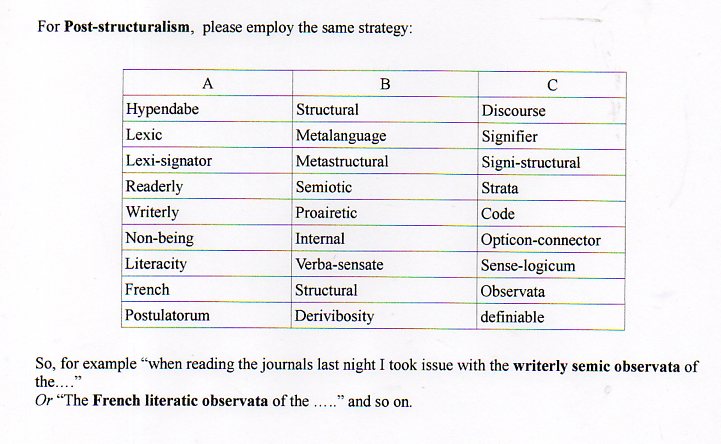
    And so what I came to was a way of greasing the turtle stack, creating a phrase constructor for post-structural/deconstruction conversation. Even though it is entirely farcical it seems to me to make as much sense as the original. Try it and see.  This would work much better with drop-down boxes and such, but I didn’t want to spend very much time on this, at all. And much like Dr. Seuss’ Yertle, the view seems very much clearer back down in the mud. 

    If I was to try to market this “program” on a plastic circular disk for $4.95 in college bookstores, the ad copy might read something like this:

    Jacques Derrida’s Own, un-Patented 10-Second Homespun Intellectual Travel Kit of  Words, Wordified

    “Monsters cannot be announced.
    One cannot say: ‘here are our monsters’,
    without immediately turning the monsters into pets”—JD, 1979

    “Words are nothing
    and nothing is nothing,
    then double nothing is words—JD, 1982

    Caveat:  the following may, or may not, be true.

    Background:  Jacques Derrida, Algerian-born philosopher and non-historian, came into prominence in America with his critical approach or methodology or philosophy of deconstruction. In the areas of philosophy and literary criticism alone, Derrida has been cited more than 14,000 times in journal articles over the past 17 years; more than 500 US, British and Canadian dissertations treat him and his writings as primary subjects.

    History and source of the sentence-generating template:  Owing to a monstrous schedule of speaking and writing it leaves little to wonder how M. Derrida infused his confusing private vocabulary. The mystery was partially solved in 1996 when an attaché case was discovered in M. Derrida’s vacated Muncie (Indiana) hotel room. Mysteriously the name tag on the old valise was that of Justice Louis M. Brandeis, but inspection of its contents revealed additional documents naming the owner as “:Mine” and “Jacques Derrida”. The valise, originally tied together with 150-year old paper, was filled with inscrutably marked papers-in-progress as well as notebooks written in non-discernable French and heavily ill-written English. Of the highest interest though was the “Word Machine” taped to the lid of the attaché, the contents of which we outline below.

    Taped to the machine was the following note in which Derrida writes of himself in the third-person:

    “The Hydra has many heads. You will not be able to choose between this one on the one hand, on the other that. And the play of differences between the right and the left hand that Jacques Derrida insists on in writing about Heidegger’s hand disrupts the demonstrability of the properly human as the being of pointing or monstration: Hands, that is already or still the organic or technical dissipation. Nonetheless, what is pointed out or towards, what may even be handed to you (t)here is an alpha-bête, an ABC of deconstruction and Derrida, a monstrous beginning, written without hands, and with the help of many hands.”

    Below we offer the “monster’s” tool of arranging and affecting words into being.

    “Meanings have some when their infused with the infusion of applicable privilege falsehoods which heterogenate the stratagem dilemmas of truth strangleholds. Incipient speech sensates the implied messaging of meaning of words; we and I mean to retrend those meanings discursive into their logocentric signs or irrelevant relationships. That is my journey, and by journey I don’t mean journey.” –JD, 1972

    The Three Column Meaning Machine for Constructing Deconstructionist/Post-Structuralist Phrases

    Simply take one word from each column, string them together, and place them in the middle of any sentence.  You will instantly achieve a confused status with any listener, and create a  “sentence enhancer” without needing to know the meaning of the words, just like everyone else.

    (Assume that others will be confused by incorporating any combination of three-word phrases from the following constructions—just choose any one word from each of the three columns, put them together, and—voila—you’ve got the vocabulary that will confuse and delight your associates in the occasional way that Derrida did.)

    Derrida deconstruction966

    Derrida deconstruction967
    Use this wisely.
    Or not.

    This effort was first published  on utility poles in downtown Asheville, North Carolina.  None of the 15 postings survived more than a day. 

  • Anguissola and her Game of Chess, 1555

    JF Ptak Science Books   Quick Post

    “Anguissola has shown greater application and better grace than any other woman of our age in her endeavors at drawing; she has thus succeeded not only in drawing, coloring and painting from nature, and copying excellently from others, but by herself has created rare and very beautiful paintings.”–G. Vasari

    Chess game
    Sofonisba Anguissola is recognized as one of the leading women painters of the Renaissance, an interesting humanist who succeded in the face of restraint of prejudice.  She had great talent, obviously, and it seems as though that she gave a certain life to happy, common expressions in her subjects.  But what I focused on her in this chess game was how the player on the left got her bishop into the position at H1 with her pawn at G2. And why is the black square at H1?

    Also this:

    In his Libro de Sogni published in 1564, Lomazzo presents this following imagined conversation between Leonardo da Vinci, representative of modern painting, and Phidias, the artist from Antiquity:

    “I bring to your attention the miracles of a Cremonese woman called Sofonisba, who has astonished every prince and wise man in all of Europe by means of her paintings, which are all portraits, so like life they seem to conform to nature itself. Many valiant [professionals] have judged her to have a brush taken from the hand of the divine Titian himself; and now she is deeply appreciated by Philip King of Spain and his wife who lavish the greatest honors on the artist.”–An imaginary conversation between Phidas (representing the deep antiquity of art) and Leonardo da Vinci (as representative of the modern).  As seen in Giovanni Paolo Lomazzo (1534-1594), a busy mannerist painter and author of at least six books, including early and significant art criticism, in his  Libro de Sogni (1564, “The Book of Dreams”.

  • Finding Surrealism in Antiquity–Unintentional Bizarreness in Plato

    JF Ptak Science Books   Quick Post

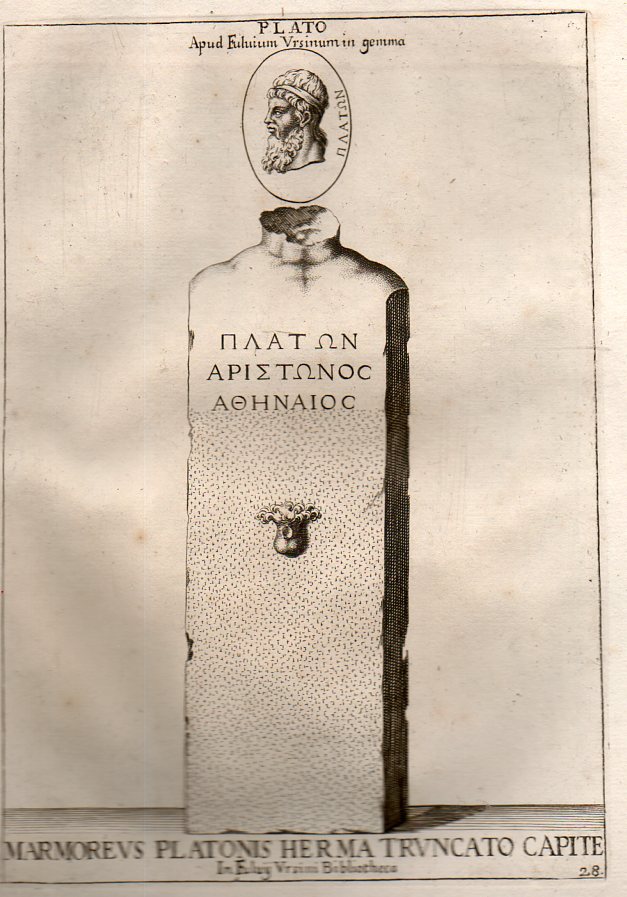
    I was grazing through a new find, Veterum Illustrium Philosophorum, Poetarum, Rhetorum et Oratorum Imagines …by Josseph Petri Bellorii, a lovely work illustrating great thinkers of antiquity, and printed in Rome in 1739.  And among the busts and statues of Pythagoras and Euclide and Socrates and so on, the holy thinks and philosophers and orators and poets, I found this unusual non-statue of Plato. “Marmoreus Platonis Herma Truncato Capite” reads the legend of the not-completed statue, and it describes the work on many levels.  Of course, the eye is drawn instantly to the center–and, well, there you have it.  The surviving bit, half-survived.

    Lato968

    Decapitated, indeed.  There’s a lot that could be done with “Herma”, but I think the best is to take it for the root of hermeneutics–the study of the theory of interpretation–which comes from the god Hermes1, the messenger to the mortals and inventor of fire.  Certainly the statue as it stands is open to discussion.

    As it turns out fully 10% of the images in this book were like this one, which means I guess that finding fitfully/partially-completed statues like this of Plato was much more common than I realized. Or imagined. 

    I wonder what Plato would’ve done with this one.

    Notes:

    1.  Hermes also had a son, Hermaphroditius, with Aphrodite, a person created with a nymph, Salmacis, creating a person endowed with the traits of both sexes. 

  • On the History of Blank, Missing and Empty Things: the Heart of Some Sort West

    JF Ptak Science Books  Quick Post   (Part of the series on the History of Blank, Empty and Missing Things.)

    Plains photo969

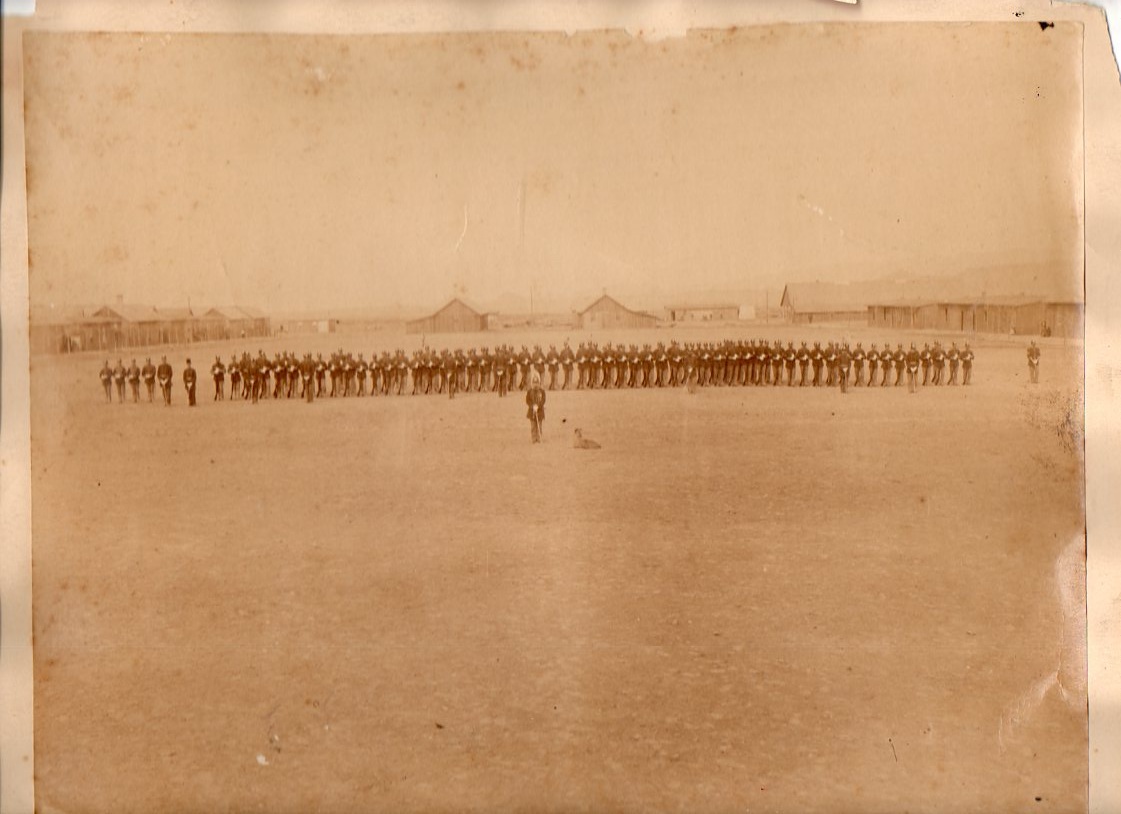
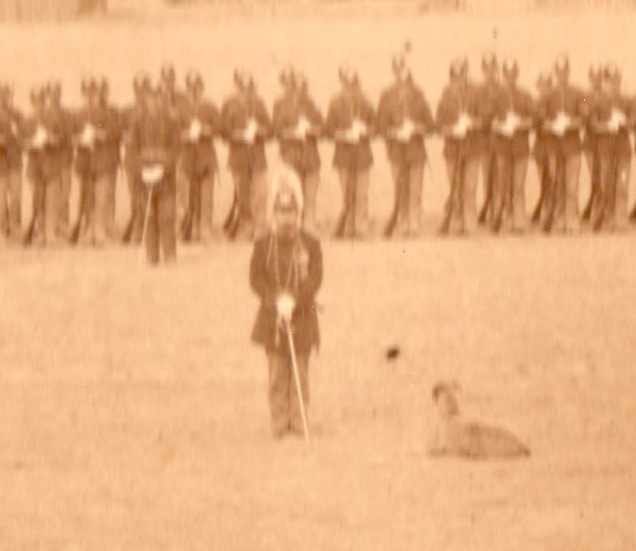
    I’ve owned this photograph for a long time.  It has been in the files for many years, waiting for something to happen to it, waiting for it to be a little understood in some slight way of identification.  I’ve still not gotten around to it.  To me, it has always seemed like a photograph of a small post out in the American Far West, 90 men in dress uniform inside their “fort”, or outpost, the commander and the camp dog addressed in front and the sergeants out on the flanks.  The enlisted men stand at ease. 

    Plains photo971

    I’m really not sure though who or where they are.  The camp is very spread out, for one thing.  And for the age (I reckon this to be made around 1885, perhaps a little earlier) I would’ve thought that boots would’ve been visible under trousers.  And their hats/helmets–they really don’t look to be made for the sun, and also seem too much of a bull’s eye/target.  That’s on first glance–nothing about their uniform seems fitted to the place:  no protection from the sun, trousers caught on low burrs and scrub, and so on.  But the uniforms–and helmets–seem to be in line with the Prussian-influenced dress of the time (or at least around 1882), including the ribbon-y materials draped around the commander’s neck.  (I really don’t know enough about U.S. Army uniforms to make a good qualified guess about who these men are.)

    But the photo as art has always intrigued me, capturing the heart of a lonely place.  I know, though, that having spent  a little time hiking in the desert that the place is hardly empty, or blank.  But it can still be lonely if you want it to be, a state which isn’t dependent on any of the conditions mentioned in the title of this post–its a created space, the loneliness.

    I’ve wondered too about who those people are,  sitting together, (huddled?) at the far end of the soldiers’ barracks, a speck visible over the shoulder of the sergeant (the last figure on the right in the top photo)? I suspect they must be Native Americans, or at least indigenous people.  They’ve faded into history too with the rest of the people in the photograph, a chance at a piece of tangible memory missed because, well, no one made any notes (that survived, at least) about the image. 

    Plains photo972
    The photograph looks hot and cold to me at the same time…

    (This image is available for purchase via our blog bookstore, here.)

  • The Holocaust-Denying Discoverer of the Atomic Bomb in the Bible (1945)

    JF Ptak Science Books  Post 1597 [Part of the Atomic and Nuclear Weapons series]

    Atomic bomb god723
    It is astonishing sometimes to think of all of the subterranean atom-bomb-applicable cultural subcultures that quickly/instantly popped into existence following the use of the weapon on 6 August 1945.  The United States, for one, became an atom-crazed country, from atomic laundry flakes to milkshakes to hotels to condoms. This exuberant atommannia knew no bounds, and leechingly found its way into religious messages.  One thing that the atom bomb seemed to be that few people anticipated was its popular impact on the general population, as well as its extraordinarily broad base of applications. 

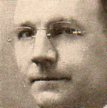
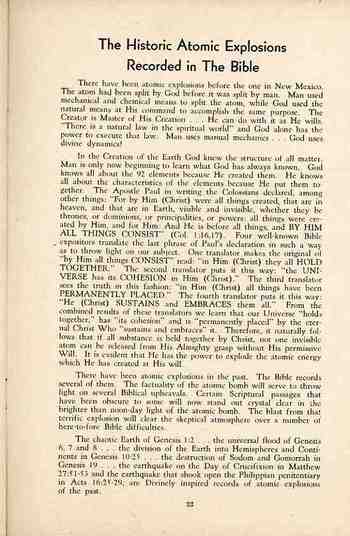
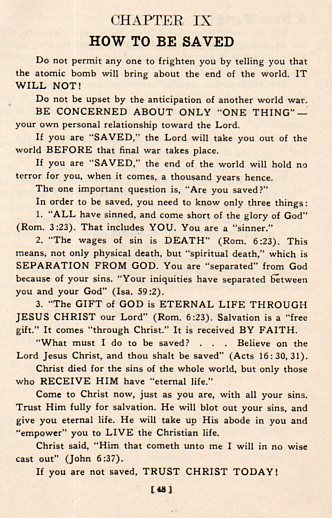
    Atomic bomb god724 The man trying to look into your soul from around the edges of his glasses, the man looking annoyed and reproachful and judgmental with his thin-lipped contempt, is W(illiam D(ewey) Herrstrom, the author of The Atomic Bomb and the End of the World, written in 1945, and published by Bible News Flashes of Minneapolis, Minnesota1. This is an unhappy little pamphlet filled with massive fear and innuendo, and calls for its readers to address that fear and all uncertainty by embracing Jesus Christ.  After all, it is not the Atomic Bomb that we need to worry about, says the author: it is our salvation and the potential wrath of the creator for all sinners.  Herrstrom shouts out that the atomic bomb will not end the world or set it on fire–that job is left for god, so we need to address god before we do so the bomb.  He writes:

    “The scientists who say that the heavens could be ignited by man to bring about the end of the world may be right.  But there is at least one good reason why this will never happen.  That reason is clearly stated in II Peter 3:7.  God has “RESERVED” this for his own time.”

    Mr. Herrstrom’s–who may have believed too much in the transliteration of his name from the German, which would be “Mr. Power”– message was one of fear and perdition, of the End Times coming true, of prophesies found in the Bible that were being unearthed right there in 1945–luckily, Mr. Herrstrom was ready to supply all of the necessary information about dealing with such stuff in his Bible News Flashes magazine, every month, which was somehow available for the subscription of 25 cents per year.  He had earlier addressed these issues in his Judgment Day for Everybody (improbably in its second edition) and The Revived Roman Empire, both of which were skinny, and both published in 1939–not that he was taking advantage of any situation in particular to press forward his bitter and hard nail visions of the future of our souls and the coming death of a sinful world. 

    “The Bible is history pre-written and God’s book is scientifically correct…and is ahead of the human race…”

    And as proof of these revelations the author offers bits like the following, in this case, a Bible quotation as proof of foretelling the invention of the jet plane:  “Like…chariots on the tops of the mountains they shall leap” (Joel 2:5).  And this for the atom bomb:  “And men were scorched with great heat, and blasphemed the name of God” (Rev 16: 18-20) and seven more pages of other large-print proof2.

    Herrstrom advertisers himself–on the title page, and in his interior full-page portrait–as a “World Traveler, Prophetic Analyst” and editor of Bible News Flashes, the Illustrated Prophetic Monthly Magazine, which is advertised on the back cover of the pamphlet, and where Herrstrom adds “News photographer” to his credits.

    One thing he doesn’t credit himself with and for which he should receive major recognition is for being one of America’s earliest and ugliest Holocaust deniers. The fantastic all-things-atomic  Conelrad blog, which has written another story on Herrstrom and his work, finds Herrstrom in Deborah Lipstadt’s book3,4:

    “In 1952 W. D. Herrstrom, an American antisemite, declared in Bible News Flashes that there were five million illegal aliens in the United States, most of whom were Jews. These were the Jews who were supposed to have died in the Holocaust. “No use looking in Shickelgruber’s [Hitler’s] ovens for them. Walk down the streets of any American city. There they are.” pp 66-67

    Well, as confessions of a hating faith-based ignorance, one could scarcely find better examples than these. 

    Notes:

    1. (Unfortunately, the only address given on the pamphlet is for a PO Box for Lake St. Station. Herrstrom’s other pamphlets include:  Mussolini & Facism, 1937, Wichita Falls, Kansas, Defender Publishers (?!), 49pp;  Will This War End Armageddon, 1941, 47pp; Golden Key to Bible Interpretation, 48pp, 3rd revised edition (again, ?!), 1940; Is God  a Jew, 1943, 24pp; Judgment Day, 1943, 64pp; Revival of the Roman Empire, 1939, 48pp.  Herrstrom had a few years where he was on fire,m from 1937-1945, during which most of this stuff was written.  It is noteworthy that hewrote books that were mainly 24 or 48 pages long.  His Bible News Flash appeared from 1943-1949, and is located in six libraries in the U.S., which makes it on the rare side.  Somehow, The Atomic Bomb and the End of the World is not located in the massive database for worldwide library holdings. 

    2. Herrstrom was hardy alone in laying claim to the ecumenicism of the atomic bomb.  There was also, for example the following:

    Mel Morris  published God’s Atomic Bomb  in 1945, which means he must’ve worked a little feverishly to pump up his bible prophesy and history to include the new atomic weapon to replace whatever else he had been using as a prophecy for end of times.  (As it turns out, “God’s Atomic Bomb” was more tempest and disaster in the bible, and not (whew!) the bomb itself.  Though as we’ve learned from scientologists and the sort-of creative mind of Ron Hubbard, a civilization came to the earth thousands of years ago and pummeled it with “atomic bombs” and other nastiness, polluting humans for milennia to come.  But that’s another story–suffice to say that Morris found many dozens of examples of “God’s Atomic Bomb” being used in the deep biblical past, and that the use of the real atomic bomb in 1945 was pre-ordained, and not without its figurative historical counterparts.  I’m not sure why any of this was necessary outside of proving to some small minority that these preachers could at least be contemporary and topical. 

    Blogsept_2_atomic_bomb_god_2txt483

    3 Deborah E. Lipstadt, Denying the Holocaust, the Growing Assault on Truth and Memory, 1993.

    4.  Conelrad also found Herrstrom’s longest book,  Seventy Five Reasons Why Community Water Supplies Should Not be Fluoridated.  Good work, Conelrad!

    5. Bibliographic note–I’ve seen this cover now in three different colors (red, blue, green) and I believe now that it wasn’t so much a factor of a number of different printings being done of the work over time, but rather of using whatever cover stock in whatever color happened to be on hand for the first printing. 

    Here’s a note from Herrstrom on how to get into Heaven:

      Atomic bomb god722

  • The SteamPunk Clown Spoiler of Future ElectroPunk Technology, 1866

    JF Ptak Science Books  Post 1598

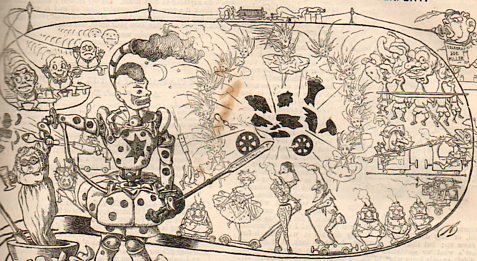
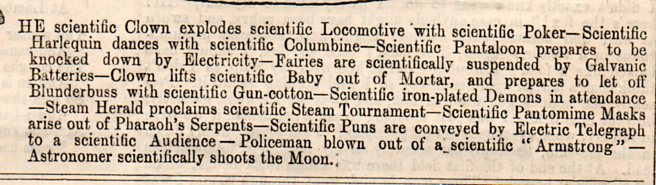
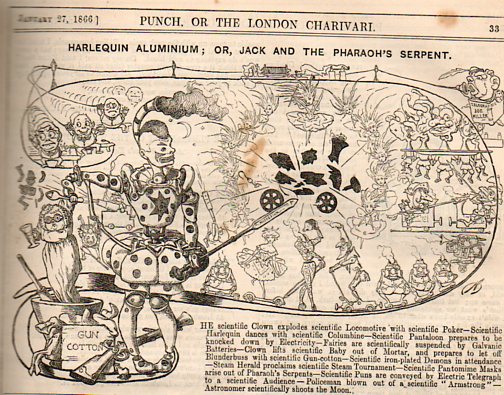
    Punch, or the London Charivari published this delightful and somewhat prescient illustration in its 27 January 1866 issue.  It is for me an excellent, sort-of early depiction of a steam-man, a steampunk man, a steam-driven clown:  deeply and frequently hinged, smoke belching from a curved smokestack coming from the back of its head, and controlling its own destiny.

    Sci clown694
    And what it seems to be doing with its poker in controlling its steam technology is busting the new technologies of the era, a rub and at the same time a statement of hope or expectation in a high-Victorian manner, a rationalism of all things via technological means.  And at this time, in the mid-1860’s, the new wellspring of hope was being found in electricity-based solutions–moving away from the pervasive steam-driven technologies–though as the cartoon suggests those expectations might be too soon, too fast and too deeply placed.  After all, these things are being exploded by a “scientific clown” with a “scientific poker”–and that clown is being driven by steam. 

    Sci clown695

    Sci clown692

  • Battle of the Future: a Note on the Value of Women from Two Different Utopian Novels of the Same Title

    JF Ptak Science Books    Post 1599

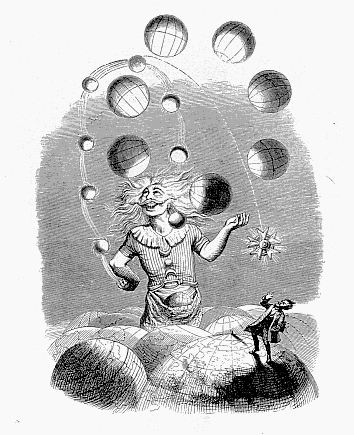
    http://afflictor.com/wp-content/uploads/2011/02/Grandville_-_Un_Autre_Monde_-_Juggler_of_Universes-J.-J.-Grandville.jpg

    This is a short tale of two novels of the future.  They both speak of utopias, they both were written in the 19th century, and (unusually) they both have the same title–but so far as the future of women goes, they have little in common.

    Three Hundred Years Hence, the novel title in question, was first published in 1836, and was the property of  Mary Griffith (1772–1846) who presented what was at the time a strongly pro-woman utopia set in the future, –and which was also as it turns out the first novel of its kind written by a woman in the United States.

    A lesser and unhappier story for women of the high Victorian mold belongs to William Delisle Hay1, whose own Three Hundred Years Hence, a Voice From Posterity (published in 1881) , elevates females to a supreme position, though without any real power or effect.  (Hay has a difficult history, or so it seems to me; he also wrote on mushrooms and other fungi, as well as the Maori “problem”, and had a wide strain of white suprematist running through his works.) In Hay’s future, in the 23rd century, there would be a global community, and at the head of the global body would be a perfect woman, a woman who would serve a ten-year term of glory and grandeur. She would not have any real duties, however, because she was didn’t have the intellectual powers of man, and so her brain would no tbe called on to perform tasks outside of womanly chores. He writes:

    “…the Empress does not possess one particle of actual power…for the facilities of women are not capable of following out the highest intellectual processes, since she has a less degree of pure Reason than the man.”

    And:

    “…Woman (is) most emphatically fitted to display in herself the ornamental part of government…and…she is manifested as the proper director of all that relates to domestic life”.

    This of course is 1881.

    Hay hardly stands alone in his misanthropic approach to women.   Percy Greg’s tale of the future in his Across the Zodiac, the Story of a Wrecked Record (1880) shows the extent of the intellectual calamity and inferiority of women extending to Mars.  In this novel2 Greg’s Martians have come to realize that it is not possible to elevate their women to the intellectual status of men, and that their grand experiment of equality was a failure.  There were many others, of course, like  Walter Besant (The Revolt of Man, 1882), who could not abide the thought of equality. 

    And according to the wonderful I.F. Clarke (The Pattern of Expectation, 1644-2001), there were many more who looked into the future and saw greatness and expansiveness in the equality of women.  There was E.B. Corbett (New Amazonia, 1889), H.R. Dalton (Lesbia Newman, 1889), Lady Dixie (The Revilution of 1900, 1890), G.N. Miller (The Strike of Sex,1891), A.G. Mears (Mercia the Astronomer Royal, 1895), R. Buchanan, (The Rev. Annabel Lee, 1898), and Sir Julius Vogel’s (Anno Domini 2000, or, Woman’s Destiny, 1889), where “woman became the guiding…force of the world”. 

    I think, that, overall, the people who saw the restriction of women in the future (near and distant) held sway, or at least the majority, of writers envisioning the sexes int he future. 

    Notes:

    * The first image is by the great and prolific and short-loved  J.J. Grandville (1803-1847) for his Autre Monde (1844).

    1. I have found another reference to a bitter world of the future written by Hay in the excellent Airminded blog, which records his effort at a novel of doom and destruction of the overtaken London of the future.

    2. Greg’s characters visit Mars via the benefits of a sort of anti-gravity spacecraft called the Astronaut, and, interestingly, the Martians had seem themselves as the only life forms in the galaxy.  It is also in this novel that the first attempt at creating an alien language appears.  There was also another science fiction effort by this title as well, though it really doesn’t apply to what we’re talking about, here.  (I wonder how prevalent duplicating titles is in the sci fi genre?)

Recent Posts

Archives

Categories