JF Ptak Science Books Quick Post
I was grazing through a new find, Veterum Illustrium Philosophorum, Poetarum, Rhetorum et Oratorum Imagines …by Josseph Petri Bellorii, a lovely work illustrating great thinkers of antiquity, and printed in Rome in 1739. And among the busts and statues of Pythagoras and Euclide and Socrates and so on, the holy thinks and philosophers and orators and poets, I found this unusual non-statue of Plato. “Marmoreus Platonis Herma Truncato Capite” reads the legend of the not-completed statue, and it describes the work on many levels. Of course, the eye is drawn instantly to the center–and, well, there you have it. The surviving bit, half-survived.
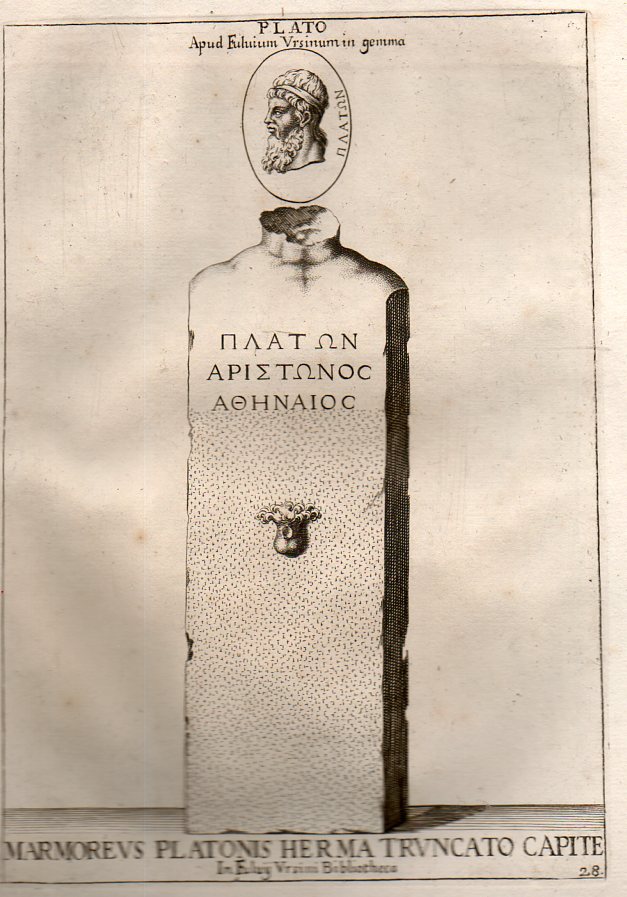
Decapitated, indeed. There’s a lot that could be done with “Herma”, but I think the best is to take it for the root of hermeneutics–the study of the theory of interpretation–which comes from the god Hermes1, the messenger to the mortals and inventor of fire. Certainly the statue as it stands is open to discussion.
As it turns out fully 10% of the images in this book were like this one, which means I guess that finding fitfully/partially-completed statues like this of Plato was much more common than I realized. Or imagined.
I wonder what Plato would’ve done with this one.
Notes:
1. Hermes also had a son, Hermaphroditius, with Aphrodite, a person created with a nymph, Salmacis, creating a person endowed with the traits of both sexes.