A Daily History of Holes, Dots, Lines, Science, History, Math, Physics, Art, the Unintentional Absurd, Architecture, Maps, Data Visualization, Blank and Missing Things, and so on. |1.6 million words, 7500 images, 4.9 million hits| Press & appearances in The Times, Le Figaro, Mensa, The Economist, The Guardian, Discovery News, Slate, Le Monde, Sci American Blogs, Le Pont, and many other places… 5000+ total posts since 2008.
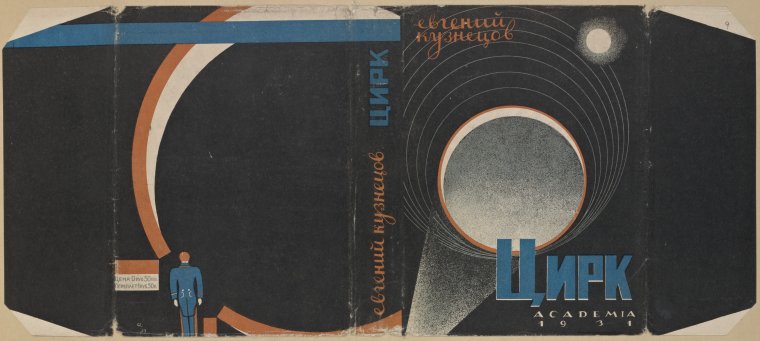
[Kuznetsov, E. Tsirk. [Circus.] Moscow: Academia, 1931; Cover design by N. Akimov.; 8 v., [655] leaves of plates : col. ill. ; 32 x 57 cm.]
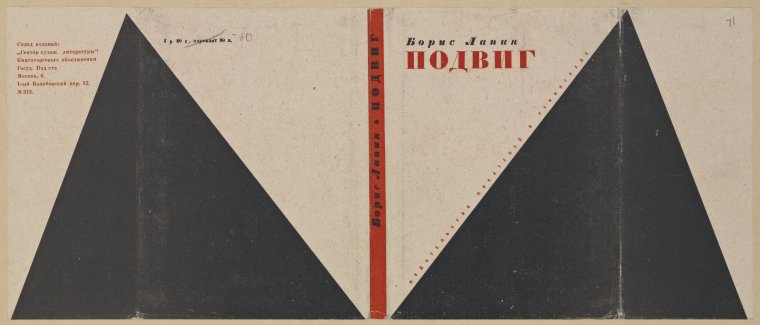
I found this dustjacket art of Soviet-era books (all from the 1930’s save one) in the New York Public Library collections (here) and was struck by the geometrical objects in many of the designs. They have a sense of warmth to me, somehow, like softer work coming from the tail end of the Constructivist period, having elements of Dada but really just having some of the hard edge of Constructivism without the scorching/awakening images that might have been embedded in the geometrical design.
JF Ptak Science Books Expansion and Correction(s) of Post 1638 (Thanks to Orion Pozo at NCSU for starting this off by outing the Marlboro baby.) Part of the series on the History of Blank, Missing and Empty Things, Part 77: Promises.
“The world is my dream.”– Sir Karl Popper
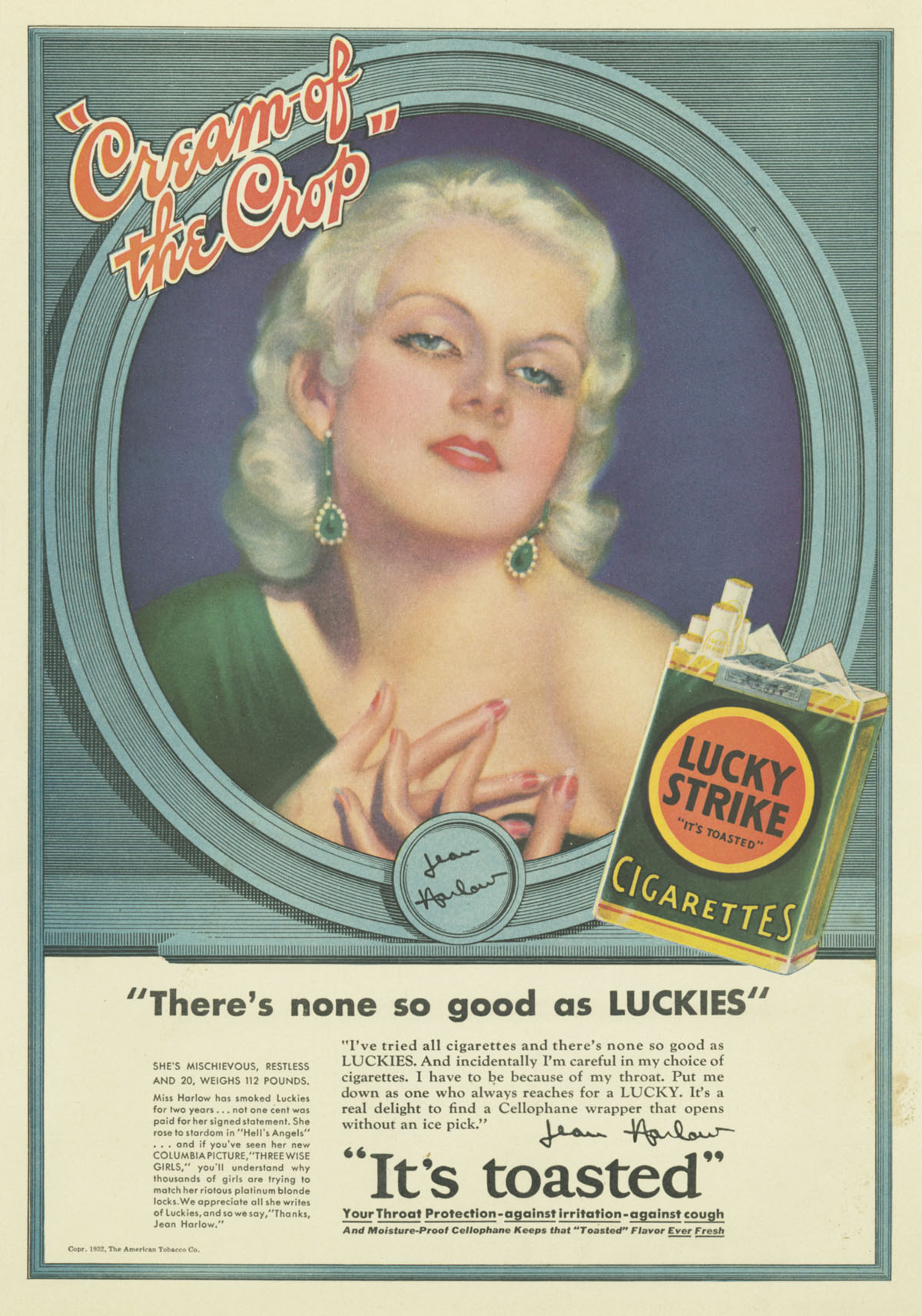
In the History of Empty Promises advertisements for fulfilling experiences with safe/pleasant/not-addictive/sweet-smelling tobacco cigarettes would find a key position, if for no other very large reason than having killed so many millions of people. Many of the lies told to the consuming public on the efficacy of cigarettes have come through billions of dollars worth of print advertisement, many of which featured the earnest eyes of someone famous (Babe Ruth, Lou Gehrig, the Duchess of Windsor), or authoritative (football referees, doctors, lawyers, airline pilots), or trustworthy (Santa, the family dog), or even innocent (teenagers and of course babies). I’ve collected a few examples that I find particularly arresting–there are hundreds or thousands more to choose from.
Note–all images are drawn from the great resource at Stanford University on cigarette advertising, here.
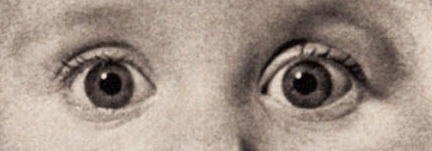
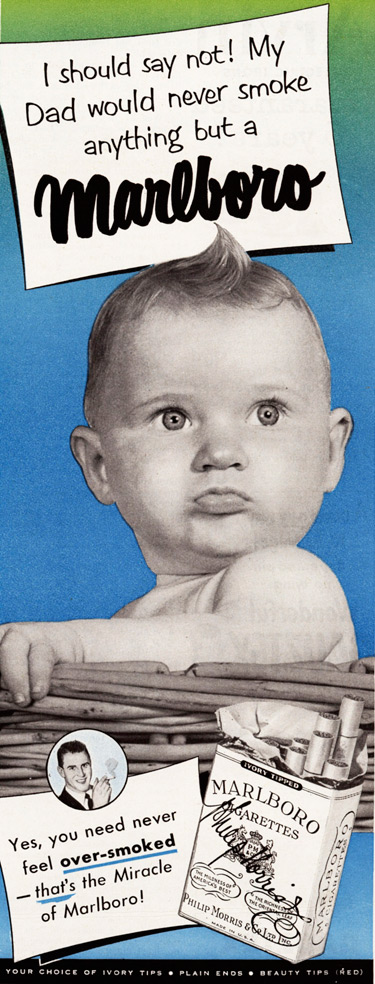
Cigarette Eyes of Babies (for Mommy–for Daddy, see below):
In one of the high twisted occurrences in the history of Buying Things, Marlboro cigarettes started its life out as a smoke for women, a mild, feminine object for ladies. And as we can see here an early appeal to the possible consumer came through the eyes of an infant. The product didn’t sell well, and was repackaged for men, the baby eyes eventually being replaced by the iconic cowboy. This is one of the few times that an a consumer object that began its career as a sales vehicle for women crossed the gender barrier.
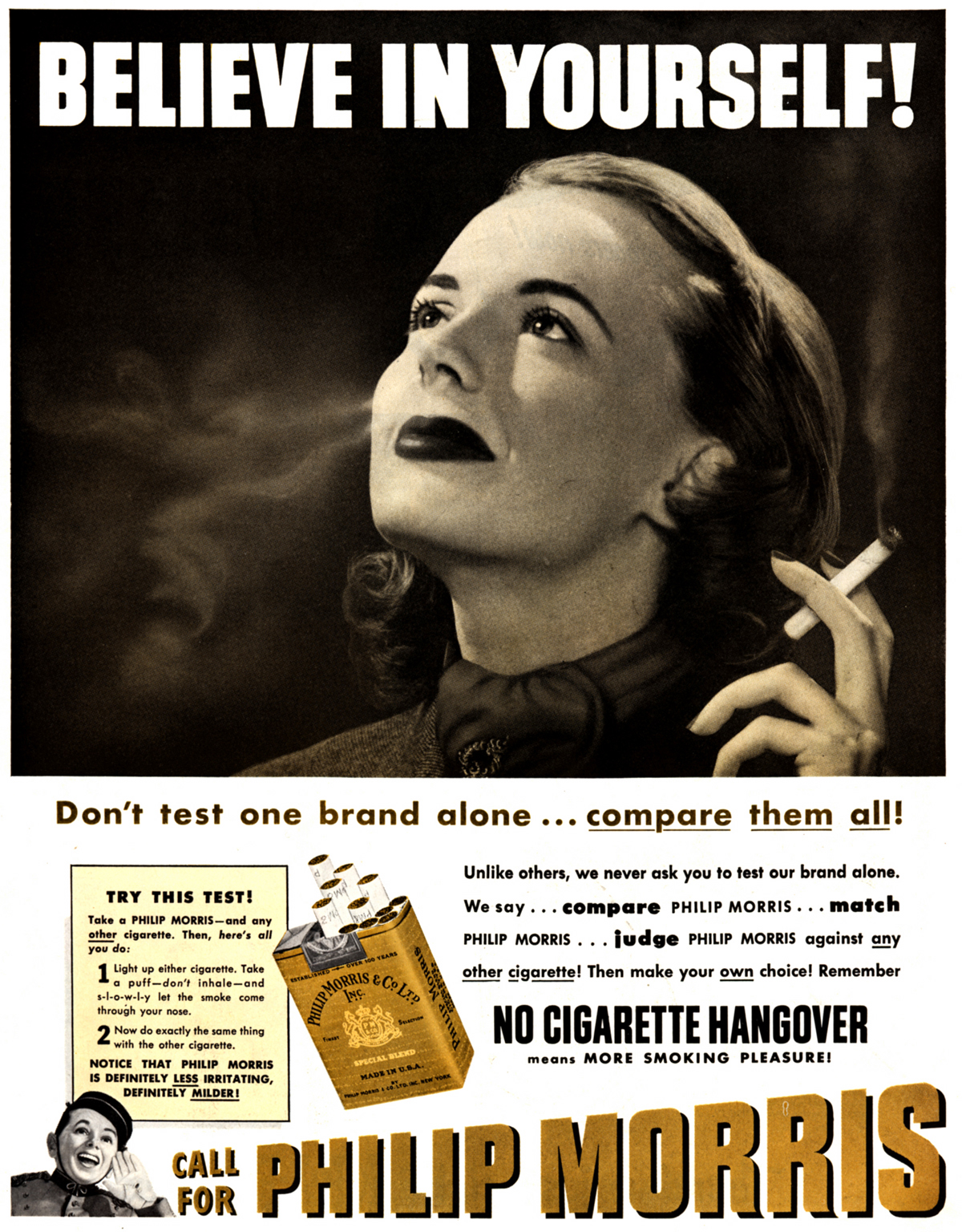
Cigarette Eyes (and Nostrils) of self-knowledge and belief (because nothing quite spells out personal knowledge than blowing hot smoke through your nose holes):
Cigarette Eyes of the edification of pure scientific support for the glory of smoking:
Chesterfield not only conquered the alphabet for cigarettes, but “science” as well. Here we see Big Science affirming the ABC claim that there is no “aftertaste” in their cigarette. (The ‘scope has no identifiers, probably taken away in the darkroom, but it looks like it might be a Spencer to me. Maybe B&L.)
Cigarette Eyes of Babies (for Daddy):
Ciggie Slim-Lust Eyes:
Cigarette Nurse Eyes of Trust and Responsiveness:
Cigarette Teenager Eyes:
Nothing quite spells out h-e-l-l (even to non-believers) than those things that are dangerous and targeted at children. This add provides even a little more than that–the leaping teenager does have a cigarette in her left hand (if you look closely you’ll see it) an is revealing quite a lot of herself in flight…even the angle of descent is suggestive. At first glance I thought this was a cheerleader to be exposing so much, but, no–she’s just a teenager who is smoking and leaping.
Cigarette Teacher Eyes:
Well, I guess that these weren’t necessarily teacher/scientist eyes, but the man in the suit was supposed to convey that. He was after all smoking a smart cigarette, with a filter–something relatively new in the mid-1960’s when Lorilard Company pushed their Micronite filter. It was supposed to filter out the bad stuff from cigarette smoke, and did so by employing crocidolite asbestos as part of the filtering agent–this is a form of asbestos that is the most dangerous of the amphibole asbestos family. Evidently something like 18% of the miners who mined this sort of asbestos (also known as “blue asbestos” have died of mesothelioma–not contracted the disease, but died of it. And here it was, being inhaled with cigarette smoke.)
Ciggie Eyes of Sex:
This was far from being the first round of advertisements using sex as a possibility achieved via the purchase of a commodity. It was also not the oddest promise for weight loss from an unsuspecting product–cocaine was sold for this purpose as well in the early part of the century. Heroin too. I can guarantee that if you these this often enough it will loosen your grip on food, almost to the point of exclusion; and then, like magic, food gone, you will lose weight. Cigarettes offered themselves as a substitute for candy–for women–and in this way became an inglorious end to what still seem the impossible dream of maintaining an always-improbable desired figure.
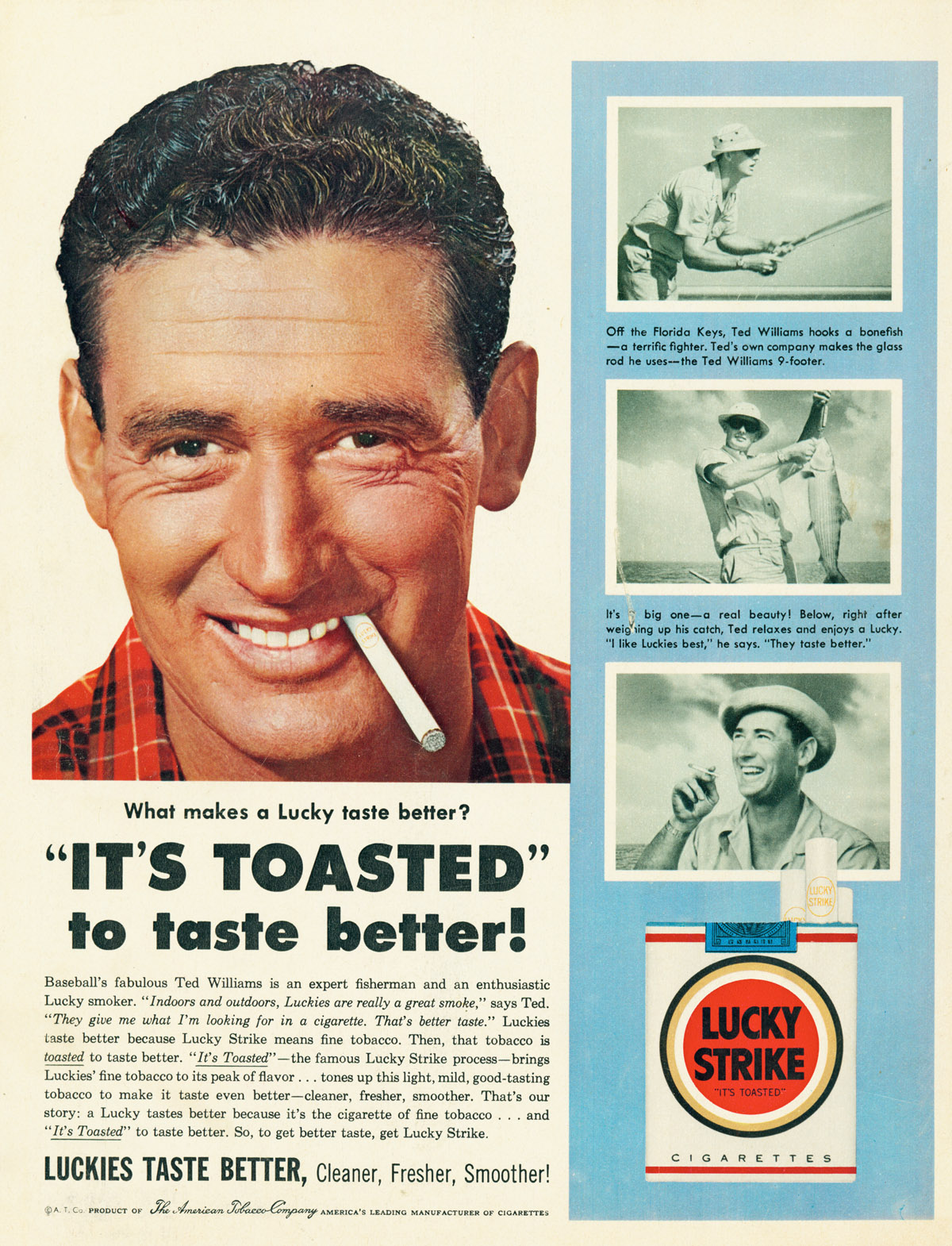
Ciggie eyes of Teddy Ballgame:
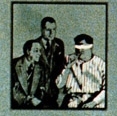
And from the other end of the field, a little inset picture of Babe Ruth, who evidently could tell his ciggies apart, blindfolded, and in uniform. It is a creepy and surreal image:
He didn’t have the best relationship with his wives, and had some other social factors weighing in against him, but the man was famously kind and generous with children, which gets him a “pass” in my book. He died of cancer in 1948, aged 53. (His last public address was eloquent and heartfelt, a truly wonderful short speech.)
Cigarette Eyes of Santa:
In a world of things in which everything was wrong, this was among the “wrongest”, so wrong it isn’t even wrong. There are many ads featuring Santa, some of which show him decorating a Christmas tree with boxes of cigs, others showing him with his sack full of yet more cigarette cartons. Even in an Encyclopedia of Bad Taste, this would be a key entry.
JF Ptak Science Books Quick Post (An addition to the post on George Orwell and his descriptions of the working poor miners of England.)
Friedrich Engels (1820-1895) traveled to England to work for the English subsidiary of his family’s textile business, settling into Manchester (and Salford) in with a keen and ravenous eye. He didn’t have the eloquence of a George Orwell, but he had more than enough to capture the essence of what he saw and to see deeply into what he suspected; and what he saw of course was not very pretty so far as the condition of the working poor was concerned.
So when he was in his early twenties, Engels researched and wrote about what he saw in the Industrial Revolution in the great smoking city of Manchester, grown from a city of 79,000 in 1811 to nearly 300,000 in forty years, seeing for himself the class struggles that he (and his new friend Karl Marx) would write about in Das Capital just four years later. What came of his work in Manchester was The Condition of the Working Class in England. Dedicated to the people of England, it would not be available in English for another 43 years (at which point the “in 1844” was added to the end of the book’s title). [The images above and below of Manchester show the city ca. 1840, when the life expectancy was around 30.] He probably would have been very surprised to see that the revolution he wrote about didn’t take place in England; and doubly so to see that the home of the revolution was Russia.
Working Conditions is seen as one of Engels’ greatest achievements, both for his insight and reporting and of course for what the work would contribute to Capital. [The full text is found here.]
He writes:
“But these are not all the evils which descend upon the head of the coal-miner. In the whole British Empire there is no occupation in which a man may meet his end in so many diverse ways as in this one. The coal-mine is the scene of a multitude of the most terrifying calamities, and these come directly from the selfishness of the bourgeoisie. The hydrocarbon gas which develops so freely in these mines, forms, when combined with atmospheric air, an explosive which takes fire upon coming into contact with a flame, and kills every one within its reach…”
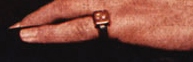
What is it about the pinky ring that makes you want to smoke? And makes you want to smoke the cigarette in the pinky-hand’s counterpart?
The psychology of advertising in cigarette ads in the 1940’s or thereabouts is a strange thing to me. The secondary items in the ads–the stuff there besides the cigarette–are sometimes baffling and occasionally troubling, disquieting, unusual things sent to capture the attention once the cigarette has been removed from the field of attention. I’m pretty sure why those things are there–because of their suggestive natures and their attempt to relate directly with cigarette smoking–but I’m not aure how that connection between the object and the suggestion (of power, or control, or social beauty, or sex and so on) takes place. The meaning and connection can be forced out with a little muscle, but that wasn’t supposed to be so hard for the viewing public back there eight decades ago. The social contrivance of the connection seems to have slipped over time into a smoky nothingness, and I think that it would be interesting to try and restore it, if only for the sake of understanding that lost part of advertising’s quadratic equation.
And so on to a few examples from the advertising world, all of the images coming from the great cigarette advertising archive at Stanford University (here). Removing the cigarettes as a main focus of attention in the following ads leaves us with pinky rings, puffy man-ladies, cigarette holders, close touching, electronics, stub-handed stubby cigarettes, wedding rings and suggestive “product placement”.
The vast smokey elegances of pinky ring (from above):
The smokey, puffy man-lady (“so round, so firm, so fully packed”):
Phil Harris just looks entirely and completely out of place, and not comfortable, though perhaps he just wanted to “feel pretty” getting a light from man-handed Alice Fayew?
This is just a very quick post making use of the excellent cigarette advertisement resource at Stanford University (all images used below are found in their archive, here). This is the third installment on this blog on cigarette advertisements that are as wrong as wrong can be, so wrong–as I’ve said in earlier posts–that they aren’t even wrong, that they are on-beyond wrong in that classification that defines terminal wrongness.
This stuff is worse than wrong–it is substantially a wrongness where the word “wrong” is too weak and impotent to describe a particular wrongness, much like the very-overused and not-replaced “spill” could be used to describe what happened in the Gulf Coast. There is no one word in English I think that described that occurrence, just as there really isn’t one suitable word to describe this behavior of the tobacco industry. The wrong that isn’t even wrong isn’t that it is nothing, but that the wrongness of the thing is too weakly described by the word.
Rudolf Peierls (a phsyicist of very high order and co-author of the Frisch-Peierls memorandum of 1940 that theorized a workable weapon fahioned of U-235) described the original use of the “not even wrong” phrase, attributing it to the great Wolfgang Pauli (Nobel physics 1945), who when shown a paper by a young physicist commented sadly that it wasn’t right, and it even wasn’t even wrong. It was nothing. (It is interesting to note that if you took two of the things that these physicists were known for and placed them out of context in a literary/philosophical arena, they kinda work to describe Pauli’s wrongness principle: that would be the Peirels Instability and the Pauli Exclusion principle.)
These ads weren’t nothing. And the odd thing is that they exist in their contemporary flavors today, efforts that will be seen in our short future as being as impossible as these antique ads seem to us today. More’s the pity when we know almost all of the story.
This adventure (“Radio Planet vs. the Ant Men”) sounds more like a Captain Beefheart song than a fantazine for kids/young adults/whatever, but there it is–and what the cover for the magazine features in spite of the article title was yet another (dazed) woman in sci-fi distress. In the panoply of sci-fi-danger-women this one is pretty composed and dressed relatively, this of ccourse is relative to all of the other who have their dresses falling/slashed/dissolving/torn/falling of, revealing the Great Secrets of Composed and Dangerous Sexuality. In any event, there seemed to be many instances of women-needing-rescue–and in many circumstances they are tending towards nakedness or its suggestion, and have their arms dangling at their sides. Here’s a quick review of some of the covers that might have put the “X” in “se_uality”:
This is the first post in a new series on this blog on “changing sides”–that is, having a new allegiance, Adopting/acting on an something completely out of the mainstream of the personal experience, believing in the opposite of an established belief; to leave something, falling away or rejecting one thing for its opposite or something different, done with integrity or with the abandonment of honesty.
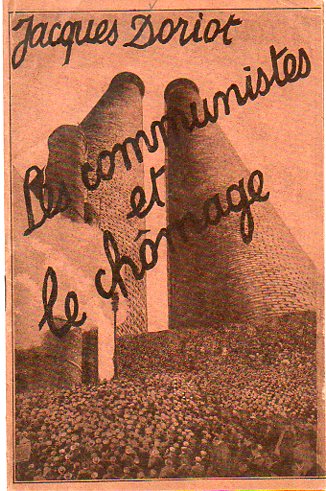
Jacques Doriot.That was the name on the pamphlet that I pulled out of a stack of pamphlets segregated for their cover art. Les Communistes et le chomage was written by Doriot in the year after he became mayor of St. Denis, an ancient commune just north of Paris, in 1932. That was years, of course, after Doriot returned home from being a POW of the Germans in WWI and found himself joining the French Communist Party (PCF), a group in which he rapidly succeeded. HE went to jail for the violent protest of teh French occupation of the Ruhr, emerging into the political arena as mayor of St. Denis.
At one point he was taken by the Communists, but a bitter debate erupted after which he was expelled from the Party (in 1934). He abandoned thoughts of the communists and established a new ultra-nationalistParti Populaire Français (PPF) in 1936. From there things went downhill, but not yet downhill and on fire.
Doriot supported the idea of France becoming more like its Facsist neighbors Germany and Italy, and when the war rolled into existence in 1939, Doriot jumped on the foreign Fascist bandwagon. In France. He supported the occupation of the Nazi’s French occupation of the north, but when that proved to not be fascist enough for him, he toddled off to Paris where he found a better reception for his pro-Nazi sentiments among the Nazis themselves, what with the Vichy government providing too-soft a version of governance. His transformation was in full blossom by that time, when in 1941–after having an Ezra Pound-like experience in espousing pro-Nazi beliefs on Radio Paris–he and Marcel Deat went almost all the way into the heart of the Fuhrer, creating the Legion des Volontaires Francais (LVF), which was a French force organized to fight with the Wehrmacht. (The French were hardly alone in this, with something like 350,000 soldiers in the Wehrmacht coming from places outside of Germany. See the note below for troop strength numbers. 1 )
Not surprisngly the LVF was thrown into the Barbarossa meatgrinder, and was decimated, along with millions of German soldiers as well as more millions of Russian citizens and soldiers. (According to a wiki page, the LVF started out at regiment strength of about 2,400 when they went into battle in October 1941; by the spring of 1942, there were only two batallions left, comprising about 600-800 soldiers in total.2.) Doriot survived, and in what must have been the high point of his life, was awarded the Iron Cross in 1943. In coming back west he pursued other pro-Nazi activities, including what looks the support of German agents inside liberated France in 1944, which I think would leave an ordinary person completely vacant and a deranged one full of pride and fortitude.
Somehow he made it almost to the end of the war, though had he survived it I am sure that he would have been visited with vengeance and retribution. (It seems that most of the officers were tried and executed while the soldiers were either sent to jail or offered to work off their debt to the nation via service in the Foreign Legion.) Doriot was killed when the car he was driving in was strafed by a fighter plane on Washington’s birthday, 1945.
It is quite a remarkable, and horrible, little life that Doriot led, a life that actually has me feeling a little hollow as I write about it–very off-putting and upsetting in a dark, struggling way.
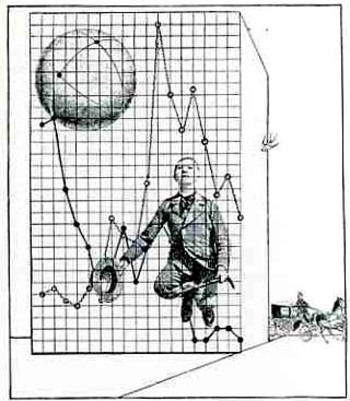
This quasi/faux statistical/graphical modern art image by Max Ernst is found in the journal Mecano (issue no. 3 “Rouge”), which was the principal Dada publication vehicle, and issued by the artist Theo van Doesburg (in the Netherlands). It arrived in 1922, just 10 years after the publication of Marinetti’s “Manifesto tecnico della letteratura futurista” and a year before Marcel Duchamp retired from painting, and just another two years before Andre Breton nailed down the meaning of Surrealisme (and again like a particle collision changed the direction of some of modern art).
The Dada Movement is generally thought to have started by WWI escapes in the neutral haven of Zurich (where the war was escapable for the duration), at the Cafe Voltaire, in 1916, the word “dada” being found as is generally believed by Tristan Tzara.) I am trying hard to form some sort of memory for other Dadist, Futurist, Symbolist or other modern movements from the ‘teens and ‘twenties to use a graph such as this in the artwork but I cannot think of any.
(By the way, also appearing in this issue of Mecano were Man Ray, R. Hausmann, Hans Arp, Kurt Schwitters, and others.)
[Part of the Atomic and Nuclear Weapons series and the History of Blank, Empty and Missing Things series.]
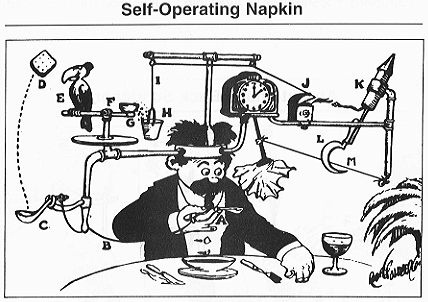
I think no plumb line was ever so worked with pulleys and wheels, strings and catclaws and other Rube Goldberg devices as were the demographic studies of nuclear warfare.It is as though their compass rose had no compass, with everything centered on the center, no way out, no way in: just there.A faceless clock face describing “G-2 o’clock” whenever it pleased.These studies seem to me the nuclear warfare equivalent of the Bellman’s map (described earlier in this blog as the most perfect map ever constructed): a pretty polygon describing a totally blank surface.
I have a number of these things here, some of which are restricted-distribution publications, works of statistical fancy/fantasy meant for other eyes in the same community dedicated to the fancies described, a tautological audience for self-referential.
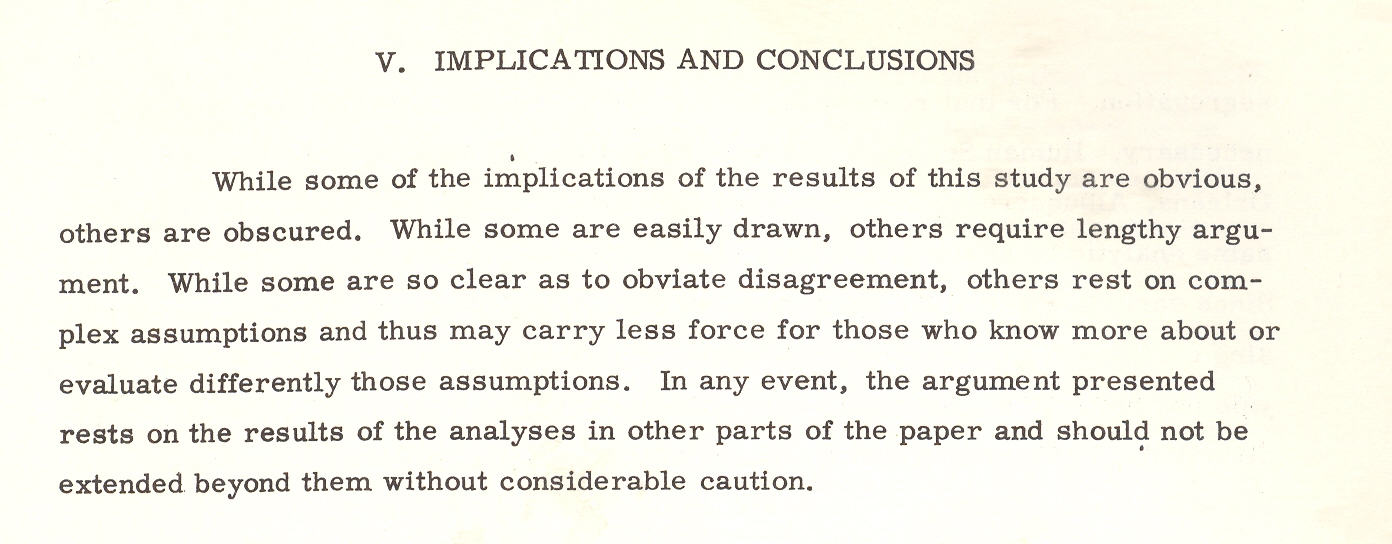
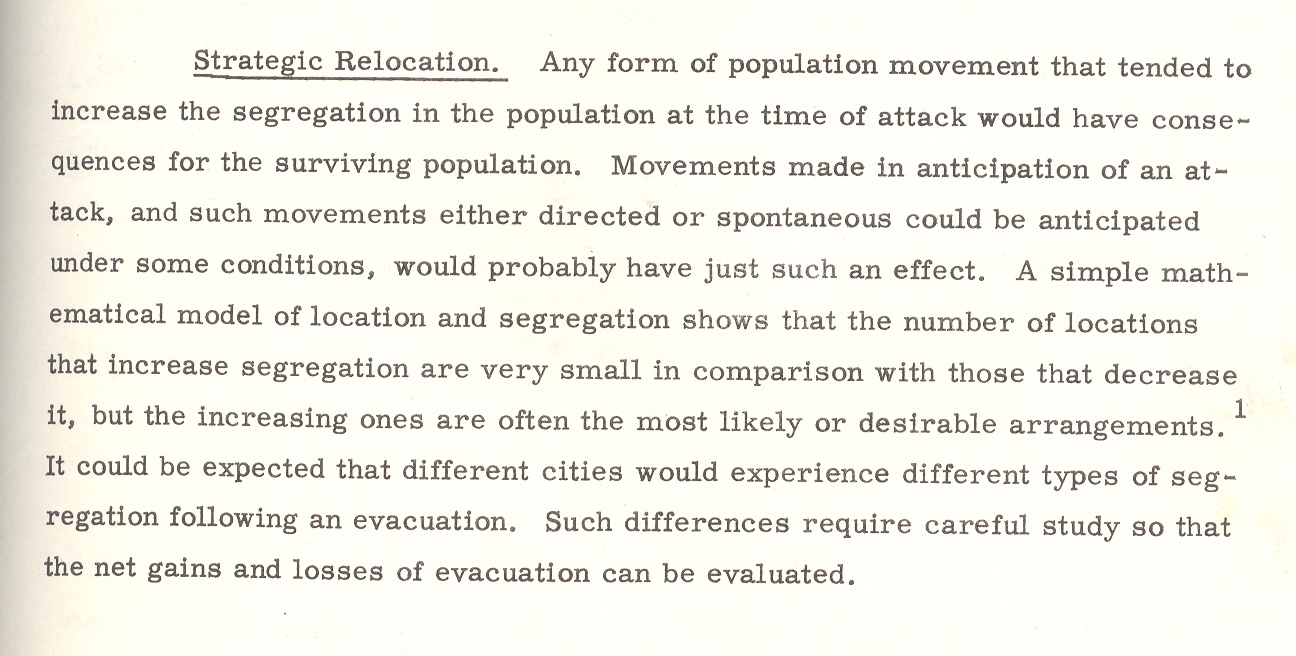
One such bit, plucked from this pile is William W. Pendleton’s A Study of the Demography of Nuclear War produced by “Human Sciences Research, Inc.” [This item is available for purchase from our blog bookstore.] Outside of its statistical foray in survivability and the procreative prospects of the left-overs of vast nuclear exchanges, the work is a solemn attempt at institutionalizing the death requirements of nuclear combat.The necessity of overwhelming carnage is presented in ironic and underwhelming language, the first bits of which are seen in the conclusion of pamphlet’s abstract1:
“Cities differ in the kinds and magnitudes of change to which they might be subjected. Considerable variation in the demography of surviving populations can be expected; that variation would be related to policy decisions; and those decisions should therefore be examined for their demographic implications.” [Emphasis mine.]
Put another way, the city is the main focus of the survivability equations, and the chances of the humans being bombed in those cities would change with—god help us—the amount of bombing.
Cities differ in the kinds and magnitudes of change to which they might be subjected.
This is the key I think to understanding documents like this, making a simple foundation statement so convoluted and tortured that it and most of what follows make any sense outside of restating themselves. Which I guess is a strength.
Back to the pamphlet and the interesting table that attracted my attention.According to one study [and for the sake of brevity I’m not going to describe the scenarios or data estimation methods and so on] the U.S. would suffer 46% casualties [meaning immediate deaths and not as a result of radiation or illness or starvation or the encyclopedia of whatever that would lead to death somewhere down the road].The resulting demographic of the “perished” by job description postulates that the most-killed category of worker would be: (#1) aeronautical engineers, 86% dead; (#2) transportation equipment salaried manager, with 79% killed; (#3), social scientists, with 78% of them going down with their clients; (#4), authors, with 76% gone.
Authors?Of what, I wonder?The good ones with the bad?Are authors different from writers?And what do you call folks who produce tv shows?Since the stats here are for 70 cities there’s no wonder that there aren’t any farmers in this table, as the majority target areas (some 450 cities cited elsewhere as targetable, including my own little burgh of Asheville, N.C.) would naturally have city folk in them.And so I’m guessing that three-quarters of all “authors” in 1960/6 were living in these target cities and were going to go up in smoke.The aeronautical engineers category is more understandable as every one of those industries employing 50 or more people would be a target; frankly I’m surprised that given the possible firepower of the Soviet Union in 1966 that 14% would survive; I’d guess offhand that the number would be 2%.
Even though this stuff is spread out in only 98 pages or so it would keep a person busy segregating the Orwellian gems from those not; it would be a tricky business as most of the “text” in the “not” category would be largely limited to prepositions.
Here’s another bit:a parenthetic poke at the post-attack composition of Congress. It is stated that the “postattack” (hyphenated no longer) Congress would be “quite different”. It would also be (“in their eyes”) “more Conservative than the pre-attack (hyphenated!)Congress.It isn’t a cause for great prognosticational (?) liberty to assume that the Congress might be more Conservative, but why on Earth did the author qualify the assumption by saying “their eyes”?Pish and posh.
The paper goes on its merry way, connecting the necessaries of Goldbergian delight, and somehow nothing ever happened, which to me is a secret miracle.Especially given the weight of papers like this one, which seems to medicate the effects of war, assuming that there will be a Congress and that people will report back to work once the factories are rebuilt and that there will be more segregation in the colossal world of post-attack America, and on and on into the red dawn.
Mr. Mencken’s view of Warren Harding comes to mind when I read this stuff and wonder about how it was that we didn’t blow the whole place up:
“I rise to pay my small tribute to Dr. Harding. Setting aside a college professor or two and a half dozen dipsomaniacal newspaper reporters, he takes the first place in my Valhalla of literati. That is to say, he writes the worst English that I have ever encountered. It reminds me of a string of wet sponges; it reminds me of tattered washing on the line; it reminds me of stale bean soup, of college yells, of dogs barking idiotically through endless nights. It is so bad that a sort of grandeur creeps into it. It drags itself out of the dark abysm of pish, and crawls insanely up to the topmost pinnacle of posh. It is rumble and bumble. It is flap and doodle. It is balder and dash.”
Notes
1. The abstract from the above paper: “The basic problem with which this report is concerned is that of determining the kinds of demographic change that might result from a range of nuclear attacks, ascertaining the effects of those changes on the future of the surviving populations, and indicating possible areas for Civil Defense action and planning. Earlier studies of the demography of nuclear war were examined and their relevant conclusions and methodology incorporated in the report. A different methodology–expected to be more sensitive to compositional effects–was then designed. The new methodology was tested and found to be more effective than the old. Surviving populations representing a wide range of variation in attack conditions were created on the basis of both old and new methodologies, and the demographic significance of these populations was examined. Assuming a range of post-attack demographic conditions, a series of projections was made on the surviving populations. The demographic significance of the recovering populations was then examined. On the basis of the analysis a series of recommendations relevant to Civil Defense planning was made: Within the framework of this analysis the crucial variable is the demographic pattern of the city. Changes in composition, as well as size, could be of substantial magnitude and would last for generations in some cases. Cities differ in the kinds and magnitudes of change to which they might be subjected. Considerable variation in the demography of surviving populations can be expected; that variation would be related to policy decisions; and those decisions should therefore be examined for their demographic implications.”
JF Ptak Science Books Post 1644 [Part of the Series on the History of Blank, Empty and Missing Things.]
“Other maps are such shapes, with their islands and capes! But we’ve got our brave Captain to thank” (So the crew would protest) “that he’s bought us the best- A perfect and absolute blank!”–Lewis Carroll, The Hunting of the Snark.
[This post fits perfectly in our History of Blank, Empty and Missing Things. Ditto for the series on The History of Lines–making this a great confluence for a History of Blank and Missing Lines (in the History of Nothing series).]
For all of the brilliance of all of the cartographers and map makers who have drawn a line in the sand or strung a strand of quipi or drawn a celestial rendering on a cave wall or imagined the Americas in 1504 or ventured out and away from the Medieval T-maps or drew maps of other worlds or fashioned spiraling maps of Hell, I think the maps I most like are maps of imagined places. Of course I enjoy the extremely rigorous and steadfast maps (like those of the German Stieler Company of Gotha who for a hundred years routinely drew the most detailed maps in a particular scale than any other mapmakers in creation—you know, the big maps of the U.S. that would locate minute places like Truman Capote’s “out there” town of Holcomb, Kansas) and of course maps of the solar system and galaxy and universe (as knowledge expanded and collapsed and expanded again). And of course there are the representational maps showing the comparative heights
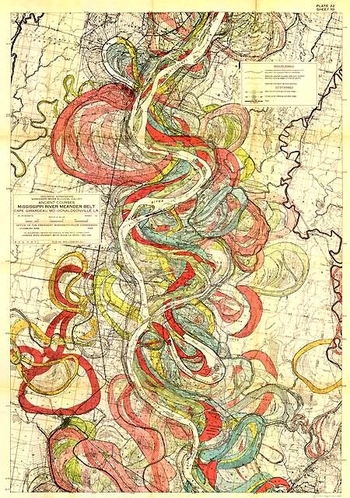
of mountains and lengths of rivers, or the grouping of all the world’s lakes, or the divorce rate map of the United States at Centennial, or the heights at which different sorts of trees are found, or geological speculations on the thrust of the Appalachian chain, or the wanderings of the course of the Mississippi River (below), and other hosts of things.
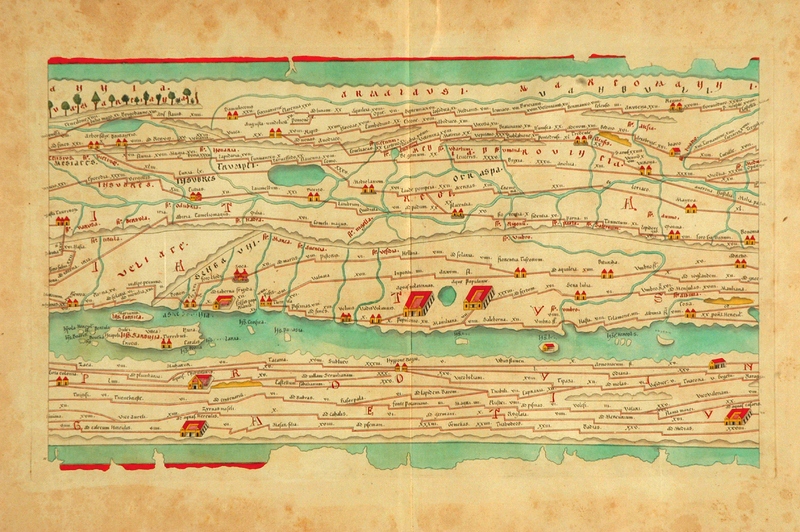
As much as detail is attractive to me—complex, staggering information correctly displayed—there is also the opposite: the quick, thoughtful, spare map. The Tabula Peutingeriana is sort of like that—this is a 17th century reproduction of an ancient Roman map that was, basically, a road map of the world (or the Roman World) that was linear and included all manner of detail of the roads themselves, with little else. It is a spectacular thing—one version I had once was 14 inches high and 16 feet long, just a skinny map of how to get around in the world from 2000 years ago. There was of course nothing “quick” about how the map was made, coming at the expense of countless hours of careful observation, keen observation, and lots of general human tragedy.
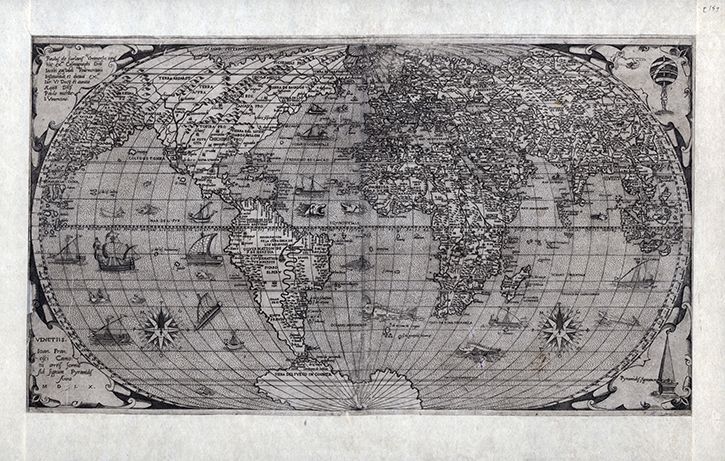
Folrani’s world map of (ca.) 1575 (which appeared in Antoine Lafrery’s (1512–1577) Geografia tavole moderne di geographia) is a glorious thing and a fantastic accomplishment for its time (and also being the first map to use the name “Canada”). It has a sumptuous artistry to it in addition to including (and excluding) certain of the newly known discoveries. In this version of the map he chose to not use the newly-incorporated Straits of Ainan
[I’m sorry to say that I’ve misplaced the original source for this map–I will try and supply. My apologies.]
In another edition of the m-which appeared a few years later–North America is still attached to Asia, but now there is added another bit, a gigantic land mass to the south, Terra Incognita. This was basically put together by some sightings in the southern seas that located different land masses, and Forlani took it upon himself to connect all of those pieces of information and draw them into one continuous land mass, greatly expanding his own version of Antarctica from a few years earlier. It is a wonderful example of leaving something(big) out and making something else (even bigger) up.
But the map that I think I love the most illustrates Lewis Carroll’s The Hunting of the Snark, an Agony in Eight Fits, and occurs in the Bellman’s tale, starting the second fit. It begins:
The Bellman himself they all praised to the skies- Such a carriage, such ease and such grace! Such solemnity too! One could see he was wise, The moment one look in his face!
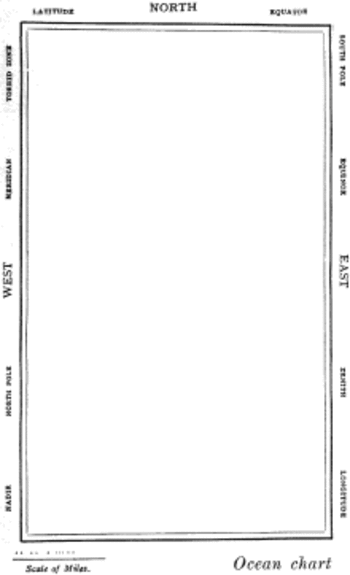
He had bought a large map representing the sea, Without the least vestige of land: And the crew were much pleased when the found it to be A map they could all understand.
“What’s the good of Mercator’s North Poles and Equators, Tropics, Zones, and Meridian Lines?” So the Bellman would cry: and the crew would reply, “They are merely conventional signs!
“Other maps are such shapes, with their islands and capes! But we’ve got our brave Captain to thank” (So the crew would protest) “that he’s bought us the best- A perfect and absolute blank!”
Sometimes there is nothing so fine as something that beautifully illustrates the nothing that isn’t there, and this lovely map, unencumbered of all of the elements and details that define the mapness of something, perfectly explains the origin of its need.
For a lovely work on the complexities and simplicities and just sheer beauty of what things like maps are check out former Ashevillean Peter Turchi’s Maps of the Imagination, the Writer as Cartographer.
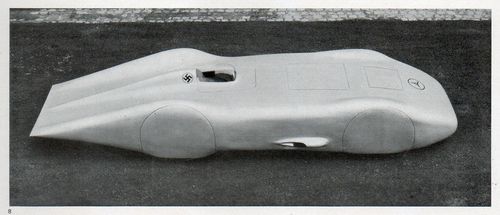
I was grazing a large bound volume of the Illustrirte Zeitung (Leipzig) and came across this photo in the issue for 10 February 1938–it was sandwiched between two stories on Austria’s attraction to National Socialism. The German invasion of Austria would begin on 12 March, just a month away, and end a day later. Czechoslovakia would follow soon thereafter.
But what we see here is a photograph of the 12-cylinder Mercedes W125 which was driven by Rudolf Caracciola in 1937 to a world speed record of 268.9 mph over a mile-long stretch of highway from a flying start. Most of the images you see of this automobile all through the internet are like those in the Mercedes-Benz Museum (which may or may not by law be able to show photographs of the racer with the symbol), and are all pretty much the same–they almost all are missing one detail, one symbol that the car carried on its record-breaking run:



















 a letteratura futurista” and a year before Marcel Duchamp retired from painting, and just another two years before

 of mountains and lengths of rivers, or the grouping of all the world’s lakes, or the divorce rate map of the United States at Centennial, or the heights at which different sorts of trees are found, or geological speculations on the thrust of the Appalachian chain, or the wanderings of the course of the Mississippi River (below), and other hosts of things.