A Daily History of Holes, Dots, Lines, Science, History, Math, Physics, Art, the Unintentional Absurd, Architecture, Maps, Data Visualization, Blank and Missing Things, and so on. |1.6 million words, 7500 images, 4.9 million hits| Press & appearances in The Times, Le Figaro, Mensa, The Economist, The Guardian, Discovery News, Slate, Le Monde, Sci American Blogs, Le Pont, and many other places… 5000+ total posts since 2008.
I have made numerous posts on this blog using images from my archive of American news service WWI photographs, though there are few depicting scenes just after the end of the war’s end on 11:00 a.m. on 11/11/11. These photographs below do so, and all come from the National Library of Scotland (which can be accessed here). They are all “British Official War Photographs”, which was a service similar to its American cousin–various news and photo agencies were given access to images produced by a pool of photographers, all of which passed by the eyes of a military censor. They were for the most part aimed at the “correct” version of the news, though given the subject matter there were plenty of images that were extremely powerful. In a war that claimed 100,000,000 casualties, the photographic image was a powerful war-time propaganda tool.
[Original reads: ‘SCENES ON THE WESTERN FRONT. WAR TROPHIES SECTION. German trophies from Vimy Ridge and Messines. In centre is Prussian Guards drum.’]
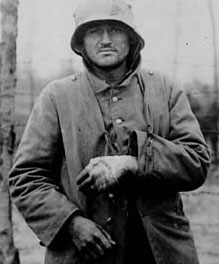
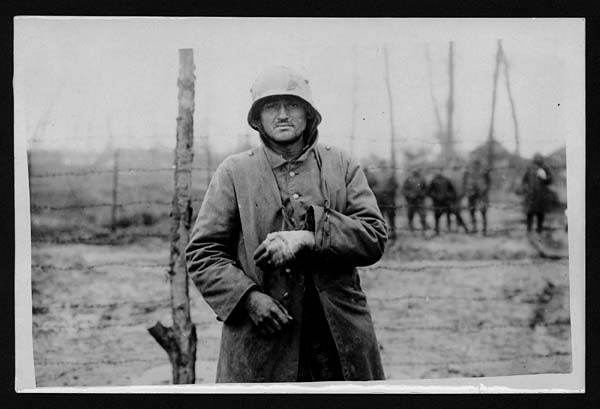
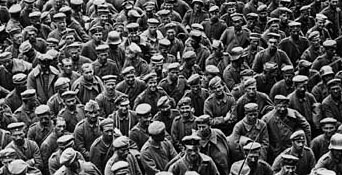
The odd thing about this series of prisoners of war is that they may or may not have been worse off than had they been in their own trenches, sinking in their own mud, eating their own questionable food. At least since they were now detained and behind British lines, no one was trying to kill them.
And the ful limage:
[Original reads: ‘OFFICIAL PHOTOGRAPH TAKEN ON THE BRITISH WESTERN FRONT. Captured in the last push. A member of the A.I.L.L. (All is lost League).’]
I have made numerous posts on this blog using images from my archive of American news service WWI photographs, though there are few depicting scenes just after the end of the war’s end on 11:00 a.m. on 11/11/11. These photographs below do so, and all come from the National Library of Scotland (which can be accessed here). They are all “British Official War Photographs”, which was a service similar to its American cousin–various news and photo agencies were given access to images produced by a pool of photographers, all of which passed by the eyes of a military censor. They were for the most part aimed at the “correct” version of the news, though given the subject matter there were plenty of images that were extremely powerful. In a war that claimed 100,000,000 casualties, the photographic image was a powerful war-time propaganda tool.
A British soldier aids a wounded German POW. A French photographer tries to avoid the image in background.
The original patent for this tube-and-rod design was made at the Danish Patent and Trademark Office in Copenhagen on 28 Jaunary 1958 at 1:58 p.m. The design could be for an associated cooling system for a steam turbine; or for a high-pressure/reactive clutch of passes and cylinders for a water turbine hydroelectric facility; or perhaps it was for a modern prison system utilizing water-filled bars for prison cells that could indicate a possible jail break if any leaking water was discovered, making tampering with the bars an impossibility.
Dort, wo man Bücher verbrennt, verbrennt man auch am Ende Menschen.“–Heinrich Heine, saying that if people burn books, they’ll burn people, too, which have been proven to be the case.
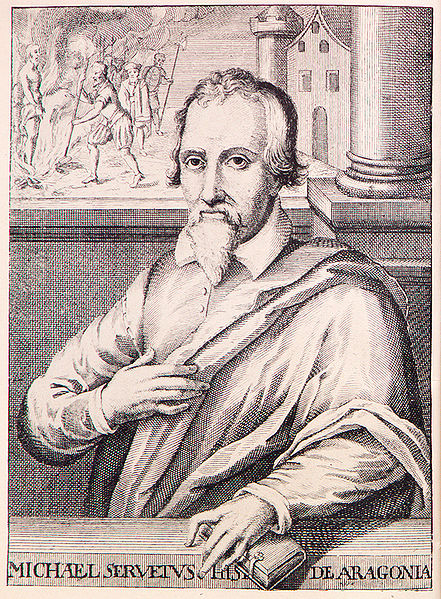
Usually this story goes the other way around, where people of the world set books on fire–or entire libraries on fire (like the House of Wisdom, Baghdad, in the 13th century), some of them more than once (and in the case of the library at Alexandria, six times.) Books are burned in repulsion and revulsion not only by their readers but also (and in greater numbers) by rulers who don’t want their potential readers to have any potentiality, or potential, reversing the flow of unwanted information back to the source. (The illustrious and esteemed have burned people as well as the villains–Thomas More sentenced John Tewkesbury, a London leather merchant, to the flames for “approved burning” for keeping banned books; for good measure More also had the works of Martin Luther burned, as well.)This later has a very long history, which is taken a step further when said leaders reach out to burn the books and their authors, sometimes at the same time. This infamously happened to Michael Servetus (1511-1553, and who I wrote about here) and of course many others, entire castes of scholars burned or buried for being in the way.
[Engraving of Servetus, being a good double-portrait showing him in the high life and then, in the upper left corner, being burned alive for his political activities ans for his books, which disturbed the notion of the heart-centered body and seat of all wisdom much favored by the clergy, replacing it with his notion of the heart as a muscle, as a functioning part of the body rather than its seat of wisdom.]
The first mass, organized book burnings in the United States were instituted for self-preservation of an economic way of life–local merchants banned together to form book burning brigades for the threat to their livelihood, the Sears & Roebuck catalog, which I wrote about here. Not quite on the scope of rejecting the lives and works of authors of what were deemed to be salacious or threatening to the core of the social structure, but in the long run perhaps they were something approaching that.
The “Memory Hole’ is the euphemism for the dispatch and destruction of books in George Orwell’s 1984, not too far removed from the institutionalized book burning in Fahrenheit 451, though seemingly a furious leap forward from Reverend Lovejoy from The Simpsons.
Reverend Lovejoy: “Oh hello Lisa! Can you recommend any books for my mobile?” Lisa: “Ooh absolutely! Well you know, anything by Jane Austen.” Reverend Lovejoy: “Jane Austen. Thanks Lisa, I’ll get right on it!” (Reverend Lovejoy drives away and reveals his Book Burning Mobile.) [Thanks to The Lisa Simpson Book CLub.]
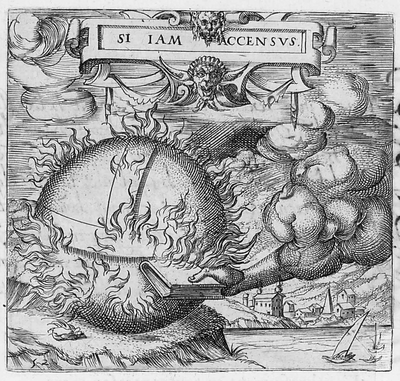
And for the first emblemata, above, comes the legend:
Alta Dei flammas vox toto suscitat orbe, God’s voice on high stirs up flames in all the world, Dum nimis auerso mens mala corde furit. While all too strongly the evil mind rages with averted heart. Sed pia mens humilis paret. Sic excoquit aurum, But the pious mind obeys in humility. So the furnace melts out gold, Et paleas eodem deuorat igne focus and with the same fire devours the chaff
And as it turns out the book to set the world on fire is the Bible, which is I guess appropriate given the number of books sought out and burnt by Mother Church, though I must say that far more books were banned than burned. (I think so, anyway–there’s a number of iterations of the list of banned books–the Index Librorum Prohibitorum–which was kept from the mid-16th century to the mid-20th. I think that there is no massive list for books that were both banned and burned.) Its a harsh-looking metaphor, particularly given the story of the Flood.
And in some cases the Bible-burning metaphor was hardly that but an actual event, and tragically ironic in the case of William Tyndale. Tyndale was a scholar who among many other rich things brought to bear a new translation of the Bible done into English, which was a first, and which greatly displeased the ruling head of England at the time, King Henry VIII. Henry had already burned translations of the Bible that he could not abide and thought heretical–not the least reason of which would have his multiple marriages condemned–and continued on to not only do so with Tyndale’s work, but also to Tyndale himself. At the end of a long and complex story, Tyndale was found to be a heretic, and in 1536 was strangled to death on a platform before a large crowd, his head chopped off, and his body burned. After a few years Henry authorized multiple new translations of the Bible to be printed, all based on Tyndale’s work. Tyndale stayed dead, though–his work had an enormous impact on other English translations of the Bible, not the least of which is the King James Version of 1611, where the overwhelming majority of the NT and OT was Tyndale’s.
This is an editor’s conception of explaining the operating principle of how the soon-to-be-built Brooklyn Bridge (finished in 1883) would support itself to the readers of the Scientific American in 1878:
These “strands” of cable would be fixed to the superstructure with these devices:
A simple explanation of an enormous undertaking.
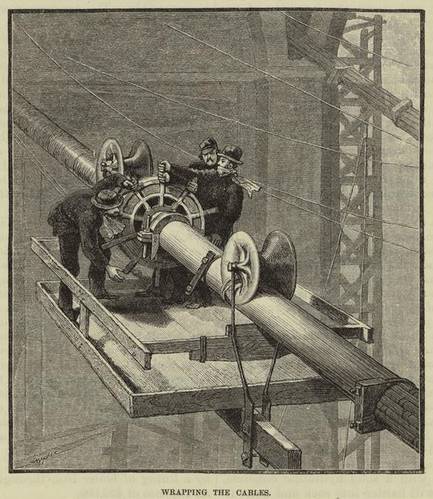
And I just need to include this image of the wrapping of Roebling’s cables, which was an enormously dangerous job, not helped by the height of the short fence that was supposed to keep these men from falling to their death in the river:
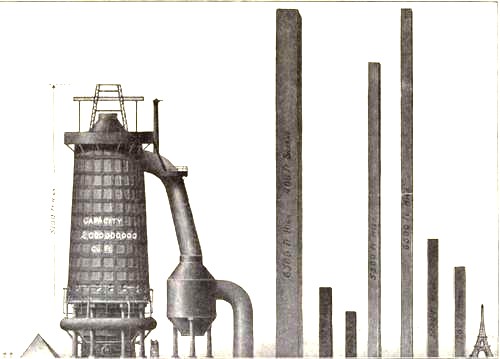
The Eiffel Tower is iconic; and being iconic makes it susceptible to be used as a standard of measure, at least so far as graphical displays of information is concerned. Here are four examples of Large Quantities of Things Being Explained in Terms of Eiffel Towers.
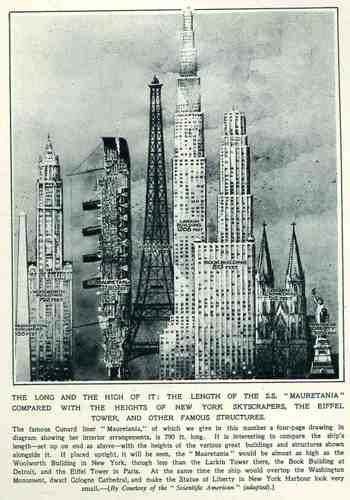
This wonderful display (appearing in The Illustrated London News for 26 March 1927, page 518) of quantitative data isn’t quite as whimsical as it appears in detail, though I can think of only a few (antiquarian) times that I have seen a ship made part of a cosmopolitan vertical cityscape. It is a great way of comparing two disparate, out-of-place equals, and certainly can get the idea of the size of something as stand-alone and solitary as a great ship to children (and adults, too) by comparing it to something as obvious as a tall building., This time its really just comparing the length of the SS Mauretania with the heights of some famous and notable buildings. (The Mauretania, 1906-1935, was a fabled, luxurious and fast ocean liner of the Cunard line; it was refitted for a resurgent oceanic service at about this time.) In the larger, expanded second image we see the Mauretania stacked up against (from left to right) the Washington Monument (555′), the Woolworth Building (792′), the Mauretania (790′), the Eiffel Tower (984′), the Larkin Building (proposed at 1208′), the Book Building (873′), the Koln Cathedral (512′) and the Statue of Liberty (305′). The Larkin Building (not the F.L. Wright structure of the same name) was a proposed super-tall of 110 floors for 330 W. 42nd Street that was proposed in 1926 and not canceled until 1930, and which would’ve been the tallest building in the world. (For an interesting site on the cancellation of tall buildings, see HERE.) In any event, this was a big ship–the largest in the world when it was launched as a matter of fact–and the drawing is wonderful. Upon closer inspection, there is a terrific amount of detail in the cross section of the ship.) (This original print is available at our blog bookstore.)
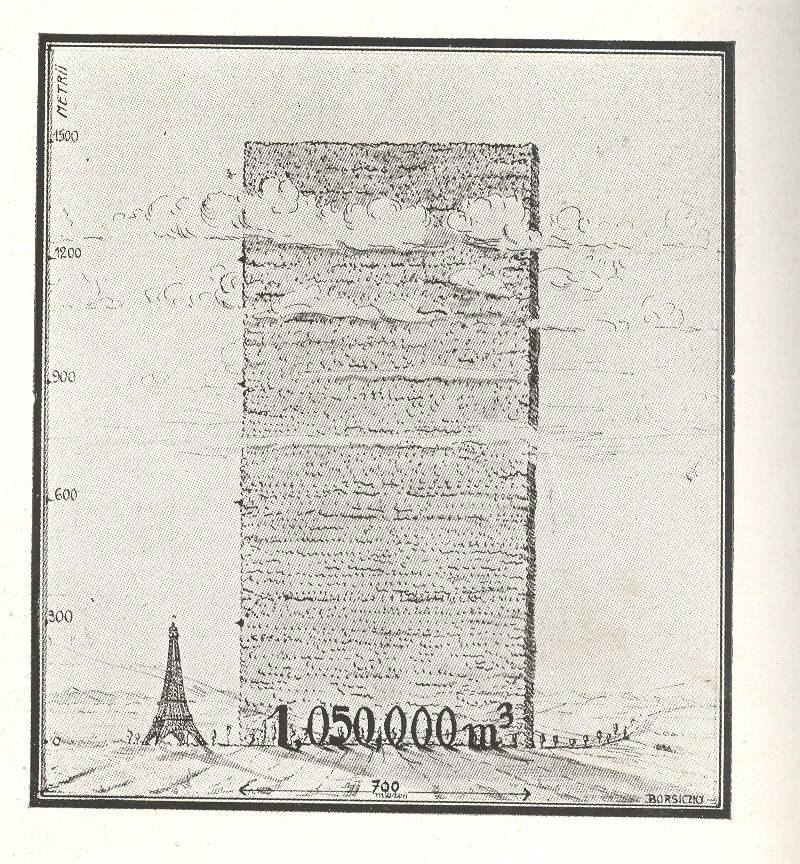
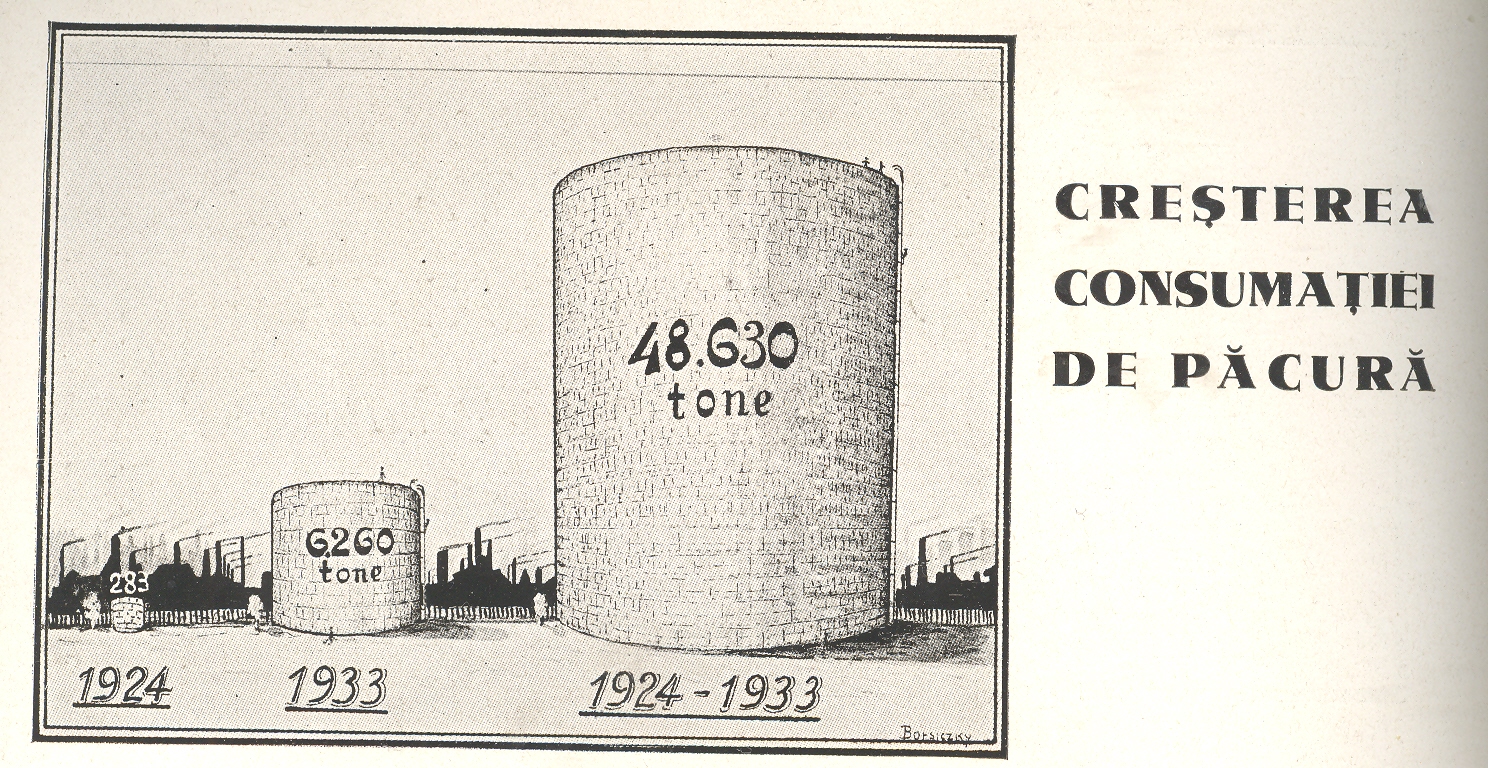
Continuing a long, developing thread on the graphical display of quantitative data–and especially that which uses man-made objects for comparison—is this interesting bit from a Romanian mining publication from 1933.
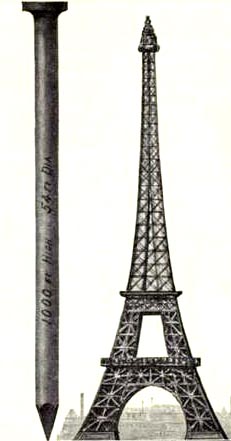
This image and data is from the generally useful data and interesting if not useless info Scientific American Reference Book. A Manual for the Office, Household and Shop, by Albert A. Hopkins, and published in 1903. It gloriously depicts the annual American finish nail production in terms of Eiffel Towers: there were evidently 10-million 100-pound kegs of these nails made in 1902; if they were made into one big nail, it would be this one–52′ in diameter and 1000 feet tall. I guess another useful visual bit would be the representation of the number of new houses built/kegs of nails, which would make this image a little more meaningful; though, perhaps, we may not be going for meaning, here, necessarily.
The huge mound next to the Eiffel Tower shows the consumption of wood in Romania over a ten year period, a stack of wood 700 metres long and 1500 metres high. Evidently this wall has only the most rudimentary depth of a metre, as the legend reads that the volume of the woodpile is 1,050,000 metres cubed, which is the same as its square area. So somebody missed something, here, though the artist did supply some nice shadowing.
Just above it appeared this comparison for the amount of oil consumed over the same ten year period
I’m not sure why this comparison was being made. This does come in the interwar period which saw a great expansion in Romanian territory and a vast modernization effort following the country’s devastating experience in WWI. Maybe it was illustrating modernization from wood-burning power/heating sources to oil-based. I really don’t know–I just liked the Eiffel Tower being dwarfed by a massively tall and impossibly skinny woodpile.
I love comparison like this, representing big, hard-to-associate numbers of something against another quantity that can be instantly understood–the relationship between the two might be tenuous and complex, but at least it can give you some sort of handle on what would normally be an inaccessible, stand-alone number. Plus, any time that you can show what an ungraspable concept might “look like” and be explainable to a 10-year-old, well, you’ve got something.
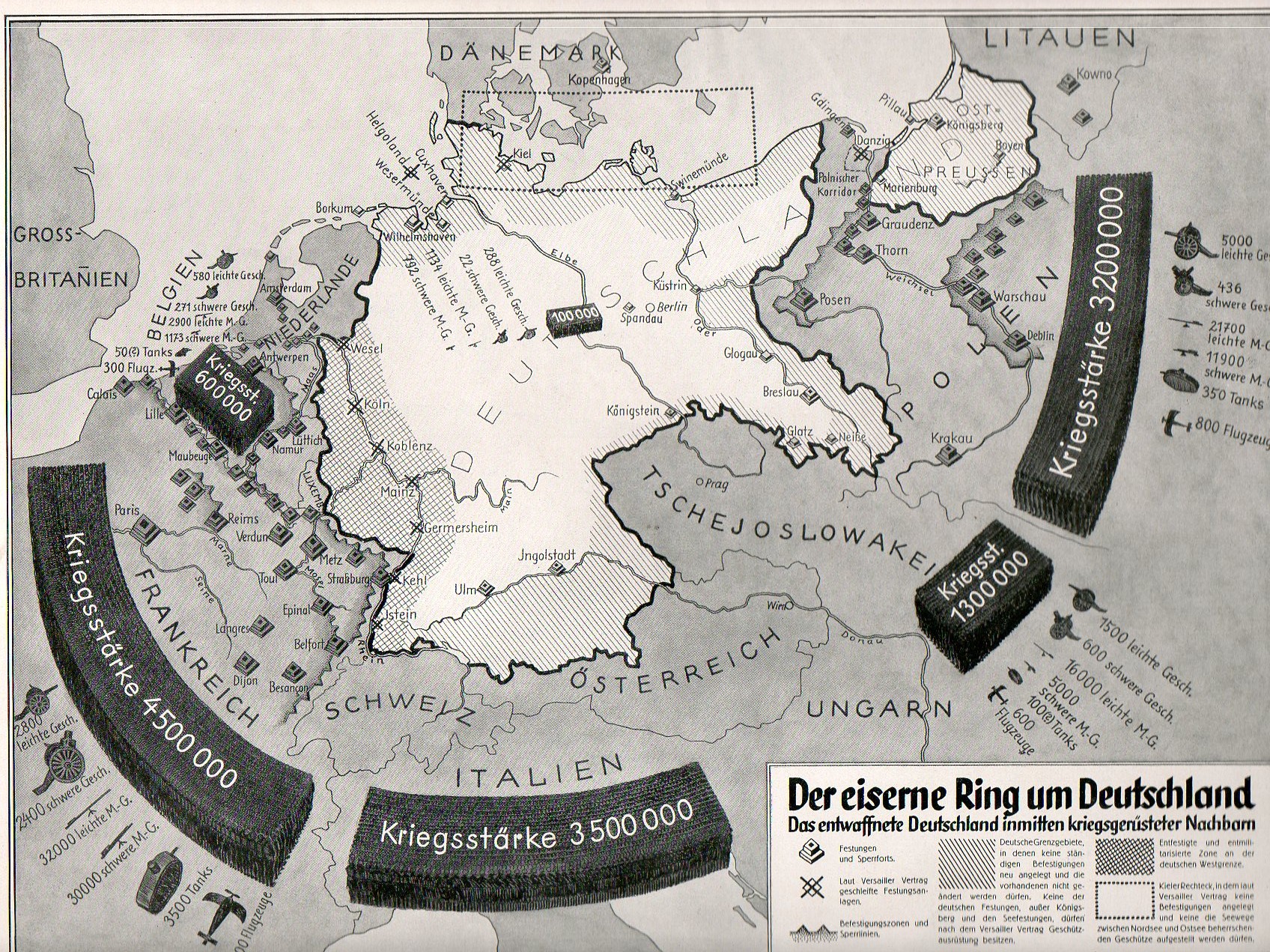
I’ve post a number of thing son this blog relating to Nazi invasion routes to America and the potential threat of Poland to Nazi Germany, all stories more vividly enhanced (whether true or not) by maps–as a matter of fact, maps seem to be validity enhancers to just about any story, for it seems that maps represent a will of some sort, and where there’s a will, there’s a way, and so there must’ve been a good Nazi plan for attacking South America via Uruguay. Except that there wasn’t. But the map looked good, and certainly it made people think.
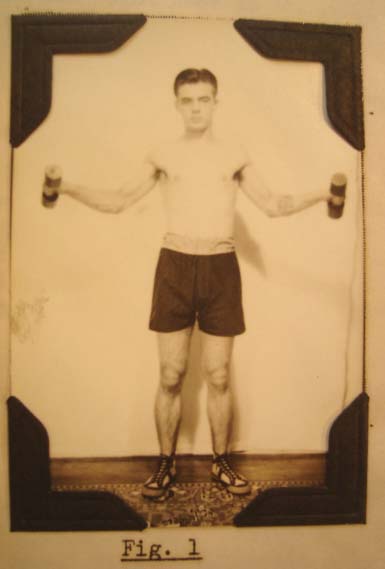
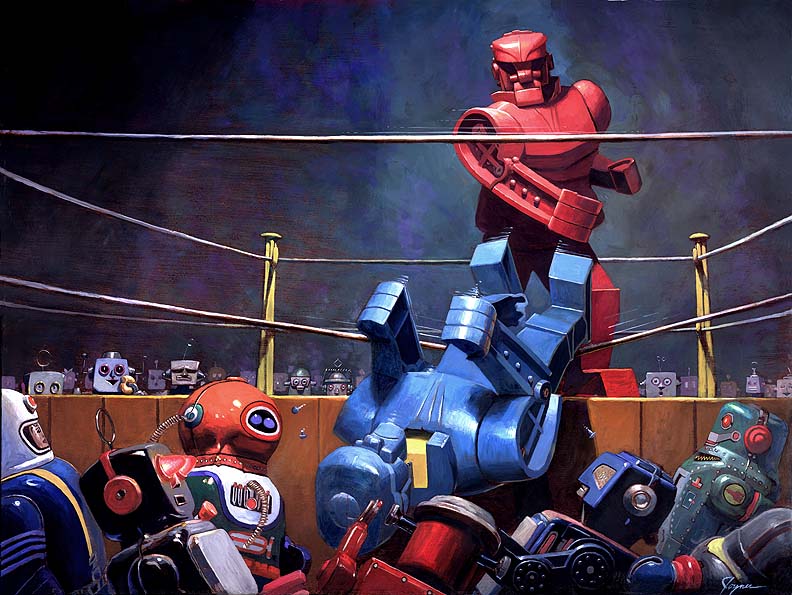
Burbling to the top of the massive (organized) heap of material that came my way from the Library of Congress was this beautiful, six-page introduction to punching people, complete with original photographs of the author performing the sweaty necessaries of readying for the punching adventure. (My guess is that it was never mass produced,m and sent to the Library to protect a copyright application, as is the case of thousands of these LC items that I have.)
But not being a boxer a punch looks pretty much like a punch to me (unless it is George Foreman crushing the formerly indestructible Joe Frazier with an insane shot to the top of the former champion’s head, a shot so devastating that Joe’s nervous system did not know exactly what to do with all that speedy data*) and, frankly, other things come to mind with the word “punch” quicker than a fist.
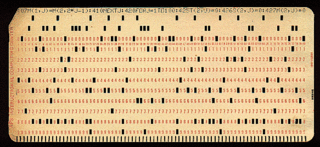
First is the “punch card” which used to be an information-transference
for programming computers, instructions being the little holes that were removed from the programming card and read as instructions by a little tiny set of people inside the large box that others referred to as “computers”. (The original “computer”, by the way, were people who did data entry and crunched same; they were carbon-based biounits. Karl Pearson’s Tracts for Computers of 1911 was a work for exactly those people.) The punch card was a programming tool used by Jacquard to guide the operation of his loom in the late 18th century and employed widely in this trade after that. It uses as a computation instrument came later to the mind of Herman Hollerith, whose earliest crowning achievement was to put it to use in the tabulation of the American 1890 census. (The government balked with meeting his demands for the use of his invention, or were hesitant primarily so, and Herman took his good work overseas. A similar path would be followed by the Wright Brothers in about 15 years, as had happened earlier with Thomas McKenney and his going-begging collection of Indian portraits. National intellectual and monumental treasures like these sometimes had a terrifically terribly go of being accepted and compensated by our government.)
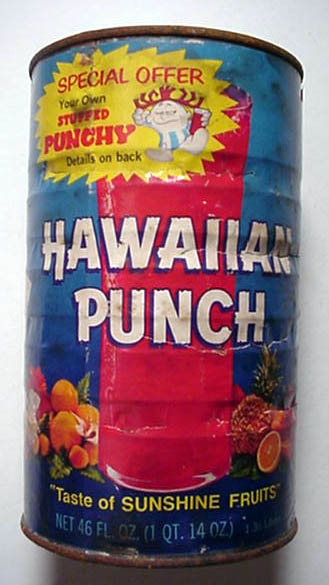
Maybe the most popular “punch” was the so-called “Hawaiian” one, which was a sugar drink given to children made by a company which was a holding company of the American Dental Association. Just kidding about the dental part. But the “energy drink” was like many others during this period–pure badness that kids loved. It was originally designed as an ice cream topping when it appeared in the early 1930’s, but when folks discovered, somehow, that the topping made a great drink when mixed with water, a new 2% or whatever fruit drink was born. The “punch” in it came from the wallop of sugar infused directly into the circulatory system. I don’t know where the “Hawaiian” part comes from.
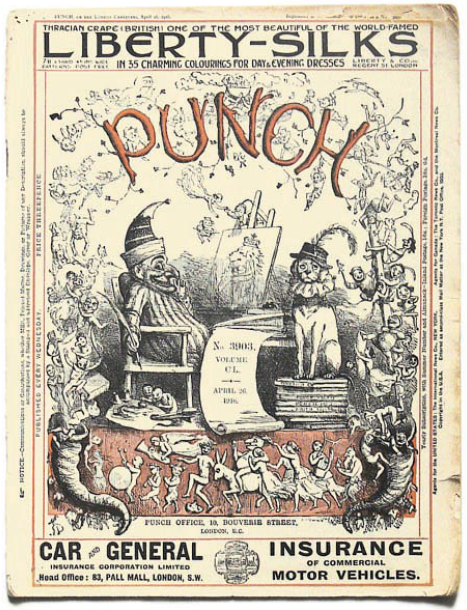
The most literary “Punch” comes in the form of the British magazine of that name, (Punch, or the London Charivari), a witty and dripping humor and satire magazine which appeared in 1842 and last until 1992. (Punches’ longevity surpasses that of supposed brawler Ernest Hemingway and the tiny-fisted fury of the problematic (did anyone read that last bilge-piece thing he did of the imaginary early life of Hitler?)Norman Mailer.) I think that, like Harper’s Weekly and other such political commentary journals of that time, if you can understand a tenth of the complex and complicated caricatures and commentary, then you really *do* know your history.
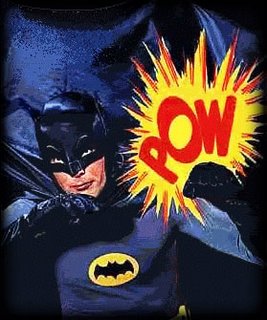
Probably the most-often referenced literary aspects though to the punch is found elsewhere, in countless magazines and comics destined for little hands, published by Dell and DC Comics and Marvel. Only the punch really doesn’t appear so without the reference to the noise it sort of makes, “POW” (as my daughter Emma has reminded me. “Honey”, I asked her, “what comes to your mind when I say the word ‘punch’? “Pow” she answered immediately.) And who better to illustrate this point than the immortal Adam West? (And this of course is not a comic, but a TV show that was made from a comic book that used comic book word balloons[for the first time?] in a video format.) Maybe it is Batman who is the most famous literary puncher, and maybe not: there’s Popeye, a man of exceptional prowess in the Department of Making Things Unconscious; and the Justice League Superman; the Hulk, who evidently did nothing but punch; and of course, my wife Patti Digh reminds me of “Punchious Pilate”. There’s also Sigmund Freud, a man who delivered a painful and boring punch to the unconscious and whose horrible thinking has been felt right down to this very day, the world suffering his made-up junk since his own annus mirablis of 1905.
Perhaps the greatest knock-out punch of all time (literally) was not the result of George Foreman or Jake Lamotta, but I.B.M. The I’ll Be Moved Company is the endish result of the work of Willard and Harlow Bundy, the brothers who created the first time, or punch, clocks. Their company consolidated into the International Time Recording Company and then in 1911 reformulated as the Computing Tabulating Recording Company (CTR) and then again into International Business Machines. The punch clock kept up to (or down to) the minute surveillance on the comings and goings of business employees (among other many other things), and was perhaps the most influential disruptor and capturing device of time since the invention of the mechanized clock. It delivered a true knock-out to the cushion of independently recorded renderings of when things “got done”.
Lastly, I cannot leave the subject of punching without remarking that I cannot mention Rocky, and that I must simply end the whole thing with two words: Muhammad Ali.
A note on the 1973 Foreman/Frazier fight clip: its actually pretty tough to watch. If you don’t care for combat like this, I’d stay away.
*Frazier was by far the superior boxer, but Foreman’s punch was unbelievably devastating. In the 1973 fight between the two men, Foreman knocks Frazier down six times. Frazier looks pretty scary for the first 2 minutes and 17 seconds of this video, but at 2:18 foreman hits him with a left that basically ended the fight–Frazier probably didn’t know where he was. At 3:16 in the comes the second knockdown, and then at 3:36 the third, at the bell ending the first round. At the opening of the second round Foreman just about lifts Frazier out of the ring, and then crushes his head at 5:10. Frazier was ready for the fight and he was probably about the best boxer in the world outside of Ali; but he couldn’t hurt Foreman, and then was completely and totally dispatched.
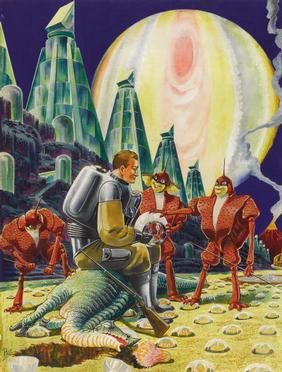
After watching a BBC series on the planets on Netflix, and having the idea of life on Jupiter’s moon Europa addressed, it occurred to me that I’ve seen the answer to this before. And here is is, by Frank Paul, “Life on Europa”, created for the back cover of Amazing Stories, September 1940. (From the Frank Wu website, much of which is dedicated to Mr. Paul.
Mr. PAul settled the issue, which he perhaps made up just that morning–I am particularly impressed by the globular units on t\he surface, plus, of course, the very interesting beings talking with the human explorer.
But in general Paul had a very large landscape for his deep well of life forms, sometimes seeming as though they were infinite.
And all of this done without the benefit or cause of Roswell. It seems to me, though, that if offered the choice between believing in a universe of teeming life versus just that which we experience here on Earth, I’d choose the former instantly, and get right on board the Frank Paul train.