A Daily History of Holes, Dots, Lines, Science, History, Math, Physics, Art, the Unintentional Absurd, Architecture, Maps, Data Visualization, Blank and Missing Things, and so on. |1.6 million words, 7500 images, 4.9 million hits| Press & appearances in The Times, Le Figaro, Mensa, The Economist, The Guardian, Discovery News, Slate, Le Monde, Sci American Blogs, Le Pont, and many other places… 5000+ total posts since 2008.

  • Q: How Long Did the Classic Cowboy Age Last? A: Not very.

    JF Ptak Science Books    Post 1706

    The Cowboy West, from Ned Buntline to Raymond Chandler and Dashiell Hammett

    http://www.the-forum.com/books/images/ww756.jpg

    I imagine that there have been significantly more people who have played cowboys in literature, on radio, in movies, on the stage and on television than ever cowboyed in the West. This doesn’t include children who have played at “Cowboys and Indians” over the past 150 years. The time of the classic cowboy-in-all-his-glory was short—maybe two generation. Probably less.  And there weren’t that many people to fill in those positions in that short period of time. 

    Certainly there are cowboys to this day, but the cowboy of our mind’s eye—that iconic cowboy of the expanding, post-Manifest Destiny West—was a victim of the great rush to land privatization in the 1880s-1890s: barbed wire and other fences took the cowboy’s place. By 1895 there were more cowboys riding fences than herding cattle. As Faulkner wrote on the “last individual” in The Fable (page 204), “the cowboy was exterminated from the earth by a tide of men with wire-stretchers and pockets full of staples…”  Of course Faulkner also saw the cowboy set among horse dung and “oxidizing cans” of sardines and tomatoes–a gemeinschaft/gesellschaft thing.

    There are only 40 or 50 years that separate cowboys Texas Jack and Ned Buntline from the Chandler/Marlowe and Hammett/Spade modern detective West of San Francisco and Los Angeels, which is an extraordinary thing.  There weren’t cowboys stretching back forty years before Texas Jack, and there weren’t forty years that they stretched into the future from him, either.  The distance in time that the cowboy existed, all things considered, was short–from the Reconstruction free-roaming Texas cattle of 1866 to the appearance of barbed wire in the early 1870’s to the refrigerated railroad car of just about the same time to the endless farming non-frontier of the 1890’s, the cowboy enjoyed probably one full decade of not being molested by the present; the future caught up with them in  a quick hurry. 
  • The Great Cowboy Race of 1893

    JF Ptak Science Books   Post 1707

    • [This post continues a series on the cowboy and the American West, prompted by a re-reading of Larry McMurtry’s novel, Lonesome Dove.]

    ++00++ 9.25 coboy

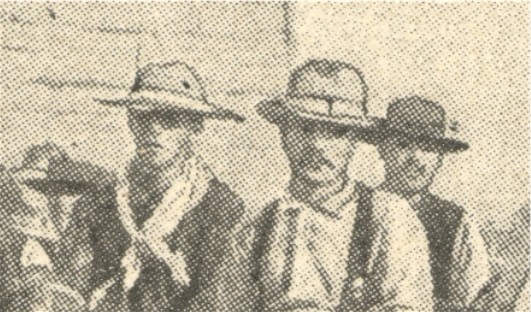
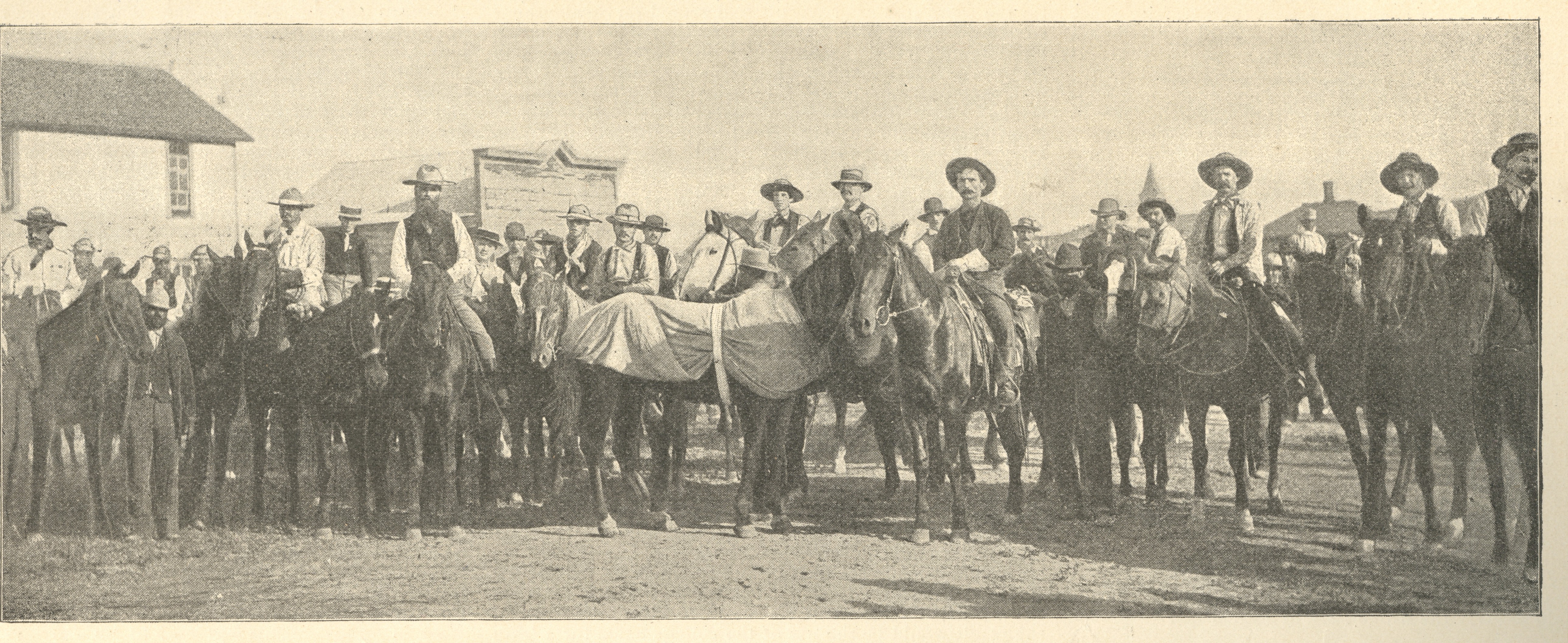
    I’ve not seen this picture of the nine cowboys who starred and started the Great Cowboy Race of 18931.  They gathered with a frenzy on the little town of Chadron, Nebraska (population 2,000, which doubled in size as the event’s opening grew near) determined to announce the “best “ cowboy, the first to cross the finish line near the Chicago World’s Fair of 1893 and shake the hand of Buffalo Bill Cody (well on his way to becoming a shell of what used-to-be).  The contest was supposed to take two weeks and average 50-75 miles a day, which is a lot to ask of a team of horses (and the riders).  So there was the expected shenanigans, and the man who “won” evidently helped plan the secret route, and someone else rode a trains with his horses for a bit, and so on. 

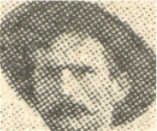
    The result doesn’t matter–it seems an overall sad story, these guys winging their way to the windy City, a race to oblivion. (Some of the cowboy contestants were already about half-faded away into Limbo judging from the photo touch up that had to be done of their faces.)  

    ++00++ 9.25 coboydet2

    Ironically these cowboys were racing to the cosmopolitan host of the World’s Fair in which the historian Frederick Jackson Turner read his paper “The Significance of the Frontier in American History,” —a significant theoretical piece announcing why Americans are so different from Europeans, and also that the American frontier had clearly, absolutely, been broken and installed in the gauzy national psyche.  The fate of the Cowboy had already been determined 20 years before with the introduction of refrigerator cars, railroad expansion and barbed wire–all of which cut the West into smaller and smaller parcels, until they restricted the Cowboy to its own Reservation. A crooked race to Chicago seemed to crystalize the Cowboy’s tenuous grasp on  existence, depicted finally by the new(ish) half-tone photo process of Stephen Henry Horgan, making a half-portrait of empty circles, the image disappearing more and more the closer we look at it..


    ++00++ 9.25 coboydet


     It was just a sorry show for the cowboy all the way around, and a story that doesn’t need to be told here.  I did just want to publish this picture.  There’s a long and good story here http://www.thelongridersguild.com/chadron2.htm about the entire affair. 

    I include the list of the riders, mainly for the names of their horses:

    Emmett Abbott riding Outlaw and Joe Bush.

    Joe Campbell riding his one horse, Boom-de-aye.

    Davy Douglas riding Wide Awake and Monte Cristo.

    Old Joe Gillespie riding Billy Mack and Billy Schafer.

    George Jones riding Romeo and George.

    Charlie Smith riding Dynamite and Red Wing.

    Rattlesnake Pete Stephens riding General Grant and Nick.

    Doc Middleton riding Geronimo and Bay Jimmie.

    John Berry riding Poison and Sandy

    .


  • A Short Note on Clerk Maxwell’s Reading

    JF Ptak Science Books  Quick Post

    We shall find that it is the peculiar function of physical science to lead  us . . . to the confines of the incomprehensible. —J. C. M., 1860

    What is done by what I call myself is, I feel, done by something greater than myself in me.—Comment made by Maxwell to the Reverend Professor F.J.E. Hort in 1879 when terminally ill.

    [Both quotes found in Fred Seitz’s article in  the Proceedings of the American Philosophical Society,  March 2001, “James Clerk Maxwell, (1833-1879), Member APS 1875”.

    Placeholder  Image

    This note may restrict itself to a small population of readers of this blog, but I’m always fascinated to come upon notices of the reading habits and library book-borrowing practices of significant people.  For example Herman Melville’s reading has been particularly studied, with scholars hunting books that had once belonged to him and then dispersed at auction (some going to the Brooklyn Public Library), and there are records of his borrowing practices at the library as well.  Thomas Jefferson’s reading habits is a well-known and fascinating study (though he did little borrowing, per se, what with there being few borrowing  libraries for him to visit, and then of course his library was much larger than anything else remotely close to him).

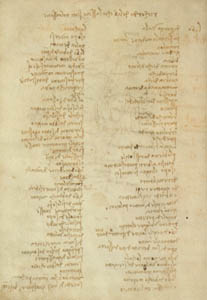
    Leonardo libraryThe library of Leonard is also well known–over the years via my bookstore I’ve had a number of people (usually involved in a classical study program, or St. John’s folks, etc) looking to try to reproduce Leonardo’s library.   In general, though, the full classification of the library of working scientists is not in general a known thing. (An interesting tour of some of the 116 books that comprise the library as described in the Codex Atlanticus and written around 1509 [left].  can be found at Museo Galileo, here.)

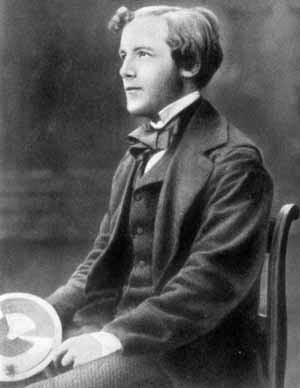
    This is the main reason why my interest was piqued when I read this biographical treatment of James Clerk Maxwell (1831-1879)  in the 27 October 1881 issue of Nature magazine. It mentions the while the great Maxwell was not-yet-great, studying at the University of Edinburgh (which he attended from 1847-1850, when he was just sixteen), that he used the library there extensive, and that the library has “records” of that reading.  The article quotes P.G.Tait from an 1879 article in that same journal (Nature, volume XXI, p 317)  that during the years at Edinburgh “without keeping the regular course for a degree”, Maxwell “carried home for study..such books as Fourier’s Theorie de la Chaleur, Monge’s Geometrque Descriptive, Newton’s Optiks, Willis’ Principles of Mechanisms, Cauchy’s Calcul Differentiel, Taylor’s Scientific Memoirs, and others of a very high order.  These were read through, not merely consulted.” 

    I’d like to see the whole list, though as yet I’ve not been able to find it, and I’ve not yet been able to find the right person to speak with at Edinburgh to determine whether there is a full list of Maxwell’s borrowing habits, or not.  It would be an interesting thing to see.  After all, the man did basically invent modern physics, and it was his portrait among the very few that were displayed in Einstein’s house at 112 Mercer Street.

    The original article on Maxwell along with a very fine steel engraved portrait is offered for sale in our blog bookstore, here.]


    ·Posted by :

    ·in:

  • Flying Tanks, 1930’s-Style

    JF Ptak Science Books   Quick Post

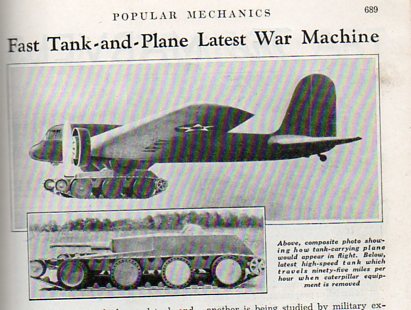
    There wasn’t much pretty in the physical outcome of this thinking–to construct “flying” tanks for quick maneuvers into battle situations–but I think that I like the thinking in it, especially as it seems that the aircraft-end of the tank was re-usable. Still, there was the whole “landing” part of the operation, which meant that (at this time, anyway) the tanks had to be placed and not parachuted to the ground, which also means that the armor would be relatively removed from the field of battle.  But this would be better than driving the things there, or hauling them all on a train  for quick transport.

    Ank158
    [Source:  Popular Mechanics, vol 65, 1936.]

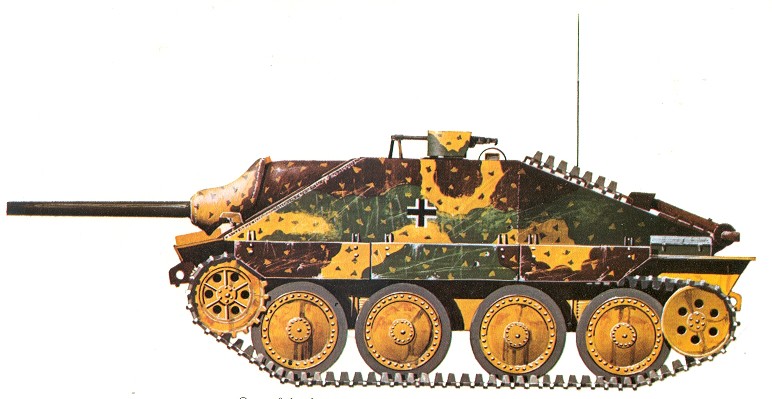
    Also I guess I’m partial to the design of the tank–which I’m guessing was a fixed-position mobile canon–because it seems so strikingly modern. (Except for the tread and wheels part, which is the place where battles are won and lost, at least according to Heinz Guderian.)  But I like the design, which at first glance reminded me of the great T-34, the Russian workhorse of WWII, sort of, at least for its low-profile sensibility, but really more like the contemporary   The Russian Chyorny Oryol (“Black Eagle“).  It really looks a lot more like the STUG assault gun, here:

    [Source: combatreform.org, here; a truly excellent site.]


  • The Doolittle Report on the State of Indians in U.S. Reservations, 1867

    JF Ptak Science Books   Post 1708

    [This is one in a series of posts prompted by my current reading of Larry McMurtry’s novel, Lonesome Dove.]

    The Indian of the Plains had few options in the 1860s and 1870s. The buffalo were gone and hunting lands were being taken over by white settlers. With this dissipation of their food source came displacement resulting in inadequate food supply and (in many cases) starvation. The government offered reservation systems, but these in general flawed results of flawed and hurried thinking. In one attempt to determine the efficacy of the government’s response to the growing crisis in caring for the removed Indian population, a committee under the titular leadership of  Senator James Rood Doolittle of Wisconsin (Republican turned Democrat, 1815-1897), created in January 1867 a report (The Condition of the Tribes, Report of the Joint Committee…) containing a wealth of information about the state of Indians on the reservations, drawing on the results of a questionnaire completed by 27 high-ranking respondents in Indian affairs, including eleven army officers, thirteen agents or superintendents, one teacher, one missionary, and one physician. It does not paint a pretty picture, even coming at the hands of a Congressional investigation.


  • Is this the Only use of the word “Rabdologia” in the History of Advertising?

    JF Ptak Science Books   Post 1710

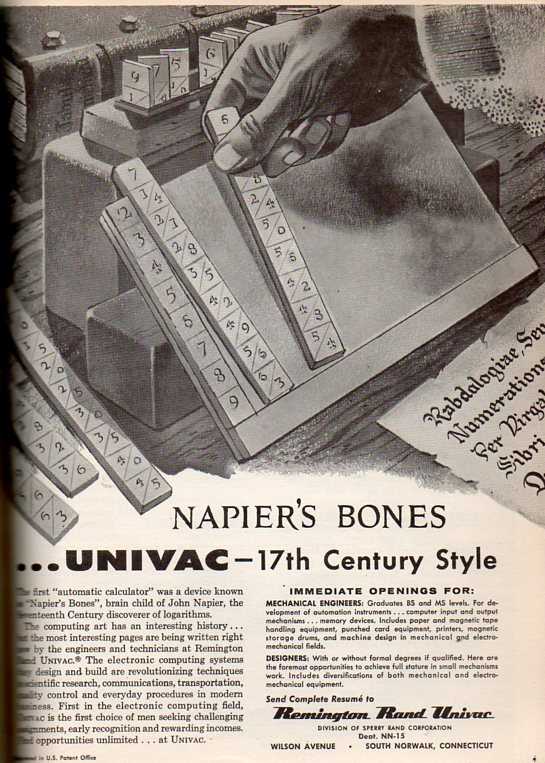
    Well, probably. The ad is by UNIVAC—fives years old at this point—and the lace-cuffed image pushing the virtues of the world’s first commercial computer is that of John Napier‘s abacus, which he wrote about in 1617. The ivory calculating bones/rods method had been seen before in the history of the maths and calculation, but not published, and the idea employed in the elegant calculating device were very old, but Napier seems to have gotten to publish it first. (His work on logarithms is of tremendous importance, far more so than the abacus.)

    Computer ad rabdol159

    The word “rabdologia” belongs to the title of Napier’s significant book (where the title is the abstract): Rabdologia, or, The art of numbring by rods : whereby the tedious operations of multiplication, and division, and of extraction of roots, both square and cubick, are avoided, being for the most part performed by addition and subtraction : with many examples for the practice of the same …

    And I just want to say that since this ad was UNIVAC and it appeared in the November 1956 issue of the early computer journal, Computers and Automation, that the illustration got the “bones” correct. That is, the calculated product is correct.

    The way these rods worked is as follows: in the illustration, the number rod on the extreme left (ranging from 2 to 9) is the multiplier; and the numbers at the top of the other rods represented the multiplicand. So we see that the lace-cuff is multiplying the number “76” (at the top of the two rods to the right) by, say, 7. Simply start writing the answer as follows: take the “2” from the 6 rod for your ending number; then add the numbers on the diagonal directly to the left of the two (4+9=13) and take the 3 and place it next to the two in the tens column, and carry the 1 to the next function, which would be 4+1=5. So the answer: 532.  The bones could do more than this, of course, but for right now I’d just like to point out that the ad folks got this right–plus its nice to see a bunch of numbers used in public display that actually mean something.  [See the Wolfram site for a nice explanation of how the bones work.)

    John Napier’s work in logarithms (published three years earlier in 1614) is the work for all time; the Rabdologia however would have been instantly appreciated by people like his father, who was master of the mint of Scotland. That said, I’ve read here and there that Napier considered his most significant published work to be his  A Plaine Discovery of the Whole Revelation of St. John (1593), in which he practiced a theo-chronometry based in the Book of Revelation that among other things in its 300-pages  predicted that the world would come to an end in 1688. Or 1700.  He evidently considered himself a Theologian first and foremost, and what bothered him most was Pope Clement VIII, who he considered to tbe the anti-Christ–and so complications arose.  Win two, lose one. 

     [I’ve just uploaded Tompkin’s classic/first textbook on the digital computer (High Speed Computing), 1950, to the books for sale section of this blog, here.]

  • The Earth & Cosmos as Balls–Renaissance Emblemata and Charlie Chaplin

    JF Ptak Science Books   Quick Post

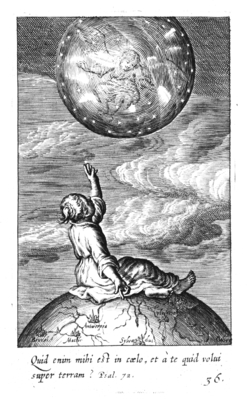
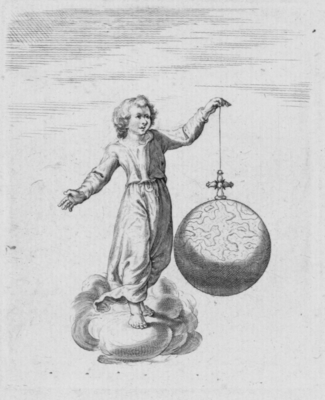
    Quid enim mihi est in caelo & a te quid volui super terram?

    (For what have I in heaven, and from thee what thou shalt do I desire upon earth?)

    Hermannus Hugo, Pia desideria (1624)hu1624036pictEvidently, there’s plenty left open to desire and want while still here on Earth–not the least of which was Heaven, or the Heavens, as we can see in this playful engraving from Hermanus Hugo’s Pia Desideria (printed in 1624).  With the Earth as a given, why not want more from the Heavens? 

    On the other end of this equation is being on Earth and wanting it–all of it. Charlie Chaplin, in his great and enormously insightful and satisfying film, The Great Dictator, styles the film’s title character after Adolf Hitler, and delivers a performance of great depth. 

    THe film was released in October,m 1940, when most of the world had been at war with Hitler and Germany for more than a year.  The United States was not, not yet (for another 14 months) though we participated in programs that meant assurance for the delivery of materiel and other materials necessary for the Allies to continue the war.  Chaplin was a savage in his attacks on Hitler, relentlessly so–and as such this was the first major American film to take such a stand against Germany in WWII. One of the great scenes of the film and perhaps of all films in the 1940’s was Chaplin’s dancing Hitler and his love affair with world domination:

    In Jan Suderman’s De godliebede ziel (printed in 1724) we see yet another rendition of the Earth and its favor with humankind, as  as ort of balanced bit at the end of a fragile connection

    el1703001pict

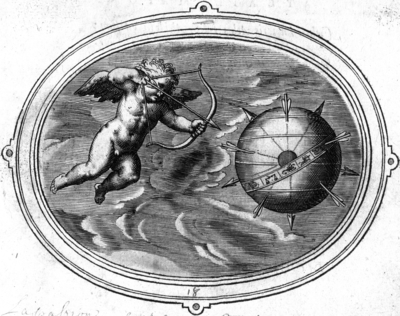
    While in Otto Vaenius’ Amorum emblemata (printed in 1608) we find a cupidesque emblem shooting the Earth with his arrows, all of which takes place under the motto “Love Keeps Everything in Essencve”, or “all Depends upon Love”, or some other variation:


    v1608018pict

    The litle God of loue transpearseth with his dartes; The heauens and eke the earth in musicall accord; For without loue it were a chaos of discord; Thats fastned now in one of well conioyned partes.

    The seemingly finished product of the love-arrowed-Earth can (possibly) be seen in Otto Vaenius’s Amorum emblemata (1608), telling us that
    Love permeates and sustains the whole, though.
    Love permeates all that breathed or not.
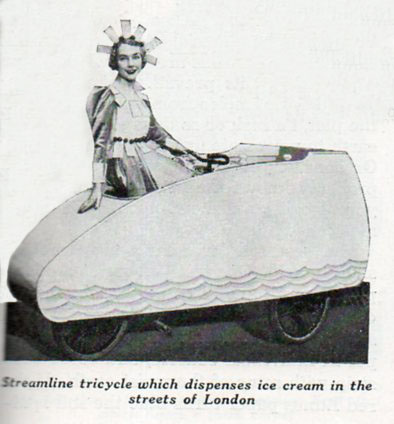
  • Technoarchaeology: Images of the Fabulous Past Futures–Streamlined Ice Cream

    JF Ptak Science Books Very Quick Post

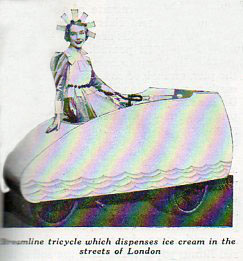
    Some things just don’t need to be streamlined, especially when they’re designed to be very slow.

    Pop mech logo027May, 1936 issue of Popular Mechanics


    Pop mech aero dyn026

    Pop mech ice cream028

  • Zoomology: a Paper Microscopic Look at Prints.

    JF Ptak Science Books   Quick Post

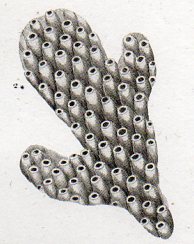
    Zoomology--vermes b032


    There’s a track on this blog located in the feebly-named category “Looking Closely/Deeply at Prints” were tiny bits and pieces of engraved artwork are exhumed for closer story, like passing a paper microscope over the image to draw out the semi-invisible and show the secret life of prints.  Often what this entails is some very curious work by the artist and/or the engraver as they sought to spice up a rudimentary architectural assessment of Salisbury Cathedral, or the town hall in Munich, or some sort of ruin in Surrey, or a street scene along old Broadway in NYC–and they would do this sometimes by including something artful and small, and completely unnecessary to the primary image on which they were working.

    See this post for a good example (with other links) of this.

    So, instead of having a few people in the street outside of Cathedral X to show the building to some sort of scale, the artist/engraver might include in their very tiny detail images of children fighting, or a legless beggar, or a pocket-thief, or a tripping aristocrat.  Or a man rounding a corner with a baby coffin on his shoulder. 

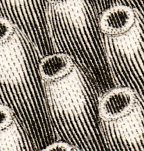
    Zoomology--vermes b034
    What happens here then is an intended-unintentional, sort of like an 18th century snapshot of Something that captures stuff of the daily grind in the process–and as it happens it is this stuff, the activities and the people doing the mundane chores of the 18th century that turn out to be the very interesting bits of the artwork.  After all, it was this sort of invisible activity that would tend not to be preserved in artwork or other visual documentation–but here it is, locked away in an architectural appreciation of some building Y in some city Z.  And we are lucky for the contrivances of those long-asleep artisans.

    But the Zoomology posts are something a little different than this–they simply are a deep observation of an interesting detail in an antiquarian print or photograph that shows an artwork in and of itself, a sort of descending fractal of appreciation.  And simple.

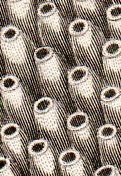
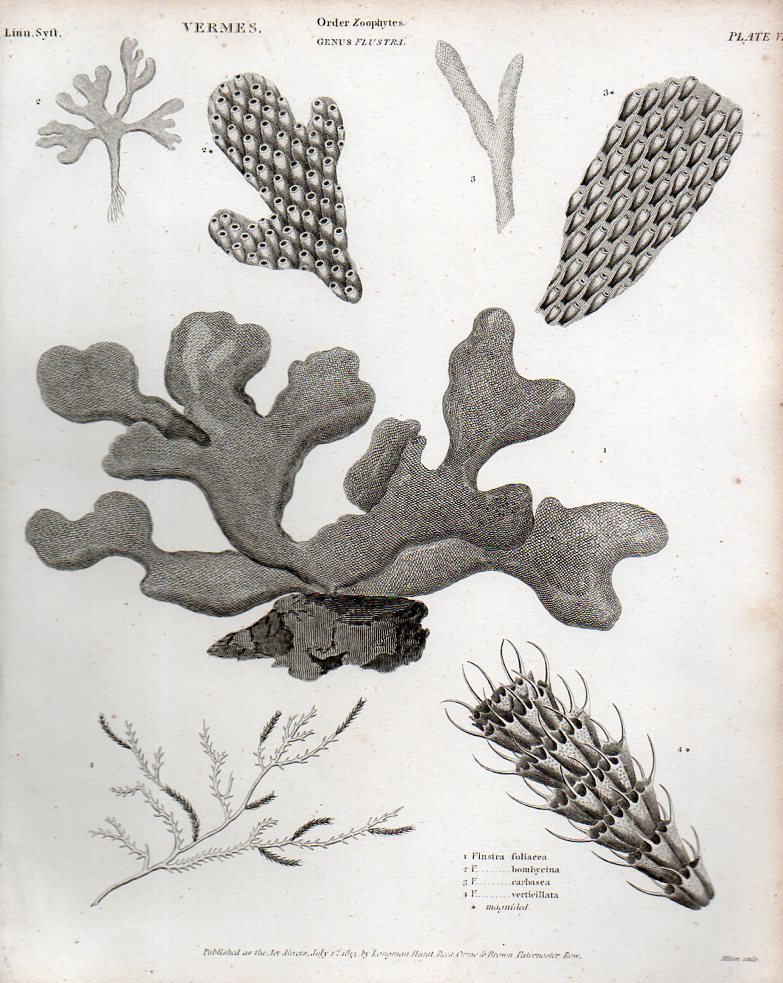
    The first sample in this quick-posting category is the sea anemone, or Zoophyte (old school classification), that we see in this series of images (above and below) from the great and prolific Abraham Rees (who must have had a team Rees, a group of scholars like the Bourbaki who worked together mostly anonymously save for the (in this case real) man whose name is given credit for the entire work) and engraved in 1813.  The image in question is a flustra bombycina, a Verme (according to the obsolete Linnaen taxonomy), and it just called out for deeper inspection:

    Zoomology--vermes b033

    And the zoom-out to the full image:

    Zoomology--vermes031


  • Zoomology–the Paper Microscope and Hidden Children in Antique Prints

    JF Ptak Science Books       Post 1668  

    Part of Paper Microscope and  Zoomology  series.

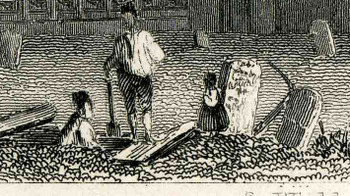
    Hidden_children_graveyard153

    [Detail from the image immediately below, the small scene immediately in the foreground.]

    Images hold selective secrets for different people of divergent interests.  Sitting through a motion picture, for example, shows a series of still images flashed before us—in a single scene people bring to bear their own ways of experience and observation.  A forensic pathologist will see things shown within their specialty different from someone with a chemical explosives background who will see a bomb differently from an ER doc who would respond to an emergency room differently from a bookseller who might notice in the scene that the paperback edition of a Tree Grows in Brooklyn being read by an American G.I. in 1944 didn’t exist yet, and so on.  A single image can hold a tremendous variety of depth and interpretation depending on the observers’ perspective. 

    Most of the time when I look at prints now I am looking at the extraneous “stuff” that is used as filler to the print’s purpose. I’ve written about this a few times earlier in this blog under the (bad) general title of Prints—Looking HARD at…), and I find the uncommitted art just fascinating, sort of like “loose”, unnecessary snapshots of common life, everyday life, of people walking by. 
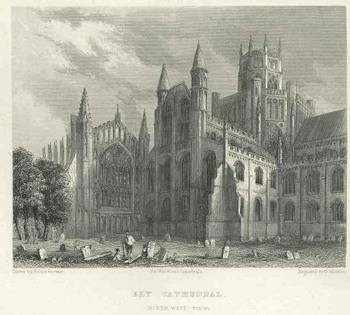
    Hidden_children151
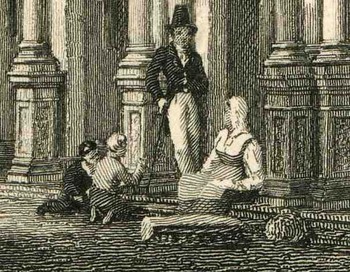
    The two prints today that I stumbled upon have a particular interest—they depict semi-hidden children in the foreground-filling detritus of the architectural marvel that is the subject of the artwork.  Children really don’t appear too terribly often in art from 1500-1850, so it is especially interesting to look really hard at these prints and pick out the kids and what they were doing.

    Of course this begs the question of “why?”—why would the artist bother with such detail in the foreground, let alone bring children into the picture?

    The first image is the gorgeous Cambridgeshire Medieval cathedral at Ely.  This is an engraving showing the north west view of the cathedral, and it is of course grand and imposing.  The curious foreground shows a somewhat dilapidated-looking cemetery, and looking further still we see two men digging a grave, and to the right of them, a small child, seemingly pointing and reading a gravestone.  What an unusual detail this is, what with it occupying less than 1% of the area of the image in general.
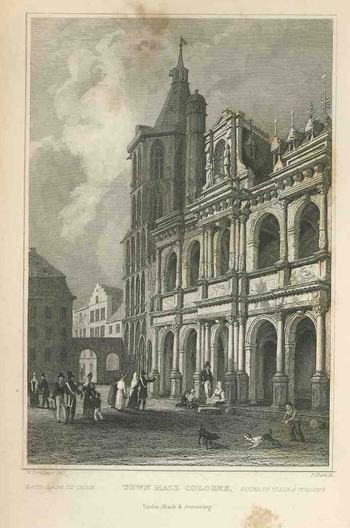
    Hidden_children_two152_2

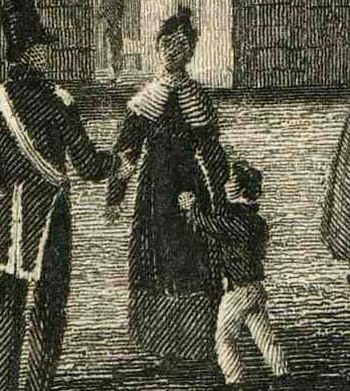
    The second image (above) shows the façade of the Town Hall at Cologne.  Of the twenty or so people in the street in front of the building, four are children (there’s also a pair of fighting/playing dogs).  One of the miniatures scenes seems to show a boy in a “pick me up” pose.  To the right of this is another, odder, scene, showing a woman—possibly a street food peddler—with her two boys(?), the children kneeling in front of a gentleman who is in turn leaning against a pillar of the Town Hall.  What the boys are doing is a mystery, as is the intention of the artist in including them.
    Hidden_children_streetpick_me_up .

    Unfortunately these “microscope” studies reveal only the basic forms of the semi-hidden, and really don’t ever seem to offer us a reason as to why they were preserved.  Presently I’m happy enough to just recognize them and appreciate their small saved existence.

    Hidden_children_street_kneeling  

  • On the End of the World Worries–1524

    JF Ptak Science Books   Post 1669

    End of the world035
    People have been worrying about the end of the world for as long as they have realized that the world could have an end.  The more-modern concerns for world-ending collisions with asteroids is relatively recent and does have a lot of truth to it; likewise the ending of large lifeforms on the planet via nuclear holocaust, which came very close to being in a number of situations over the last 55 years or so.  Less convincing arguments have been made through biblical interpretations and resurrections of ancient myths about the coming end-of-times because of of confluence of floating numbers which are after all is said and done just numbers and not actually attached to very much.  There have been untold numbers of predictions and world-end scares, but reality was not at all accommodated.  (An interesting end of the world date prediction timeline appears here.)

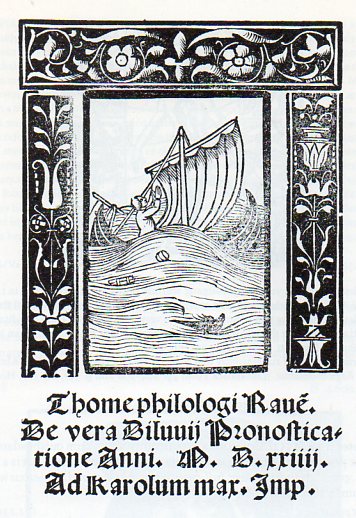
    One of the earliest printed menaces scaring people into believing that the world was coming to an end appeared in 1524, when a conjunction of the planets in the constellation Pisces was supposed to be similar to that which appeared in the times of Noah and in the sign of Aquarius. The conjunction plus the bits about Pisces and Aquarius evidently lead to the belief among some that there would be a great flood. There were over one hundred pamphlets published on this topic in the early 1520’s, though to be fair the bit about Noaic deluge was evidently an outrigger–most of them it seems (at least to Lynn Thorndike) were argumentative over one principle or another of astrologic practice. 

    Of the many people who addressed this topic–including Machiavelli, Luther, Apian, Rabelais and Vives, among many others–was Tommaso Gianotti (Rangoni) (1497-1577), who gave his predictions this fantastic woodblock visual life in his work De vera diluvii prognostications (and printed in 1522).  It was 16 pages long, and was one of many such slim pamphlets–his, though, did have this marvelous illustration.  I think the blank sky helps set the sunken world and the collapsing boat of mankind into stark contrast on what lay ahead. (Gianotti led a long and distinguished career teaching logic (Padua) and astronomy (under the direction of Pope Leo X) as well as astrology (Bologna), and managed to outlive his many dire predicitons by half a century.)

Recent Posts

Archives

Categories