JF Ptak Science Books Quick Post
Quid enim mihi est in caelo & a te quid volui super terram?
(For what have I in heaven, and from thee what thou shalt do I desire upon earth?)
Hermannus Hugo, Pia desideria (1624)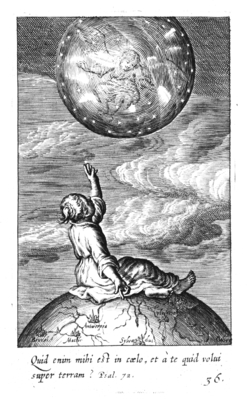 Evidently, there’s plenty left open to desire and want while still here on Earth–not the least of which was Heaven, or the Heavens, as we can see in this playful engraving from Hermanus Hugo’s Pia Desideria (printed in 1624). With the Earth as a given, why not want more from the Heavens?
On the other end of this equation is being on Earth and wanting it–all of it. Charlie Chaplin, in his great and enormously insightful and satisfying film, The Great Dictator, styles the film’s title character after Adolf Hitler, and delivers a performance of great depth.

THe film was released in October,m 1940, when most of the world had been at war with Hitler and Germany for more than a year. The United States was not, not yet (for another 14 months) though we participated in programs that meant assurance for the delivery of materiel and other materials necessary for the Allies to continue the war. Chaplin was a savage in his attacks on Hitler, relentlessly so–and as such this was the first major American film to take such a stand against Germany in WWII. One of the great scenes of the film and perhaps of all films in the 1940’s was Chaplin’s dancing Hitler and his love affair with world domination:
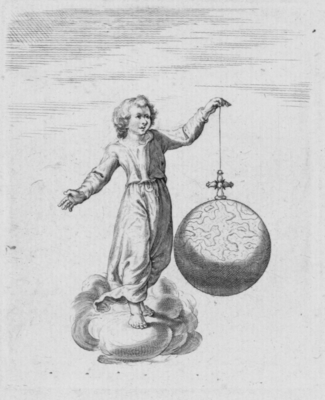
In Jan Suderman’s De godliebede ziel (printed in 1724) we see yet another rendition of the Earth and its favor with humankind, as as ort of balanced bit at the end of a fragile connection
While in Otto Vaenius’ Amorum emblemata (printed in 1608) we find a cupidesque emblem shooting the Earth with his arrows, all of which takes place under the motto “Love Keeps Everything in Essencve”, or “all Depends upon Love”, or some other variation:
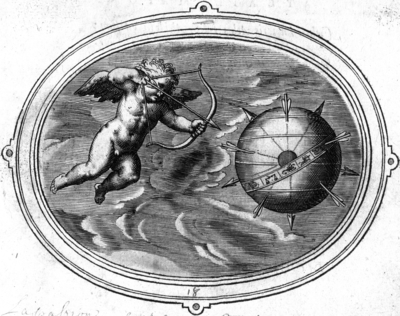
The litle God of loue transpearseth with his dartes; The heauens and eke the earth in musicall accord; For without loue it were a chaos of discord; Thats fastned now in one of well conioyned partes.