A Daily History of Holes, Dots, Lines, Science, History, Math, Physics, Art, the Unintentional Absurd, Architecture, Maps, Data Visualization, Blank and Missing Things, and so on. |1.6 million words, 7500 images, 4.9 million hits| Press & appearances in The Times, Le Figaro, Mensa, The Economist, The Guardian, Discovery News, Slate, Le Monde, Sci American Blogs, Le Pont, and many other places… 5000+ total posts since 2008.

  • WIlliam Herschel, Adam Smith, Sunspots and Wheat Prices

    Herschel253JF Ptak Science Books   Quick Post

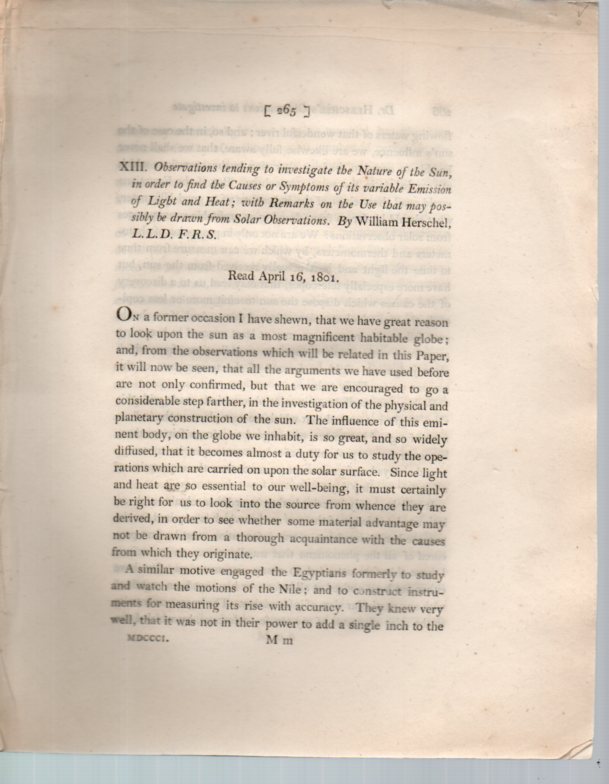
    While flipping through William Herschel’s 1801 Philosophical Transactions paper “Observations tending to investigate the Nature of the Sun in order to find the Cause of Symptoms of its Variable Emission of Light and Heat”, I thought it was a good early-ish paper on sunspots.  I was surprised to find a lengthy entry on the applied nature of his findings, and that on the variable nature of sunspots and agricultural yield as determined by wheat prices found in Adam Smith’s Wealth of Nations.  Honestly I was fully unaware of Herschel’s involvement with sunspots and seasonal growth and price fluctuations, but there it was.  And he does find a correlation, albeit a very cautious one where he says the subject deserves more study and more data.

    He writes: “it seems probable that some temporary scarcity or defect of vegetation has taken place, when the sun has been without those appearances which we surmise to be the symptoms of a copious emission of light and heat…”

    This must make Herschel–already a celebrity astronomer for his discovery of the first planet discovered since ancient times, Uranus, among many other things–one of the earliest (if not the first) astronomer to experimentally entertain the effects of solar disturbances on the Earth.  And this on sunspots years before Schwabe established the periodicity of sunspots (1846) or the electromagnetic connection with sunspots (that would come only with G.E. Hale in 1908).  Herschel (who left/fled Germany to reside in England) was a man of interesting sight: he discovered Uranus, identified new moons of Saturn, established that the previously-nebulous nebulae were collections of vast numbers of distant and faint clouds, drew a spectacular image of the Milky Way galaxy as an outside observer looking in, that there was a light from the sun that was beyond the visible spectrum, and also discovered in the micro-world found that coral were animals rather than plants.The business of trying to see if there were any correlations between solar activity and plant production on Earth was novel, and interesting. [The original paper is available for purchase through our blog bookstore, here.]

    In the Edinburgh Review for 1825 we find:

    ·Posted by :

    ·in:

    —
  • The Polish Threat to Germany as Seen by the Nazis, 1939

     JF Ptak Science Book–expansion of Post 230 (September 2008)

    This is one of those times when a pamphlet has posed an idea that had never before occurred to me. This anonymous work produced by the German propaganda machine in May 1939  asserts that Poland did indeed have plans to continue to break the back of Germany over the never-to-be-forgotten and at this point hardly-observed Treaty of Versailles, and to also physically attack south-eastern Germany some time in 1940.

    Blogsept_1_poland476

    Again, the idea that Germany was defending itself against an imminent attack by Poland was completely novel to me.  There’s always a reason for these sorts of beginnings of wars, but this one really is exceptionally removed.  Poland had just decided to defend its borders against the Germans following their conquest of Czechoslovakia the previous year–until then the Polish military’s biggest threat was the Soviet Union.  The German attack, the blitzkrieg (Fall Weiss) which would begin on 1 September 1939 involved 1.5 million German soldiers attacking two principal points in Poland. It was ostensibly launched in response to a supposed Polish attack on the German border town of Gliwce–an attack orchestrated and simulated by Germany.  In the attack, the Germans unleashed 11 tank divisions versus Poland’s 1; sent in 1250 bombers and fighters to Poland’s (mainly obsolete) 360; rolled 4 motorized divisions against Poland’s, um, that’s right, they didn’t have any.  And of course the Germans had a modern and vastly superior navy, compared with Poland’s 4 destroyers, five subs, and assorted smaller numbers of smaller and less-significant vessels. 

    The British and the French issued an ultimatum to Germany to cease and desist; Hitler had no intentions in stopping, throwing the five armies of von Rundstedt and von Block deeper into the country in a fast and (according to many German generals) breakneck manner.  The British and French declared war on the 3rd, by which time the war in eastern Poland was already almost over.  The Germans did respond to the ultimatum (see this in continued reading, below) in which it outlines some of their needs and Polish-inspired dears. 

    By 24 September the Germans had reached the formerly important geographic boundary of the Vistula and swarmed past.  Warsaw was bombed by some 1150 aircraft, and by the 27th, the fighting was almost entirely over. (Some divisions held out to 6 October, the invasion completed in 36 days). 


    It is sometimes forgotten in the quickness of this defeat that Poland inflicted some heavy losses on the German military machine:  8000 soldiers killed with 27,000 wounded and 5,000 MIA; 217 tanks were destroyed.  The Luftwaffe lost over 500 planes, either entirely destroyed or damaged to the point of uselessness.  Polish losses were far greater.

    It was at this time that the first of my grandmother’s brothers, Raymond Dymek of Pittsfield, Massachusetts, would cross the border into Canada and volunteer, becoming a pilot in the Royal Canadian Air Force.  He would fly against the Nazis with the CRAF, then joined the RAF, until finally, when the U.S. joined the  European war 27 months later, would fly for the U.S. Army Air Force.  He had a very long career and made it through.  His five brothers would also enlist in the U.S. armed forces; all six brothers would return home. Fatherland and all that.   I know the vocabuarly for their response to the idea that Germany was responding to a Polish threat of invasion didn’t exist to them–it barely does for me.

  • Courageous “Degenerate” Art, 1937

    JF Ptak Science Books    Post 1731

    I came upon this pamphlet out in the warehouse, and I was reminded again of the greatness and courage of some of the anti-NSDAP/Hitler artists in Germany in the early period of Nazism, 1933-1936.   There were many who were overtly anti-Nazi–like George Grosz and John Heartfield–in the political messages that were their artwork; then there were those  (like Felixmueller, Wollein, Otto Dix, Max Pechstein) who became enemies of the Nazi state because they chose to depcit the horrors of war or poverty or other social ills

    Degenerate art257[“Brains Behind Barbed Wire”, with a woodcut by Frans Masereel.]

    John Heartfield, Blood and Iron, 1934

    And then, as the Nazis consolidated power they erected an enormous edifice of propaganda and thought control, codified in law and absorbed into societal practice, where artists and writers and their artwork and books and ideas were banned, being “deliberate sabotage of national defense”.   The books were burned, the art removed or sold or destroyed or hidden, the writers and artists threatened with extinction as well:  deported, thrown away, controlled, imprisoned, sent to concentration camps, murdered. 
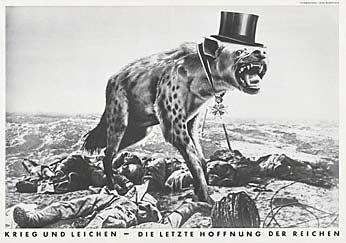
    Photomontage by John Heartfield, 1932

    [War and Corpses, by John Hearfield, 1932.]

    One way of another, they were mostly gotten rid of–the paintings and other works of those who were abroad or dead or otherwise not-reachable; and the art as well as the artists who were still in Germany, and whose presence could be controlled.
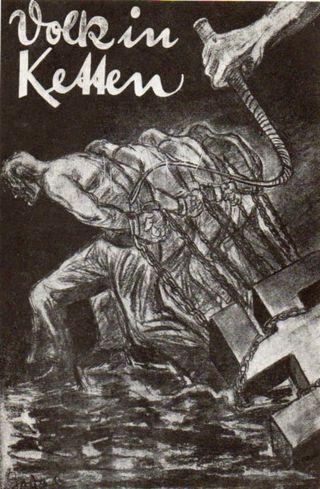
    Klinger258[“Max Klinger”, Volk in Ketten. Deutschalnds Weg ins Chaos, 1934]

    Some of the artists who were not able to escape, or who were Jewish and who did no tget sent to concentration camps, were murdered via the infamous Aktion 4 or T4 program–the mass murder of the physically disabled, the sick, the weak, the “moral degenerate”, and those too incapacitated to take care of themselves.  The name comes from the address of the organization responsible for it, at Tiergartenstrasse 4 in Berlin–the  Gemeinnützige Stiftung für Heil- und Anstaltspflege, [or Charitable Foundation for Curative and Institutional Care] which was run from (at least ) 1939 to 1945 under the direction of Recihsleiter Philipp Bouhler (who unfortunately escaped life by suicide after being captured by the Americans in May 1945). 

    [From Wiki: “This poster (from around 1938) reads: “60,000 Reichsmarks is what this person suffering from a hereditary defect costs the People’s community during his lifetime. Fellow citizen, that is your money too. Read ‘[A] New People‘, the monthly magazine of the Bureau for Race Politics of the NSDAP.”]

    To make things easier on the German mind, the NSDAP selected artists and entire art movements that were to be banned as “degenerate”, and displayed them in an infamous 1937 show called Entartete Kunst (“Degenerate Art”).  

    The people who committed their beliefs about the great Evil Thing that was National Socialism, those who committed their thoughts in art or literature, and did so in the 1933-1937 period, were brave people.  Hitler and Goebbels and the rest of the Nazi machine deeply appreciated the influence of visual images, being great practioners in the idea themselves, only though with vastly different content.

    The great social commentator/satirist/cartoonist for Harper’s Weekly magazine, Thomas Nast, also knew the great influence of the single visual image, and magisterially used his insight and art to great effect in helping to effect social change.  One of the evils he brought down–Boss Tweed of Tammany Hall–said that he didn’t fear anything that was written about him in the newspaper because his constituency “couldn’t read”.  But what he didn’t get, and what he never did understand, that the thing that brought him down were cartoons, and those were the things that people didn’t need to be able to read words in because they could already “read” the images. And it got him in the end.

    The manufacturers of the NSDAP recognized this factor and saw how much it could play against them, and so sought to remove “it”.  They went after the art, the artists, and the ideas, and came away from it all with safe and sanitized and partially meaningless culture. 

    The artists condemned in the 1937 Degenerate Art exhibition necessarily reads like a who’s-who of modern and 20th century art:  the show included Ernst Barlach, Willi Baumeister, Max Beckmann, Max Ernst, Wassily Kandinsky, Emil Nolde, Max Pechstein, Paul Klee, Ernst Krircherm Lyonel Feiniger, Oskar Schlemmer,  Franz Marc, El Lissitzky, Oscar Kokoschka, George Grosz, Marc Chagall, and Kurt Schwittersto name a few.  (A full list can be seen below.) Entire artistic movements were also to be eliminated in order to save the morality and conscience of the German people, including Bauhaus, Surrealism, Impressionism, Fauvism, Expressionism, Cubism and Dada. Basically, it was almost all of modern art.

    [Hitler visiting the Degenerate Art Show, 1937.)

    A fuller list of those exhibited at the 1937 Degenerate Art show.

    These artist were abandoned/exiled/killed in favor of a more morally-robust and Aryan flavor, a genetic correctness, like the work here by Ernst Liebermann, moribund in its deadly color, greasy, tumescent hyper-non-sexuality:

    By the Water - Oil painting by Nazi artist, Ernst Liebermann

    which is picture postcard bad, like Franklin Mint artists gone to Nazism and shining/lustrous nudes.

    The “degenerate” label didn’t last very long in Germany, at least not in years–measured in lives, however, it is a completely different story.
  • Re-publishing a Rare Work on French Parachutists, 1943

    Corps parachutiste265JF Ptak Sciene Books   Quick Post

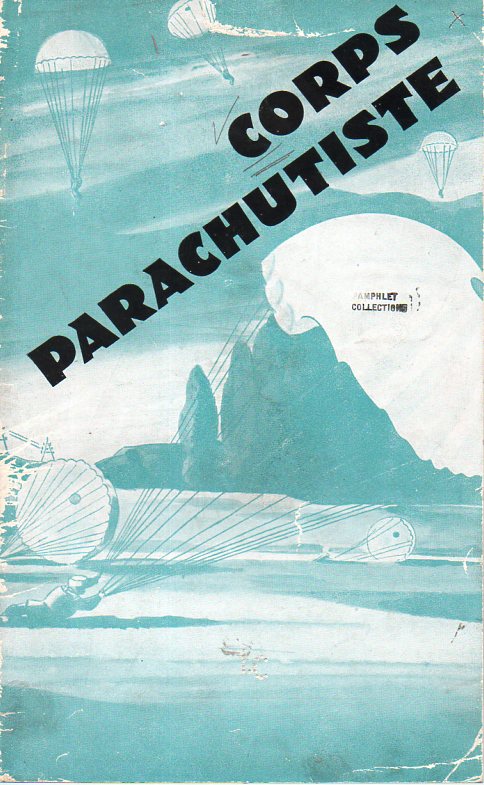
    I’ve always enjoyed reading about the Airborne, and when I came across this pamphlet it looked immediately interesting. It was printed in England (1940-1943 or so) for distribution (I guess) in occupied France or to the French in exile, and possibly for recruit (but at least for a hearts and minds campaign to show that France was fighting back).  It tells quite a story in its pictures, which to me shows men trying to do as much as they can with, well basically nothing. 

    The pamphlet shows up nowhere, not even in the massive 70-million item librarians’ reference database, the OCLC.  So I decided to scan the whole (short) thing and make it available.  Enjoy. [The original is also offered for sale in our blog bookstore, here.]

    ·Posted by :

    ·in:

  • The History of Lines series: the String of Empire, 1908

    JF Ptak Science Books     Post 1733

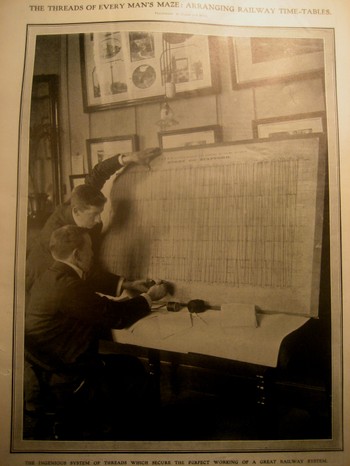
    String_big_board It is astonishing sometimes to think about how much was accomplished with so little.  This photograph, found in the 6 June 1908 issue of the Illustrated London News, entitled “The Threads of Every Man’s Maze:  Arranging Railway Time-Tables” (sub-titled “the ingenious system of threads which secure the perfect working of a great railway system”) is just such a case in point of wonder.  Each section of the board represents one hour, top to bottom; these are further subdivided by thinner lines representing 5-minute intervals; the horizontal lines representing the distances between stations.  And the guys in the foreground are keeping the whole thing up-to-minute, using string and tacks. 
    This was the British Empire at about its loftiest heights, with a spectacular internal railroading system, kept all in line and on time and correct with the help of heavy thumbs.  Can you think of a better way to display all of this complex data (with 1910 technology)  in real-time so that it is all intelligible–and to be so instantly?  I can’t.  This was just sheer, simple, brilliance.

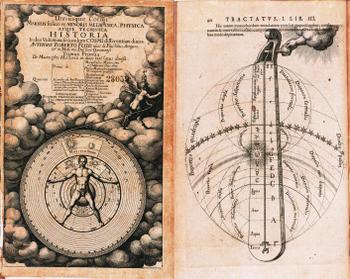
    I know, I know, this is actually “thread”, but so it goes.  If you elongated and strengthened this concept just a bit you’d come up with rope and wire, and chains–the most simple metallic form of which was used by surveyors for hundreds of years to help map our earth.  And I won’t even get close to the String Theory stuff here, or stringed instruments–but if I did, I would want to talk a little about perhaps the ultimate string/cosmology image in the history of science, which would be Robert Fludd and his fantastical thought-experiment  called “Monochordum mundi”. from his Utriusque cosmi maioris scilicet et minoris metaphysica, physica atque technica historia, printed in 1617.

    Robert_flood Fludd makes an elaborate and beautiful stab at understanding the deepest aspects of an imagined supramusical relationship between the order and rationality and mathematical aspects of music and the functioning of the universe—based on sound itself.  These ideas come up time and time again, most visually pleasing in Fludd, but most dramatically argued by Johannes (Harmonicae Mundi, “Music of the Spheres”) Kepler.  But Fludd trumps with god’s graphical intervention.
    The hand of god makes an appearance here as it adjusts the magic monochord of creation–a Pythagorean monochord of two octaves which are then divided into harmonic intervals.  But god’s hand is definitely there, doing some sort of adjustment (or perhaps even holding the slipping peg in place?), which is actually a little bit late in the history of the mechanical universe being turned by the hand of the creator, with the hand actually depicted doing the job.  In general the hand stopped making appearances by this point in the history of science, but did manage to linger on in the work of Fludd.

  • The Great Passaic Textile Strike of 1926

    JF Ptak Science Books    Post 1734

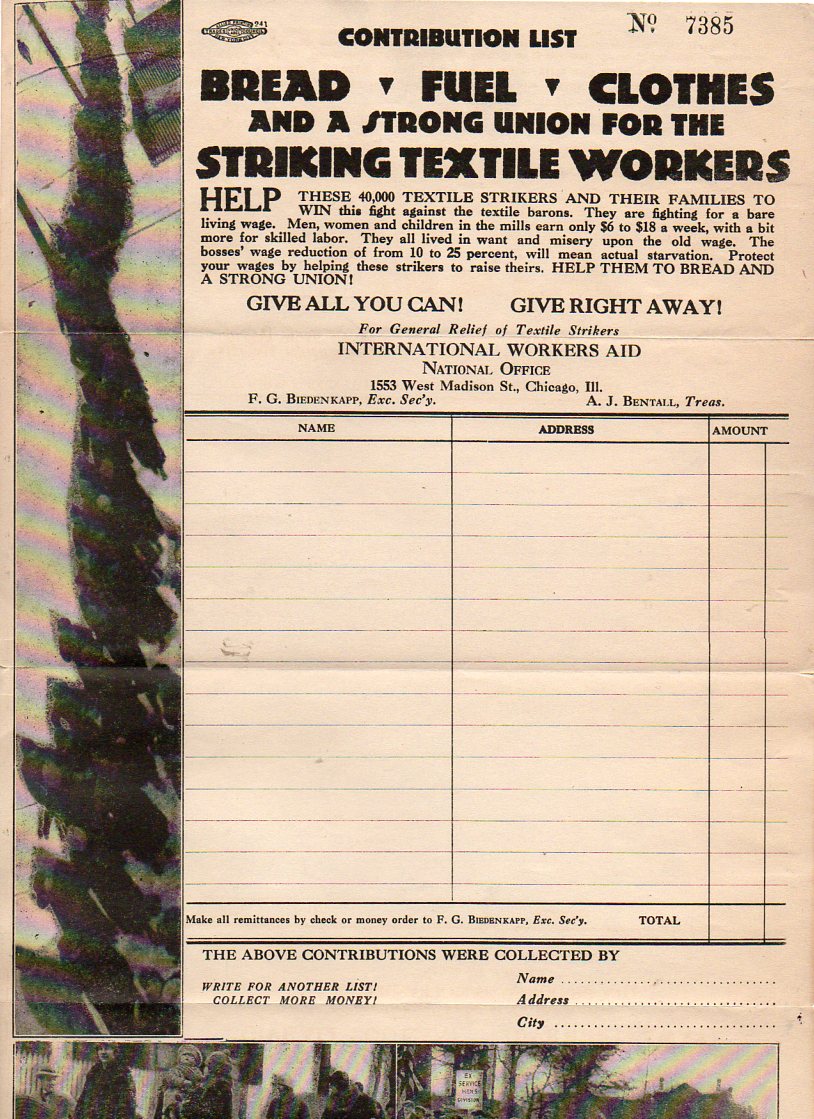
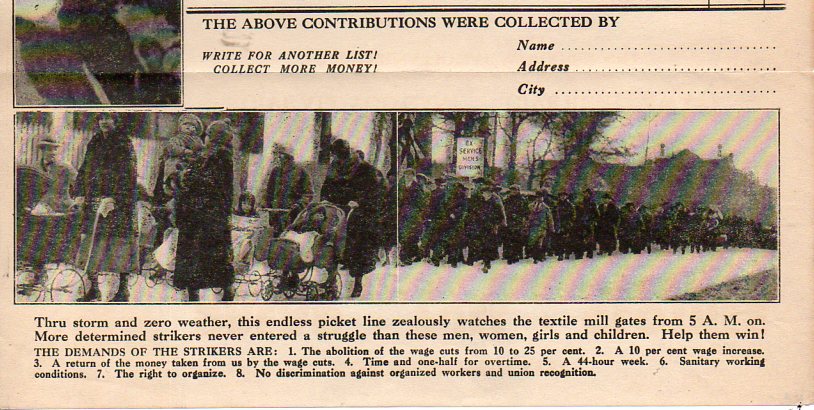
    This broadside was an appeal to like-minded people to contribute to a fund to help relieve thew dire conditions of textile worker strikers in Passaic, New Jersey, in 1926.  There were more than 16,000 people involved in this sometimes-brutal strike, people who were trying to stay even in their lives, looking for a little more money and a little better working conditions than what they had.  The Passiac (a working city just south of Patterson in an industrial triangle section of the state) strikers were moving against a number of textile (wool and silk) mills there, trying to force management to pay them something closer to the $1400 annual income for a family of four to survive. 

    Passaic strike277

    [This great piece of American ephemera is available for purchase from our blog bookstore, here.]

    Most workers there were making $1,000-$1,200 a year ($800-$1,000 if the worker was a woman, and about half of them were) for 50+ hours of labor per week.  The result was that the workers could not afford good housing and food, and those disadvantages paid off in high rates of tuberculosis, very high incidence of child mortality, and a low average life expectancy.  The strike began slowly in January 1926, with the mills responding with vicious attacks by paid thugs and by police.  IT was a long and involved process for the strikers, with the strike lasting its way for another 14 months, finally getting choked out in March 1927.  It looks like there were some victories, but those seem mainly pyrrhic to me–at the end of the process many of the strikers were hired back but soon terminated, replaced by other workers who agreed to work for less.

    Passaic strike278
    There’s quite  a bit written on this strike, and most seem to say that it was an important event in the history of “labor relations”, and that it was the first time that a Communist-led strike succeeded in the United States, (There is a complex legacy as to who the leadership was for this strike, but the end result is that, at the end, the Communists were in charge.)

    But what I wanted to say here about this broadside was the communal effort involved with keeping the strikers (and the strike) going.  The strikers needed money to live, as there was certainly no money coming in, and since there was obviously no union, there was no general fund from which any of these families could draw food money from). they needed money just to buy food and pay for housing.  SO the call for “Give all you can!” and “Give right away!” were as desperate as they sounded.  My guess is that there would be a representative of the International Workers Aid society national office going from factory to factory, or door-to-door, soliciting for money for the Passaic workers’ relief.  The strike was no doubt a very nasty business, with a victory only a victory once there was more food on the table, less illness, and far fewer babies dying from preventable causes. Probably this looked like a victory to others so far as the future of fair labor/pay was concerned, but not so much for the strikers who brought this about. 

    It is also interesting to note that this copy was given at some point to H.L. Mencken, who gave it right away to the Library of Congress, where it wound up in a forgotten “Pamphlet Collection”, and then sold to me (years afterwards).

    Passaic strike279


    ·Posted by :

    ·in:

  • On the Center of Everything (continued)

    JF Science Book

    Continuation of  Visual Chronology of Cosmology Part 1 and Visual Chronology of Cosmology Part II,.

    I started out in this post to write about the scholar pictured in Andrew Borde’s book, The Breuiary of Healthe, for all maner of syckenesses and diseaes, Expressynge the obscure terms of Greke, Araby, Latyn, and Barbary, in Engluish concernying Phisicke and Chierurgerie…., which was printed in London in 1556.  Underneath this rather long title is perhaps the earliest “modern” work on hygiene–or at least (in a real test of qualifications) it was the first book written by a medical man on hygiene that was originally written and published in English.  In its way it is a wonderful book, being a compendium, really, of 384 short chapters on the this-and-that of medicine, all alphabetically arranged, which made it a simpler book to compose than a full treatise on the subject arranged in a medically-logical way.  But what I liked in it was the contrasting image of the scholar, which to me is the very picture of ennui, laid side-by-side with the chief element by which this book is probably best remembered, which is “Myrth is one of the chiefest thygnes in physicke” (or “humor is the best medicine”).  Borde’s scholar may not be taking his own medicine, here.   

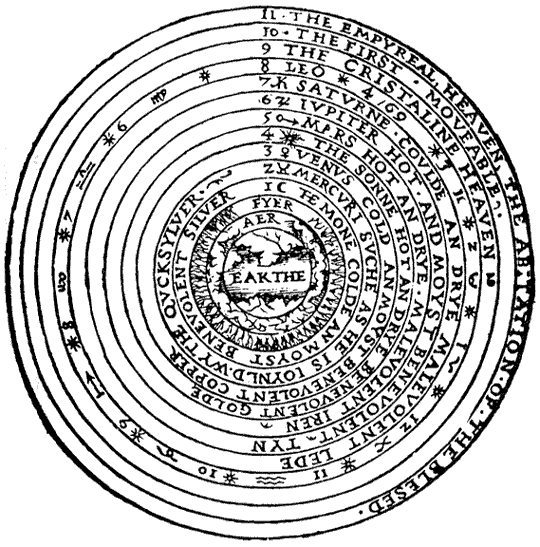
    In looking for the text for this fine book I came across something else, Borde’s Aristotelian celestial spheres in his  The First Book of the Introduction of Knowledge, printed in 1542, the year before the publication of Copernicus‘ De Revolutionibus. It is a magnificent woodcut, and tells the story of a vision of mankind that would soon come to vast change. 

    Ptolemaic Universe
    Source:  the Luminarium, here.

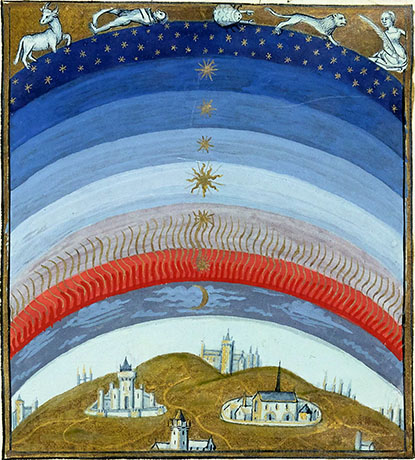
    The image shows us the geocentric universe, the creation, and eleven-sphere unit that follows the Earth at center and the four subluminaries (earth wind air fire), followed by the orbit of the Moon and Mercury and Venus, after which comes the Sun, followed by the rest of the planets.  These spheres are followed by the fixed stars/the starry firmament), and ultimately by the Primum Mobile, divided into the crystalline heaven, the first mover, and the Empyrean.  Its a beautiful image. 

    The following is in a sense a cross-section of the Borde image, which shows pretty much the same information (with the Sun being in the fourth sphere).  This is manuscript is more than a hundred years earlier than the Borde, and accurately represents the elements of cosmology of the time.

    Image source:  Luminarium, here; From Les Echecs amoureux (“Amorous Chess”) Manuscript made for Louise of Savoy, 15th c.  Bibliothèque nationale de France, département des Manuscrits; Mss.fr.143, fo 20.

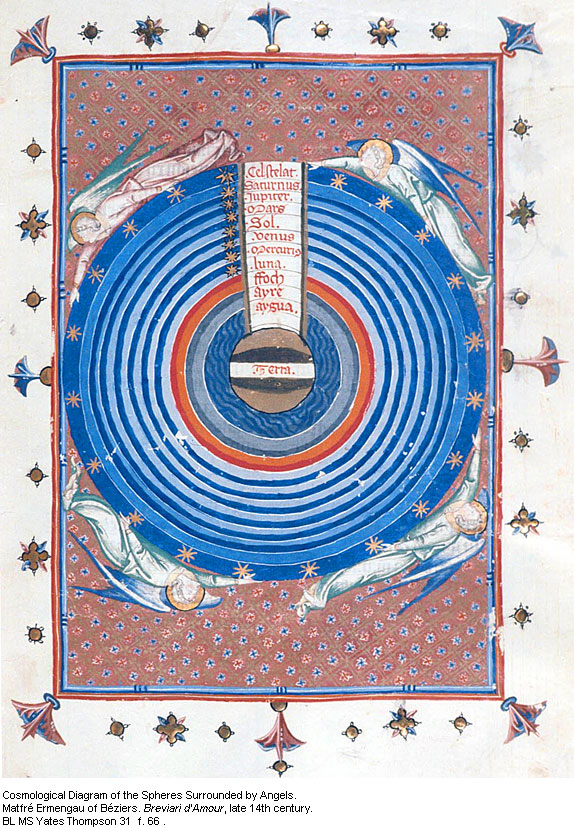
    An even earlier version of this more-or-less static image, the perfect image of the perfect creation in which all of the stars in the visible sky were always there, in some perfect number, in the configurations for all time. (This idea of course would be one of the greatest disfigurers of ancient thought that the telescope of Galileo  would provide.)

    Spheres of angels
    Source:  Spheres Surrounded by Angels, Brevari d’amour, late 14th c

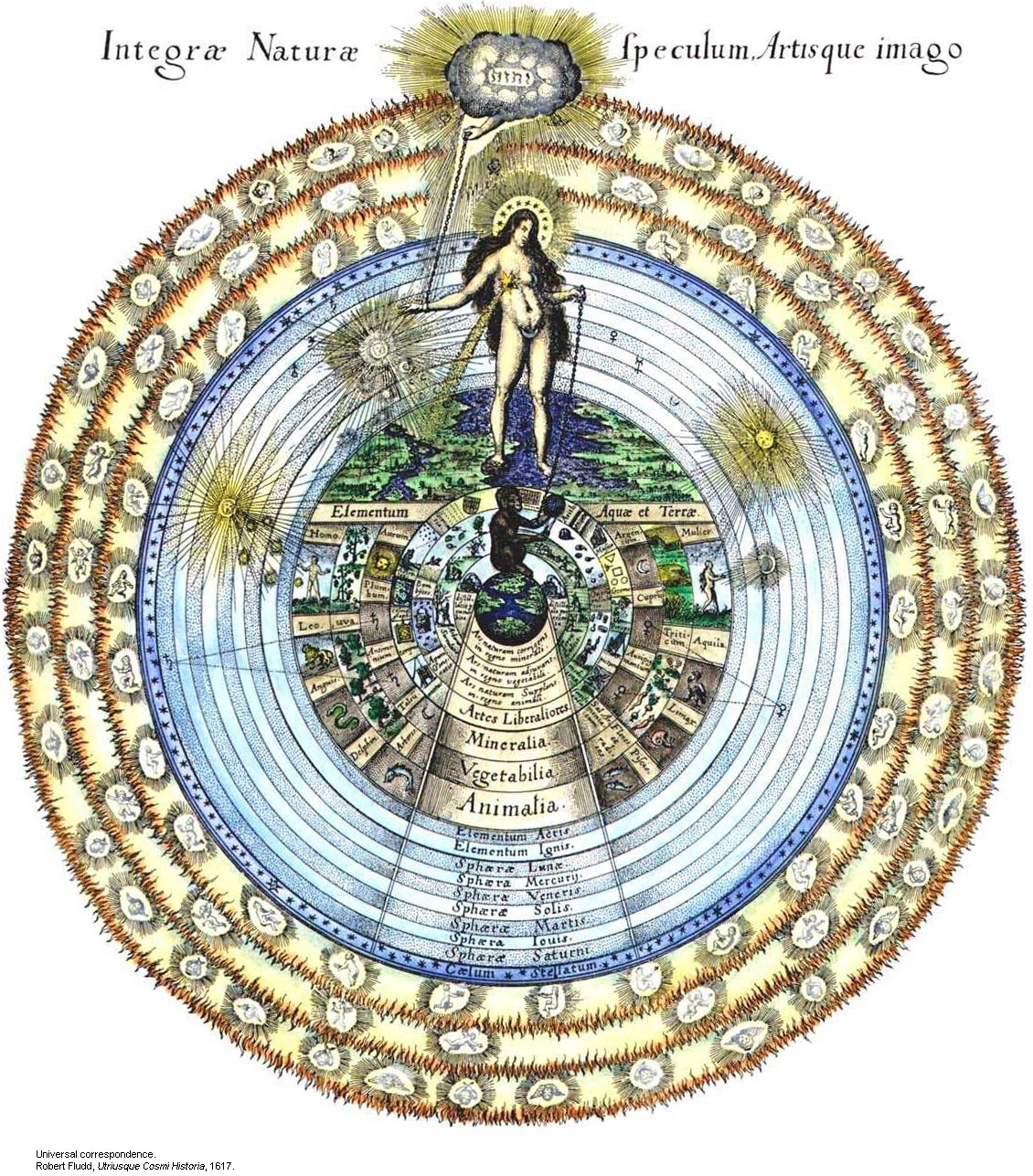
    Robert  Fludd, a visionary of a different sort, as his celestial sphere will show:

    Spheres--robert fludd
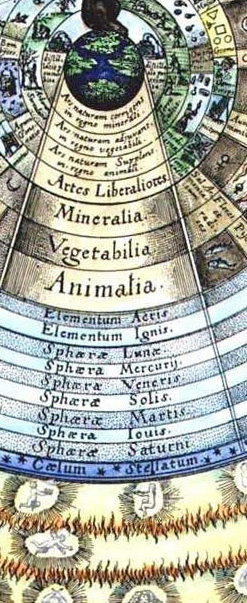
    And here in detail:

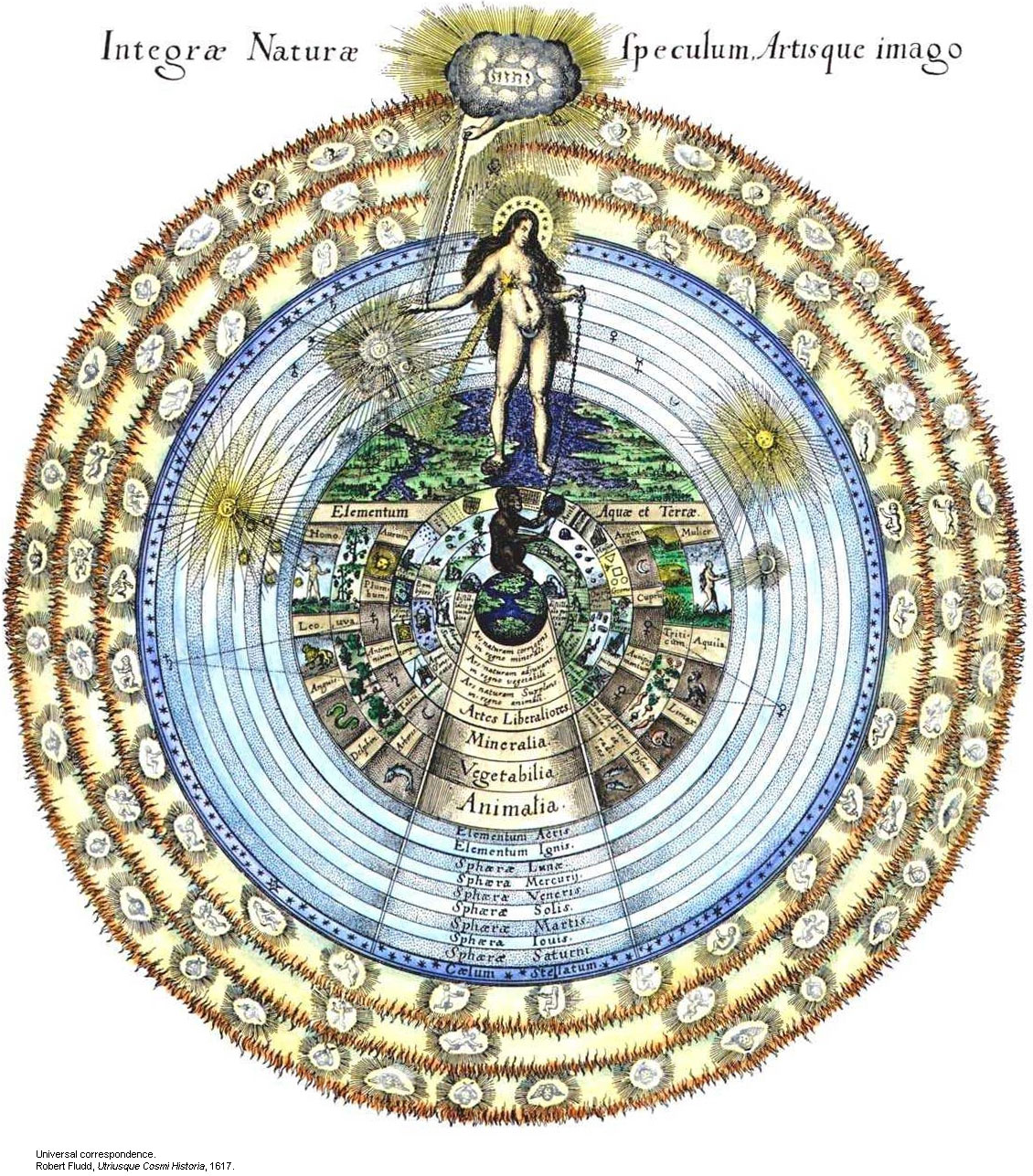
    Universal Correspondence from Fludd’s Utriusque Cosmi Historia, 1617.Rob

    Spheres--robert fludd det

    Fludd’s (1574-1637)  features a complicated astrological existence well beyond the point of Copernicus.  In addition to everything else, real and imagined, Rosicrucianism and astrology and puffy-birds, Fludd, who was  an English physician, delved deeply into the real stuff of the world in this book in addition to all of the other make-believe–optics, the musical intervals, perspective drawing, hydraulic engineering, construction of lifting machines, military engineering and many other interesting, physical science topics.  But this drawing, right there on the title page, reveals Fludd’s real interests and shows what governs what he does.  Everything else, the math and and the physics, services this need.  Of course the image is beautiful, which is why it is here, but it is also a deeply personal, exploitative, cover-all for the things that Fludd *wanted* to find.

  • Lunar “Firsts”–the First Image of the Moon using the Telephone?

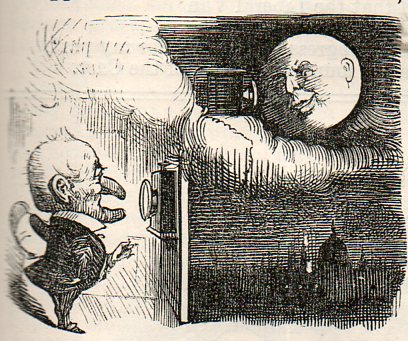
    Perhaps, or perhaps not, but what this image does seem to show is a conversation between the Moon and Mr. Punch.  It appears as a small text woodcut in a long series of short stories in Punch, or the London Charivari, called “What Mr. Punch’s Moon Saw”, 14 September 1889.

    Moon281
    Mr. Bell just barely beat a host of competitor’s for his telephone patent 13 years earlier, and the telephone didn’t really get semi-“widespread” use in London until at least the mid-1880’s, so it is really quite possible that this is the first time that the Moon is shown engaged on the ‘phone. 

  • Sawing Through the Catalonian Mountains, 1499

    JF Ptak Science Books  Quick Post

    Mountains282
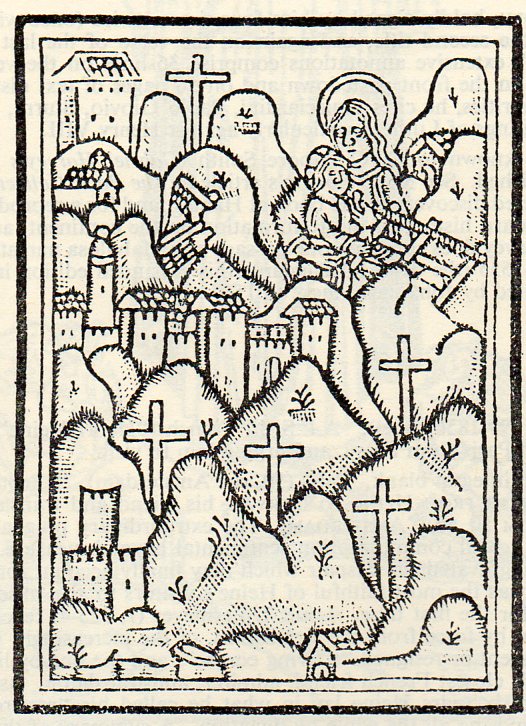
    The beautifully-named Gerardus de Zutphanis wrote de spiritualibus ascensionbus, a lovely gothic-lettered work of 84 leaves, in 1499, in the fifth decade passed the Gutenberg invention.  It was published in Montserrat–in Catalonian Spain, some 4,000′ or so about the valley floor– by Joseph Luschner, in the mountain keep of the Benedictine abbey there. 

    The woodcut image reproduced here was used as a printer’s device, and in it, remarkably, are shown not only the abbey, as well as some others as indicated by the series of crucifixes, but the improbable figure of the Virgin Mary holding the Christ child with both seemingly sawing their way through a mountain.  Its a magnificent thing–I particularly enjoy the use of dots in shading the mountainsides. 

    The press–or the business, the publisher that is–that produced this work is still in business today.

    ·Posted by :

    ·in:

    —
  • A Note on the Vast Wealth Possibilities of the Refill Business: Ink and Paper

    JF Ptak Science Books   Post 1735

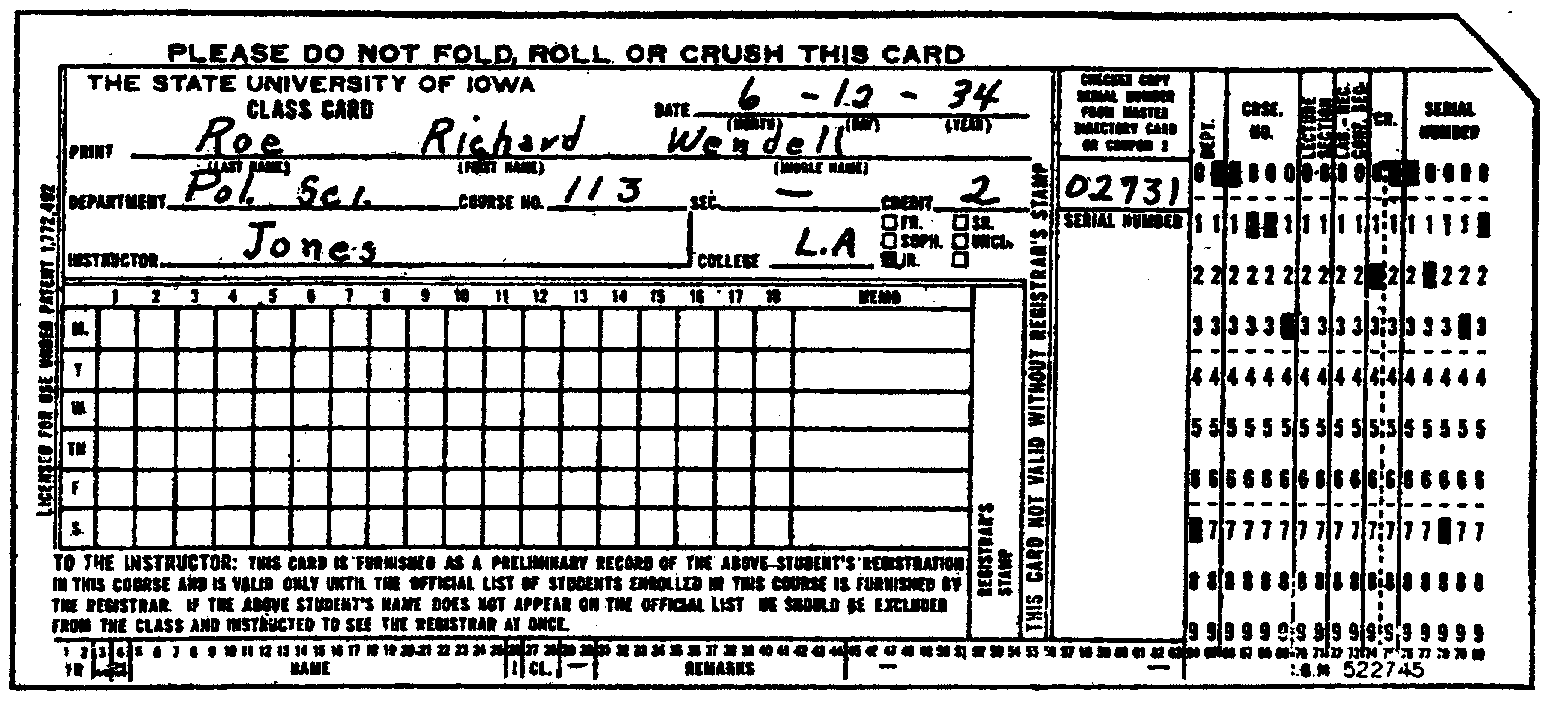
    http://www.columbia.edu/cu/computinghistory/reg-card-80.gif

    [Source: Columbia University computing history site, here.]

    I guess that the only reason why HP charges for their printers is that they can.  When you buy one of these products you’re basically purchasing the need to keep the things fed with semi-proprietary HP ink–and as everyone knows, printers are notoriously thirsty creatures, and one can easily spend multiples of the cost of the printer on ink in the first year alone. 

    This is a great idea so far as the manufacturer goes, but it is hardly a new one–International Business Machines counted on this sort of income for several decades, partially getting the company through the Great Depression. 

    And what was the IBM necessary-suppliable that their customers had to keep buying over and over?  It was the business machines themselves, because it was IBM practice to rent their machines out (which would pay for the initial investment and production in the machine in about two years, and most customers seemed to keep their rented mater1al for 5 or 7 or 10 years.  What IBM kept supplying their customers with was the stuff that they sent through the machines–the IBM cards.  The customer needed the cards from IBM itself, mainly because it was part of the contractual agreement for the lease of the machine, and also because the IBM product was superior to other mass-produced cards.  In the 1930’s the card business for IBM accounted to something like a few billion cards per year, which evidently would account for 30-40% of IBM’s yearly profit.  And that’s quite something. 

    The idea of the necessary refill is not IBM’s to claim for themselves–years earlier, Eastman Kodak accomplished the same deal with film for their cameras; and razor blades were supplied by Gillette to users of their razors.  And although you don’t need Ford gasoline to run a Ford automobile, in the 1930’s you did need a General-Motors spark plug to run a G-M vehicle.  Radio Corporation of America sold radios and also the necessary tubes to replace the ones in the stock radio; Thomas Edison too had a vastly controlling interest on how his light bulbs would be installed and replaced. 

    So as annoying as it might be to have to pay a fair amount of money for a small amount of ink to make your printer function, the printer-producing companies are just following an old (and highly profitable) business practice. 

  • Singular Placards and Perhaps a Singular Christianity?

    JF Ptak Science Books   Quick Post

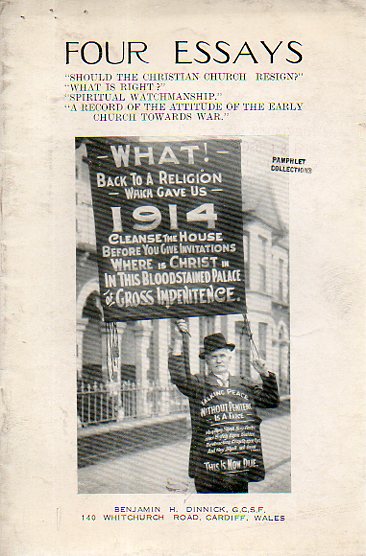
    I found this rather, um, provocative pamphlet that asks, right up front on the cover of the thing, “Should the Christian Church Resign?”  The author, who I think is the man holding the placard on the cover, is Benjamin H. Dinnick (Cardiff, Wales) who published the work in the 1930’s. 

    Dinnick286
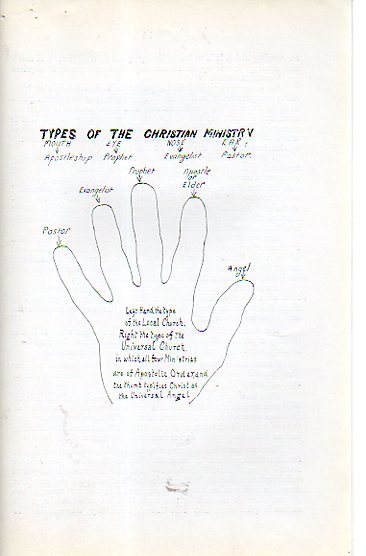
    I’m reproducing the cover and one of Mr. Dinnick’s impenetrable diagrams–I can’t really say what he was after or what he was for, but I find the images interesting. 

    Dinnick287

Recent Posts

Archives

Categories