A Daily History of Holes, Dots, Lines, Science, History, Math, Physics, Art, the Unintentional Absurd, Architecture, Maps, Data Visualization, Blank and Missing Things, and so on. |1.6 million words, 7500 images, 4.9 million hits| Press & appearances in The Times, Le Figaro, Mensa, The Economist, The Guardian, Discovery News, Slate, Le Monde, Sci American Blogs, Le Pont, and many other places… 5000+ total posts since 2008.

  • An Early English-Language Image Diplay from a Computer, 1957

    JF Ptak Science Books   Quick Post

    Computer display225
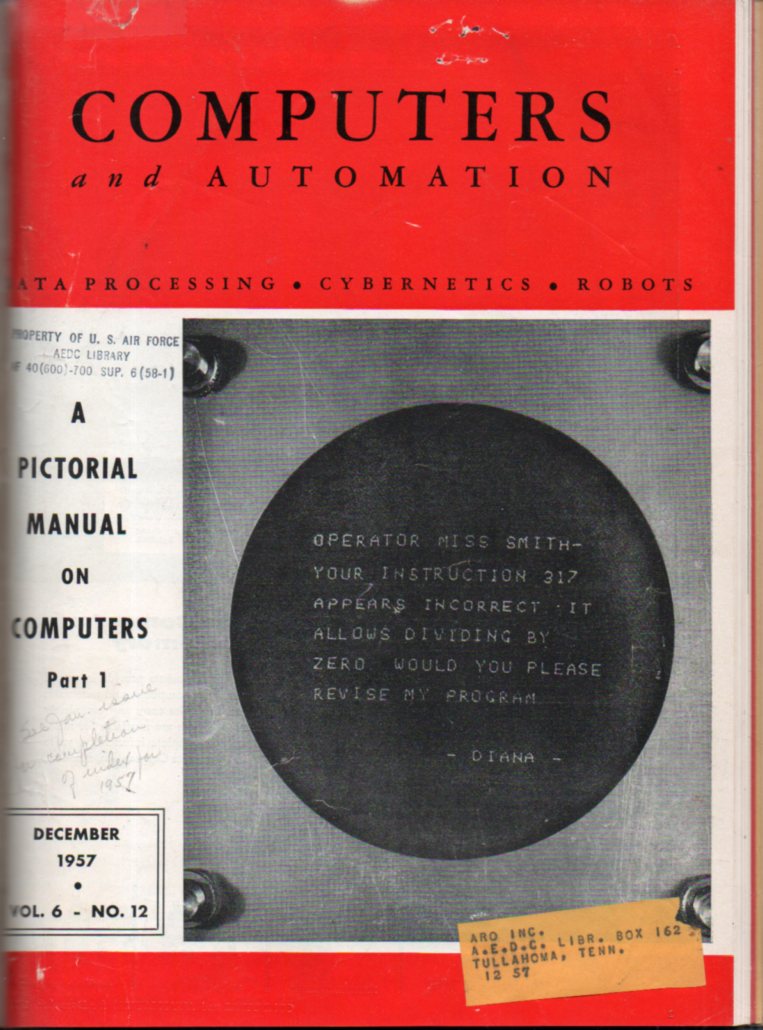
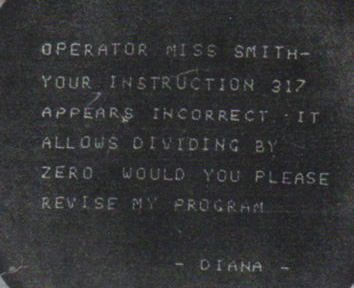
    The cover of this magazine–Computers and Automation, one of the earliest popularly-based journals dealing with electronic computation–features a rather remarkable image, an English message, a response to a problem, from a computer.  The editor, Edmund C. Berkeley, wrote a short appreciation of this “output device for an automatic computer”, a “symbol generator and viewer”. 

    “The screen of the picture tube shown will present as many as 10,000 characters per second. Each character is formed by an array of bright spots, a selection from a rectangular array of a total of 35 spots, five wide and seven deep.  For a capital letter T, for example, the selection is five spots across the top and six more spots down through the middle…

    For 1957, it would have been a remarkable thing to see messages displayed in such a fashion, in a revolutionary new way.

    Computer display225

  • A Note on the Future of Computer Demand, 1957

    Computer survey227JF Ptak Science Books  Post 1723

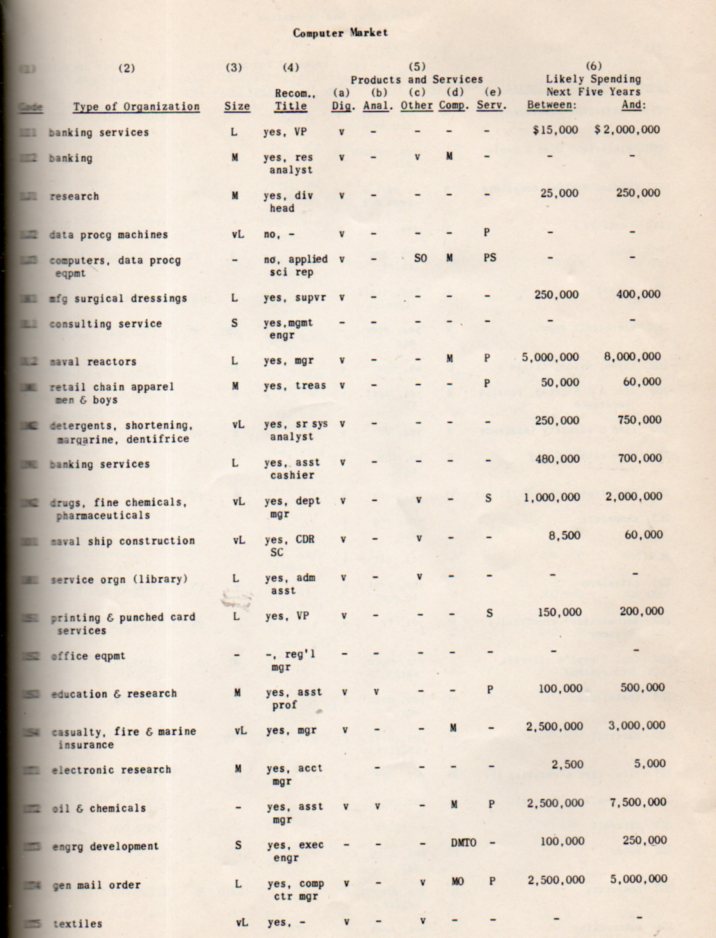
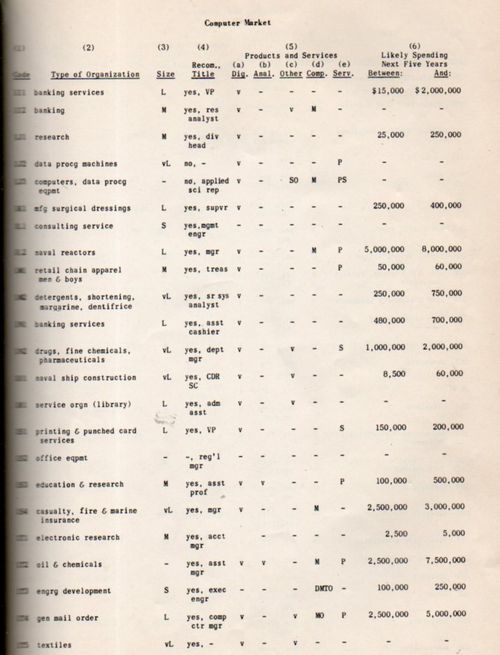
     This computer market survey (“Computer Market Survey—Report No. 1”), authored by the editor of the journal in which it appears—Computers and Automation, May 1957—is one of the earliest of its type. It takes a peek into the future demands on the computer industry, looking at different industries, their growth potential their products and support, and the amount of money that they might be spending (“on products and services in the computer field in the next five years”).  And what Edmund Berkeley saw in the next five years or so was–according to his survey–about $400,000,000 to $750,000,000 worth of computer sales. 

    The numbers come from a survey mailed to the subscribers of Computers and Automation: about 2200 were mailed out, and about 200 forms, or 9%, were returned. “The replies contain interesting, important and extraordinary information, showing the nature and size of the current market for computing and data processing machinery”, and it is upon these replies that the iterations of the report were established.

    The categories that I’m interested in here are the types of organization, its size, and the possibility and computer/data processing purchases.

    Some of the largest customers  in the future for computers and data processing were reckoned to be:

    Air transportation, ($2-4 million); electrical machinery ($1-6 million); “chemicals” ($10-15 million), “electrical apparatus and equipment” ($25-35 million); “gen(eral) mail order”, $2.5-5 million); “naval reactors”, ($5-8 million); “oil and chemicals”, ($2.5-7 million); “maps”, ($3-10 million); “petroleum, ($2-4 million); “research and atomic energy”, ($5-7 million); “airplanes, missiles, reactors”, ($35-50 million); logistics, ($4-6 million); “airplanes”, ($7-10 million); “core memories, matrices, buffers, data processing”, ($10-25 million); “airplanes, ($5-10 million); “computers”, ($15-30 million)

    The elephant in the small pink room stood to be “business machines”, which came in at a whopping $100-200 million), which was about a quarter of the entire plausible expenses in the coming five years. 

    And some of the smallest:

    “Naval ship construction”, ($8,500-60,000); “rubber, plastics, etc.”, ($100-200,000); “energy consulting services”, ($80,000-120,000); “retail chain apparel, mens & boys”, ($50-60,000); “basic agricultural) and industrial chemicals”, ($180,000-200,000); “research & development”, ($25-50,000); “data processing”, ($100-300,000); “research & development” ($25-50,000); “aircraft components”, ($10-40,000)

    And “electronic research”, ($2,500-$5,000)

    Somewhere in the middle, but not yet discernible needs fell to: 

    “banking services”, ($15,000-$2 million); “research”, $25,000-$250,000); “custom design processes and systems”, $1,000-500,000; life insurance, ($600-700,000); “department store”, ($17,500-225,000)

    And of course, “banking”, ($15,000-$2 million).

    This was all in 1957, fifty-five years ago.  Perhaps a “computer year” is equal to something along the lines of a “dog year”, like a 7:1 ratio, so perhaps when folks were trying to see ahead in 1957 in reference to the computer and computing needs it was sort of like trying to make a political prognostications for 2012 in the year 1662.  It was just too much. 

    And that $450,000,000-$750,000,000 figure would be worth about seven times that, around $3-5 billion.  Still a small figure, especially when you compare it to the defense budget for 1957, which was about $45 billion, which would make that figure just a few percent of the money spent on defense, and nowhere near what the amount would become.  Still of course Berkeley was on the right path, its just that the potential for the use of the computer hadn’t yet come to be realized. 
  • The Circleville Squaring Company–Squaring the Circle, 1837

    JF Ptak Science Books   Post 1725

    In the very full and ancient (Babylonian at least)  history of attempts at squaring the circle it is interesting to find that victory in its pursuit came on the fields of south-central Ohio in the mid-19th century. Who would have thought that this insoluable problem of ancient geometry (and which found a voice in popular culture going back to Aristophanes The Birds)  would find itself smoothed out in mid-western dirt?   And it all came at  the hands of a magnificently-titled state-authorized endeavor called the Circleville Squaring Company.  (Honestly, isn’t that a fantastic name? I’m reminded instantly of Flatland.) 

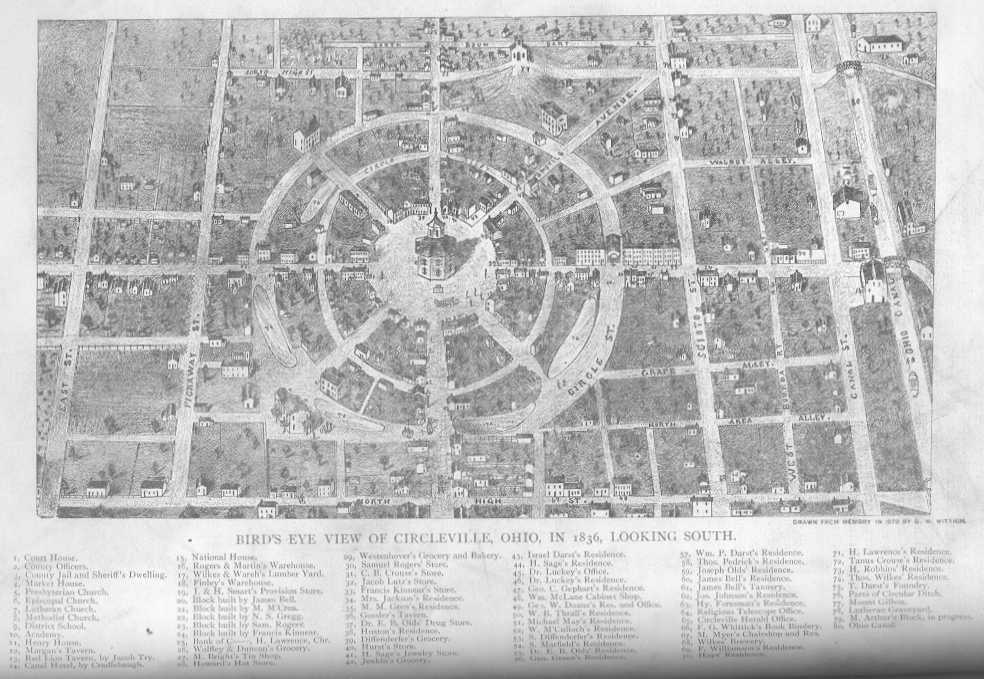
    It turns out that the American West pressed on through these lands in the Ohio Valley in the mid-ish 18th century, with white people coming in to colonize the place by the 1770’s.  What existed here, in a village/town to be called “Centerville”, was an ancient Hopewell culture circular earthwork, an enclosure of some sort, a fortification, with a large mound in the center.

    The settlers thought that the best thing to do was to plan their town around this design, eventually placing an octogonally-shaped structure at the center of it all, on the top of the mound. 

    Circleville, pre-squaring (1836):

    http://www.genealogybug.net/FrankPic/illus/circleville.jpg[Source, here.]

    The source noted above (and here as well) tells the whole and complete story of what would happen next, but suffice to say that after some decades the people of Circleville decided that they did not like the circular plan of their town, and in 1837 occurred some legislation to do something about it.  The circles had to go, to be replaced by 90-degree angles for streets.

    And thus to this end the Circleville Squaring Company was born in 1837, and over the next few decades quarters of the center city of Circleville were bought up, torn down, and replaced by a more desirable geometry.  The process seems to have been completed around the time of the Civil War.  Nothing remained of the original circular town plan.

    Circleville, post-squaring:

    Circleville 1876

    In spite of the circumstances, the town remained “Circleville”.


  • On the Sublime Mundane–Great Classics in the History of Flagpoles, Pole Painting, and Zippers

    JF Ptak Science Books   Post 1724

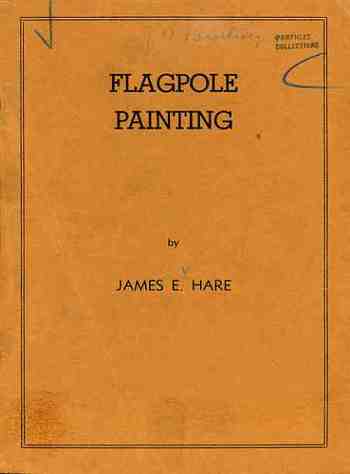
    Blogaugust_18flagpole408It is difficult not to stand in complete respect of something being Very Well Done–especially if that “something” is something very simple, a “something” that is generally  invisible because it is so much part of the visual or social or mental environment.  I’ve touched on this topic earlier in this blog, particularly here on a post on a beautiful and quick pamphlet written on the care and painting of flag poles.  It is a monumental work in its subject area of the Very Small–a very well written, concise and what seems to be complete treatment and mastery of its subject.  The subject just happens to be flagpoles–but if you ever needed something to describe what to do if faced with the task addressed by this pamphlet, then you have certainly found the Ulysses of the subject. 

    Blogaugust_28zipper469_2

    This tall (11×8 inch) 35-page 1945 work with an impossible title has everything that you would need to know–as its title promises and delivers–to repair a zipper.  Not replace a zipper–repair it. 

    It is so beautiful as to want to make every engineer residing in the deepness of everyones’ soul just simply weep in the glory of this pamphlet.  The work  is simply but well illustrated and addresses 50-odd contingencies for zipper malfunction and failure, and speaks to a particular WWII mindset that that addresses problems in this very fashion. Repair rather than replace.  The bottom line here is that this is as good as any book of the history of fluxions or the making of the atomic bomb or cooking up a virus, given the parameters and limitations of its subject.

    These memories were brought to the surface tonight because of a pamphlet that I found that had burrowed itself deep inside a box of science pamphlets written by folks in the D-H part of the alphabet on particle physics in the 1940’s and 1950’s.  It just popped out:   Decay of Poles.

    Decay of poles230
    I really wasn’t sure what the book could be about.  Having just finished a short post on the work of Jules Verne’s Moon Gun being used to alter the axis of the Earth to make Polar exploration easier, I thought that, well, perhaps someone put something “special” together on how the Earth’s poles were decaying. Or “decayable”. 

    The title page of this sweet, small pamphlet says otherwise:  it is written by Howard Jones (“A.B., A.M., M.D.”) of the “Universal Pole and Post Preservation Company” of Circleville, Ohio. (The story of Circleville is extraordinary–we’ll deal with that tomorrow.)  Dr. Jones addresses the issue of decay and wood, particularly and of the utmost importance was the decay of the wood in poles and posts.  When you think of it just a bit, you’ll see that Decay of Poles was an essential work, as there must have been tens of millions of poles and posts slowly (or not) rotting themselves away into splinters in holes in the ground all over the United States.  As a matter of fact that are still tens or hundred of millions–billions–of wooden poles still in this country:  its how we support the very backbone of the digital infrastructure of the world economy, strung on wires in between poles made of dead trees, and stuck in holes in the ground. 

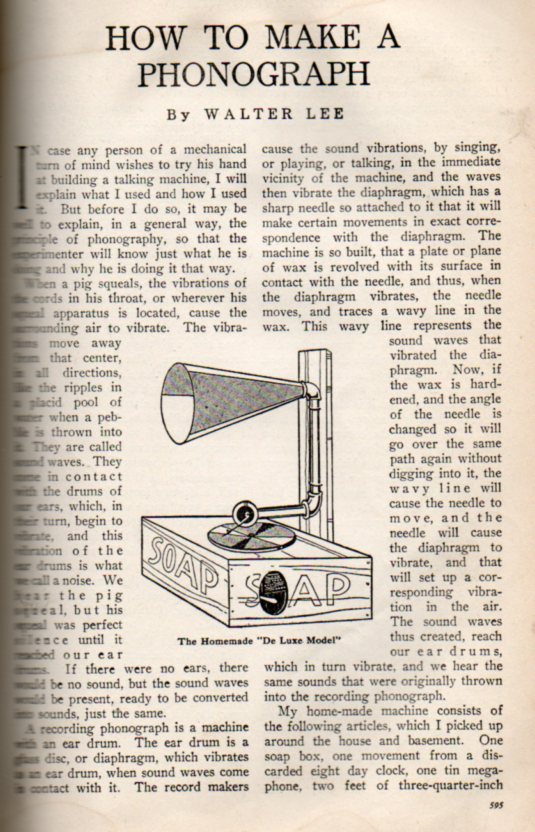
    And lastly for tonight, I’d like to address one more thing, something that took my breath away when I saw it for the first time.  It was the following article in the relatively obscure magazine, Illustrated World–a sort of more-popular Popular Mechanix–for June, 1917.  I saw the title which suggested doing something that I had never considered doing before, or thought about anyone else doing–building your own phonograph at home. 

    How to phonograph228
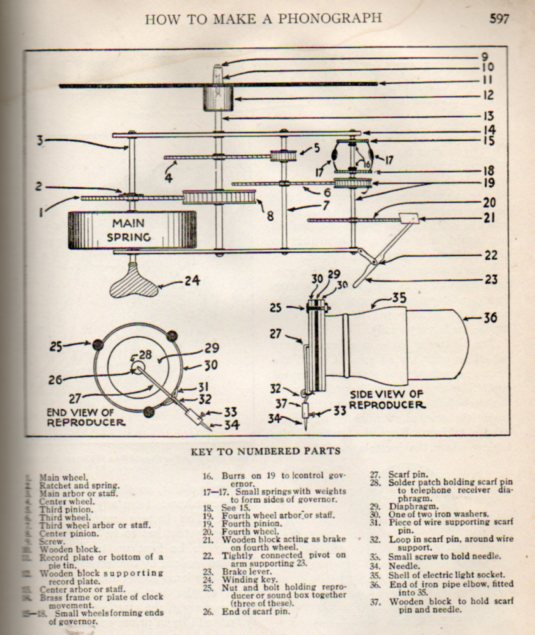
    And of course the lovely schematic, which suggests that you could pull this thing together with bits of stuff from the kitchen junk drawer and fluff from the basement; then, Things Happen, and you have a phonograph.

    How to phonograph229
    This just seems to me to be so perfectly right, correct.  Why not make your own phonograph?  IF you remind has heard the music before it will fill in the pops and hisses and misses that your homemade will invariably produce, so why not make something that will play your vinyl without necessarily killing it? 

    All of these items speak to an appreciation for the recognition of The Small Job Well Done.  This may be a key ingredient to what we may not be doing for ourselves, collectively, today.  This is lovely work brightly done with basically unseeable results–unless you look for them.  And then you can find the beauty. 


  • A Note on the Rarity of Published Artwork of Children pre-1900

    JF Ptak Science Books  Quick Post

    I’ve written a number of posts in this blog about the great scarcity of the antiquarian published art of children (here) and couldn’t help but make a quick post of this very recent find.  It occurs in the page of the August issue of the London Punch, and even though graffiti, this is definitely the artwork of a child, crept into the page of a popular journal.  And as I say in a number of early posts, this work is really quite rare. 

    Children art232

    ·Posted by :

    ·in:

  • A Peek into the Future of Modernist Painting–1863

    JF Ptak Science Books   Quick Post   [Part of the History of the Future series.]

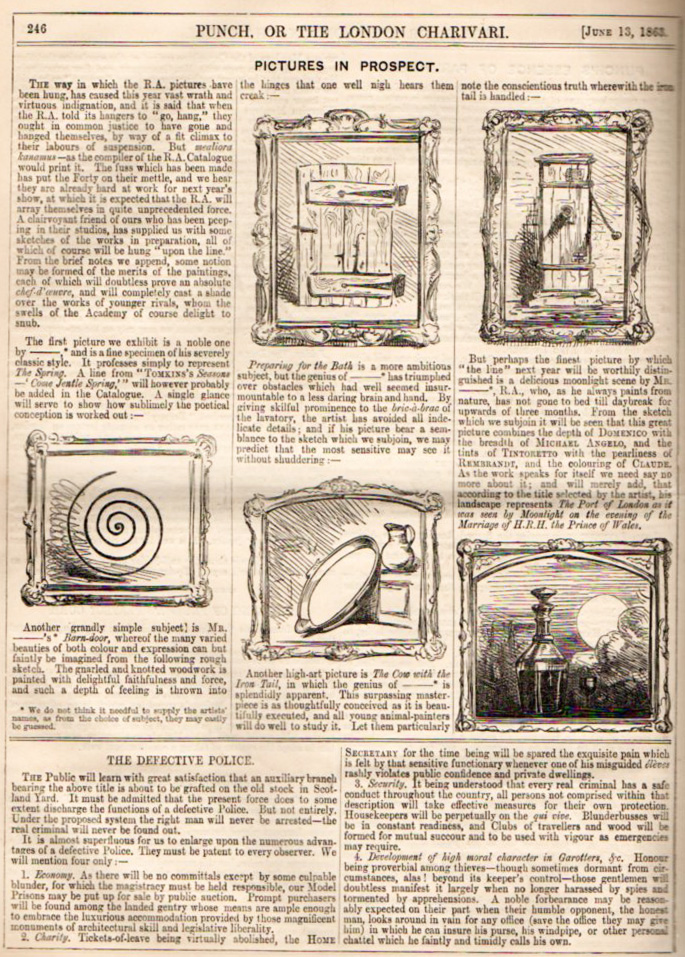
    I’ve written on this blog on a number of occasions about the coming of The Modern, about the coming of many modernisms that came to life in the extraordinary period of 1885-1925 (which could even be shaved perhaps to  1895-1920), when nearly all things “modern” in nearly all fields came to be.  Sometimes though one can see a hint of the future, even though it might not necessarily be recognized at the time.

    Punch modern231_edited-1
    Such is the whisper of the future in this humorous, somewhat mocking piece on art in the 13 June 1863 issue of Punch, or the London Charivari.  Overall its pretty funny in a 19th century fashion, but what I am taken with most of course is the first piece, the framed non-representational artwork, a taste of the future that wouldn’t arrive for another 50 years with Wassily Kandinsky.  But here it is, or here is something, presented as art, in 1863, and with no discernible, naturalistic subject matter. 

    Punch modern231
    Even in satire, seeing such a picture give sone pause–if for no other reason, that even here in the early stretch of Impressionism, that such an image would appear in a very popular journal and have (a) no impact  and (b) not an ounce of staying power. 

  • British Science (And a Screaming Zero) in Cartoon, 1865

    JF Ptak Science Books   Post 1728

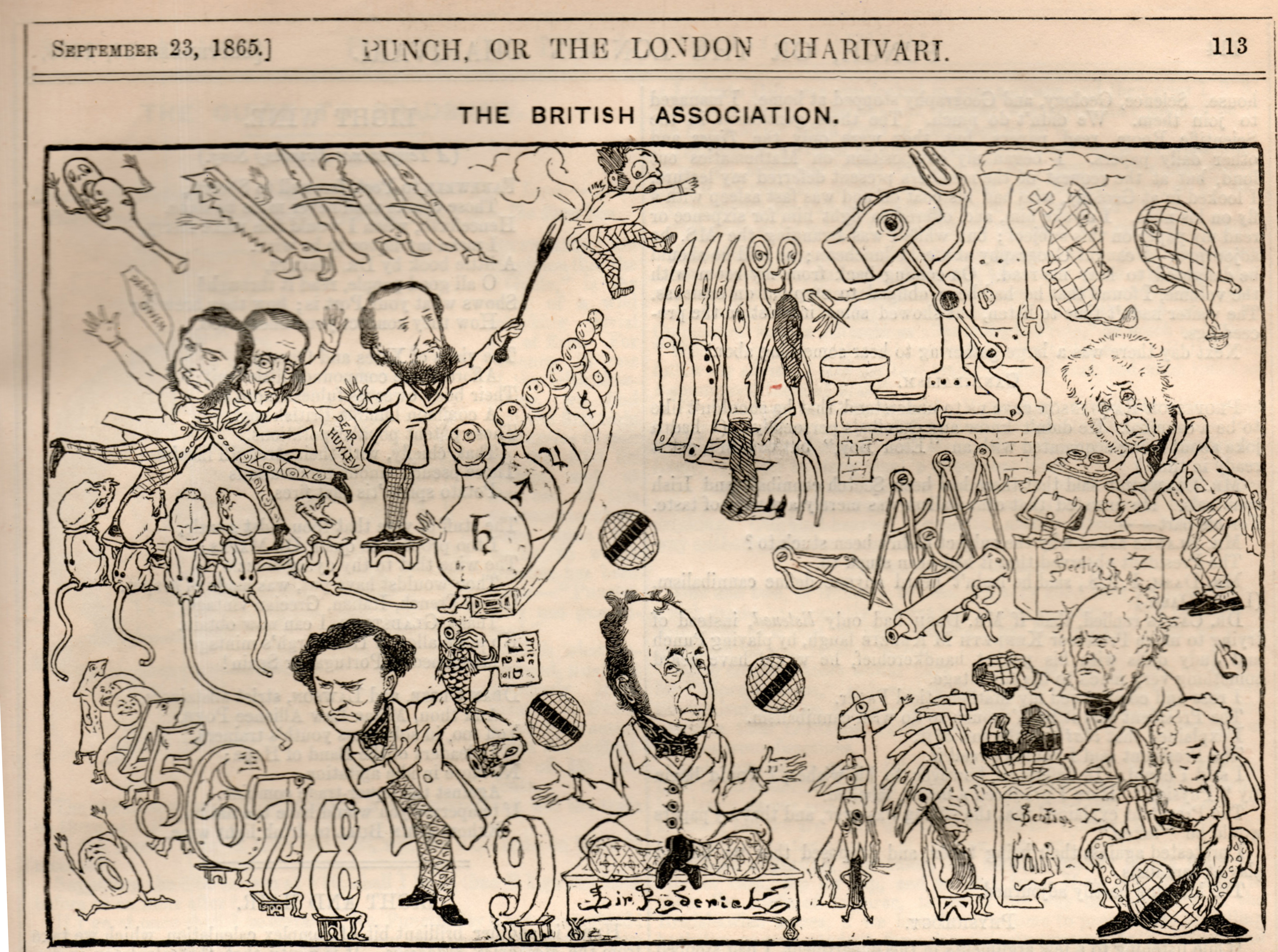
    This fine cartoon appeared in the 23 September 1865 issue (page 114) of the London Punch magazine, poking a little fun at the recent meeting of the British Association for the Advancement of Science, which had just finished its 35th meeting in Birmingham.  Its attendees and contributors read like a “who’s who” of the heights of mid-19th century British sciences (across fields of geology, physics, physiology, chemistry, mathematics, statistics (and economics)):  attending and contributing were JC Adams, Airy, Hooker, Thomas Graham, Wheatstone, Nasmyth, Fairbairn, Murchison, Lyell, Huxley, Thomson, Maxwell, Tyndall and of course numerous others (also including foreign members). 

    Baas 235
    Of the figures I can identify in this image are Thomas Huxley and the not-beautiful Richard Owen at top left, discussing the principles of evolution in front of a small audience of skeletal/fossilized monkeys, and standing to their immediate right waving an instrument over chemical elements may be JAR Newlands. I am not sure who is presiding over the numerals at bottom left, but what attracts me the most is the zero is running away, screaming, from the other numbers seated calmly on tiny stools.  Seated serenely at center juggling earth/spheres in the geologist Roderick Murchison, who appears prominently in the Punch report–I’m less sure about the two other geologists (one placing the Earth-chunk back into the globe, and the other placing a short-handled shovel into another globe, both in front of an audience of geologist’s hammers…are they Charles Lyell and John Phillips?)  Above them may be John Tyndall, working with an optical viewer in front of an audience of dividers and a telescope.  And above the maybe-Tyndall is a steam hammer demonstrating itself to a set of jackknives and cutlery. 

    Punch baas233_edited-1
    The text is pretty interesting in itself, not the least of which is another visit to the squaring of the circle (having just written about this two days ago), which goes like this:

    “A few words on Squaring a Beadle who was arguing in a vicious circle.  Illustrated pugilistically. (A portmanteau to itself, including gloves and change of linen.”

    I should be able to idenbtify these men though I’m afraid I can’t; perhaps I’ll have a little help with them. 

    Notes (including the contents of the volume published in 1866 of this Birmingham 1865 meeting):

    ·Posted by :

    ·in:

  • The Female Doctor Gets a Vote of Confidence, 1865

    JF Ptak Science Books   Post 1727

    “Life for both sexes—and I look at them, shouldering their way along the pavement—is arduous, difficult, a perpetual struggle. It calls for gigantic courage and strength. More than anything, perhaps, creatures of illusion that we are, it calls for confidence in oneself.”–Virginia Woolf, A Room of One’s Own

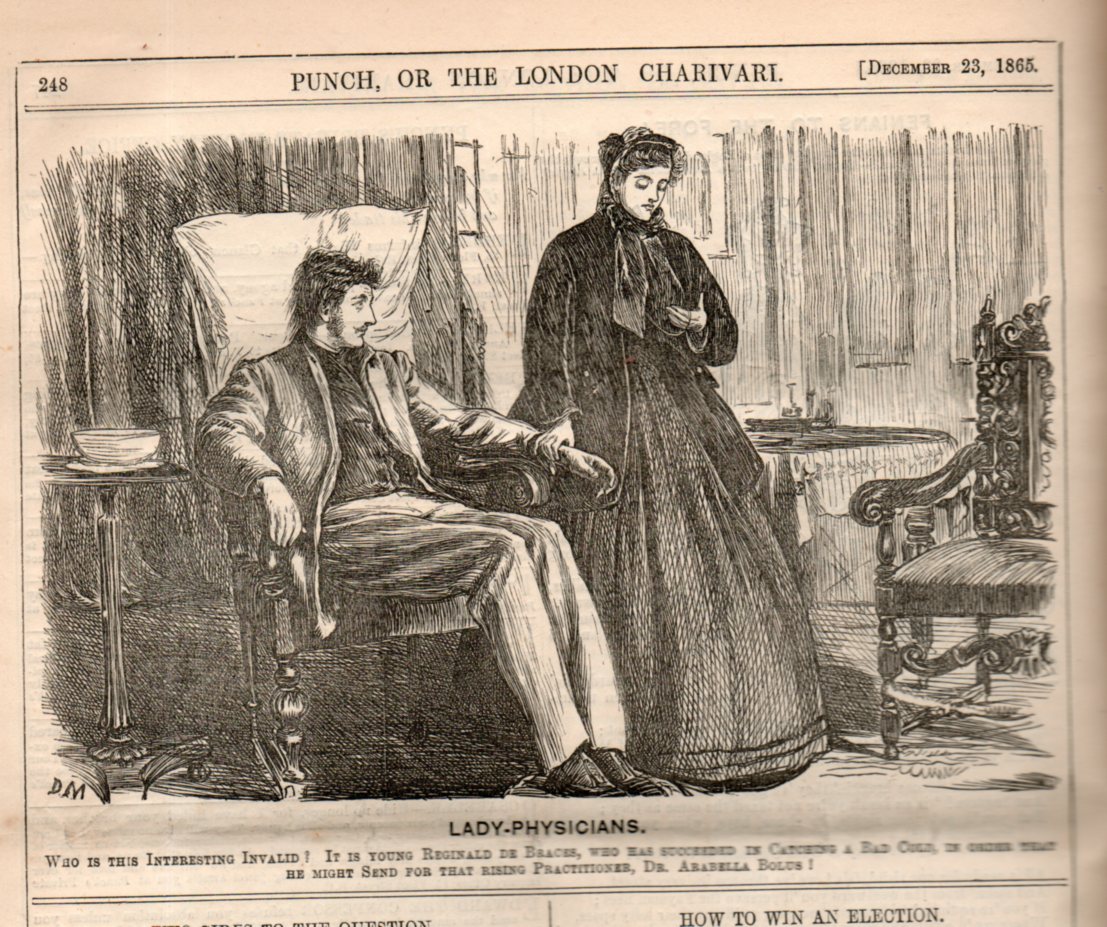
    I’m sorry to have stayed for so long in Punch magazine, but it is a very interesting read.  I’ve a run of 50 years or so of it here and on occasional a few volumes get pulled out and I make my way slowly/quickly through them.  Earlier this morning a cartoon lampooning British scientists (and a screaming zero) caught my eye–and now, after tea, comes a chance find of this image of a female doctor that seems to my interpretation to be an endorsement of sorts to the general idea of female education.

    Woman dr234

    Punch can be a very cranky periodical, lampooning everything, taking few (or no) prisoners.  On occasion I’ve noticed (and this is hardly an academic summary, just an exposure-to-a-lot-of-pages identification) that the idea of educating women and girls has fallen in and out of favor with Mr. Punch–the idea of the general intellectual capacity of woman seems occasionally to be in crinoline-entombed confusion in Punch‘s pages, even though it does seem to be a not-irregular contradiction for the large-headed, small-bodies, world-balancing Mr. Punch.

    But not this time.  It seems the cartoon, the “Lady-Physicians”, takes the high road for the woman doctor, portraying her as a competent professional while her limpid cold-attracted patient is portrayed as a pillow-encrusted dandy who has called upon his doctor than for no other reason than to gain her fancy.  Its an interesting position for the magazine to take, here in its 23 December 1865 issue.  A pro-woman professional, pro-female education stance is not a common one for many magazines at this time, not even in Punch itself, which seems at this point to be throwing off its own earlier opinions on the question sagacity of advanced instruction and education for women. 

    It seems to me as though Punch, even as early as 1865, is getting ready to grant women a room of their own in which to do what needs to be done. 

    ·Posted by :

    ·in:

  • Fantastic Cover Art: Young Communist League, 1937

    JF Ptak Science Books   Post 1728

    In the wide and deep collection of social history pamphlets and ephemera that exists here cheek-and-jowl with the history of science material I have found one of the truly great pieces of cover art/design–it stands easily in the top percentile for overall design, and it does get its message across very quickly.  It is also evidently rare, as I can find no other copies of the thing.  It certainly seem to be the first time it has appeared on the intertubes.

    Young communist league little247

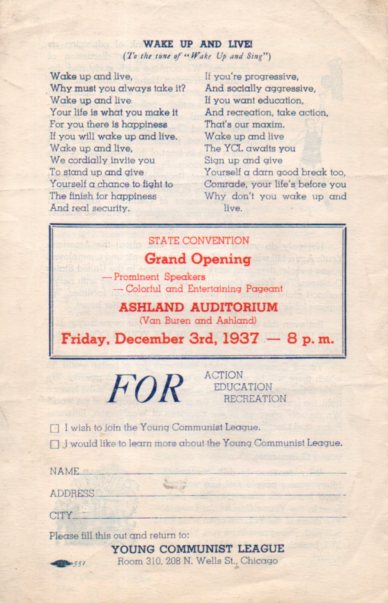
    The pamphlet was aimed at the “under 30” crowd, as we are warned right up front, in the first paragraph of the pamphlet, that if you are over 30, “we suggest you pass it along to someone under 30”–which is where the “Young” must come into play. 

    The essence of the Young Communist League is “ACTION  EDUCATION  RECREATION” and of course to teach their “Comrades” to “help understand the world we live in”.

    Young communist league Big scan246_edited-1
    The bait was set for the young and restless–and probably unemployed–youth in the midst of the Great Depression of 1937.  War in Spain, a big war that not that many people were hearing about in China, a failing economy, falling prospects, and the rise of Fascism in Italy and National Socialism in Germany may have contributed to the growth in interest in this movement among the under-30 set in the great state of Illinois to attend the YCL state convention in Chicago.  There were a number of odd businesses located at “208 N. Wells St” in Chicago (the Loop), though fewer were less unusual than the Young Communist League in Room 310.  I’m sorry to say that I cannot determine how long they lasted there, though my guess is that Room 310 was occupied by someone else in 1942. 

    Young communist league little248


    ·Posted by :

    ·in:

  • On Eclipses of Io and the Speed of Light: Ole Romer, 1676

    JF Ptak Science Books   Post 1730

    “When the father and creator saw the creature which he has made moving and living…, he rejoiced, and in his joy determined to…make the universe eternal, so far as might be. …Wherefore he resolved to have a moving image of eternity, and when he set in order the heaven, he made this image eternal but moving according to number, while eternity itself rests in unity; and this image we call time… Such was the mind and thought of God in the creation of time. The sun and moon and five other stars, which are called the planets, were created by him in order to distinguish and preserve the numbers of time… And for this reason the fixed stars were created, to be divine and eternal animals, ever-abiding and\ revolving after the same manner and on the same spot…” Plato, in which he wrote about the formation of the universe, among many other things, (Jowett. v. 2. Timaeus, p. 19), and spotted at the Linda Hall [Science] Library here

    Well, not exactly, but this was some pretty good thinking by Plato for his time, and beyond that–actually, the thinking was held for centuries.  But it was some very nice thinking by (Danish) Ole Rømer that pieced this part of Plato out, turning it around, and coming to terms with the use of “the order of heaven” to “preserve the numbers” of the speed of light, all through the observation of eclipses of Jupiter’s moon Io. 

    Horrebow249
    I should first say that today’s post came about via Peter Horrebow’s (1679-1764) Operum Mathematico-Physicorum… , a three-volume work published in Copenhagen in 1740-41.   Horrebow was a very accomplished astronomer in his own right (we’ll get to that in a moment), but what is of interest for me right now is the third volume of his book, as it (the Basis Astronomiae…) contains very detailed descriptions of the astronomical instruments and observatory of his fellow Danish astronomer Rømer (1644-1710).  Horrebow must have been a very gifted machinist and man-about-the-“lab”, as he was able to make his way through the educational system and then to the highest levels of academia even though beginning his life as a fish-seller’s son–an extraordinary accomplishment, really, as there were not many opportunities for people without some sort of privilege to succeed on this level.  And succeed Horrebow did, serving as the great Rømer ‘s assistant and charge, living in the man’s house for some time. (He didn’t stay for very long, as Horrebow was a father of twenty.)

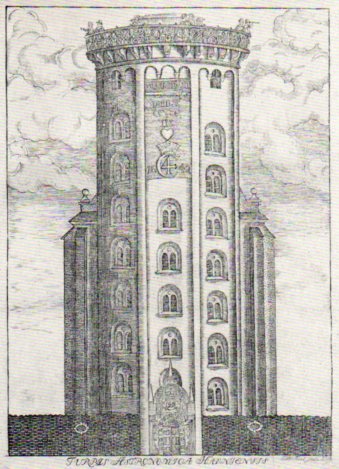
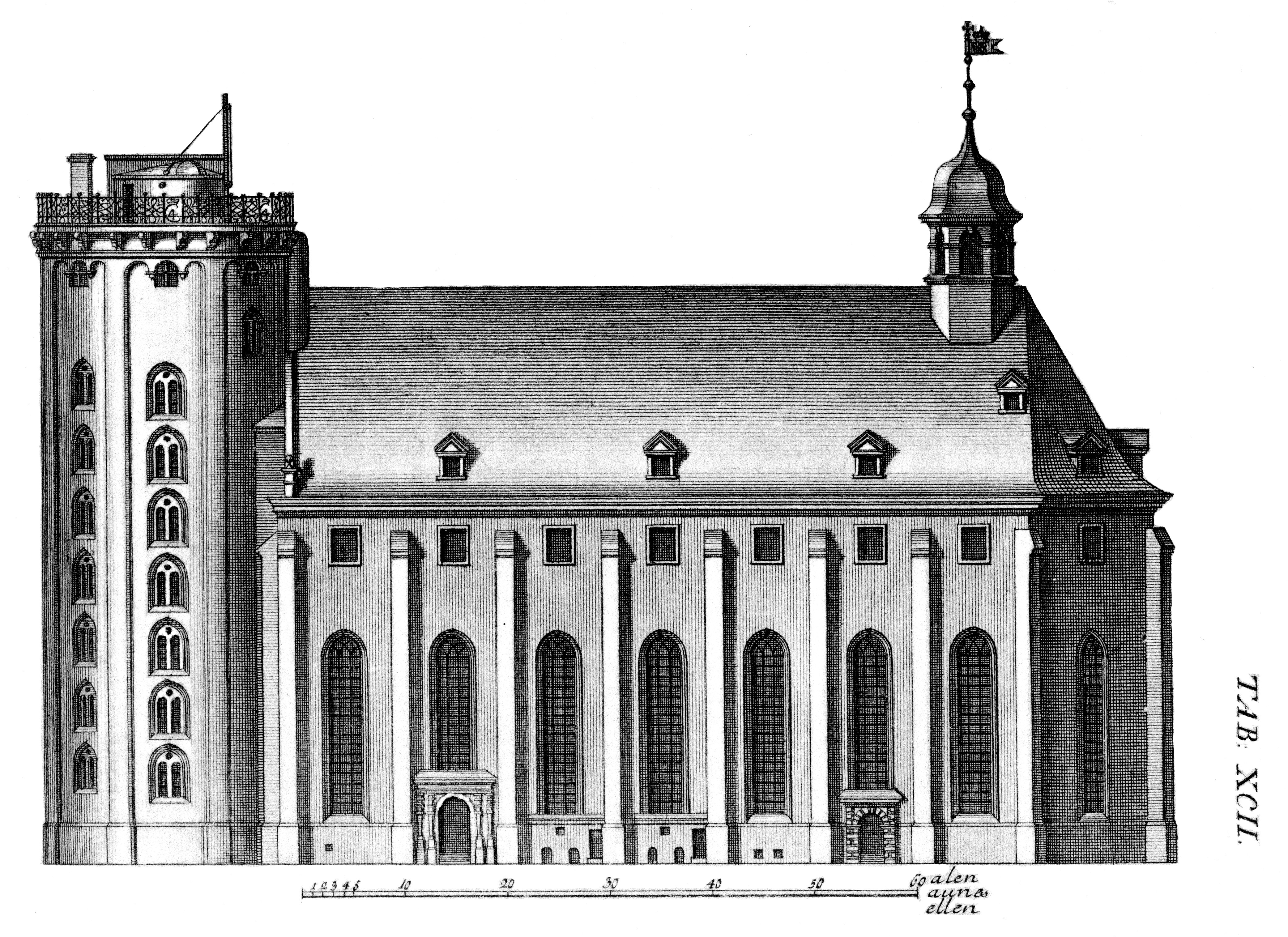
    There are some famous illustrations in this book–not the least of which is the depiction of Rømer at work on a transit in his observatory–but the image I like most of all is not one of the instruments, but a beautiful engraving of the observatory built by Charles IV.  The massive structure–called the Rundetam–was begun in 1637and finished in 1642; it is as its name suggests a “round tower” that rises 34 meters; it has no stairs using a 7.5-turn walkway instead. (It is a confusing thing, walking ’round to go up, and seems to me to have been much more than just seven turns; in a weird way by the top of the walk it felt as though one was going “down” somehow. Maybe I  just got dizzy.)  In any event the tower would be an observatory, with Rømer (and then, later, Horrebow) working from the roof as well as from some high windows, and was meant to replace the great Tycho Brahe’s demolished Stjeneborg

    File:Hafnia Hodierna Tab XCII Trinitatis Kirke.jpg

    [Cross-section of the observatory.}

    Rømer’s career was remarkable, but what I find particularly beautiful was his determination of the speed of light, and all from basically sitting there with his instruments in a window of a massive stone structure in the middle of a city, figuring out minute differentiations, making detailed observations of eclipses of the moons of a planet that had only been observed telescopically less than 67 years earlier (with the newly-invented instrument, the telescope). 

    The moons of Jupiter had been observed in 1666-1668 by Cassini and were a subject of intense study by him and Rømer, among others; Rømer in fact would travel to the Paris observatory and be an assistant to Cassini as the two worked together on the moons and eclipse observations. In this Rømer noticed a particular peculiarity in the changes of the times of these eclipses, becoming shorter when the Earth was closer to Jupiter and longer when farther away.  From this Rømer concluded that light was taking different times to reach the Earth, and from their calculated its speed.  He reported to the Royal Academy of Science on 22 August 1676:

    This second inequality appears to be due to light taking some time to reach us from the satellite; light seems to take about ten to eleven minutes [to cross] a distance equal to the half-diameter of the terrestrial orbit.

    What a jewel that was to give to the world!  It is difficult to imagine the impact of this sort of announcement in the first three-quarters of a century of the telescope, to be able to calculate something as elusive as the idea of the speed of light, and that coming from the observation of moons of another planet.  This was the first true quantitative measurement of the speed of light–there were earlier attempts (by Isaac Beekman  and Galileo), but while their ideas for measuring  were interesting and theoretically workable the instrumentation for recording minute differences in light flashes were not.  (For example in the Galileo experiment (measuring the differences in the light of exposed lanterns a  mile apart, the time was not measurable.  If it could have been measured the answer would’ve been 10 microseconds; at that time the idea of the “second hand” a clock had not yet come to be.)  Rømer established that the speed of light was finite, and gave a value that was within about 25% of the modern standard, or at least 220,000 km/sec. Galileo’s earlier best estimate was that light was at least ten times that the speed of sound. (HE was right, of course, light is at least 10x sound, but the capacity for more accurate observation and instrumentation were just beyond his age.)  This was a truly remarkable accomplishment.

    The observatory had a relatively short shelf-life, what with light pollution and the rumble and vibration of city traffic doing it in by the mid-18th century; so for its size and heavy fullness, the building lasted a little more than a century as a useful observatory. 


    ·Posted by :

    ·in:

    — —
  • An Example of Japanese Propaganda: the Philippines, 1942.

    JF Ptak Science Books   Quick Post

    I came across something late last night, out of place in an out of place basement, a pamphlet entitled Ideals of the New Philippines, and issued by the Japanese propaganda corps.  Says so right on the label.  It was issued in 1941/2  [This pamphlet is available on our books for sale blog, here.]

    There are several essays in this work, all of them address the victory of the Japanese army over the United States and allies (USAFFE), and calling for Filipinos to accept their new responsibilities in rebuilding their country according to Japanese and “Asiatic” ideals. In general the approach to the newly-captive population was that of a liberator, helping the Philippines to “escape from the captivity of the United States”. The Japanese call for a “Marshall Petain  model of rehabilitation: “… and “you must surmount tremendous difficulties everywhere you go”.

    There is no escaping the very determined, authoritarian approach: “Filipinos must follow the Japanese way or they will be deemed a traitor to the Philippines and to the Japanese Imperial Army. Those who spread rumors about the return of the US Army to the Philippines are unpardonable criminals because they disturb the tranquility of the country”.  And “You shall never regret your collaborations with us.”

    Yosihide Hayasi (Director General of the Japanese Occupation) writes strongly of the anti-Imperialist efforts of Japan and their Army’s liberating efforts, and the plan to spring about a great Asiatic Asia, free of Western influences “and the eradication of Anglo Saxon and Western imperialism”. “Believing in the superior blood of Asiatic people” “the Filipinos will wash away the defects of the Anglo Saxons”. There is a further short essay by Jorge Vargas (“Chairman of the Executive Committee), entitled “Philippine Islands Grateful to Japanese”. There is also appended (from pp 28-37) the Field Service Code of the Japanese Army, heavy belief in strength, discipline, honor, obedience.

    The Philippines fell to the Japanese weeks after the bombing of Pearl Harbor, and was not liberated for another three+ years.  And it was a very grueling liberation, particularly in Manila, where the month-long battle to free the city resulted in the death of 100,000 Manila residents.

    ·Posted by :

    ·in:

Recent Posts

Archives

Categories