A Daily History of Holes, Dots, Lines, Science, History, Math, Physics, Art, the Unintentional Absurd, Architecture, Maps, Data Visualization, Blank and Missing Things, and so on. |1.6 million words, 7500 images, 4.9 million hits| Press & appearances in The Times, Le Figaro, Mensa, The Economist, The Guardian, Discovery News, Slate, Le Monde, Sci American Blogs, Le Pont, and many other places… 5000+ total posts since 2008.

  • Monopolis and Multiopolis: a Note on -apolises, -opolises, and Such

    JF Ptak Science Books   Post 1757

    Monopolis379
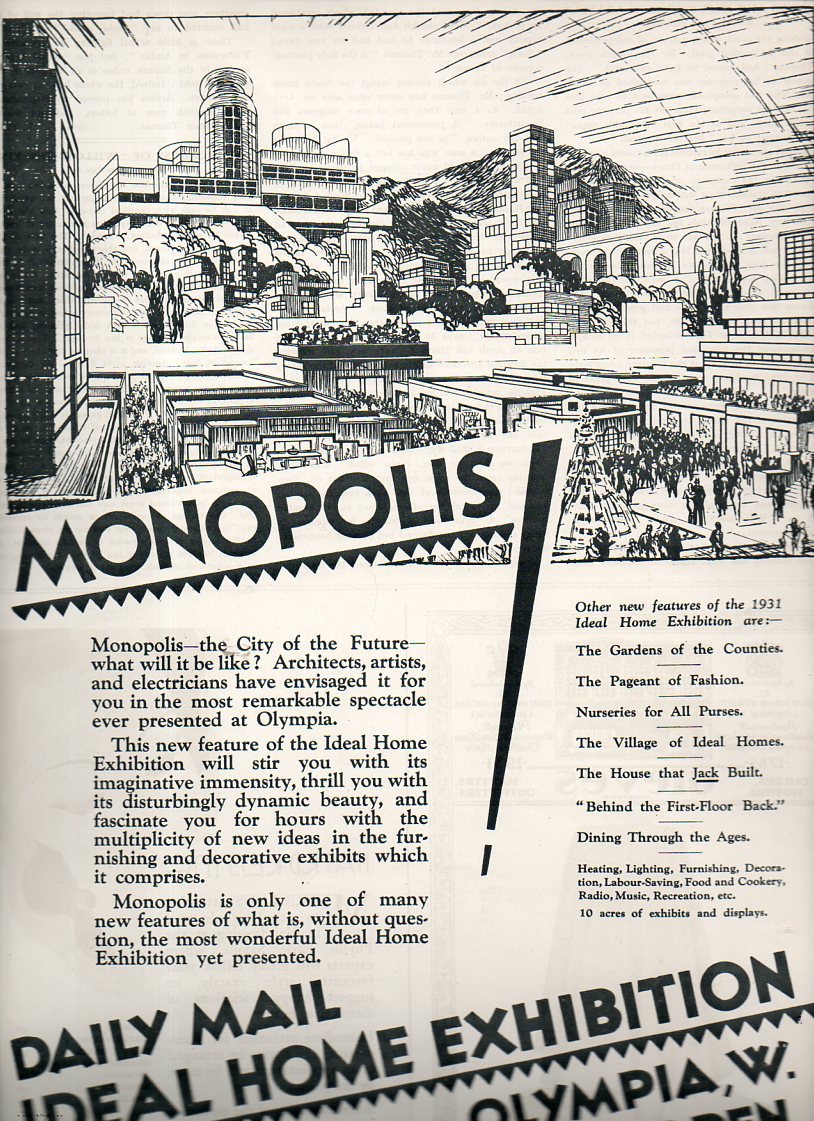
    Welcome to Monopolis!  “City of the future…imaginative immensity…disturbingly dynamic beauty…”

    The moment I look at it Monopolis suggests another word:  Multiopolis.  Although the originators of the Mono- word weren’t really suggesting plain vanilla wrappings for a one-size-fits-all existence, the more diversified-sounding Multi- at least sounds a little more enchanting and not so Orwellian.  It is also a little odd that I can find nothing on “Multiopolis”, not even in a popular Google search–and of course, having been printed in 1931, “Monopolis “can’t be “Orwellian” since Mr. Blair had not yet written any books, least of all 1984, which wouldn’t appear until the man was almost completely out of life. (Blair/Orwell wrote nine books in fifteen years, 1934-1949, and would die in January 1950.)

    Monopolis378


    “Monopolis” certainly suggests a gritty sameness, a suffocating city of similarity with no central decency.

    In this image (above), published in the Illustrated London News on 18 April 1931, Monopolis seems to live up to its promise in all aspects except for its name, which is actually pretty creative. The great building on the hill, the skyline in the mountain, all bauhaused-up with perhaps nowhere to go into the near-future, with really not that much, not too terribly much, to distinguish itself from a first-year architectural student’s semi-dreamed-upon work, though for some reason an aqueduct does makes an appearance to spice things up. 

    In the end, though, Monopolis was a simple title for a continuing series of new-house/design shows in London–it hasn’t much to do with anything, and was simply an interestingly-named bit for a bad advertising campaign.

    I wonder about a collection of “Opoluses”, like the Christianopolis of the Lutheran Christian Utopia, published  by Johann Valentin Andreae, in Reipublicae Christianopolitanae descriptio… published in Strasburg by the heirs of Lazarus Zetzner, 1619.  This is certainly among the most elegant of things ending with “-opolis”, even though it does look like a prison. Or hospital.  And no one would want to be in either in 1619. 

    [Source:  Martayan Lan with thanks]

    There is a small town in Kansas called Opolis, a place of 54 houses and 117 people or so.  It sounds like a perfectly nice bookend to places like Indianapolis and Minneapolis (and yes they’re both “apolis” and not “opolis”), not to mention Hotdogopolis, Bike-opolis, Planned-opolis, and the fantastically-named Possible-opolis. 

     I think that Monopolis just won’t do. 

  • Humanitarian Propaganda II–POWs and the Hope for Those at Home, 1943/1944

    JF Ptak Science Books  Post 281 (from 2009) Extended [Part of the History of Nothing series.]

    Propaganda Red Cross383War propaganda is distributed across all levels of society during a time of conflict.  I’ve made a number of posts concerning Nazi and Japanese propaganda but no so much on the Allies’ side.  These pamphlets come from a small stash of mine relating to Red Cross activities and prisoners of war (POWs), and they fall chiefly I think in The History of Nothing series, mainly because of the chances that all of these packages wouldn’t stop and be used by German troops rather than going all the way through to POWs.  The expectations of the Home Front concerning the disposition of their loved ones as prisoners of the Nazis were clearly illusory, what with steamed and pressed trousers and clean sharp shirts.

    ·Posted by :

    ·in:

    —
  • The Reverse of the Origin of Species and the American Civil War, 1862

    JF Ptak Science Books  Post 1759

    Darwin elephant392

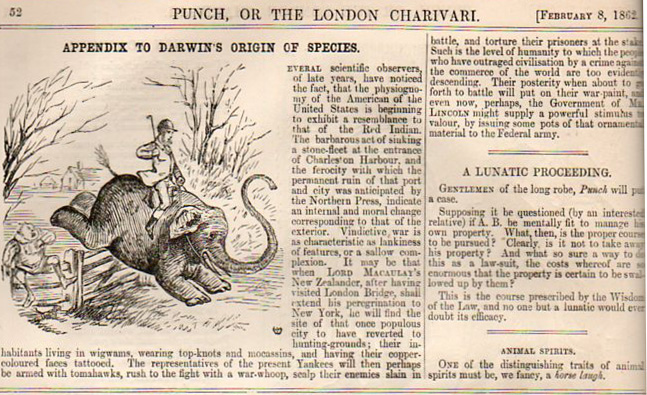
    This pungent bit appeared in Punch magazine 8 February 1862, and was a vicious attack against the Americans (almost entirely directed at the Union North)  in the second year of the U.S. Civil War.  What Mr. Punch saw in “his” editor’s mind was a “sinking” of the American race to the level of the “Red Indian”, the whole of the nation reverting to some previous developmental state, far removed by their actions to a more primitive people, a different sort of “evolution”–in fact, what the spoofing (?) and chiding editors saw in the Americans’ actions was a reverse of Darwin’s theory.  These same people were already uncomfortable with Darwin (at this point three years past the publication of the Origin1) but so long as using the book to a comfortable goal was concerned it seemed a perfect fit, a proof for the reverse of the Origin.  As we see in the second short article:

    “If there is any truth in the theory of the Origin of Species there may be an inversion of the originating process…”

    Chief (and first) among the complaints was the blockade action against the Confederate port of Charleston (South Carolina).  The “stone fleet” is incorrectly described in the wonderful “Science in 19th Century Periodicals” website as being of Confederate origin.  The Stone Fleet was actually part of  a Northern action, being a large contingent of ships brought south and sunk in the waters off Charleston Harbor in the hopes of preventing Confederate blockade runners from escaping the ring of Federal ships already present there.  There were also a number of ships sunk off the coast of beautiful Tybee Island, there to be used as breakwaters and landings for Union ships operating just south of Savannah. 

    The behavior of the United States, so far as Mr. Punch was concerned, just wouldn’t “do”.

    “SEVERAL scientific observers of late years have noticed the fact that the physiognomy of the American of the United States is beginning to exhibit a resemblance to that of the Red Indian.The barbarous act of sinking a stone fleet at the entrance of Charleston Harbour and the ferocity with which the permanent ruin of that port and city was anticipated by the Northern Press indicate an internal and moral change corresponding to that of the exterior Vindictive war is as characteristic as lankiness of features or a sallow complexion. It may be that when LORD MACAULAY’S New Zealander alter having visited London Bridge shall extend his peregrination to New York he will find the site of that once populous city to have reverted to hunting grounds their inhabitants hunting grounds their living in wigwams wearing top knots and mocassins and having their coloured faces tattooed. The representatives of the present Yankees will then be armed with tomahawks, rush to the tight with war whoop, scalp their enemies slain in battle, and torture their prisoners at the stake. Such is the level of humanity to which the people who have outraged civilisation by a crime against the commerce of the world are too evidently descending. Their posterity when about to go forth to battle will put on their war paint and even now perhaps the Government of MR. LINCOLN might supply a powerful stimulus to valour by issuing some pots of that ornamental material to the Federal army.”

    Later in the year Mr. Punch again addressed “Brother Jonathan”, (a reference from Revoutinary War days to Americans in general, but more so during the Civil War, when “Brother Jonathan” and “Johnny” were both used…its also intersting to note the use of “Johnny Red” and also the appearance in “When Johnny Comes Marching Home”) and again invoked Mr Darwin and the Origin, and again using the “Indian type” as the state to which the “model Republic” was sending itself towards, with Americans “descending to the very lowest place”, an “inversion of the originating process”. 

    “Thus Jonathan you see you are sinking from bad to worse from savage to lower savage and your manifest destiny at that rate of decadence is the zero of humanity.”

    It is a rather bad letter, brother-to-brother, so to speak., Mr. Punch claiming that Americans will descend to gorillas, “Apes with foreheads villainous low”.  Surprisingly (to me, anyway)   Mr. Punch slips easily into very vile characterizations of other types of human beings in use by metaphor–these don’t need to be singled out here but can be found in the original, below.  And so the Manifest Destiny of American–“declared” or at least the phrase originated just 17 years earlier by John O’Sullivan in the Democratic Review in an article “Annexation” regarding Texas–so far as England was concerned was to be excruciatingly, intolerably, low; so low inn fact that it is the very proof of the stuff that the Origin of Species theory runs in reverse.

    I’m not sure why the editorial cartoonist used the elephant in the hunt scene and how it relates to Mr. Darwin, though I guess it sends the overall message of The Ridiculous regarding the American affair, at least in the eyes of Punch–England still smarting from the Trent Affair, still newly developed.

    Notes:

    1. The title in full by C.R. Darwin, On the origin of species by means of natural selection, or the preservation of favoured races in the struggle for life, would stay so until it was shortened to The Origin of Species in its sixth edition of 1872. By the time these two articles in Punch appeared, the Origin already in its third edition (published in April 1861).  In all of this, the enormously popular book was printed in not-large quantities.  The first edition of November, 1859 sold out on the first day, and was printed in an edition of 1250 copies, of which about 1170 were for sale.  Darwin was immediately put to work on a second edition (rather than simply reprint the first edition), and the work appeared two months later, in January 1860, in an edition of 3000 copies.  The third edition appeared in April 1861 in an edition of 2000. The fourth edition appeared in 1866 (2000 copies); the fifth, in 1869 (2000 copies0, and the sixth and last in Darwin’s lifetime came out in 1872, in 3000 copies, the largest print run during CD’s lifetime.  So, the most important book in the history of biology (?) sold a total of 13,170 copies or so as published in England by John Murray. 

    ·Posted by :

    ·in:

    — —
  • “Seven People to Make a Shadow”: Andersonville Prison, 1865

    JF Ptak Science Books    Post 1760

    While reading about the story of Andersonville Prison I was much taken with a passage from the diary of Sgt. David Kennedy (of the 9th Ohio Cavalry), held at that prison, writing on 9 July 1864:

    ‘ Wuld that I was an artist & had the material to paint this camp & all its horrors or the tounge of some eloquent Statesman and had the privilege of expresing my mind to our hon. rulers at Washington, I should gloery to describe this hell on earth where it takes 7 of its occupants to make a shadow.’

    Seven men to make one shadow.  That does pretty much tell the story of Andersonville.  It was known also as Camp Sumter, in Sumter County (Georgia), constructed and then opened in February 1864–quite late in the war–to hold 13,000 Union prisoners.  That was a hoepful sentiment and held little planning, as the site held nearly 32,000 prisoners at one time, filled twice beyoind a capacity that even in the best conditions was too high. The prison was ill-conceived, not well made (except for the stockade fence constructed by slave laborers, which was pieced together so well that a person inside the stockade could not see anything whatsoever of the outside world through an imperfect join in the fence). So the view left to the prisoner was of other prisoners in fetid and deplorable states, lumber of the stockade, the poor Earth and disgusting mud of the central section of the stockade fed by a stream and turned into a disease-breeding swamp, and the sky. 

    The actual photograph (above) and the artist’s rendition, clarification, amplification, below:

    [Source:  Library of Congress. Andersonville prison, Georgia. Group of prisoners.   ca. 1864-1865  “Drawing of prisoners among tents, showing starvation, crowding, poor clothing among prisoners.” 
    From “U. S. Navy. Edisto Island. Morris and Folly Islands. Fort Warren, Mass. Andersonville Prison, Miscellaneous.” photographic album, p 74 ([Andersonville Prison]).

    Of the 45,000 Union soldiers held at the prison in its short life (February 1864-May 1865) nearly one-third of them died, most killed by ill-treatment, malnutrition, exposure, poor sanitary conditions, and starvation. 

    The map below gives a good view of the size of the swamp (“Whole Content of Stockade 25 1/2 acres, including swamp…”)

    [Source: Robert Knox Sneden scrapbook (Mss5:7 Sn237:1), Virginia Historical Society.  In the Robert Knox Sneden diary, 1861-1865 (v. 5, p. 606). 1 map : pen-and-ink and watercolor ; 18 x 14 cm.]


  • How Much it Cost to Clothe the Working Poor of London, 1854

    JF Ptak Science Books  Post 1761

    The “working poor” of England may have been half of that–working, that is, and hard at work, though not being paid even enough to be considered poor. Their story has been told in many ways, of course, the backbone of the Industrial Revolution succeeding on their bones, observed and recorded and shared by Charles Dickens and others, and on and on, told elsewhere in brevity and quick detail better than I can do so here.

    I did want to make a quick comment about a very small detail in the state of those poor people, found in Charles Kingsley’s  Cheap Clothes and Nasty, printed in 1850.  It is quite a documentarian’s tour of the plight of the poor, written by a very able observer.  (Kingsley is a very interesting person–an historian, priest in the Church of England, social commentator, and novelist.  As a matter of fact he was exceptionally prolific, producing during his lifetime (1819-1875) a fine long list of accomplishment, three of which have survived to this day as sorts of minor classics.  But what he did with great regularity was publish books–34 of them in 25 years between 1850 and 1875, including 15 during the decade of the 1850’s, 11 in the 1860’s, and 8 in the 1870’s to his death in 1875.  Perhaps as important as all of that was the role he played in the arrival of C. Darwin’s On the Origin of  Species…, as Kingsley wrote one of the earliest reviews of the book and defended it strongly.)

    But getting back to the poor,  Kingsley made a very strong case for the poor being less so than that, as we see here:

    “Folks are getting somewhat tired of the old rodomontade that a slave is free the moment he sets foot on British soil! Stuff! – are these tailors free? Put any conceivable sense you will on the word, and then say – are they free? We have, thank God, emancipated the black slaves;  it would seem a not inconsistent sequel to that act to set about emancipating these white ones.Oh! we forgot; there is an infinite difference between the two cases – the black slaves worked for our colonies; the white slaves work for us. But, indeed, if, as some preach, self interest is the mainspring of all human action, it is difficult to see who will step forward to emancipate the said white slaves; for all classes seem to consider it equally their interest to keep them as they are; all classes, though by their own confession they are ashamed, are yet not afraid to profit by the system which keeps them down…”–Charles Kingsley, Clothes, Cheap and Nasty, 1850

    Kingsley continues on with the stuff of research, uncommonly sharing the lot of what a vast section of English society experienced daily though mostly in silence.

    Another excruciating and interesting report was made by George Godwin in his London Shadows, a glance at the “homes” of the thousands of 1854 (the whole work found on the wonderful Victorian London blog, here and about which I posted about here).

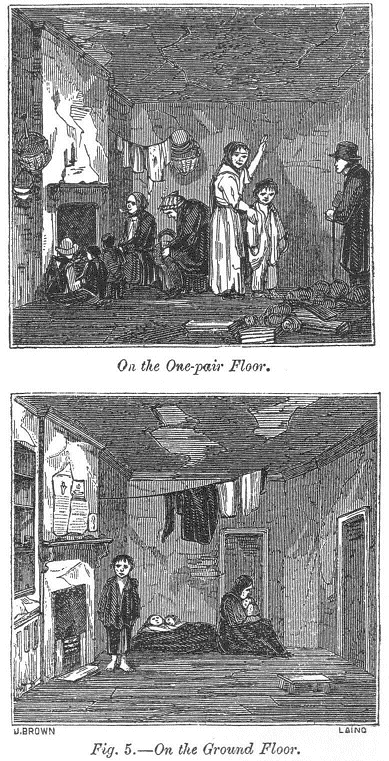
    Godwin–an influential architect and editor of the very influential The Builder  as well as a social reformer, who lived from 1813-1888) wrote an expose of how so many Londoners lived at the middle of the century. It is also illustrated with woodcuts of the places in which people lives–artwork in wood and ink that have a very definite quality of the unforgiving cameras of Life magazine a century later.  The images are awakening and abrupt–all the bitter observation of George Orwell, only told much more quickly, like a person trying to describe a raging house fire before the thing burned itself out.  Its a powerful work, and I can’t help but think that those reading it in 1854 must have been appalled not only by the deep visualization of the state of the working poor, but also by its scope, and the possible revelation of England’s basic bedrock.

    Here is an example of Godwin’s work, which includes observations on not only housing the poor, but clothing them as well, and published in the editorial pages of journal The Builder. He presents one aspect of their lot by discussing their clothing and its purchasing, bought for what the polite reading circles who would find The Builder  to be almost for no money at all, though the few pennies spent on a pair of shoes or shirt were a major factor in the weekly ration of the working poor., particularly if they were making 5 or 10 pounds per year.   It was an interesting way for Godwin to present to the non-poor what the other-half really had to live like, and perhaps by reaching out to the population that did the building-of-London he probably hoped to affect some sort of reform in the way in which the poor had to live and work.  An example of the Godwin work:

    “One of the London missionaries (a body whose valuable services can only be properly appreciated by those who understand the nature and extent of the evil to which we are directing attention) says:-
        “Persons who are accustomed to run up heavy bills at fashionable tailors’ and milliners’, will scarcely believe the sums for which the classes we are describing are able to purchase the same articles for their own rank in life.”
        A missionary who recently explored Rag-fair, reported that a man and his wife might be clothed from head to foot for from 10s. to 15s. Another missionary stated that 8s. would buy every article of clothing required by either a man or a woman, singly. In Pennant’s time it was less. He says (speaking of the other Rag-fair), that the dealer pointed out a man to him, and said: “Look at him. I have clothed him for fourteen-pence. A third missionary reported : “There is as great a variety of articles in pattern, and shape, and size, as I think could be found in any draper’s shop in London.” The mother may go to “Rag-fair” with the whole of her family, both boys and girls,- yes, and her husband, too, and for a very few shillings deck them out from top to toe. I have no doubt that for a man and his wife, and five or six children, £1 at their disposal, judiciously laid out, would purchase them all an entire change. This may appear to some an exaggeration: but I actually overheard a conversation in which two women were trying to bargain for a child’s frock; the sum asked for it was 1½d. and the sum offered was a penny, and they parted on the difference…”

    http://www.victorianlondon.org/publications4/shad-06.gif

  • The Ouroboros and Infinity

    JF Ptak Science Books    Post 1762

    Ouroboros390
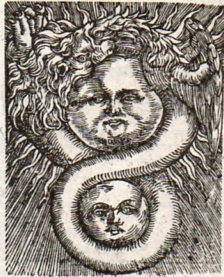
    The ouroboros–and in this particular case, the double, over-and-under ouroboros–is an interesting and ancient symbol.  In my experience, the single unit is to be expected, but the double seems uncommon. The symbol (“oura” or tail and “boros”, eating, in Greek, one who eats one’s tail) stretches back into the dim and dusty past, at least to the Egyptian Book of the Dead, and is Plato’s first living thing–its is the primordial unity, the rebirth of forever, death/life/birth/rebirth, continuing into infinity, the great world soul…a kind of Western equivalent of the Taoist Yin Yang.

    There’s much more to be said about this symbol, especially by such people as Erich Neumann and Carl Jung, but I’ll resist, mainly because it is just too complicated for me to make an intelligent statement. (I’ve tried to read the Great Mother as well as The Origins of the History of Consciousness by Neumann, but only made my way around the edges of the first, and picked through the interesting bits of the later.  Jung is someone I’ve never had much luck with.)

    The first symbol, and a gorgeous one it is, comes from the Theatrum chemicum (1659-1661, and published in six volumes by Lazarus Zetzner in Strasbourg), and shows the combination of what was supposed to be an alchemical highpoint:  the spiritual coming together of sulfur and mercury, elements of what the practioners believed were the basic constituents of all metals and minerals.  And of such stuff miracles were understood to be made, except that of course, they weren’t–the fact that this stuff never worked to produce something more substantial than mercuric sulfide wasn’t due to the theory or practice or thought but to the “fact” that the mercury and sulfur used in the process weren’t “pure” enough.  That said, the Theatrum was a very important work, the largest collection of alchemical works ever gathered and published together–it was also evidently much appreciated by Isaac Newton, who was said to consult it often and who owned the set in his library.

    A more classical appearance of the ouroboros (De Lapide PhilosophicoTriga Chemicum (Prague 1599) compiled by Nicolas Barnaud), depicting a dragon seizing the polarities of its soul, ultimately uniting them: 

    File:Ouroboros 1.jpg

    And in the discussion of the ouroboros and philosophical aspects of infinity it should be mentioned that there is some connection between it and the mathematical symbol for infinity, which seems to arise from (the remarkable and original) John Wallis’ De Sectionibus Conicibus, which was published in 1655.  Wallis employed the old Roman symbol for 1,000 to use for the mathematical infinity, which of course is the ouroboros on its side.  (Wallis it should be noticed was also among the earliest people to put into print the symbol for pi, as well.)

    ·Posted by :

    ·in:

    — — — —
  • Strange Things in the Sky Department: the Exploding Moon.

    JF Ptak Science Books    Post 1763   [Part of the Strange Things in the Sky Department.]

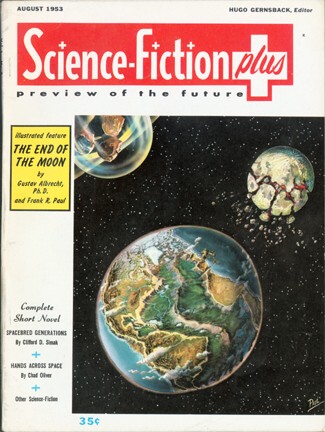
    Moon exploded[Cover art by the great Frank R. Paul for the August 1953 issue of Science Fiction Plus.]

    In my experience of Strange-Things-in-the-Sky Department,the idea of the exploding Earth is far more popular and more illustrated than that of the Exploding Moon.  So far as I can recall Moon doesn’t explode in most cases of early sci fi, including the earliest case of Lucian’s Icaromenippus and his great True History (a satire on outer space travel and interplanetary warfare between the kings of the Moon and the Sun over possession of the Morning Sat (Venus).  Nor does the Moon explode in the other very early efforts of de Bergerac (1657), Francis Godwin (Man in the Moone, 1632, where Our Hero gets to the Moon on a goose-powered aerial something), Johnannes Kepler (Somnium, 1634) and others.  The Moon gets into trouble enough, but not so much trouble to lead it to blow up. 

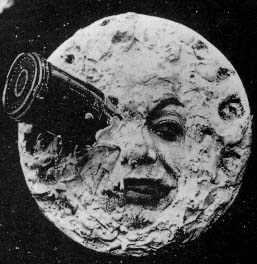
    File:Le Voyage dans la lune.jpg

    (I can’t leave this without mention of Robert Heinlein, who wrote many short stories addressing the Moon, many with fantastic titles and even better story lines:   “Columbus Was a Dope”,  1947;  “Gentlemen, Be Seated!”, 1948, about a lunar tunnel;  a Boy Scouts on the Moon, “The Black Pits of Luna”, 1948;  “The Man Who Sold the Moon”, a 1949    “Nothing Ever Happens on the Moon”, 1949 (future Boy Scouts on the Moon);     “The Menace From Earth”, 1957, (Lunar teenager angst and a muscle-powered space ship); “The Moon Is a Harsh Mistress” (1966), (and a Lunar penal colony)–lovely titles for some superior writing.

    The Moon certainly takes abuse here and there, ranging from cloud attack (in Lucian) to colonization to this very memorable (and frightening/disturbing, as I found as a child)  as in the case of the Man in the Moon being shot in the eye with a space ship (George Melies, Le Voyage dans la lune (A Trip to the Moon) (1902)). 

    Frank Rudolph PaulAnd of course there’s always the runaway Moon and the havoc that it would soon cause to the Earth, though then again this is not an exploding Moon, except it seems as though it might soon be so. 

    And so in a bit of rambling about the Moon that has gone on in this blog, there are no other mentions of the Moon exploding, though there are some other strange things going on there.  Just not “exploding” strangenesses.

    And especially not Laurie Anderson’s “The Exploding Moon“.

  • On the Early Development of ASCII

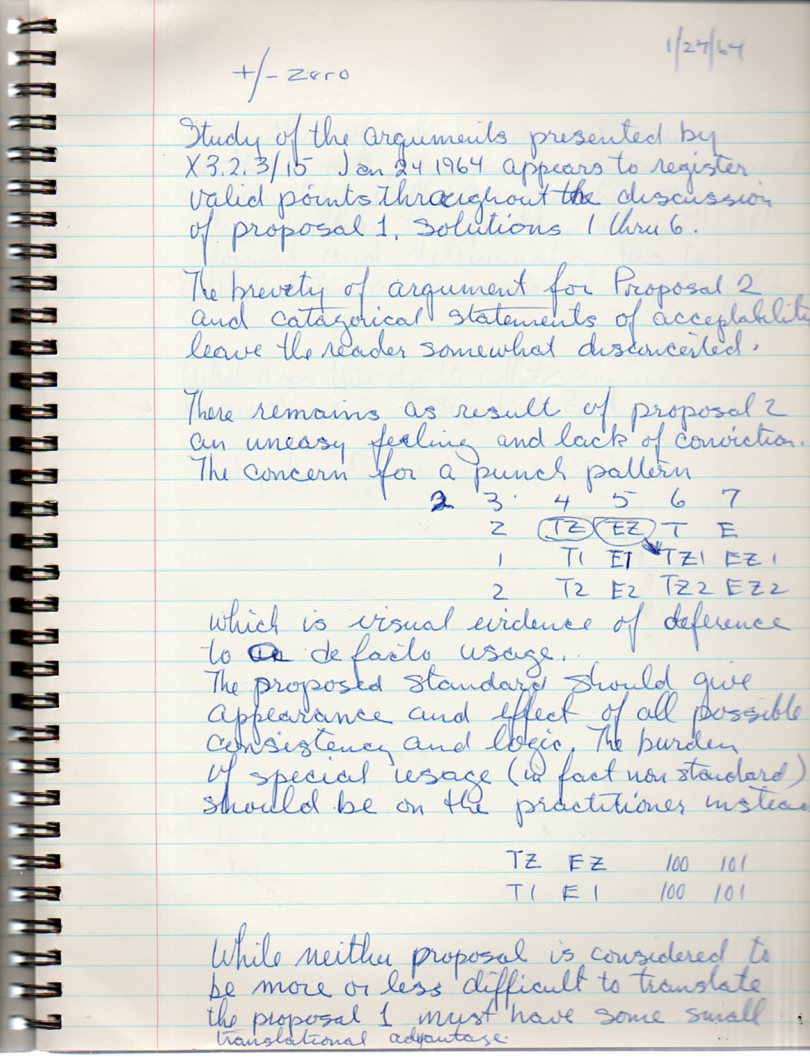
    The History of ASCII.  I just wanted to include this short bit on a small archive of material related to the development of ASCII from one of the team members who helped to create it.  A more full description appears in the “continue reading” section, below. [Since writing this in 2012 the archive has been donated to special collections at North Carolina State University at Raleigh, where I assume it can be viewed and utilized.]

    Mullendore651

    ·Posted by :

    ·in:

  • 17th & 18th Century Steampunk Flight

    JF Ptak Science Books   Post 1764  [Part of the Unintentional Absurdist/Surreal series]

    Belidor upside down
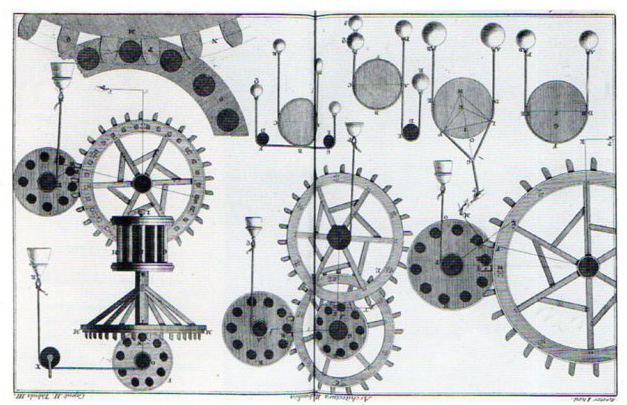
    I’ve called on M. de Belidor (1698-1761) before in this blog, using some of the images of his books to describe the Found-Surreal, the Unintentional Dadaist (and so on), images that once slightly removed from their original context take on an entirely new life, sometimes fantastical and odd. 

    The engraving above is a fine example, an appears innocently (and beautifully, and importantly) in his Architectura Hydraulica (1740), and titled “Demonstration of Friction”.  I’ve simply inverted it and removed some of the numerical notation–and then, suddenly, it becomes a sort of Steampunk Balloon Machine–a lovely collection of small balloons lifting large wheels and cogs, assembling some sort of something in mid-air, demonstrating very little friction, of lightness and airiness

    Belidor was a remarkable engineer and theoretician who blended the two practices perfectly–actually one of the great issues in his career as trying to disseminate higher levels of techno-competence among people working with machines and using technology to some end.  He often found that the skills necessary to reproduce and maintain some of the machines he wrote about to be, um, lacking in the population at large.  He was also very transparent in technology’s role in military life (which at about the time he was writing was nearly tautological) and tried to apply the advancements he made in that area (as he was a military engineer and soldier) to the industrial and social sphere. In any event he was a very interesting man who produced books that were significant for a half-century or more past his death. 

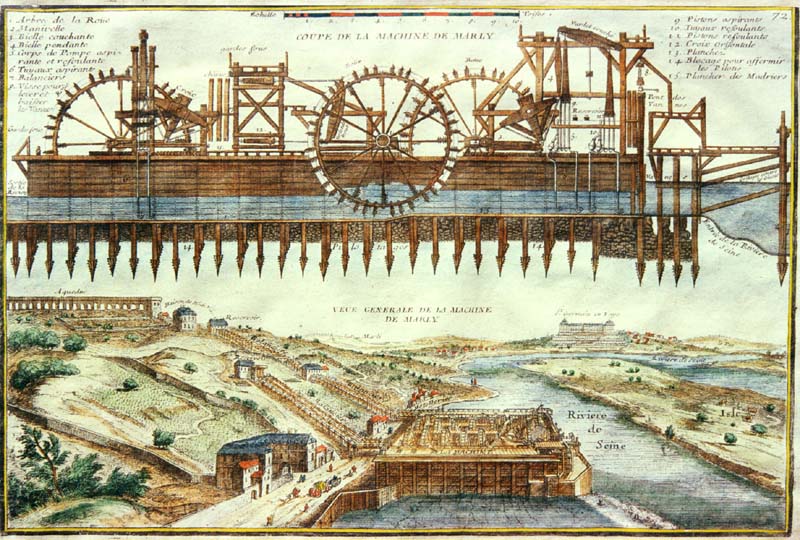
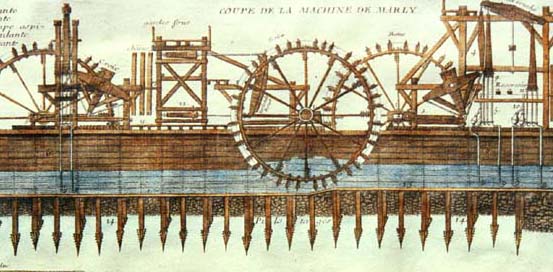
    The second image is even more striking, and is not altered at all–the difference in perspective comes with a difference of perspective, which in this case is simply labeling the image as something it isn’t, a Massive Steampunk Flying Machine of the 17th Century:

    http://world.std.com/~hmfh/mferclrsect.jpg

    It is nothing of the sort, of course, but if you suspend a little critical thinking then that is what this engraving sort of looks like.  In reality it a combined profile of the machine (top of the image) and view of its placement (bottom) of the great technological and engineering feats of the day, a modern marvel, a wonder–the Marly Machine. This was a large, integrated device constructed (over a seven-year-long period and finished in 1684) to pump water from the Seine to Louis XIV’s chateaux at Versailles and Marly, and did so magnificently up a 500-foot vertical rise to an aqueduct and then on to the final destinations.  Those paddle wheels on the sides of the installation were monsters:  36′ in diameter, capturing and releasing the water of the Seine to power 250 pumps which sent the water on its way up the long and steep hill. 

    Marly

    Here’s a view of the device in situ, with a long course of other implements ascending the hill.  [Images courtesy of Marlymachine.org.]

    So with a slight suspension of analysis and a little inversion, these two images take on a flighty life of their own, independent of their intended purposes.

  • The Rot of Modern Art–1910

    JF Ptak Science Books   Post 1765

    “Suddenly I had entered a new world, a universe of ugliness”.–Gelett Burgess, on entering the Salon des Independents Exhibition, 1910

    One of the earliest recognitions of the great early masterpiece of Cubism, Picasso’s Les Demoisselles d’Avignon, makes its appearance in the Architectural Record1, and by a most-unanticipated critic:  Gelett Burgess (1866-1951).  Burgess glides through an unexpectedly wide terrain of The Modern, and has quite a lot of interesting observations, including George Braque and Czobel, Friesz, Harbin, Metzinger, Derain, Chibaud, Matisse  and–perhaps most significantly–Pablo Picasso.  Burgess found his way to Les Demoisselles, and presents a photograph of what would become perhaps the great masterpiece of Cubism, the caption announcing it as a “study” rather than with any real title for the work.  As is well known Picasso worked for some years on the painting (generally the work is assigned a date of 1907 though he worked on it for some years afterwards), spending time alternatively in great loneliness and also in the midst of crowds of the interested/supporters/friends/the curious, sometimes hoping for feedback of his major work from the visitors, sometimes not. 

    Burgess was known as an accomplished illustrator with a distinctive and distinguished style, as well as a humorist-poet, a poet whose best-remembered (and longest-surviving) lines run as follows:

    “I never saw a Purple Cow,
    I never hope to see one,
    But I can tell you, anyhow,
    I’d rather see than be one!”

    And I think that it is in this style that Burgess concedes his opinion of Picasso’s work, complete with a short bit of a poem at the end:

    “And now for Picasso, of whom, here and there, one has heard so much. Picasso will not exhibit his paintings. He is too proud and too scornful of the opinions of the canaille. But he sells his work, nevertheless. That’s the astonishing thing about all of them. Who buys? God knows! Germans, I suppose.”


    ·Posted by :

    ·in:

    — —
  • History of Fear: Science Fiction Images–the 1950’s.

    JF Ptak Science Books   Quick Post  [Part of the History of the Future series.]

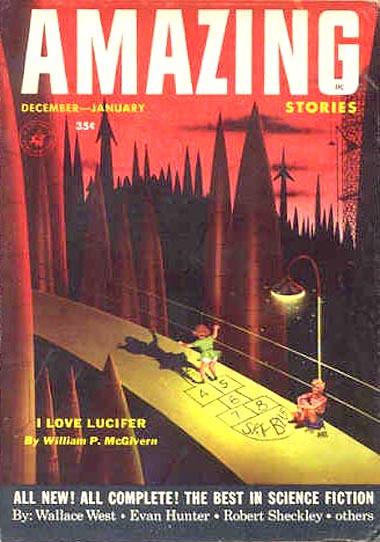
    This cover of Amazing Stories is really very gripping, very cold in a Red Nightmare way, filled with fear and the possibility of mega-death.  The cover was made at the very beginning of the real fear of Soviet attack with nuclear weapons, made just months after the first hydrogen bomb detonation by the Soviet Union (a 400 kt device on 12 August 1953).  (The Soviets made their entrance into the nuclear endgame four years earlier, in 1949, years before most informed speculation had placed their weapon potential.)

    http://static.flickr.com/48/182497900_9cb5a7ebcf_o.jpg

Recent Posts

Archives

Categories