A Daily History of Holes, Dots, Lines, Science, History, Math, Physics, Art, the Unintentional Absurd, Architecture, Maps, Data Visualization, Blank and Missing Things, and so on. |1.6 million words, 7500 images, 4.9 million hits| Press & appearances in The Times, Le Figaro, Mensa, The Economist, The Guardian, Discovery News, Slate, Le Monde, Sci American Blogs, Le Pont, and many other places… 5000+ total posts since 2008.

  • Disinventing Human Flight–Hiram Maxim’s Steampunk Mistake

    JF Ptak Science Books   Post 1751

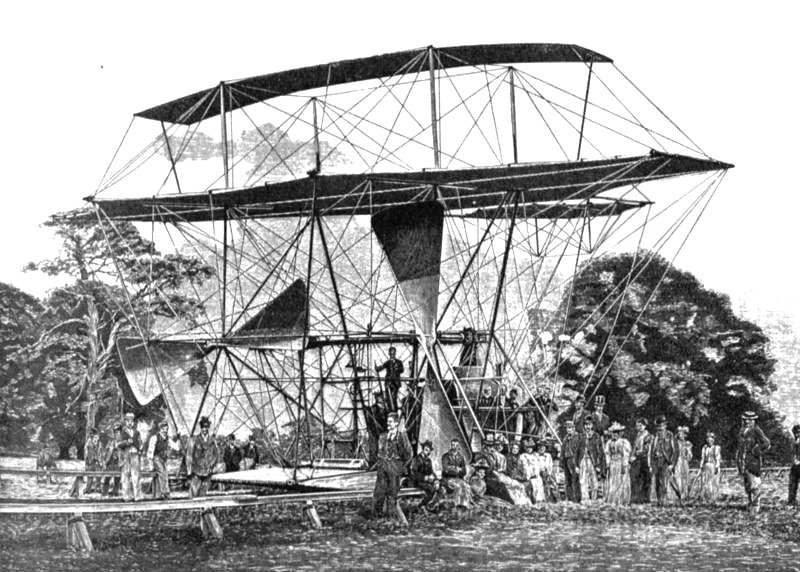
    Hiram Maxim, Sir Hiram Maxim, an ex-pat Yank and a great inventor of things other  than aircraft, certainly did not do his best on his early flying machine.  He built an enormous monument to Steampunk Aerostation, and in that 8,000 pounds of steel wheels and smoke, he completely lost the idea of making a flying machine, concentrating solely on the idea of thrust and lift, consoling himself with the notion of raising a brick from the ground.

    Hiram Maxim sitting with dignatories on support rail by his crashed aircraft, Baldwyns Park, 1894

     I’m not sure that you can disinvent many physical things, although I know that there have been many attempts to do just that , though usually in the fields of human beings doing horrible things to other human beings.  The Soviets I know disinvented untold numbers of people in the plague years of the human stain, Joseph Stalin; so to with Adolf Hitler, who tried to disinvent the Jewish people and the Soviet Union. 

    Hiram Maxim (1840-1916) tried to build a monster that would leave the ground but not actually fly, and he basically did just that, very briefly with very heavy/crashy results. His flying machine was over 100′ wide, had two 17.5′ propellers, room of multiple crew members, weighed four tons, and traveled along guiding railroad tracks on steel wheels. In 1897 it powered  down 1800′ of track before accidently breaking free of its moorings and  rizing briefly above them for a distance of about 100′, which at 40mph would’ve been about 2 seconds of  foot-tall “flight”, causing the crew to shut the engines down and causing the whole thing to crash  And that was that, the end of Maxim’s adventure. It was remembered by him in strange and wonderfully terrible ways in his memoirs, where he claimed that his truly dreadful ideas were those that were used and copied by the pioneers who followed him and who actually created successful flying machines.  That he could remember things in their imagined states with such hopeful clarity is to think of him as providing precisely the wrong blueprints at the right time. 
    http://www.wright-brothers.org/History_Wing/History_of_the_Airplane/Who_Was_First/Who_Was_First_Intro/Who_Was_First_Intro_images/1893_Maxim_Test_Rig.jpg

    In his book, Aviation, an Historical Survey from its Origins to the End of World War II (Science Museum, London, 1970), the insightful, opinionated and occasionally acerbic Charles H. Gibbs-Smith remarked on Maxim’s outlandish maxims on his enormous failure, quoting him so:

    “…the fact that practically no essential departure has been made from my original lines, indicates to my mind that I had reasoned out the best type of a machine even before I commenced a stroke of the work”  (Maxim, Natural and Artificial Flight, 1908)

    Gibbs-Smith writes: “it is hard to imagine anyone uttering more egregious nonsense”, and when you look at the Maxim machine and see its specs and the nil-time spent on what to do with the thing if it ever actually lifted off the ground, you’d be hard-pressed not to agree.  Had people followed his lead, Maxim would have been able to disinvent human flight.  There, I said it.  There’s wrong, and then there’s wrong–and then there is this.
  • A Temple of Texts–Steampunk Victorian Printing Cathedral

    JF Ptak Science Books  Quick Post

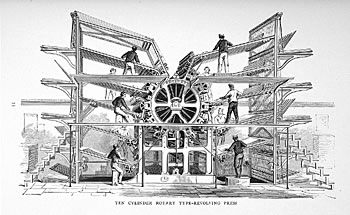
    This is what printing looked like, once upon a time, a great and giant mass, tended by works, massive sheets of paper flying this way and that, smoke from a steam engine drive (somewhere)–heavy, loud. Accurate.  A temple of texts (apologies to William Gass).  The illustration is from Robert Hoe’s A Short History of the Printing Press and of Improvements in Printing Machinery from the Time of Gutenberg up to the Present Day (1902) and exhibits a ten cylinder rotary type-revolving press

    Pritning machine[Source: Harry Ransome Center, here.]

    In addition to being a state-of-the-art (and above that, really) printing press it is in image a generator of metaphors–there’s certainly plenty to go around, even on just a surface investigation of the woodcut.  You can easily see a feeding-the-beast scenario in there–for news or for technology or steam or motion or whatever else), as well as darker interpretations, making the printing press into a spider as well; also, there’s humans being subservient to the god of technology from whom all good things come, and so on.  I’d really just like to feel one of those gigantic newspapers in my hands, fresh off the press…

  • German Decorative Painting in Biedermeier and the New Style (or Jugendstil), 1907

    JF Ptak Science Books   Quick Post

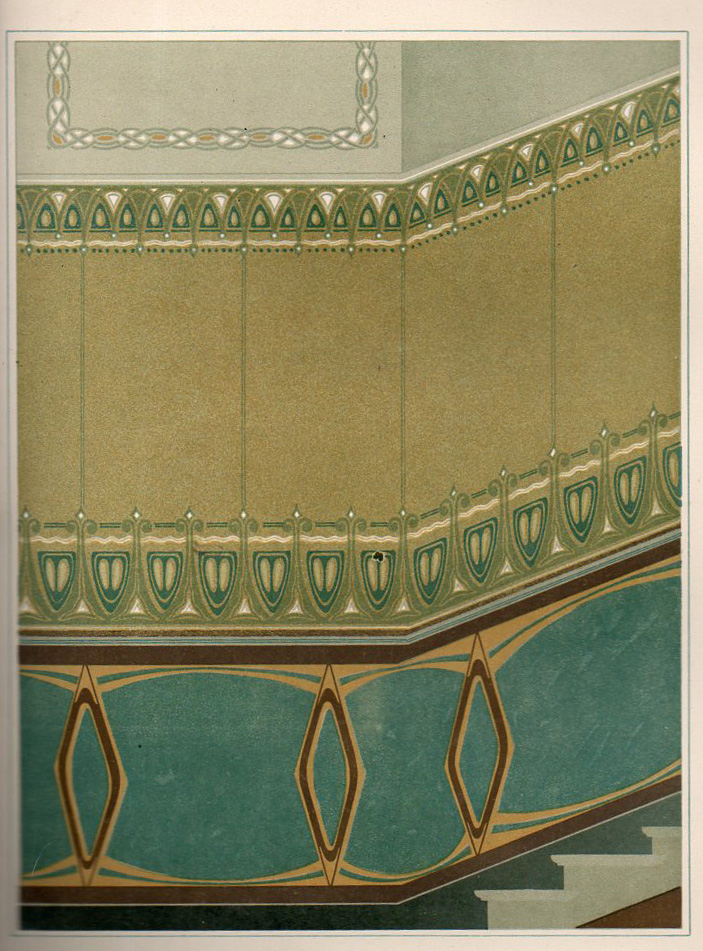
    This beautifully illustrated 1907 German book1 seems to me to be a sales catalog for a company selling flat-masks, or templates, through which desirable and somewhat complicated (or at last complex) painting may be produced.  A customer could leaf through this book of 60 designs which are arranged according to room type, and perhaps, if the fancy struck, could purchase the sheets and instructions necessary for the job to be done.  For example, plate #44 (Reggie Jackson’s number in the great summer of 1977), the “Pause mit Hilfsschablone” (its identifier in the “Preisliste” and offered at 10 Marks) is meant to decorate a wall for a stairway. 

    Jugendstihl361

    The great bulk of the designs are those for ceilings, and ceiling corners, as well as for wall designs and the small bits that run slightly above the floor and the wall (I’m sorry, but I don’t know the technical term for this).

    In any event it is a very surprising work to find–for me, at least–to see someone selling the possibilities of such advanced design motifs in a simple, order-it-from-our-catalog format.  [The catalog is available for purchase from the blog bookstore, here.]

    ·Posted by :

    ·in:

    —
  • Big G’s: Grim & Gross Saturn: Grandville, Goya, Galileo and the German Gnostics

    JF Ptak Science Books  Post 1752

    Blogsaturn_large
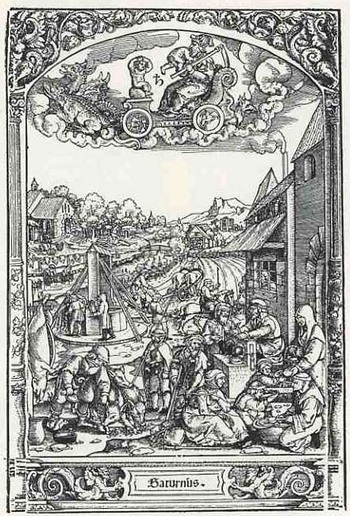
    I was getting ready with what was supposed to be the real post for today when I stumbled upon this woodcut of the Roman god Saturnus.  What makes this image so terrifically compelling is how benign it is—in its weird, mechanical, disinterested observational manner the artist conveys almost nothing about the act that we witness as the god plots his way across the sky in its celestial chariot.  Saturn (equated with the Greek Kronos, and the Titan father of Zeus, and also the name of the gaseous oblate six planet) commits acts of horror, and becomes, again and again, perhaps the greatest coward of the Roman pantheon of questionable deities. 

    It begins with Saturn being told his future:  that at some point in his life his son or sons will supplant him, catch him, replace him and kill him.  And the best thing that Saturn can think to do is to methodically eat his children, and he does manage to consume all but one—Zeus—who then fulfills the prophecy; but then again, who wouldn’t?  There is really very little like this in mythology—and, really, why should there be?
    Blogsaturn_ldetaileating

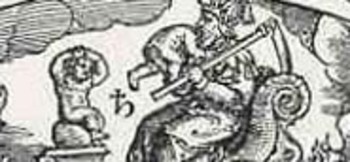
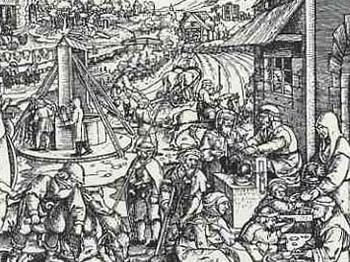
    Our artist—or engraver—is George Pencz (1500-1550), alive and dead very neatly at the century and half-century mark, and his work (“The Life of the Children of the Planet Saturn”) is illustrated in Folge der Planeten .  The image of Saturn racing along with his son’s head in his mouth looks naive compared top the rest of the illustration, which is a very lively, if quiet, depiction of the industry that his dead sons would have applied themselves to if they hadn’t been consumed by their father.  The illustration of Saturn is very disturbing to me, particularly when you notice the son-in-waiting, who is watching his father eat his brother, and in an incredibly pathetic and heart-breaking way is trying to protect himself by holding his head.  I think it is so very moving because it is a perfectly logical (from a child’s point of view) reaction to an unimaginable terror, and perhaps this is how Pencz can best deal with the vile god.
    Blogsaturn_ldetailallegory

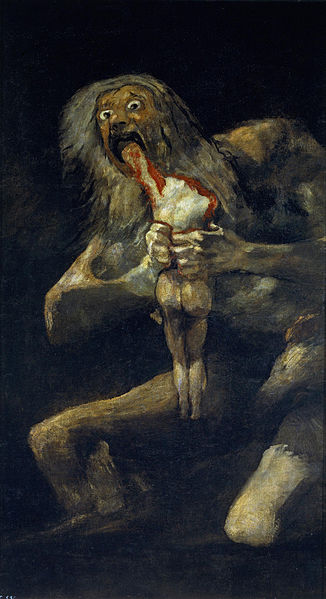
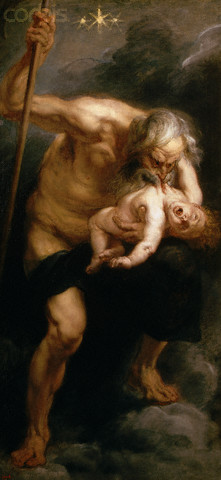
    Images of Saturn really are legion, but there are a host-and-a-half that are pretty upsetting, like the one above, and the one coming, below. I think that the one that is the test against which all others are measured is by Francisco Goya, who during his “black period” painted the truly terrifying image of Saturn devouring his child right on the wall of his house in 1824 (or thereabouts). It really is bad stuff. The scene as painted by Peter Paul Rubens isn’t much better.

    Saturn goya Saturn rubens


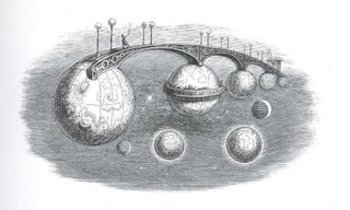
    Admittedly, J.I.I Grandville (1803-1847) didn’t conceive of this series of bridges as a plausible means of interplanetary travel and is in all probability an allegorical creation, but the image does–in an odd way–allow a dialogue on the idea of moving from planet to planet, which was still pretty solitary thinking in the mid-19th century. Although this didn’t have a direct effect on the perception of man’s place in the solar system, it did have a great and direct impact upon a vast number of illustrators and cartoonists who followed in his considerable wake.

    BlogfuturegrandvilleThis image comes from Grandville’s Un Autre Monde, published in 1844.
    In addition to an interplanetary bridge that there is another singular creation here in Grandville’s cosmos–a balcony constructed of the rings of Saturn (if indeed this was supposed to be Saturn–it is as advantageous as not to think of it in this way) and if we think of a balcony being a place to watch and observe, then we are brought instantly to W.G. Sebald’s Rings of Saturn, which is a textural masterpiece, and mostly I guess a novel about everything that Sebald observed in his walk through Suffolk.  (Another Saturn-related work of fiction is Sirens of Titan, by Kurt Vonnegut,  a very mature and insightful 1959 novel which really has nothing to do with anything here; I just needed to throw that in, what with him being a master storyteller, crank and human-caricaturist-observer and all…)  And so by 1844 it comes to pass that one French caricaturist/imaginist comes to draw an extraordinary and impossible land/space bridge between the planets only 234 years after Galileo  first glimpsed Saturn’s “handles”–give the optics of his telescope Galileo didn’t see the rings of Saturn as such, seeing rather two “extra bodies” on either side of the planet  It would take another 65 years and accumulations of observations by some of the greatest names in the history of astronomy (Galileo, Casini, Hevelius, Huygens) to show that the disk (singular) on Saturn was actually a series of rings.  (I should add that the first photograph of Saturn’s rings is not made until 1883.

    Saturn gnosis303
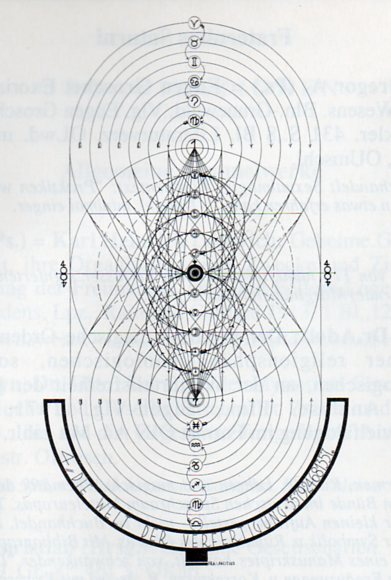
    Which somehow brings me to the troubled world of the “Saturn Gnosis”, the Fraterniti Saturni.  Actually the only place I’m getting to here is a picture (above), which I tried to understand before I realized what it was, and how much of an expanding hocus-pocus (otherwise defined as  “woo woo” in the words of James Randi) rabbit hole of diminishing returns it leads to, a dizzying history of competing complexities and nonsense.  But the image (found in a book edited by Eugen Grosche, (Offizielles Publikations-Organ der deutschen Gross-Loge Fraternitas Saturni Orient Berlin,  1929), comes from a psycho-sexual-astrological-magical group (one of a number of such associations in Germany and particularly Berlin in the 1920’s), and seems no less a part of reality as does Grandville’s Saturn.  Sameness ensues when you try to approximate the volume of limitless emptiness, or belief.

    ·Posted by :

    ·in:

    — —
  • Lost German Color of 1927

    JF Ptak Science Books    Quick Post

    German color375[Part of the series on Color and its Abuses, as with an example of “When Color is Best in Black-and-White”, here.]
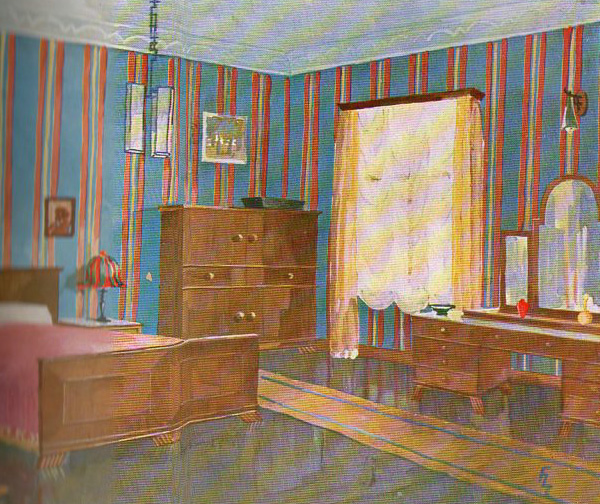
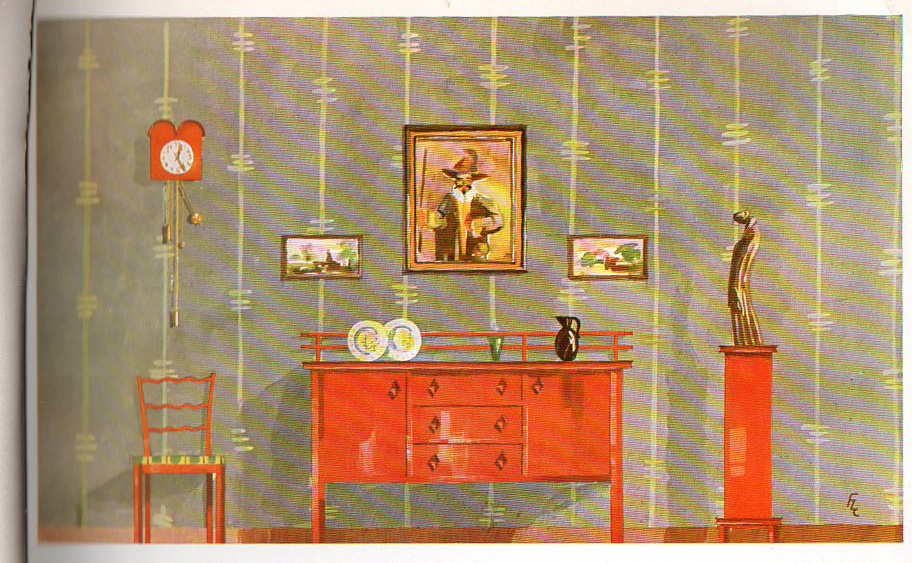
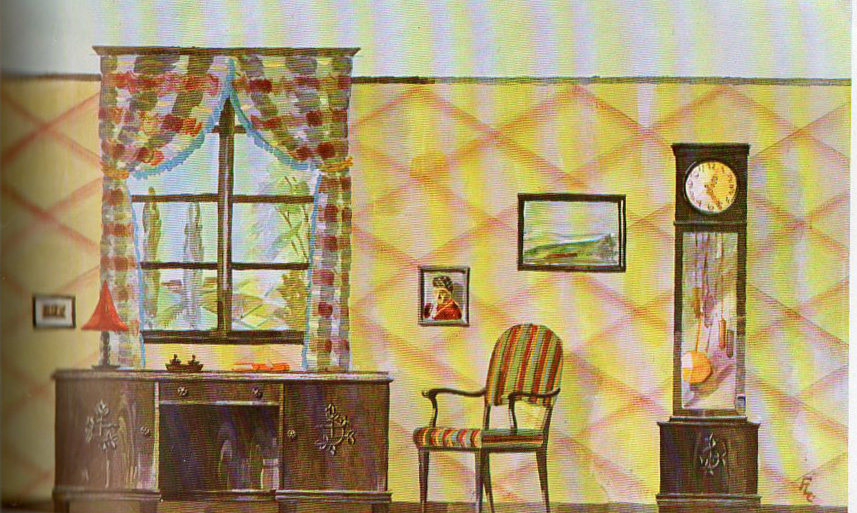
    Nothing quite says no-color as German deep noir of the mid- and late-1920’s.  These movies can be so deep and contrasted, so very black-and-white, with such stark Moon-like shadows, no dawn or dusk just night and day, that it can make you forget that outside of the photographs and movies that people were moving around in great swirls of color.  And nothing quite helps you to remember this than by having a look at a book like one below, a DIY piece printed in Berlin in 1927, the Farbige Wohraume1.

    German color377
    It is of interest here because in addition to blueprints and sections of the furniture to be built, there are associated illustrations showing the completed work placed in a decorated room.  And it just so happens that these rooms are highly, colorfully decorated–not that there’s so much in the room, per se, but there is definitely a lot of color. [This book is available from our blog bookstore, here.]

    German color371

  • The Atomic Crossbow of Leonardo da Vinci

    JF Ptak Science Books   Post 1753

    Leonardo understood “big”, especially when it came to weapons, and he understood what the concept of ‘big” meant to adversaries and enemies of the folks with the “big” weapon—a bit of psych-ops in the mid-Renaissance by the High Renaissance man. 

    Giant crossbow

    Leonardo’s crossbow (drawn around 1486) should have worked. He certainly understood the idea of stored power in his many drawings–bent and twisted and torqued wooden arms and such–and the concepts of enormous potential is certainly reeking through-and-through this fantastic weapon.  The bow itself seems certainly like a laminated object, adding to its strength via flexibility, the giant bow-string drawn back by a very considerable worm and gear, the whole of which is set to give flight to a large stone more so than an arrow. And that stone was supposed to be able to be delivered to its target over and over again, with minor adjustments, which would have placed it head-and shoulders above cannons, whose recoil made it really quit impossible to re-aim the instrument with any accuracy at the same target over and over again.  The main compliment of the crossbow, then, was reproducible accuracies. (In this vein it is interesting to recall “Operation Crossbow”, a Combined Bombing Operations during WWII that took place in 1943 and 1944 against the Nazi installations for the V-2 and V-3 weapons–a directed effort to remove a threat which was even more “precise” (if by “precision” we mean marginally guided weapons loaded with high explosives).)

    The “atomic” part of the title of this post is I know far from the mark of being metaphorically correct–the scale isn’t anywhere near being accurate.  Offhand to have an “atomic” crossbow in relation to a nominally normal crossbow in similar scale of the Fat Man weapon in scale with an “average” 500-pound bomb (40 million pounds in relation to 500 pounds) the atomic crossbow would need to be miles wide. 


  • A Temple of Bricks: London, 1872

    JF Ptak Science Books  Quick Post

    There is almost nothing in this image except for bricks–a few people are in their tiny gardens, and there’s a tiny bit of sky visible just above the train on the railway bridge.  But the medium of the image is brick. And smoke,  and soot.  Sooty red bricks rendered in black-and-white in this homage to the working classes of London, a temple of bricks for the second-generation members and cogs of the industrial revolution, packed together in a neat and orderly and tight way.  By this point, in 1872, there were strong differentiations between the lower middle class and the working poor, and these people below–with their own houses and yards–are the lower middle class and the very backbone of the British Empire.

    This is the work of Gustave Dore from 1872, “Over London by Rail”, as it appeared in Blanchard Jerrold’s London, a Pilgrimage (1872).  It seems that in this collaborative expedition into the city of London that the Frenchman-_Dore–gives us the best view of what life was like then.  The pair set out to document, to record, to observe–Blanchard provides the text, and he does a very good job at seeing and responding to it,m doing so with almost no interior thoughts about causes or reasons.  Dore responds with pictures, and for the most part is a devastating chronicler. 

    Some of the 180 illustrations can be seen here.

  • The Dance of Work: Satires and Grotesques of the Professions, 1700.

    JF Ptak Science Books   Post 1754


    Nicolas de Larmessin (1640-1725) was an enormously creative and productive artist, and in his way created a genre similar to the great and ancient Dance of Death/.Danse Macabre/Totentanz--though his was the Dance of Life. Or perhaps it was something less political and  philosophical, simply showing itself as a Dance of Work,  A Satire of Occupation.  (In the earlier, 14 & 15th century printed version of the Dance of Death, which shows death coming to people of different professions, that the earliest meetings between death and its intended depict death done only in bones, and is relatively scary; later on, moving into the 17 and 18th centuries, death occasionally wears some elements of the profession of the person whom he seeks, giving the expedition a little share of irony or dark comedic relief.  In general, though I find the Wolgement, Holbein, Durer varieties of death-hungry Death to be fairly well off-putting; those later on less so.)

    About 100 of these images from de Larmessin were published over a period of time and in variously-titled works, appearing as Les costumes grotesques et les métiers, and Costumes grotesques and Habits des métiers et professions–maybe they were more grotesques than anything else, or satires.  Nicolas was part of a long family history of the de Larmessin (also L’Armessin) family,  a famous series of generational  engravers and  printers, who worked and functioned in the 17th and 18th centuries.

    To me the devil of his work is in fact in the details, and their accumulations. There very well may be a lot to study in the minutiae of what each profession has hanging to the ends of their clothing–or at least it seems possible that some previously overlooked widget gets a little public airing in one of these images…

    Some of the alphabet of professions treated by de Larmessin include:  Baker, (Boulanger), Basket maker (Vannier), Blacksmith (Ma Brick Mason (Masson), Butcher (Boucher), Chef (Cuisinier), Chest and Box maker (Malletier-Coffretier), Clock maker (Corlogeur), Clothes seller (Fripier), Coffee merchant (Caffetier), Comb and brush seller (Peigné), Comedian (Comédien), Dairy & cheese maker (Laitier), Farm laborer (Labourer), Fisherman (Pescheur), Furier (Foureur), Gardener (Jardinier), Hat maker (Chapellier), Hosier (Bonnetier), Knife and Sissor Sharpener (Remouleur), Locksmith (Serrurier), Leather worker (Ceinturier), Miller (Meusnier), Money changer (Monnoyer), Maker of table games (Tabletier), Perfume maker/seller (Parfumeur), Playing Card printer (Cartier), Plume and feather seller (Plumassier), Plumber (Plombier), Printer (Imprimeur), reschal), Saddle maker (Sellier), Second-hand Shoe maker (Sauetier), Tailor (Tailleur), Wheel wright (Charron), Wild Game chef/seller (Rotisseur), Wild Game chef/seller (Rotisseur),Wine merchant (Cabaretier), Wine maker (Vigneron).

    Source for all following images:  Live Journal

    But before proceeding any further, I must at least make reference to another master in this field, an earlier, perhaps revolutionary figure, Arcimboldo (1527-1593), who produced royal portraits composed entirely of fruits and vegetables, as so:

    http://www.lessing-photo.com/p2/400706/40070643.jpg

    The people and professions portrayed by de Larmessin are “people” underneath it all; with Arcimboldo its fruit and veggies all the way down, just like with the Dance of Death, there’s nothing beyond the bone but disappeared bone.  

  • Digital “Computers” 1450-1750: Memory and Calculating on the Fingers and Hands

    JF Ptak Science Books   Post 1755


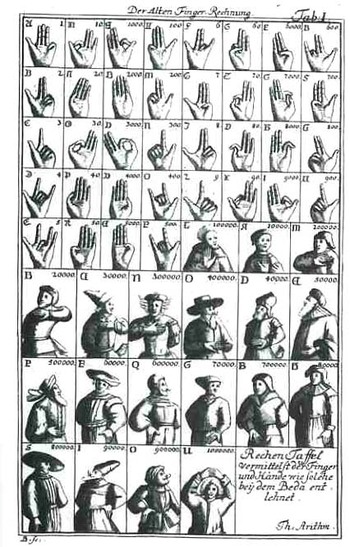
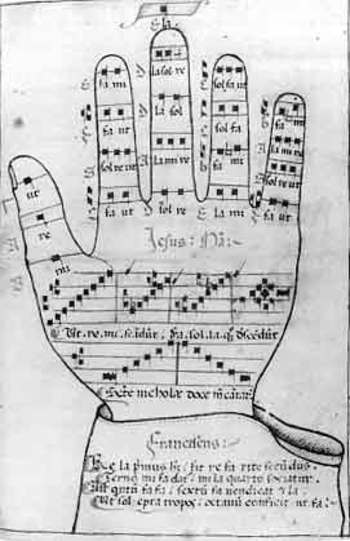
    Bloghands_memory072_2    
    These lovely images weren’t intended to show people living in the Renaissance and Baroque eras how to actually record data on their hands—they were intended rather as templates to show how they could use their fingers and hands for calculating and as memory devices.  Much like Frances Yates has shown us so beautifully in The Art of Memory and how info and data was stored in imagined and compartmented palaces in the mind (relying upon images), the hands were also used as a theatre of memory in addition to extended calculation. 

    These mnemonic devices were necessary—especially during the Renaissance—because of the general lack of and access to affordable vellums or paper and writing instruments.  Having notebooks filled with memoir or history o calculation was generally not something that was happening for even the not-wealthy but not struggling class.  These mental images were used widely in the areas of religion, palmistry, astrology mathematics, astronomy, astrology, alchemy, music, and other such fields. 
    Bloghands_big074_3
    The first image (from a German manuscript) of the hand-theatre was found and deciphered by Claire Richter Sherman (Folger Shakespeare Theatre) and is religious in nature, an intentional piece of memory for the devoted and for devotions.  The needs of religion were splayed out as the hand was opened and fingers flexed, and working from thumb to pinkie, from finger tip and joint—“do God’s will, examine  your conscience, repent, confess”, and so on, and above all be content with your lowly penitente stature.  If there were 28 of these admonitions or reminders at different points of the hand and you memorized them all, it would be a much simpler time to recall and keep them in order if you merely had to touch a part of your hand where that memory should be to invoke what it was you were supposed to do.  Therefore you could theoretically cast about with your creator with your hands in your pockets—if you had pockets. 

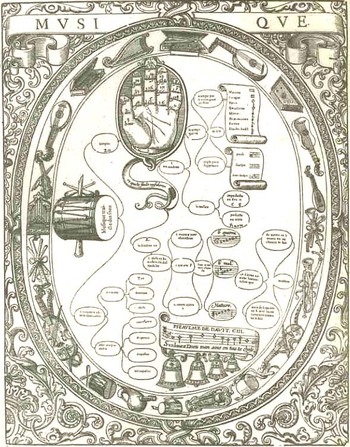
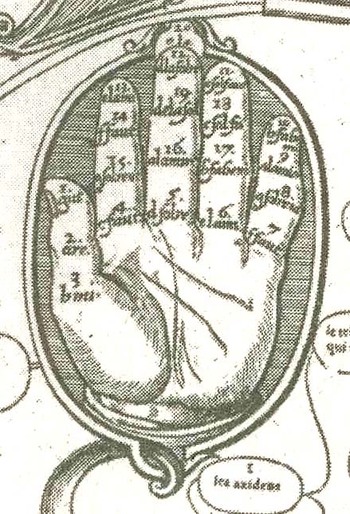
    The next two images (including the enlargement of the hand section) are from a work from 1587 entitled Musique and are attributed to John Cousin the Younger (1522-1597).
    The basic premise for this device—it seems to me—was to be able to order the different chords of 20 different instruments. 
    Bloghands070_2
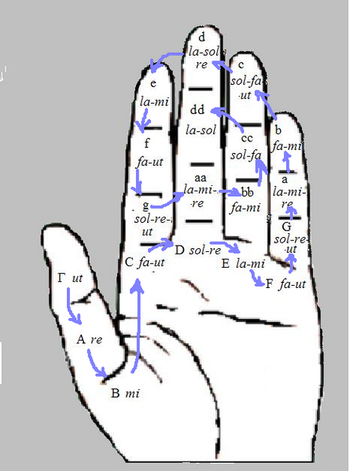
    Another musical hand mnemonic was the Guidonian hand, a survivor of Medieval times, and possibly named after Guido of Arezzo (a musical theorist), and was an aid to singers learning to sight sing.   

    The entry for the Guidonian hand in Wiki explains it use rather well:  “The idea of the Guidonian hand is that each portion of the hand represents a specific note within the hexachord system, which spans nearly three octaves from “Γ ut” (that is, “Gamma ut”) (the contraction of which is “gamut”, which can refer to the entire span) to “E la” (in other words, from the G at the bottom of the modern bass clef to the E at the top of the treble clef). In teaching, an instructor would indicate a series of notes by pointing to them on their hand, and the students would sing them. This is similar to the system of hand signals sometimes used in conjunction with solfege…”
    Bloghands_bodies071
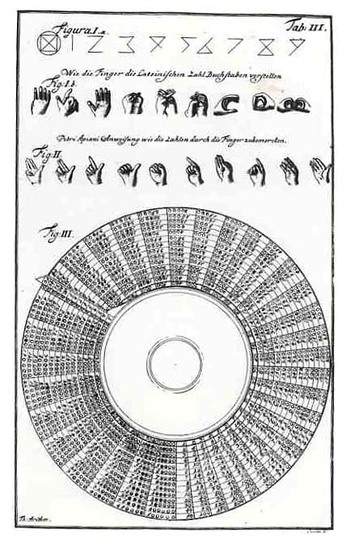
    The final two examples come from Jakob Leupold’s  (1674-1727) Theatrum Machinarum (1724)—this was a complex work involving nine sections and addressed the theoretical  aspirations of engineering (load, flexure, that sort) and its applications to its daily practitioners.  In one section of the book he sought to explain the connections (and correlations) of hand motion and symbolism to the origins of the number systems, carrying it out further still into body language, so that two people conversant in these symbols could talk and bargain between themselves in economic/body terms.  Barbara Maria Stafford, in her Artful Science, Enlightenment, Bloghand_guido

    Entertainment and the Eclipse of Visual Education (1994) points out the long history of this tradition, and that it reached far back into misty time:  Leupold knew that Appian, the Venerable Bede, and Aventinus had been fascinated by manuloquio, or natural language with the hands.  He thus linked counting to a global….medium of prearranged gestures…”

    Bloghandguido_2_2

    ·Posted by :

    ·in:

    —
  • French Humorous Menu Postcards

    JF Ptak Science Books   Quick Post

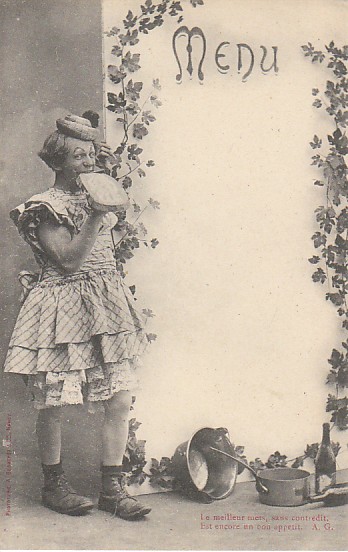
    I’m not sure where the need came from for these turn-of-the-century French photographic postcards to exhibit a blank “menu” possibility to the recipient.  Maybe it was a dinner invitation, or perhaps it was just a card poking fun at fun.  I really don’t know–perhaps someone will be able to put one of these to use for their next dinner party? 

    All are from the charming Fantaisies Bergeret site, here.

    http://fantaisiesbergeret.free.fr/images/menu_05.jpg

    ·Posted by :

    ·in:

  • On Time’s Arrow and Change: the Death of Silent Movies

    JF Ptak Science Books  Post 1755

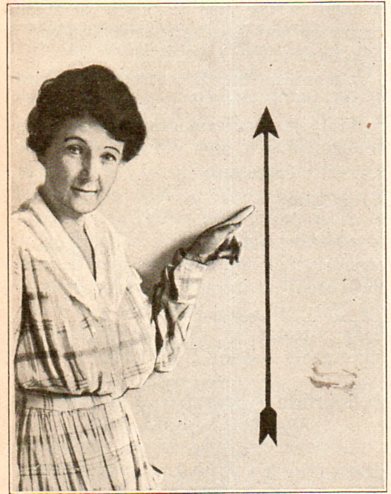
    Arrow382Few people who know about Tomas Kuhn would think that the true benefactor of the idea of the structure of scientific revolutions was Ms Midge Flep, seen here in a 1920 photograph next to her famous arrow.  Ms. Flep, who always maintained that she was “never a head for schooling” did however think large thoughts, culminating evidently in her procedural banquet of what happens with change and time, and written famously of course on a series of large black paper and wooden arrows.  “The nice thing about writing on wood” said Ms. Flep, “is that you can get your ideas down before the wood even gets turned into paper”.  Her main and evidently much-copied thesis is that “big change like in big events are big”, and that “time will like an arrow will fly” somewhere, usually getting where it was going, “as arrows do, Mr. Zeno notwithstanding”. 

    This of course is not a true story, but it was the best I could do for this fantastic, high non sequitur found-photograph.

    It does remind me of fast change, though–not in viewing the image exactly but in writing the nonsense about it. 

    Revolutions in science and in all sorts of other things does sometimes take sometime and great effort to find its way through the world.  And sometimes, though not rarely, monumental changes in theory and technology and delivery systems find near-instantaneous reception, finding its universal spot very quickly.  Ms. Flep-Bent’s arrow would have been deflected almost not-at-all in the case of the successful application of sound-on-film technology and its application in making movies–the effects of these changes were felt immediately at the Bijou, with a near-complete turnaround from one state of affairs to another (silent film and talkies) in only three years or so. 

    Look:  people had been messing around with sound and cinema for decades, basically from the start of the mass exhibition of movies–results of these efforts up to the early 1920’s were poor.  Enter the prolific and brilliant and problematic inventor and non-businessman Lee de Forest and the application of his audion in November 1922, when he established his De Forest Phonofilm Company at 314 East 48th Street in New York City.  This was the true beginning and some very fierce and fast competition for sound-on-film motion pictures, which developed along the strengths of the RCA Photophone and Warner Bros Vitaphone, which basically left de Forest’s Phonofilm in the developing dust. 

    Fast forward through the technical part, sound-on-film motion pictures iconically took center stage with Al Jolson’s The Jazz Singer on 16 October 1927.  The movie went box office boffo, setting records all alog the way, and the studios began producing talkies at a prodigious rate–in the first two years after the Jolson film the only thing keeping the monumental change away from silent films was the rate of changeover in the theatres themselves as they upfitted to the new sound and projection systems.  the result of all of this:  1927 was the absolute zenith for silent films; by 1930 Hollywood produced 335 sound films and 175 silent films; in the next year, 1931, only two silent films were made.  The change was complete.

    Sound changed everything, not the least of which were the careers of actors whose voices turned out to be unacceptable for whatever reason–nasal tons, high pitch, accents and so on doomed many a silent star. Also the idea of “acting” was tremendously affected–“overacting” gave way instantly to subtlety, now that actors no longer needed to act as though they were listening to something.  Now they just did so, and the audience didn;t need the explanation, as they were experiencing the sound as well, right at the same time.   But the big deal is that the fates changed dramatically for writers, who became important.  Now that all sound was available and didn’t need to be described in pantomime or an occasional text card, the stuff of the script became extremely significant, especially the new thing:  dialog.


Recent Posts

Archives

Categories