A Daily History of Holes, Dots, Lines, Science, History, Math, Physics, Art, the Unintentional Absurd, Architecture, Maps, Data Visualization, Blank and Missing Things, and so on. |1.6 million words, 7500 images, 4.9 million hits| Press & appearances in The Times, Le Figaro, Mensa, The Economist, The Guardian, Discovery News, Slate, Le Monde, Sci American Blogs, Le Pont, and many other places… 5000+ total posts since 2008.

  • 1902’s Women of the Future Trading Cards

    JF Ptak Science Books   Quick Post

    Again from the interesting and charming La Boite Verte website I’ve found an interesting suite of French photographic postcards.  This set concentrates on the possible occupations of women in the  future (“avenir”/”future”), and printed in 1902 by A. Bergertet in Nancy, France.  The images are slightly odd, most tbeing a little on the “swimsuit issue” side, but then again not without the women exhibiting a kind of coy pride in spite of what they looked like.  In spite of the attire, the women depicted as the “general”, the firefighter (“pompier”), student (complete with a jauntily-held cigarette), and the sailor (“marin”), for example, are all taking their future positions seriously, even though their uniforms have been arranged for a 1902 man’s viewing pleasure. 

    Its interesting to see that seeing into the future of professions and callings for women didn’t habe to “see” all that far, with all of the professions being attained within the next 50-75 years. Of course the pay is largely still not same for women as it is for men, nor is women’s percentage share (for most) anywhere close to a proportional share, but it is a good start. 

    [Image Source: Le Boite Verte and Fantasies Bergeret]

    les femmes de lavenir phototypie bergeret 13 Les Femmes de lAvenir   1902

  • Designs in Flowers, 1635

    JF Ptak Science Books   Quick Post

    This lovely, and short, pamphlet was published by Baltazar Moncornet in Amsterdam in 1635 as Livre de fleurs et de feuilles pour servir a l’art…Dessins de fleur pour orfeverie, with designs by Francois Lefebvre. Slender and tall, there was an engraved title followed by five plates for the entire production.  It is a very fine work, hard in detail, and worthy of close inspection.

    http://www.beauxartsparis.fr/ow2/catzarts/images/BIBMasson2911_02-60494.JPG

    ·Posted by :

    ·in:

    —
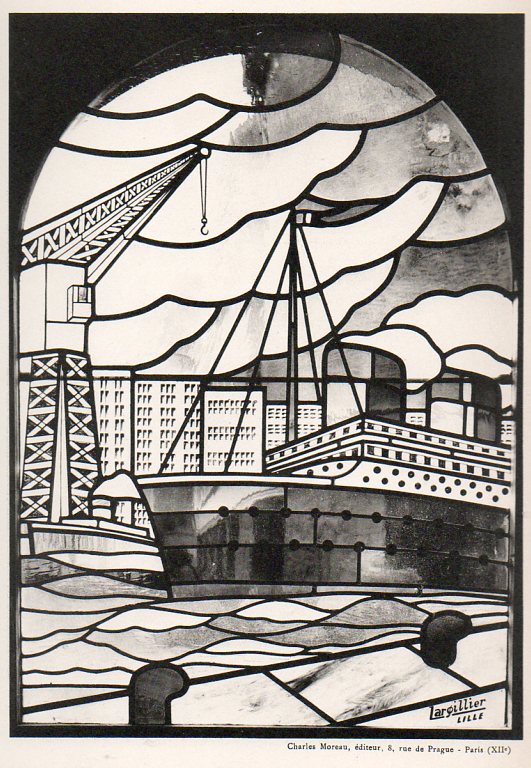
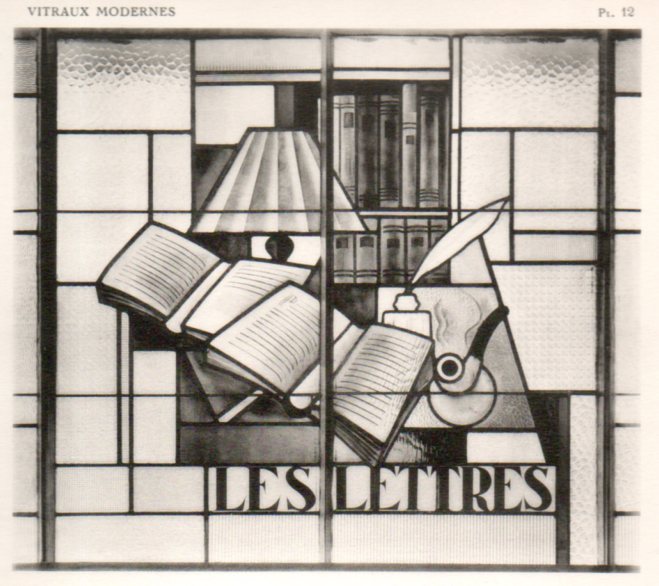
  • Modern Stained Glass Windows–Secular Work, 1937

    JF Ptak Science Books    Quick Post

    Stained glass424

    I was browsing this very interesting book on an exposition of modern art (1937) which concnetrated on the stained glass windows.  I’ve reproduced a number of the secular images below, some of which are unexpected and remarkable:  there are images of jazz players, a portrait of Babar, steamships, laborers, racehorses, factory workers, and the like.  [The work:  MALLET-STEVENS, Robert. Exposition internationale de 1937. Vitraux modernes. Avant-propos de Paul Léon. Paris: Charles Moreau, 1937. Portefeuille in-4 (320 x 250 mm). 48 fine plates reproducing the work of  Décorchemont, Maumejean, Cingria, Robert Delaunay, and others. “L’Exposition de 1937, qui nous montre la ‘généralisation’ de l’architecture moderne, nous offre quelques vitraux de tout premier plan… Quand l’architecte voit dans l’espace des volumes bien ordonnés, le peintre verrier trace des lignes et oppose des couleurs heureuses… Je n’oserai dire que l’architecture moderne est en plein progrès, mais je puis affirmer que le vitrail ‘va très bien’!” (Robert Mallet-Stevens, Introduction).]

    The portfolio of images is available at our blog bookstore, here. 

    Stained glass414

    ·Posted by :

    ·in:

    —
  • Drop-Dead Gorgeous Flying Man/Ornithopter Patent Drawings, 1889

    JF Ptak Science Books    Post 1746

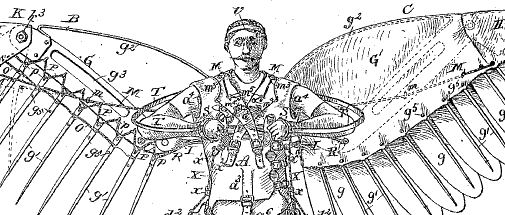
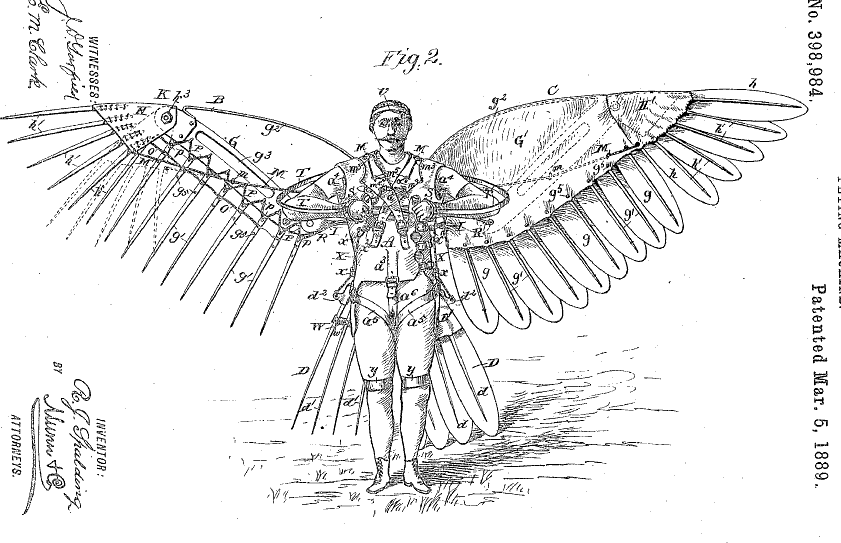
    This is one of the most appealing sets of “flying” or manned aerostation patent drawings that I have seen in the USPTO collection for the 19th century. The machine is a human-powered ornithopter, applying the structure of a human against that of a bird, and outfitting the flyer accordingly to combat their human weaknesses as adapted to bird flight.  Needless to say, and in spite of the beauty of the thought, this arrangement was destined to deep failure.  (The patentee, Reuben Jasper Spaulding, of Rosita (“Little Rose”), Colorado (south of Pueblo), may have been the same Reuben J Spaulding who made the first gold strike on the Blue River on Colorado’s Western Slope in 1859.)  Spaulding’s design is interesting also for the balloon device for getting the aero pioneer off the ground. 

    [Source:  Google Patents (and also for the extensive annotations for the images).]  I note that there was a model constructed for this patent–I’d love to see that.

    Patents--spalding flying_edited-1

    Patents--spalding flying

    And along this same vein of ornithopter-y thought is this, another American solution to the man-bird-mechanical-flight continuum, produced a dozen years earlier–it is similar, though not nearly as glorious (at least in presentation) as the later Spaulding effort: 


    The work really ins’t quite as awesome as Spalding’s beautiful Lazarusian resurrection, and not as detailed, but still quite interesting:


  • The Death Ray and Cloud Writing–Battlefield to Breakfast in a Few Short Years.

    JF Ptak Science Books  Post 1749  [Part of the Strange Things in the Sky department.]

    The Death Ray is a long-discussed idea, extending back as far to Archimedes at least–discussed, attempted, abandoned and dismissed.  But as a matter of fact, the thing was actually invented, and deployed, though not int he sense of an EM weapon, or LRAD/ultrasonic, or Teller x-ray laser, or even a Wellsian heat ray (below).

    File:Alvim-correa12.jpg

    The “Death Ray” made its appearance in the 1880’s, but not in the normal sense of what we would today think of as a “weapon”–this death ray could locate the enemy hidden miles from the front, or pick out ships at sea far from shore, and so on, removing stealth capacity, making it possible for these elements to be identified as targets, and then possibly removed, though not by the ray itself. 

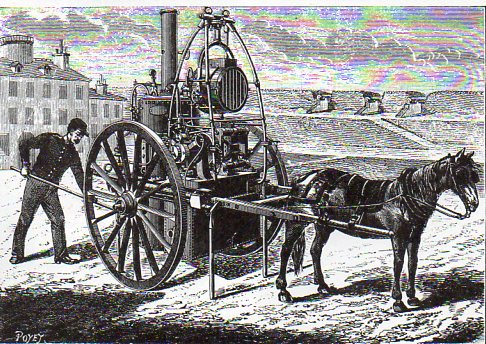
    This “death ray” was the search light.  In the 1880’s when the technology of electric lighting was still in its first practicable decade, the idea of being able to focus a beam of light from a lantern source hauled on a single-mule carriage and powered by an on-board battery, small steam engine  and Gramme dynamo was a spectacular. achievement. 

    Searchlight359
    [This image appeared in the Scientific American in 1886 and features what is probably a one-foot diameter mirror, making it capable of illuminating an object up to about a mile away.  Something with a three-foot diameter could work its magic on object up to four miles away.]

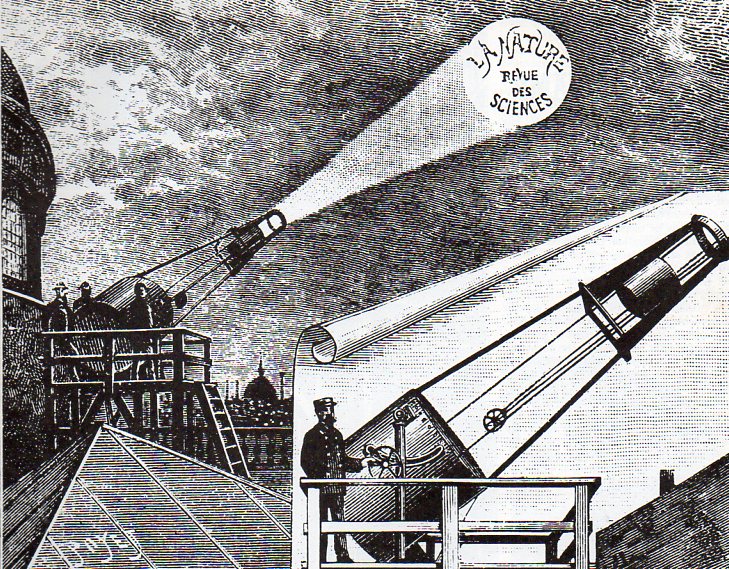
    This defensive/offensive weapon/device was very soon afterwards made into a trickle-down appliance that was placed into commercial use almost immediately.  The standard use of course would be upgrading lighthouses, but one special use was using a large mirror in a device to project an advertisement on the clouds in a city–ads in the sky.

    Searchlight360[Source, La Nature, 1894; also reprinted in Scientific American in the same year.]

    Such a device was used experimentally at the Columbian Exposition in Chicago for the World’s Fair of 1893, flashing the daily attendance on the clouds.  I’m not sure why the greater revenue-generating employment of this technology took another year to develop.  And so “The Death Ray”, from Battlefield to Breakfast Cereal in a few short years. 

  • A Few Examples of “Heavy Stuff”: Patent Drawings for Flying Machines, 1877-1900

    JF Ptak Science Books  Quick Post

    This is as beautiful as it is heavy; and it is in its way very beautiful, so I guess that also means that is is very heavy…

    And speaking of heavy, this balloon doesn’t seem large enough to lift the very heavy ship-like carriage:

    Another flying boat:  I don’t see a power source to drive the “fans”/propellers on this one, though there is a tail for its “kite” body:

  • Titanic Understatement on (1) “A” Big Bang and (2) “The” Big Bang

    JF Ptak Science Books   Post 1748  (An expansion of an ealier post from 2008)

    The soft-sell of the generally recognized and understood propositions, stepping well around the main, central, controlling issue, hinting broadly along its perimeters, defining the emptiness by its shell, left to an undistinguished recognition, is what we’re hunting here.

    I have two examples of extreme examples of understatement occurring at the beginning and end of things—all things.

    The first understatement–“the” Big Bang of the title–that we will look at here belongs in the last paragraph of the seminal paper by Edwin Hubble and Milton Humason, writing an extension and refinement (and adding much more data) on the “discovery” of the Big Bang as they defined the Red Shift, which was actually a roughly proportional increase of distance traveled to red shift. They plotted a trend line for 46 galaxies and in 19291 formulated the empirical Redshift Distance Law of galaxies, which is today known as Hubble’s Law, which was consistent with the solutions of equations of GRT. (This momentous discovery was cheered by the normally non-cheering astronomy community in unusually verb-y ways, such as with the statement made by W.S. Adams, (director of the Mt. Wilson Observatory), who said that thee Hubble/Humason effort was “the most ambitious project astronomy has ever undertaken…maybe (the) research will reveal the very edge of the universe”2.
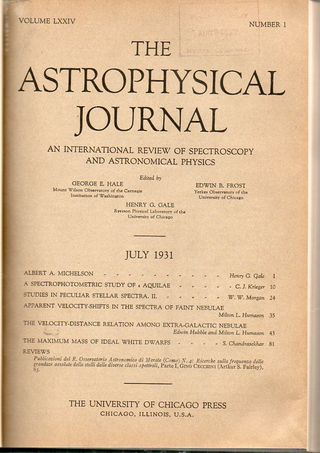
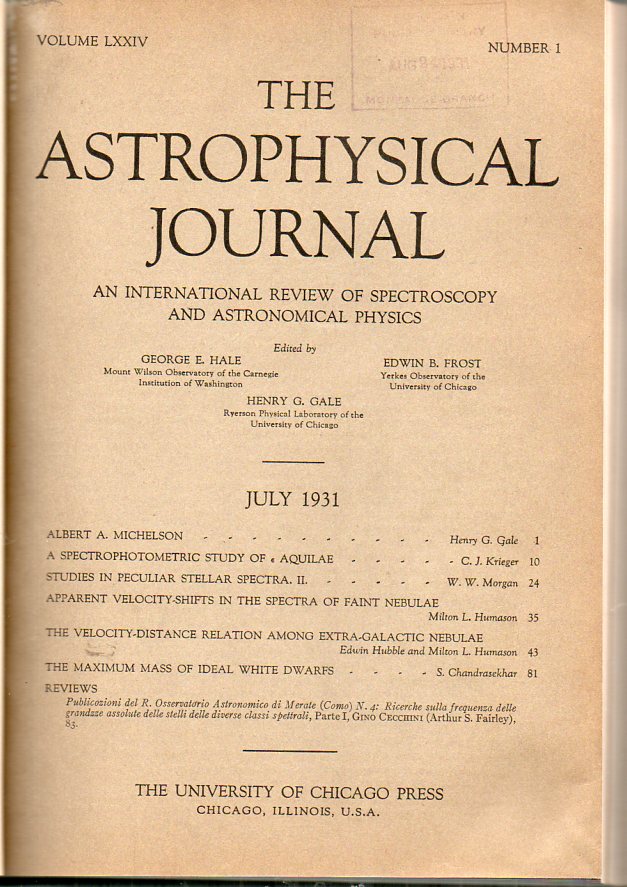
      Hubble358It is in a further report on their studies in The Velocity-Distance Relation Among Extra-Galactic Nebulae (The Astrophysical Journal, July 1931, full text here) that Hubble and Humason react to and answer questions that arose from their 1929 paper, and also incorporate much new data.  As a matter of fact, they managed to “spectacularly extend the linear relationship”3 to a speed of 20,000 kps, and also to an estimated distance of about 100 million light years, this by using many more points in the 1931 diagram.  This was the further proof needed to strengthen the existence of a linear redshift-distance relation, and it appeared in this “promised sequel”4 of the 1931 paper. 

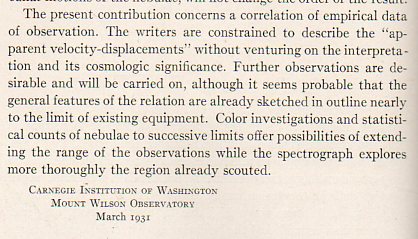
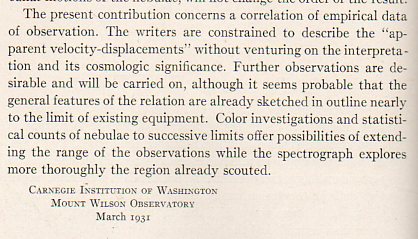
    It is in the 1931 paper that Hubble and Humason make their stupendous understatement: regarding their understanding of the phenomena and the expanding universe. They take many steps back, and say in the concluding paragraph “the writers are constrained to describe the apparent velocity-distance displacements without venturing on the interpretation and its cosmological significance”. They basically lay out the functioning of the universe and the best understanding of how we got to where we are in the cosmos (Vesto Slipher notwithstanding), and how according to their understanding that the universe is expanding and is consistent with all known laws, that they decide to not say anything, um, philosophical.
    Hubble357
    And so, in the last paragraph of this paper discussing the Great Alpha, the authors decided, in their modest and terrifically understated Bartlebian way, to not comment.

    The second example of tremendous understatement occurs in a report discussing the Great Omega, and how in the end the end might actually be avoided. Written by Joseph Coker, Chief of the National Resource Evaluation Center in the Office of Emergency Planning in Washington, D.C. in April 1965 (100 years to the month after the end of the U.S. Civil War), “NREC Programs for Gaming the Logistics of National Survival” is by its very title and appearance a startling looking and sounding document. Coker and his NREC worked within the Executive Office of the President (LBJ at the time), and his paper concentrated on a succinct appraisal of the existing gaming programs looking at survival of all aspects of the national life in the days following nuclear end-game.
     

    Blogalphaomega_2025  

    In general the document is as dry and cardinal as bagel toast—it warms quickly and invisibly, however, and that bagel toast becomes a burnt and invisible cinder via Coker’s prose.

    The document wastes no time in getting directly to vast understatement, and stays there. In chapter one “Logistics of National Survival”, the second chapter opens:

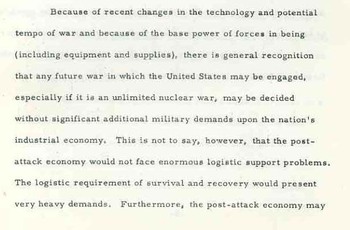
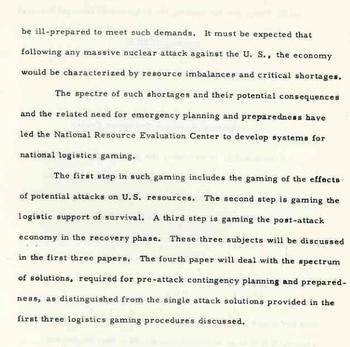
    “Because of recent changes in the technology and potential tempo of war and because of the base power of force is in being (including equipment and supplies), there is general recognition that any future war in which the United States is engaged, especially if it is an unlimited nuclear war, may be decided without significant additional military demands upon the nation’s industrial economy.” Hmm. He continues: “That is not to say, however, that the post-attack economy would not face enormous logistical support problems.” There is no human element of this equation. “The logistic requirements of survival and recovery would present very heavy demands.”
    Blogalphaomega_3_2026

    “Very heavy demands” reaches a very great height of understatement. How high is high? I don’t know. Remember: Mr. Coker was Chief of this division and working within the Executive Office. This was thinking at a very high level.

    He continues in this same paragraph: “Furthermore, the post-attack economy may be ill-prepared to meet such demands”. The paragraph ends in a tremendous horizontal soar: “It may be expected that following any massive nuclear attack against the U.S., the economy would be characterized by resource imbalances and critical shortages (italics our’s). 

    Coker’s papers meant to remedy the approaches to these “imbalances”. The NREC was up and running with ideas and computing fire—in the form of the CD 3600 computer and FORTRAN—to develop a “damage assessment system” called READY that would replace the existing programs named, with no evident imagination, JUMBO, STREAK and DART.

    Throughout this entire document there is no mention of overwhelming, catastrophic death and/or obliteration of the social structure, except that it must be implied that there must be “someone” to operate the essential industries that must be brought back on line.

    Curiously there is a discussion about the survivability of the Federal Reserve and the banking system. My guess is that in the ensuing giga-tons of holocaust of flame that paper money didn’t burn along with its human holders.

    Notes:

    1.  Hubble & Humason,  A Relation Between Distance and Radial Velocity Among Extra-Galactic Nebulae…  Mount Wilson Observatory,  1929.    Contributions from the Mount Wilson Observatory No. 427

    2.  David Harland, The Big Bang, Springer, 2003. 

    3. R.W. Smith.  “The Origins of the Velocity-Distance Relationship”, in Journal for the History of Astronomy, volume 10, p. 133, 1979. 

    4.  _____.  Page 136.

    ·Posted by :

    ·in:

  • An Early–and Patented–“Flying Saucer”, 1898

    JF Ptak Science Books   Quick Post

    This magnificent flying thing was perhaps among the earliest of its kind, at least according to shape, which as we can see really wasn’t quite a flying saucer,, though it was a flying disk.  And a big one, at that.  From the ladder that led to the major axle we can infer that the aircraft was at least 60 feet high, which made its disk apparatus a very ferris-wheel-like 40′ or 50′ in diameter.  If nothing else, the patent drawings are quite pretty.

  • A New Miniature, TV-size Computer: the Leprechaun, 1957

    JF Ptak Science Books   Quick Post

    “Leprechaun, an Automatic Digital Computer the Size of a Television Set”  was a short article written for Computers and Automation in the July 1957 issue.  It is uncredited, by the two-pager I think was the product of the editor, Edmund Berkeley, and discussed a remarkable new computer that was as “small” as a not-by-today’s-standards small television set.  The Leprechaun used seriously fewer components than a “regular” machine (though that standard is not identified), using “only about 9,000 electrical components”, half of which were transistors).

    Leprechaun represents a significant advance in computer design, with its innards very reachable and accessible, making it a highly useful tool for testing other components for other machines. The TRADIC (for TRAnsistor DIgital Computer or TRansistorized Airborne DIgital Computer) was also the first transistorized computer in America, completed in 1954, and the godchild of  J. H. Felker of Bell Labs for the for the U.S. Air Force, and was initially designed for use aboard an aircraft or a naval vessel (making it the first airborne transistorized digital computer). The idea of the manageably-sized computer had only recently lifted itself from science fiction thoughts of it being able to fit in the trunk of a car (as envisioned somewhat earlier by Isaac Asimov) and here we see it, already in the future-made-present, miniaturized to the size of a television set.

    ·Posted by :

    ·in:

  • The Computer (mostly Ads) on TV, 1955-1986

    JF Ptak Science Books, Quick Post

    Here’s a selection of nine early television spots for computers and computing…and calculating.  The piece on the coming Internet (1969) to me is the most interesting:

    Mid-1950’s and how engineers build computers:

  • Hobo Signs Map, 1870

    JF Ptak Science Books   Post 1750

    Bloghobo_b200

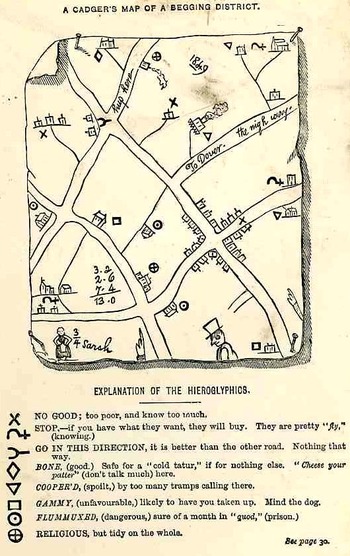
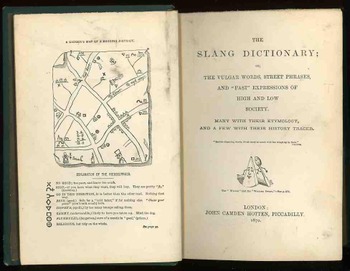
    This is the frontispiece to the delightful work with the luscious title of The Slang Dictionary; or, the Vulgar Words, Street Phrases and Fast Expression of High and Low Society… printed in London by John  Camden Hotten, in 1870.  It is a hobo or “cadger” (“a  mean or vulgar fellow who would rather live on other people than work for himself”)  map (or the map of “a tribe of vagabonds”) of Maidstone, in Kent, drawn by a “screever” (a sidewalk chalk artist who normally would draw religious images for money), and showing the various chalked and etched signs that the hoboes (“and other mendicant marks”)  would leave for one another, being a key to the town, for what was practicable, safe, dangerous, and the like.

    Recorded antiquarian hobo and tramp symbols like these are really quite rare, given their ephemeral nature to begin with; of course the need to record these obscure signs by polite society was not on a high order.  There are many indications that signs such as these existed, but not many illustrations.  For example in the book The Triumph of Wit; or, Ingenuity Display’d in its Perfection, edited by John Shirley. (1724), as well as works by Holyland and Borrow there is a description of English gypsies and their travels, and a short description of their use of boughs and sticks, set out for each other, so that a duplication of effort by different bands or families would not occur.

    (The figure of the woman, wonderfully named “3/4 Sarah”, probably connects this Sarah to a sort of popular dance.)Bloghobo_a199_2

    Hotten also published the following interesting and title-bending work in 1874:  THE ORIGINAL LISTS OF PERSONS OF QUALITY;  EMIGRANTS; RELIGIOUS EXILES; POLITICAL REBELS; SERVING MEN SOLD FOR A TERM OF YEARS; APPRENTICES; CHILDREN STOLEN; MAIDES PRESSED; AND OTHERS WHO WENT FROM GREAT BRITAIN TO THE  AMERICAN PLANTATIONS 1600-1700, WITH THEIR AGES, THE LOCALITIES WHERE THEY FORMERLY LIVED IN THE MOTHER COUNTRY, THE NAMES OF THE SHIPS IN WHICH THEY EMBARKED, AND OTHER INTERESTING PARTICULARS.

Recent Posts

Archives

Categories