A Daily History of Holes, Dots, Lines, Science, History, Math, Physics, Art, the Unintentional Absurd, Architecture, Maps, Data Visualization, Blank and Missing Things, and so on. |1.6 million words, 7500 images, 4.9 million hits| Press & appearances in The Times, Le Figaro, Mensa, The Economist, The Guardian, Discovery News, Slate, Le Monde, Sci American Blogs, Le Pont, and many other places… 5000+ total posts since 2008.

  • Letters Inscribed in the Sky: Gaffarel, Kircher and Curious Ideas

    JF Ptak Science Books    Post 1905
    Alphabet Hebrew sky806

    Could we satisfy our selves in the position of the lights above, or
    discover the wisdom of that order so invariably maintained in the fixed
    stars of heaven……we might abate…..the strange Cryptography of
    Gaffarell in his Starrie Booke of Heaven. 
    Thomas Browne1 (1605-1682) in his major Hermetic effort, The Garden of Cyrus, or The Quincunciall Lozenge, or Network Plantations of the Ancients, naturally, artificially, mystically considered (published in 1658).

    The Garden of Cyrus is a neo-Pythagorean insight weaving together all manner of visions in nature and art, and the art of nature and vice versa and so on, all tied up in universal thinking about these intersections in terms of the great quincunx patterns and the number five and it various variants in terms of latticework and the figure X. 

    Quincunx


    “What is more beautiful than the
    quincunx, that, from whatever direction you regard it, presents straight
    lines?–
    Quintillian’s Institutio Oratoria VIII.3.ix

    The Browne quote relate to the work of J. Gaffarel, who saw connections in art and nature quite literally in the structure of the heavens, among other places–but it is his “star-writing”  that I’d like to address a bit here.  His provocatively-titled Curiositez inouyes sur la sculpture talismanique des Persans, horoscope des Patriarches et lecture des estoiles  (“Unheard-of Curiosities concerning Talismanical Sculpture of the Persians, the horoscope of the Patriarchs and the reading of the Stars”) was published first in 1629 and then many times thereafter well into the 18th century.  Garrafel (1601-1682) presented to the world a wide class of interesting subjects which had previously been thought of as being outside the normal realm of academic discussion, the subjects being mainly seen as dogmatic occultism.  What Garrafel did was very interesting, writing about these areas as discussion-builders, as “curious” topics that could or should be considered to widen general inquiry. (In an interesting article, “The Use of Curiosity in Early Medieval France and Germany” the author  Neil Kenny writes of Gaffarel, “Making occult knowledge into conversation rather than a dogmatic system made [his work] less likely to be universally censured”)

    His work definitely interesting and curious, though the use of that word didn’t save him, as some of the topics  were verbotten–certainly Gaffarel
    was aware of this, and he tried his best to write about them in a way
    that the ruling intellectual powers would not find offensive, but it
    didn’t work, and his book was found to be abusive and was banned by the
    Sorbonne. This was such an integral action that Gaffarel succumbed to
    not one but two retractions.

    What is of primary interest right now with Gaffarel is his interpretation of writing systems, and how frequently they seem to exist exclusive of human manufacture.  It seems that a fair percentage of the time that these appearances came in the form of agate. and that these durable micro- explorations in agate go back thousands of years,
    expounded by Pliny and some of the other ancients, who followed the origins of
    humanity back into the 1blog_oc_t_9_not_here_kircher_793rocks. This was a
    popular idea for the origin of animate beings, propounding itself for centuries,
    even winding up in the bony lap of Leibniz of all people, who wrote that “men
    derive from animals, animals from plants, plants from fossils, which in turn
    derive from bodies that the senses and imagination represent to us as being
    totally dead and formless”. Stones
    therefore held the seeds of the formation of the world; all things living,
    breathing, and not.

    Our own Athanasius Kircher, the definition of polymathic ability and
    superior imagination was responsible for many such observations and
    discoveries. It seems to me that as much
    as Kircher gave, he took away, keeping ahead of his critics and the rest of the
    scientific community with tremendous output…people I think just couldn’t keep
    up with him. He found all sorts of
    things in stone: as early as 1619  he exhibited an image of   St. Jerome (in no less a place than the cave of the Nativity
    in Bethlehem!) that he found in
    agate. His Mundus Subterraneus (1661)
    is a home to a wide range of these
    objects: quadrupeds of all shapes and descriptions, human full-length
    portraits, hands with jewels, and even the Virgin Mary and child. AS spectacular as these are there is always
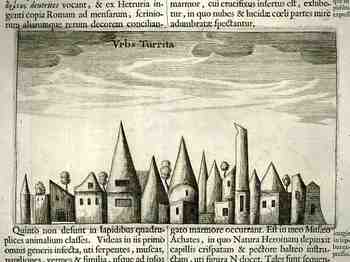
    more: the magnificent cityscape
    (reproduced here) and the sublime discoveries of a full set of the alphabet and
    a series of 15 geometrical drawings, all naturally impressed in stone.

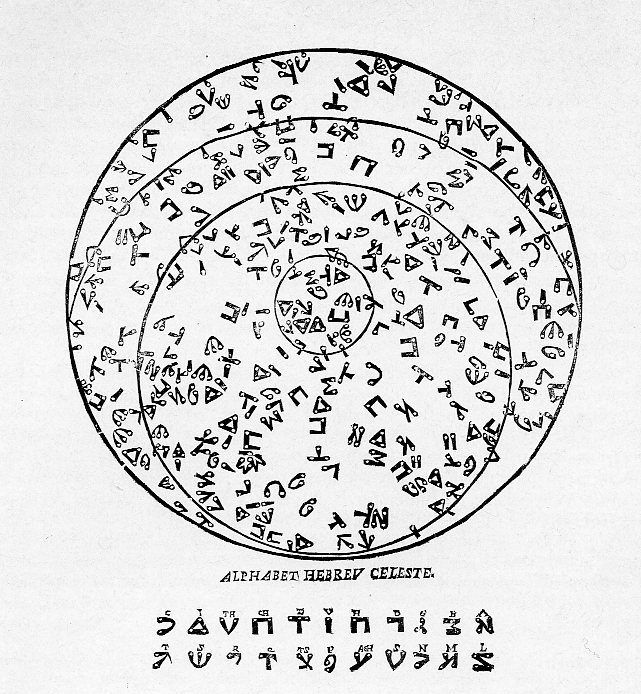
    Gaffarel’s principle and perhaps first-on-the-scene notion (though some of it may have appeared in Agrippa’s Three Books of Occult Philosophy (first published in 1533))  was the elements of an alphabet–the Hebrew alphabet–was found not in stone, but actually written in the night sky. In the stars.

    It was another sort of artificial language, an entire alphabet, though this was written in the sky; Hebrew letters transcribed in the stars, lines connecting them here and there.  Replaceable letters from one point to another.  The possibilities of the formation of actual words was present.  This seems to have been the first time this idea appeared in print. 

    Notes:

    1. Browne’s writing is both beautiful and difficult, or complex and impenetrable, as can be seen from the very opening paragraph of his work here.

    That Vulcan gave arrows unto Apollo and Diana the fourth day after their Nativities, according to Gentile Theology, may passe for no blinde apprehension of the Creation of the Sunne and
    Moon, in the work of the fourth day; When the diffused light contracted
    into Orbes, and shooting rayes, of those Luminaries.
    Plainer Descriptions there are from Pagan pens, of the creatures of the
    fourth day; While the divine Philosopher unhappily omitteth the noblest part of the third; And Ovid (whom many conceive to have borrowed his description from Moses) coldly deserting the remarkable account of the text, in three words,
    describeth this work of the third day; the vegetable creation, and
    first ornamentall Scene of nature; the primitive food of animals, and
    first story of Physick, in Dietetical conservation.

    2.  An interesting article in the blog 8vo appears here on Gaffarel’s celestial writing.

  • “Ordinances For Sanitation In A Time Of Mortality”–Protection from the Plague, 1348

    JF Ptak Science Books  Quick Post


    [Image of a “plague doctor” trying to protect himself from the disease with long robes and a mask.]

    Ordinances For Sanitation In A Time Of Mortality
    Pistoria is a town about 40km northwest of Florence, and was visited by plague a number of times between the 13th and 18th centuries.  In this instance, below, in the plague season of 1347/8, the governance of the city issued a 23-point, nine-page proclamation, trying to protect the citizens from the vast threat that would cost the lives of a quarter of the residents of the town.  The text of the document treated the matter of plague at all levels, from an attempt at scientific treatment to regulations about how a person could be allowed back into Pistoria after visiting a plague area.


    ·Posted by :

    ·in:

  • Porta’s Visions, Big & Small: On “Magic”, Chaos and Not Inventing the Telescope

    JF Ptak Sciene Books   Post 1906

    https://historyofideasblog.com/a/6a00d83542d51e69e201156ecdf55e970c-pi

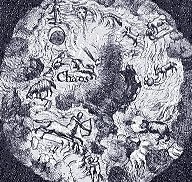
    [Detail from the title page of Natural Magic, below.]

    Giovani Baptista della Porta was a magus, or a natural (science)
    “magician”, who searched nature for similarities that would serve to build a
    broad template of forced  understanding of seeming likenesses, looking for the great connector
    in the exceptional and the unusual, the stuff outside of the formerly
    Aristotlean world.   Natural Magic is his magnum opus, an expansion of  its earlier
    version (Magna naturalis)  published in Latin in 1558, which Porta expanded to twenty sections in 1589. The 1589 edition was a maturing of the 1558 edition, toning down the philosophical/religio-mystic basis for the ordering of the natural environment with an approach more suitable to observation and experimentation. It was an encyclopedic work of vast proportions, a
    gold-mine of information and clever wishfulness, and very accessible due to
    Porta’s  wide inter-personal travel,
    very wide reading and critical abilities, clear reasoning and deep vision:  the book was hugely successful, going into at
    least twelve Latin, four Italian, seven French, two German, and two English
    editions in the early modern era. Natural
    Magic
    , which first appeared in English in 1658, concerned itself with
    magic, alchemy, optics, geometry, cryptography, magnetism, agriculture, the art
    of memory, munitions, and many other topics, all grouped together and refined,
    distilled, into a cloudy assemblage of natural knowledge—it would end up that the magical
    whole was worth far less than the sum of its parts. 

    Porta magic english
    But the parts were pretty considerable, and much of the
    information was spot-on for the time, not the least of which was a very capable
    demonstration and explanation of a lensed camera obscura. 

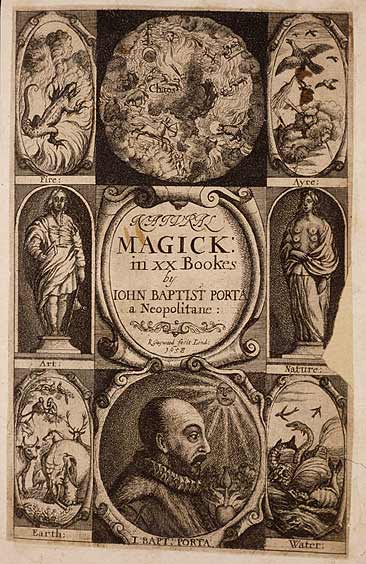
    What I’m interested in right now though is the title page of
    the book (pictured above).

    It turns out and as we can see in the top image of the
    title page, Chaos is not some subspace trajectory of cellular automata, or in
    Dr. Brown’s/Einstein’s dancing dust—it is right above us.  This recognition of its regular, localizable structure
    probably does not support parameterization, or anything else for that matter,
    except to say that it is definitely “pretty”. 
    The title page has nine illustrated compartments:  the four corners depict the four elements,
    the two opposing middles show art and nature; the bottom shows the author,
    illuminated by the knowing sun.  The top
    center image is the element showing “chaos”, which I’ve chosen to use a map,
    identifying where exactly chaos might be. 
    I’ve not seen an antiquarian map identifying chaos, though I have seen a
    number showing lots of other non-existent places, like heaven and hell and
    purgatory and Eden and the Kingdom of Prester John, to name a few.  But not chaos.

    It is very interesting to note that while in the process of looking at nature, and observing connections real and imagined, and creating ways of organizing and storing information in the brain, Porta conceived of a telescope, and this several decades in advance of Galileo. (The idea of the telescope stretches pretty far back, though.  The idea seems ancient, though the scientific thought on the matter really weren’t present until the 13th century with the work of Roger Bacon and Robert Grosseteste, and then with Nicolsa of Cusa (in 1451) doing experimental work on the properties of lenses, and then on to John Dee and Thomas Digges in 1570/1.  Porta seemed right about there, just ont he edge of the invention of an instrument which would have allowed him to see farther and deeper than anyone else before him, but he didn’t follow through.  He mentions in the 1589 edition of Magiae:

        “With a Concave lens you shall see small things afar off very clearly. With a Convex lens, things nearer to be greater, but more obscurely. If you know how to fit them both together, you shall see both things afar off, and things near hand, both greater…”  (Porta would expand this section of the 1589 book (section XVII) into a complete and separate work in 1593,  De refractione optices.)

    I do not know what happened to this idea, or why it didn’t flourish in Porta’s hand like it would in those of Galileo less than three decades latter.

    Porta was a very  nimble and penetrating man–his Magia naturalis was a dissecting tool for the complexities that he saw around him, and his later works were in some ways continuations on this theme.  The first two books following Magiae were concerned with private visions of Very Large Things:  the first, De furtivis literarum notis (published in 1563) was one of the earliest works on cryptology.   This looking-deeper book was followed three years later in 1566 by a book on how these thoughts could be organized in the mind.  Given the spirit of the times and the difficulty of actually recording what it was you saw, Porta wrote  Arte del ricordare, which addressed the very idea of memory and then the more applicable bits of mnemonic devices.  He looked for more hidden messages in his next work–on the physiology of hands–but it didn’t see the light of publishing day until after Porta died.

    Working in the areas of pharmacology, hydraulics, military engineering, physiology, and physics, among many other areas, Porta published De aeris transmutanionbus (1609) on meteorology; De distillatione (1610), on chemistry; Coelestis Physiogranonia (1603), on a sort of “writing in the sky” and both a blast and support of astrology; and De humana physiognomonia libri IIII (1586), which was a work physiognomy and discerning function from structure. There were other books, not to mention at least 17 dramatic works.  Porta was basically unstoppable.

    All of this takes me back to the question of wondering about his inability (?) to see the possibilities of the telescope. In all of his books on deterministic vision, and of seeing things deeply–whether it was in the sky, or in chemical experiments, or in seeing the structure of a plant incised with its function in nature, or in the complexities of memory, and so on–it is a mystery to me how he could have left the development of the telescope along. 


  • Jack Delano Photographs, 1939-1972

    JF Ptak Science Books   Quick Post

    I found Jack Delano as a photographer for the Farm Security administration where he worked for Ray Stryker making photographs of the vastly changing America during the mid/late 1930’s. He worked with a relatively small group of photographers
    including Esther Bubley, Marjory Collins, Mary Post Wolcott, Arthur
    Rothstein, Walker Evans, Russell Lee, Gordon Parks,
    Charlotte Brooks, John Vachon, Carl Mydans, Dorothea Lange and Ben
    Shahn–as a collective they produced perhaps the greatest body of documentary work this country has ever seen.  Delano was in his mid-20’s when he started with the FSA, a little more than a decade in the U.S. after arriving here from the Ukraine (born Jack Ovcharov in 1914).  Besides his life in photography, Delano was a gifted and versatile composer.  He died in 1997. 

    Here’s an interview with Delano at the Archives of American Art (here).

    Most images below are from the FSA collection at the Library of Congress (here). Another nice selection is found at the Museum of Contemporary Photography (here)


    Delano2003_126

    File:Locomotives-Roundhouse2.jpg


    DelanoEL2003_150


    ·Posted by :

    ·in:

    —
  • Beautiful Book Cover Design and Defending Something Coming from Nothing

    JF Ptak Science Books   Post 1907   [Part of the series The History of Blank, Empty and Missing Things]

    • Coming shortly:  The Other Great Work of The Principia Year of 1687  AND  “Where Light is Declared to be not Similar”, Newton’s First Published Work 1671

    Universe

      I should feel pleased were this study to be looked upon as the
    entrance of the temple in which lie hidden the mys- terious splendors of
    Nature, and if it were the means of in- spiring some with a desire to
    penetrate into the sanctuary itself, and uplift the veil which conceals
    them, my labors will bear good fruit.
    — Pouchet, from his Introduction

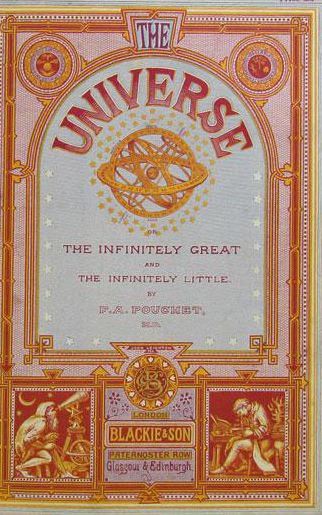
    Felix-Archimede Pouchet (1800-1874) was a serious academic and professor of anatomy, a skilled medical man with a long history at university.  Late in his life, nearly very well at its end, he published a general popular history of science with a probably-unique title, The Universe, or the Wonders of Creation, the Infinitely Great and the Infinitely Little.  It was a wrist-bender, going through at least 12 editions before 1900 (a best-seller) and weighing in at just over 1000 pages.

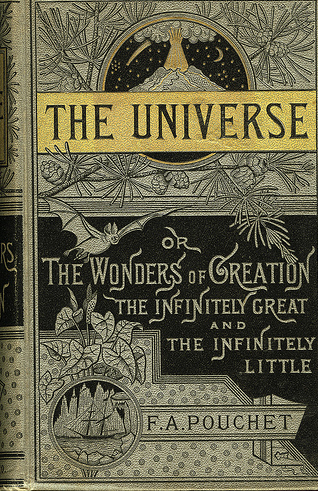
    The title is lovely, and the artists responsible for the design of the publisher’s binding, the front cover, for the book did an absolutely excellent job. (The title page for the 1882 edition appears below, looking much like the covers of the book.)

    Universe1871As it turns out, it seems as though there have been a thousand or two books published over  the 400 years between 1500 and 1900 using the word “universe” in the title–at least according to a quick browse through the WorldCat catalogue.  It seems actually to be a little common, which was a surprising to me. (Some of the titles were remarkable, as the one below by Herman Moll1, though the Pouchet title seems to be of high elegance compared to the lot I’ve seen.)

    Pouchet does have some disappointments in the book, some classic beliefs that went afoul of experimentation and discovery.  He has a towering time with Louis Pasteur, whose theory of airborne organisms causing all manner of changes in the state of biological systems ran directly against Pouchet’s belief system of spontaneous generation, and of things being borne of nothingness.  It was a bitter time Pouchet had with the great man, and a long and fruitless argument that would come to no good end for the man railing against what he called “pansperma”.

    His book in general was interesting, and ran the full gamnut of interest, establishing itself as a versatile and popular encyclopedia of sorts, in spite of his very obvious problem with being on the wrong side of the argument with Pasteur.  Still, the title is great, and having it worked into the cover design of the book was brilliant. 

  • “Where Light is declared to be not Similar”–Isaac Newton’s First Publication, 1672

    JF Ptak Science Books   Post 1907

    Next:  on Intitutionalized Nonthinking: the “Negro Pencil” 1938

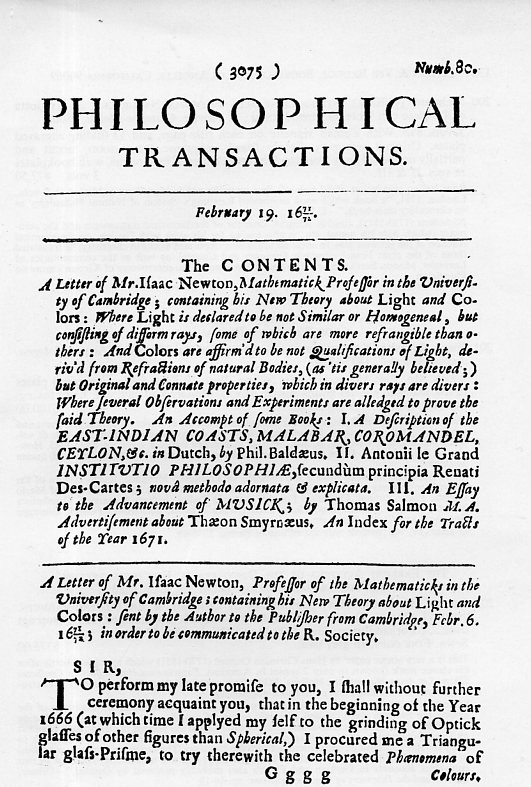
    “…Where Light is declared to be not Similar…”–from the “abstract” of Newton’s experimentum crucis

    There were four main contributors to the 19 February 1672 issue of the yet-young Philosophical Transactions of the Royal Society, (No. 80,  pp. 3075-3087). One original papers and three reviews of recently published books:  the first book was a description of the coast of eastern India by Phil. Baldeus; the second, a work on the philosophy of “Renati Des Cartes”; and third, “an essay on the advancement of MUSICK, by Thomas Salmon1.  These three have a common trait in that they are mostly entirely forgotten though the works seem interesting to me.  The scientific paper was written by Isasac Newton:  “New Theory about Light and Colors”.  Though it was his very first publication2 (coming at age 29), it was already the result of years’ worth of hard thought and experimentation3. It also among the most important things he ever published, and was a direct link to his superlative and iconic work published as Opticks in 1704.

    Newton--light809

    (It is interesting to note that the date on the title page is given as “February 19, 1671/72”. This refers to a bubble int he calendar system at the time, where in some quarters the old first day of the year was celebrated on March 25, a practice which didn’t firmly disappear until 1752.  So th e”1671/72″ bit refers to the year being 1671 according to the Old System and 1672 according to the New.)

    Newton was simply the most important person in the history of science.  Aside from all of his many iconic and revolutionary accomplishments, one thing that sands out over the collective of greatness is that he applied a sameness in investigation of different fields, a constant standard of scientific method across the disciplines, which was not necessarily the case with science folks, even extending back into the dimness of the great ancient philosophers.  This in itself was a most major accomplishment.

  • Hippocrates on Ancient Medicine

    JF Ptak Science Books   Quick Post

    Extract from “On Ancient Medicine”, by Hippocrates, translated by Francis Adams, (1891),  from his The Genuine Works of Hippocrates, published in New York by the medical publisher William Wood and Company.

    Hippocrates, Hippocrates of Cos, Hippocrates of Kos, a man of enormous and justified fame, is considered the father of modern medicine. He lived during the age of Pericles, this great physician, (ca. 460-370 BCE), though his life per se, and perhaps even his works, are more of an accumulation of efforts of others through addition and edit than the work of the one man known as Hippocrates. Still he is the outstanding figure in antiquity in the history of medicine, and perhaps it really doesn’t matter if people could ever know his absolutely original works, or not. Part of his life may be legendary, but his lasting importance to the practice of medicine is all that really matters.

    ·Posted by :

    ·in:

  • Institutionalized Nonthinking: the “Negro Pencil” of 1938

    JF Ptak Science Books   Quick Post

    • See also The Long Fight for the Capitalization of the “n” in “Negro” here  

    “I believe that eight million Americans are entitled to a capital letter.” W.E.B. BuBois
    1002021653
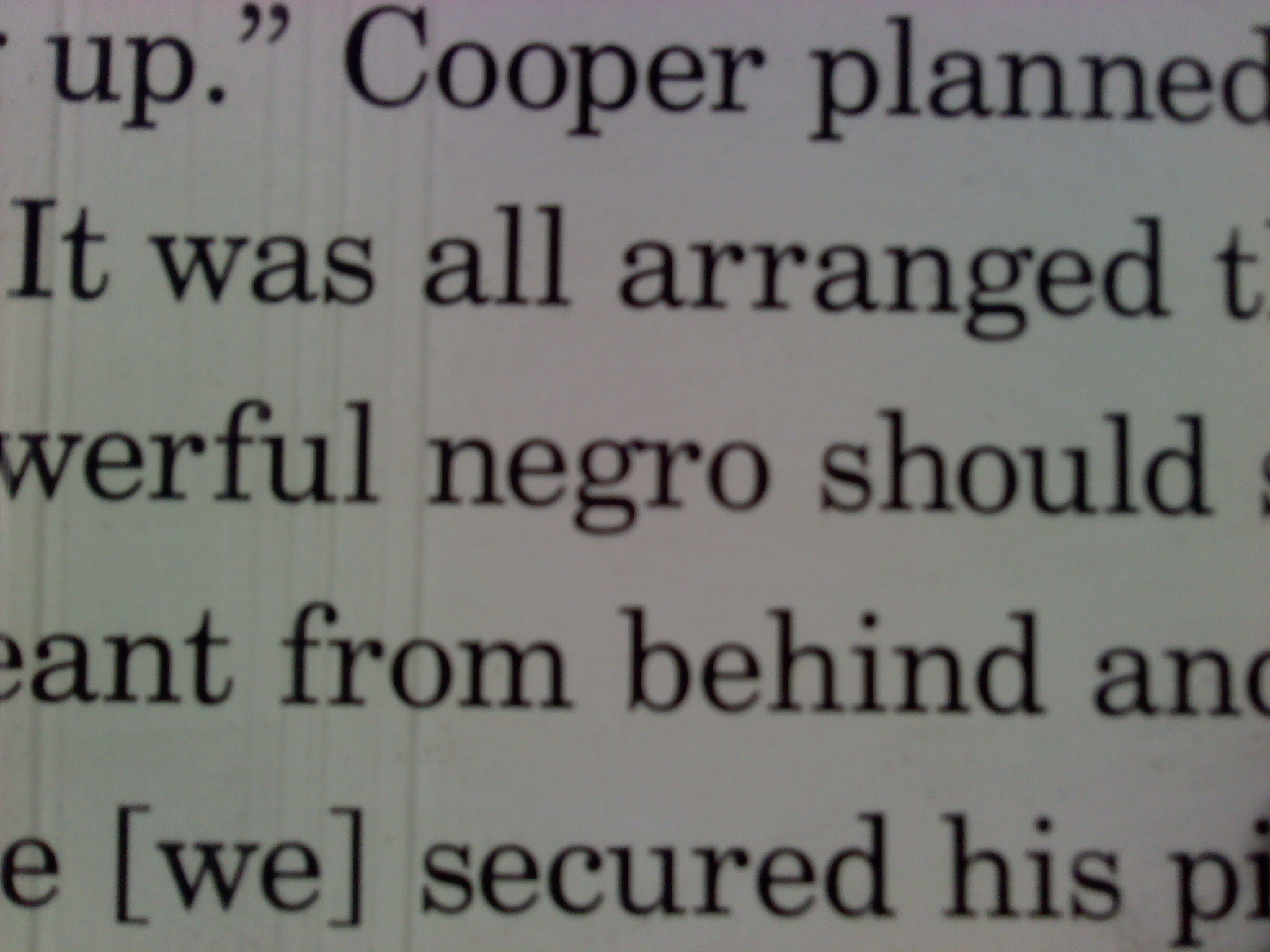
    I was walking home the other day, taking a short cut through the Chamber of Commerce (of Asheville) and stopped to read an historical marker placed in parking lot for a Civil War prison and hospital.  Sprinkled throughout the two hundred word synopsis were varied parenthetic ( ) corrections of the quoted text. But not when it came to the quoted line using the small-n “negro”, there was no parenthetic correction to (N)egro.  No sic. Nothing.

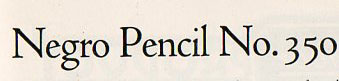
    The “Negro Pencil” was found in the corporate pamphlet, The Pencil, published by the American arm of the Czech company Koh-I-Noor Pencil Company.  It was a lovely thing, really, a lusty bit for the pencil fancier.  And then I came to this.

    Negro pencil811

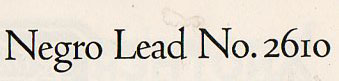
    The “Negro” Pencil is not a matter of non-translation into “hard black” or whatever–there are no other instances of the transliteration not taking place.  “Negro Pencil” is a product of its time. 

    Negro pencil812

    The history of the power of words is long and complex, and for the most
    part is on one side or the other of the political and social mirror, at
    least in the United States. Controlling the meaning of a word or phrase
    controls the idea which alters the way people approach it, defining the
    very heart of what may control the impulse for war or peace, which
    means that people may die as much for words as they will for ideas.

    “Negro” may be capitalized here, but perhaps it is because it started a sentence.

    It may have been capitalized, but using the name of a race to sell the color of a pencil might as well have taken the capitalization away, demeaning a race to sell a pencil, all without a second thought.  It was a product of the time that such a discrimination could be so engrained as to not even think that the use of the word was demeaning. 

    Washington Redskins.

    Negro pencil813


    ·Posted by :

    ·in:

    —
  • Descartes–Discourse on the Method of Rightly Conducting the Reason, and Seeking Truth in the Sciences

    JF Ptak Science Books  Quick Post

    DISCOURSE ON THE METHOD OF RIGHTLY CONDUCTING THE REASON, AND SEEKING TRUTH IN THE SCIENCES  by Rene Descarte. 

    Descartes contributed a towering amount in the history of science and in establishing modern Western philosophy, all accomplished in a relatively short period of time, as Descartes for all of his massive output only lived to be 54 (1596-1650)…and most of that was completed between 1630 and 1650.  Twenty years. Outstanding. 

    René Descartes. Engraving by Jacques Lubin, after Frans Hals. MS Hyde 77 (1.48.1)

    René Descartes. Engraving by Jacques Lubin, after Frans Hals (via Houghton Library blog, here).

    “PREFATORY NOTE BY THE AUTHOR

    If this Discourse appear too long
    to be read at once, it may be divided into six Parts: and, in the first, will
    be found various considerations touching the Sciences; in the second, the
    principal rules of the Method which the Author has discovered, in the third,
    certain of the rules of Morals which he has deduced from this Method; in the
    fourth, the reasonings by which he establishes the existence of God and of the
    Human Soul, which are the foundations of his Metaphysic; in the fifth, the
    order of the Physical questions which he has investigated, and, in particular,
    the explication of the motion of the heart and of some other difficulties
    pertaining to Medicine, as also the difference between the soul of man and that
    of the brutes; and, in the last, what the Author believes to be required in order
    to greater advancement in the investigation of Nature than has yet been made,
    with the reasons that have induced him to write.

    ·Posted by :

    ·in:

    —
  • Daily Dose from Dr. Odd: Hermits, Putridity & Long Life Spans in “The Bible”, 1826.

    JF Ptak Science Books   Quick Post

    [Les Ages de l’homme (The Ages of Man)  by D de Vosthem, late 16th century, source here.]

    Increasing nothingness and putridness can possible lead to longer life spans, at least this is an hypothesis posed by John Blake in his Geographical Atlas…, published in New York in 1826:

    ” Rare examples however of extreme longevity of a life of more than 150 years seem to he common to all countries without distinction. If England the salubrity of which is so highly extolled has furnished thrice or four examples of men arriving at the age of from 150 to 169 years. Hungary which generally speaking is not a very healthy country has scen the celebrated Pierre Czartou prolong his life to the 185th year and John Uovin at the age of 172 had a wife of 164 and a younger son of 117. It is in the Bannat of Temeswar a very marshy district and subject to the putrid fever that these examples of longevity and many others have been observed A mode of life which is soher and unruffled by tumultuous passions singularly contributes to longevity…”

    “According to the author of a very curious little work called the Apology for Youth* 152 hermits taken in all ages and under every climate produce a sum total of 11,589 years of life and consequently an average of 70 years and a little mare than thrice months for each whereas the same number of Academicians the one half belonging to the Academy of Sciences and the other to that of Belles Lettres gives only 10,511 years of life consequently 69 years and a little more than two months for the mortal career of each. It is therefore not improbable that in the ages of patriarchal innocence the period of 150 or even 200 years was much more commonly attained than it is in our times…”

    Notes:

Recent Posts

Archives

Categories