A Daily History of Holes, Dots, Lines, Science, History, Math, Physics, Art, the Unintentional Absurd, Architecture, Maps, Data Visualization, Blank and Missing Things, and so on. |1.6 million words, 7500 images, 4.9 million hits| Press & appearances in The Times, Le Figaro, Mensa, The Economist, The Guardian, Discovery News, Slate, Le Monde, Sci American Blogs, Le Pont, and many other places… 5000+ total posts since 2008.

  • The First Printing of an Actual Portrait in a Book

    JF Ptak Science Books   Quick Post

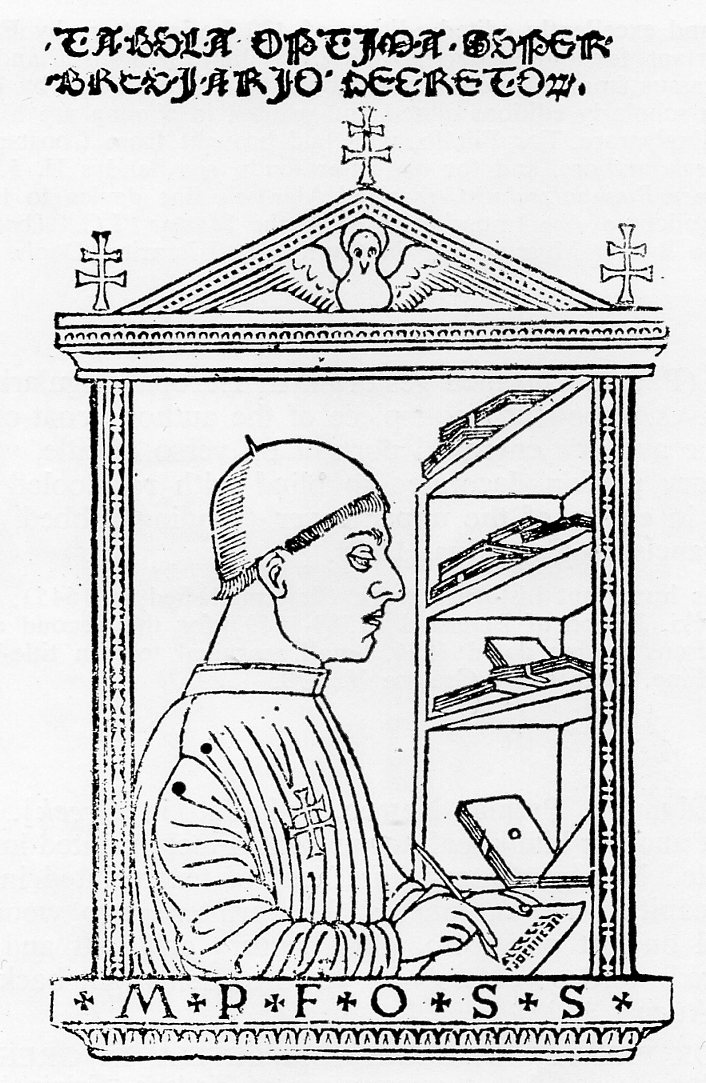
    Out of the many hundreds of portraits printed in the first 25 years of the printed book, none were of actual people who were alive during the printing of the book. There were classic images of great thinkers, mythological beings, saints, martyrs and so on, but no “citizen” humans. Well, that was until Attavanti Paulus’s (d.1499)  book on law, Breviarium totius juris canonici, sive Decretorium breviarium, which was printed in Milan in 1479 (in a small folio) and contained a portrait of the author–it was, as A. Hyatt Mayor said in Prints & People, “the first printed portrait of a living private individual”.

    Portrait890

  • Paintings Looking for their Subjects

    JF Ptak Science Books    Quick Post

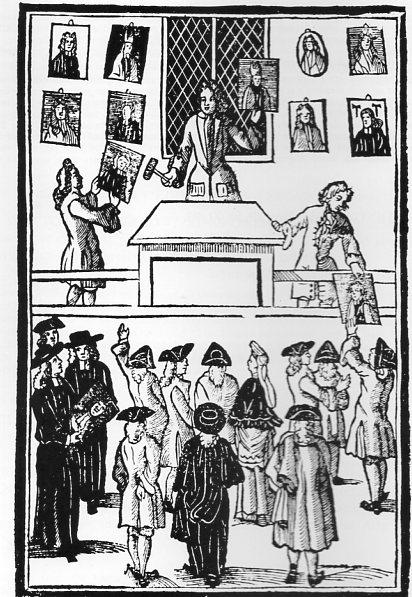
    I think that this blog needs a (Jorge Luis) Borgesian category for the easily-to-multi-interpret things that move across the Blog Desk. Such is the case for this pamphlet printed in 1710, An Auction of State Pictures, Containing
    a Most Curious Collection of Original Low-Church Faces: Drawn Exactly
    to the Life by a High-Church Limner
    , which carries this beautiful woodcut as the only illustration for its slim twenty pages.

    Arch skyscraper881

    The pamphlet is a wonderful satirical farce, a political diatribe against the enemies of a Dr. Henry Sacheverell who set against the cleric for the sermons he preached against the Whig ministry of the Earl of Sunderland.  Its not necessary to be drawn into the intricacies of early 18th century English religico-polisci–just that the enemies of Sacheverell were dispatched by describing them as portraits being sold at this imaginary sale–unflattering portraits with unflattering descriptions. All anonymous they were, but to anyone having any knowledge of the scene their identities were clear enough. 

    I think that the creation of an imaginary auction to tread on the disguised portraits of enemies was a brilliant idea.

    Evidently, there is a description of what happens on the sales floor of this “auction”, which appears to one of the earliest descriptions of an art auction scene–and the action of the auctioneer is pretty much that which you can find today.

  • Making Human Junk from Children, 1914

    JF Ptak Science Books  Quick Post

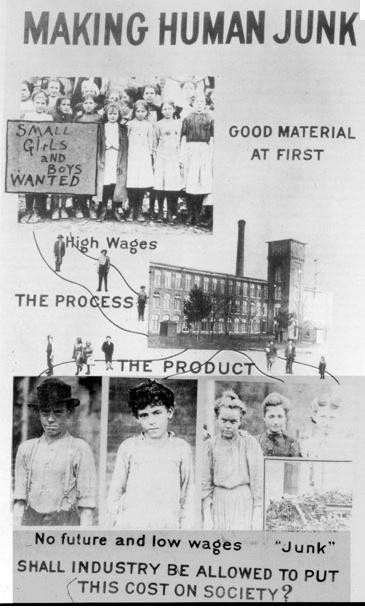
    “There is work that profits children, and there is work that brings
    profit only to employers. The object of employing children is not to
    train them, but to get high profits from their work.”
    –Lewis Hine, 1908

    These broadsides are tough going. They are the work of advocates and reformers who sought to give children an even chance at growing up as children, rather than joining the hundreds of thousands of 6-12 year olds already in the workforce in America in the first decade or two of the 20th century. They were a simple and very powerful appeal to business-owners and parents to resist the temptation of child exploitation–none though so far as I can tell directly addressed the children.  See my other posts on this topics here:

    [Source for the following images at Inquiry Unlimited, follow the link for other examples. ]

    Child work making_human_junk

    ·Posted by :

    ·in:

    — —
  • Veterans Day 2012 11/11/11

    Veterans Day repost:
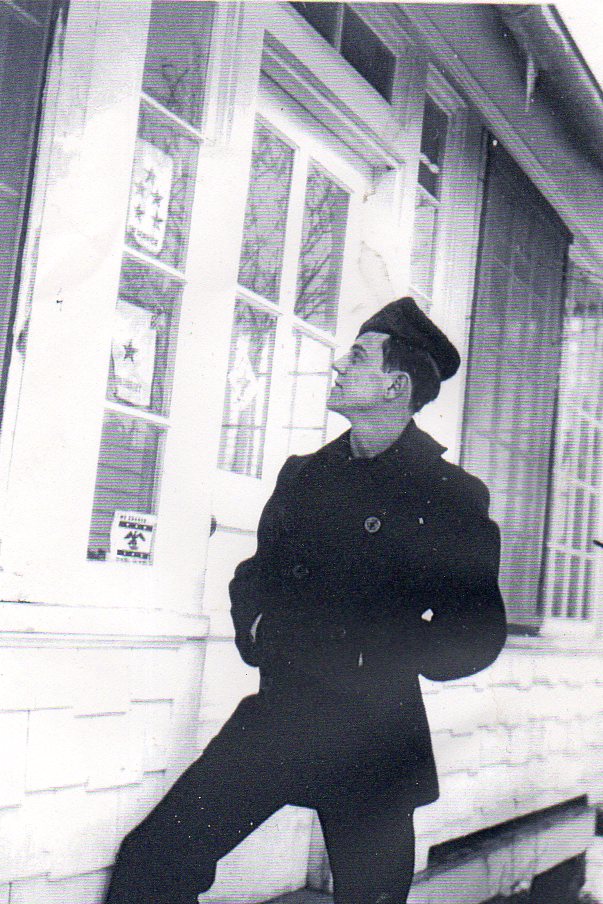
    I want to thank all Veterans today, all of our Veterans everywhere, for all of your sacrifices. I particularly want to say to say how much I appreciate the members of our family who have served: Uncle Pete (USMC, WWII), Uncle Ray (RCAF, RAF+USAAF, WWII), Uncle Stan (Navy, WWII), Uncle Alex (Army, WWII), Uncle Joe (Army, Korea), Uncle Jerry (Army, WWII), Uncle Frank (USAAF WWII), Uncle Walter (Navy WWII) and my other Uncle Stanley (Army, WWII), Uncle Francis (Army, WWII), Uncle Vincent (Army, WWII), cousin Billy (USMC, Vietnam) and Grandpa (Army, WWI); Patti’s father Melvin Lonnie (Navy, WWII) and stepfather Boyce (Army, 2nd US Cav WWII), Uncle Guy (USMC WWII), Uncle Max (Army WWII) and her four relatives in the CSA. Nearly everyone was in battle, and nearly everyone came home. [Image: Uncle Walter looking at the 5-star Blue Star flag, Housatonic, Mass, 1943.]

    Brothers 2990

    ·Posted by :

    ·in:

  • Mall-Mortuary Faces on Robot Patent Drawings, 1936-1976

    JF Ptak Science Books   Post 1927

    There is something that I’ve found in my time grazing through U.S.patent drawings–for the most part, if the device has a face, or is being worn/employed by some human with a face, chances are that this face will indeed have some high invasion of “Creep Factor” elements.  It is just so.  I’ve encountered this many times, and I think that it is possible that in these hundreds of samples that I have come across that these inventors (a) could not draw, (b) could not draw well, or (c) chose not to (a) and/or (b). It is too much to expect that these creepy faces are an expression of humor–that would be too much of a conspiratorial element for anyone to absorb.  It is just remarkable that these faces are time after time just so off, and soft-creepy, like a puffed-up rougey death mask found in a mall mortuateria.


    1936

    1938

    1938

  • Patenting the Artificial: Moustaches, Bark and Ideas

    JF Ptak Science Books   Post 1928

                An Alphabet of the Artificial as Seen in Patent Drawings

                      ”
    I…can wet my Cheekes with artificial Teares.”–3 Henry VI, iii, ii, 184.

    Using “artificial” as the word preceding a concept makes for some pretty interesting thought, especially if you remove it a bit from what the expected outcome is supposed to be.  So: creation. Intelligence. Harmomics. Society. Language. Consciousness. Person.  With the word “artificial” in front of these, they become captivating ideas both inside and outside of the realms of possibility.  (“Artificial creation” can have a definite hard sci-fi edge to it beyond genetic algorithms and trying to cook primordial chemical elements into the stuff of life in controlled environments; the “artificial person” more than just the person ficta of the law, although “artificial personality” wrapped around that gets to be very interesting as well.  The “Artificial society”has some Superman aspects to it from my 25-cent comics day, though the von Neumann/Ulam/Conway simplified paper grid cell creations are fr more interesting; artificial consciousness has a nice film-feel to it beyond machine/synthesis and cognitive robotics, where consciousness has somehow been identified and was controllable to a walking-around state. And so on.)

    What I’ve pulled together below is a small sampling of patented items using the word “artificial” in its title, and presented them in a (near-complete) alphabet of artificial creations.

    There is no patent on “artificial ideas” itself, though the idea of taking real issues like “artificial harmonics” and turning into something wholly unrelated to its intended use might be considered so. In any event, it would be an interesting thing to try to patent.

    A

    ·Posted by :

    ·in:

    — —
  • Putting the “Numb” in “Numbers”–on Long Lines of People Working and Fighting

    JF Ptak Science Books   Pot 1929

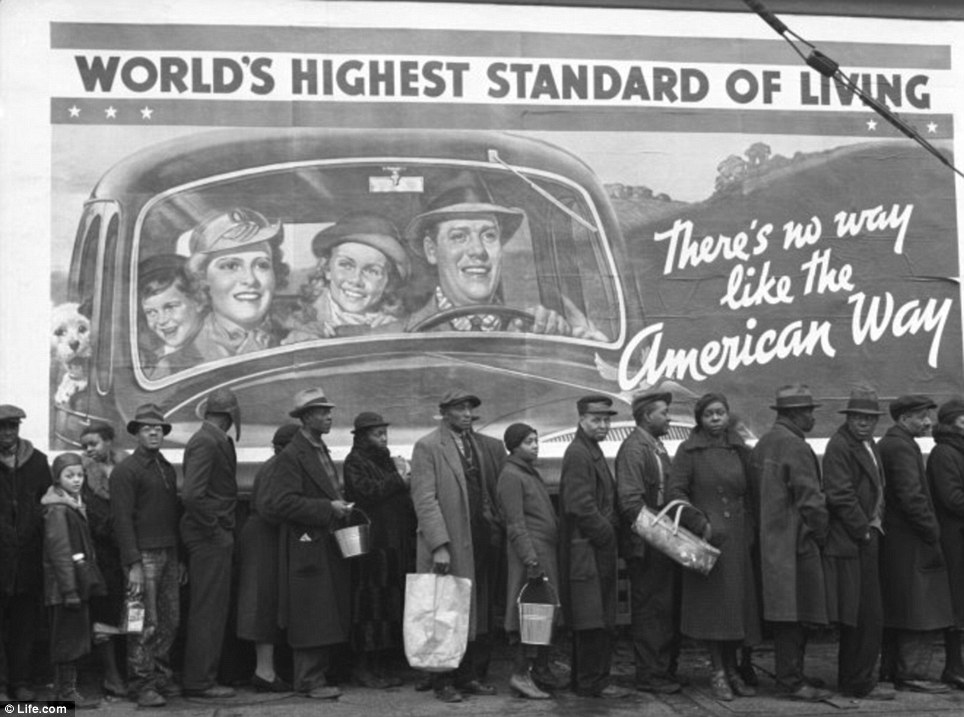
    The history of people forming lines to perform a task is an integral part of the general History of Lines. Certainly this sort of activity has been a prevalent feature of the human experience, whether it was done for commercial gain, or for construction, or betterment of the social cauldron, or in work, or whether the workers were compensated in some way or were enslaved–the idea of collective and enforced lining-up-for-a-task is about as old as humanity. 

    It would be interesting to know what the percentage of those lines were “happy” or “satisfied”.  Say  in the 10×1023 lines that have been formed over the last 10,000 years that 9% of them were constituted by people who enjoyed being there.  Offhand I’d say that this would be a very liberal estimate.

    Line food relief
    I wonder how long these lines in the modern times would stretch?  My guess is that the line formed for construction of food or agriculture or whatever else could be thought of would not be nearly so long as those lines formed for killing.  Or defence.  That said, it is easy to picture long lines of Prussian Blue set up against British Red, or the Blue stacked up against the Butternut, the long lines making their way over 3/4 mile of open field to a small stone fence at the top of Cemetery Ridge–harder to imagine those front lines being ripped apart by supersonic pieces of lead, and to have the line keep moving forward, the casualty-breaks to it plugged up by the lines of red or blue or gray moving in unison behind the first line.  It seems impossible to imagine “British Grenadiers” playing in your head while marching slowly towards another line in front of you, kneeling, and firing into you, trying to break your line, magnificent and completely insane.

    But getting back to line length question–this is tricky, but if you were to consider that during WWI that some 10-15,000 miles of trenches were constructed and that, say, a thousand miles of trenches were in use at any one time post-1916, and that those trenches were filled with soldiers, then perhaps those would be the longest human lines.  They were humans in lines in ditches, trying to not get killed and then trying to kill the other side in a simple equation of one line fighting the other.

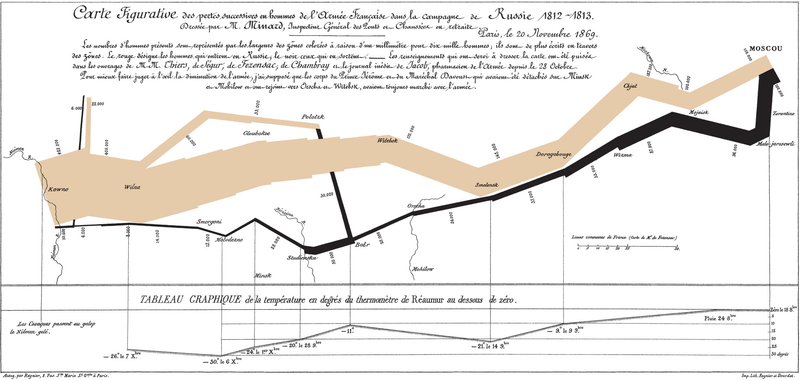
    There were also very long lines of advancing troops, armies on the move with men and countless supplies, enormous numbers of soldiers and warriors, the fighters for Zululand or the infantry of Napoleon, almost all getting smaller and smaller as time and war wore them down. (A very famous line by the statistician Charles Joseph Minard shows the devastating effect of time/weather on Napoleon’s army to and from Moscow, the thinness of the final line segment showing death and destruction.)

    Line--minard
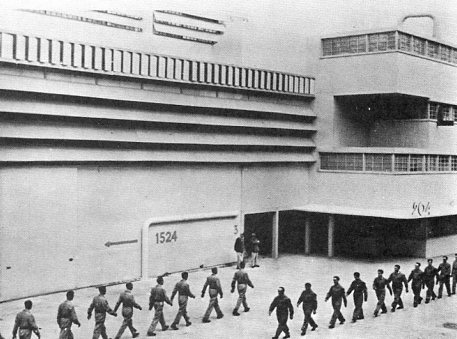
    There is another sort of long line that appears in the 20th century that matches up with lines quite similar to it that had appeared somewhat earlier, though under different circumstances.  The story of this line–the production line–is one of a limited line segment of human beings put to work on a basically-infinite line of repetitive work.  The production line began to appear in rudimentary form in the making of the needles in the 18th century, and then more effectively in musket manufacturing in the late 1850’s and through the Civil War,  and in the McCormick reaper works in the 1860’s, and then far more famously and with greater effect in the making of the Singer sewing machine  (in the 1870’s/early 1880’s).  The process was revolutionized by Henry Ford in the 1911-1916 period, when his production lines of relatively-still automaton workers and their moving work increased the production numbers of the Model T from 53,000 (and $690/car) to 585,000 ($360/car) in just six years.

    The idea made Ford into a king of sorts, heroic and iconic, and to his detriment he believed these things of himself as well.  It took a decade and a half for the most popular culture response to make a vt appearance in regards  to Fordism and the development of mechanization and mass production to things beyond consumables like cars and rifles and bikes and sewing machines, and the picture wasn’t a very pretty one.  Brave New World by Aldous Huxley was perhaps the most chilling of these assessments, though the more popular reactions like Rene Clair (in his movie A nous la liberte, 1931) and Charlie Chaplin (Modern Times, 1936) were less abrasive in their endings, though the visual imagery of the workhouse is what stayed with people.

    A nous la liberte892
    Clair and Chaplin both presented the new work environment in light of an old one–the old one being the prison work system.  Clair especially showed the great similarities between the two–the marching to work stations, the silence, the overseer, the matching uniforms, the very controlled motions of the worker, the non-lunch period, and so on.  Chaplin did this too, making these connections through laughter that may have led to realization that the laughed-at stuff wasn’t all that laughable.  Its the imagery of these movies that made them important, I think; much more so than their endings, which produced happy/whistling/victorious workers. 

    Chaplin modern times

    You can’t spell “numbers” without “numb”.

    Notes

    ·Posted by :

    ·in:

  • Portraits of Scientists & Philosophers on Baroque Title Pages

    JF Ptak Science Books    Post 1930

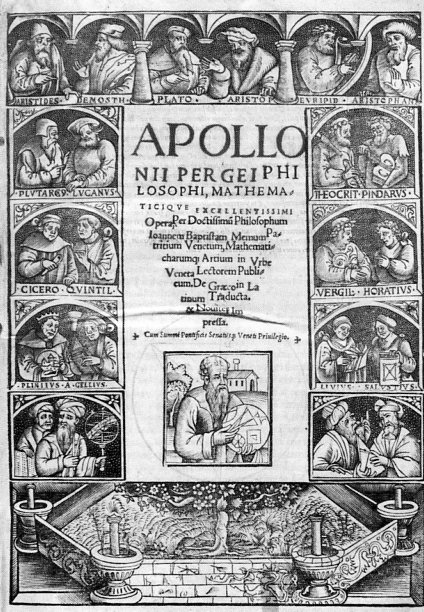
    In the 16th and 17th centuries it was not terribly uncommon to decorate a title page of a scientific/philosophical work with the portraits of standard-bearers and significant people in the field.  This is particularly true in the Baroque era, when so much more of the title page seems to be decorated.  I should have kept closer memory of examples of these works, but for right now two will suffice–they are rather good. The first is the work of Pergaeus Apllonius (ca. 260-200 bce) in the Opera, per doctissimum philosopphm Iohannem Memum, printed in Venice in 1537, which contains the first appearance in print of Apollonius’ Conics.

    Ortraits scientisits apollonius882Around the title of the book we find the half-length portraits of Pliny, Cicero, Quintiliius, Plutarch, Lucan, Aristotle, Demosthenes, Plato, Aristides, Euripedes, Aristophanes, Pindar, Theocritus, Vergil, Horace, Livy, Sallustius/Sallust and Apollonius–a big cast with differing shadows.

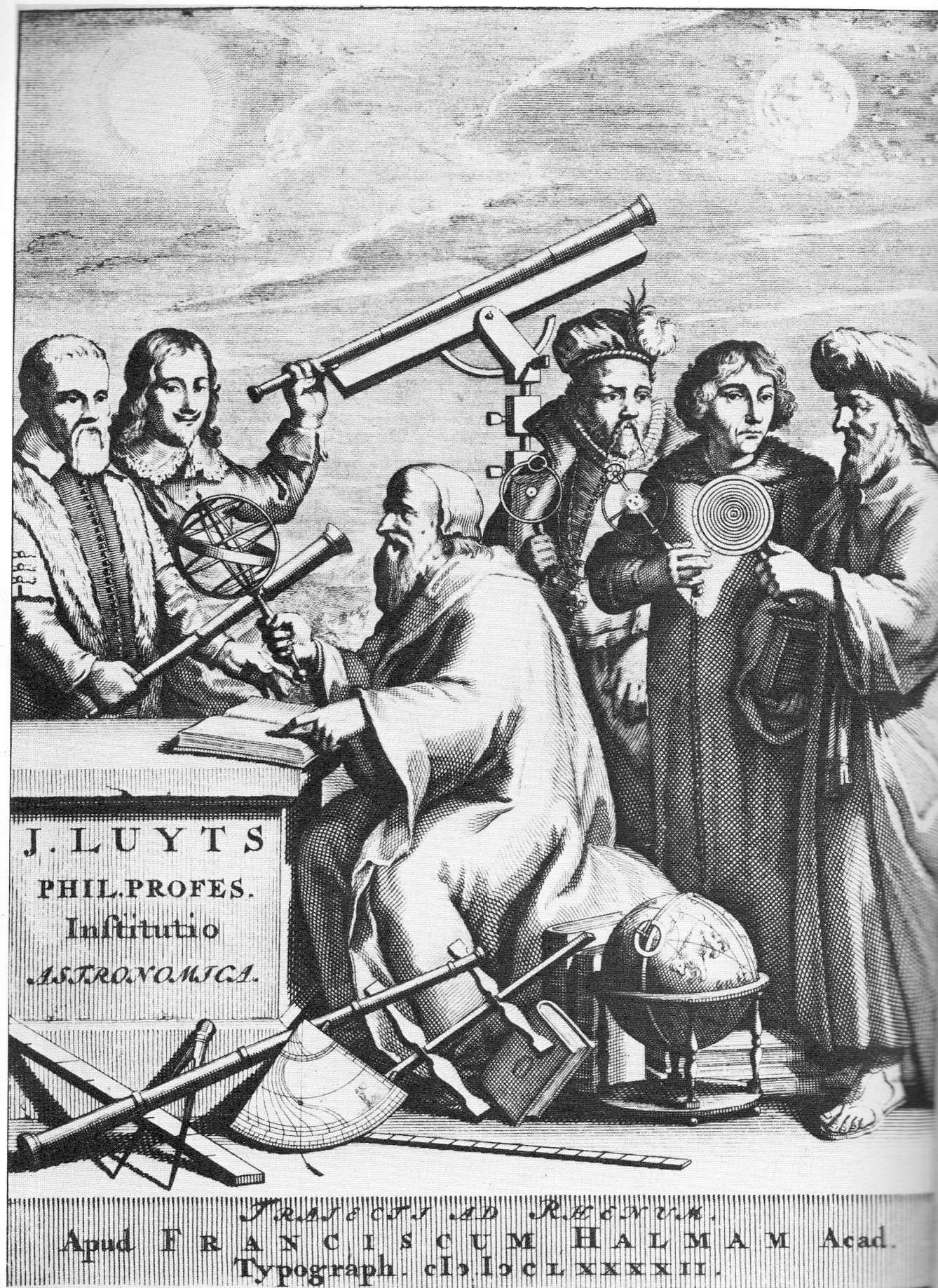
    A great example of a title page dedicated to astronomers is that for Jan Luyts’ (1655-1721, an instructor in maths and physics at Utrecht), text Astronomica Institutio, in qua Doctrina Sphaericaa atque Theorica… printed in Utrecht in 1692. It features a “action shot” of five major figures in astronomy:  (from left to right) Galileo (who is rarely seen actually holding a telescope and here is brandishing one like a club, holding the instrument very weirdly), a ham-handed Hevelius looking slyly over Galileo’s shoulder (though it sort of looks like Kepler in a way, I’m pretty sure that Galileo is Galileo), with  Brahe, Copernicus and Ptolemy each holding elegant demonstration devices for their own particular model of the solar system.  I’m not sure who the central figure is–perhaps just a generic philosophe.

    Ortraits scientisits luyts887

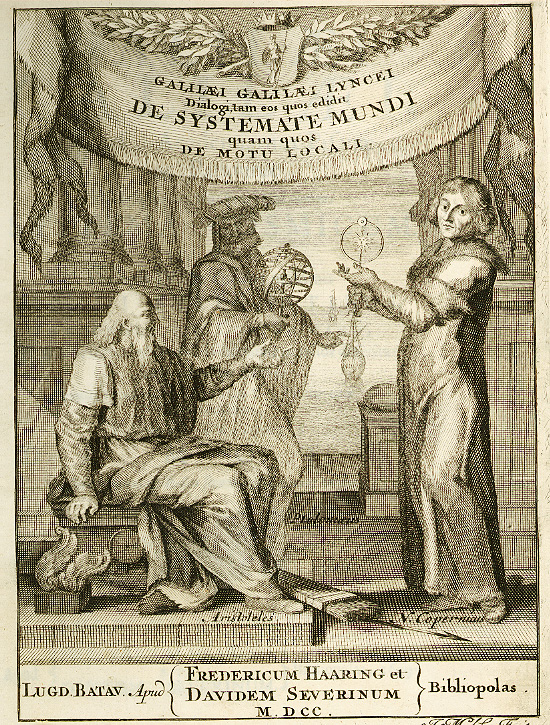
    Here’s the frontispiece to Galileo’s   which features Copernicus at right and the seated figure as Aristotle, which bears some fleeting resemblance to the figure above.

    Galileo two world systems[Image source University of Sydney]

    In this 1641 edition there are some slight alterations:

    [Image source and full text here.]

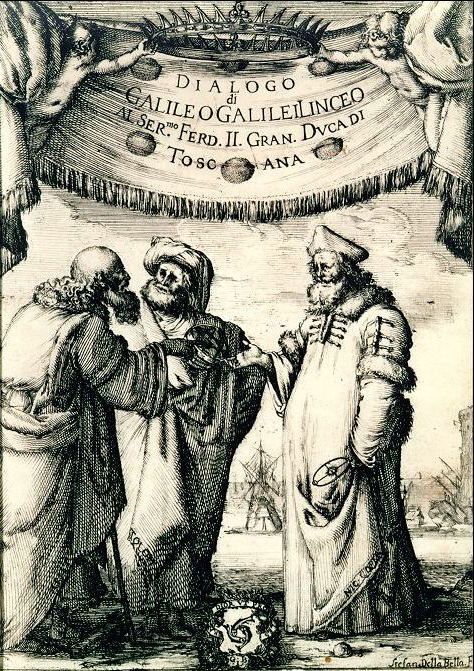
    Galileo’s Dialogo (1632) was the open invitation to trouble that Galileo no doubt expected and then famously received, the work being a defense of the Copernican system which at the time of regressive church wisdom posed a direct threat to Catholic belief systems.  In the frontis to this work we again see some old friends, finding Aristotle, Copernicus and Ptolemy beautifully (and with realistic old-man slumpiness) portrayed by Stefan della Bella. 

    Galileo dialogo SYdney
    (The full title of the Dialogo: Dialogue Concerning the Two Chief World Systems (Dialogo
    sopra i due massimi sistemi del
    mondo
    ), in which the Copernican and Ptolemaic systems are described and
    compared.  Galileo almost worked within the Vatican’s matrix necessitating a balanced
    presentation between the different systems, and evidently did so enough for the book to become a best seller, but
    its ride on the list of the Vatican’s
    banned (“Prohibited”) books lasted until 1835.

    Details of the portraits in “continued reading” section below.

  • Blank and Missing Things: Land (California as an Island)

    JF Ptak Sciene Books    Part of the series on The History of Blank, Empty and Missing Things.

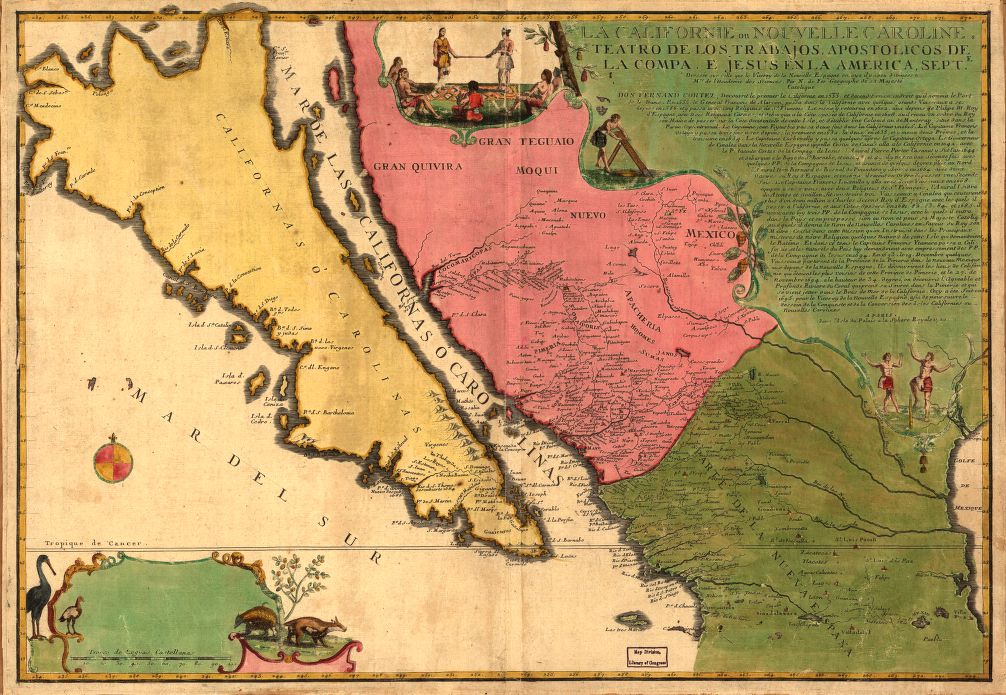
    The influence of economic strategy seems to be the Old Red Sandstone of the geology of life on this planet, and sometimes it reaches right into cartography, expressing itself in unusual ways.  Such may be the case with the creation of the idea of California beign an island.

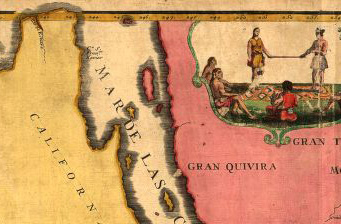
    California as an island det[A detail of a sample map showing California as an island, by Nicolas de Fer, 1720, and depicting the famous missing land at the north end of the Gulf of California.]

    In general, much of the vast expanse of blankness of the continent in the 16th and 17th century was hidden under ornate Baroque cartouches and their encumbrances, which was a tried-and-true method of taking up space on  a map where you didn’t (a) really know what was their and (b) didn’t want to make stuff up to fill in the white space. By necessity most of North America was unknown to cartographers at this time because, well, there was no reliable information to work with.  The far reaches of the middle North American western coastline enjoyed a history of
    connectivity with the large land mass that exists east of the Gulf of
    California, the region known today as “california” being connected to the rest of the continent from the early 16th century.

    About 116 years later, though, cartographic thinking on part of the coast changed.  Antonio de la Ascensíon is credited with first giving flight to the idea that the California Peninsula was in fact an island–and so, beginning in 1620, California would frequently make guest appearances on maps as an island. (Fray Antonio was born in Salamanca in 1573/4 and studied there and at the College of Pilots in Seville; he was ordained in the Order of Discalced Carmelites, and sent off to Mexico. As a cosmographer he accompanied Sebastian Vizcaino (1548-1624) on his expedition to California to find a good port for Spanish galleons coming from Manila, which is when Antonio produced his diaries with the famous island maps1.)  This map was created during a period where there was heavy competition for trade routes and geographical knowledge was actual currency, so there was some amount of cartographic information that was proprietary. When the abbot’s map was lost to/and recovered by the Dutch, the changes that were made to California were codified and published–the Spanish thought it not necessary to correct the misinformation. Perhaps.  In any event, it seems plausible that the Spanish crown had no interest in involving itself with what may or may not have been the loss of proprietary information, and so let the island business slide.  Until1751, when the King of Spain issued a proclamation saying that California was indeed not an island.

    This practice continued to about 1747, when there was more than ample evidence to suggest that the island status of California was erroneous–still, it took several decades for the last of the island-maps to make its appearance. 

     
    California as an island

  • Finding Death on the Moon, 1834

    JF Ptak Science Books   Post 1932

    “That those spots and brighter parts which by
    our sight might be distinguished in the Moon, do show the difference between
    the Sea and Land of that other World… The spots represent the Sea, and
    the brighter parts Land… That there are high mountains, deep valleys,
    and spacious plains in the body of the Moon… That there is an atmosphere,
    or an orb of gross vaporous air, immediately encompassing the body of
    the Moon… That it is probable there may be inhabitants in this other
    World, but of what kind they are is uncertain…”–
    Discovery of a New
    World in the Moone
    (1638). by astronomer John Wilkins

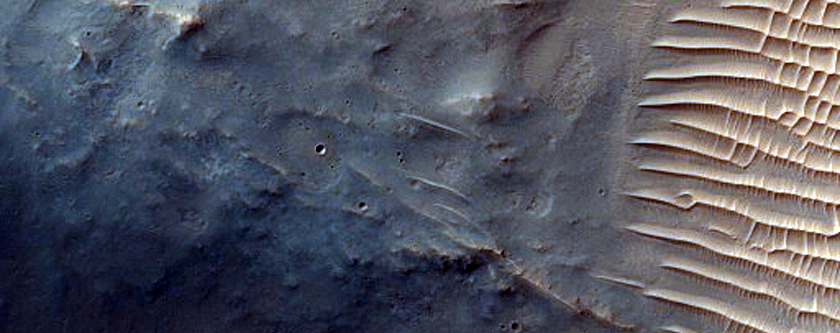
    Reading about the rover Curiosity taking bites of the Martian surface to analyze brought to mind an early and elegant piece of reasoning which put to rest the claims of life on the Moon. Belief in Lunar life is ancient, stretching back (for example) to Pythagoras, Plutarch and Lucian (who wrote perhaps the earliest piece on flying off to another non-celestial sphere). In more recent times bigger scientific names get thrown into that selenite melting pot:  Carl Friedrich Gauss was a believer int eh possibilities of life there, as were the astronomers Helevius, Bode and (later on)  Olbers, Littrow and Gruithausen.  (Franz von Paula Gruithuisen [1774-1852]  published his findings of urban structures in the very rough terrain above the Schroeter crater; his Wallwerk was quickly discredited though by astronomers with more powerful telescopes.)

    Schroeter crater
    [The seat of the problem for Gruithuisen–the complex structures at left thought by high in observation a low-powered refracting telescope to be streets and buildings. Source: NASA/JPL/University of Arizona, University of Arizona’s HiRISE (High Resolution Imaging Science Experiment).]

    In addition to the improvements in telescope resolving power–which provided better/more accurate maps of the lunar surface, particularly in the 1830’s by Beer/Maedler and Lohmann–there was a major piece of thinking by Friedrich Bessel (1784-1846).  Bessel was a superb observationalist and contributed vastly to the field with his work on stellar distance and identification, publishing his Fundamenta Astronomiae in 1818 and consequently constructing a star catalog of 63,000 objects. In 1834 he established that given the very sharp occulations that the Moon’s diameter was found to be not very much smaller at all in relation to its measure by direct observation, meaning that the starlight was not deviated by atmospheric reaction, because the atmosphere of the Moon such as it was was 1/2000th of the density of that on Earth. Therefore: no perceptible atmosphere, no respiration, no life as it was understood to be “living”.

    Very pretty.

    It is odd that given that work and the very barren maps being produced in the 1830’s and the higher-powered telescopes that showed masses of scarred surface that there was a flurry of pro-Lunar-life stuff to hit the popular newsstands just a few years later. A famous (and first?) case of this was with Edgar A. Poe’s  “The Unparalled Adventures of One Hans Pfall” which appeared in the Southern Literary Messenger in June 1835 and which detailed the story of a debt-ridden Pfall who takes off to the Moon in a hot air balloon for it more debt-free climate, and who then sends back a Selenite messenger on another balloon, and, well, nothing really happens. A much ore effective hoax was perpetrated in the New York Daily Sun for six days in August 1835 in a story attributed to the great astronomer William Herschel about find vast and complicated life on the  Moon.  (In real life Herschel was a believer but I think never published on it.)

    It is odd that such a fair amount of activity–something which was also the modern beginnings of ET-based storytelling of fear and hope–would begin a year after Besell’s thinking.  And in a reutn-to-home0again, the crater nearby the Wallwerk of Gruithuisen (who also claimed that the whitish polar icecaps of Venus were caused by fire ceremonies by practicing Venetians), named Schroeter, was done so in the honor of  the astronomer Johann Schroeter (1745-1816), for whom Besell worked as an assistant. (Surveyor 2 landed about 100km from the Schroeter crater, as well.)


    ·Posted by :

    ·in:

    —
  • The Earth Skeleton, Primal Pansperma & the Gigantic California

    JF Ptak Science Books   Post 1933
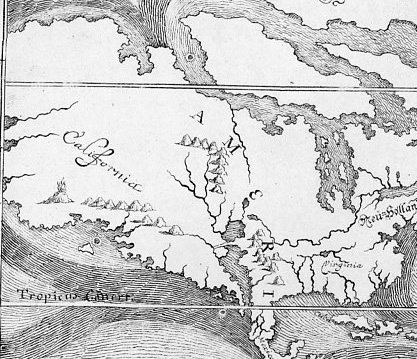
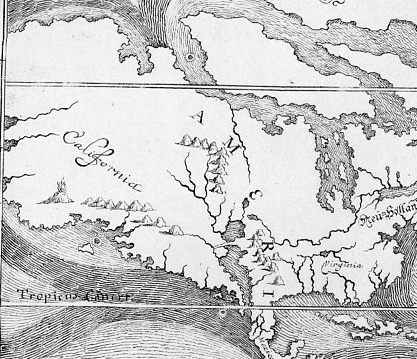
    Happel map895 detail;
    [Detail of  E.W. Happel’s map in his Relationes Curiosae (1675), plates 23 in the Peabody Library’s The World Encompassed, 1952.]]

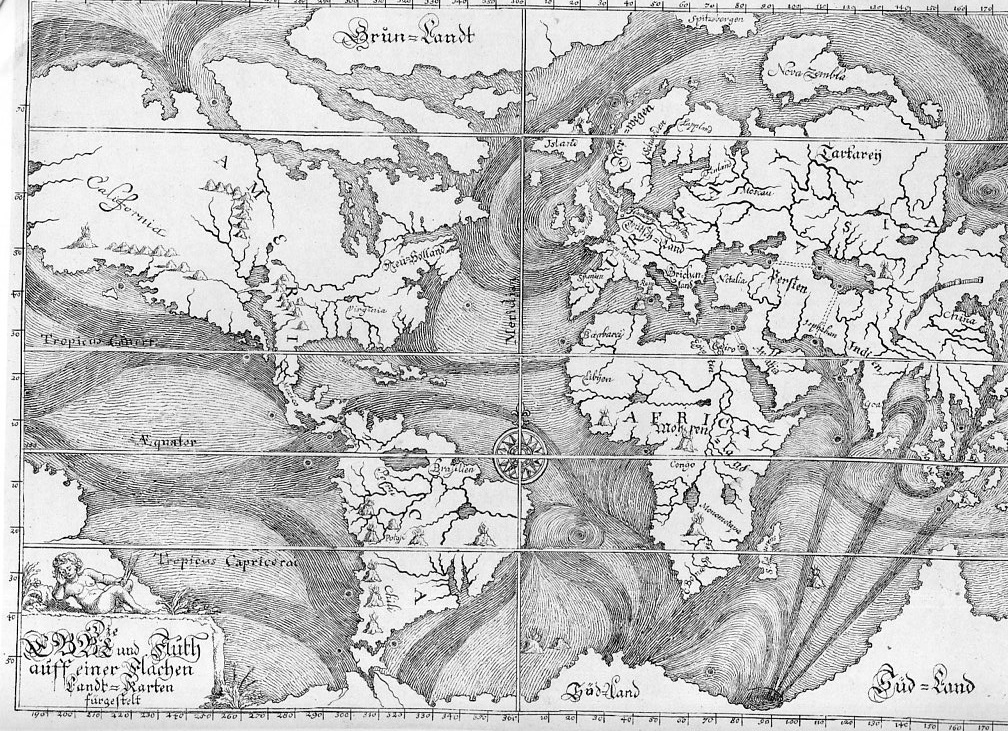
    I’m not sure how my thinking went from Athanasius Kircher’s Earth skeleton to the magnificent Eberhard Werner Happel 1675 world map of ocean currents featuring what might be the largest California ever seen in the history of cartography, but, well, the thinking wound up there, (and this leaving out Bishop Burnett’s perfect primordial world egg in the process). This was intended as a simply post following up yesterday’s bit in the Blank and Missing Things series relating to California as an island and the missing land mass connecting the non-island to the rest of North America.  Nominally California usually appears as a stubby/plump infected-appendix-sized bit either attached/not to the continent, but the California in the Happel (1647-1730, a man of math and medicine) map is larger than the rest of North America from the California gulf to the Atlantic.  Of course that also includes all of Alaska and then some imagined lands as well, but, still the mass of it is labelled “California” stands by itself larger than South America, Africa (which looks surprisingly good for the age of the rendering), China (which is very very small) and Russia (which lacks virtually all of Russia east if the Urals).  The only land mass that comes close to California’s size is the Antarctic regions, which is drawn here as a solid land mass including the scant points of data for New Zealand and Australia and whatever other island was found in southerly South Sea travels, all drawn together and fitted into an enormous continent.
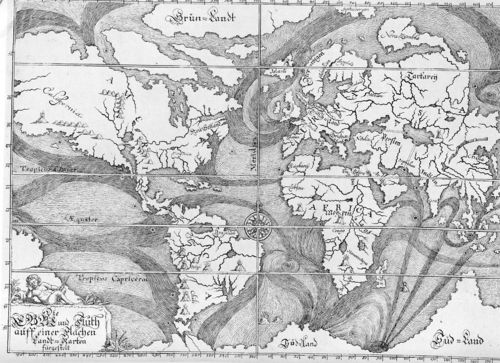
    Happel map895[The full image of the Happel map]

    Although there weren’t many explorers yet to go up the west coast of North America in 1675, other maps of the period render the coastline in a more accurate way than this.  The point of the map, really, is to display what was known of the ocean currents, some of which was correct but a lot of which is not–though it is a very good attempt given the state of the data collection.  The source of this map,the Peabody Library’s The World Encompassed (1952)  calls it the “first chart of ocean currents”, which I think is incorrect–and it is here where our favorite 17th century science-Jesuit comes into play, for it is in Athanasius Kircher’s Mundus Subterreaneus (1642) that the first map of ocean currents occurs.
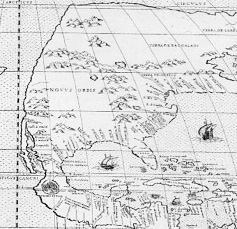
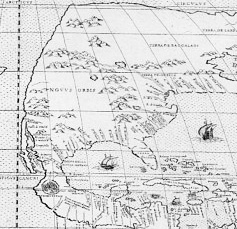
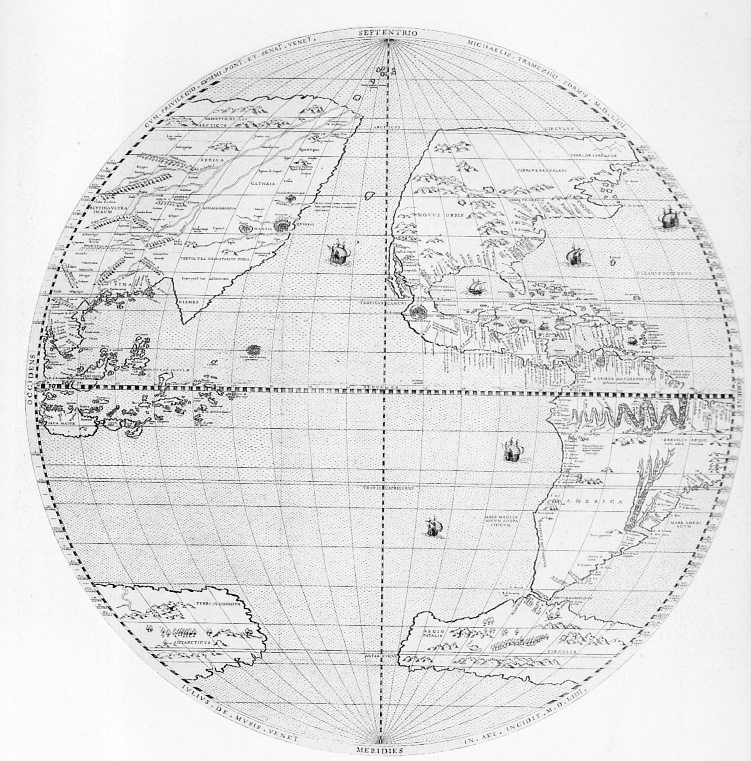
    Tramerzinus map896_edited-1 detailed

    [Michael Tramezinus’s map of the Western Hemisphere (1534) showing a mostly non-existent western coastline of North America along with a stringy California–but given the time and the available information, it is an excellent map that is not afraid to define unknown lands with a squiggly line. Source, plate 35 from The World Encompassed.]

    Kircher is a highly problematic character in the history of science.  He is at times wonderful and insightful and creative; at other times he is boring, pedantic, grueling, wrong, fanciful, and stingy with attribution.  I’m no Kircher scholar, but it seems to me after al this time that sometimes he writes stuff that he couldn’t’ve meant, that he absolutely knew better than to assert–but there it is, anyway, written as gospel truth (and the Gospels and related religious mythio-stories evidently demanded obedience to their own truths, in which Kircher complies) . This is one of the problems with the Fra Athanasius.
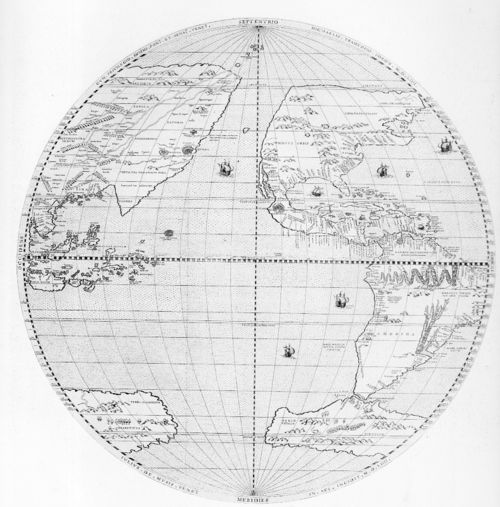
    Tramerzinus map896
    [The full detail of the Tramezinus map.]

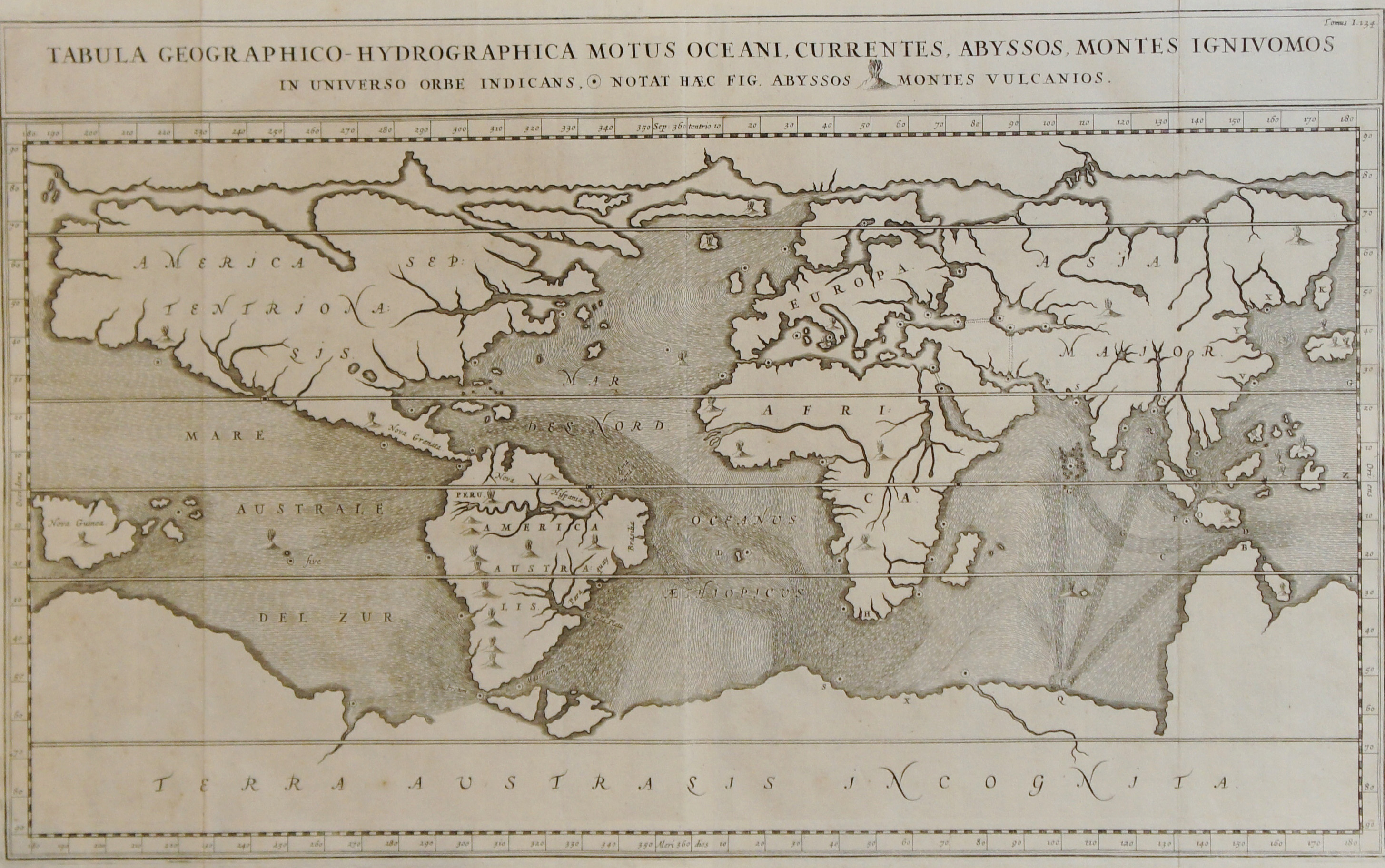
    In his Mundus Subterraneus Kircher presents the true first map of ocean currents (Tabula Geographico-Hydrographica motus Oceani, currents, abyssos, montes igniuomos in universe orbe indican), some bits being correct and others not so. He rejects the Aristotelian concept of condensation, and figures that the accumulation of snow/rain/dew is simply not enough water to feed the rivers and lakes and oceans, so he devised subterranean oceans and rivers with vast stores of water to feed the waters topside.  His hydrophyllaciae is one of four components of an underground Earth that closely coincides with the four elements and with the human condition, much in the tradition of the Medieval body/spirit approach to the understanding of the world system. 
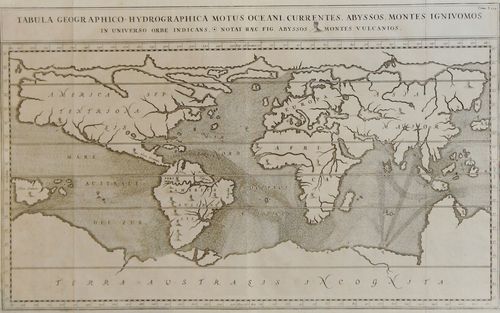
    Kircher current maop
    [Source: image from the mapseller site of Sebastian Hidalgo Sola, Buenos Aires, here.]

    John Edward Fletcher, in his A Study of the Life and Works of Athanasius Kircher, ‘Germanus Incredibilis …” describes Kircher creating an “Earth Skeleton”which he dresses according to science and ecclesiastical needs, finding a vis spermatica, the launching of all matter from the primeval chaos of primordial Earth.  The Mundus addresses this and many other things–it is, in all of this and all of its faults (as Fletcher states), a great repository of all geological knowledge of the time.  There is the good with the bad in the Mundus, “a conglomeration of exotic facts and fiction, along with odd scraps of truth and the occasional flash of brilliance” (Fletcher, p. 172), and the ocean currents map is one of those bits.

    Kircher undertakes an enormous and probably impossible job in this book, but may actually be kept from getting to the big point by depending upon himself too much. As Fletcher points out (page 171), the Mundus‘ third edition of 1671 failed to take into account the major advances in fields touching on the book’s contents, in particular, the work of Mariotte and Varenius, which was much superior to that of Kircher on the ocean currents, neither of which are discussed or even mentioned in the new edition.

    This was a very round-about way of getting to the California-part of the Happel map, but the attribution of the World Encompassed as “the first” of its kind needed to be addressed.

    Notes:

    Here’s an interesting read on the Kircher/Happel maps:  from http://www.coastalguide.com/helmsman/gulf-stream-history-noaa2.shtml
Recent Posts

Archives

Categories