JF Ptak Science Books Post 1330 [Part of a developing series in the History of Normalcy]
“There is work that profits children, and there is work that brings profit only to employers. The object of employing children is not to train them, but to get high profits from their work.” — Lewis Hine, 1908
As rudimentary as the title of this pamphlet seems, it isn’t really quite so, not really completely in the column of not having child laborers and exploiting children. There is a degree of exploitation allowable–yes it was a different time–and the map that I’ve plucked from this work shows the extent of rough-edging of the law that was tolerated. The authors weren’t so much concerned that there were 2500 newsboys in Boston-proper hawking newspapers morning/noon/night, but rather that they found over a third of them weren’t wearing their Newsboy Selling Badge when confronted. And it wasn’t that they were under-aged–just that they were badgeless.
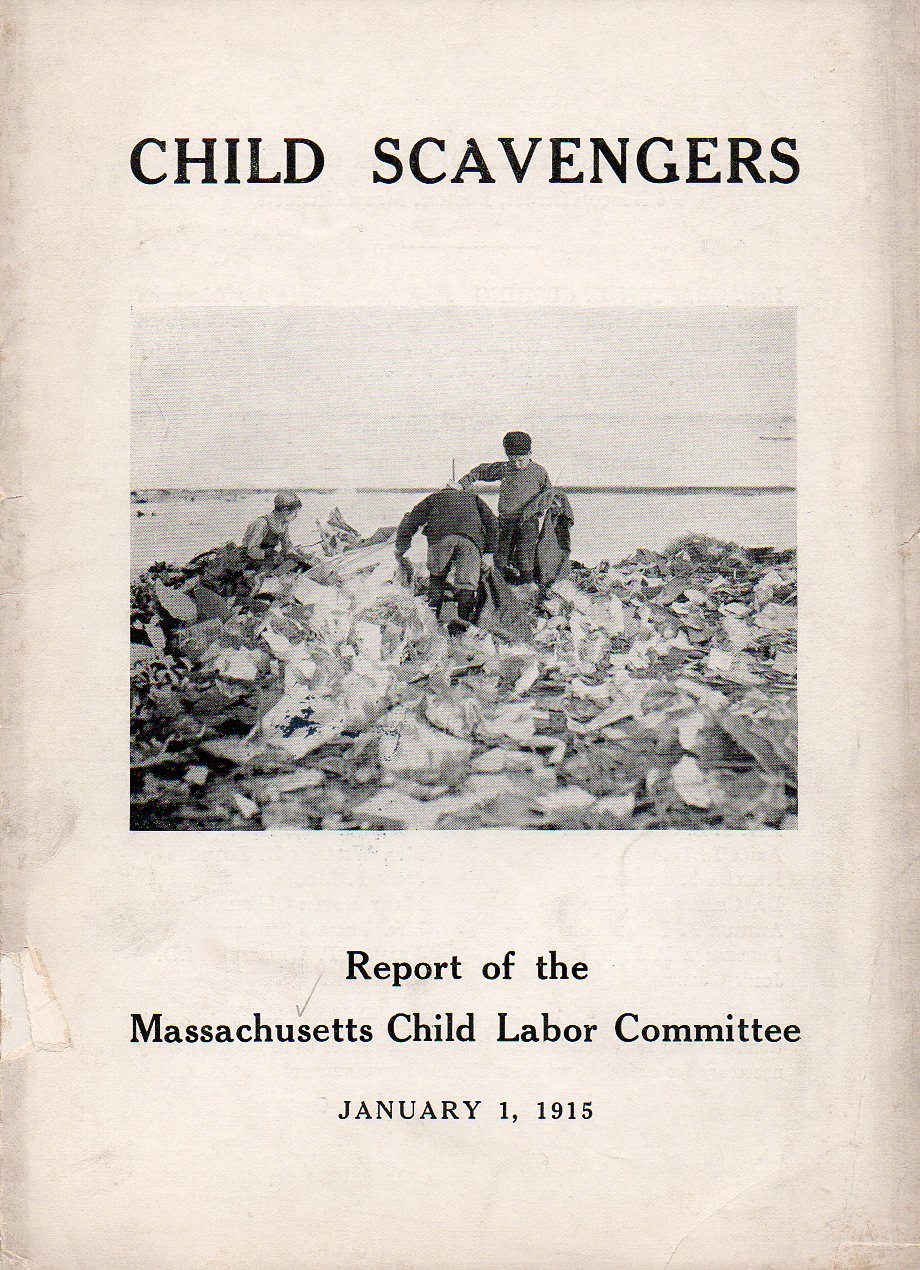
On the other hand, the Massachusetts Child Labor Law Committee cited unidentified “critics” (and I don’t doubt that there were many) saying that “children don’t work enough nowadays, and that child labor laws have left nothing for children to do, especially in the cty where there are no chores”. (This work is available for purchase from our blog bookstore.)
And they did do a study of child scavengers, reporting that in “one dump in a Massachusetts city fifty-five children from five to fourteen years old were moving slowly over an acre of rubbish…” The authors report (unfortunately without reference) that in one Boston school distict of 2,128 children that 125 of them “do this work”, and that 500 children in Boston “are so engaged”. This didn’t include the children who “gathered refuse” from martketsm freight yards, and ash barrells” or who were sent out collected odd bits of dropped wood and coal.
But the fact of the matter is that these folks were just knocking at the big door of child labor reform, a big piece of which would come into being in the next year (1916) with the Keating-Owens Act, which began the strict reulation of child labor, defining what the terms “labor” and “child” were. (The act restricted minig occupations to children 16 and over, and for 14 years of age for the manufacturing industries; no night work was any longer permitted, and the work day was limited to eight hours. This was the reform, so one can imagine what the labor was like before this legislation.) In 1890 there were something like 1.5 million children in the workforce, a figure which was raised to 2 million by 1910, and which was nearly halved (because of awareness and federal oversight) by 1920.
Lewis Hine (1874-1940)–who gives us the quote to lead this short post–was a school teacher and sociologist who was extremely aware of the plight of the children around him–well, children, and immigrants, and laborers; people without voices, or representation, poor working people. He was a pioneering photographer whose images of these classes of people were revoltuionary, a tremendously important documentarian of a societal symptom that was pretty much misdiagnosed, or at least was chosen as something to not be seen. That was hard to do when you had actual photographs of the grim situaiton.
This could’ve been my grandmother. At about this same time.

Hine also made some of the most iconic labor images in American history, a vastly underappreciated heroic figure duirng his lifetime.