A Daily History of Holes, Dots, Lines, Science, History, Math, Physics, Art, the Unintentional Absurd, Architecture, Maps, Data Visualization, Blank and Missing Things, and so on. |1.6 million words, 7500 images, 4.9 million hits| Press & appearances in The Times, Le Figaro, Mensa, The Economist, The Guardian, Discovery News, Slate, Le Monde, Sci American Blogs, Le Pont, and many other places… 5000+ total posts since 2008.

  • Looking Straight Down Department: the Topography of Hell

    JF Ptak Science Books    Post 1920

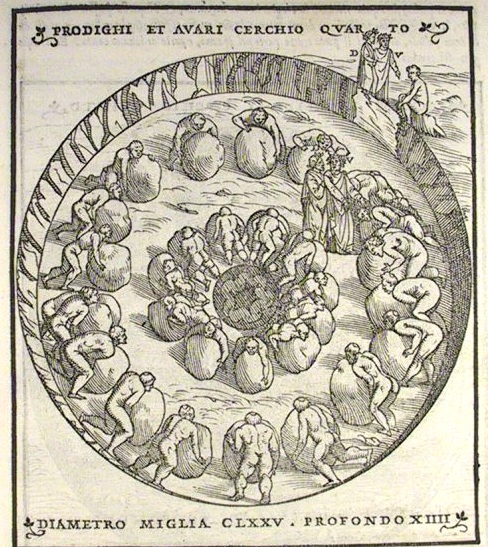
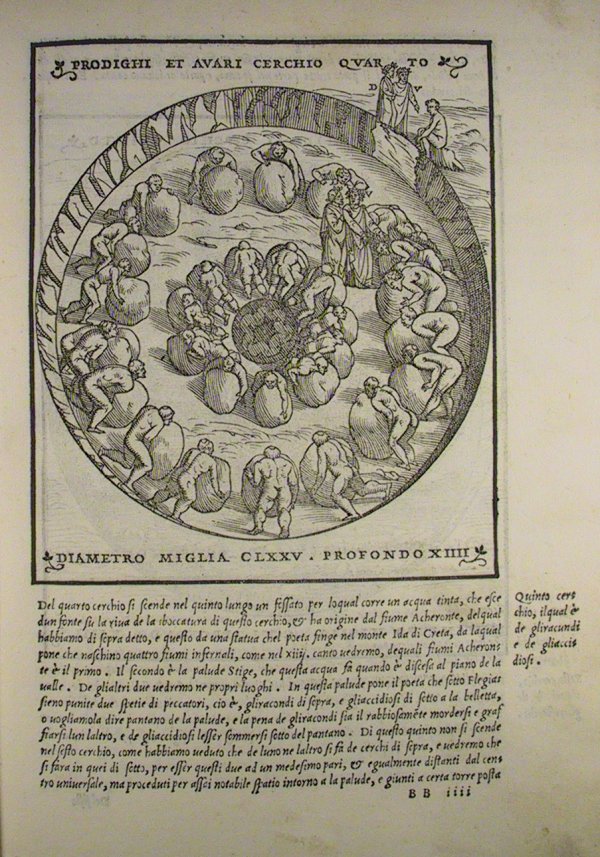
    The interesting thing about Hell–Dante’s Hell–is that it has been shown and reconstructed and imagined for a long time–eight centuries–and, outside of painting, most of the representations seem to be in cross-section. That is why this image from the famous exposition by Alessandro Vellutello’s 1544 struck me so strongly–it is a mostly straight-down look at the miserly and the prodigal in the fourth circle of Hell. 

      InfernoVIIfullpage

    InfernoVIIfullpage

    “… I saw multitudes
    to every side of me; their howls were loud
    while, wheeling weights, they used their chests to push.
    They struck against each other; at that point,
    each turned around and, wheeling back those weights,
    cried out: Why do you hoard? Why do you squander?’ –Canto VII, lines 25-30

    This image depicts the great, tiring but tire-less, endless, despicable joust of the miserly and the prodigals, going at each other with large, difficult-to-move stones.  Pluto is supposed to be in the middle, but I don’t see him here.  The artist though has made the men basically unrecognizable, giving them little character to their faces and virtually no differences in their bodies–Virgil tells Dante that they have lost themselves to something else, that there is no “there” there, that Dante–who would normally speak with the people he was coming into contact with–would not be able to interview them as they were too absorbed in their vicious need. 

    As has been seen in the many maps constructed for the Divine Comedy over the years–but especially during the Renaissance–Hell for Dante was a real place, a nine-layered inverted cone of measured depth and width commensurate with the sin, and established under the city of Jerusalem.  Dante visited the place

    “… but who art thou
     That hast inquir’d of us?” To whom my guide:
     “One that descend with this man, who yet lives,
     From rock to rock, and show him hell’s abyss.”      (Inferno XXIX, 89–92, trans. Cary)

    entering Hell on Good Friday and emerging from Purgatory on Easter morning, taking three days to travel through the two places and straight through the center of the Earth. 

    Here are a few examples of the cross sections that are the great standard bearers of Dante’s visions:

    The  Hell of Dante by Pietro da Fino, 1568:
    Frontispiece of Hell

    The circles of Hell from Commedia di Dante insieme con uno dialogo circa el sito, forma et misure dello Inferno by Filippo Giunta, Florence, 1506.

    The circles of Hell

    Again, just a few examples of the cross sections of Hell to contrast with the scarce looking-straight-down-at-Hell image above. 

  • A Note on the Most Famous Missing Doorknob in the History of Art

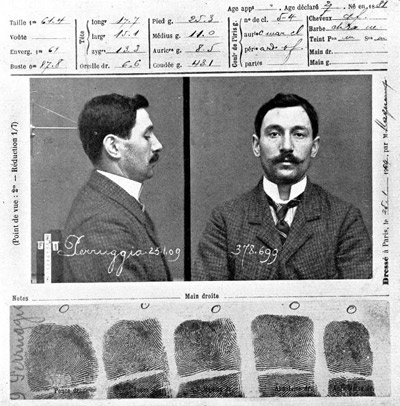
    JF Ptak Science Books     Post 1921  [Part of the series on the History of Blank, Empty and Missing Things]Leonardo peruggia fingerprint

    [See also the recent post on Mona Lisa’s Missing Jewelry.]

    In the category of upper-levels things gone missing (though not nearly in the same category as entire libraries that have been destroyed over time) is the theft of the Mona Lisa. This is an odd story full of detail and holes  that could have been the work of one man, Vincent Peruggia  (born in 1881 and pictured above in his mugshot) and who with extreme naviete thought he could steal the painting and sell it to the Uffizi and regain the prestige of Italy over its own missing masterpiece by a native son. It also could have been the work of a thief/forger team of Marque Eduardo de Valfierno and Yes Chaudron  who set Peruggia to the task of stealing the painting, with Valfierno contracting the sale of as many as six Mona Lisa forgeries to interested parties. 

    Valfierno’s idea was pretty cunning and diabolical–his only need was to have the real Mona Lisa disappear; then he could have his accomplice forger produce x-number of copies and sell them to x-number of collectors as the real thing.  After all, its not as though Mona Lisa owners would have a convention, so the ownership of the world’s most famous and stolen painting would be a very private affair. Also any claim of the real Mona Lisa appearing anywhere else–even restored to its place in the Louvre–would simply be met by the assertion by Valfierno that those “other” Mona Lisas were forgery. So it was forgeries all the way around.

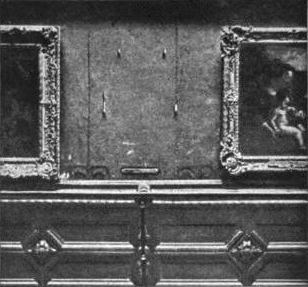
    Mona_lisa_stolen-1911And so Peruggia–an itinerant laborer who made his way to Paris for a better life and who had been working as a carpenter there at the Louvre–stole the painting on 22 August 1911. A Monday, it was, when the Louvre was closed to the public for staff to make repairs and such.  Evidently he simply worked his way over to the painting, took it off the wall, got a quiet place and removed it from the big frame (and glass!, which was a new security innovation to protect treasures from crank marauders), and loaded the Mona Lisa under his work smock. (He got the painting out of the building by getting a guard to unlock a door for him–one from which he had previously removed the doorknob, blaming its absence on scofflaws, distracting the man with the key enough to just open the door for Peruggia.)  

    The blank/missing hanging space of the Mona Lisa  at the Louvre in the Gallerie Carre was a vivid testament to the power of the painting, with thousands of people trudging by the depressing art-hole to stare at its absence. There were just four iron hooks on the wall, waiting for it, pounded into the plaster between Correggio’s Mystical Marriage of St. Catherine and Titian’s Allegory of Alfonso d’Avalos.

    Once Peruggia had completed the theft he was no longer needed. If Valfierno had actually been involved he would simply have used Peruggia as a fall guy, the many who made the sale of the forgeries possible. Peruggia wound up living in a series of shabby places, working his way back to Italy, perhaps waiting for further instructions, perhaps just a solo agent making his way back home.

    If he was an accomplice in  a more involved scheme, one could only imagine his frustration in being abandoned–there he was, sleeping on a cot in top of a box filled with his clothing and the Mona Lisa, waiting for something to happen that wouldn’t. 

    Peruggia found his way back to Florence, staying in Room 20 of the third floor of the Hotel Tripoli Italia on Via Panzoni, which was only hundreds of feet away from where Leonardo had once painted the Mona Lisa.   In 1913 he  finally contacted officials at the Uffizi in a very weird and awkward attempt to sell it to the museum. He was of course apprehended almost immediately, the museum guardians retrieving the painting from beneath Peruggia’s socks and underwear in the box under his bed.After being exhibited in Italy to tens of thousands of viewers, the Mona Lisa was returned to Paris on 4 January 1914. 

    Peruggia was evidently quite open about his theft but didn’t have anything to say about accomplices.  He was sentenced to a little more than a year for his crime–a sentence very soon after reduced to seven months. Following honorable service in WWI, Peruggia wound up in a suburb of Paris with a family and a hardware store, where he died of a heart attack in 1925. When returned to his hometown following his brief incarceration, he was welcomed as a hero–he may have been more so if he hadn’t demanded a payment for the painting.


  • Beautiful Ladders of the Baroque

    JF Ptak Science Books LLC     Post 1921

    Blogzabaggi043web
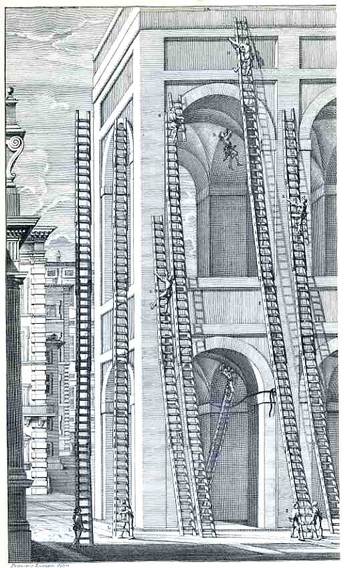
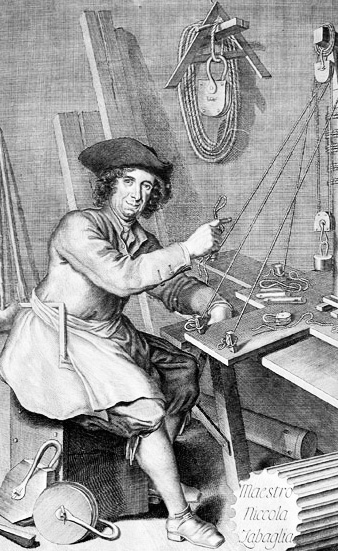
    This gorgeous, near-pre-Dadist image belongs to Niccola Zabaglia, who published the engraving in his book Castelli, e ponti di maestro Niccola Zabaglia con alcune ingegnose practice, e con la descriziojne del trasporto dell’obelsico Vaticano, e di altri del cav. Domenico Fontana, in Rome, in 1743.  This is the literal and absolute height of pre-modern, pre-mechanized building construction in the soaring Roman Baroque, ordained by “maestro”, the master, Zabaglia (1664-1750), a spectacular (and necessary) proponent of practical mechanics as applied to the building trades.  Among the “Castles” and churches and bridges alluded to in the title of his book, Zabaglia was responsible for affecting the maintenance and repair of St. Peter’s (more particularly to the basilica and the vault)—specifically, he had to figure out how to get the workmen and materials into place, and into very difficult and very high places, without damaging or destroying any of the existing decoration, artwork, sculpture, frescoes, and so on.  This was no easy feat to perform back there in the dim, 265+ years-ago pre-electric pre-power past, with enormous technical and operational difficulties, and Zabaglia accomplished this was superior affect, devising complex and elegant moving and stationary scaffolds, hoisting and holding mechanisms for the ladders, and much else.  He did just beautiful work, and he is a patron saint in the history of repair. 

    Ladders and scaffolds were important of course but were among the least of Zabaglia’s numerous accomplishments and inventions—they were so plentiful and useful that two Pope Benedicts ago (Pope Benedict the 14th) ordered their publication with actual teams of artists and engravers performing specific tasks.

    It cannot be left unsaid that Zabaglia’s portrait as the frontispiece to his work presents almost without a doubt the most approachable, humane and amused representations of a major engineer/artist/artisan published in almost any work of the 18th century–I mean, the man just looks so happy in his work.  There he is, surrounded by the tools of his trade, in work clothing and a scruffy hat, and needing a shave, and just looking as pleased as can be.  No?

    ZabagliaBut to the ladders:  the examples in the engraving above are certainly massive.  The ladder in the middle I would say must be 70′ tall (judging that it has 60-odd rungs and that there are 5 rungs to the men who are stabilizing it at bottom), and since they’re made of a good hardwood (to prevent bowing that must occur in a lesser material), the things must’ve weighed a good amount.  And offhand I’m not exactly sure how they raised them.  I can’t see the tops of the building, but I would assume that there was a pulley up there. I hope.  In any event, the ladders and their found geometries are gorgeous things.  Also, I would guess that in the very long histories of ladders (a ladder appears in a cave painting from 10,000 BCE and also appears in one of the very first photographic experiments) that these must’ve been among the high points in ladder construction. 

  • On the History of the Weight of Unknown Things

    JF Ptak Science Books LLC  Post 1922

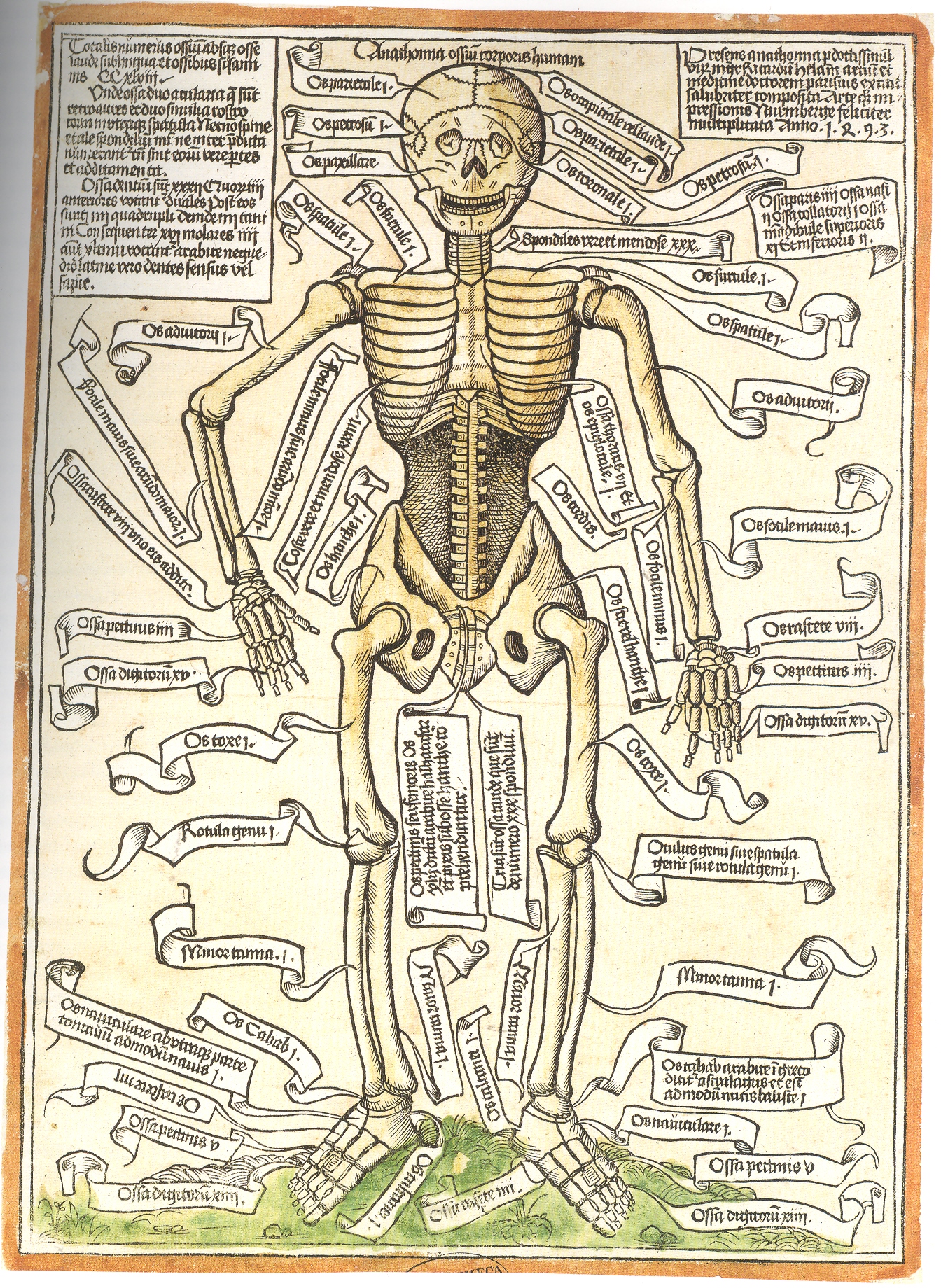
    Blog--may 5 skeleton

    Much of human intellectual history has been dedicated to looking inside, seeing
    the unseen, the stuff underneath, the invisible, the clouded, the inscrutable, the
    things-behind-something-else.   If you could somehow weigh all of the stuff that
    we know that is “visible” versus all of the other stuff that is not, I think that
    the scales would fly over instantly into the world of the unseen. Some of this
    material though does not have a measure:  for
    example, numbers are part of the unseen world, ideas made of nothing, points
    and lines in an imaginary series of planes and dimensions, and so have no mass
    themselves. Everything that is alive on and in our bodies, on our skin, in our
    water and food, and which were all basically unknown until the invention if the
    microscope, have little weight in and of themselves, but when  you add the whole biota together…well, then
    you’ve got a whole weighty lot of nothing  Then there’s the stars unseen beyond the six
    or eight thousand that we can see without a telescope, the rest of the universe
    waiting, discovered only 400-odd years ago, a very weight affair (and that’s not counting the dark matter). 
    I know that this is sort of a horrible argument, a beery and inelegant way
    to describe the path of human knowledge, but it strikes a (dis)chord with me. 

    What is the history of the unknown, anyway? Its seems like an infinite volume in Borges’ infinite library. After all, at any given point in time it would not be possible to know what the things unknown in your universe were, though you could guess at the absence of things by the changes they brought to the known stuff around you.  And to go back and write a history of the unknown would probably show an expansion of the topic rather than its collapse. However, if we are dealing in a Borgesian vocabulary we could establish that The Unknown at some point in the future becomes finite, and that a human-techno-cyborg race was closing in on the concept of the unknowable unknown having somehow established its parameters, and that at some point in the prickly future, the end of the unknown was in sight. As a matter of fact, it could be stipulated that the concept of the Unknown would cease to be in existence on 26 March 3012.  Then it would become time for a special assortment of people to work together to create the unknown, even as galactic brain churned in the background producing all of the possible works of literature/art/music, filling up the gap between the known and the unknown. 

    Creating unknowables in a time of the Post-Unknown would be, um, problematic.

  • Anatomy of Maps–Dissections in Geography

    JF Ptak Science Books   Quick Post

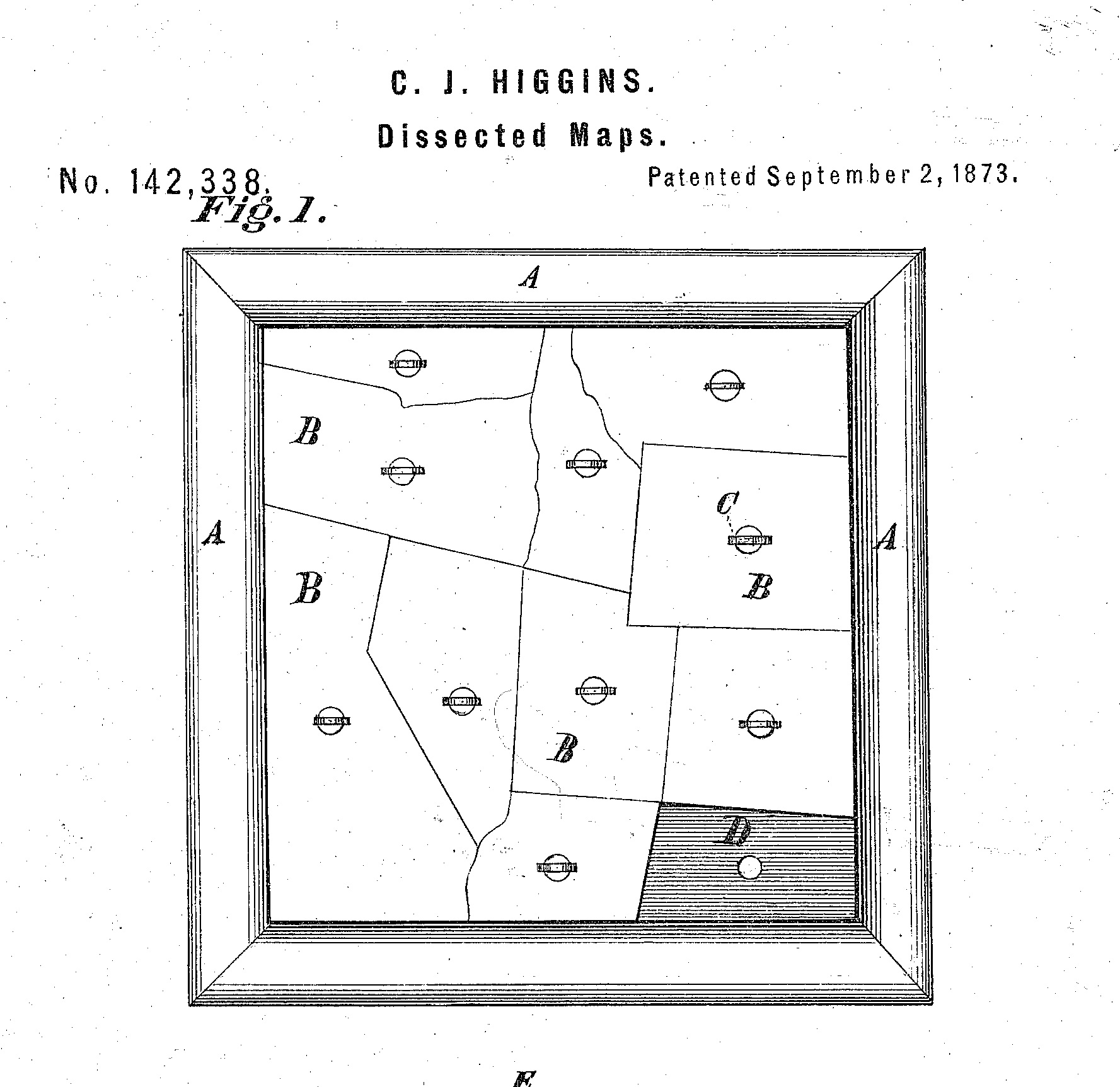
    This is an odd entry for the History of Blank, Empty and Missing Things category as it relates both to making things missing and finding them again.  In this instance the topic is maps and puzzles, where both actions of making things blank and restoring them are intentional. The first item on display–a sample from a “dissected” map patent from 1873, shows both an unusual “blank map” (a template simply waiting for a face) and the ability to remove part of the whole or the entire thing itself–and then of course replace/return the pieces.  But I must admit the original image (below) had that appeal of being mostly an unintentionally absurd item, a blank jigsaw in a frame. 

    Maps dissectedSource:  Google Patents  http://www.google.com/patents/US142338?dq=puzzle

  • “Vote Against the Terrible Men”, 1869

    JF Ptak Science Books  Quick Post, Election Day

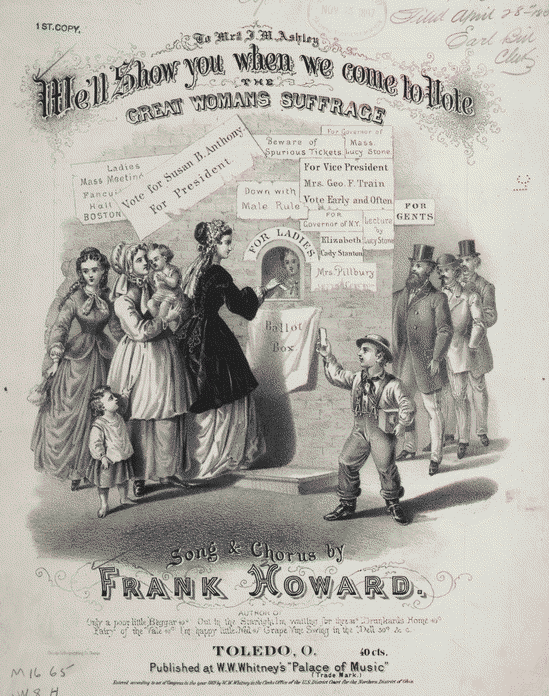
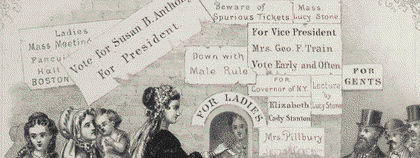
    This piece of Suffragette music was published in the incredibly-named “Palace of Music”by W.W. Whitney in Toledo, Ohio in about 1869.  For most intents and purposes the women’s vote movement was still in its first generation, and still five decades away from a  national vote for women. The music and words were those of Frank Howard (not of the Baltimore Orioles, as this Mr. Howard was born in 1823).  Images courtesy of the vast colelctions at/connected to the Library of Congress, here.

    Vote terrible men

    Vote terrible men_edited-1

    ·Posted by :

    ·in:

  • Patent Drawings for Voting Machines, 1873-1971

    JF Ptak Science Books    Quick Post, Election Day

    I’ve just simply collected a representation of  sixteen patent drawings for voting machines for the decades from 1873 to a very early electronic voting apparatus in 1971. Today I simply filled out a paper ballot with a pencil, which was in turn read by the real voting tabulator.

    I  found very few examples for “ballot boxes” or “ballot ____”  or “vote ___” anything prior to 1850; most of  the patent actions seem to take place after 1875 (perhaps ignited by the very problematical “stolen” election of 1876. 

    I don’t know if it is ironic/prophetic/problematic that the first example is by an inventor named “Doolittle”.

    1873


    1875


  • Doing Your Laundry at Home, 1922

    JF Ptak Science Books  Quick Post

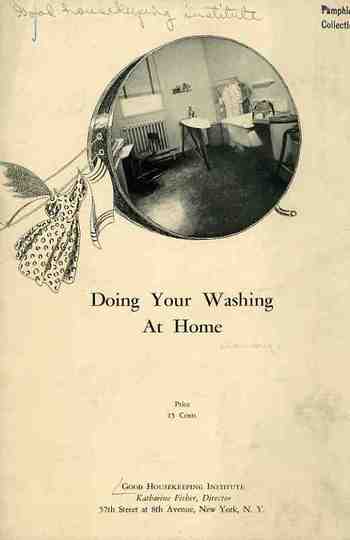
    This anatomy of convenience first seems to be the opposite of what it was–the newly-established laundry room as a place in which great chunks of time were spent on repetitive and numbing labor.

    Doing the laundry at home–where else was the laundry being done? By some middle class people the laundry was being taken care of elsewhere, and then also at home but by someone else–at least by semi-imaginary standards of the day in 1922. Perhaps to distinguish itself a little more clearly this pamphlet should have been called Doing Your Laundry at Home Yourself. 

    Good Housekeeping was presenting the Laundry Room, complete with all of the modern conveniences, including an electric washing machine, which (although there is no electric dryer in site) would have saved perhaps a waking week in the life of the average housekeeper by relegating hand-washing the laundry to an electrical convenience.  Blogjuly_17_work_laundry335

    ·Posted by :

    ·in:

  • Roentgen, Marey, & Malevich on the Edge of Modernity

    JF Ptak Science Books   Post 1924


    Pleasant_1bertha
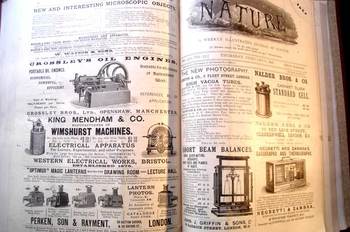
    The 1895/1896 issues of Nature magazine are compliantly normal until the first weeks of
    1896 when the first of a flood of articles is published about the astonishing discovery of 50-year-old Wilhelm Conrad Röntgen. The English-language popular science journal announcement of his December 28, 1895  “Ueber eine neue Art von Strahlen” (“On a New Type of Ray”), appeared on 16 January 1896, and began the introduction of a new state of human experience.  Roentgen’s experiments—built upon the work of J. Plucker (1801-1868), J. W. Hittorf (1824-1914), C. F. Varley (1828-1883), E. Goldstein (1850-1931), Sir William Crookes (1832-1919), H. Hertz (1857-1894) and the odious Phil Lenard (1862-1947)—revealed as much to humans as did the experiments and inventions of Hooke and Leeuwenhoek on the invisible worlds revealed by the microscope.  There are more than 150 articles on the Roentgen (and soon to be “X-“) Ray, all published within 12 months of the original announcement, almost all excitedly, trying to comprehend, elucidate, expand, verify, this new world. 
    Blogxraybigads_2
    [The news of the discovery is first and most popularly reported in the January 6, 1896 London Standard:  “The noise of war’s alarm should not distract attention from the marvelous triumph of science which is reported from Vienna. It is announced that Professor Routgen (sic) of the Wurzburg University has discovered a light which for the purposeBlogxrayad
    of photography will penetrate wood, flesh, cloth, and most other organic substances. The Professor has succeeded in photographing metal weights which were in a closed wooden case, also a man’s hand which showed only the bones, the flesh being invisible”. By the end of the month the news was completely absorbed, worldwide.]

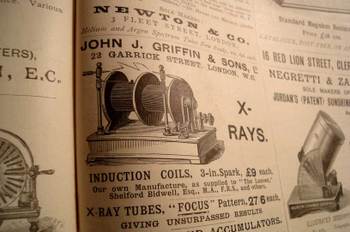
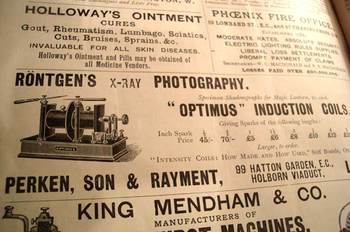
    I looked at the advertising in these issues (my copies of Nature for these decades generally have the original paper wrappers for the weeklies, complete with ad copy), looking for the first time that a Roentgen machine was offered for sale to the general public.  As it turns out, they popped up 12 March 1896 (once), 19 March (twice), and then about once a week for the rest of the year.  A little surprising, I think, a little light to my Monday-morning quarterback’s eye—I expected more; bigger, more, splashier.  But the ads are small and sedate, hardly similar to the discovery they represent. 
    Blogfeb_22marey
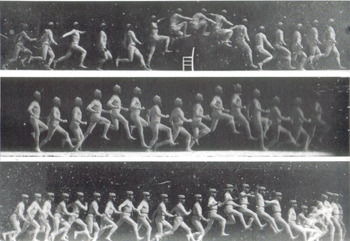
    The rest of the world, the rest of the advertising world, stayed the same–the Roentgen discovery and the enormous possibilities and promises of his “new photography” lived in their own unique sphere, unencumbered by their sassy new brother.   This mild response seems dimmer still when you compare it to that which greeted other (relatively) simple but still major advancements in the world of photography.  Take for example Etienne Marey, who was a technoid and physician who was able to capture motion of all sorts–he was able to develop a picture so to speak of the movement of blood in the body via his instrument to calculate blood pressure, and he also created a shotgun-style camera that made the Blog_feb_22_nude
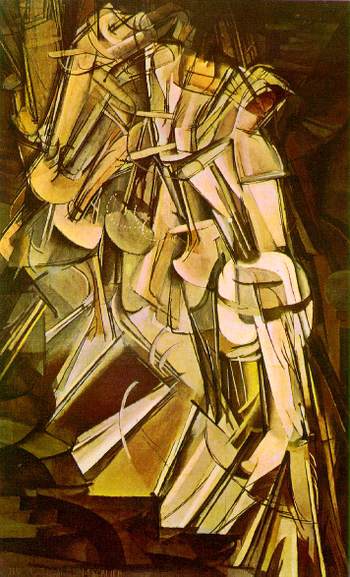
    world’s first high-speed photographs of movement.  And so it cane to pass that in the late 1870’s and early 1880’s people were instantly able to see what a horse looked like when it galloped or what the body did *exactly* when jumping over a chair.  When you couple this with fourth-dimension material one wonders why it took several more decades to bump into these images in the art of 1907+. 

    (Duchamp Nude Descending series, 1915; above, Marey, 1881)

    And what indeed was normal in these pages?  Magic lanterns
    and magi lantern slides appearMagiclantern
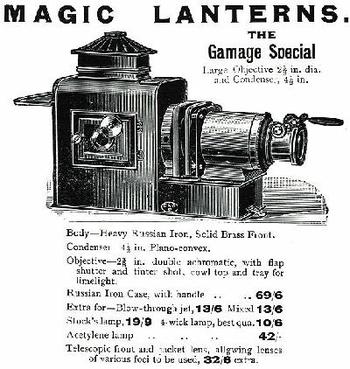
    at all levels; the gorgeous Wimshurst machine gets heavily advertised; the redoubtable Negretti & Zambra advertised all manner of excellent scientific instruments (biographs, thermogrphs.  Nadeer Bros. advertised a pretty standard cell, and the ancient Crossley displayed their “new” oil engines, “suitable for all classes of agricultural work”.  J.H. Stewart was selling their semi-automatic electric arc lamp, while across the page was Newton & Company’s “Newtonian” arc lamps for lanterns (“self feeding and focus keeping”).  Microscopes and prepared slides abound, and Thomas Bolton advertises discretely and effectively for their “living specimens for the microscope”. 

    The Physical Review, the American upstart in the science world advertises that its third volume was available, while its distant cousin, the Psychological Review, advertised its own third volume.  Booksellers seem to take the most space, thank goodness. 
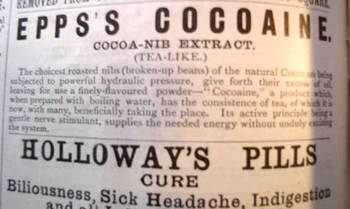
    Blogxrayepps
    There are a few medical throwbacks:  Epp’s Cocaine takes out occasional tenth-page ads for their “cocoa-nib extract, tea-like” selling its ‘gentile nerve stimulant”.  Right underneath is “Holloway’s Pills”, promising to cure biliousness, sick headache, indigestion, and all (?!) internal complaints.   These are brilliant simple samples of the skeleton of science in world-dominant Great Britain, in a world dominated at that time by H.A, Lorentz, Ernst Mach , Roentgen, Korteweg, de Vries, Bateson, Jean-Baptiste Perrin, Pierre Curie, Zeeman, Becquerel, Joseph Thomson,  Ernest Rutherford, Marconi, Ramsay, Fitzgerald.  And so on. 

    Nothing offered for sale here offered any significant clue to the pregnant world of modernity that was nearlyBlogxray3
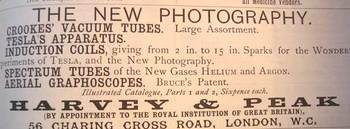
    there—the world would become ‘modern” almost immediately following Roentgen, with revolutionary, epochal changes in art (in non-representational form more so than Impressionism), theater, literature, music.  Just about everything changed (except politics).  But there is no hint to paradigm shift hidden in the ads, just as they were with the machines selling the promise of Roentgen’s “new photography.  There’s something about the fine glass, superb turning of the screw, and a perfectly oiled gear though that makes this sort of perfection seem so lonely in the world of larger change.  Bertha, Roentgen’s wife, sat for 15 minutes while her husband passed his rays through her hand; she ran from the room once she saw the results, revealing her very bones and no doubt a strong sense of the Blog_feb_22_malevich
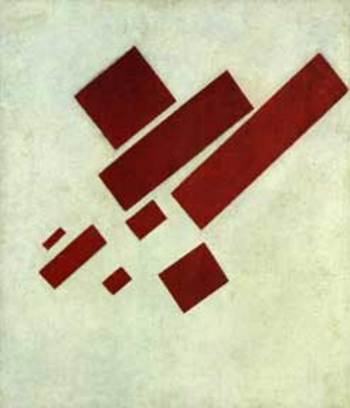
    fragility of life, and the strong presence of death.  Many had the same reaction to the Kandinsky’sBlogxrayad2
    shapes and Malevich’s white circles and red rectangles and Ibsen’s drama and Einstein’s dancing dust and the rogue syncopation of jazz.  It is probably a very natural reaction to try and protect established memory—but memory should be more flexible than that, I think, to keep a healthy mind.

    (Malevich’s 8 Red Triangles, 1915)
  • Acoustic Weapon “Performance Degrader”, 1933

    JF Ptak Science Books  Post 1926

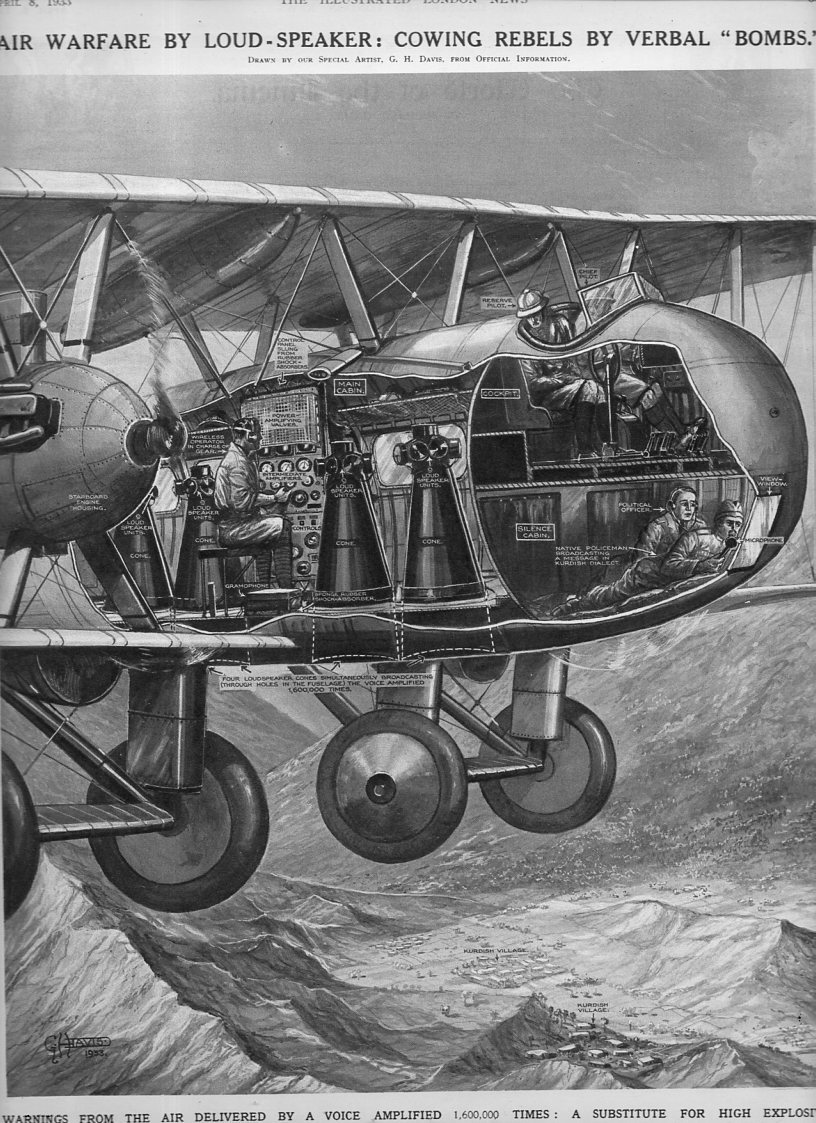
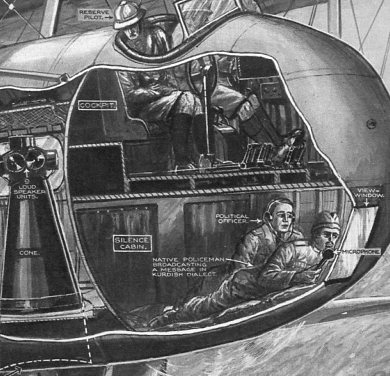
    From the looks of it, this image from an 8 April 1933 issue of the Illustrated London News is not quite a “verbal bomb” as we might think of such a thing today.  The cutaway drawing (by the sensational G.H. Davies, who produced hundreds of these images for the magazine over four decades)shows an acoustic device housed in a Vickers Victoria aircraft. As described in the descriptive text to the image, Sir Philip Sassoon (“speaking in the House of Commons on the Air Estimates last month”) mentioned in May 1933 an attempt to induce forces hostile to the U.K. in Northern Kurdistan by flying over rebel strongholds and threatening an air attack if no surrender was forthcoming.

    Verbal bombs877

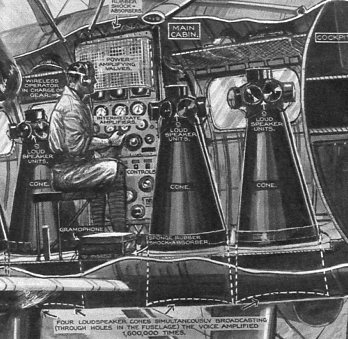
    Evidently a translator would address the town at 2-4,000′ elevation through an audio system that amplified the voice”1,600,000 times”. An address was made to the leaders of the tribesmnen to surrender their position, else an air attack would occur after three days. Even though described in the title of the image as a “verbal bomb”, it isn’t anything like the directed energy/sonic/acoustic/infrasonics/pulse weapon performance degraders that are currently available.  What was happening here was simply (or not so) an attempt to get an enemy to relieve their position via tangible threat, sort of an acoustic leaflet bombing prior to the real thing. Of course this was backed up by actual bombing, which was still a relatively new weapon for armies–several nations which possessed this newish facility of war practiced bombing civilian/military targets alike in extra-territorial possessions. (There was a hot debate over what constituted fair use of aerial bombs beginning in earnest in the 1920’s, but much of that soon devolved into debates on what constituted “civilian populations”, and there the definitions were wide and sloppy.)  In any event, the loudspeakers did not emit high-powered sound that would disturb/puncture eardrums or cause dizziness or problems with eyesight by making the eyeballs vibrate–they were just loud conveyers of Bad Things to Come.

    Verbal bombs det 2879
    Verbal bombs det878

  • A Dance of Armless Anatomy, 1741: an Enormously Expressive Anatomist

    JF Ptak Science Books    Quick Post

    Anatomy da cortona

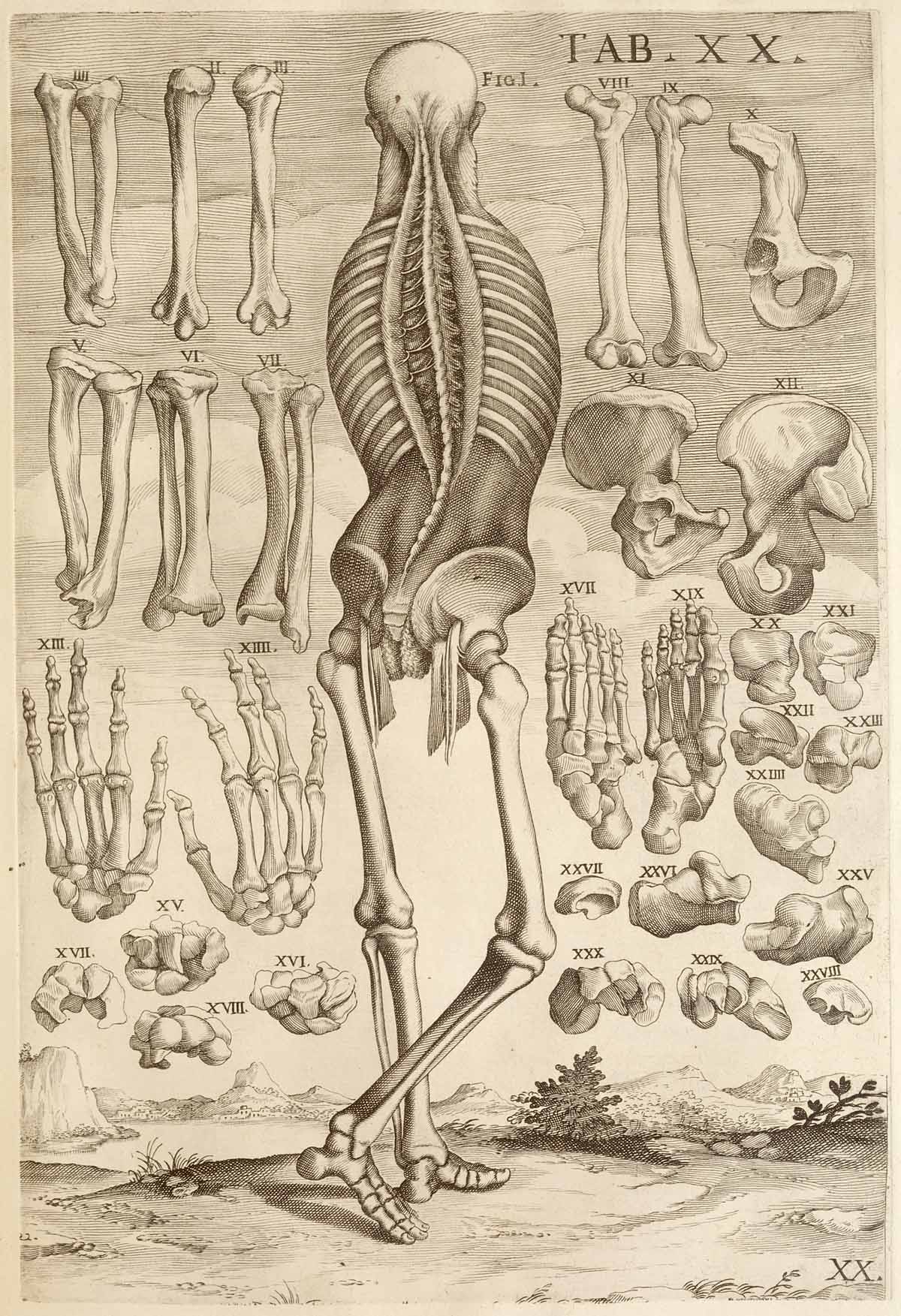
      This “dancing” skeleton is the work of artist/anatomical illustrator Pietro Berrettini da Cortona (1596-1669) and appears as a copperplate engraving in his book Tabulae anatomicae…which was printed in Rome in 1741. 

    [Source: National Library of Medicine.]

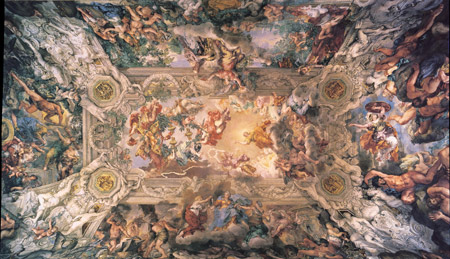
    He complete this work around 1618 and it was neglected for more than a century, finally seeing publication in 1741.  It may be because Mr. da Cortona was busy being an architect and artist-outside-of-anatomy, For example, he did this:

    Cortona ceiling
    [Source:  Galleria Borghese.]

     Which is not to say that a giant ceiling to the dedication of a pope is “better” necessarily than anatomical illustration, but it certainly consumes more effort and time.

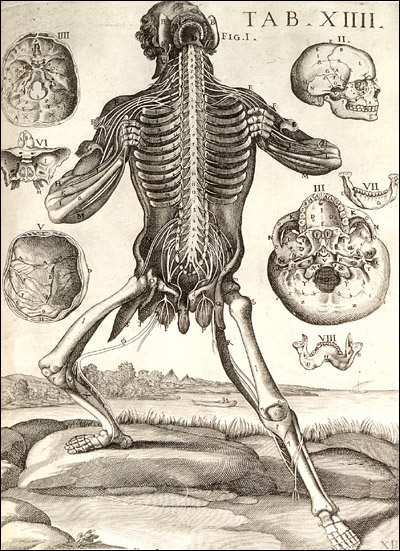
    That said, when da Cortona did these images in his youth he reserved very little in the way of expressive sentiment of the cadaver models.  His work was nothing short of extraordinary:

    Cortona[Source: National Library of Medicine.]

    This is simply magnificent, and the artist is letting everyone know it.

    [The full text but with muddy images is available at the Internet Archive,]

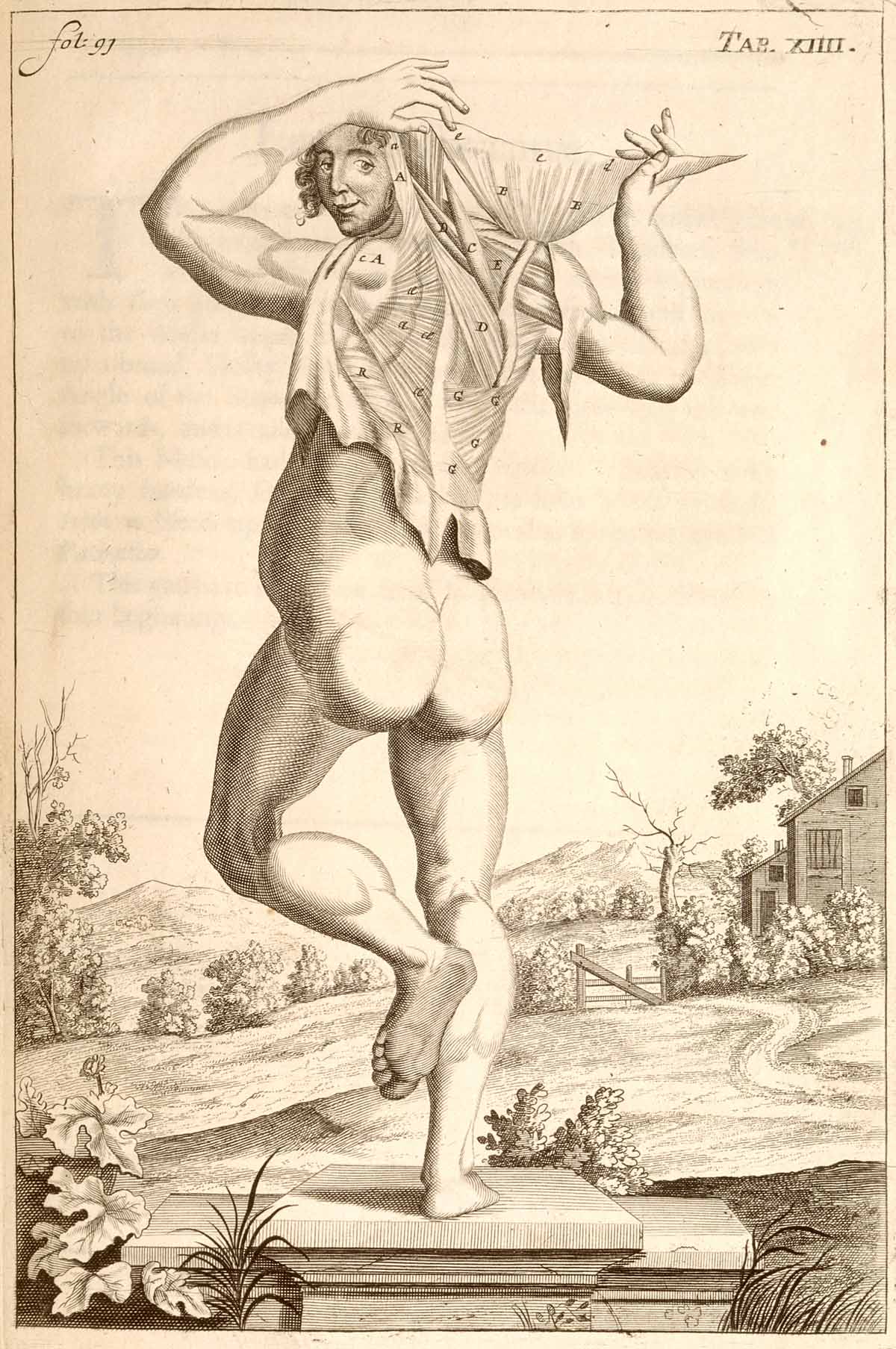
    A not-armless dancing anatomical figure that isn’t nearly as aggressive as the figure above–and in fact seems to have a bit of a “come hither” attitude” is this example from A compleat treatise of the muscles, as they appear in the humane body, and arise in dissection…by John Brown (ca.1642-1702) and which was published in London in 1681:

    Anatomy john brown

    [Source:  http://www.nlm.nih.gov/dreamanatomy/images/1200-dpi/I-D-3-16.jpg]

Recent Posts

Archives

Categories