A Daily History of Holes, Dots, Lines, Science, History, Math, Physics, Art, the Unintentional Absurd, Architecture, Maps, Data Visualization, Blank and Missing Things, and so on. |1.6 million words, 7500 images, 4.9 million hits| Press & appearances in The Times, Le Figaro, Mensa, The Economist, The Guardian, Discovery News, Slate, Le Monde, Sci American Blogs, Le Pont, and many other places… 5000+ total posts since 2008.

  • A Massive Triple Tandem Triplane (1921)

    JF Ptak Science Books  Quick Post

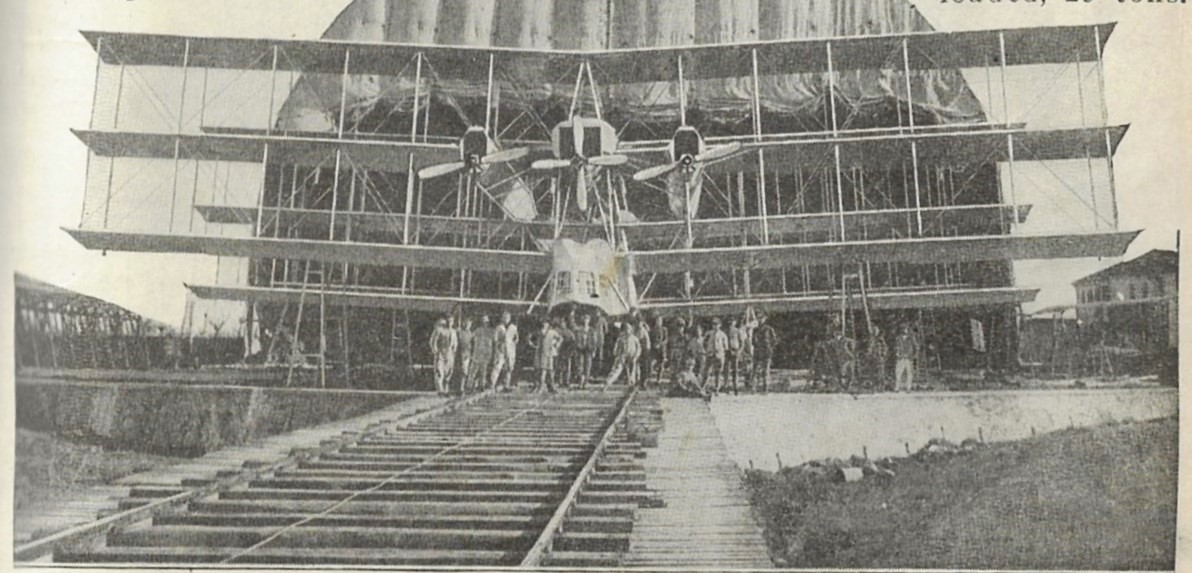
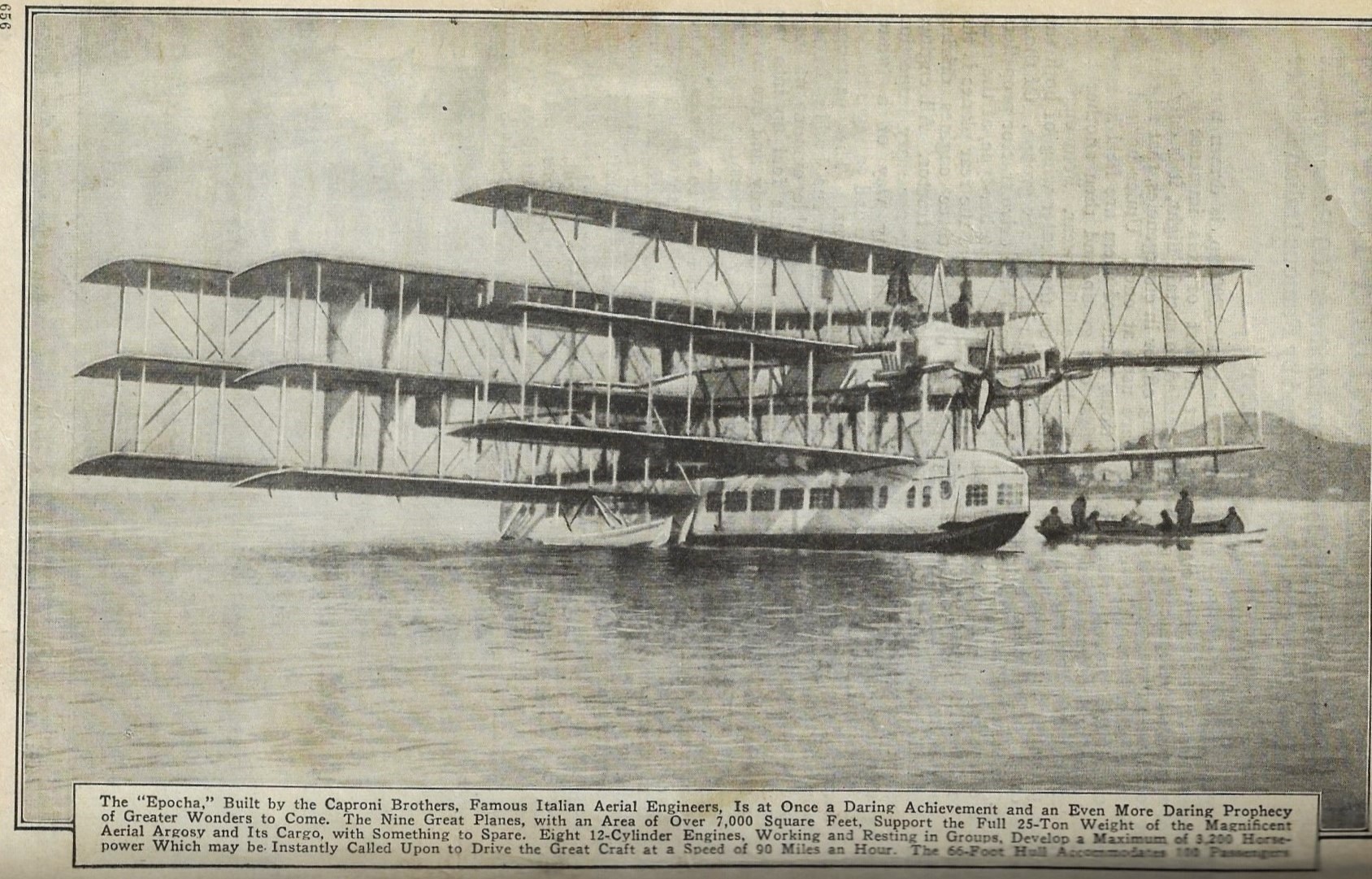
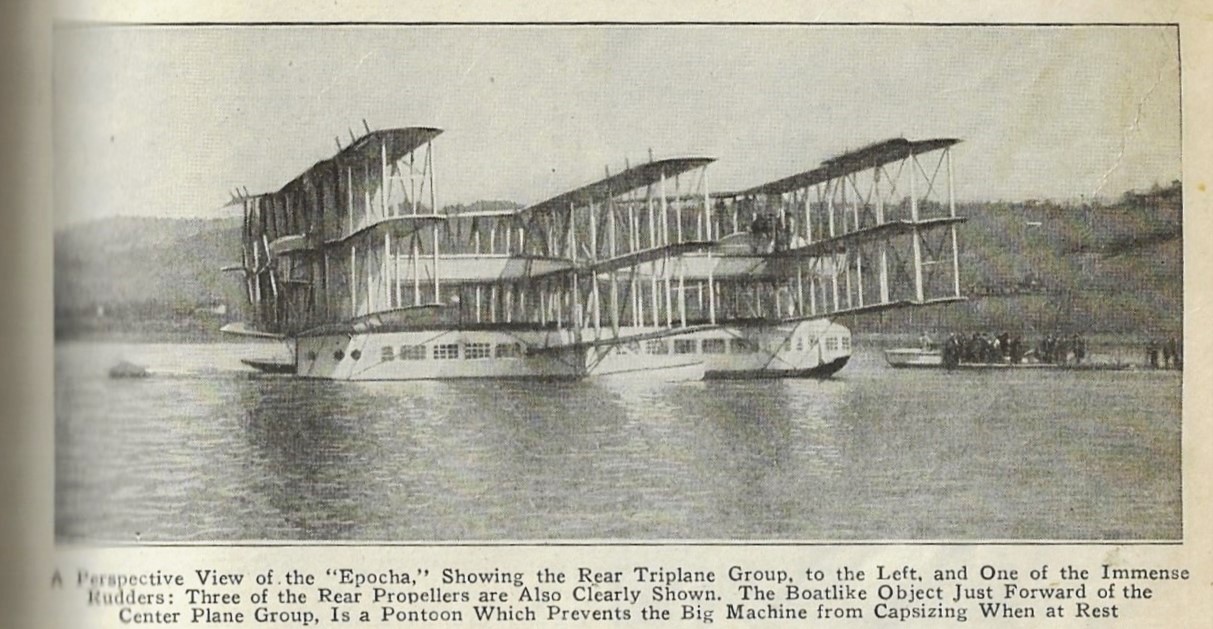
    What we see here, below, is a rather extraordinary flying machine, a mammoth beast with 8,000 square feet of wings (more than 40% greater than that of a 747). It was a triple tandem triplane, which is a glorious-sounding and possibly epic description of the aircraft—a plane with three independent triplanes fixed to one fuselage. The article appears in Popular Mechanics for May 1921, and describes this aeronautical attempt as the work of Giovanni (Gianni) Caproni (1886-1957), which was to be a transport for 300-mile round trip excursions at about 80mph cruising speed. It was powered by 8 12 cylinder 400 hp Liberty engines operating on push/pull arrangements on different wings, carrying a crew of eight and 100 passengers. Unfortunately the flying boat crashed on its second test flight, and then the remains were towed badly toward shore, and that was the end of the plane.

    Pop Mech 1921 massive flying boat caproni _2_


    Pop Mech 1921 massive flying boat caproni _3_
    Pop Mech 1921 massive flying boat caproni _3_

    ·Posted by :

    ·in:

  • J. Robert Oppenheimer on the Economics of Atomic Bombing (1945)

    JF Ptak Science Books  Post 2811

    On the heels of the sale of a letter [https://historyofideasblog.com/thesciencebookstore/2013/03/william-shockley-on-the-economics-of-atomic-bombing-1945.html] written by transistor pioneer and then mega problem child William Shockley on the economics of atomic bomb a friend told me about a potentially similar account by J. Robert Oppenheimer. Leaving the modern racist Shockley behind in this post for time consideration, the Nobelist (sharing the 1956 award with co-workers Walter Brattain and John Bardeen), the man wrote an appraisal on the monetary aspect of conventional vs. atomic attack for one of the Vannevar Bush groups in 1944/5. It may seem pretty harsh—especially when he came out with the unsurprising finding that the economics of the situations were firmly positive for the use of nuclear weapons—but it was a job that someone had to do, somewhere, and Shockley turned out to be that person, probably to the surprise of very few.

    Oppenheimer is a different story. Philosophically conflicted and occasionally torn, the man who announced himself as the “destroyer of worlds” while still bathed in the light of the successful atomic test shot in the Jornada del Muerto also contributed some thought to this issue. The original reference to this was told to me to be in Scientific Information Transmitted to the United Nations Atomic Energy Commission…June 14, 1946, a set of seven slender volumes prepared under the direction of the always-present Bernard Baruch. The reference came in the first volume (which also has a short and simple and brilliant 18-page history by Richard Feynman and Robert Bacher of atomic energy and the building of the atomic bomb) in a paper by Philip Morrison in which he records a one-line quote of Oppenheimer’s overall assessment of the dollars and cents of atomic bombing. The Oppenheimer quote was referenced to its source in a Congressional special report on atomic energy published a few months earlier in 1946, and there he speaks for about one page on these explosive economics.

    As I said it is far easier finding this thinking in Shockley—but for Oppenheimer as disagreeable as this thinking might’ve been, it was still a pertinent question and one that needed to be researched and answered, and I believe Oppenheimer did just that, with no extra-emotional attachments to the issue. It was an issue/problem/question, and the scientist answered it.

    So for the general interest I’m reprinting Oppenheimer’s testimony on this one aspect of the use of the atomic bomb, which you will find below.

    • The source: Hearings before the Special Committee on Atomic Energy, United States Senate, 79th Congress, first session, pursuant to S. Res. 179, A resolution Creating a Special Committee to Investigate Problems Relating to the Development, Use, and Control of Atomic Energy. Part 2: December 5,6,10 and 12, 1945. USGPO 1946.

    “Senator Hart [Thomas C. Hart of Connecticut]. Doctor I think perhaps you may be misunderstood at one point on account of brevity.

    You said that atomic weapons can be cheap instruments of devastation and then explained it briefly.

    I think it would be better for purposes of the record if you expanded that.

    Dr Oppenheimer. Well I have seen a figure I don t know whether it is a reliable figure but it is surely not a crazy one that it has cost us in this war $10 a pound to deliver explosive on the enemy. I am unable to give an accurate cost figure on atomic weapons partly because I don t know and partly because if I did know it I would be prevented by that knowledge from saying it but I think that I can say that even taking account of the in some ways diminished effectiveness of concentrated bombing it is somewhere between 10 and 100 times cheaper to deliver atomic weapons which is simply in terms of the area destroyed it is 10 or 100 times cheaper.

    I don t know if it is 10 times or 30 times and this will depend on policy but it is an enormous factor. It is not a trivial change.

    Senator Hart. Cheaper for instance than TNT?

    Dr Oppenheimer. That is right and I am using a figure which may well be criticized but which is I believe the figure used by Army Ordnance for over all cost of delivering a pound. You can see what that means if you take a round figure of 10,000 tons as a possible effective equivalent for an atomic bomb. That is 20,000,000 pounds which is $200,000,000. Now without revealing any secrets I can say that an atomic bomb and the equipment for delivering it is not going to cost that by an enormous factor.

    Senator Hart. But those large TNT bombs which are the usual comparative figure though the destruction in any one point any one small area is by no means as great it is sufficient and is spread over a wider area is it not?

    Dr Oppenheimer. I used a somewhat conservative figure of the 10,000 tons rather than the actual equivalent in part to take this into account. The actual atomic bomb releases more energy than this.

    Senator Hart. But it is true that the comparison as is usually made is a little faulty because of the respective areas involved?

    Dr Oppenheimer. What I would say is this and I will be somewhat sharper about it if you wish. For the equivalent tonnage the factor of cost will be more than 100. For equivalent area it will be somewhere between 10 and 100 and that is to try to take account of this effect which you mentioned. Of course if you want to knock out three houses somewhere you will not use an atomic bomb.

    Senator Byrd [Harry Flood Byrd, Virginia]. Doctor, when you spoke of destroying the stock pile of bombs would that mean too destroying the organization and the factories that made the bomb?

    Dr Oppenheimer. In the first place I did not speak of destroying it. I was asked about it.

    Senator Byrd I understood you to say that if you had faith in other nations you would then favor the destruction of the bombs we accumulate during this period before we can ascertain what other nations are going to do.

    Dr Oppenheimer I would say this country should do for the problem of atomic armament what we expect other nations to do If we expect them and are convinced that they wish not to arm atomically then I think that we should not arm atomically and if we want to keep the plant some place. I think we should have that plant completely open and should allow the representatives of the powers with whom we are dealing to know as much about what we are doing as we would want to know about their plants…”
    ·Posted by :

    ·in:

  • General Groves on The Possibility of Blowing Up the World and What Comes Next (1945)

    JF Ptak Science Books   Quick Post

    Yesterday I wrote a post about Robert Oppenheimer’s 1945 Congressional testimony on the economics of using atomic bombs over conventional bombs. In an earlier section of the same volume1 publishing the Oppenheimer statements there are also testimonies of some other Los Alamos and atomic bomb figures, including Harold Urey, Irving Langmuir, and Vannevar Bush. And Leslie Groves. General Groves of course was the military chief of the Manhattan Project and ran it with some interpersonal difficulties but with great success with Robert Oppenheimer, who was in charge of the scientific cadre.  They were an odd pair but worked well enough together to push through an enormous project of absolutely fantastic complexities and depths. In questions from six Senators Groves addressed a number of wide-ranging issues about the bomb, though what particularly appealed to me today was his observations on the possibilities of the U.S. precipitating some sort of event with atomic weapons that would bring an end to the world. The question came from  Senator Richard Russell (Ga.) who (with some difficulty) asked after this possibility. Groves responded with brusqueness and a sort of common authority, which I reprint below. 

    “Senator Russell: General, the papers tell us that some of the scientists are of the opinion that if a large number of these [atomic bombs] were exploded over the world that it would reach out into the elements in the atmosphere and instead of being a world we would just be a new star, and all life on the planet would be extinguished almost automatically. Do you have any theory on that to give us?

    General Groves: My only theory is that I don’t worry about it because if it happens it will be all over and we won’t have that to worry about. We won’t have to explain that one but the theory is not concerned with getting a number of these bombs but with getting one that is big enough to do that. No one knows what that size is. It is all highly theoretical…It is more or less the kind of thing that they [physicists] will discuss as a possibility when they are just sitting around talking theoretically they may be able to prove that such a thing is possible but the best advice I have and I certainly don t hold any personal views or knowledge on the subject but the best advisers tell me that they are not a bit worried, and I personally am not worried. I feel it will be beyond my lifetime and then I will let the next generation worry as to whether they are going to blow themselves up or not.”

    And there you have it. 

    Notes:

    1. HEARINGS BEFORE THE SPECIAL COMMITTEE ON ATOMIC ENERGY UNITED STATES SENATE SEVENTY NINTH CONGRESS FIRST SESSION PURSUANT TO S Res 179 4.  A RESOLUTION CREATING A SPECIAL COMMITTEE TO INVESTIGATE PROBLEMS RELATING TO THE DEVELOPMENT USE AND CONTROL OF ATOMIC ENERGY.  USGPO, 1945.

    ·Posted by :

    ·in:

  • On Dr. Frankenstein and a Female Creation

    JF Ptak Science Books    Post 2705 

    Why did Dr. Frankenstein create a male and not a female being? I guess it would be easy to slip into a rolling piece of guesswork as to why the good doctor took on what he referred to as feminine Nature to substitute himself for the job and bring forth yet another male.

    It is perhaps a little odd that Mary Shelley took this route, given her proto-feminist-founding mother and anarchist father, but then again her novel was published in 1818 when she was all of 21, which means she probably wrote it in her ‘teens, which means there was only so much time at that point to have given much long thought to the rights of women ideas. Or not—this is purely speculative. In any event, I liked the idea of the question.

    Victor Frankenstein did indeed nearly create a female being, and was half-way or so there. He wasn’t a fan of this thinking earlier on in the novel, as we hear him addressing his Monster:

    • “Abhorred monster fiend that thou art the tortures of hell are too mild a vengeance for thy crimes. Wretched devil you reproach me with your creation come on then that I may extinguish the spark which I so negligently bestowed…” (By the way, “sparks” is what brought the Frankenstein’s creation to life, this being an early heyday of electricity, though “spark” is mentioned only three other times in the book.)

    His creation pleaded with him for companionship, but old Dr. Vic thought better of the idea and destroyed “her”, ripping the new creation literally limb from limb. It is an unpretty story, though the case made to the doctor from his “monster” is excellent, and I include a good selection of the dialog below.

  • “Smoking and Longevity Statistically Associated with Impairment of Life Duration” (1938)

    JF Ptak Science Books  Post 2706

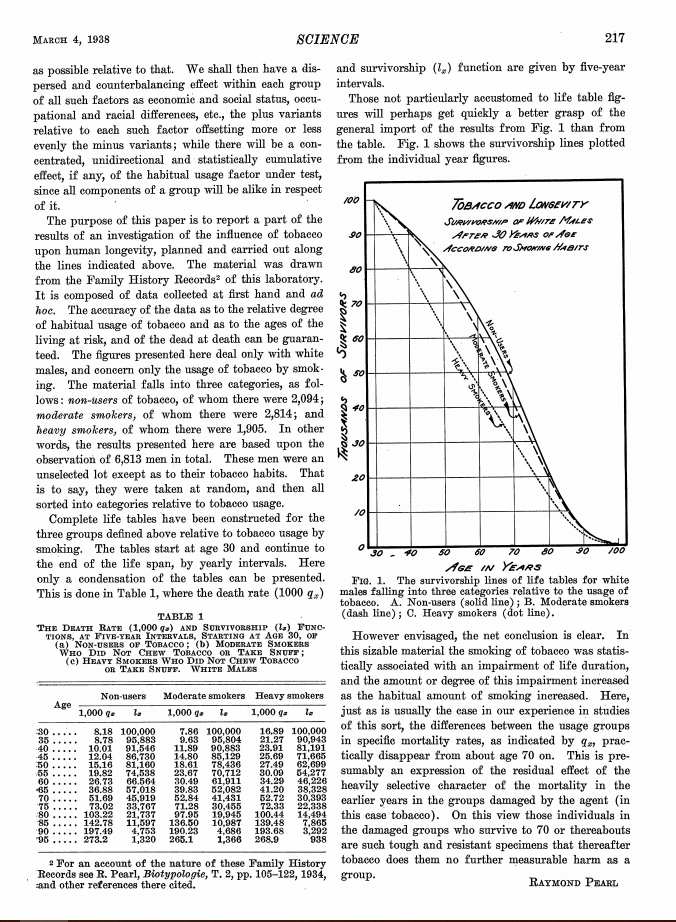
    Raymond Pearl brought to the readers of Science in 1938 what seems to be the first scientific study1 on the effects of smoking tobacco on longevity, announcing that “smoking of tobacco was statistically associated with an impairment of life duration” The work has been described as a classic in epidemiology:

    • “Despite his often provocative pronouncements, the proof that Pearl provided that smokers are prematurely killed by the effects of tobacco must be recognized as one of his most important achievements in epidemiology. In fact, Pearl’s 1938 article in Science describing the premature death of smokers was the first significant piece of data on the link between tobacco and longevity.”–Goldman, I L, “Raymond Pearl, smoking and longevity”, in Genetics, 11/2002, Volume 162, Issue 3 https://www.genetics.org/content/162/3/997

    Pearl certainly had a way with turning a long and tumbling and turgid phrase—you can almost see him crafty his long wide-tired sentences and chuckling through them, gravity of the subject or not.

    He starts the paper off with a rather longish statement about the vast majority of human beings consuming things that they really don’t need to consume, and that some of these controllable non-essentials may cause them some harm:

    “In the customary way of life man has long been habituated to the routine usage of various substance and materials not psychologically necessary to continued existence: he writes. “Tea, coffee, tobacco, opium and the betel nut are statistically among the more conspicuous of such materials…all of them contain substances of considerable pharmacologic potency if exhibited in appropriate dosage”. Pearl states that even with heavier usage of these products that the long-term negative effects of usage does not outweigh the benefits of use “in the opinion of vast number of human beings”.

    • “Purely hedonistic elements in behavior, which are present in lower animals as well as in man, have a real importance…there are undoubtedly great numbers of human beings who would continue the habitual use of a particular material they liked, even though it were absolutely and beyond any question or argument proved to be somewhat deleterious to them”.

    Pearl smokingHe doesn’t say anything about people being addicted to any of these things.

    In the next page or so he describes the study and the numbers (though we don’t learn in this paper what the difference is between his “heavy” and “moderate” smoker categories), establishing with a strongly accusatory graph that there is a bulbous result in shortened lifespan for heavy smokers aged 30-70-ish.

    He concludes in this short two-page paper that after the subjects in his study turned 70 that “individuals in the damaged groups…are such tough and resistant specimens that thereafter tobacco does them no further measurable harm as a group”. There’s nothing here about the “why” or “how” of death, just that it occurs.

    So there it is, the first measure of tobacco use and shortened lifespan. This was the first step in the long climb to the very public introduction of the killing nature of the tobacco habit, which entered its modern phase in 1964 after considerable battles with those in the business of producing the deathsticks.

    1964 was 55 years ago and fortunately great strides in research and education have been made. The tobacco menace has been extinguished now that we’ve learned beyond all question the great horrors it brings, everyone worldwide knowing that smoking tobacco will kill you, and in very nasty ways. Humans have learned something, and this is one extremely preventable mode of death that we’ve managed to eliminate.

    Oh, wait a minute…

    Notes:

    1. Raymond Pearl, “Tobacco Smoking and Longevity”,  Science, vol 87, no. 2253, March 4, 1938, pp 216-217.

    ·Posted by :

    ·in:

  • An Improbable Advertisement in “Astrophysical Journal”, 1903.

    JF Ptak Science Books   Quick Post

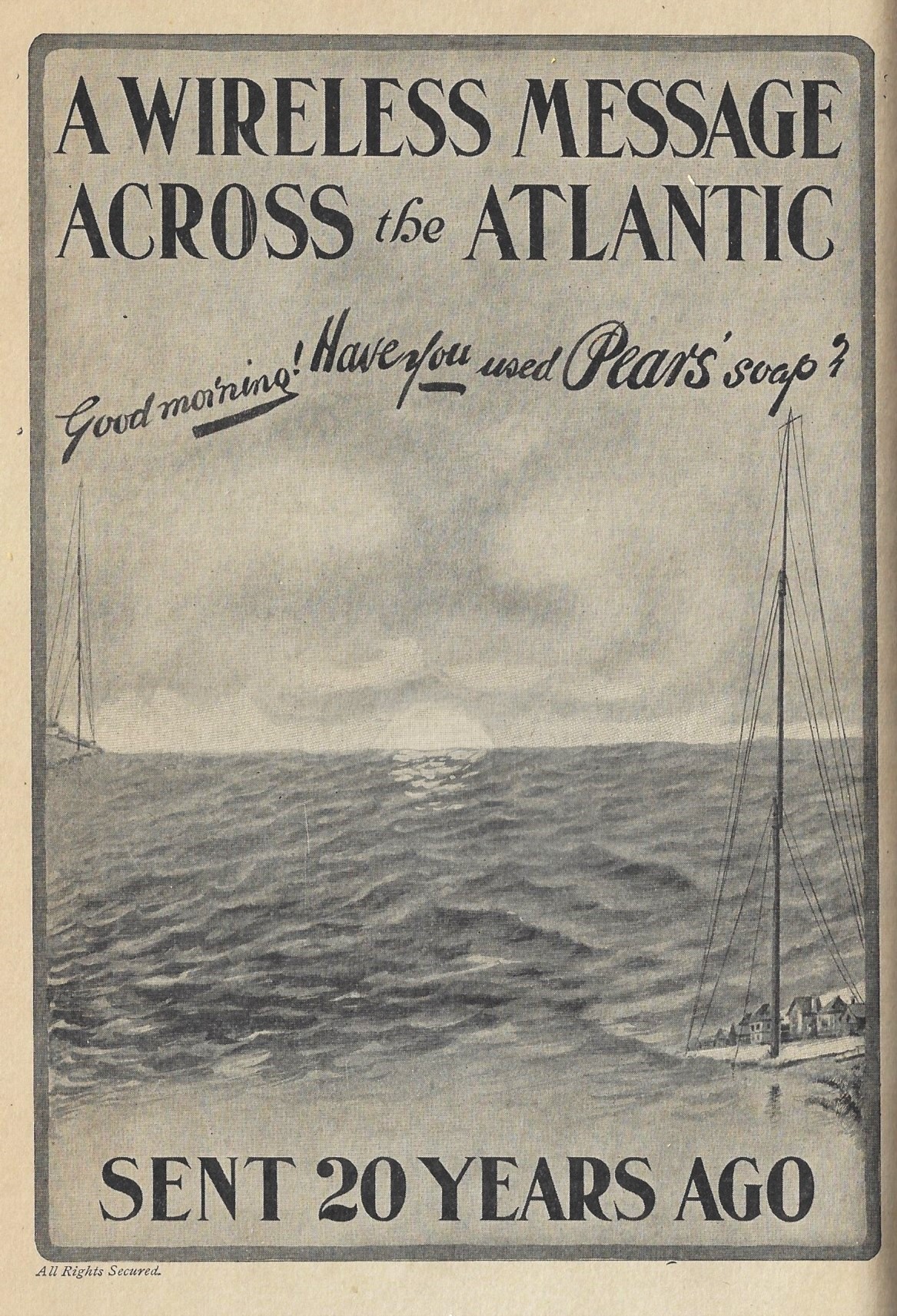
    Pears soapHere’s a scamperingly light post: an ad for Pears’ soap making a very curious and probably intentional incorrect claim. Of course it is just an ad, and it is just soap, but it is displayed proudly full-page on the inside cover of the prestigious Astrophysical Journal for 19031, and it seems to make an odd statement about transoceanic radio communication, inferring that a message was sent across the Atlantic via wireless “20 years ago”.

    Here’s the deal: I don’t understand why this ad is so purposefully wrong. The first message sent across the Atlantic didn’t occur “20 years ago” or 1883 as is coddled in the ad–that honor belongs to Marconi (1874-1934) who expanded on his first experiments in 1894 to send and receive radio signals across the Atlantic on 12 December 1903. (The signals originated in Poldhu, Cornwall, England, and was received at Signal Hill, St. Johns, Newfoundland—the message was a simple Morse code for the letter “s”.) Those twenty years notwithstanding, Marconi and Ferdinand Braun shared the Nobel in 1909 for their work in radio.

    Now, the ad says “sent 20 years ago” and not sent and received, or received at all for that matter. I know the “twenty years” doesn’t correspond to when Pears began operation, because that occurred in 1807. So I’m not sure what it is that they’re talking about here, though it is a pretty ad. If anyone has the answer to this little issue, I’d like to hear about it.

    (The antennas depicted here are very unlike the ones that Marconi constructed for his famous feat: “The spark-gap transmitter fed a mammoth antenna array — four hundred wires suspended from 20 masts, each 200 feet tall, placed in a circle. A similar station was set up on the American side of the Atlantic at South Wellfleet, Cape Cod.”–IEEE Milestones, “Milestones:Reception of Transatlantic Radio Signals, 1901.”)

    Notes:

    1. Oddly enough, Pears’ was about the only advertiser in the 1903 volume of the journal. I don’t know what the attraction was between soap and astronomy, though perhaps the elite at Pears’ just wanted to sponsor the relatively new journal.  

  • On Looking for One Thing and Finding Another (1878). What Does Criminality Look Like?

    JF Ptak Science Books   Quick Post

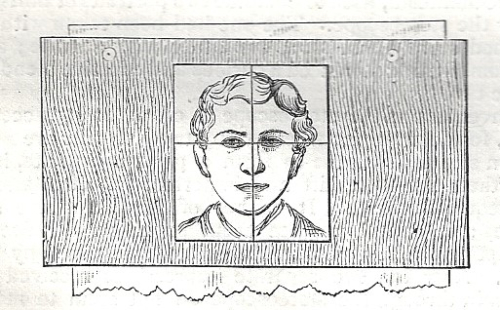
    Galton faceSir Francis Galton’s “Composite Portraits” article in May 23, 1878 volume of Nature (pp 97-100) came early on in the prehistory of cognitive and computational aspects of “facial recognition”, though more like an analog development for a later digital environment. In this paper he discusses his attempts to see the face of criminality before crime was committed. Galton put together and projected a number of portraits of criminals to see if a fundamental picture of criminality arose–what he found was the opposite, and poetic. He started with a first set of eight portraits of people convicted of murder, manslaughter, or robbery accompanied by violence. What he found I’m sure must’ve been surprising to him: the composite of the eight were “much better looking” than the individual components, and that the “special villainous irregularities…have disappeared”. It was the “common humanity that underlies each of them (that) has prevailed”.

    Galton continues to state that the composite “represents not the criminal, but the man who is likely to fall into crime”.

    There is then a fair amount of discussion of the many uses of the composite photograph, though I think for our purposes we can stop right here.

    [A sample composite image, above.]


    ·Posted by :

    ·in:

    — —
  • The First Microscopical Images of Captured-and-Reproducible Sound? (1878)

    JF Ptak Science Books   Quick Post

    Only months into the invention of the phonograph by Thomas Edison (at Menlo Park in December of 1877 and patented in January 1878) Alexander J. Ellis reviewed a version of it constructed in London by Mr. Stroh, and found it, well, wanting.  Ellis (1814-1890) was a product of Eton, Cambridge, Trinity, and was a gifted mathematician, philologist, and a groundbreaking ethnomusicologist, and did see some limited utility of the machine to restricted areas of his research. In the short note he wrote for Nature in their April 18, 1878 issue1, he mostly found that the phonograph was generally flawed in its reproductive capacity, and did not venture far from this interpretation so far as the possible applications of the machine was concerned, which seems iconically short-sighted from my perch here in the future. Even though Ellis recognized that “the effects produced are sometimes startling (as in cries, coughs, laughter, music), the philosophy of the process (making a permanent impression of a very complex compound vibration, and using it as a mould to reproduce that vibration is exceedingly attractive, but at present the instrument–at least the one that I saw…” he concludes that the status of the invention “…has not risen beyond a lecture illustration or a philosophical toy”.  

    Nature 1878 Perifser Frazer

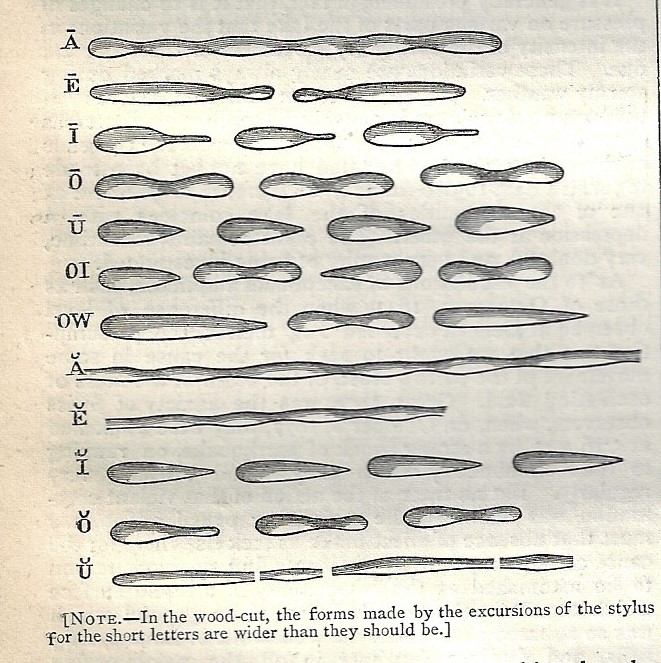
    Five weeks after this article and about four months following the patenting a visually-arresting article appeared in Nature which contains what I am assuming to be the first microscopic images of recorded and reproducible sound. I know that is a pretty deep qualification, but I think that’s its accurate. The article appeared as “Examination of the Phonograph Record under the Microscope” by Persifor Frazer2, who investigated what the impression of the stylus looked like as known sounds are recorded on tin foil. And so this remarkable image, showing what vowel and some dipthongs “look like”.  

    Notes:

    1. Persifer Frazer,   “Examination of the Phonograph record under the Microscope”,  an abstract of a paper presented at the Franklin Institute April 17, 1878, by Persifor Frazer, Nature, May 23, 1878, p. 102, in the weekly issue. 
    2. Persifor Frazer was of the Philadelphia Frazers, of long and interesting lineage. A Gettysburg vet, he was in professional life mainly a geologist; he did become expert in handwriting and the detection of forgeries using photographic means.  
  • “A Drop of Water on its Travels” (1878)

    JF Ptak Science Books   Quick Post

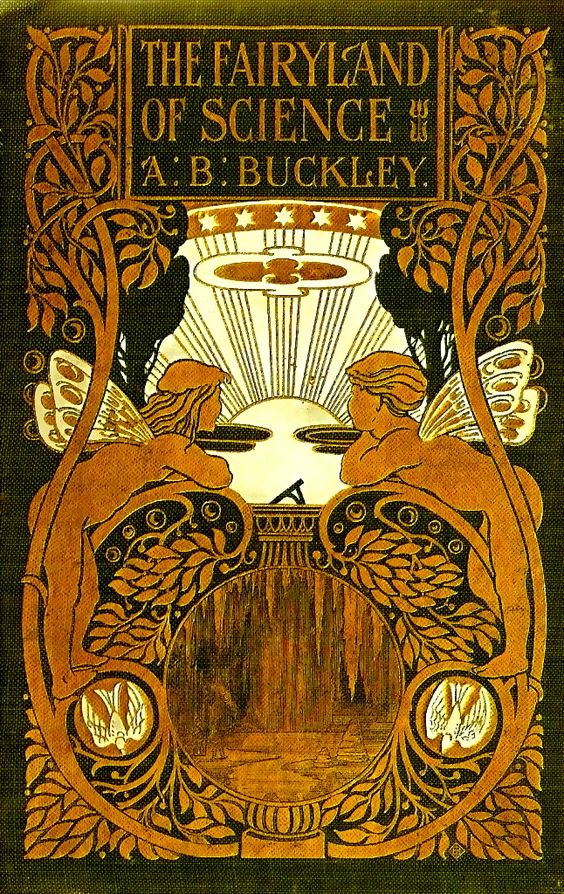
    Books covers fairyland of scienceHere’s an absolutely lovely book: The Fairyland Of Science, written by Arabella Burton Buckley (1840-1929), published in 1878. To start with I was more interested to see how many other books have “fairyland” and “science” in their titles and checked it out on WorldCat—I was not surprised to see there was only one other (George McPherson’s Fairyland Tales of Science , published in 1891). Well, there was a second title, but that was Buckley’s sequel to her 1878 book with its title repeated in the title of the newer book. But that was it.

    A look at the contents though shows that Buckley wove some fairy dust into the sciences, and reading of it confirms this observation:

    Lecture I The Fairy-Land of Science; How to Enter It; How to Use It; And How to Enjoy It
    Lecture II Sunbeams, and the Work They Do
    Lecture III The Aerial Ocean in Which We Live
    Lecture IV A Drop of Water on its Travels
    Lecture V The Two Great Sculptors – Water and Ice
    Lecture VI The Voices of Nature, and How We Hear Them
    Lecture VII The Life of a Primrose
    Lecture VIII The History of a Piece of Coal
    Lecture IX Bees in the Hive
    Lecture X Bees and Flowers

    The author gently and beautifully opens the book for the young reader with the following, there being little greater a wish for the appreciation of science than this:

    • “I HAVE promised to introduce you today to the fairy-land of science – a somewhat bold promise, seeing that most of you probably look upon science as a bundle of dry facts, while fairy- land is all that is beautiful, and full of poetry and imagination. But I thoroughly believe myself, and hope to prove to you, that science is full of beautiful pictures, of real poetry, and of wonder-working fairies; and what is more, I promise you they shall be true fairies, whom you will love just as much when you are old and greyheaded as when you are young; for you will be able to call them up wherever you wander by land or by sea, through meadow or through wood, through water or through air; and though they themselves will always remain invisible, yet you will see their wonderful poet at work everywhere around you.”

    Buckley walks the reader through familiar territory, explaining the great and overall consequences of water, ice, bees, flowers, coal, and the like, and how these everyday bits figure in the greater scheme of the workings of the world. Here’s the table of contents, which is splendid all on its own.

    She ends the book as nicely:

    • “Neither is it pleasure alone which we gain by a study of nature. We cannot examine even a tiny sunbeam, and picture the minute waves of which it is composed, traveling incessantly from the sun, without being filled with wonder and awe at the marvelous activity and power displayed in the infinitely small as well as in the infinitely great things of the universe.”

    Full text via Gutenberg: http://www.gutenberg.org/cache/epub/5726/pg5726-images.html

    Buckley followed a few years later with a companion volume, equally as accessible and interesting as her first: Through Magic Glasses…(1890) explaining how telescopes/microscopes/spectroscopes work and what they reveal—a fine accomplishment.

    Again, full text provided by Gutenberg: http://www.gutenberg.org/ebooks/37589


    ·Posted by :

    ·in:

  • Very Early Special Effects in Reproduced Audio (1878)

    JF Ptak Science Books  Quick Post

    This title for this post is fairly accurate given that the phonograph had been invented by Edison only months earlier and that this is one of the earliest publications on manipulating the sound that it reproduces.  The author of the paper, “The Phonograph” (published July 18, 1878 in Nature), George Bidder, experimented by laying down a spoken “track” on the tinfoil medium and then recording on top of it, finding that “after a series of musical or articulate sounds have been recorded other series could successively be superimposed…and reproduced.” I’m not sure when this became standard practice in the recording industry (the musical “industry” part of the phonograph was still about two decades away), but my feeling is that this was a technique that would remain a peep into the future for some time to come. No?  

    “The Phonograph”, by George Bidder.  

    • “In experimenting lately with the phonograph it occurred to me to try whether, after a series of musical or articulate sounds have been recorded, other series could successively be superimposed on the same tinfoil and reproduced. I found that if the instrument be simply reset to the starting-point, and sung or spoken to a second time, it will afterwards faithfully reproduce both series of sounds as though two persons were singing or speaking simultaneously, and by repeating the same process, a third and fourth voice may be added, or one or more instrumental parts, all of which will be reproduced. This experiment forms a striking commentary on Helmholtz’s theory of the mode in which the ear recognises different tones in a chaos of sound, by analysing the compound wave, which it receives, into its component simple vibrations. Here the aggregate impressions on the tin-foil produce, so to speak, a compound indentation capable of reproducing a wave of sound which the ear can resolve into the original constituents.”


  • “Is The Sun One-Sided?” (1878)

    JF Ptak Science Books  Quick Post

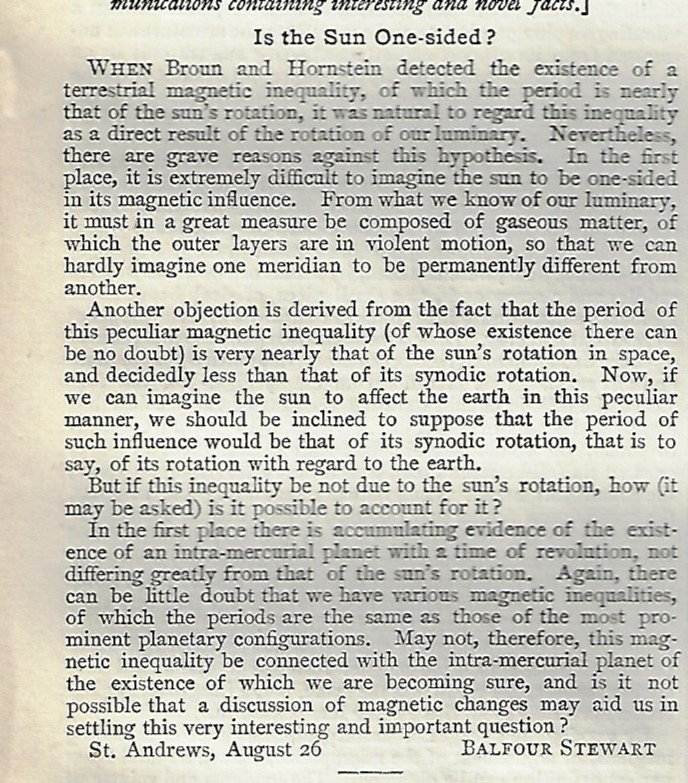
    There are a number of unexpected and interesting notes and articles in the September 5, 1878 of Nature as is usually the case with is excellent journal. The first to catch my eye was “Spontaneous Combustion of Wasps’ Nests” where some unusual behavior was observed in wasps’ nests in Venezuela–the correspondent was wondering if there was any corroborating evidence anywhere else in Nature’s world.  Then there was a short paper on the newly-invented telephone, the display of parental affection in Sparrows, “The Sea Serpent Explained”, the physics of photography, hypnotism (in animals), and a number of others. And then there was a letter to the editor which I think I’ve never heard before, and so I reproduce it in full:

    Nature 1878 sun ine sided


    ·Posted by :

    ·in:

Recent Posts

Archives

Categories