A Daily History of Holes, Dots, Lines, Science, History, Math, Physics, Art, the Unintentional Absurd, Architecture, Maps, Data Visualization, Blank and Missing Things, and so on. |1.6 million words, 7500 images, 4.9 million hits| Press & appearances in The Times, Le Figaro, Mensa, The Economist, The Guardian, Discovery News, Slate, Le Monde, Sci American Blogs, Le Pont, and many other places… 5000+ total posts since 2008.

  • “Told by some nice computors of national glory” and the “Cumputor” (1951)

    JF Ptak Science Books  Quick Post

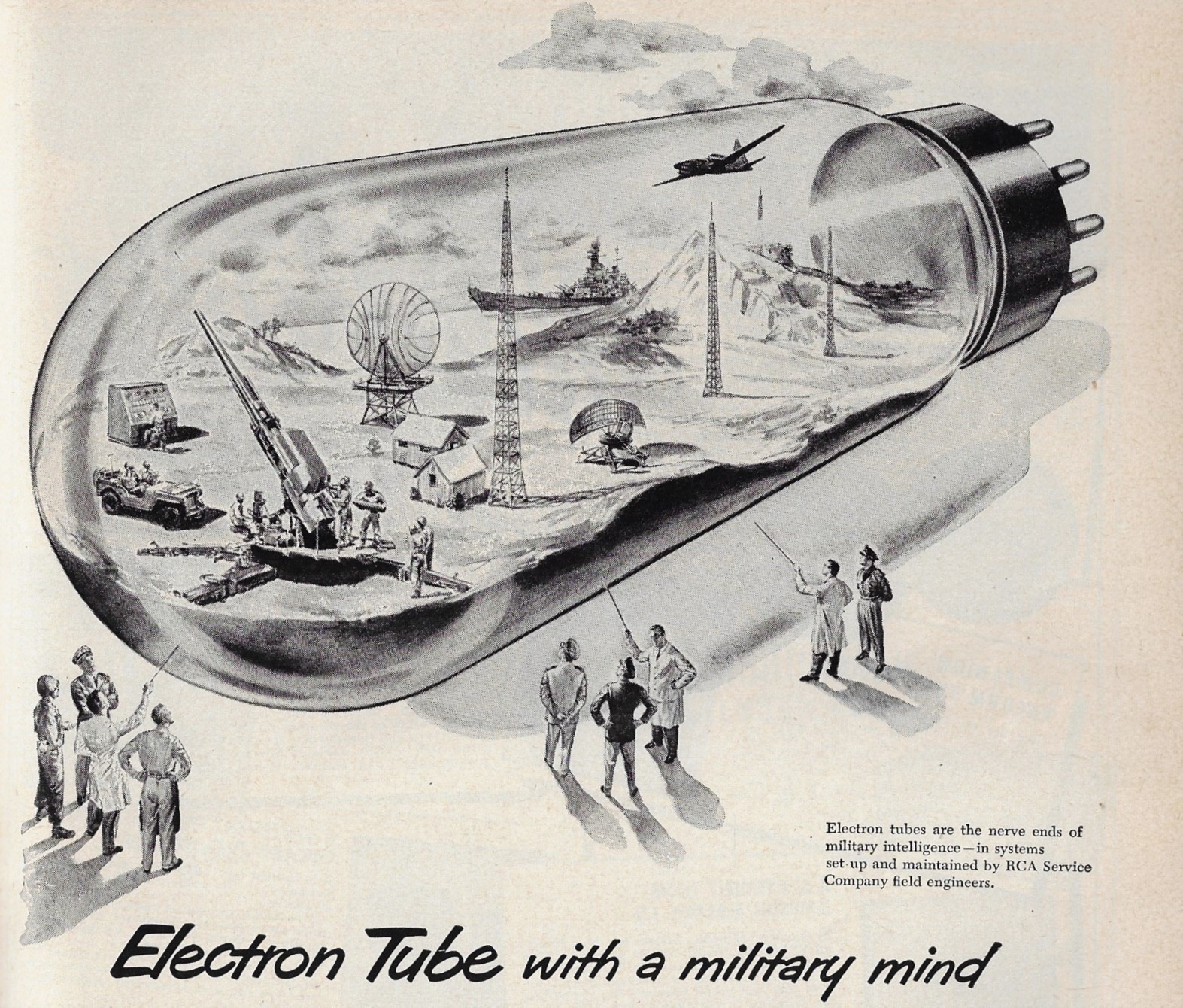
    Here’s a terrific little ad that appeared for RCA electronics in the November 1951 issue of Radio & Television News (“the Radio-Electronic Engineering edition”).  The main article of interest–and what brought me to this journal in the beginning–was the two-page story “Analogue Cumputors [sic] Solve Complex Problems” about the differential analyzer (the Bush machine I reckon), thermal analyzer, and electric differential analyzer  at UCLA, and which was the main title and illustration on the cover of the magazine.
    Tube military

    I could not find “cumputor” in the OED, though I did find “computor” (as a person who computes or calculates) which came into recorded being in 1669. (“Told by some nice computors of national glory”, H. Walpole Let. 18 June in Corr. (1954) XVIII. 463.) “Computer” occurs a little earlier in 1613, found in another very quotable quote: “I haue read the truest computer of Times, and the best Arithmetician that euer breathed, and he reduceth thy dayes into a short number.”, (‘R. B.’ Yong Mans Gleanings). 

    This is a short article of only a few pages and a lot of pictures, but that spelling of “cumputor” does not occur in the article, though the word “computer” does. Apparently “cumputor” is a simple typo on the cover of the magazine.

  • Unusual Shading/Shadows (1866)

    JF Ptak Science Books  Quick Post

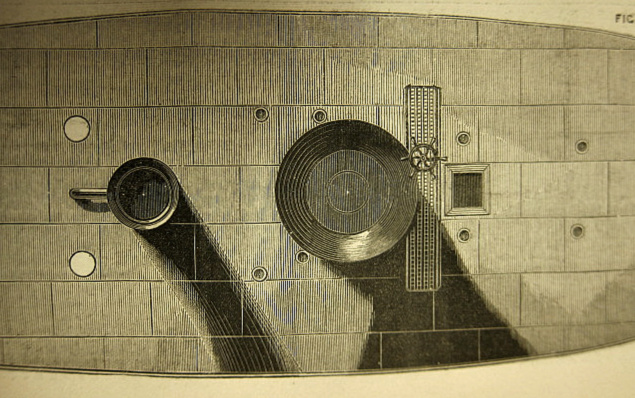
    I’ve made a number of entries on this blog of beautiful/odd shadow practices in antique mechanical and technical drawings, though not so for a while. Today’s entry comes from a stout volume of Engineering (volume 2) 0.for 1866 and comes in an illustration for the U.S. Navy torpedo boat, the Spuyten Duyvil. The boat’s name seems like a bit difficult to maneuver, except if you’re Dutch, though it is far-better sounding than the original name, which was Stromboli.  In any event this was a torpedo boat that saw a little bit of service right at the end of the Civil War–mostly on the James River in Virginia, it seems–and was a torpedo boat. (The “torpedo” at this time was more like a mine than a powered underwater “missile” that we’d think of in these terms today.)  The chief attraction for me for these images though is a bit wholly unnecessary to understanding the boat or its workings, and that’s the shadowing for the exhaust stacks, which to me seem a little unusual, though quite lovely. And so the sharing…

    ENgineer 1866_2_

  • Found Sci-Fi: Proto-Robot Head (1866)

    JF Ptak Science Books  Quick Post

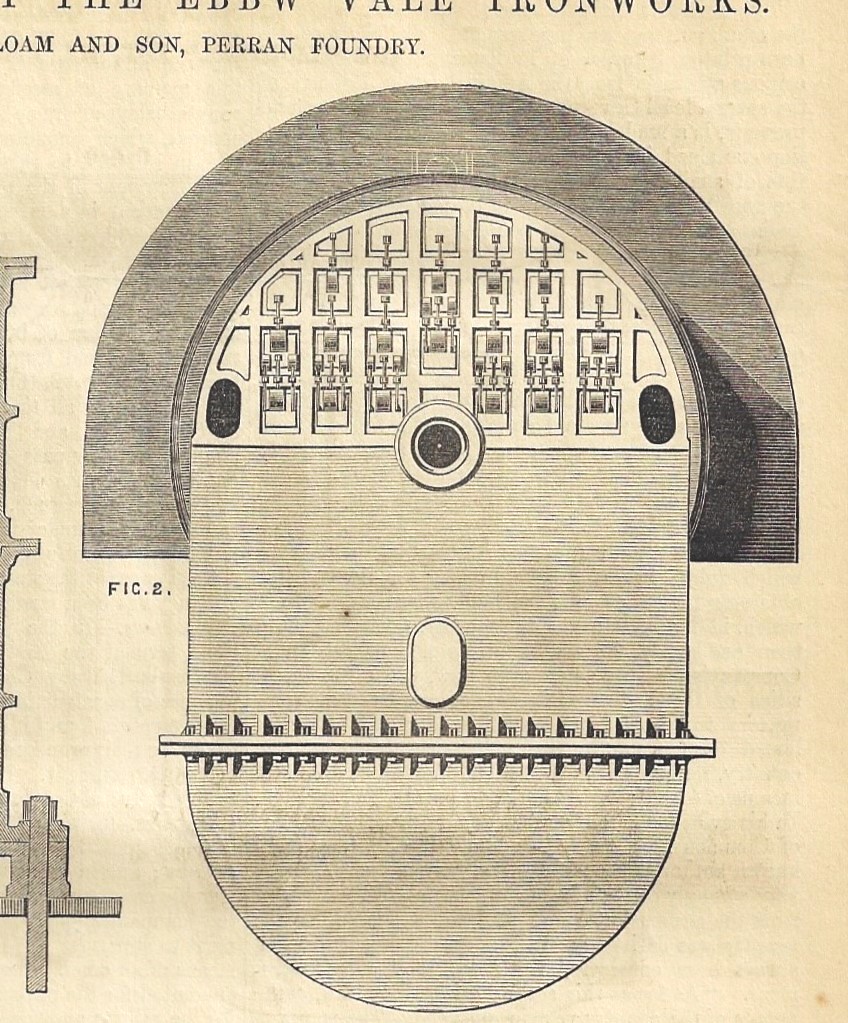
    Anthropomorphic images make their sudden appearances now and again in technical illustration, though they do less so when they surprise the viewer with a simultaneous endo/exo view of the “head” of such pre-vizualization robots. The image here is the view of a plan of “the Darby Blowing Engine at Ebbw [sic] Vale Ironworks” and appears in the second volume of Engineering, September 7, 1866.  The engraving bears a faint resemblance to the Iron Giant, giving both an internal and external view of the workings of the head. Anyway, that’s what I see in it…

    Engineering 1866 proto robot

  • Adventures in Electronia: Another Electronic “Brain” (1944/5)

    JF Ptak Science Books   Quick Post

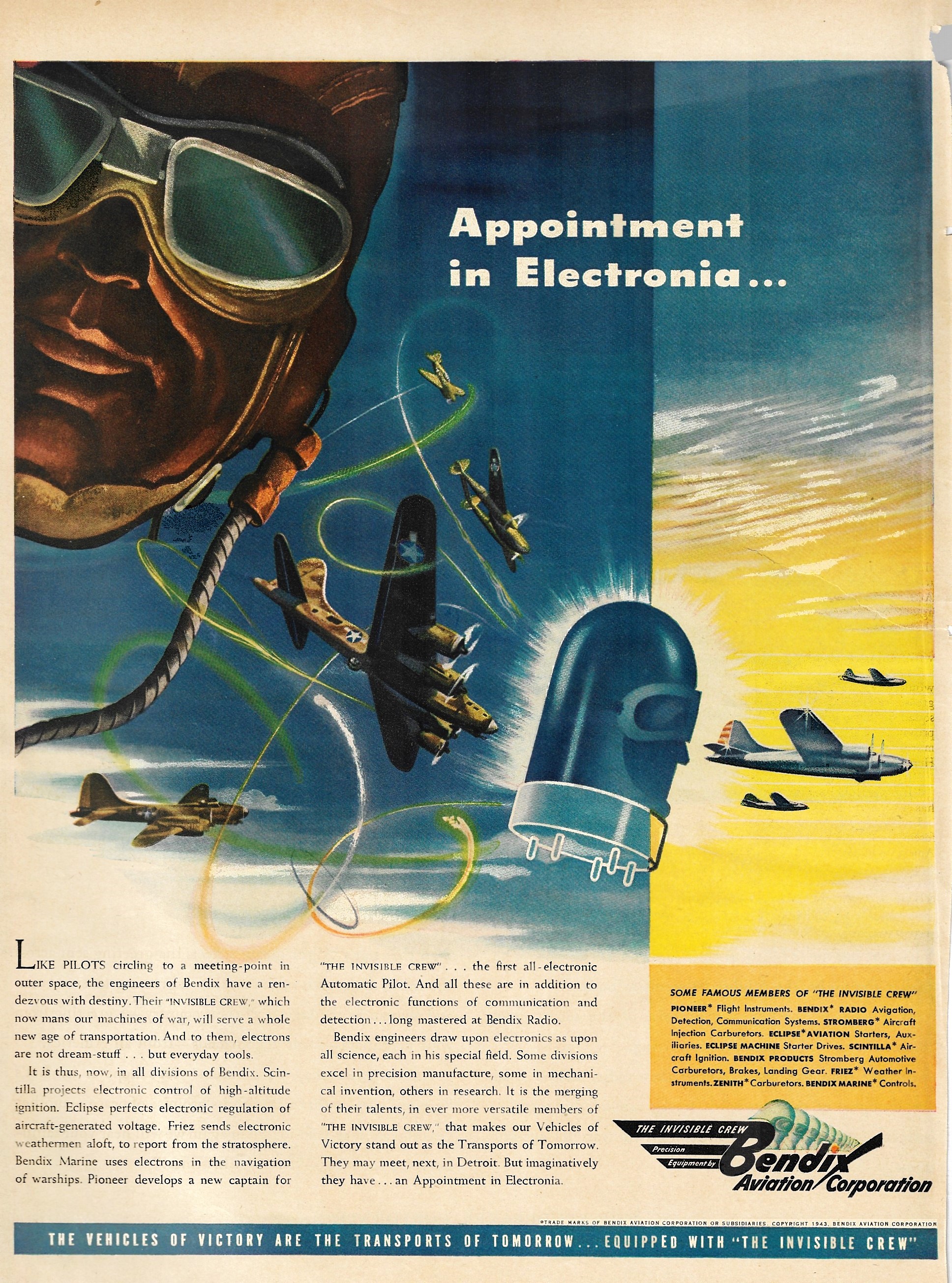
    Only a few days ago I made a post featuring the tides of war taking place inside a RCA electronic tube/valve, and just this morning I shared an unusual image of a proto-robot with a si-fi-ish view of the “robot’s brain”–it is probably high time that these mechanical/electronic brain human-as-machine images be collected. A good number of them are unintentionally anthropomorphic, but the majority (as in this case) are not.  The current image (from an issue of LIFE magazine ca. 1944) invites us into “Electronia”, a world apart from the carbon-based world at war, electronic innovations by the Bendix Aviation Corporation that essentially became “the invisible crew”. The fact of the matter is that this was largely correct–the tech innovations that were taking place in 1943/4 were fantastic,and were being undertaken at a pace and scope that was incredible. The text of the ad highlights some of the integral electronic advancements made by Bendix, and the graphics depict some of the latest aviation advancements that would help crush the Luftwaffe and Imperial Air Force (what seems to be a P-51, a P-38, and a B-17G,  plus on the right some new bomber and what seems to be two jet aircraft). Marshall Admiral Yamamoto was correct when he hypothesized that attacking and declaring war on the U.S. would lead to the destruction of the Japanese military and the defeat of the empire given the spectacular potential of U.S. industrial and technological capacity, and this ad shows just one small aspect of the advances that Japan could not possible counter–and I believe that at the time this ad appeared Yamamoto was already dead, a casualty of war and to U.S. ingenuity in breaking many of the Japanese ciphers and codes. 

    Electronic brain LIFE 1944

  • The Geometry of Pebble-Making (1878)

    JF Ptak Science Books  Quick Post

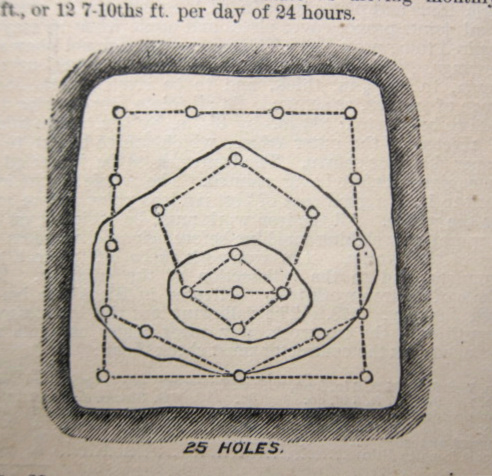
    Holes boring tunnelHere’s a good, no-longer-missing missing part of entries for the virtually bottomless History of Holes section of this blog—blasting holes drilled into rock faces for tunneling, appearing in an article in the Scientific American Supplement, February 2, 1878.  I’ve never considered the placement of the holes drilled through rock before, mostly I guess because I’ve never though about it before today–also I have no doubt that I would not have been able to figure out what sort of info was being represented in the small drawings if they were out of context. The circles and lines standing apart from any explanation or legend could’ve represented any number of things, from pole or column placement to fort construction, though blasting holes would’ve been far from my guess list of what these geometries were.

    There are a number of tunnels under consideration, all of different lengths, through different media, of different dimensions, and so on, all of which come into play when considering drilling and blasting one’s way through 20,000 or 50,000 running feet of mountain.

    The article was dryly fascinating, particularly in the human elements. On average it seemed as though for the tunnels surveyed in the article that 15-30 feet of earth would be removed each day, which seems like a lot given the time and the space to work in. Most of the excavating faces seem to have been about 8′ x 10′, or about 80 square feet, and in that space there were usually six workers operating the drills at one time. That seems to me to be very very cramped quarters operating big and noisy machines generating a lot of dust, all of which was happening with not-great lighting with a questionable air supply. That was one tough job. 

  • Another Segment in the History of Lines: Lining Up to the Fractionating Tower (1949)

    JF Ptak Science Books  Quick Post

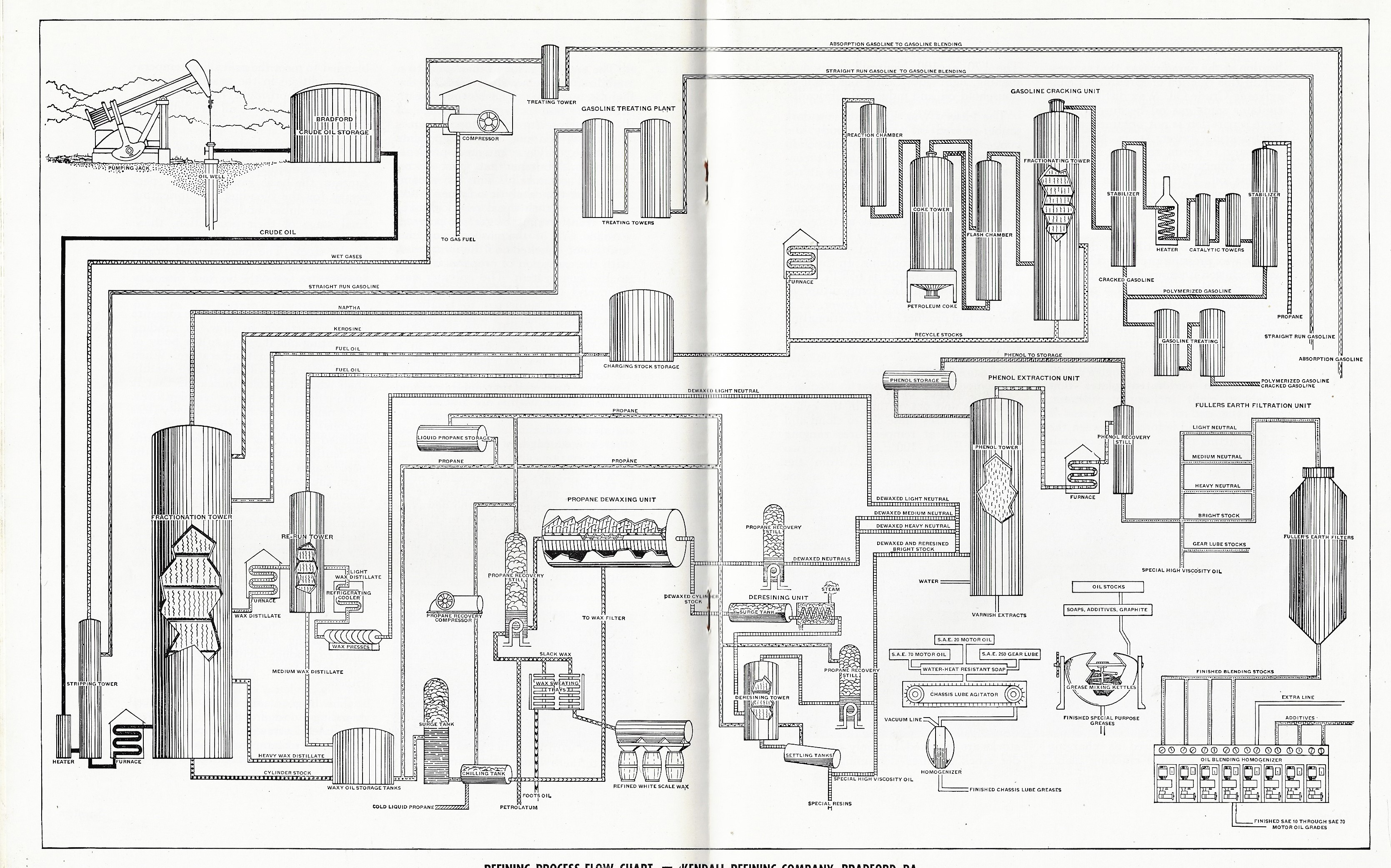
    At first glance this display of data looks a bit like a plate of straightened/geometrizied spaghetti, though it is actually a very good representation of the oil production process, from pump to purchase:

    Oil schematic

    Delivery, fractionating, and distillation process from A Refinery Process Bulletin, Kendall Refining Company, 1949.

    Also, here’s the attractive and nicely-designed front and back cover of the publication:

  • The Earth and an Inter-celestial Mjölnir (1951)

    JF Ptak Science Books  Quick Post 

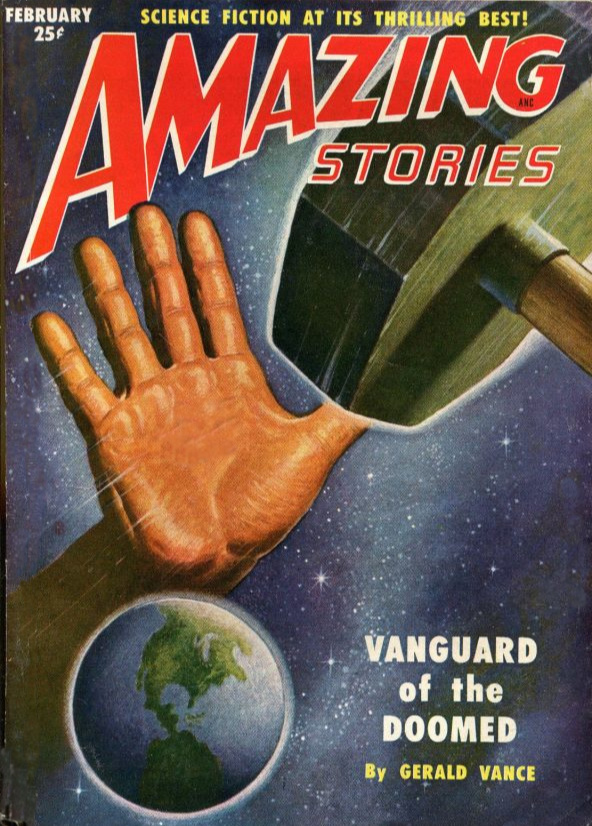
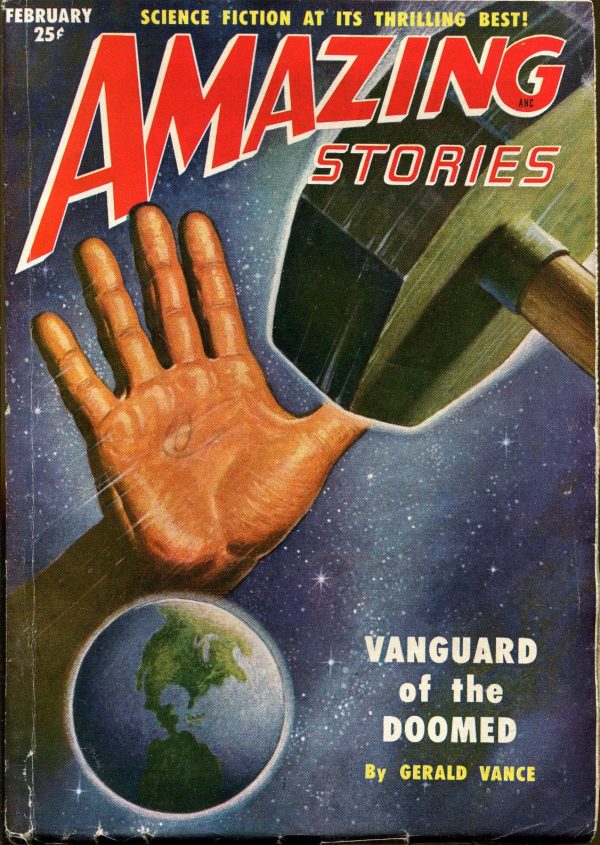
    There is a longish thread through this blog collecting images of The Earth Doomed–that, and the Exploding Earth, or Cracking Earth, or the Earth spinning into infinity; they are joined by other Odd Earth images such as the Earth as a square, or tiny Earth, and so on. They really need to be collected into one category, but if you are interested just use the google search box for the site using “Earth” and survey the image section, which should put you in touch with some unusual bits. This morning I found the image below, which is a great cover in Amazing Stories for a story by Jack Vance (February 1951). Unfortunately I don’t have the time to read it, but I appreciate the artwork, though  I doubt this is Thor’s Mjölnir  as is teased in the title to this post…except that if there was a mega-hammer out there making its way through the not-so-voidy-void it would probably be powerful enough to _________.

    Earth doomed sci fi

  • Charles Babbage, Poet: on Chess and Miracles.

    JF Ptak Science Books  Post 2797 (extended)

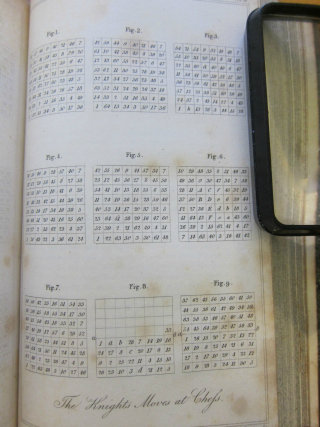
    When reading through a volume of the Royal Society’s quarterly publication on the stuff of science (for the year 1817) I came across an article on the Knight’s Tour puzzle: “An Account of Euler’s Method of Solving a Problem, relative to the Move of the Knight at the Game of Chess, from a  Correspondent”, and which was published in Babbage chess The Quarterly Journal of Science, Literature, and the Arts, edited at the Royal Institution of Great Britain, published by John Murray for the Royal Institution, London, 1817-1818. After a little digging to find the authorship, I found that the “Correspondent” here is Mr. Charles Babbage himself, with the authorship established at least by the time of his Passages from the Life of a Philosopher if not before. The Knight’s Tour puzzle–in which a  knight is moved around a chessboard (8×8 grid, though smaller and much larger have been used) so that every square is touched only once–is ancient, with the host of the famous 18th century mathematical revelers3 positioning the problem in the dim past, with Lucas in 1882 and then Kraitchik in 19272 fixing it more resolutely in India over 2000 years ago.
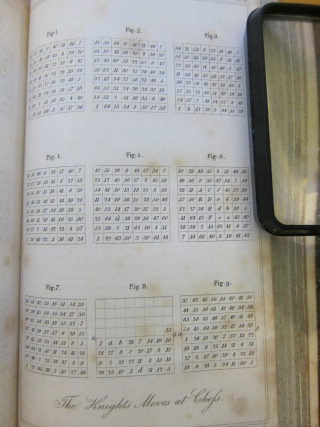
    Babbage identifies the paper as his own in the section of his own “contributions to human knowledge” in his retrospective, Passages in the Life of a Philosopher, published in 1864. I’ve never read this book though I’ve used bits and pieces for research, and last night and today I’ve read in it quite a bit. Apart from the sheer enjoyment of the power of this guy’s mind, I’m finding the book to be unexpectedly amusing. The man is actually funny, plus witty, and an entertaining writer–why this is so surprising, I don’t know; perhaps it is because he is associated in a personal sense in my mind with General Winfield Scott, as they resemble one another, both looking Very Highly Contentious and gassy. In any event, I can safely say that this is a Good Read. 

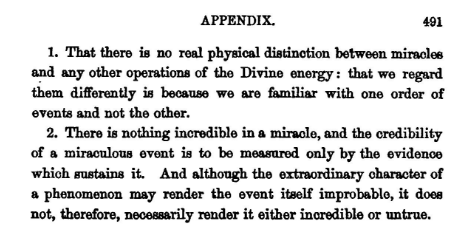
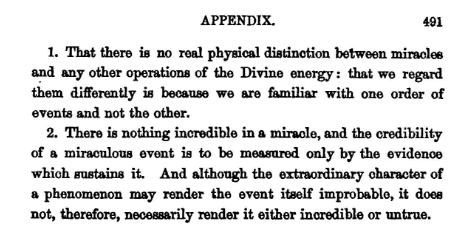
    Now to the Found Poetry part in this bit, the text of which is found in the appendix of the article, in the section called “On Miracles”. The text is as found, though the spacing/structure has been “poematized”to exhibit the great and hidden logical poetry of Mr. Babbage:

    On Miracles

    "1. That there is no real physical distinction between miracles 
    and any other operations of the Divine energy: 
    that we regard them differently 
    is because we are familiar 
    with one order of events 
    and not the other. 
    
    2. There is nothing incredible in a miracle, 
    and the credibility 
    of a miraculous event 
    is to be measured only by the evidence 
    which sustains it. 
    
    And although the extraordinary character 
    of a phenomenon may render the event itself improbable, 
    it does  not, therefore, necessarily 
    render it either 
    incredible or untrue."

    And the original:
    Babbage miracles

    There’s a few pages of reasoning before we get to his enumerated “prepositions”, but this should do nicely.  The guy was a very very good thinker. 

    Full text of the article is found here: https://archive.org/stream/passagesfromlif01babbgoog#page/n510/mode/2up

    Notes

    1. See the “collected works” section in Babbage’s Passages from the Life of a Philosopher (1864) where he outs himself as the author.  https://archive.org/stream/passagesfromlif01babbgoog/passagesfromlif01babbgoog_djvu.txt

    2. “Chronology of Knight’s Tours”, compiled by George Jelliss, http://www.mayhematics.com/t/1g.htm

    3. Just as a sample the folks working on this puzzle in the 18th c included d’Alembert and Diderot in theEncyclopedie; Jacques Ozanam  in Recreations Mathematiques et Physiques; d’Ortous de Mairan, Abraham de Moivre, Pierre Rémond de Montmort; Jean Etienne Montucla,, Leonhard Euler, and many others.

    The “Euler” in the title refers to Leonhard Euler “Solution d’une Question Curieuse qui ne Paroit Soumise a Aucune Analyse”, Mémoires de l’Academie Royale des Sciences et Belles Lettres, Année 1759, volume 15, pp.310-337, which was the first mathematical paper on knight’s tours.
     

    ·Posted by :

    ·in:

  • The Voltaic Armadillo, Electric Earth, and Invisible Reverse Double Dandruff: Quack Medical Ads, 1877.

    JF Ptak Science Books  Quick Post  (An entry in the category of Questionable Quidity)

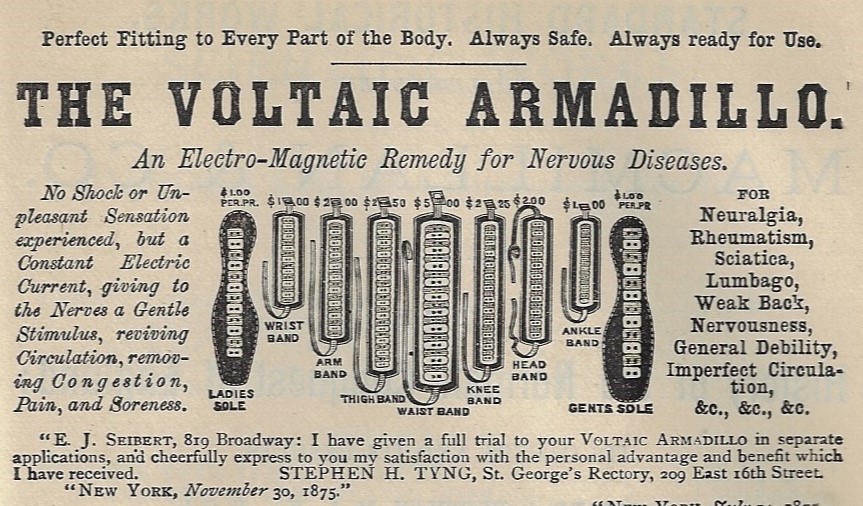
    The Popular Science Monthly (today known as Popular Science) was founded in 1872 and treated all manner of scientific/tech subjects for the general reader–most of the time very successfully, though sometimes not-so-much.  The issue at had for August 1877 had a number of interesting articles, but my attention was stolen away by a pair of ads in the back of the journal. Remember that there were few (if any) regulatory agencies for advertisements on scientific and medical subjects, which means that people were left to their own devices and internal customary ethics, which were sometimes abided and sometimes not.  What I found were two half-page ads for electrical cure-alls, battery-driven devices that were supposed to be a cure and a dependent for just about all things, from dandruff to neuralgia, or the twists or tremors, triple-reverse invisible exuda, marble mouth, inverted feet, and so on. These devices could fix anything because they fixed nothing.  The ads were striking, as you can see:

    Pop Sci Mo 1867 voltaic armadillo detail

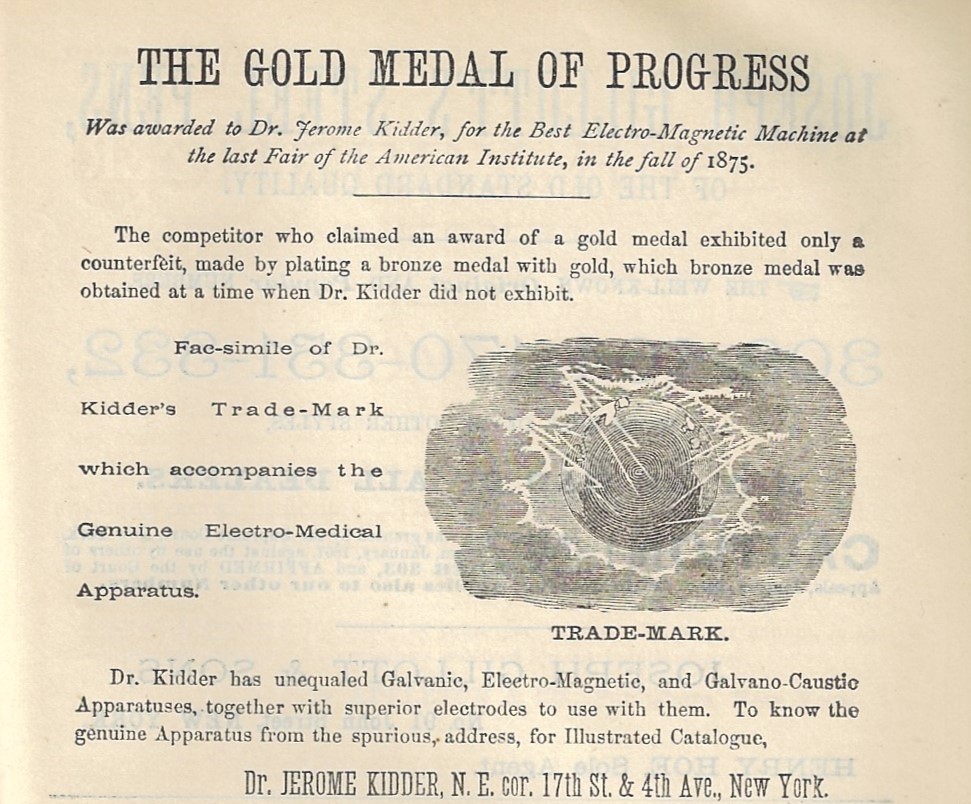
    A few pages away the “galvano-caustic” entry by Dr. Jerome Kidder, who both tried to sell his stuff and protect himself from impostures in the same ad. It was the Kidder trademark of the electrical earth surrounded and beset by a field of electrical-something bits and bobs that attracted my attention:

    Pop Sci Mo 1877 Kidder

    There were other ads in the 1877 volume, though these were the only two of real Charlatanesque sub-virtues.  

    ·Posted by :

    ·in:

  • Using Darwin to Sell Stuff–an Early Appearance of Marketing Darwin (1877)

    JF Ptak Science Books  Quick Post

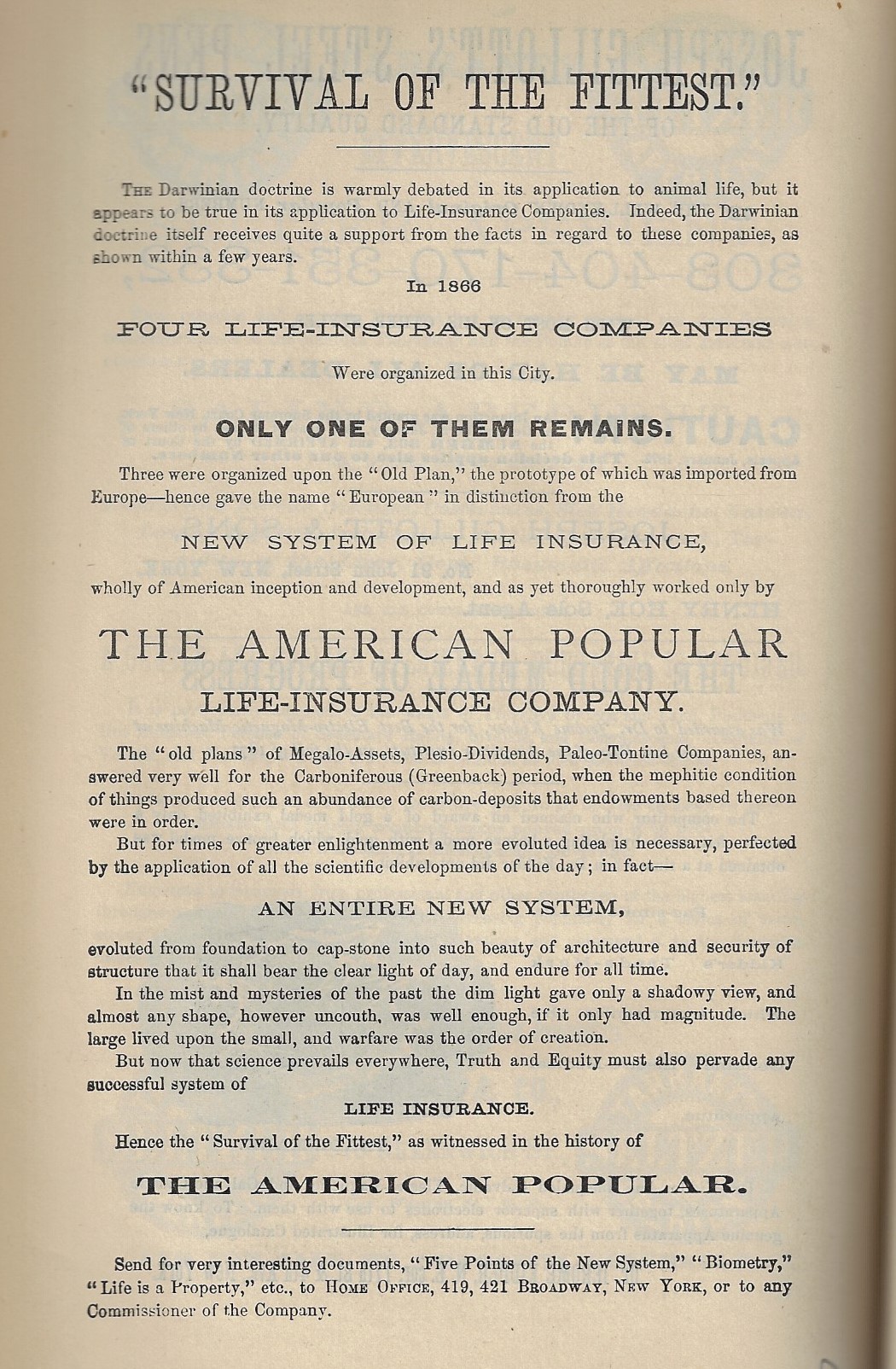
    I can’t be sure of where this stands overall, but it certainly seemed to my reading over the last x-yearsx that using a quote or idea from our Mr. Darwin to sell something in the first decade or two after the publication of On the Origin of Species…. is a rare thing. So seeing this ad in the back of the volume of Popular Science Monthly (1877) was really surprising, as it was taking the phrase we find in Darwin to sell the long-lasting qualities of a life insurance firm.  (Well, the phrase actually starts out with Herbert Spencer as he was influence by OTOOS, writing it to express an idea in economics in his Principles of Biology in 1864; Darwin himself adopts it in Variations of Animals and Plants under Domestication in 1868 and then in the fifth edition of OTOOS in 1869. I’ve included a lengthy quote from the Spencer, where the phrase turns out on page 444.)  I do have a recollection of a drawing in Punch of a crying Mr. Darwin in a quarter illustration promoting kindness to animals or some such…but offhand there’s no memory of using the man/ideas as a sales vehicle before this. Again, that’s not my field so I may be missing a lot–if you know of other ads like this please let me know.  

    Pop Sci Mo 1877 survival fittest full

  • From the Department of Hopes and Dreams: the Red Cross, St. John, and POWs (WWII)

    JF Ptak Science Books   Post 2798

    I assembled a little collection of WWII Red Cross and St. John charity pamphlets–what they all share is a sense unity, duty, perseverance, and hope. They are all published between 1942 and 1944, the majority coming in the summer of 1943–a wicked bad time for the Allies, perhaps the worst time since the Nazi onslaught of Europe. Five of these pamphlets directly addressed trying to help the prisoners of war held by Nazi Germany, and portrayed some healthy and sustaining images of the possibilities of POW life, as well as what would seem to be a high chance of delivery all manner of goods to the prisoners to make their time behind barbed wire somewhat more bearable. (Several of these short pamphlets are reproduced below, while the covers of four of them follow):

    Red Cross POW _1_ (1)

Recent Posts

Archives

Categories