A Daily History of Holes, Dots, Lines, Science, History, Math, Physics, Art, the Unintentional Absurd, Architecture, Maps, Data Visualization, Blank and Missing Things, and so on. |1.6 million words, 7500 images, 4.9 million hits| Press & appearances in The Times, Le Figaro, Mensa, The Economist, The Guardian, Discovery News, Slate, Le Monde, Sci American Blogs, Le Pont, and many other places… 5000+ total posts since 2008.

  • The Moon as an Aeroplane, 1914

    JF Ptak Science Books  Quick Post 

    Follow Me on Pinterest


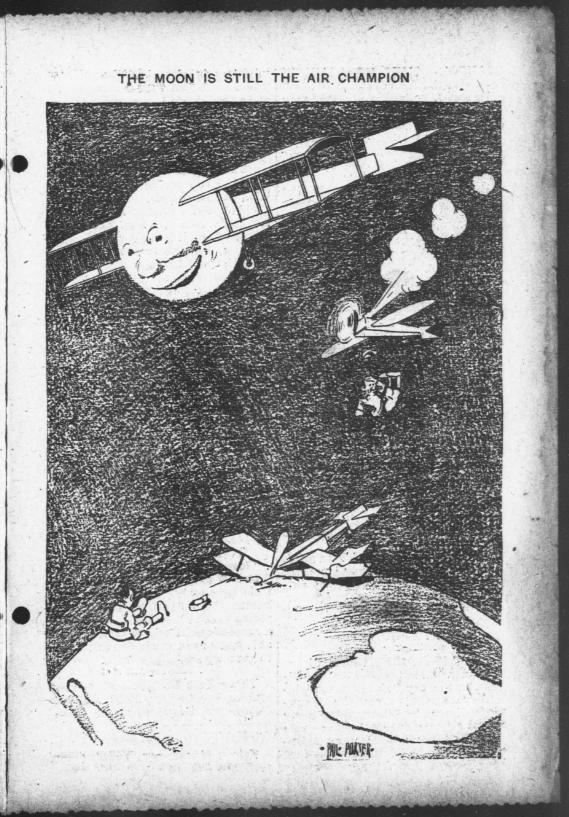
    Moon is still champion


    The iconography of the Moon is certainly wide and vast, but I’m thinking that this may be a very good candidate for the first time that the Moon appears as an airplane. I found this lovely image depicting the champion of the air, the great and all-knowing height-highness, the Moon. In 1914, eleven years after the first powered heavier than air flight of the Wright brothers, the development of more sophisticated was appreciating at a high rate, and there were newer higher records for (fixed wing) altitudes. (In 1908 the altitude record was about 360′; in 1910, it stood at 8,000′–balloons had achieved loftier records, around 40,000′ in 1912.)  This was a sly way of pointing out that try as they may and try as they might, the inhabitants of Earth wouldn’t come quite so close to the Moon as they would dream.  And that was true until Apollo 8 found itself on the far side of the Moon, only 56 years later.   [Source: The Day Book, Chicago, March 24, 1914. Image provided by University of Illinois at Urbana-Champaign Library, Urbana, IL. Persistent link: http://chroniclingamerica.loc.gov/lccn/sn83045487/1914-03-24/ed-1/seq-31/]

    ·Posted by :

    ·in:

    —
  • The Positively Enormous Skyscraper Plant Eyeballs of Mars, 1912

    JF Ptak Science Books   Post 1988 

    People get stuff wrong.–(could’ve been said by) R.P. Feynman

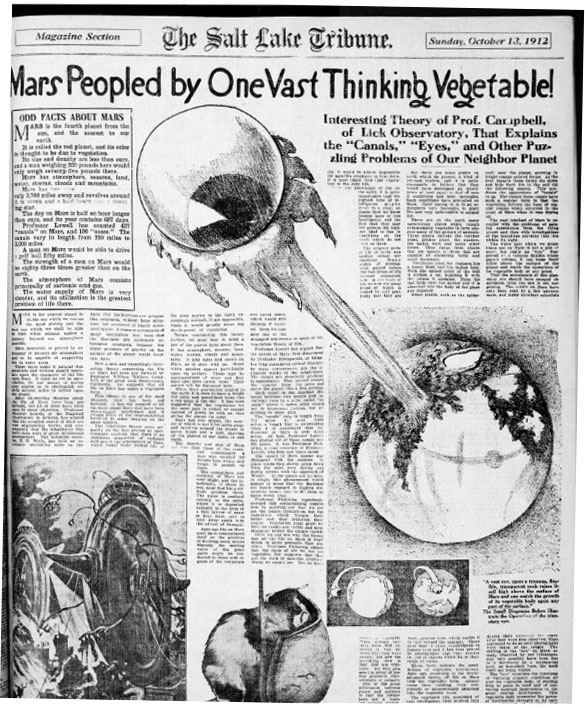
    Maras eyeball2_edited-1[Source: via Chronicles of America series at the Library of Congress, here, and first seen via the interesting Pinterest collection of Trevor Owens, here.]  

    Some  five years after Percy Lowell filed his Gigantic Situation of intelligent life on Maris in 1906, and 14 years after H.G. Wells’ octopusian Martian invasion, the Salt Lake Tribune published this limb-numbing story on solar-flare-sized plant eyeball creatures who were said to inhabit Mars. Rather they lived of Mars–the eyeball plant was thousands of miles big, growing along the surface of Mars, and then rising up above it to survey itself and its dominion via an unlashed and unlidded eggy eyeball of stupendous size mileage.

    But when you squint and feel the whole scenario out, you can sort of see how someone might’ve come up with this solution to the Martian canals. Or canali, as they were first described in in 1877 in Italian by the very busy and very astute G.V. Schiaparelli–it was unfortunate that the need for mistranslating the word from Italian into “canals” rather than ‘channels”, but wicked imagination must’ve taken hold of Lowell, and he ran with the idea that the markings on the surface of the planet were of intelligent design.  (I’m sorry that Schiaparelli is remembered mostly for this particular contribution to astronomy in the popular mind–he was really a pretty extraordinary scientist and historian of science, and in his exceptional biography in the 1910 volume of the Astrophysical Journal there is a long and lauditory appraisal of his life and career, without a peep/mention of the infamous canali).

    And by “squinting” acknowledgement I mean squinting very hard–at least it could account for the changing seasonal forms of the canals, as their positions would change if the thing was alive.  Of course, the whole “living planet” deal doesn’t work out so well physically and biologically, though it is a smashing good idea for a scifi story, especially one appearing in 1912. Lowell had a very difficult time explaining the movements of these figures, because–according to his theory–the Martians would’ve been constructing positively enormous canals that stretch across the planet which were also wide enough to be visible via telescope from Earth–with changing positions, that would mean, possibly, that the Martians would fill these things back up again at the turn of the season, and then build and fill the next, and so on. It would be an interesting calculation to see how much real estate was being moved on Mars every year. 

    Lowell did come up with an explanation for this seeming motion–turgidly, he felt that the canals themselves didn’t actually moved; rather, it was a huge movable biomass on the canals at were changing so much the activity could be seem fro space.  There were many problems with the theory, as very ably pointed out by the great Alfred Russell Wallace, who eviscerated Lowell and his intelligent Martian life idea (published in his Mars and its Canals published in 1906 which was followed by Mars as the Abode of Life in 1909)  in his own book, Is Mars Habitable? (1907).  The Mars business eclipses Lowell’s other very capable work, or at least so it seems–when the man died in 1910, he was buried on Mars Hill at the observatory in Flagstaff.

    The Giant All-Seeing Eyeball was hoisted high in the Tribune, given supposed life by the very highly capable astronomer W.W. Campbell (1862-1930, with his biography here at the National Academy of Science), who is quoted by the paper as being the source of this preposterous theory.  Campbell was not pleased by this–not at all.  And I can well imagine why. 

    I can’t consider the Salt Lake paper’s story a hoax (as in the case of the great Moon hoax perpetrated in the pages of the New York Sun in 1835), mainly because it is surrounded by other crazy/funny stories–and it didn’t try to present the story as a piece of non-fiction, as is classically the case with hoaxes. The Tribune followed up this story on the very next page with one on how the English aristocracy was turning into gorillas. 

    ·Posted by :

    ·in:

  • FuturePunk: When Sci-Fi Hyper-Speculation Becomes Under-Speculated

    JF Ptak Science Books   Post 1990  Follow Me on Pinterest

    Let no man seek / Henceforth to be foretold
    what shall befall / Him or his children. — Milton, Paradise Lost XI,
    770-72

    In recent history the general response of the popular vision of society to new innovations in technology is to put whatever the newcomer is to work and to find a commonality to mediate newness and necessity.  There’s really nothing quite like having a vision of the future when there’s something new in the techno-world to make the image seem as though it could be possible, the limitations of the innovation not yet being established and all that.  And so when something like the Second Industrial Revolution takes of in the 1830’s there is a new belief that problems wide and narrow could in the future be solved with steam power—and often these same hopes and visions were cauterized in print, the belief in inventions like steam-powered laundresses and carriage horses and ditch-diggers all painted with sloppy buckets of incredulity and overreaction by immensely talented and public artists like George Cruikshank, a gifted English cartoonist/satirist/caricaturist and social commentator.  In many cases like these though artist/visionary was wrong in the short run by right in the long–Cruikshank couldn’t have seen too deeply into the future in the 1830’s/1850’s because that Steampunk world of the 1930’s would arrive with electricity or the internal combustion engine or some other innovation that would come after Cruikshank’s time, and those impossible images that he created of steam-powered flying machines and such would actually come true and quickly, but would just skip his own generation’s technological innovations and become the commonplace object in the future two-generations or so hence.   

    For example, here we seem some hyperspeculative Cruikshankian dreams on the possibilities of near-in-time powered flight, which combines the newness of steam and flight, and published in his The Comic Almanac (1843).   The possibility of Utopia prophesy is so strong that steam-fired flying machines fill the air and passengers fill building-tops, standing above enormous banners advertising daily trips to Peking, Mont Blanc and Canton, as well as half-hour departures to Paris. 

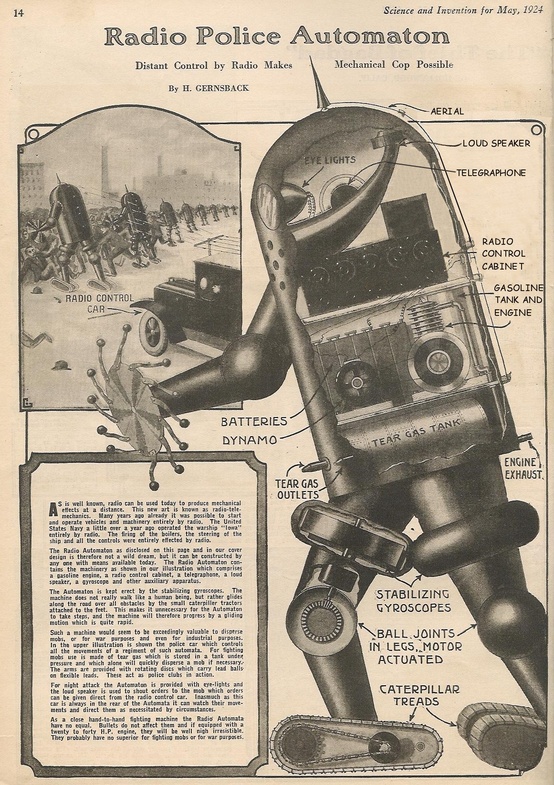
     There are legions of images like this, but what attracted my attention this morning was the application of the relatively new-found technologies wrapped around the possibilities of robotics and radio. Early radio broadcasting  and the newly-coined “robot” (the term was coined just a few years earlier in 1921 in Karel Capek’s play Rossum’s Universal Robots) came together very nicely in this spec article for Science and Innovation in May 1924:Radio-police-automaton-1924

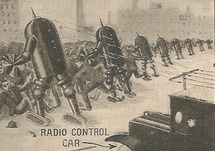
     The inset detail is pretty interesting, the robots unleashed on a crowd, under control of a radio patrol car.

    Radio-police-automaton-1924 det

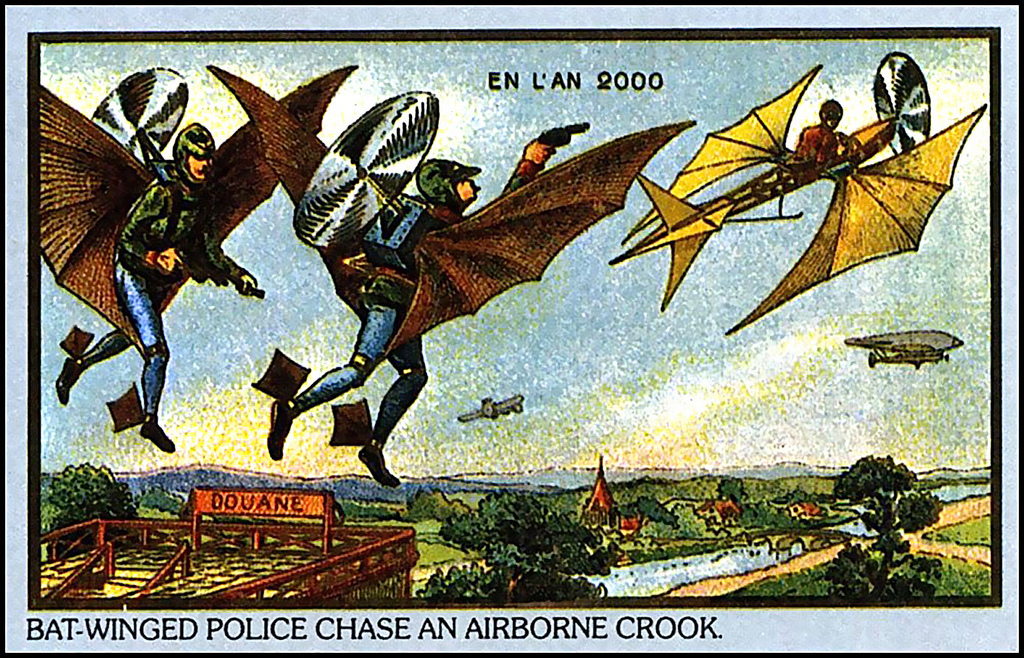
    Another view of police-in-the-future, earlier-on in the century, from a series of French postcards (printed ca. 1900), depicting what the possible world of the future might look like in the year 2000:

    Police flyinh

    And an earlier ‘version” of both came to life int he hands of Curikshank (again), who produced what might be the earliest image of an artificial exoskeleton:

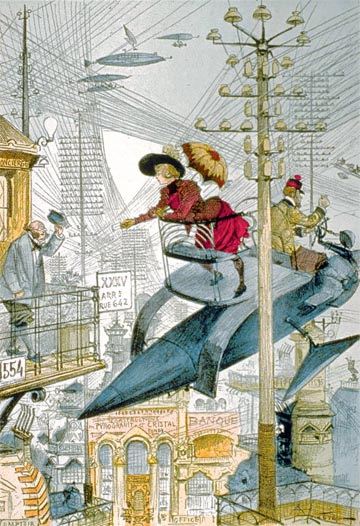
    Albert Robida (1848-1926) saw pretty deeply into the future, his mind
    wrapped around the plausibilities of possibilities, and getting a lot of
    them quite right.  (He was enormously prolific, with some 60,000 designs
    to his credit as well as 200 illustrated books and many dozens of
    illustrated journals, many of them quite lovely and prescient, if
    somewhat upsetting to the common-reading mind of mid-late 19th Europe).  Here’s Robida on the possibilities of ElectroPunk:

    [“Un quartier embrouillé “, La Vie électrique, Paris, Librairie Illustrée, [1892]. I wrote a little about Robida here.]

    Of course, Robida as well overplayed and underplayed his vision of the electrical future–I think he woul d have been shocked to see that dead trees are still supporting most of the wired world’s digital infrastructure, but he would have been overwhelmed to learn what that electricity was transmitting. 

    It would be an interesting measure to see how long it took between some futures going from hyper-speculated to not-so to be positively under-speculated and perhaps naive. 

    Notes: 

  • Visual Display of Data: Who Had What in Strategic War Materials, 1940

    JF Ptak Science Books    Post 1991   Follow Me on Pinterest


    Infographic nazi materials148

     
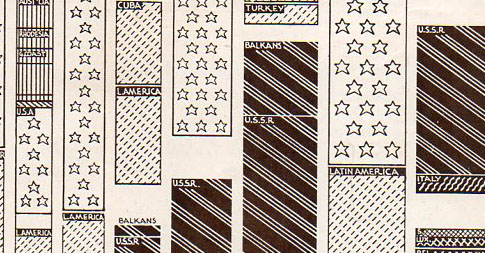
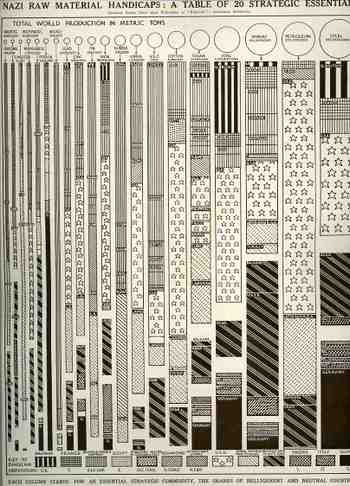
     This dense, complicated table showing the distribution of
    strategic raw materials (published in The Illustrated London News 3 August
    1940) I is a decent example of how not to display data.

    1ebaysept19_graphical_bad602

     Perhaps there’s just too many variables to
    try to control here in one visual display: it tracks twenty raw materials by percentage of access for thirteen
    different countries, with the entire graph being displayed in a sort-of
    progression according to metric tons of material. Maybe it’s the varying widths of the bars
    representing the material, maybe it’s the complex designs distinguishing the
    countries, and maybe its just too many lines. The only time this really works for relatively-offhand use is when you’re
    looking for one country in particular, and then the eye allows it self to just
    concentrate on the solid black (Germany) or the stars in a bar (U.S.) When the
    graph is used in this manner it displays rather quickly that Nazi Germany doesn’t
    control a whole lot of the combined tonnage of the twenty strategic materials, which
    was a particularly good thing for the general reading population in the Allied
    world to see, because the war was not going so well at this early stage. (At this
    point in the war—less than a year old now in Europe—the Battle of Britain had begun
    though it was still weeks away from when the massive Blitz begins, and Hitler had
    just toured Paris…it was not a good time for Britain, and a worse time for France.
    The

    Soviet Union is listed still with the Axis as it was
    still 10 months away from being attacked, Hitler turning on his allies in Operation
    Barbarosa in June 1941.)

    A little further
    effort would show that the Allied countries are mainly lighter, with the “belligerent”
    or neutral countries are darker, showing the lighter is on top with darker
    beneath, and that in general the Allies control more of these materials than
    the Axis.  It is also interesting to not
    ethe relative smallness of control by Great
      Britain, though when you throw in the rest
    of the British and then the French empires the possession summary changes
    dramatically.

    So the data is there, and there’s allot of it, and its
    fairly nimble—its just that the visual display is not pretty or easy to use .  

  • Speculating on Ned Ludd as a 2013 Figure

    JF Ptak Science Books  Post 1991  Follow Me on Pinterest

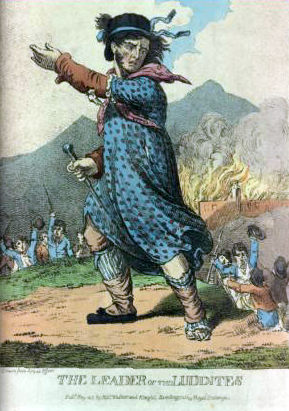
    LudditeIf the young Ned Ludd had fallen asleep and somehow managed to stay in a reverential dreamland for the past 225 years or so, I wonder what he would think, awakening in 2013. Where would his ambitions lie, assuming that he awoke with the old fire still intact?

    Certainly the strength of his convictions would be displaced to some new area beyond smashing the machines that took away the jobs of workers and helped secure them as the lowest-end of a very new man-machine interaction that keep workers working hard for less money.  Seeing that machines are everywhere, it would be a hard thing to reject, what most jobs in most areas depending upon a pile of machines that like the cosmological pile of turtles of James Jeans reaches all the way down and all the way up.

    Ned Ludd may not have been real, but his name and at least imagined riotous activities against machines were real enough to give the Luddites their name.  I think it is commonly believed today that a Luddite is simply anti-tech, but back at te turn of the 19th century and into its second decade, the Luddites were a definite force intent on destroying the very new machines that were taking away the jobs of skilled workers.  In the 18-teens, it seems that most of the historical interest in this movement concentrates on their actions against machines in the textile industry: these were proto-“strikes”, very physical labor protests against industry selecting machines over man.  The threat grew so intense that following the threatening acts of  the late 1780’s attempting to protect industrial property from this sabotage, that in the war year of 1812 the  Destruction of Stocking Frames, etc. Act 1812 (52 Geo 3 c. 16), also known as the Frame-Breaking Act was passed by an act of Parliament, which made it a capital offense to destroy mechanized looms. It was intended to break the back of the Luddite movement and preserve industry, and in the progress of the life of the limited act (it was designed to expire after two years), saw the execution of some 60-75 people for  acts of violence against property.  (The sentencing end of this act is a little difficult, as it seems that judges imposing sentences tended not to cite this act, though the result was the same.)  The Frame Breaking Act was replaced by another less lethal act which sentenced lawbreakers to 10-20 years “exile” in Australia, but that too was short-lived and replaced by another flavor of the act that brought back the death penalty. 

    For whatever reasons, the Luddites seem to have been broken, or absorbed, or exhausted, by the end of the second decade of the 19th century.  Mr. Ludd it seems never had a birth date and didn’t seem to die, and may not have been an actual person.  But as I said if he had slept for 225 years and entered consciousness again, today, it may well be the current evolution of human-machine interaction may be too advanced for him to address.  Perhaps Ludd would be interested more in the coming future of human/machine development, when human bodies are disposable, and i hta tcase would fight for the right of humans to retain their humanity.  But where would that fight start? Would he have rejected artificial hearts in the 1960’s? Artifical hips?  Would heart stents be a part of this encroaching history of the mechanization of humanity? And if that was so, would the innovations of Joseph Lister in sanitizing the operating theatre also be an unfavorable development?  Would spectacles count? Haring aids?  Canes” Wheelchairs?  It does get very sticky, unless Mr. Ludd decided to draw the line in the sand at the future transmission of consciousness or whatever into a new non-carbon-based receptacle to cheat death. 

    Maybe Ludd would aim lower and higher at the same time, deciding that the computer and its veiny internet was the real culprit of contemporary human demise, seeing the world wide web as more a primitive attempt at a global consciousness that robs all of its users of their individual humanities.  Of course he would have to become something on the lines of an alchemical adept in order to  know how he and his confederates could hack and destroy the internet, causing what might be monumental collapse of the economic world as we know it, launching a new/old era of agrarianism. 

    Or maybe Ludd has something entirely different on his mind, like Captain Ahab not really thinking very much about The Whale at all, his mind elsewhere, concentrating just on the contract for hunting up a commission rather than an intellectual and hyper-spiritual trophy.

    Philip K. Dick might have had a place for Ludd in one of his stories, which is about as much harm as he could do, unless resurrected by a super-evil-rich-nogoodnic with a mask and a cape intent on committing his Geniusopathia to Digiocide. 

  • Suprematist Planetary Images of Very High Contrast 1837

    JF Ptak Science Books   Post 1993    Follow Me on Pinterest

    There are times when the future turns up in unexpected places–and sometimes that imagery is quite unintentional, and belongs only to the viewer in that future, looking back.  It seems to me that many of these examples belong in the history of scientific illustration

    Thomas Dick’s Celestial Scenery, or, The wonders of the planetary system displayed
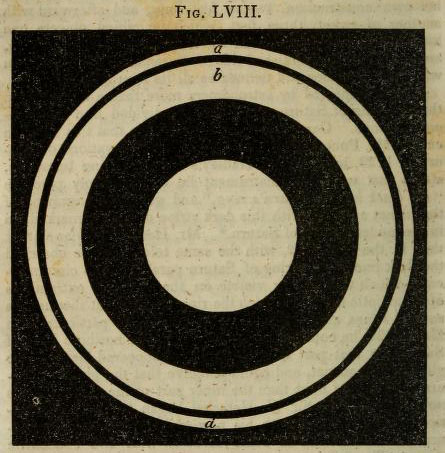
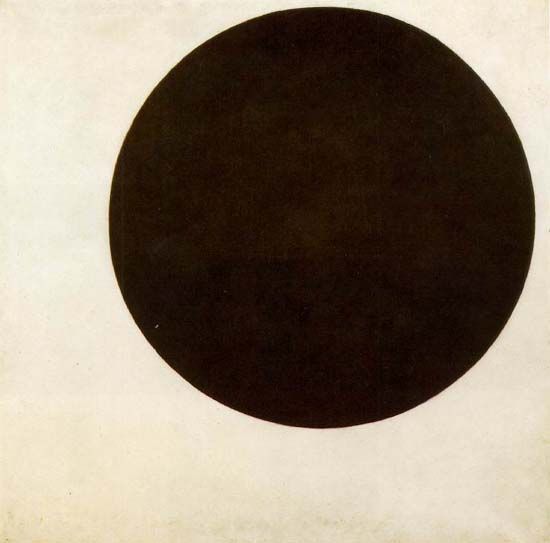
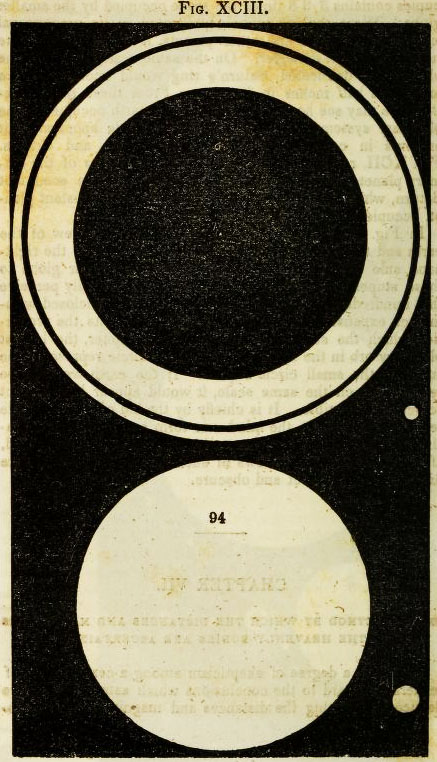
    was published by Harper & Brothers in New York in 1838 is a good example for a home of some of these flashes of future brilliance.  What we’re seeing in the pages of this chunky book–which was an influential object in the early reading of a number of people who were to become influential astronomers, one including E.E.. Barnard–are lovely, simple, and include some relatively simple images of size comparisons. The result seems to my eye to suggest Suprematist art, geometrical art that would come into being another 75 years hence or so.  (This movement was founded by the great Kazimir Malevich in the 19-teens, who said of it: “Under Suprematism I understand the primacy of pure feeling in creative art. To the Suprematist, the visual phenomena of the objective world are, in themselves, meaningless; the significant thing is feeling, as such, quite apart from the environment in which it is called forth.“) Of course the Dick images were simple comparatives and not-yet-art–but they certainly do suggests themselves as something more than what they are. The full text of the book is located at the Internet Archive, here.  (Thanks to Trevor Owens and his interesting Pinterest collection here who brought my attention to the Dick book via images of the Martian canals.)

    A plan of the rings of Saturn relating their size and some of their imagined composition:

    Astronomy dick saturn
    Kazimir Malevich, Black Circle, 1915:

    Black_circle

    Comparative of the Earth to Saturn’s rings; image bottom, depicts the Sun and Jupiter

    Astronomy dick earth saturn

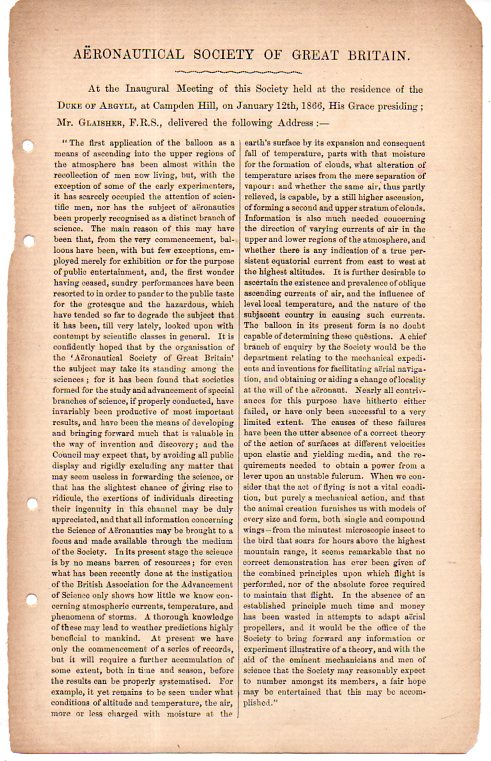
  • Making “Flying” a “Proper Subject of Investigation”, 1866

    JF Ptak Science Books  Quick Post

    I came upon this small, rare item in the early aviation box here.  Its the inaugural address establishing the Aeronuatical Society of Great Britain, the even held at the residence of the Duke of Argyll (Campden Hill) on 12 January 1866.  The text is by James Glaisher, who was a significant experimentalist/balloonist in addition to running the Department of Meteorology and Magnetism at the Royal Greenwich Observatories for 34 years. The document is only 7×4 inches, but it winds up being quite dense (literalyl and figuratively), with about 800 words packed onto one side of this double-column sheet.   

    Gibbs-Smith, in his interesting and very useful Aviation, an Historical Survey states:

    “One of the most important dates in flying history is the year 1866, when there was founded in London the Aeronautical Society (now Royal) of Great Britain.  Although not the earliest society devoted to flying it
    was by far the most important and. influential .  It soon attracted men  who realized that mechanical flight was ultimately possible, and who were determined to study and solve its problems..  From then on the main
    development of aviation was to lie in the hands of scientifically or technologically trained men.  The subject if flying…now took on a new seriousness…it now become a proper subject of investigation…”– p. 41. 

    The object itself does not appear in the OCLC/WorldCat, and so is extremely uncommon in this format, so I thought it would be useful to report on it and reprint it here.  The original is also available for purchase onthe store’s blog.


    Aeronautical society150

    ·Posted by :

    ·in:

  • Structure for Wide Thinking–Gropius as Teacher

    JF Ptak Science Books 

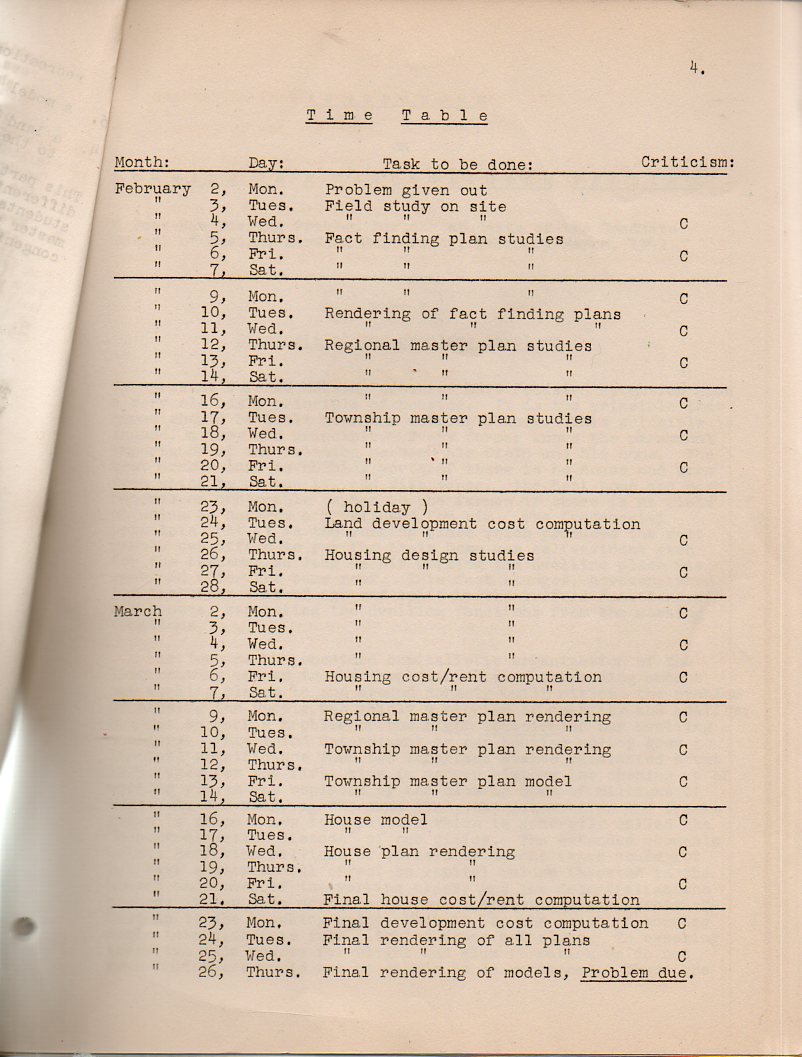
    Walter Gropius (1883-1969, founder of the Bauhaus School and one of the principle builders of modern architecture) and Martin Wagner (1888-1957) were thinking of a new type of “town”, of a different sort of settlement for people, when they wrote this exercise instructional for their Harvard course. Housing as a townbuilding1 problem, written during the war in 1942, was intended to be an exercise (or  “problem”), a case to be studied by the students in the departments of landscape architecture and the graduate school of design at Harvard. The class opened with this rare2 pamphlet as a basis for course work, given to the students on 2 Feb 1942, with the problem’s answers expected to be on Gropius desk five weeks later.  Gropius and Martin put a tough, wide-ranging, landscape-changing question and expected answers in a very short period of time, though they definitely had a very structured plan and approach to dealing with massive implications of their exercise.  The theory was outlined there in the paper, of course, and was expanded much more fully in class.  And then there was this: a full page of datelines and expectations, a way of dealing with a large problem in logical chunks, adding up the answered bits, and then delivering a larger answer at the end and on time. 

    Gropius table899
    [The original work is available at our blog bookstore.]

    I’m not an architecture or design historian, so much of this paper was a little lost on me–but I could definitely appreciate the way in which the great Gropius outlined the process of problem-thinking and solution for his students.  This may be the part of this paper that I liked the most. 

    In  “The Walter Gropius House Landscape: A Collaboration of Modernism and the Vernacular”3 (published in the  Journal of Architectural Education, 1984, 57 (3), p. 39) Eric F. Kramer wrote:

    “Sounding similar themes in a 1942 joint studio problem for landscape and architecture, Walter [Gropius] wrote of the inspiration of the vernacular landscape and of integrating with existing systems: ‘Such a landscape invites the artist planner to observe and preserve its variety of aspects, and to invent a settlement pattern that .ts into its natural beauty. Fortunately our forefathers have already traced out a settlement pattern that fits very well into the landscape.’ Gropius–the grand master builder and master teacher–set out the problem and the solution”.

    There are of course major statements in city-building and human resettlement in this work, but for now, I’m still concentrated on the Bauhaus-founder’s outline for problem solving.   

    Notes

    1.  The full title: Housing as a townbuilding problem; a post-war housing problem for the students of the Graduate School of Design, Harvard University, February-March, 1942.

    And in that publication Gropius writes: “When we speak of ‘new townships’ we think of a new type of human settlement “, with a redefined vision of what a “town” means, using an idea of “reception basins” for spheres of cities as centers of culture, art and commerce “and our open country as furtherer if an industrialized agriculture and of forestry and recreation”. (page 21).  And all of that to be manufactured along the lines of “planned super-highway systems, one branch of which is to go through New England region and will supposedly cut through the towns of Weston and Weyland”.–Gropius and Martin.

    2. This copy was in the Office for Emergency Management; only  six other copies have been found and these in excellent collections: MIT, Harvard Special Collections, Harvard College of Design, Cornell, Columbia and the NYPL (Special Collections).  So the publication is pretty scarce, and given its method of printing and distribution, it looks like not many survived, though it is difficult to say how many were actually printed.  In any event, few survived.

    3. The abstract of this paper is helpful: “The Walter Gropius House Landscape A Collaboration of Modernism and the Vernacular”. “The Gropius house landscape is a potent physical manifestation of the design debates of its era. The landscape is an element of both mediation and integration forging a reciprocal and evenhanded relationship between architecture and site. Shaped by modern architectural sensibilities translated to the landscape and developed at a moment when landscape architecture was struggling to .nd a modernist inspiration and voice, it is an object lesson in the development of a modernist landscape architecture in America…”   
    “In these studio problems, Gropius consistently encouraged students to find new form in the functional requirements of modern times and yet to integrate with existing systems through an understanding of their own functionally driven evolution.”

    ·Posted by :

    ·in:

  • Von Braun on German Liquid Rocket Development, 1945

    JF Ptak Science Books Post 1994

    Von braun title157I was prepared to just list this for sale in the books for sale section of this blog and be done with it–until I semi-realized that this famous (or at least significant) report is not to be found available online. Von Braun is far from being of interest to me–I don’t need to know his part of the space program from 1946-1977, though I am interested in his what he was doing from 1936-1945 when he was trying to kill London.

    Again, I’m no expert on this man, but reading between the lines of his politically whitewashed account of German/Nazi flying bomb program makes me wonder about his enforced/codified forgetfulness and suggestive memory.

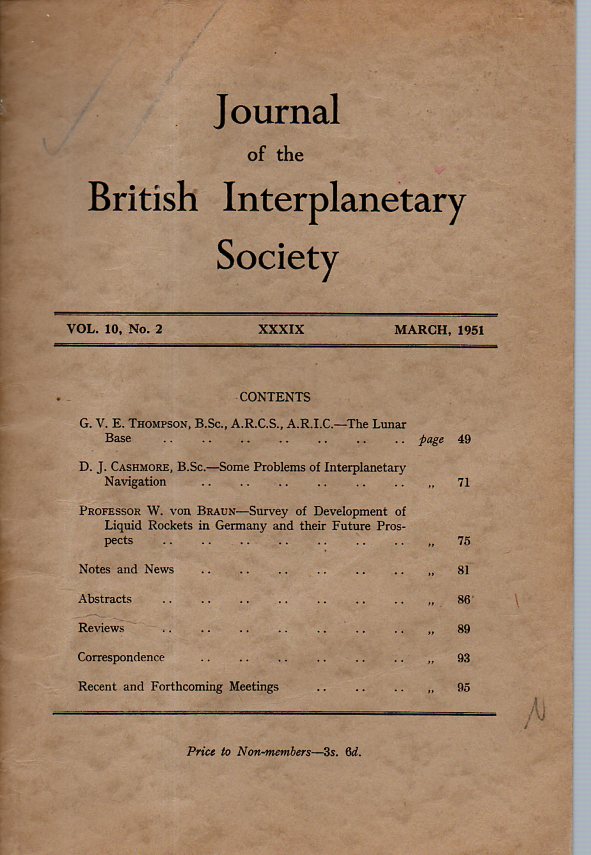
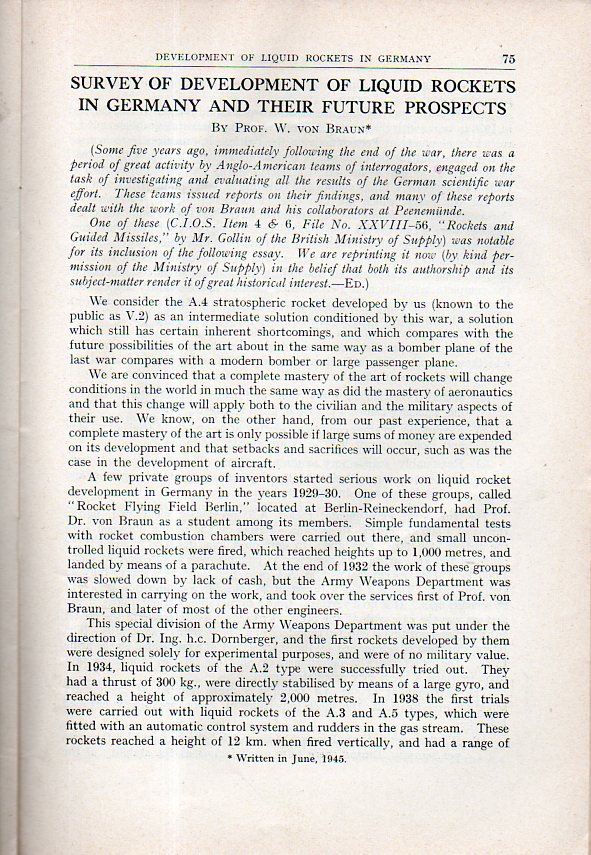
    The paper in hand is his “Survey of Development of Liquid Rockets in Germany and their Future Prospects”, a six-page effort that appeared in the Journal of the British Interplanetary Society on March, 1951. It is a reprint of a reprint of a report that he wrote for his Anglo-American interrogators in the summer of 1945, when he and the Allies were scurrying around and trying to figure out what to make of the post-war world with all of that valuable German technology-ops out there in the wind.

    In any event, von Braun wrote out this history and prognostication (as there is a big chunk of the paper devoted to future space travel and such) for them in 1945 which then found itself in print by at least 1946. There are many glosses. For example, his use of the A.-prefix determination throughout the course of the document to refer to the V-weapons though it is noted in the first sentence of the report (and no doubt by an editor), that the A.4 “is known to the public as the V.2”. (Perhaps that has the scent of freshness to it, to rid the report of a small part of its scrubbiness…or not.)

    He writes occasionally in the third person, and also makes the case that the development of the rocket complex at Peenenemunde was for research in high-flight/super-fast travel, when the place had always been intended for military applications. He does mention that the A.4 had severe problems with the guidance system, but that was acceptable since they were given large-target areas to bomb–such as “London”.

    It is an interesting read for what it says about the future of vast fast travel, as well as for what it does not say about defeat and responsibility and the use of slave labor and bombing large civilian areas. But that’s not what he was talking about, here.  Or basically ever.


    Von braun 1151

  • Racism in Space

    JF Ptak Science Books   Quick Post   Follow Me on Pinterest

    Attributing human characteristics to extra-terrestrial bodies is an ancient practice.  Constellation It is an ancient human practice of giving stuff human attributes, to allow things to have powers of reason,and understanding, in order to make them understandable, intellectuallyconsumable.  This applies to (Father) time, many aspects of the
    possibilities of g_d, constellations, planets, the Man in the Moon, facial appellations of the Sun, winds, rain, and so on. Large chunks of our real and imagined worlds are given faces and mentions–that, plus personifications of elements, where we describe the difficult and the invisible with traits that are in our common human understandable currency:  like, for example, sin “lurking” and storms “hiding” and meteors “racing”. It makes the complex and uncommon more reasonable. 

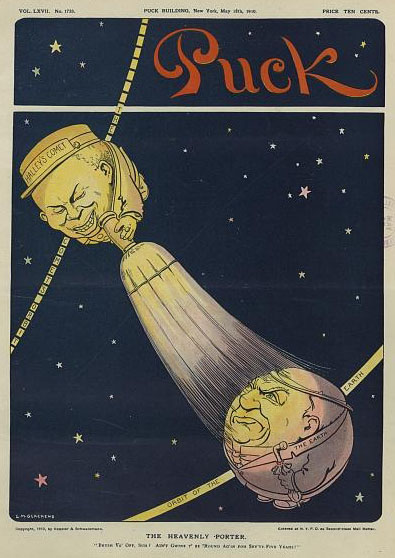
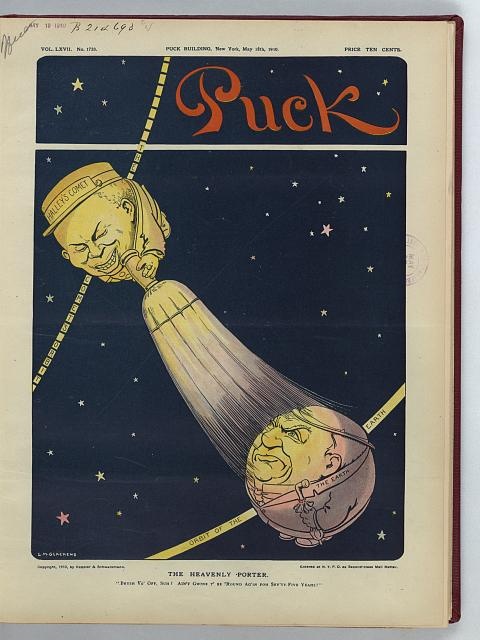
    In all of this, particularly in the personification and anthropomorphization of celestial entities, there are very few examples of vicious and cruel representation of a subject.  That is what struck me so about the following cartoon from Puck magazine–I am sure that I have never seen a racist representation of an element in the sky.  Until
    today. 


    Race sky

    [The heavenly porter: Caption: “Brush yo’ off, Suh? Ain’t gwine t’ be ’round ag’in foh sev’ty-five yeahs!”  Illustration in Puck, v. 67, no. 1733 (1910 May 18), cover.  Copyright 1910 by Keppler & Schwarzmann. Source:  Trevor Owens, via the LOC.]

    This is an example of how engrained racist thinking like this was at that time–and it makes a person think about the unthought aspects of racism exists elsewhere, at other times, and today. 

    ·Posted by :

    ·in:

    —
  • Alphabet of the Magnetic Field: Breton Lists his Surrealists

    JF Ptak Science Books   Post 1994  Follow Me on Pinterest
    Breton

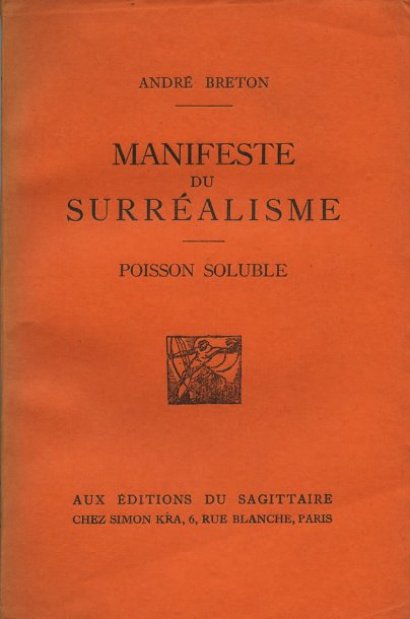
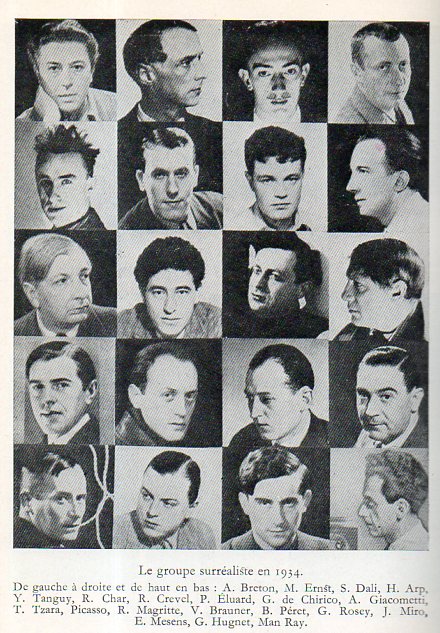
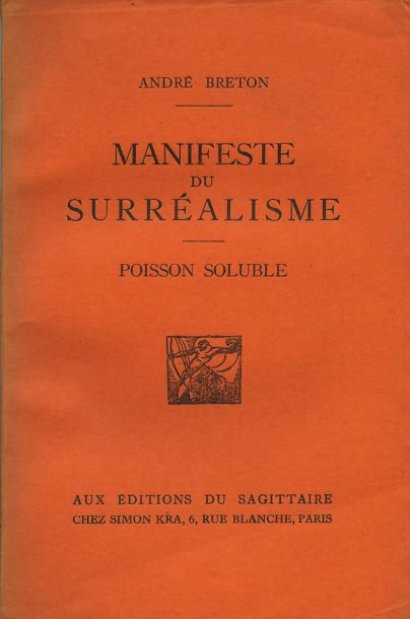
    Andre Breton (1896-1966)  may be the patron and founding saint of the movement we know as “Surrealism”.  “I believe”, he said, “in the future resolution of the states of dream and reality, in appearance so contradictory, in a sort of absolute reality, or surrealite, if I may so call it”.  So he wrote in his Manifeste du Surrealisme (pp 23-24), published in Paris in 1924, just days after the first meetings of the group of writers and artists to which he belonged called the Centrale Surréaliste or the Bureau of Surrealist Research, (also known as the Bureau of Surrealist Enquiries). Breton’s Manifesto was a defining element of the movement (in spite of its own probably intentional contradictions), and , well, entirely too much to summarize here in this minor post.  I am more interested presently in some of the names he discussed here and in a later work.
     

    Breton149
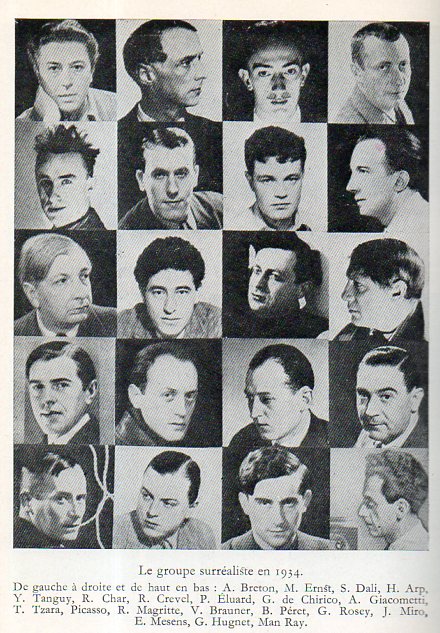
    [Source: Maurice Nadeau, Histoire du Surrealisme, Editiosn du Soeuil, 1964.]

     Breton made several interesting lists of artists and writers who he identified as Surrelaists or precursors of Surrealism, the names appearing in the  Manifestes… and then in the Anthologie de l’Humor Noir.  The suggestions are factual and fanciful, meant to be taken seriously and not–ir at least his reasons and identifiers of those names were to be taken loosely if not the names themselves.  In any event it is an itneresting amalgamted list, which is presented below, cobbled together from the two sources and then alphabetizied. These are names Breton mentions explicitly in his lists, and do not include all of those folks whos eart he discusses in those works. I mean to return to this with portraits and links, but for a start today I’d at least to start with the backbone of the names.
    Surrealist portrait Paris 1933

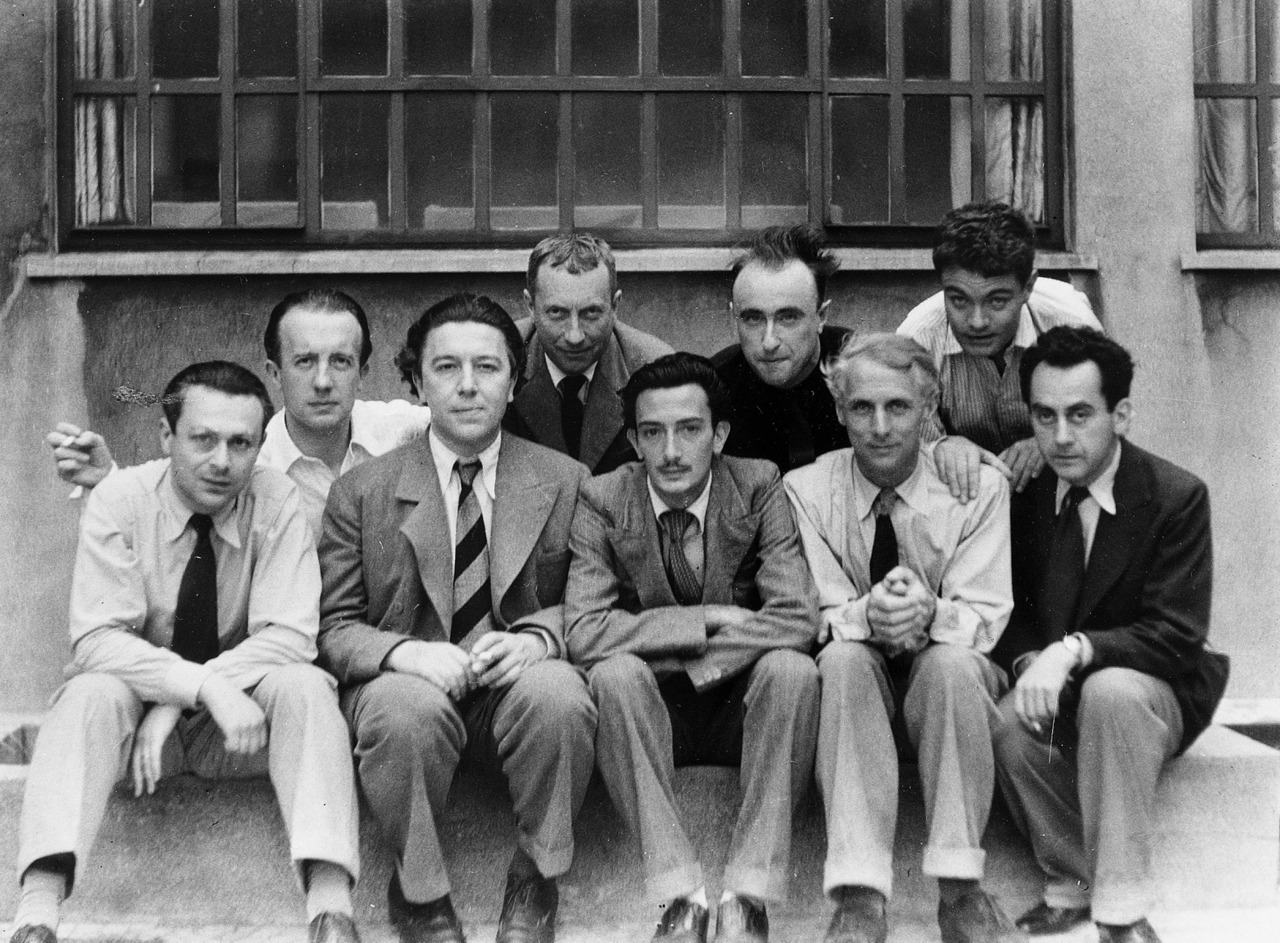
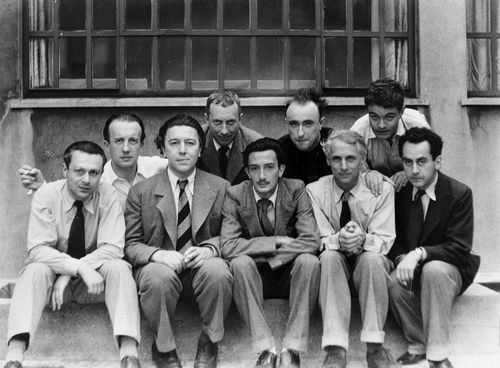
    [Source: the Paris surrealists, 1933: Tristan Tzara, Paul Éluard, André Breton, Hans Arp, Salvador Dalí, Yves Tanguy, Max Ernst, René Crevel and Man Ray. Photo by Anna Riwkin-Brick.  Image found here: Art and Studio Tumblr, here.]

    Manifestes du Surrealisme (1924) is available in French here and in English here.
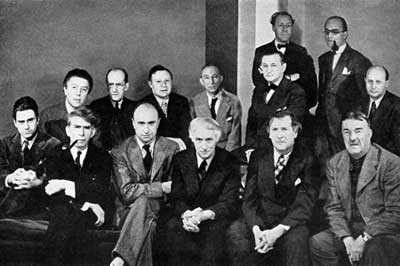
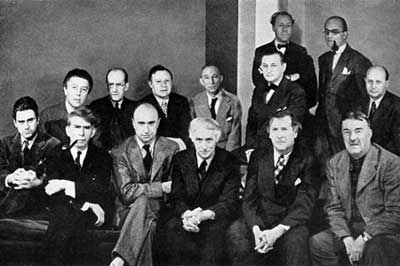
    Surrealists 1942[Artists in Exile, 1942:   Front row left to right: Matta Echaurren, Ossip Zadkine, Yves Tanguy, Max Ernst, Marc Chagall, Fernand Léger Second row: André Breton, Piet Mondrian, André  Masson, Amédée Ozenfant, Jacques Lipchitz, Pavel Tchelitchew, Kurt Seligmann and Eugene Berman. (Photo: George Platt Lynes]

    Breton’s definitions of surrealism:

    SURREALISME, n, m. Automatisme psychique pur
    par lequel on se propose d’exprimer, soit verbalement, soit par écrit,
    soit de toute autre manière, le fonctionnement réel de la pensée, en
    l’absence de tout contrôle exercé par la raison, en dehors de toute
    préoccupation esthétique ou morale. [Surrealisme. Noun, masculine. Pure psycic automatism, by which one intends to express verballym in writing or by any other method, the treal functioning of the mind. Dictation by thought, in the absence of any control exercise by reason, and beyond any aesthetic or moral preoccupation] 

    ENCYCL; Philso. Le
    surréalisme repose sur la croyance à la réalité supérieure de certaines
    formes d’associations négligées jusqu’à lui, à la toute puissance du
    rêve, au jeu désintéressé de la pensée. Il tend à ruiner définitivement
    tous les autres mécanismes psychiques et à se substituer à eux dans la
    résolution des principaux problèmes de la vie. [Encycl. Philos. Surrealisme is base on the belief in the superior
    reality of certain formes of association heretofore neglected, in the
    omnipotence of dreams, in the undirected play of thought…]
     

    ·Posted by :

    ·in:

Recent Posts

Archives

Categories