A Daily History of Holes, Dots, Lines, Science, History, Math, Physics, Art, the Unintentional Absurd, Architecture, Maps, Data Visualization, Blank and Missing Things, and so on. |1.6 million words, 7500 images, 4.9 million hits| Press & appearances in The Times, Le Figaro, Mensa, The Economist, The Guardian, Discovery News, Slate, Le Monde, Sci American Blogs, Le Pont, and many other places… 5000+ total posts since 2008.

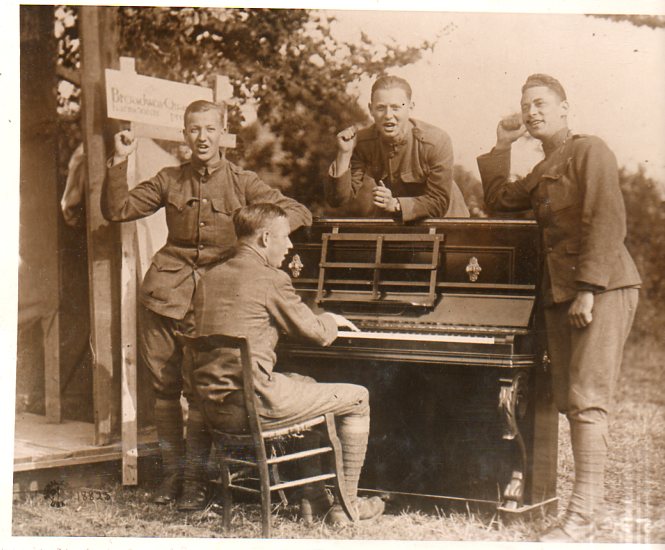
  • A Field-Constructed Piano, November 1918.

    JF Ptak Science Books  Quick Post

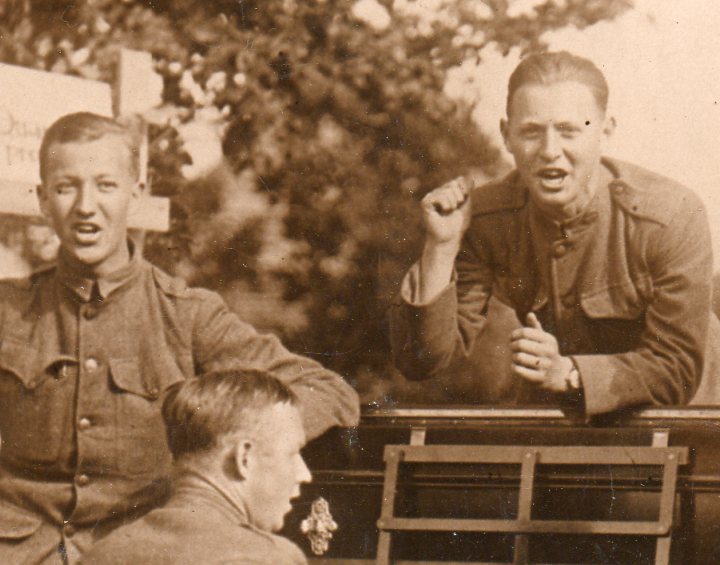
    This fine image was made for distribution to newspapers and magazines, and was printed 2 November 1918–just nine days before the armistice–and shows the “Broadway Quartet” as they rehearse “I’m Only a Buck Private” for a behind-the-lines show for U.S. servicemen, somewhere in France.  The note with the image (from the Western Newspaper Union) says that the staging used for their shows came from found wood, bits of flooring, and camouflage netting torn into pieces.  

    WWI  piano250
    WWI  piano251


    ·Posted by :

    ·in:

  • Strange Things in the Sky Department: Floating Arms

    JF Ptak Science Books   Quick Post  (An entry in the “Found Absurdist” category)

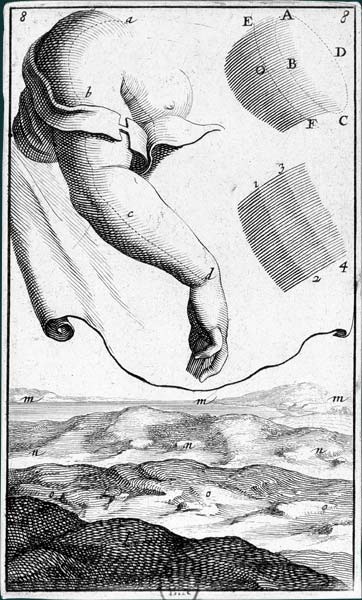
    There’s a series on this concentrating on unusual things found “floating” in the sky, bits and bobs that are odd, or visual non sequiturs (“sequuntur”?) that just happen to use a landscape as a decorative visual for the viewer, and so on. There are many varieties of this atmospheriana, including floating cities, bombing ladies, eyeballs, hands, extra-earths, alien populations, and the unexpected like. Today’s entry is less involved than those, showing a disarticulated arm and shoulder floating above a gentle landscape…all this is, in real life, is an engraving showing a number of different varieties of engraving, all presented on one leaf rather than using several. The explanation for the image is boring, but the stand-alone of the unexplained floating arm isn’t.


    Bosse odd

    Source:  Abraham Bosse, 1604-1676 (printmaker and artist), in his classic work on engraving and illustration, Traité des manières de graver en taille-douce…, 1645.

    ·Posted by :

    ·in:

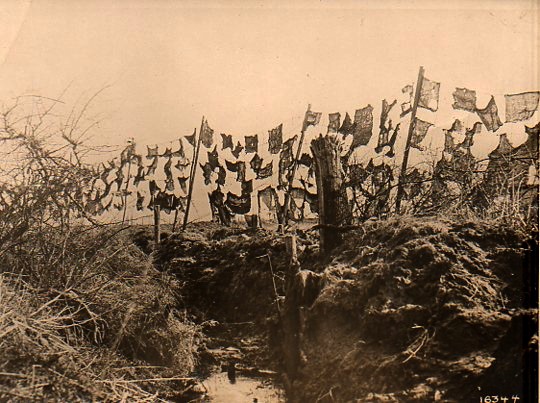
  • Camouflage on the Belgian Front, 1915

    JF Ptak Science Books   Quick Post

    Its a little difficult to think of Ellsworth Kelly, Jacques Villon, Grant Wood, Laslo Moholy-Nagy and Thomas Hart Benton as painters-for-war.  But its true, and true for many of hundreds of other artists in the 1915-1918 era. Its not as though they were in the trenches gunning down the enemy or lobbing hand grenades into the swirling gunsmoke. They were camofleurs, camouflage1 experts, artists employed as magicians, Wartime Magi, employed/drafted to make ships and such disappear. 
    World War I photos--Camouflage291

    Ever since it was (sort of) first noticed in 1915 that designs odd to the environment, stark geometric patterns and such, were capable of fooling the eye, people with  design capacity were pressed into service, rendering offensive and defensive instruments of war optically semi-impervious with variations of the then-five-year-old modern nonrepresentational art. That must’ve been a very odd position to wake up to every morning. 

    Of course the idea of camouflage in the animal world is probably 250 million years old–animals and insects have been blending into their environment for eons, and I’m sure too that early hominids did their fair share of walking behind brush.  But the idea of hiding great amalgamations of very heavy metal with paint is really quite modern.

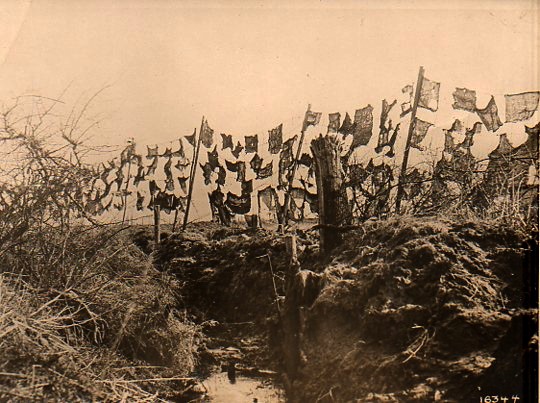
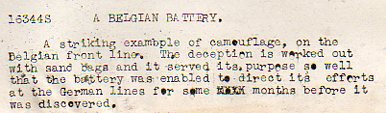
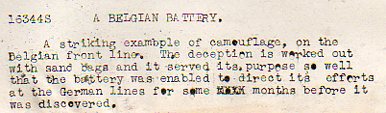
    In this photograph the camouflage is more a more futuristic conception of art than the abstract and cubist approaches that were taken during the war, this looking more like assemblages of found material more than anything else.  And, according to the text that accompanied the photograph (which comes from 1918, from the Underwood & Underwood news photo service agency), the camouflage–empty sandbags thrown on a barbed wire fence) successfully concealed a gunnery emplacement for months on end. 
    World War I photos--Camouflage det292 

    Notes

    1. A fine bibliography on camouflage appears here, at Leonardo Online.

    The definition of “camouflage” from the Oxford English Dictionary shows that it is a young word, in English:
    “(n) The disguising of any objects used in war, such as camps, guns, ships, by means of paint, smoke-screens, shrubbery, etc., in such a way as to conceal it from the enemy; also, the disguise used in this way; freq. attrib.


    1917    Daily Mail 25 May 4/4   The act of hiding anything from your enemy is termed ‘camouflage’.
    1917    Daily Mail 16 July 5/3   The King paid a visit to what is called a camouflage factory.
    1922    C. E. Montague Disenchantment viii. 108   A French aerodrome across which the French camouflage painters had simply painted a great white high-road.
     

    ·Posted by :

    ·in:

  • A View of Manhattan from the Top of the Brooklyn Bridge, 1877

    JF Ptak Science Books   Quick Post

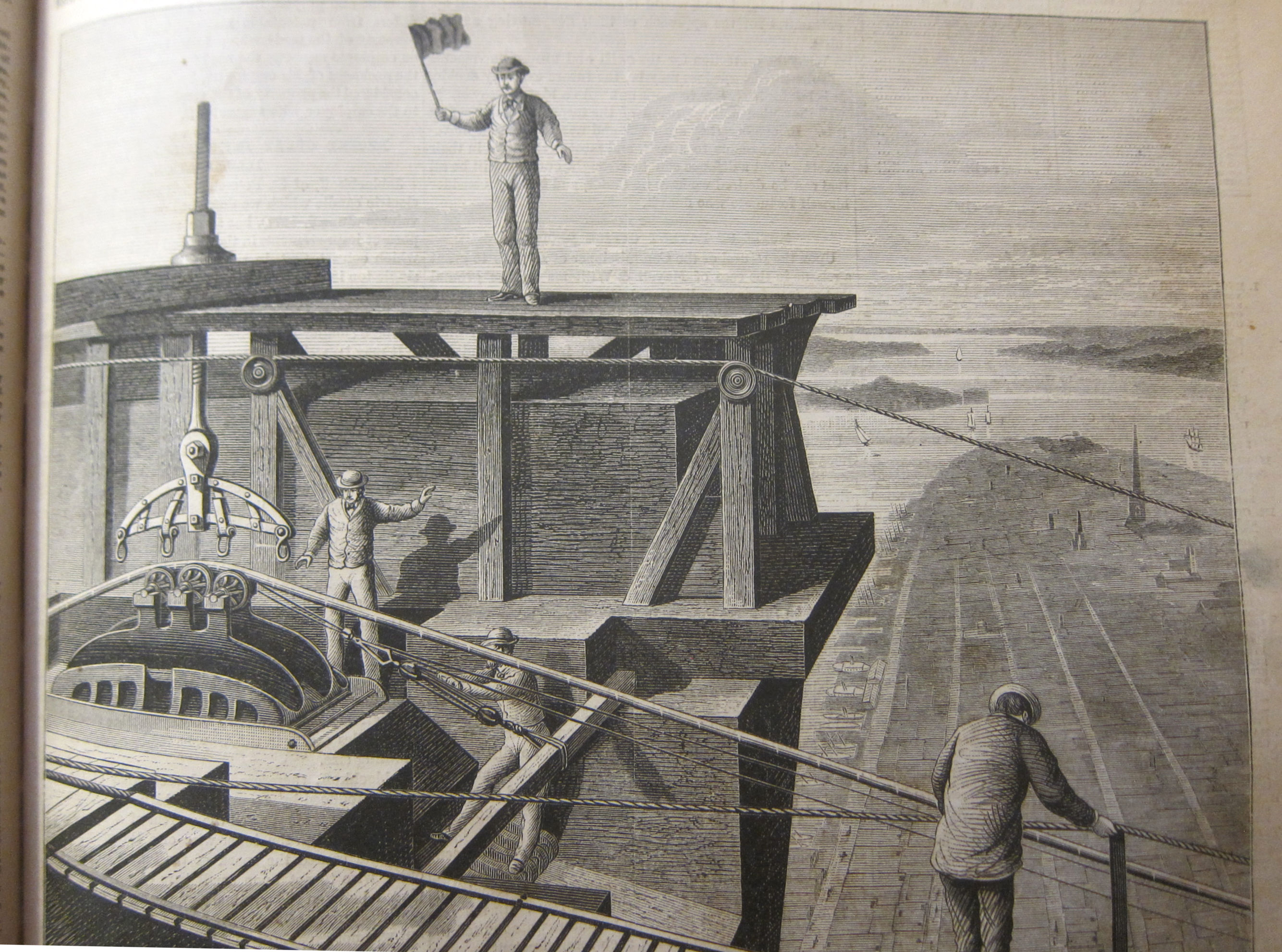
    Yes,  this is indeed a wonderful and celebratory view of Manhattan from the top of the East Tower of the under-construction East River (“Brooklyn”) Bridge. The thing about this is that the view seems to be too good, the tower too tall…unless there is something odd about the perspective and bird’s eye view of it. From this vantage point we’re looking south-east towards the battery and then Governor’s Island and then out to Jersey and Brooklyn with Staten Island in the distance.  Now the steeple we see downtown is Trinity Church, standing there at 284′; given that the tower is 278′ tall,  this perspective completely dwarfs the church for reasons I do not know. I’m not sure what’s going on–perhaps this is more a suggestive view than an actual you-are-there rendering.   The source:  Scientific American, October, 1877.                         Sci Am 1877 Brooklyn Bridge

  • Humpty Dumpty on Words (History of Nothing series)

    JF Ptak Science Books  Quick Post (History of Nothing series)

    Watching the performances of the U.S. president for these thousand+ days—particularly exemplified in the wind/”wind mill” address–seeing him teetering and as always ready for a fall that never happens, put me in mind of an old character, Humpty Dumpty. This doesn’t apply for what happened to Humpty Dumpty in the old rhymes, but for what he said in Mr. Carroll’s book:

    “When I use a word,” Humpty Dumpty said, in rather a scornful tone, “it means just what I choose it to mean—neither more nor less.”

    “The question is,” said Alice, “whether you can make words mean so many different things.”

    “The question is,” said Humpty Dumpty, “which is to be master—that’s all.”

    –Lewis Carroll,  Alice Through the Looking Glass, (1871), Lewis Carroll’s sequel to Alice’s Adventures in Wonderland (1865).  This one isn’t doesn’t have such a cushioned fall through the rabbit hole, and has very sharp edges all the way around. Carroll introduces us to the reverse in this world, having Alice step through a mirror into a realm that is a reflection of sorts of what her world once was, including the example of logic above that so fits the U.S. situation at the top of the turtle stack.  Or bottom–das macht nichts.  

    Communication when the speaker uses a private truth table is difficult (for the listener). 

    And then I wondered about whether or not Wittgenstein had ever read Carroll, which is way more of a question that I can answer in one of these quick posts with the one-hour time limit imposed—suffice to say that it is something interesting to pursue.

    For now, a good quote from the early W:

    “Roughly speaking, to say of two things that they are identical is nonsense, and to say of one thing that it is identical with itself is to say nothing at all.”–Ludwig Wittgenstein, Tractatus… 5.5303.)

    For an interesting read not quite on the point of whether W read C, see: George Pitcher, “Wittgenstein, Nonsense, and Lewis Carroll”, The Massachusetts Review, Vol. 6, No. 3 (Spring-Summer, 1965), pp. 591-611

    ·Posted by :

    ·in:

  • “Found Art” in Architectural Engineering (1868)

    JF Ptak Science Books  Quick Post

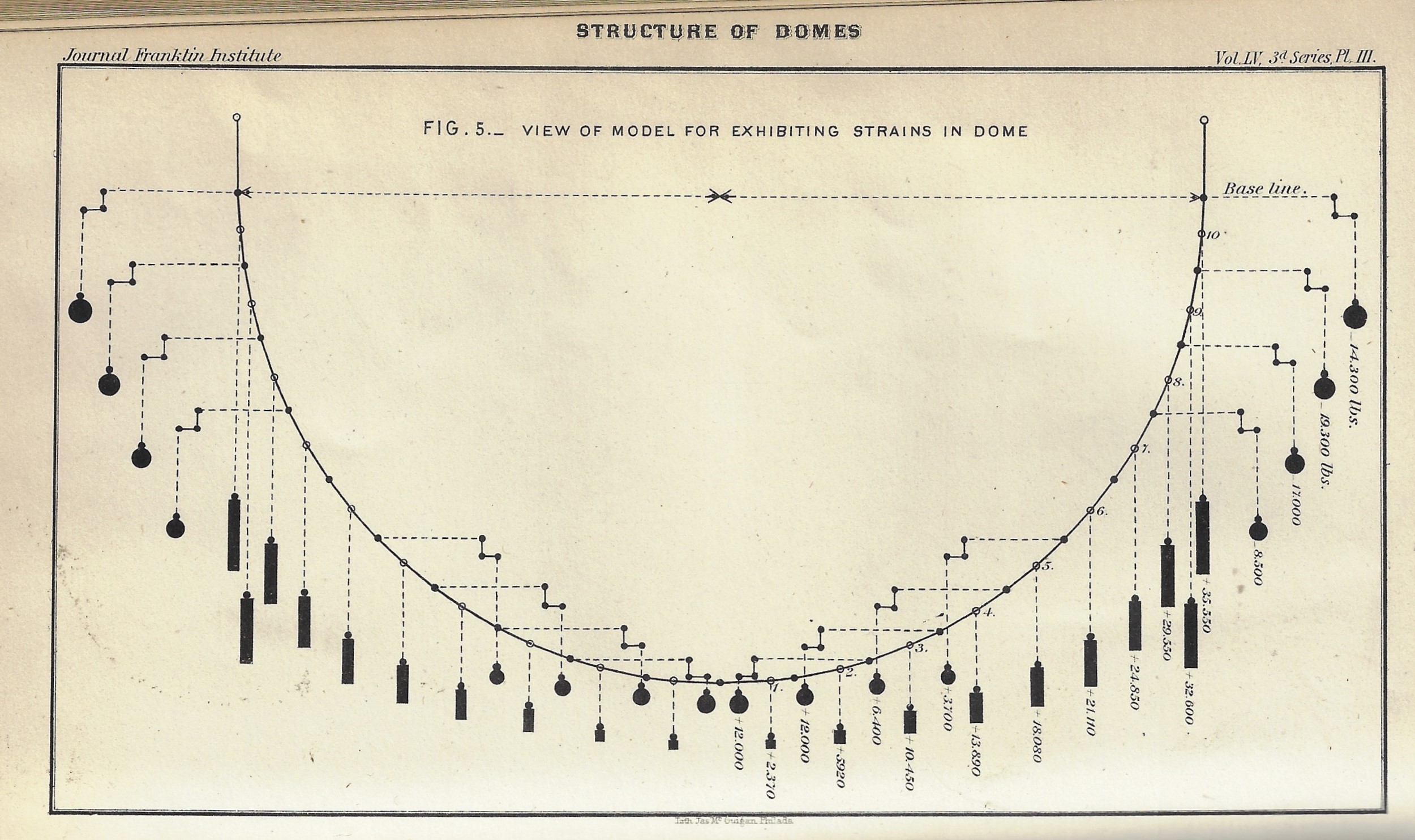
    Aha! Another lovely image for the long “FOund Art”/”Found Dadaist” categories on this blog, this being an engineering simulation for the building of domes.  The image was found as an illustration in “The Supportive Power of Piles, Both as Wood and Iron, and the Use of the Latter, Either as Piles or Columns of Support for Foundations”,  found on pp 98-110, and pp 170-182, in the Journal of the Franklin Institute, vol 55 (3rd series), 1868.  

    JFI 1868 domes _2_

    ·Posted by :

    ·in:

  • A Rare Work Detailing the Minor but Important Social Aspects of Life in the USSR, 1933

    JF Ptak Science Books  Post 2815

    Here’s a very unusual and interesting pamphlet that I just found, and partially read. Philena Weller Montgomery and John Ferguson Montgomery wrote Traveling Hard Through the USSR1, a travelogue on their trip through the old country in the mean and bitter summer of 1933. They printed the pamphlet themselves in 1934, giving their address as 1105 Morrison Ave, Bronx, NYC.

    They produced a remarkable major-minor work, I think, making hundreds of small observations on the little bits and bobs of everyday life that one usually does not see in a work like this. For example, they walk around Stalingrad and rather than remark on the great sights and vistas they report on the state of window displays—that there were unrelated objects on display, like urinals with lamp lights and pictures of clothing for sale that the storekeep didn’t have, and that the windows were dirty and hadn’t been cleaned in months or years, and that the broken ones were fixed with metal and rivets; that sort. That’s the real strength of this work, I think; the ability of the writers to see the small local, personal detail—they weren’t interested so much in a grand building, but rather the women who were scrubbing the marble floors with some evil-smelling something because there was a shortage of soap; and not so much the boat they were passengers on, but rather the shabby dress whites of the captain and how he moved through the crew and how the crew responded to that; not the grand vistas of old St. Petersburg but rather the dirty shop windows that displayed pictures of items that they didn’t have in stock.

    The authors left with a group of 10 other people (fellow students?) for a loosely-guided trip through the Soviet Union. This was not a North Korean-style tourist experience for this group; they write that even though they had a guide that they were in no way constrained from wandering off or speaking to anyone they wished; they felt that there was no control over their activity outside of the route they were following for their visit. The fact that they saw so much poverty and hardship, and interviewed whomever they pleased, attests to the limited control the state placed on their tour.

    Their adventure begins in Leningrad, and moves to Moscow, Gorki, Kaza, Samara, Saratov, Stalingrad, Rostov, Yalta, Odessa, and then back west via Kiev. The authors write that if the USSR were really trying to control what the visitors saw that they would positively not send people out of or into the country via Kiev because of the state of the city and the people.

    I’m sharing this here just in case anyone out there knows anything about this work—I do plan on posting the full work here in the near future.

    Here are some notes from my reading:

    Kiev

    • pale children working elevators at night of their hotel;

    • more Bezpreysosny (orphans) here than they saw in all the rest of the Soviet Union combined;

    • city swarmed with red Soldiers and OGPU;

    • shop windows displayed odd assortments—corks, urinals, bridge lamps, washboards, side-by-side, with very little consumer goods;

    • buildings were shabby as were the people, especially the children, “who show the effects of suffering”’;

    • visit to a Jewish collective farm

    ·Posted by :

    ·in:

  • Music, Color, Shape, and Synesthesia (1890)

    JF Ptak Science Books  Quick Post

    • “A studious blind man, who had mightily beat his head about visible objects, and made use of the explication of his books and friends, to understand those names of light and colours which often came in his way, bragged one day, That he now understood what scarlet signified. Upon which, his friend demanding what scarlet was? The blind man answered, It was like the sound of a trumpet.”— John Locke, An Essay Concerning Human Understanding.

    This is a big subject for a quick post, the subject of synesthesia having an origin enfogged in mist and with ill-defined boundaries, or at least that is until we get to the 19th century. If we leave aside the earlier thinking (by folks like the quoted Mr. Locke, above) we can speed ahead to Gutav Fechner (the father of psychophysics) with his empirical study of a group of synesthetes in 1871. He was quickly followed by Francis Galton (in 1881, a paper that I write about elsewhere on this blog), though neither Fechner nor Galton’s work in this area achieved very much recognition beyond pale acknowledgment. Things speed up somewhat in the early 20thc when the empirical work is taken more seriously.

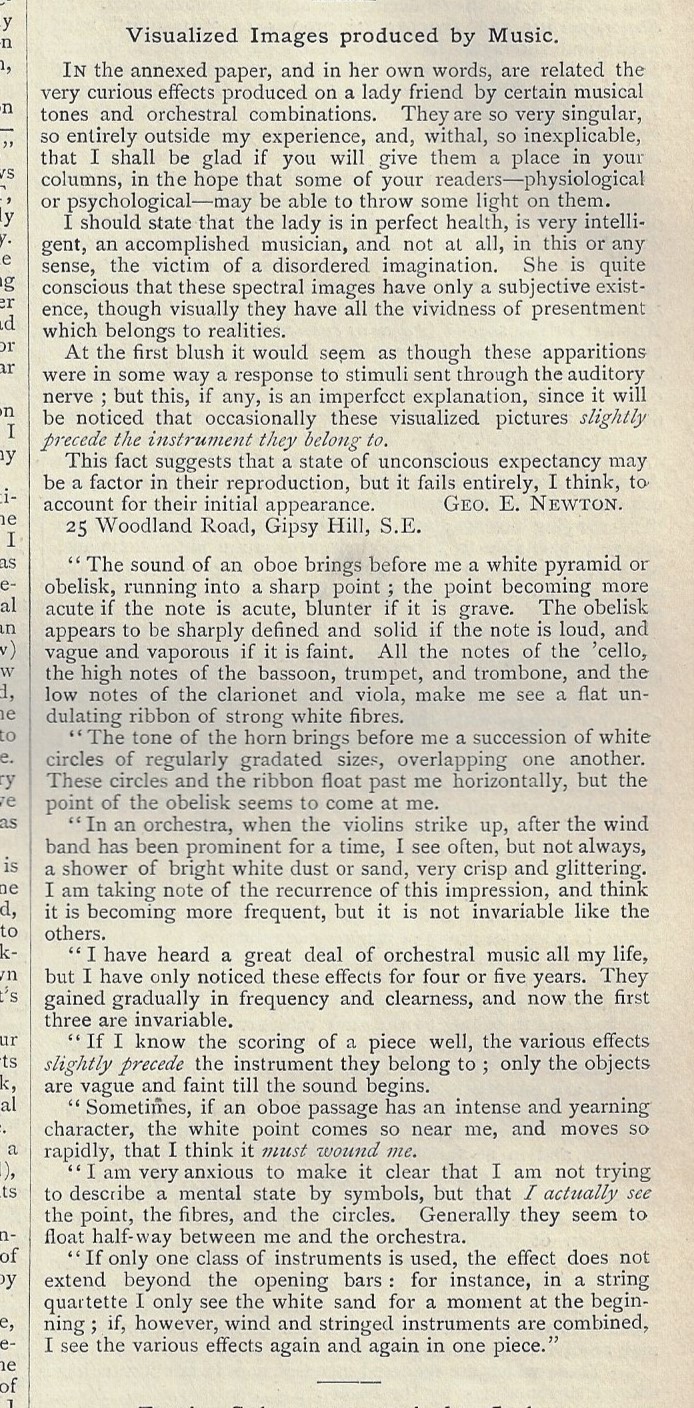
    But stepping back for a moment, I’d just like to share this unusual and interesting 1890 paper from Nature. I never bumped into it before nor could I find more than a couple of bare references to it. So I’m wondering if anyone out there knows anything about it—this is done in the spirit of the original author of the paper, George Newton, who posted his story (“Visualized Images Produced by Music”, March 6, 1890) to see if anyone else in nature-world recognized anything like the situation he describes.

    The opening paragraph of the paper:

    “IN the annexed paper, and in her own words, are related the very curious effects produced on a lady friend by certain musical tones and orchestral combinations. They are so very singular, entirely outside my experience, and, withal, so inexplicable, that I shall be glad if you will give them a place in your columns, in the hope that some of your readers-physiological or psychological-may be able to throw some light on them.”

    Nature 1890 Newton synesthesia

    ·Posted by :

    ·in:

    — —
  • What to Do When the Bombs (and Gas) Come(s)–Austria, 1935.

    JF Ptak Science Books  (Earlier post corrected).

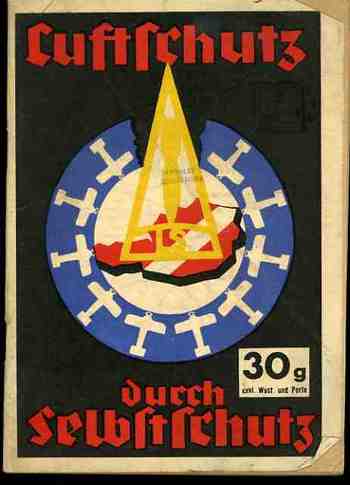
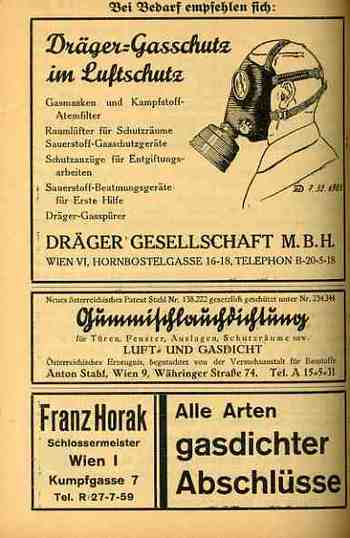
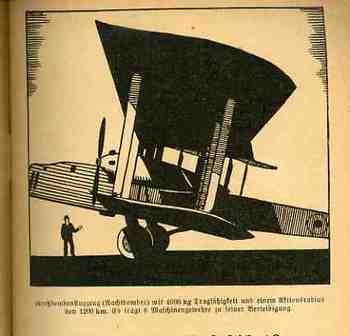
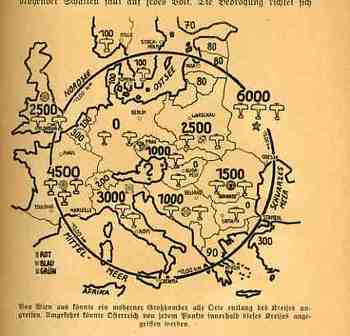
    1ebay_oct_4nazi_prop747 This is another in a series of posts about the use of maps and images in propaganda, principally concentrating in the 1930’s and 1940’s.  This pamphlet, Luftschutz durch Selbstschutz Schtz fuer jedermann bei Fliegerangrissen), was published by the Luftschutzbund and written by Hugo Noll in Vienna in 1935.  The title page claims that this is the 4th (augmented) edition, with the print run already above 30,000 (which you can either believe or not (is there anyone who starts their program out as version 1.0?)) 
    1ebay_oct_4nazi_prop745

    The pamphlet begins right at the beginning–the cover shows Austria in red, surrounded by airplanes of its enemies, with a bomb coming down into the heart of the country in a yellow triangle (which resembles a flame).  The striking design begs to be picked up by anyone who sees it–as I did, as a person here in its future; I’m sure that it must’ve been very provocative to its target audience.  It gets immediately into the idea of Austria being surrounded by nations who wish do it harm by air.  Another map in the text is more detailed and shows exactly where the threat was coming from–as you can see the threat was coming perhaps from everywhere, except Germany, which as the map indicates had no aircraft in its air force. Austria of course would be annexed in the Anschluss of 12 March 1938, just three years later.   

    1ebay_oct_4nazi_mask748_2
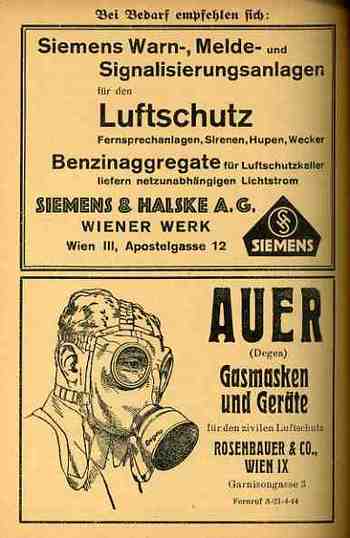
    The main body of the text is a series of warnings about what to do when the bombs come; the rest of it has to do with preparing yourself and your household from attack, which means that there’s allot of digging and canning and putting away water and fire retardant.  In general the population was getting very stirred up about the sure-to-arrive but survivable Apocalypse.  
    .
    1ebay_oct_4nazi_mask750_3

    1ebay_oct_4nazi_prop746_2
     

  • “Flying Saucers” (1952)

    JF Ptak Science Books  Quick Post

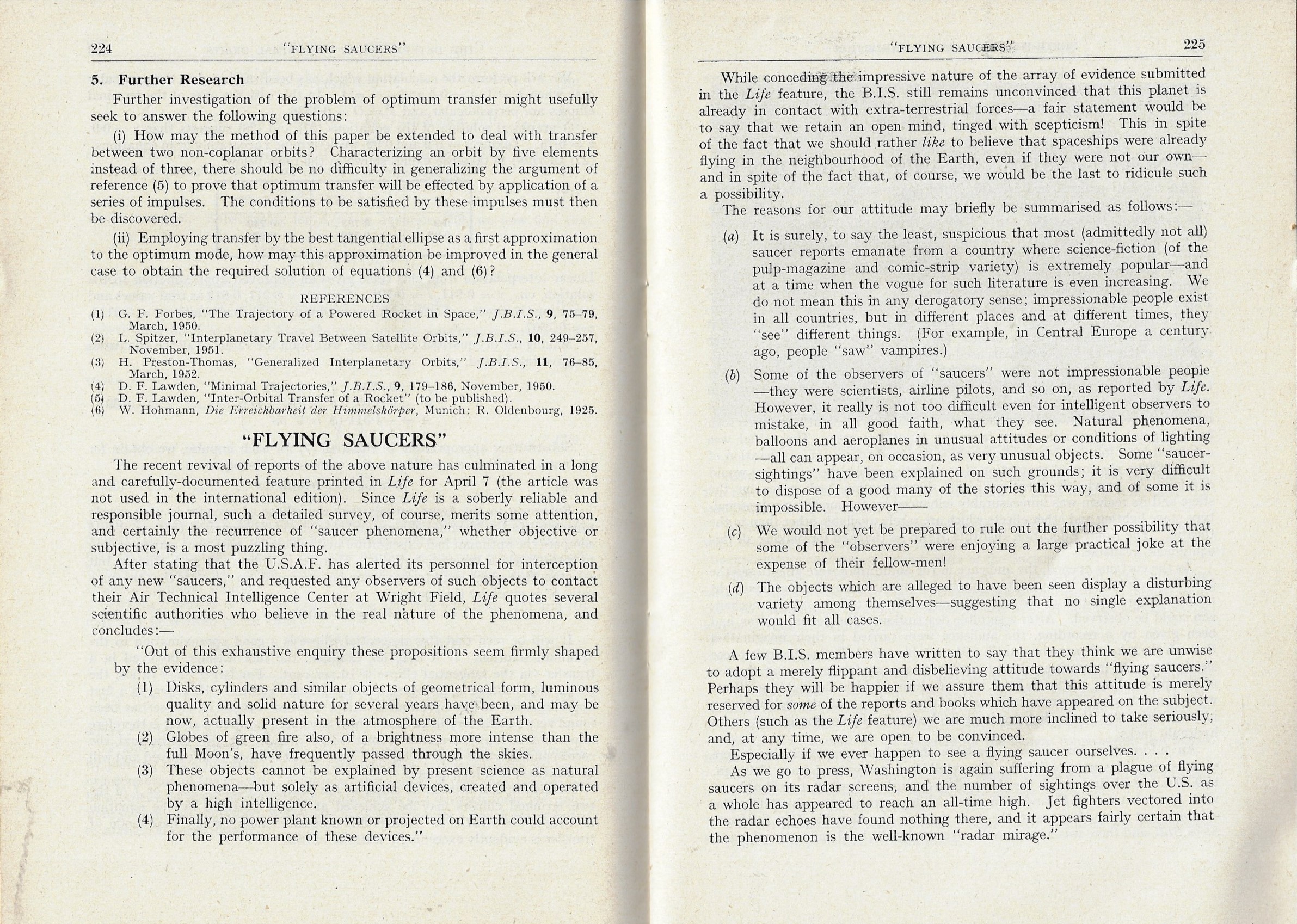
    I want to spend only a few minutes on this subject as I have just now come upon a nicely-written and logical response to the “flying saucer” issue in the pages of the Journal of the British Interplanetary Society1 for 1952.  Rather than discuss it I’m just going to reproduce the two pages of the piece below.  I did bend to curiosity a bit here and checked out “flying saucer” and “U.F.O.” in the Oxford English Dictionary, just to get a sense of how quickly they came into being following the hysteria of 1946.  Turns out that the BIS is no stranger to the term, the OED listing it second in usage back in 1948, back when the word still had its new-car-smell, though as you can see it hardly registered so with the members of the Society.

    “Flying saucer” n.: the fanciful name given to various unidentified disc- or saucer-shaped objects reported as appearing in the sky.

    • 1947   Times 8 July 4/4   During the past fortnight reports that dish-like objects, nicknamed ‘flying saucers’, have been seen travelling through the air at great speed..have come from the United States and Canada.
    • 1948   Jrnl. Brit. Interplanetary Soc. 7 199   I haven’t examined the details carefully, but the ‘flying saucers’ bear all the hall-marks of mass-suggestion.
    • 1953   D. Leslie & G. Adamski Flying Saucers have Landed i. i. 13   Ever since the cliché ‘flying saucer’ was coined, the greatest and most exciting mystery of our age has been automatically reduced to the level of a music hall joke.

    “U.F.O.”, n.: An unidentified flying object; a ‘flying saucer’.

    • 1953   D. E. Keyhoe in Air Line Pilot Oct. 9/3   The UFO was estimated to be between 12,000 and 20,000 feet above the jets.
    • 1956   E. J. Ruppelt Rep. Unidentified Flying Objects 13   UFO is the official term that I created to replace the words ‘flying saucers’.

    [Click for a cleaner and larger image]

    Flying saucers BIS 1952

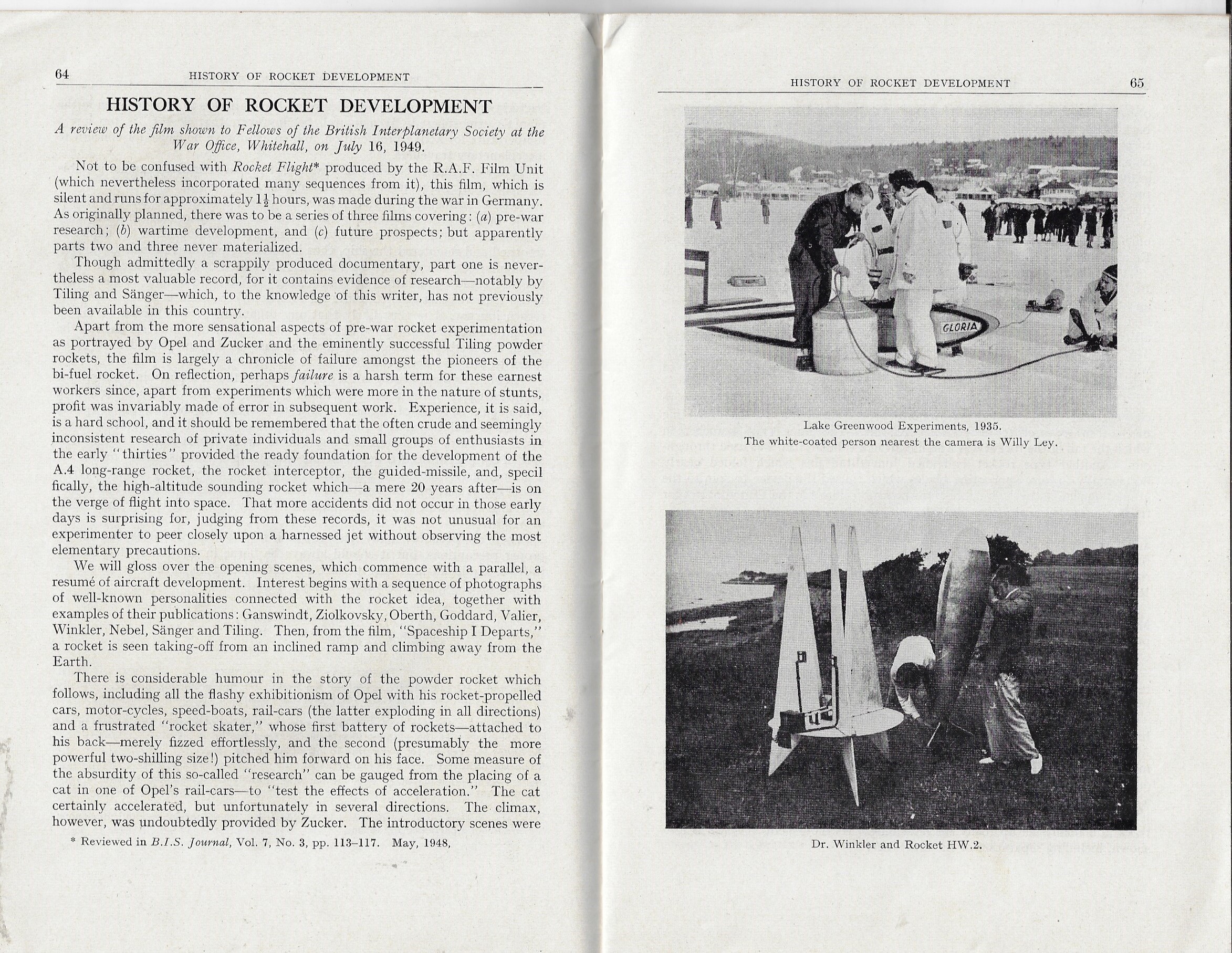
  • A Review of a WWII German History of Rocket Development Film (1950)

    JF Ptak Science Books  Quick Post

    The gem in the title to this short post bubbled into view while looking through an issue of the Journal of the British Interplanetary Society (March 1950) for a biography of Wernher von Braun. The two-page biographical notice was perfunctory and the war years were sanitized (stating that after interrogation there “was no room for doubt” that von Braun’s real interests were only in interplanetary travel and high altitude research).  

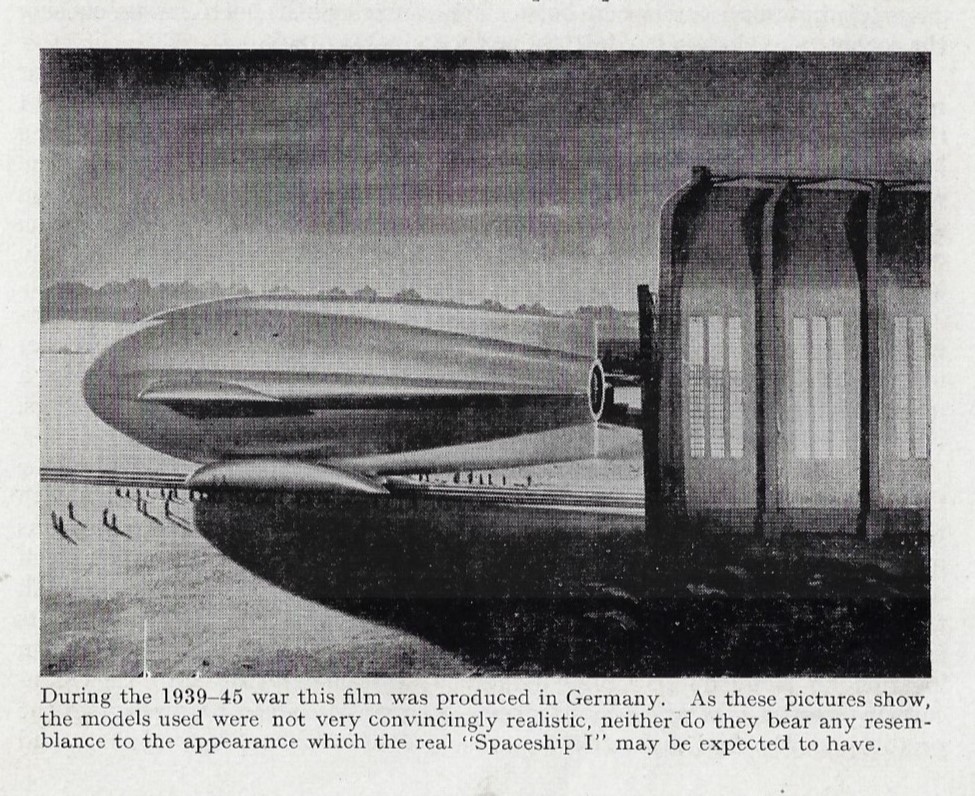
    Rocket development history of -2_ DETAIL

    The review of the German film on rocket development is another story–I’ve reproduced the eight-page tightly packed review below, as it is very useful and in the face of not having the viewable film it serves as a good outline.

    I found the references to “Spaceship I” (pictured above) to be very intriguing, though outside of two images of models for the proposed dirigible-like behemoth almost no other information is presented. 

    Rocket development history of -1_

    ·Posted by :

    ·in:

Recent Posts

Archives

Categories