A Daily History of Holes, Dots, Lines, Science, History, Math, Physics, Art, the Unintentional Absurd, Architecture, Maps, Data Visualization, Blank and Missing Things, and so on. |1.6 million words, 7500 images, 4.9 million hits| Press & appearances in The Times, Le Figaro, Mensa, The Economist, The Guardian, Discovery News, Slate, Le Monde, Sci American Blogs, Le Pont, and many other places… 5000+ total posts since 2008.
(I know, I’ve been on a bit of a fictional non-science bender–please bear with me.)
Amazing Name Masticating Namonamemaker
How do you change your bland,
old-fashioned everyday name into an EXCITING, NEW, FRESH and ENTIRELY
ORIGINAL title? Hmm? It is as simple as falling down. Just take
the first letter of your first name and the first AND last letters of
your last names, find them in the columns below, and, PRESTO, your
new name appears. For example, we’ll use the name of a happy dog,
say, Blue Ptak, so, take the “B” in column 1 (“StumpY”) and
the “P” of column 2 (“Pityprance”) and the “K” of column
3 (“Stubbypencil”) and you get Blue’s new non-secret name,
Stumpy Pityprance Stubbypencil.
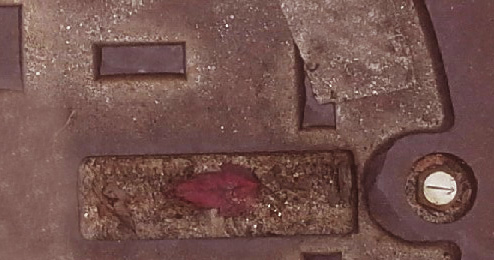
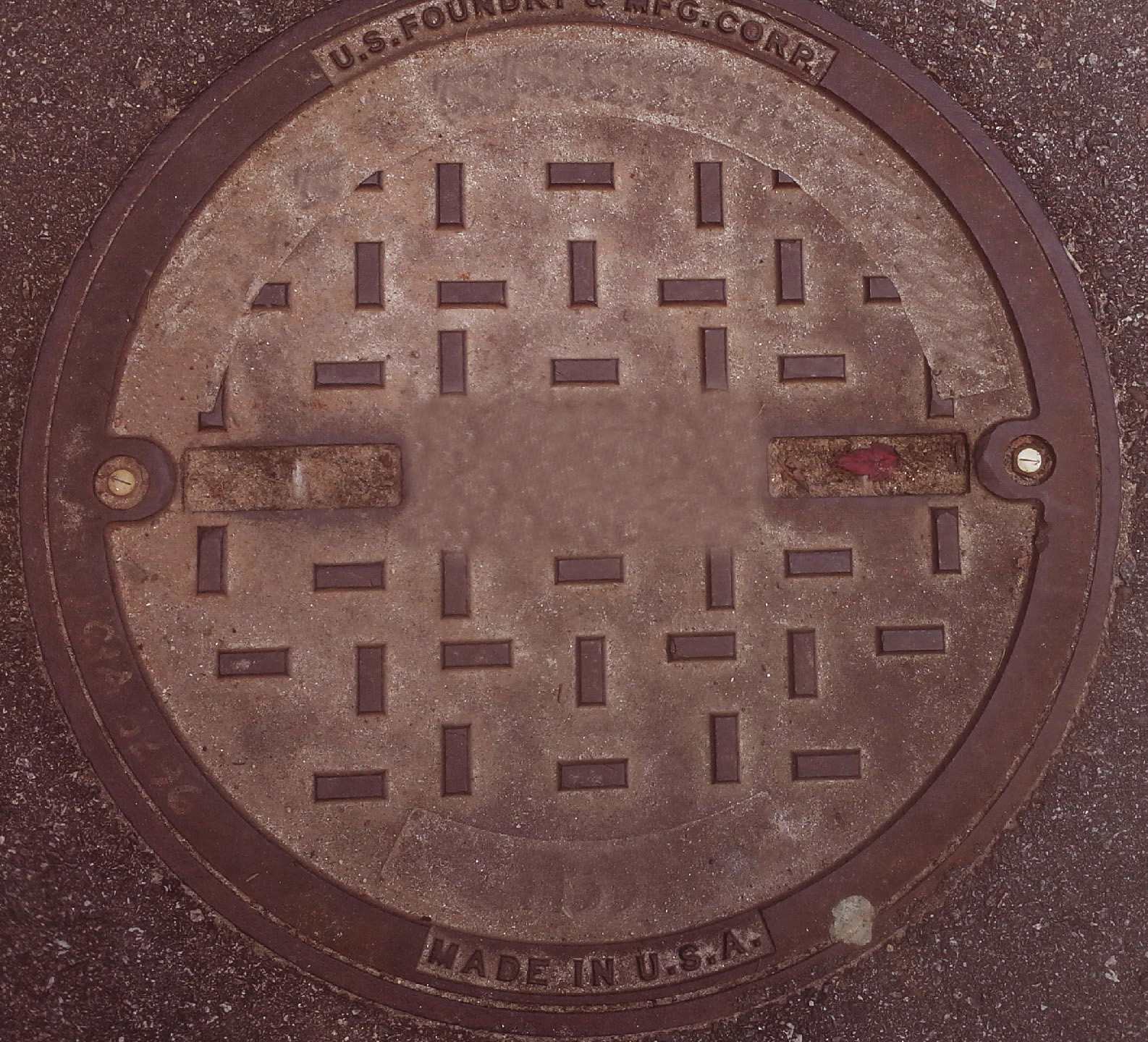
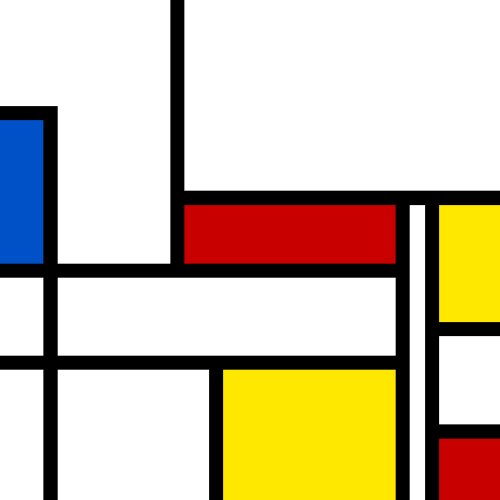
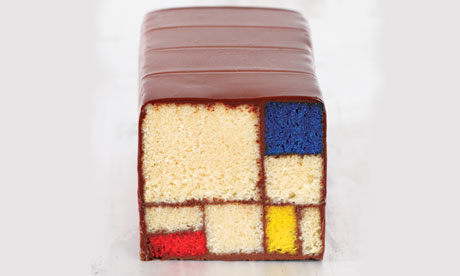
Walking through the Western North Carolina Mountain Fair last week-end I found a little bit of Piet Mondrian (1872-1944) embedded in the sidewalk. (Mondrian helped establish De Stijl (1917 or thereabouts), with a philosophy of using lines to
transform artistic thought onto canvas, and the lines were all
horizontal or vertical, with square and rectangular shapes. These would
represent the pure harmonies of expression, along with the primary
colors as well as black and white. His images are iconic.)
Here’s the cleaned-up version of what I saw underneath the text:
And the original:
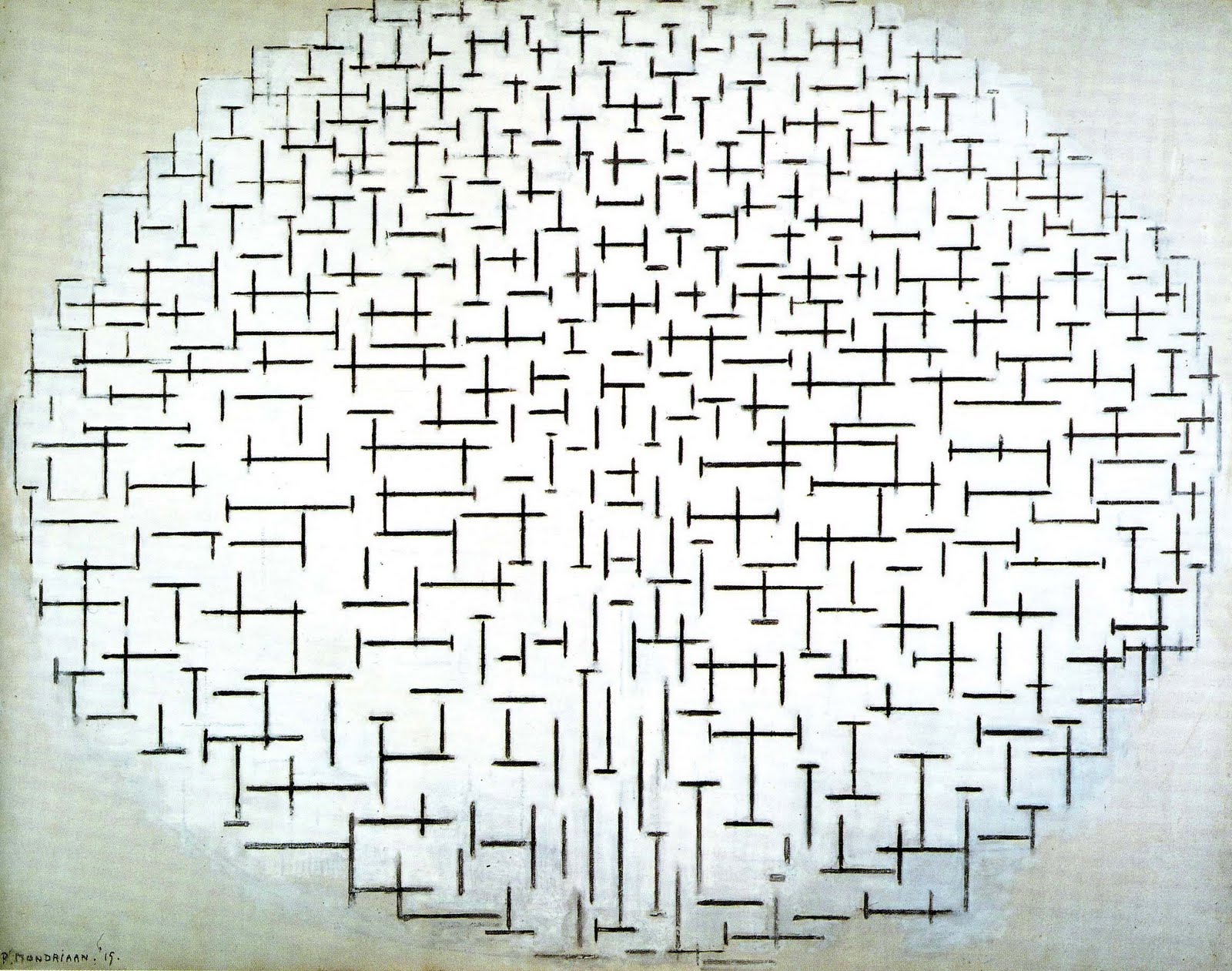
And Mondrian’s trees:
And this:
Had he seen this sewer access, I think that Mondrian would have been pleased.)
Once you start looking for Mr. Mondrian, he seems to be everywhere:
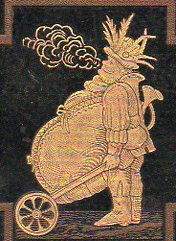
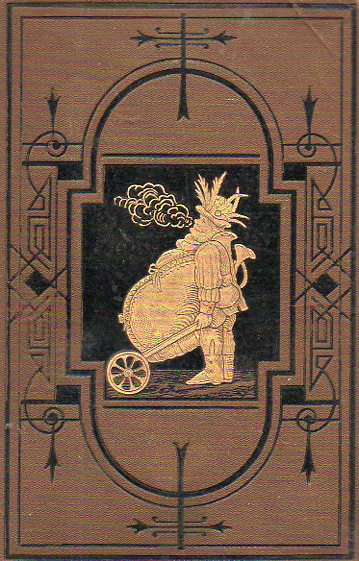
There is no good reason to include these images in this blog on the history of science and general ideas–except that they are rather extraordinary, and highly unusual, even in the genres of caricature and grotesque.
The first is the book cover image for Thomas Wright’s A History of Caricature and Grotesque in Literature and Art (published in London by Chatto and Windus in 1873) and is a peculiar rendition of largesse and self-greed.
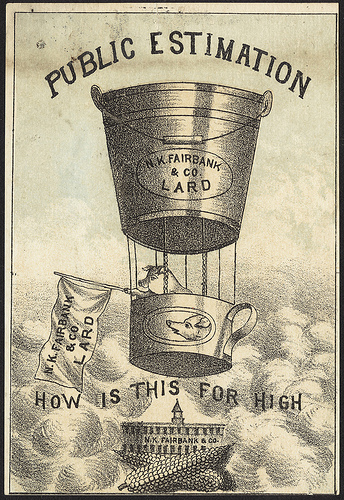
Another never-seen-it-before image popped up today–this one an illustration for a swaddling-meat peddler’s trade card, entitled “The three graces of N. K. Fairbank & Co.’s lard – purity,
weight, sweetness”, printed in the late 19th century. The image cannot be contained by the card’s size (12x8cm):
The floating lard aside, the image is disturbing and heart breaking. The pig has every indication of kindness and quiet enjoyment, flying a small flag in his gondola of floating fat, being taken away to points probably-known. The image was found via Bibliodyssey, and the image used is from the collection at the Boston Public Library Print Department. (Interesting to note that the entry at Boston lists the following: “Subject: Swine; Corn; Oil & fats; Animals in human situations”).
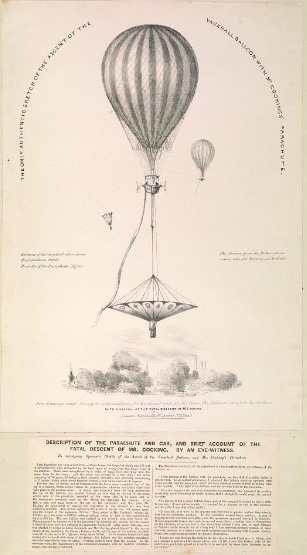
The The Great Nassau ballooned ascended from Vauxhall Gardens on 24 July 1837 under the control of aeronaut Charles Green (1785-1870) along with a small crew. Also included was Robert Cocking, another aerial explorer who was in tow of the balloon with an experimental parachute of his own design and construction. He was taken aloft, and at 5000 feet was released into disaster–the parachute failed, and Mr. Cocking was dead.
This lovely broadside (found via Bibliodyssey) describing the even exists on the Smithsonian Institution website (here).
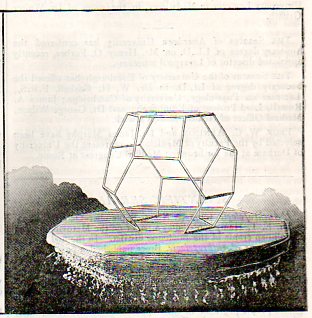
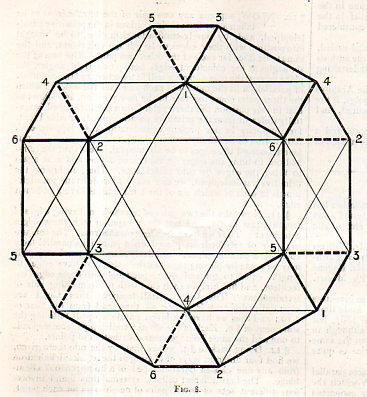
The question above is probably seldom asked and probably even less than so required, but it sure does look good for the title of a post. The pillowed polyhedra came into light while I was breezing through some issues of the British Nature magazine for 1893/4–the title of the work of course was a lovely thought and the author of the paper was the mega-gifted and highly significant Lord Kelvin (William Thomson), but the bait that made me swallow the hook on the paper was the illustration.
There are many (i.e., 1,496,225,352) different forms of the convex 14-faced polyhedron tetrakaidekahedron (see Wolfram Math
for a quick summary)–this is the first I can remember being displayed
on a 19th century pillow. Kelvin was particularly interested in
displaying geometrical figures in three dimensional space, and would
return to the issue numerous times, particularly in the Baltimore Lectures on Molecular Dynamics and the Wave Theory of Light (see page 606ff).
Notes:
Lord Kelvin, (William Thomson, 1824-1907), “On the Homogeneous Division of Space”, in Nature, two issues, as follows: (1) 8 March 1894, pp 445-448; and (2) 15 March 1894, pp 469-471. A version of this paper appears slightly earlier (17 January) in the Proceedings of the Royal Society.
Both papers are available for purchase via our blog bookstore, here.
These are remarkably interesting papers–especially considering their brevity.
It is interesting to note the list of what Thomson “is known for” in his Wiki entry:
This bibliography for George Boole just came in very handy, so I decided to distribute it. It appears in Treatise on Differential Equations, printed in 1865 and edited by Isaac Todhunter, the full text of which is found here. A very good entry on Boole is found in the Encyclopedia Britannica 11th, here.
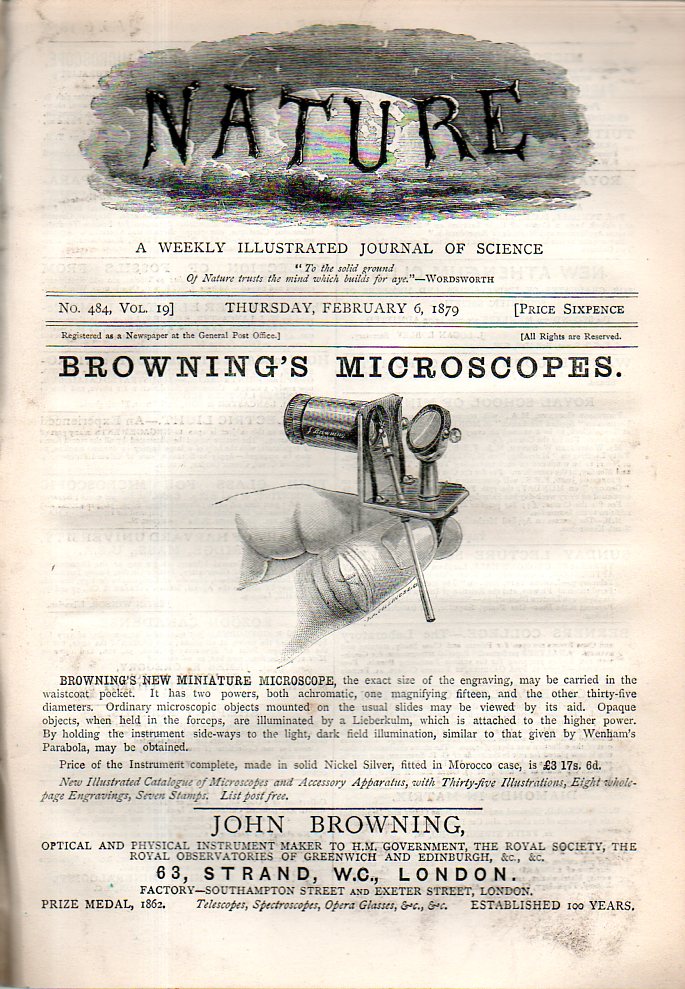
For some reason this short article–found in Nature for 6 February 1879–was titled “A Real Telegraph”. “Real” telegraphs were in existence for quite some time, more than 30 years at this point. What the author meant in this case was that rather than have a key operator tap out the message in Morse Code, the sender would be writing out the message in long hand, and the receiver would gather up the message so that it appeared in recognizable letters and words rather than dots and dashes. The inventor’s name was E.A. Cowper, and he brought to the telegraphic art something as “startlingly” as the “marvels” of the telephone, which had been invented just three years earlier. [This paper is offered for sale at our blog bookstore, here.]
The author describes the appearance of the script on the receiving end seeming as though to have been guide by a “spirit hand”, such as the highly unexpected result even to the trained scientific reporter.
A somewhat longer article appeared in the New York Times a few weeks later, the full text of which is here.
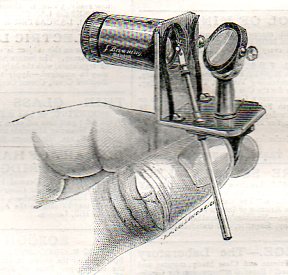
This is just so splendid, I had to stop and admire it, publicly. The design of the front page of Nature is a lovely thing in itself, and the placement, and spacing, it all works so well together. But the big treat of course is the “Browning New Miniature Microscope”, which we are told is in 1:1 scale. It “may also be carried in the waistcoat pocket” if only I could remember where my waistcoat was. The instrument was good for 15x and 35x, and came prepared with tiny foreceps to hold natural objects, but it was also of course built to accept miniature slides. Just for the record, 19th century microscope slides are generally things of high beauty–miniature microscope slides from that time are quite simply the bee’s knees.
The Browning scope came complete, with fitted case, for three pounds. Nowadays the same instrument in lovely condition might bring $3000–and worth it.
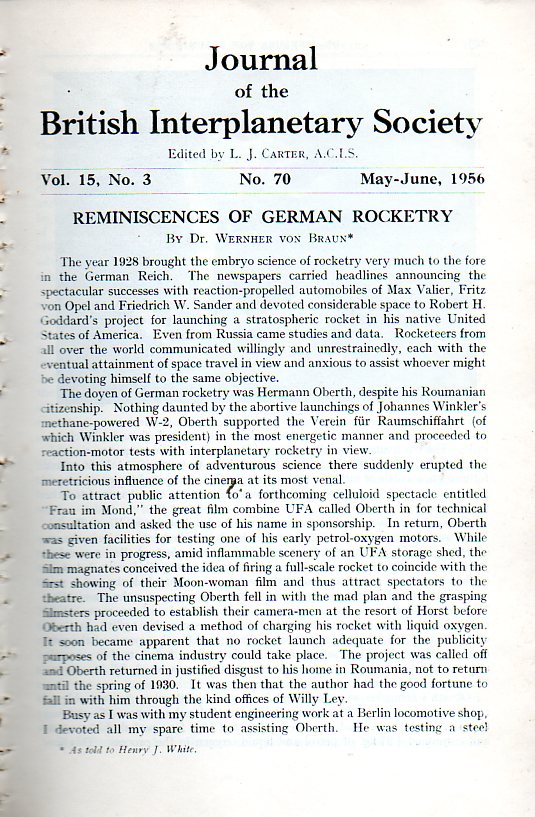
That is the non-question1 that can be easily answered by anyone in the U.K.(and Belgium, and France, and the Netherlands) from 1940-1945. That question was asked by Wernher von Braun of himself, semi-third person, wondering aloud to his interviewer about what he saw was the unintentional use of his A-4 rocket–renamed the V-2, or Vergeltungswaffe 2, Retaliation weapon 2, or Vengeance Weapon 2–in the rocket attack upon Britain (and to a lesser extent Belgium and then to a lesser extent as well on France and the Netherlands). He writes that the A-4 was intended for interplanetary flight–and at some distant point that was true, but not so much in the early 1940’s, when the intention regarding the use of the rocket mattered most. Perhaps von Braun was hanging on to a distant memory, back to the early days when he dreamed along with Hermann Oberth and others about leaving the Earth.
“The A-4’s subsequent career is no mystery” says von Braun, without irony and in high reportage.
Indeed not. The V-2 was huge compared to its older and slower brother, the V-1–it was 45′ tall and weighed 28,000 pounds, delivering a 2,000lb Amatol warhead. The odiously-sound-of-death V-1 came in slowly, slow enough to be outrun by a Spitfire–the V-2 came in with a different awful sound, the crack and boom of the sound barrier as it braced for a Mach 2+ impact (which would cause the detonation of the weapon). 6,000 of these weapons were made (beginning in September 1943) and more than 5,000 were launched.
These weapons killed some 9,000 Earthlings, so the weapons didn’t really get very close to another planet. Nor, really, was it ever intended to during the war. Von Braun et al used it very effectively as a bargaining too with Hitler to gain more money for the program–not for interplanetary exploration, but to kill as many people as possible. I don’t know what von Braun was complaining about here in this brief semi-memoir about his A-4 becoming the V-2–it certainly could have come as a surprise.
And that 9,000 killed figure is misleading–it is actually more like 21,000. That figure would include the 12,000 human slaves from the Mittelbau-Dora concentration camp who were killed or worked to death while building the rockets. So in a weird and horrible twist of sick ironies, the weapon actually consumed more lives than it caused in its use for death. How von Braun didn’t know about the thousands of slave laborers at work on his non-Moon rocket is simply impossible to comprehend.
Von Braun was single-minded and determined–lives consumed and lost, plus an enormous amount of money (his project costing more than the Manhattan Project) and energy. The return on this particular investment was exceptionally poor in the long run–close to the point of the whole affair being created by the Allies to crush the Nazi economy.
Notes:
1. The question is part of a sub-head in the von Braun interview that appeared in the Journal of the British Interplanetary Society, volume 15, no. 3, May-June 1956, pp 125-145, “Reminiscences of German Rocketry”.
The original is available for sale via our blog bookstore, here.
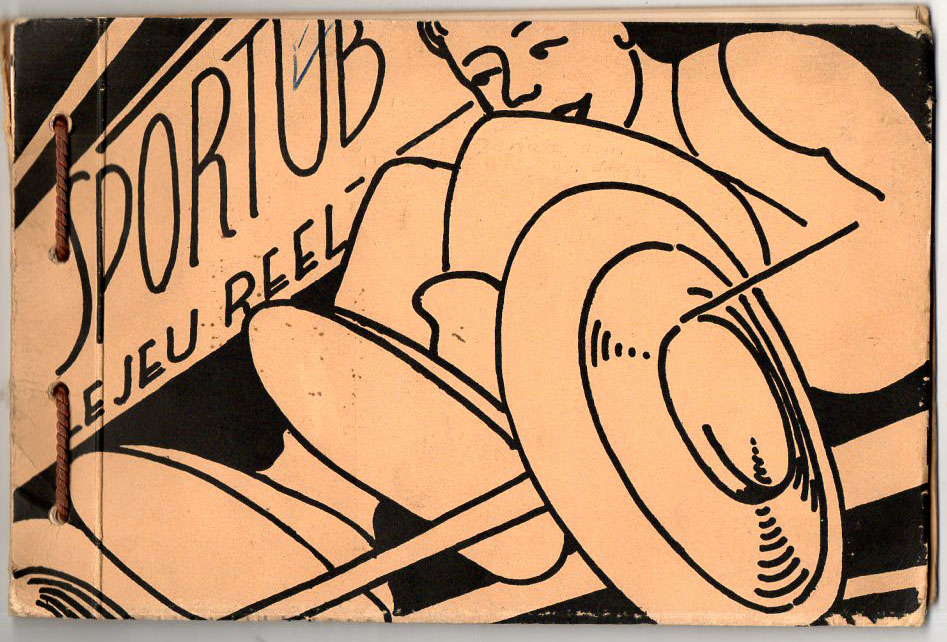
My eyes didn’t quite focus on this cover when I first saw it–I was in the process of reviewing several hundred pamphlets, and for some reason I saw mostly color and not so much form. When I focused, I hoped that it would be exactly what it was–a do-it-yourself (mostly) catalog of designs for wheeled recreational toys for kids. Sportub, le Jeu Reel, was composed by William Derlaz and printed in 1937 in Geneva, and held the key to the design for a host of soap-box-derby things many of which were assured to cause minor fun injury. It is complicated and simple at the same time, with enough information to shopw you how to build these things, with everything on one small page.
In its way this little pamphlet with its two dozen designs is nothing short of a little bit of sublime.
(As it turns out, this pamphlet is pretty rare–no copies show up in the massive WorldCat/First Search cataloging tool; and there are also no hits in Google. If you wanted this, you may certainly have it, findable for sale in our bookstore section.)