A Daily History of Holes, Dots, Lines, Science, History, Math, Physics, Art, the Unintentional Absurd, Architecture, Maps, Data Visualization, Blank and Missing Things, and so on. |1.6 million words, 7500 images, 4.9 million hits| Press & appearances in The Times, Le Figaro, Mensa, The Economist, The Guardian, Discovery News, Slate, Le Monde, Sci American Blogs, Le Pont, and many other places… 5000+ total posts since 2008.

  • Experimental Visual License

    JF Ptak Science Books   Quick Post

    Gernsback[Hugo Gernsback with his TV glasses, 1963]

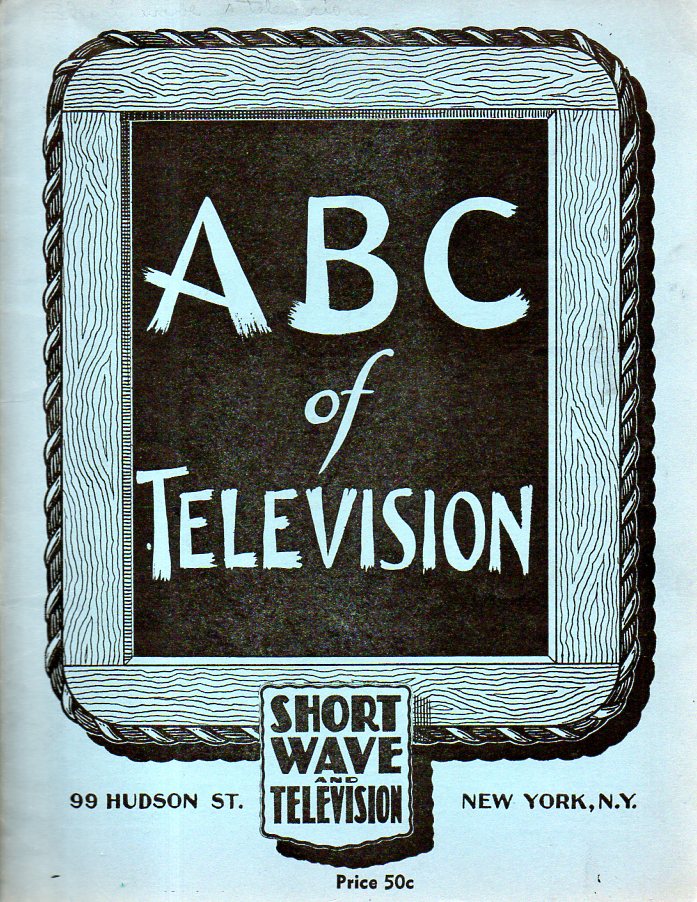
    The “Experimental Visual License” is a very nice turn-of-phrase, and it occurs in a technical and less poetic sense in this nteresting and nicely designed pamphlet from the earliest days of popular commentary on the new medium of television.  The ABC of Television was published in 1937 by the exceptional and extremely busy Hugo Gernsback (1884-1967, basically the inventor of the SciFi magazine) in his Short Wave & Television journal.

    Television abc477

    The pamphlet includes technical basics (“fundamentals of scanning”, “mechanical systems”, “Cathode ray emission”, transmitter operation”) as well as some popular and necessary information, like “when will we have television” and a list of television stations.  

    Just for the record, this publication lists 25 active stations, including low wattage stations like W2XAX, the Atlantic Broadcasting Company, in NYC at 50 Watts–there were 9 broadcasters with 150 Watts or less of the 25 listed. There’s also a list of nine other “discontinued” television stations (“experimental visual licenses and permits discontinued or expired”), which is where that phrase crackles into life.  

  • Electronic Beds, Odors, and Other Futuristic Grotesques, 1945

    JF Ptak Science Books   (Expanding an ealier post #610 from 2010)

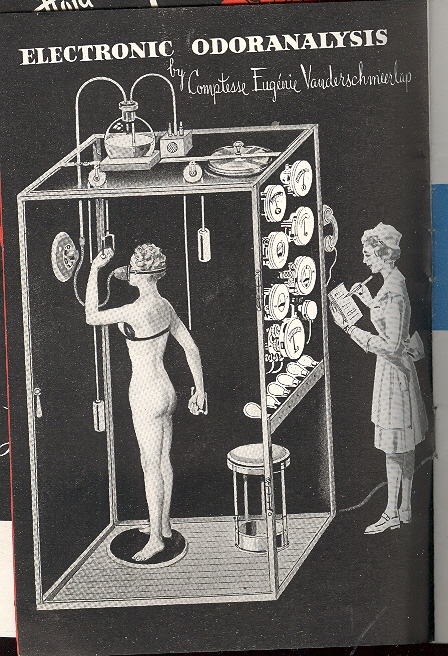
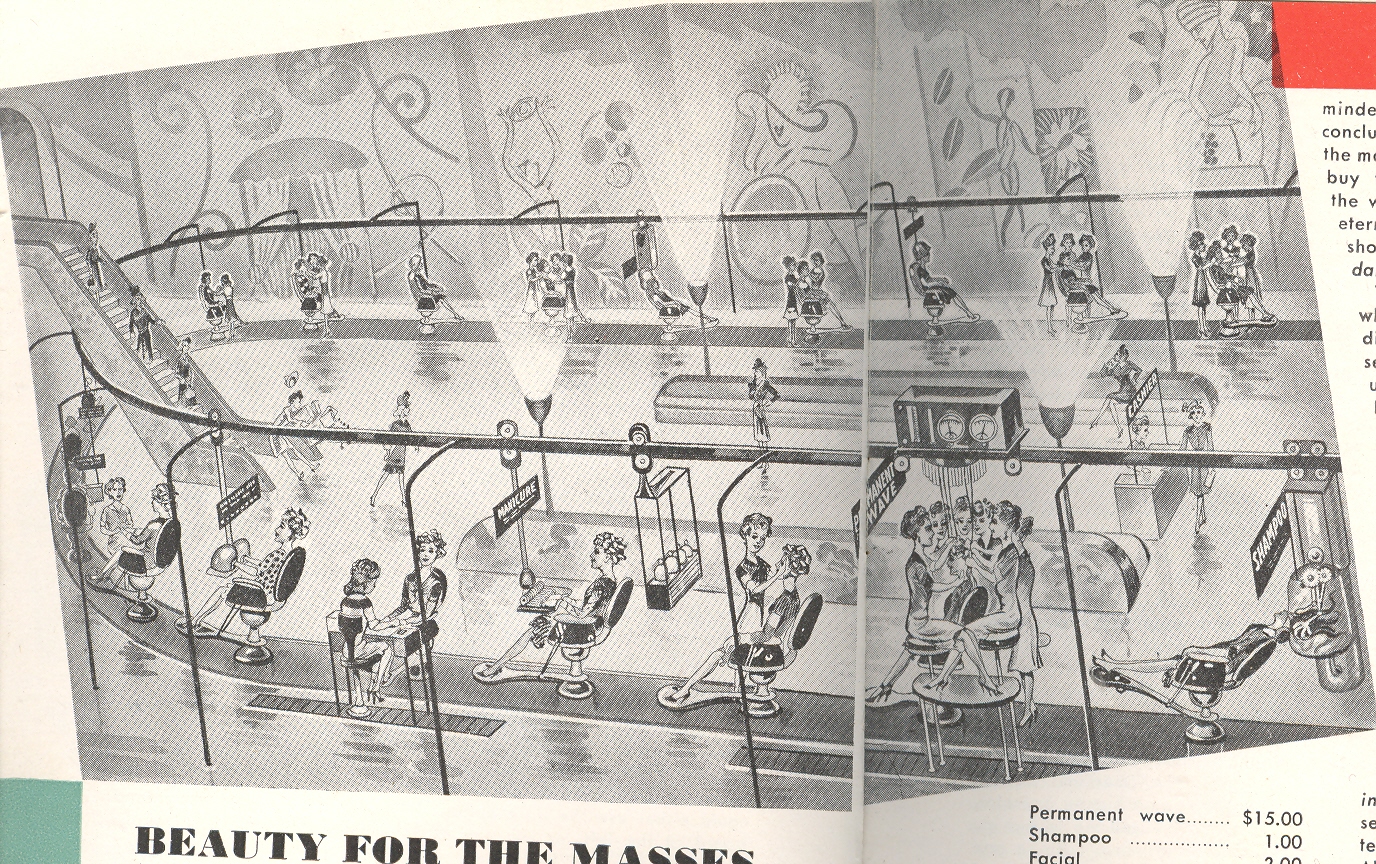
    I am very attracted to the innocence and softly bizarre category of my store’s Naïve Surreal Collection, like this little pamphlet that came out New York in 1945.   The titles in this category are odd but still understandable, and the “what the ____!” response to the subtle ones isn’t quite so high and the exclamation points not so many as in the cases of the Naive Surreal titles. 

    Blog--may 11--odd 005

    Bizarre is just that, certainly not hiding behind any lesser or ambiguous title–it seems to be a parody of  small magazines and their advertising sponsors,  and copyrighted by the very far-reaching Hugo Gernsback, who in 1926 started the first magazine dedicated to the genre of science fiction (Amazing Stories) and for whom the World Science Fiction Society’s annual award for Science Fiction Achievement is named (the “Hugo”).  Gernsback evidently had a taste for cheeky parody, producing similar magazines to this called Quip, Forecast, Jolliers, Tame and Newspeep.

    I guess that this was deeply weird for mass-production publication, and it was probably funny–now it is just weird, odd, and somewhat discomforting–a successful and intentional reach for being part of the Naive Surreal right from the start.


    Blog--may 11--odd 008

  • The Mother of all Furnaces

    JF Ptak Science Books   Quick Post

    Siemens furnace066

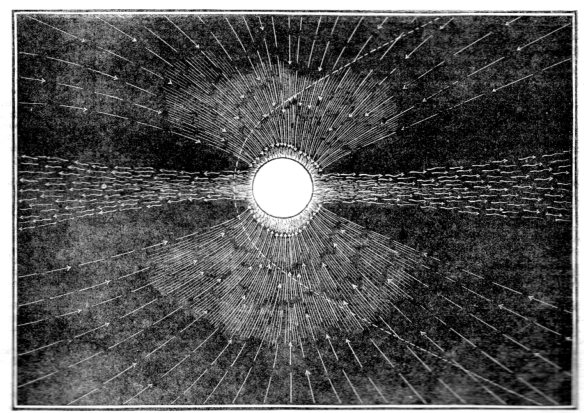
    Sir William Siemens (1823-1883) was an important inventor who had an even larger genius for the application of his ideas, mostly in the fields of heat and electricity and power.  He occasionally strayed into the pure sciences, the work of which was sometimes fruitful and sometimes not. The illustration below is from an idea of the second variety, something where he applied his work in the regenerative furnace to the conservation of solar energy.  It was an adventurous and unworkable, although the illustration he used to illustrate a paper on the subject (in Nature, 9 March 1882) was drop-dead beautiful.  

    ·Posted by :

    ·in:

    —
  • The Future as the Color Red

    JF Ptak Science Books   Post 2172

    Rca300

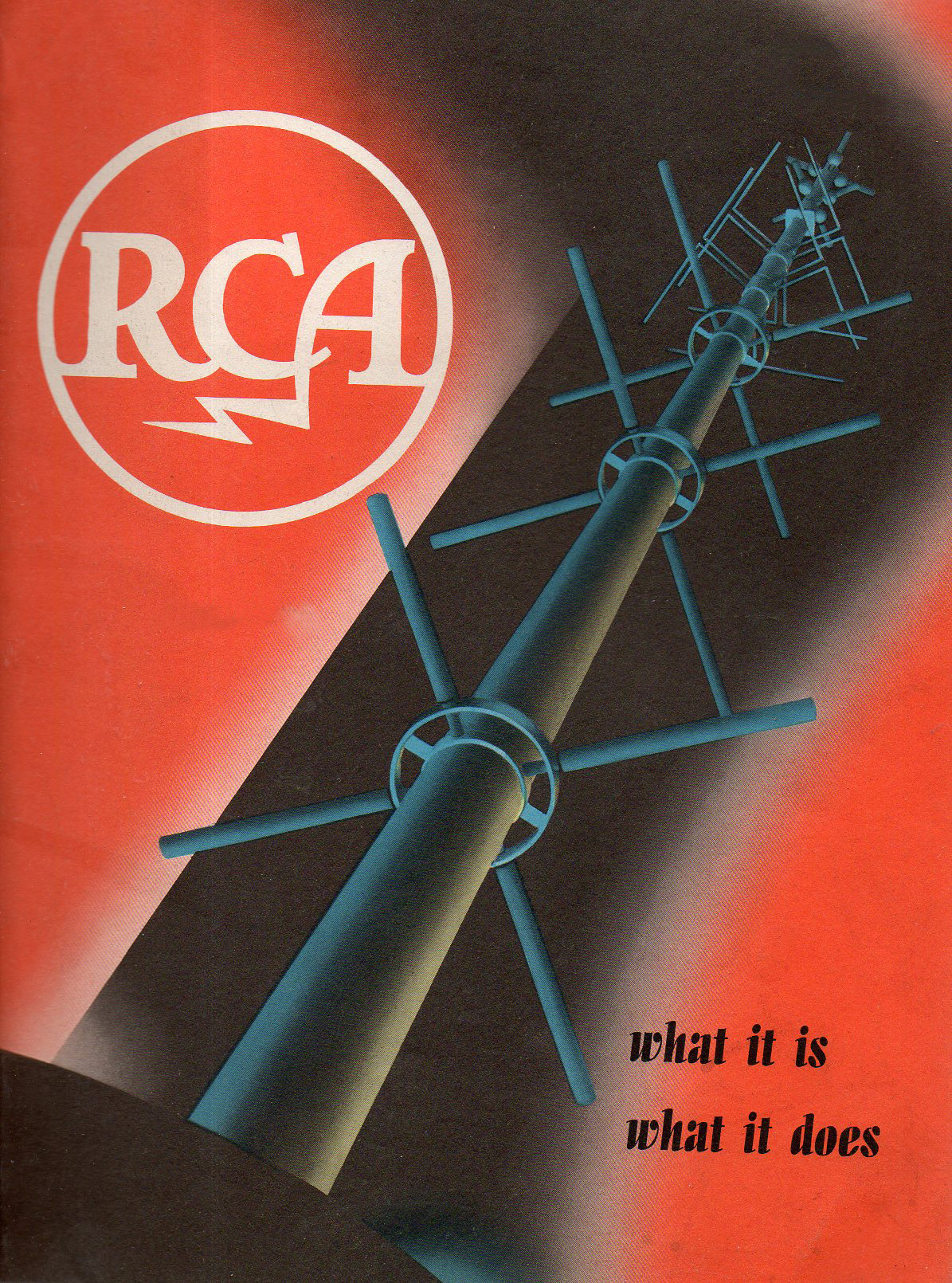
    In 1947 the future looks a little red, and sparky, and filled with television.  

    This image is that of the television antenna of station WNBT and for many years it sat on top of the Empire State Building.  WNBT was the flagship station of NBC, which was owned by RCA (Radio Corporation of America, 1919-1986) which (according to its name) was really the first national broadcasting radio network in the United States, and which (as experimental station W2XBS) became the first to broadcast a television picture (of a papier mache Felix the Cat) in 1928.  This fantastic cover art for a 1947 promotional for the company pictured the famous antenna,  the great visual of the company’s external hardware, right there on top of the world’s tallest building. 

    This was really a picture of the future, and in 1947 the future of mass communications and entertainment (and in making money in the two) was seen in television, much more so than the formerly gargantuan radio.

    And why red?  Was it latent images for a few decades of seeing Lenin marching forward with a poiny figure and folllowed by legions againsst a background of deep red?  Or is it the hundreds of years of red being associated with power–it did cost a fair amount, centuries ago, given the difficulty of its manufacture.  

    And in the history of red the business of its business was obtuse and secret.  The Spanish began exporting the source of red–the cochineal bug, which was a tiny cactus-borne bug–from Mexico.  They sent barrels of these bugs back home, where they were pounded and prepared for the Spanish worthies’ textiles.  The source of the color was held as secretly as possible, making the bug as odd a guarded source as the secretive history of medical forceps so long shrouded in mystery by their progenitors, the Chamberlain family.  So red was expensive, limiting its use to the ruling/economic powers.  It would also start showing up in art in the depiction of robes for royalty, or for robes for Mary and Jesus, and occasionally in Renaissance skies.  Alternatively, it is also associated with Hell and Satan, I assume that is the case since red was not-often used (given the cost) and so it was a rare-ish color that would strike the viewer as being exceptional. 

     Blog jan 17 francke

    That said, I’m not sure why RCA chose red for their sky in 1947, though the company did have its famous “red Seal” label beginning in 1902 and used the color freely in its logo. Aside from that, why there is a red sky is a bit of a mystery.  

  • Public Service and the War Production Board, 1942

    JF Ptak Science Books  Post 2173

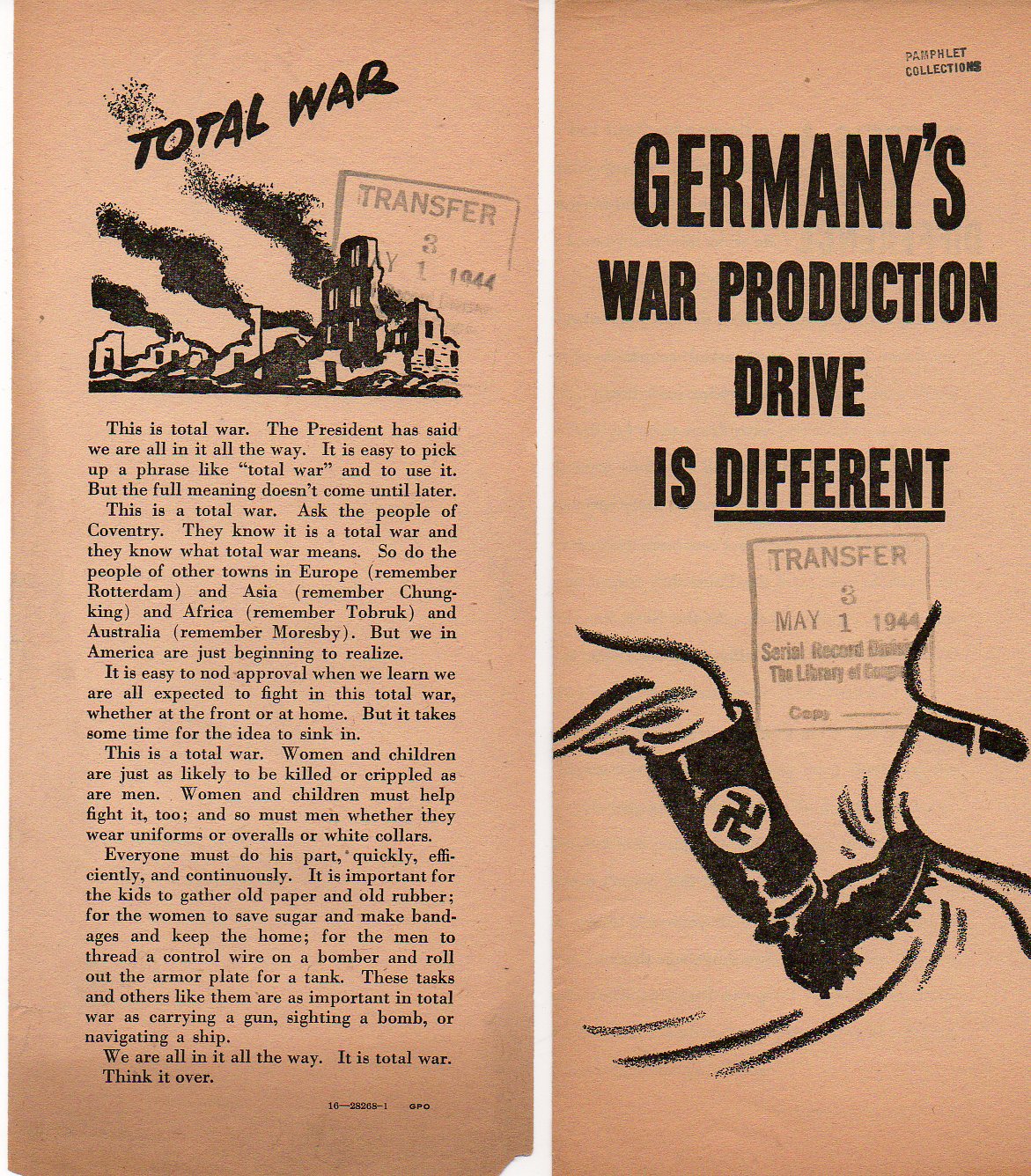
    The War Production Board (WPB)–the entity responsible for printing the leaflets below–was instituted 16 January 1942 as a federal effort to direct U.S. wartime production and allocation of essential commodities.  And time. The WPB centralized the effort to convert some peacetime industry to wartime production, as well as direct the production of existing wartime industries in the manufacture of critical goods, and rationed or prohibited the manufacture of other material that could possibly hinder the war effort.  Thus the WPB rationed things like sugar, heating oil, plastic, gasoline, paper, rubber, nylon and metals of all descriptions; it also controlled large swaths of the workforce, restricting wages and benefits as well as prices.   It was an essential element of fighting the war, and brought necessary control to an economy and industrial base that needed organization for what would become a total war.        

    War Production Board265
    Instituting a war-production base for American industry allowed production to ratchet way up, producing (for example) multiples more aircraft more in 1943 than in 1941:   1940, 6k aircraft; 1941, 19k; 1942, 47k; 1943 85k; 1944, 56k; 1945, 46k.  Also there were enormous production advancements for total shipping tonnage (reaching a wartime production total of 33 million tons), across-the-board huge increases in coal and iron ore (and especially in crude oil), and on and on.  The U.S. was able to mobilize itself and take advantage of its enormous natural resources, industrial base and civilian workforce in what was essentially an unreachable island economy, forming what was actually an unbeatable combination of war goods production. (Plus of course there was the atomic bomb, which is another story, but which also only could have been produced in the U.S., given the enormous quantities of energy and material needed to begin its production.)     

    ·Posted by :

    ·in:

    —
  • An Early Scientific Screed-Rant on the Disparaging of the Sciences (1873)

    JF Ptak Science Books  Post 2175

    I always thought that the word “scientist” came to us from William Whewell in his Philosophy of the Inductive Sciences (volume 1, page 113) in 1840, the group of people dedicated intrepid seekers of standards and anomalies finally receiving a short and concise (if three-syllable) name for what it is they are (for even in death a scientist is still a scientist, no past tense there, like a Marine): once one, always one.  

    “We need very much a name to describe a cultivator of science in general. I should incline to call him a Scientist.”

    But I notice that an anonymous note in the Quarterly Review peeks its head under the tent, using the word six years earlier in 1834, though not favorably:

    “Science..loses all traces of unity. A curious illustration of this result may be observed in the want of any name by which we can designate the students of the knowledge of the material world collectively. We are informed that this difficulty was felt very oppressively by the members of the British Association for the Advancement of Science, at their meetings..in the last three summers… Philosophers was felt to be too wide and too lofty a term,..; savans was rather assuming,..; some ingenious gentleman proposed that, by analogy with artist, they might form scientist, and added that there could be no scruple in making free with this termination when we have such words as sciolist, economist, and atheist—but this was not generally palatable.”–Quarterly Review, volume 51, page 59, via the Oxford English Dictionary 

    Later in the year a prettier offer emerges, though it has more to do with beauty than truth:  
     
    “Leonardo was mentally a seeker after truth—a scientist; Coreggio was an assertor of truth—an artist.”–1840   Blackwood’s Magazine, volume 49, page 273.
     
    What brought me to the word “scientist” was an article/notice in Nature in 1873, where scientists are terribly put out by what the writer felt was a disparaging of the sciences–in short, a pissed-off mini-screed on the societal attack of ennui against the very idea of Science.  The thing is in the two paragraphs the word scientist doesn’t come into play.  So far as I can tell, this is the earliest scientific screed in this high-ish Victorian journal of proper and popular science,  Nature began in 1869, and even though it was eight volumes and four years into publication, I’m surprised that it took this long for a note like this to appear. It isn’t exactly a white-knuckled jumbleup venom-bomb from Dr. Hunter S. Thompson, but the anonymous writer does get the message across:   

    ·Posted by :

    ·in:

  • Math Dreams and Mathmares

    JF Ptak Science Books  Post 692  (from 2009) Expanded

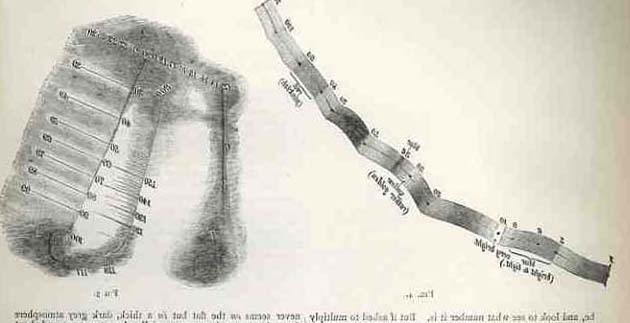
    This post was written five yers ago when I was excited to find an illustration of a dreamer and numbers with some mathematical content.  I thought that it was pretty unusual to find as an illsutrastion, even though I had read many stories of people being influenced byt their dreams, evem in the sciences, but that there were few images of the process.  In Post 692 I psoted a found image of such a thing that was just a simple advertisement in a German magazine.  There was also a series of images from Francis Galton on imaging arithmetical processes from Nature back in 1880, which may also be the first scientific article on synesthesia.  And there doesn’t seem to be a lot more than this, even in canonical illustration.  

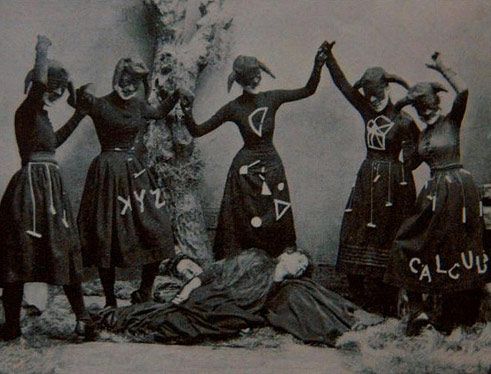
    So it came as a surprise today to find this photo to add to the small collection of math dreams and imagery of “doing” math (from ca. 1880):
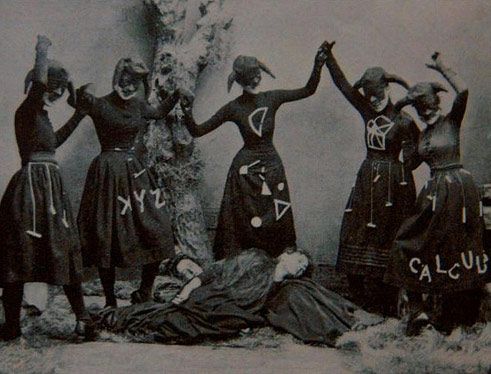
    Math nightmare

    Thinking big thoughts in dreams is generally not a common thing, as anyone who has read their own semi-conscious half-awake memory notes of a dream-based inspiration could attest.  But it does happen: 
    ==Blog July 21=math dream

    Paul  McCartney1 dreamed the song Yesterday, Gandhi dreamed the source of non-violent resistance, Elias Howe  dreamed of the construction of the first sewing machine, and Mary Shelley the creation of her novel Frankenstein…  For good or for ill, William Blake was evidently deeply influenced by his own dreams; on the other hand, Rene Magritte was deeply influenced by dreams but didn’t use any of his own for his paintings, or so it was said. Otto Loewi turned an old problem into not one in a dream, finding a solution to the prickish problem of whether nerve impulses were chemical or electrical (and resulting in the Nobel for medicine in 1935); the fabulous discovery of the benzene ring came to August Kekule in a dream as well.  Artists have been representing people in dreams and dreamscapes for many centuries: Durer depicted a dream in a 1525 watercolor, for example, and thousands of artists have depicted famous biblical dreams (Joseph of Pharo) for long expanses of time.

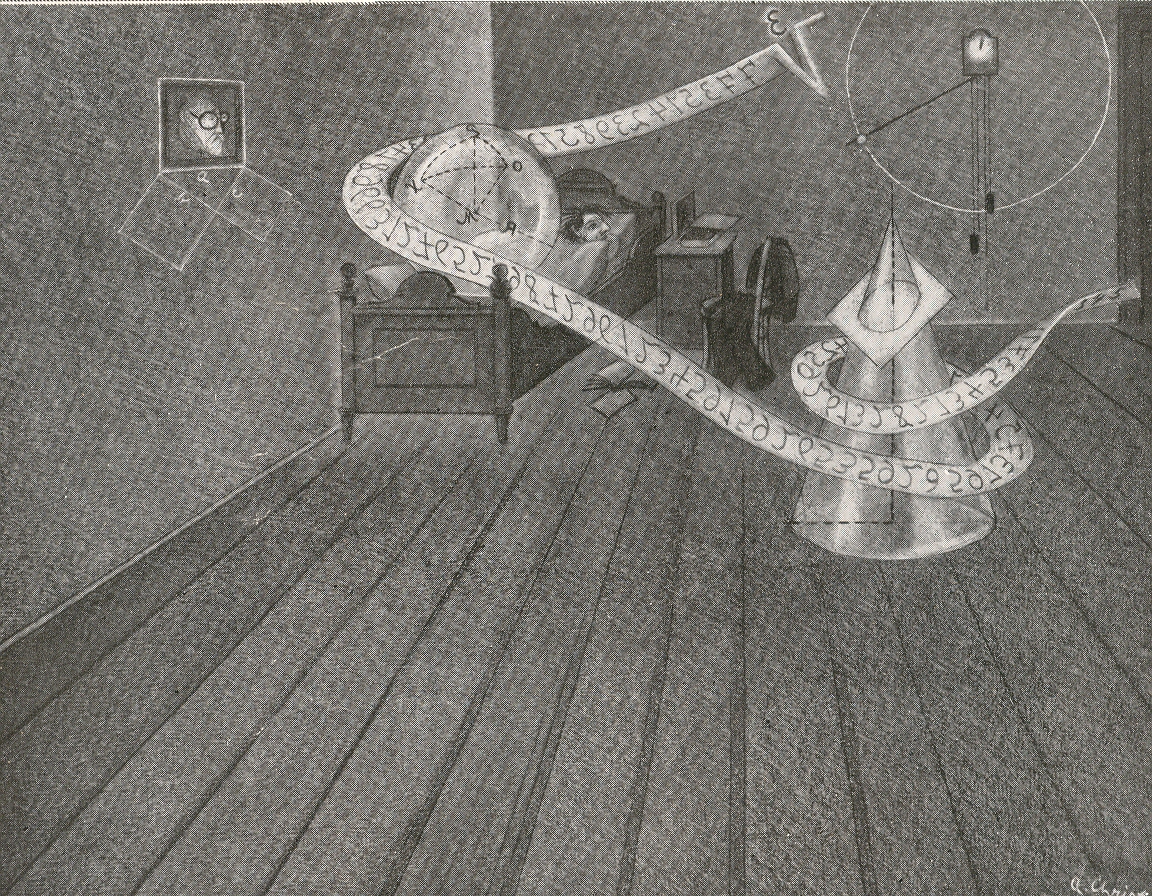
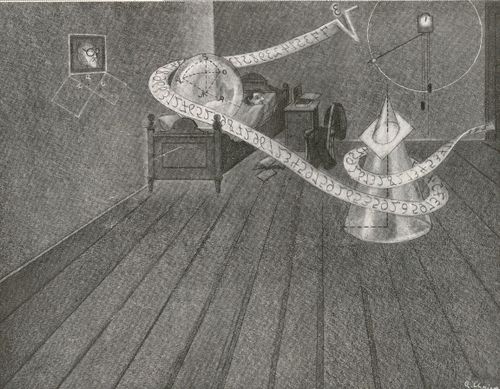
    What struck me, though, in this illustration found on the other side of the page of the Illustrirte Zeitung2 (for August 1932) that I used for yesterday’s post about damming Gibraltar and Shakespeare’s memories, was the depiction of someone dreaming mathematical thoughts…or at the very least, dreaming numbers.  People have undoubtedly dreamed much in mathematics, but I can not recall seeing illustrations of these dreams.

    I’m differentiating here from something like a Poincarean inspiration, or vision, or thunderstrike–I’m talking about drop-dead asleep sleep, dreaming sleep, REM and all that. Also I’m differentiating this from imaging mathematical thought, as in the work of Francis Galton in 1880 in which the subject of mentally seeing the process of mathematics is perhaps first addressed. I wrote a short piece on that here, way back in Post 9. )
    Photo

    The numerical sequence in this dream doesn’t look like anything to me:  the backwards radicand doesn’t strike anything common in my head.  The geometrical drawing under the portrait in the dreamer’s room though is the impossibly iconic Pythagorean theorem, and there is a nice picture of a conic section in the foreground; but the artist, who improbably signed the work “A. Christ”, doesn’t offer much of math in the dreamscape.  Still, it is a rare depiction of someone dreaming about math. 

    Notes
    1. “I woke up with a lovely tune in my head. I thought, ‘That’s great, I wonder what that is?’ There was an upright piano next to me, to the right of the bed by the window. I got out of bed, sat at the piano, found G, found F sharp minor 7th — and that leads you through then to B to E minor, and finally back to E. It all leads forward logically. I liked the melody a lot, but because I’d dreamed it, I couldn’t believe I’d written it. I thought, ‘No, I’ve never written anything like this before.’ But I had the tune, which was the most magic thing!” from Barry Miles (1997), Paul McCartney.
    2.  This is really a great sheet of paper, coming from issue 4492, pp 518-519.  Two pictures of dreams on one side, with three visionary images on the other (the Gibraltar dam, a sub-polar submarine, and a futuristic Indian railway/bridge.
    ·Posted by :

    ·in:

    —
  • An Alphabet of Ages of Scientific Terms

    JF Ptak Science Books    Quick Post                                                                Follow Me on Pinterest

    Teaching

    It is interesting to think about the newness of old things, particularly English words that we have in use every day.  In this case I’m referring to words in the sciences–and not necessarily the words coming in the 20th century following the explosion of modernity beginning in 1895.  It is surprising sometimes to realize the relative newness of some terms, like, for example, “scientist”. The word “science” is very old and very old in English, but the word “scientist” is coined only in 1833. It is surprising to think of the modernity of some of the words when by their constant use they seem as though they must be ancient, but of course are not so.

    Here’s a quick lising of some interesting candidates, everyday words with a not-very-old lineage, their dates taken from first-usages identified by the Oxford English Dictionary:

    Altimeter, 1847; Ampere, 1861; Aphasia, 1867;

    Bacterium, 1847; Biology, 1802;

    Cambrian , 1836; Centigrade, 1812; Chlorophyll, 1810; Chromosome, 1890; Claustrophobia, 1879; Cosmology, 1730; Cretacious, 1832;

    Diatom, 1854;

    Electron, 1891; Embryology; 1859; Ethnology, 1842;

    Gastritis, 1806; Gynaecology, 1847;

    Histology, 1847;

    Joule, 1882; Jurassic, 1833;

    Kleptomania, 1830;

    Morphology, 1830;

    Ohm, 1861;

    Palaeobotany, 1872; Palaeography, 1822; Palaeolithic, 1865; Palaeontology, 1838; Petrology, 1811; Pilocene, 1833;

    Scientist, 1833; Symbiosis, 1877; Synthesis, 1804;

    Taxonomy, 1828; Triassic , 1841;

    Voltmeter, 1882;

    Watt, 1882.

    ·Posted by :

    ·in:

  • Collection of Useful Free Texts in the History of Math

    JF Ptak Science Books   Reference Post  

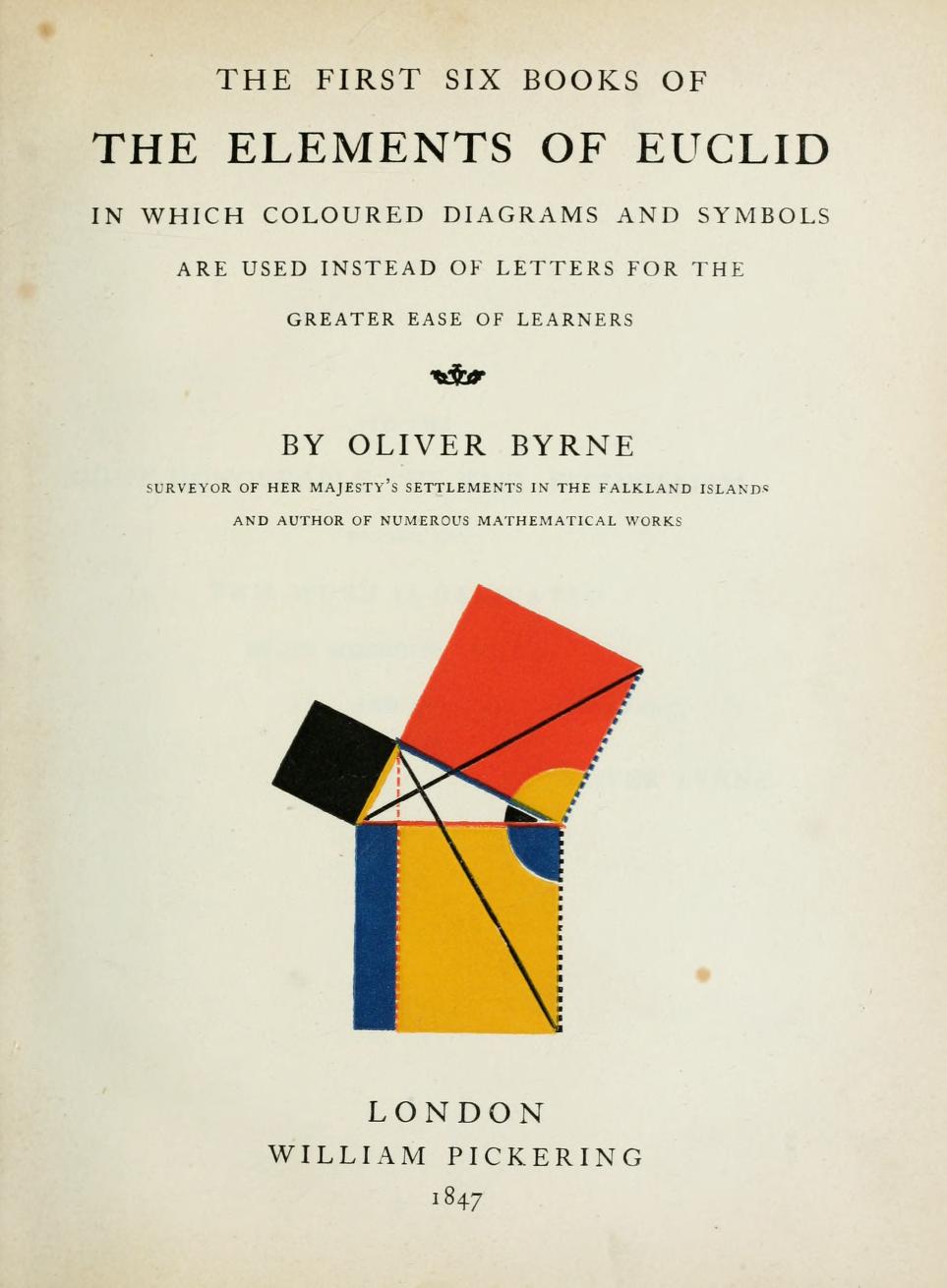
    This is the start of what I hope to be a useful page of interesting and useful texts and timeline/chronological links for the history of mathematics. I’ll be adding to this over time.  

    Euclid byrne

    The Development of Categorical Logics–John L. Bell

    A Short Account of the History of Mathematics–W. Rouse Ball


    ·Posted by :

    ·in:

  • The Makings of a Scheme Alphabet of Antique Schemes

    JF Ptak Science Books   Quick Post

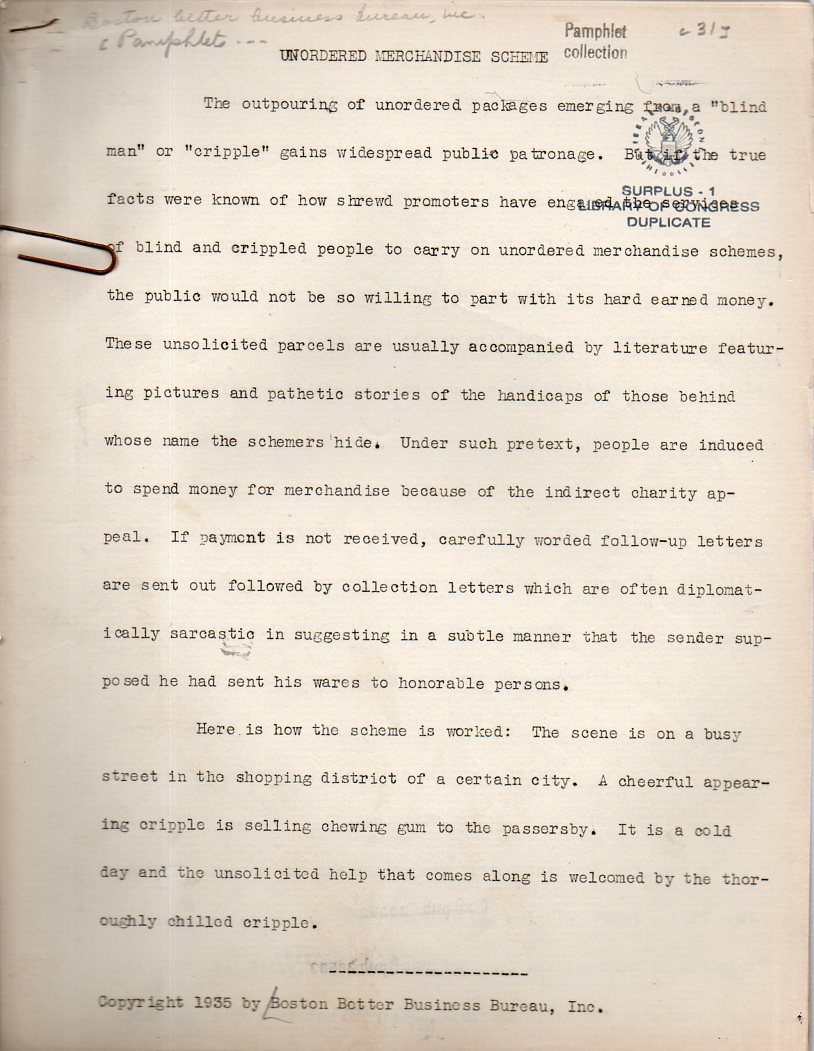
    I found this sub-magnificent collection of Police-Sponsored Anti-Crime Bunko-Squad pamphlets in a collection of other material from long ago that today looks so mundanely sublime.  They were published by the Boston Better Business Bureau, and listed an alphabet or thereabouts of small- (and not-so) time grifters and frauds and what-have-you who were set to produce ill among the good folks of Beantown, and how to recognize and avoid them.  (The reports are all in the same format, printed via offset on 11×8.5 inch sheets, titled in pencil “Pamphlets on Fraudulent Business Methods and Schemes” and printed in 1936.)  There are  34  in all, stapled sheets at left-top, each about 10pp  long (making for about 350 leaves), with each having an example of a conversation between the consumer and the grifter.  

    BBB310

    [Source: ex-library with the occasional stamp from the Library of Congress (“Pamphlet Collection”), via the U.S. Copyright Office and then to my collection.] 

    These schemes have a colorful flavor, and some sort of antique pleasantness to them, except that they were all based on fraud and deceit.  The schemes include numerous out-and-out bait-and-switch approaches:   Bait Window Advertising Scheme,  Free Permanent Wave Scheme, Smuggled Goods Scheme, Bait Advertising Scheme, Business Opportunity Scheme, the Re-load Scheme, A Switch and Sell Scheme, Bucket Shop Scheme, Tipster Sheet Scheme, Sewing Machine Scheme, Memorial Park Cemetery Scheme, Heir Scheme, Bait Advertising Scheme, Song Writing Scheme, Is It Bait? Bait Scheme, Action Sale Scheme, Stuffed Plate Scheme, Stuffed Flats (Furs) Scheme, Buy Wholesale Scheme, Insurance Association Scheme, Partner-Wanted Scheme, Long Distance Tailoring Scheme, Bait Advertising (T.C. System) Scheme, Free Lot Scheme, Home Work Scheme, Furniture Club Lottery Scheme, Charity Merchandise Scheme, Suit Club Scheme, Picture Enlargement Scheme, Puff Sheet Scheme, Territorial Rights Scheme, Obesity Cure Scheme, Territorial Rights Scheme, Cash Bond Scheme, Unordered Merchandise Scheme.  Schemes enough for one and all, and all with a flavor of Mony Python’s Spam routine.  

    ·Posted by :

    ·in:

  • Kolberg and Sachsenhausen, 1945–Visions of Harsh Fantasy and Harsher Reality

    JF Ptak Science Books 

    At the end of WWII there was a tale of two battles, both by the name of Kolberg.  One was a propaganda tool filmed in Agfacolor at the demand of Josef Goebbels, a movie begun in 1944 about the mythically-endowed victory of Germany over Napoleon at Kolberg.  It was an epic, costly movie made at a time when the 180,000 “extras” composed of Wehrmacht troops could not be spared, but it was seen by Hitler and whoever was around to agree with him that a movie selling selflessness and sacrifice (blood sacrifice) was more valuable than a military victory1. When it was finally put to bed, the movie “opened” virtually nowhere in Berlin in January 1945, as  the city was becoming a bombed-away shambles–much more so in the next three month.  The visions of resistance-to-the-last-breath played in few places outside of Hitler’s bunker, where the dictator professed the qualities of sacrifice and the fight-to-the-death messages in the movie, though not applying those necessaries to himself.  

    The other Kolberg battle was the Battle of Kolberg (a Baltic seaport city in Pomeria located about halfway between Berlin and Koenigsberg), which took place in real life from 4-18 March 1945.  It was a fight between the Germans and combined forces of the Soviet and Polish armies–it ended in Polish hands on the 18th following the retreat of the Germans and he destruction of most of the city.

    It is ironic that the defeat of the Nazi forces in the real city of Kolberg occurred at nearly the same time as the wasteful film of the 1807 battle extolling the virtues of heroism and sacrifice was released.

    It is interesting too that the  actor depicting the leading German hero in the movie Kolberg (directed Veit Harlan and Wolfgang Liebeneiner)  Heinrich George–who acted in a number of Nazi propaganda films after finding ways to get back into favor following his pre-Nazi pro-Communist politics–found himself arrested and imprisoned in Sachsenhausen concentration camp, where he died of “complications” in 1946.

    Sachsenhausen was one of the longest-lived concentration camps, being in operation from 1936 to 1950.  From its beginning to May 1945 it was of course a Nazi concentration camp (Konzentrationslager Sachsenhausen), where from 1943 until the fall of Nazi Germany it was also an extermination camp.  As many as 200,000 people were seized and sent through Sachsenhausen and its satellite/tributary camps. From the end of 1945 to 1950 it was operated by the Soviet Union, where another 15,000-30,000 people were imprisoned, Heinrich George being one of them. 

    In addition to the many horrors of Sachsenhausen, there was also this–it was the center of a plot to destroy the British economy with the production and distribution of a hundred million pounds worth of counterfeit British currency.  The lead counterfeiter at Sachsenhausen, Salomon Smolianoff (a gifted artist who once said “why make art when you can make money?”) was an inmate with exceptional skills and who basically headed the team of workers responsible for this effort,  For good work in his part of pulling down the economy of Great Britain, Smolianoff was rewarded with an occasional go at a ping pong table, as well as less-rancid pieces of meat. 

    File:Forgednote.jpg[One of the forged Sachsenhausen notes.]

    This was operation Bernhard, named for its director, SS Major Bernhard Kruger (the leader of the VI F 4a Unit in theReichssicherheitshauptamt (Reich Main Security Office) or RSHA), who was responsible for the operation from 1942, and which eventually extended from Sachsenhausen to other camps, most notably a major operation at Auschwitz.  More than 134,000,000 pounds of what the Brits considered to be the most perfect counterfeits ever were produced, but for various reasons–not the least of which was sabotage instigated by extraordinarily brave concentration camp internees–the vast part of the plan was never implemented. 

    As it turns out, Smolianoff survived Sachsenhausen, survived the war, and then became a puff of smoke. He was a wanted-but-not-found fugitive, and spent his last days in Brazil, painting.  And creating toys.  He died in 1976.

    Bernhard Kruger (born in 1904), also survived the war.  When the pound-forging plan was scuttled in 1944, he moved the idea over to American currency, which he worked on until the end of the wat.  Although he was kept by the British for two years, and then by teh French for one year, he was eventually released, and faced no charges until a Denazification court ordered him to trial, where he was somehow acquitted.  He died an old man, aged 85, in 1989, in his bed. 

    Notes:

    1.  At least this is so as reported by Sir Ian Kershaw in his biography, Hitler, 1936-1945.

    ·Posted by :

    ·in:

Recent Posts

Archives

Categories