A Daily History of Holes, Dots, Lines, Science, History, Math, Physics, Art, the Unintentional Absurd, Architecture, Maps, Data Visualization, Blank and Missing Things, and so on. |1.6 million words, 7500 images, 4.9 million hits| Press & appearances in The Times, Le Figaro, Mensa, The Economist, The Guardian, Discovery News, Slate, Le Monde, Sci American Blogs, Le Pont, and many other places… 5000+ total posts since 2008.

  • The Task Book, 1819

    JF Ptak Science Books      Quick Post

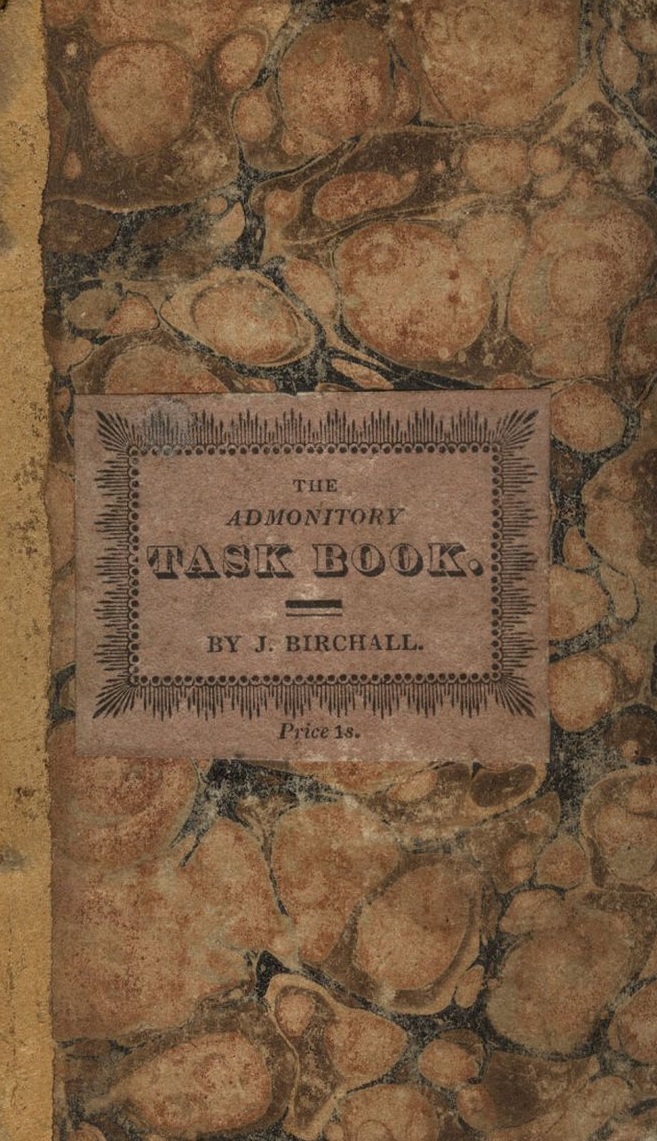
    TASk book detail

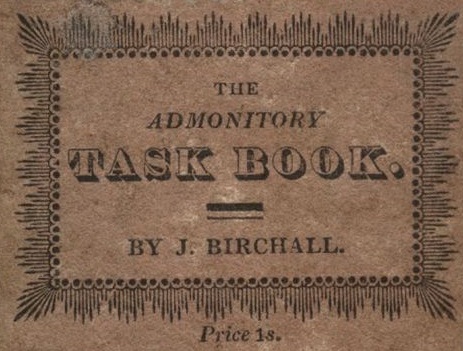
    I would love to write a book like this.  The full title of the work by J. Birchall, The Admonitory Task Book;: Consisting of Prose and Poetry, Original and Selected: Interspersed With Striking Aphorisms, Useful Maxims, and Moral Precepts. Designed for the Use of Schools (1819).  I want very badly to open this book.  Unfortunately, it isn’t anywhere to open–it seems not to be located in WorldCat/OCLC.  

    The source for this lovely title is Holletts Rare Books from the U.K. –its beautiful.  

    TASk book


  • The First (?) Electric Calculator, 1817

    JF Ptak Science Books   


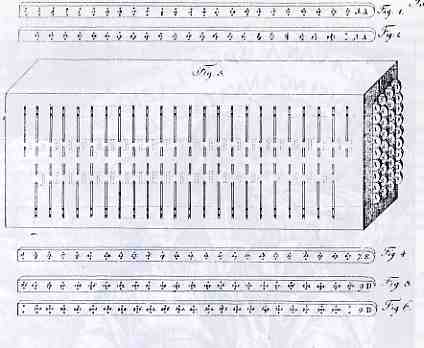
    One of the most unexpected monuments–to me at least–in the history of modern computation is the fantastic electrical calculating machine that shows up in the vast, dense, and bibliographically complicated work by Georg Heinrich Seiferheid (1757-1818), Sammulung Electrischer Spielwerke fur junge..., published over the years 1791 to 1817. 

    0 blog march 9 computer659

    Mr. Seiferheid was an experimenter, innovator, inventor and writer, and wrapped up in one complicated ball, publishing his major and minor bits under the heading of this one large work over a period of least 16 years.  And don’t let the title fool you:  in the vein of Chandrasekhar’s Newton’s Principia for the Common Reader, there wasn’t all that much in these volumes by Seiferheid for kids, just like in the Chandrasekhar book, which ratcheted the phrase “Common Reader” way, way up.  Even taking into account the level at which children were educated in the applied and natural sciences/philosophy, which demanded more from the 18th and 19th century kids than out grade school do now, Seiferheid’s work is obvious far removed from that.  Perhaps it was because he had a large number of gadgety trinkets that hung through the work like plumb lines that the word junge was included–I really don’t know.  The vastness of his reach though into all manner of mechanical and electrical objects is very impressive–Seiferheid evidently constructed electrically powered guns, clocks, and of course this fantastic calculating device. The calculator was much similar to the machine invented (although no version of it survived) by Wilhelm Schickard (1592-1635)  in 1623, followed by that in 1643 of the overwhelming Blaise Pascal (with the “Pascaline”) and then again in 1675 of Gottfried Leibniz (1646-1716) who produced the “Stepped Reckoner”—the Seiferheid machine was more complex, and of course, electric, a true and terrific innovation, creating for its maker the sobriquet of “grandfather” of the modern computer.  

    * I have found very little biographical data on this man; even the very reliable Poggendorff has only about 15 lines on him:  he was born in Wurtemberg, was a professor of physics at the Gymnasium at Schwabisch Hall, and that’s about it for the personal data.  He did write four other books in addition to this ten-volume magnum opus. 

  • The Gaping Mouth of Hell, ca. 1475

    JF Ptak Science Books  Post 2233

    “If a man were a porter of hell gates, he should have old turning the key.” Shakespeare’s Macbeth.

    SPECULUM 064

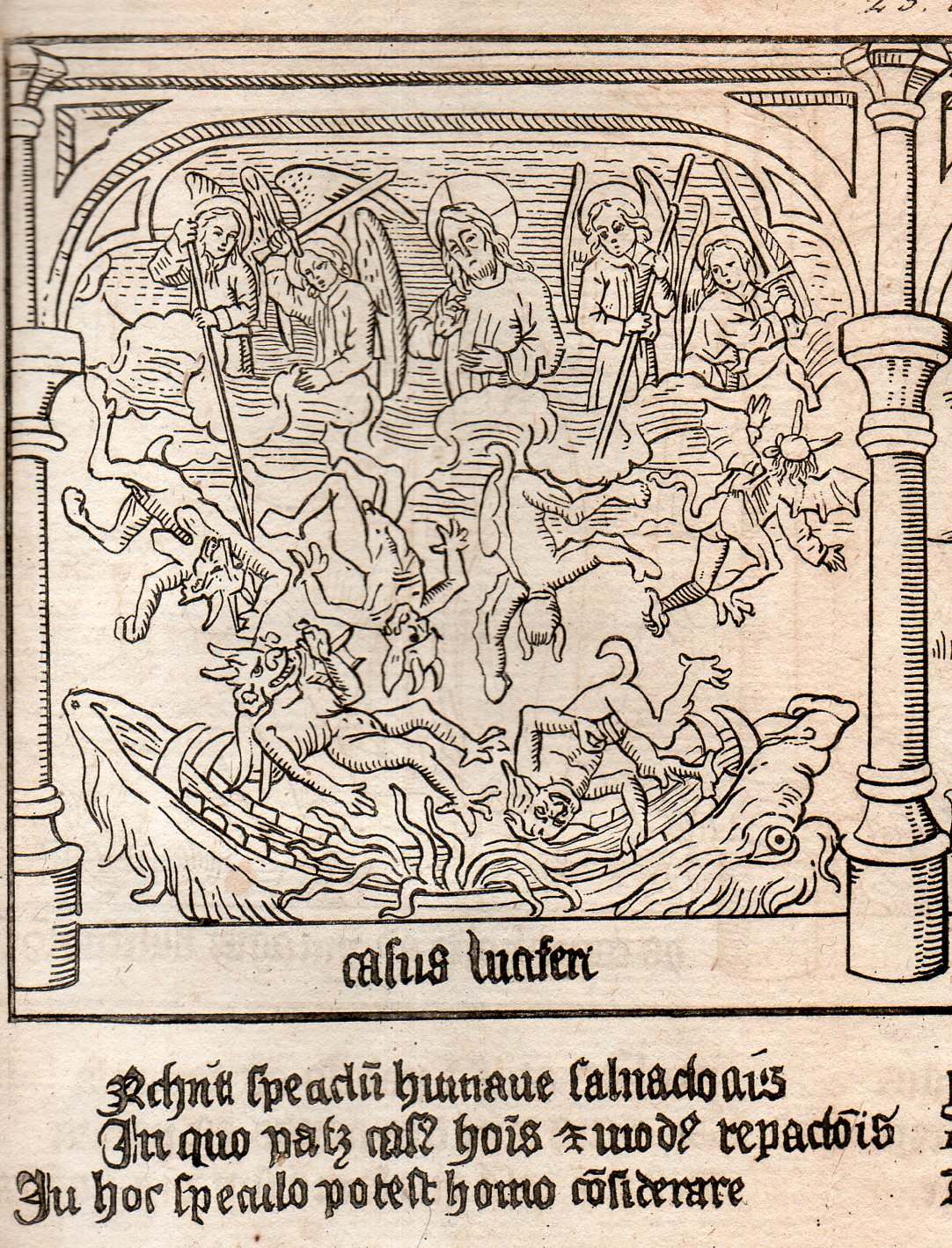
    This woodblock, printed ca. 1475, appears in a Medieval/Renaissance classic, Speculum Humanae Salvationis, which appeared in hundreds of manuscripts beginning in the early 14th century and then through 16 editions as a printed work to the year 1500.  It was a very popular work, very highly illustrated, a best-seller even, a famous work dedicated to showing the presaging relationships of the Old Testament to the New.  

    This image presented here depicts the Fall of Lucifer, overseen by Jesus and Angels, and falling into the gaping mouth of Hell.  It is a wicked image no doubt used to scare the pants off of its readers, in the general tradition of the depiction of the massive wickedness that awaits those who stray from the teachings of that which is necessary to enter Heaven1.  

    Gaping mouths of Hell appear quite frequently in the history of Christian art, particularly in the representation of the place in the harrowing of hell, when after his execution Christ descends into the pits to bring to salvation all of those who were worthy of it who died before his appearance on earth. It is a very common seen, with hell appearing as a cave, or a hole in a mountain, and of course as ferocious monster mouth.  In a way the stunted, black hole in a mountain, lonely and dark and just about non-existent, looked more frightening in its way, its terror implied rather than overtly visualized by horrible teeth and jaws.  

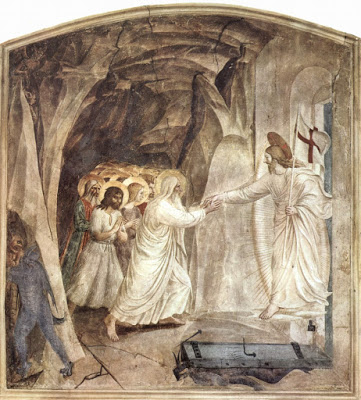
    For example, Fra Angelico presents the scene in 1437(-46), and shows Christ in what looks like coldness reaching for the hand of the person usually depicted the first among the saved, Adam:

    Harrowing of hell fra angelico[Image source, here]

    It doesn’t have the flavor of fear that other entrances to Hell have, though it is forbidding, with the long line of dead stretching far back into the interior. 

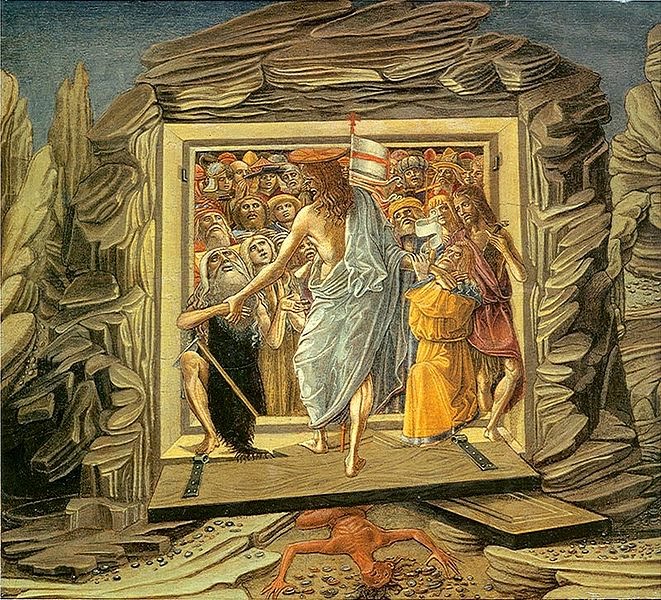
    An old friend from the National Gallery in D.C., Benevento di Giovanni (ca. 1493), shows a more dramatic entry of Christ, though the crushed devil evidently doesn’t stay crushed for that long, as Limbo and Hell do not actually perish once Christ leaves: 

    Harrowing of hell Giovanni

    [Image source, here]

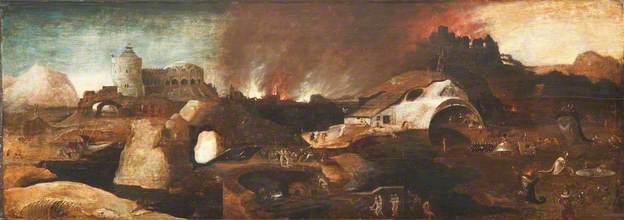
    There are many such examples, and perhaps more still featuring the anthropomorphically-alive and toothy entrance–few are scarier though than the entrance to Hell that meets these two ideas sort of in the middle, that being the quietlky shivering contribution by Hieronymus Bosch, placing the entrance to Hell in the mouth of a dead human.

    Harrowing bosch[Image source, here.]

    Of course Bosch can and does make the entrance more hideous and obvious in other works, but this “understated” variety is very effective.  

    But it is the image from the Speculum that attracts me right now, found in a book on my shelf on deeply old engravings and woodblocks, Idee Generale d’Une Collection Complette d’Estamps...by Heinecken, printed in Leipzig in 1771.  

    “God, shown throughout this chapter as Jesus Christ, is surrounded by the blessed angels in Heaven. Below is the scene of the Fall of Lucifer and his followers into the gaping mouth of the Leviathan, of the book of Job XLI, which is commonly identified with the inferno. The fallen angels are represented with wings, horns and cocks’ feet. The Fall of the Angels is first found in Judeo-Greek literature of Alexandria in the two centuries before Christ.”–Source: Speculum Humanae Salvationis 1324–1500,  by Adrian Wilson & Joyce Lancaster Wilson, U.C. Berkeley Press, 1985. 

    NOTES:

    1. The heaven-helly Ambrose Bierce in what would become his Devil’s Dictionary, spunkily writes of heaven so:  “HEAVEN, n.A place where the wicked cease from troubling you with talk of their personal affairs, and the good listen with attention while you expound your own.”  Uncharacteristically, he did not make an entry for hell, which I am sure he was better able to discuss.  

    ·Posted by :

    ·in:

  • A Cosmological Map of the Descending Dead (1855) & a Surprise Death-Cosmo Guest Image

    JF Ptak Science Books   Post 2234

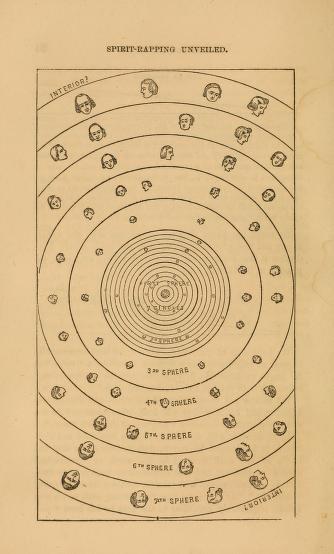
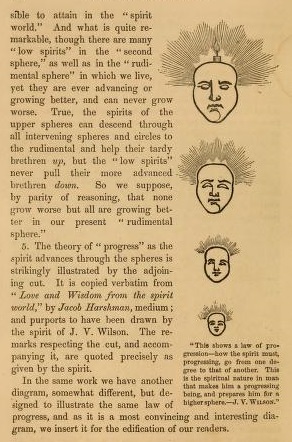
    Oh my! The book Spirit-Rapping Unveiled (1855, see below for the long and potentially boring and extensive title1) in the midst of much dizzying introductions and elucidations, refutations and condemnation, praise and pain, is this almost one-of-a-kind map, showing the descent of the dead onto the Earth. 

    Spirit wrappins universe

    [Source: https://archive.org/stream/spiritrappingunv00matt#page/n3/mode/2up]

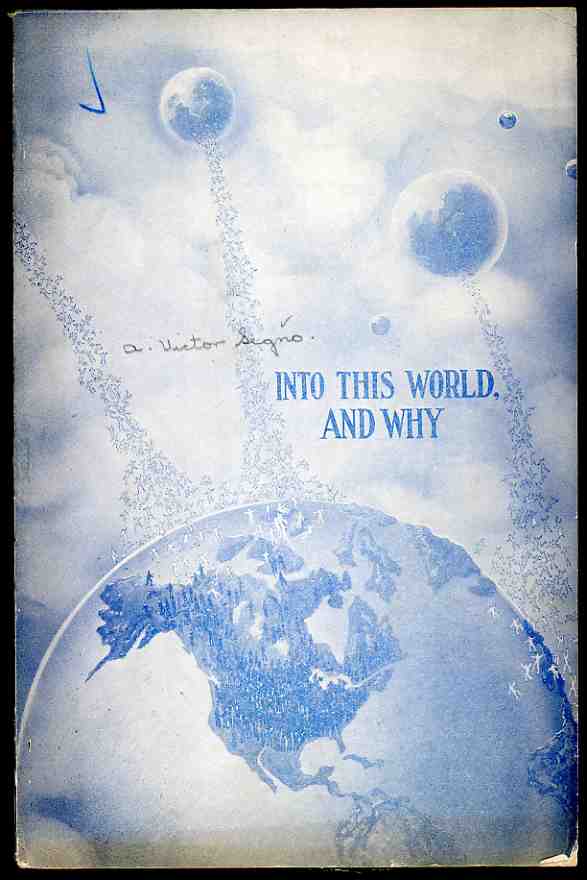
    I say “almost” because there is also this highly unlikely image-though-not-map which I wrote about in a 2008 post with the hyperbolic title “Extra-Earth Humano-Alien Souls From Outer Space Repopulate Earth-Hell!!(??), in which the title accurately tells the contents of its text and the front cover depicts the descending alien dead: 

    So there are at least two such map/images depicting Earth-bound dead descenders, and both are magnificent in their own _________  way.  

    The text of Spirit-Rapping explains the deathly cosmogram: 

    “In accordance with the theory already described and illustrated, it is assumed by our modern necromancers that the spirits of the dead descend to the earth or ” rudimental sphere” at pleasure, and thus communicate from time to time, and in various ways, with certain favored mortals called ” mediums.” At the same time they belong each to his own sphere, respectively, according to the time he has been ” progressing,” and his head is large or small according to the sphere to which he has attained. Indeed the earth, seen in the center of the cut, is a small affair compared with the heads of some of the sixth and seventh sphere progressives.” —from page 21

    WHo would/could or want to say more?  

    Spiritrappingunv00matt_0024


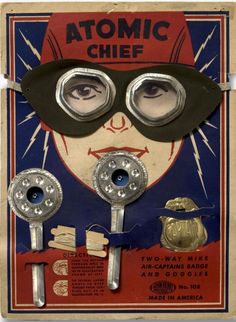
  • Nuggets of Atomic Bombiana: Atomic Stuff

    JF Ptak Science Books  Quick Post    
    Follow Me on Pinterest


    I have a pinterest account with 50 categories and over 3,500 images–the images below form a subset of the Department of Atomic Hope and Fears: Atomic Stuff (with 150 or so atomic/nuclear images overall).  The source for each can be found on the Pinterest site.  

    4819d2e2f638a524032a76466e2e8825


    ·Posted by :

    ·in:

  • Dancing at the Edge: Yosemite, 1890’s

    JF Ptak Science Books   Quick Post

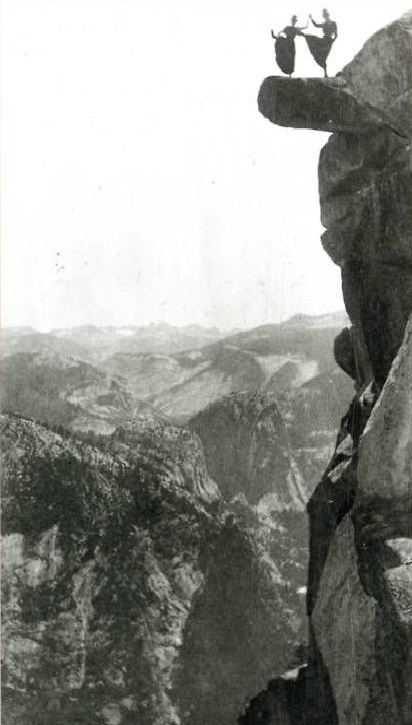
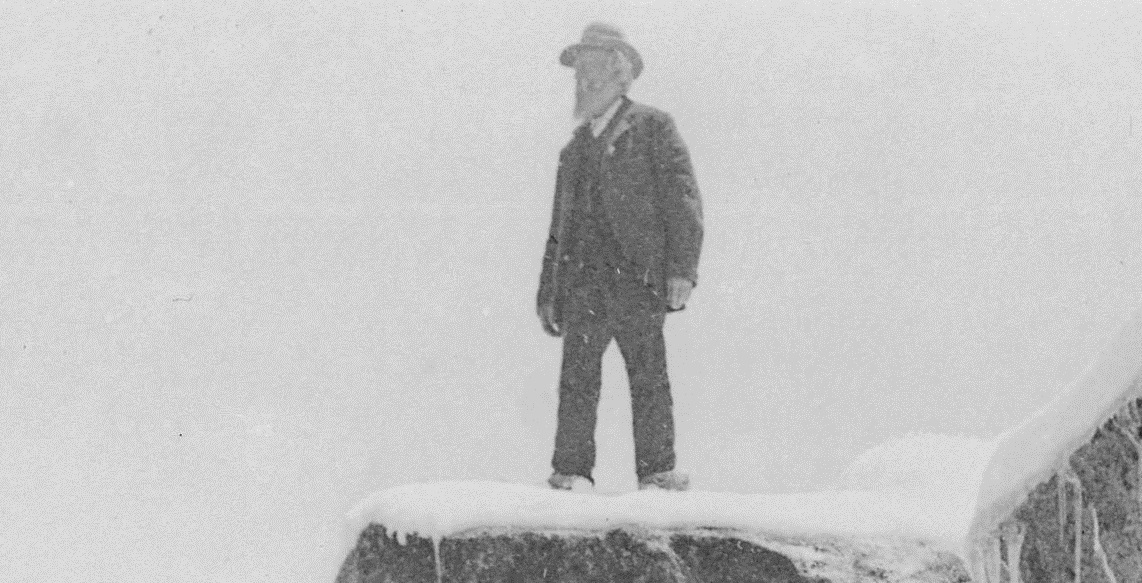
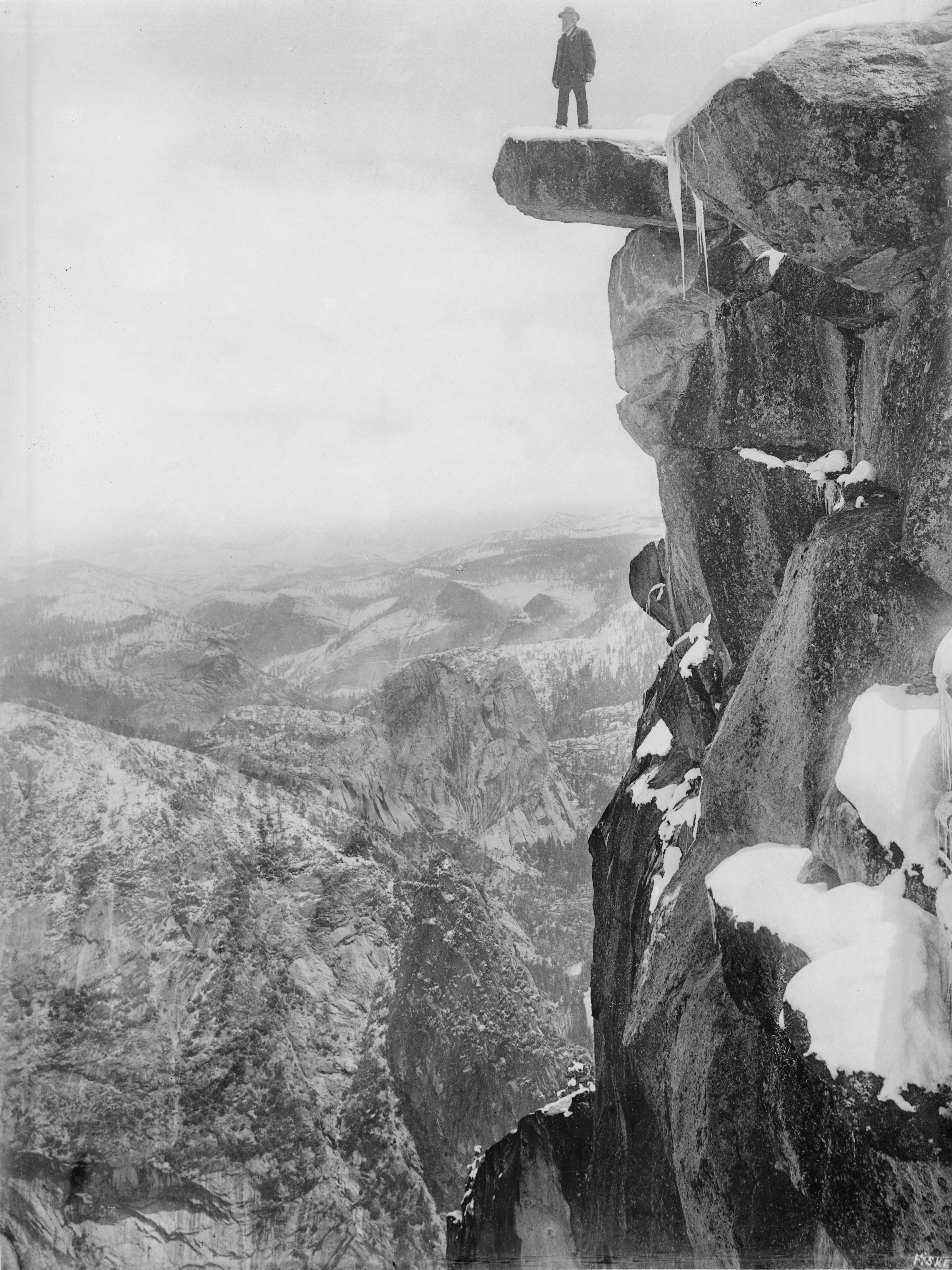
    These are remarkable photos of folks standing at the edge of the world in Yosemite National Park.  They were made by George Fiske, a New Hampshire boy who left for San Francisco and moved to Yosemite at age 44 in 1879. He worked there for decades, producing beautiful and iconic work before running out of steam after the turn of the century, and in the end committing suicide in 1918 because as he said he lost interest in being alive.  

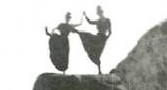
    I came to Fiske today because of the dancing ladies, hanging out at the edge of the overhanging lock, a photo made by him in the 1890’s at Glacier Point in Yosemite. That led me to another photo that Fiske made of his co-author Galen Clark, made at the same place some years later at the same famous spot, in 1910.  

    Detail of the dancing ladies, 1890’s:

    WOmen--dancing on ledge detail

    And the full image:

    WOmen--dancing on ledge

    And a clearer image Galen Clark:

    Women yosemite Galen_Clark_on_Glacier_Point_in_Yosemite_National_Park,_ca.1900_(CHS-1207) detail

    Women yosemite Galen_Clark_on_Glacier_Point_in_Yosemite_National_Park,_ca.1900_(CHS-1207)

    [Image source:  wikipedia ]

    Notes:

    James Mason Hutchings, In the Heart of the Sierras (1888), with many illustrations including a number of photos by Fiske. Great digital copy at yosemite.ca.us here. 

    Galen Clark, The Yosemite Valley (1910) with more photographs by Fiske.

  • Everything John Brown Owned in 1842

    JF Ptak Science Books   Post 2235


    John BRown

    Long before John Brown led his armed Abolitionist revolt, he was–like many people on the inner edge of the frontier–trying to make his way in the world at a host of different businesses, some of which did well, some not.  He had a farm, operated a tannery, raised sheep and cattle, a bit of this and that, a man with a big family (he would have 20 children in his life) who absolutely had to make some money one way or the other. Some of these enterprises involved loans, which when combined with the Panic of 1837 and the Crisis of 1839 put the man under water.  He was so deeply done that by 1842–at the age of 42–John Brown was bankrupt.

    I’m writing about this now because Rebecca Onion published (in her excellent Slate Vault blog) a list of all of the worldly possessions of Brown and his family, collected and listed out by order of federal bankruptcy laws.  The resulting list is heartbreaking and hopefully, and probably representative of a broad-spectrum slice of American semi-pioneer daily life about what the working family owned at mid-century somewhere along the speedily disappearing frontier.

    What appeared to me first was the worn and worn out material, all listed in workman-like observational undertones, especially in the housewares and daily life category:  “6 feather beds old and poor”, “3 tables old”, “5 chests old”, “6 pots cracked”, “6 bedsteads old”, “4 wooden pails old”, “2 earthen ware crocks broke”. There was the broken stuff, and then just the inexpensive:  the 75-cent writing desk, 50-cent washtub, the pepper mill for a quarter, three soup bowls for a quarter, the pot hook for a skinny dime, and so on.

     Most of the value of the family was in the livestock and food stores, mostly because there was so much that could be done with that, and by every/anyone.  Though even there are found some shriveling disappointments: the 75-cent nail hammer, the 12-cent inkstand, and the 25-cent pitchfork (“work needed to be done on same”).

    The listing of possessions was complete–also found here under guided supervision was the clothing of the family in their house as well as what everyone was wearing; and for a large family, there wasn’t much at home that wasn’t already being worn. “2 overcoats – 5 coats – 10 vests – 12 pairs Pantaloons – 26 Shirts 10 Womens & Girls dresses – 3 Skirts – 2 Cloaks – 4 Shawls – 8 Womens and childrens aprons – 5 pairs of Boots – 3 pairs of Shoes – 13 pairs of Socks & Stockings – 7 Stocks & Handkerchiefs – 4 Bonnets – 1 Hat 5 Palmleaf Hats – 8 mens & Boys cloth caps – 1 Fur cap – & 1 Wool cap.”

    It is the children’s clothing that is really hard to read about.  

     Photographs of the original documents as well as transcriptions are available here

  • Nuggets of Atomic Bombiana: Atomic Book & Magazine Covers

    JF Ptak Science Books   Quick Post 
    Follow Me on Pinterest


    I’m introducing some of the images from my 3,500-item Pinterest collection.  The following is a subset of the Department of Atomic Bomb Hopes and Fears.  The original sources for the images can be found in the links in the Pinterests categories.  

    06a0303cbfbd9d8d6b1255005f3d920f


    8726db0ac5a8d61b421eec77b95850f7

    ·Posted by :

    ·in:

  • A Girl and her Submarine, 1918

    JF Ptak Science Books  

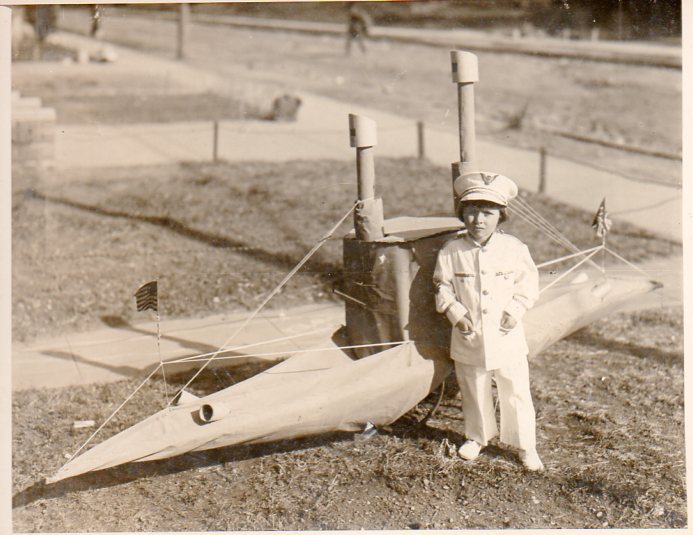
    I could hardly resist this 1918 image:  the young girl, her hands in her pockets,  ribbons on her chest, her submarine fashioned over a tricycle with the two flags (Stars and Stripes and the Union Jack).

    WWI photo--girl submarine249

    The sun is low, rising or setting, and it is catching the girl in the face, the home-fashioned hardboard visor of her home-grown officer’s headgear doing nohing to shade her eyes.  She’s in her dress whites, maybe proud of someone else’s handiwork on her ten foot long submarine. 

    The image comes from my small archive of 200 or so WWI  news service photos, this one no doubt intended to stir some home fires to help raise money or spirits.  I have no idea of the image was ever published. 

    And of course the details:

    WWI photo--girl submarine250

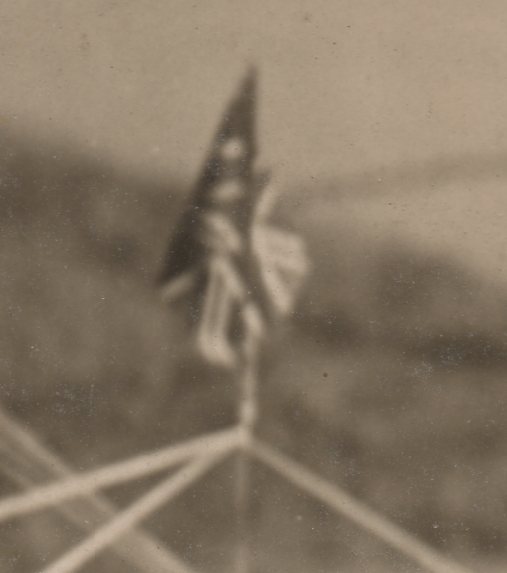
    And this of the stern flag, the Union Jack:

    WWI photo--girl submarine251

    And this, with the hand-sewn eagle on the hand-made jacket, with all of the trimmings a creation of mom, or someone else as kind:

    WWI photo--girl submarine252

    And you can purchase the original: World War I news service photo, made 1918.  8×6 inches.  Good condition.  $350

    ·Posted by :

    ·in:

    —
  • I Love “Nature” Magazine

    JF Ptak Science Books    Post 2199

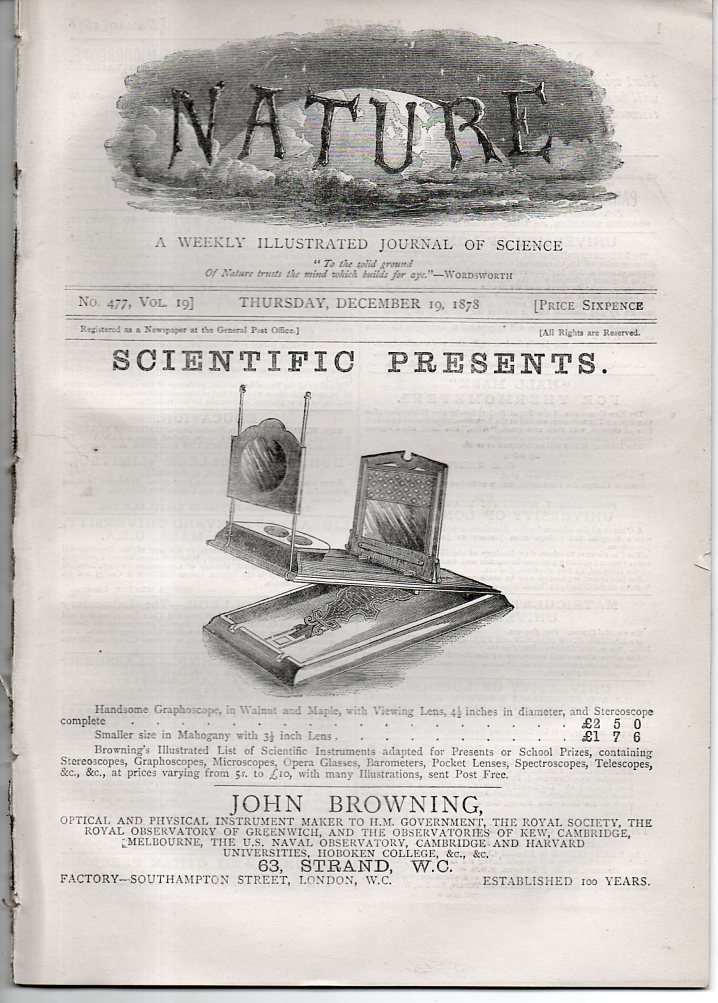
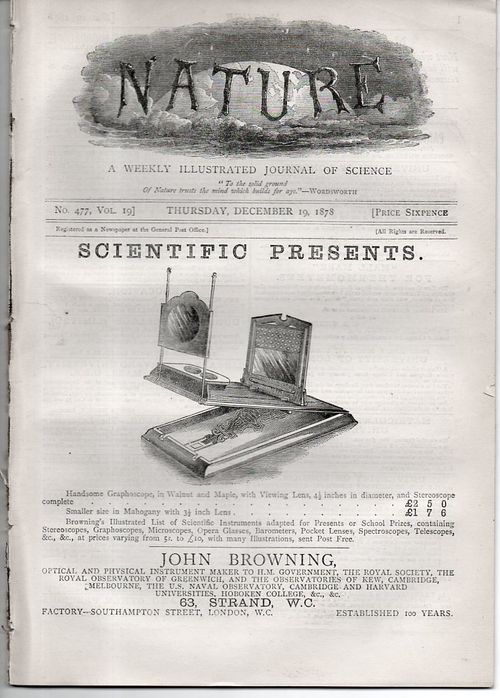
    One of the great pleasures in the business of antiquarian science book selling is the Advanced Ability/Capacity to Browse the books. Or Graze.  All in the semi-pursuit of an undefined goal that sometimes leads to something that leads to something else, and sometimes all of them get pulled together.  And so this came to be last night, working my way through an issue of Nature, a Weekly Illustrated Journal of Science, for December 1878–and yes, this is the same Nature that we know today, begun in 1869. The modern Nature is massive and perhaps one of the world’s foremost publications in the sciences–in 1878, the magazine was a semi-popular, quick-to-publication-and-print journal, usually less than two dozen pages long.  
    Thomson191

    The magazine was short and to the point, and it packed an enormous amount of material on a limited amount of paper–two columns of print per page, 7-10 words per line, 70 lines per column, or about 1500 words per page.  (An average novel has about 400 words per page.)  It attracted the attention of everyone, and virtually every big name in the sciences in the 19th century seemed to find their way into this publication: Darwin, Huxley, von Helmholtz, Thomson, Maxwell, Hertz, and on and on.  

    I admit that I was attracted to this issue by the beautiful engraved ad (“Scientific Presents” (!)) for a graphoscope, sold by John Browning (63 Strand) of London. (The graphoscope was an entertainment device created around 1860 and was an elegant/extravagant magnifying glass for viewing photographs and prints and such.  The base was lifted to meet the gaze of a seated viewer who would look through the large magnifying glass at an image that was placed on the theatrical/framework bit at the back of the device.)

    The contents are terrific.  The issue starts with a provocatively-titled work by James Clerk Maxwell, a review called “Paradoxical Philosophy”, which I like quite a bit–and it is rather long for Nature, and it was a joy to make my way through Clerk Maxwell as he makes his way through the story.  

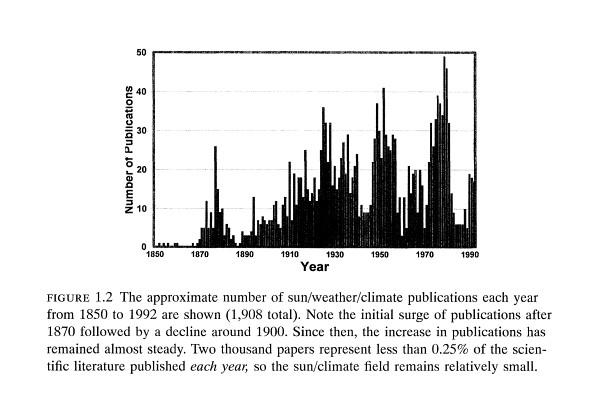
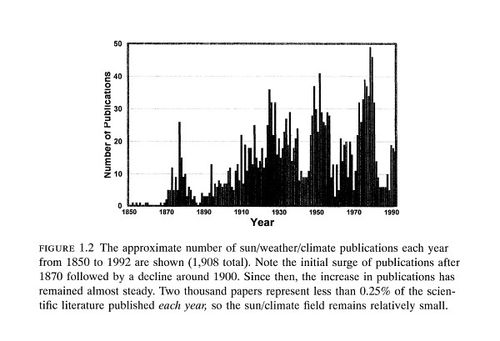
    And then:  a short piece by E.D. Archibald on “Locusts and Sunspots”, which fits nicely into the history of th esun and sunspots and cycles and weather, nicely into teh early-ish modern period.  That also brought me to a fascinating book with this great graphic on the history of publications dealing with what I just mentioned.
    Climate[Source: The Role of the Sun in Climate Change, by Douglas V. Hoyt, Kenneth H. Schatten Program Director of the Solar Terrestrial Research National Science Foundation.]

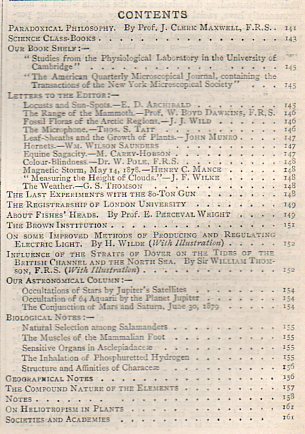
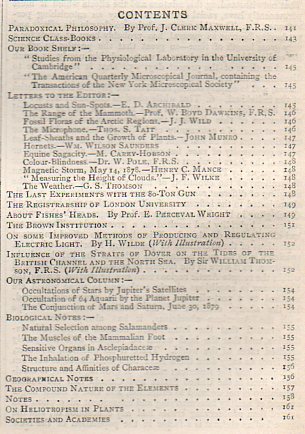
     The there is so much more, as we can see:
    Nature196

    Tait on the Microphone, Dawkins on the range of the mammoth, Wild on the fossil floras of the Arctic, Carey-Hobson on equine sagacity, Pole on colour blindness, and a beautiful effort by Wilke on measuring the heights of clouds–all lovely efforts.  

    And then, at the very end, under the unlikely title of “Societies and Academies”, emerged a magnificent effort by William Thomson, Lord Kelvin, another very major scientific name, and his effort at constructing a mechanical analog device, a very smart machine that wasn’t built until 1932.  His “On a Machine for the Solution of Simultaneous Linear Equations” is a remarkable effort, calculating its way through masses of numbers with pulleys and cords, as noted by Tom Woodfin of the MIT AI lab ( here):

    “Lord Kelvin proposed one mechanical system in 1878. Designed to solve sets of linear equations, it operated on a tilling-plate mechanism—essentially a collection of pulleys spaced along balanced plates and connected with rope. Coefficients of the linear equations would correspond to pulley placements, and the ropes would be tugged to balance the beams and hence the equations. Results would be read off as the lengths of loose ends of rope.”

    “Kelvin’s scheme had several advantages. First, it was based on rudimentary technology—within
    the capabilities of 19th century craftsmanship. Second, it was possible to increase the precision of a calculation through successive applications of the device, taking advantage of the characteristics of the linear equations it was designed to solve. Third, its mechanical nature made it ideal for “tweaking”—slight adjustments in inputs could be made quickly, and results obtained rapidly, without substantially reconfiguring the device.”

    All-in-all, the chance meeting with the graphoscope produced a number of very interesting finds, none of which really pulled themselves together in this context, but certainly could possibly play their role as missing pieces in some future puzzle–which is really what all of this is all about.  
     

    ·Posted by :

    ·in:

  • The Department of Irony: the Unselfish Society

    JF Ptak Science Books  Quick Post

    1502   tr. Ordynarye of Crysten Men (de Worde) iv. xxii. sig. ff.iii,   Suche synne is named yronie, not that the whiche is of grammare, by the whiche a man sayth one and gyueth to vnderstonde the contrary.  —  Oxford English Dictionary, in an example of the earliest usage of “irony” in English.

    I wonder if there are such things as “small” and “big” ironies?  Perhaps it is more a question of small and big wonders. 

    Eugenics198

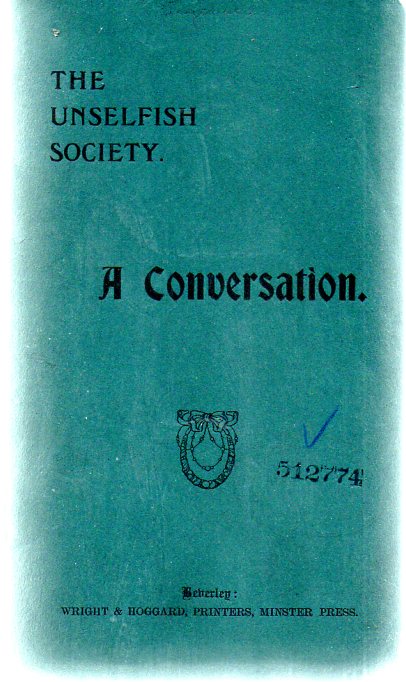
    In any event, the Unselfish Society of this pamphlet refers to a eugenics Society, or eugenics in general, and was part of a Socratic dialog in the pamphlet concerning eugenic principles and education.  It feels more like backlash of theatrical Shavian wit, what with the eugenics folks being about as far removed from principles of un-selfishness as possible.  Or perhaps they are interested in “unselfishness” as a principle expressed by others in order to better the genetic and societal lot of the more-privileged people.  But the expectation of unselfishness in others is not being unselfish in yourself, unless you’re Ayn Rand.  And in this instance we’re talking about the so-called “positive” eugenics, and not the “negative” one, where there is an enforced elimination of what is deemed (by them) to be society’s “weak links”.  “Unselfishness” is not a currency expected (and sometimes extracted) from others and used for yourself.  

    Eugenics1971883   F. Galton Inquiries into Human Faculty page 44.   “The investigation of human eugenics, that is, of the conditions under which men of a high type are produced.”

    Full text here

    ·Posted by :

    ·in:

    —

Recent Posts

Archives

Categories