A Daily History of Holes, Dots, Lines, Science, History, Math, Physics, Art, the Unintentional Absurd, Architecture, Maps, Data Visualization, Blank and Missing Things, and so on. |1.6 million words, 7500 images, 4.9 million hits| Press & appearances in The Times, Le Figaro, Mensa, The Economist, The Guardian, Discovery News, Slate, Le Monde, Sci American Blogs, Le Pont, and many other places… 5000+ total posts since 2008.

  • The World Going On Underground: Miners, Sappers, Tom Waits

    JF Ptak Science Books 

    Underground working steep102

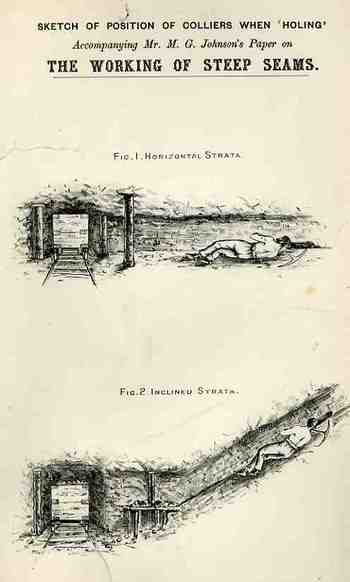
    Looking at these two images of the shirtless miner laying down and working on his side in the semi-dark way underground in what looks to be a tunnel about twice the width of his shoulders makes you wonder about how in the name of great bog could people have done this, day in and day out.  The fact that the appearance of these images were both essential and mundane further tells us—as we sit here in a comfortable chair in the print’s future—that this is, simply, what people did, and what they had to do.

    Blogjuly_17_work334

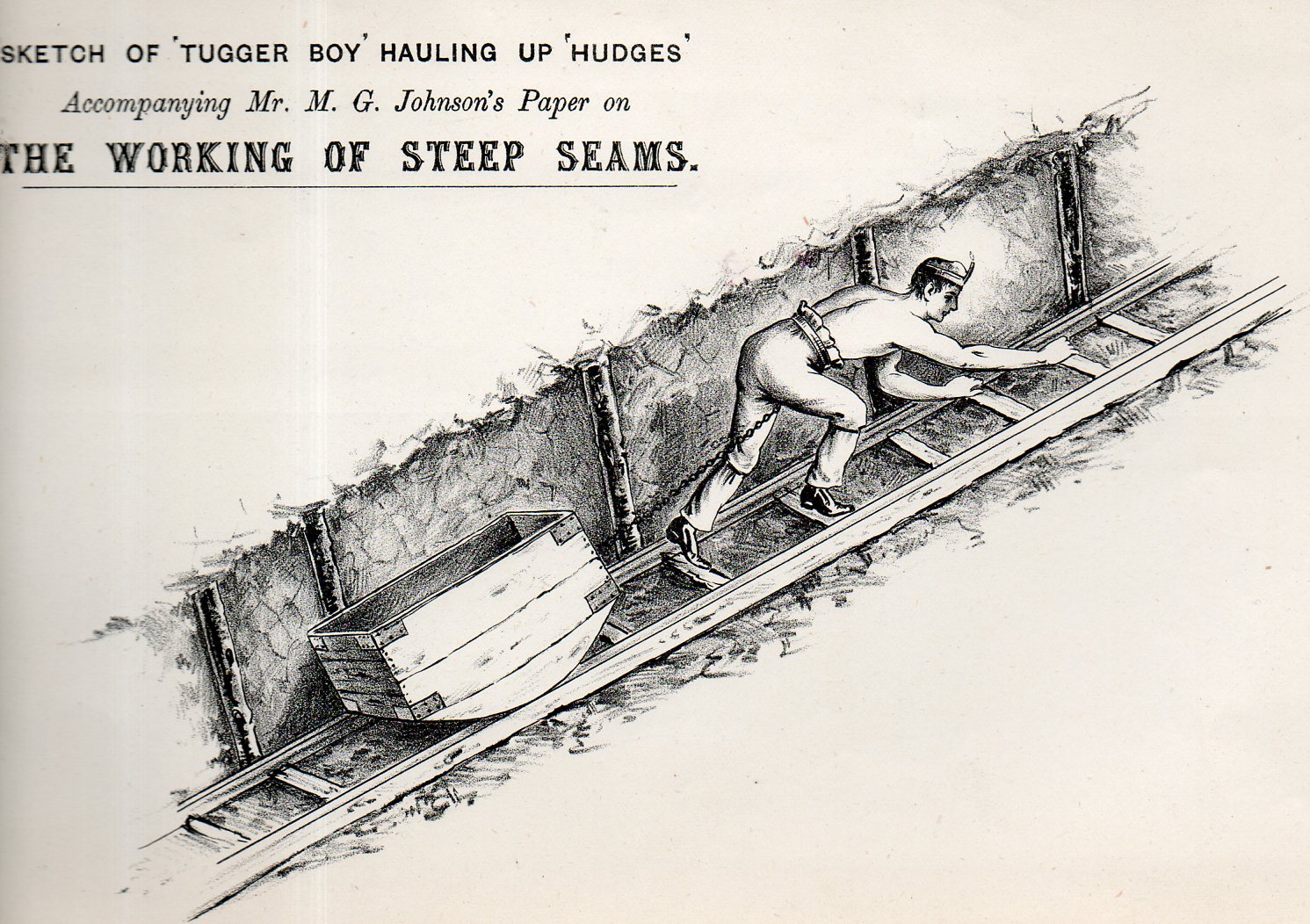
    This was “holing”, as in working in a hole, and served to illustrate a point in Mr. M.G. Johnson’s paper “The Working of Steep Seams”, which I think appeared in a West Australian mining journal around 1900.  So, it seems, the guy, the worker, in the picture would spend his day chunking coal from a hard vein, laying down, scrapping (I think) away at the coal in a too-tight tunnel.  Did he do this for hours?  Days?  Weeks?  I guess the bad answer is that he did this as long as the coal could be followed.   (Also, it looks as though that the major tunnel in which the coal car is located may be 4 or 5 shoulders high—certainly not tall enough to walk in, which means that this guy could’ve crab-walked to this position for a half mile or more, just to get to work.  The tenacity of this worker to do his work and collect his pay to feed his family was just incredible. 

    The first image really doesn’t need much commentary, though calling the worker a “tugger boy” pulling up a “hudge” was probably a bit of sardonic camraderie–except that the doing of the job would distance you from its folksy name. Well, that, or the “tugger boy” really is referring to a boy, as we see in the followlign mining definition: “Tugger boy (Brist). One who draws small tubs or sleds underground by
    means of a tugger. Called Tugger-work. (Gresley), 1883).  The depiction of what seems to be a mature man in the image might be a piece of propaganda. In any event,  the Tugger Boy carries his own flame on the top of his headgear, and the chain that attaches him to the heavy coal bucket runs from his waste down the front of his body and through his legs.  Very hard work needless to say–harder yet done by a child.

    George Orwell wrote perhaps one of the most brilliant descriptions of the mining environment in his superb The Road to Wigan Pier. (It is well worth reading all of Orwell’s books at this point—his insights almost never looked so fresh.)

    He  describes the crab-walk from the elevator to the place of work, telling how difficult and exhausting the process was of just getting to the place where you would then begin your difficult workday.  Of the miners he says at one point:  “Watching coal-miners at work, you realize momentarily what different universes people inhabit. Down there where coal is dug is a sort of world apart which one can quite easily go through life without ever hearing about. Probably majority of people would even prefer not to hear about it. Yet it is the absolutely necessary counterpart of our world above.”  Read more here.

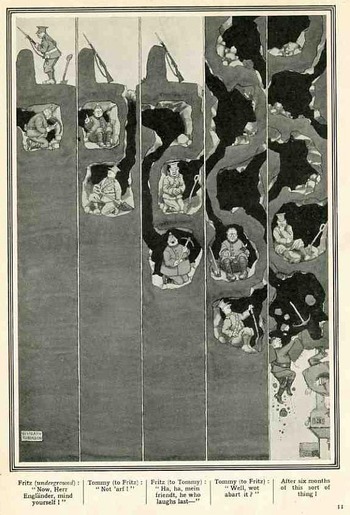
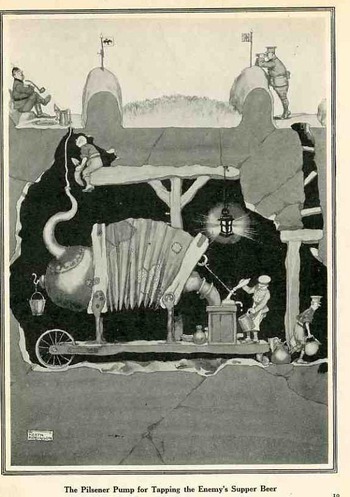
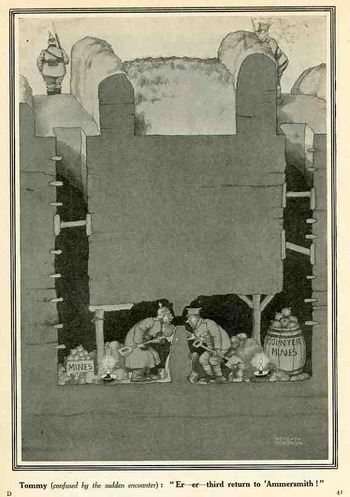
    The next series of images come from the pen of W Heath Robinson (1872-1944) who was a lovely, quirky, charming, skewed, dark, stiff-bouncing and creative illustrator capable of considerable whimsy (light and complex) and deep skepticism.  The images I’ve selected are from one of his three WWI books, Hunlikely, published in 1916 (Some “Frightful” War Pictures (1915), and Flypapers (1919), were the other two) and depict scenes from the intra-trench tunnel wars, which were battles fought in the midst (or, actually, beneath) other battles.  This was a savage, grueling, post-adjectival affair—exceedingly dangerous, difficult, awful.  And it happened a lot during the war, given the experience of stalemates between vast armies sunk into mole city trenches, with no one going anywhere for long periods because there was nothing in between the two impervious lines but a death vacuum. 

    Blogjuly_18_mining_robinson338

    So one of the solutions was to try and tunnel underneath the opposing army’s defenses, fill the far end with high explosives, and blow them up.  The other side was doing it too, and in the middle of it all was the incorporation of newer/better listening devices to detect forces rummaging around underneath your position dozens of feet into the ground.  It was a bad business. (One of the other means of breaching the trench lines was aerial combat, but bombers carrying tons of HE were still yet to be invented; poison gas was another.  Most of the time the armies would just meet in the middle  in wide plains of nothingness in a sea of hot, expanding metal,  where to this day in many of those places nothing can live).

    Robinson’s illustrations are odd, and oddly funny, the dark humor coming at the expense of both sides of the conflict, piercing each.   

    Blogjuly_18_tunnel_2_robinson340

    This puts me in mind of Tom Waits’ concrete-toothed “There’s A world Going On Underground” song from the Swordfishtrombones album. 

    Rattle big black bones in the danger zone
    There’s a rumblin’ groan down below
    There’s a big dark town, it’s a place I’ve found
    There’s a world going on underground
                
    They’re alive, they’re awake
    While the rest of the world is asleep
    Below the mine shaft roads, it will all unfold
    There’s a world going on underground
                
    All the roots hang down, swing from town to town
    They are marching around down under your boots
    All the trucks unload beyond the gopher holes
    There’s a world going on underground

    Blogjuly_18_tunnel_3_2_robinson341

    ·Posted by :

    ·in:

  • Anti-Nazi Cover Art, 1931

    JF Ptak Science Books   Post 2226

    German cover art044

    In a similar intellectual capacity (though not so much in the same genre) as the great John Heartfield, this cover illustration depicted what many were thinking about the Nazi Party in 1931. It appears as the illustration for Brechen die Nazis die Zinknechschaft?? Raffer und Schwatzer!, printed by the SPD (Sozialdemokratisch Partie Deutschland in 1931.  It also seems as though it was a response to the recent NSDAP victories in elections for the Reichstag on 14 September 1930.  That election was a major show of the Nazis and a semi-modern meet-and-greet campaign for Hitler, a political blitzkreig (in its way), a showing that had been unseen before in German politics, a production of short and repetitive phrasing, long promises and short details.  The result was an incredible win for the Nazis, going from fringe element with a comical leading figure to the second-most powerful party in the country, receiving more than 6 million votes and 107 seats in the Reichstag.  

    The SDP had a lot to worry about. In the last election the SDP had 153 seats with the Nazis 12; in September 1930 the SDP lost ten seats while the Nazis took 95, outpacing their new rival by over about 2 million popular votes.  In the March 1933 election the NSDAP took control of the Reichstag, ending with 288 seats, with the Social Democrats becoming the new second party with 120.  This was the beginning of the end–by the third week in March the Enabling Act was pushed through the NSDAP-Reichstag giving Hitler plenary powers with the ability to make laws without the input of the Reichstag.  The Act passed following the strong-handed rule-bending, with only the SDP members voting against it.  A new election was called in November 1933, with the Nazi Party being the only part to vote for–it received 92%  of the vote, consolidating Hitler’s control.  

    The pamphlet above was a slim 10-pfennig work, a diatribe against the Nazis.  The cover art warns the casual browser that once the Nazi mold/Facade (? of a relatively decent-looking Hitler-like face) was broken there was nothing underneath it but a snarling, puffy, monocled Brown Shirt.  (Unfortunately the cover art is unsigned. The pamphlet is pretty rare, with only one copy (NYPL) showing in the massive catalog of worldwide library holdings, the OCLC/WorldCat.)

  • Crazy Eyes in Advertising

    JF Ptak Science Books
    Mercedescrazy

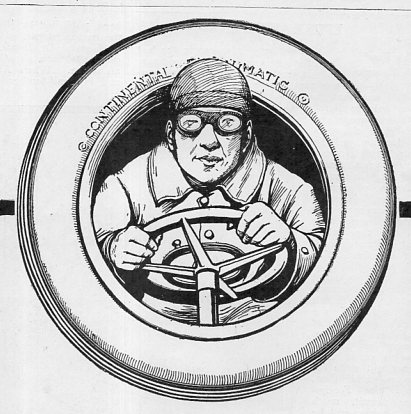
    I must say that when I first saw this advertisement for Mercedes (1924?, in the Illustrirte Zeitung from Leipzig) that I couldn’t really remember seeing someone looking quite this crazy/dedicated while trying to sell something, to anyone. This is particularly so when you take a look at a similar design for Continental Tyres, except that this ad appeared 14 years or so earlier, in 1910 (and in The Illustrated London News for May 14):   

    Crazy driver not043

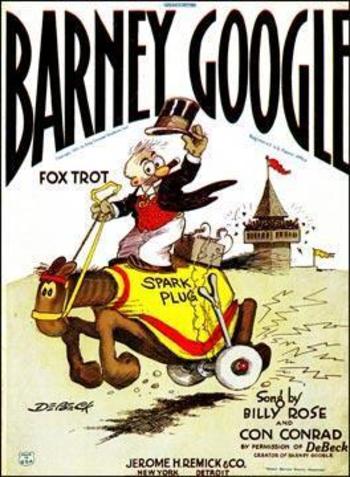
    Then I wondered about insane/laser eyes in general, and couldn’t come up much there, either.  Barney Google certainly had “goo goo googly eyes” but they weren’t necessarily crazy/insane.

    Classics_barney_google_sheetmusic

    Superman on the other hand did have laser eyes, and sometimes he was (made to be) crazy–still not quite up to the Mercedes guy, and he wasn’t trying to sell anything but himself and the comic that he was in.   I think that the Mercedes Man might be in his own category, and I’m not so sure how successful this ad campaign could’ve been, especially in the Weimar/Schacht era in hyper-inflated Germany.  

    Crazyeyesblank

    ·Posted by :

    ·in:

  • The Broken Windows of Uncle Chuckles–Charles Babbage Figures Stuff Out, 1857

    JF Ptak Science Books  Post 2227   

    The polymathic Charles Babbage’s (1791-1871) name is well known as the father of the computer–creating a non-steam steampunky sense of modern computing with metal gears–though some of his other nitty and detailed research is not nearly so well known.  One fantastic example of this is his interest in public nuissance problems of Dickens’-strollable London at high-Victorian mid-century, and particularly in one case in the breaking of plate glass windows. 

    He published the results of his study in an 1857 article, “Table of the Relative Frequency of Occurrence of the Causes of Breaking of Plate Glass Windows” in the  Mechanics Magazine volume 66, the highlights of which were summarized in this appearance in The Insurance Cyclopedia‘s (1878)  chapter on “Glass Insurance”, as follows:

    I just find this fabulous!  He no doubt found the whole thing appalling, as he did the other unruly stuff of life in the streets, with a withering view of the street-side life of the working and lower classes, but mostly for street hawkers and musicians and above all else it seems the organ grinder.  Babbage had a lot on his mind but there seemed to have been plenty of micro-room for concerns like these.  

    It should be mentioned that Babbage wrote a best-selling work in the not-yet-established field of operations research, writing a great and influential work on industrial production called On the Economy of Machinery and Manufactures (1832, with a fourth edition by 1836), so the fact that he took an unusually fine interest in window breakage and how that all worked out is not so unusual, for him.

    And just because the numbers are there and the results so interesting, I’ll include the previous entry from the article above:  

    ·Posted by :

    ·in:

  • An Old Fear Updated

    JF Ptak Science Books  Quick Post    

    Destroyer045

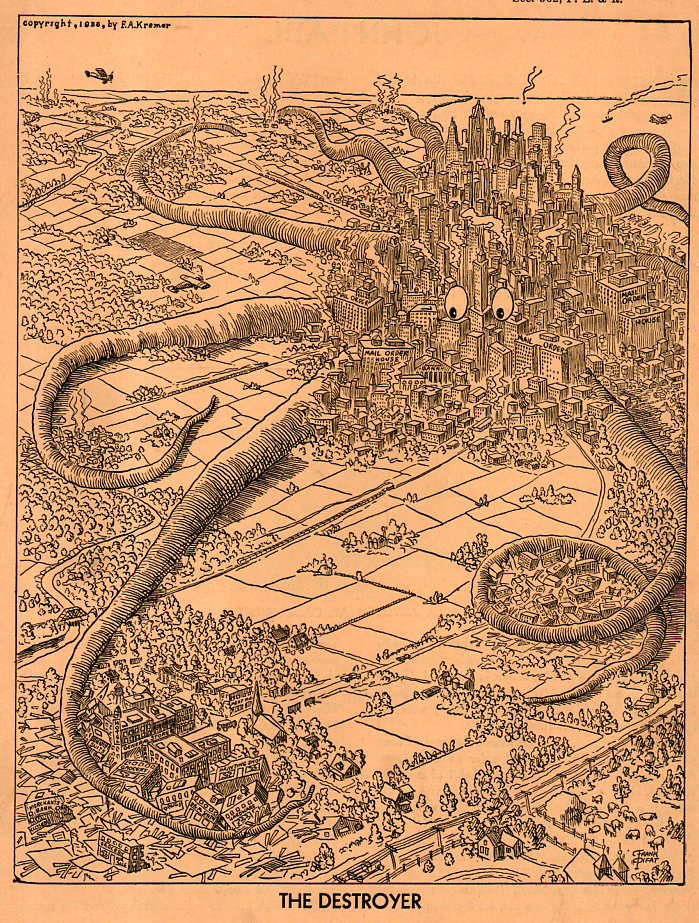
    The cover for this 1939 pamphlet I just found is pretty remarkable–very striking, strong, and capable of some sort of message which could’ve been helped along by another identifying agent.  Thomas Nast it isn’t, because it really doesn’t send the intended message by just visual means–you have to read the pamphlet to find out its meaning.  

    And as it turns out the octopus represents mail order companies.  Located in cities far-ish removed from small communities, the author (F.A. Kremer?, the man who at least copyrighted the thing) maintains in his morality tale that by ordering from far-away places a person causes the failure of local business. 

    He’s not far from the truth, especially if you update the language a bit and label the octopus “Amazon” or some such thing–even a megastore like “WalMart” would do. Or any large chain that has spelled the doom of a smaller/local business.  

    In any event I like the graphic, and I sincerely doubt that it has been published before, as there are no copies discernible on WorldCat/OCLC, and my copy (from the Library of Congress Pamphlet Collection) is also a copyright deposit copy.  So I suspect that Kremer’s effort didn’t make it out too far into the world.  

  • Outsider Logic and Bizarro Energy Conversion, 1926

    JF Ptak Science Books   Quick Post

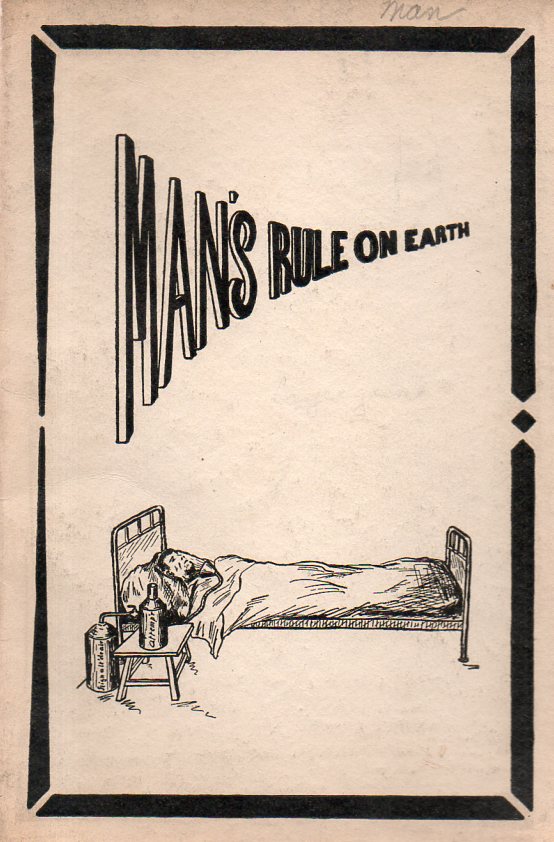
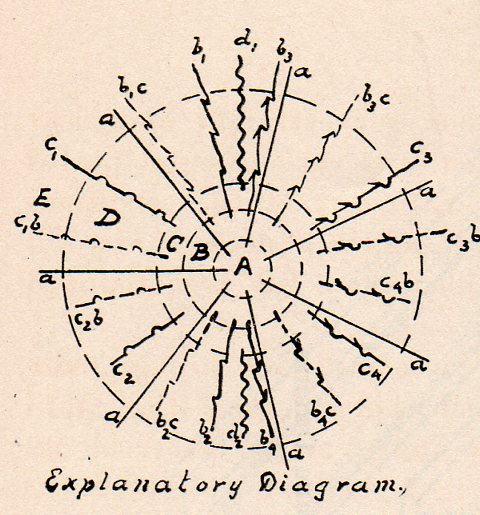
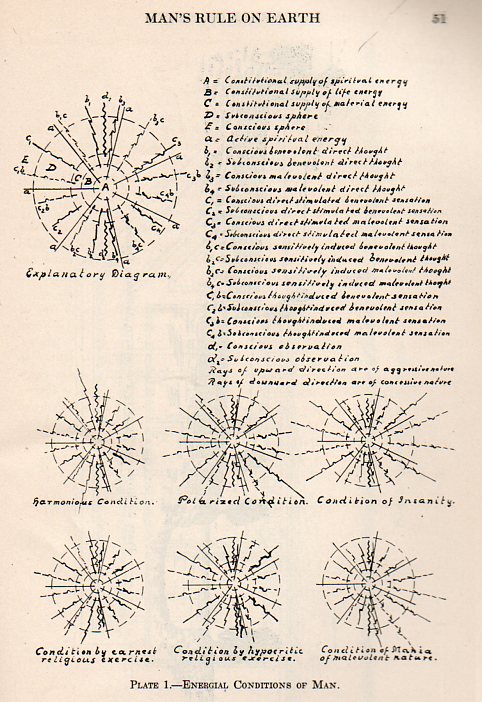
    This magnificent piece of outsider thinking by J.T. Lagergren, Man’s Rule on Earth, was published in 1926, and seeks out the secret human-powerly passions that are/were present in people and their surroundings.  Maybe “published” is too strong a word, as my copy is the copyright deposit copy, and there seems to have been no other copies, or copies that I can find, anyway.  (I can find no copies of the work in the massive library database OCLC/WorldCat, and no other works by him, although he did register a number of patents for refrigeration valves and such.)

    Mans rule050


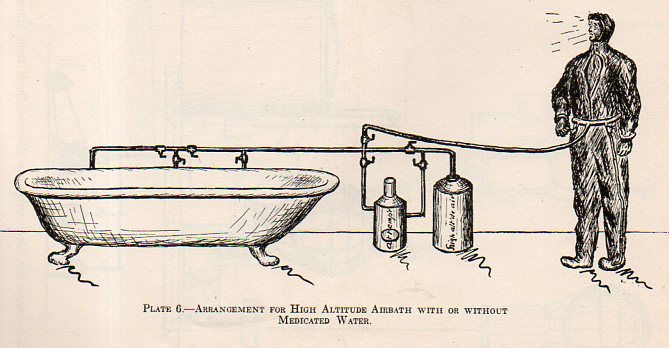
    I’m not altogether certain how the author was going to re-establish what was claimed to be the degeneracies of mankind, except that it involved removing “energial” capacities of water, and to “retrieve the energy being carried away through the rivers”. It also involved a plan to retrieve “high altitude air” and pump it into pressure suits of some sort to release hidden and lost energies, and of course much more, worthy of the pamphlet’s 56 pages, though much of it sounded better of it was done in secret and invisibly.

    Here’s an example of the content of the work:

    Mans rule051There are diagrams to go with this:

    Mans rule048Which is a detail from the following:

    Mans rule047

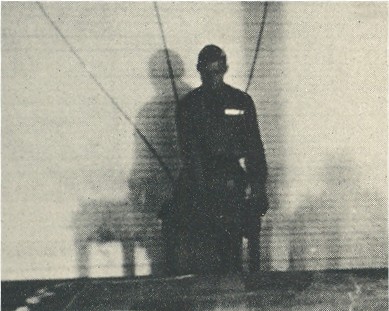
    Mans rule049

    ·Posted by :

    ·in:

  • Bombing and the End of the World: the Physics of 1932 And All That

    JF Ptak Science Books 

    1932 in my book turns out to be one of the most collectively epochal years in the history of science.  Certainly others stand out for individual achievements, like 1905 (Einstein’s four papers over two volume of the Annalen), 1687 (Principia), but there are other yeas with fabulous achievements by numerous people.

    Mar 7 airmen det


    1543 is one.  That year witnessed the published of Copernicus’ De revolutionibus and Andreas Vesalius’ De humani corporis fabrica, two giant achievements for the outer and inner worlds, one challenging the structure of the universe and the other the Galenic tradition of physiology and anatomy. (To a lesser extent is Peter Ramus’ Animadversions on Aristotle which was a very sustained and elegant attack on the ancient-precept Aristotle an physics.)

    1859 saw the publication of On the Origin of Species…JC Maxwell’s work on the kinetic theory of gases, Riemann’s hypothesis, and the spectacular invention of the spectroscope of Kirchhoff and Bunsen (that turned much of the invisible universe visible).

    Mar 7 airmen det 2


    1939 (nuclear fission, chain reaction, neutron stars, magnetic moments, penicillin (advancement), Vitamin K, FM) and 1948 (nuclear structure, QED, transistor, Big Bang) also come quickly to mind.

    1932, though is really quite something, seeing a sweeping array of discoveries in the large and small.  Carl Anderson identified the positron while James Chadwick discovered the neutron; also, the Joliot-Curies’ made their monumental discoveries in radiation.1 Iwanenko described the neutron as a constituent f the nucleus, while Heisenberg described the nucleus as composed of protons and neutrons.  Knoll and Ruska built the electron microscope, allowing a vision of the interior parts of the interiors of the smallest things, offering images almost as spectacularly new as Hooke’s two centuries earlier.  Looking up and out, in the same year, Lev Landau postulated the existence of neutron stars while Karl Jansky invented radio astronomy. There was also the perfection of the “Polaroid” process by Ed Land, and the isolation of ascorbic acid (Vit C, by  Charles Glen King, and the beginning of a long war between him and Szent-Gyorgyi on priority of discovery).  (In the non-sciences, there was the addition of Franklin Roosevelt and Adolf Hitler to their national agendas. It was also a banner year for literature: Death in the Afternoon, Ernest Hemingway; Light in August, William Faulkner; 1919, John Dos Passos; The Thin Man, Dashiell Hammett; Tobacco Road, Erskine Caldwell; Young Lonigan, James Farrell; Little House in the Big Woods, Laura Ingalls Wilder; and Brave New World, by Aldous Huxley…)

    Mar 7 airmen 

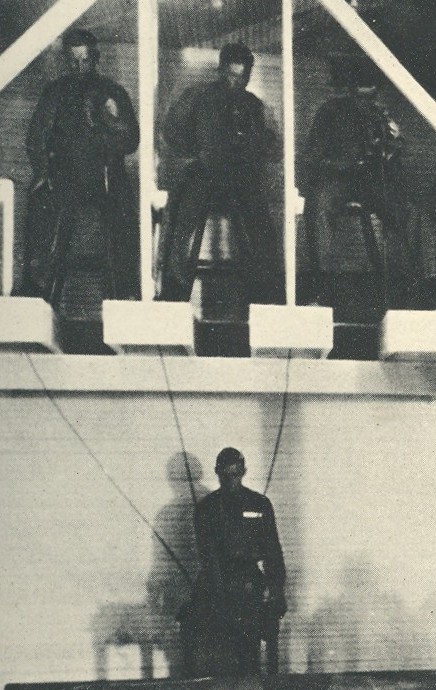
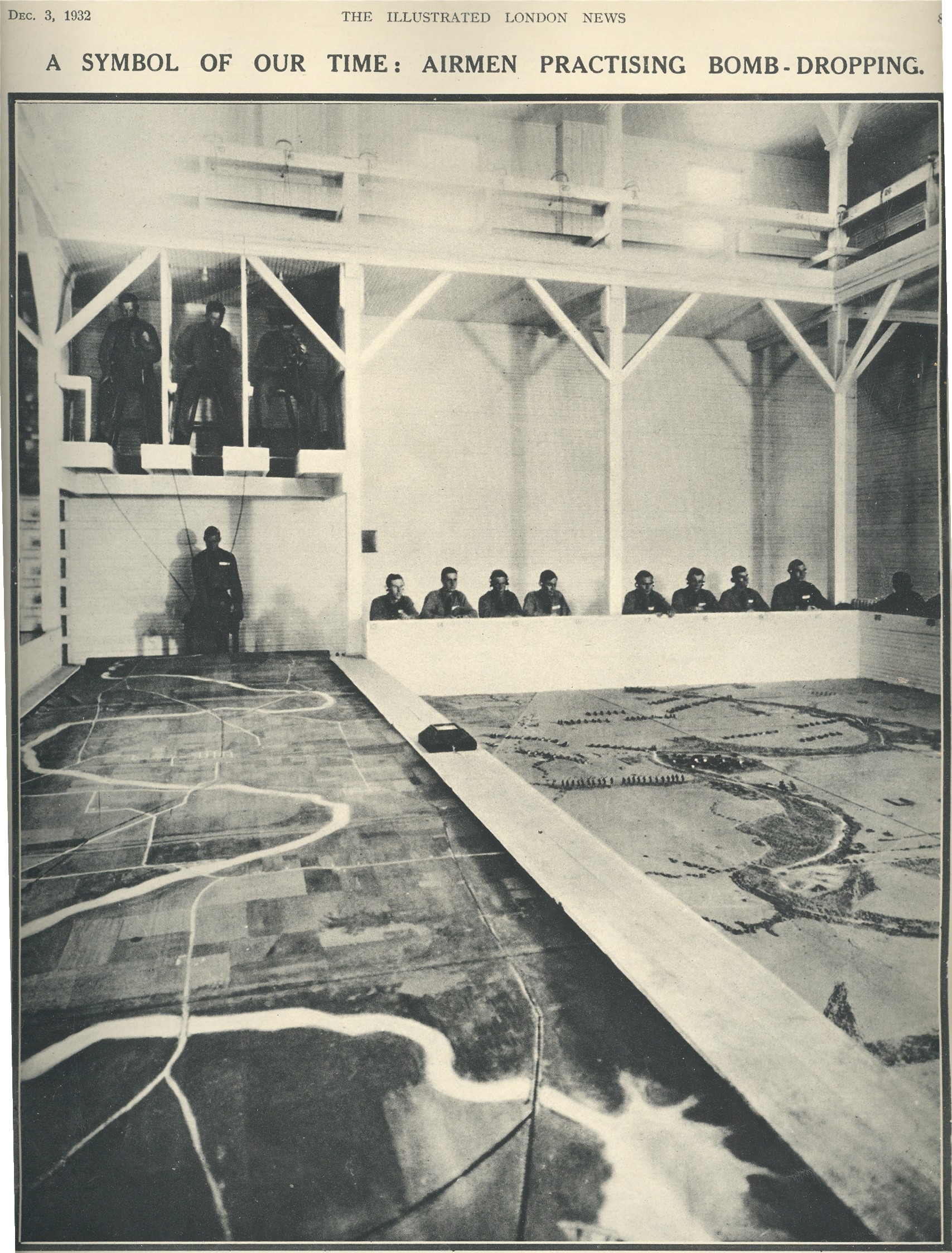
     The thread of thinking about all of this came to mind looking at this image of a bombing instruction room for aviation in England in 1932.  The image is also a great one; the aviator at far left looks like a marionette; the three men above responding to his piloting maneuvers as he concentrates on the endless panoramas of landforms that advances before him on a horizontal diorama.  It is a fabulous analog flight simulator constructed at a time of great change in aviation


    Wonder stories

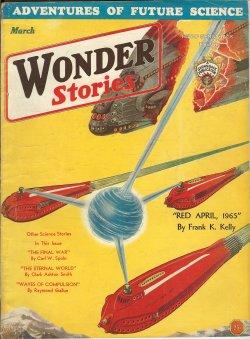
    1932 is also the year of the publication of Carl W. Spohr’s classic future-vision/speculative fiction apocalyptic-atom bomb end-of-the-world two-parter (so many hyphens!) that appeared in Wonder Stories.2 The story begins with a relatively simple series of catastrophic bombings that lead to a sort of détente, a kind of mutually assured destruction, which is then upset when the combatants discover and construct the atomic bomb.   MAD breaks down, and the ensuing massive exchanges result in a  devastated world.   Pretty prescient stuff, all-in-all, even so far as the policy goes—especially so when you wrap this sci-fi story around the elements of 1932—Chadwick, Anderson, Joliot-Curie—that made all of this stuff possible just 13 years later.

    Notes

    1 The Joliot-Curie discovery was called “one of the most important discoveries of the century… the consequences of the discovery of artificial radioactivity are immense” from Segrè, From X-rays to Quarks, 198-199).  

    2.  Part one appeared in the March issue, which also carried stories like“Red April, 1965” by Frank K. Kelly; “The Eternal World” by Clark Ashton Smith; “Waves of Compulsion” by Raymond Gallun; “Mutiny on Mercury” by Clifford D. Simak; “The Time Stream” by John Taine (Eric Temple Bell), and others.  Pretty good bumper crop of sci-fi writers in itself.

    ·Posted by :

    ·in:

    —
  • The Floating Aristotelian Hobo Poet Laureate of West Madison Blvd, 1925

    JF Ptak Science Books  Post 2228

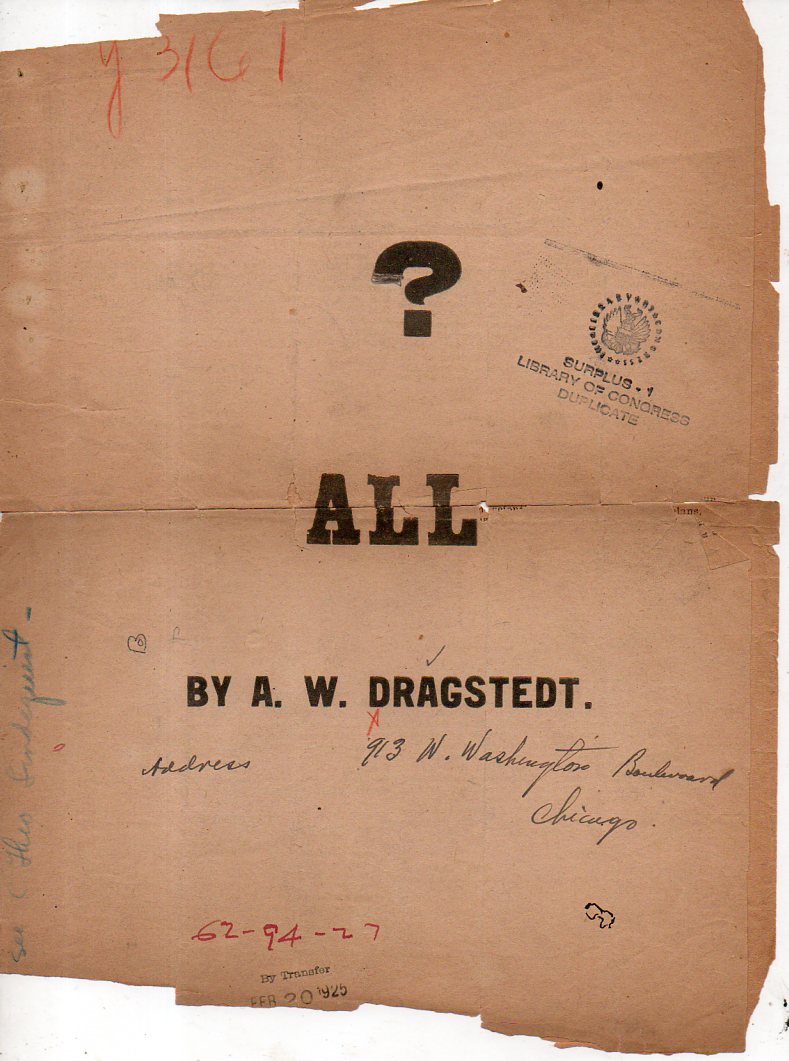
    It seems that this odd and strangely beautiful pamphlet, ?All, by A.W. Dragstedt, is a fascinating surviving relic of a largely ephemeral world.  Mr. Dragstedt was the secretary of the Kingdom of Hobos of the United States, and for years was largely and necessarily on-the-move, though he seems to have settled into Chicago a bit when he served in official HoboWorld capacities.  The penned address on the incredible front cover (“913 W. Washington Blvd, Chicago”, today the home of the improbably-named “Sushi Pink” restaurant) was one of the addresses identified for the Hobo College in which he worked–that according to Roger Bruins, in his book on King of the Hobos, The Damndest Radical (1987).  This means that Dragstedt–also known to some as the Poet Laureate of West Madison (Blvd)1 and the “Hobo Intellectual”2–probably wrote this while staying there, at the Hobo College, in 1925. THis opens up a new field to me–printed Hoboiana, published works by working Hobos3.  

    Hobo--dragstedt053

    Aside from its unusual composition and design, the work is an unwieldy but semi-non-poetic Aristotelian pronouncement on the constitution of man and the cosmos, and pretty mysterious. Well, “Aristotelian” goes a bit to far, but in a way it is accurate, because the author considers the essence of matter and being and time and space and is an observer of his world, and seems for himself anyway to have drawn a conclusion from it all, though it is difficult for me to say exactly what that is.  Since the document is only a folded piece of paper, and the cover and back-page ad covers half of it, I’ve reproduced the two pages of print below.  

    It must have been a considerable effort to make something like this happen, even if you did occupy a powerful position in a floating world.  

    ·Posted by :

    ·in:

  • History of (Electronic) Holes, 1946

    JF Ptak Science Books  Post 2229           History of Holes series

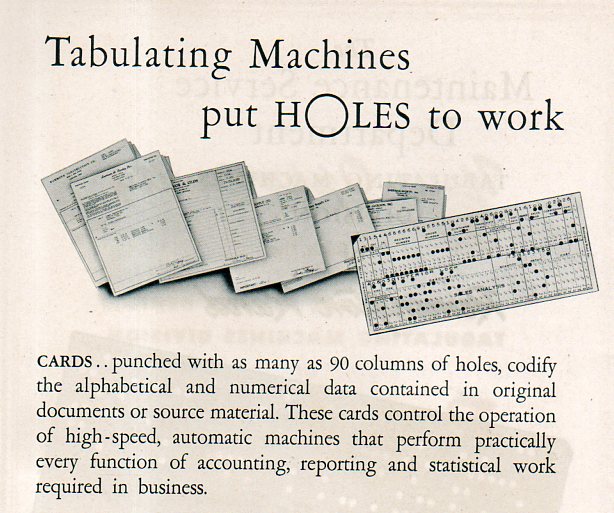
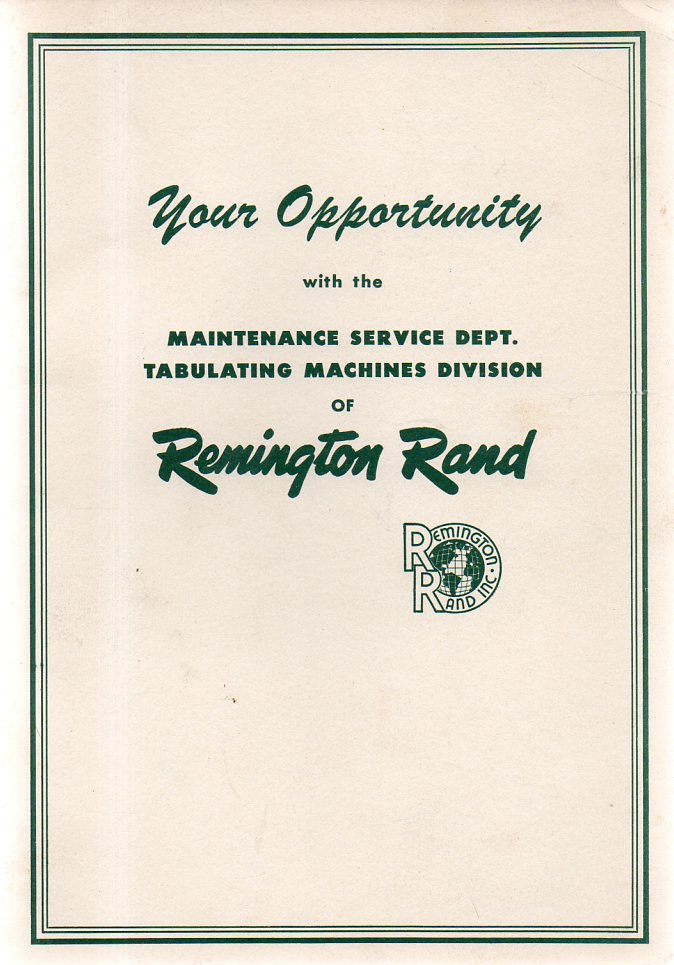
    I’ve written elsewhere in this History of Holes series about holes and electricity and the Jacquard loom and early tabulating machines–but I’ve never seen anything in-print from this period of time using the word “holes” to promote a tabulating device.  And here it is in a Remington Rand promotional for scouting field service technicians, and printed ca., 1946:

    Remington rand holes057

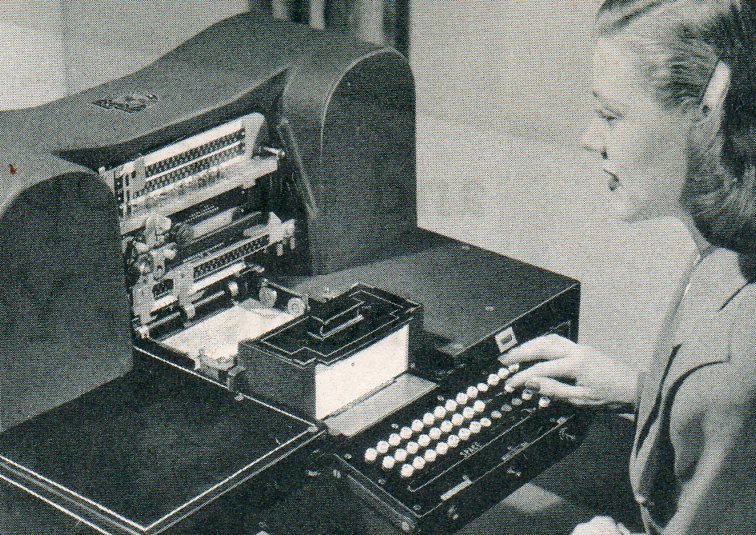
    Remington Rand at one time was Remington Arms, and then diversified to produce all manner of light and heavy electrical goods (and of course famously producing the standard U.S. Army sidearm, the 45-calber Remington M1911 pistol), and by the end of WWII the company produced a vast line of tabulating equipment (of another order of high caliber).  Interestingly the pamphlet exclaims that a person working for RR could work there for as long as they wanted, that the company was there to stay.  

    Remington rand holes058

    Certainly the company would hang on for some time in one form or another, but the tabulating card division was about to change drastically.  In 1950 RR purchased Eckert-Mauchly Computer Company (ENIAC) and a few years later (1952) secured another giant computer pioneer, Engineering Research Associates (ERA), making Remington Rand about the largest computer company in the world. RR would be purchased a few years later by Sperry in 1955, becoming Sperry Rand, and then simply Sperry a short time after that; later, in 1986, Sperry would merge with Burroughs and become Unisys. Somewhere in there all of these tabulating machine repairmen and techs hired fresh in 1946 would be out of their lifetime job less than a decade later.  

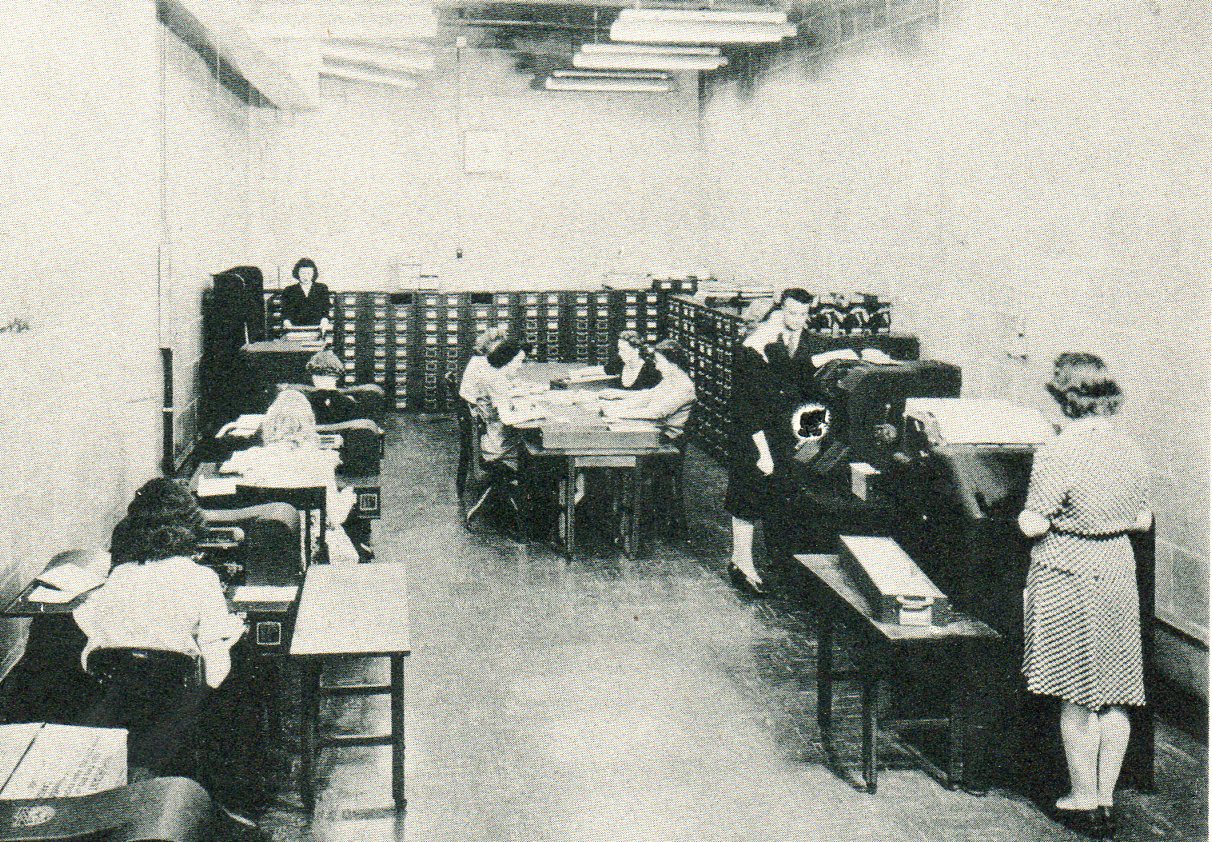
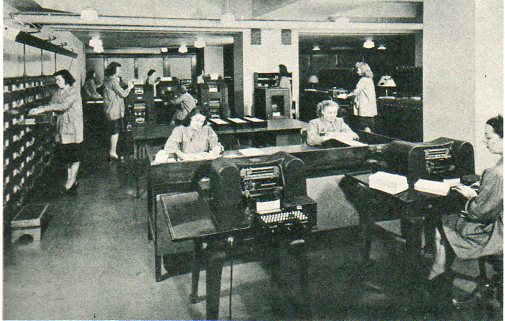
    [“Typical office installations of Remington Rand equipment”]

    Remington rand holes059

    Remington rand holes060

    Remington rand holes061

  • On Unusual Collections: Roads

    JF Ptak Science Books

    In my time I’ve encountered interesting people with advanced, iconic and unusual collections:  there’s one fellow with a superb collection of (better than 30,000) cds with basically nothing to play them on (but of course he knew all  of the music, and listening was almost but not quite secondary); then there’s another with an audio outfit worth better than a quarter million with literally almost nothing to play on it.  Then there was the delightful guy in the salvage business who collected cornerstones (!) and giant iron puddlers.  And of course the bee collector with dozens of thousands of specimens.  Oh yes!  And there was that time when I had a meeting with a man on something (on the day the Challenger exploded) unrelated to the spectacular collection he showed to me:  the world’s largest, privately-owned 19th century mechanical toys.  It was really just unbelievable.  So was the man, who in the course of the day, as we sat watching the Challenger story unfold, performed on of the most amazing feats I’ve ever seen in my life. 

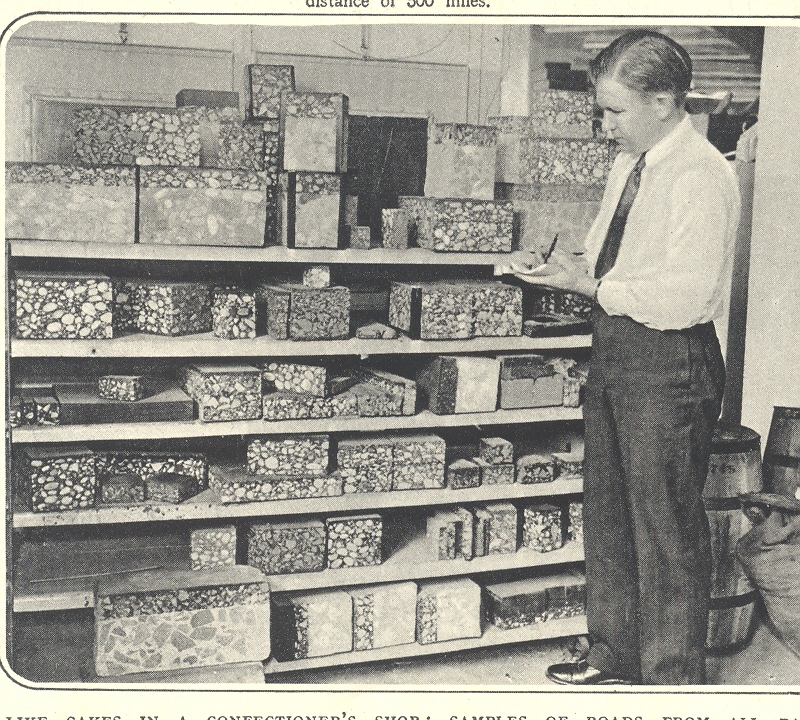
    Road samples

    My collecting bits are simpler: I collect dirt and antiquarian artwork by children, among other simple things.   Also, once upon a time I owned a very large collection of lower gastrointestinal dissections as well as gorgeously prepared wet dissections of salivary glands. 

    And so it was that when I came upon this unusual image in The Illustrated London News for 21 May 1932 I felt a certain tenderness.  This is a picture of a road collection, located somewhere in the U.S.,  and includes shelf upon shelf of cross sections of roads.  They happen to look like cubes of fat to me.  (We’ll leave the bags of eyes story for another time.)  I understand the need  for  such a collection for engineering purposes; I just happened to like the idea (and the picture) of A Road Collection, and have it undisturbed by any explanation or insight.  Just a collection of roads. 

  • Big Sparks: an Early Electric Piano & Sorta-Telegraph, 1767

    JF Ptak Science Books   Post 2230

    The description of one of the electric piano-like instruments1 occurs early on in the history of electricity, and in the case of the Jesuit Giuseppe Marie Mazzolari, it is a narrative that found its way into print in 1767. Mazzolari was actually a contributing editor of this work which was a compendium of  state-of-the-art/science tour of mid-18th century thinking and accomplishment, making his Electricorum Libri VI2 is a semi-encyclopedic testament to the period of scientific achievement and progress. Another outstanding and unexpected contribution in this book though was made by Joseph Bozzoli (1724-1783) who made the suggestion of using electricity to transmit information–that would have been a sort of electric telegraph, using encoded sparks in a Leyden jar to transmit info from one end of the electric circuit to another, which is very cool stuff 70 years before the first certified electrical transmission of data, and nine years before Tiberius Cavallo, who is generally considered to be the first to make this suggestion.  

    Oddly the book–or references to it–do not seem to show up very often in the standard histories of electricity.

    Notes 

    1.  This is actually an electric cymbalo (“Cymbalum Electricum” as it is called in the illustration in the book), but the issue is the same, being a description of the first electric keyboard instrument.  It is called a cimbalom, cymbalom, cymbalum, ţambal, tsymbaly, tsimbl, santouri, sandouri, and so on, and is a type of hammered dulcimer. A slightly earlier description occurs in Jean-Baptiste Thillais Delaborde’s  Le Clavessin électrique avec une nouvelle théorie du méchanisme et des phénomènes de l’électricité (Paris, 1761)  “Delaborde built a working model of his innovative instrument and organized performances, however, even though the press was sympathetic to the clavecin électrique, it was never developed further and was soon forgotten.”–Wiki

    2.  Mazzolari’s book isn’t in six volumes–“Libri VI” or “Libri sex” is simply the notation for the book being divided into six major sections, or books in Old School antiquarian parlance.  

Recent Posts

Archives

Categories