A Daily History of Holes, Dots, Lines, Science, History, Math, Physics, Art, the Unintentional Absurd, Architecture, Maps, Data Visualization, Blank and Missing Things, and so on. |1.6 million words, 7500 images, 4.9 million hits| Press & appearances in The Times, Le Figaro, Mensa, The Economist, The Guardian, Discovery News, Slate, Le Monde, Sci American Blogs, Le Pont, and many other places… 5000+ total posts since 2008.

  • World War I Photos (cont.) Telegraphs and Woods, 1918

    JF Ptak Science Books  Quick Post

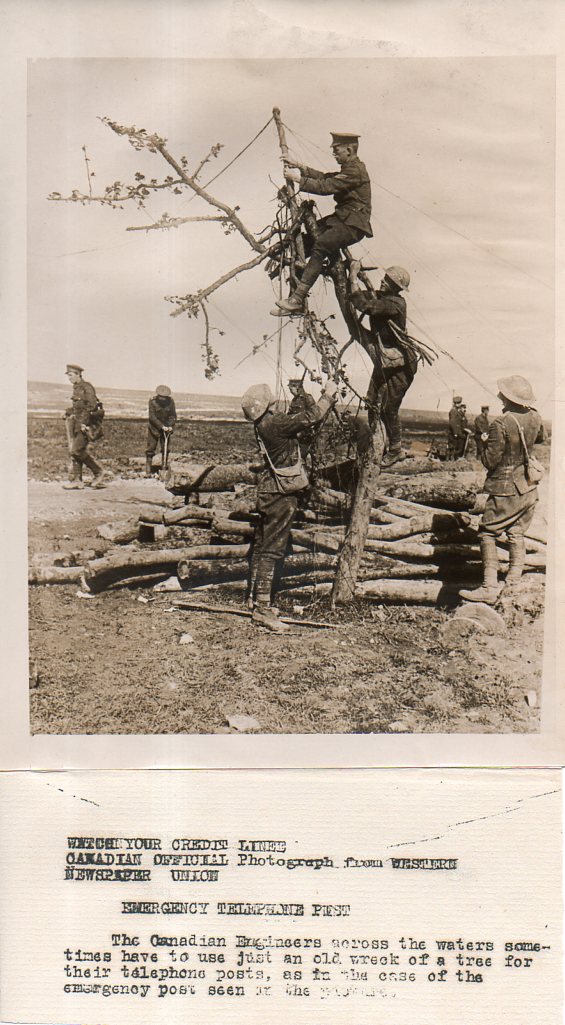
    During World War I battlefields that began as forests ended as plains.  And since telephonic communications depended upon wires, and since the wires needed to go somewhere, anything that survived that was head-and-shoulders above the ground was of particular use, especially to the telephone corps and especially for the use of telephone wires.  This news service photo (provided by the Western Newspaper Union) shows a rather desolate scene, with Canadian engineers working the wreck of a lone tree for all it was worth…as is plainly visible, there is nothing else like it in the near or remote vicinity.  

    WWI Photo Telegraph176It was the practice of the agencies providing these images for worldwide distribution to also include typed captions for the photographs.  

    This image can be purchased from this blog’s WWI Photography site, here. 

    ·Posted by :

    ·in:

  • A Captured German Three-Inch, 1918

    JF Ptak Science Books   Quick Post

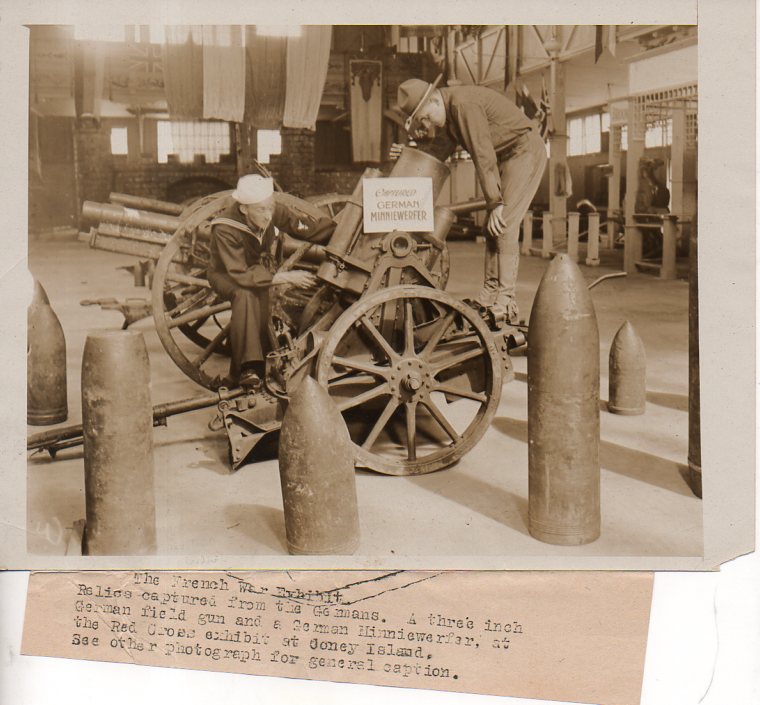
    The American soldier in thiis news service photo is having a good hard look at the business end of a captured German Hinniewerfer, a three-inch field guin used to devastating effects throughout the war.  We are told via the supplied typed caption that the display was installed on Coney Island (Brooklyn) as part of a Red Cross fund-raising exhibit.  (The original photograph is available on our blog bookstore, here.)

    WWI Photo Captured German artilleryh177

    ·Posted by :

    ·in:

  • WWI Photos (cont,)–a Corps of Women Aiding Soldiers at the Front

    JF Ptak Science Books   

    0 blog jan 12baker377

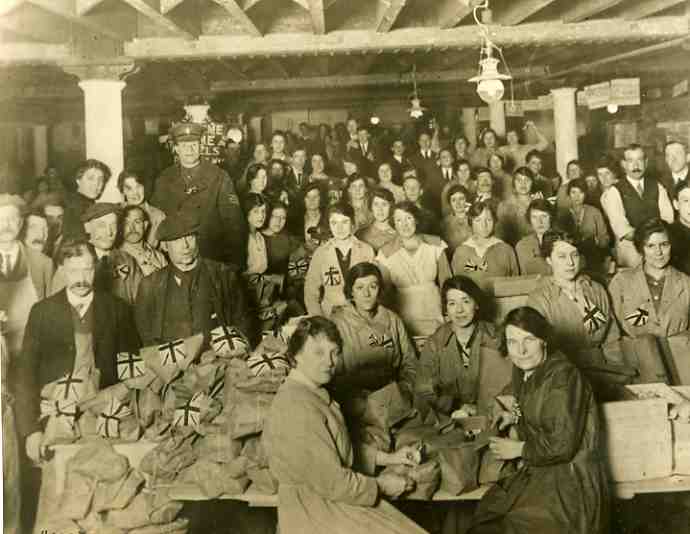
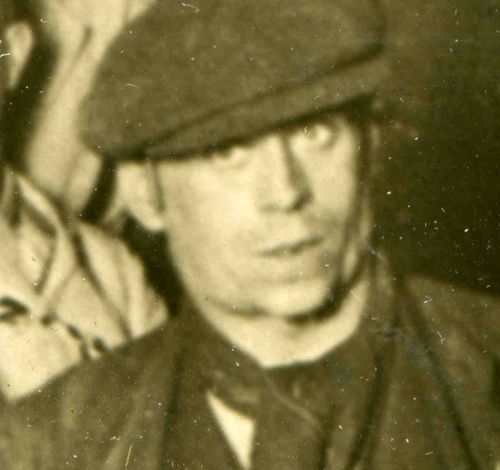
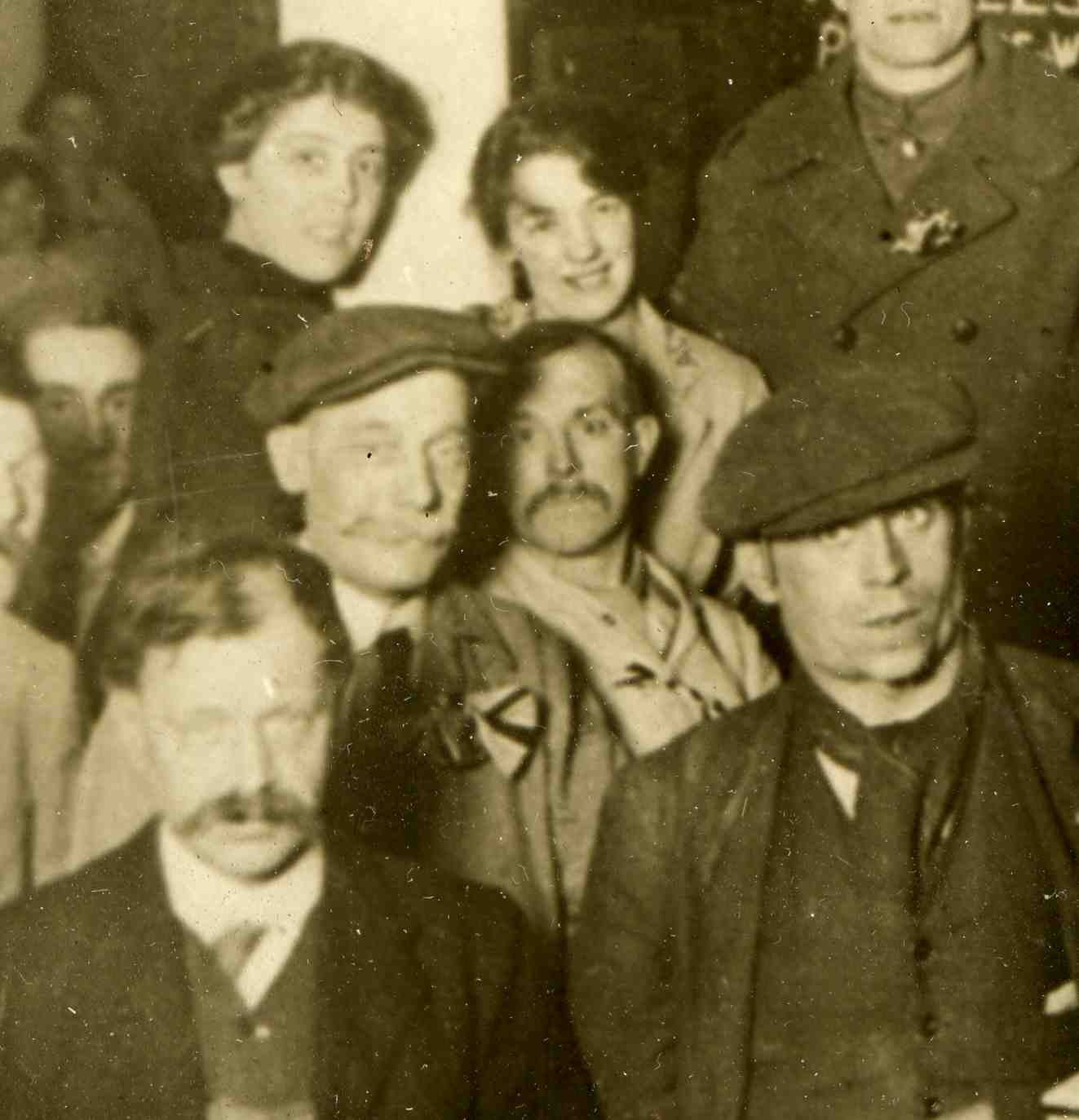
    This is another magnificent group portrait from my collection of News Service Photographs from World War I.  This is image is from mid-1918 and depicts nurses, wounded and recovering soldiers and an assortment of volunteers preparing relief packages for other wounded soldiers in field hospitals.  My experience with these images is that are many levels of portraits within the larger group portrait–looking at them under magnification is an addictive process, and quite often there are some lovely surprises.  

    The original can be purchased from us here.

    0 blog jan 12baker379

    0 blog jan 12baker378

    ·Posted by :

    ·in:

  • An Unusual Set of Astronomical Images

    JF Ptak Science Books  Quick Post

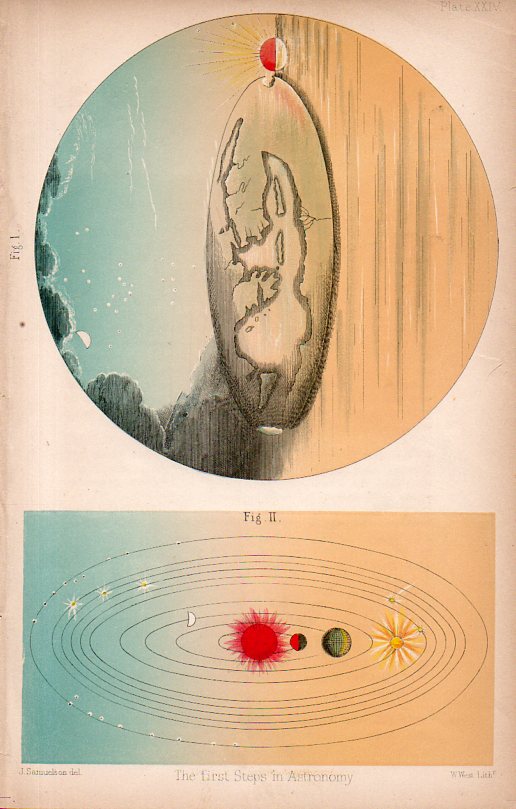
    Well, these look unusual to me, mainly because I do not understand the representation of the Sun in either image.  The first image (printed I guess around 1860) is the easier of the two, showing the Oikoumene, the inhabited world, of the Earth as known to Herodotus, the orbis herodoti, of the 5th century bce.  All of the land to the right (south) is Libya, Arabia, Persia, and India, all undifferentiated, though we can see the Nile delta. The two main land masses poking into the sea are Thrace and Phrygia, with

    Astronomy odd178

    no sign of very much to the west of that, no sign of Italy, nothing for the Celtic regions or Iberia, with some hint of polar regions.  Why the Sun is so, I am not sure.  

    The red Sun makes another appearance in the outline of the solar system, in the next image.  It is red, and brilliantly so, and firey; in the place of the Earth in the third sphere is the Moon, and beyond that another yellow firey star, which I take to be, perhaps, our own planet.  I can’t read this one, the yellow star and all…though it is very pretty.  

  • Towering Minor Masterpieces

    JF Ptak Science Books   Post 2271

    Years ago I purchased a very large collection of pamphlets from the Library of Congress, something like 2000 crumbling blue document boxes on two long ranges of metal shelving.  It was creatively called (and stamped) “Pamphlet Collection” and rounded up to about 90,000 items, all of which needed to be hand stamped “Library of Congress Surplus Duplicate”.  Now the great majority of these were things like updates to the Cleveland plumbing code of 1922, but there were still many thousands of interesting items, and even after all of this time I really haven’t dealt with all of it.

    (The remarkable thing is that on the next range over was housed a very large collection of a (or the) Ray Eames archive.  There were models, boxes labeled  “1939 World’s Fair”, “IBM”, so on–and his phone.  I walked the range of this collection but didn’t touch or open anything, which was remarkably tempting.  It was all very dusty–years of dust.)

    The arrangement of storage of the pamphlets was also very precise and thorough and also almost entirely useless. Even though if you squinted everything could be in its proper box, the sorting was very democratic, with things arranged by title and subject and author and period, all within one single category, making the notes on the side of the box just hopeful expressions of what might be inside.   It made for an interesting hunt. 

    One of my favorite categories of pamphlets from this collection were the mimeographed or early-photo-mechanical reproduction productions, things that were home/office produced, and usually for a very restricted audience.  These people meant business.  For example:

    The Struggle for Life in Los Angeles County, published by Edward Reimer (825 West 8th St), Los Angeles; presumably Reimer printed the document, as well, it just has that homemade feel to it, and it seems to be an early mimeographic reproduction production, and, probably, of very  limited distribution.  It was printed on 11×8.5″ sheets in purple ink, 107pp, running about 60,000 words, and is also the Copyright Deposit copy (serial A 208715, July 6, 1936). This seems to be the only available copy of any interesting report on the conditions and remedies of social and economic conditions in Los Angeles in the mid-1930’s, and I think in the right hands could be brought back to life again as a semi-lost social document.  

    [All of the following are available for purchase via the blog bookstore/social history section.]

    LA Struggle176


    LA Struggle178

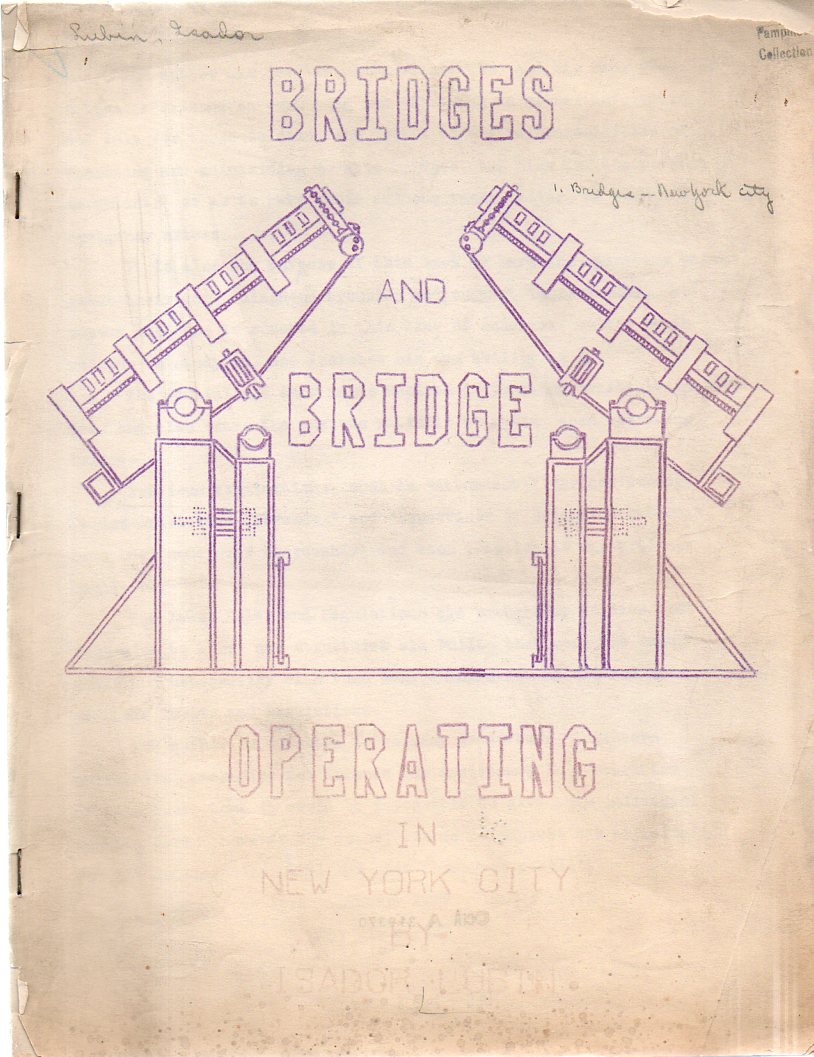
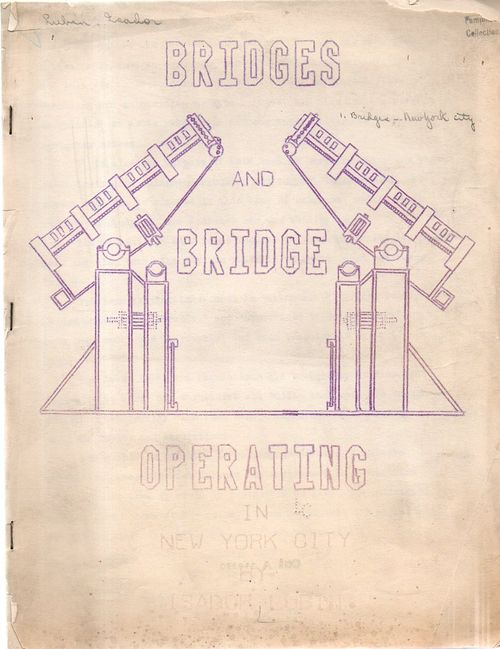
     And another, being everything you wanted to know and then more so on operating movable bridges in New York City, Isidor Lubin’s Bridges and Bridge Operating in New York City, printed in 1939. It is 11×8″, a 114pp, single-spaced typed and mimeographed document of about 70,000 words.  This also seems to be a copyright deposit copy, with no copy turning up in the massive WorldCat catalog, and seemingly no copy available in libraries worldwide. In exhaustive detail Lubin discusses the operations and maintenance of movable bridges–and I mean all manner of things, from oiling to fuse boxes and lighting scenarios of control boxes and communicating with landside control; uniforms, courtesies, questions given in promotion examination to bridge operators (with answers), duties of bridge operators and tenders in operating drawbridges, distress signals and on and on.  
    New York movable bridges180


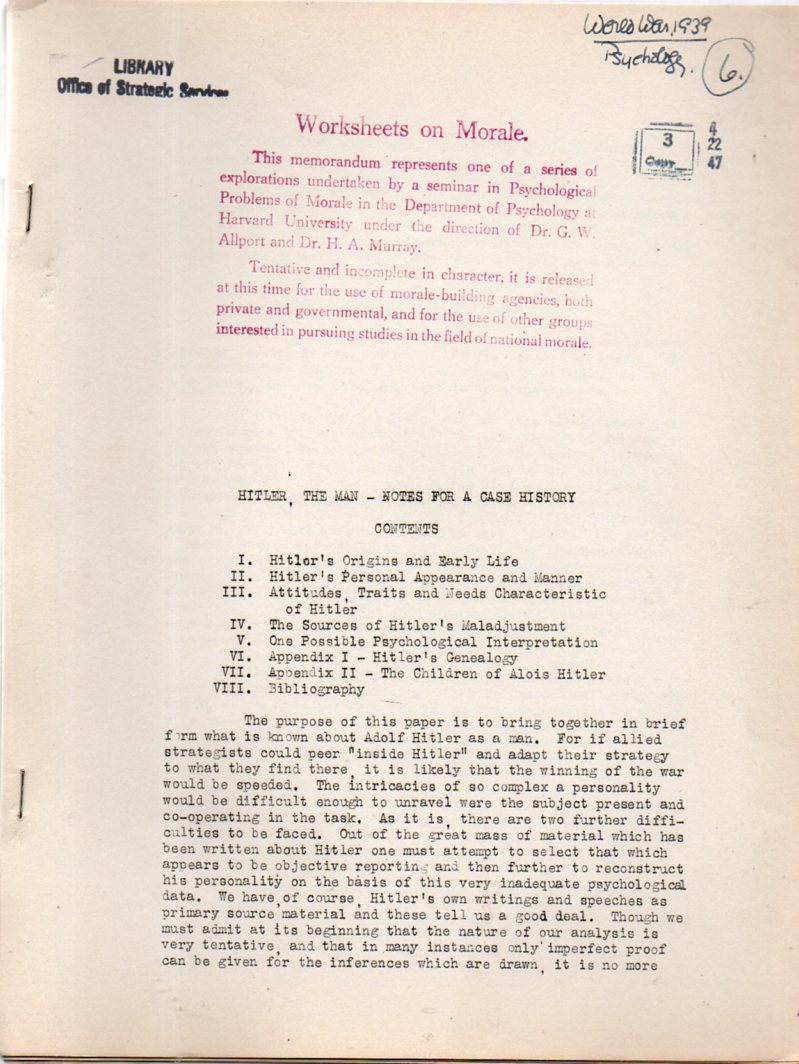
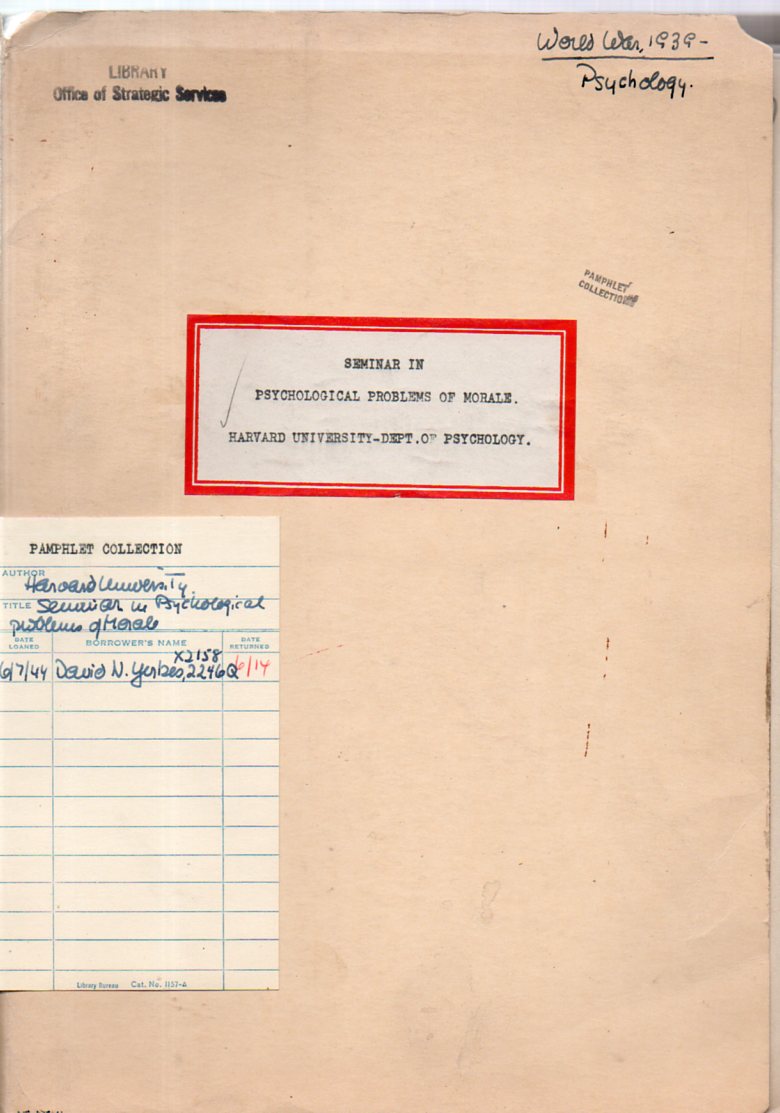
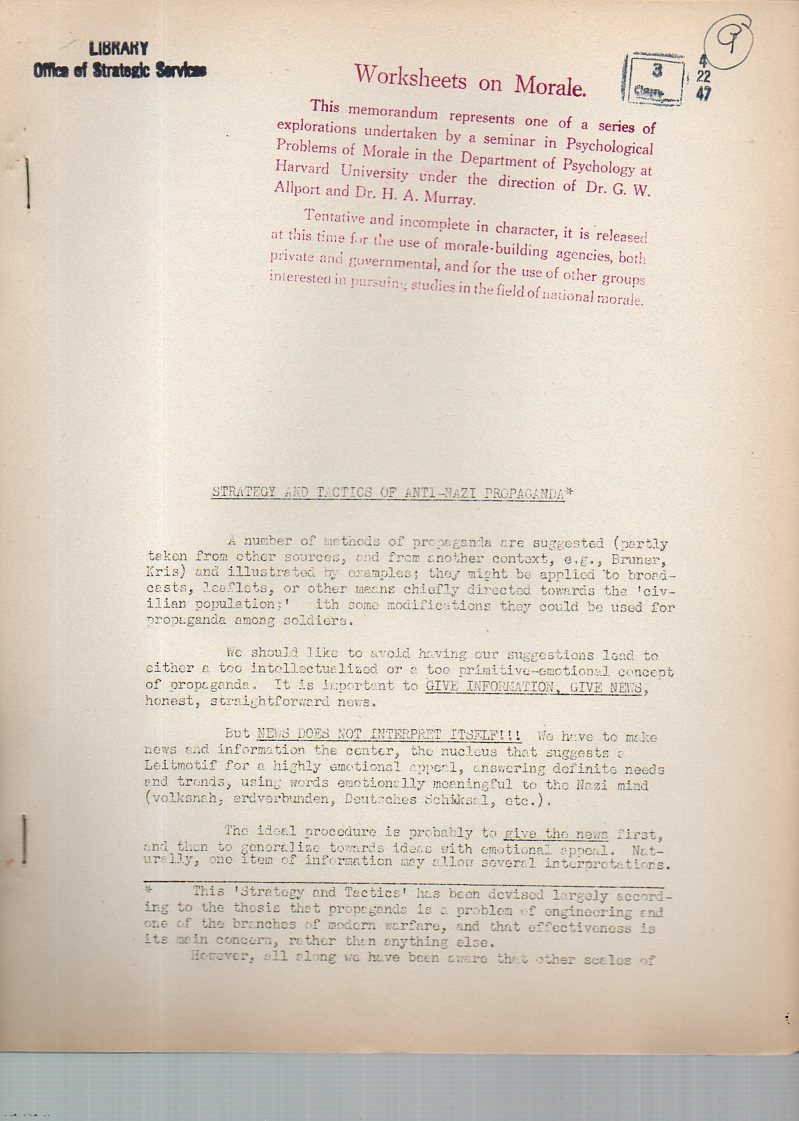
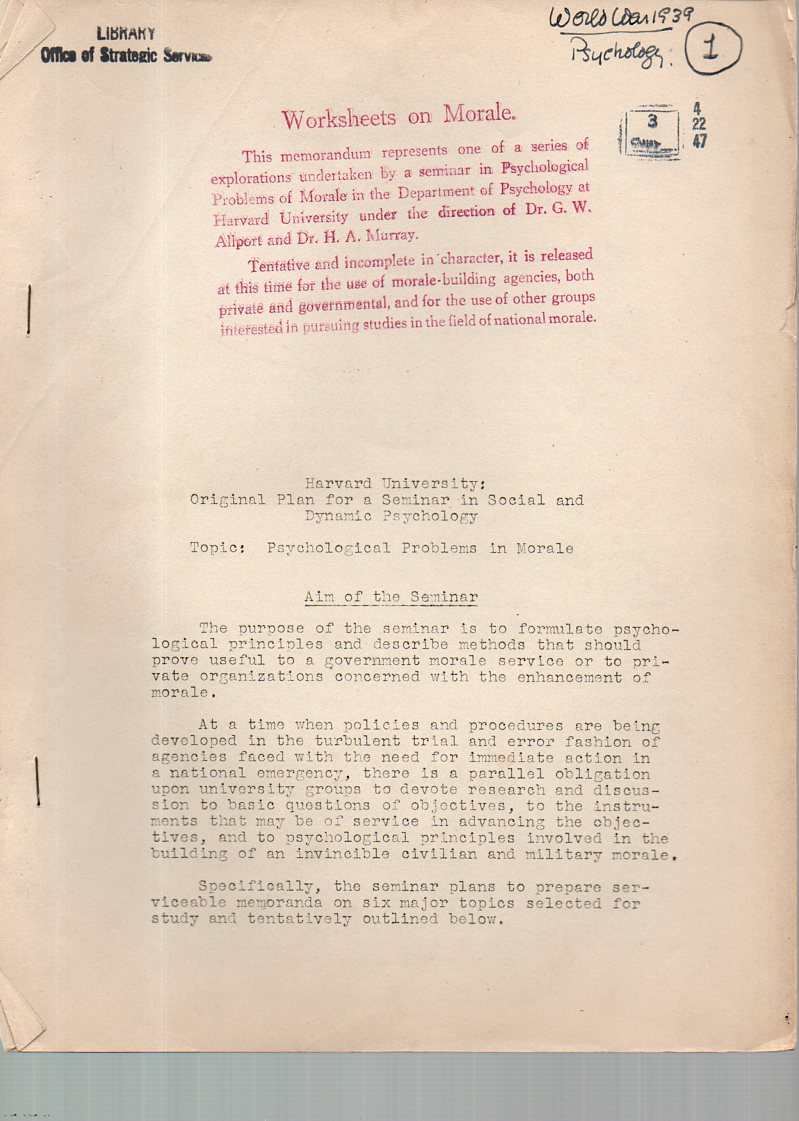
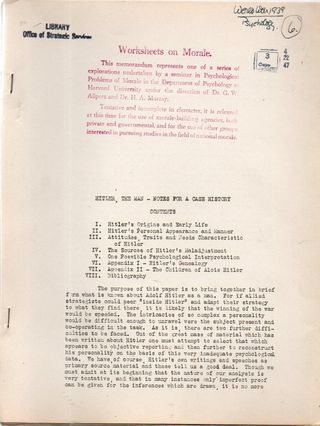
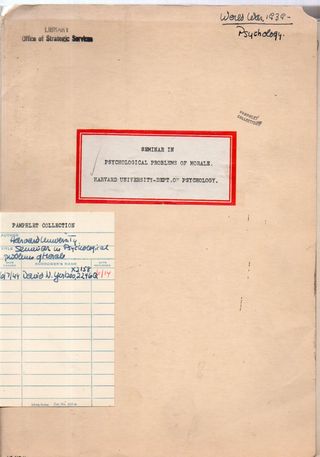
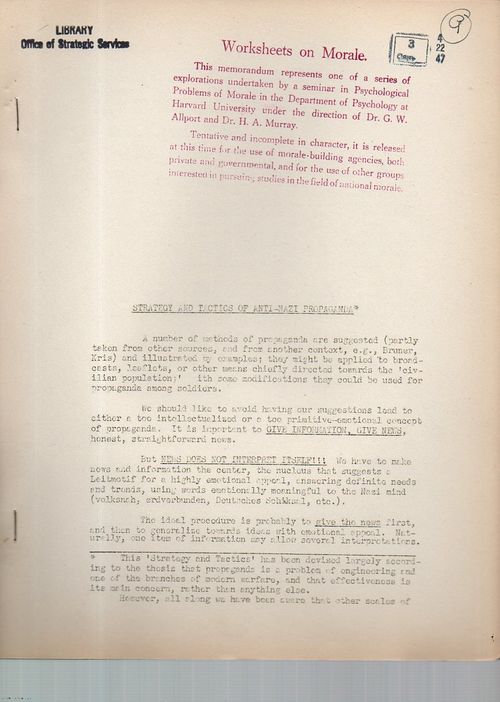
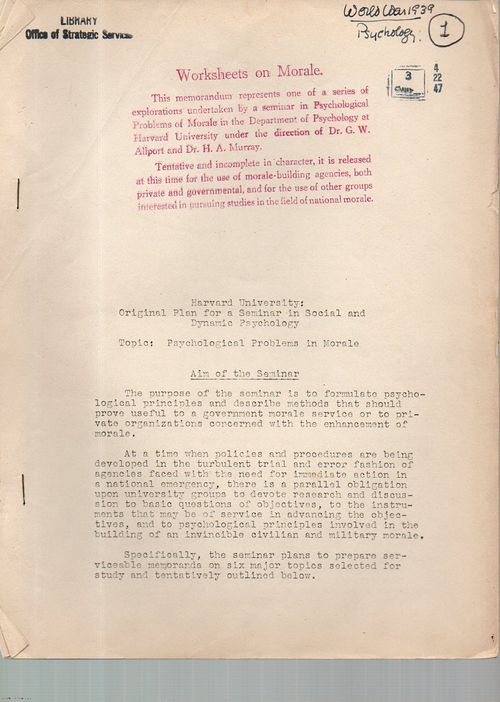
    Then there’s this–a profesisonal production but still of very limited distribution, at least in this format,  a work produced at the Harvard University Department of Psychology by Henry A. Murray (1893-1988). The Worksheets on Morale. Seminar in Psychological Problems of Morale  was published in 1942 and contains a section that turns out to be the first psychological profile of Adolf Hitler–this copy was formerly in the library of the Office of Strategic Services, the precursor and incubator of the CIA.
    Allport696

    Allport697


    The sections include: (1) Aim of Seminar, 2 lvs; (2) Selected Bibliography, 1941, 3 lvs; (3) Notes on the Definition of Morale, 3+3lvs; (4) Determinants of Good and Bad Morale, 18 lvs; (5) Historical Trends of National Socialist Ideology, 14 lvs; (6) Hitler the Man, Notes for a Case Study, 22 lvs; (7) Education in Nazi Germany, 8 lvs; (9) Strategy and Tactics for anti-Nazi propaganda, 10 lvs; (10) Democratic vs. Totalitarian Morale in Groups, 5 lvs; (11) Standards of Democratic Morale-Building in the U.S., 6 lvs; (12) Civilian Morale Building Techniques, 7pp; (13) Psychology of Influence (Education Persuasion) Applied to Morale Building in America, 16 lvs; (14) Long-term Aspects of Democratic Morale-Building, 7 lvs; (15) Analysis and Execution of Propaganda Campaigns, 18 lvs.

    The portions of this publication concerning the psychological profile of Hitler seem to pre-date the very recent re-publication of Murray’s very obscure 1943 work again published for the OSS on the psychological composition of Hitler. The date of publication of these sheets is somewhat uncertain, although there are no references dated after 1941. 

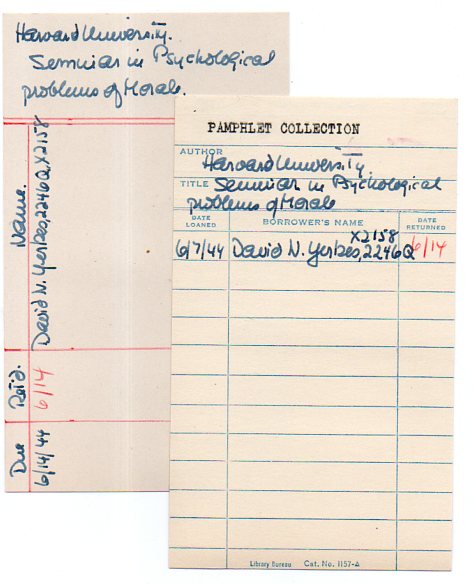
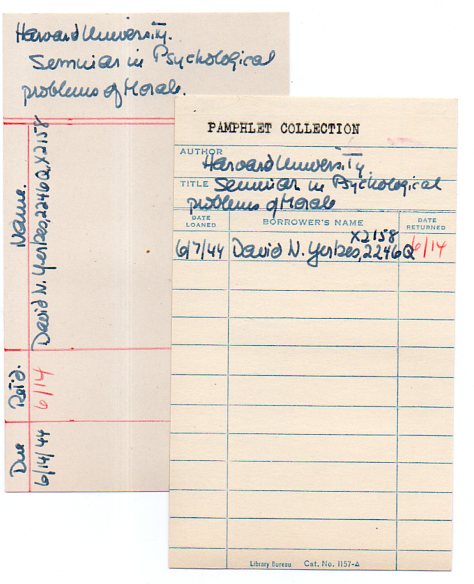
    These sheets were obviously not intended for a wide distribution. It is interesting to note the circulation card in the pocket at the rear of this work as it bears the signature of David N. Yerkes. I spoke with Mr. Yerkes about 15 years ago (he was a neighbor in Georgetown as it turns out, living about six blocks north of the store) and inquired after his interest in this work (taken out on 7 June 1944 and returned 14 June 1944). He told the story that Henry Murray was a pupil of his father’s, who was Robert Yerkes, former president of the American Psychological Association, Professor of Psychology at Harvard and innovator in the use of psychological testing and training of American servicemen during WWI.  He didn’t remember requesting or reading this report, though–after 55 years there’s probably not a lot that most people remember about what they were reading, and when, six decades earlier.
    Hitler six085

    Hitler three082

    Hitler sevewn086


    These are just a few examples of these towering minor classics that I find fantastic and fascinating.  
  • How Many Dreams Have Humans Dreamed? A Remarkable Recorded Dream from 1762

    JF Ptak Science Books   Post 2273

    The Dreamworks of Human Beings over the last 10,000 years have generally not directly survived, unless they were painted on a cave wall, or saved in the spoken tradition, or recorded in a painting, or written down as literature or poetry or religious tracts (as “visions”, say).  The work of human brains while asleep is almost entirely lost, especially so before the year 1900, when disposable writing instruments and more easily found paper supply came into being, making it possible to record personal ephemera like dreams and wishes and posie notions. A vast amount of subconscious thinking and overall brain activity is just simply disappeared.

    An off-the-cuff guessitmate is that humans have had the capacity to have dreamt 10×10^15 dreams over the present history of humanity, and before the year 1900 I’d say that .00001% of them have ever been recorded, have ever found a stable platform to be carried into the future. (It would be easier to pass a monumental camel through the eye of a nanoneedle than it would be to try and reconstruct these dreams, paraphrasing Luke 10:25 as long as we’ve got 1^15 in our sights.)  Even though the human brain spent probably 20% of its time over human history dreaming, there is almost nothing to show for it. 

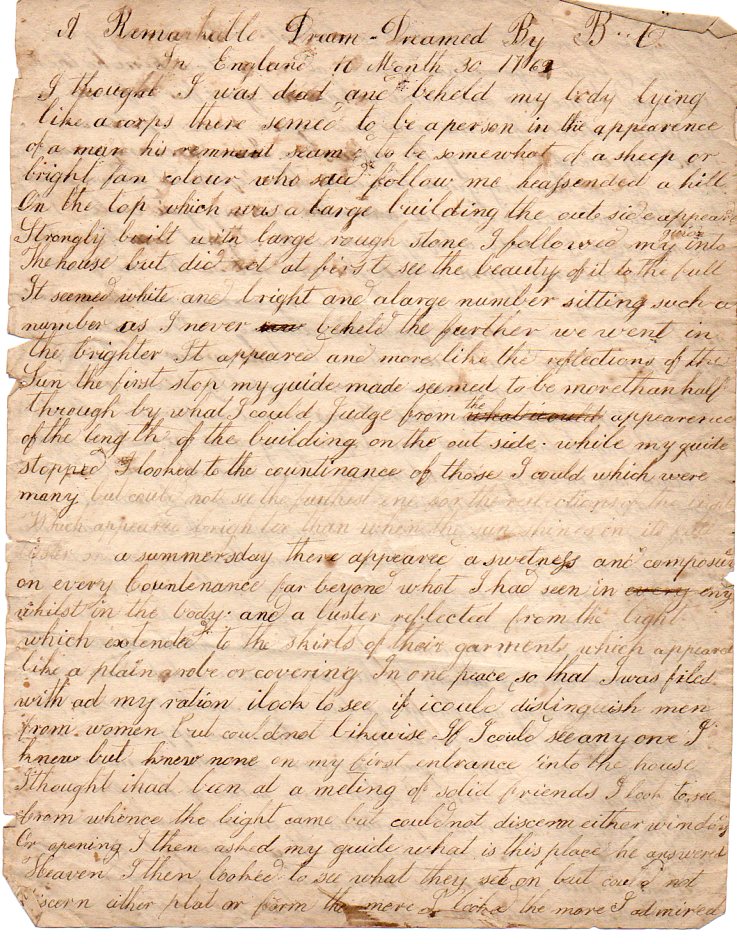
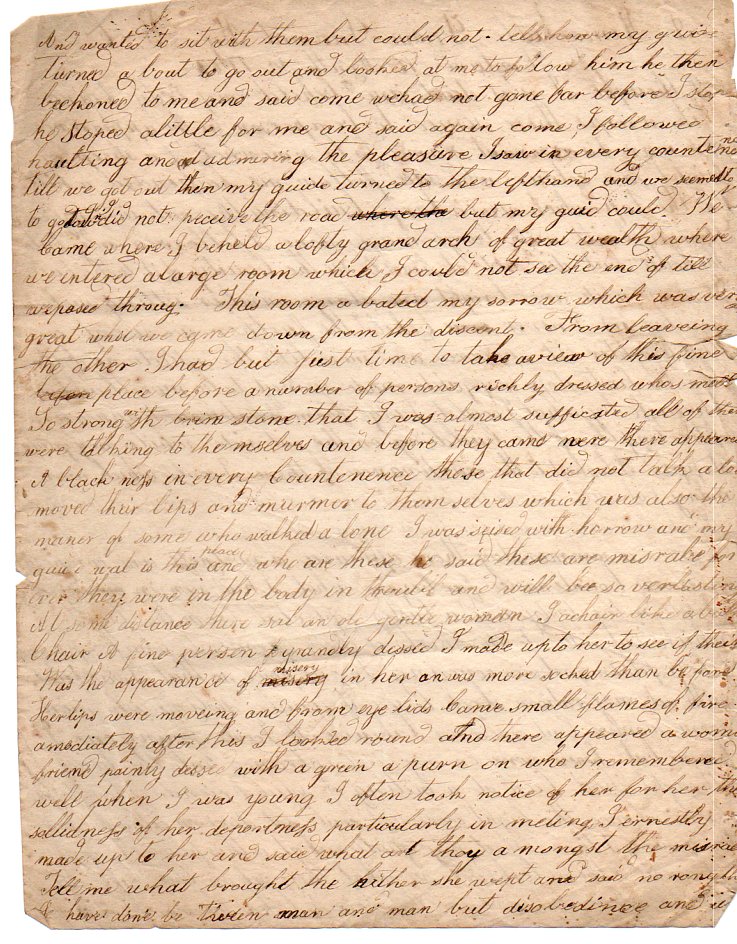
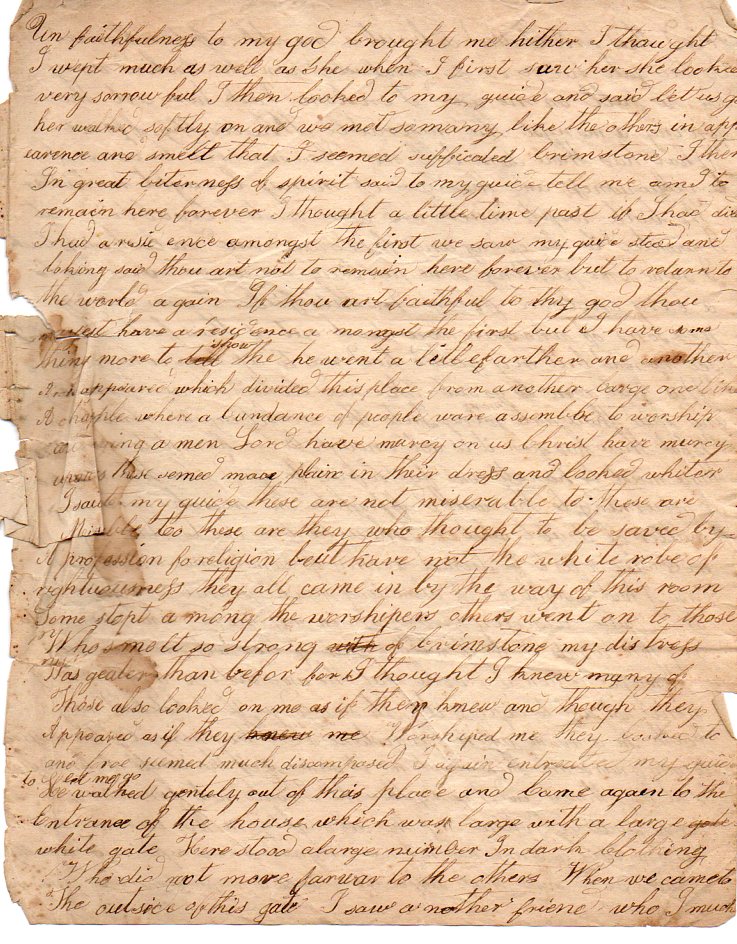
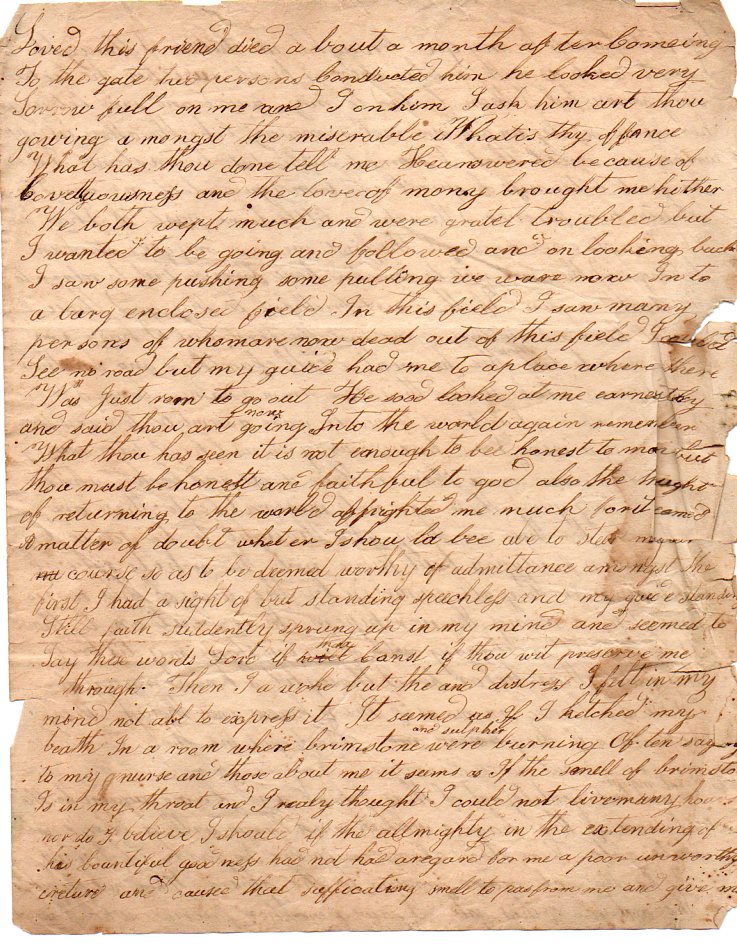
    Here’s a surviving dream, a manuscript–or rather a copy of a manuscript–called A Remarkable Dream–Dreamed by B.C. in England 10 Month 30 1762.  It is four pages of pretty densely packed recollection of a long dream, 4,000 words strong, recalling fire and brimstone visions of the Bad Land, some sights of Heaven, remarkable animals, strange happenings, and general Ecclesiastical undertones.  One unusual thing–there is mention of color, which seems not to be common in dreams in general.

    Dream--remarkable 1945 

    I’ve found several examples of this dream/story, copied by different hands over the decades–it seems to have been a somewhat popular account, transcribed by (young?) folks as a part of a lesson, perhaps with a Quaker-related bearing (?). 

    This manuscript copy (available for purchase from our blog bookstore) was made in the very early 19th century, 1800-1820 or thereabouts, and my guess is that it is American. 

    I’ve scanned all four pages for the eager reader.  It is a little bit of a tough go, but your eyes get used to the writing style after a while.

     Dream--remarkable 2946

    Dream--remarkable 3947

    Dream--remarkable 4948 

    ·Posted by :

    ·in:

  • New Orleans at the Top of the U.S., 1861

    JF Ptak Science Books  Quick Post

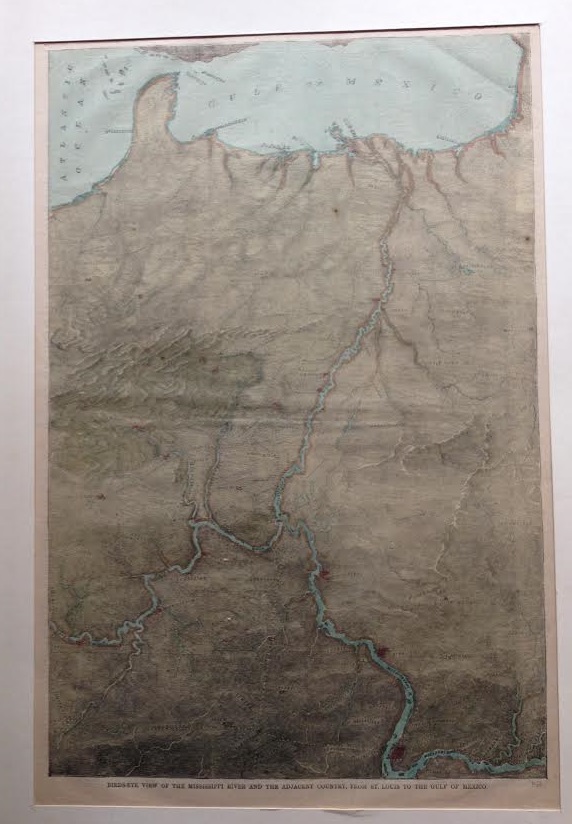
    Mississipi River

    Maps with unusual perspectives have long been interesting to me, and this map of the Mississippi River certainly fits this category.  Printed in Harper’s Weekly on July 6, 1861, and entitled “Bird’s-eye View of the Mississippi River and the adjacent Country, from St. Louis to the Gulf of Mexico” it displays the river from north-to-south, landing New Orleans at the top of the United States.  I’m not altogether certain why this perspective was used –perhaps it was just to acquaint readers with possible “western” battlefields for the brand-new Civil War, showing the terrain from a different position for the sake of running old geographic info through a news interpretative lens.  

    It displays this middle-ish section of  the country from just east of Knoxville (and almost to the mountains in which I am sitting) and then south to Charleston, and north along that same line to Vincennes and the Wabash River;  then on west to St. Louis and Rolla and south to Galveston. We can easily see the entire Florida peninsula–truncated, owing to the bird’s-eye view part. There are probably dozens of cities shown, all of which are on one railway or another. The terrain is very interestingly cut and also very useful.  And again, New Orleans sits on top of it all, perhaps to emphasize its importance in the future fight for the river and the middle of the country in the three-month-old Civil War.  

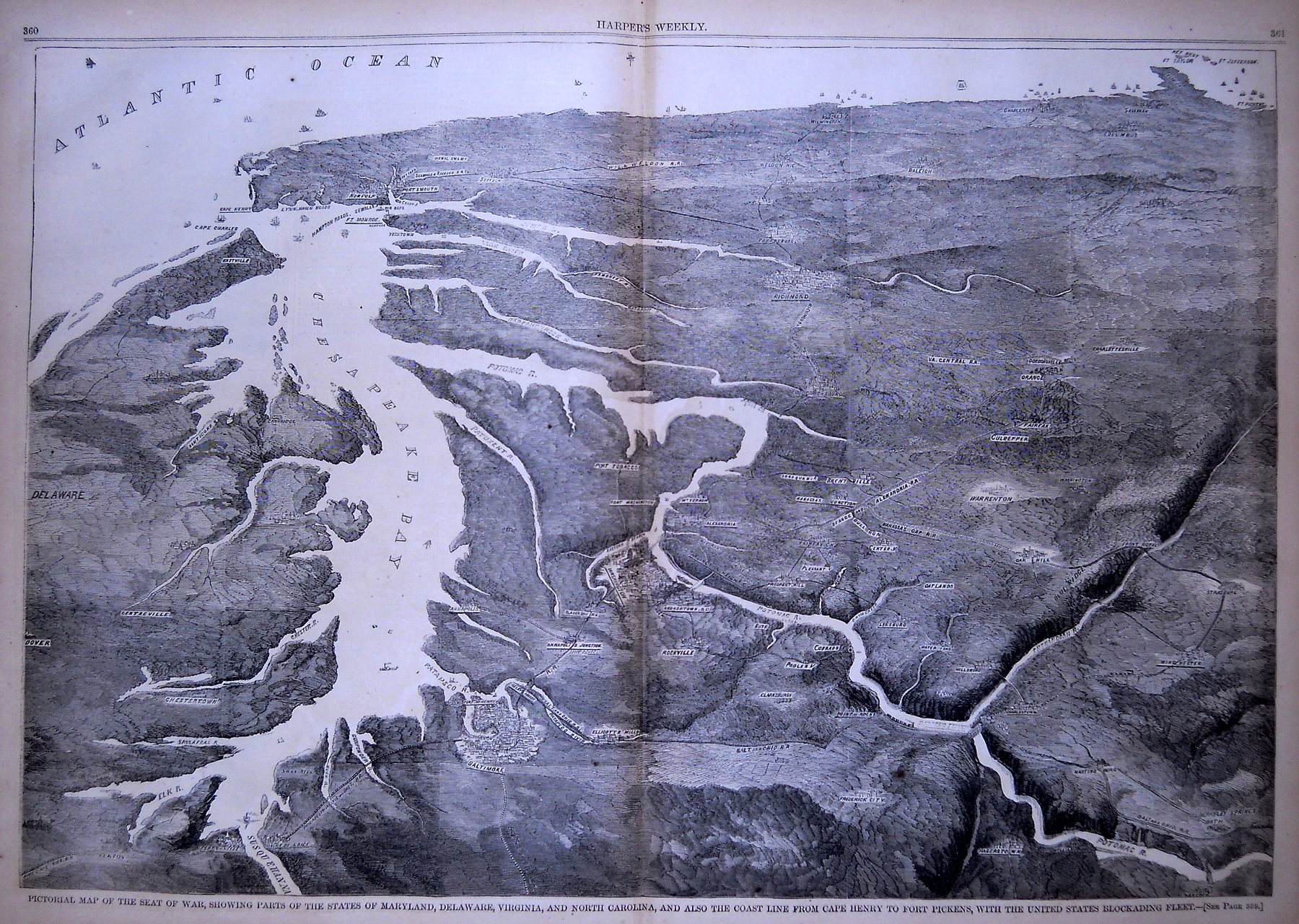
    Harper’s Weekly published several perspectives like this–for example, here’s another very creative and imaginative view of the theater of war looking southeast from high above Baltimore, and surveying the country that leads south and encompassing the entire coastline to just beyond Savannah.  It is a very interesting portrayal of the terrain, especially for the Blue Ridge, and for giving a good idea of what was on the road between Washington and Richmond.  

    Chesapeake[Image source: the Philadelphia Print Shop]


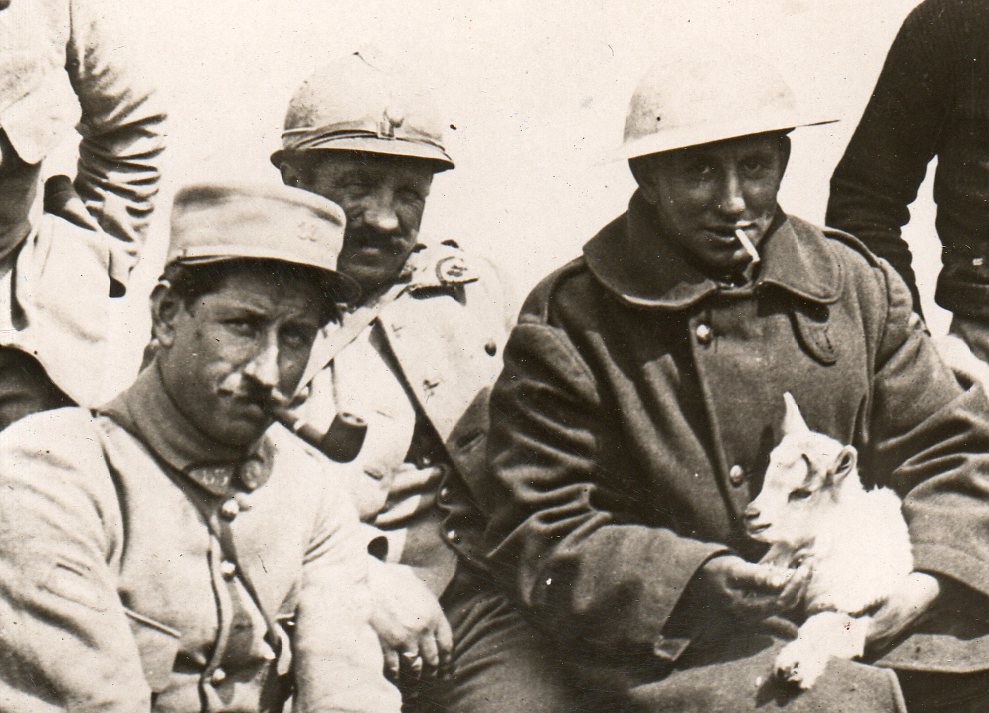
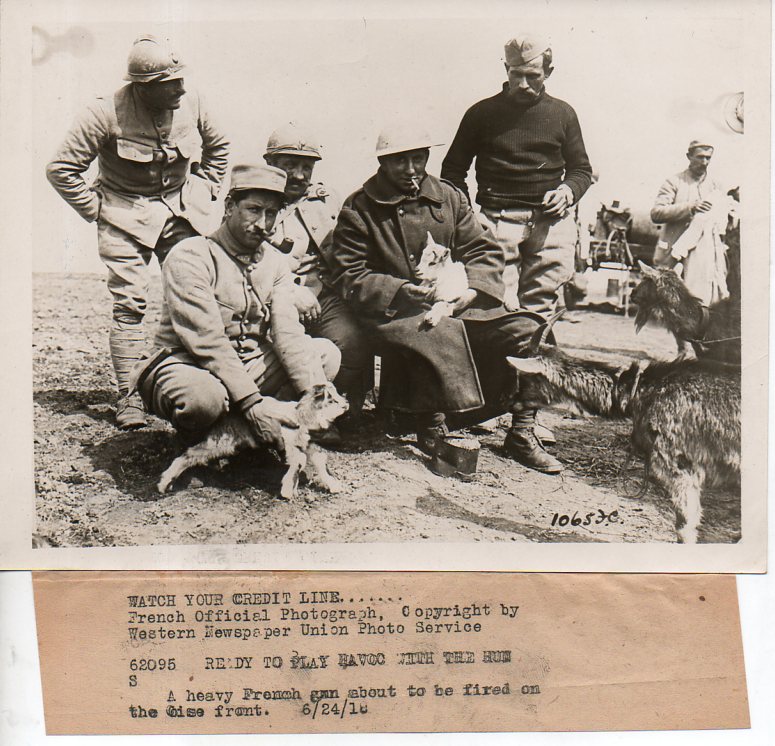
  • World War I Photography: Soldiers, Big Guns, Lambs

    JF Ptak Science Books  Quick Post 

    WWI Dogs182

    Which is a detail from:

    WWI Dogs181


    This original photograph is available for purchase via our blog bookstore, here.

    ·Posted by :

    ·in:

  • M(art)hematics (Math Art), 1806

    JF Ptak Science Books   Quick Post

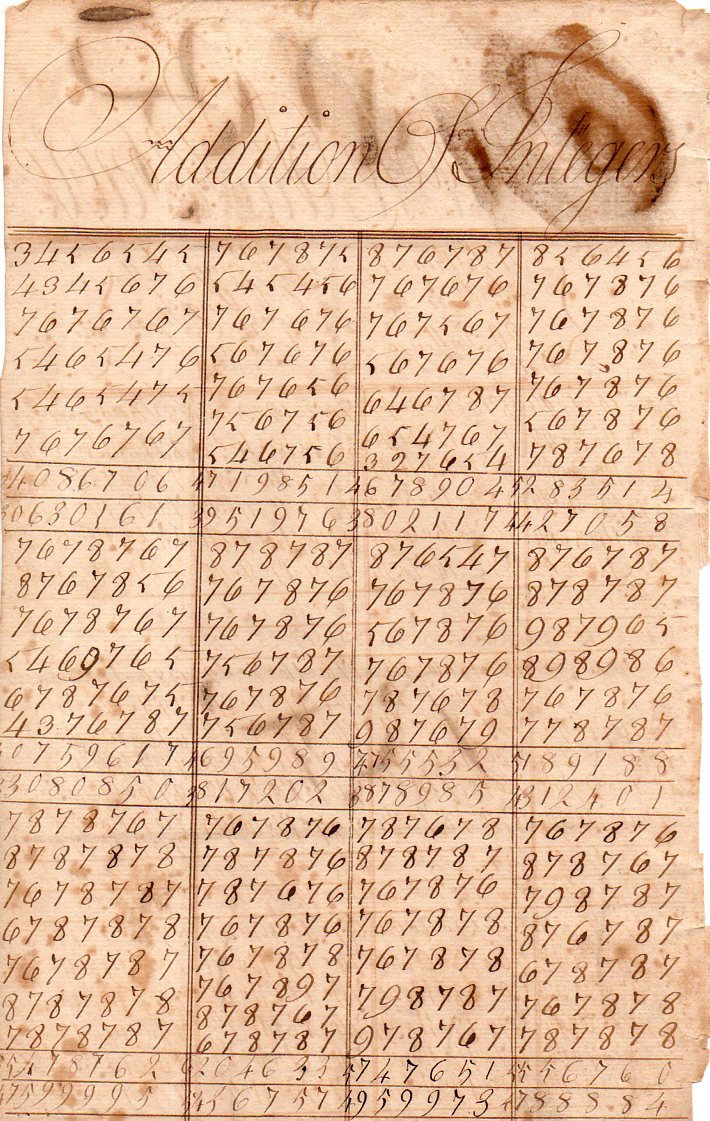
    Sometimes the rote and the routine as practice by young hands two hundred years ago can yield some surprising and beautiful results.  And so we find the beauty in these columns of arithmetic problems, practiced by a young girl in Philadelphia in 1806.  The work is determined and taken all together is just a lovely thing.  (And yes there’s a mistake here and there but it doesn’t matter, not really.)

    See also:  Mathematical Art, the End of Simple Multiplication (1814), here.

    Marthematics183

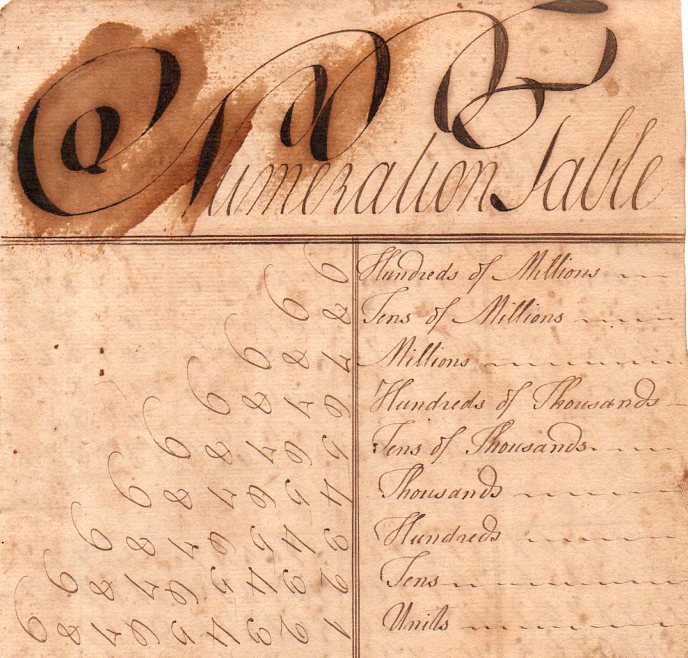
    And again in this “numeration table” where we see the 

    Marthematics184

  • Small, Compact, Unusual Comparative Heights of Mountains Map

    JF Ptak Science Books    Quick Post

    Mountains185

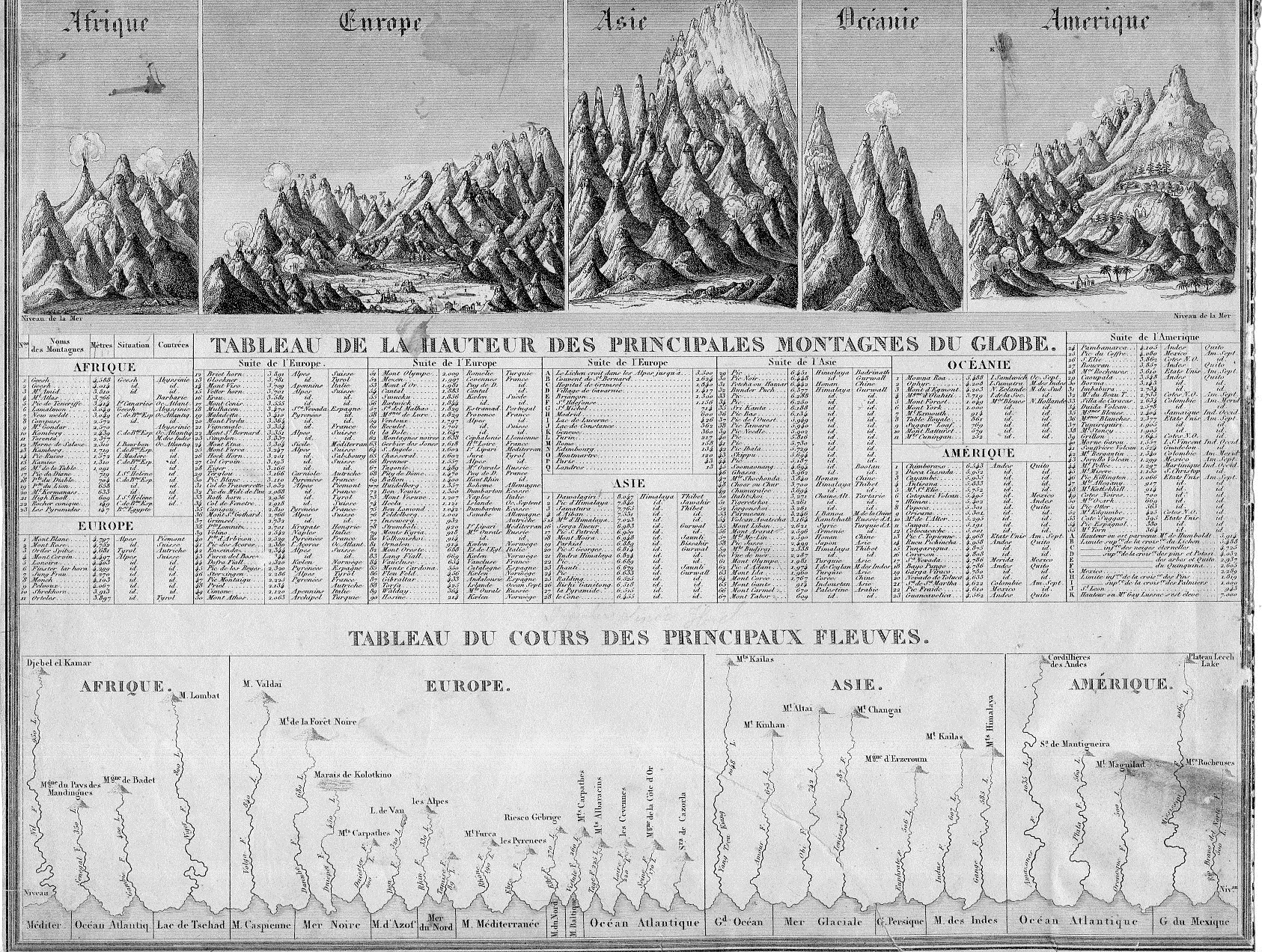
    Generally the dozens of maps/charts showing the comparative heights of mountains and lengths of rivers maps that have come through the store part of this blog have been somewhat large–or at least larger than the present example, which may be about the smallest (at about 11×8″) detailed representative of this genre that I have seen. 

    “Tableu de la Hauteur des Pricnipales Montagenes du Globe” was published in Guillemin’s Atlas universel de Geographie Ancienne et Moderne, and published by Langlume in 1845.  It is also at the beginning of the more-modern heyday for publishing maps and charts such as these.  (The practice began modestly at the end of the 18th century, came into a high tide in the 1850’s/1860’s or so, and then pretty much disappeared by the 1880’s.)

     There’s a lot of comparatively-displayed information presented on 88 square inches, including the lengths of 30 rivers and the heights of about 500 mountain peaks distributed over Africa, Europe, Asia, Oceania, and the Americas.  And for as much imagery and data there is on this sheet, the whole is very nicely designed, a real success in the display of quantitative data.  

    ·Posted by :

    ·in:

  • German Resistance, Great Britain, 1944

    JF Ptak Science Books  Quick Post

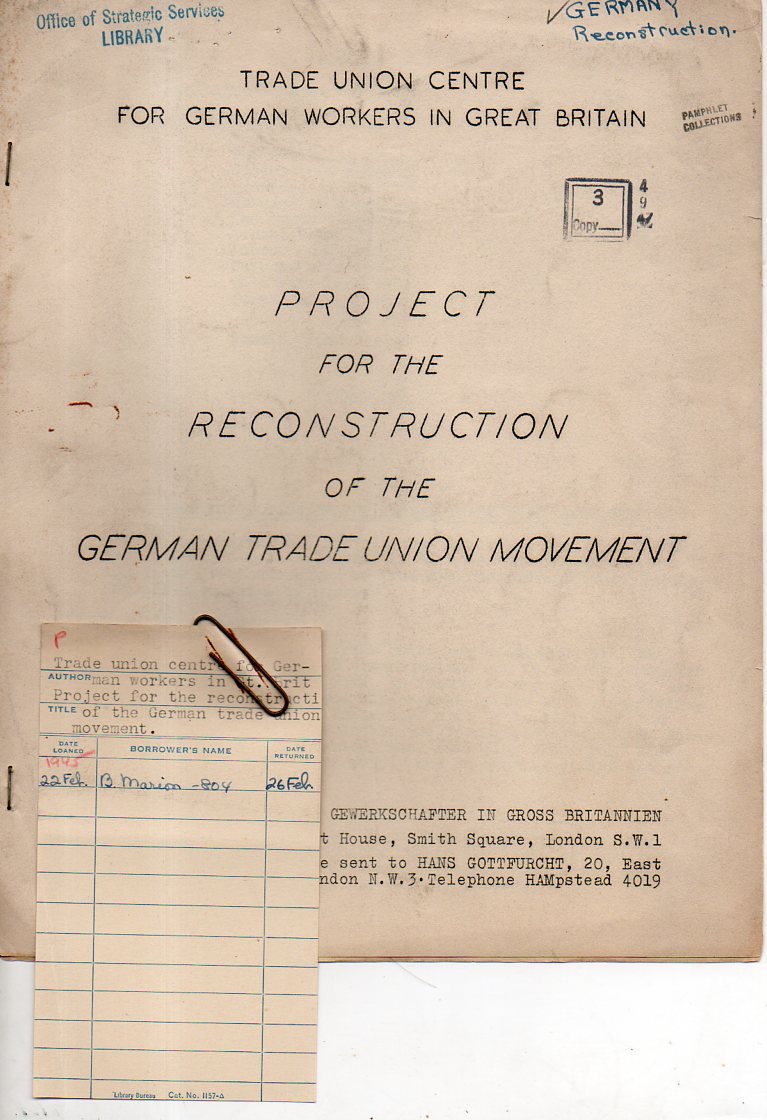
    German trade union187The Project for the Reconstruction of the German Trade Union Movement was the brainchild of the wonderfully-named Hans Gottfurcht (God Fear, Fear of God, God Fright, etc), the docuiment printed in 1944 a year after the author began the organization in London.  Gottfurcht was a major domo in the union movement in Germany and headed one of the principal national committees from 1919-1933–that is, until the Jewish Gottfurcht found himself to be at odds with the NSDAP. And also when the NSDAP outlawed trade unions.  Gottfurcht survived in Germany as an insurance agent until finally getting out in 1938.  He worked his way to England, where at the begining of teh war found himselkf interned as an enemy alien–one of those ironic cases in which anti-Nazi Germans were rounded up with thousands of other fellow Germans.  Out of detention Gottfurcht founded the Socialist Trade Union for German Wrkers in Great Britain, advocating union positions and getting ready for the state of the economy in Germany in post-Nazi Germany.  

    The pamphlet below is from my purchase of the Library of Congress “Pamphlet Collection”, and came to the LC via the library of the Office of Strategic Services (the OSS), the precursor to the CIA.  This was in the library for some time, and borrowed only once.  

    It is interesting to see how strong post-war planning was for Germany–I haven’t studied this at all but in general reading I have come across many instances like this where plans were being made on how some segment of the German nation could proceed once the war was ended and the NSDAP extinguished.  

    ·Posted by :

    ·in:

Recent Posts

Archives

Categories