A Daily History of Holes, Dots, Lines, Science, History, Math, Physics, Art, the Unintentional Absurd, Architecture, Maps, Data Visualization, Blank and Missing Things, and so on. |1.6 million words, 7500 images, 4.9 million hits| Press & appearances in The Times, Le Figaro, Mensa, The Economist, The Guardian, Discovery News, Slate, Le Monde, Sci American Blogs, Le Pont, and many other places… 5000+ total posts since 2008.

  • A Short Notice on Some Short but Very Important Flights–the Wrights, 1902

    JF Ptak Science Books    Post 2823
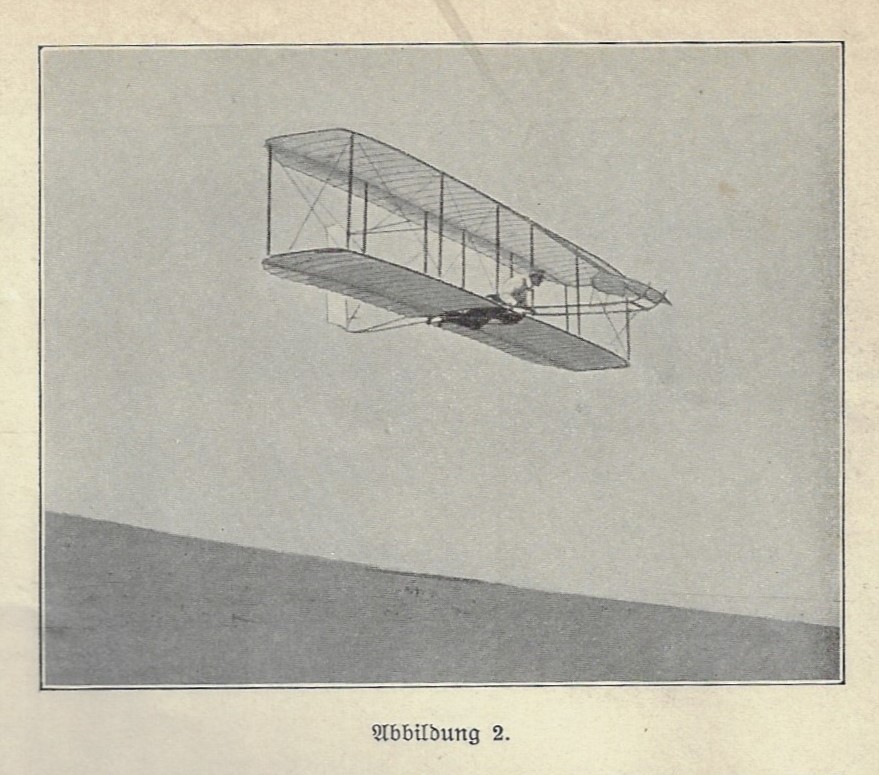

    Illus Zeit 1902 wright bros

    Here’s an interesting piece of reporting by (Professor) Raimund Nimfuhr (Czech, 1874-1954) on the Wright brothers gliding experiments in late September/October 1902.  The two men transported their 1902 aircraft to Kill Devil Hills near Kitty Hawk , N.C., and carried out between 700 and 1000 gliding tests, with great success. This story on their efforts appeared a few months later on 5 March 1903 in the Illustrirte Zeitung (Leipzig), with an unusual accompaniment of five photographs.  

    The Wright’s received very circumspect coverage during this time, what with the certain level of disbelief that accompanied early reports on flight. As it turns out when the brothers made their great and historic powered flight a year and two months later the local papers near the Wright community in Ohio gave the achievement scant notice.  The reverential Scientific American gave the Wright flight an inside notice—it wasn’t front cover material for them. (The papers were a little shorted though because the results of the experiment were leaked to the local Norfolk paper, and the rest of the world got scooped.)

    In this short notice, “The latest advances in practical flying art”, Nimfuhr takes the first two paragraphs to review a bit of aviation history and to remark that “practical activity in flying has become increasingly common”, with a “feverish activity” particular to the “New World”. He states that the importance of Otto Lilienthal had not yet been recognized for what it was, with Europeans paying the price in wasted experimentation for not employing Lilienthal’s results—this he states is not the case in the New World, which has made good use of the Lilienthal experimentation.

    When he gets to the den Bruden Wright, Nimfuhr starts by saying that their 1902 glider was almost exactly like that of the second type of Octave Chanute, though he almost immediately states that the Wright machine was a “brand new, significantly improved machine”. He describes the wings and the method of controlling die gleilfluge, and then on th=o a description of some of he “700” flights they made, the longest being 189 metres (with time aloft at 26 seconds). Nimfuhr does take great care to describe the exacting control the Wrights had on the glider, which “promptly obeyed the slightest movement of the rudder”. He ends saying that the Wright glider is not the “ideal”, and that in order to fly several kilometers or into a headwind, an engine was necessary, though as things were in March 1903 the Wrights had made a “very significant advance”.
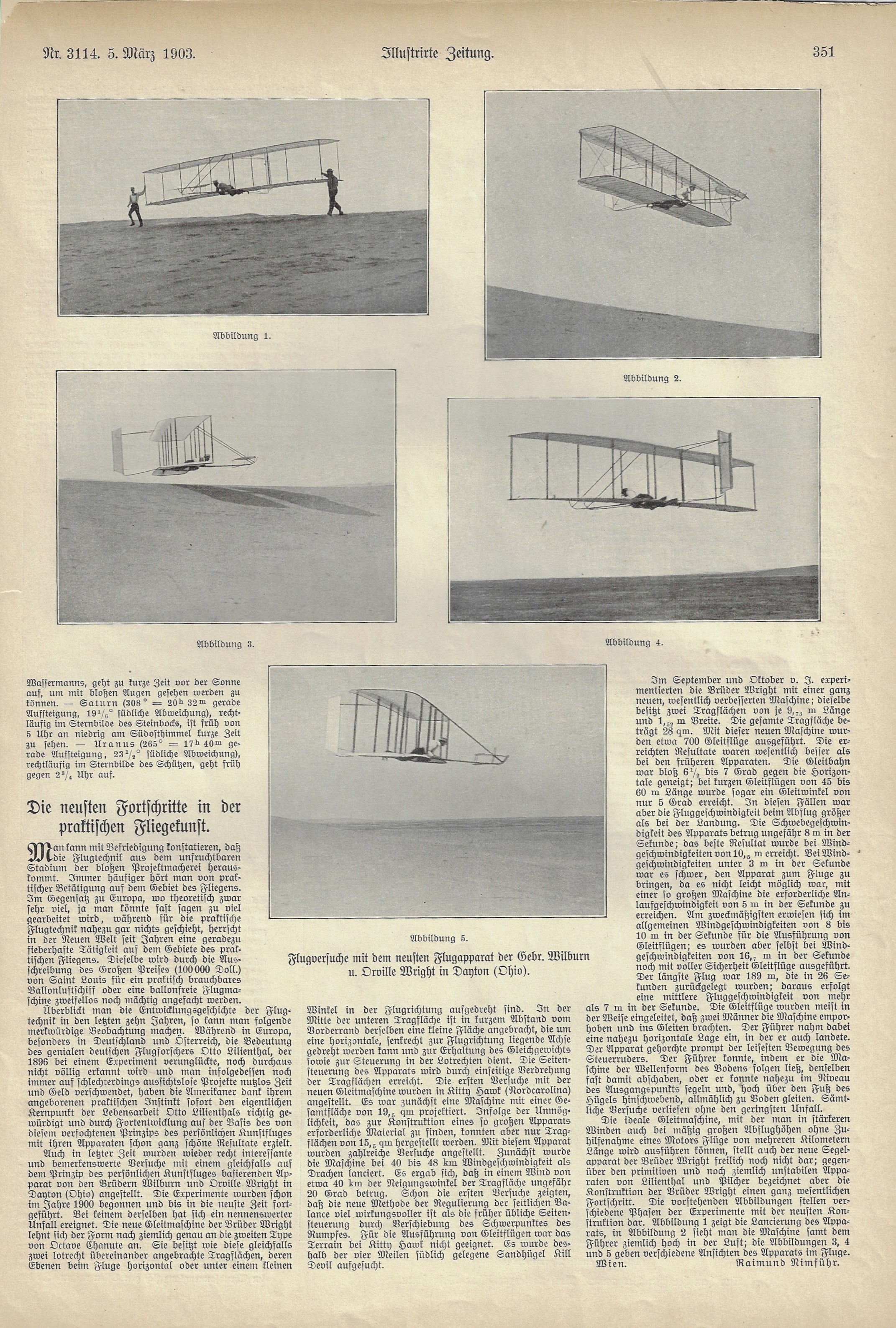

    Illus Zeit 1902 wright bros

  • A Piece of Nazi Propaganda Warning of Spies, Traitors, and Saboteurs (1938)

    JF Ptak Science Books  Quick Post

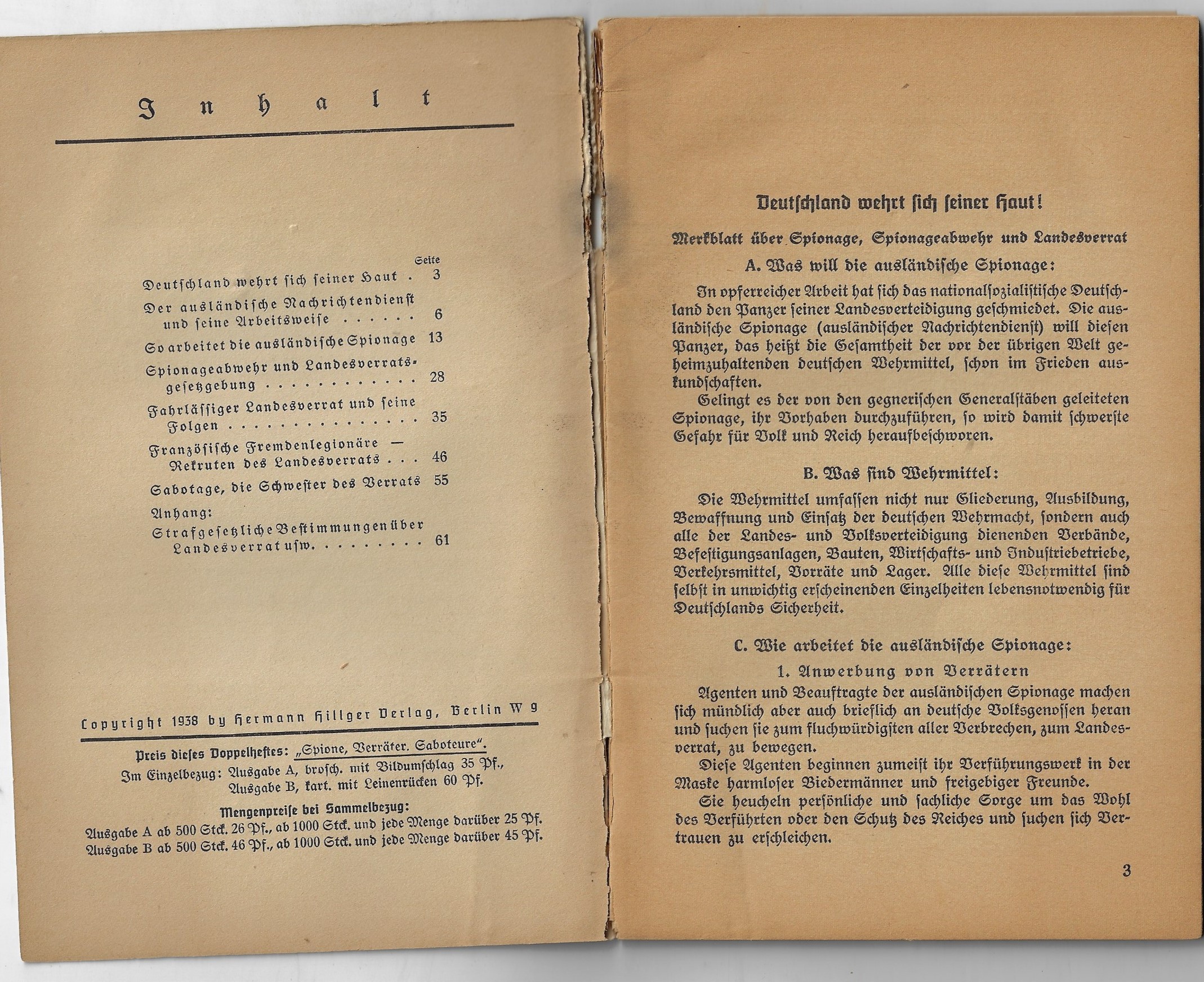
    WWII German spy coverPublished a year or so before the official beginning of the war in 1939, this piece of Nazi propaganda took aim at the people of Germany, seeming to stoke the home fires and ready folks for subterfuge and dirty tricks. Spione, Verrater, Saboteure (Spy, Traitor, Saboteur) was already in its fifth edition (whatever that means in this case), and in its 64pp it warned people about what foreign intelligence processes were like,what sort of government response and legislation might be necessary to combat foreign intrigue, and counterintelligence. It also addressed “negligent treason”(loose lips stuff) amd its consequences (severe), how traitors could be recruited in Germany, “Sabotage, the sister of treason” (“Sabotage, die Schwester des Verrats”), and then finishing off the whole lot with a bit on the recruitment of traitors (the worst of the bunch).

    It was a plea—well, demand seems more like it—telling folks that “the means of defense include not only the structure, training, arming and deployment of the German Wehrmacht, but also all associations, fortifications, buildings, commercial and industrial companies, means of transport, supplies and warehouses serving the national and national defense. All of these means of defense are vital for Germany’s security, even in unimportant details”.

    The pamphlet’s rear cover was a full page ad for a 32-page annotation of Hitler’s “Volk und Rasse” from Mein Kampf, which a reader could purchase for about a pfennig a page.

    The pamphlet makes me itch.

    WWII German spy

    ·Posted by :

    ·in:

  • A Sober Appraisal of “the Flying Saucer” (1948)

    JF Ptak Science Books  Quick Post

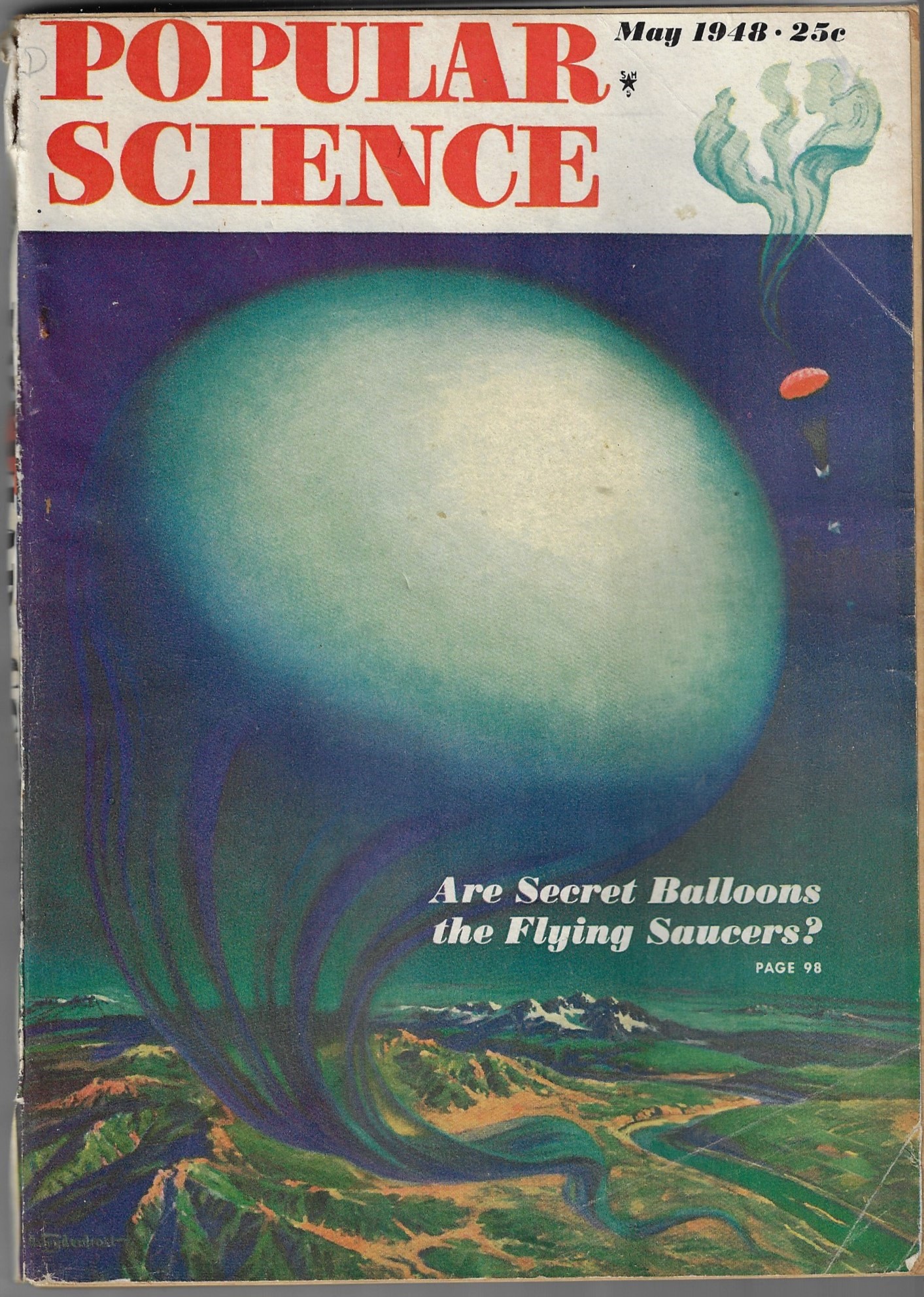
    Pop Sci 1948 flying saucersThis slightly engaging cover of Popular Science offers its readers a sober appraisal of the still very popularly new phenomenon of “the flying saucer”. Not “flying saucer” plural–”the” flying saucer phenom, complete at this point with a definite article…I have no idea when the “the” disappeared. In any event it is a pretty good explanation, though there is no mention here of “The Battle of Los Angeles”, when in 1942 aircraft batteries and searchlights blazed away into the high night air trying to stop a supposed Japanese attack. Six people on the ground were killed by shrapnel and debris, with no damage to anything flying overhead reported. There were some wild theories about what the “attack” was, along with accusations of cover-ups and political/economic conspiracies, and that seems to have been the extent of the matter. In any event, Pop Sci takes up the case of the weather balloon as a general explanation to people seeing intelligent life forms scooting around in our sky but not bothering to stop and say “hello”.

    Just in case anyone is interested, here’s the Oxford English Dictionary entry for “flying saucer”:

    –flying saucer  n. the fanciful name given to various unidentified disc- or saucer-shaped objects reported as appearing in the sky.

    • 1947   Times 8 July 4/4   During the past fortnight reports that dish-like objects, nicknamed ‘flying saucers’, have been seen travelling through the air at great speed..have come from the United States and Canada.
    • 1948   Jrnl. Brit. Interplanetary Soc. 7 199   I haven’t examined the details carefully, but the ‘flying saucers’ bear all the hall-marks of mass-suggestion.
    • 1953   D. Leslie & G. Adamski Flying Saucers have Landed i. i. 13   Ever since the cliché ‘flying saucer’ was coined, the greatest and most exciting mystery of our age has been automatically reduced to the level of a music hall joke.
    • 1965   New Society 9 Sept. 14/2   When Kenneth Arnold saw something from his airplane near Mount Rainier in June 1947, he gave them the happy name of flying saucers.
  • The Drug Menace to Japan from the U.S., 1923

    JF Ptak Science Books  Quick Post

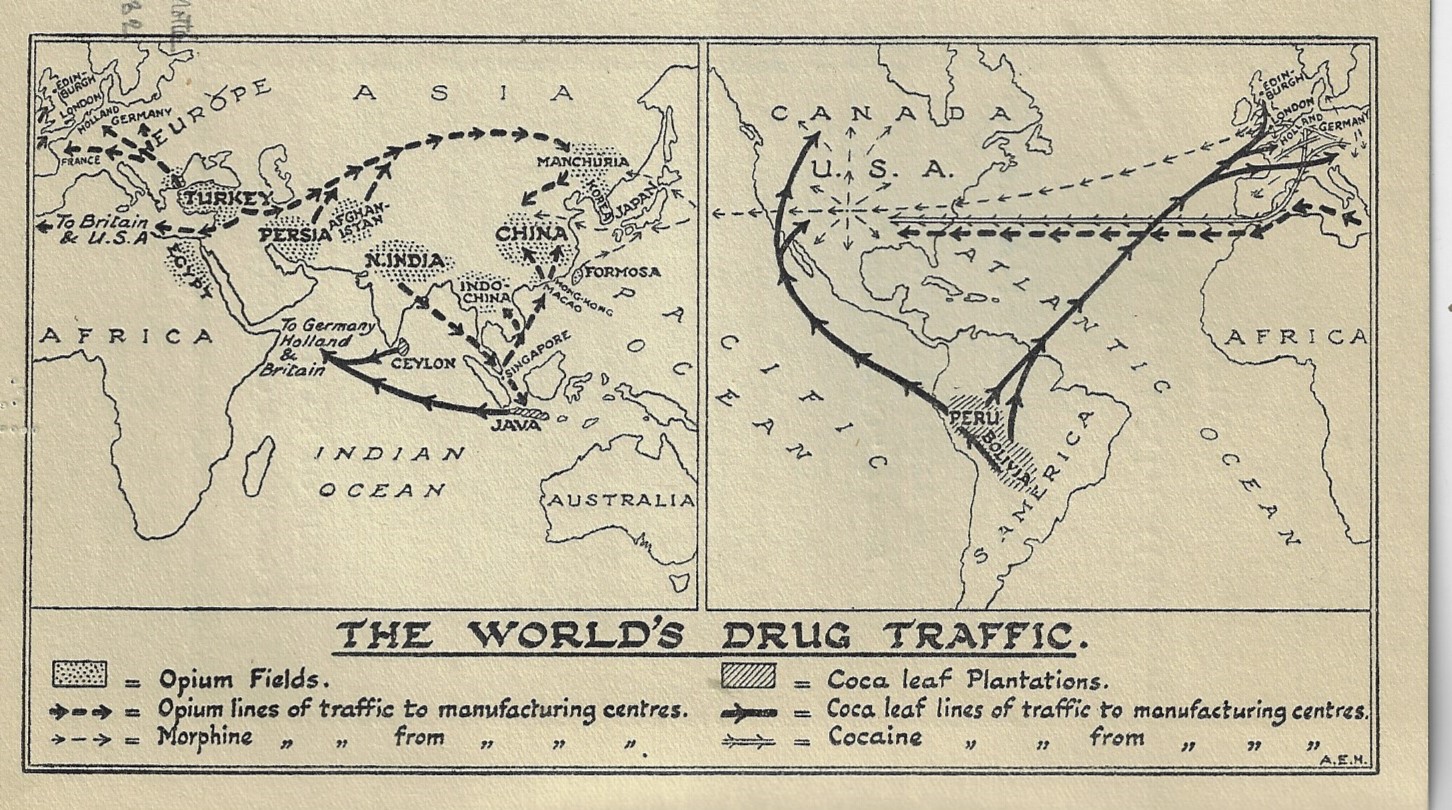
    Here’s a bit of a quick factoid on the international drug trade in 1923, taken while on a stumblethru  in Basil Mathews’ The World “Dope” Menace and the League of Nations (London, the League of Nations Union, 1923).  This is a very slim (24pp) and compact work but it does have a significant amount of dpo (data per ounce!) impact, particularly when it came to Mathews’ short sober and clinical appraisal of the amount of narcotics being smuggled and consumed in Hong Kong, China, Japan, French Indochina, Ceylon, and Mauritius.  The man has the numbers, and those numbers that struck me the most were those concerning Western shipments of morphine (and etc.) to Japan. He lists them out so, the counties’ exports to Japan: England 10,000 lbs, France 8,000 lbs, Germany 2.800 lbs, Belgium 2800 lbs, Switzerland 4400 lbs, Holland 250 lbs,  and (the big surprise for me) the USA with 18,500 lbs of nasty export. 

    World Dope menace map

    The numbers were even more brutal for the China trade, with Mathews stating “In cold literal fact men in Britain and America and Japan have grown rich by debauching of China’s morphino maniacs who are now innumerable.” And  to drive home the human aspect of the drug trade, Mathews continues: “The seriousness of morphine addiction can be understood from the opinion of an expert authority who says Morphine is not only ten times more deadly than opium but is more seductive and overwhelming in results. The addict becomes an absolute slave entirely powerless for not only are his will and moral fibre entirely rotted by the drug itself but he becomes the victim of the most dreadful tortures directly that he is robbed of his doses nervous tortures so terrible that they often drive him mad and end in death.”

    Mathews concludes that the drug trade is a major menace to the League and Nations and for international stability as a whole–he makes a pretty remarkable case for cease-and-desist back there in 1923.  

    ·Posted by :

    ·in:

  • Rhymes on the Value of Pi (1905)

    JF Ptak Science Books   Quick Post


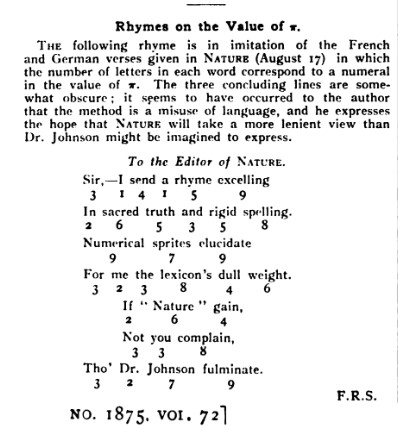
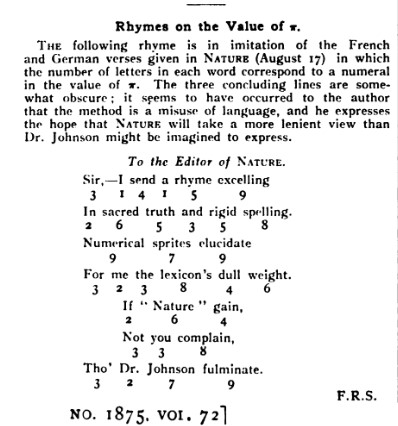
    Nature 1905 Pi rhymesHere’s an interesting little aside from the 1905 issue of Nature–the notice is a great example of what made this one of the most interesting science journals in the modern period, as they were not adverse to including some lighthearted and thoughtful pieces along with their very concise and exacting coverage of science news and discovery.  Here we see a reader contributing a poem based on the value of pi: they used the number of letters in the poem corresponding to the number in pi: so, 3.1415 meant that part of the first line had words of 3 then 1 then 4 the 1 letters/word. This is a little more difficult than it looks, and harder still I think to have something decent come of it as Haiku.


  • Plans of Major Aircraft, 1908

    JF Ptak Science Books   Quick Post    

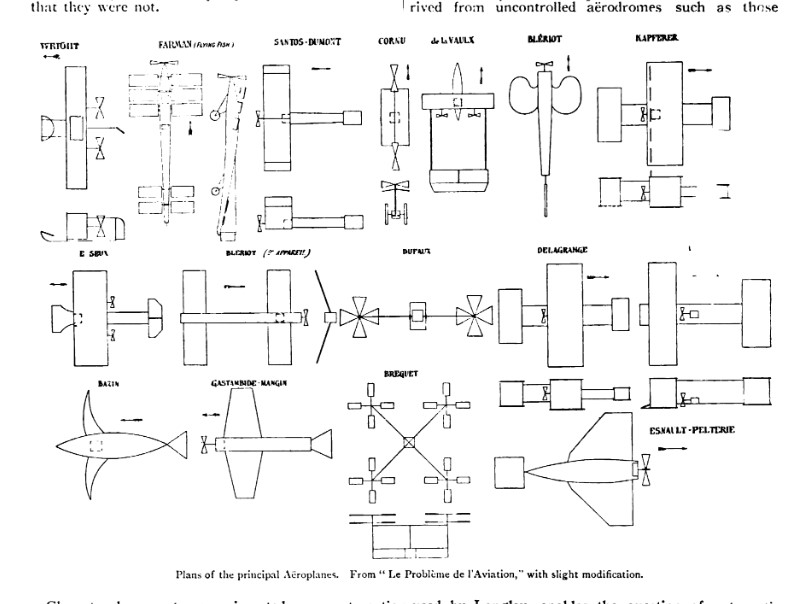
    This interesting illustrations shows the plans of 16 different aircraft and the triumph of aviation in the scant five years since the Wright brothers’ successful first powered flight in 1903.  From left-to-right and top-to-bottom the designer/builder reads: Wright, Farman, Santos Dumont, Cornu, de la Vaux, Bleriot, Apferer, Bleriot (again), Dufaux, Delagrange, Farman, Bazin, Langly, Brequet, and Esnault-Peletrie.  The image is found in Nature, 1908, vol 78, pp 668-672.

    NAture 1908 vo 78 670

    There’s a lot in this article but what I focused on was the shot across the bow to the Brits, the author taking issue with their capacities, and telling them to go and get some better maths (or someone better than them to do the thinking and work the numbers): “The recent flights show what can be done in aviation by a person possessed of skill and experience. They are a necessary factor in the development of artificial flight. The problem is quite in a different position from what it was a year ago. But if flying machines are to be made accessible to the million, the sooner English aeronauts learn mathematics or get someone to do the mathematics the better. At the present time a great deal of rubbish passes off as mathematics which is quite unworthy of the name…”


    ·Posted by :

    ·in:

  • Nature Magazine Reviews Hitler (1933)

    JF Ptak Science Books  Quick Post

    Here’s a razor-sharp summation and review of Adolf Hitler, being an uncommon appearance of that man and his “science” in Nature, volume 132, p. 198, 1933. 

    “That the Nazi leader stands self-revealed as an ill-balanced, fanatical and otherwise abnormal is immaterial. What is supremely significant is that he has come into power on a wave of popular discontent  with present day social, political and economic conditions which is sufficiently intense to submit to previously unheard of restrictions for which a “scientific” backing is advanced.”

    Nature 1935 HITLER

    ·Posted by :

    ·in:

  • The Beautiful Ephemeral: the Perfect Desktop, plus Ads for Pencils and Matches (Japan, 1955)

    JF Ptak Science Books  Quick Post (Part of the “Magnificent Mundane” series) 

    The Japan External Trade Recovery Organization’s General Merchandise of Japan was an “effort is made to introduce every category of general merchandise” being made in the country in 1955.  Ten years after the war the country was still of course recovering from its devastating defeat, though the national economy did make tremendous progress back to some sort of normalcy during that time, particularly during the ‘fifties. This is not a Sears catalog, though, as it weighs in at 110 (thick) pages plus 30 pages of advertisements. The merchandise does spread out wide, if not very deep at all, and it makes for an interesting browse to see what sorts of goods were being manufactured and sold overseas so soon after the war.  What caught my eye (following ads for tribal table art, “Japanese-style lanterns”, cigarette lights, reed organs, toys, glasses, shoes, scissors, wooden bowls, eyeglasses (two varieties), and so on were the ads for pencils. There were at least four of them, three of which are visually striking. (And speaking of that, there’s also a great ad for matches.)  On the “Pencils of Japan” page there is also a peep into perfection, showing an office desktop outfitted with goods manufactured in Japan. There’s not much, but the necessaries are there, and it is very tidy in a geo-Spartan way (and nothing like my own desk). In any event, I share the “Pencils of Japan”:
    Japan merch 1955 pencil _1_

    Japan merch 1955 pencil _1_

    ·Posted by :

    ·in:

    —
  • An Anti-Gravity Space Ship (?) of the Year 2659 (1911)

    JF Ptak Science Books  Quick Post

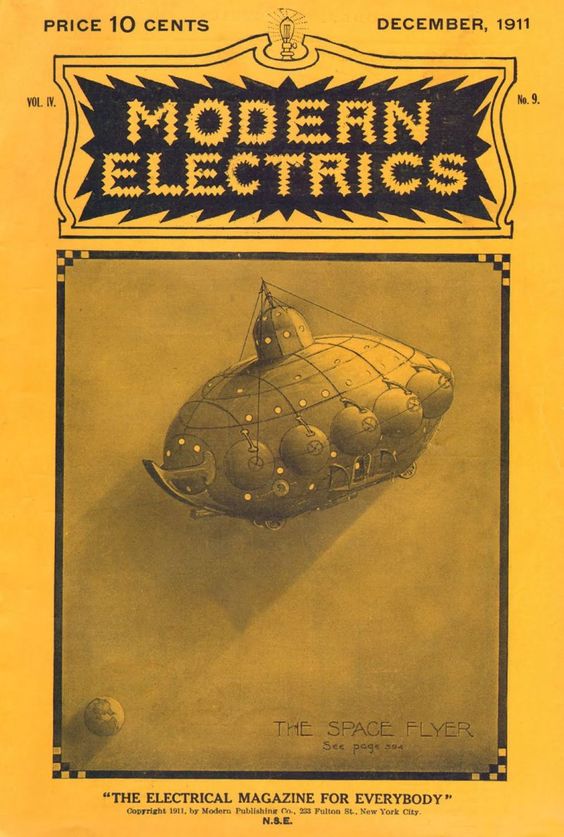
    Modern electrics 1911 _1_I was very curious about the cover illustration for the Hugo Gernsback sci fi story, “Ralph 129 C 41 +”, in Modern Electrics for December 1911 (volume 4 #9).  “129 C 41 +” was the name of a scientist who was working on the discovery by another “famous scientist” named “1246 41”–it seems that they were all involved in looking for a particular “space flyer” (first discovered by “famous scientist” 96929 in the year 2210), but then there was a kidnapped woman involved and talk of an anti-graviton antigravity engine of some sort, and then the whole thing gets a little misty. (It looks like those semi-sphere around the perimeter of the pace ship were the anti-gravity devices.)  All I really want to do here is share the cover, which I think is the best part of the story. Modern Electrics isn’t that familiar a magazine to me, but there seems to be plenty of real stuff in it, not the least of which is a pretty good article on the Bleriot flyer just a few pages after the Gernsback.  

    The entire issue is available at Hathi Trust.  


  • Atlas of the Engines–the Antoinette Aero Motor, 1908

    JF Ptak Science Books  Quick Post

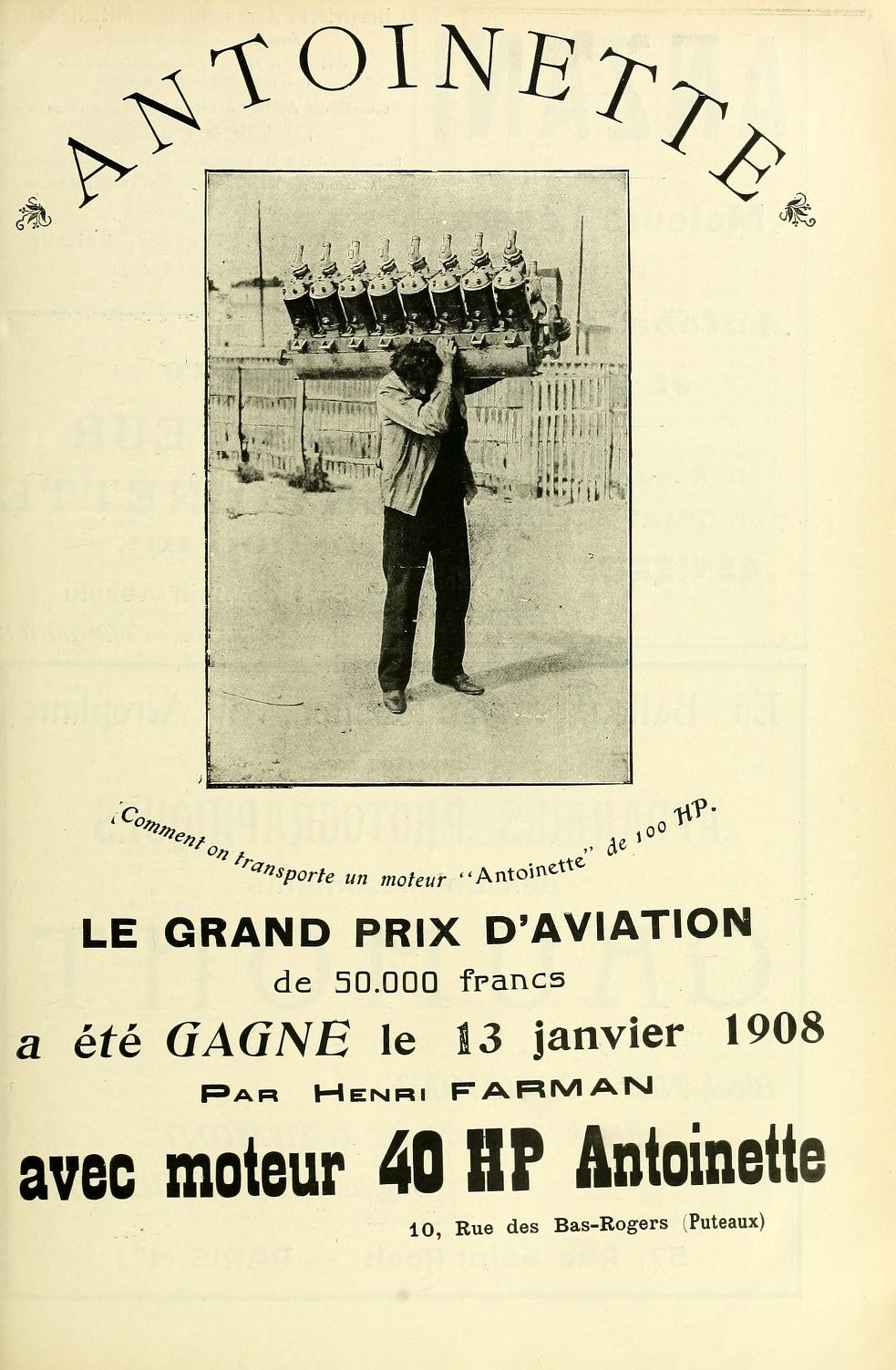
    Smithsonian aeroph antoninette 90hpI couldn’t but help to share this terrific advertisement found in the page of Aerophile magazine for 1908 (via the “Unbound” section of the Smithsonian Institution and Internet Archive. This is the famous “Antoinette” engine, designed and construction by Leon Levavasseur in an aircraft-building partnership with  Jules Gastambide (whose daughter’s name became that of the series of engines). As you can see the man supporting the engine is not having an easy time of it (assuming the guy is 5’8″ 150 lbs or so), though this was a far-advanced aircraft engine for the day, a V-16 (?) developing 100- horse (the Wright’s 1903 engine was 12hp 180lbs but did its job perfectly).  In any event this was an interesting demonstration of comparative lightness and power, delivered in January, 1908.  (I’m reasonably sure that this is not the 40hp engine of the Farman flight…)

    Source: https://archive.org/details/larophile16besa/page/28)

  • Found-Abstract Art and the Coming of the NCC-1701: the Capazza Lenticular Airship, 1909

    JF Ptak Science Books  Quick Post

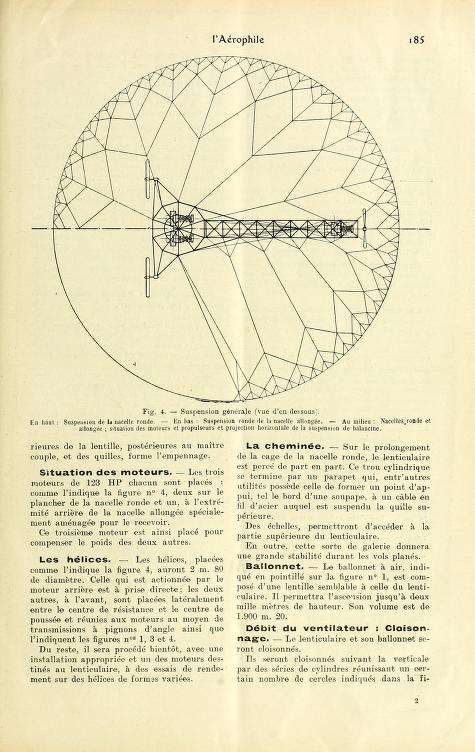
    Smithsonian Aeroph Capazza cross sectionHere’s another early aviation post, as I seem to be a little stuck this morning in the 1908-1911 period…or suitably enough down a small rabbit hole to keep me from doing my mailing duties.  This is a fascinating period with tremendous steps forward in technology taking place just five years after the first successful Wright powered flight test–it is hard to imagine the Wrights were roundly ridiculed in their efforts and worked for the most part in deep privacy; and yet here, just 1500 days or so later, there are hundreds of aeronauts and a dozen or so journals devoted to tech aspects of flight.

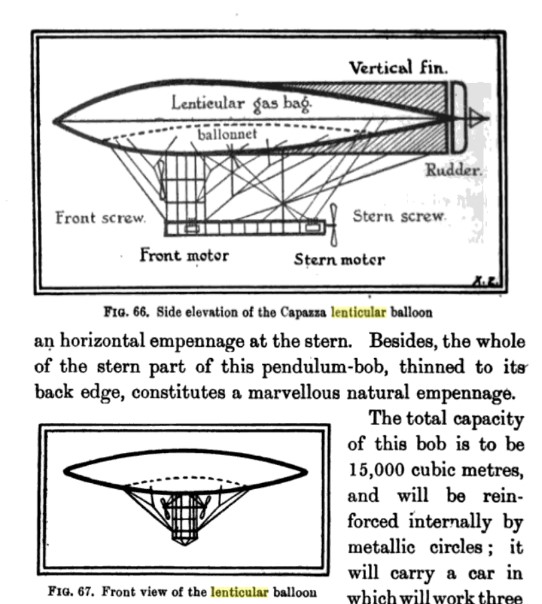
    What caught my Star Trekian eye here in this May 1908 article in l’Aerophile was the lovely found-abstract plans for supporting the envelope of Louis Capazza’s lenticular airship, a composite balloon/aircraft. The firm of Adolphe Bayard-Clement was the planned producer of the airship (they were the first to go into general production of an airplane, the Santos-Dumont Demoiselle 19) though it never was built. It was certainly intriguing–it was lighter than air, non-symmetrical, top be powered by three 120 hp engines supplying power to three screws fore and aft–it was lovely in its way, and of course given it plan and profile immediately suggests to me the Starship Enterprise, though I may be alone in that.  

    And here’s the Found-Abstract art end of the deal–the structure for the non-symmetrical support for the balloon/plane envelope:
    SMithsonian Aeroph Capazza planeur _1_ plan

    Tech info (and image source, above) see Berget, Conquest of the Air, 1909, pp 183-186. 

    Images sources (below):  https://archive.org/details/larophile16besa/page/182

Recent Posts

Archives

Categories